14 Wooden Wall Decor Ideas to Transform Your Home
Wooden wall decor is purpose-designed or purpose-selected timber artwork, panel treatment, or three-dimensional installation applied to interior walls — using wood’s natural grain, texture, warmth, and material honesty to create wall features that are simultaneously decorative and architecturally considered. This article gives you 14 genuinely creative, buildable wooden wall decor ideas that transform plain interior walls into the rooms’ most interesting surfaces, working across every aesthetic from Japandi minimalism to rustic farmhouse to contemporary maximalism.
Most wooden wall decor defaults to the mass-produced — the reclaimed wood sign with a generic phrase, the floating shelf with no design logic, the wooden letter set spelling a family name. The homes in this list make a fundamentally different choice: they apply material intelligence and compositional intention to timber in ways that make the wall read as a genuine design decision rather than a decoration layer applied after the fact. Here are 14 ideas worth saving — and building.
Why Wooden Wall Decor Works So Well
The use of timber as a decorative wall material has deep roots in multiple distinct design traditions that have converged in the contemporary interior design movement. The Japanese sukiya-zukuri tradition — the architecture of tea houses and traditional inns — established the principle of timber as a primary surface material valued for its natural grain variation, seasonal movement, and the way it records the passage of time through its aging. The Scandinavian tradition of timber-lined interiors (the panel rooms of Swedish country houses, the pine-planked walls of Norwegian hytte) established the domestic warmth principle: that a room with timber walls operates at a different psychological temperature than a plastered room of the same physical dimensions, inviting a quality of habitation that hard, reflective surfaces cannot produce. The Arts and Crafts movement of the late 19th century established the material honesty principle: that the grain, knot, and natural variation of timber are design qualities to be revealed and celebrated rather than covered and concealed.
The materials that define well-executed wooden wall decor are as varied as the design traditions that have employed timber as a wall treatment. Unfinished white oak with a wire-brush texture finish reads as Japandi and architectural; rough-sawn reclaimed pine with visible nail holes reads as farmhouse and warm; tightly grained American walnut with a clear oil finish reads as mid-century modern and sophisticated; pale ash with a bleached finish reads as coastal and light-filled. The finish applied to the timber is as important as the species — a penetrating oil finish that allows the grain to read at full depth and the surface to retain its natural matte quality is almost always more design-effective than a high-gloss lacquer that creates a plastic-like surface sheen that conflicts with the material’s natural character.
The trend reflects the broader cultural return to natural materials in residential interior design that has defined the post-pandemic period. The Biophilic Design movement — which advocates for the integration of natural materials, patterns, and processes into built environments on the basis of their documented positive effects on psychological wellbeing — has established timber as the most universally available and most aesthetically versatile biophilic material in residential design. Research published in the International Journal of Environmental Research and Public Health in 2021 found that rooms with visible timber surfaces produced measurably lower cortisol levels in occupants than comparable rooms without timber — a finding that connects the aesthetic appeal of wooden wall decor to a genuine physiological benefit that no synthetic material can replicate.
Small rooms and apartments benefit specifically from wooden wall decor because the warmth and dimensional interest of a timber wall treatment compensates for the limitations that compact spaces impose on furniture quantity and scale. A small bedroom with a single wall of timber paneling reads as more characterful and more considered than a larger bedroom with four identical plaster walls — the timber surface creates the spatial identity and visual richness that generous floor plans achieve through furniture scale and variety. The installation complexity of ideas in this list ranges from genuinely DIY-accessible (the reclaimed timber frame gallery wall, the painted wood slice arrangement) to moderately skilled (the slatted wood panel wall, the geometric marquetry art) to professionally installed (the full-height shiplap feature wall, the integrated timber and lighting system).
Style at a Glance
| Element | Detail |
|---|---|
| Philosophy | Timber brings the outside in — its grain, warmth, and natural variation create spatial qualities that painted walls cannot produce |
| Key Materials | White oak, reclaimed pine, American walnut, ash, cedar, plywood, MDF with oak veneer, driftwood |
| Color Palette | Natural timber warm, pale ash grey, deep walnut brown, bleached pine ivory, charred black cedar, aged silver driftwood |
14 Wooden Wall Decor Ideas
1. Full-Height Slatted Wood Panel Feature Wall
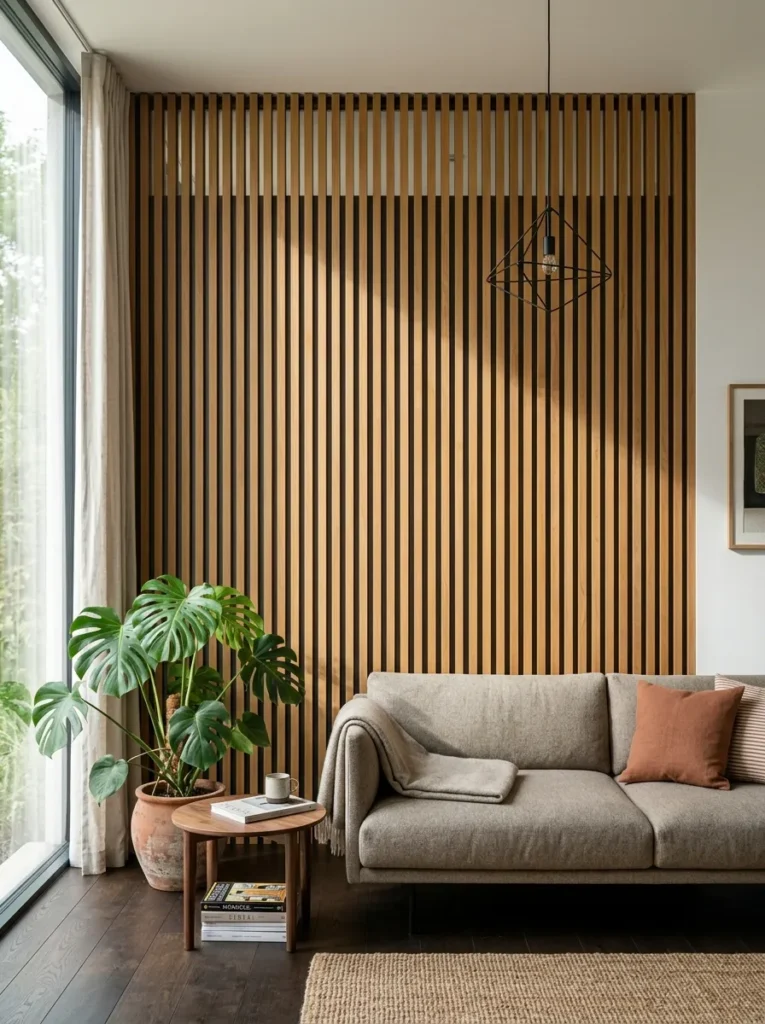
Vibe: Warm and architectural — the wall treatment that makes the room feel like it was designed by an architect rather than decorated by a homeowner.
Why it works: The full-height slatted timber panel wall is the wooden wall decor idea with the highest architectural impact per installation effort — it converts a plain plaster wall into a three-dimensional surface with genuine depth, shadow, and material richness through the simple principle of vertical rhythm. The shadow lines between the slats are as important as the slats themselves: at 15mm gap width, the shadow creates a visual rhythm that reads as a surface with depth rather than a flat panel. The charcoal grey wall painted behind the slat front face — visible through the gaps — creates a color contrast that amplifies the three-dimensional quality and prevents the wall from reading as a flat timber surface. The 40mm slat width at 15mm gaps is the proportional system that produces the most refined visual rhythm — wider slats or narrower gaps read as commercial acoustic paneling rather than residential architectural detail.
How to get it: Mount a continuous 18mm MDF substrate board to the wall first (screwed into studs), paint the substrate in deep charcoal before attaching the slats — this painted background becomes the shadow colour visible through the gaps. Attach 40mm × 18mm clear-grade white oak slats using a brad nailer or construction adhesive, using a 15mm spacer block between each slat to maintain the gap consistency. Finish with a single coat of Rubio Monocoat in Pure or White to seal the oak without adding any plastic-like sheen to the surface.
Quick Win: Pre-finished white oak slat panels are available from specialist timber wall panel suppliers (Stikwood, Timberchic, and WoodUpp all produce peel-and-mount slatted systems) that eliminate the substrate and finishing work — these systems cost more per square meter than raw timber but can be installed in a single afternoon by a confident DIYer with no carpentry experience.
Shop the Look
| Product |
|---|
| White oak slat timber wall panel system |
| Rubio Monocoat timber oil finish |
| Deep charcoal wall paint |
| Low profile sofa warm greige |
| Terracotta floor planter large |
Also view: 15 Modern Wall Decal Ideas for Beautiful Bedrooms
2. Reclaimed Timber Frame Gallery Wall
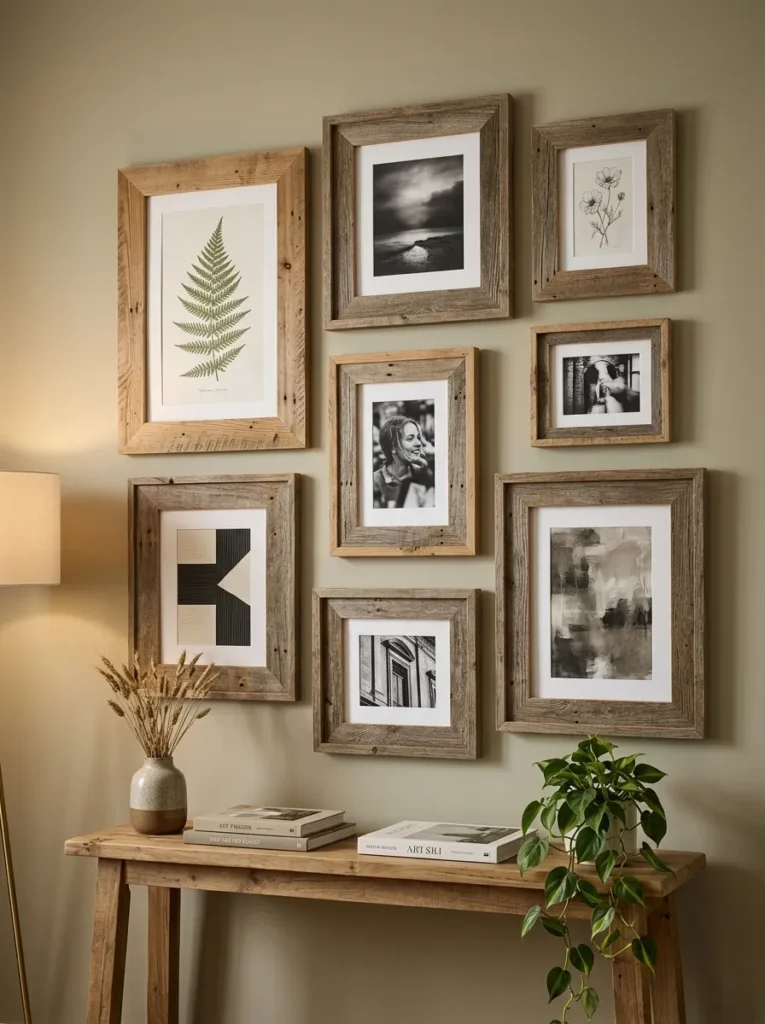
Vibe: Warm and collected — the gallery wall that looks like it took twenty years to accumulate and arrived exactly right.
Why it works: The reclaimed timber frame gallery wall elevates the standard picture gallery concept by making the frames themselves the primary material statement rather than the artwork they contain. Standard gallery walls treat the frame as a neutral carrier for the artwork — they seek frame consistency and visual invisibility to allow the art to read without interference. The reclaimed timber frame gallery inverts this logic: the weathered, rough-sawn, nail-pocked frames carry the visual narrative of the wall, and the artworks within them are the secondary element that provides color and subject variety. This inversion produces a gallery wall with a material warmth and personal character that uniform metal or painted frames cannot achieve — each frame is visually unique, and the collection of frames reads as an archive of material history.
How to get it: Build reclaimed timber frames from demolition yard pine or cedar in 50mm × 25mm rough-sawn section — the rough-sawn finish (as opposed to dressed and planed timber) retains the saw marks and surface variation that define the reclaimed aesthetic. Join corners with simple butt joints and 40mm screws rather than miter joints — the visible butt joint reads as honest and constructed rather than fine furniture joinery, which is the correct material register for this application. Do not sand or finish the frames — apply a single coat of raw linseed oil if protection against moisture is needed, but allow the natural weathering and color variation to remain visible.
Shop the Look
| Product |
|---|
| Reclaimed pine timber lengths |
| Raw linseed oil timber finish |
| Picture frame mount backing board |
| Gallery wall hanging kit level |
| Botanical print art set |
Also view: 15 Ambient Decorative Lantern Ideas You’ll Love
3. Japanese Charred Cedar Shou Sugi Ban Accent Wall
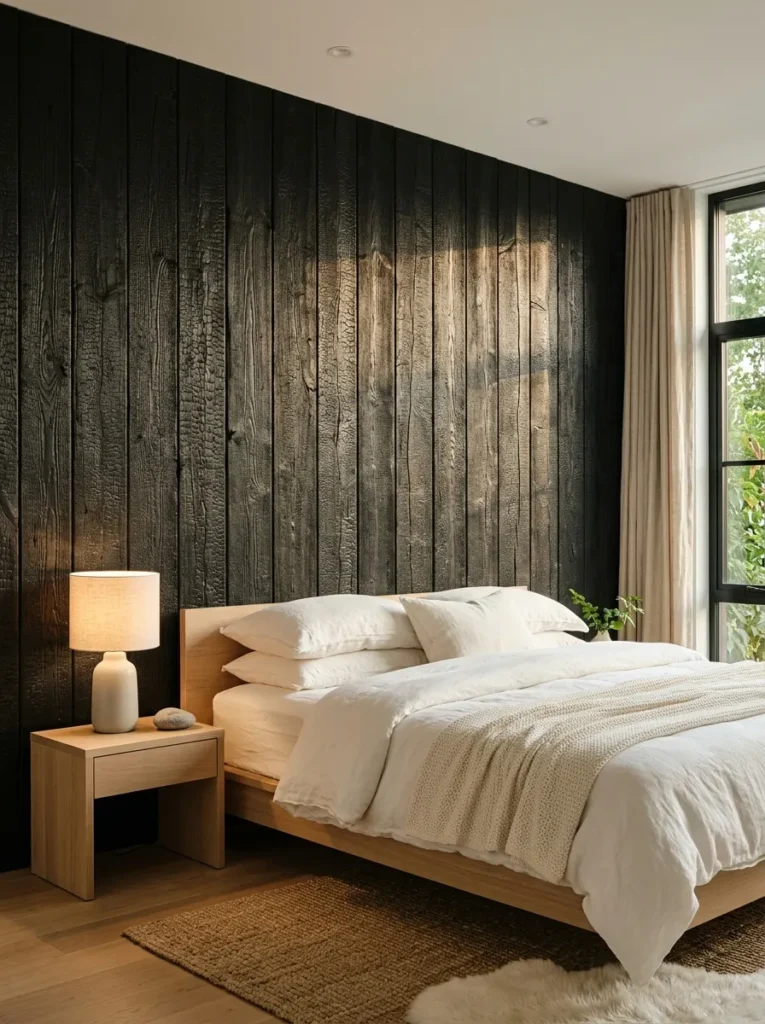
Vibe: Dramatic and warm — the accent wall that makes the rest of the room look more considered simply by existing.
Why it works: Shou Sugi Ban — the Japanese technique of charring the surface of cedar or pine timber to create a durable, pest-resistant, deeply textured surface — is the wooden wall treatment that delivers the most dramatic visual contrast per material investment in interior design. The carbonization process creates a surface texture that no manufactured product can replicate: the soft spring wood cells between the grain ridges burn more completely than the dense summer wood grain lines, producing a three-dimensional relief of carbonized valleys and darker-charred ridges that catches and deflects light at different angles as the viewer’s position changes. This dynamic light behavior at the wall surface — the way the charred cedar appears to shift between deep black and warm charcoal brown as the light changes — gives the wall a living quality that no painted or flat timber surface can produce. The deep black of the charred surface is simultaneously the most dramatic and the most space-expanding color choice for an accent wall — it recedes visually, making the room appear deeper than its actual dimensions.
How to get it: Shou Sugi Ban cedar boards are available pre-charred from specialist timber suppliers in Australia, the UK, and the US. For DIY charring: use a propane torch applied evenly across each board face until the surface chars to a consistent black depth of approximately 1–2mm, then brush with a stiff wire brush to remove loose carbon while retaining the textured grain. Seal with a diluted raw linseed oil (1:1 with mineral spirits) applied in a single coat to fix the carbon and provide moisture protection without adding any surface sheen.
Shop the Look
| Product |
|---|
| Shou sugi ban charred cedar boards |
| Propane torch DIY charring |
| Wire brush carbon removal |
| Raw linseed oil diluted finish |
| White linen bedding set king |
4. Geometric Wood Marquetry Art Panel
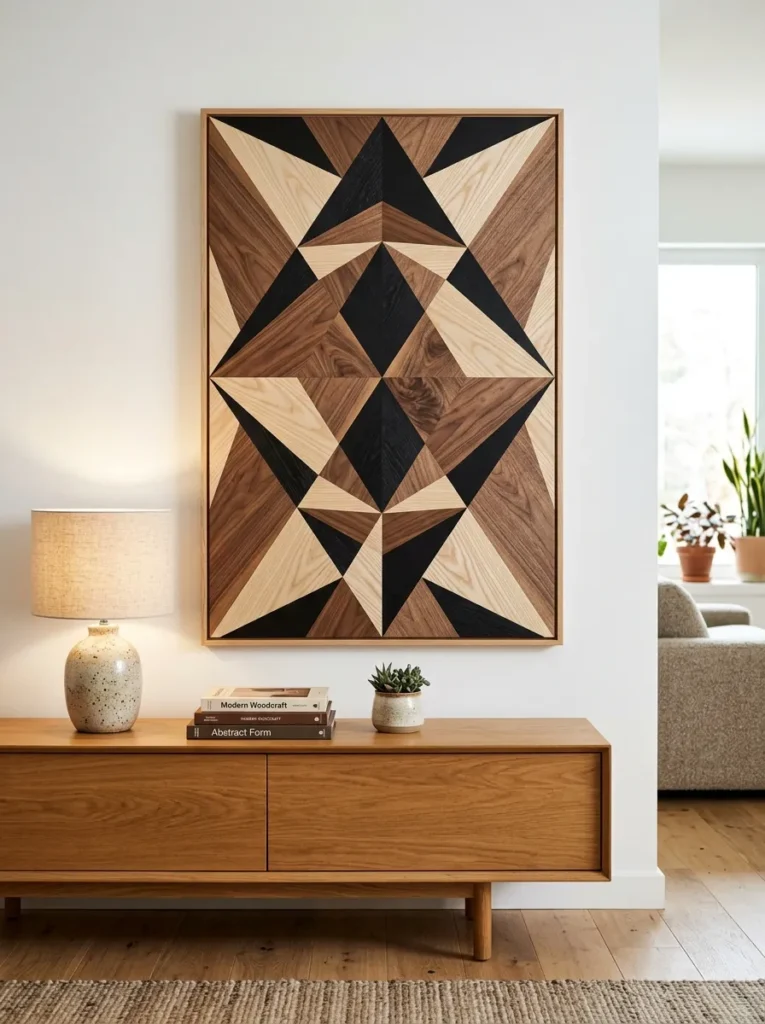
Vibe: Warm and artistic — the wall piece that makes guests lean in to understand how it was made.
Why it works: The geometric wood marquetry art panel is the wooden wall decor format that most directly occupies the space between craft object and fine art — the centuries-old marquetry tradition (the creation of surface decoration from precisely fitted timber veneer pieces) produces an object whose material richness increases the more closely it is examined, as each geometric section reveals a different timber species’ grain pattern, color, and natural character. This increasing visual reward with proximity is the quality that distinguishes a genuinely made object from a printed reproduction, and it is the quality that gives the marquetry panel its art-object status rather than its craft-object status. The geometric composition — triangles, diamonds, hexagons, and parallelograms arranged in an abstract pattern — is the correct design vocabulary for a contemporary interior because it connects the ancient craft tradition to a present-day design language without the historicism of traditional floral or figurative marquetry.
How to get it: Commission from a specialist wood marquetry artist or furniture maker (most furniture makers with joinery experience can produce a marquetry panel as a bespoke commission at $300–800 depending on complexity and size). For a DIY approach: thin timber veneers (0.6mm thickness) are available from woodworking suppliers in dozens of species — cut geometric sections using a sharp craft knife against a steel ruler on a self-healing cutting mat, and adhere to a 9mm birch ply substrate using PVA wood glue applied evenly to both surfaces.
Shop the Look
| Product |
|---|
| Timber veneer sheet set species variety |
| Birch plywood substrate 9mm |
| PVA wood glue |
| Craft knife and steel ruler |
| Slim oak frame strip |
5. Driftwood Wall Sculpture Arrangement
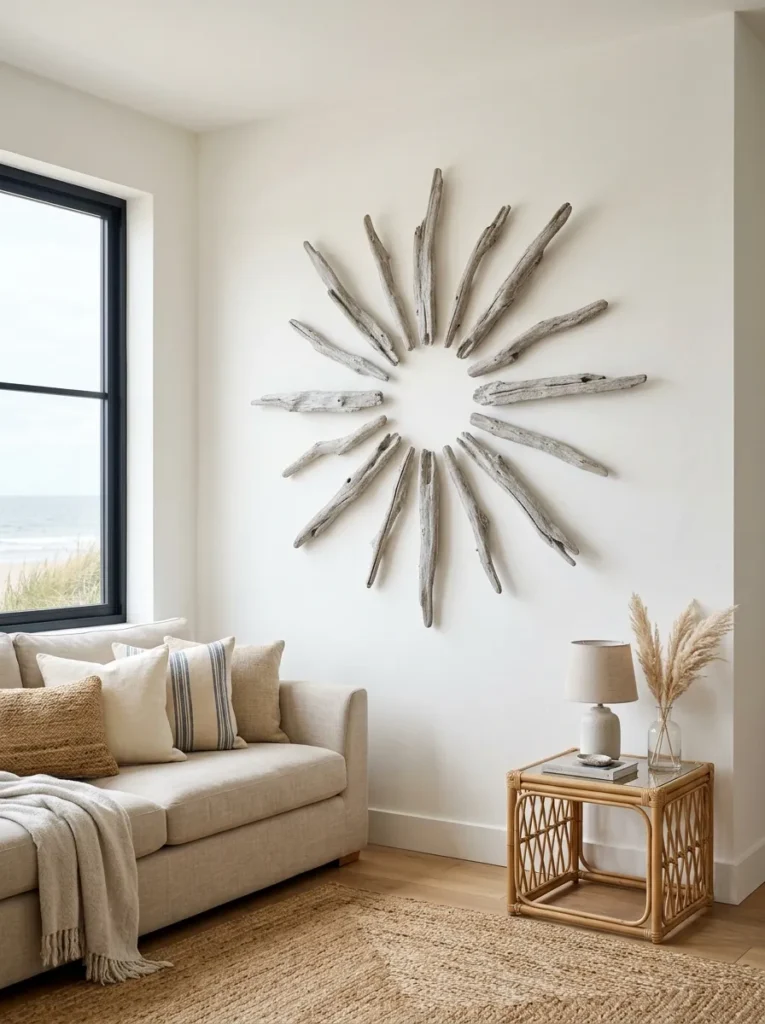
Vibe: Natural and coastal — the wall arrangement that makes the inside of the room feel as undesigned and as beautiful as a beach after a storm.
Why it works: The driftwood wall sculpture arrangement is the wooden wall decor idea that most completely demonstrates the design principle of found-material composition — the creation of a considered design object from materials that are genuinely natural, genuinely found, and genuinely unique. No two pieces of driftwood are identical in form, surface, or color, which means no two driftwood wall arrangements are identical — the arrangement is literally unrepeatable. This irreproducibility is the quality that gives a driftwood wall arrangement its design authority beyond any manufactured wall decoration: it cannot be purchased in a shop, it cannot be reproduced by a manufacturer, and its beauty is a function of natural forces (water, time, sun, salt) rather than human design decision. The sunburst or organic abstract arrangement pattern is the composition structure that transforms a collection of found objects into a wall sculpture — without a deliberate composition, the same pieces would read as a random attachment of beach finds rather than a resolved design.
How to get it: Collect driftwood from beaches, riverbanks, or woodland forest floors — pieces in the 150–600mm length range work best for a 90cm diameter wall arrangement. Allow to dry completely indoors for minimum 2 weeks before installation to prevent warping after mounting. Attach to the wall using stainless steel picture hooks or small masonry anchors depending on wall type — each piece requires its own attachment point positioned to present the piece at its most visually resolved angle.
Quick Win: Bleaching collected driftwood in a 1:10 bleach-to-water solution for 24 hours before drying unifies the color variation of pieces collected from different environments, creating a consistent pale silver-grey tone across all pieces in the arrangement that reads as designed cohesion rather than random collection.
Shop the Look
| Product |
|---|
| Driftwood pieces collected natural |
| Stainless steel picture hook set |
| Household bleach whitening solution |
| Coastal jute rug natural |
| Woven rattan side table |
6. Plywood Chevron Pattern Accent Wall
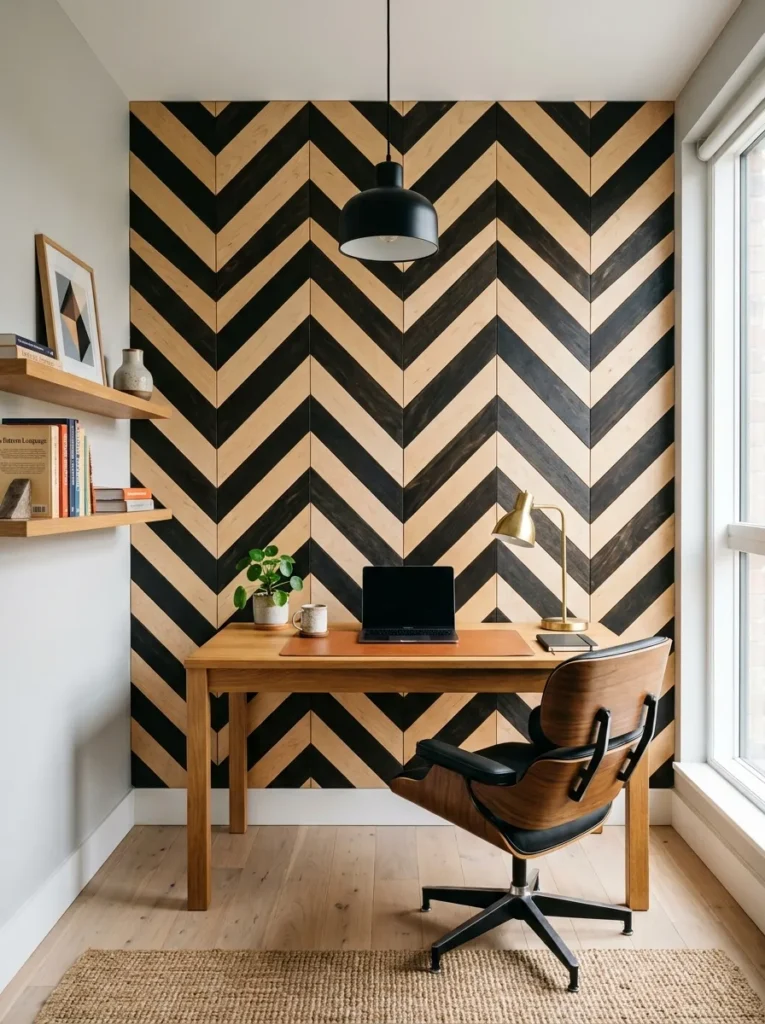
Vibe: Graphic and warm — the home office accent wall that makes working from home feel like working somewhere genuinely good.
Why it works: The plywood chevron pattern accent wall is the wooden wall decor idea that most powerfully demonstrates the design potential of a humble, inexpensive material elevated by precise cutting geometry. Plywood is architecturally mundane as a sheet material — it is the material of construction and subfloor rather than interior finish. Cut into 80mm strips at precise 45-degree angles and alternated between natural and ebonized finishes, the same material becomes a graphic, dynamic wall surface whose visual energy comes from the interaction of the pattern direction with the viewer’s position. The chevron pattern creates a V-shaped rhythm that reads as pointing upward when viewed directly and as directional movement when viewed from oblique angles — this dynamic quality makes the plywood chevron wall behave like an architectural surface rather than a decorative one.
How to get it: Cut 12mm birch plywood sheets into 80mm strips using a table saw set to exactly 45 degrees for the strip ends. Ebonize alternate strips using a black timber stain or Japan black (a traditional black oil finish) applied in two coats and allowed to cure for 48 hours before installation. Attach to the wall using construction adhesive and finish nails, building the chevron pattern from the center of the wall outward to ensure the pattern is symmetrically balanced at both wall edges.
Shop the Look
| Product |
|---|
| Birch plywood sheet 12mm |
| Japan black timber stain |
| Table saw or circular saw 45-degree |
| Construction adhesive tube |
| Timber desk natural finish |
7. Live-Edge Timber Floating Shelf Wall Display
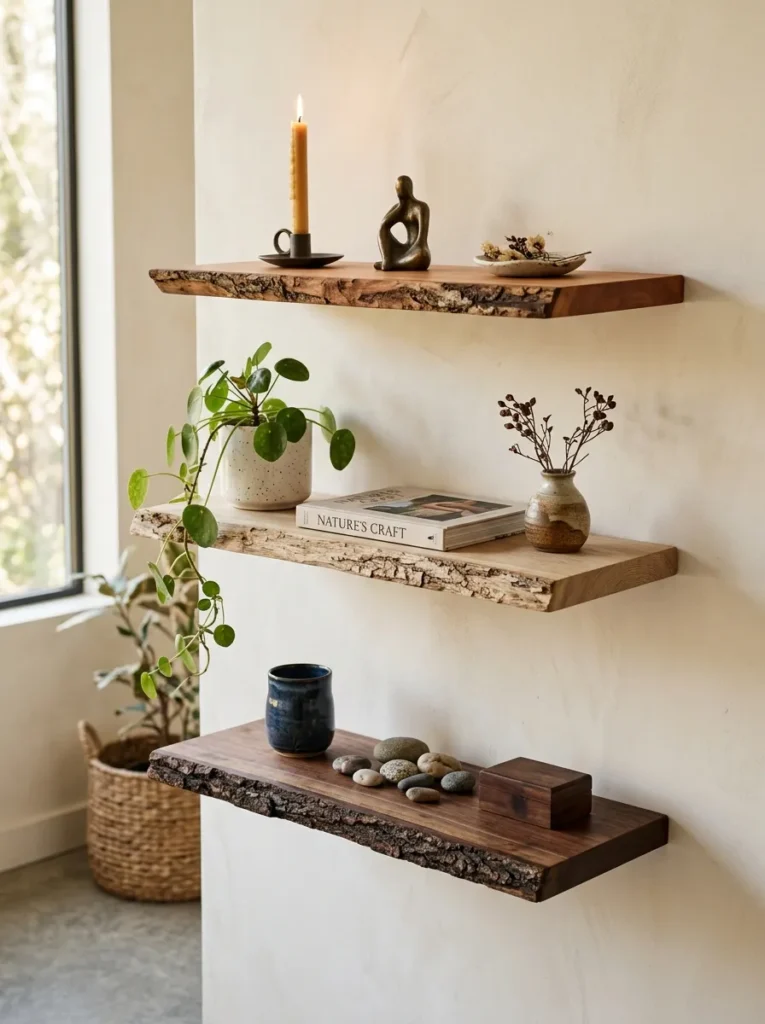
Vibe: Warm and organic — the shelf wall that looks like a cross-section of a forest condensed into a single wall arrangement.
Why it works: The live-edge timber floating shelf wall display is the wooden wall decor idea that delivers the most immediate visual impact per piece of timber — the preserved natural edge of a slab-cut timber board carries the entire design statement without requiring any additional material, pattern, or composition beyond the board’s own form. A live-edge shelf’s silhouette — the organic, irregular profile of the board’s original outer edge, with bark remnants, natural checking, and the specific profile of the tree’s growth — is as visually resolved and as personally unique as any piece of artwork, because it is a direct record of a specific living tree’s form. The three-shelf arrangement in three different species is the composition strategy that makes this a wall design rather than individual shelf installations — the visual dialogue between dark walnut, pale white oak, and warm cherry across the wall creates a species collection that reads as deliberately curated rather than randomly assembled.
How to get it: Source live-edge slabs from specialist timber merchants or sawmills that keep slab inventories — slabs suitable for shelves are typically 40–60mm thick and require machining flat on the bottom face (to provide a level mounting surface) while leaving the top face in its natural sawn condition. Mount each shelf using a floating shelf bracket recessed within the slab’s thickness — the bracket should be completely invisible from the front and sides of the shelf. Apply a penetrating oil finish (Rubio Monocoat or Osmo Polyx) to all surfaces to protect against moisture and handling while maintaining the timber’s natural matte surface character.
Shop the Look
| Product |
|---|
| Live edge walnut slab floating shelf |
| Live edge white oak shelf slab |
| Floating shelf bracket concealed |
| Rubio Monocoat finish oil |
| River stone smooth decorative |
8. Wood Slice Painted Wall Art Arrangement
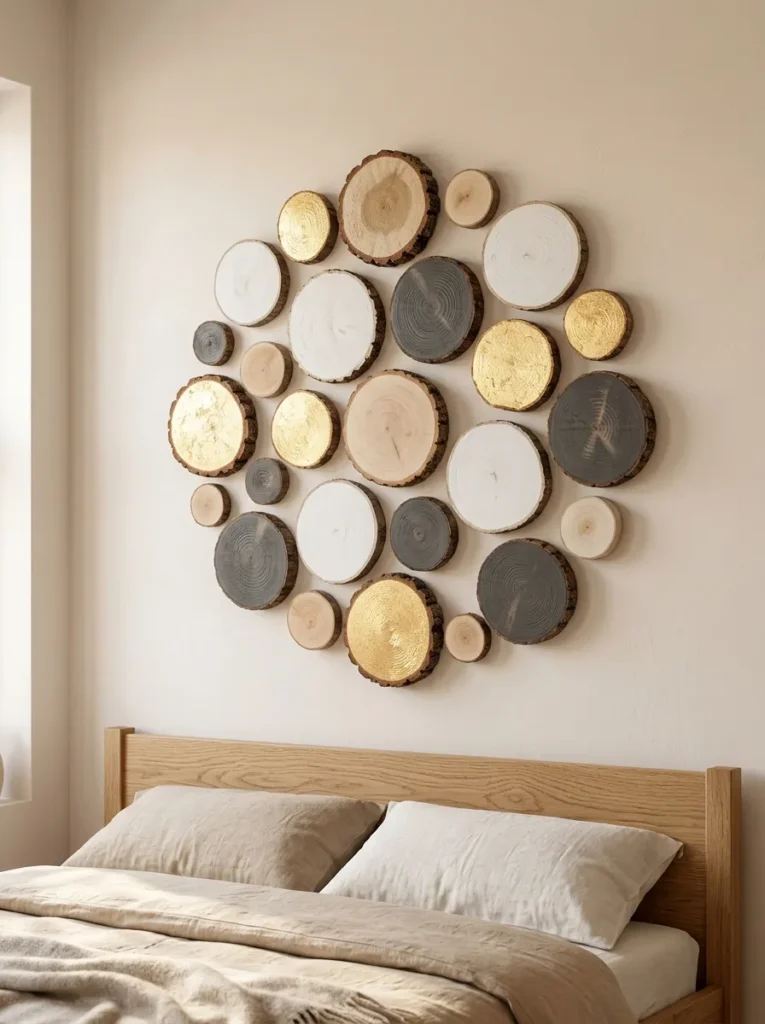
Vibe: Warm and creative — the wall arrangement that makes an empty wall feel intentional rather than unfinished.
Why it works: The wood slice painted wall art arrangement is the wooden wall decor idea with the lowest material cost and the highest creative accessibility — cross-section timber slices are available from firewood merchants, tree surgeons, and craft suppliers at very low cost, and the varied treatment approach (natural, painted, stained, gilded) makes the arrangement infinitely customizable to any room’s color palette and aesthetic register. The design principle at work is tonal composition within an organic arrangement — by treating each slice differently while maintaining a three or four-tone palette across the full arrangement (natural timber, white, gold, and charcoal in this palette), the arrangement creates a composed design rather than a random collection of circles. The circular cluster composition — with the largest slices at the cluster’s center and smaller slices at the edges — creates a naturally weighted composition that reads as a resolved design gesture rather than a scattered arrangement.
How to get it: Dry the wood slices completely before any treatment or installation — green (freshly cut) timber will crack and warp after mounting. Dry in a well-ventilated space for minimum 4 weeks for slices under 30mm thick, 8 weeks for thicker sections. Apply treatments before arranging on the wall: chalk paint in flat white for the white slices, raw Japan black for charcoal slices, genuine gold leaf (or imitation gold leaf at a fraction of the cost) for the gilded slices. Mount using standard picture-hanging hooks or 3M Command strips for lighter slices.
Shop the Look
| Product |
|---|
| Wood slice cross section set |
| Chalk paint flat white |
| Imitation gold leaf sheets |
| Japan black stain small tin |
| 3M Command strip picture hanging |
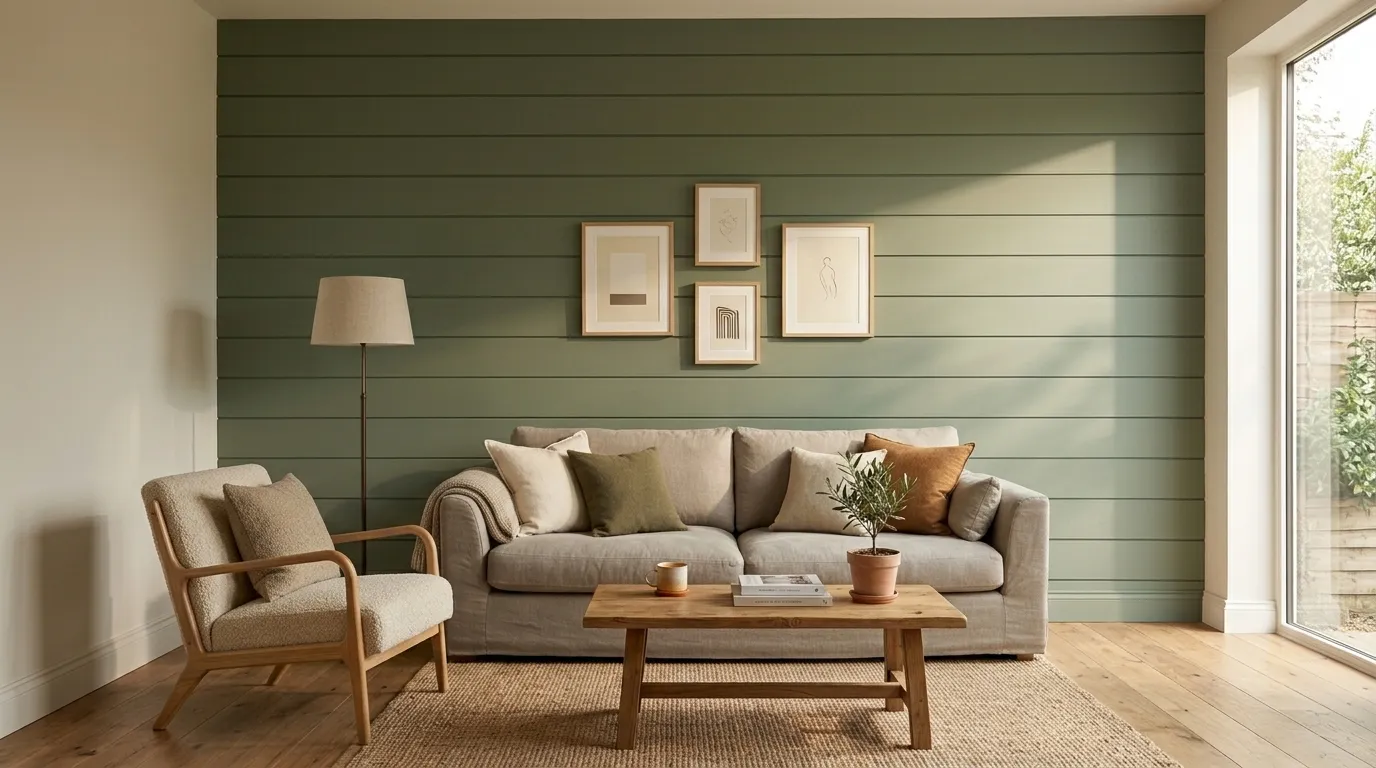
9. Shiplap Feature Wall Behind the Sofa
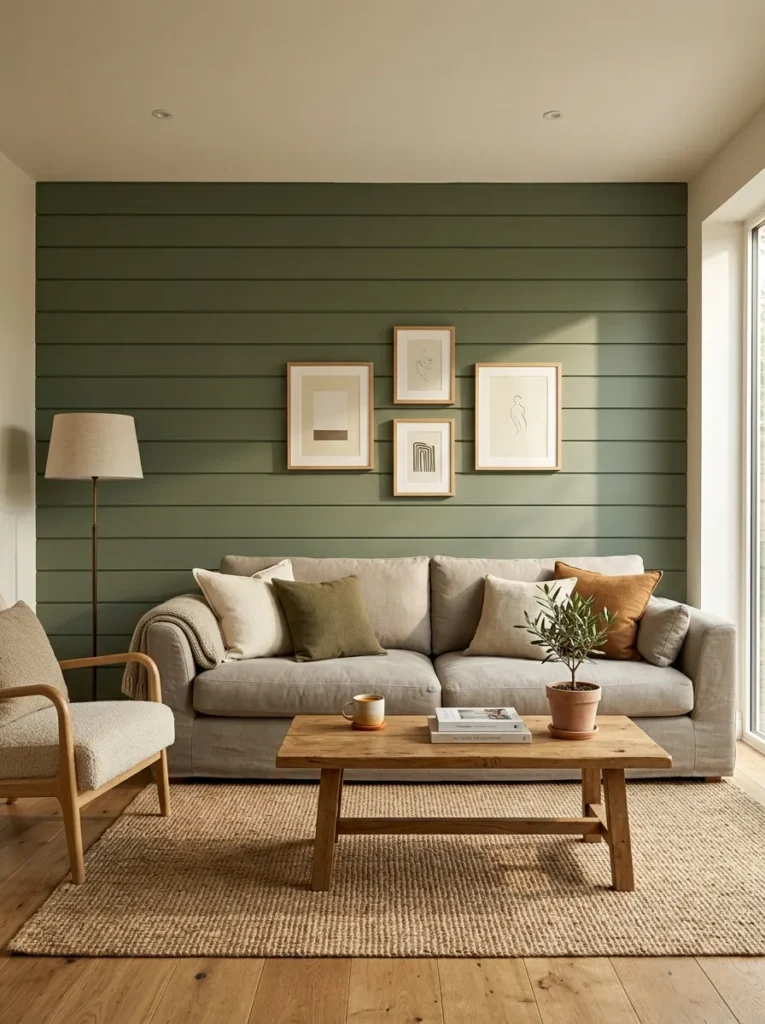
Vibe: Warm and resolved — the living room wall that makes the sofa look like it was designed specifically for this room.
Why it works: The shiplap feature wall behind the sofa is the wooden wall decor idea that most effectively creates the architectural backdrop that makes the living room’s primary furniture arrangement read as deliberate and considered. A sofa floating in front of a plain plaster wall reads as furniture in a room; the same sofa in front of a textured, colored shiplap wall reads as the centerpiece of a designed room — the shiplap provides the visual weight and the visual terminus that the room’s primary seating axis requires to feel resolved. The deep sage paint is the color decision that elevates this from a standard farmhouse shiplap (typically white or natural timber) to a contemporary design statement — the saturated, earthy green connects the shiplap’s timber material to the garden and landscape context, while the horizontal shadow reveals create a surface texture that the solid color enhances rather than conceals.
How to get it: Install standard 140mm × 19mm pine shiplap boards (available from any building materials supplier) horizontally, starting from the floor and working upward, with each board’s rebate sitting over the top edge of the board below to create the characteristic shadow reveal. Paint in Dulux’s Tranquil Retreat, Farrow & Ball’s Mizzle No. 266, or Sherwin-Williams’ Pewter Green SW 6208 for a deep sage that reads as complex and saturated rather than flat and commercial. Use a semi-gloss paint rather than flat for a shiplap feature wall — the slight sheen enhances the shadow reveal’s depth and makes the surface easier to wipe down in high-contact areas behind a sofa.
Shop the Look
| Product |
|---|
| Pine shiplap board 140mm |
| Deep sage semi-gloss wall paint |
| Large warm greige sofa |
| Natural woven rug living room |
| Simple timber coffee table |
10. Laser-Cut Timber Panel Screen Wall Feature
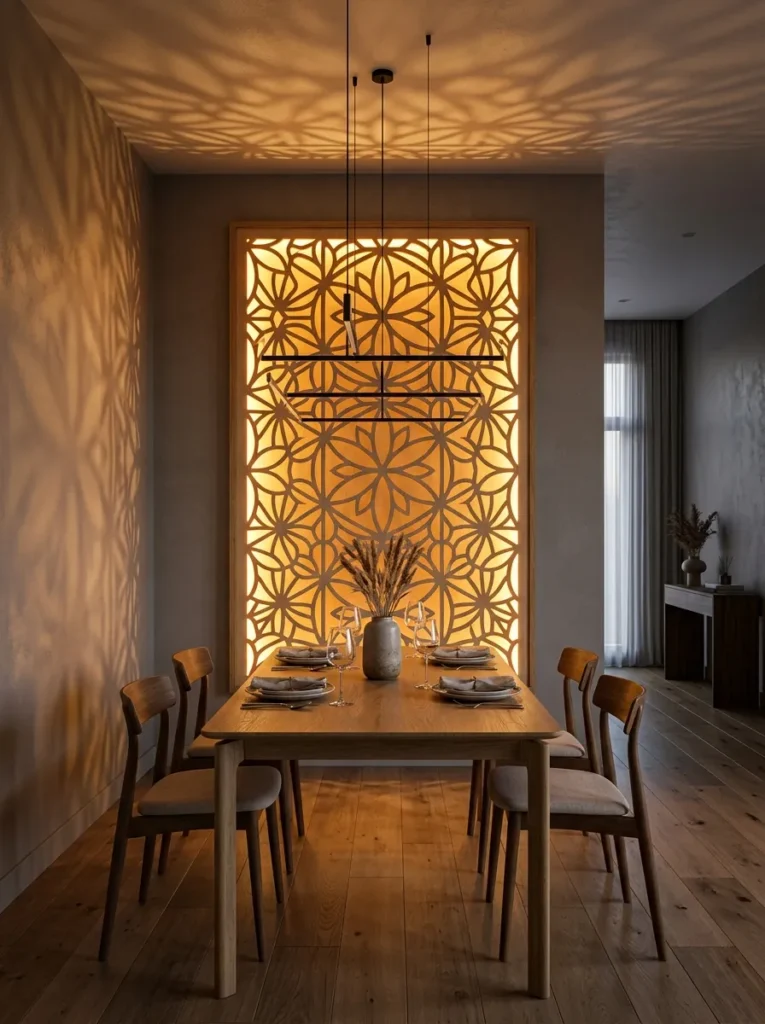
Vibe: Warm and dramatic — the dining room wall that makes candlelit dinners feel like art.
Why it works: The laser-cut timber panel screen wall feature is the wooden wall decor idea that most powerfully combines material warmth with light design — by backlighting a precision-cut timber panel with warm LED light, the feature becomes simultaneously a wall installation, a light fitting, and a shadow projection artwork. The laser-cut apertures allow light to pass through in the specific pattern of the design, casting a moving, dynamic shadow across adjacent walls and ceiling surfaces that changes with the viewer’s position and with the quality of ambient light in the room. This triple function — wall art, light fitting, shadow projector — makes the laser-cut panel the highest-value single wall installation available in a dining room context. The intricate geometric or botanical pattern of the laser cutting creates a fine-mesh aperture field that reads as a sophisticated design object rather than a DIY construction project.
How to get it: Commission laser-cut timber panels from a local laser cutting service or CNC routing workshop — most offer a design-to-cut service where you supply a DXF file of your chosen pattern and they produce the panel to your specified dimensions. Source patterns from design marketplace sites (Creative Market, Design Bundles, or Etsy DXF files) or commission a custom pattern from a graphic designer. Backlight with a warm white LED strip at 2700K mounted on a simple timber batten frame behind the panel — the LED strip should be positioned 50–80mm behind the panel to allow the light to disperse evenly before reaching the apertures.
Shop the Look
| Product |
|---|
| 6mm plywood panel laser cut custom |
| Warm white LED strip 2700K |
| Timber batten frame backlight mount |
| LED dimmer controller |
| Timber dining table natural |
11. Woven Timber Strip Wall Hanging
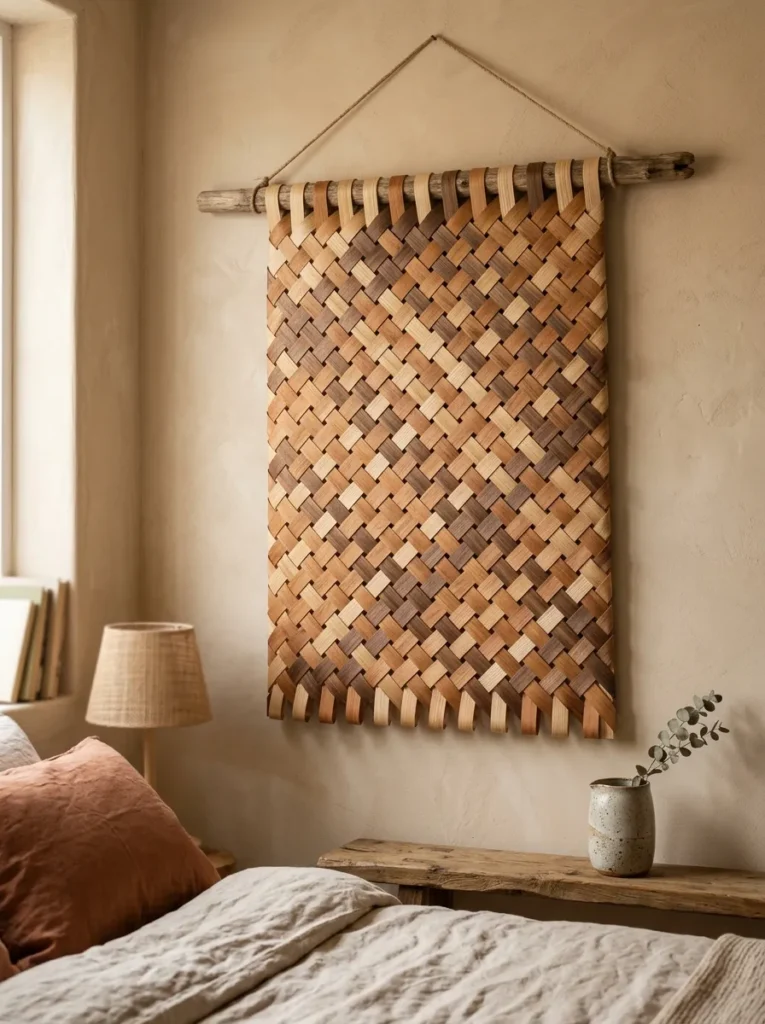
Vibe: Warm and artisanal — the wall piece that makes people ask “is that made of wood?” before they lean in to confirm that it is.
Why it works: The woven timber strip wall hanging is the wooden wall decor idea that most completely subverts the expected material behavior of timber — by using thin veneer strips flexible enough to weave in a basket pattern, it creates a wall object that behaves as textile while remaining made of wood. This material subversion is the conceptual content of the piece: wood is expected to be rigid, structural, and planar — a woven wood textile challenges all three expectations and rewards close examination with the revelation of the material’s unexpected flexibility. The three-species color contrast in the weave pattern creates a color field that changes depending on which set of parallel strips the eye follows — dark walnut diagonals against pale ash backgrounds, or warm cherry diagonals against walnut backgrounds — giving the piece a visual complexity that a single-species weave cannot achieve.
How to get it: Timber veneer strips (0.6mm thickness, 10mm width) in multiple species are available from specialist veneer suppliers. Soak the strips in warm water for 15 minutes before weaving to increase flexibility — dry veneer strips crack when bent at the angles a diagonal weave requires. Weave at a 45-degree diagonal to the vertical hanging direction and secure each strip end at the outer edges with a thin bead of PVA glue, trimmed flush after drying. Mount on a driftwood or turned timber rod using jute or linen cord at the top edge.
Shop the Look
| Product |
|---|
| Timber veneer strip set multi-species |
| PVA wood glue |
| Driftwood rod natural |
| Jute cord hanging |
| Ceramic vessel small display |
12. Pegboard Timber Organizer Panel as Feature Wall
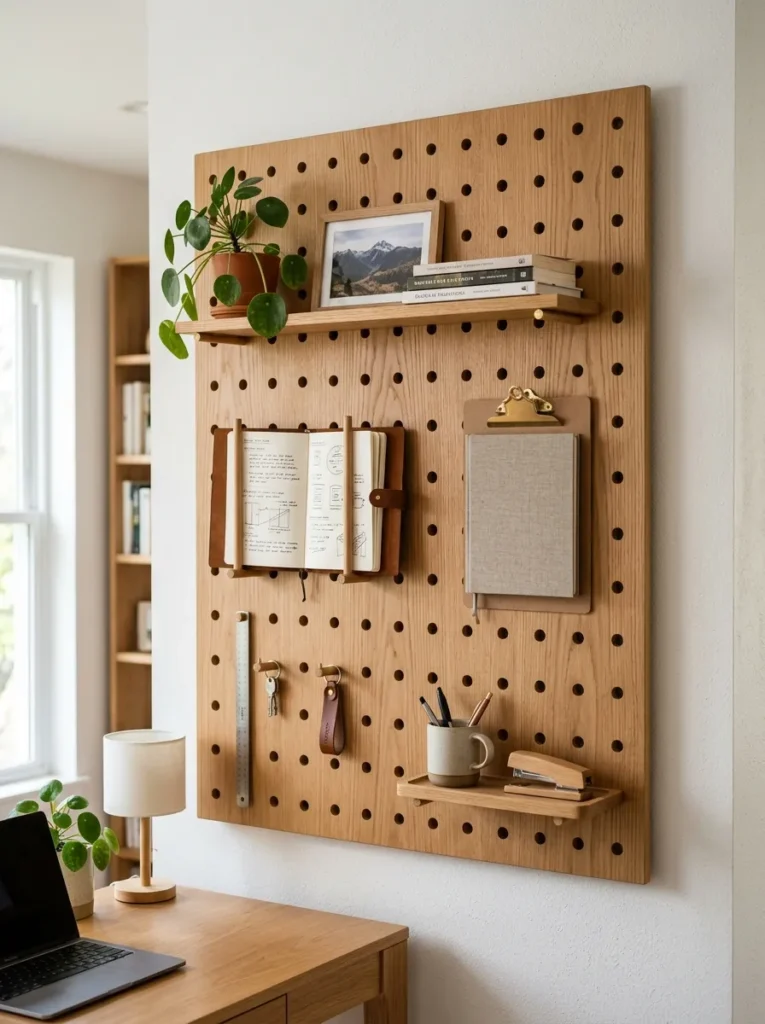
Vibe: Organized and warm — the home office wall that makes the act of working feel as considered as the work itself.
Why it works: The oak pegboard organizer panel is the wooden wall decor idea that most completely serves the dual function of decorative wall feature and practical organizational system — unlike standard MDF or hardboard pegboard (which reads as utilitarian regardless of how it is styled), an 18mm solid oak pegboard panel reads as a quality piece of furniture applied to the wall rather than a storage product, because the material quality, grain visibility, and surface warmth of natural oak elevate the pegboard concept from the register of stationery storage to the register of designed workspace. The 30mm standoff behind the panel is the installation detail that prevents the pegboard from reading as flat wall-mounted hardware: the shadow between the panel and the wall surface, visible around the panel perimeter, gives the oak board a three-dimensional, floating quality that reads as an intentional design decision.
How to get it: Source an 18mm solid white oak board or oak-veneered MDF sheet and drill 20mm holes at 50mm centers using a forstner bit — the forstner bit produces a clean, flat-bottomed hole with sharp edges that reads as precision-made rather than rough-drilled. Mount on 30mm solid oak standoff blocks at each corner and at 300mm intervals along the long edges. Source oak-specific pegboard accessories from specialist home organization brands — Designstuff, Graf & Lantz, or custom turned oak dowel sets.
Quick Win: An unfinished oak board (600mm × 900mm, 18mm thick) drilled with a standard forstner bit in a home workshop produces a custom oak pegboard for $40–80 in materials — less than a quarter of the cost of purpose-made designer pegboard systems, with the same visual quality when finished with a single coat of penetrating oil.
Shop the Look
| Product |
|---|
| White oak board 18mm solid |
| Forstner drill bit 20mm |
| Oak standoff spacer set |
| Pegboard accessory kit natural timber |
| Trailing plant small pegboard mount |
13. Timber Veneer Wall Map Art Installation
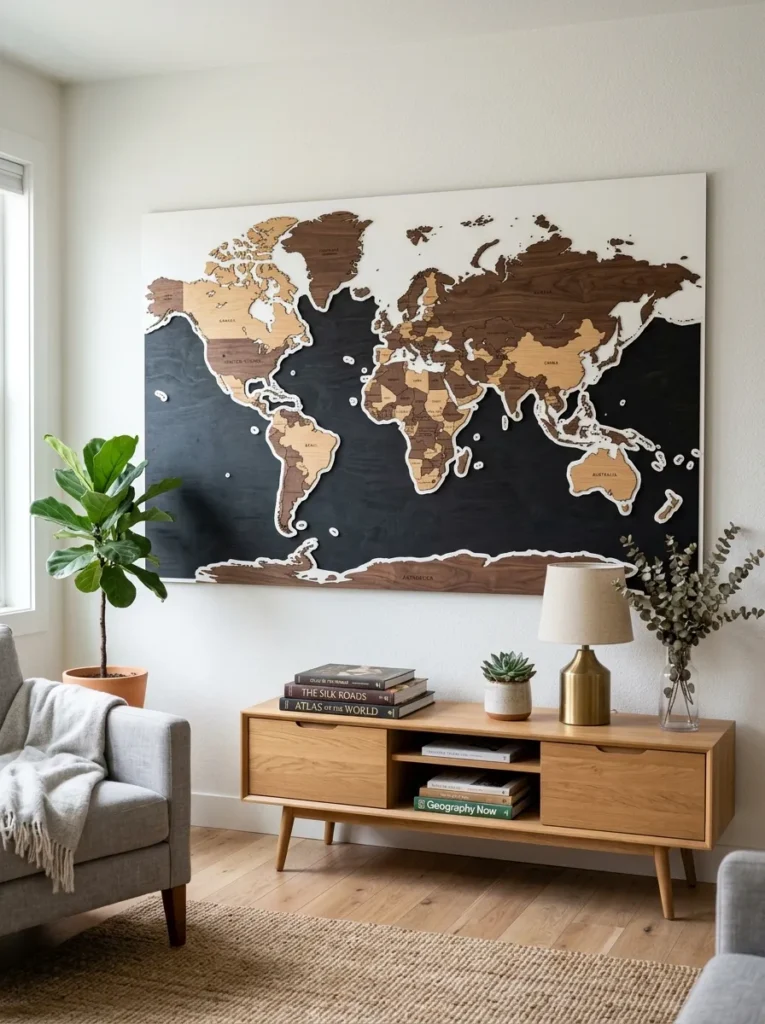
Vibe: Warm and intellectual — the wall art that makes every visitor walk toward it to identify the detail of their own geography within it.
Why it works: The timber veneer wall map art installation is the wooden wall decor idea with the highest intellectual and personal engagement potential — a map in timber veneer invites a quality of close examination and personal navigation that a printed or painted map cannot elicit, because the material variation between timber species creates a physical texture and warmth that makes the act of locating a specific place on the map a sensory as well as intellectual engagement. The use of different timber species to represent different geographic zones — ebonized birch for oceans, natural walnut for major continents, pale oak for islands and smaller landmasses — creates a geographic key that is built into the material itself rather than applied as a printed legend, making the map read as designed cartography rather than a reproduced image in an unusual material.
How to get it: Source the map outline as a DXF or SVG file from a cartographic resource and send to a laser cutting or CNC routing workshop for precision cutting from thin veneer sheets. Adhere the cut veneer pieces to a 6mm birch ply substrate using PVA glue applied to both surfaces, working from the largest geographic features to the smallest details. Frame the completed map installation in a slim natural oak or walnut frame that matches the dominant species in the composition.
Shop the Look
| Product |
|---|
| Timber veneer sheet ebonized birch |
| Timber veneer sheet natural walnut |
| Birch plywood substrate 6mm |
| World map DXF file digital |
| Slim oak frame strip |
14. Carved Relief Timber Panel with Abstract Pattern
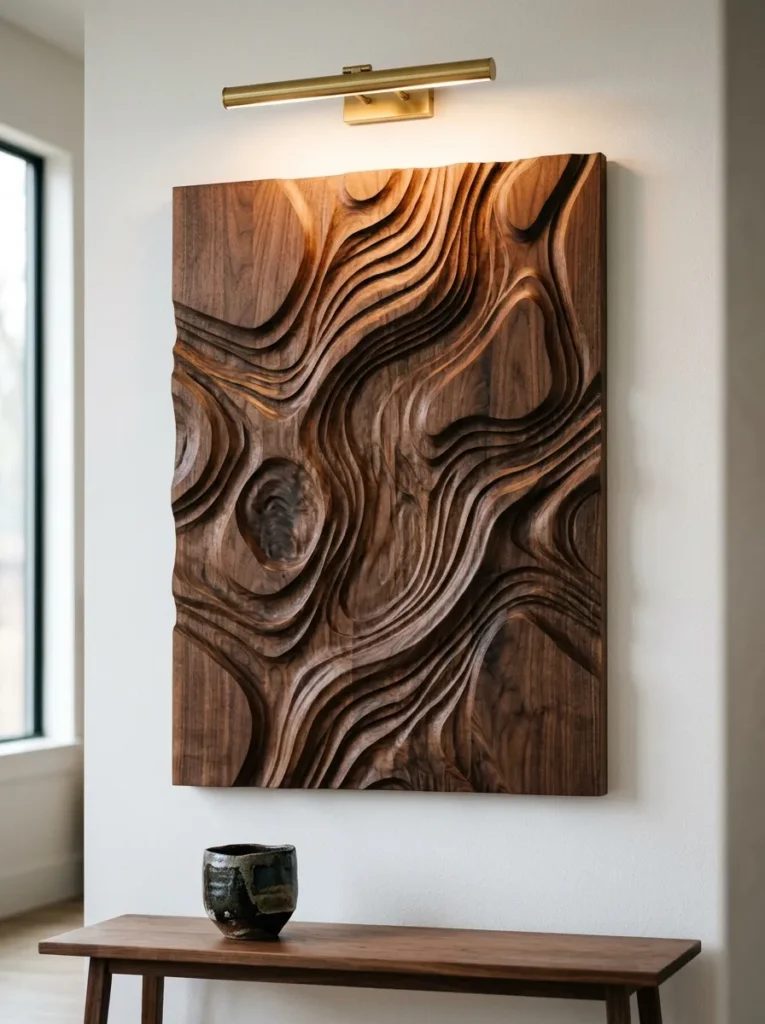
Vibe: Warm and artistic — the wall piece that a gallery would exhibit and a home deserves.
Why it works: The hand-carved timber relief panel is the wooden wall decor idea with the highest craft value and the most dynamic light behavior — because the carved surface creates valleys and ridges at varying depths, the panel’s appearance changes dramatically with the quality, direction, and intensity of light falling on it. Under a raking gallery picture light, the deepest carved valleys fall into shadow while the highest ridges catch the light — the panel reads as a composition of light and dark rather than a composition of carved lines. Under diffused natural light from a window, the same panel reads as a textured surface with subtler tonal variation. This responsiveness to light — the panel’s appearance changing through the day as the room’s light quality shifts — gives the carved relief panel a living quality that flat artwork cannot possess. The walnut species is the correct choice for a carved relief panel because its deep warm brown color creates maximum depth in the carved shadows, and its tight grain structure holds fine carved detail without splitting.
How to get it: Commission from a studio woodcarver or furniture sculptor — most woodcarving artists accept commissions for abstract relief panels at $400–1,500 depending on size and carving depth. For a DIY approach at a simpler depth level: use a router with varied diameter bits to carve flowing abstract patterns into a 30mm thick solid timber panel, working from a chalk-drawn pattern transferred to the surface. The carving depth progression (shallow at the pattern periphery, deeper at the center of each motif) is the technical detail that creates the dimensional quality that makes a routed pattern read as carved rather than machine-produced.
Shop the Look
| Product |
|---|
| American walnut solid panel 30mm |
| Brass picture light gallery style |
| Router bit set varied diameter |
| Chalk pattern transfer paper |
| Slim timber bench below panel |
How to Start Your Wooden Wall Decor Transformation
Your single first move is to identify the wall in your home that most needs a primary design feature — the wall that is visually dominant from the room’s primary entry point or primary seating position, the wall that your eye goes to first when you enter the room and finds nothing resolved to rest on. This is the correct wall for a wooden wall decor feature, because the visual impact of a resolved wall treatment is proportional to the frequency with which it is seen — a feature wall on the room’s dominant sightline is experienced every time the room is used, while a feature wall on a side or secondary wall is noticed occasionally. Once you have identified the primary wall, measure it precisely and photograph it in the room’s natural light — these two pieces of information determine which of the 14 ideas in this list is physically and proportionally achievable in your specific space.
The most common wooden wall decor mistake is selecting the wrong timber finish for the room’s existing palette — specifically, applying a dark timber treatment (walnut, ebonized oak, charred cedar) to a room whose existing furniture and textile palette is already dark and warm, producing a heavy, light-absorbing room that reads as cave-like rather than characterful. The correct palette relationship for a wooden wall feature is contrast with the room’s existing dominant tone: a dark walnut carved panel or a charred cedar accent wall reads best against a light palette of pale plaster, white linen, and pale oak furniture; a pale bleached ash slatted wall reads best against a room with darker furniture and deeper textile tones. Before selecting the timber species and finish for a wall feature, audit the room’s existing dominant tone and choose a timber treatment that provides contrast rather than alignment.
Three specific material investments under $100 that create immediate wooden wall decor quality: (1) Rubio Monocoat timber oil finish ($45–70 for a small tin, sufficient for 10–20 square meters of timber surface) is the single finish that produces the most natural, most matte, most grain-revealing timber surface quality — one coat to penetrating depth, no surface film, no sheen, no artificial quality to the finished surface. (2) Fine black basalt or grey limestone aggregate for timber surface interstices ($12–20 per kilogram) applied into the gaps between wall-mounted timber elements (slat walls, shiplap, woven timber pieces) prevents dust accumulation in the gaps and adds a mineral quality to the material composition that coordinates with the timber’s own geological timescale. (3) A single can of Japan black timber stain ($15–25) provides the ebonizing solution for creating dark contrast elements in multi-species timber compositions — used to darken one in three pieces in a wood slice arrangement, or alternating boards in a chevron pattern, at a material cost that makes the contrast effect available at any project scale.
Realistically, a single wooden wall decor feature — a full-height slatted panel wall on one room wall — costs $600–1,800 in timber and installation materials for a standard wall of 3 meters width at 2.7 meters height, depending on the timber species specified and whether pre-finished panel systems or raw timber with site-applied finish are used. A DIY reclaimed timber frame gallery wall costs $80–300 depending on the number of frames and the art prints selected. A hand-carved or laser-cut statement panel costs $300–800 as a bespoke commission, or $150–400 as a DIY project in a well-equipped workshop. Most homeowners begin with an accessible, lower-cost wooden wall feature — the wood slice arrangement, the reclaimed frame gallery, the woven hanging — and build toward the more architecturally ambitious treatments (slatted wall, shiplap feature, carved relief panel) as their confidence with timber as a design material develops.
Frequently Asked Questions About Wooden Wall Decor
What is the best type of wood to use for indoor wall decoration?
The best timber species for indoor wall decor depends on the aesthetic register and the specific application. White oak is the most versatile species for contemporary residential applications — its tight, attractive grain, warm natural color, and stability in varying indoor humidity conditions make it the most design-forward choice across a range of applications from slatted walls to floating shelves to pegboard panels. American walnut is the correct choice for a dark, sophisticated statement — its deep brown warmth and fine grain make it the premier species for carved relief panels and marquetry art. Western red cedar is the correct choice for charring (shou sugi ban) applications — its natural resin content produces a more even, more deeply textured char than other common species. Reclaimed pine is the correct choice for applications where material history and imperfection are the design content — its knots, nail holes, and weathering are visual qualities that the specific application in Idea 2 specifically requires.
What colors work best with wooden wall decor in an interior?
The wall colors that best complement wooden wall decor are those in the warm neutral family — warm white, warm greige, dusty ivory, and pale sage — because these tones coordinate with timber’s natural warm yellow-orange-brown color spectrum without creating the cool-warm color clash that cool grey or blue walls produce against most timber species. The exception is the charred timber (shou sugi ban) feature wall, where a warm white palette in the surrounding room maximizes the contrast between the deep charred black and the pale, light-filled room. For slatted wall applications where a colored backdrop wall is used behind the slats, deep charcoal grey, deep forest green, and deep navy are the three colors that create the most sophisticated depth effect visible through the slat gaps — their depth makes the shadow reveals read as genuinely three-dimensional rather than as gaps in a flat panel.
How do I protect indoor timber wall decor from moisture and dust?
The correct protection for indoor timber wall decor depends on the application’s room position and use conditions. In living rooms and bedrooms, a single coat of penetrating timber oil (Rubio Monocoat, Osmo Polyx, or Livos natural oil) provides adequate moisture and dust resistance without adding any surface film or artificial sheen to the timber. In bathrooms and kitchens where condensation or splash exposure is likely, a water-based exterior-grade hardwax oil (Osmo Top Oil or equivalent) provides enhanced moisture resistance while maintaining the natural matte surface character that architectural timber wall features require. Never use polyurethane or lacquer finishes on decorative interior timber wall features — the plastic-like surface film they create conflicts with the material honesty that is the primary design value of exposed timber wall treatments.
Can wooden wall decor be removed without damaging the wall?
Removability depends on the attachment method. Lightweight wooden wall decor — wood slice arrangements, woven timber hangings, framed panels under 5kg — attached with 3M Command strips or standard picture hooks can be removed without wall damage beyond small nail holes easily filled with wall filler. Heavier installations — slatted wall panels, shiplap boards, live-edge shelves — are typically attached with construction adhesive to a substrate board, which makes complete removal require removing the substrate and repairing the wall surface behind. For rental or commitment-averse installations, a freestanding approach — attaching the timber feature to a lightweight timber frame that leans against the wall or is attached at top and bottom with removable fasteners — provides the visual effect of a wall-mounted feature with complete reversibility.
How do I choose the right scale of wooden wall decor for my room?
The scale principle for wooden wall decor follows the same rule as all interior artwork — the feature should occupy at minimum 60% of the wall width it is positioned on (or 60% of the wall section above the furniture it is paired with) to read as a resolved feature rather than an undersized decoration. A wood slice cluster arrangement for a standard living room wall should span minimum 70cm in its widest dimension; a slatted panel feature wall should cover the full wall width rather than a partial section; a framed marquetry panel should be minimum 60cm × 80cm to read as a feature piece rather than a decorative accessory. The most common scale mistake in wooden wall decor is positioning a small timber piece on a large wall — the undersized piece reads as an object placed on the wall rather than a feature of the wall, and all the material quality and craft investment in the piece is undermined by the proportional failure.
Ready to Transform Your Walls with Wooden Wall Decor?
These 14 ideas span the full range of what timber can do on an interior wall — from the architectural drama of full-height slatted oak panels and Japanese charred cedar to the organic warmth of driftwood sculpture arrangements and woven veneer hangings, from the graphic precision of plywood chevron patterns and laser-cut backlit screens to the artisanal depth of hand-carved walnut relief panels and reclaimed timber gallery frames — so whether you are designing a single feature wall or planning a room-wide material transformation, whether your aesthetic is Japandi minimalism or coastal organic or contemporary maximalism, there is a genuinely buildable wooden wall decor approach here for your space, your skill level, and your specific wall. The transformation begins with the right wall — the room’s most-seen, most-dominant wall — and the right timber species for your existing room palette, and those two decisions together determine which of these 14 ideas will look like it was always meant to be there. Today’s specific action: stand in the doorway of the room you most want to transform, look at the wall your eye goes to first, and take a photograph of it with your furniture included in the frame — that photograph, with the room’s existing palette and the wall’s specific dimensions clearly visible, is everything you need to choose the right wooden wall decor from this list. Save the ideas that matched your room’s existing material language and your confidence with DIY or commissioning — those are the ones that will be on the wall before the end of the month, and that will make the room feel permanently more considered, more warm, and more genuinely like the home you intended it to be.