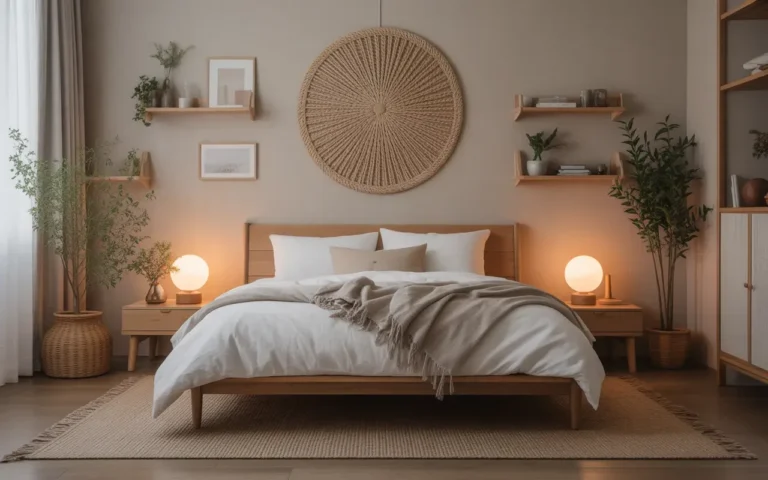
15 Dreamy Coastal Decor Ideas for Your Home
Coastal decor ideas for the home use the colors, materials, and sensory qualities of the coastline — bleached timber, warm sand tones, ocean blues, natural fiber textures, and the specific quality of diffused maritime light — to create interiors that feel open, unhurried, and genuinely connected to the natural world, without relying on clichéd nautical motifs or literal ocean imagery. This article gives you exactly 15 ideas spanning color palettes, furniture, lighting, textiles, wall treatments, and accessories so every room and every home finds a coastal approach that feels authentic rather than themed.
Coastal decor at its best is not about anchors and rope. It is about the specific quality of light in a beach house at 8 a.m., the texture of weathered timber, the way natural fiber rugs feel underfoot on warm mornings, and the particular calm that comes from a room with enough white space to breathe in. It is the feeling of somewhere — a place that is recognizably coastal without announcing it. Here are 15 ideas worth saving — and living inside.
Why Coastal Decor Ideas Work So Well for Modern Homes
The coastal aesthetic has a design lineage running from the sun-bleached beach shacks of the mid-20th century American East Coast through the whitewashed Cycladic interiors of the Greek islands to the contemporary coastal Scandinavian interiors documented in Kinfolk and Apartamento — a lineage defined by a consistent set of material and spatial priorities: natural materials over synthetic, pale and warm over saturated and dark, texture over pattern, and openness over enclosure. What distinguishes the contemporary coastal interior from its predecessors is a greater sophistication in material selection and a decisive movement away from the nautical clichés (rope handles, anchor motifs, lighthouse prints) that made 1990s coastal decor feel themed rather than genuinely place-connected.
The core material palette of contemporary coastal decor includes: whitewashed or wire-brushed oak for furniture and flooring (the specific weathered quality of coastal timber, where sun and salt bleach and silver the grain, is the material reference that unifies the aesthetic); natural linen, undyed cotton, and organic jute for textiles (unprocessed fiber reads as coastal in its organic, unmanufactured quality); rattan, seagrass, and woven natural materials for lighting, storage, and decorative accents; weathered concrete and smooth river stone for sculptural and functional accessories; and ceramic in matte, salt-glaze, and stoneware finishes for tableware and vases. Color palette extends from the warm neutral base (sand, oat, warm white, bleached linen) through to the specific coastal blues — the blue-gray of North Sea skies, the turquoise clarity of tropical shallows, and the deep navy of deep water at dusk — with the critical specification that all blues in a coastal palette carry either a gray or a green undertone rather than a pure cool blue, which reads as graphic rather than environmental.
Coastal decor has maintained consistent design media engagement and consumer interest across every trend cycle since approximately 2010, which is itself a design statement — aesthetics that survive trend cycles do so because they address something more fundamental than trend: in this case, the documented psychological benefits of nature-connected environments (reduced cortisol, improved mood, increased restorative experience) and the specific version of those benefits that maritime environments provide. Blue-green color fields, the sound-absorbing qualities of natural fiber textiles, and the sensory warmth of bleached timber all contribute to the coastal interior’s documented capacity to produce genuinely calming domestic environments.
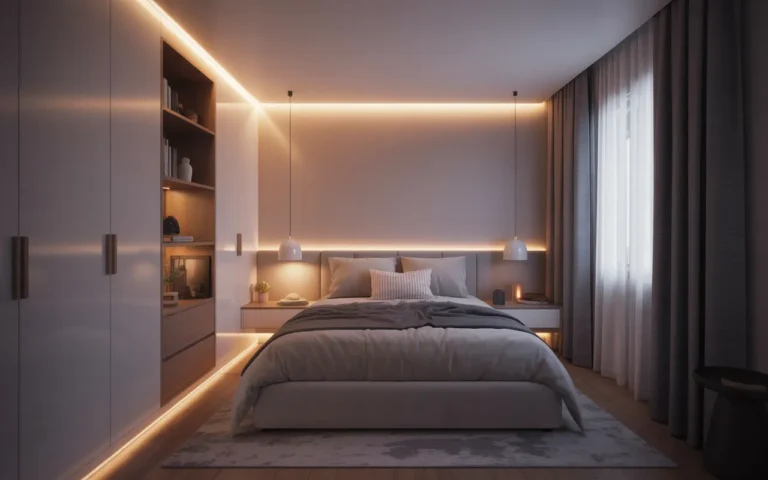
Small apartments and inland homes achieve the coastal aesthetic most successfully by focusing on material quality and color rather than on decorative ocean references. A studio apartment with whitewashed oak shelving, linen curtains, a seagrass rug, and walls in a warm blue-gray achieves the coastal atmosphere entirely through material and color, without a single shell, anchor, or map of the coastline. The honest consideration: dark rooms with limited natural light are the most challenging contexts for a coastal aesthetic because the aesthetic depends heavily on the interplay of light with pale surfaces and natural materials — supplementing with warm, diffused artificial lighting (pendants, table lamps, and soft LED warm strips) can compensate significantly for limited natural light, but rooms with genuinely no natural light will struggle to sustain the openness the style requires.
Style at a Glance
| Element | Coastal Core | Contemporary Edge |
|---|---|---|
| Philosophy | Nature-connected calm | Material honesty over ocean motif |
| Materials | Linen, rattan, whitewashed oak | Wire-brushed timber, salt glaze ceramic |
| Color Palette | Warm white, sand, oat | Blue-gray, sage-aqua, deep coastal navy |
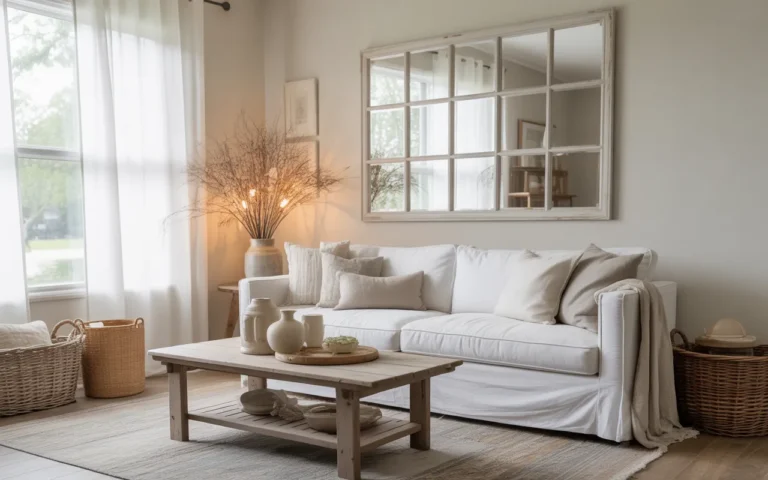
1. Warm White Limewash Wall Finish for Coastal Texture
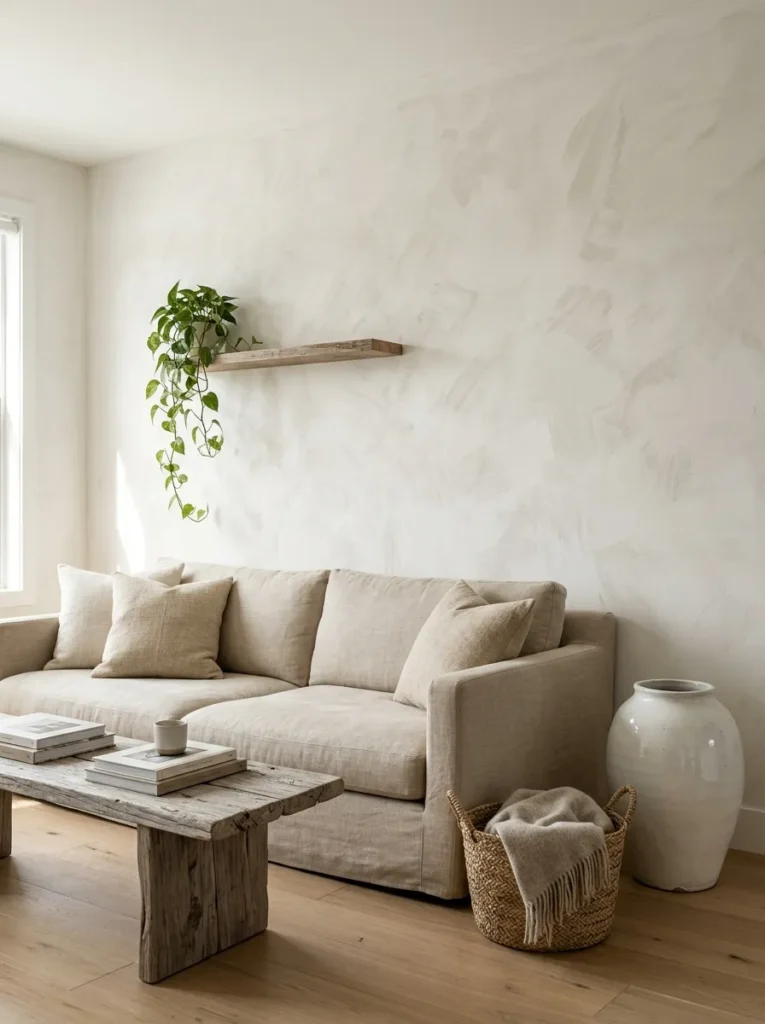
Vibe: The limewashed wall feels luminous and alive — the surface breathing with the light in a way that flat paint never does.
Why it works: A warm white limewash wall finish applies the material design principle of surface texture as atmosphere — flat paint produces a visually inert surface that simply reflects light uniformly, while limewash’s slightly irregular, layered application creates a surface with genuine micro-topography that catches and scatters light directionally, producing the kind of warm, shifting luminosity found in whitewashed Mediterranean buildings and Cycladic island architecture. This is the most fundamental coastal material reference available for an interior wall — the material is genuinely coastal in its origins (limewash was historically applied to buildings in coastal environments for both weather protection and pest deterrence) and in its visual quality (the warm white with slight gray undertone reads as sea-bleached rather than manufactured).
How to get it: Apply limewash paint (Bauwerk Colour, Ressource, or Portola Paints’ limewash range all produce high-quality results) over smooth plaster or drywall in a minimum of two coats, using a wide natural-bristle brush and applying each coat in random, overlapping directional strokes rather than systematic parallel passes. The second coat is applied partially over the dried first coat, intentionally leaving some first-coat surface visible for the layered depth effect. Seal with a matte mineral topcoat for a washable finish in higher-traffic areas. Total cost for a living room limewash application: $80–180 in paint materials plus one to two days of application time.
Quick Win: A single limewash accent wall behind the sofa or bed (rather than all four walls) costs $25–45 in materials and transforms the room’s atmospheric quality in a single day — the most cost-effective single wall treatment modification available for a coastal interior.
Shop The Look
| Product |
|---|
| Limewash paint warm white mineral |
| Wide natural bristle wall brush |
| Linen sofa cover slipcover oat |
| Large ceramic floor vessel coastal |
| Seagrass storage basket natural |
Also view: 15 Mid Century Bedroom Ideas for Timeless Charm
2. Rattan Pendant Lighting for Warm Diffused Coastal Atmosphere
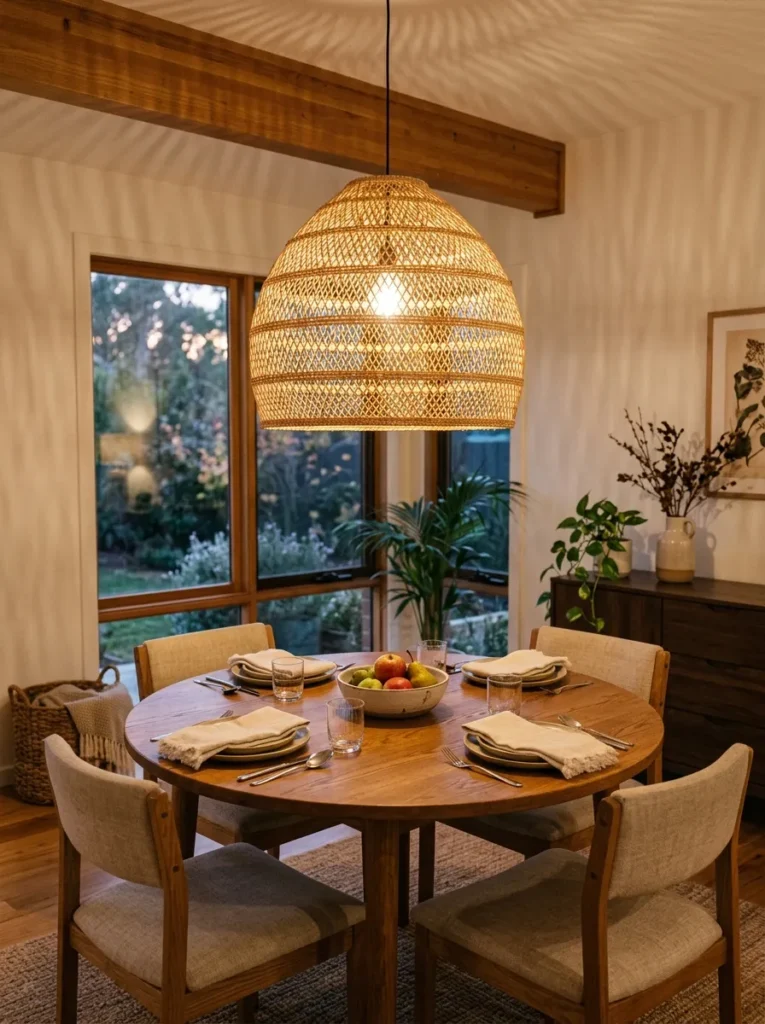
Vibe: The rattan pendant feels like the room is lit from within a basket — the specific quality of warm, dappled light that no solid shade can produce.
Why it works: A rattan pendant light applies the coastal design principle of material-derived light quality — the woven structure of natural rattan diffuses the light source into a warm, dappled pattern (rather than a directional beam or a uniformly diffused glow) that references the quality of light filtering through palm fronds, reed mats, and woven screens found in coastal environments across warm-climate cultures. The honey tone of natural rattan also warms the color temperature of standard LED lighting — a 3000K bulb inside a rattan shade produces approximately 2700K quality of warmth on the surfaces it illuminates, effectively adding warmth to the room’s light without changing the bulb specification.
How to get it: Source a natural rattan pendant in a scale appropriate to the space — a pendant’s diameter should be approximately half the table width for a dining application (a 120cm table benefits from a 50–70cm diameter pendant) or equal to the width of a bedside table zone for a bedroom installation. Install at a hanging height of 70–80cm above the table surface for a dining pendant, and 150–160cm from the floor for a bedroom or living room pendant. Choose a warm-white bulb at 2700K for the most authentic coastal warmth.
Shop The Look
| Product |
|---|
| Large rattan woven pendant light 60cm |
| Warm white LED bulb 2700K E27 |
| Round dining table solid wood natural |
| Linen dining chair seat pad set |
| Ceramic bowl natural glaze table |
3. Linen Curtains in Warm White for Diffused Maritime Light
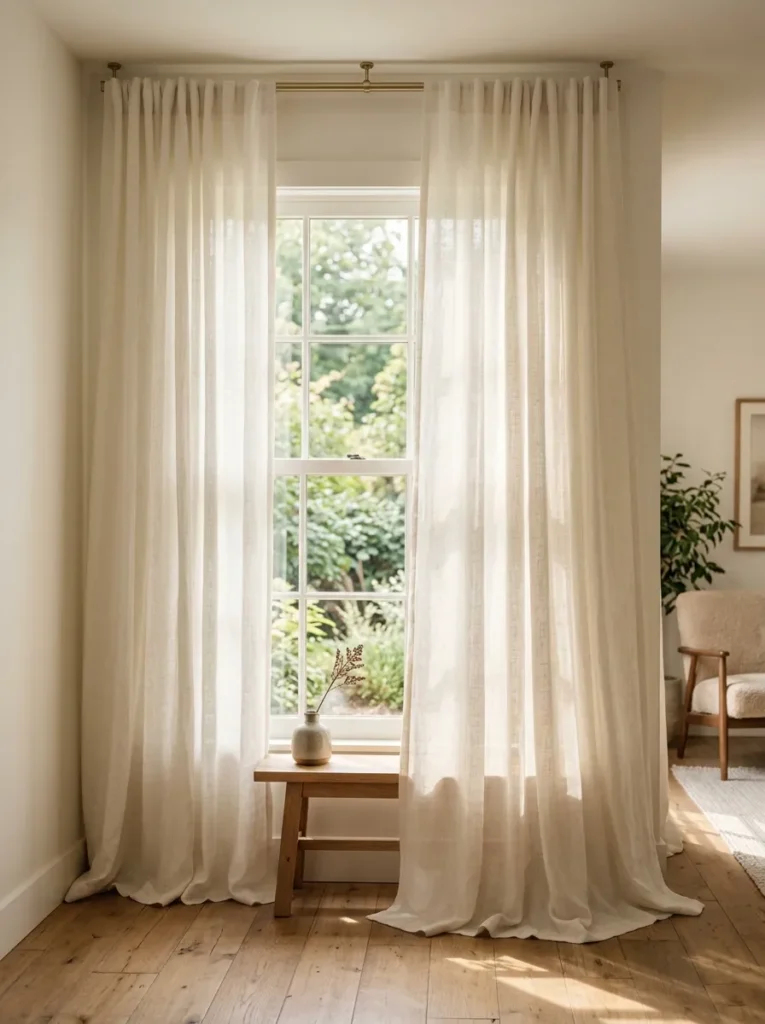
Vibe: The linen curtains feel like a breath of sea air made visible — light arriving softly, the room held in a permanent sense of morning.
Why it works: Floor-to-ceiling natural linen curtains in warm white apply the coastal design principle of light filtration over light control — rather than blocking natural light (as blackout curtains do) or letting it pass entirely unmodified (as a bare window does), semi-sheer natural linen diffuses light into the soft, even quality of overcast maritime sky — the specific light condition that makes coastal environments feel simultaneously bright and calm. The ceiling-height hang (mounting the curtain rod as close to the ceiling as possible rather than directly above the window frame) applies the spatial design principle of vertical exaggeration — curtains hung from the ceiling rather than the window head make the room’s vertical dimension appear significantly greater than it is.
How to get it: Specify natural linen curtains in a weight between 150–200 gsm — lighter than this reads as purely sheer and loses the structural drape quality that characterizes a well-made linen curtain; heavier than this loses the semi-transparent quality that allows light diffusion. Hang from a simple brass or warm-toned metal tension rod mounted within 5–10cm of the ceiling. Allow a minimum of 10cm of fabric to puddle at the floor — the slight floor puddle references the relaxed, unhurried quality of beach house interiors and prevents the curtain from reading as precisely tailored.
Shop The Look
| Product |
|---|
| Natural linen curtain panel semi-sheer white |
| Simple brass curtain rod ceiling mount |
| Brass curtain ring clip set |
| Small wooden bench window seat natural |
| Dried botanical stem slim vase |
4. Wire-Brushed Oak Flooring for the Authentic Coastal Timber Look
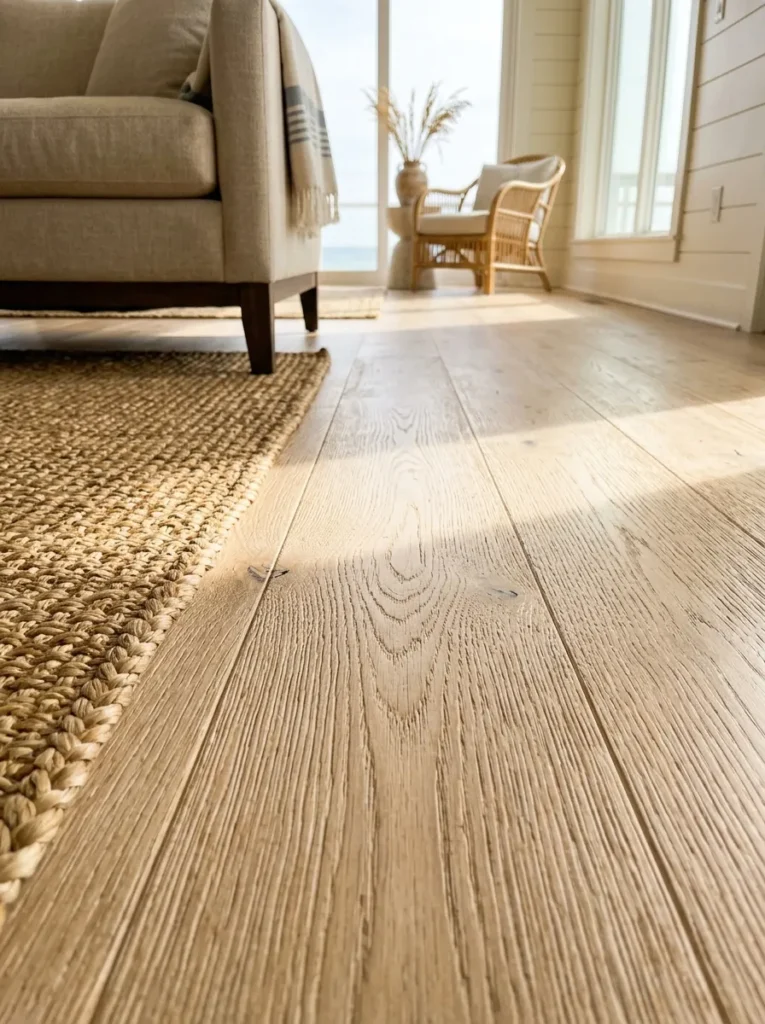
Vibe: The floor feels sun-bleached and genuine — the specific quality of timber that has spent years in bright, salt-air light.
Why it works: Wire-brushed oak flooring applies the material processing principle of accentuated natural character — the wire-brushing process removes the soft early-growth wood from the timber’s surface, leaving the harder late-growth grain raised in a dimensional texture that references the weathered quality of coastal timber (where natural weathering produces the same effect over years of UV and salt exposure). The white oil or white stain applied after wire-brushing further bleaches the grain’s color to the warm blond of naturally aged coastal wood. This is the most authentic coastal material available for flooring — it references the actual physical processes that coastal environments exert on timber rather than simply suggesting the coast through color.
How to get it: Specify engineered or solid white oak flooring in a wire-brushed finish with a white oil or white hardwax oil surface treatment from flooring suppliers — Dinesen, Havwoods, and V4 all produce high-quality wire-brushed white oak in wide plank formats (180mm+) that maximize the visual impact of the grain texture. Wide planks are essential for the coastal effect — narrow planks (under 100mm) read as traditional or farmhouse rather than coastal. For a budget-accessible alternative, purchase standard white oak LVT in a wire-brushed simulation format, which approximates the visual quality at approximately 30% of the cost.
Shop The Look
| Product |
|---|
| Wire-brushed white oak flooring engineered |
| White hardwax oil finish wood floor |
| Seagrass area rug natural honey 2x3m |
| Wide plank oak installation spacer set |
| Floor white oil maintenance coastal |
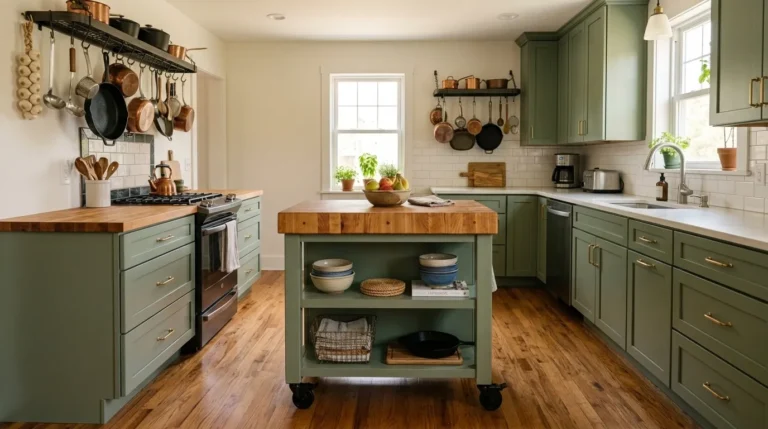
5. Blue-Gray Painted Cabinetry for a Coastal Kitchen
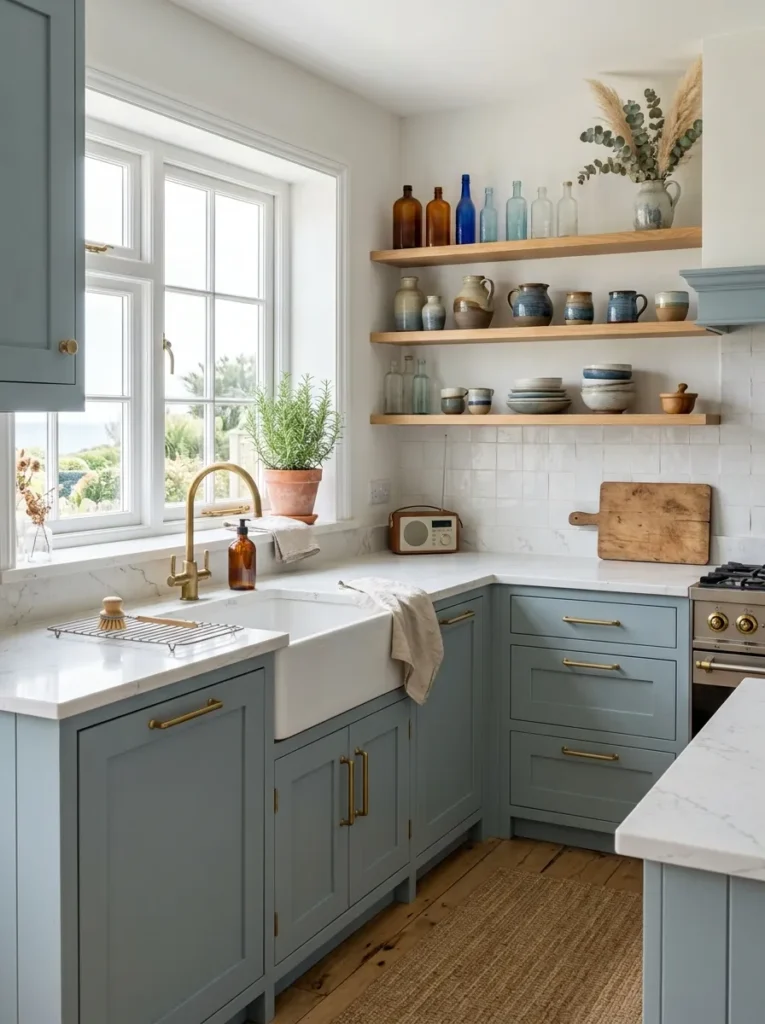
Vibe: The kitchen feels sea-washed and grounded — the blue-gray reading as the color of a North Sea morning rather than a paint chip.
Why it works: Blue-gray cabinetry in a coastal kitchen applies the color design principle of environmental color reference — the specific tone of blue-gray with a slight green undertone (referencing the particular blue of overcast coastal sky, sea glass, and weathered painted boats) is the most genuinely coastal color available for kitchen cabinetry because it reads as found in the natural environment rather than manufactured for decoration. The critical color specification is the green undertone — pure cool blues read as graphic and contemporary rather than environmental; pure grays read as urban industrial. The blue-gray with green tone (Farrow & Ball Mizzle No. 266, Little Greene Mussell, or Dulux Coastal Charm) sits in the exact chromatic position that coastal environments produce in naturally weathered paint.
How to get it: Specify kitchen cabinetry in Farrow & Ball Mizzle No. 266 for the most historically precise coastal blue-gray, or Benjamin Moore Sea Salt 2123-40 for a slightly warmer interpretation. Apply in an eggshell or satin finish for washability in a kitchen environment — matte finishes mark too easily in a cooking context. Pair exclusively with unlacquered brass hardware and white or warm-white worktops — polished chrome reads as clinical against coastal blue-gray, and dark worktops read as too contemporary.
Shop The Look
| Product |
|---|
| Blue-gray kitchen cabinet paint eggshell |
| Unlacquered brass bar pull kitchen hardware |
| White quartz worktop kitchen standard |
| Glass bottle collection kitchen shelf |
| Ceramic vase matte glaze coastal |
6. Seagrass and Jute Layered Rugs for Natural Fiber Warmth
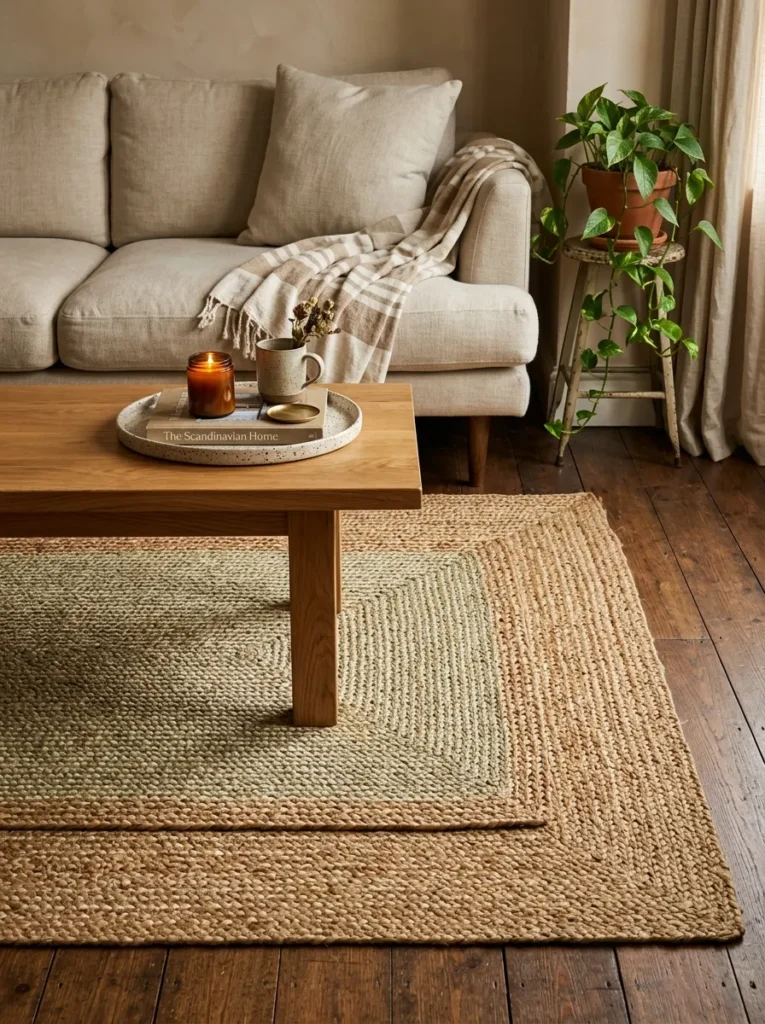
Vibe: The layered rugs feel warm and textural underfoot — natural fiber on natural fiber, a floor that rewards bare feet.
Why it works: Layered natural fiber rugs — jute below, seagrass or sisal above — apply the textile design principle of tonal texture layering, where both materials share the warm honey-cream color family but have distinct surface textures (jute’s softer, more irregular weave against seagrass’s tighter, more uniform grid), creating visual and tactile depth without color contrast. Natural fiber rugs are the single most coastal-essential textile category because plant fiber (jute, sisal, seagrass, coir) embodies the coastal aesthetic’s core material principle — organic, unprocessed, directly referencing the raw natural world — more completely than any dyed or manufactured textile can. The layering technique also practically solves the common problem of natural fiber rugs being too rough for comfortable barefoot contact: the seagrass on top provides the visual coastal texture, while the softer jute below provides underfoot padding.
How to get it: Size the base jute rug to extend 45–60cm beyond the sofa and chairs on all sides (this typically requires an 8×10 or 9×12 foot rug for a standard living room seating arrangement). Size the layered seagrass rug to approximately 60% of the base rug’s area, centered on the base. Place a non-slip rug pad between the two rugs to prevent the top rug from shifting. Both rugs should be undyed or minimally dyed in their natural color range — any significantly dyed or colored natural fiber rug loses the coastal reference immediately.
Shop The Look
| Product |
|---|
| Natural jute area rug handwoven 8×10 |
| Seagrass area rug woven border 5×8 |
| Non-slip rug pad layering grip thin |
| Low oak coffee table modern simple |
| Linen throw blanket natural oat |
7. Driftwood and Natural Branch Sculptural Accents
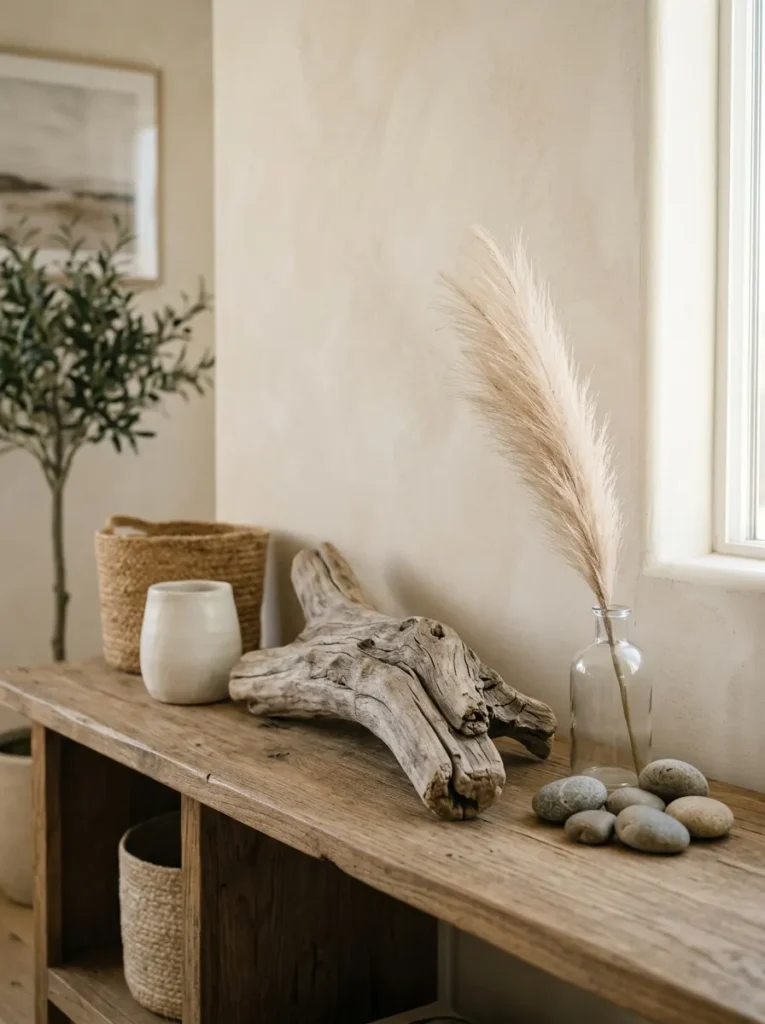
Vibe: The shelf display feels found and collected — as though these objects arrived from different beaches rather than from different shops.
Why it works: Driftwood and natural stone sculptural accents apply the interior design principle of material provenance — objects that appear to have been gathered from the natural environment (whether genuinely foraged or sourced to look as though they were) communicate authenticity and personal connection to the coastal landscape in a way that manufactured decorative objects cannot. The specific visual qualities of driftwood — the smooth, sun-bleached surface, the warm gray coloration, the irregular natural form — are the direct product of coastal environmental processes (wave action, UV bleaching, salt weathering) and carry those environmental references regardless of where they’re displayed. Grouping driftwood with smooth river stones, a clear glass bottle, and dried botanicals creates a composition that reads as a small collection assembled over time from coastal walks.
How to get it: Source driftwood pieces from specialty coastal suppliers (available online in a range of sizes) or gather from beaches where collection is permitted. Combine with smooth river pebbles (available from garden suppliers and pet stores as aquarium gravel in larger, natural sizes), clear glass bottles (recycled wine bottles make excellent single-stem vases for dried botanicals), and dried pampas grass or reed stems. Arrange in a composition of three to five objects at varying heights on a flat shelf or console surface, with the largest piece (the driftwood) as the visual anchor.
Shop The Look
| Product |
|---|
| Natural driftwood piece decorative large |
| Smooth river stone set decorative natural |
| Matte white ceramic vessel medium |
| Dried pampas grass stem natural |
| Clear glass bottle vase tall slim |
8. Coastal Blue and White Bedroom for Restful Maritime Calm
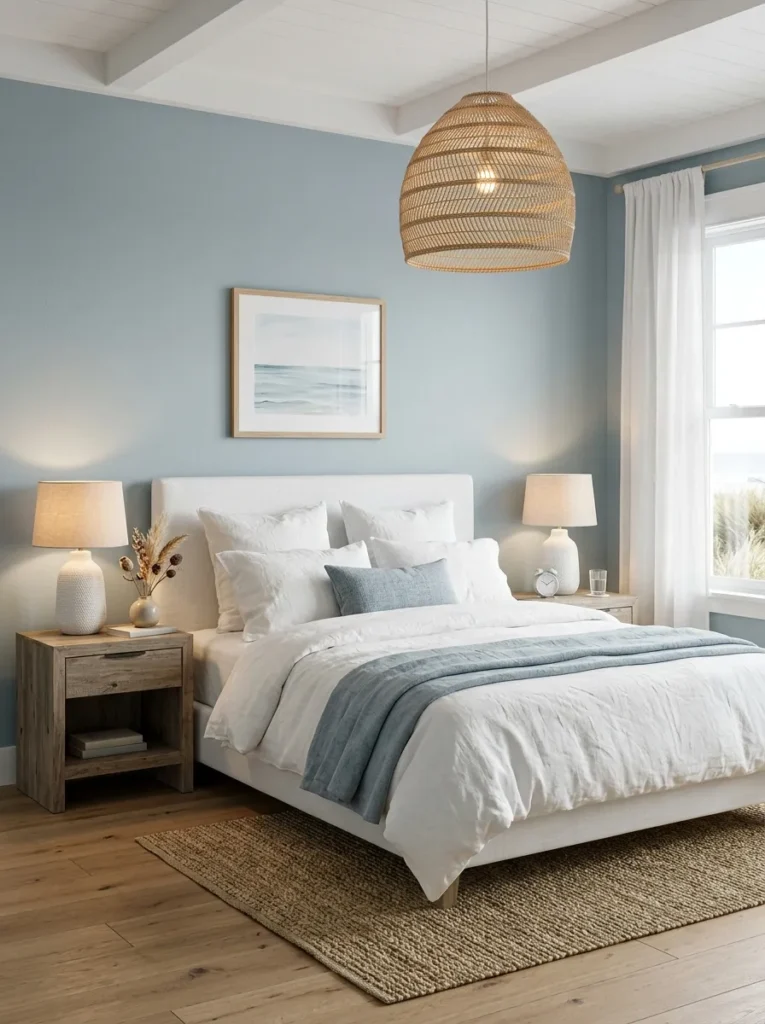
Vibe: The bedroom feels like waking up at a beach house — the blue-gray wall and white linen creating that specific morning quality of sky meeting sea.
Why it works: A coastal blue-gray bedroom wall with white linen bedding applies the color psychology principle of hue-induced calm — blue-gray (particularly variants with a slight green undertone, which reads as sea-adjacent rather than sky-adjacent) is the color most consistently associated with physiological relaxation responses in environmental psychology research. Combined with the sensory warmth of linen textiles and natural fiber rugs, the bedroom achieves the neurological conditions for genuine restfulness that clinical sleep medicine recommends: cool-toned visual environment, natural material textures, and soft diffused light. This is the coastal aesthetic functioning not merely as decoration but as a designed wellness environment.
How to get it: Paint the accent wall behind the bed in Benjamin Moore Iceberg 2122-50 or Farrow & Ball Borrowed Light No. 235 — both are the precise blue-gray with a slight green undertone that reads as coastal rather than clinical. Specify bedding in 100% linen (washed, not starched) in white or warm white — linen’s natural temperature-regulating properties complement the room’s sleep-optimizing purpose as well as its aesthetic. Source rattan or bamboo pendants (rather than fabric or metal shades) for the overhead light to maintain the natural material palette throughout.
Shop The Look
| Product |
|---|
| Coastal blue-gray bedroom paint eggshell |
| White washed linen duvet cover set |
| Natural rattan bedroom pendant light |
| Driftwood finish bedside table natural |
| Seagrass bed runner natural fiber |
9. Open Shelving with Coastal Ceramic and Glass Collections
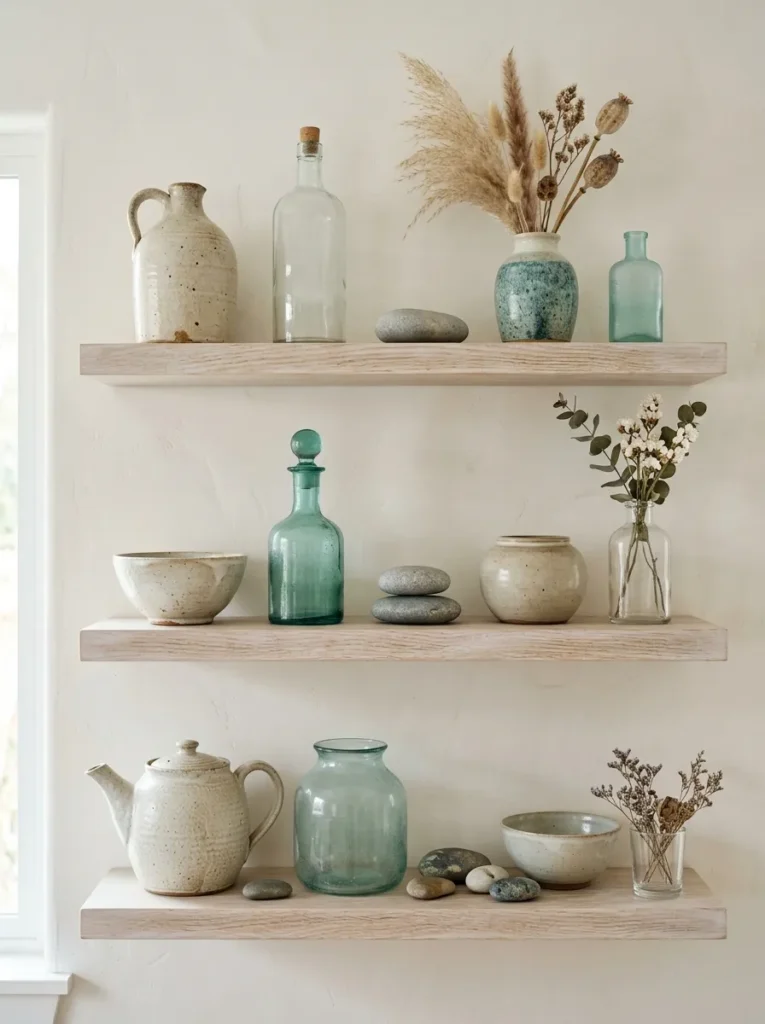
Vibe: The shelf display feels slowly collected — the kind of arrangement that took years rather than an afternoon.
Why it works: Open shelving styled with a curated coastal ceramic and glass collection applies the display design principle of material family cohesion — objects in different forms (ceramic, glass, stone) but united by a consistent material tone family (matte cream, blue-green, and warm gray) read as a collection rather than a miscellany. Salt-glaze ceramics are the most specifically coastal of all ceramic techniques — the glaze is produced by throwing salt into the kiln at high temperature, which creates the characteristic orange-peel surface texture and varied gray-brown mottling that references coastal landscape materials directly. Sea-glass tinted glass (pale blue-green) introduces the coastal color accent without the literalism of a painted ocean motif.
How to get it: Build the ceramic and glass collection gradually from a consistent color brief rather than purchasing a coordinated set — the collected-over-time quality is essential to the aesthetic, and a single-purchase matched set always reads as purchased rather than curated. Source salt-glaze ceramics from local potters, craft fairs, and pottery studios; sea-glass tinted glass bottles from antique shops, vintage markets, and specialty glass suppliers. Style the shelves using the rule of three for each shelf section: one tall object, one medium object, one low or horizontal object, with the heights varied across different sections of the shelf for visual rhythm.
Shop The Look
| Product |
|---|
| Salt-glaze ceramic vessel set natural |
| Sea-glass tinted glass bottle set |
| Whitewashed oak floating shelf set |
| Smooth stone decorative set natural |
| Dried botanical stem bundle small |
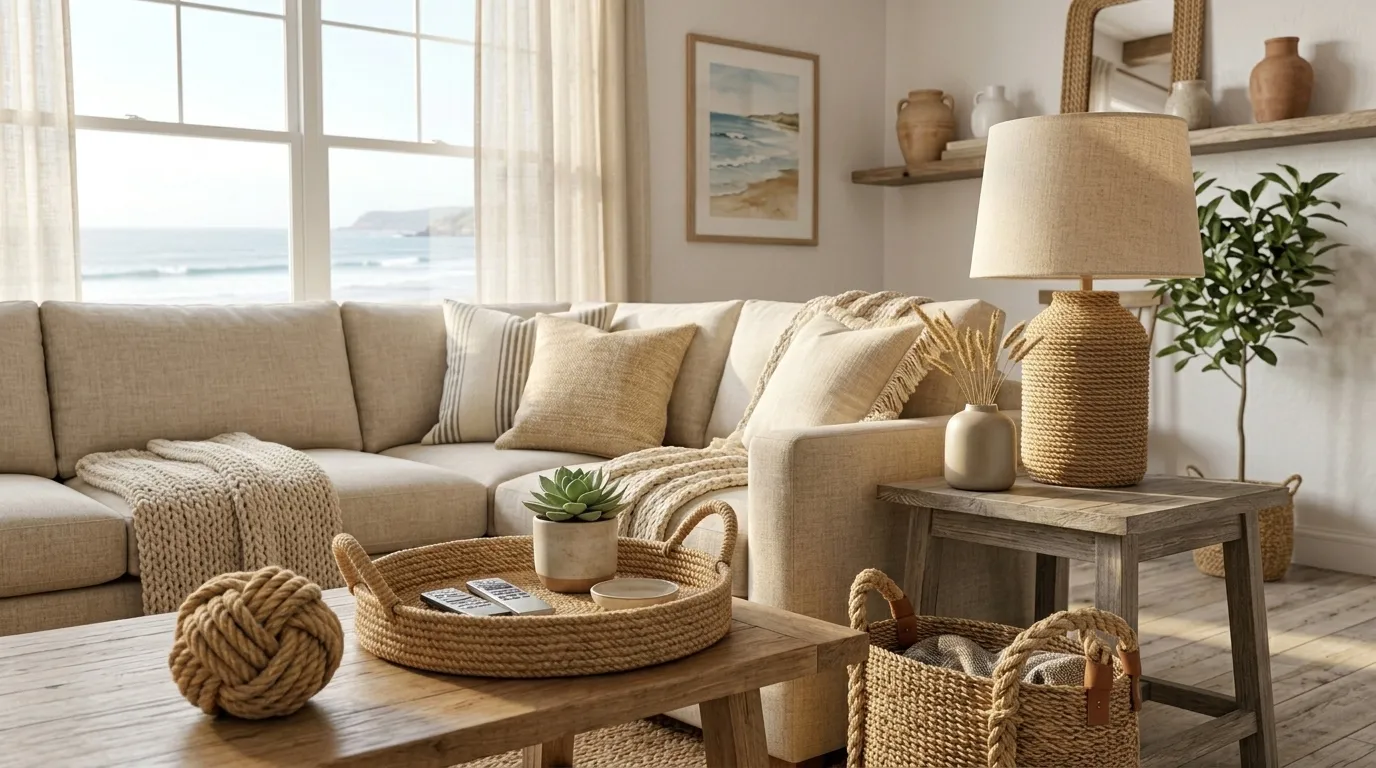
10. Natural Rope and Jute Textile Accessories for Tactile Warmth
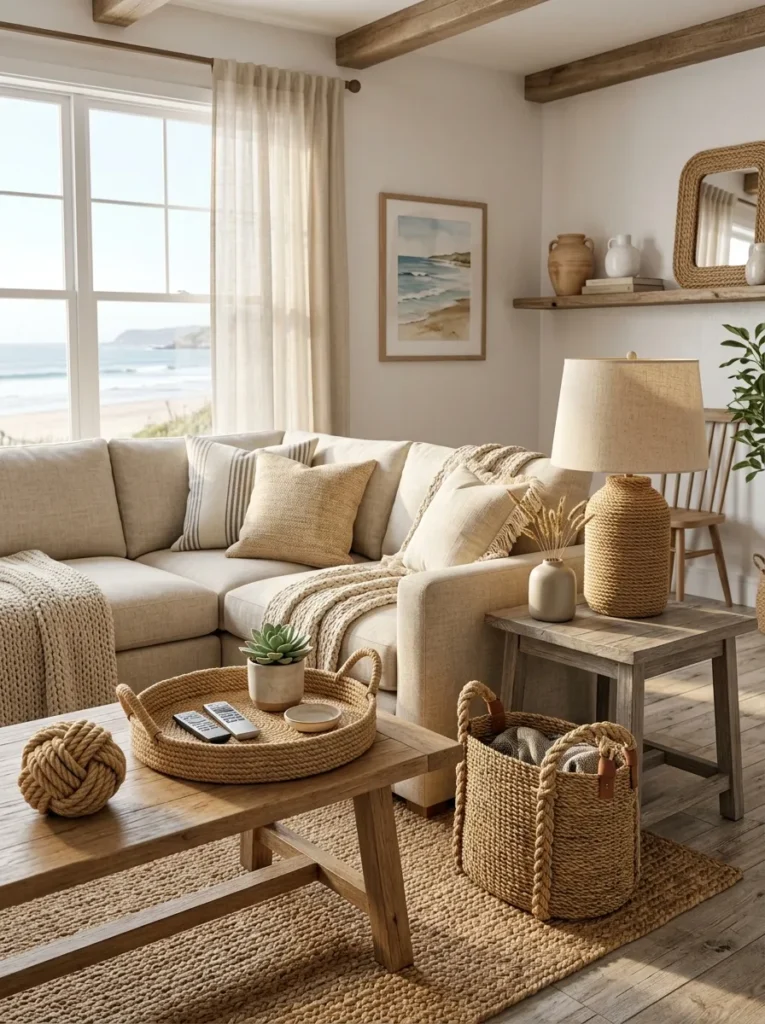
Vibe: The room feels tactile and warm — natural fiber everywhere the hand might reach, all of it inviting touch.
Why it works: Natural rope and jute textile accessories apply the sensory design principle of tactile environment coherence — when multiple objects in a room share the same material register (natural plant fiber, irregular in texture, warm in tone) the combined effect is a sensory environment that registers as warm, organic, and genuinely coastal rather than the isolated impact of any single natural fiber object. Rope specifically carries the strongest coastal material association of any domestic textile material — the functional use of rope in fishing, mooring, and boat rigging makes it inseparable from maritime culture, and its domestic use as a decorative and functional material directly translates that cultural reference into interior contexts. The critical distinction is scale and restraint — rope used as a detailed accent (a handle, a wrapped base, a coiled object) reads as coastal sophistication; rope as a dominant material (entire furniture pieces in rope, rope shelving, rope everywhere) reads as themed excess.
How to get it: Introduce natural rope and jute in at least three functional or display positions in the room simultaneously — the simultaneity creates the material coherence effect that single objects cannot. Coil a length of 12–15mm natural manila rope into a flat disc or decorative object for the coffee table ($5–12 in materials). Source jute-wrapped lamp bases from homeware suppliers or wrap existing ceramic bases with natural jute twine using craft adhesive. Use a rope-handled woven jute basket for storage beside the sofa.
Shop The Look
| Product |
|---|
| Natural manila rope 15mm 5m coil |
| Jute lamp base table lamp natural |
| Rope handle storage basket jute woven |
| Jute woven tray natural medium |
| Natural jute twine roll craft |
11. Shiplap or Tongue-and-Groove Wall Treatment for Coastal Architecture
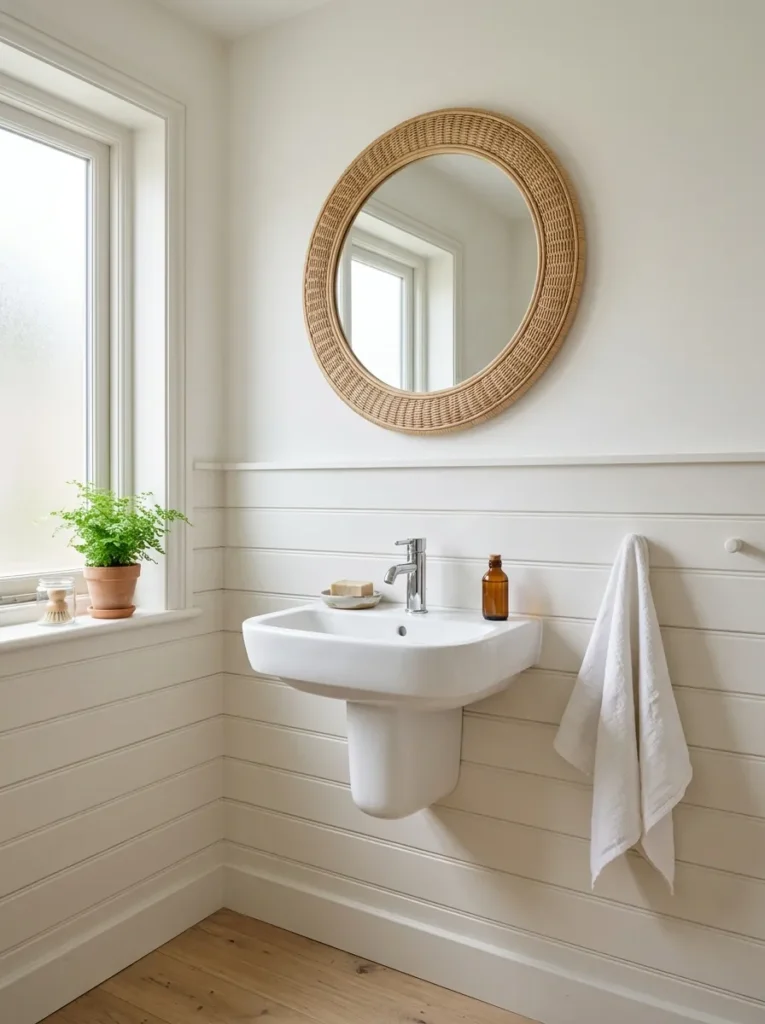
Vibe: The paneled bathroom feels like the inside of a boat — the horizontal boards referencing maritime architecture without stating it.
Why it works: Horizontal tongue-and-groove or shiplap wall paneling in warm white applies the architectural reference principle of maritime vernacular detail — the horizontal board construction used in beach huts, boathouses, and traditional coastal cottages is one of the most legible architectural coastal references available, read immediately as coastal in the same way that a pitched roof is read as domestic. Applied to a bathroom’s lower walls at wainscot height, the paneling creates an architectural feature that elevates the room from a tiled box to something with genuine material and historical character. The horizontal emphasis of the boards also visually widens a narrow bathroom — horizontal lines expand perceived width in the same way that vertical stripes expand perceived height.
How to get it: Install tongue-and-groove pine cladding boards (available as pre-primed MDF or solid pine from builders’ merchants) at wainscot height (typically 90–100cm from the floor) using panel adhesive and finish nails. Use a moisture-resistant primer and paint suitable for humid environments (bathroom-specific eggshell paints include anti-mold additives essential for longevity in a shower-adjacent environment). Apply a continuous wood trim capping piece along the top of the paneling for a clean finished edge. Paint in warm white — Farrow & Ball All White No. 2002 or Benjamin Moore White Dove OC-17 for the most resolved warm white tone.
Shop The Look
| Product |
|---|
| Tongue-and-groove pine cladding board set |
| Bathroom eggshell paint warm white |
| Rattan round bathroom mirror 50cm |
| Ceramic soap dish bathroom white |
| White linen hand towel set bathroom |
12. Coastal Gallery Wall with Watercolor and Monochrome Photography
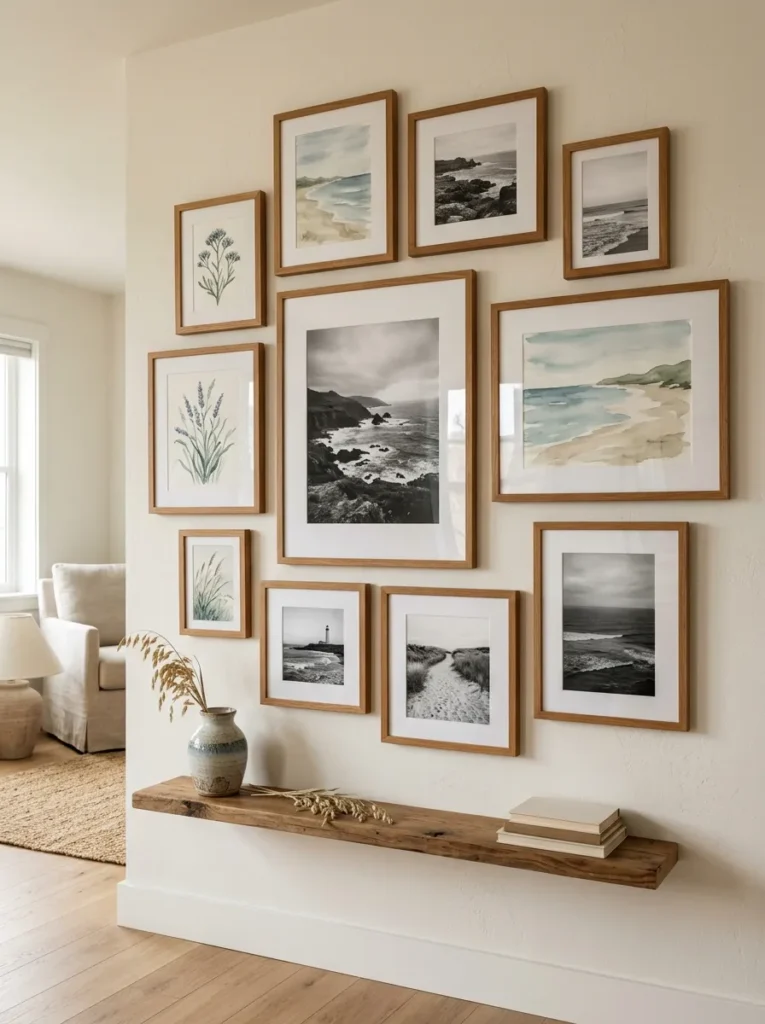
Vibe: The gallery wall feels personal and coastal without being literal — art about the coast without a single anchor or lighthouse.
Why it works: A mixed watercolor and black-and-white photography coastal gallery wall applies the curation design principle of medium variation within subject cohesion — mixing loose watercolor paintings (which capture the atmospheric, impressionistic quality of coastal light) with precise black-and-white photography (which captures the documentary, observational quality of coastal landscape) creates a gallery that reads as collected from different sources over time rather than purchased as a coordinated set. The consistent warm wood frame is the single unifying element that allows the medium variety to read as a collection rather than a mismatch. Avoiding overtly representational coastal imagery (no lighthouses, boats, or starfish) in favor of abstract seascapes, coastal botanicals, and landscape details maintains the sophisticated register appropriate for a contemporary coastal interior.
How to get it: Build the gallery over time from independent illustration and photography print sources — Etsy’s coastal art print category has hundreds of independent watercolor artists producing genuinely beautiful coastal botanical and seascape work at accessible prices ($15–45 per print). Print black-and-white photography at A4 and A5 sizes from stock photography sources for the photography component. Frame all pieces in matching warm oak frames from a consistent supplier, in varied sizes (A5, A4, A3, and one larger piece as the anchor). Arrange starting from the anchor piece and building outward, maintaining 2–3cm gaps between frames.
Shop The Look
| Product |
|---|
| Coastal watercolor art print set |
| Black white seascape photography print |
| Warm oak picture frame set assorted |
| Small ceramic vessel gallery shelf |
| Picture hanging strip set damage free |
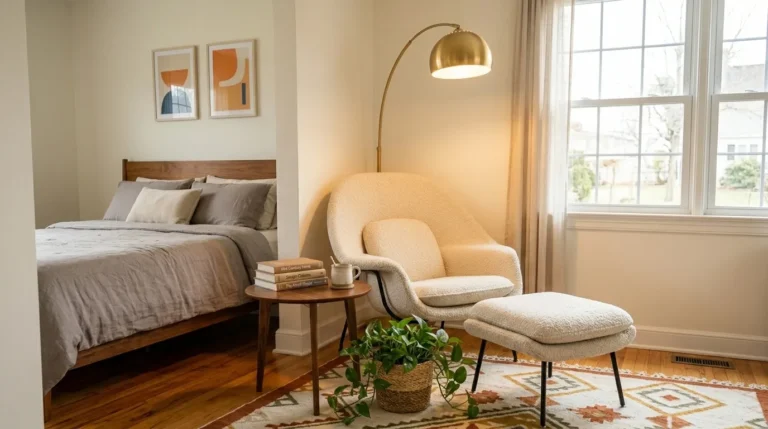
13. Woven Rattan and Bamboo Furniture for Natural Texture
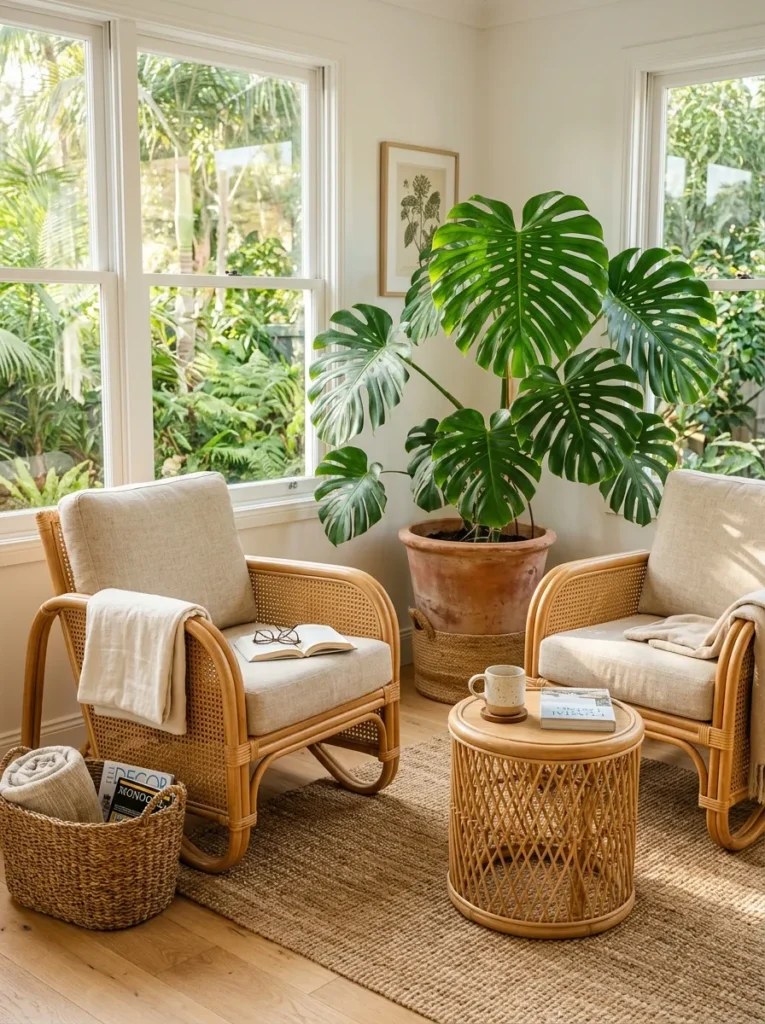
Vibe: The corner feels like a verandah on a warm afternoon — rattan and linen and tropical greenery, the specific atmosphere of a comfortable coastal retreat.
Why it works: Woven rattan furniture applies the material design principle of living material reference — rattan is a naturally growing palm vine harvested and woven into furniture forms, and its presence in a room literally introduces the cellular structure of a living plant into the domestic environment. The visual quality of rattan — the irregular honey-amber tone, the visible weave pattern at close range, the slight gloss of the outer skin — is one that no manufactured or synthetic material can replicate, because it is the product of an organic biological process rather than a manufacturing one. In a coastal context specifically, rattan references the furniture tradition of veranda and colonial beach house design that spans Southeast Asian and Indian Ocean coastal cultures, carrying that cultural warmth into contemporary interiors.
How to get it: Source natural (not synthetic wicker) rattan furniture from specialist suppliers — the difference between natural rattan and synthetic resin wicker is immediately visible at close range and in the quality of how each material ages. Natural rattan develops a warm patina over time; synthetic resin wicker fades and brittles. Specify removable, washable cushion covers in 100% linen (rather than cotton or polyester blend) for a coastal material consistency. Pair with a large-leafed tropical houseplant (monstera, banana leaf, or bird of paradise) to complete the verandah atmosphere that rattan furniture alone suggests.
Shop The Look
| Product |
|---|
| Natural rattan armchair with cushion |
| Oat linen chair cushion cover removable |
| Low rattan side table natural |
| Monstera plant large indoor terracotta |
| Woven seagrass floor basket large |
14. Ceramic Tableware in Salt-Glaze and Earthenware for Coastal Table Setting
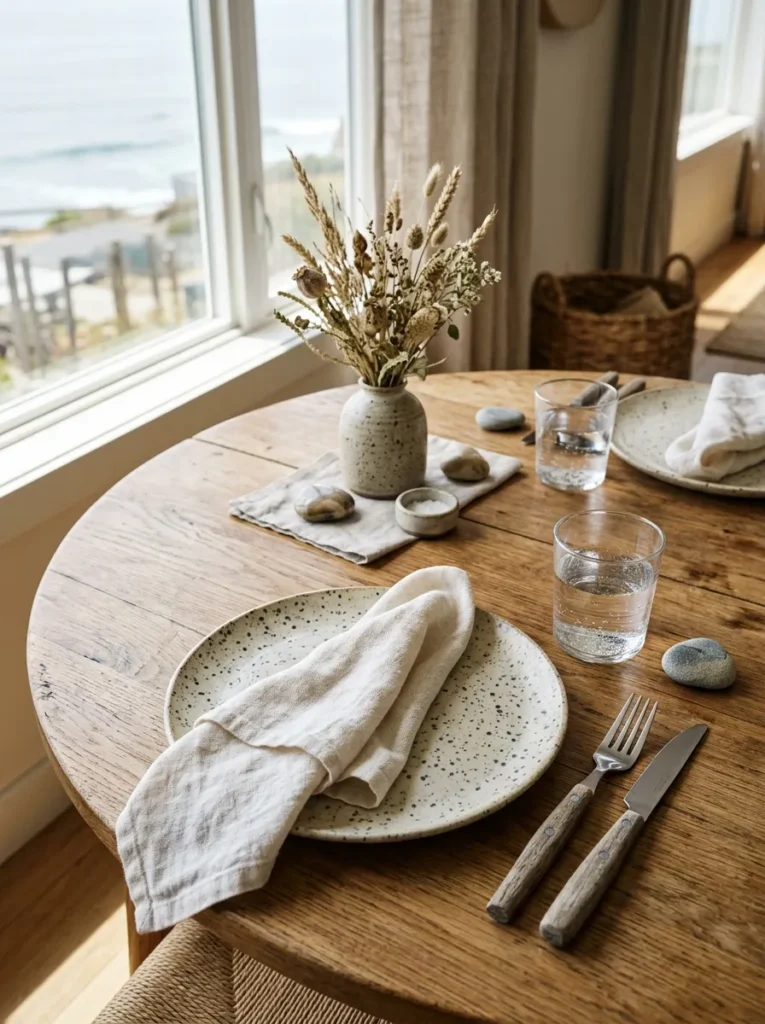
Vibe: The table setting feels warm and considered — the ceramic’s imperfection and the linen’s natural weave making the meal before it’s been served.
Why it works: Salt-glaze ceramic tableware applies the material authenticity principle at the dining scale — the irregular, speckled surface of salt-glaze ceramic is the direct physical result of a specific high-temperature kiln process that cannot be precisely controlled, meaning no two salt-glazed pieces are identical and every piece carries the evidence of its making. This material honesty (the visible process, the individual variation) is the defining quality of contemporary coastal tableware and distinguishes it from the uniform, mass-produced surfaces of standard ceramic dinnerware. Paired with undyed linen napkins (which carry the same organic, unprocessed material quality), the table setting reads as a complete and consistent material statement.
How to get it: Source salt-glaze ceramic tableware from independent potters (studio pottery at farmers’ markets, craft fairs, and Etsy) for the most authentic individual variation, or from specialty ceramics retailers (East Fork, Farmhouse Pottery, and Wonki Ware all produce production-scale ceramic tableware in the salt-glaze and speckle aesthetic at accessible prices). Specify linen napkins in undyed natural white rather than bleached bright white — the slight warmth of undyed linen coordinates with salt-glaze’s warm cream base color where pure white would contrast.
Shop The Look
| Product |
|---|
| Salt-glaze ceramic dinner plate set 4 |
| Undyed natural linen napkin set 4 |
| Driftwood handle cutlery set 4 |
| Clear glass tumbler set 4 |
| Dried grass stem centerpiece natural |
15. Coastal Outdoor Living Area with Natural Materials and Deep Shade
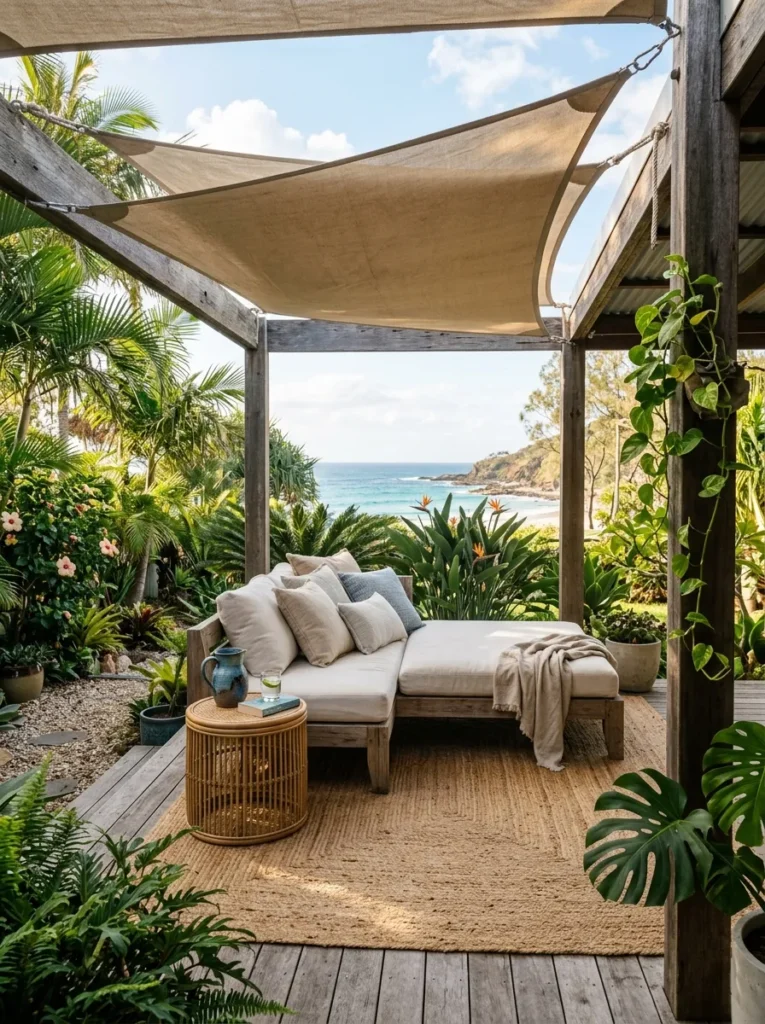
Vibe: The outdoor space feels like the best part of a beach holiday — deeply shaded, warm, and entirely unhurried.
Why it works: A coastal outdoor living area with deep natural shade applies the environmental design principle of shelter-within-openness — the specific quality of a shaded outdoor space (cool, protected from glare, surrounded by visible open landscape) is the fundamental physical experience of coastal architecture across every climate, from the deep verandahs of Australian coastal homes to the pergola-covered terraces of the Mediterranean. Deep shade is the most welfare-significant element of any outdoor coastal living area — it makes the space genuinely usable through the warmest part of the day and creates the visual contrast between the bright exterior and the cool interior that defines the coastal outdoor room’s atmosphere. Natural materials throughout (jute, teak, linen, canvas) maintain the material coherence that makes the outdoor space read as an extension of the interior rather than a separate outdoor furniture installation.
How to get it: Specify a shade sail in natural or undyed canvas (rather than synthetic fabric, which ages poorly and reads as pool equipment rather than coastal architecture) sized to cover the full outdoor living zone, attached to structure at three to four points at varied heights for natural sag and visual interest. Source a teak or reclaimed timber daybed (teak is the most weather-appropriate natural timber for outdoor coastal use due to its natural oil content) with removable cushions in marine-grade linen fabric. Lay a natural jute outdoor rug (specify indoor-outdoor jute rated for exterior use) beneath the seating arrangement.
Shop The Look
| Product |
|---|
| Natural canvas shade sail triangle large |
| Teak daybed outdoor lounge natural |
| Marine-grade linen outdoor cushion cover |
| Natural jute outdoor rug rated exterior |
| Ceramic pitcher outdoor table coastal |
How to Start Your Coastal Decor Transformation
The single best first move in any coastal decor transformation is painting or treating a single wall with a limewash or warm white mineral finish before purchasing any furniture or accessories. This wall treatment establishes the atmospheric quality — the warm, textural luminosity — that all subsequent coastal decor decisions will build on, and it does so at very low cost (a single wall limewash costs $25–45 in materials) while providing immediate, dramatic visual evidence of the direction the space is moving. Every subsequent purchase — the rattan pendant, the linen curtains, the seagrass rug — will look and read differently against the limewashed wall than it would against a flat painted or wallpapered surface, because the wall’s warmth and texture amplifies the coastal quality of everything placed near it.
The most common mistake in coastal decor is introducing too many literal coastal motifs — shells, anchors, starfish, maps, lighthouse prints, and rope knot decorations — in an attempt to communicate the coastal theme explicitly rather than atmospherically. These literal references work against the sophisticated coastal aesthetic because they announce the theme rather than embodying it, and they date quickly because they depend on the current relevance of a nautical trend rather than on the timeless material quality that defines genuine coastal design. The fix is a strict material brief: every object introduced to the space should earn its place through material quality (natural fiber, ceramic, natural timber, glass) and color coordination rather than through subject matter or coastal iconography.
Three specific items under $50 that create immediate coastal atmosphere in any room: a set of four salt-glaze or speckled ceramic mugs ($28–45, which transforms the daily coffee ritual into a material coastal moment); a jute-wrapped table lamp base ($22–35, the fastest single lighting change to introduce natural fiber to a room’s material palette); and a 2-metre length of natural manila rope coiled into a flat disc and placed on a coffee table ($6–12, the most cost-effective natural fiber sculptural accent available).
A surface-level coastal refresh — limewash accent wall, linen curtains, seagrass rug, and natural accessory edits — is achievable over a single weekend for $150–350 in materials. A mid-range coastal transformation — new furniture in natural materials, updated cabinetry paint, new lighting, and a complete textile refresh — runs $600–1,500. A full coastal room renovation — wire-brushed oak flooring, bespoke shiplap wall treatment, new kitchen or bathroom cabinetry, and complete furnishing — represents a $3,000–12,000 investment depending on room size and material specification. The limewash wall and three coastal accessories are achievable this weekend; the flooring and cabinetry transformations follow a renovation sequence determined by budget and scope.
Frequently Asked Questions About Coastal Decor Ideas
What is the difference between coastal decor and nautical decor?
Coastal decor draws from the material, atmospheric, and sensory qualities of the coastline — bleached timber, natural fiber textiles, marine-adjacent colors like blue-gray and sage-aqua, and the specific quality of diffused maritime light — without relying on maritime symbols or iconography. Nautical decor adds explicit maritime references — anchor motifs, rope details as primary decorative elements, compass roses, sailor knots, lighthouse prints, and boat hardware used decoratively. Coastal is the evolved, design-sophisticated version of nautical: it references the sea through atmosphere and material rather than through icon. In contemporary interior design, coastal is the commercially and critically dominant of the two approaches — virtually every editorial coastal interior since approximately 2015 has been free of explicit nautical motifs, while nautical decor has retreated to themed hospitality environments (seafood restaurants, beach resort bathrooms) rather than residential interiors.
What colors work best for a coastal interior?
The most effective coastal interior color palette builds from a warm neutral base (warm white, sand, oat, bleached linen) and adds selective color accents in the blue-green family. The specific coastal blues that work best have either a gray or a green undertone rather than a pure cool blue: Farrow & Ball Borrowed Light, Benjamin Moore Sea Salt, and Dulux Coastal Calm all sit in the blue-gray-green zone that reads as environmental rather than graphic. Avoid pure cool blues (which read as contemporary graphic design rather than coastal), pure aquas (which read as 1990s coastal rather than contemporary), and excessively saturated cobalt blues (which read as Mediterranean restaurant rather than residential coastal). The warmth specification is critical throughout: every coastal color should lean warm rather than cool in its undertone, because warmth is the quality that distinguishes beach house atmosphere from swimming pool aesthetics.
How do you achieve a coastal look in a room without natural light?
In a room with limited or no natural light, the coastal aesthetic requires compensation through warm artificial lighting and careful material selection. Warm-white LED bulbs at 2700K (the warmest standard LED color temperature) behind rattan or bamboo lampshades create the diffused, warm quality of natural coastal light more effectively than any other artificial lighting source. Limewash or mineral plaster wall finishes, which are designed to reflect natural light, also perform well under warm artificial light in a way that flat paint does not. Mirror placement (large mirrors positioned to face light sources, reflecting and distributing warm lamp light across the room) amplifies the sense of luminosity that natural light provides in a bright coastal room. The palette should shift slightly warmer in a low-light room — a slightly more golden sand tone on the walls rather than a pure white, and warmer oat tones in textiles rather than bright white — to compensate for the absence of natural light’s warmth.
Can coastal decor work in an inland or urban apartment?
Yes — the most successful contemporary coastal interiors are often urban apartments with no ocean view, because the aesthetic’s power comes from material quality and color rather than from geographic proximity. A studio apartment with whitewashed oak shelving, linen curtains, seagrass rug, a rattan pendant light, and walls in a warm blue-gray achieves the coastal atmosphere entirely through material choice, without any sight or sound of the sea. The key principle for an inland coastal interior is material authenticity over literal reference: avoid any decorative object that states “sea” (shells displayed as decor, fish prints, boat pictures) and focus entirely on the material palette (natural fiber, coastal timber, ceramic, glass) and the color palette (warm neutrals plus coastal blue-gray). The result is an interior that feels coastal to anyone who enters it, regardless of the view from the window.
What is the most important single element in a coastal interior?
Natural light management is the most important single element in a coastal interior, because the coastal aesthetic’s defining quality — the openness, warmth, and luminosity that makes a coastal room feel genuinely calming rather than merely decorated — is produced by the quality of light in the space rather than by any individual furniture piece or accessory. Everything else in the coastal palette (the warm whites, the natural fiber textures, the bleached timbers, the ceramic and glass) depends on appropriate light to read as coastal rather than simply pale and neutral. Linen curtains that diffuse harsh direct sunlight into soft maritime light, limewash walls that scatter warm light into the room’s depth, and warm-white artificial lighting that compensates for insufficient natural light all serve this fundamental objective. A coastal room with perfect materials and poor lighting will always read as flat; a room with modest materials and excellent warm, diffused lighting will always read as coastal.
Ready to Create Your Dream Coastal Home?
These 15 ideas move through every dimension of what makes a home genuinely coastal — from the foundational atmospheric qualities of limewash walls and linen curtains that manage light as the aesthetic’s primary tool, to the material depth of wire-brushed oak floors and salt-glaze ceramic tableware that carry coastal environmental references through material process rather than motif, to the sensory warmth of layered natural fiber rugs and natural rope accents that make the coastal interior as tactile as it is visual. Starting with the limewash wall — one accent wall, this weekend, before any furniture changes — is not a modest beginning. It is the correct beginning, because that single surface change establishes the atmospheric warmth that every subsequent purchase will build on, and it costs under $45 in materials. Pick up the limewash paint today, choose the wall that receives the most natural light, and let the surface breathe in the morning. Everything the room needs after that will become clearer once the light has something beautiful to land on. Pin the material and lighting ideas that match your room’s existing palette, and return to the furniture and flooring transformations when the walls have set the direction.