15 Mid Century Bedroom Ideas for Timeless Charm
Mid-century modern bedroom design is a style rooted in the post-World War II era of the 1940s–1960s, defined by clean lines, organic forms, and a seamless relationship between indoor living and the natural world. Here are 15 ideas for bringing timeless mid-century charm into your bedroom — from furniture profiles to palette choices to lighting that gets it exactly right.
There’s a particular quality of calm in a well-executed mid-century bedroom. The low-slung furniture that seems to elongate the room. The warm walnut grain against a backdrop of dusty sage or ochre. The lamp that casts a pool of amber light so precisely placed it could only have been intentional. Mid-century modern doesn’t chase trends — it predates them, which is precisely why it keeps coming back. Here are 15 ideas worth saving — and stealing.
Why Mid-Century Modern Works So Well
What is mid-century modern? Mid-century modern emerged in America and Scandinavia between roughly 1945 and 1969, shaped by a generation of designers — Eames, Saarinen, Nakashima, Wegner — who believed functional objects could also be genuinely beautiful. It draws from Bauhaus principles, Scandinavian craft traditions, and the post-war optimism that made experimentation feel possible. What distinguishes it from similar styles like Japandi or Danish modern is its embrace of bold accent color, playful organic curves alongside rectilinear forms, and a visible enthusiasm for new materials — molded plywood, fiberglass, spun aluminum — that were genuinely novel at the time.
Core materials and colors. The palette is warm but not heavy: teak and walnut in their natural medium-brown and honey tones, matte white or warm cream walls, and accent colors drawn from the original era — avocado green, harvest gold, burnt sienna, dusty teal, and warm terracotta. Upholstery runs to bouclé, wool tweed, and structured linen in mustard, rust, or caramel. Hardware finishes are consistently warm: brushed brass, aged gold, or patinated bronze. Legs — on everything — are tapered, splayed slightly outward, and invariably in solid wood.
Why it’s trending now. Mid-century modern has enjoyed a sustained revival for over a decade, but the current iteration feels different: less about buying replica Eames chairs and more about building rooms that carry the emotional quality of the era — warmth, craft, optimism, and the sense that objects were chosen with care. Post-pandemic nesting pushed more people toward interiors that feel genuinely personal, and mid-century’s emphasis on curated, meaningful pieces aligns perfectly with a turn away from fast furniture and disposable decor. Pinterest search data consistently places mid-century bedroom in the top five most-searched bedroom style terms year over year.
Can small bedrooms achieve this style? Mid-century modern is arguably better suited to small bedrooms than almost any other style, for one reason: its furniture sits low. A low-profile platform bed, a pair of floating walnut nightstands, and a single low dresser keep the visual horizon well below eye level, making the ceiling feel dramatically higher and the room feel more expansive than it is. The one caveat: avoid overcrowding. Mid-century rooms require breathing room between pieces — negative space is load-bearing in this aesthetic.
Style at a Glance
| Element | Detail |
|---|---|
| Philosophy | Form follows function — but function can be beautiful |
| Key Materials | Walnut, teak, bouclé, wool tweed, molded plywood, brushed brass |
| Key Colors | Warm walnut, dusty sage, harvest gold, burnt sienna, warm cream |
15 Mid-Century Bedroom Ideas for Timeless Charm
1. Low-Profile Walnut Platform Bed with Splayed Legs
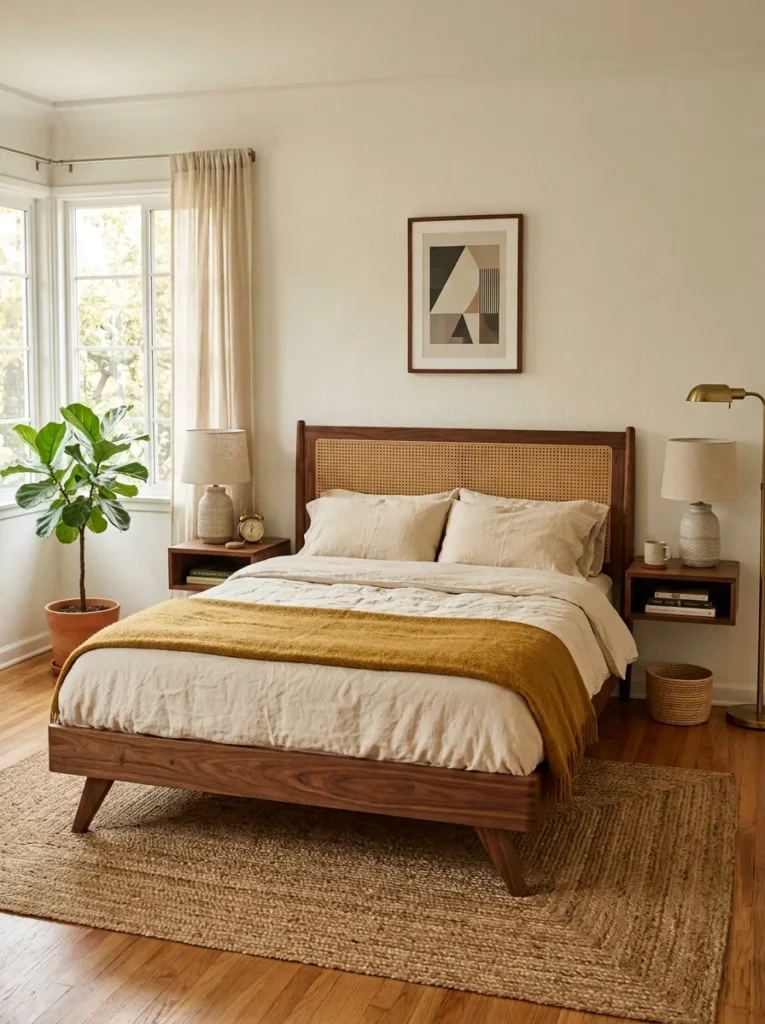
Vibe: This bed feels grounded — low and deliberate, like furniture that knows exactly what it is.
Why it works: The platform bed is the single most defining piece in a mid-century bedroom because its silhouette does the work before anything else is added. The low profile — typically 14–18 inches from floor to top of mattress — lowers the visual center of gravity in the room, which paradoxically makes the ceiling feel higher. Splayed tapered legs (angled outward at roughly 10–15 degrees) are the signature mid-century detail that separates authentic period design from modern imitation: they create a visual lightness that straight legs simply cannot achieve. A horizontal cane inset in the headboard adds texture without weight, reinforcing the era’s preference for natural materials alongside manufactured ones.
How to get it: Look for a platform bed frame in solid walnut or teak veneer with a minimum leg height of 6 inches and a visible outward splay. Pair with a cream linen duvet cover (thread count 200–300 for the relaxed, slightly textured hand that reads as mid-century rather than crisp hotel-modern) and a single wool throw in harvest gold or burnt mustard draped across the foot third of the bed.
Quick Win: A mustard yellow wool throw draped loosely across the lower third of any existing bed introduces instant mid-century color accent for under $35 — it’s the single fastest style injection in the bedroom.
Shop The Look
| Product |
|---|
| Low profile walnut platform bed frame queen splayed legs |
| Cream linen duvet cover queen 200 thread count |
| Mustard wool throw blanket mid century |
| Walnut floating nightstand wall mount set of 2 |
| White ceramic table lamp drum shade warm |
Also view: 14 Budget Backyard Ideas for Small Outdoor Spaces
2. Dusty Sage Accent Wall with Warm White Trim
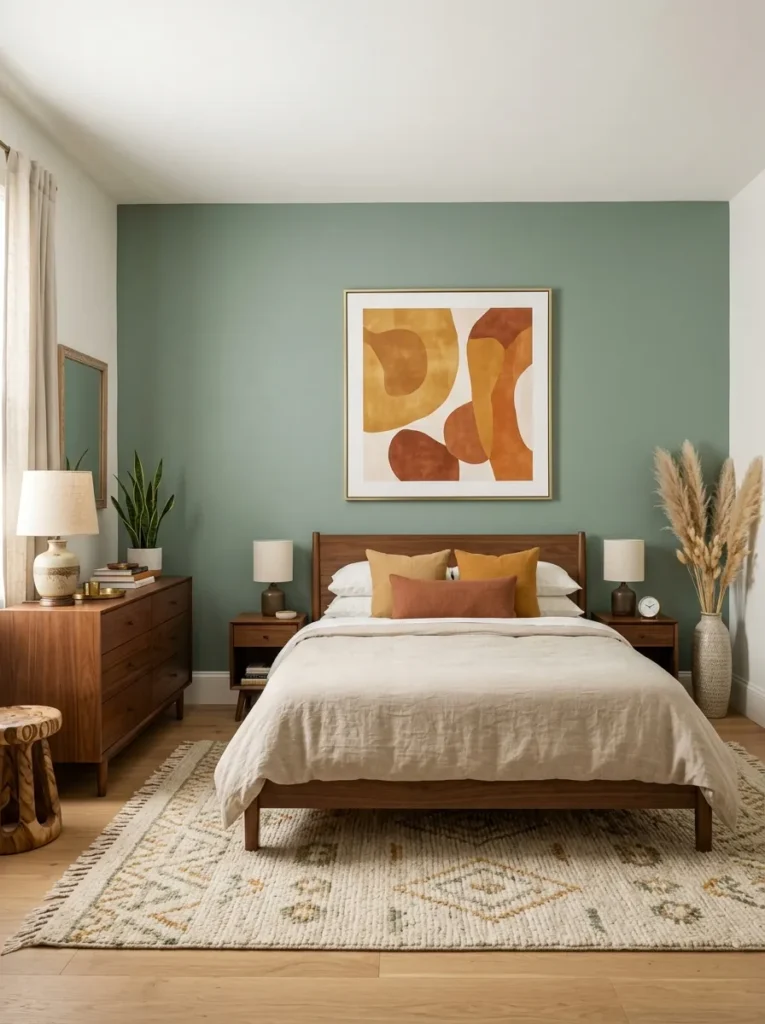
Vibe: A sage accent wall feels serene — warm enough to feel intentional, muted enough to let the furniture speak.
Why it works: Color is where mid-century bedrooms either succeed or fail at feeling authentic rather than costume. Dusty sage — a muted, grey-toned green such as Farrow & Ball’s Mizzle or Benjamin Moore’s Saybrook Sage — hits the precise tonal register of original mid-century color schemes: present but not assertive, warm but not earthy. The key design principle is contrast without competition: the sage wall provides depth behind the walnut bed, while warm white trim on the adjacent walls and ceiling prevents the room from reading dark. The large-format abstract print above the headboard in ochre and rust connects the wall color to the era’s enthusiasm for abstract expressionism.
How to get it: Paint only the headboard wall — the wall your bed sits against — in your chosen dusty sage in a matte finish (matte absorbs light and reads as more sophisticated than eggshell in this palette). Keep all trim in a warm white, not a cool bright white: Benjamin Moore’s White Dove or Chantilly Lace are the benchmark warm whites that work with mid-century palettes.
Shop The Look
| Product |
|---|
| Dusty sage green matte paint sample quart |
| Large abstract art print ochre rust framed |
| Brass picture frame 24×36 for art print |
| Ceramic floor vase tall matte white |
| Dried natural pampas grass bundle |
Also view: 15 Stylish Kitchen Ideas with Bold Functional Design
3. Bouclé Upholstered Headboard with Brass Nail-Head Detail
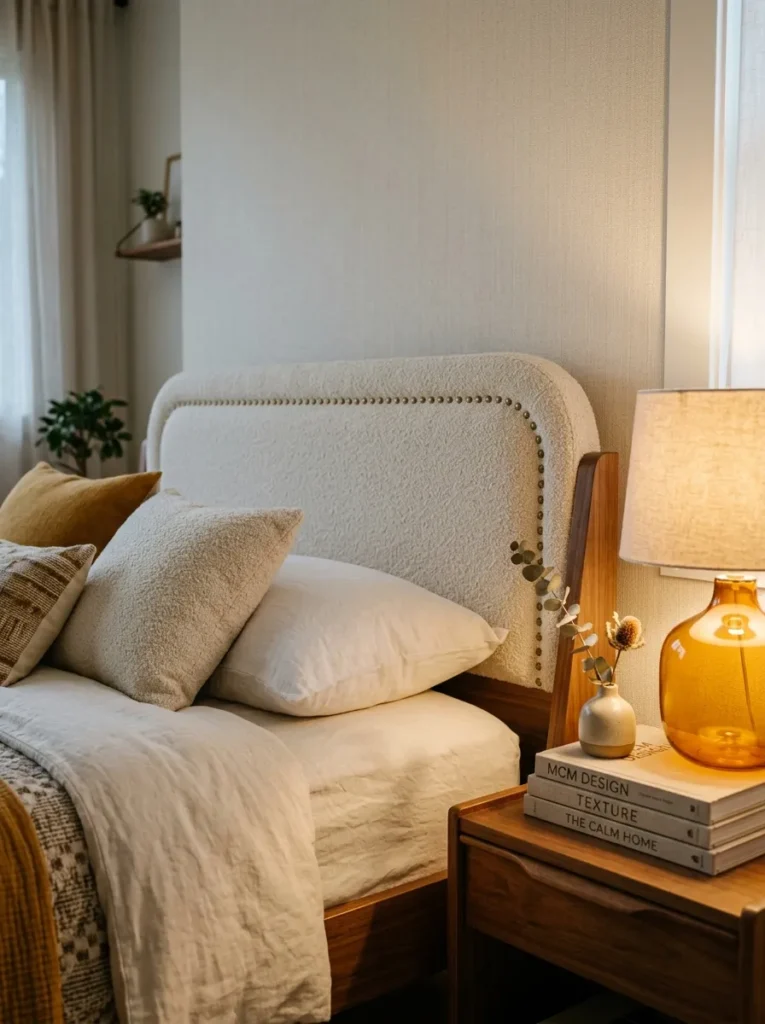
Vibe: A bouclé headboard feels textured and deliberately warm — tactile luxury that doesn’t announce itself.
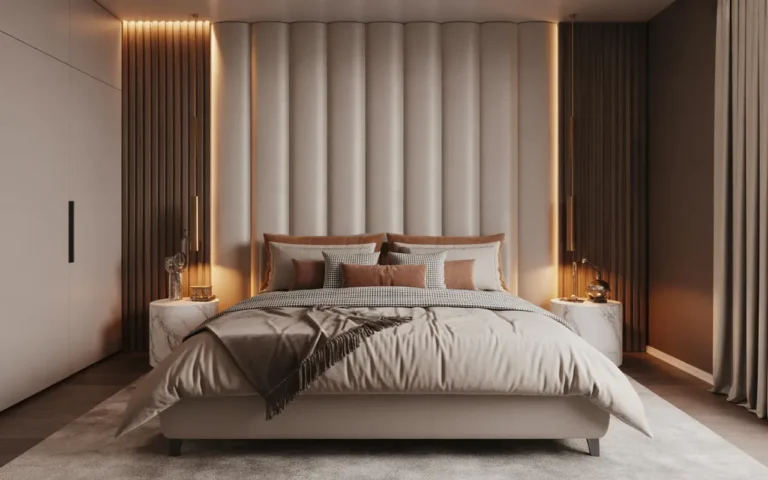
Why it works: Bouclé — a looped, nubby woven fabric — is the mid-century upholstery material having its fullest revival moment, and for good reason: it photographs with a depth and richness that flat fabrics cannot match, and it ages gracefully rather than showing wear in obvious ways. A low upholstered headboard in cream bouclé with a single row of brass nail-head trim hits three mid-century notes simultaneously: the organic texture of natural fiber, the warmth of brass metal, and the restrained decorative detail that characterizes the era’s “decoration as structure” philosophy. The headboard should be low — 36–42 inches from the floor — to maintain the horizontal emphasis that defines mid-century bedroom proportion.
How to get it: Source a low upholstered headboard in cream or oatmeal bouclé, or reupholster an existing headboard using 54-inch-wide bouclé fabric (approximately 1.5 yards for a queen headboard). Apply a single row of brass upholstery tacks spaced 1 inch apart along the bottom and side edges — pre-made nail-head trim strips make this achievable without professional upholstery experience.
Quick Win: Brass upholstery nail-head trim tape (pre-assembled on a strip) costs $15–$25 for 10 feet and can be applied to any existing upholstered headboard in under an hour — it’s the most period-accurate detail you can add without reupholstering.
Shop The Look
| Product |
|---|
| Cream bouclé upholstered headboard queen low profile |
| Brass nail head trim tape upholstery strip 10ft |
| Amber glass table lamp mid century modern |
| Small ceramic bud vase white matte |
| Dried single stem pampas or wheat bundle |
4. Walnut Credenza Repurposed as Bedroom Dresser
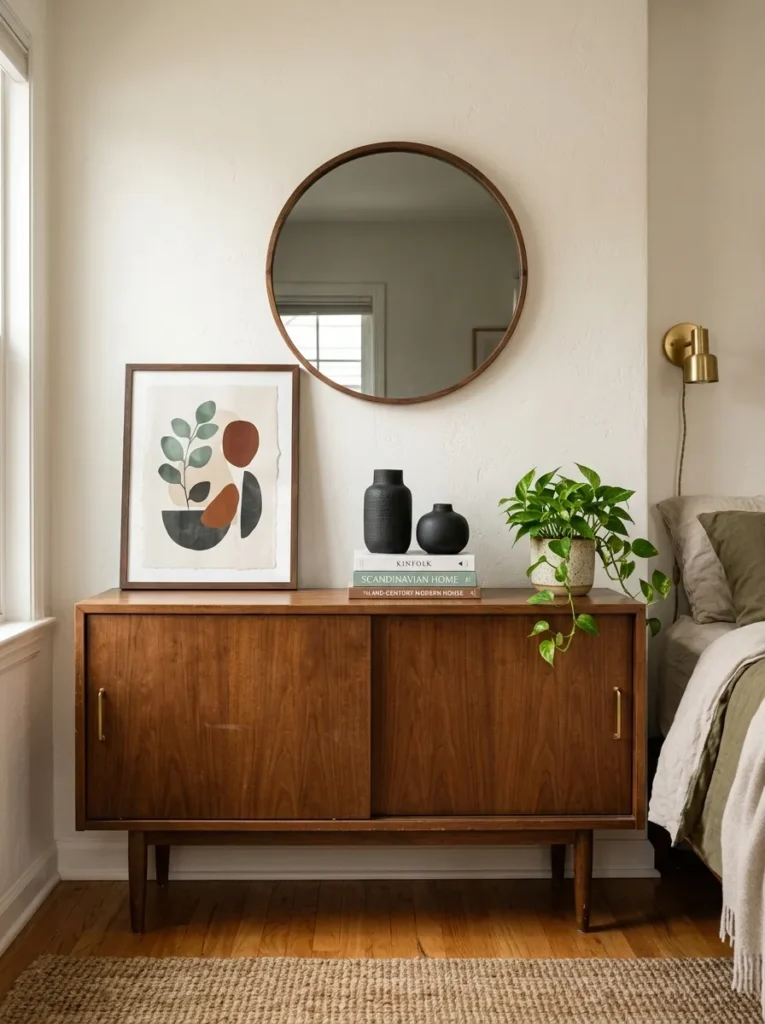
Vibe: A low walnut credenza feels considered — furniture that takes up space with total confidence.
Why it works: The credenza-as-dresser is the furniture move that most immediately identifies a mid-century bedroom as intentional rather than incidental. Standard tall dressers read as contemporary or transitional; the long, low credenza profile — typically 60–72 inches wide, 28–32 inches high — is uniquely mid-century in its horizontal emphasis and its relationship to the room’s wall as a whole piece of composition. Sliding or tambour doors eliminate the visual interruption of swinging drawer fronts, keeping the silhouette clean. Styling the top as a vignette — a round smoked mirror, a pair of ceramic vessels, a small plant — makes the credenza read as furniture plus art.
How to get it: Source a genuine vintage credenza at an estate sale, Chairish, or Facebook Marketplace (prices range from $200–$1,200 depending on maker and condition) or choose a quality reproduction in solid walnut. Mount a round smoked-glass or brass-framed mirror directly above at 6 inches from the credenza top surface — not floating high on the wall, which breaks the horizontal composition.
Shop The Look
| Product |
|---|
| Mid century modern walnut credenza long low dresser |
| Round smoked glass mirror 24 inch wall mount |
| Matte black ceramic vessel set of 2 |
| Small trailing pothos plant indoor potted |
| Coffee table book design architecture hardcover |
5. Harvest Gold Linen Curtains with Blackout Lining
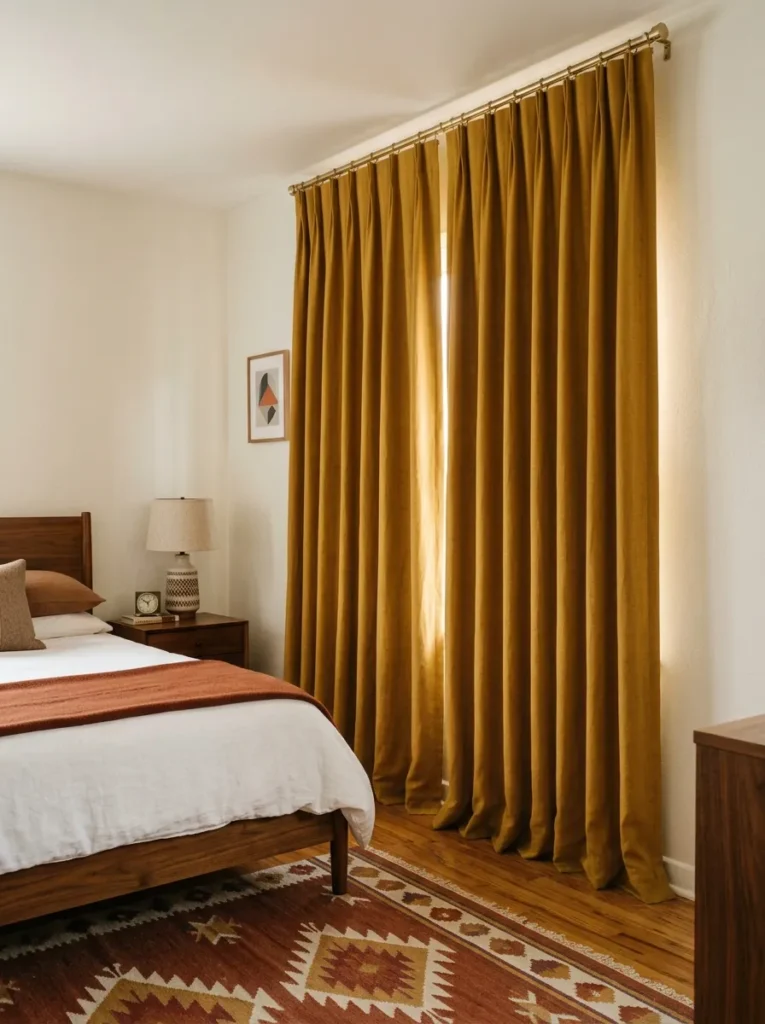
Vibe: Harvest gold curtains feel enveloping — the room wraps around you rather than simply containing you.
Why it works: Curtain color is one of the most underused tools in mid-century bedroom design, largely because most people default to white or linen. Harvest gold — a warm, muted ochre with enough brown in it to read as sophisticated rather than bright — is the period-accurate curtain color that transforms a room’s atmosphere most dramatically. Floor-to-ceiling drop (mount the rod at ceiling height, let the fabric fall to the floor) creates the illusion of height that mid-century rooms consistently used to connect interiors to their architectural volume. A pinch-pleat heading adds the structured formality that distinguishes mid-century drapery from casual contemporary panels.
How to get it: Install a slim satin brass curtain rod at ceiling height or 2 inches below the crown molding. Choose curtain panels in medium-weight linen in harvest gold or warm ochre, with a blackout lining sewn in — this is non-negotiable for a bedroom, as unlined linen lets through more light than most sleepers find comfortable. Hang at a length that creates a 1-inch puddle at the floor for period-accurate drama.
Quick Win: Mounting an existing curtain rod at ceiling height instead of window height costs nothing and immediately adds 12–18 inches of apparent ceiling height — the single most impactful no-purchase improvement in any bedroom.
Shop The Look
| Product |
|---|
| Harvest gold linen curtain panel blackout lined pinch pleat |
| Slim satin brass curtain rod adjustable 72-144 inch |
| Brass curtain rod finial set decorative end cap |
| Geometric wool area rug rust cream 8×10 |
| Brass curtain ring clip set for pinch pleat |
6. Sputnik-Inspired Ceiling Fixture in Brushed Brass
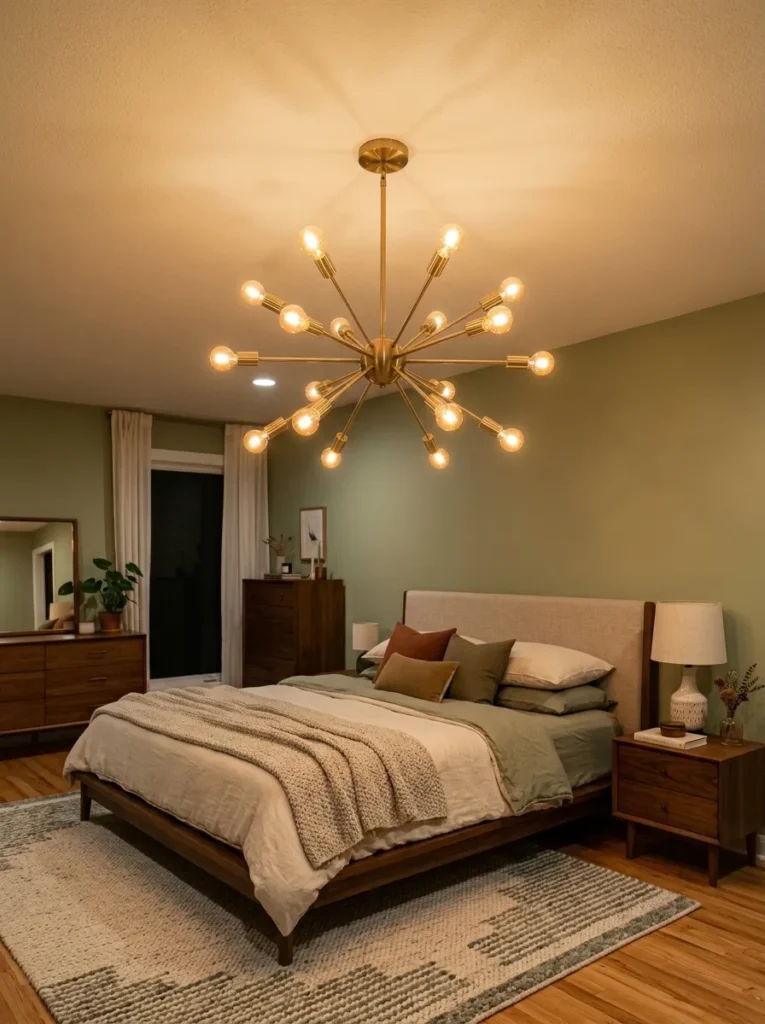
Vibe: A Sputnik fixture feels dramatic — the one element in the room that announces the era without hedging.
Why it works: The Sputnik chandelier — named after the 1957 Soviet satellite it visually echoes — is the most period-specific lighting choice in the mid-century vocabulary. Its multi-directional arms reference the Space Age enthusiasm that shaped mid-century design’s most optimistic phase, and its sculptural quality means it functions as ceiling art as much as light source. Brushed brass is the correct finish for a bedroom application: warm enough to be intimate, matte enough to avoid the gilt quality that tips into a different era. The fixture works best centered over the bed rather than centered in the room — this keeps the light source functionally relevant to where you need it most.
How to get it: Choose a Sputnik fixture with 8–16 arms and globe-style Edison or G9 bulbs in a 2200–2700K color temperature — this warm range is essential for bedroom atmosphere. Install on a dimmer switch (compatible with the fixture’s bulb type) so the fixture serves both ambient and accent lighting purposes depending on the time of day.
Shop The Look
| Product |
|---|
| Brushed brass sputnik chandelier 12 arm bedroom |
| G9 LED warm white globe bulb 2700K set of 6 |
| Dimmer switch compatible LED wall plate |
| Walnut platform bed low profile queen frame |
| Sage green matte paint quart sample |
7. Geometric Wool Rug in Rust, Cream, and Teal
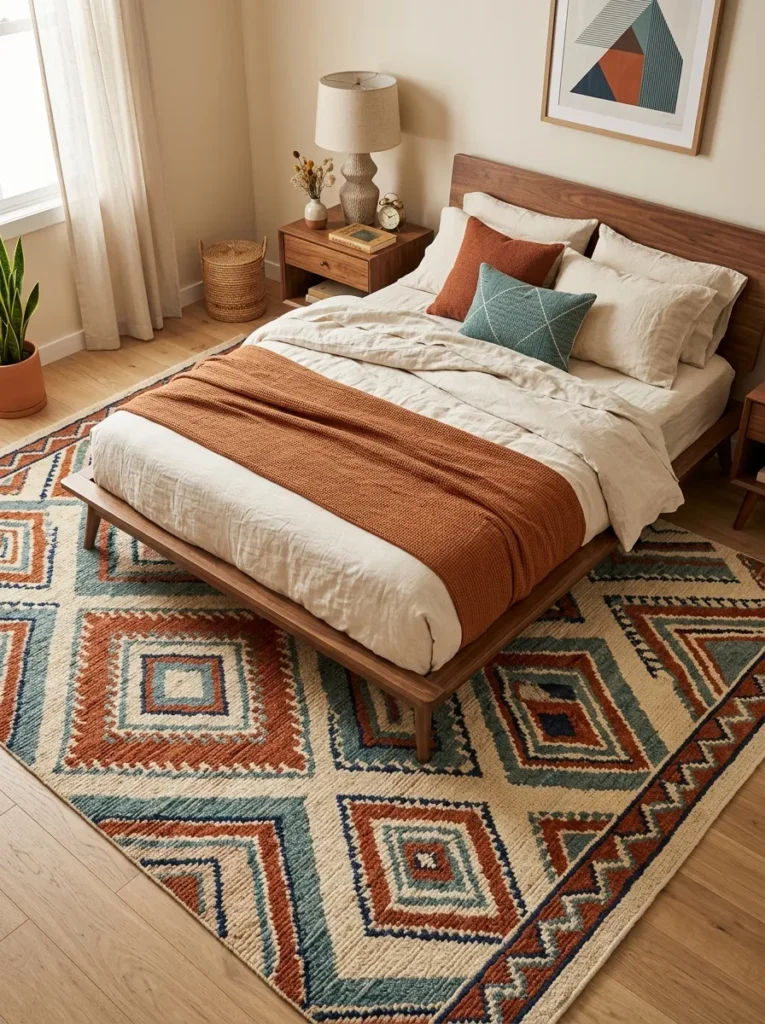
Vibe: A bold geometric rug feels layered — the room’s visual anchor that gives every other element permission to be calm.
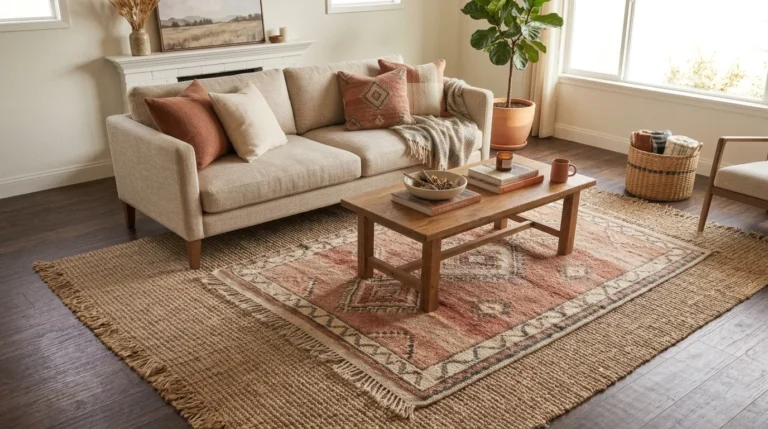
Why it works: The rug is where mid-century bedrooms introduce pattern, and the pattern language is specific: geometric rather than floral, bold in graphic quality but muted in color saturation. A rust-and-teal combination on a cream ground directly references the original period color relationships — teal (often called “atomic turquoise” in period design) paired with rust or burnt orange is as authentically mid-century as a tapered leg or a Sputnik fixture. The wool material adds texture that reads as crafted and warm, preventing the geometric pattern from feeling cold or graphic. Sizing matters: the rug should extend at least 18 inches beyond the bed on the sides and foot.
How to get it: Choose a hand-tufted or hand-knotted wool rug (or a high-quality power-loomed wool blend for budget-conscious applications) in a geometric pattern — diamond, chevron, or abstract grid — in a palette of rust, dusty teal, and cream. Size up: a queen bed bedroom needs at least an 8×10 rug, and a 9×12 is rarely wrong.
Quick Win: A 5×8 geometric wool rug placed at the foot of the bed rather than underneath it costs significantly less than a full room-size rug and still introduces the pattern and color accent the style requires — start here if the full-size investment feels large.
Shop The Look
| Product |
|---|
| Geometric wool area rug rust teal cream 8×10 |
| Non-slip rug pad for hardwood floor 8×10 |
| Walnut tapered leg nightstand bedside table |
| Ceramic drum table lamp warm white shade |
| Cream linen euro sham set of 2 |
8. Teak Floating Nightstands at Precise Mattress Height
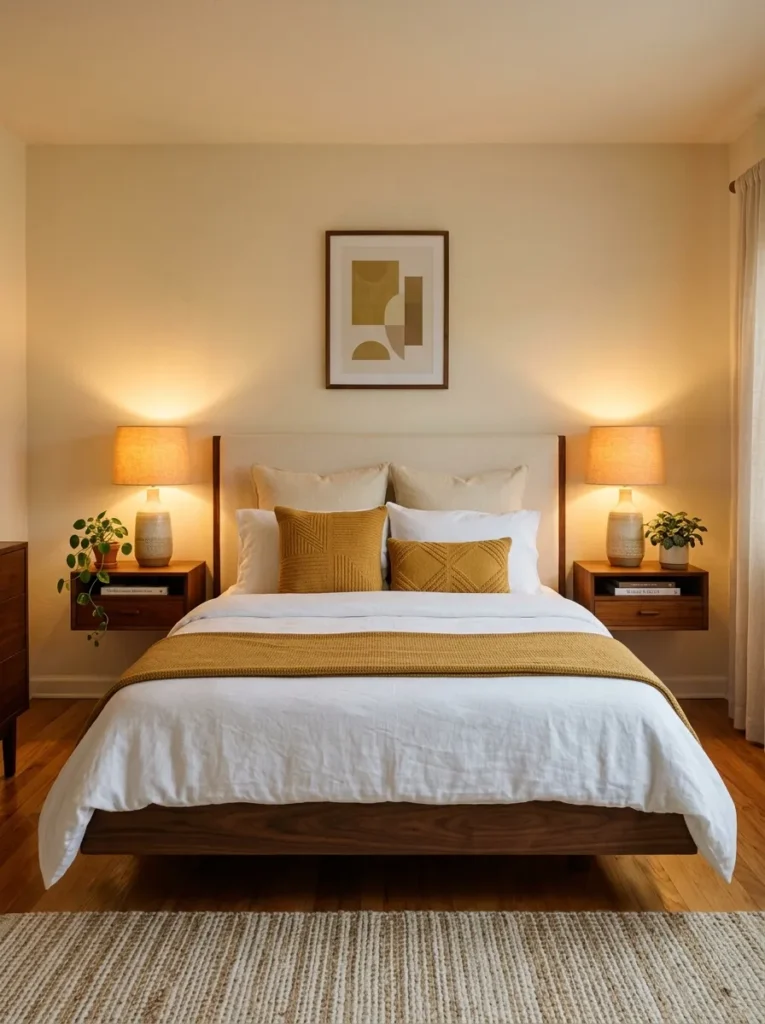
Vibe: Symmetrical floating nightstands feel balanced — the visual steadiness of a room that has been genuinely thought through.
Why it works: Floating nightstands are a mid-century design solution that solves a practical problem with visual elegance: by eliminating the legs of a traditional bedside table, they keep floor space visually open, which amplifies the low-profile quality that the platform bed creates. Mounting them at exact mattress height — not 2 inches above or below, but precisely level with the top of the mattress — is the detail that distinguishes a well-executed mid-century bedroom from one that just has the right furniture. Teak, slightly lighter and more golden than walnut, reads as warmer against a cream or sage wall and was the dominant wood species of Scandinavian mid-century production.
How to get it: Install floating nightstand brackets rated for at least 50 lbs per shelf. Measure your mattress height and mount the bracket so the shelf surface sits flush with the mattress top — this typically means the mounting bracket center sits at mattress height minus 1 inch. Teak or walnut floating shelves in 18×12-inch dimensions are the right scale for most queen and king beds.
Shop The Look
| Product |
|---|
| Teak floating wall shelf nightstand 18×12 inch |
| Invisible floating shelf bracket heavy duty set 2 |
| Small ceramic bedside table lamp warm white |
| Mini trailing plant pot small indoor |
| Mustard linen throw pillow cover set 18×18 |
9. Abstract Expressionist Art Grouping Above the Bed
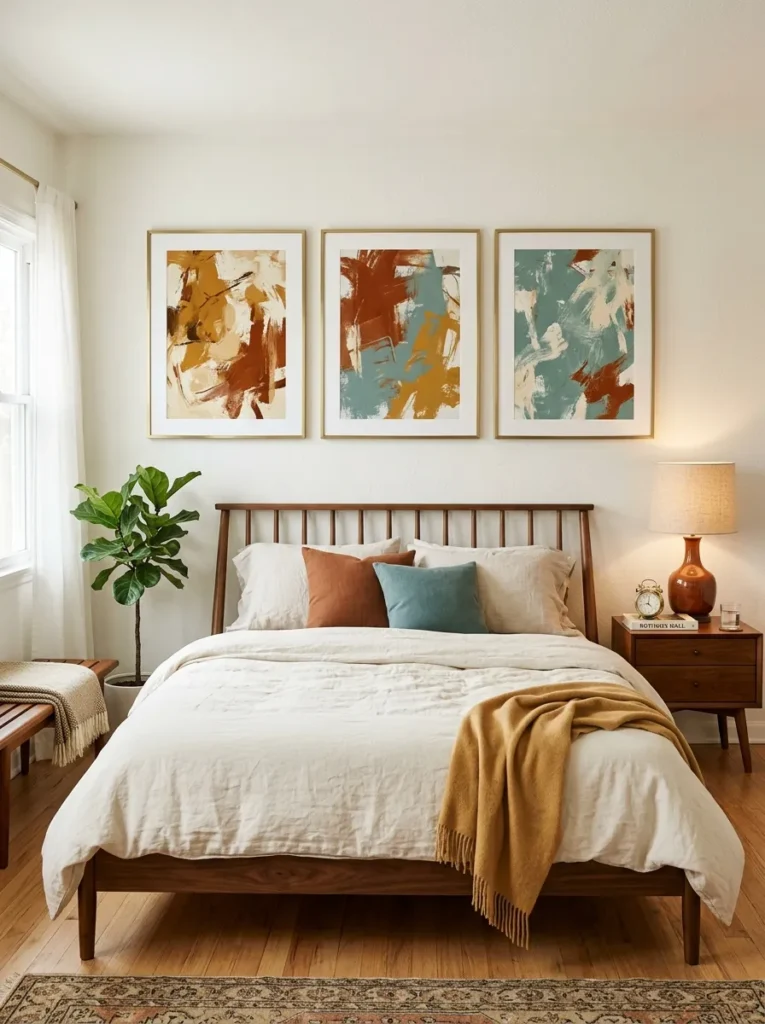
Vibe: An art grouping above the bed feels artistic — the bedroom as a room that takes creativity seriously.
Why it works: Abstract expressionism — the dominant art movement of the mid-century era — is the natural art language of the mid-century bedroom. A grouping of three prints in a horizontal arrangement references the gallery wall format that original mid-century homes used to bring museum-quality work into domestic spaces. Slim brass frames with a generous white mat allow the artwork to read clearly without the frame competing with the colors inside, and the horizontal format (three 18×24 prints in a row, spaced 3 inches apart) mirrors the horizontal emphasis of the bed below, reinforcing the compositional logic of the whole wall. The color palette of the art — ochre, sienna, teal — should deliberately echo the room’s accent colors.
How to get it: Source three abstract prints from Society6, Etsy, or a local art fair in a consistent size (18×24 is the most versatile for a queen bed wall). Frame identically in slim brass or warm gold frames with a 2-inch white mat. Mount them in a horizontal row with the center of the grouping at 57 inches from the floor (the standard art hanging height) and 3 inches of spacing between frames.
Quick Win: Three matching poster frames in brass or warm gold from any home goods retailer cost $15–$25 each, and printable abstract art downloads from Etsy run $5–$15 per file — a full three-print gallery wall above the bed can be assembled for under $90.
Shop The Look
| Product |
|---|
| Slim brass picture frame 18×24 with white mat |
| Abstract expressionist art print ochre teal set of 3 |
| Picture hanging strip set damage free |
| Spirit level small for art hanging |
| White matboard pre-cut 18×24 for framing |
10. Walnut Dresser with Angled Legs and Brushed Brass Pulls
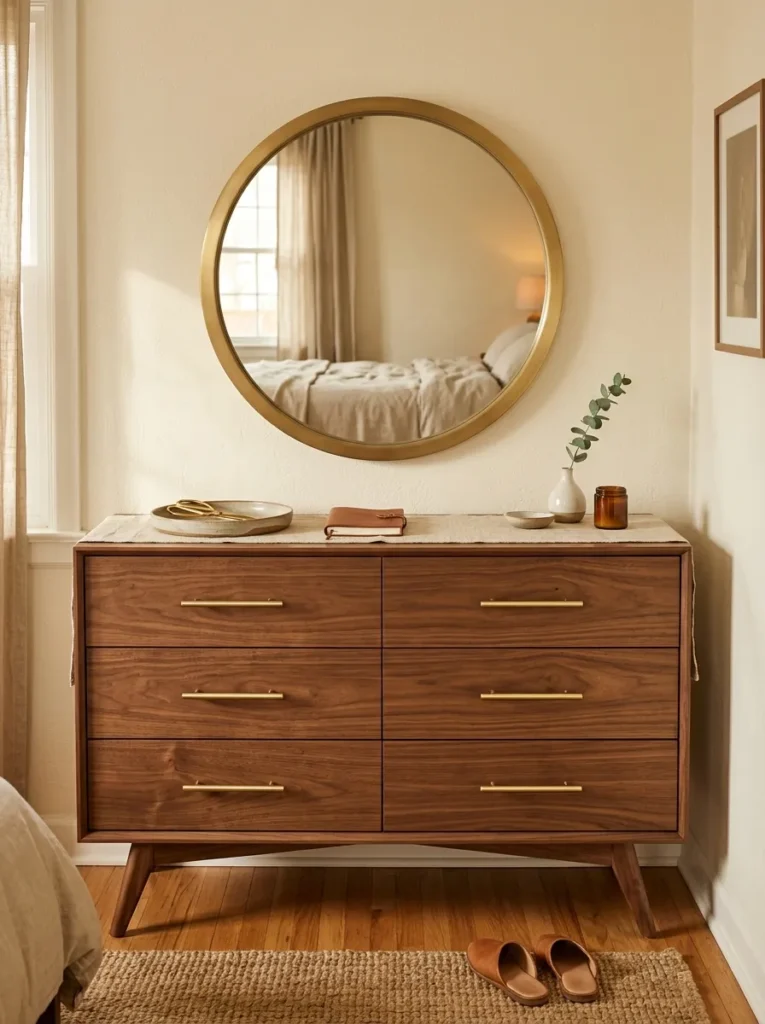
Vibe: A walnut dresser with brass pulls feels grounded — furniture built to last a generation that looks like it already has.
Why it works: Hardware is where mid-century bedroom furniture is most often diluted by contemporary substitution — changing out brushed brass bar pulls for chrome or matte black immediately pushes the piece out of the era and into a different design language. Elongated bar pulls (the rectangular bar pull, 4–6 inches long) are the most period-accurate hardware choice for mid-century case goods, referencing the handle designs used by Drexel, Heywood-Wakefield, and Danish producers throughout the 1950s and 60s. The angled leg is the structural detail that confirms authenticity — even a reproduction dresser reads as correct when the leg has that characteristic outward splay and taper to a fine point.
How to get it: Upgrade any existing walnut-toned dresser by replacing hardware with brushed brass 4-inch bar pulls — a set of 12 pulls costs $30–$60 and takes under an hour. For the top vignette, place a ceramic tray as a base layer, then a single ceramic bud vase with one dried stem, then one or two small objects of personal meaning. Keep it to three items maximum — mid-century styling is edited, not collected.
Shop The Look
| Product |
|---|
| Brushed brass bar pull 4 inch set of 10 |
| Mid century walnut six drawer dresser tapered legs |
| Round brass framed mirror 24 inch |
| Ceramic decorative tray oval warm white |
| Linen dresser scarf runner natural |
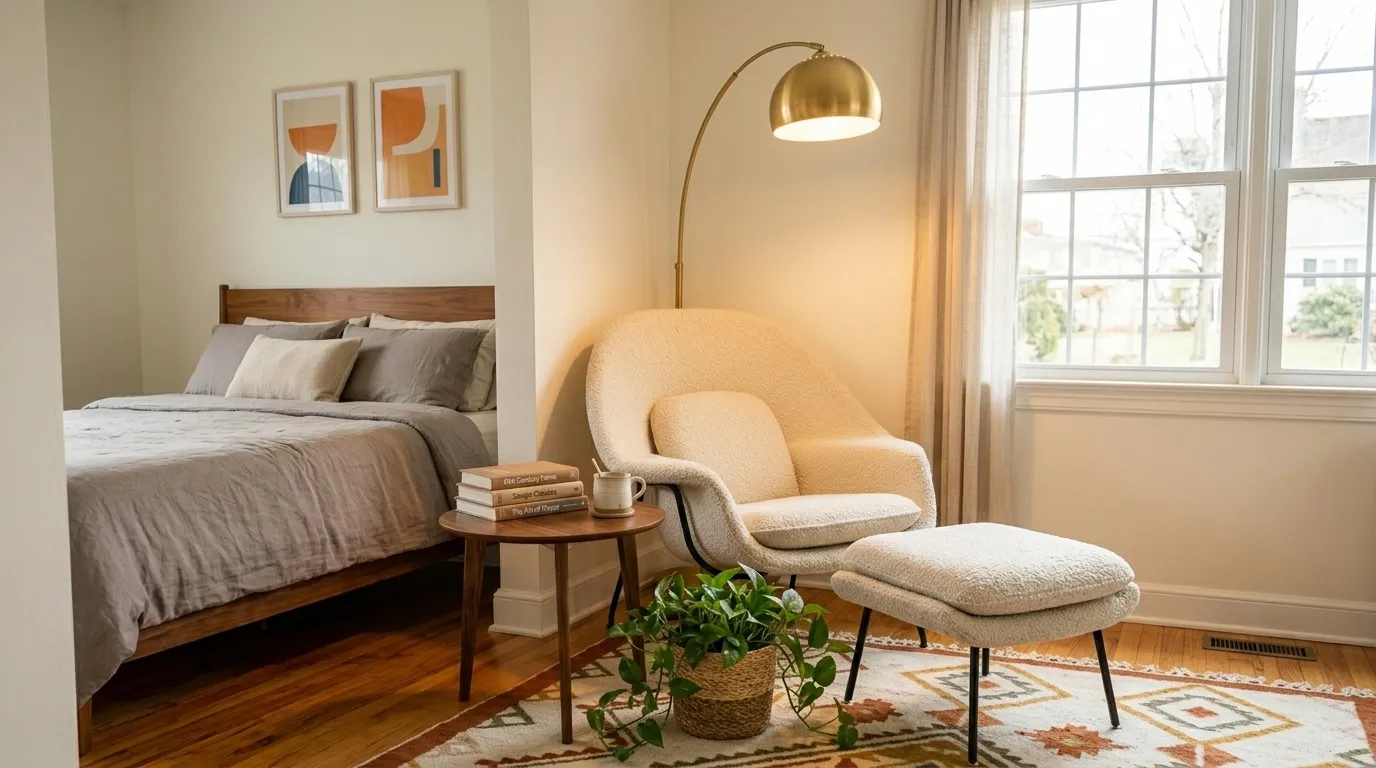
11. Womb Chair Reading Corner with Arc Floor Lamp
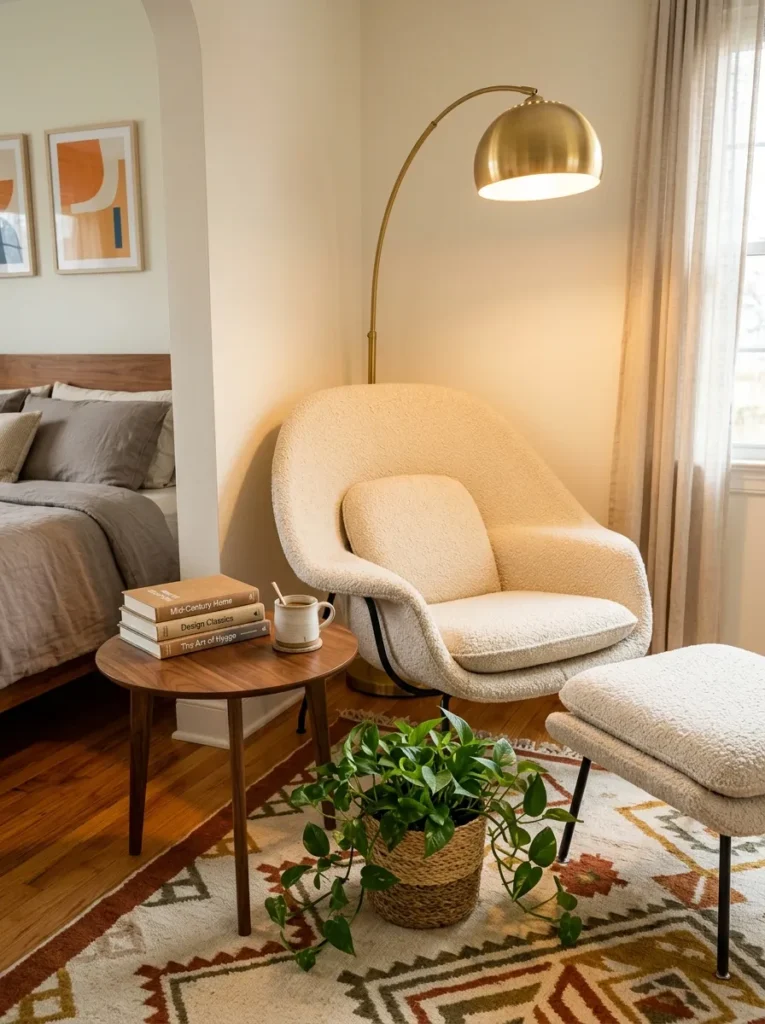
Vibe: A reading corner with an arc lamp feels inviting — a complete world in a single corner of the room.
Why it works: The reading corner is the functional zone that transforms a mid-century bedroom from a sleeping room into a living space — and the furniture combination of a curved accent chair and an arc floor lamp is both the most historically accurate and practically useful arrangement in the mid-century vocabulary. The womb or tulip-form chair (a deep curved seat shell on a pedestal or four splayed legs) reflects the era’s embrace of organic form alongside the geometric, providing visual counterpoint to the rectilinear lines of the bed and dresser. The arc floor lamp — with its curved reach over the chair — provides task lighting with a sculptural presence that a table lamp cannot match.
How to get it: Designate a bedroom corner opposite the bed as the reading zone. Position a curved accent chair (womb, tulip, or egg silhouette) facing into the room at a slight angle to the corner. Place an arc floor lamp so its head is approximately 18 inches above and 12 inches in front of the chair’s center. Add a small circular walnut side table (20-inch diameter) beside the chair’s right arm.
Quick Win: A reproduction arc floor lamp in brushed brass costs $80–$150 and creates the entire reading corner atmosphere before any chair is purchased — even an existing armchair reads as mid-century beneath the right light source.
Shop The Look
| Product |
|---|
| Cream bouclé accent chair womb style curved |
| Arc floor lamp brushed brass adjustable arm |
| Small round walnut side table 20 inch |
| Hardcover design coffee table books set |
| Woven jute plant pot cover medium |
12. Terracotta Linen Bedding with Textured Pillow Layering
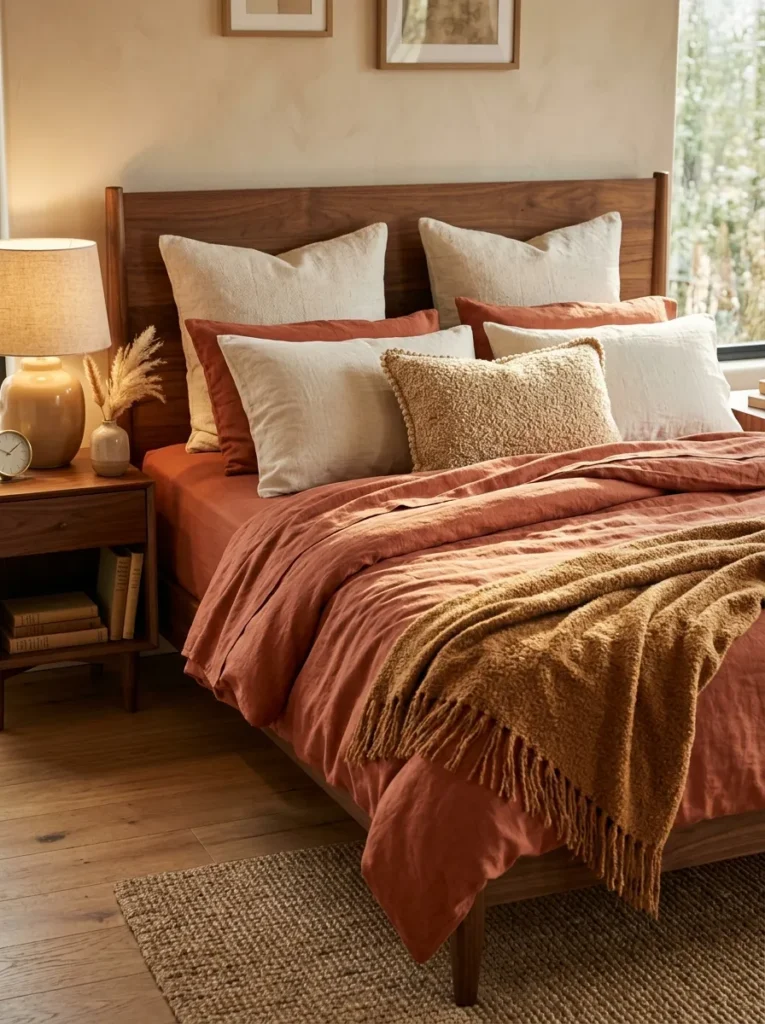
Vibe: Terracotta linen bedding feels sun-warmed — the exact texture and color of an afternoon that never quite cools down.
Why it works: Bedding is the largest surface area of color and texture in a bedroom, and terracotta — a warm, muted red-orange with enough brown in it to avoid feeling saturated — is the mid-century accent color that reads most warmly against walnut wood tones. Washed linen is the correct fabric: its subtle crinkle texture photographs as deliberately relaxed, and its ability to absorb and reflect warm light differently from flat cotton gives the bed a visual depth that reads as styled without being precious. Pillow layering in mid-century bedrooms follows a specific hierarchy: two sleeping pillows, two euro shams behind, and one accent pillow in a contrasting texture — bouclé or wool tweed — at the center front.
How to get it: Start with a washed linen duvet cover in terracotta or brick clay (wash it three times before first use to achieve the desired softened texture). Add two cream linen euro shams behind the sleeping pillows. Finish with a single 20×20 bouclé accent pillow in caramel or warm oatmeal at center. The bed should look made but not architectural — mid-century bedrooms are lived in, not staged.
Shop The Look
| Product |
|---|
| Terracotta washed linen duvet cover queen |
| Cream linen euro pillow sham set of 2 |
| Bouclé accent pillow cover 20×20 caramel |
| Caramel knit throw blanket lightweight |
| Walnut wood tray nightstand styling accessory |
13. Hairpin Leg Desk Nook in Compact Bedroom Corner
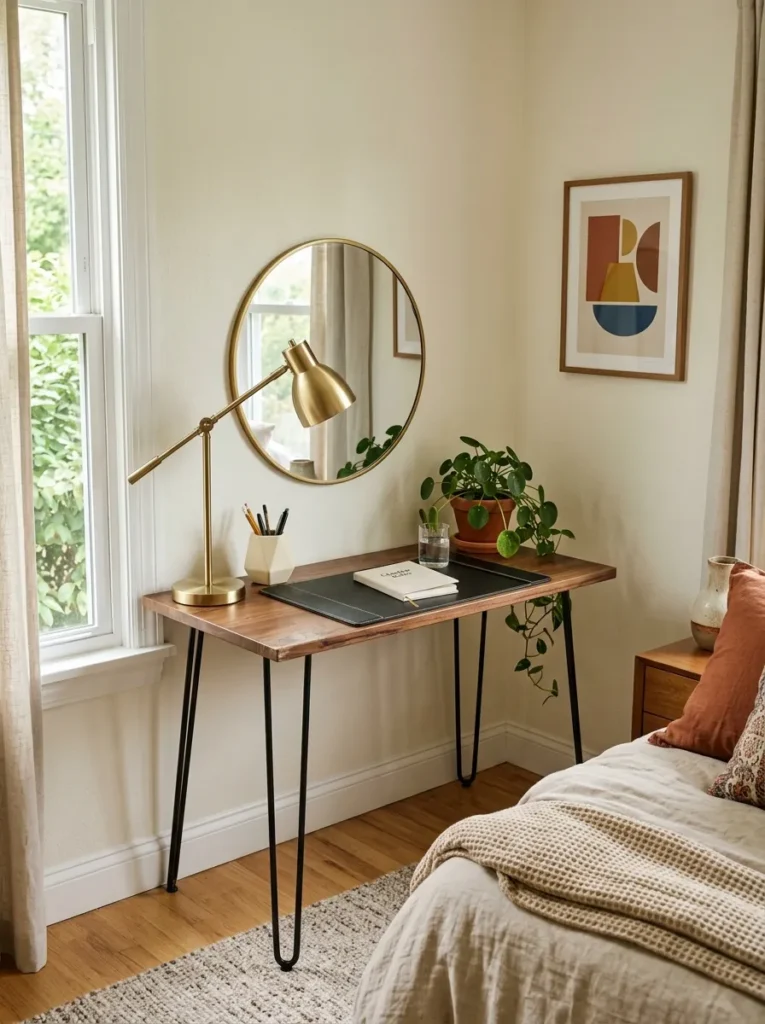
Vibe: A hairpin leg desk nook feels purposeful — compact, considered, and completely sufficient.
Why it works: The hairpin leg — two or three steel rods welded to a flat base — is the structural element that most efficiently communicates mid-century modern in a small bedroom where a full reading chair won’t fit. Its visual weight is nearly zero (the negative space between the rods reads as air), keeping even a small bedroom feeling open rather than crowded. A walnut desk surface on black hairpin legs is simultaneously a workspace, a vanity, and a decorative moment — three functions in a footprint of approximately 48×20 inches. The black hairpin in contrast with warm walnut is the signature material pairing that reads as authentic to the early 1950s industrial-meets-craft ethos.
How to get it: Purchase a set of four hairpin legs in 28-inch height (standard desk height) in matte black. Source a solid walnut or walnut veneer board cut to 48×20 inches from a lumber supplier, sand to 220 grit, and finish with two coats of matte polyurethane. Attach the legs with the included screws. Total material cost: $80–$140 for a desk that reads as considered and bespoke.
Quick Win: A set of four 28-inch hairpin legs costs $40–$60 and can be attached to any solid wood board from a home improvement store in under 30 minutes — this is the fastest DIY furniture project with the highest mid-century style payoff.
Shop The Look
| Product |
|---|
| Black hairpin leg set of 4 28 inch desk height |
| Adjustable brass task lamp desk clamp or base |
| Black leather desk mat 24×14 inch |
| Small geometric ceramic pen and pencil holder |
| Round mirror 18 inch wall mount bedroom vanity |
14. Warm Amber Lighting with Edison Globe Bedside Lamps
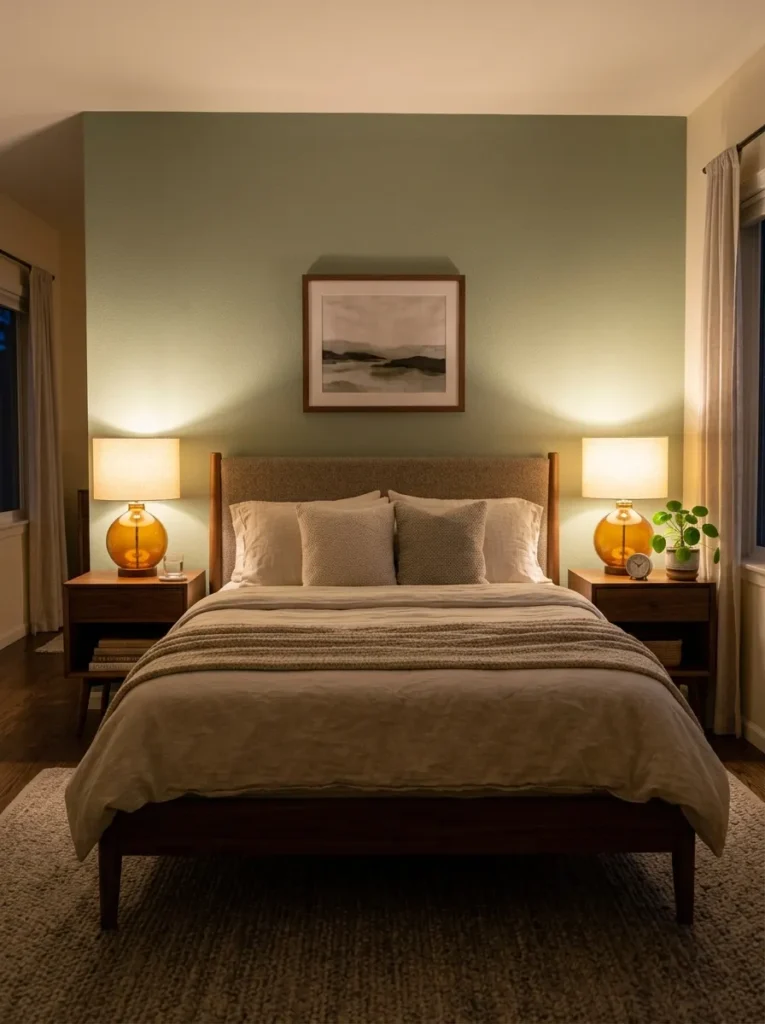
Vibe: Amber globe lamps at dusk feel intimate — the room contracts warmly around the light sources and everything outside them recedes.
Why it works: Lighting color temperature is the invisible variable that determines whether a mid-century bedroom feels warm and authentic or cold and clinical, and the correct temperature is unambiguous: 2200–2700K, which produces the amber-to-warm-white range that incandescent and early LED bulbs in this era approximated. Amber glass lamp bases amplify this effect by tinting the light source itself, creating a warm glow rather than simply warm illumination. Symmetrical bedside lamps on matching nightstands apply the bilateral composition principle that mid-century bedroom photography consistently used — it creates visual balance that reads as considered even before any other design decision is made.
How to get it: Choose bedside lamps with amber or smoked glass bases and cream linen drum shades — the shade should be opaque enough to direct light downward and outward rather than upward (uplighting in a bedroom creates unflattering shadows and disrupt sleep-conducive atmosphere). Use LED filament bulbs at 2200K, 40-watt equivalent, for authentic amber color without heat.
Shop The Look
| Product |
|---|
| Amber glass globe table lamp cream linen shade |
| LED filament globe bulb 2200K 40w equivalent set 2 |
| Walnut bedside table nightstand small |
| Small ceramic planter pot indoor bedside |
| Linen hardcover book set decorative |
15. Small-Space Mid-Century Bedroom with Floating Everything
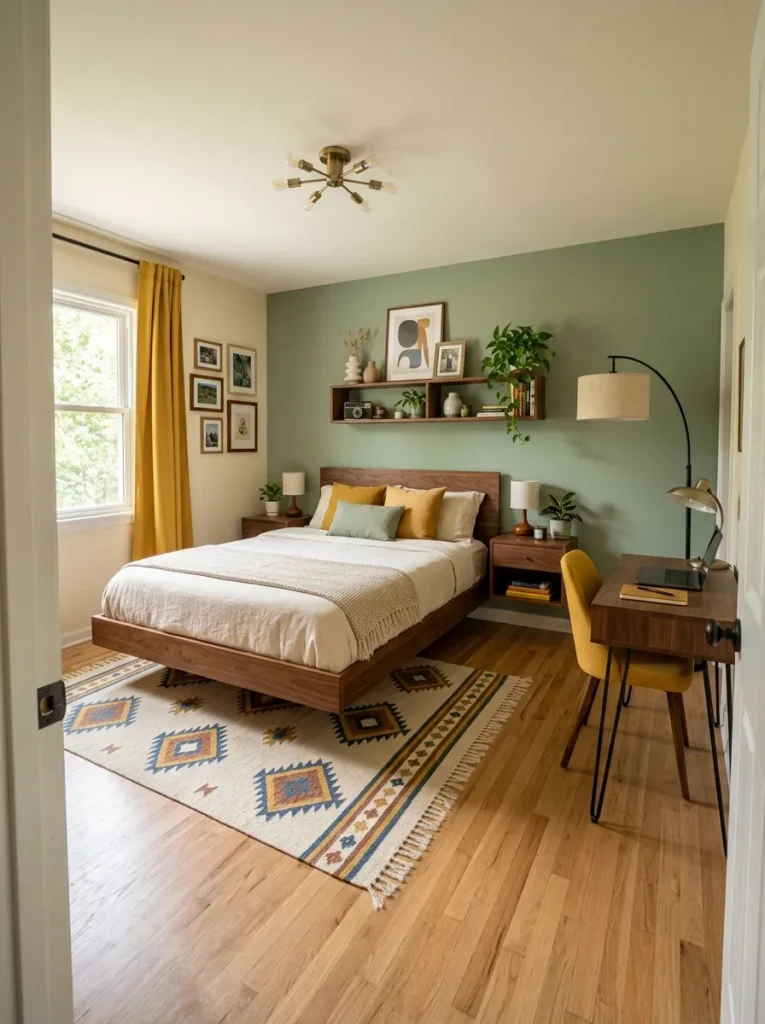
Vibe: A fully floating bedroom arrangement feels airy — the exposed floor beneath every piece of furniture makes the room feel twice its actual size.
Why it works: The “floating everything” approach is the small-space application of mid-century design’s most powerful visual principle: the revealed floor. When furniture sits on legs or is wall-mounted rather than floor-based, the floor reads as continuous — the eye travels the full length of the room uninterrupted, which dramatically increases the perception of space. In a bedroom under 150 square feet, combining a wall-mounted floating bed (available from several Scandinavian-influenced furniture brands), floating nightstands, and a wall-mounted shelf in place of a dresser can make the room feel 30–40% larger without changing a single dimension. A geometric wool rug positioned under the floating bed anchors the composition without interrupting the floor plane around it.
How to get it: Prioritize three floating elements: the nightstands (most achievable), a floating shelf above or in place of a dresser, and — if structural walls permit — a wall-mounted bed rail system. A geometric rug in the 5×8 range centered under the bed unifies the floor zone. Keep all wood tones consistent (all walnut or all teak — never mixed) to prevent the small room from reading fragmented.
Quick Win: Replacing two bedside tables with wall-mounted floating shelves costs $40–$80 total and immediately opens 6–8 square feet of floor space — the single most impactful small-space upgrade in a mid-century bedroom.
Shop The Look
| Product |
|---|
| Wall mounted floating bed frame walnut queen |
| Floating walnut shelf nightstand set of 2 wall mount |
| Geometric area rug rust teal 5×8 |
| Single arc floor lamp brushed brass |
| Mustard linen blackout curtain panel set |
How to Start Your Mid-Century Bedroom Transformation
The single first move is to replace your current bed frame with a low-profile walnut platform bed with tapered splayed legs. This one piece does more to establish the mid-century aesthetic than any other single purchase — it sets the floor height, the wood tone, the silhouette, and the horizontal emphasis that every subsequent choice will either reinforce or contradict. Everything else in the room — the rug, the lighting, the art — layers onto the foundation the bed creates.
The most common mistake is mixing wood tones without intention — specifically, combining light pine or gray-washed oak with walnut or teak pieces in the same room. Mid-century modern is a warm-wood style: walnut, teak, and rosewood in their natural medium-to-dark brown tones. Introducing a cool or pale wood immediately dilutes the palette and pushes the room toward a generic “Scandinavian” reading rather than specifically mid-century. Fix it by committing to one dominant wood tone and treating any secondary wood (a chair leg, a mirror frame) as a deliberate accent kept to one piece.
Three items under $50 that create immediate impact: a set of brushed brass bar pulls ($30–$45 for 10) that replace chrome or black hardware on any existing dresser, a mustard yellow wool throw ($25–$40) draped across the bed’s foot, and a pair of LED filament bulbs at 2200K ($12–$18 for two) that replace cool-white bulbs in existing bedside lamps. Together, these three changes shift the room’s warmth, hardware tone, and light quality — the three invisible variables that most determine whether a bedroom reads as mid-century or merely adjacent to it.
Realistic expectations: a beginner mid-century bedroom — new bed frame, rug, curtains, and lighting — sits in the $600–$1,200 range sourcing quality reproductions. A room that includes a vintage or solid-walnut credenza, an accent chair, and original or high-quality art sits at $1,500–$3,500. The investment rewards patience: sourcing a genuine vintage piece from an estate sale at $200–$400 often yields a quality that $800 in reproduction furniture cannot match. Expect the full transformation to develop over six to twelve months of deliberate, unhurried sourcing.
Frequently Asked Questions About Mid-Century Modern Bedrooms
What is the difference between mid-century modern and Scandinavian design?
Mid-century modern is an American-origin style that incorporates bold accent colors, sculptural organic forms, and references to Space Age optimism alongside natural materials. Scandinavian design — often called Danish modern or hygge-influenced — tends toward more restrained palettes (white, grey, pale wood), simpler silhouettes, and a quieter emotional register. Both styles use tapered legs and natural wood, which causes the confusion. The clearest differentiator is color: if the room has harvest gold curtains, a burnt sienna rug, or a teal accent, it’s reading mid-century modern. If everything is pale, muted, and serene, it’s leaning Scandinavian.
What wall colors work best in a mid-century modern bedroom?
The most authentic mid-century wall color choices fall into two categories: warm neutrals (warm white such as Benjamin Moore White Dove, warm cream, or greige in the Edgecomb Gray range) as the dominant wall color, or a single accent wall in a period-accurate tone — dusty sage, avocado green, burnt sienna, or dusty teal. Avoid cool greys, stark bright whites, and any color with a blue undertone, which push the palette toward contemporary rather than mid-century. The accent wall should always be the headboard wall — the single surface that anchors the room’s color story.
How much does it cost to furnish a mid-century bedroom?
A starter mid-century bedroom — platform bed, two floating nightstands, a basic rug, and updated lighting — can be assembled for $500–$900 using quality reproduction pieces from retailers like Article, West Elm, or CB2. A room with solid walnut furniture, a vintage credenza, an accent chair, and original art sits at $2,000–$5,000+. The most cost-effective approach is to invest in one genuine quality piece (typically the bed frame) and supplement with reproductions, vintage finds, and updated hardware on existing pieces.
Can mid-century modern work with a contemporary bedroom layout?
Yes — mid-century modern is one of the most compatible styles with contemporary architectural layouts because both share an emphasis on clean lines, open floor plans, and minimal ornamentation. The style adapts particularly well to rooms with large windows (the era celebrated natural light and indoor-outdoor connection), neutral wall colors, and hardwood or light concrete floors. The one contemporary element to avoid is recessed ceiling lighting as the primary light source — it produces a flat, even illumination that is antithetical to the warm, directional pool-of-light atmosphere that mid-century bedrooms depend on. Always supplement with table and floor lamps.
What type of rug is most authentic to mid-century modern bedroom design?
Hand-knotted or hand-tufted wool rugs in geometric patterns — diamonds, chevrons, abstract grids, or simplified tribal motifs in warm color palettes — are the most period-accurate choice. Flat-weave kilim rugs in rust and cream are also authentically mid-century and work particularly well in warmer climates. Avoid shag (which reads as 1970s rather than 1950s–60s), stark graphic black-and-white patterns (which lean contemporary), and Persian or floral orientals (which belong to a different design vocabulary entirely). Size up: the most common mid-century bedroom rug mistake is choosing a rug too small — it should extend at least 18 inches beyond the bed on all exposed sides.
Ready to Create Your Dream Mid-Century Bedroom?
These 15 ideas move across every dimension of the style — from the foundational furniture silhouette and wood palette to lighting temperature, textile layering, art selection, and small-space adaptations — so whether you’re starting from an empty room or refining what you already have, there’s a specific, actionable entry point here. The right approach is incremental: one considered piece at a time, each one chosen to reinforce the warmth and horizontal calm that make mid-century bedrooms feel timeless rather than trendy. Today, start by swapping your bulbs to 2200K filament LEDs — it takes five minutes and shifts the entire emotional register of the room before a single piece of furniture changes. A finished mid-century bedroom doesn’t just look right; it feels like a room that was designed for the person who sleeps in it — warm, unhurried, and entirely deliberate. Pin the ideas that made you picture your own room, and let those be the ones you build toward.