17 Gold Wall Mirror Ideas for Elegant Homes
A gold wall mirror is a framed or frameless reflective glass panel — in polished brass, aged gold, antique gilt, or warm metallic finishes — hung as a primary decorative and functional element on an interior wall, simultaneously expanding perceived space through reflection, introducing warm light through its metallic frame, and providing a visual anchor that elevates the design quality of any room it inhabits. This article gives you 17 genuinely creative, styled gold wall mirror ideas that work across every room and every aesthetic — from a minimal Japandi entry to a maximalist French-inspired salon — making the most versatile decorating object available into the most intentional one in your home.
Most gold mirrors default to the obvious — a plain round mirror in a thin gold frame above a console, a sunburst that everyone already has, a generic arched mirror from a discount homewares retailer. The homes in this list make a more considered choice: they treat the gold mirror as the room’s primary design decision rather than its finishing touch, selecting form, scale, placement, and frame treatment with the same intention that an architect brings to a window opening. Here are 17 ideas worth saving — and hanging.
Why Gold Wall Mirror Design Works So Well
The gold-framed mirror as a domestic design object has one of the longest and most culturally rich histories of any decorative interior element. The earliest European silvered glass mirrors with gilt frames appeared in Venice in the 16th century, where the Murano glassmakers’ monopoly on mirror production made a well-framed mirror the most expensive and most status-laden object in any household inventory. The French Sun King Louis XIV installed 357 mirrors in the Hall of Mirrors at Versailles — not merely as reflective surfaces but as light-multiplying architectural elements that transformed the natural light entering through seventeen arched windows into a luminous interior experience that no other material could have achieved. Both traditions established the design logic that contemporary gold wall mirror use still operates from: a gold-framed mirror is simultaneously a practical tool (reflection, light amplification, spatial expansion) and a declaratory design object whose presence in a room communicates aesthetic intention and material quality.
The materials that define the most compelling contemporary gold wall mirrors span a wide spectrum of metallic registers. Polished brass — the bright, high-reflectivity gold of contemporary minimalist mirror frames — reads as confident and clean, coordinating with the warm metallic hardware of contemporary kitchens and bathrooms. Aged or antiqued gold — the warm, slightly oxidized tone of traditional gilt frames — reads as collected and historical, connecting the mirror to the European furniture tradition. Burnished gold — a deeper, darker warmth between polished brass and aged gold — reads as sophisticated and contemporary, particularly in the leaning floor mirror format that has defined residential interior design editorial since 2018. Raw brass — unlacquered and deliberately left to develop a living patina — reads as the most considered metallic choice of all, because its changing surface over time communicates a deliberate material philosophy rather than a fixed decorative decision.
The contemporary gold mirror trend reflects two intersecting cultural movements. The first is the sustained backlash against the cool, grey-toned interior aesthetic of the 2010s — the all-grey kitchen, the cool-white bedroom, the chrome-and-concrete aesthetic that dominated residential design from approximately 2012 to 2019 — which drove a widespread return to warm metallics, natural timber, and earthy tones from 2020 onward. Gold mirrors are the most visible single design object associated with this warm return: their presence in a room immediately shifts its temperature from cool to warm. The second movement is the resurgence of maximalist and eclectic interior aesthetics on social media, driven by designers including Kelly Wearstler, India Mahdavi, and Luke Edward Hall, for whom a large, ornate, or dramatically proportioned gold mirror is a fundamental design vocabulary element rather than an optional accessory.
Small rooms benefit specifically from gold wall mirrors for three compounding reasons. The reflective surface creates the perception of additional depth — a mirror on the wall opposite a window reflects the window’s light and view into the room, doubling the apparent presence of natural light. The gold frame introduces a warm metallic element that reads as a luxury material regardless of the room’s scale — a small room with a genuinely beautiful gold mirror reads as more designed than a large room with a plain wall. The vertical emphasis of most gold mirror formats (arches, ovals, tall rectangles) creates upward eye movement that makes ceiling height appear greater than the actual measurement.
Style at a Glance
| Element | Detail |
|---|---|
| Philosophy | The gold mirror is the room’s primary design decision, not its finishing touch — its form, scale, and frame treatment determine the room’s character before anything else is hung |
| Key Materials | Polished brass, aged gilt, burnished gold, raw unlacquered brass, antique mirror glass, smoked mirror glass |
| Color Palette | Polished gold, warm aged brass, deep burnished gold, antique gilt, champagne pale gold, rose gold warm |
17 Gold Wall Mirror Ideas
1. Oversized Arch Gold Mirror as Living Room Focal Point
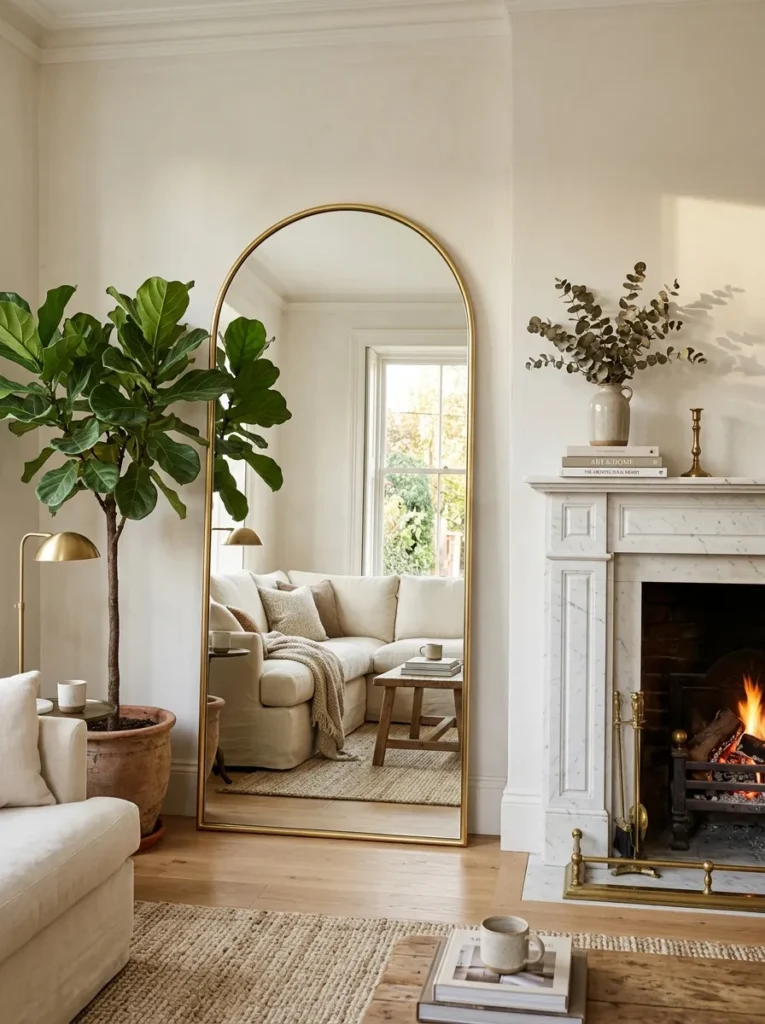
Vibe: Warm and editorial — the living room object that makes every other design decision in the room look more considered simply by reflecting it.
Why it works: The oversized arch gold mirror leaning against a living room wall is the single decorating gesture with the highest spatial and atmospheric impact per object in contemporary residential interior design — it simultaneously provides a focal point of sufficient scale and visual weight to anchor a room, reflects the existing room elements (sofa, plant, fireplace, natural light) in a composition that doubles the room’s visual richness, and introduces the arched form that has been the dominant architectural motif in premium residential design since its resurgence in 2018. The leaning position — rather than wall-mounted — adds a further layer of design intention: a leaning mirror communicates deliberate casualness, suggesting that the mirror’s placement is too natural and too considered to require formal mounting hardware. The thin polished brass frame is the correct framing choice for an oversized arch mirror because its minimal visual weight prevents the frame from competing with the mirror’s reflective surface, keeping the room’s reflection as the primary visual content.
How to get it: Size the arch mirror at minimum 150cm tall for a standard-height living room ceiling — below this height, the arch mirror lacks the commanding presence that makes the leaning position read as deliberate rather than provisional. Position the base of the mirror 100–150mm from the fireplace or sofa edge — close enough to create a visual relationship with the adjacent furniture, far enough to avoid physical interference. Lean at an angle of 8–12 degrees from vertical — the slight lean reads as deliberate; more than 12 degrees reads as unstable.
Quick Win: A large arch mirror leaned against a wall does not require any installation hardware — it can be positioned and repositioned without tools, making it the most commitment-free large-scale room transformation available. Secure the base with non-slip furniture pads to prevent sliding on smooth floors.
Shop the Look
| Product |
|---|
| Oversized arch mirror polished brass frame |
| Non-slip furniture pad set |
| Large-leaf plant terracotta planter |
| Marble fireplace surround |
| Cream linen sofa |
Also view: 17 Christmas Decorating Ideas for a Cozy Holiday Home
2. Vintage Ornate Gilt Mirror Above a Fireplace Mantel
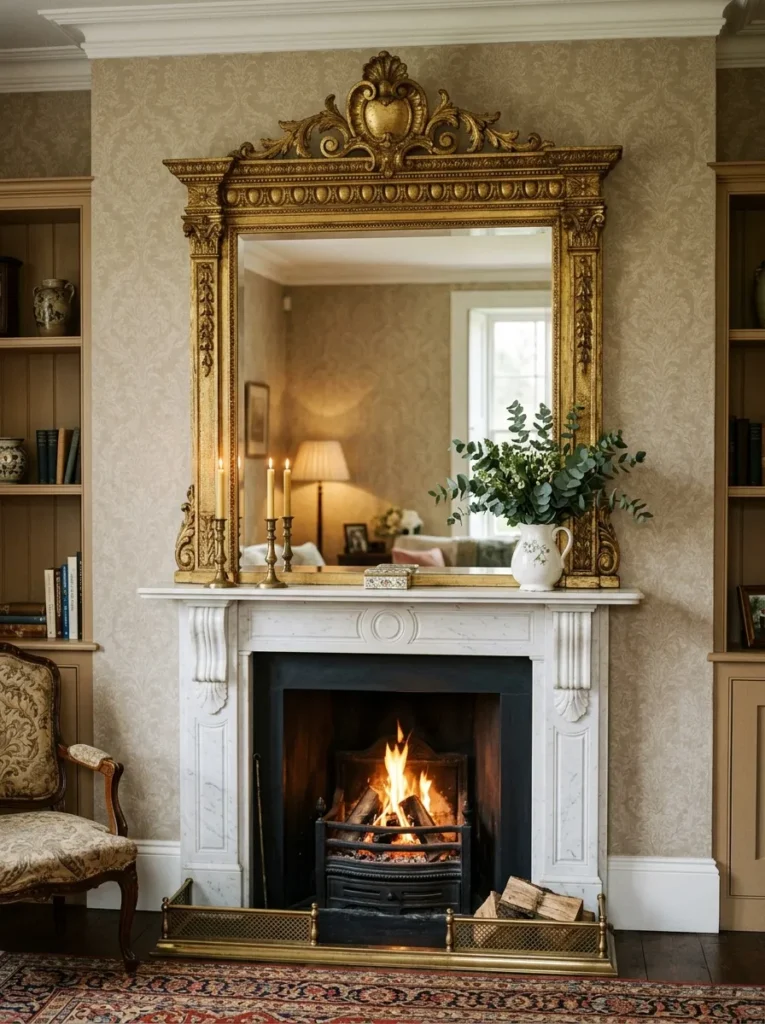
Vibe: Warm and traditional — the fireplace wall that resolves itself the moment the mirror is hung above it.
Why it works: The ornate gilt mirror above a fireplace is the most historically grounded of all gold mirror applications — the overmantel mirror has been the primary visual feature of the fireplace wall in European domestic architecture since the 17th century, and its presence in a room activates a cultural memory of domestic warmth, gathering, and social ritual that is more deeply embedded in Western interior design tradition than almost any other single decorative decision. The acanthus leaf scroll frame and egg-and-dart molding of a traditional gilt overmantel mirror reference the architectural vocabulary of the classical orders — the same design language as the marble fireplace surround below it — creating a visual coherence between frame and mantel that makes the mirror read as architecturally integral rather than decoratively applied. The reflection of the room in the mirror above the fireplace is particularly effective because it shows the room from the fireplace’s perspective — the most intimate, most socially central position in any traditional room.
How to get it: Size the ornate gilt mirror to between 60% and 90% of the mantel width — too small and it reads as undersized for the fireplace architecture; too wide and it overwhelms the mantel proportions. Mount at a height that places the mirror’s bottom edge 150–200mm above the mantel shelf surface — this gap allows the mantel objects (candlesticks, vases) to read as belonging to the mantel rather than appearing cropped by the mirror’s lower edge.
Shop the Look
| Product |
|---|
| Ornate carved gilt mirror overmantel |
| Brass candlestick pair |
| White ceramic vase large |
| Eucalyptus stems bundle |
| Marble mantel fireplace |
Also view: 15 Modern Wall Decal Ideas for Beautiful Bedrooms
3. Sunburst Gold Mirror in an Entry Hall
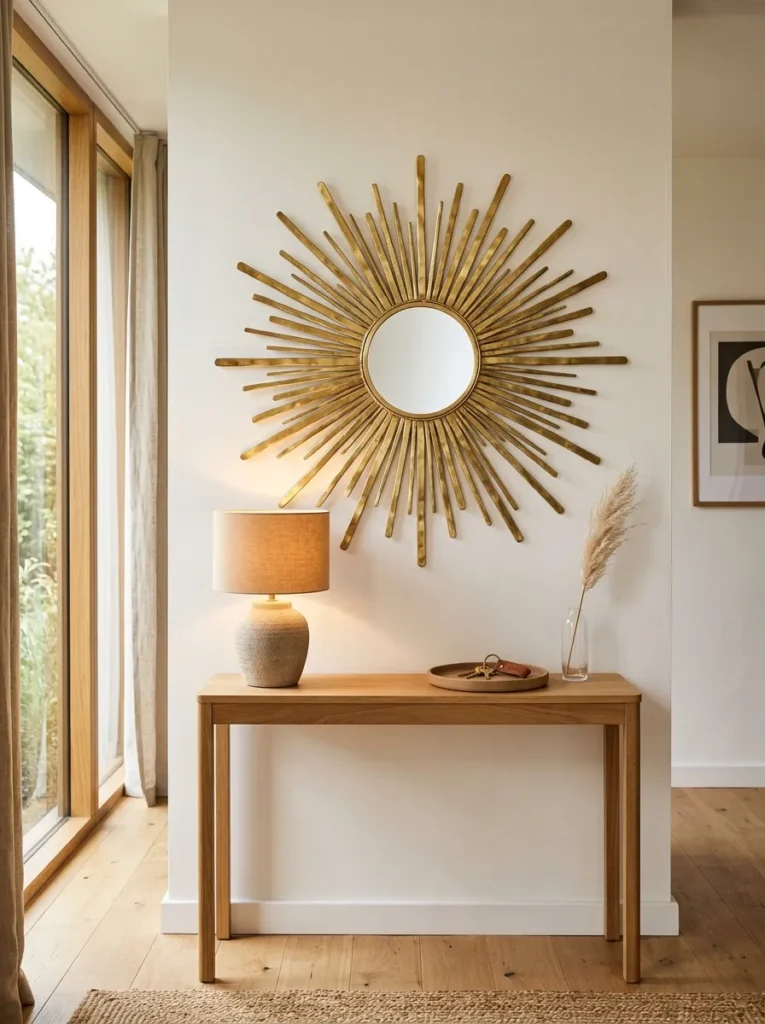
Vibe: Warm and welcoming — the entry hall feature that makes arriving home feel like arriving somewhere genuinely considered.
Why it works: The sunburst gold mirror in an entry hall is the mirror application that most powerfully creates a strong first impression of the home’s design character — positioned as the first object seen on entering, the sunburst mirror establishes the warm, metallic, and decoratively generous aesthetic register before any other room is reached. The sunburst form is specifically effective for an entry hall because its radiating rays mimic the light-dispersing quality of sunlight itself, creating a visual energy that reads as welcoming rather than merely decorative. The asymmetric organic ray arrangement — where rays vary in length, thickness, and spacing in a way that reads as hand-made rather than mechanically produced — is the quality that distinguishes a design-forward sunburst mirror from a mass-produced version: genuine asymmetry communicates the involvement of a human maker in a way that perfect symmetry cannot.
How to get it: Position the sunburst mirror at eye height — the mirror’s center at 1500–1600mm from the floor — which is the height at which it both reflects the entrant’s face on arrival and reads as the primary feature of the hall rather than a wall-mounted decorative element above normal eye level. The console table below the sunburst should extend no wider than 70% of the sunburst mirror’s diameter — a console that extends to the same width as the mirror creates a rigid rectangle that removes the dynamic quality of the sunburst form.
Shop the Look
| Product |
|---|
| Sunburst mirror polished brass |
| Slim timber console table natural |
| Ceramic table lamp entry |
| Small round tray key storage |
| Single stem slim vase |
4. Gallery Wall of Mixed Gold Frames and Mirrors
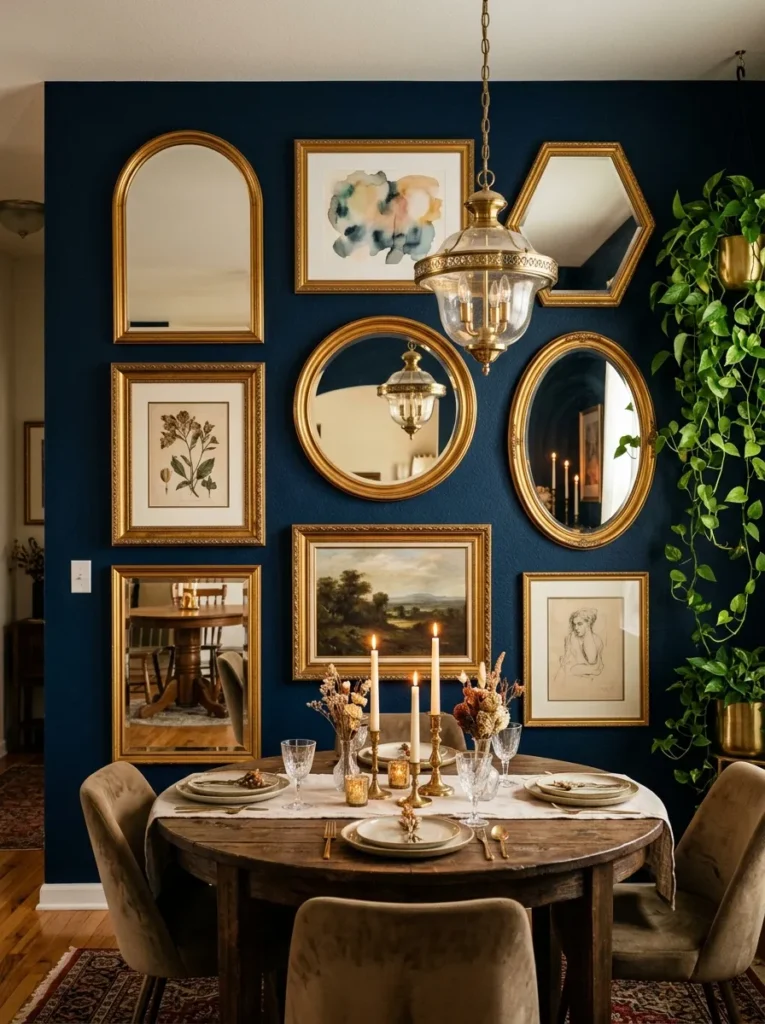
Vibe: Warm and maximalist — the gallery wall that feels like the most considered room in the most interesting house you have ever visited.
Why it works: The gallery wall that mixes gold-framed mirrors with gold-framed artworks is the decorating approach that most completely exploits the mirror’s unique dual identity as both a reflective tool and a decorative frame object — within the gallery arrangement, some frames hold static artwork while others hold a dynamic, constantly changing reflection of the room itself, creating a visual dialogue between fixed image and moving image across the same wall. This dialogue between art and reflection is the compositional content that makes a mirror-inclusive gallery wall more visually interesting than a standard all-artwork gallery — the mirrors introduce spatial depth into a flat wall composition, and the living reflections within them prevent the gallery from ever appearing static or finished. The consistent aged gold frame tone across all pieces — mirrors and artworks — is the unifying discipline that allows the varied shapes to coexist without creating visual fragmentation.
How to get it: Plan the gallery arrangement by laying all frames on the floor in the intended composition before making any wall holes. The ratio of mirrors to artworks should be approximately 1:1 for maximum visual dynamism — more mirrors than artworks creates a disorienting wall of reflections; more artworks than mirrors reduces the spatial depth benefit that mirrors contribute. Position mirrors at the arrangement’s key focal points (the center and the lower-center position) where their reflections will pick up the most interesting room elements.
Shop the Look
| Product |
|---|
| Mixed shape gold mirror set |
| Gold frame art print set |
| Deep navy wall paint |
| Gallery wall hanging kit |
| Round dining table |
5. Floor-to-Ceiling Gold Mirror Panel for a Dressing Room
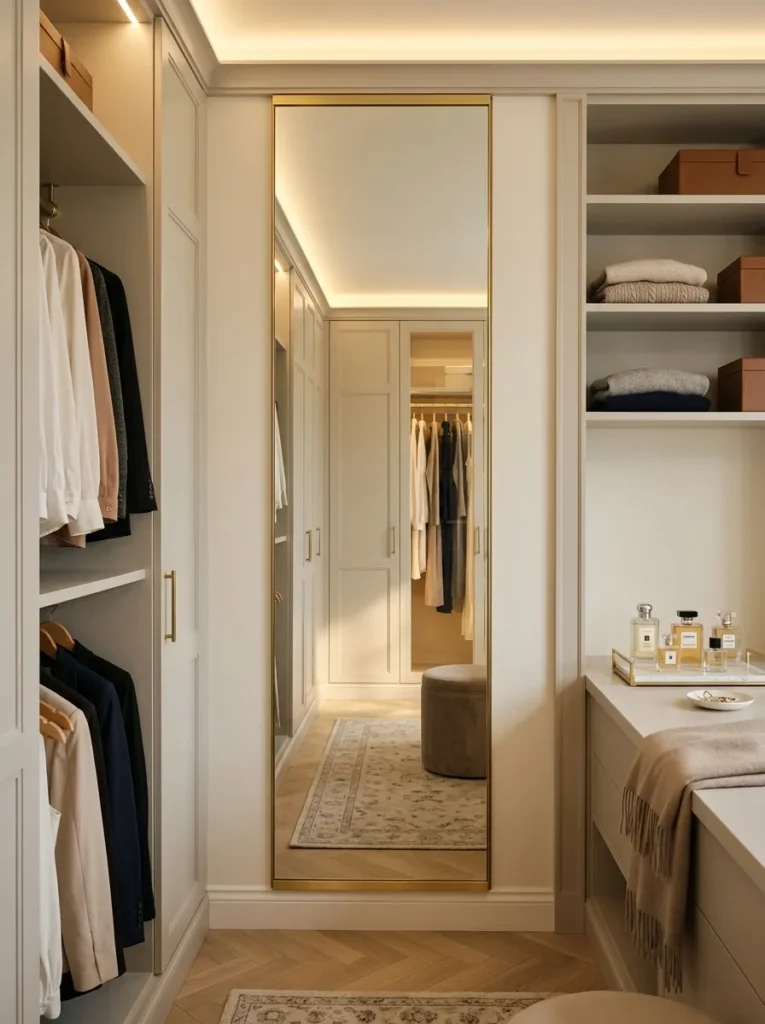
Vibe: Warm and refined — the dressing room detail that makes getting dressed feel like the beginning of something considered.
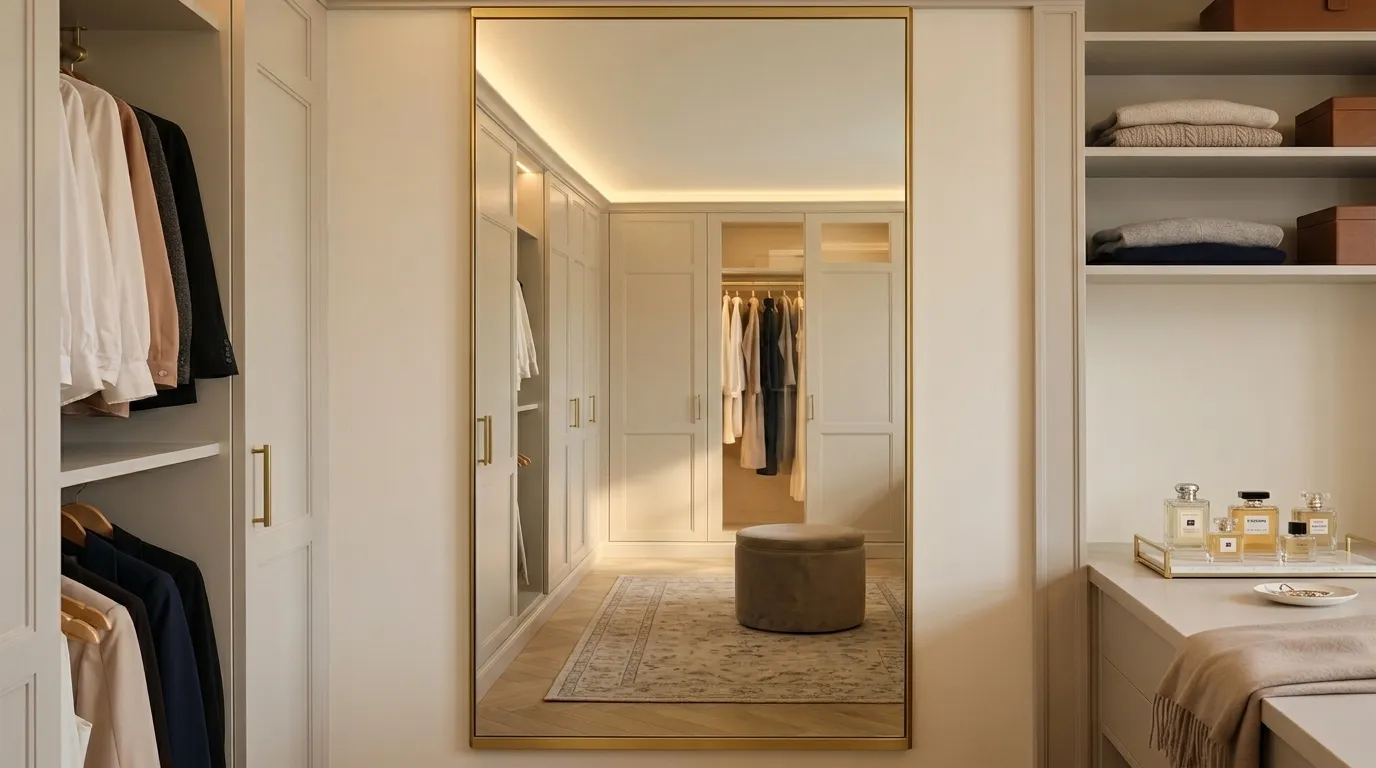
Why it works: The floor-to-ceiling gold mirror panel integrated into a dressing room wall is the mirror application that most directly serves its functional purpose while simultaneously creating a design feature of architectural quality. The full-height mirror eliminates the awkward process of dressing in front of a mirror that shows only part of an outfit — the head-to-toe reflection is both practically superior and aesthetically more complete than any partial-height mirror. The minimal gold bar frame at the top and bottom edges — rather than a continuous perimeter frame — is the design specification that allows the mirror to read as an architectural feature of the wardrobe rather than a mirror placed within it: the gold bar frames reference the material of the wardrobe’s hardware without competing with the full-height reflective surface as the mirror’s primary design element.
How to get it: Specify the mirror panel at the same width as a standard wardrobe cabinet module (typically 600mm) to allow seamless integration between the mirror and adjacent cabinet sections. The gold bar frames should be 30–50mm wide in polished or satin brass — wide enough to read as deliberate framing elements, narrow enough not to interrupt the visual continuity of the mirror surface. Install using mirror adhesive applied to the wall surface with the frame elements attached on top — this installation sequence allows the full mirror surface to be glass from edge to edge without gaps between the glass and the frame profile.
Shop the Look
| Product |
|---|
| Full height mirror panel custom |
| Satin brass bar frame profile |
| Mirror adhesive tube |
| LED strip light warm recessed |
| Wardrobe cabinet pale grey |
6. Antique Gold Convex Mirror as a Bedroom Accent
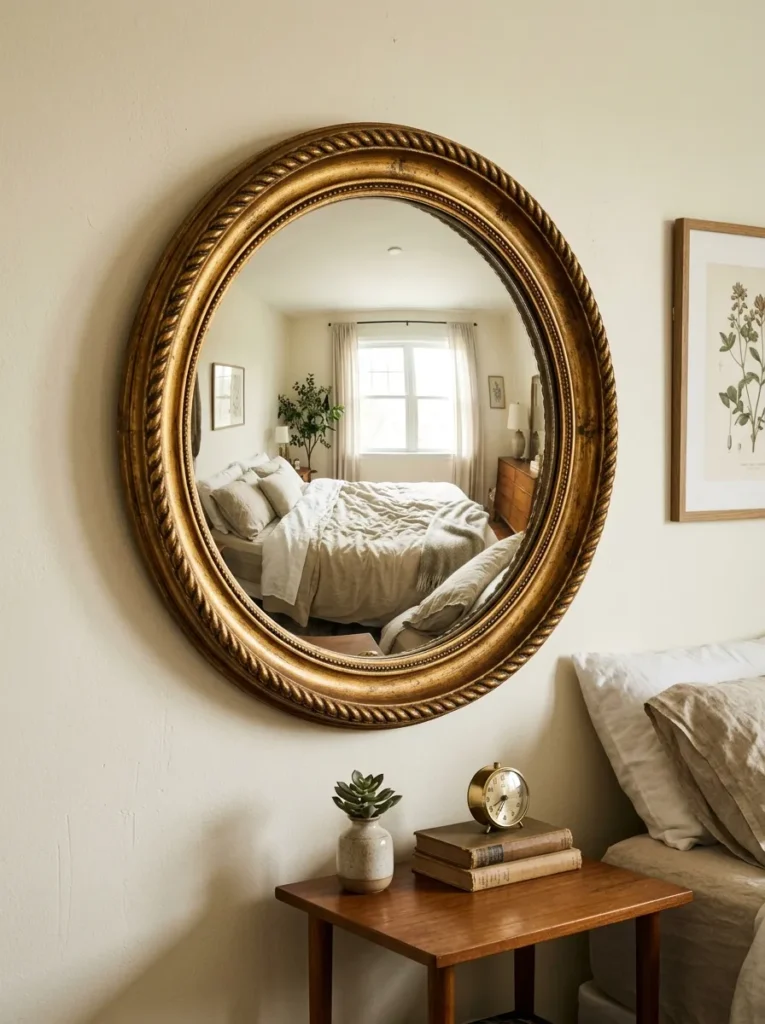
Vibe: Warm and collected — the bedroom detail that rewards close examination with an entire room in miniature.
Why it works: The antique gold convex mirror is the gold mirror format with the richest historical pedigree in residential interior design — the convex mirror’s characteristic wide-angle reflection has been a feature of European domestic interiors since the Flemish masters depicted them in 15th-century oil paintings (most famously in Jan van Eyck’s Arnolfini Portrait), where their property of reflecting the entire room in a single circular surface made them simultaneously a practical tool for room surveillance and a conceptual representation of the household’s complete domestic world. In a contemporary bedroom, the convex mirror performs this same function: its wide-angle reflection provides a complete, albeit miniaturized and slightly distorted, view of the room from its wall position — a room-within-a-room that rewards the attention of anyone who looks closely enough to explore the reflected details. The rope-detail molding on an antique gold convex frame references the Regency English interior tradition where convex mirrors with eagle-crested frames and rope-detail surrounds were a standard feature of the most fashionable drawing rooms.
How to get it: Hang the convex mirror at slightly above eye height — at 1600–1700mm center height — so the wide-angle reflection captures the bed, window, and opposite wall rather than only the floor and ceiling. The convex mirror’s reflection quality changes significantly with hanging height: too low and it reflects mainly floor; too high and it reflects mainly ceiling. The 45cm diameter is the minimum size at which the convex reflection is sufficiently detailed to be visually engaging — smaller convex mirrors produce reflections too miniaturized to reward examination.
Shop the Look
| Product |
|---|
| Antique gold convex mirror |
| Rope molding frame detail |
| Linen bedding set natural |
| Slim timber bedside table |
| Small framed print art |
7. Venetian Etched Glass Gold Mirror for a Bathroom
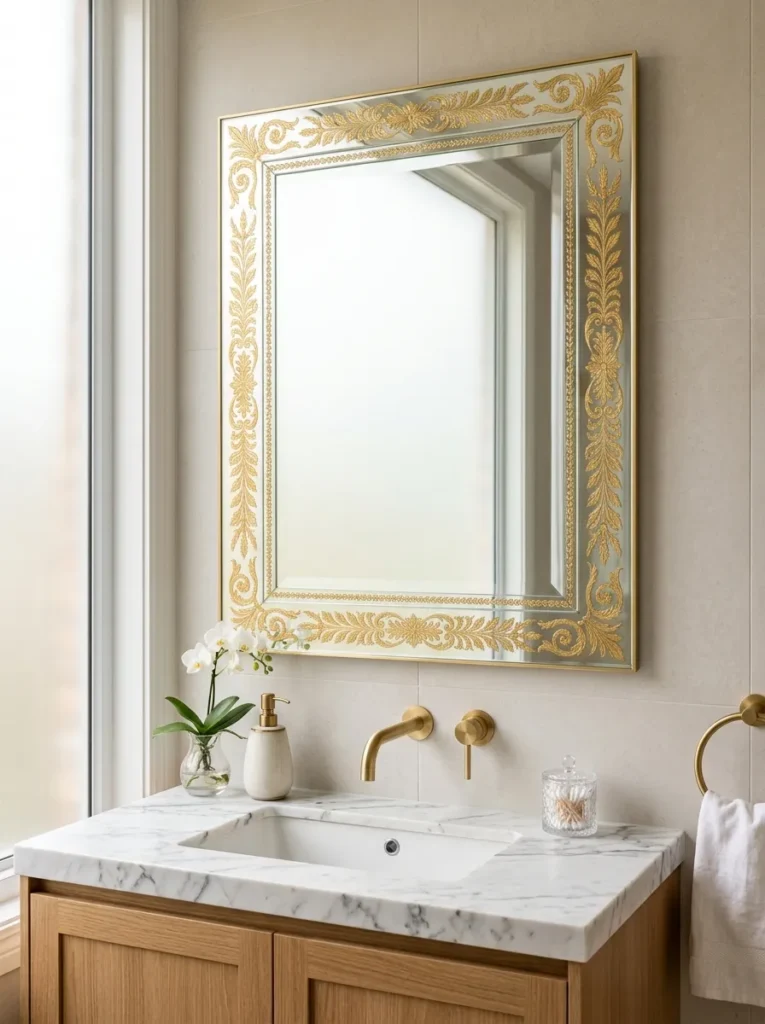
Vibe: Warm and luxurious — the bathroom mirror that makes the morning routine feel like a ritual in a Venetian palazzo.
Why it works: The Venetian etched glass gold mirror is the bathroom mirror application that most completely elevates a functional requirement — the vanity mirror — into a design object of genuine luxury and historical reference. The Venetian mirror tradition, developed in Murano from the 16th century onward, distinguished itself from other European mirror-making traditions through its integration of decorative glass-working techniques — etching, gilding, beveling, and eglomisé (back-painted glass) — into the mirror surface itself rather than limiting decoration to the frame perimeter. An etched botanical or classical border applied in gold leaf directly to the mirror glass surface creates a material richness that no frame can achieve, because the decoration is within the glass rather than surrounding it. This interiority of the decoration — the gold motifs are literally part of the mirror rather than attached to it — is the quality that makes a Venetian etched mirror read as an authentic luxury object rather than a decorated product.
How to get it: Source genuine Venetian etched mirrors from Italian glass specialists or their authorized importers — authentic Venetian glass work carries a price premium ($300–1,200 for a bathroom-scale mirror) that reflects the labor and skill of the etching and gilding process. For a more accessible version, an eglomisé-style gold-backed border (where gold leaf is applied to the back of a glass border panel attached to the mirror perimeter) achieves a visually similar effect at lower cost. Mount with mirror-specific adhesive cleats rather than screws through the glass — screw holes compromise the decorative border’s integrity.
Shop the Look
| Product |
|---|
| Venetian etched gold mirror bathroom |
| White marble vanity top |
| Brushed brass tap mixer |
| Ceramic soap dispenser brushed brass |
| Glass bud vase slim orchid |
8. Triptych Gold Mirror Above a Dining Room Sideboard
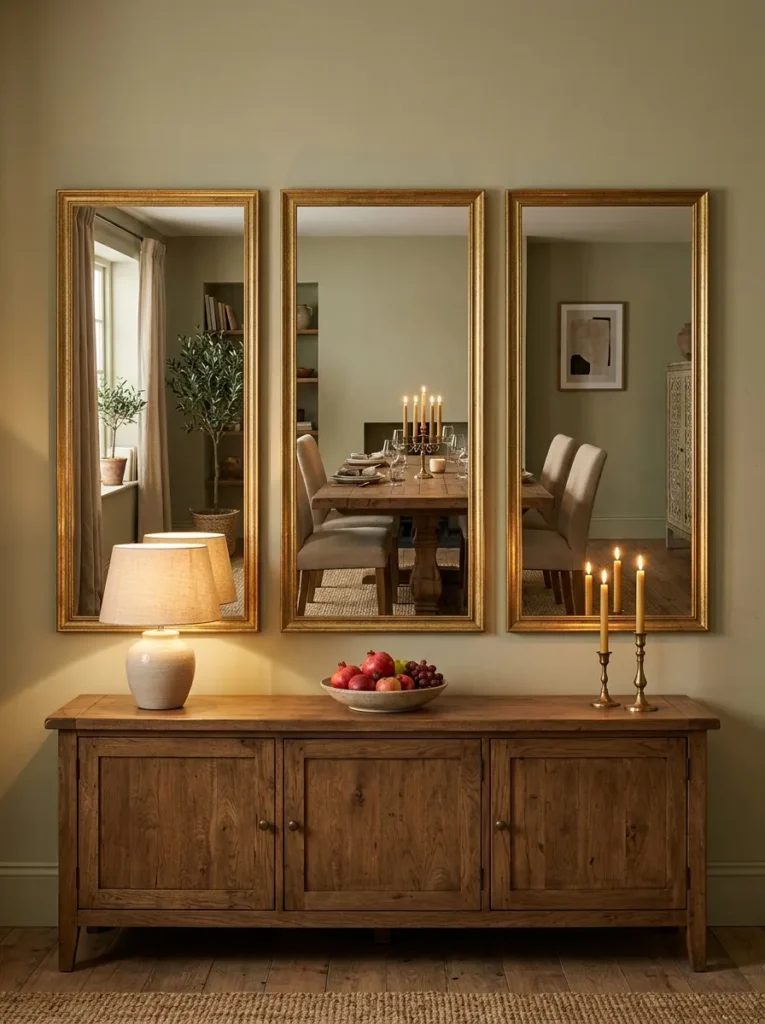
Vibe: Warm and resolved — the dining room wall treatment that turns a sideboard into the room’s most considered destination.
Why it works: The three-mirror triptych arrangement above a dining sideboard is the gold mirror application that most powerfully combines the compositional logic of the altarpiece with the practical function of wall decoration — the triptych format (three vertical panels in a continuous arrangement) references the devotional triptych painting tradition of medieval and Renaissance art, which devoted the central panel to the primary subject and flanking panels to contextual scenes. Applied to mirrors above a sideboard, this format creates a panoramic reflective composition that shows three different sections of the dining room simultaneously — the left mirror reflecting the window or entry, the center mirror reflecting the dining table and chandelier, the right mirror reflecting the opposite wall — turning the sideboard wall into a narrative reflection of the entire room’s character. The matching aged gold frames across all three mirrors create the visual unity that makes the triptych read as a single composed installation rather than three separately hung mirrors.
How to get it: Space the three mirrors with a consistent 20–30mm gap between frames — this gap creates the visual separation that makes the triptych read as three distinct panels rather than one continuous mirror, while the narrow gap width maintains the sense of a unified installation. The total triptych width should match the sideboard width within 100mm on each side — a triptych significantly narrower than the sideboard reads as undersized, while one wider than the sideboard reads as incorrectly scaled.
Shop the Look
| Product |
|---|
| Rectangular gold frame mirror set three |
| Timber sideboard natural finish |
| Ceramic table lamp warm |
| Brass candlestick pair dining |
| Fruit bowl ceramic |
9. Irregular Organic Shape Gold Mirror for a Powder Room
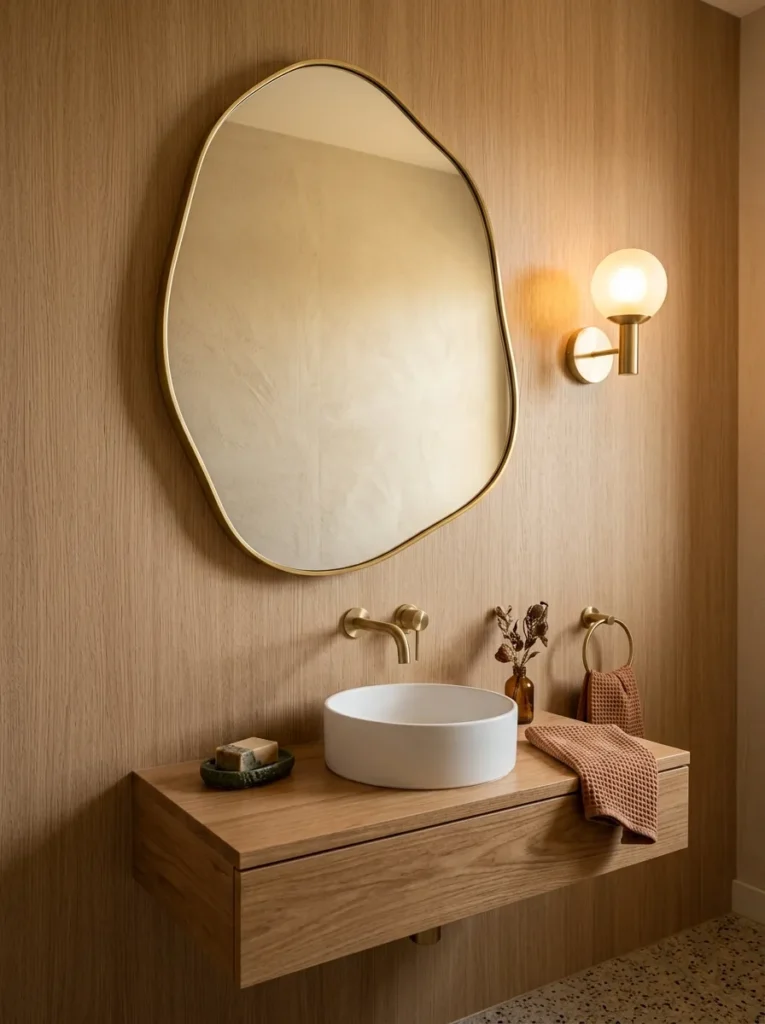
Vibe: Warm and artistic — the powder room mirror that makes guests forget they came in to wash their hands.
Why it works: The organic irregular-shape gold mirror is the mirror format that most directly introduces sculptural quality into a small bathroom or powder room — its free-form perimeter, following no geometric rule but achieving its own internal compositional logic, reads as a three-dimensional sculptural object rather than a flat wall-hung surface. The powder room is the specific room where this sculptural mirror quality delivers the highest design impact: powder rooms are small, enclosed, visited briefly, and provide a concentrated opportunity to create a memorable design experience that guests specifically notice and discuss. An organic gold mirror in a powder room achieves the same design effect as a statement sculpture in a larger room — it is the room’s singular strong design gesture, and the rest of the room’s elements (vessel sink, timber vanity, wall sconce) are its supporting cast.
How to get it: Organic irregular-shape mirrors with custom brass frames are available from specialist mirror and glass workshops who cut custom mirror shapes from full glass sheets — the custom cutting adds cost ($150–400 depending on complexity of the organic form) but produces a result that no mass-manufactured mirror can replicate. Source the form inspiration from natural objects — a river-smoothed stone, a dried leaf, a cloud form — and provide this reference to the glassworker as the basis for the custom cut shape.
Quick Win: A custom organic mirror shape can be achieved at lower cost by purchasing a standard mirror tile and having a glazier cut the organic perimeter using a glass cutting tool and tile nippers — the irregular edge is then polished smooth and framed with a continuous strip of 15mm polished brass edging tape applied around the perimeter.
Shop the Look
| Product |
|---|
| Custom organic shape mirror |
| Thin polished brass frame edging |
| Timber wall hung vanity |
| Circular vessel sink matte white |
| Brushed brass wall sconce |
10. Smoked Antique Mirror in a Gold Frame for a Bedroom
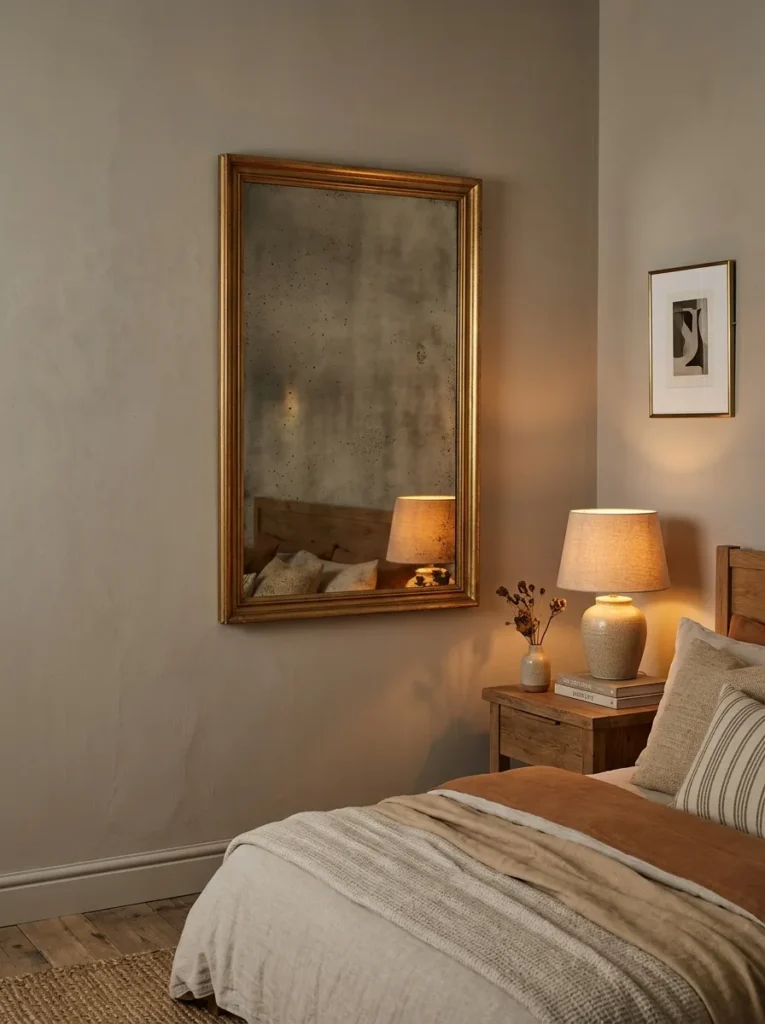
Vibe: Warm and moody — the bedroom mirror that makes every reflection look like it was taken through a vintage filter.
Why it works: The smoked antique mirror in an aged gold frame is the mirror application that most completely prioritizes atmosphere over functional reflection — the warm grey-brown tint and surface variation of antique mirror glass produces a reflection of dramatically reduced clarity and dramatically increased warmth compared to standard silver mirror, creating a reflection that flatters rather than reproduces, that suggests rather than defines. This atmospheric quality is specifically appropriate for a bedroom context where the mirror’s function is more emotional than practical — a bedroom mirror that produces a flattering, warm, slightly hazy reflection of its surroundings creates the same quality of light as candlelight or a warm amber bulb, contributing to the restful, spa-like atmosphere that a well-designed bedroom seeks. The aging variation visible across the antique mirror surface — the characteristic dark spots and silver-clouding of genuinely aged mirror glass — is the material quality that connects the mirror to the tradition of found and inherited objects, giving it a biography that a new mirror cannot possess.
How to get it: Genuine antique mirror glass (recycled from antique mirrors with genuinely aged silver backing) is available from specialist antique glass suppliers and is the most authentic material for this application. New antique-effect mirror glass (produced by deliberately aging the silver backing of new mirror glass through chemical treatment) is a widely available and visually similar alternative at lower cost. Both are available as cut-to-size panels that can be framed in a custom aged gold frame by any picture framing workshop.
Shop the Look
| Product |
|---|
| Antique smoked mirror glass panel |
| Aged gold frame profile |
| Picture framing custom service |
| Ceramic bedside lamp warm |
| Linen bedding set greige |
11. Round Gold Mirror Cluster of Three Sizes
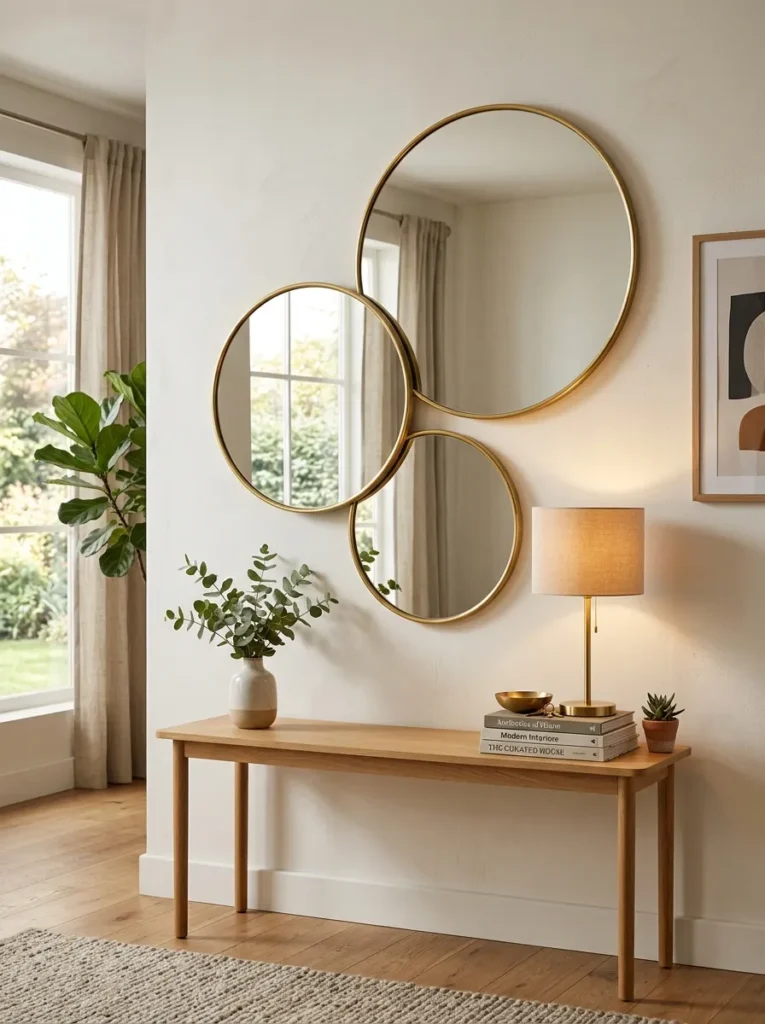
Vibe: Warm and dynamic — the wall cluster that makes a console table arrangement look complete from across the room.
Why it works: The three-circle mirror cluster in graduated sizes is the gold mirror arrangement that most effectively demonstrates the design principle of visual rhythm through size variation — three identical circles create static repetition, while three circles in a 2:1.4:1 size ratio create the dynamic rhythm that the human eye reads as movement across the composition. The overlapping cluster composition — where the three mirrors are positioned so their frames approach or overlap rather than maintaining uniform spacing — creates a visual density that reads as a single composed feature rather than three separately hung objects. The triangle arrangement (largest at the top or center, medium and small flanking at different heights) is the composition logic that allows the size graduation to read as intentional descent rather than arbitrary placement.
How to get it: Position the center points of the three mirrors at the vertices of an imaginary triangle — the largest mirror’s center at the composition’s visual center-top, the medium mirror’s center at the lower-left, and the smallest mirror’s center at the lower-right (or the inverse arrangement). The gaps between mirror frames should be consistent at 10–20mm — this narrow, consistent spacing is the detail that makes the cluster read as a designed composition rather than mirrors hung in proximity.
Shop the Look
| Product |
|---|
| Round gold mirror large 70cm |
| Round gold mirror medium 50cm |
| Round gold mirror small 35cm |
| Slim console table natural |
| Ceramic object display set |
12. Gold Mirror with Integrated Shelf for Entryway Storage
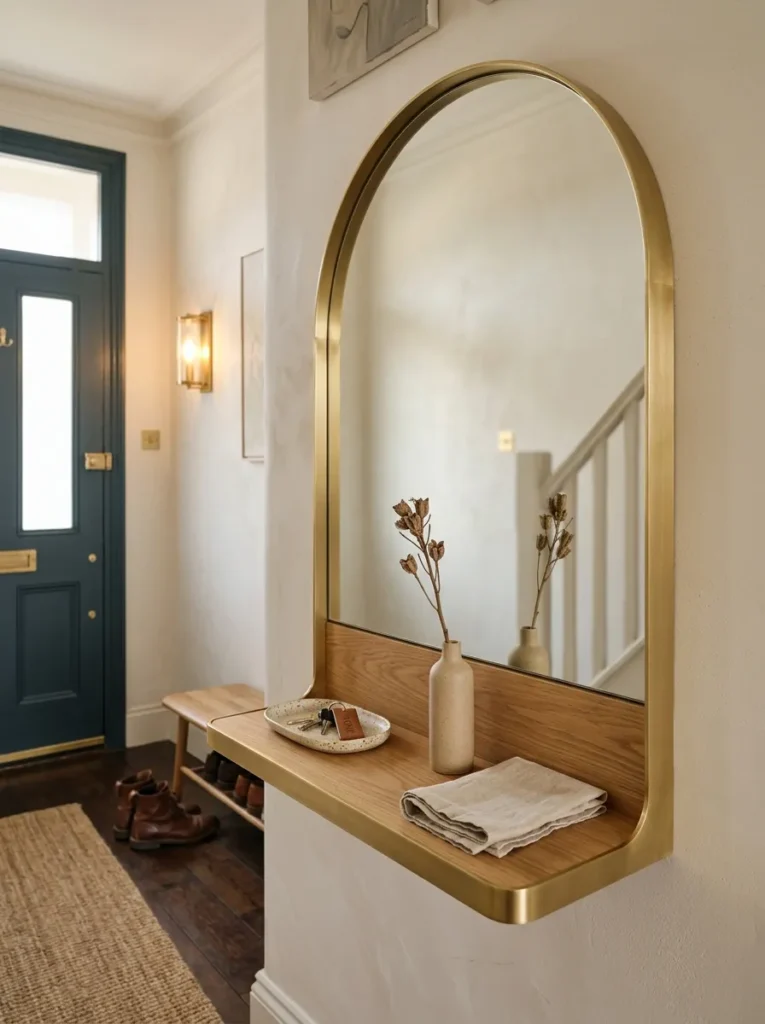
Vibe: Warm and functional — the entryway station that makes arriving home feel organized without looking organized.
Why it works: The gold mirror with an integrated shelf is the mirror application that most completely resolves the entryway’s two simultaneous design requirements — a reflective surface for last-minute appearance checks before leaving the house, and a landing surface for the items (keys, wallet, phone, mail) that arrive and depart daily. Standard entryway solutions address these requirements separately — a mirror on the wall and a console table below — creating a two-piece arrangement that consumes more space and reads as less resolved than a single designed object that integrates both functions. The frame continuity between the mirror’s brushed brass frame and the shelf’s front edge is the design detail that makes the integrated unit read as a single commissioned piece rather than a mirror placed above a shelf: the brass profile flows from mirror frame to shelf edge without interruption, creating the material unity that distinguishes a designed object from assembled furniture.
How to get it: Source from specialist mirror makers who produce integrated shelf-mirror units, or commission from a metal fabricator who can produce the brushed brass frame and shelf edge as a single continuous profile. The shelf depth of 300mm is the minimum for genuinely useful entryway storage — shallower shelves accommodate a key tray but not the width of a wallet, phone, and mail in combination. Mount the integrated unit at a height that places the mirror’s center at 1500mm from the floor, which positions the shelf at approximately 1150mm — a height comfortable for placing items without bending.
Shop the Look
| Product |
|---|
| Mirror with integrated shelf brushed brass |
| Small ceramic key tray |
| Slim vase single stem |
| Folded linen cloth decor |
| Entry hall hook wall mounted |
13. Geometric Hexagonal Gold Mirror Arrangement
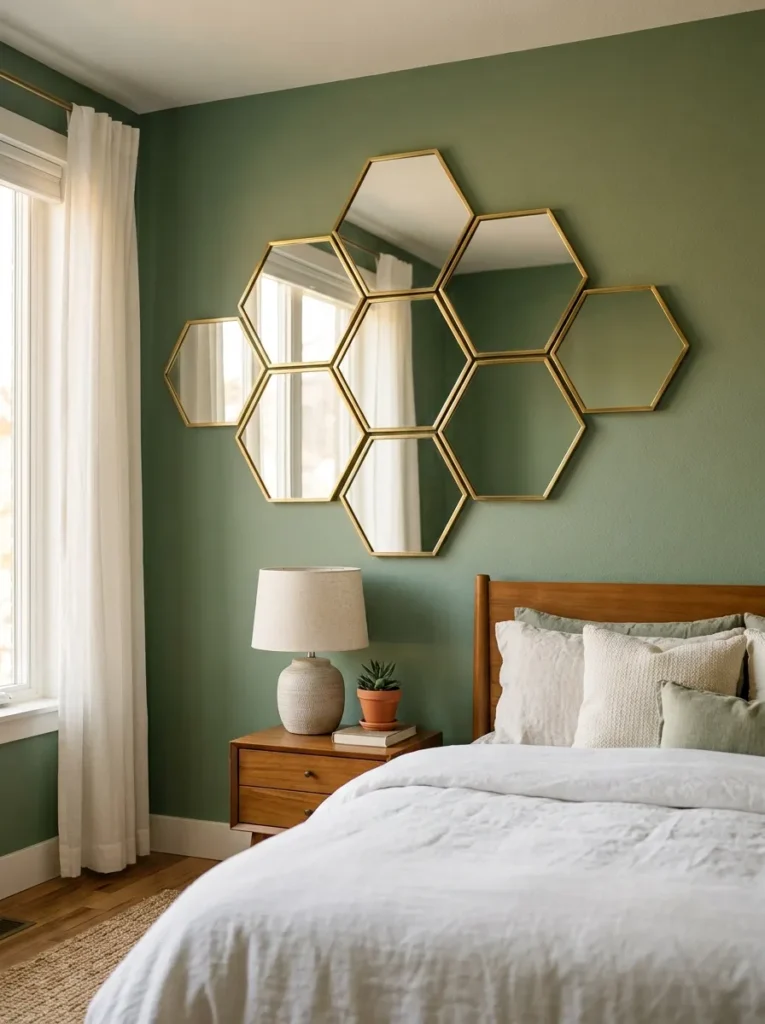
Vibe: Warm and graphic — the bedroom feature wall that uses geometry to create something that photographs like a bespoke installation.
Why it works: The hexagonal gold mirror arrangement exploits the unique geometric property of the hexagon — its ability to tessellate (tile without gaps) in a continuous field — to create a mirror wall composition that reads as a single designed surface rather than a collection of individual mirrors. The honeycomb tessellation pattern is specifically compelling because it is found throughout nature (in bee honeycomb, in basalt rock formations, in the compound eye structure of insects) — its presence in an interior wall installation creates a biophilic connection that circular or rectangular mirror arrangements cannot achieve. The two-size composition — larger hexagons at the center and smaller hexagons at the edges — creates a composition that has a natural center of visual gravity that pulls the eye to the arrangement’s core, which is the compositional quality that makes the arrangement read as designed rather than randomly assembled.
How to get it: Install the hexagonal mirrors using the tessellation’s inherent geometric logic as the installation guide — start from the arrangement’s center and work outward, maintaining the consistent minimal gap (5–10mm) between all adjacent frames throughout the installation. Use a laser level to maintain a true horizontal baseline for the first row of hexagons — any deviation from true horizontal in the first row propagates through every subsequent row and becomes progressively more visible as the arrangement grows.
Shop the Look
| Product |
|---|
| Hexagonal mirror polished brass large |
| Hexagonal mirror polished brass small |
| Laser level installation tool |
| Warm sage green wall paint |
| White linen bedding bedroom |
14. Gold Mirror with Decorative Candle Sconces Flanking
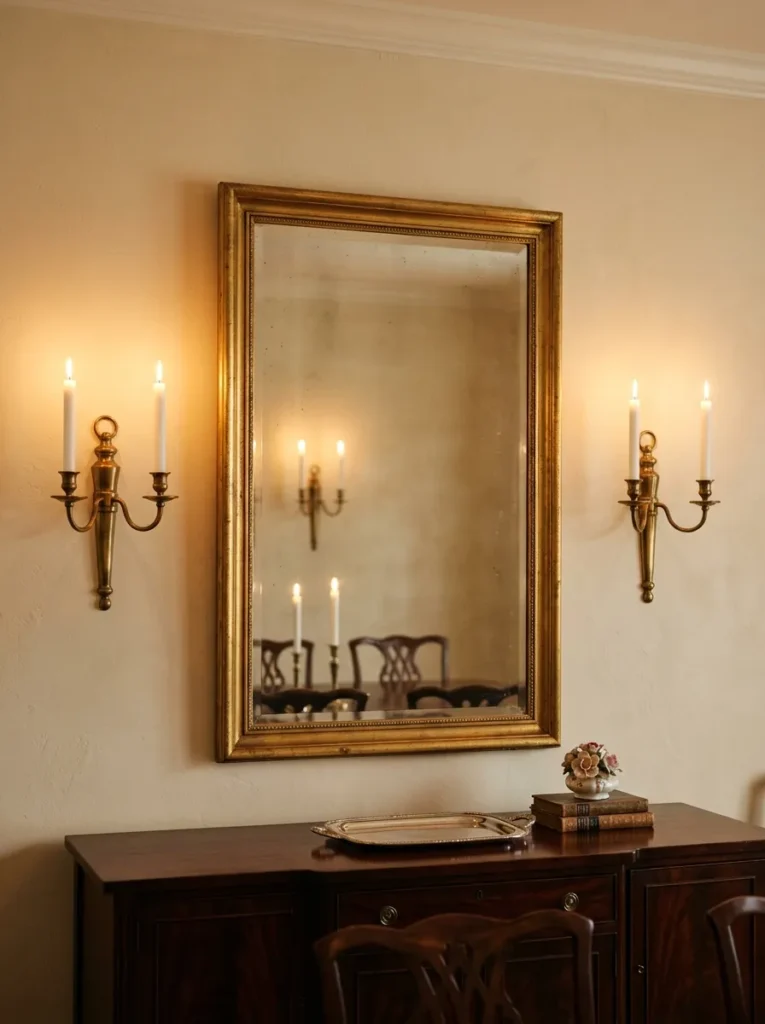
Vibe: Warm and ceremonial — the dining room wall arrangement that makes every dinner feel like an occasion.
Why it works: The gold mirror flanked by candle sconces is the mirror arrangement that most powerfully activates the mirror’s light-amplifying function — the candlelight from the flanking sconces is reflected in the mirror surface and projected back into the room, producing twice the warm candlelight atmosphere for the same number of candles. This light multiplication effect has been the practical basis of the mirror-and-sconce arrangement in dining rooms since the 18th century, when expensive tallow and later beeswax candles made the efficiency of mirror-reflected candlelight a genuine domestic economy as well as an aesthetic choice. The symmetrical sconce flanking creates a formal, bilateral composition that reads as architecturally deliberate — the mirror is not a decorative object but the center of a composed light installation that frames the dining room’s most social wall with warm, flickering light that flatters both food and faces.
How to get it: Position the sconces at the mirror’s mid-height (half the mirror’s vertical dimension from the top edge) and approximately 100mm beyond the mirror’s side edges — this positioning creates visual symmetry with the mirror while keeping the sconces close enough to the mirror that the candlelight reflection relationship reads clearly. Use LED flame-effect bulbs in the sconces if real flame candles raise safety concerns in an unattended dining room — quality LED flame-effect bulbs now produce a convincing flicker at warm amber color temperatures.
Shop the Look
| Product |
|---|
| Rectangular aged gold mirror dining |
| Brass candle sconce wall pair |
| White taper candle set |
| LED flame effect bulb warm |
| Sideboard timber below mirror |
15. Leaning Floor Mirror with Gold Frame for Bedroom Styling
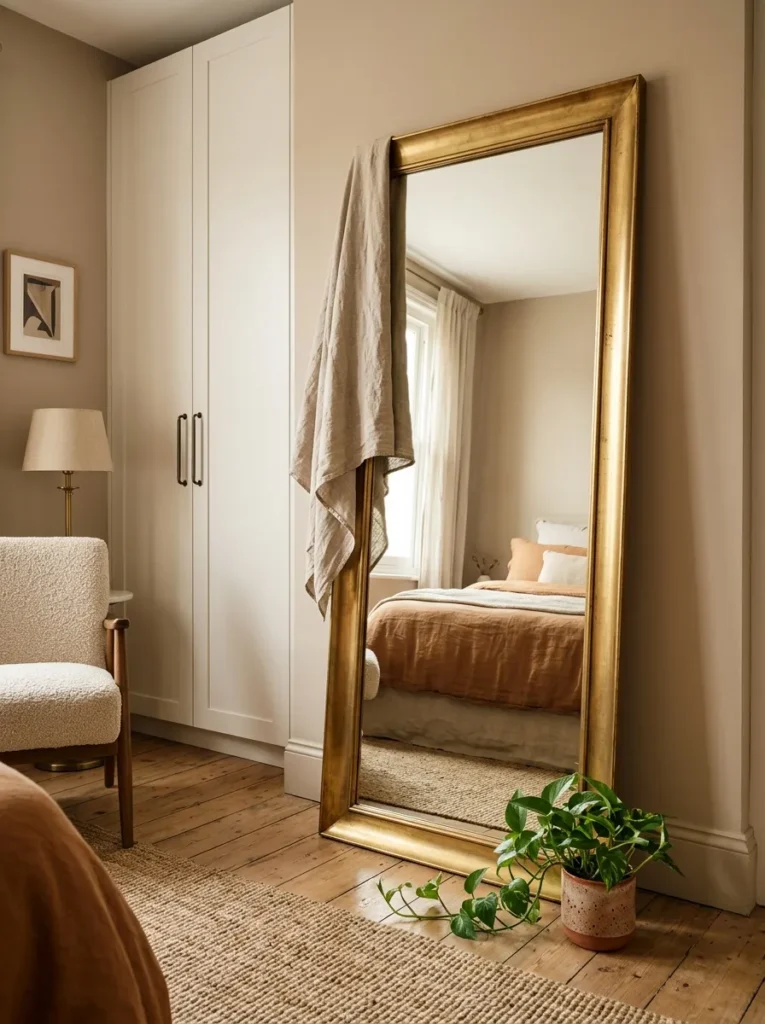
Vibe: Warm and relaxed — the bedroom mirror that makes the room feel styled without feeling styled.
Why it works: The leaning floor mirror with a wide burnished gold frame is the bedroom mirror format that most effortlessly communicates the curated-yet-casual aesthetic that defines contemporary residential interior design at its most sophisticated — its leaning position suggests that it arrived and found its natural resting place rather than being formally installed, and its wide frame provides the decorative weight of an ornate piece without the rigidity of a wall-mounted formal mirror. The burnished gold frame specifically — with its slightly distressed, warmly toned surface that reads as aged and collected rather than newly purchased — is the material choice that gives the leaning floor mirror its editorial quality: a polished brass frame in the same format reads as contemporary and precise, while a burnished gold frame reads as personal and warm. The linen throw draped over the top edge is the styling detail that most distinctly makes the leaning mirror read as inhabiting the room rather than decorating it.
How to get it: The correct lean angle is 8–12 degrees from vertical — enough lean to prevent tipping (the base should be positioned 150–200mm from the wall) while maintaining the deliberate casual quality that makes leaning mirror styling read as intentional. The wide frame (50–70mm) is important at floor mirror scale — a narrow frame on a large mirror reads as a picture frame scaled up to mirror size rather than a considered furniture piece. Secure the base with non-slip rubber pads and ensure the lean angle is controlled by wedging the base if the floor surface is slippery.
Shop the Look
| Product |
|---|
| Large floor mirror burnished gold frame |
| Non-slip rubber base pad |
| Natural linen throw |
| Trailing plant ceramic pot small |
| Wide frame mirror burnished |
16. Gold Leaf Hand-Painted Mirror for a Maximalist Room
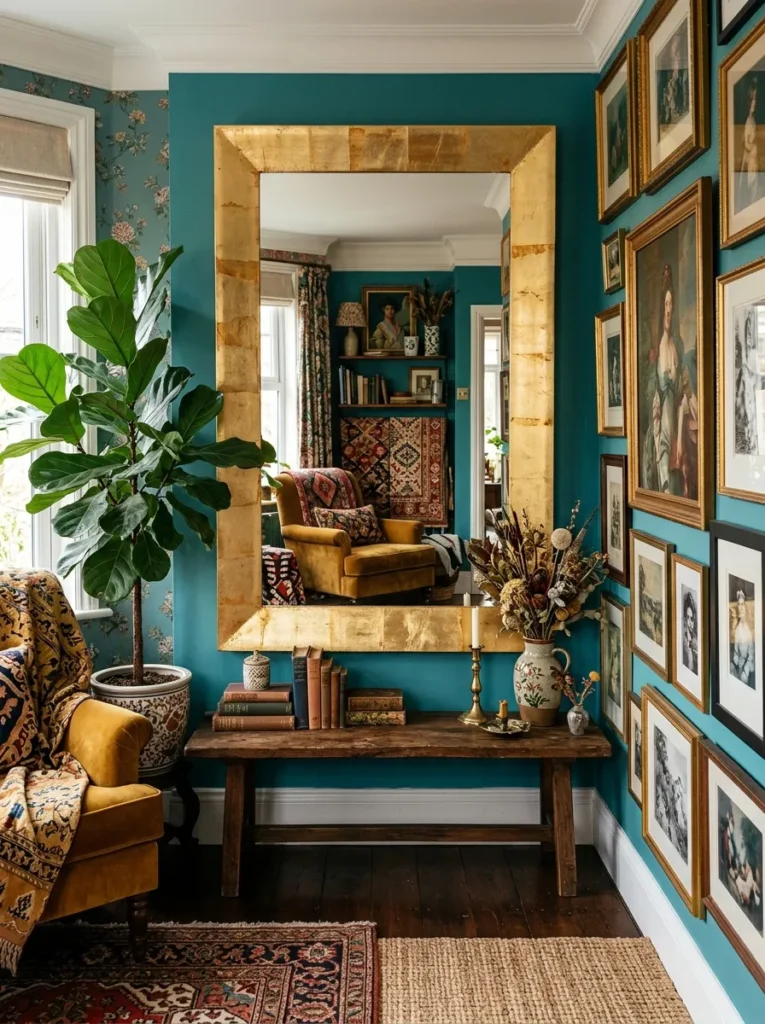
Vibe: Warm and maximalist — the mirror whose frame rewards close examination as much as its reflection rewards distance.
Why it works: The hand-applied gold leaf mirror frame is the wooden wall decor idea’s mirror equivalent — it makes the frame itself the primary art object by introducing the craft tradition of gilding, which has been the most prestigious surface treatment for frames, furniture, and architectural details in European decorative arts for five centuries. Applied gold leaf has a specific visual quality that no gold paint, gold vinyl, or gold powder can replicate: the individual leaf sections (typically 80mm × 80mm each) create a pattern of slightly varying reflectivity across the frame surface that catches light differently at each leaf boundary, producing a warm, living quality that moves and changes with the viewer’s position. This movement and variation in the gold leaf surface is the material quality that makes a gold leaf frame read as handmade and precious rather than manufactured and decorative.
How to get it: Apply gold leaf to any MDF or timber frame using the traditional oil gilding method: apply a thin, even coat of gold leaf size (oil-based adhesive) to the frame surface and allow to reach “tooth” (the state of just-tacky adhesion, typically 30–60 minutes), then apply individual gold leaf sheets in overlapping sections using a gilding brush, pressing each sheet gently into the tacky size. Tamp the applied leaf with a soft natural-bristle brush to adhere all edges. For a worn, aged quality, apply a raw umber oil paint wash over the completed gold leaf and wipe off the surface, leaving the pigment in the frame’s recesses and low points.
Shop the Look
| Product |
|---|
| Gold leaf sheets imitation set |
| Gold leaf size oil based |
| Gilding brush soft natural bristle |
| Raw umber oil paint small tube |
| MDF frame profile custom |
17. Antique Gilt Mirror as a Kitchen Backsplash Feature
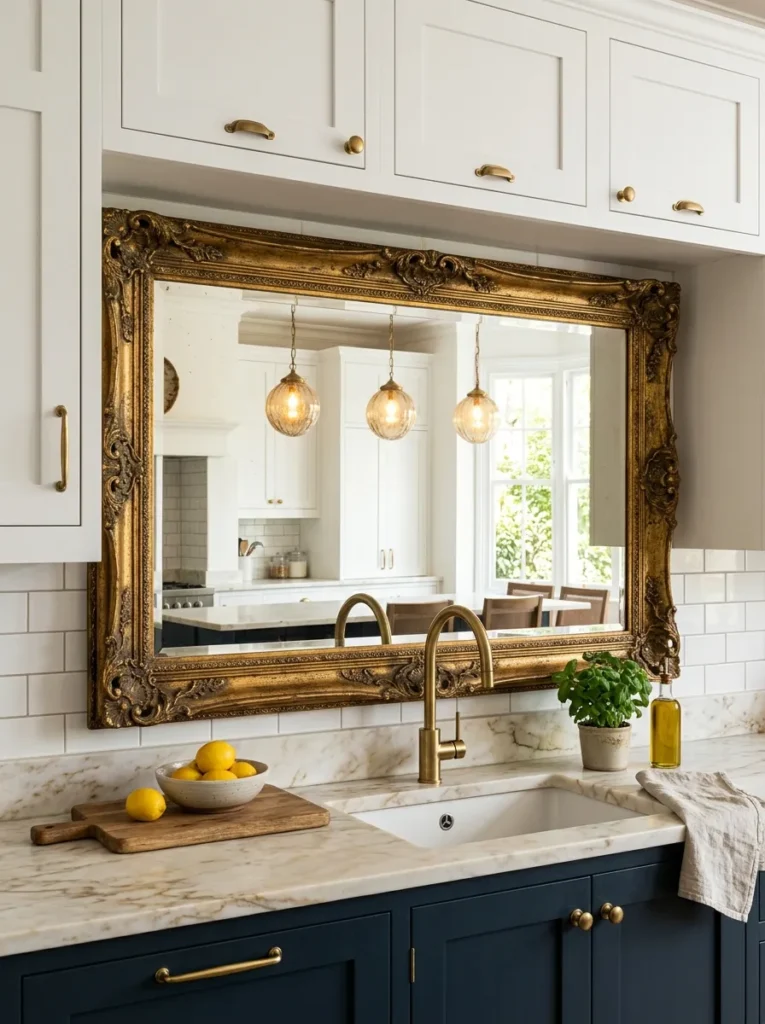
Vibe: Warm and unexpected — the kitchen design decision that makes every visitor look twice to understand what they are seeing.
Why it works: Using an antique gilt mirror as a kitchen backsplash is the gold mirror application that most dramatically subverts the expected domestic function of the mirror — in a room defined by functional materials (tile, stone, glass, stainless steel), a gilt-framed decorative mirror as a backsplash introduces the visual language of the drawing room or dining room into the kitchen, creating a deliberate aesthetic collision that reads as wit, confidence, and design literacy. The practical backsplash function is fully served — the mirror glass surface is as impervious to kitchen splashes as any standard tile — while the decorative contribution is incomparably richer than any tile material could provide. The mirror’s reflective function in the backsplash position creates an optical illusion of doubled kitchen depth, reflecting the pendant lights and opposite cabinetry to produce the visual impression of a larger, more luminous kitchen.
How to get it: Mount the mirror in the standard backsplash zone between upper and lower cabinets using mirror adhesive applied to the wall surface — do not use the mirror’s hanging hardware for this application, as the backsplash requires the mirror to sit flush to the wall with no gap. Seal the perimeter where the gilt frame meets the countertop with a clear neutral-cure silicone — this prevents water ingress behind the mirror while remaining invisible at the frame-to-countertop junction. Choose an antique gilt frame whose depth (the frame’s front-to-back dimension) does not exceed the depth of the adjacent cabinet door profiles — a frame that projects beyond the cabinet doors interferes with their operation and creates a visual inconsistency.
Quick Win: Testing the mirror-as-backsplash concept by temporarily leaning a framed mirror against the kitchen backsplash before permanent installation allows the spatial and atmospheric effect to be assessed and confirmed before any adhesive is applied — the leaning position is surprisingly close to the final installed effect and costs nothing to try.
Shop the Look
| Product |
|---|
| Antique gilt mirror backsplash width |
| Mirror adhesive tube |
| Clear silicone sealant neutral cure |
| Marble countertop slab |
| Brushed brass kitchen hardware set |
How to Start Your Gold Wall Mirror Transformation
Your single first move is to identify the room’s primary light source — the window or windows through which the strongest natural light enters — and position the intended gold mirror on the wall that will receive the light reflected from that source. A mirror hung directly opposite a window reflects the window’s light back into the room, effectively doubling the natural light quality of the space. A mirror hung on the same wall as the window, or on a wall that does not intercept the window’s reflected light path, provides only the decorative value of the frame and the spatial illusion of its reflective depth without the light-amplification benefit that is the gold mirror’s primary practical contribution to a room. This light-positioning principle applies to every gold mirror format in this list — the arch mirror, the sunburst, the convex, the floor mirror — and should be established before any decision about frame style, scale, or arrangement.
The most common gold mirror mistake is selecting a frame tone that mismatches the room’s existing metal hardware — specifically, installing a polished brass mirror in a room whose taps, door handles, and light fittings are in chrome, matte black, or brushed nickel. Metal finish mixing in interior design requires a deliberate and resolved approach: either commit to a single metallic register throughout the room (all brushed brass, or all polished brass) or make the mixed-metal approach intentional by ensuring at least two items in the room share each metal tone (if the mirror is polished brass, the lamp base and at least one other object should also be polished brass). A solitary polished brass mirror in a room of chrome hardware reads as a mistake; two or three polished brass elements in the same room create a palette rather than an error.
Three specific purchases under $100 that create immediate gold mirror installation quality: (1) Mirror adhesive cleats ($15–25 for a pair) rather than standard picture hooks or screws through the mirror glass — mirror adhesive cleats grip the mirror frame from behind without drilling through glass or frame, distributing the mirror’s weight evenly and preventing the single-point stress that causes mirror frames to crack at screw-hole positions. (2) A laser level ($25–50) for confirming horizontal alignment before any permanent mounting — even a 2mm tilt in a large gold mirror is visible from across the room and reads as an installation error rather than a design decision. (3) A packet of gallery wax or museum putty ($8–15) applied to the mirror frame’s back corners prevents the mirror from swaying against the wall and the frame from scratching the wall surface with repeated movement — particularly important for mirrors in high-traffic entry halls and narrow corridors.
Realistically, a single large-format gold mirror — a 150cm arch in polished brass, an oversized convex in aged gilt, or a floor-leaning burnished gold mirror — costs $200–600 from quality homewares retailers, $600–1,500 from specialist mirror suppliers, and $1,500–5,000 for bespoke or custom work. The three highest-value gold mirror investments in a home — the entry hall sunburst or integrated shelf mirror, the living room oversized arch, and the dining room triptych above the sideboard — collectively cost $800–2,500 from quality mid-range suppliers and produce a visual transformation across three primary rooms of the home that no other single category of decorative investment can match at equivalent cost. Most homeowners begin with a single statement mirror in the room they most want to transform — typically the entry hall or the primary living room — and build the gold mirror palette through the home gradually, informed by the cumulative effect of each mirror’s contribution to the rooms they inhabit.
Frequently Asked Questions About Gold Wall Mirrors
What is the difference between polished brass, aged gold, and burnished gold mirror frames?
Polished brass is a bright, high-reflectivity metallic gold produced by machining and polishing raw brass to a mirror-like surface finish — it reads as clean, confident, and contemporary, and coordinates naturally with other contemporary metallic hardware in brushed or polished brass. Aged gold (also called antique gilt or antique gold) is a warm, slightly oxidized metallic tone produced either by the natural oxidation of unlacquered brass over time or by the application of a chemical patination process to new brass — it reads as collected, historical, and eclectic, and coordinates with the deeper, warmer palette of traditional and maximalist interiors. Burnished gold sits between these two extremes — it has the warmth of aged gold without the green-grey oxidation that some antique brass develops, and its slightly matte quality reads as more sophisticated than polished brass in a residential context. Raw unlacquered brass develops all three of these finishes progressively over time, making it the most design-forward specification for anyone who values living material character over stable, predictable appearance.
What colors work best with gold wall mirrors in a bedroom?
The wall colors that most flatter a gold mirror in a bedroom are warm neutrals and earthy saturated tones — warm white, warm greige, dusty sage, deep forest green, and warm terracotta all create strong visual relationships with gold frame tones. Warm white creates the maximum contrast that makes the gold frame read at full visual intensity. Dusty sage creates a sophisticated complementary relationship with the warm gold based on their shared earthiness. Deep forest green creates the most dramatic and maximalist pairing — the deep cool-dark green and the warm-bright gold are near-complementary in the color wheel’s temperature register. Cool grey and blue-grey walls consistently underperform with gold mirrors because the cool-warm temperature clash between the grey wall and the gold frame creates a visual tension that both elements read as wrong rather than as designed contrast.
How large should a gold wall mirror be relative to the wall it hangs on?
The minimum practical size for a gold mirror to read as a designed wall feature rather than a decorative accessory is 60% of the wall section it occupies. For a mirror hung above a console or sideboard, the mirror should be minimum 60% of the furniture piece’s width. For a mirror hung on a bare wall as a feature, it should occupy minimum 60% of the wall’s width or height in its longest dimension. For a leaning floor mirror, the mirror should reach minimum 1400mm tall for a standard-height bedroom — a floor mirror below this height reads as a furniture piece rather than an architectural feature. The most common gold mirror scale mistake is selecting a mirror that is technically functional (the right format, the right finish, the right room) but too small in its dimensions to deliver the spatial and visual impact that the format’s design potential offers.
Can I use a gold mirror in a small bathroom without making it feel cluttered?
Yes — and in fact, a gold mirror in a small bathroom is one of the highest-impact design interventions available for compact spaces because the mirror’s reflective surface creates the perception of additional space while the gold frame introduces material richness at a scale that does not consume any of the room’s limited floor area. The correct specification for a small bathroom gold mirror is: a large-scale mirror (as large as the wall zone above the vanity will accommodate) to maximize the spatial expansion through reflection, a thin or minimal gold frame (rather than an ornate wide frame) to prevent the frame’s visual weight from competing with the mirror’s spatial function, and a clear silver or antiqued-silver mirror surface rather than a smoked or tinted mirror — in a small bathroom, the full-clarity reflective surface is more spatially generous than the atmospheric but space-reducing antique mirror glass.
How do I clean and maintain a gold mirror frame without damaging the finish?
The correct cleaning method for gold mirror frames varies by frame material. For polished brass frames: clean with a dry microfiber cloth for dust removal, and for stubborn marks use a slightly damp cloth with no cleaning agent — soap and cleaning products accelerate the oxidation of unprotected brass and strip the lacquer coating from lacquered brass. For aged gilt or hand-applied gold leaf frames: use only a dry, very soft natural bristle brush (a wide watercolor brush works well) to remove dust — any damp cloth or cleaning agent will lift the gold leaf or disturb the aged patina that gives the frame its character. For lacquered brass frames: a damp microfiber cloth is safe for cleaning, but avoid abrasive cloths or cleaning products that contain acids (including vinegar-based cleaners) which etch the lacquer surface. For raw unlacquered brass frames: allow the natural patina to develop without cleaning — the oxidation process is the intentional material behavior, and removing it defeats the design philosophy of specifying unlacquered brass.
Ready to Transform Your Home with Gold Wall Mirrors?
These 17 ideas span the full range of what a gold wall mirror can be and do in a home — from an oversized leaning arch that makes a living room feel like an editorial shoot and an ornate gilt overmantel that resolves a fireplace wall that has never quite worked, to a Venetian etched glass bathroom mirror, an organic irregular-shape powder room statement, a honeycomb hexagonal bedroom cluster, and a gilt-framed antique mirror used as a kitchen backsplash that makes visitors look twice to understand what they are seeing — so whether you are furnishing a single room or planning a whole-home mirror palette that introduces warm metallic light across every primary space, there is a genuinely achievable, genuinely considered gold mirror idea here for your specific room, your specific wall, and your specific aesthetic. The transformation begins with the light-positioning principle — mirror placed opposite the primary light source, frame tone matched to the room’s existing metal hardware — and continues with the scale decision: choose generously, because the most common regret in mirror selection is the one that is too small to read as the designed feature it was intended to be. Today’s specific action: stand at the door of the room you most want to transform, look at the primary light source, look at the wall opposite it, and measure that wall’s width and height with a tape measure — those dimensions, combined with the existing metal tones in the room, determine the precise gold mirror from this list that will make that room feel permanently more elegant, more luminous, and more like the home you intended it to be. Save the ideas that matched your rooms’ specific proportions, existing palettes, and aesthetic registers — those are the mirrors that will hang beautifully, reflect generously, and make every room they inhabit feel more considered from the first morning you wake up to them on the wall.