17 Christmas Decorating Ideas for a Cozy Holiday Home
Christmas decorating ideas for a cozy holiday home use warm materials, natural elements, layered lighting, and considered color to create the specific atmosphere of a genuinely festive domestic interior — one that feels warm and seasonal without reading as themed, abundant without tipping into clutter, and personal rather than catalog-perfect. This article gives you exactly 17 ideas spanning trees, mantels, tablescapes, lighting, wreaths, garlands, and room-by-room approaches so every home size, every aesthetic preference, and every budget finds a Christmas decorating direction that genuinely fits.
A cozy Christmas home is not the same as a heavily decorated one. The distinction is intentionality — each element placed for a specific atmospheric contribution rather than accumulated for quantity, with the warmth of natural materials and candlelight doing more decorative work than the number of ornaments. Here are 17 ideas worth saving — and building into the most comfortable version of Christmas your home has ever had.
Why Christmas Decorating Ideas for a Cozy Holiday Home Work So Well
The domestic Christmas interior as a designed space has its aesthetic origins in the Victorian English tradition — the Christmas tree introduced to British popular culture through Prince Albert and Queen Victoria’s royal example in 1848, the decorated mantel with evergreen garlands and candles, the dining table set for an extended family gathering, and the particular warmth of a lit room against winter darkness that Charles Dickens documented across his Christmas writing. Contemporary cozy Christmas decorating draws from this Victorian foundation while filtering it through Scandinavian hygge (the Danish and Norwegian aesthetic philosophy of warmth, simplicity, and comfort as active pursuits rather than passive states), the British country house Christmas tradition (natural materials, open fires, agricultural references like pine cones and berried branches), and the contemporary slow-living movement’s preference for genuine natural materials over synthetic equivalents.
The materials that define a genuinely cozy Christmas interior share a consistent set of properties: they are warm in color temperature (amber, copper, gold, deep red, forest green, warm white — never cool silver, blue, or pure stark white), natural in origin (fresh and dried botanicals, real wood, natural fiber textiles, beeswax candles, undyed wool), and tactile in quality (the roughness of a pine cone, the softness of a wool blanket, the coolness of a glass ornament, the bark of a branch used as a garland anchor). The color palette of the cozy Christmas interior has expanded significantly from the 20th-century dominance of red and green: contemporary versions include the all-white Scandinavian palette (warm white, natural linen, birch, and silver birch branches), the warm neutral palette (oat, terracotta, brass, dried botanical), the deep jewel palette (forest green, burgundy, deep navy, aged gold), and the natural palette (unpainted wood, undyed cotton, dried botanical, beeswax) — all warmer and more material-specific than the primary red-green-gold of commercial Christmas decoration.
The cozy Christmas decorating category generates some of the highest engagement of any seasonal content in home decor media, with Pinterest’s Christmas decorating categories showing sustained strong annual engagement from October onward and Instagram’s Christmas home content driving significant commercial behavior in the premium homeware and natural decoration sector. The cultural drivers are consistent with the broader slow-living and natural materials movements: a desire for a Christmas that feels genuinely warm and personal rather than commercially produced, a preference for natural and sustainable decoration over synthetic equivalents, and an increasing awareness of the atmospheric and wellness dimensions of domestic lighting, material, and color that makes the cozy Christmas interior a practical application of principles with year-round relevance.
Small homes and apartments achieve the cozy Christmas aesthetic most successfully because the warmth the style produces is amplified by spatial compression — a small living room lit by a fire, a tree, string lights, and four candles in lanterns is warmer and more atmospherically successful than the same elements in a large open-plan space where the light sources are too far from the viewer to create intimacy. The honest consideration: the cozy Christmas aesthetic requires warmth, and warmth requires warm light sources — if a home’s primary lighting is cool-white LED and the Christmas decoration is cold-toned (silver, blue, cool white), the cozy atmosphere is very difficult to achieve regardless of decoration quantity. Switching existing bulbs to warm-white (2700K) during the Christmas period is the single highest-impact change available for any home trying to achieve a cozy Christmas atmosphere.
Style at a Glance
| Element | Cozy Core | Contemporary Edge |
|---|---|---|
| Philosophy | Warmth over quantity | Natural materials over synthetic |
| Materials | Fresh evergreen, beeswax, wool, brass | Dried botanical, linen, raw wood, copper |
| Color Palette | Forest green, warm white, brass | Burgundy, oat, terracotta, aged gold |
17 Christmas Decorating Ideas for a Cozy Holiday Home
1. The Warm-Lit Natural Tree — Decorating for Atmosphere First

Vibe: The natural tree at dusk feels like Christmas distilled to its essential quality — the warm light points in the deep green branches the oldest and most complete version of the season available.
Why it works: A naturally decorated fresh tree with warm-white LED lights applies the Christmas lighting principle of point-source warmth within organic structure — the dense branching of a fresh spruce creates hundreds of small visual pockets at varying depths within the tree’s volume, and warm LED lights nested within those branches create points of warm illumination at varied depths simultaneously, producing the three-dimensional quality of light that flat-surface lighting cannot replicate. The specifically warm color temperature (2700K or warmer) is the critical technical decision — cool white lights (4000K+) convert a spruce tree from warm and welcoming to clinical and wintry. A galvanized metal bucket as the tree base is the contemporary natural alternative to the standard plastic tree stand, reading as industrial and honest rather than concealed.
How to get it: Purchase a fresh-cut tree from a reputable tree farm — the freshest trees have flexible needles that don’t shed when gently pulled, a strong resinous scent, and a cut base that is not fully dried. Place in a water-holding tree stand (even inside a galvanized bucket, insert a water-holding liner) and keep topped up — a fresh tree drinks 1–2 litres of water daily in its first week. Apply warm-white LED string lights (minimum 200 lights for a 180cm tree, working from the trunk outward in each section from top to bottom) before any ornaments. Add ornaments in a restrained edit — fewer, more considered pieces read better than comprehensive coverage.
Quick Win: Switching from cool-white to warm-white LED string lights ($12–20 for a 200-light set) on an existing Christmas tree creates a more dramatic atmospheric improvement than any other single change available to a decorated tree — the warm-white version of an identical tree reads as significantly warmer, more traditional, and more atmospherically appropriate than its cool-white equivalent.
Shop The Look
| Product |
|---|
| Warm white LED Christmas tree lights 200 |
| Natural wooden ornament set |
| Cream linen star tree topper |
| Galvanized metal bucket planter |
| Fresh Norwegian spruce Christmas tree |
Also view: 15 Ambient Decorative Lantern Ideas You’ll Love
2. Evergreen and Brass Mantel Garland

Vibe: The garland mantel feels genuinely seasonal — the mix of fresh green, warm brass, and dried citrus creating the specific scent and visual warmth that makes a room feel like Christmas without being told it does.
Why it works: A fresh evergreen mantel garland with brass and dried citrus accents applies the material richness principle of multi-sensory decoration — fresh evergreen garlands contribute not only visual warmth but the specific aromatic quality of pine, eucalyptus, and juniper that is among the most universally recognized and emotionally resonant scents of the winter season. Brass and gold ornament clusters provide the warm reflective surface that catches and distributes candlelight from the taper candles at each end, making the garland appear to glow from within as the candles are lit. Dried orange slices and cinnamon sticks add additional aromatic layers and textural contrast. The mantel garland is the cozy Christmas interior’s highest-impact single decorating investment — it transforms the room’s primary architectural feature into a seasonal statement.
How to get it: Source fresh evergreen garland from a florist, garden centre, or specialty wreath maker — a 180cm garland is typically sufficient for a standard 150cm mantel with slight end draping. Secure at two or three points along the mantel using small S-hooks over the mantel edge or removable adhesive clips. Tuck brass ornament balls (available in packs from Christmas decoration retailers) into the garland at varied depths. Wire dried orange slices, cinnamon stick bundles, and pine cones to floral wire and insert into the garland at irregular intervals. Place brass candlestick holders at each end of the mantel with cream taper candles.
Shop The Look
| Product |
|---|
| Fresh mixed evergreen garland 180cm |
| Brass candlestick holder set 2 |
| Cream taper candle set 6 |
| Dried orange slice set decorative |
| Brass ornament ball set gold |
3. Dried Botanical Wreath for a Contemporary Front Door
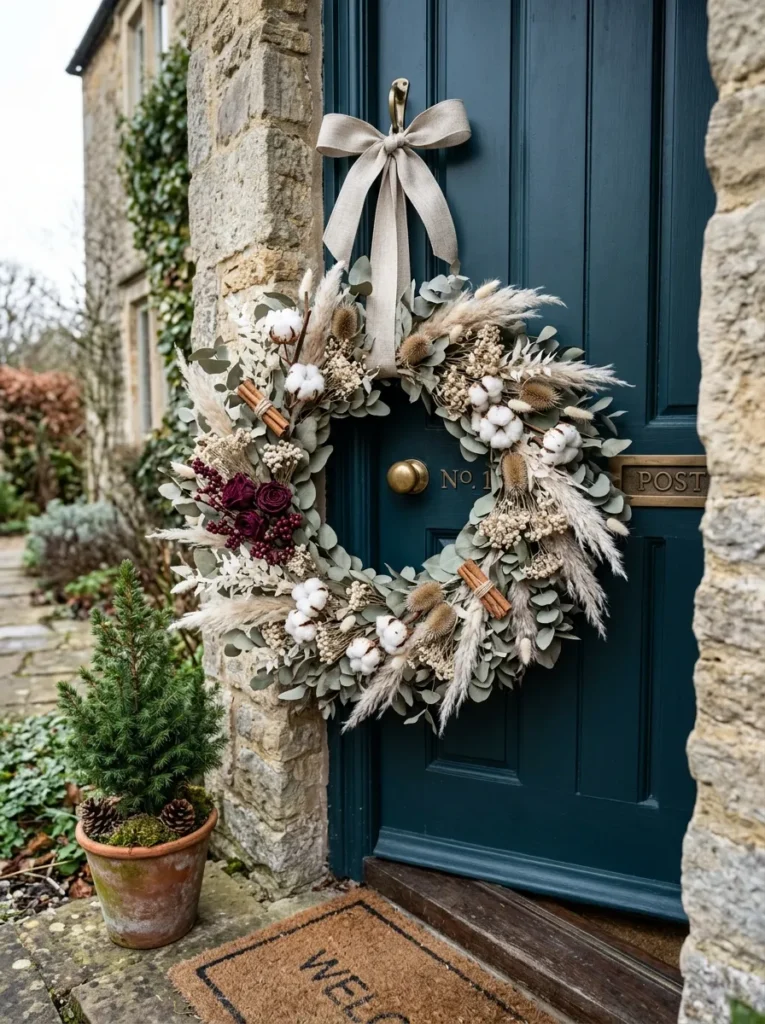
Vibe: The dried botanical wreath feels designed rather than traditional — the botanical palette fresh enough to belong to this specific house rather than to the generic idea of a Christmas door.
Why it works: A dried botanical Christmas wreath in natural neutral tones applies the contemporary wreath design principle of material richness without color saturation — the conventional Christmas wreath’s red-green-gold palette is replaced by a more sophisticated range that references the season through texture and material (the dried stems and seed heads of winter) rather than through conventional Christmas color. The natural cream, warm gray, and dried parchment tones of dried cotton, gypsophila, and pampas grass create a palette that is simultaneously neutral and warm, making the wreath appropriate for a wide range of door colors and architectural styles that conventional Christmas wreaths do not suit. The single deep burgundy accent (dried roses or rosehips) provides the seasonal warmth without converting the palette into a conventional Christmas arrangement.
How to get it: Source a ready-made dried botanical wreath from specialist wreath makers on Etsy or at Christmas markets, or construct your own using a wire wreath ring and dried botanical bundles inserted through the wire. Build the wreath in layers: dried eucalyptus as the base coverage, then gypsophila and dried cotton for texture, then larger statement elements (pampas plumes, teasel heads) at intervals. Add the burgundy rose cluster as a single focal point at the 4 o’clock or 8 o’clock position (asymmetric placement reads as more contemporary than a centered focal point). Hang with a natural linen ribbon looped over a door wreath hook.
Shop The Look
| Product |
|---|
| Dried botanical wreath 40cm natural |
| Dried eucalyptus wreath ring base |
| Dried pampas grass small plume set |
| Dried cotton stem set natural |
| Natural linen ribbon wide wreath |
4. Staircase Garland with Woven String Lights
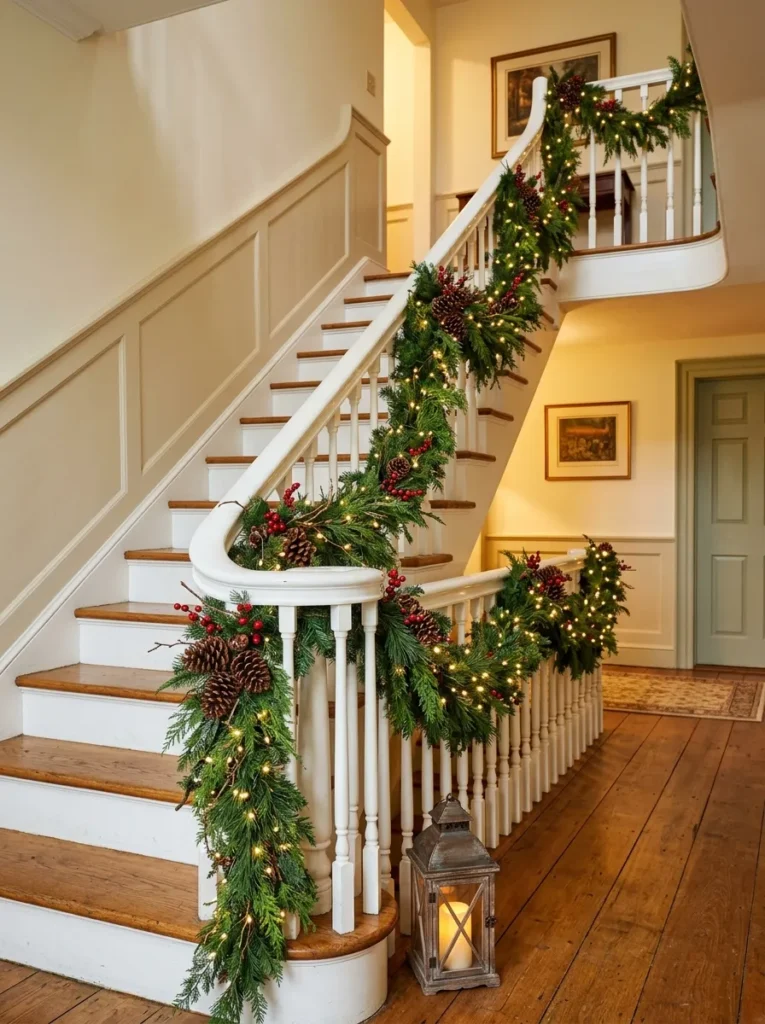
Vibe: The staircase garland feels like the house is wearing Christmas — the decoration woven into the architecture rather than placed upon it.
Why it works: A staircase banister garland with woven string lights applies the architectural decoration principle of linear element celebration — the staircase banister is a continuous structural line that runs through the home’s vertical space, and dressing it with a garland converts this everyday architectural element into a seasonal focal feature that is experienced every time anyone moves between floors. The woven warm-white LED lights (woven through the garland rather than draped over it) are the critical detail — lights lying on top of a garland read as an addition; lights woven through the garland read as integral to it. This distinction between added and integrated is the difference between a garland that looks dressed and one that looks designed.
How to get it: Measure the banister length (including any horizontal sections at the top and bottom of the stair run). Source fresh pine or mixed evergreen garland in the appropriate length, adding approximately 25% extra for the spiral winding around the banister. Secure the garland at the top of the banister first using garden wire or floral wire wrapped around the banister, then wind the garland in a loose spiral down the banister, securing at every third baluster. Weave a 10-metre warm-white LED string light through the garland from top to bottom before the final securing, so the LED wire is within the garland structure. Tuck pine cones and berry sprigs at the securing points.
Shop The Look
| Product |
|---|
| Fresh pine staircase garland 3m |
| Warm white LED string light 10m |
| Floral wire green craft |
| Dried pine cone set natural |
| Deep red berry stem artificial |
5. Advent Calendar as Decorative Wall Installation
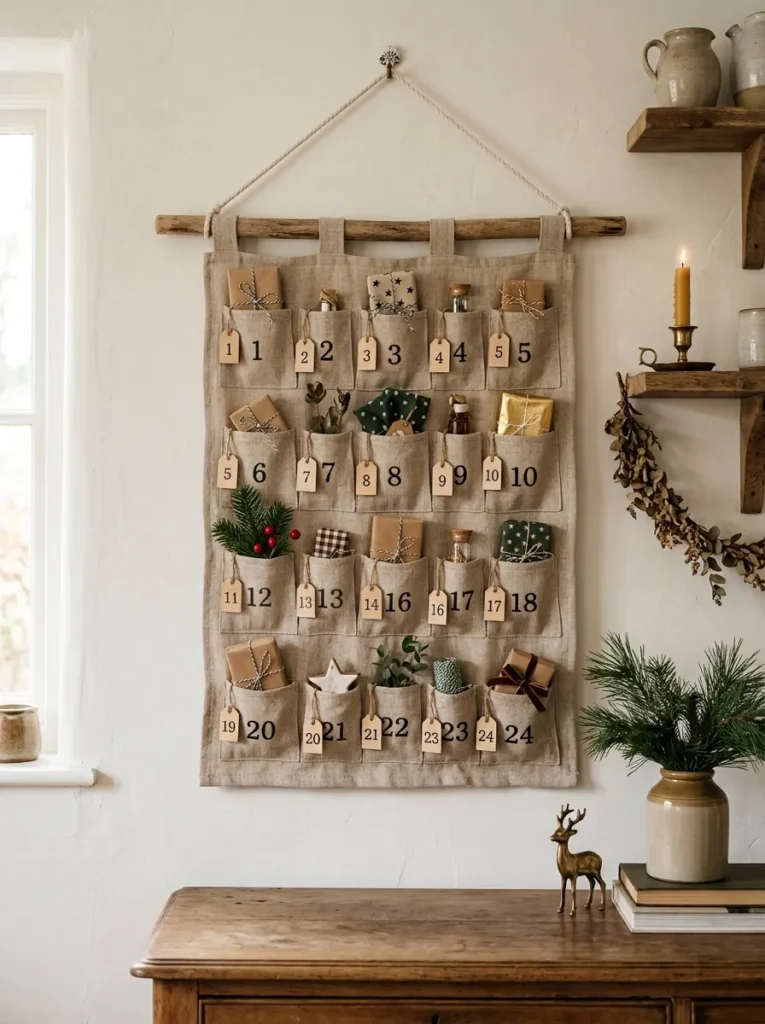
Vibe: The fabric advent calendar feels like December has been given physical form — the numbered pockets on a wall making the countdown visible and tactile throughout the room.
Why it works: A fabric advent calendar as a wall installation applies the design principle of functional decoration — an object that performs a specific temporal function (marking the 24 days of Advent) is also the room’s primary December wall decoration, combining utility and aesthetics in a single piece. Natural linen as the calendar material is the specifically contemporary alternative to commercial cardboard or plastic advent calendars, which read as purchased rather than considered. The visual presence of the calendar on the wall — its scale, the numbered pockets, the slight activity of pockets being opened daily — creates a seasonal atmosphere in the room that no static decoration can replicate because the calendar changes daily throughout December.
How to get it: Source a quality fabric advent calendar from independent makers on Etsy (search “linen advent calendar wall hanging”) or specialist Christmas retailers — the most durable versions have machine-washable linen pockets and a wooden dowel mounting system that allows the calendar to be stored flat and reused annually. Fill with a combination of small wrapped chocolates, folded notes with December activities, small botanical elements (a cinnamon stick, a dried orange slice, a small pine sprig), and miniature presents appropriate to the household’s inhabitants. Hang at a height accessible to the youngest member of the household who will be participating in the daily opening ritual.
Shop The Look
| Product |
|---|
| Fabric linen advent calendar wall hanging |
| Small parcel wrap kraft paper set |
| Thin ribbon set small parcel tie |
| Dried orange slice advent fill |
| Cinnamon stick bundle advent fill |
6. Windowsill Candlescape with Seasonal Botanicals
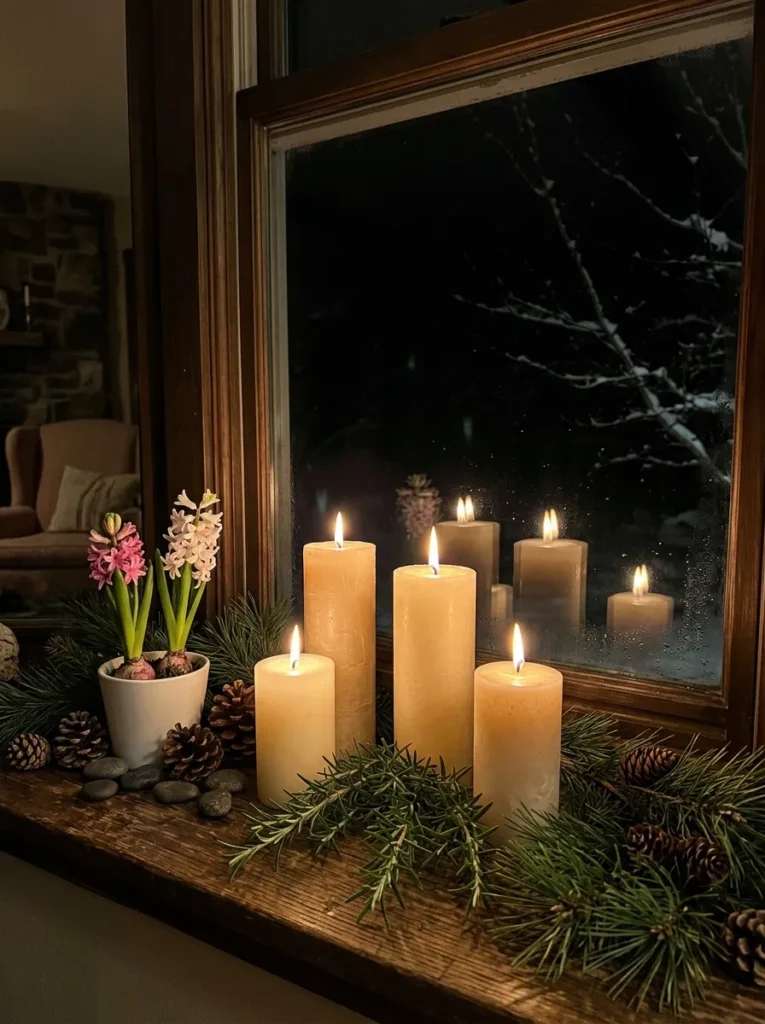
Vibe: The windowsill candlescape feels like the warmest moment in the room — the window’s winter darkness framing the warm glow of candles and botanicals as a composed Christmas scene.
Why it works: A windowsill candlescape applies the dramatic contrast principle of warm light against winter darkness — a window in December, viewed from outside, shows exactly what is warm and lit within the house, making a windowsill candlescape simultaneously an interior decoration and an exterior gesture. From inside the room, the winter darkness behind the window converts the lit candles into a composition that appears to float against a dark background, creating the theatrical quality of illuminated objects in darkness that is the visual mechanism of the most atmospherically successful Christmas decorating. The small potted hyacinths are the seasonal botanical addition that contributes fragrance as well as visual warmth — hyacinths forced for December flowering are among the most strongly and pleasurably fragrant of all winter bulbs.
How to get it: Use a window with reasonable depth to the sill (minimum 10cm) and place a thin fire-resistant liner (a piece of aluminum foil, a slate tile, or a thin metal tray) beneath the candles for fire safety. Arrange five pillar candles (varying from 8 to 20cm tall) in a staggered pattern, never directly beneath the window fabric. Fill gaps with fresh rosemary sprigs (available fresh from most supermarkets year-round and strongly fragrant when touched), small pine clippings, smooth river stones, and two or three forced hyacinth bulbs in small terracotta pots.
Shop The Look
| Product |
|---|
| Cream pillar candle set varied heights |
| Fresh rosemary bunch seasonal |
| Potted hyacinth forced winter bulb |
| Smooth river stone set decorative |
| Metal tray liner candle safety |
7. Natural Wrapping Paper and Gift Display Under the Tree

Vibe: The gift display feels like the presents are already part of the decoration — the coordinated natural packaging making the pile under the tree as styled as any mantel arrangement.
Why it works: Coordinated natural gift wrapping as Christmas decoration applies the styling principle of color palette extension — when all the gifts beneath a tree are wrapped in a consistent palette (kraft brown, white, and natural linen, with a single burgundy accent), the gift pile becomes a designed element of the tree’s base styling rather than a miscellaneous accumulation of commercial wrapping. The natural materials (kraft paper, linen twine, fresh botanical sprigs) reference the same material palette as the rest of the cozy Christmas room, creating visual coherence from tree to gifts to mantel. Botanical sprigs attached to each gift (rosemary, a small pine sprig, a dried orange slice) simultaneously decorate the gift and reinforce the multi-sensory aromatic atmosphere of the room.
How to get it: Establish a three-material wrapping palette: kraft paper as the primary (for most gifts), white tissue as the secondary (for smaller gifts and gift bags), and one pattern option (a simple stamped or block-printed paper) as an accent. Use only two ribbon/tying materials: natural linen or jute twine as the primary, and one accent ribbon in a single deep tone (burgundy, forest green, or deep navy) for variety. Attach a small botanical element (rosemary sprig, dried orange slice, small pine cone) under each bow or knot using the same twine. Present all gifts together in a loose, natural pile rather than in arranged rows.
Shop The Look
| Product |
|---|
| Kraft paper roll gift wrapping |
| Natural linen twine roll gift |
| Burgundy satin ribbon roll |
| Fresh rosemary bunch botanical wrap |
| Dried orange slice gift decoration |
8. Scandi-Inspired White and Natural Christmas Palette
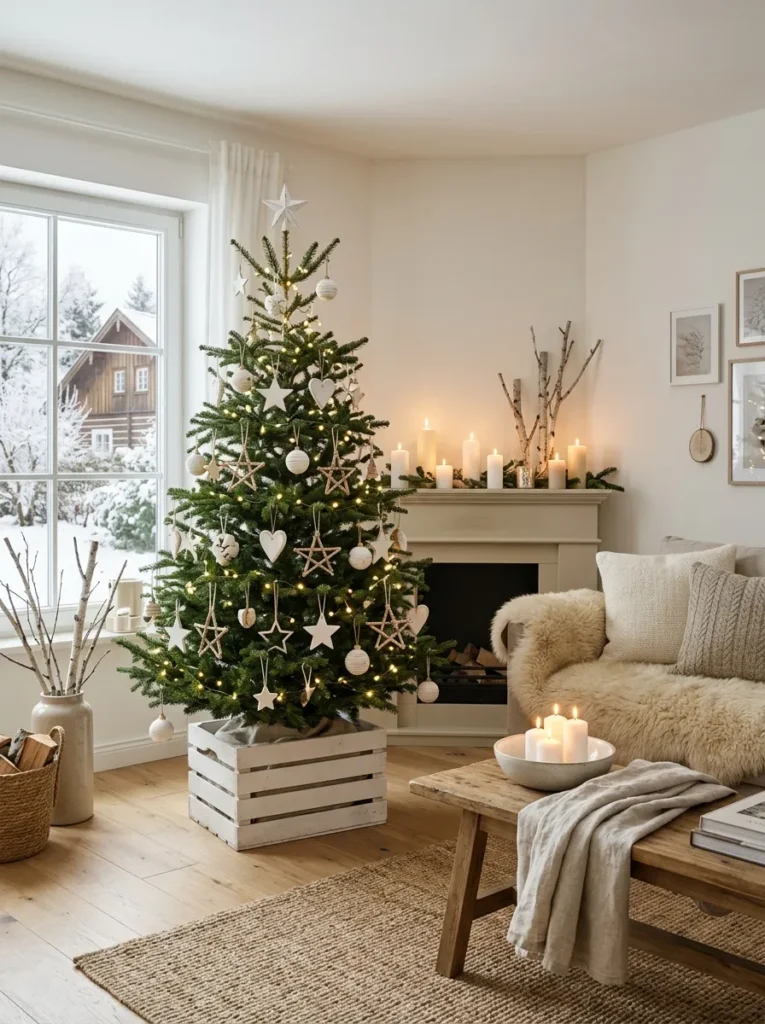
Vibe: The Scandi Christmas room feels like the visual equivalent of silence — the quiet and the warmth and the absence of color saturation creating the specific calm that no other Christmas palette achieves.
Why it works: A Scandinavian-inspired Christmas palette of white and natural tones applies the color design principle of tonal warmth without chromatic saturation — by restricting the entire seasonal palette to warm whites, natural creams, unbleached cotton, birch wood, and wool, the room achieves the paradox of being simultaneously Christmas (the accumulated decorative elements signal the season unmistakably) and calm (the absence of bright red, saturated gold, and high-contrast color combinations prevents the visual noise that conventional Christmas decoration creates). The Scandinavian approach specifically references the natural winter landscape (snow, birch forest, pale sky, warm candlelight against darkness) rather than the commercial Christmas visual language, making it feel more genuinely connected to the season’s environmental reality.
How to get it: Restrict the entire decorating scheme to five materials: white-painted wooden ornaments (available from Scandinavian homeware retailers including Flying Tiger, Søstrene Grene, and online Nordic design retailers), natural birch twig stars (handmade or purchased), unbleached cotton thread loops (the simplest possible ornament), warm-white LED lights (2700K), and sheepskin and natural wool textiles on the sofa and armchair. Add silver birch branches in tall ceramic vases as the room’s botanical accent. Allow no additional colors — the discipline of the palette is the entire design.
Shop The Look
| Product |
|---|
| White wooden Christmas ornament set |
| Natural birch twig star ornament |
| Unbleached cotton ornament loop set |
| Sheepskin throw natural white |
| Silver birch branch bundle decorative |
9. Christmas Kitchen — Herb, Citrus, and Spice Styling
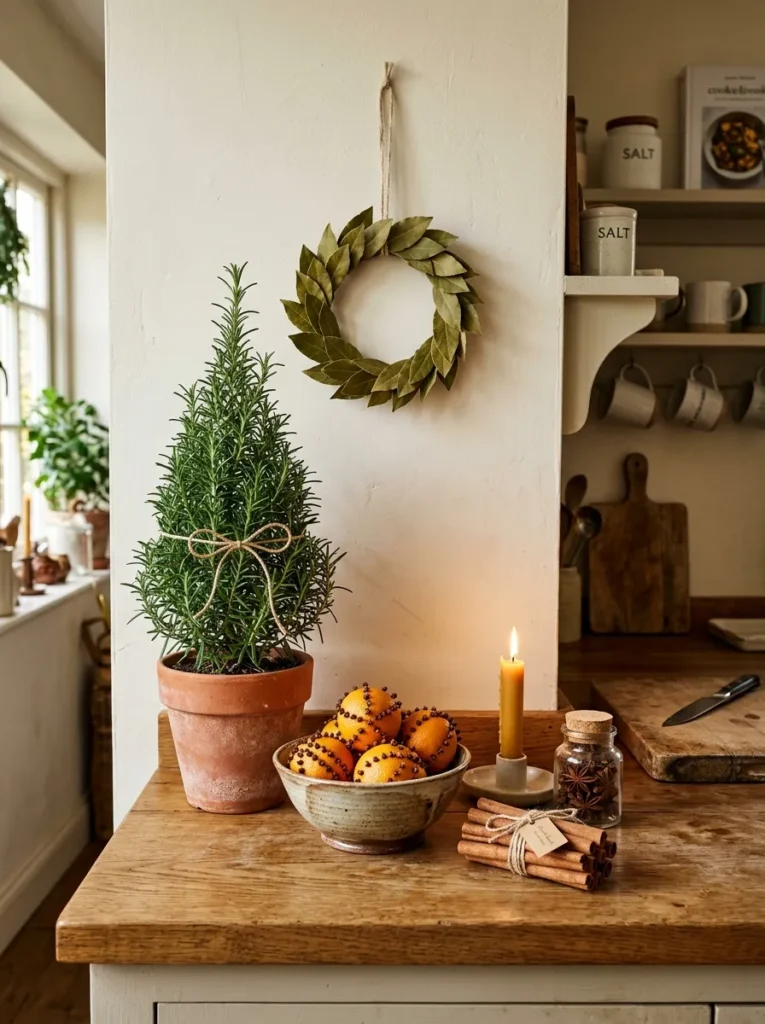
Vibe: The kitchen Christmas styling feels genuinely culinary and genuinely festive — the decoration made from the same materials as the cooking, the line between decorating and preparing blurred.
Why it works: A kitchen Christmas styling in culinary materials applies the design principle of context-appropriate decoration — the kitchen’s functional character means it resists conventional Christmas decoration (a tree in the kitchen, a garland on the refrigerator) while being perfectly suited to decoration from the materials it uses every day. Rosemary clipped into a small tree shape in a terracotta pot is simultaneously a decorative Christmas tree reference and a living culinary herb; pomanders (oranges studded with a geometric clove pattern) are simultaneously a Christmas decoration tradition with a history dating to the Tudor period and a fragrant preparation that will dry into a long-lasting aromatic object. Bay leaf wreaths are kitchen appropriate, aromatically appropriate, and visually warm. The kitchen Christmas styling in culinary materials is also one of the most cost-effective approaches in this list — most ingredients are already in the kitchen.
How to get it: Clip a rosemary plant (available as a supermarket herb or garden centre plant) into a simple cone tree shape using small scissors — the plant will regrow and is usable for cooking throughout the process. Make pomanders by pressing whole cloves into an orange in geometric patterns using a cocktail stick to pre-pierce the skin. Collect cinnamon sticks, star anise, and dried bay leaves from the kitchen store cupboard. Hang a small bay leaf wreath (made from a wire ring threaded with fresh bay leaves) on the kitchen wall or a cabinet handle.
Shop The Look
| Product |
|---|
| Rosemary plant terracotta pot |
| Whole cloves natural spice |
| Cinnamon stick bundle natural |
| Dried bay leaf bundle natural |
| Star anise jar decorative display |
10. Layered Living Room Textiles for Christmas Warmth
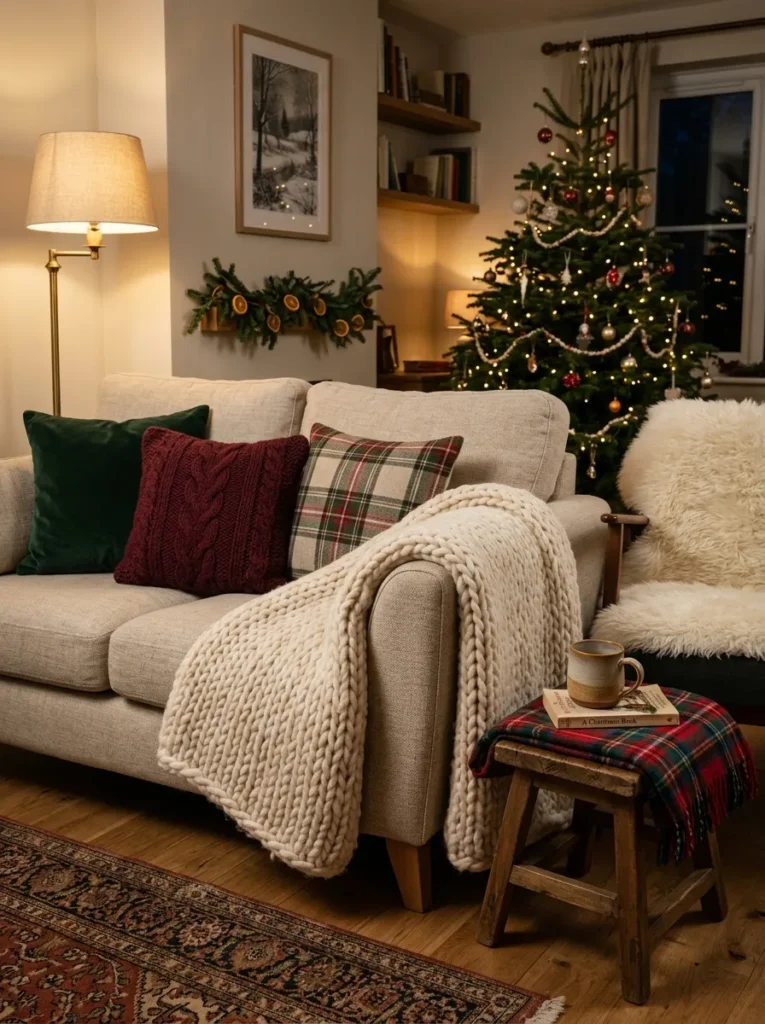
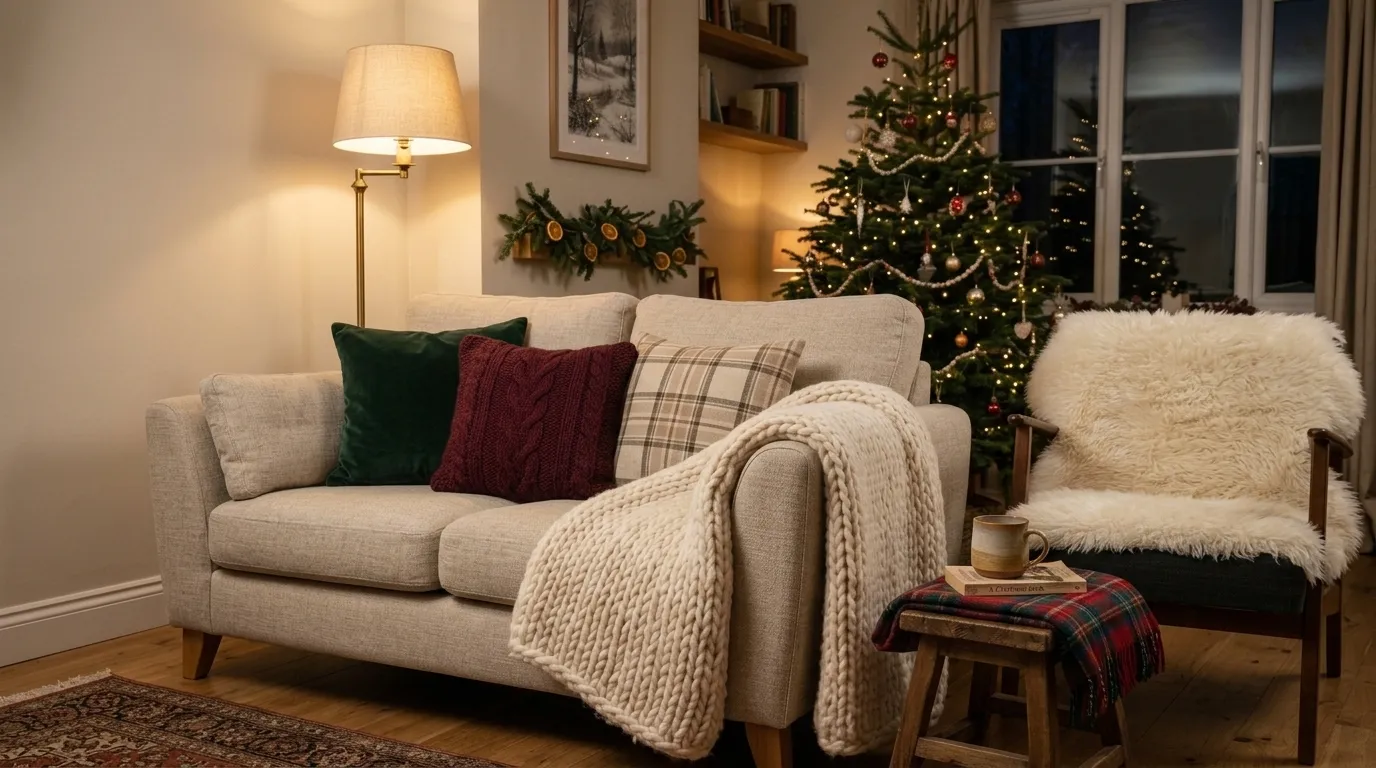
Vibe: The layered textile living room feels like the most comfortable room in any house during December — the deep green velvet and burgundy against natural wool and cream creating the warmth that radiators alone cannot provide.
Why it works: Layered Christmas textiles apply the seasonal home design principle of warmth through material accumulation — the most immediate physical and visual experience of warmth in a domestic interior comes not from the temperature of the room but from the presence of warm-tone, thick-fiber textile materials (velvet, chunky knit, sheepskin, tartan wool) that the brain associates with warmth and comfort through both visual and tactile processing. Adding three or four seasonal cushions and two additional throws to an existing sofa configuration for December costs very little (cushion covers swapped seasonally, throws stored and retrieved annually) and has the most dramatic single-item impact on a living room’s perceived warmth of any decorating intervention available. The forest green velvet cushion specifically is the element that most immediately communicates “Christmas” within the textile arrangement — the deep jewel tone of velvet in forest green references both the evergreen botanical palette and the historical textile associations of the season.
How to get it: Source seasonal cushion covers in forest green velvet, burgundy knit, and a warm plaid or tartan (cushion cover-only purchases are significantly more cost-effective than full cushion purchases and store compactly between seasons). Add a chunky-knit throw in cream or oat to the sofa arm and retrieve a sheepskin from storage for the armchair. Place a folded tartan blanket on the footstool. These additions require no installation, no damage to the room, and no permanent change — the entirety of the Christmas textile layer can be added and removed in under twenty minutes, making this the most instantly reversible and most atmospherically impactful Christmas decorating intervention available.
Shop The Look
| Product |
|---|
| Forest green velvet cushion cover |
| Burgundy knit cushion cover |
| Warm plaid cushion cover seasonal |
| Chunky knit throw cream natural |
| Sheepskin rug natural white sofa |
11. Christmas Dining Table Setting with Natural Elements
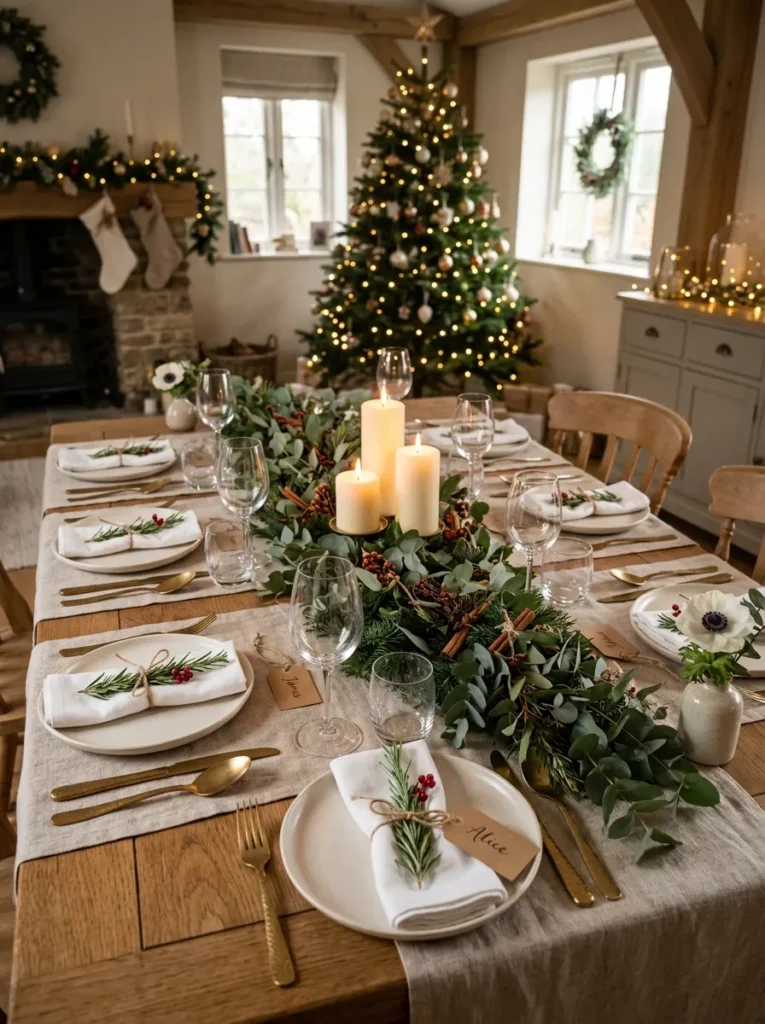
Vibe: The Christmas table setting feels like dining in a garden — the botanical runner bringing the outside to the table surface in a way that no commercial centerpiece can replicate.
Why it works: A Christmas dining table with a botanical garland runner applies the table design principle of horizontal botanical installation — a garland running the full table length rather than a single central centerpiece creates a continuous living element at the table’s center that every seated guest experiences at close range throughout the meal. Fresh eucalyptus (which is available year-round from florists and maintains its fragrance and visual quality for 10–14 days when cut) is the ideal garland runner material because its natural draping quality allows it to follow the table surface without additional support, and its blue-green tone coordinates with both the warm and cool ends of the Christmas palette. The small botanical napkin tie (a rosemary sprig or dried berry stem) extends the botanical element to each individual place setting, creating a consistent visual and aromatic thread from table center to each guest.
How to get it: Purchase 2–3 bunches of fresh eucalyptus from a florist and trim into individual sprigs. Lay the sprigs along the table’s length in overlapping arrangement, with larger sprigs in the center and smaller ones trailing toward each table end. Tuck dried botanical accents (pine cones, dried roses, small pine sprigs) into the eucalyptus arrangement at varied positions. Place three cream pillar candles (in ceramic or natural stone holders) at intervals along the garland runner. At each place setting, tuck a small rosemary sprig or dried berry stem under the napkin’s raffia tie.
Shop The Look
| Product |
|---|
| Fresh eucalyptus bunch 3 stems |
| Cream pillar candle set dining |
| White ceramic dinner plate set |
| Brass-effect cutlery set dining |
| Natural linen table runner |
12. Festive Bedroom — Subtle Seasonal Warmth
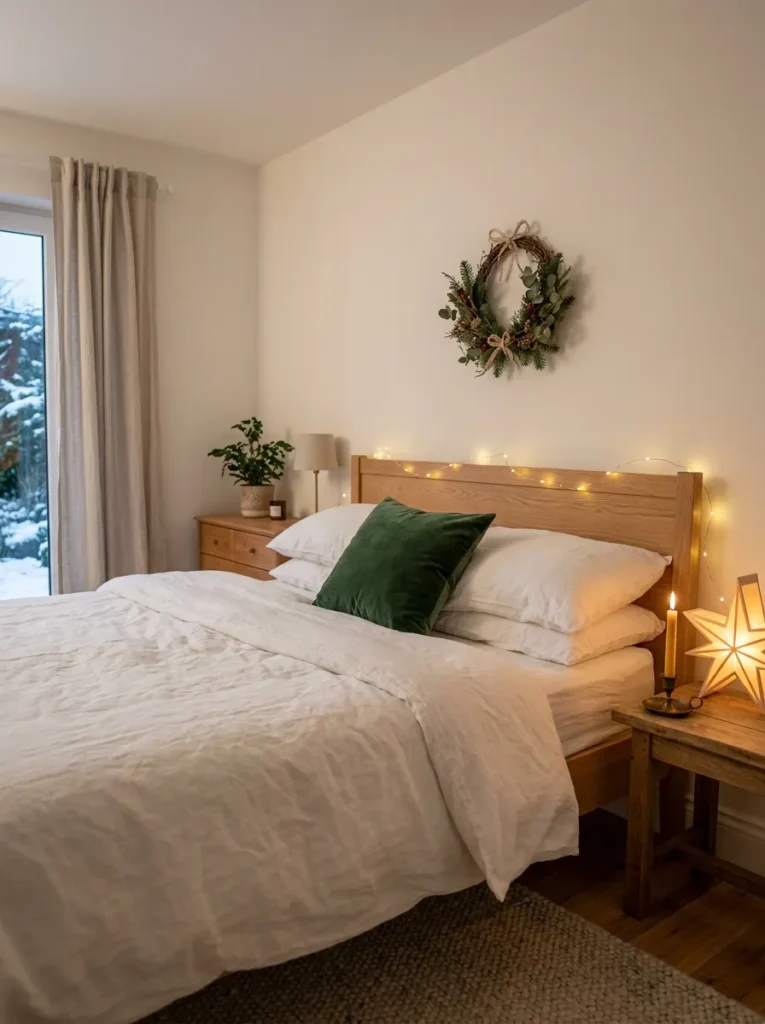
Vibe: The Christmas bedroom feels seasonal without being festive in a way that would disturb sleep — the small warm additions communicating the season gently rather than announcing it.
Why it works: A subtly decorated Christmas bedroom applies the sleep environment principle of minimal visual stimulation with maximum warmth — a bedroom’s primary function (sleep and rest) is served by calm, low-stimulation visual environments, which means the aggressive decorated quality of a fully Christmas-styled room is counterproductive in a bedroom context. The three small additions (micro LED headboard garland, small botanical wreath, one velvet cushion) each contribute to the room’s seasonal atmosphere without introducing visual complexity or stimulation incompatible with a restful environment. The wooden advent star (the Herrnhuter Stern or similar traditional German folded paper or wooden star) is a specifically appropriate Christmas bedroom object because its warm, soft point-source glow when illuminated is the bedroom-appropriate equivalent of the living room Christmas tree.
How to get it: Source a 2-metre copper wire micro LED fairy light string and drape across the top of the headboard (a small piece of removable putty adhesive at each end and center point secures the wire without marks). Hang a small dried botanical wreath (20–25cm diameter — small enough for a bedroom wall) using a single picture hook. Add one forest green velvet cushion to the existing bedding arrangement. Place a small advent star (Herrnhuter-style, battery-operated) on the bedside table with a small candle in a simple holder beside it.
Shop The Look
| Product |
|---|
| Copper wire micro LED 2m warm white |
| Small dried botanical wreath 20cm |
| Forest green velvet cushion cover |
| Wooden Herrnhuter advent star small |
| Small candle holder ceramic bedside |
13. Bookshelves Dressed for Christmas
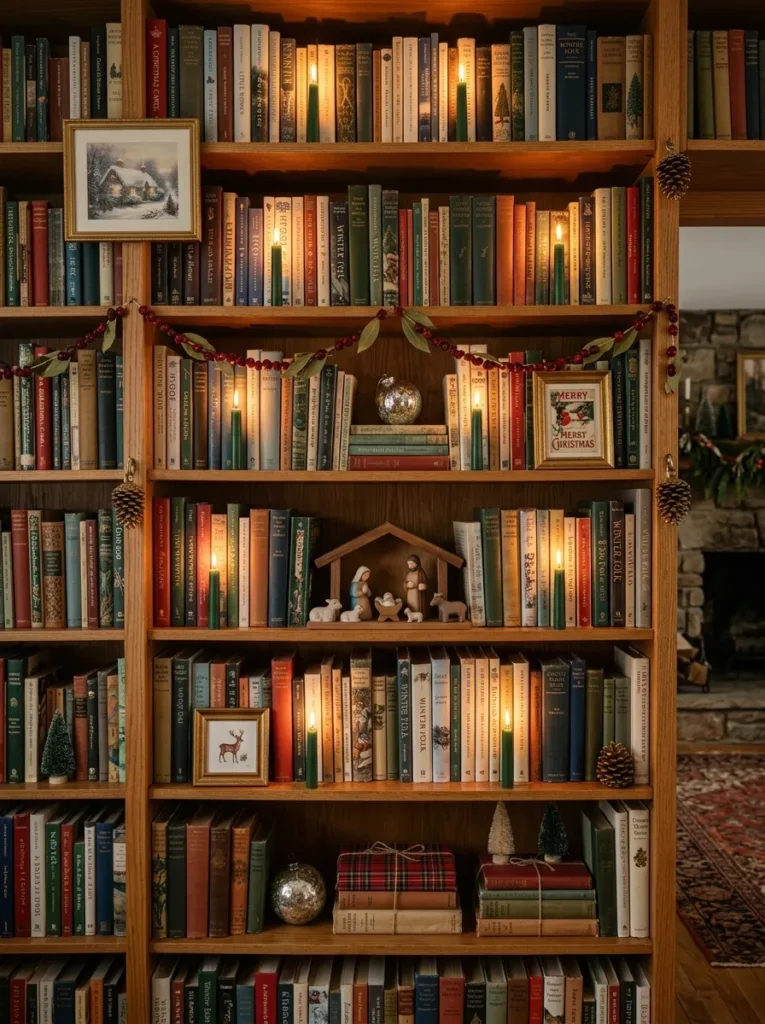
Vibe: The Christmas bookshelf feels like the books have been celebrating quietly all along — the seasonal additions nestled between familiar spines with the ease of something that was always there.
Why it works: Christmas bookshelf styling applies the decorating principle of seasonal enrichment of existing infrastructure — rather than clearing the shelves to replace books with Christmas objects (which reads as themed replacement rather than seasonal addition), the Christmas elements are added within and between the existing book collection so that the shelves remain recognizably themselves while acquiring a seasonal warmth. Small candles between books, brass ornaments resting on shelf edges, and a cranberry-and-bay garland along one shelf’s front edge all work within the existing spatial framework of the shelf rather than displacing it. This integrated approach is the most home-appropriate and most personally resonant shelf styling method because it allows the inhabitants’ own book collection to remain present and visible throughout the season.
How to get it: Distribute five to seven small pillar or taper candles (forest green, cream, or natural beeswax) at varied positions among the books — place on small coasters or glass plates for fire safety and ensure no book is within 15cm of any flame. Add three to five brass or gold ornament elements (pine cones dipped in gold spray paint, small brass star ornaments, small gold bell clusters) at shelf edges and between books. String a garland of dried cranberries (threaded on strong cotton thread with a large needle) along the front edge of one shelf. Tuck two or three small framed seasonal prints among the books.
Shop The Look
| Product |
|---|
| Small forest green pillar candle set |
| Brass pine cone ornament set |
| Dried cranberry garland string craft |
| Small wooden nativity figure set |
| Small framed seasonal print set |
14. Star and Celestial Theme — Overhead Decoration
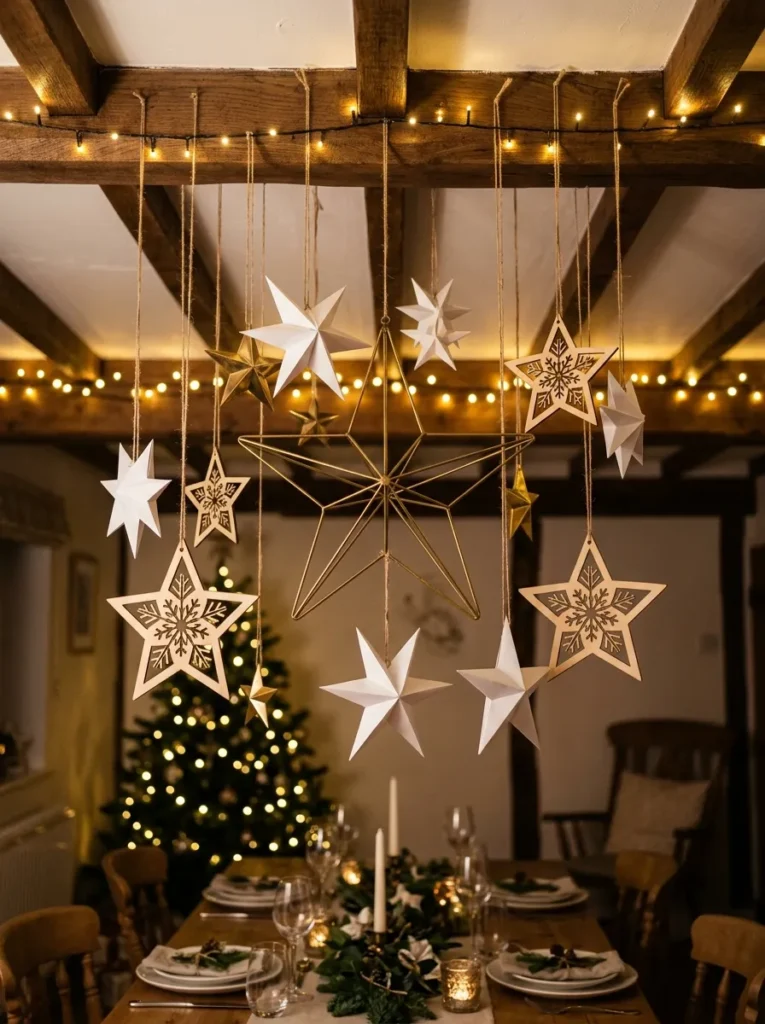
Vibe: The overhead star installation feels like being inside a winter sky — the room’s ceiling converted into a constellation by the cluster of varied stars.
Why it works: An overhead star and celestial Christmas installation applies the spatial design principle of vertical dimension activation — the ceiling of any room is its most consistently under-decorated surface, and a hanging installation that uses the full height of the room (from ceiling to 80cm drop) creates a three-dimensional seasonal installation in the room’s vertical space rather than its horizontal surface. Stars are the most specifically appropriate ceiling decoration for Christmas because the celestial reference (the star of Bethlehem, the winter night sky, the stars visible in the darkness of December evenings) is genuinely seasonal and genuinely vertical — looking up at stars is the activity the objects reference. Varied materials (paper, wood, brass wire) at varied scales (15cm to 50cm) create the compositional richness that makes the installation read as a designed constellation rather than a uniform repetition.
How to get it: Source paper stars (origami lucky stars, flat Scandinavian paper stars, or flat gold paper stars), wooden laser-cut stars (available from Christmas decoration retailers and Etsy makers), and one large statement star in brass wire or metal. Install small ceiling hooks (command strip hooks for lightweight paper stars, drilled hooks for heavier metal stars) at varied positions within a defined ceiling area. Hang each star at a different drop length using nylon thread (invisible from below), creating the sense of stars at different distances. Frame the cluster with a single strand of warm-white LED fairy lights installed at ceiling level around the cluster’s perimeter.
Shop The Look
| Product |
|---|
| Large brass wire star Christmas 50cm |
| Wooden laser-cut star set medium |
| Paper star ornament set white |
| Nylon thread clear thin hanging |
| Warm white fairy string ceiling light |
15. Entryway Welcome — First Impression Christmas Styling
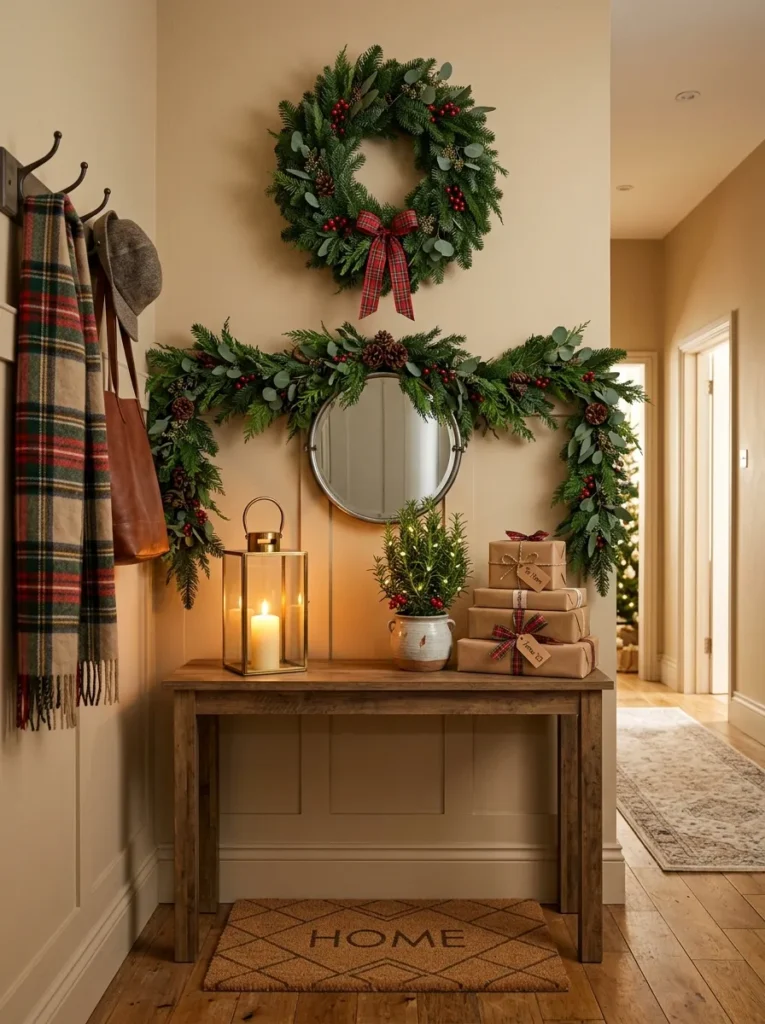
Vibe: The entryway feels like the house greeting you — the warmth and scent of fresh evergreen and candlelight the first thing experienced when the door opens from the cold.
Why it works: A Christmas-styled entryway applies the hospitality design principle of threshold welcome — the entryway is the space that transitions between the outdoor cold and the indoor warmth, and its Christmas styling is the first domestic experience both for the household returning home and for guests arriving. The combination of fresh evergreen (whose scent is immediately experienced at the entry threshold), warm candlelight (which is visible as soon as the door opens and the eye adjusts from exterior light), and a seasonal botanical element (the rosemary tree on the console) creates a multi-sensory welcome that operates through three distinct channels simultaneously: visual (the lit lantern and dressed console), olfactory (the fresh evergreen scent), and tactile (the transition from cold to warm). No other room in the house offers this simultaneous multi-sensory impact for Christmas decoration.
How to get it: Install a fresh wreath above the console table on the interior hallway wall using a picture hook — the interior wreath is an element rarely used in British and American homes but standard in Scandinavian and central European Christmas traditions, creating a second welcome moment inside the door as well as the exterior door wreath. Dress the console table with a lantern, the rosemary tree (see Idea 9 for clip-and-shape guidance), and two or three wrapped gifts. Use adhesive hooks to weave a small length of fresh evergreen around the mirror or picture frame that typically sits above the console.
Shop The Look
| Product |
|---|
| Small fresh wreath interior 30cm |
| Glass lantern console table medium |
| Rosemary plant topiary cone seasonal |
| Fresh evergreen sprigs hallway |
| Natural fiber hallway doormat |
16. Handmade Ornament Workshop — Make-Your-Own Christmas

Vibe: The ornament-making session feels like the most Christmas afternoon available — the activity itself as warm and seasonal as the objects it produces.
Why it works: A handmade ornament workshop applies the making-as-celebration principle — the activity of making Christmas decorations with other people is itself a form of Christmas celebration, generating the warmth, conversation, and shared purpose that define the domestic cozy Christmas experience as much as the decorated room it produces. Salt dough ornaments (the simplest possible clay substitute, made from flour, salt, and water), clear glass baubles filled with botanical materials, and fabric offcut stockings all produce genuinely beautiful finished objects while requiring minimal skill and generating the pleasant, easy-paced social activity that Christmas afternoon gatherings benefit from. Handmade ornaments also have a specific long-term resonance that purchased ones lack — they are identifiable as made in a specific year, by specific people, in a specific place.
How to get it: Prepare salt dough the day before the making session (mix 2 cups plain flour, 1 cup salt, and 1 cup water into a smooth dough). Roll to 5mm thickness on baking parchment, press botanical specimens or star stamps into the surface, and cut with cookie cutters. Dry in an oven at 120°C for 2–3 hours or air-dry for 24–48 hours. Collect clear glass baubles with removable tops (available from Christmas decoration retailers), dried botanical pieces small enough to fit through the opening, and small lengths of ribbon or thread. Cut fabric offcuts into simple stocking shapes, sew (or glue) along two sides, and add a loop of ribbon for hanging.
Shop The Look
| Product |
|---|
| Plain flour salt dough ornament |
| Clear glass bauble fillable set |
| Small dried botanical fill set bauble |
| Velvet fabric offcut set green burgundy |
| Cookie cutter set Christmas shapes |
17. New Year’s Eve Transition — From Christmas to Celebration

Vibe: The New Year’s Eve transition feels like the Christmas room dressing up — the same warm foundation elevated with gold and sparkle for the night’s specific occasion.
Why it works: A New Year’s Eve room transition that builds on existing Christmas decoration rather than replacing it applies the decorating principle of additive occasion styling — the most cost-effective and most visually coherent approach to New Year’s Eve decoration is not to remove all Christmas elements and install a separate New Year’s scheme, but to add occasion-specific elements to the existing Christmas room that shift the atmosphere from cozy to celebratory without displacing the warmth that the Christmas decoration has built. Gold star additions, metallic balloons, champagne flutes, and increased candle density raise the room’s visual energy level while retaining the warm foundation of the Christmas tree and garland. The visual logic is clear: Christmas provides the warmth, New Year’s adds the sparkle.
How to get it: Retain all existing Christmas decoration in place. Add a cluster of gold and copper metallic balloons (helium or air-filled, anchored with ribbon weights) in one room corner. Scatter small gold star confetti on the coffee table surface and around the candle holders. Bring out champagne flutes and place on a small tray on the coffee table with a bottle of champagne in a bucket nearby. Add five or six additional tea light holders throughout the room to increase the candle density from cozy to celebratory. The entire New Year’s Eve transition should take under thirty minutes from the unchanged Christmas room and cost under $25 in additional materials.
Shop The Look
| Product |
|---|
| Gold metallic balloon set celebration |
| Copper metallic balloon set warm |
| Gold star confetti scatter table |
| Champagne flute set six stemmed |
| Additional tea light holder set |
How to Start Your Cozy Christmas Home
The single best first move in creating a cozy Christmas home is addressing the lighting temperature before purchasing or placing a single decoration. If the home’s existing lighting is cool-white (4000K or above LED), replacing the bulbs in the rooms that will be primarily used during the Christmas period with warm-white (2700K) equivalents — or simply purchasing warm-white LED string lights and using them as the primary light source during December evenings — transforms the atmospheric quality of the space before any decoration is introduced. Every decorating decision in this list is designed to be experienced against a warm light background; every decoration in this list will look significantly less effective against a cool light background. The bulb change costs $15–30 and takes twenty minutes, and it is the most impactful single pre-decorating act available.
The most common mistake in Christmas home decorating is acquiring too many decorations and placing all of them — the annual accumulation of items purchased at different times under different aesthetic impulses, deployed simultaneously because they all somehow belong to “Christmas,” produces a room that reads as commercially decorated rather than personally curated. The fix is an editing audit before decorating begins: retrieve everything from storage, assess each item against the intended room’s color and material palette, and commit to using only the items that genuinely contribute to the specific aesthetic direction. Items that don’t fit the palette or material story can be donated, re-gifted, or stored for a future year when the decorating direction might suit them. A room decorated with thirty selected items read as designed; the same room with seventy accumulated items reads as maximalist regardless of the individual quality of any specific piece.
Three specific items under $50 that create immediate cozy Christmas atmosphere in any home: a set of three warm-white LED pillar candles ($12–18, battery-operated with timers, deployable on any surface without fire risk and providing the warm enclosed light of real candles without the management requirement); a fresh eucalyptus bundle ($8–12 from a florist, which can be arranged in a vase, draped along a shelf, woven into an existing garland, or used as napkin ties — one bundle providing aromatic and visual warmth across multiple applications); and a forest green velvet cushion cover ($12–20, which immediately signals the Christmas season on any sofa without requiring any other decorating commitment). These three items combined for under $50 create the warm lighting, botanical scent, and seasonal color that constitute the core of the cozy Christmas atmosphere before any other decoration is considered.
A simple cozy Christmas refresh — warm lighting, one botanical element, and a textile layer addition — is achievable in a single afternoon for $30–80. A mid-range Christmas room transformation — tree, mantel garland, botanical table setting, layered textiles, and window candlescape — takes a weekend and costs $100–250. A complete whole-home Christmas scheme — every room approached, staircase garland, entry styling, kitchen, bedroom, and dining room — represents a $200–500 investment in materials over two to three weekends. The warm lighting bulbs and the forest green cushion are achievable today; the fresh garland and the wreath follow this weekend, and the dining tablescape and staircase garland take their time and arrive when the season deepens.
Frequently Asked Questions About Christmas Decorating for a Cozy Home
How do you make a small home feel cozy at Christmas without it looking cluttered?
The anti-clutter discipline for a small cozy Christmas home rests on the same principle as all good small-space decorating: restrict rather than accumulate. Choose one room as the primary Christmas room (usually the living room) and invest the decorating effort there — a small room decorated deliberately with quality elements reads as intentional; a small home with Christmas decoration in every room reads as crowded regardless of the elements’ individual quality. Within the primary Christmas room, restrict the palette to three materials and four colors maximum, allow significant wall space to remain undressed, and prioritize the vertical dimension (the tree, a wall wreath, a staircase garland) over horizontal surface accumulation.
What natural materials work best for a cozy Christmas?
The most consistently effective natural materials for a cozy Christmas home are fresh cut evergreen (pine, spruce, eucalyptus, juniper, and holly — all available from florists and garden centres in December, all aromatic, and all maintaining their appearance for two to three weeks when kept away from heat sources and direct sunlight), dried citrus and spice (dried orange slices, cinnamon sticks, dried pomanders, star anise — aromatic, warm-toned, and available year-round from kitchen suppliers), natural beeswax candles (warmer in color temperature than paraffin or soy, with a natural honey scent), and dried botanical elements (pampas grass, cotton stems, dried roses, dried eucalyptus — which maintain their appearance for the full season and beyond). These materials share the properties of warmth, organic origin, and multi-sensory appeal that define the cozy natural Christmas aesthetic.
How do you choose a Christmas color palette?
The most functional approach to Christmas color palette selection is beginning with the room’s existing neutral base (the wall color, the sofa color, the floor tone) and selecting two Christmas accent colors that complement it rather than competing with it. A warm white room with oat and natural wood tones suits the Scandinavian palette (white, natural, birch, warm amber) or the botanical palette (forest green, dried cream, brass); a neutral gray room suits the jewel palette (forest green, burgundy, aged gold); a warm terracotta or earthy-toned room suits the natural palette (deep red, cinnamon, dried botanical, warm copper). The choice of metallic is equally important: warm gold and aged brass suit warm-toned rooms; silver and cool chrome suit cool-toned rooms. The most common palette mistake is mixing warm and cool metallics (gold tree star with silver tinsel) which creates a visual discord that undermines the cohesion of any other palette decisions.
What are the most sustainable Christmas decoration choices?
The most sustainable Christmas decoration choices prioritize longevity and natural origin over novelty and synthetic convenience. A real Christmas tree from a UK or domestic farm sequesters carbon during its growing years and can be composted or chipped after Christmas, making it a significantly more sustainable choice than a synthetic tree (which typically requires 7–10 years of use before its manufacturing carbon cost is offset). Natural botanical decoration — fresh and dried evergreens, citrus, botanical elements — is compostable after use. Quality wooden, ceramic, and glass ornaments that last for decades have significantly lower lifetime carbon costs than annual plastic ornament replacement. Beeswax and natural soy candles are preferable to paraffin. The most sustainable Christmas decoration strategy is a small collection of quality, natural-material pieces that are used, stored well, and reused annually for twenty or more years.
How do you maintain the cozy Christmas atmosphere throughout the season rather than just at the start?
The cozy Christmas atmosphere is sustained throughout December by three ongoing practices: daily candle and lantern lighting in the primary living spaces during the dark hours (the physical act of lighting candles and switching on fairy lights at dusk creates the daily atmospheric shift from daytime to Christmas-evening mode), regular fragrance maintenance (replacing depleted dried citrus, refreshing pomanders, cutting fresh evergreen sprigs to replace depleted garland sections, and simmering a pot of water with orange peel, cinnamon, and cloves on the stove for instant aromatic warmth), and a deliberate editing approach to any new items introduced during the season (resisting the accumulation of additional decorations, gifts, and packaging in the decorated spaces so the original decoration’s visual clarity is maintained throughout December rather than gradually buried in seasonal accumulation).
Ready to Create Your Coziest Christmas Home Yet?
These 17 ideas move through every dimension of what makes a Christmas home genuinely cozy — from the foundational atmospheric magic of a warm-lit natural tree at dusk, to the multi-sensory welcome of an evergreen and candlelight entryway, to the culinary warmth of a rosemary tree and pomanders in the kitchen, to the restful seasonal subtlety of a bedroom decorated with a micro LED headboard garland and a single velvet cushion. Starting with the warm light — switching one living room bulb to 2700K warm white this week — is not a small beginning. It is the beginning that determines whether every subsequent decoration in this list reads as warm and cozy or merely as colorful and seasonal, because warmth is light before it is anything else, and the quality of the light in a room determines the quality of every material, color, and textile decision made within it. Order the warm-white bulbs today, cut a branch of fresh evergreen from the garden or buy a bunch from the florist this weekend, and light the first candle of the season when the dusk comes early as it does in December. Everything else in this list follows from that specific, simple moment of gathered warmth against the winter dark.