15 Organic Modern Dining Rooms with Timeless Style
Organic modern dining rooms combine the clean, uncluttered geometry of contemporary design with the warmth, texture, and natural imperfection of organic materials — creating dining spaces that feel both visually refined and genuinely livable, grounded in nature without sacrificing the elegance of modern restraint. This article gives you exactly 15 organic modern dining room ideas with timeless style, covering furniture choices, lighting, materials, color, and styling, with practical guidance and curated product tables for every idea.
There is a particular quality of warmth that the best dining rooms share — the kind that makes guests slow down before sitting, that makes conversations run longer than planned, that makes the table feel like a destination rather than a furniture piece. Organic modern dining design achieves this through a specific and learnable formula: natural materials in refined forms, warm neutrals with deliberate texture, lighting that flatters both food and faces, and a restraint that makes every object count. Here are 15 ideas worth saving — and stealing.
Why Organic Modern Dining Rooms Work So Well
Organic modern design as a defined aesthetic emerged from the convergence of two previously distinct design movements in the early 2000s: the clean-lined minimalism of Scandinavian and Japanese modernism, and the tactile, nature-referencing warmth of the biophilic design movement that gained mainstream traction in the 2010s. The result is a design language that refuses the false choice between visual sophistication and human warmth — it is simultaneously calm and inviting, refined and textural, contemporary and timeless. Architecturally, the style draws from the organic modernism of mid-century masters like Alvar Aalto, whose bentwood furniture and sinuous forms demonstrated that modernist design could be simultaneously rigorous and warm, and from the Japanese aesthetic of wabi-sabi, which finds beauty in natural imperfection and the passage of time.
The materials that define organic modern dining rooms are specific and consistent: solid live-edge and character-grade hardwoods in white oak, walnut, and ash; natural stone in honed travertine, limestone, and marble with visible veining; hand-thrown and slip-cast ceramic tableware in matte white, warm sand, and sage green; natural fiber textiles in undyed linen, raw cotton, and hand-woven wool; woven rattan and cane for chair details; brushed and unlacquered brass, aged copper, and matte black metal for lighting and hardware; and dried and living botanicals including olive branches, eucalyptus, dried pampas grass, and trailing pothos. Color palettes are warm and restrained — warm white, greige, natural linen, warm sand, dusty sage, warm terracotta, and the deep natural tones of walnut and dark oak, with matte black as the single graphic accent that anchors without dominating.
The organic modern aesthetic is experiencing its strongest cultural moment to date, driven by three intersecting forces: the post-pandemic revaluation of the home as a place of genuine nourishment and gathering rather than merely functional shelter; the sustained influence of Scandinavian and Japanese interior design on global mainstream aesthetics through platforms like Pinterest and Instagram; and the growing material consciousness of design-literate consumers who are choosing natural, sustainable, and handcrafted materials over synthetic and mass-produced alternatives. Architectural Digest, Elle Décor, and House Beautiful data consistently show organic modern dining rooms as among the most saved and most requested interior design directions across all residential projects.
Small dining rooms achieve organic modern style most effectively by prioritizing one or two hero material choices — a solid oak table, a statement pendant light — and keeping everything else in the palette restrained and secondary. The organic modern approach to small spaces is additive restraint: add one beautiful natural material object at a time until the space feels complete, and resist the urge to add the next object before the previous one has been fully absorbed into the room’s visual economy.
Style at a Glance
| Element | Trait 1 | Trait 2 |
|---|---|---|
| Philosophy | Nature refined by form | Warmth without clutter |
| Materials | White oak, travertine, linen, rattan | Brushed brass, matte black, hand-thrown ceramic |
| Color Palette | Warm white, greige, natural linen | Dusty sage, warm walnut, matte black |
15 Organic Modern Dining Rooms with Timeless Style
1. Live-Edge Walnut Table with Sculptural Chairs
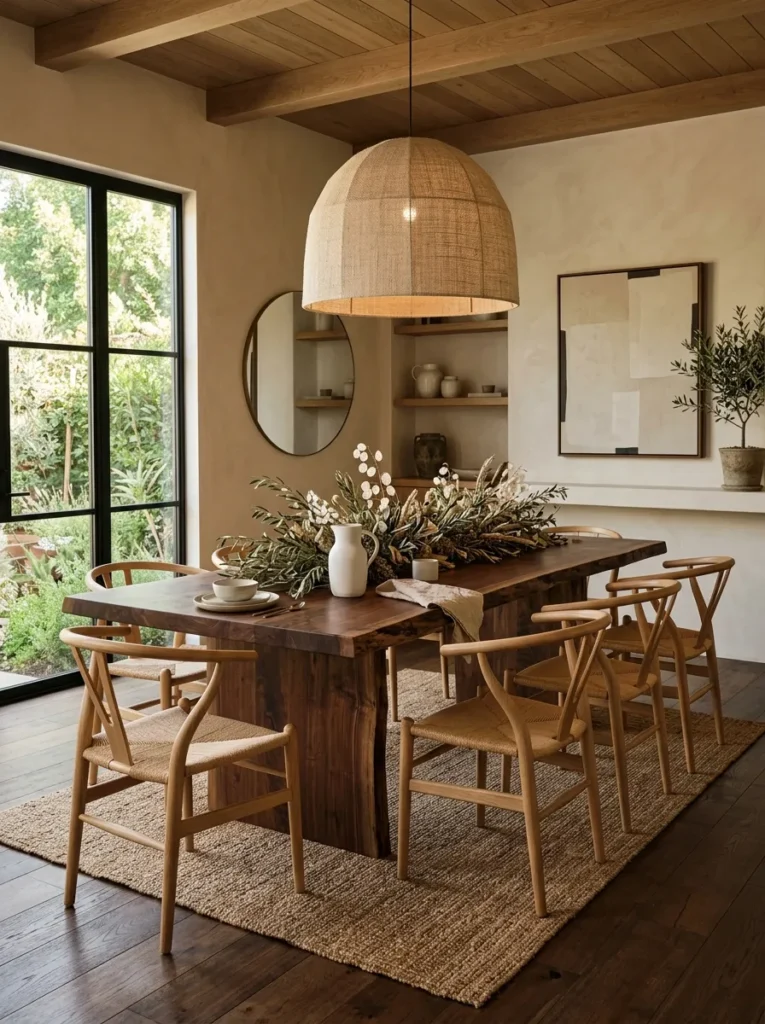
Vibe: The dining room feels deeply warm and quietly extraordinary — the kind of table that makes the room feel like it was designed around it, because it was.
Why it works: A live-edge walnut dining table is the single most powerful organic modern dining room investment because the natural edge — the preserved outer boundary of the tree’s trunk, with its organic undulations and character inclusions — introduces a direct material connection to the natural world that no manufactured table can replicate. The design principle at work is material authenticity: the visible grain, the natural edge, and the color depth of solid walnut communicate the tree’s full history in every surface, producing a table that becomes more beautiful and more personally resonant with every year of use. Pairing with sculptural white oak chairs creates a tonal conversation between the two woods — the dark walnut table ground and the pale oak chairs — that gives the dining room a color composition of genuine sophistication without any paint or wall treatment.
How to get it: Source a live-edge walnut table from a local woodworker or specialist supplier — the live edge requires bookmatching or careful orientation for a dining table to avoid an uneven surface, so work with a maker who understands the structural requirements of a dining top. Specify a hard-wax oil finish rather than lacquer or polyurethane — hard-wax oil penetrates the wood, enhancing the grain’s depth and warmth, and is infinitely renewable with a new oil coat, making the table genuinely heirloom-quality. Chair selection should prioritize a curved back profile — the organic curve against the table’s organic edge creates a visual harmony that straight-backed chairs with a live-edge table cannot achieve.
Quick Win: A single large dried olive branch ($18–$28 from a florist or dried botanical supplier) laid flat along the center of a dining table — no vase, no arrangement, simply placed — creates an organic modern centerpiece of immediate visual impact that costs under $30 and lasts indefinitely.
Shop The Look
| Product |
|---|
| Live edge walnut dining table solid natural edge |
| White oak dining chair curved back rattan seat |
| Hard wax oil finish natural wood dining table |
| Dried olive branch large centerpiece natural |
| Linen drum pendant shade natural woven large |
Also view: 14 Young Boys Bedroom Designs Full of Style and Storage
2. Travertine Dining Table as Room Anchor (MATERIAL)
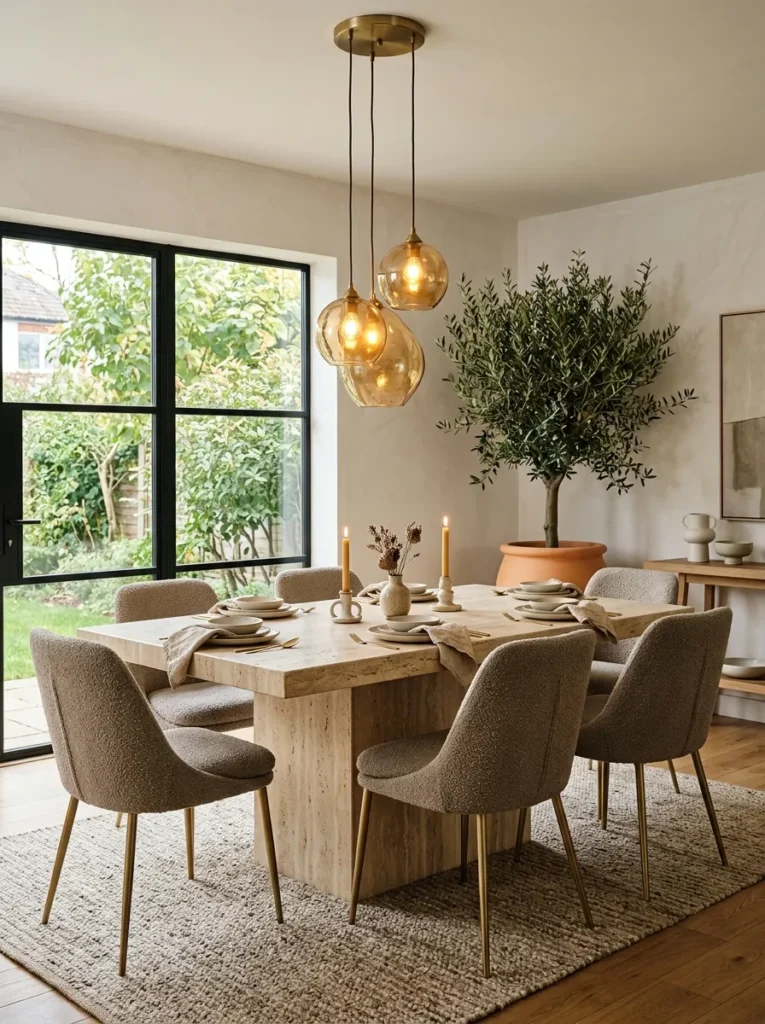
Vibe: The dining room feels elegant and permanently considered — the particular gravity of natural stone making every meal feel more significant.
Why it works: A honed travertine dining table anchors an organic modern dining room more powerfully than any other single furniture piece because natural stone carries a material weight — both literal and visual — that immediately establishes the room’s design seriousness. The honed (matte) rather than polished finish is the critical specification for organic modern dining rooms: polished travertine reads as formal and high-maintenance; honed travertine reads as warm, tactile, and genuinely livable. The natural veining, color variation between slabs, and the characteristic pitting of travertine’s cellular structure are not flaws but the precise qualities that make it irreplaceable by any manufactured surface. Pairing with boucle-upholstered chairs introduces a textile softness that balances the stone’s visual weight without competing with its material authority.
How to get it: Specify honed rather than polished travertine and request filled travertine (pits pre-filled with grout) for a dining table surface — unfilled travertine’s open pores trap food and liquid in a dining environment. Seal the surface with a penetrating stone sealer immediately after installation and reapply annually. Boucle upholstered dining chairs require a removable, washable seat cover or a performance boucle fabric rated for dining use — specify Crypton or similar performance treatment for genuine dining room practicality.
Shop The Look
| Product |
|---|
| Honed travertine dining table large natural stone |
| Boucle dining chair upholstered greige set of 4 |
| Penetrating stone sealer travertine natural |
| Blown glass pendant light amber set of 3 cluster |
| Large olive tree indoor pot terracotta natural |
Also view: 16 Comfy Bedroom Ideas for Ultimate Relaxation
3. White Oak Dining Table with Linen Upholstered Bench (MATERIAL / LAYOUT)
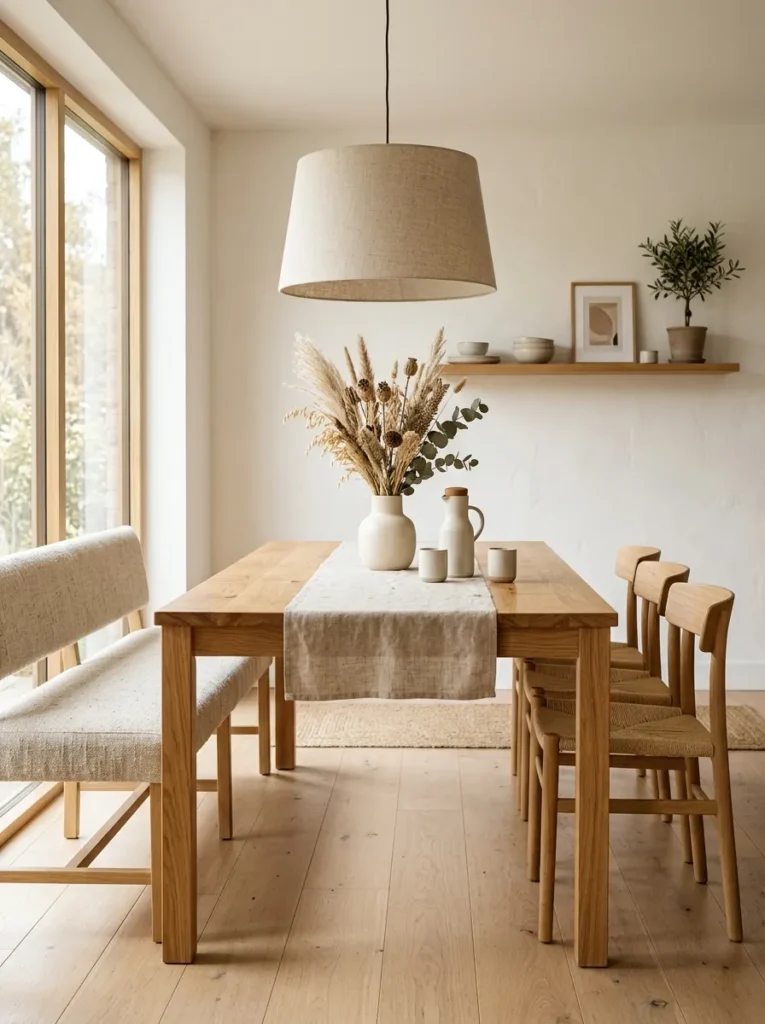
Vibe: The dining room feels warm and generously Scandinavian — the bench seating creating an informal, communal quality that chairs alone cannot produce.
Why it works: The table-and-bench configuration is the organic modern dining room’s most socially generous seating arrangement — a bench along one side of the dining table accommodates more guests than an equivalent row of chairs, creates a more informal and communal dining atmosphere, and introduces a long horizontal form that balances the table’s rectangular geometry with a different but equally simple line. White oak is the defining material choice of organic modern dining rooms because its warm honey tone reads as simultaneously Scandinavian and Japandi, its straight grain is visually calm without being sterile, and its hardness (1290 Janka) makes it genuinely practical for a daily-use dining surface. The combination of solid oak table, linen bench, and matching oak chairs creates a material palette of deliberate simplicity — two materials, one textile, unified by their natural origin.
How to get it: Size the bench to match exactly the length of the table’s short side, with no overhang beyond the table legs — a bench that extends beyond the table legs creates a trip hazard and looks proportionally incorrect. Specify the linen upholstery in a natural undyed or warm white tone that will develop character with use rather than showing every mark — a medium-weight linen in a seat-depth of 45–50cm provides both comfort and the relaxed aesthetic that makes bench seating feel genuinely inviting rather than institutional.
Shop The Look
| Product |
|---|
| Solid white oak dining table straight leg natural |
| Linen upholstered dining bench natural undyed |
| White oak dining chair matching set of 3 |
| Dried grass botanical arrangement large ceramic vase |
| Oversized linen pendant light natural woven shade |
4. Rattan and Cane Dining Chair Statement (MATERIAL / ACCESSORIES)
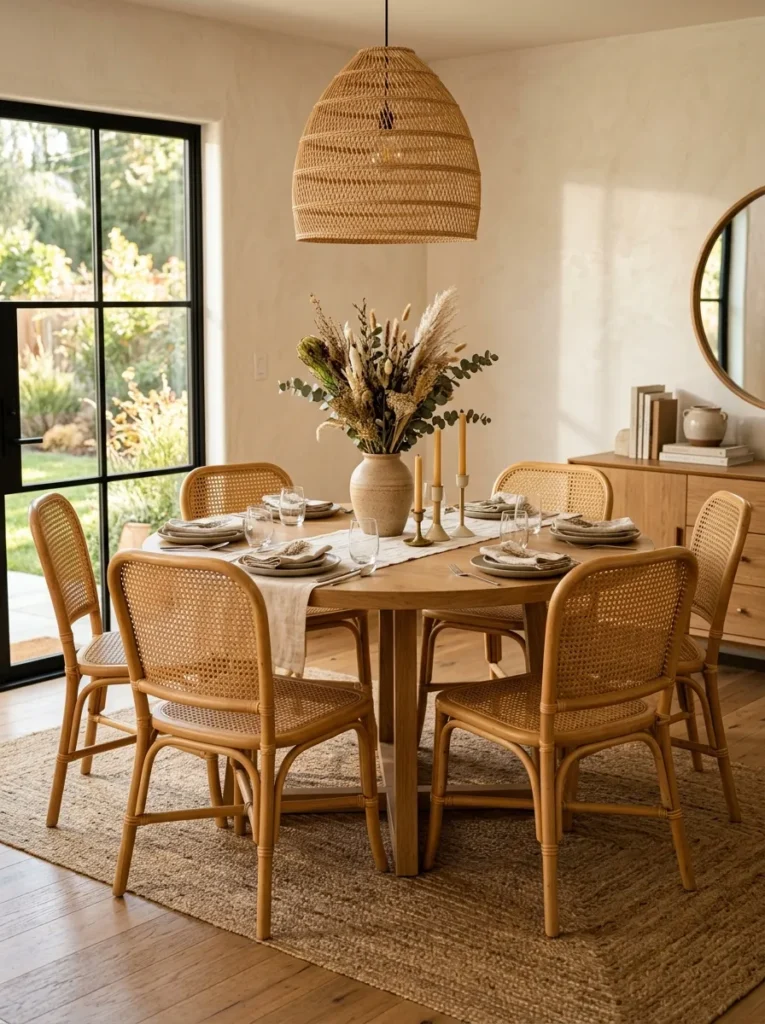
Vibe: The dining room feels warm and textural — the rattan weave creating a surface interest that makes the room feel layered without additional decoration.
Why it works: Rattan and cane dining chairs are the organic modern dining room’s most effective single-material texture statement because their woven surfaces introduce a density of organic pattern that no solid material can replicate. The visual principle is textural contrast: smooth table surface against woven chair backs creates the most fundamental design pairing in organic modern dining rooms — hard against soft, smooth against textured, manufactured precision against handmade irregularity. A round dining table paired with rattan chairs is a particularly successful organic modern combination because the circular form echoes the organic irregularity of the woven rattan material, creating a visual harmony between furniture form and material texture that rectangular table and rattan chair combinations cannot achieve as completely.
How to get it: Specify rattan chairs with a solid rattan frame rather than a bentwood or metal frame with rattan panel inserts — the all-rattan construction is warmer, more cohesive, and more aligned with the organic modern material philosophy. Treat rattan frames annually with a thin coat of raw linseed oil to maintain suppleness and prevent cracking in centrally heated interiors. A round dining table in this configuration should be sized to leave at least 90cm of clearance between the table edge and the nearest wall — rattan chairs are slightly wider than standard dining chairs and require adequate pull-back space for comfortable seating and rising.
Shop The Look
| Product |
|---|
| Rattan dining chair cane back natural set of 4 |
| Round white oak dining table 120cm natural |
| Woven rattan pendant light large dining natural |
| Linen table runner natural undyed 180cm dining |
| Raw linseed oil rattan furniture care natural |
5. Statement Lighting as Dining Room Anchor (LIGHTING)
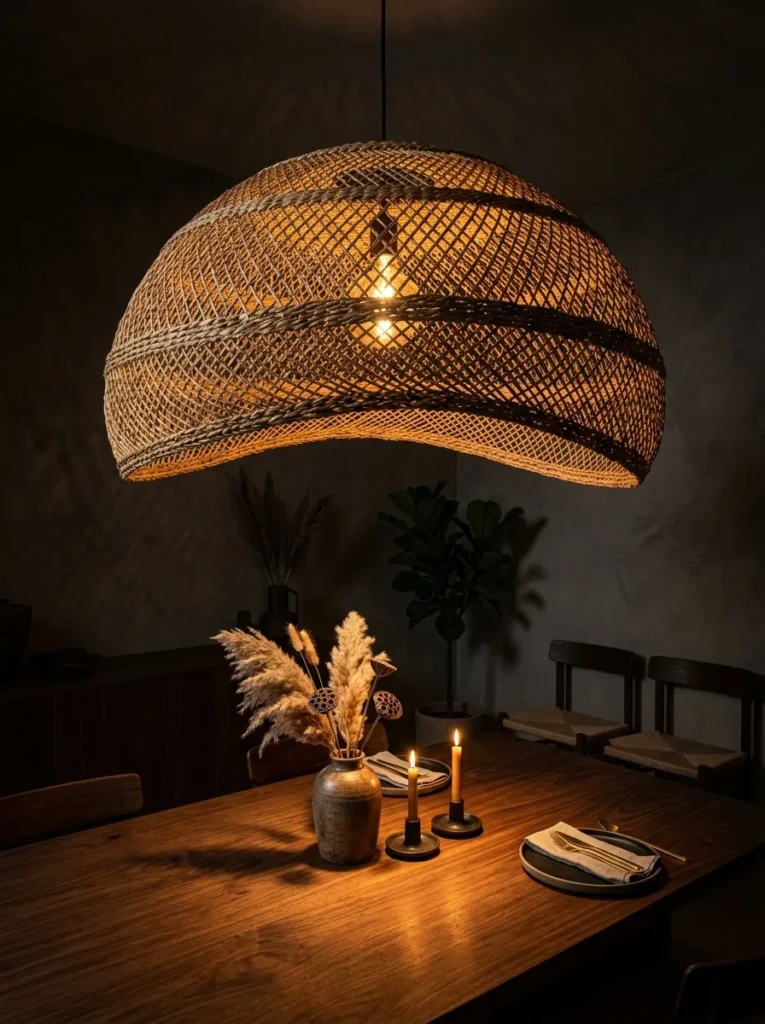
Vibe: The dining room feels dramatic and intimate — a pendant light large enough to make the table feel like the most important surface in the home.
Why it works: The dining room pendant light is the single most impactful organic modern design investment after the dining table itself, because it determines the quality of light that falls on food, faces, and the table surface during every meal. The organic modern principle for dining lighting is generous scale and warm temperature: a pendant that feels too large in the room’s daytime visual field creates exactly the right intimate light pool at dinner, when the ambient light drops and the pendant becomes the room’s primary illumination. The woven natural fiber shade — seagrass, rattan, bamboo, or linen — difuses the light bulb’s point source into a warm, even glow that flatters both food and faces in a way that glass or metal shades cannot, because the fiber material absorbs and warms the light before releasing it into the room.
How to get it: Hang the dining pendant at 75–85cm above the table surface — close enough to create an intimate light pool on the table without impeding sightlines across the table for seated diners. For a standard 8-foot ceiling, this positioning creates approximately 180–195cm of clearance above the floor at the pendant’s lowest point — adequate for standing clearance in most dining contexts. Specify a warm white LED bulb at 2700K color temperature — the exact color temperature at which food appears most appetizing and skin tones most flattering — and install on a dimmer circuit for full atmospheric control across the range from bright task lighting to intimate dinner ambiance.
Quick Win: Installing a dimmer switch on an existing dining room pendant circuit ($15–$25 for a standard dimmer switch) transforms the atmospheric range of any pendant from on-off to a full spectrum of light levels, creating the most immediate and least expensive dining room upgrade available.
Shop The Look
| Product |
|---|
| Woven seagrass pendant light large 80cm natural |
| Dimmer switch rotary standard fitting dining room |
| Warm white LED bulb 2700K E27 dimmable |
| Pendant light cord grip canopy ceiling rose brass |
| Ceramic candle holder set dining table natural |
6. Organic Modern Color Palette: Warm White and Greige (COLOR)
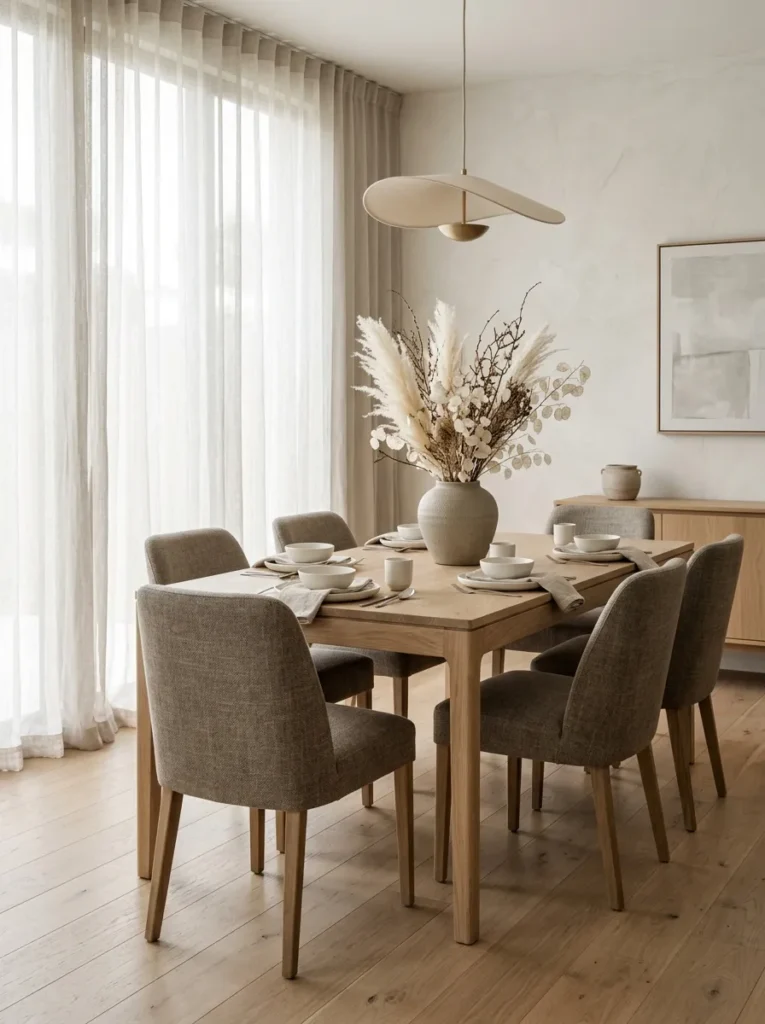
Vibe: The room feels serene and unified — a tonal palette so carefully calibrated that every object reads as part of a single considered composition.
Why it works: The warm white and greige color palette is the defining chromatic signature of organic modern dining design because it creates the maximum possible visual calm while maintaining the warmth that makes a dining room feel genuinely inviting rather than clinical. The distinction between warm white and greige is the operative design principle: warm white (white with yellow, pink, or beige undertones) reads as natural plaster and stone; cool white (white with blue or grey undertones) reads as clinical and institutional. Greige — the precise midpoint between warm grey and beige — functions as the most versatile neutral in residential interior design, reading as simultaneously sophisticated and comforting in every light condition from bright morning sun to warm candlelight. Used together as a tonal palette, warm white and greige create a dining room that recedes gracefully as a background for the people and food it hosts.
How to get it: The critical technical decision in a warm white and greige dining room is undertone consistency: every paint color, fabric, and material choice must share the same undertone family — yellow-beige rather than blue-grey. Test paint colors on the actual wall in the actual room’s light before committing — the same paint chip reads differently on a north-facing wall in winter morning light and a south-facing wall in summer afternoon light. Farrow and Ball’s Elephant’s Breath, Benjamin Moore’s Revere Pewter, or Sherwin-Williams’ Accessible Beige are the most consistent greige starting points across varied light conditions.
Shop The Look
| Product |
|---|
| Warm white interior paint low VOC natural finish |
| Greige linen dining chair upholstered set of 4 |
| White ceramic dinner plate set matte organic |
| Dried botanical arrangement large greige ceramic |
| Linen curtain panel warm white natural 240cm |
7. Matte Black Dining Furniture as Graphic Anchor (COLOR / FURNITURE)
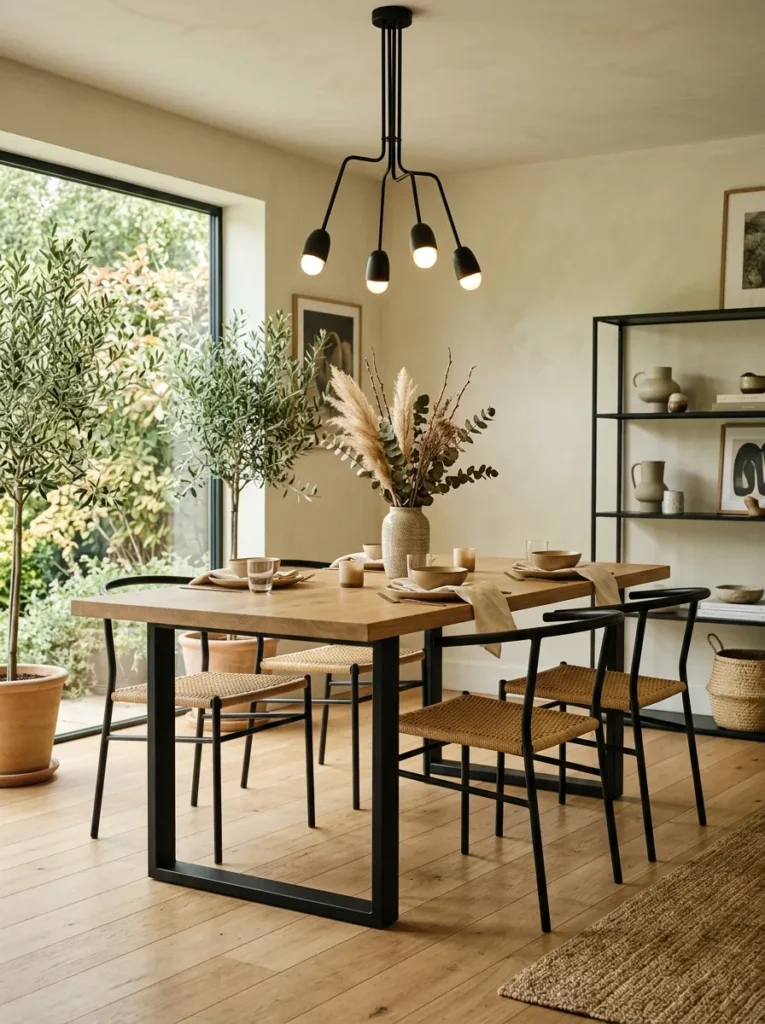
Vibe: The room feels bold and confidently graphic — matte black furniture that anchors the space without heaviness, softened by natural material warmth at every surface.
Why it works: Matte black furniture in an organic modern dining room functions as the single graphic accent color that gives the room visual definition and prevents the warm neutral palette from reading as indeterminate or unresolved. The critical specification is matte rather than gloss black — gloss black creates a high-contrast, reflective surface that reads as formal and hard; matte black absorbs light, creating a softer, more resolved presence that coexists harmoniously with organic materials. The design principle is material counterpoint: matte black metal against white oak, linen, rattan, and ceramic creates the most fundamental organic modern material dialogue — industrial precision against natural warmth, graphic certainty against organic irregularity.
How to get it: Specify powder-coated matte black steel for furniture frames rather than painted black — powder coating is significantly more durable than paint in a dining room context where chairs receive daily impact and abrasion. The table configuration of matte black base with solid wood top is the more versatile and visually warmer choice compared to an all-black table — the wood top provides the warm natural surface that makes food and tableware look their best, while the black base provides the graphic visual anchor. Introduce natural material softening at every point of human contact: linen seat cushions, rattan seat pads, ceramic tableware — the natural materials should always outnumber the black metal elements.
Shop The Look
| Product |
|---|
| Matte black metal dining chair rattan seat set 4 |
| Solid white oak table top matte black base dining |
| Matte black cluster pendant light dining 3 shade |
| Natural linen seat cushion dining chair tie on |
| Matte white ceramic tableware set dining 4 place |
8. Dining Room Biophilic Wall with Living Plants (ACCESSORIES / LAYOUT)
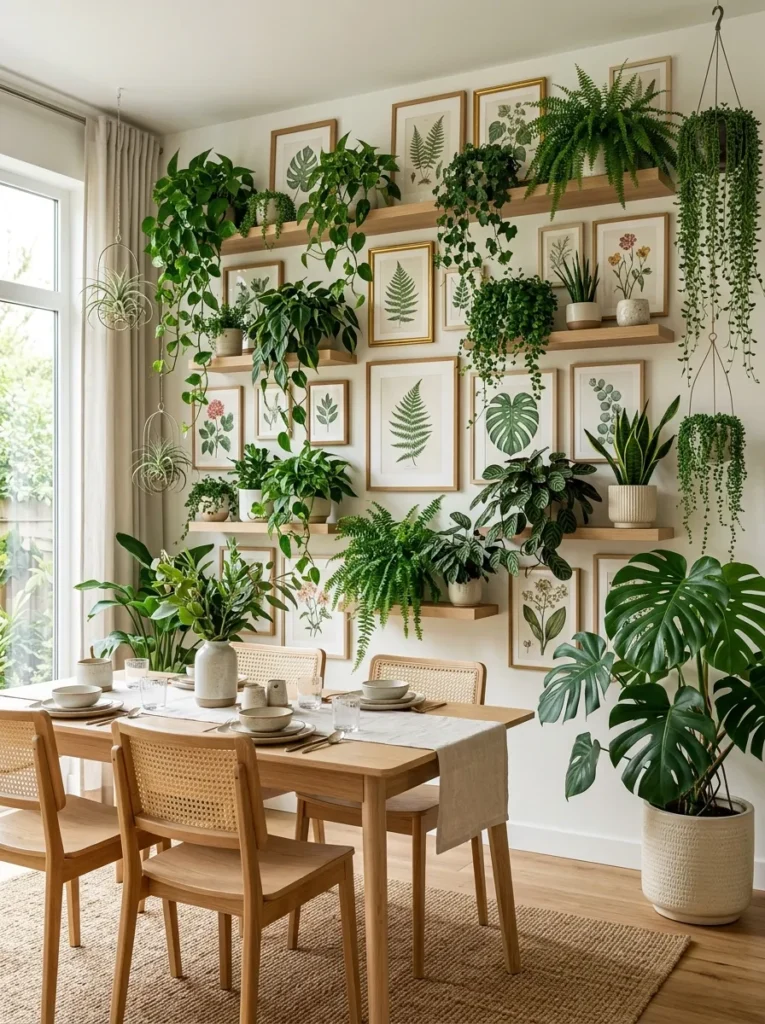
Vibe: The dining room feels alive and deeply lush — eating in front of a living green wall is the closest a dining room can come to an outdoor experience.
Why it works: A biophilic dining room wall — combining living plants, trailing botanicals, and botanical art in a unified composition behind the dining table — creates the most powerful organic modern dining room statement available through styling alone, because it introduces genuine living nature as the room’s primary visual element. The biophilic design principle is direct nature contact: research in environmental psychology consistently demonstrates that proximate contact with living plants during meals increases positive affect, reduces cortisol levels, and extends the duration of social dining — making a plant-rich dining room backdrop a genuine contributor to the quality of the dining experience rather than merely an aesthetic choice. The trailing pothos is the ideal organic modern dining room plant because it grows prolifically in indirect light, tolerates the temperature variation of a dining room, and its cascading form creates the most visually dynamic shelf plant available.
How to get it: Begin the biophilic dining wall with one anchor plant — a large monstera, fiddle leaf fig, or olive tree at floor level in a generous terracotta or ceramic pot. Add floating shelves at two heights on the adjacent wall sections and populate with trailing pothos, string of hearts, and air plants. Integrate framed botanical prints (pressed herbarium specimens or watercolor botanical illustrations) between plant positions at the same heights as the shelves — the mix of living and illustrated botanical material creates a depth and variety that living plants alone cannot achieve. Water all plants on the same day each week to maintain a consistent care routine that prevents plant health from becoming a visual liability.
Shop The Look
| Product |
|---|
| Large monstera plant indoor pot terracotta natural |
| Trailing pothos plant set of 3 small hanging pot |
| Floating oak shelf set dining room plant display |
| Botanical print set framed pressed herbarium art |
| Ceramic plant pot set natural large indoor |
9. Organic Modern Dining Room Lighting: Candlelight Layering (LIGHTING)
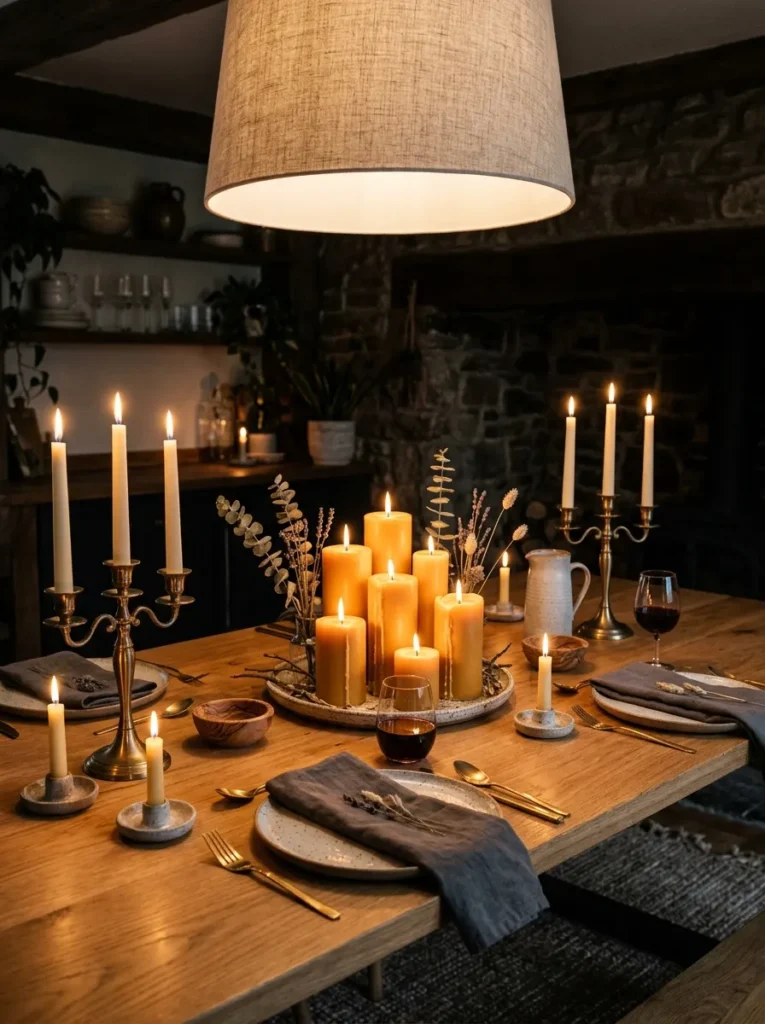
Vibe: The evening table feels deeply intimate — the particular warmth of beeswax candlelight that makes every dinner feel like a special occasion.
Why it works: Layered candlelight is the organic modern dining room’s most powerful atmospheric tool because beeswax candles produce a light spectrum closer to natural sunlight than any LED technology — warm, slightly golden, with a natural flicker that creates the dynamic quality of living light rather than static electrical illumination. The layering principle — pillar candles at the table center, tapers at the table ends, individual holders at each setting — creates light at three distinct heights simultaneously, producing an intimate light cocoon around the dining table that makes the room beyond the table recede into warm darkness, focusing all social attention on the table and the people around it. This is the oldest dining room lighting technology in existence and remains the most effective.
How to get it: Build the candlelight arrangement in height order from center outward: the tallest elements (pillar candle cluster or candelabra) at the table center, medium-height individual tapers in ceramic or brass holders along the table’s length, and the lowest elements (small tealight holders or votive candles) closest to each place setting. Use only natural beeswax candles — their honey fragrance, natural color, and clean burn are irreplaceable by paraffin alternatives, and their slightly golden flame color is warmer and more flattering than the white-blue flame of paraffin. Never leave burning candles unattended; extinguish all table candles before leaving the dining room.
Shop The Look
| Product |
|---|
| Natural beeswax pillar candle set tall ivory large |
| Brass candelabra dining table 3 arm natural |
| Ceramic taper candle holder set dining 6 piece |
| Beeswax taper candle set 12 piece natural honey |
| Linen pendant light shade dining warm ivory |
10. Curved Furniture Forms in Organic Modern Dining (FURNITURE)
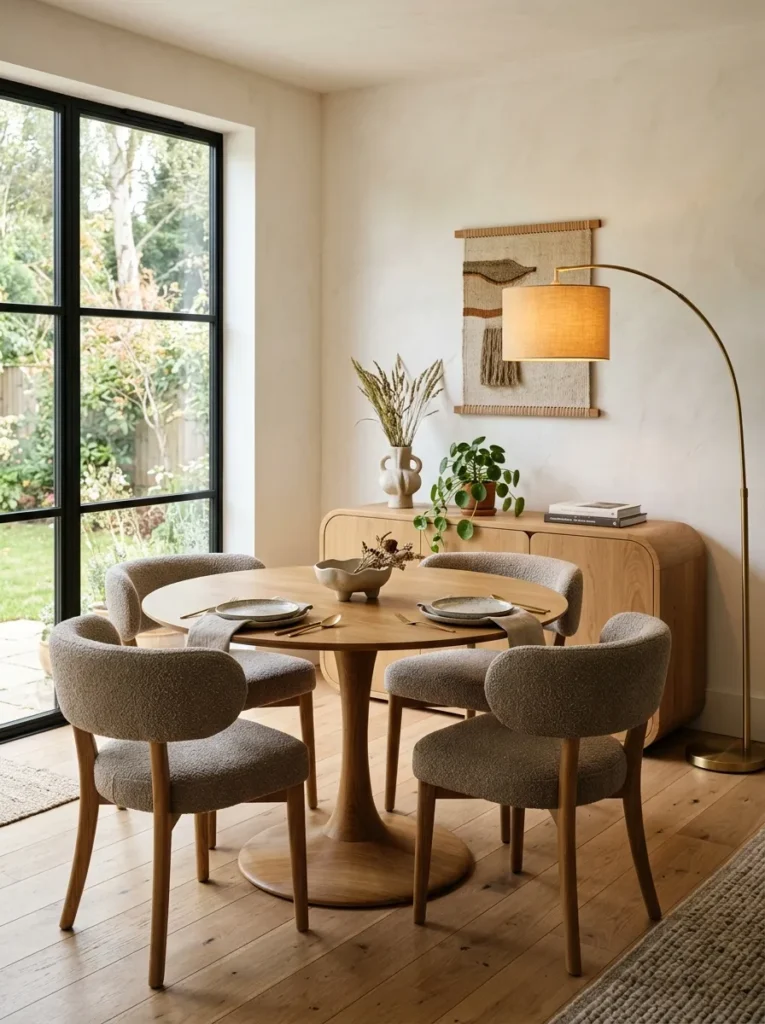
Vibe: The room feels sculptural and organically resolved — curved forms throughout creating the most human, least institutional version of modern dining design.
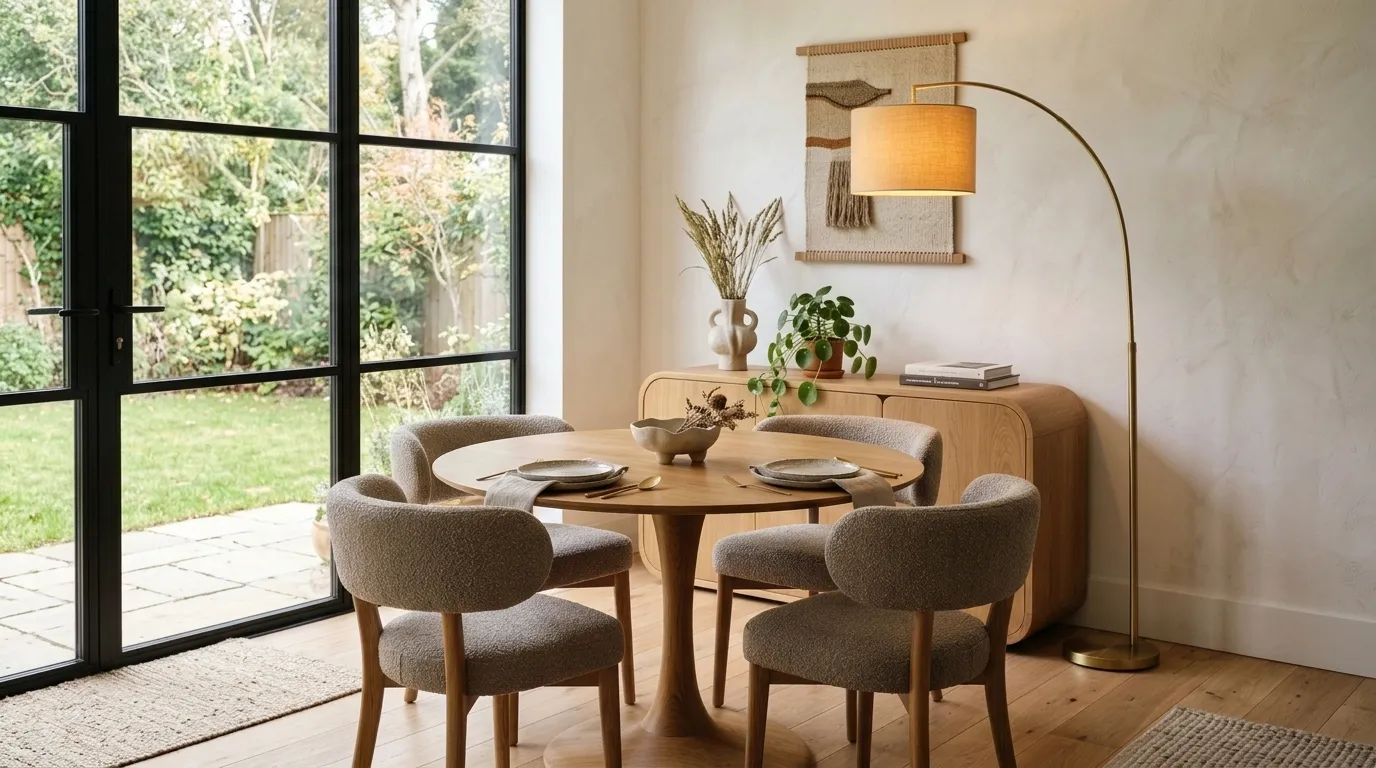
Why it works: The organic modern design principle of repeated curved forms — round table, curved chair backs, rounded sideboard edges, arc lamp — creates a visual harmony through formal consistency that is one of the most sophisticated techniques in interior composition. The design logic is form language coherence: when every furniture piece in a room shares a curved profile element, the room develops a unified visual identity that makes the space feel designed rather than assembled. The round dining table is specifically the most socially democratic table form — it has no head position, creates equal proximity between all diners, and facilitates conversation across the full table rather than the linear back-and-forth of a rectangular arrangement.
How to get it: Begin with the round dining table as the room’s formal anchor — choose a pedestal base rather than four legs for a round table, as four-legged round tables create a seating conflict where table legs interfere with chair placement. Select dining chairs with a curved back profile — the curve need not be dramatic, but any perceptible curve in the back creates the formal relationship with the round table that straight-backed chairs cannot. A curved or arched sideboard on the dining room wall opposite the table completes the curved vocabulary without requiring any structural change.
Shop The Look
| Product |
|---|
| Round dining table pedestal base white oak 120cm |
| Curved back dining chair boucle greige upholstered |
| Rounded oak sideboard curved corner dining room |
| Arc floor lamp warm shade dining room corner |
| Ceramic centrepiece bowl organic shaped dining |
11. Organic Modern Dining Room Gallery Wall (ACCESSORIES / COLOR)
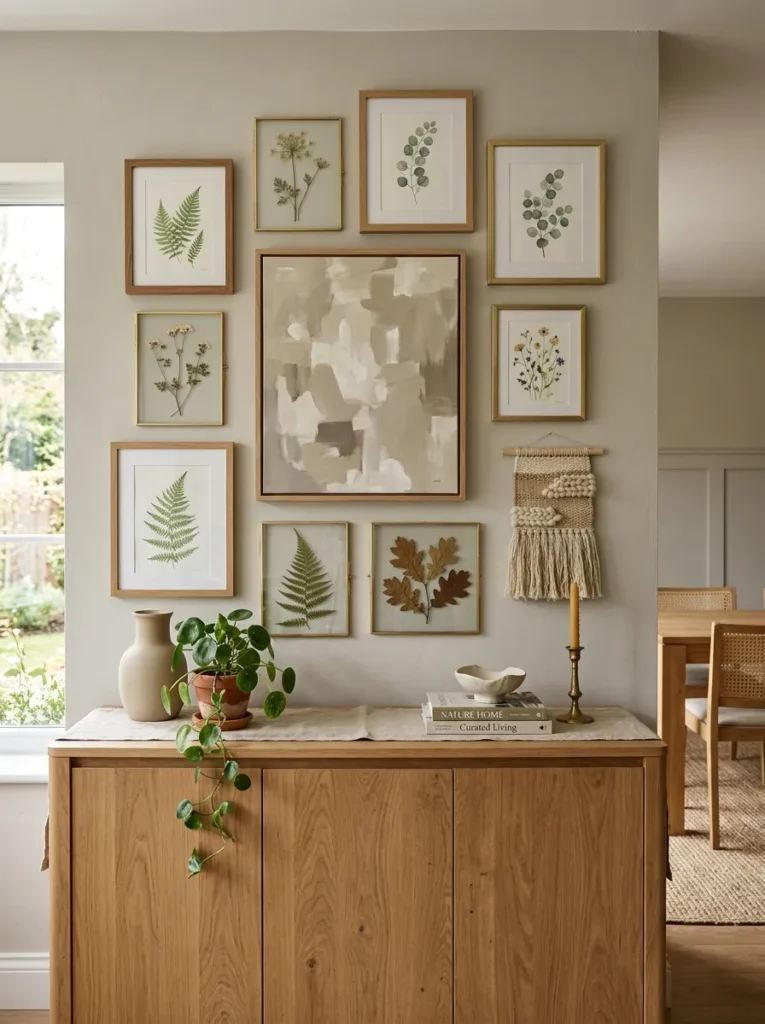
Vibe: The gallery wall feels warmly curated — a collection of botanical and nature-referencing art that makes the dining room wall feel like an extension of the table’s natural material world.
Why it works: An organic modern dining room gallery wall succeeds through two specific curatorial decisions: content unity and frame material cohesion. Content unity means every piece on the wall references the natural world — botanical watercolors, pressed specimens, abstract landscapes, textile weavings — so the wall reads as a coherent celebration of nature rather than a miscellaneous art collection. Frame material cohesion means every frame is within the same material family — natural wood and thin brass — so the frame system recedes and the art content advances. The asymmetric arrangement, weighted slightly to one side, creates the casual collected quality that distinguishes an organically assembled gallery wall from a symmetrical, deliberately composed one.
How to get it: Curate content before purchasing frames — identify all the art pieces first and build the frame selection around them. For organic modern dining rooms, botanical watercolor prints, pressed herbarium specimens, abstract works in warm neutral tones, and simple woven textile wall pieces are the four content categories that create the most cohesive botanical gallery wall. Limit frame materials to two: natural wood (oak or ash) and thin brass or gold — introduce no other frame materials into the composition. Plan the arrangement on the floor before mounting, photograph it, and use the photograph as the installation reference.
Shop The Look
| Product |
|---|
| Botanical watercolor print set framed natural wood |
| Pressed herbarium specimen art brass thin frame |
| Abstract warm greige art print large framed |
| Small woven textile wall hanging natural cotton |
| Natural oak picture frame set assorted sizes |
12. Organic Modern Dining Table Setting (ACCESSORIES)
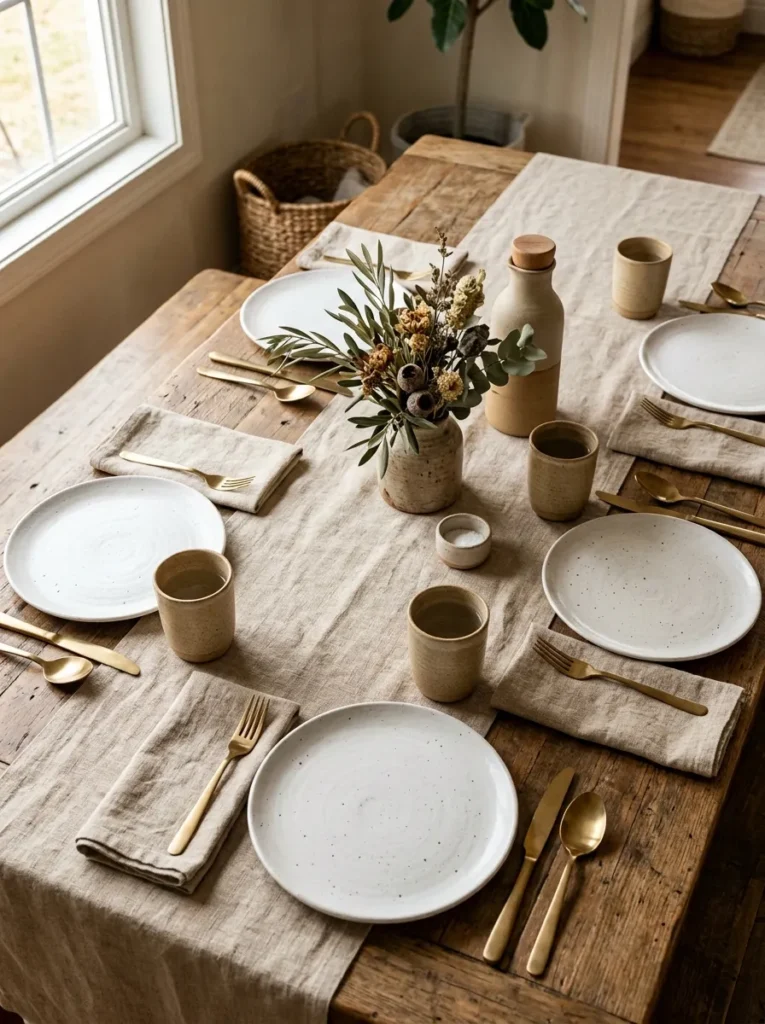
Vibe: The table setting feels artisanal and genuinely considered — the kind of table that makes guests feel that the meal was prepared with the same care as the setting that precedes it.
Why it works: The organic modern dining table setting is where the room’s design philosophy becomes most directly experiential — it is the one element of dining room design that guests touch, hold, and use rather than simply observe. Hand-thrown ceramic plates carry visible evidence of their making in their slight irregularity of form and surface texture, which creates a tactile warmth that industrially manufactured tableware cannot replicate. The design principle is material consistency through the setting: matte ceramic, natural linen, brushed brass, and hand-thrown ceramic vessels share the same organic modern material language as the furniture and lighting around them, creating a dining experience where the objects of the table and the objects of the room are in genuine material conversation.
How to get it: Build an organic modern table setting around one anchor piece — the dinner plate — and select every other element in reference to it. Hand-thrown matte white or warm sand ceramic plates are the most versatile anchor choice, accepting every color of food beautifully and coordinating with every table linen and cutlery tone. Natural linen napkins in undyed or warm white tones are the textile equivalent — they improve with washing, coordinate with every ceramic palette, and provide the soft, organic texture that cotton and synthetic alternatives cannot match. Brushed rather than polished brass or gold cutlery maintains the matte, warm quality of the organic modern material philosophy throughout.
Quick Win: A set of four natural linen napkins ($18–$28) replacing synthetic or cotton napkins immediately elevates the material quality of any organic modern dining table setting — linen’s natural drape, slight irregularity of weave, and warm ivory tone are the single most impactful affordable table setting upgrade available.
Shop The Look
| Product |
|---|
| Hand thrown matte white ceramic dinner plate set 4 |
| Natural linen napkin set undyed 4 piece dining |
| Brushed brass cutlery set 16 piece dining natural |
| Hand thrown ceramic tumbler warm sand set of 4 |
| Ceramic water carafe white matte large dining |
13. Organic Modern Dining Room in a Small Space (SMALL SPACE / LAYOUT)
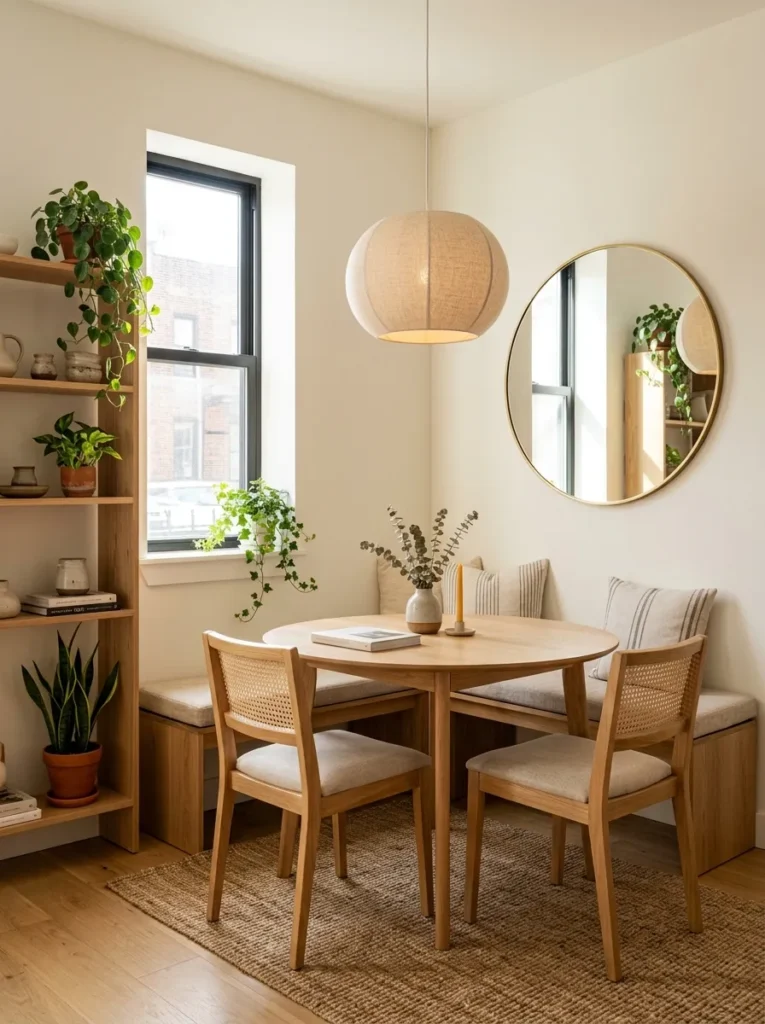
Vibe: The small dining space feels complete and considered — the proof that organic modern design’s power is independent of room size.
Why it works: Small organic modern dining rooms succeed through the ruthless application of scale discipline — every furniture piece chosen at the smallest size that serves its function without sacrificing the quality of the dining experience. A 90cm round table is the minimum size that seats four adults comfortably for a full dinner service; below 90cm, the table feels like a café rather than a dining room. The wall-mounted bench on one side of the table is the small dining room’s most space-efficient seating solution — it requires no pull-back clearance for seating and rising (the sitter slides along the bench from the end), freeing the remaining floor space for chair clearance on the table’s open sides. A round mirror on the adjacent wall doubles the perceived light and depth of the space without consuming any floor area.
How to get it: Plan the small dining zone around a 90cm round table with a minimum 85cm clearance on all open sides — this is the minimum comfortable passage width for moving around a table during a dinner service. Against the wall that can provide the bench position, mount the bench at standard seat height (45cm) with a 5cm gap between the bench back and the wall to allow for wall protection. Select pendant lighting at a maximum diameter of 50cm for a small dining zone — a larger pendant in a small space creates visual compression rather than the intimate warmth that a well-proportioned pendant achieves.
Shop The Look
| Product |
|---|
| Compact round dining table 90cm white oak small |
| Wall mounted dining bench natural oak upholstered |
| Round mirror 60cm brass frame dining room light |
| Narrow tall shelf plant display dining room wall |
| Small linen pendant light 50cm dining compact |
14. Organic Modern Dining Sideboard Styling (ACCESSORIES / LAYOUT)
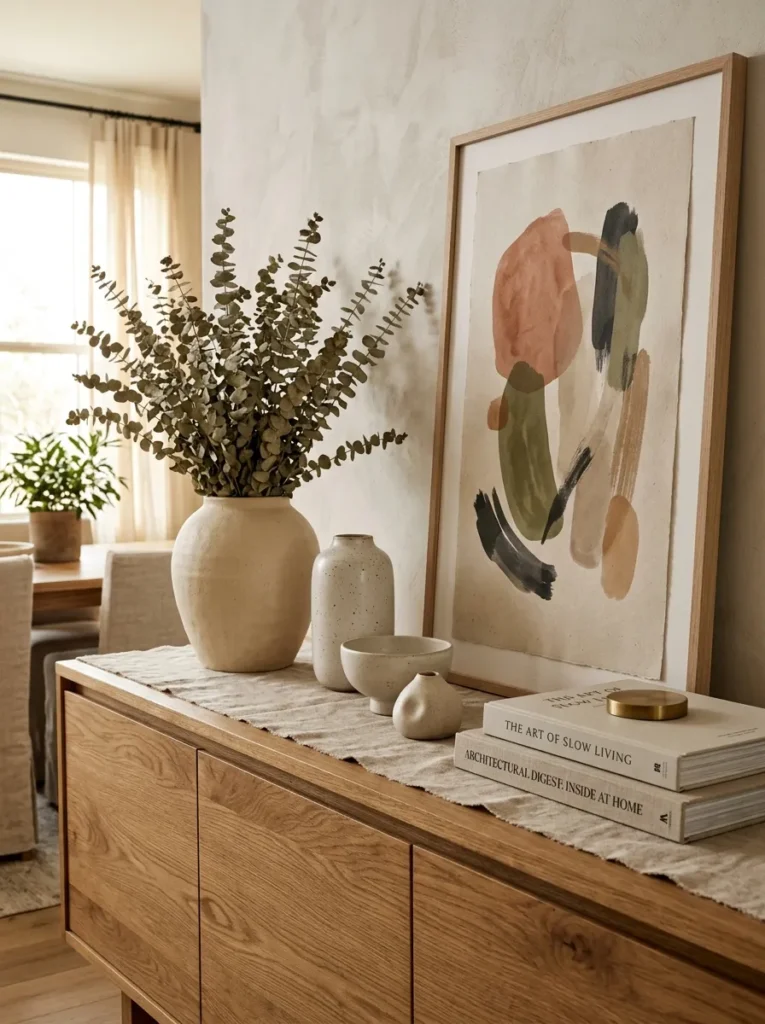
Vibe: The sideboard feels warmly curated and quietly considered — a surface styled with enough intention to anchor the dining room wall without competing with the table.
Why it works: The dining room sideboard vignette applies the same three-plane styling principle as all successful shelf compositions — background, middle ground, foreground — at the larger scale of a dining room service surface. The art print propped against the wall at the sideboard’s back creates the background plane and adds vertical dimension above the sideboard’s horizontal surface; the large ceramic vessel and art books create the middle ground with height variation; and smaller graduated objects at the front edge create the foreground plane, pulling the composition toward the viewer. The linen runner unifies all three depth planes under a single textile element that also protects the sideboard surface during dining service. The organic modern sideboard vignette is always editing-led — maximum five objects on the surface, never more.
How to get it: Position the sideboard parallel to the dining table and perpendicular to the room’s primary window, so it receives natural sidelight that brings out the wood grain and creates soft shadows between the styled objects. Style in three moves: first, establish the vertical anchor (tall ceramic vessel with botanical element); second, establish the horizontal anchor (art books stacked flat at the opposite end); third, fill the middle space with two or three graduated smaller objects that create a visual rhythm between the two anchors. Lay the linen runner after all objects are positioned, adjusting it so it runs from one end of the sideboard to the other with equal overhang at each short end.
Shop The Look
| Product |
|---|
| Low solid oak sideboard dining room storage natural |
| Large ceramic vessel tall matte white 40cm dining |
| Dried eucalyptus bunch large natural arrangement |
| Art book set large format hardcover decorative |
| Linen table runner natural 180cm dining sideboard |
15. Organic Modern Dining Room with Japandi Influence (COLOR / MATERIAL)
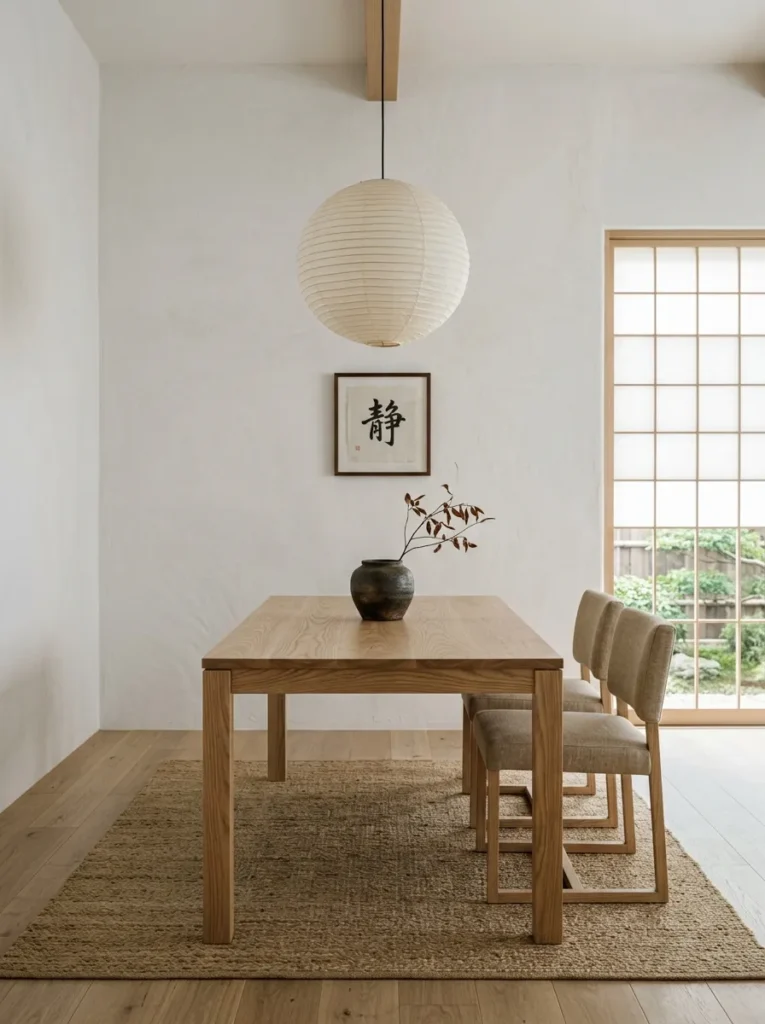
Vibe: The room feels meditative and deeply resolved — the Japandi principle of meaningful simplicity applied to a dining room that says everything by showing almost nothing.
Why it works: The Japandi-influenced organic modern dining room is the most demanding design proposition in this entire list because it requires the most complete commitment to restraint — every object must justify its presence not just aesthetically but philosophically, as an expression of the Japanese concept of ma (meaningful negative space) and the Scandinavian concept of lagom (exactly the right amount, neither too much nor too little). The result, when executed with genuine discipline, is the most powerful organic modern dining room of all because the extreme reduction of visual information focuses all perceptual attention on the quality of the remaining objects — the grain of the ash table, the texture of the linen chair, the form of the ceramic vessel, the quality of natural light from the window — in a way that a more fully furnished room never can.
How to get it: Begin by removing every object from the dining room and returning only the four non-negotiable elements: the dining table, the chairs, the light fitting, and one decorative object. Sit with this extreme reduction for one week before adding anything. When an object is returned to the room, it must answer affirmatively to three questions: Does it serve a function? Is it made of a natural material? Does it improve the room’s quality of silence? Every object that cannot answer yes to all three remains outside the room. This discipline, maintained consistently, produces the Japandi dining room’s defining quality: a space that feels complete in its incompleteness.
Shop The Look
| Product |
|---|
| Solid ash dining table straight leg natural grain |
| Low profile linen dining chair natural minimal |
| Japanese paper lantern pendant large dining room |
| Large ceramic vessel matte white tall organic form |
| Dried magnolia branch large single stem natural |
How to Start Your Organic Modern Dining Room Transformation
Your single best first move is to assess the dining table currently in your room and determine whether it is worth keeping, worth transforming through refinishing, or worth replacing as the foundation of an organic modern dining scheme. The dining table is the organic modern dining room’s irreducible center — every other decision in the room is made in reference to it — and no amount of lighting, textiles, or accessories can compensate for a dining table that is wrong in material, scale, or form for the organic modern aesthetic. A solid wood table in any condition that can be sanded and oiled is always worth keeping; a laminate, glass, or heavily lacquered table in a non-natural finish is the one element worth replacing as a genuine priority.
The most common beginner mistake in organic modern dining room design is purchasing a statement pendant light before addressing the dining table’s scale and material, then discovering that no pendant light can compensate for a table that undermines the room’s organic material story. The fix is to establish the table, then the chairs, then the lighting — in that order — because each subsequent decision is calibrated to the previous one, and working in reverse order produces rooms that feel disjointed between their hero pieces. The pendant should be the final furniture decision, chosen to complement the specific table and chair combination already in position.
Three specific items under $50 that create immediate organic modern dining room impact: a set of four natural linen napkins in undyed or warm white ($18–$28) that replace synthetic alternatives and immediately elevate the table setting’s material quality; a single large dried olive or eucalyptus branch ($15–$22) laid flat along the table center as a year-round centerpiece; and a warm white dimmable LED bulb at 2700K ($8–$12) installed in the existing dining pendant, which transforms the quality of evening dining light from harsh to genuinely flattering without any fixture change.
A starter organic modern dining room transformation — new table linen, a natural centerpiece, a dimmer switch installation, and a pendant replacement — takes one weekend and costs $80–$150. A full organic modern dining room scheme with a solid wood table, natural fiber chairs, statement pendant, gallery wall, and complete table setting runs $800–$3,000 depending on table size and material choices, with the solid wood table consistently representing the highest proportion of the total investment and the highest proportion of the long-term value.
Frequently Asked Questions About Organic Modern Dining Rooms
What is organic modern style and how does it differ from Scandinavian or Japandi design?
Organic modern design is a synthesis aesthetic that draws from Scandinavian minimalism, Japanese wabi-sabi, and the biophilic design movement simultaneously — it shares Scandinavian design’s commitment to functional beauty and natural materials, Japanese design’s appreciation for imperfection and negative space, and biophilic design’s emphasis on direct connection to living and natural material references. Where it differs from pure Scandinavian design is in its greater material warmth and texture complexity — organic modern accepts and celebrates more material variety than strict Scandinavian minimalism allows. Where it differs from Japandi is in its greater acceptance of decorative richness — an organic modern dining room may include a gallery wall, a biophilic plant wall, and a fully styled sideboard that a Japandi room would edit away entirely.
What wood is best for an organic modern dining table?
White oak is the most universally appropriate wood for organic modern dining tables because its warm honey tone, straight grain, and strong hardness rating (1290 Janka) combine material beauty with genuine dining table durability. Solid walnut is the premium alternative — its deeper color, dramatic grain, and rich surface make it the most visually striking dining table material available, but its slightly lower hardness requires more careful surface maintenance. Ash is the budget-accessible option that shares white oak’s light tone and straight grain with comparable hardness. Avoid tropical hardwoods (teak, mahogany) which read as traditional rather than organic modern, and avoid softwoods (pine, fir) which dent and scratch too easily for daily dining table use.
How do I make a small dining room feel larger using organic modern principles?
The four organic modern principles most effective for spatially expanding small dining rooms are: choosing a round table rather than rectangular (round tables allow more seating in the same footprint and create better traffic flow around their perimeter); mounting a round mirror on the wall opposite the primary window (which doubles perceived natural light and creates the illusion of additional depth beyond the wall surface); using a wall-mounted bench on one wall rather than chairs on all sides (which eliminates the clearance space behind chairs on that wall side); and maintaining a strict warm white and natural material palette throughout (which prevents the visual fragmentation that contrasting colors and mixed finishes create in small rooms, making the space read as larger and more unified than its actual dimensions).
What dining room lighting temperature is best for food and people?
2700K (warm white) is the universally agreed best color temperature for dining room lighting because it is the closest LED equivalent to incandescent and candlelight — the two light sources under which food and skin tones have appeared most flattering throughout the history of dining. At 2700K, food colors appear vivid and appetizing (roasted vegetables look more golden, salads appear more vibrant, wine looks richer), and skin tones appear warm and healthy rather than the pallid, grey quality produced by cool white lighting above 4000K. Install all dining room lighting on dimmer circuits capable of reducing from full 2700K output to approximately 10% intensity — this range covers every dining scenario from bright Sunday lunch to intimate candlelit dinner without fixture changes.
Can organic modern dining design work in a rented home where walls cannot be painted?
Absolutely — the organic modern aesthetic’s primary design tools are all removable and renter-friendly. Furniture, lighting (pendant replacement is renter-appropriate in most tenancies with original fittings restored on departure), table linen, ceramics, dried botanicals, woven textiles, and gallery walls hung with picture hooks rather than permanent fixings are all fully reversible interventions that create the organic modern dining aesthetic without requiring any permanent wall treatment. The one genuinely transformative renter-friendly wall intervention is a large-scale botanical or abstract art print in a natural wood frame — a single large-format print (80x100cm or larger) leaned against or carefully mounted on a dining room wall creates a visual focal point equivalent to a feature wall paint color without any permanent commitment.
Ready to Create Your Dream Organic Modern Dining Room?
These 15 ideas span the full depth and breadth of organic modern dining room design — from the foundational material authority of the live-edge walnut table and the travertine anchor through the sensory warmth of layered candlelight and the social generosity of curved furniture forms, to the biophilic abundance of a living plant wall, the meditative discipline of a Japandi-influenced scheme, and the artisanal intimacy of a hand-thrown ceramic table setting — covering material, color, lighting, layout, small-space strategy, and styling philosophy across every design dimension. Begin with the table — sit at what you currently have, assess what it asks of the room around it, and determine whether it can become the organic material foundation that every other decision in an organic modern dining room builds from. Today’s specific action: lay one large dried olive or eucalyptus branch flat along the center of your existing dining table without any vase or vessel, and observe what a single natural material element does to the room’s visual quality before committing to any furniture change. When your dining room finally has the particular quality of warmth that makes guests slow down before sitting and conversations run longer than planned — when the table feels like a destination rather than a furniture piece — you will understand exactly why organic modern dining design earns its place at the top of every interior design Pinterest board year after year. Save your favorites now, especially the live-edge walnut table and the layered candlelight setting — they are the two ideas that, once experienced in person in your own dining room, make every meal that follows feel like it deserves to be remembered.