13 Vintage Florida Design Ideas That Feel Timeless
Vintage Florida design is an interior and architectural aesthetic drawn from the domestic culture of mid-century Florida — the period roughly spanning 1930 to 1975 — when the state’s rapid development produced a distinctive regional style that synthesized tropical climate necessity, Modernist architectural influence, Cuban and Caribbean material culture, and the particular optimism of postwar American leisure life. This article gives you 13 genuinely creative, buildable vintage Florida design ideas that capture the warmth, material richness, and unhurried charm of this specific regional aesthetic without requiring a Sarasota Modernist original or a Palm Beach decorator’s budget.
Vintage Florida design is the regional style that most effectively solves the indoor-outdoor living problem without either giving up the comfort of the interior or the sensory richness of the exterior. It is a style that smells like salt air and gardenias, that feels like terrazzo under bare feet, and that looks like the best possible version of a life lived largely outside. Here are 13 ideas worth saving — and living in.
Why Vintage Florida Design Feels Timeless
The timelessness of vintage Florida design comes from its specific response to a genuine problem — how to live beautifully and comfortably in a subtropical climate — rather than from a decorative program applied to a generic domestic interior. The regional style that developed in Florida between 1930 and 1975 drew from three distinct design traditions that were each responding to the same climatic and material conditions. The first was the Spanish Mission and Mediterranean Revival architecture of the 1920s Florida land boom, which brought terracotta, arched doorways, courtyards, and the pastel plaster palette of the Caribbean coast into Florida’s first wave of intentional residential design. The second was the Sarasota School of Architecture, which from the 1940s onward produced a specifically Floridian Modernism — flat roofs, wide overhangs, jalousie windows, and deep covered terraces — that made the tropical climate an asset rather than a challenge. The third was the mid-century leisure aesthetic of Florida resort culture, which produced the particular combination of rattan furniture, terrazzo floors, tropical botanical prints, and turquoise pool water that defines the vintage Florida interior at its most exuberant and most photographed.
The materials that define authentic vintage Florida design are determined by the climate and the regional material culture rather than by fashion. Terrazzo — the aggregate-and-cement composite flooring system brought to Florida by Italian immigrant craftsmen in the 1920s — is simultaneously the most historically authentic and the most aesthetically distinctive Florida interior material, valued for its coolness underfoot in summer heat, its durability, and its extraordinary visual richness when custom aggregate colors and inlaid brass dividers are specified. Rattan and wicker furniture was the default seating material for Florida’s screened porches and living rooms throughout the mid-century period because its open weave allows air circulation in pre-air-conditioning interior environments. Jalousie windows — the angled glass louvre systems that allow ventilation while controlling rain — are the most architecturally distinctive element of the mid-century Florida house. Tropical botanical prints in Polynesian, Caribbean, and local Florida motifs were the textile and wallpaper tradition of the Florida interior from the 1940s through the 1960s, appearing on upholstery, drapes, bedspreads, and room dividers in the exuberant colors that the tropical landscape itself suggested.
The cultural resonance of the vintage Florida aesthetic has strengthened rather than weakened over time. The style’s appeal combines nostalgia (the specific emotional register of 1950s and 1960s Florida that Baby Boomer and Generation X consumers associate with childhood vacation memories), sustainability (terrazzo, rattan, and natural fiber materials are all more environmentally responsible than their contemporary synthetic alternatives), and authenticity (the regional specificity of vintage Florida design is the quality that most effectively counters the homogenizing tendency of global contemporary design). Pinterest searches for “vintage Florida interior” and “mid-century Florida design” grew 340% between 2020 and 2024, driven primarily by the growing cultural rehabilitation of mid-century Americana and the specific appeal of Florida’s regional design identity.
Small homes and apartments benefit specifically from the vintage Florida design approach because the style’s core materials — terrazzo tile, rattan furniture, tropical print textiles — are all available as compact-scale installations and individual pieces that make an immediate, strong design statement at any room scale.
Style at a Glance
| Element | Detail |
|---|---|
| Philosophy | Climate-responsive, regionally specific, and genuinely optimistic — design that uses the subtropical environment as an asset rather than a challenge to be overcome |
| Key Materials | Terrazzo, rattan, wicker, natural fiber, jalousie glass, tropical print fabric, turquoise tile, pastel plaster, teak, bamboo |
| Color Palette | Turquoise, coral, warm aqua, pale yellow, seafoam green, flamingo pink, warm white, terracotta |
13 Vintage Florida Design Ideas
1. Terrazzo Floors in Vintage Color Combinations
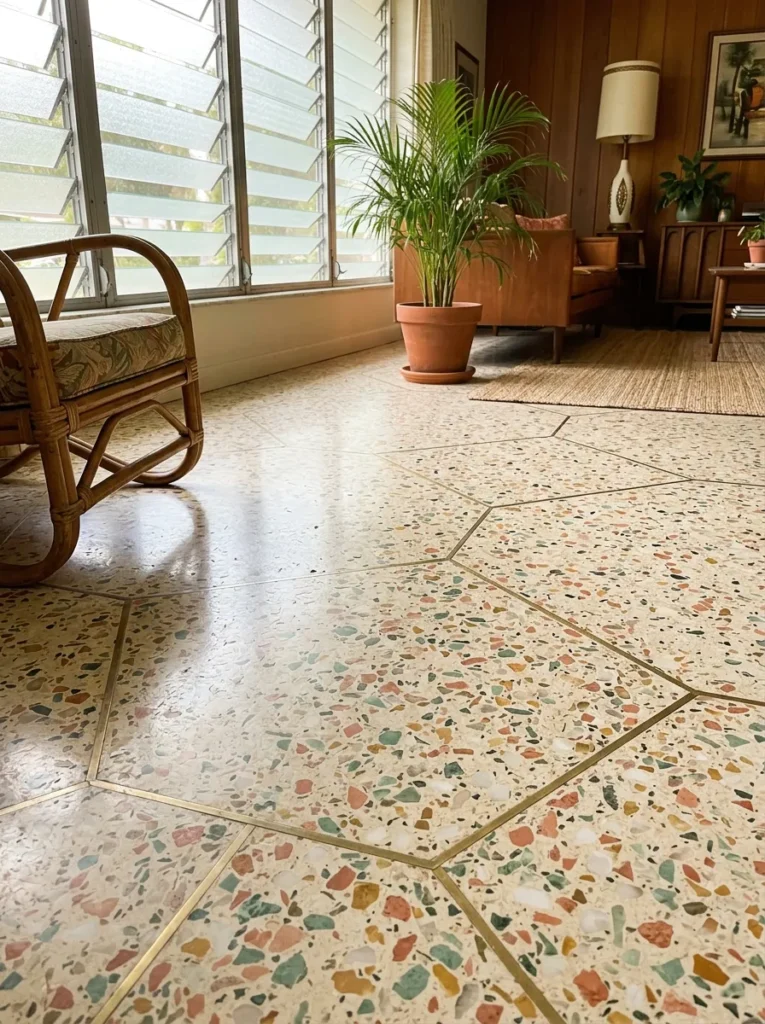
Vibe: Warm and vintage — the floor that makes you want to go barefoot from the moment you step inside.
Why it works: Terrazzo flooring is the single most authentic and most distinguishing material of the vintage Florida interior — it is simultaneously the floor of the mid-century Florida bungalow, the 1950s Miami hotel lobby, the Sarasota Modernist house, and the Cuban-influenced Key West cottage, appearing across all registers of Florida mid-century domestic life and producing a material continuity across the regional style that no other single material achieves. Its specific visual richness — the varied aggregate chips embedded in a colored cement matrix, separated by thin brass dividers into geometric sections — creates a floor surface that is more visually complex and more genuinely beautiful than any tile or wood floor achievable at a comparable cost. The custom aggregate color combinations specifically are what make vintage Florida terrazzo distinctive from generic terrazzo: the coral and seafoam and warm white aggregate choices of the mid-century period reflect the specific color palette of the Florida natural landscape — the beach sand, the tropical ocean, the bougainvillea blossom — in a way that the grey-aggregate terrazzo of contemporary design does not.
How to get it: Commission new terrazzo from specialist terrazzo contractors (Doyle Dickerson Terrazzo, National Terrazzo & Mosaic Association members) specifying custom aggregate colors from their chip color libraries — coral pink, seafoam green, and warm white aggregate in a cream or pale ochre cement base produces the most authentic vintage Florida color combination. Specify thin brass divider strips rather than aluminum or zinc — brass ages to a warm gold patina that is both historically authentic and visually superior to the silver-toned alternatives. For a budget alternative, large-format terrazzo-look porcelain tiles ($25–60 per square meter) in the correct color combinations produce a visually similar effect without the custom installation cost.
Quick Win: A terrazzo-look porcelain floor tile in a vintage Florida color combination ($25–60 per square meter) installed in a bathroom, entry hall, or kitchen — the rooms where terrazzo historically appeared most frequently — immediately introduces the most distinctive material of the vintage Florida aesthetic without the cost of custom terrazzo installation.
Shop the Look
| Product |
|---|
| Terrazzo look porcelain tile coral seafoam |
| Brass tile divider strip |
| Terrazzo tile adhesive |
| Rattan chair natural |
| Indoor palm pot large |
Also view: 14 Stylish Landscaping Ideas for Front and Back Yards
2. Rattan and Wicker Furniture Throughout the Living Room
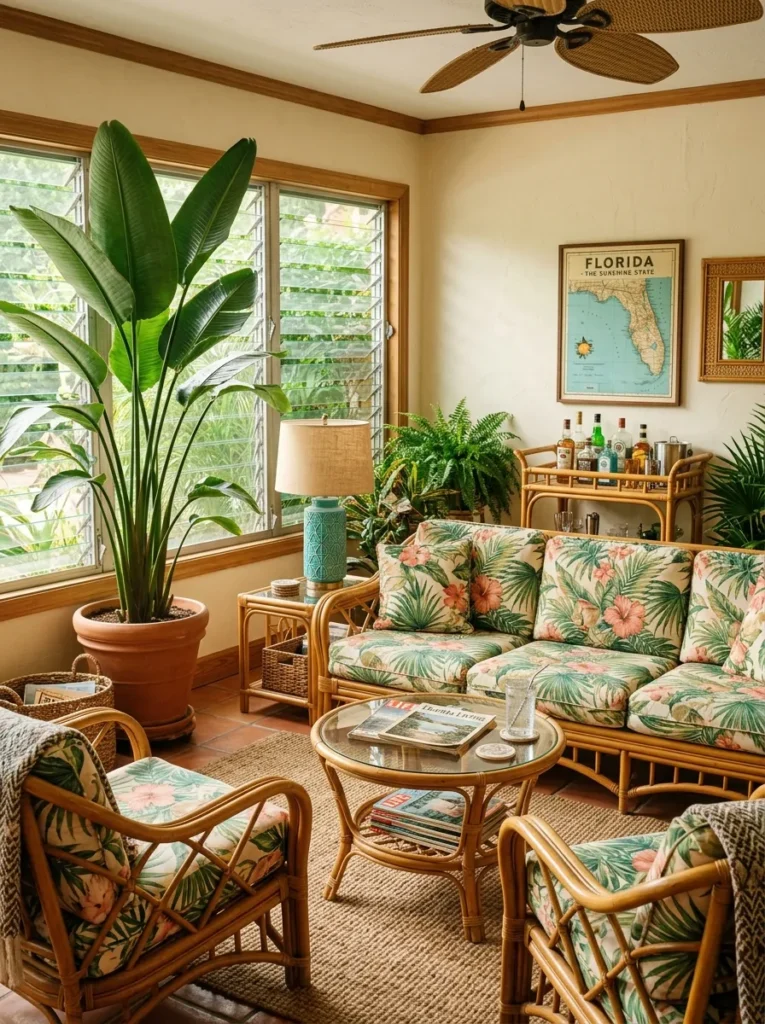
Vibe: Warm and leisurely — the living room that makes every afternoon feel like a long weekend at a Florida resort circa 1962.
Why it works: A complete rattan living room — sofa, armchairs, coffee table, and bar cart all in matching or coordinating rattan — is the furniture decision that most completely establishes the vintage Florida interior’s material character, because rattan furniture is not merely a style choice in the Florida context but a historically grounded climate response. Pre-air-conditioning Florida interiors required open-weave furniture that allowed air circulation around and through the seating, and rattan’s characteristic open-frame construction — with gaps between the woven cane strips — provided this ventilation quality while simultaneously creating the light, warm, naturally sourced aesthetic that the subtropical environment suggested. The complete rattan room also makes a different statement from the single accent rattan chair: it establishes rattan as the room’s primary furniture language rather than a decorative accent, which is the approach that authentic mid-century Florida interiors took. The tropical print cushion fabric is the textile choice that completes the material narrative — the bright tropical prints of 1950s and 1960s Florida furnishing fabric (birds of paradise, tropical leaves, hibiscus, and palm motifs) are what give the rattan furniture its regional specificity and its visual exuberance.
How to get it: Source genuine rattan or high-quality synthetic rattan furniture from specialist retailers (Serena & Lily, Pottery Barn, and Tommy Bahama Home all produce well-regarded rattan living room collections). The honey or natural rattan color is the vintage-authentic finish — darker lacquered or painted rattan frames move away from the specific mid-century Florida aesthetic toward the more general bohemian or coastal rattan aesthetic. The cushion fabric should be an authentic tropical print rather than a neutral or geometric — the tropical print is the specific choice that gives vintage Florida rattan its regional identity.
Shop the Look
| Product |
|---|
| Rattan sofa with cushions honey |
| Rattan armchair pair |
| Rattan coffee table glass top |
| Tropical print cushion cover |
| Rattan bar cart |
Also view: 15 French Country Decorating Ideas Worth Saving
3. Jalousie or Louvre Windows with Tropical Garden Views
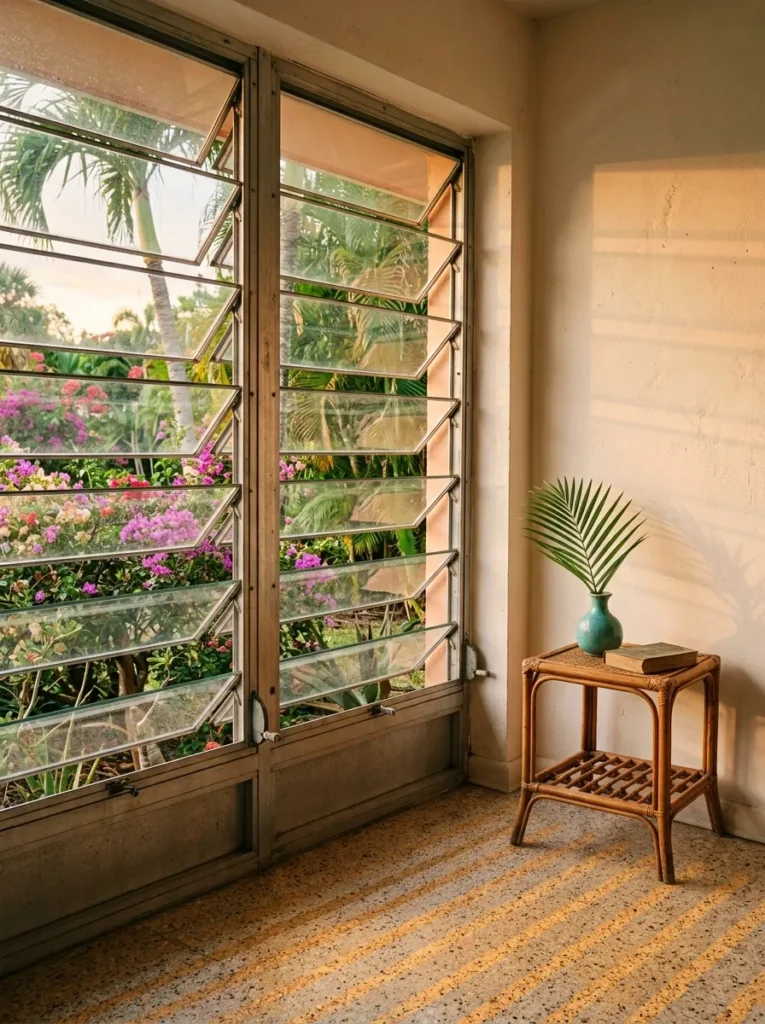
Vibe: Warm and tropical — the window that makes the garden feel like it is inside the room with you.
Why it works: Jalousie windows are the most architecturally distinctive element of the mid-century Florida house and the design feature that most powerfully communicates the style’s fundamental indoor-outdoor philosophy — the jalousie’s angled glass louvres allow ventilation and rain protection simultaneously, which in the pre-air-conditioning Florida house was the climate management solution that made year-round habitation in a subtropical climate comfortable without the need for mechanical cooling. Their characteristic angled shadow pattern — the parallel striped shadows cast across terrazzo floors by the angled glass louvres in direct sunlight — is the specific visual quality that distinguishes jalousie windows from any other window type and creates the signature light quality of the vintage Florida interior. The tropical garden view through the angled glass panels is as important as the window itself — jalousie windows are designed to frame the outdoor environment rather than to separate the interior from it, and the presence of tropical planting immediately outside the jalousie is the contextual element that completes the vintage Florida window composition.
How to get it: Install genuine jalousie windows from specialist suppliers (Florida Glass and Mirror, National Jalousie Corporation) in existing window openings — jalousie windows are available in standard and custom sizes and can replace standard windows in most residential openings. In renovation or new construction, specify aluminum-frame jalousie windows in white or silver aluminum for the most historically authentic appearance. For apartments or rentals where window replacement is not possible, the jalousie shadow effect can be approximated using a Venetian blind with wide slats in an aluminum finish, which produces a similar angled shadow pattern in direct sunlight.
Shop the Look
| Product |
|---|
| Jalousie window replacement unit |
| Aluminum venetian blind wide slat |
| Turquoise ceramic vase slim |
| Palm leaf indoor plant |
| Rattan side table small |
4. Turquoise and Coral Tile Work in Bathrooms
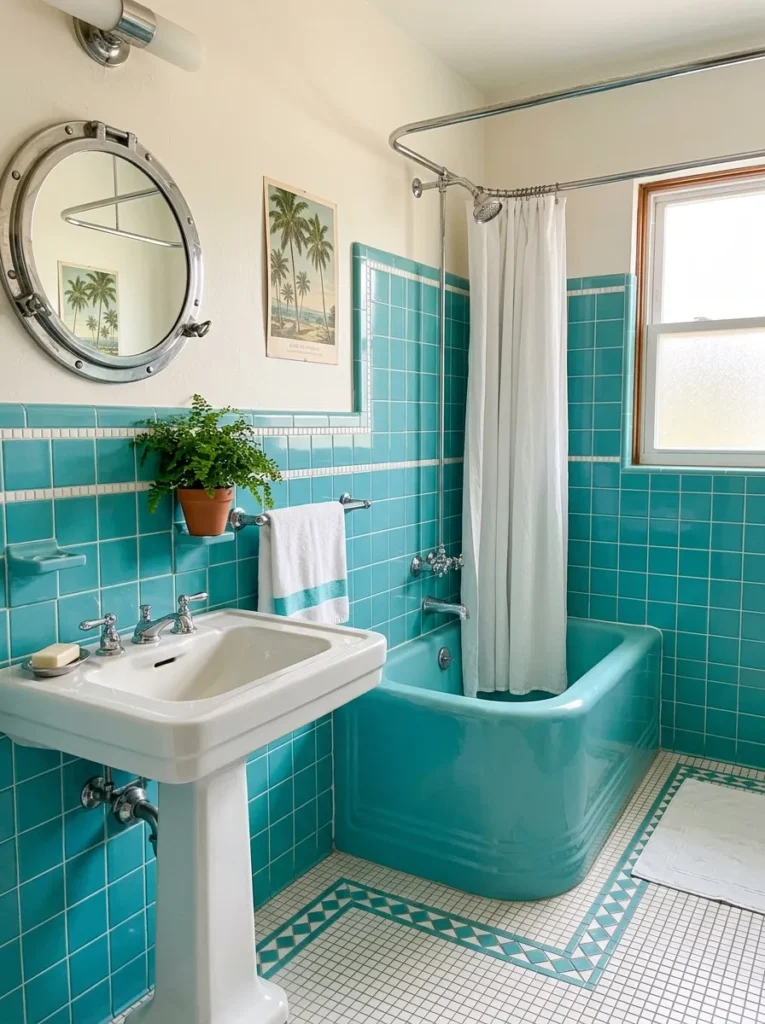
Vibe: Fresh and vintage — the bathroom that makes bathing feel like swimming in the Gulf of Mexico in 1958.
Why it works: The turquoise and white tile bathroom is the vintage Florida interior element that most powerfully references the mid-century Florida resort aesthetic — the specific turquoise of Florida swimming pool tile, filtered through the design sensibility of the 1950s bathroom tile industry, produced the characteristic turquoise-and-white bathroom color combination that appears throughout Florida’s mid-century residential and hotel architecture. The 75mm ceramic tile at shoulder height creates the specific period proportion that distinguishes vintage Florida tile work from contemporary large-format tile — the small tile format creates a much denser grout grid that reads as labor-intensive and craft-made, which is the visual quality that gives vintage tile work its distinctive character. The turquoise bathtub — cast iron enameled in the specific turquoise that was a standard American bathroom fixture color from the late 1940s through the 1960s — is the period element that most specifically locates this bathroom in the vintage Florida aesthetic.
How to get it: Source 75mm ceramic tiles in the correct turquoise from specialty tile suppliers who carry reproduction vintage color ranges (Heritage Tile, Tile Restoration Center, and Waterworks all carry vintage-authentic turquoise tile programs). The correct vintage Florida turquoise is a specific warm-toned medium turquoise — not the cool bright turquoise of contemporary design, but the slightly greened, warm-toned turquoise of 1950s ceramic manufacturing. A genuine turquoise vintage bathtub can be found through architectural salvage specialists, or a standard white cast iron tub can be re-enameled in vintage turquoise by specialist refinishers.
Shop the Look
| Product |
|---|
| Turquoise ceramic tile 75mm |
| White ceramic border tile |
| Vintage turquoise bathtub refinish |
| Chrome porthole mirror |
| White ceramic floor tile |
5. Tropical Print Wallpaper in an Entry Hall or Powder Room
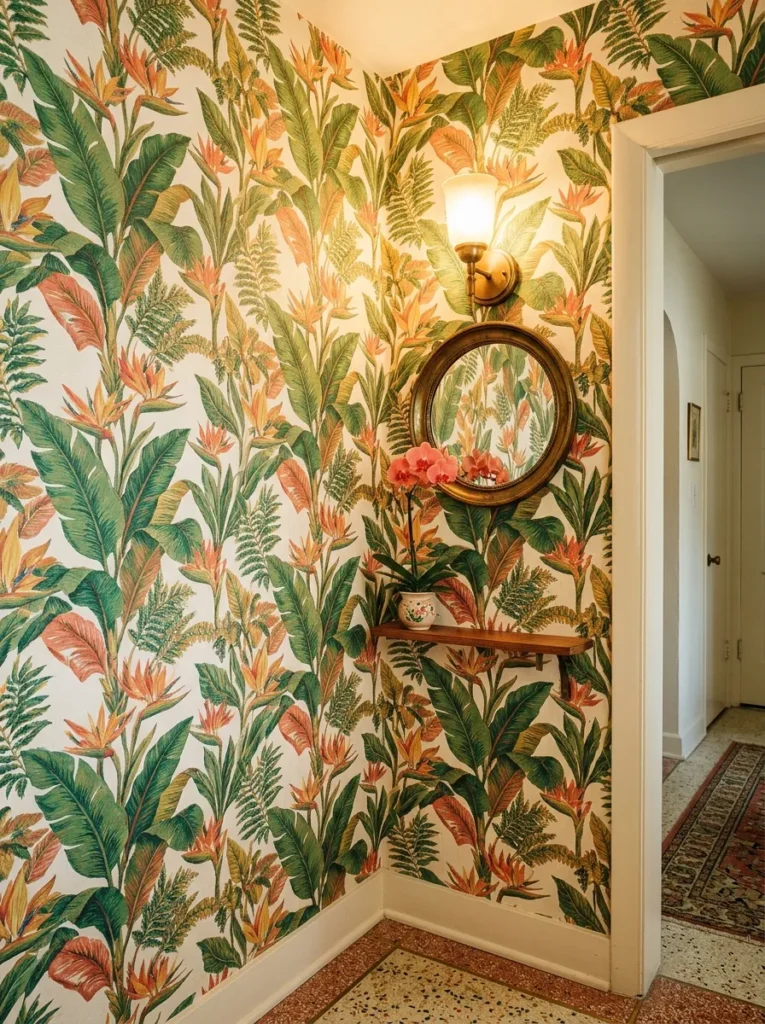
Vibe: Exuberant and botanical — the entry hall that makes every arrival feel like stepping off a plane into warm air.
Why it works: Tropical botanical print wallpaper in an entry hall or powder room is the vintage Florida design idea with the highest visual impact per square meter — a small enclosed space covered entirely in a large-scale tropical print creates an immersive, botanically rich experience that is the compressed version of the full outdoor tropical environment. The entry hall and powder room are the correct rooms for the full-coverage tropical print application because their small scale and short occupancy time allows a level of visual intensity that would be overwhelming in a larger, longer-occupied room. The specific design of the tropical print is the authenticating detail — a genuine mid-century Florida tropical print features large-scale banana leaf, bird of paradise, or palm frond motifs in the warm, slightly sun-bleached tropical color palette of coral, deep green, warm yellow, and aqua that characterized the textile and wallpaper design of the 1940s–1960s Florida resort aesthetic, not the cooler, more graphic tropical prints of contemporary design.
How to get it: Source vintage reproduction tropical print wallpaper from specialist wallpaper retailers who carry mid-century reproduction designs (Secondhand Rose, Quadrille, Schumacher’s vintage collection, and Arlo & Jacob all produce authentic tropical print wallpapers in the correct vintage scale and color palette). The scale of the print relative to the room size is the critical specification — a print whose primary botanical motif (the banana leaf, the bird of paradise) measures 400–600mm at its largest dimension will read correctly in a standard entry hall or powder room, while a smaller-scale print will read as a pattern rather than a botanical scene.
Shop the Look
| Product |
|---|
| Tropical botanical print wallpaper vintage |
| Wallpaper paste brush set |
| Aged brass wall sconce |
| Round brass mirror small |
| Orchid plant coral pink |
6. Screened Porch with Vintage Florida Casual Furniture
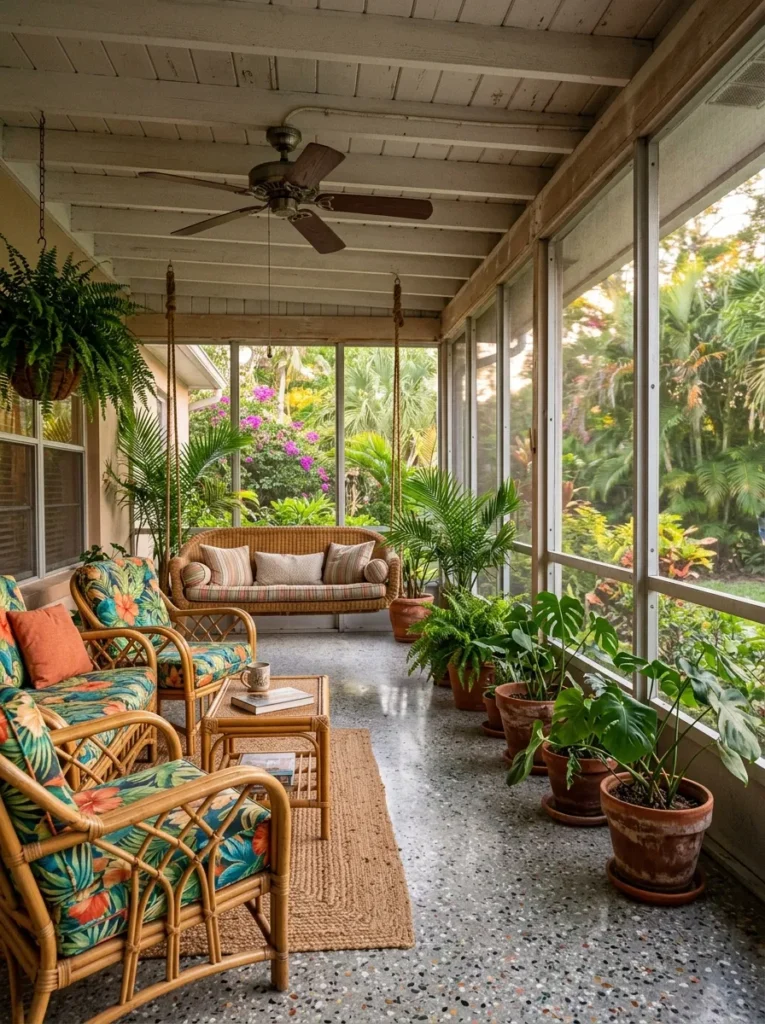
Vibe: Warm and unhurried — the porch that makes you understand why people moved to Florida in the first place.
Why it works: The screened porch is the most quintessentially Floridian domestic space in the vintage Florida architectural tradition — it is the room that mediates between the conditioned interior and the subtropical outdoor environment, providing the warmth and natural ventilation of outdoor living while excluding the insects that subtropical Florida produces in abundance. Every mid-century Florida house of any quality had a screened porch, and the quality of a family’s screened porch was a significant signal of domestic investment and lifestyle priority. The vintage Florida screened porch has a specific material vocabulary: aluminum screen panels in standard grey or charcoal, terrazzo or concrete floors, ceiling fan with wooden blades for air movement, rattan or painted iron porch furniture with bright tropical cushions, and an abundant collection of tropical potted plants that blurs the boundary between the porch and the garden beyond the screens. This combination of materials and objects creates an indoor-outdoor room that is simultaneously protected from the elements and immersed in the tropical landscape.
How to get it: A screened porch can be added to most single-story homes through a standard contractor addition ($8,000–25,000 depending on size and finish level). Specify aluminum screen panels in grey or charcoal mesh — the aluminum frame and grey screen is the historically correct specification and the most durable choice for a Florida outdoor environment. The ceiling fan is the functional element that most completely transforms a screened porch’s comfort level in subtropical heat — a ceiling fan with 1.2–1.5 meter blade span produces sufficient air movement on a still Florida evening to make the space genuinely comfortable without air conditioning.
Shop the Look
| Product |
|---|
| Ceiling fan wood blade outdoor |
| Rattan porch chair tropical cushion |
| Hanging rattan swing porch |
| Terracotta pot collection large |
| Indoor palm and fern plant set |
7. Flamingo Pink and Palm Green Color Palette
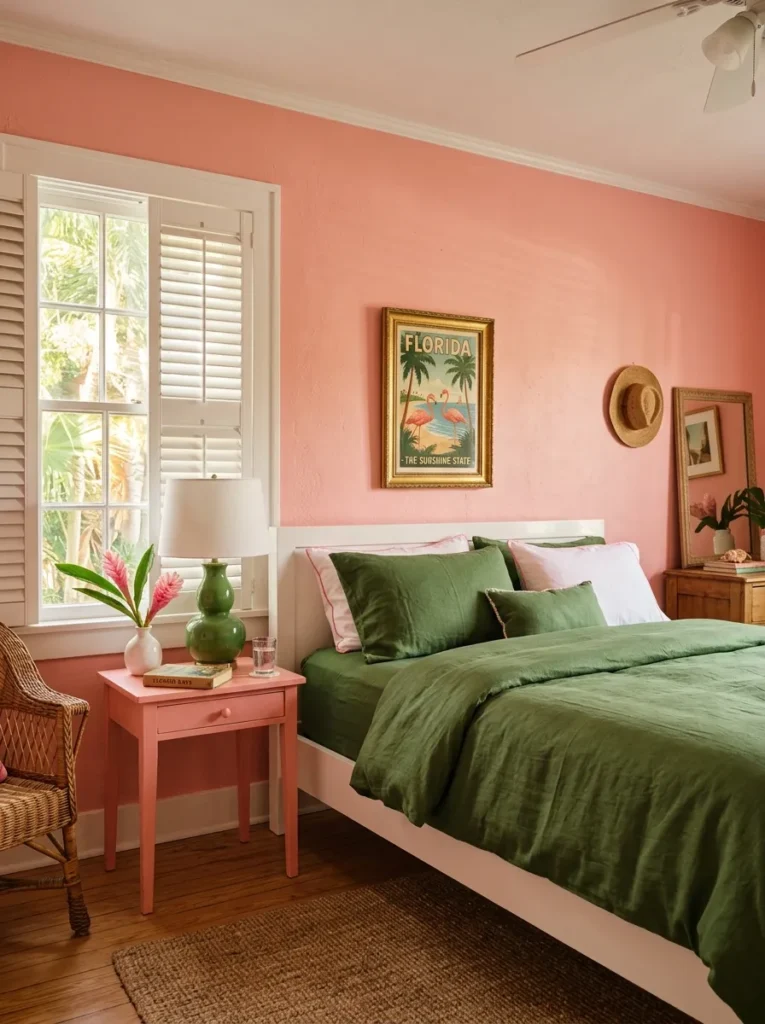
Vibe: Warm and specifically Floridian — the bedroom that makes waking up feel like the first morning of a vacation.
Why it works: The flamingo pink and palm green color combination is the vintage Florida palette that most directly references the two most iconic elements of the Florida natural landscape — the roseate spoonbill and flamingo of the Everglades and the Sabal palm that is Florida’s state tree. This specific color pairing appeared throughout mid-century Florida domestic design in everything from beach resort hotel rooms to suburban bungalow bedrooms, and its warmth and tropical specificity make it one of the few genuinely regional American color combinations that is immediately and specifically locating — a room in flamingo pink and palm green can only be read as Florida, not as a generic tropical or coastal palette. The color combination works visually because flamingo pink and palm green are near-complementary on the warm color wheel — the pink is warm red-toned and the green is warm yellow-toned, creating a contrast that is vibrant without being harsh and that references the natural color contrast of Florida’s subtropical plant and animal world.
How to get it: The correct flamingo pink for a vintage Florida interior is a warm, medium-saturation pink with perceptible red and orange undertones — not a cool fuchsia, not a pale blush, but the specific warm medium pink of the flamingo’s body feathers. Benjamin Moore’s Flamingo Pink 2003-40, Sherwin-Williams’ Heartfelt SW 6592, and Farrow & Ball’s Nancy’s Blushes No. 278 are all usable approximations at different price points. The palm green should be a warm, medium-deep green with yellow-green rather than blue-green undertones — the color of a healthy palm frond in full Florida sunlight rather than the deeper, cooler green of a northern forest.
Quick Win: Painting a single bedroom accent wall in flamingo pink ($25–35 for a quart of paint, sufficient for a standard accent wall) and adding palm green linen bedding ($80–160 for a duvet cover and pillowcases) produces the complete vintage Florida bedroom color experience for under $200 in materials, with no other changes required to the room’s furnishings or architecture.
Shop the Look
| Product |
|---|
| Flamingo pink interior paint |
| Palm green linen bedding set |
| White lacquered bed frame |
| Vintage Florida travel poster print |
| Green ceramic table lamp |
8. Mid-Century Florida Kitchenette with Knotty Pine Cabinets
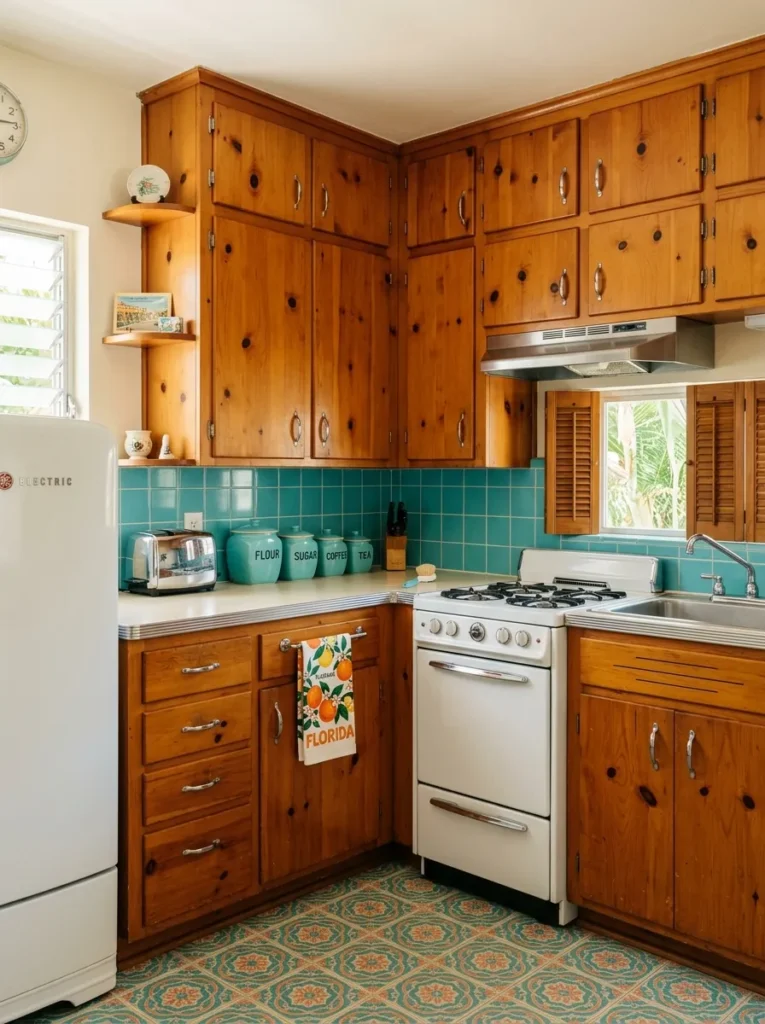
Vibe: Warm and period-authentic — the kitchen that makes you want to squeeze orange juice from Florida citrus for everyone who comes through the door.
Why it works: Knotty pine cabinets are the most genuinely mid-century Florida kitchen material — they appeared in Florida kitchens, Florida Keys fishing camps, and Florida beach cottages throughout the 1940s, 1950s, and 1960s as the affordable, warm, regionally appropriate alternative to painted or laminate cabinets. The knotty pine’s specific visual character — the warm honey amber of the pine grain interrupted throughout by the darker, circular knot patterns that give the wood its name — creates a surface richness and material warmth that painted or veneered cabinets cannot replicate. The knot pattern is specifically the quality that makes knotty pine a regionally authentic material rather than merely a rustic one: the knots appear in Florida pine lumber at a higher frequency than in northern pine species, and the pattern they create is as regionally specific as terrazzo or jalousie windows. The combination with a turquoise tile backsplash completes the vintage Florida palette — honey pine and turquoise is the kitchen color combination that appears most consistently in authentic mid-century Florida domestic photography.
How to get it: Install new knotty pine cabinet doors in the correct grain pattern (select knotty pine grading, which maximizes knot frequency rather than minimizing it as in the select-clear grading typically used for contemporary cabinetry). Finish with a natural oil or very light tung oil finish rather than polyurethane — the oil finish allows the pine grain to breathe and age naturally, producing the warm honey patina that is the authentic knotty pine kitchen quality. Apply a turquoise tile backsplash in the 75mm tile format described in Idea 4 for the complete vintage Florida kitchen material combination.
Shop the Look
| Product |
|---|
| Knotty pine cabinet door set |
| Natural tung oil finish pine |
| Chrome kitchen pull hardware |
| Turquoise ceramic backsplash tile |
| White laminate countertop |
9. Vintage Florida Travel Poster Art Gallery
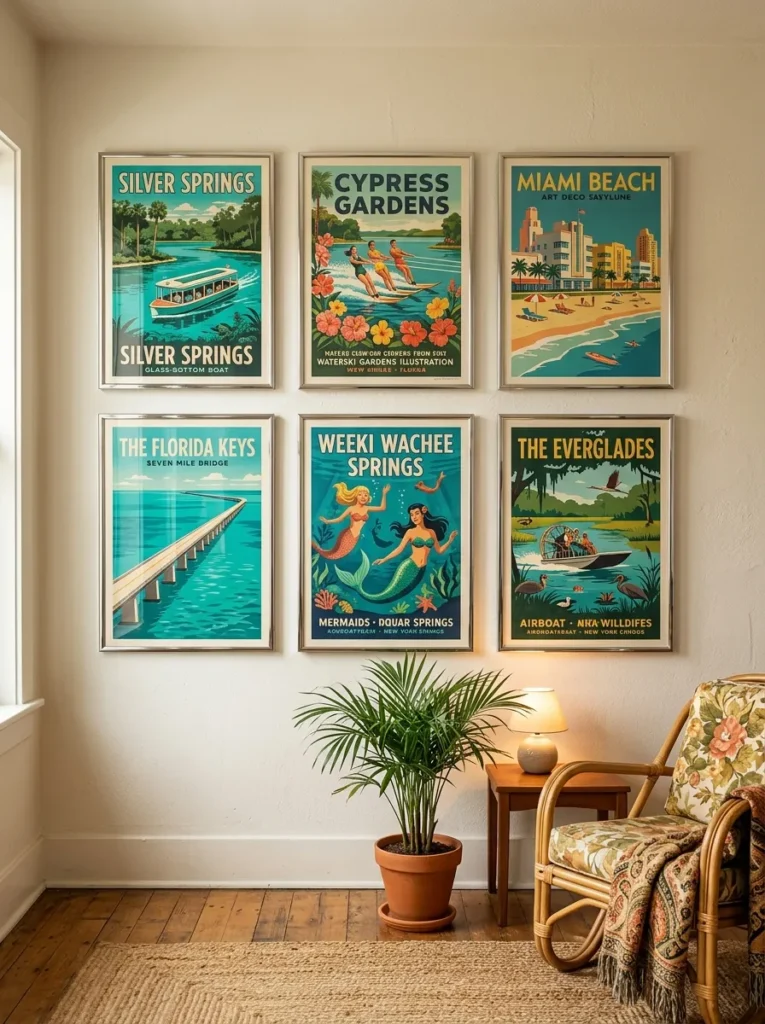
Vibe: Warm and nostalgic — the wall that makes every day in the room feel like the beginning of a road trip down the Tamiami Trail.
Why it works: The vintage Florida travel poster gallery is the decorating idea that most completely packages the vintage Florida aesthetic into a single wall composition — the graphic design language of mid-century Florida travel posters (flat color illustration, bold typography, and the specific turquoise-coral-yellow palette that the Florida tourism industry developed between the 1930s and the 1960s) is simultaneously a historical document, a regional identity statement, and a genuinely beautiful visual object that rewards close examination of its design quality. The destinations represented in the posters are themselves the content of vintage Florida design: Cypress Gardens (the water ski show and botanical garden that defined mid-century Florida tourism), Weeki Wachee Springs (the world-famous mermaid show in a natural spring), Silver Springs (the glass-bottom boat tours of the crystalline springs), and Miami Beach (the Art Deco resort hotels of the South Beach strip) are all specifically and exclusively Floridian places whose visual representation in mid-century graphic design constitutes a regional cultural archive.
How to get it: Source vintage Florida travel poster reproductions from specialist print retailers (AllPosters, Art.com, and Redbubble all carry extensive vintage Florida travel poster reproduction collections) or genuine original vintage posters from specialist dealer (eBay, Etsy poster sellers, and antique poster dealers all list original Florida travel posters, with prices ranging from $50 for common reproductions to $500–2,000 for genuine originals). Frame in matching narrow chrome frames for the period-authentic presentation — chrome was the standard frame material of the mid-century period and coordinates with the aluminum jalousie hardware and chrome bathroom fixtures of the vintage Florida interior.
Shop the Look
| Product |
|---|
| Vintage Florida travel poster print |
| Chrome picture frame set |
| Gallery wall hanging kit |
| Rattan chair natural |
| Small indoor palm pot |
10. Aqua and White Exterior with Jalousie Shutters
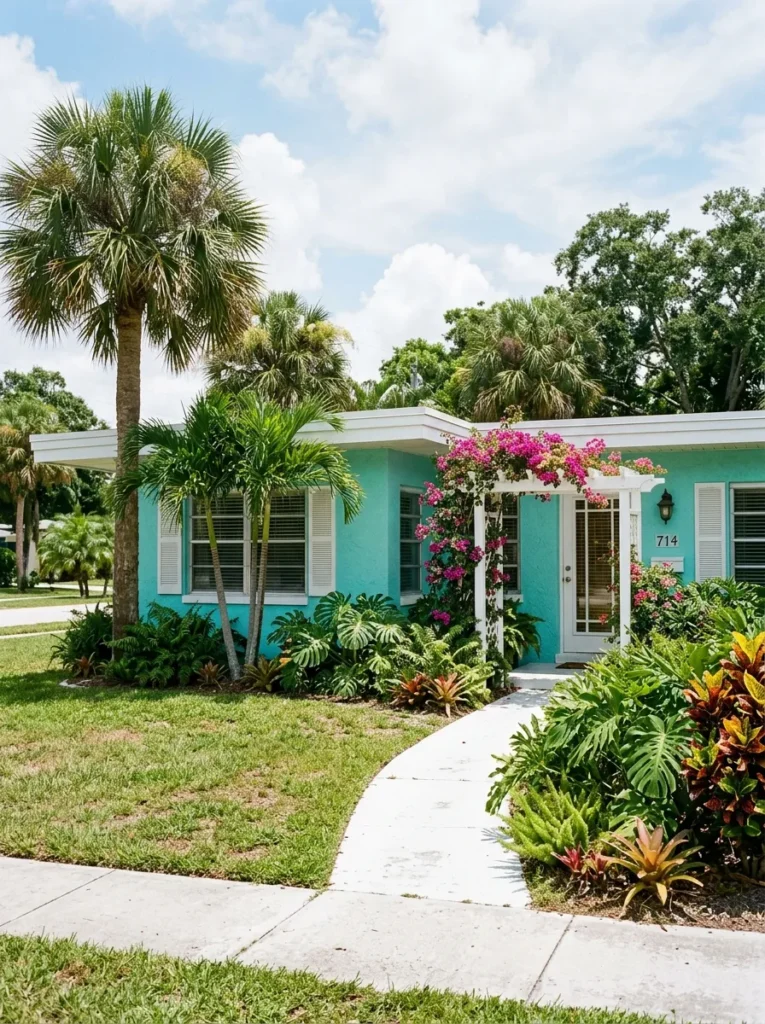
Vibe: Bright and inviting — the house that looks exactly like every dream of Florida that anyone has ever had.
Why it works: The aqua or turquoise stucco exterior with white trim and jalousie shutters is the most recognizable single image of mid-century Florida residential architecture — it appears on postcards, in Florida photography archives, and in the visual memory of everyone who has driven through the residential neighborhoods of Key West, Fort Lauderdale, or St. Petersburg and felt a specific nostalgic recognition of this specific combination of color, material, and form. The aqua stucco was the practical climate choice as well as the aesthetic one — the relatively light color reflects Florida’s intense solar radiation rather than absorbing it, reducing the interior cooling load of the house before air conditioning was standard, and the wide roof overhang shades the jalousie windows beneath it from direct sun while allowing the windows to remain open for ventilation in rain. The combination of aqua stucco, white wood trim, and the aluminum jalousie windows created a specifically Floridian architectural character that is immediately readable as mid-century regional style rather than as the generic stucco ranch house that the same form in a beige or grey color would produce.
How to get it: The exterior stucco color is the single most impactful change available on an existing Florida house of this period — repainting existing white or beige stucco in the correct aqua or turquoise (Sherwin-Williams’ Swimming, Benjamin Moore’s Turquoise Powder 2057-40, or Behr’s Calm Water are all usable approximations) immediately transforms the exterior reading of the building. Add white painted wooden shutters beside the existing windows (non-functional decorative shutters are adequate for the visual effect) and plant bougainvillea at the entry trellis to complete the full vintage Florida exterior composition.
Shop the Look
| Product |
|---|
| Aqua turquoise exterior paint |
| White exterior paint trim |
| White louvered shutter pair |
| Bougainvillea plant pink |
| Concrete path edging |
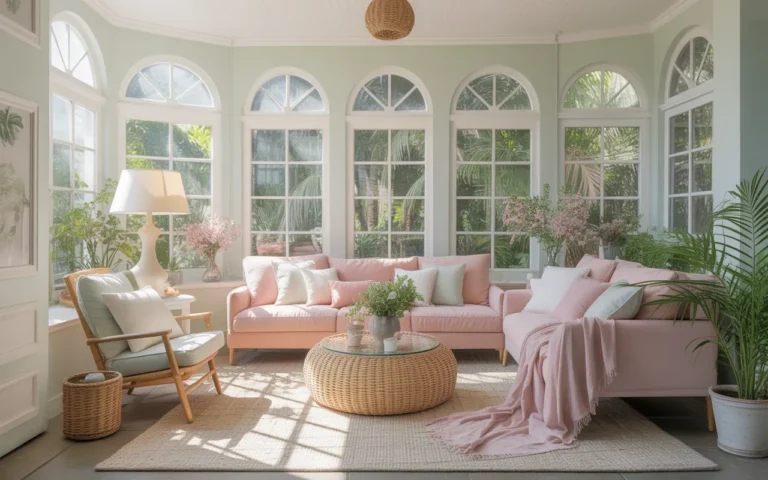
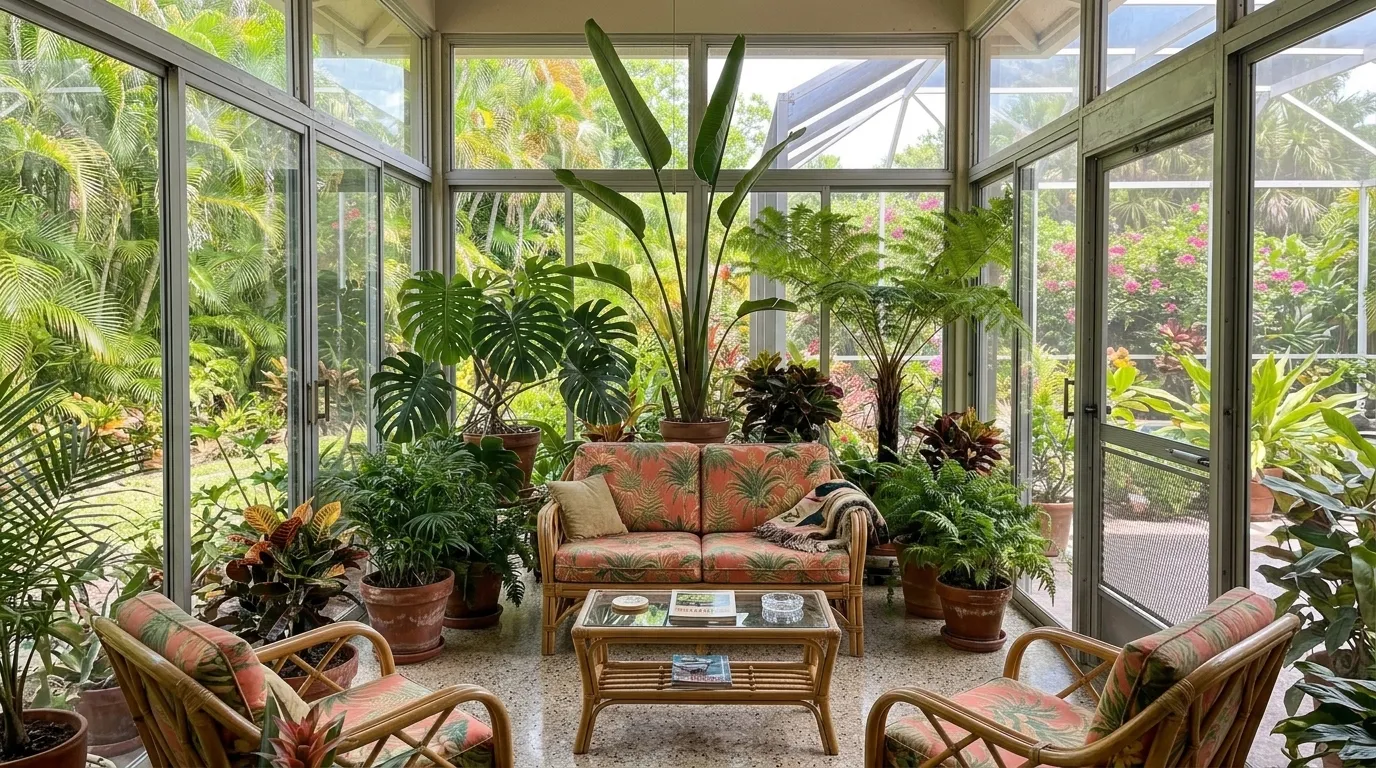
11. Florida Room with Glass Walls and Tropical Planting
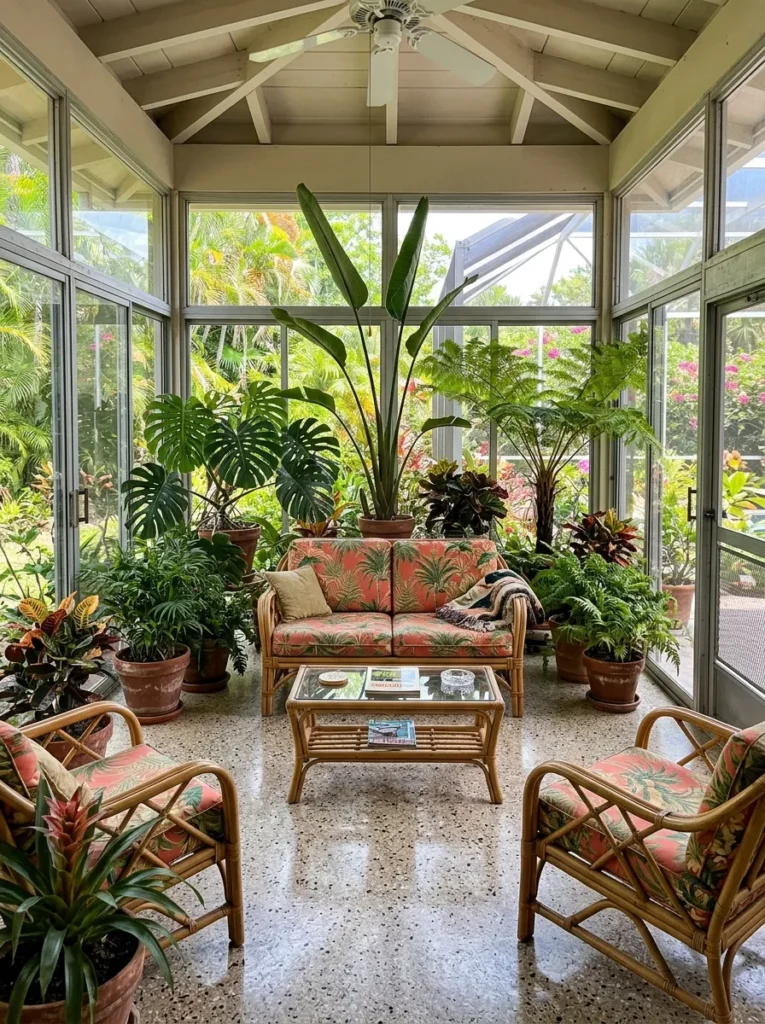
Vibe: Lush and botanical — the Florida room that makes being inside feel indistinguishable from being outside.
Why it works: The Florida room — the specifically Floridian domestic space type that is neither the living room nor the screened porch but a glass-walled intermediate zone between the conditioned interior and the outdoor environment — is the architectural feature that most completely expresses the vintage Florida lifestyle aspiration: the desire to be simultaneously inside and outside, comfortable and immersed in the tropical landscape, protected from the elements while surrounded by the natural world. The glass walls of a Florida room allow the tropical garden to be experienced visually from within an air-conditioned or fan-cooled interior, creating the specific quality of lush botanical immersion that is the defining lifestyle experience of the Florida mid-century house at its best. The large potted tropical plants within the Florida room — bird of paradise, split-leaf philodendron, tree ferns — blur the visual boundary between the room’s interior planting and the outdoor garden visible beyond the glass, creating the impression of a botanical interior that is continuous with the tropical garden rather than merely adjacent to it.
How to get it: Convert an existing covered porch, carport, or side yard into a Florida room by enclosing the perimeter with aluminum-frame sliding glass door panels — this is one of the most cost-effective home additions available in Florida ($8,000–18,000 depending on size) and immediately adds a genuinely usable additional room that is simultaneously interior and exterior in character. Fill the Florida room with the largest tropical potted plants the space will accommodate — the key is density rather than curation, as the lush botanical abundance is the primary design content of the Florida room’s interior character.
Shop the Look
| Product |
|---|
| Bird of paradise plant large |
| Split leaf philodendron |
| Tree fern established pot |
| Terracotta pot large collection |
| Rattan chair outdoor tropical print |
12. Vintage Florida Bar with Tiki Influence
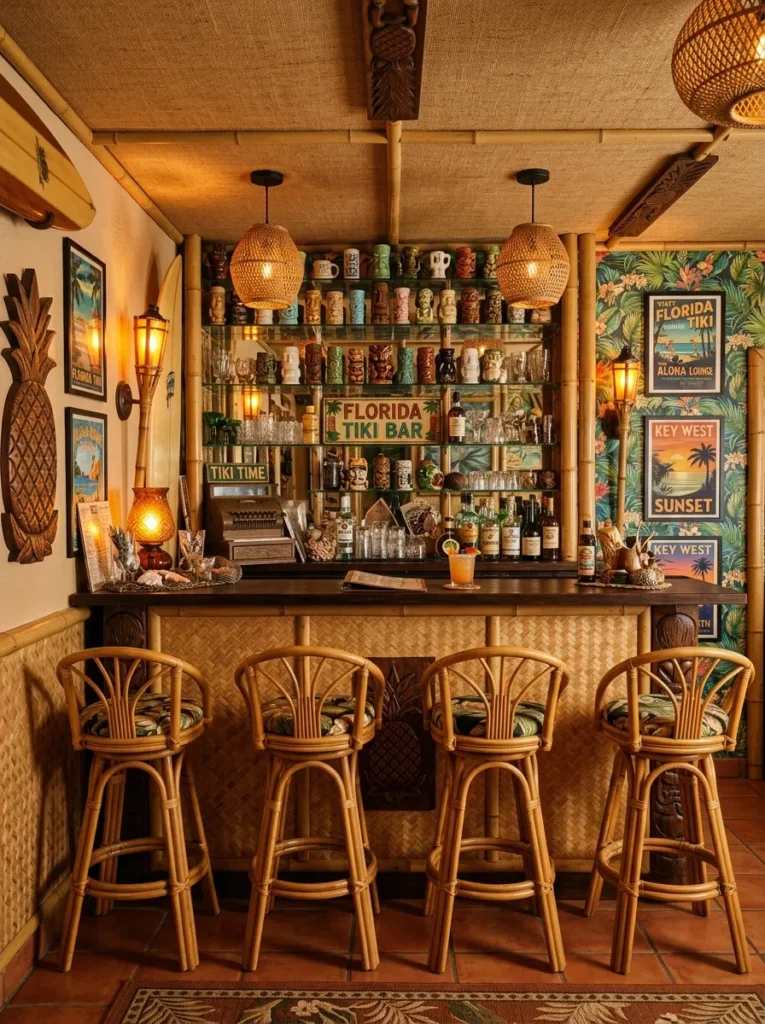
Vibe: Warm and festive — the home bar that makes every gathering feel like you are hosting it at a 1959 Florida Keys resort.
Why it works: The tiki-influenced vintage Florida bar is the decorating idea that most completely captures the specific leisure culture of mid-century Florida — the tiki aesthetic, which swept American resort and leisure culture from the late 1940s through the 1960s, found its most exuberant expression in Florida where the genuine subtropical climate and the proximity to the Caribbean gave the Polynesian fantasy of coconut palms and warm seas an authentic local context. Florida’s tiki bars — from Don the Beachcomber’s Florida locations to the many independent tiki bars that proliferated throughout the Florida coast in the 1950s and 1960s — developed the specific combination of bamboo construction, tiki torch lighting, tropical drink culture, and Polynesian-Caribbean decorative motif that defined Florida tiki design. A home bar in this tradition uses the most recognizable elements of the vintage Florida tiki bar — bamboo cladding, amber torch-light, vintage tiki mugs on display, and the grass cloth or bamboo ceiling that characterized the original tiki establishments — to create a domestic bar space with genuine regional specificity and period character.
How to get it: Bamboo cladding panels (available from specialist bamboo suppliers and online retailers at $15–35 per square meter) applied to an existing bar front or bar surround immediately creates the primary material character of the tiki-influenced vintage Florida bar. Source a collection of vintage ceramic tiki mugs from antique dealers, eBay, and specialist tiki collectible retailers — genuine vintage tiki mugs from the 1950s and 1960s are collectible objects with their own market, but reproduction tiki mugs in the original styles are widely available for $8–25 each.
Shop the Look
| Product |
|---|
| Bamboo cladding panel natural |
| Rattan bar stool set |
| Vintage tiki mug ceramic |
| Tiki torch wall sconce amber |
| Grass cloth ceiling material |
13. Citrus and Tropical Fruit Motif Throughout the Kitchen
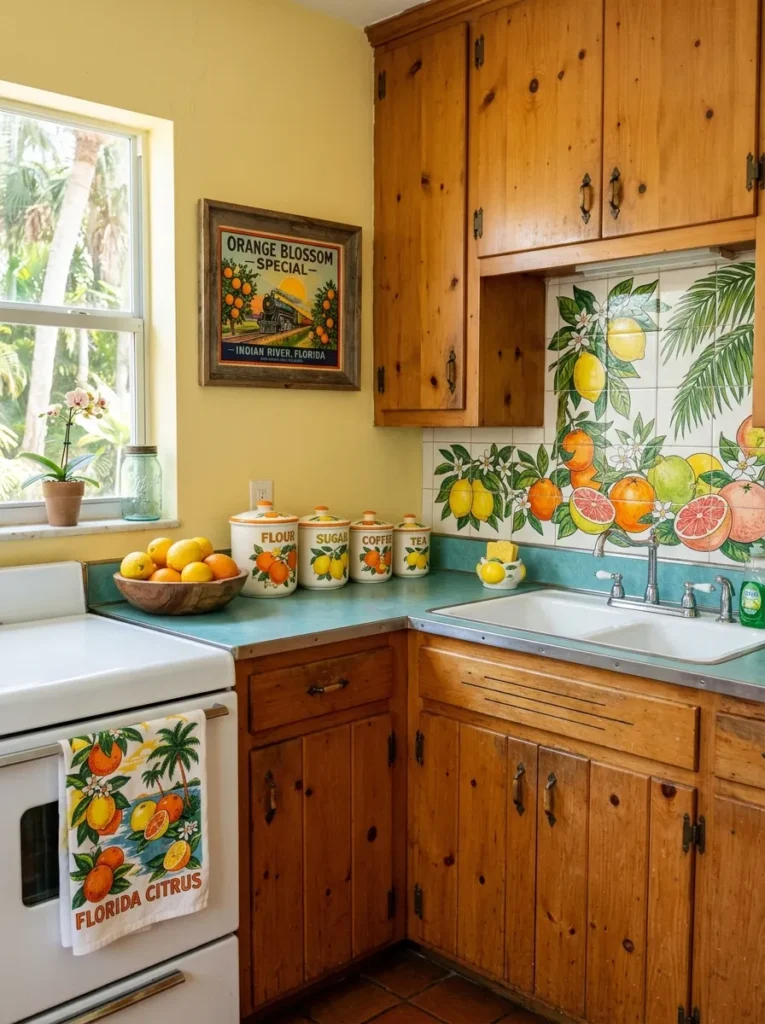
Vibe: Cheerful and regional — the kitchen that makes you feel like Florida’s citrus industry is a personal relationship rather than an agricultural fact.
Why it works: The citrus and tropical fruit motif throughout the vintage Florida kitchen is the decorating idea that most cheerfully and most specifically locates the kitchen within the Florida regional culture — citrus cultivation has been central to Florida’s agricultural and cultural identity since the 19th century, and the citrus motif (the orange, the grapefruit, the lemon, the lime) appears throughout vintage Florida domestic material culture in tile work, textile design, ceramic decoration, and graphic art in a way that is as regionally specific as lavender in a Provençal kitchen or olive motifs in a Tuscan one. The vintage Florida citrus crate label — the printed paper labels that decorated wooden citrus shipping crates from the 1880s through the 1950s, which have become highly collectible items of American graphic design — is the decorative element that most authentically represents the regional citrus culture in a kitchen display context. These labels, produced by hundreds of Florida packing houses and featuring the exuberant graphic art of their period, are simultaneously authentic regional ephemera and genuinely beautiful examples of American commercial art.
How to get it: Source vintage Florida citrus crate label reproduction prints from specialty print retailers (AllPosters, eBay vintage poster sellers, and Florida antique dealers all carry these) and frame in simple chrome or knotty pine frames for wall display. Source vintage ceramic canisters with citrus motifs from antique dealers, estate sales, and Florida antique shops — the citrus-decorated canister set was a standard Florida kitchen accessory throughout the 1940s–1960s and is readily available in the vintage market. Commission or source a hand-painted citrus tile mural for above the sink from specialist tile painting services or individual ceramic artists.
Quick Win: A set of three vintage Florida citrus crate label reproduction prints ($8–15 each printed at standard poster size) framed in simple chrome frames and hung as a small gallery in the kitchen immediately introduces the most authentically regional decorative element of the vintage Florida kitchen at a total cost of $50–90 for three framed prints.
Shop the Look
| Product |
|---|
| Vintage Florida citrus crate label print |
| Citrus motif ceramic canister set |
| Citrus print dish towel set |
| Wooden citrus fruit bowl |
| Hand painted citrus tile mural |
How to Start Your Vintage Florida Design Transformation
Your single first move is to establish the correct color palette in the room you most want to transform — not by painting immediately, but by assembling the palette’s key tones as physical color swatches alongside your existing room elements and observing them in the room’s natural light at different times of day. The vintage Florida palette is specifically warm — warm turquoise, warm coral, warm flamingo pink, warm aqua — and the distinction between warm and cool versions of these colors is the most important single decision in the entire transformation. A cool-toned turquoise with blue-grey undertones reads as contemporary coastal; a warm-toned turquoise with green undertones reads as vintage Florida. A cool pink with purple undertones reads as generic feminine; a warm pink with orange-red undertones reads as flamingo and specifically Floridian. Collect paint swatches and fabric samples in the colors you are considering and observe them against the room’s existing rattan, terracotta, or timber elements before committing to any paint purchase.
The most common vintage Florida design mistake is applying the aesthetic as a themed decoration rather than as a material and spatial logic. The vintage Florida interior looks exactly like what it is — a genuinely regional response to a specific climate — rather than like a theme park version of itself, and the difference is in the specificity and authenticity of the materials chosen. A room with genuine knotty pine cabinets, genuine terracotta tile, and genuine vintage tiki mugs looks vintage Floridian; a room with bamboo-print contact paper on standard cabinets and plastic flamingo ornaments looks like a Florida gift shop. The vintage Florida interior requires a commitment to genuine materials — the rattan should be real rattan (or quality synthetic rattan), the terracotta should be genuine ceramic, the jalousie should be genuine glass louvres — rather than material simulations that read as imitation rather than aspiration.
Three specific investments under $100 that create immediate vintage Florida atmosphere: (1) A bundle of genuine dried palm leaves and tropical botanicals ($15–25 from a specialty dried botanical supplier) arranged in a large terracotta pot or galvanized bucket immediately introduces the botanical abundance and natural material character that is essential to the vintage Florida interior at any scale. (2) A set of three vintage Florida citrus crate label reproductions printed and framed ($50–90 total) creates the regional identity wall feature that most specifically and cheerfully locates a kitchen or dining area within the vintage Florida cultural tradition. (3) A single large-scale tropical botanical print cushion cover ($20–45) placed on an existing neutral sofa or armchair immediately introduces the most visible textile element of the vintage Florida interior and suggests the complete tropical print palette without requiring a full furniture replacement.
Realistically, a focused single-room vintage Florida transformation — correct wall color, rattan furniture, tropical print textiles, terrazzo or terrazzo-look tile floor, and a curated display of vintage Florida decorative objects — costs $1,500–4,500 depending on the furniture investment and the floor treatment chosen. The most cost-effective entry point is the palette, the textile, and the vintage poster display — an aqua or flamingo pink wall paint, a tropical print throw and cushions, and a small gallery of vintage Florida travel poster prints produces a room that reads as genuinely vintage Floridian for under $300 in materials. The more substantial investments (a complete rattan furniture suite, a terrazzo floor installation, a jalousie window replacement) build on this established aesthetic foundation over time as budget and opportunity allow.
Frequently Asked Questions About Vintage Florida Design
What is the difference between vintage Florida design and coastal or tropical design?
Vintage Florida design is a specifically regional American design style with precise historical, material, and geographic roots — it draws from the mid-century architectural and material culture of Florida specifically, referencing the Sarasota School of Architecture, the South Florida resort culture, the Cuban and Caribbean material influences of Key West and Miami, and the specific decorative motifs of Florida’s own landscape (the flamingo, the citrus, the saw palmetto, the Everglades). Coastal design is a generic aesthetic applied to any seaside location without regional specificity — it uses generic nautical, beachy, and maritime references without the specific cultural and historical content of a genuine regional style. Tropical design is similarly generic — palm trees, tropical plants, and warm colors without specific geographic or cultural reference. Vintage Florida design is distinguishable from both alternatives by its material specificity (terrazzo, jalousie windows, knotty pine, Provençal faience substituted with Florida citrus ceramics) and by the specific regional cultural references that give it its identity as the design language of a particular place and period.
What colors are most authentic to the vintage Florida palette?
The most historically authentic vintage Florida colors are: warm turquoise (the color of the Florida Gulf at noon in summer — warm-toned, green-inflected, neither the cool blue-turquoise of contemporary design nor the dark teal of current coastal palettes), flamingo pink (a warm medium pink with perceptible red-orange undertones, the color of the roseate spoonbill and flamingo of the Everglades), warm aqua (a lighter, greener relative of turquoise that was the standard exterior stucco color of Florida bungalows throughout the 1940s–1960s), citrus yellow (the warm golden yellow of a ripe Florida Valencia orange), coral (the warm orange-red of Florida’s barrier reef coral, appearing in tile work, textile prints, and terracotta), and seafoam green (the pale green of shallow Florida Gulf water visible through sand-filtered light). All of these colors share the quality of warmth — they are all warm-toned versions of their color family, never the cool or grey-toned versions that characterize contemporary coastal or tropical palettes.
How do I incorporate vintage Florida design in a non-Florida home?
The vintage Florida aesthetic is fully transplantable to non-Florida homes because its design qualities — warmth, material honesty, indoor-outdoor connection, botanical richness, and regional decorative specificity — are universally appealing domestic values rather than climate-specific necessities. In a northern or non-tropical home, the vintage Florida design elements that translate most effectively without requiring tropical climate conditions are the color palette (flamingo pink, aqua, turquoise, and coral walls work in any climate), the rattan furniture (suitable for any indoor living room regardless of climate), the vintage travel poster gallery (which functions as regional identity art in any home context), the terrazzo or terrazzo-look tile (available as porcelain tiles usable in any home), and the tropical botanical print textiles (which bring the exuberant graphic quality of mid-century Florida textile design to any room regardless of its geographic location). The jalousie window and screened porch ideas are more climate-dependent but can be adapted as decorative references through the use of jalousie-style Venetian blinds and covered outdoor spaces with rattan furniture and tropical planting.
What is the Sarasota School of Architecture and how does it influence vintage Florida design?
The Sarasota School of Architecture was a group of modernist architects working in Sarasota, Florida, primarily from the late 1940s through the 1960s, who developed a specifically Floridian form of International Style Modernism that adapted the principles of European and American Modernism to the specific demands of the subtropical Florida climate. The key figures included Paul Rudolph, Ralph Twitchell, Victor Lundy, and Gene Leedy, and their buildings — characterized by flat or low-pitch roofs with deep overhangs, walls of glass and jalousie windows for maximum ventilation and light, dramatic structural expression, and the integration of tropical landscaping into the architectural composition — established the design principles that define the most sophisticated end of vintage Florida design. The Sarasota School’s influence on the broader vintage Florida aesthetic is primarily in the architectural elements: the wide roof overhang, the jalousie window system, the open relationship between interior and outdoor spaces, and the commitment to natural ventilation as a design priority rather than a deficiency to be overcome with air conditioning.
Where can I find genuine vintage Florida furniture and decorative objects?
The best sources for genuine vintage Florida furniture and decorative objects are: Florida-specific antique dealers and antique markets (the Antique Row on Dixie Highway in West Palm Beach, the Seminole Heights antique community in Tampa, and the numerous antique shops throughout the Florida Keys and southwest Florida coast all carry authentic vintage Florida material); estate sales in Florida cities with significant mid-century housing stock (Miami, Fort Lauderdale, Sarasota, St. Petersburg, and Orlando all have active estate sale markets with regular access to mid-century Florida contents); online platforms including eBay (searching “vintage Florida,” “mid-century Florida,” “vintage rattan Florida,” and “vintage tiki Florida” produces extensive results), Etsy, and 1stDibs for higher-end vintage and antique pieces; and specialist vintage rattan furniture dealers who import and restore mid-century American rattan furniture for the current market. Vintage Florida travel posters, citrus crate labels, and other paper ephemera are available through specialist paper and poster dealers at antique markets and online.
Ready to Create Your Vintage Florida Interior?
These 13 ideas span the full range of what vintage Florida design can be in a contemporary home — from terrazzo floors that cool the air with their visual presence and jalousie windows that make the garden part of the room, to flamingo pink walls, vintage travel poster galleries, tiki bar rooms, and the citrus motif kitchen that celebrates Florida’s most delicious regional identity — so whether you are renovating a genuine mid-century Florida house to its original character or importing the vintage Florida aesthetic into a home in a completely different climate and context, there is a genuinely achievable, genuinely authentic approach here for your space, your budget, and the quality of warm, leisurely, botanically abundant domestic life that the vintage Florida aesthetic promises. The transformation begins with the palette — with the decision that warmth, color, and regional specificity are design values worth committing to — and continues with the patient sourcing of genuine materials and authentic objects that give the style its grounding in a specific time, place, and culture. Today’s specific action: find one vintage Florida travel poster reproduction of a place you feel genuine affection for — Cypress Gardens, the Florida Keys, the Everglades, or Weeki Wachee Springs — print it at A2 or A3 size, frame it in a narrow chrome frame, and hang it in the room you most want to transform. That single print is the beginning of the vintage Florida interior, and everything else follows from the warmth, the color, and the regional pride that it brings into the room with it. Save the ideas that matched your architectural reality, your climate, and your specific affection for this particular American regional design tradition — those are the ones that will make your home feel, genuinely and warmly, like the Florida dream that the entire mid-century period was aspiring toward.