16 Comfy Bedroom Ideas for Ultimate Relaxation
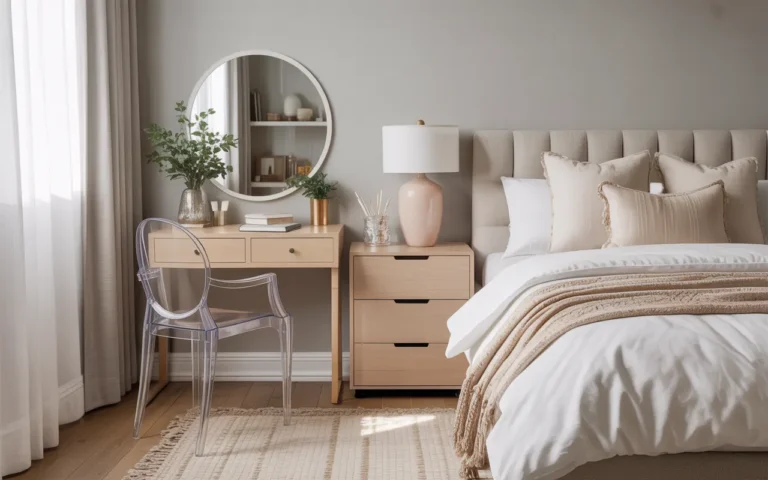
A comfy bedroom is a sleeping and resting space deliberately designed to support the body’s recovery, the mind’s decompression, and the specific quality of ease that makes a bedroom feel genuinely restorative rather than merely functional — through material warmth, lighting intelligence, acoustic softness, sensory calm, and a compositional restraint that communicates, from the first moment of entering, that this room exists for rest. This article gives you 16 comfy bedroom ideas across bedding selection, lighting systems, material layering, color, furniture arrangement, acoustic treatment, and wellness integration so every element of your bedroom actively contributes to deeper sleep and more genuine relaxation.
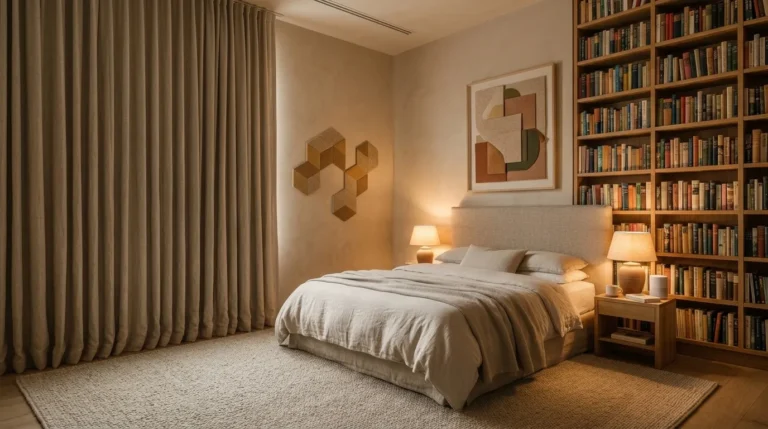
A bedroom that is truly comfortable is not the room with the most pillows or the most expensive mattress. It is the room where every decision — from the light temperature to the textile weight to the wall color to the distance between the bed and the window — has been made in service of the nervous system’s ability to downregulate from the day’s demands into genuine rest. The difference between a bedroom that feels comfortable and one that merely looks comfortable is the difference between design for appearance and design for experience. Here are 16 ideas worth saving — and sleeping in.
Why Bedroom Comfort Design Transforms Sleep and Wellbeing
Bedroom comfort design draws from the convergence of sleep science, environmental psychology, and the design traditions that have historically prioritized domestic rest — the Japanese sleeping room with its minimal visual complexity and floor-level futon; the Scandinavian hygge bedroom with its layered textiles, warm candlelight, and deliberate exclusion of productivity associations; and the contemporary wellness design movement that has applied research from hospitality design (where the quality of a guest’s sleep is a business outcome) to residential bedroom practice. What all these traditions and disciplines agree on is consistent: the physical environment of the sleeping room has measurable effects on sleep onset time, sleep quality, and subjective experience of morning restoration.
The material palette of a genuinely comfortable bedroom is specific and physiologically grounded. Natural linen and cotton are the correct bedding materials — both are breathable fibers that regulate temperature by allowing moisture wicking, unlike synthetic materials that trap body heat and disturb the core temperature drop that is necessary for deep sleep onset. Wool and boucle are the correct textile materials for throws and blankets — their natural fiber structure provides warmth without the static electricity and breathability problems of acrylic alternatives. Warm-toned paint (warm white, dusty sage, warm greige, or deep forest green) is the correct wall color — cool-toned grays and blues are visually stimulating in a neurological register that warm tones are not, with research showing that warm-colored environments produce faster sympathetic nervous system downregulation. And warm-spectrum lighting (2200–2700K, the color temperature of candlelight and early morning sun) is the correct light source for bedroom evening use — it contains minimal blue wavelength light that suppresses melatonin production.
The cultural urgency for genuinely designed bedrooms has never been stronger. The sleep deprivation epidemic — affecting an estimated 35% of adults in developed countries — has elevated bedroom design from an aesthetic preference to a genuine public health concern. The bedroom is simultaneously the room we spend the most time in (approximately one-third of a life) and the room that most people design last, with the least investment of attention and resources. The bedroom comfort ideas in this article represent a direct inversion of this priority — treating the sleeping room as the home’s most important space precisely because of the time spent there and the physiological importance of what happens during that time.
Small bedrooms are not barriers to comfort design — in many cases they are advantages, because the smaller volume of air in a small bedroom is easier to cool to the optimal sleeping temperature of 65–68°F, the shorter distances between surfaces mean textile layering has a proportionally greater visual and tactile impact, and the smaller wall area makes material investments like Roman clay or quality paint more accessible in cost.
Style at a Glance
| Element | Detail |
|---|---|
| Philosophy | Design in service of the nervous system’s recovery — every element chosen for what it does, not just how it looks |
| Key Materials | Natural linen, organic cotton, wool, beeswax, warm wood, ceramic, natural stone |
| Key Colors | Warm white, dusty sage, warm greige, terracotta blush, deep forest green, soft oat |
16 Comfy Bedroom Ideas for Ultimate Relaxation
1. Organic Linen Bedding Layered with Wool Blanket and Down Duvet
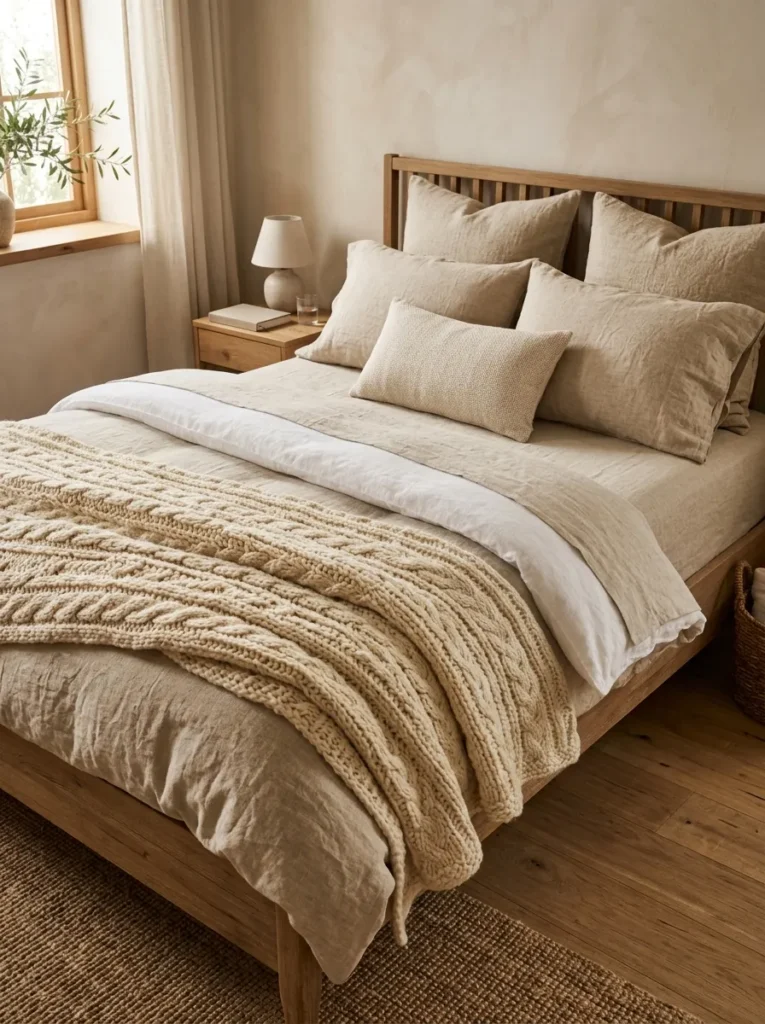
Vibe: The bed is deeply inviting — layered organic linen, a thick down duvet, and a chunky wool blanket at the foot create the specific visual and tactile promise of warmth and comfort that makes a bed look genuinely worth climbing into.
Why it works: The layered bedding system works both visually and physiologically. Visually, the combination of three distinct textile weights and textures (the flat weave of linen sheets, the smooth puff of the down duvet cover, and the dimensional loops of the chunky knit blanket) creates depth that a single duvet or comforter cannot achieve — the eye reads the layers as evidence of someone who has thought carefully about what sleeping in this bed will feel like. Physiologically, the layered system provides temperature adaptability — the linen sheet is breathable for warm sleepers, the down duvet adds warmth for cold periods, and the foot-of-bed blanket provides additional weight and warmth for the foot-cooling that research shows improves sleep onset. Natural fiber in all layers (linen for sheets, linen-covered down duvet, wool blanket) ensures moisture management through breathable fiber rather than synthetic trapping.
How to get it: Begin with 100% organic linen sheets in warm oat or dusty blush ($80–$200 for a set from Cultiver, Parachute, or similar). Add a white down duvet (at least 600-fill power for comfort, $100–$300) in a linen duvet cover that can be washed easily. Drape a hand-knit or hand-loomed wool throw at the foot of the bed ($40–$120 from craft markets or specialty retailers). Add Euro pillow shams (26×26 inch inserts, $30–$60 each) behind the sleeping pillows for depth and visual substance.
Quick Win: Adding a single chunky knit wool throw draped at the foot of an existing bed costs $30–$60 and immediately transforms the bed’s visual warmth — it is the single most impactful bedding accessory available per dollar spent.
Shop The Look
- Organic linen sheet set warm oat queen
- Down duvet insert 600 fill queen
- Linen duvet cover white organic cotton
- Chunky knit wool throw cream natural
- Euro pillow sham linen warm white set
Also view: 15 Cool Room Ideas to Upgrade Your Style
2. Circadian Rhythm Lighting System with Warm Evening Transition
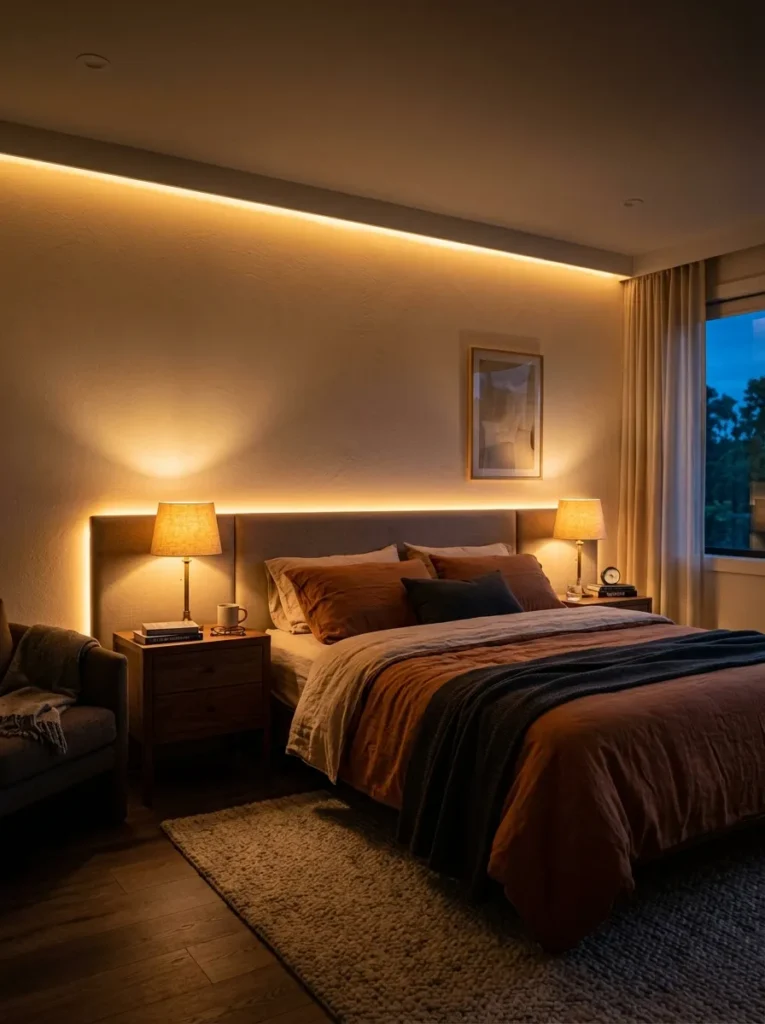
Vibe: The bedroom is sleep-ready — a warm 2200K lighting environment without any overhead fixture creates the specific light quality that the nervous system reads as evening transition, allowing melatonin production to begin naturally rather than being suppressed by the blue-white light of conventional overhead fixtures.
Why it works: The bedroom’s lighting environment is the most scientifically well-supported bedroom comfort variable available. Blue wavelength light (present in cool white LEDs and daylight at 5000–6500K) suppresses melatonin production through the melanopsin photoreceptors in the retina, delaying sleep onset by up to 90 minutes with evening exposure. Warm amber light at 2200K contains minimal blue wavelength and allows natural melatonin rise after approximately 8pm, which supports both sleep onset speed and deep sleep duration. The elimination of overhead ceiling fixtures in the evening is the architectural expression of this principle — ceiling fixtures are typically positioned to direct light downward at a steep angle that falls directly on the retina, maximizing blue-light impact; bedside lamps and perimeter strip lighting direct light horizontally and downward, minimizing direct retinal exposure.
How to get it: Replace bedroom bedside lamp bulbs with warm 2200K LED filament bulbs ($3–$8 each, available as E26 base in decorative filament style). Install a warm LED strip (2700K or 2200K) behind the headboard or along the ceiling perimeter cornice on a separate switch for use as the only light source in the hour before sleep. Install a smart dimmer on the bedside lamp circuit ($15–$30) so both bedside lamps dim simultaneously with a single switch. Program any smart bulbs (Philips Hue, LIFX) to automatically reduce color temperature from 3000K at 8pm to 2200K at 9pm for automated circadian support.
Shop The Look
- Warm filament LED bulb 2200K E26 set
- Bedside table lamp ceramic warm shade
- LED strip 2200K warm white adhesive back
- Smart dimmer switch bedside compatible
- LED strip driver power supply 12V
3. Blackout Curtain and Sheer Layering System
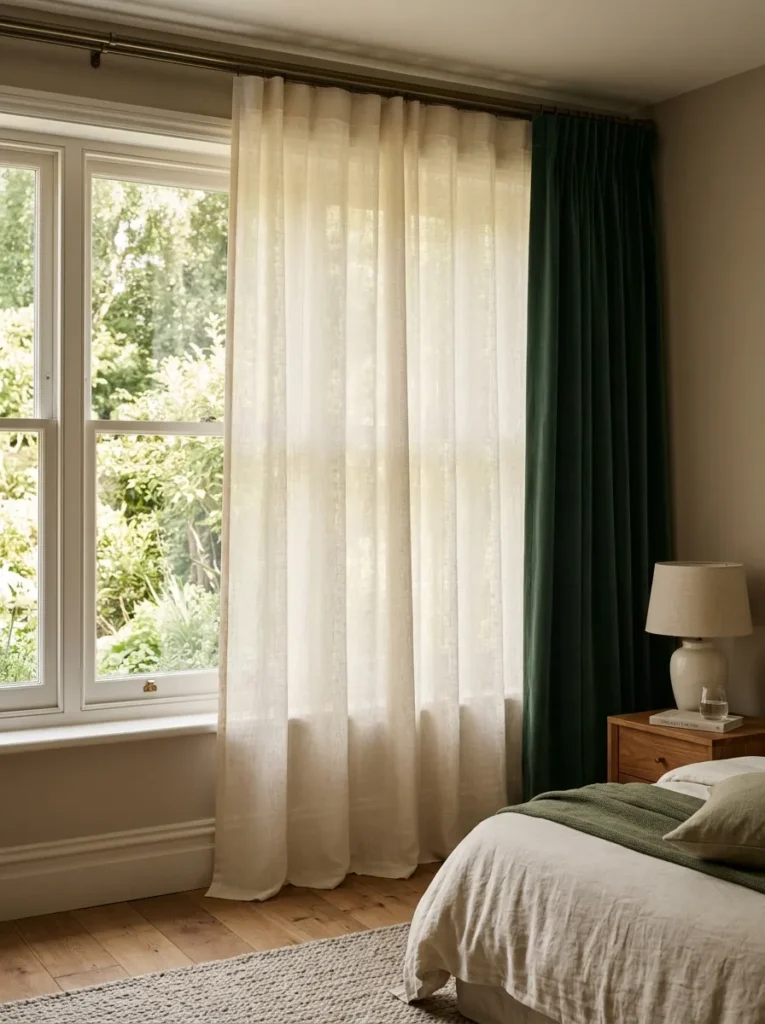
Vibe: The window is controllable — a two-layer curtain system that transitions between filtered natural daytime light and complete light exclusion for sleeping gives the bedroom complete control over its light environment throughout the 24-hour cycle.
Why it works: Complete darkness during sleep is the second most scientifically well-supported bedroom comfort variable after light temperature. Even low levels of ambient light during sleep (a streetlight through thin curtains, the glow of an illuminated clock) disrupt melatonin production, increase cortisol, and reduce REM sleep duration. True blackout (99%+ light exclusion) during sleep has been shown to improve sleep quality measurably — deeper sleep stages, longer sleep duration, and improved morning cognitive function. The two-layer system (sheer plus blackout) is superior to a single blackout panel because it allows the bedroom to function beautifully during the day (the sheer alone creates the soft, diffused natural light quality that makes bedrooms pleasant to be in during waking hours) while providing complete light exclusion for sleeping.
How to get it: Install two curtain rods at ceiling height — one for the sheer inner layer, one for the blackout outer layer — or use a double curtain rod that accommodates both layers on a single bracket. The sheer panel should be 1.5 times the window width in fabric for soft gathering. The blackout panel must extend at least 4 inches beyond the window frame on each side and reach from the rod to the floor, pooling 1–2 inches for complete edge coverage. True blackout curtains (not “room darkening” which allows edge light) should be tested by standing in the closed curtain bedroom during daylight — no light should be visible anywhere.
Shop The Look
- Blackout curtain panel deep green charcoal
- Sheer linen curtain panel cream inner
- Double curtain rod ceiling height brass
- Blackout curtain liner white clip in
- Curtain ring clip set brass or black
4. Platform Bed with Low-Profile Frame for Grounded Sleeping
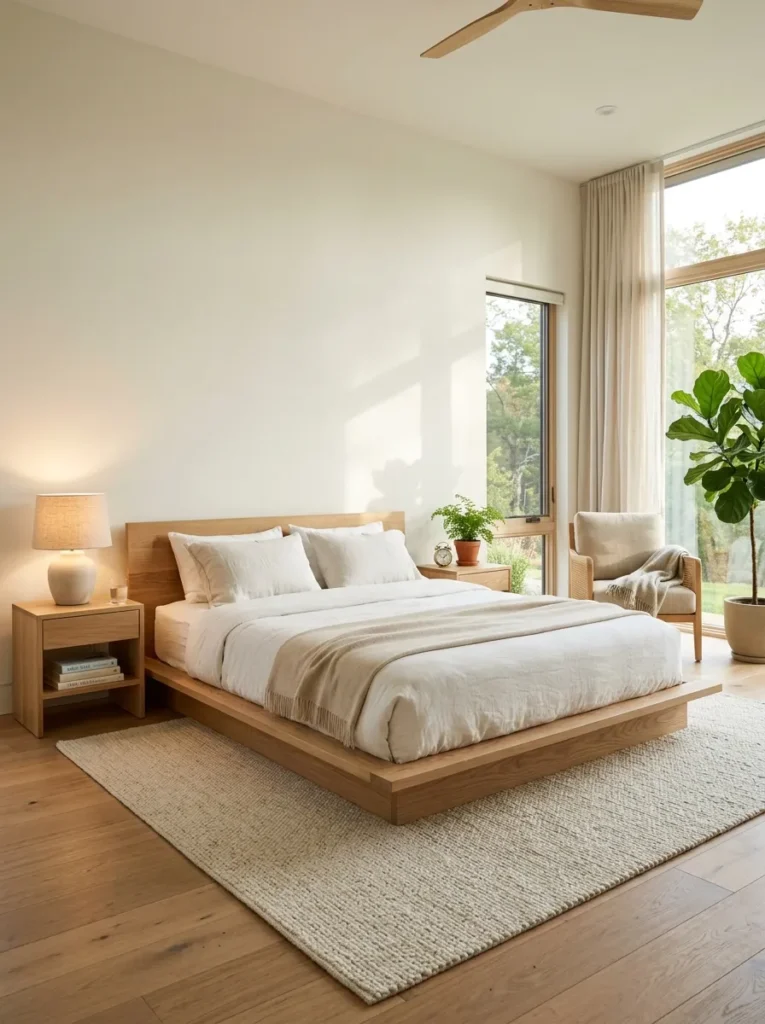
Vibe: The room is grounded — a low-profile platform bed that places the sleeping surface close to the floor creates the specific quality of groundedness and openness that makes a bedroom feel both more generous in its proportions and more intimate in its sleeping experience.
Why it works: Bed height has a measurable effect on room proportion — a low-profile bed (mattress top at 18–22 inches from the floor, compared to the standard 25–30 inches for box spring beds) leaves more visual space between the mattress surface and the ceiling, making the room feel more open and less crowded. The low-profile approach also has a psychological grounding quality that resonates with the Japanese futon and Korean ondol floor-sleeping traditions — both cultures that associate floor-proximity sleeping with deeper rest and physical connection to the earth. For contemporary bedrooms, the platform frame in solid wood (without a box spring) provides the structural support needed while achieving the low profile — total height from floor to mattress top of 14–18 inches is the optimal range.
How to get it: Select a platform bed frame specifically marketed as “low profile” — many furniture retailers now offer low-profile versions of their platform beds at 6–8 inches frame height (mattress adds 8–12 inches). Solid wood frames (white oak, walnut) are preferable to upholstered or metal platforms for the visual warmth they provide at floor level. Remove the footboard if the selected frame includes one — the absence of a footboard makes the room feel more open and the bed more accessible. Ensure the platform slats are spaced no more than 2.75 inches apart for adequate mattress support without a box spring.
Shop The Look
- Platform bed frame low profile white oak
- Walnut platform bed minimal frame queen
- Slatted platform bed insert queen
- Low profile platform bed no footboard
- Natural wood plank headboard simple
5. Acoustic Textile Wall Treatment for Sound Absorption
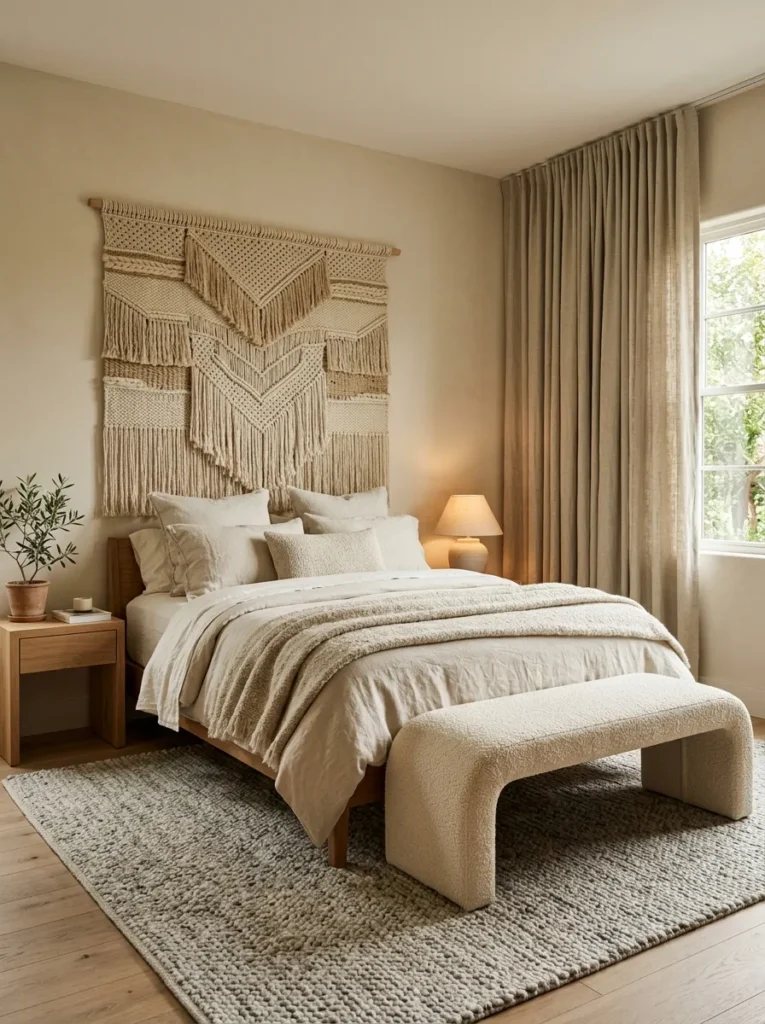
Vibe: The room is quiet — the combination of multiple soft surface treatments (woven wall panel, wool rug, heavy curtains, upholstered bench) creates a measurably quieter acoustic environment that is as important to sleep quality as the visual comfort of the room.
Why it works: Sound is the most underaddressed bedroom comfort variable in residential design — most bedrooms have hard floors (or low-pile synthetic carpet), minimal textile wall coverage, and lightweight curtains, creating reverberant environments where ambient sound (from the street, from adjacent rooms, from HVAC systems) has long decay times that maintain a background noise floor that disrupts the brain’s sleep consolidation processes. Natural soft surfaces — woven textiles, wool rugs, heavy linen curtains, upholstered furniture — absorb acoustic energy rather than reflecting it, shortening reverberation time and reducing the ambient sound floor that the sleeping brain must process. A bedroom with a full wool rug (covering 60%+ of the floor area), heavy curtains, and a large wall textile has approximately 50% less acoustic energy than the same room without these elements.
How to get it: Prioritize soft surface investment in this order: floor (a wool area rug covering most of the bedroom floor area — a 9×12 foot rug in a standard bedroom is the single highest acoustic impact investment), window (heavy linen or velvet curtains that reach from ceiling to floor), wall (a large woven textile, macramé panel, or tapestry above the bed), and furniture (an upholstered headboard, an upholstered bench, and a linen armchair if space permits). Each addition reduces reverberation and creates both acoustic and visual warmth.
Shop The Look
- Large wool area rug bedroom 9×12
- Hand woven wall textile panel large
- Heavy linen curtain panel oat floor length
- Boucle upholstered bench foot of bed
- Macramé wall hanging large natural cotton
6. Dedicated Reading Nook with Warm Lamp and Armchair
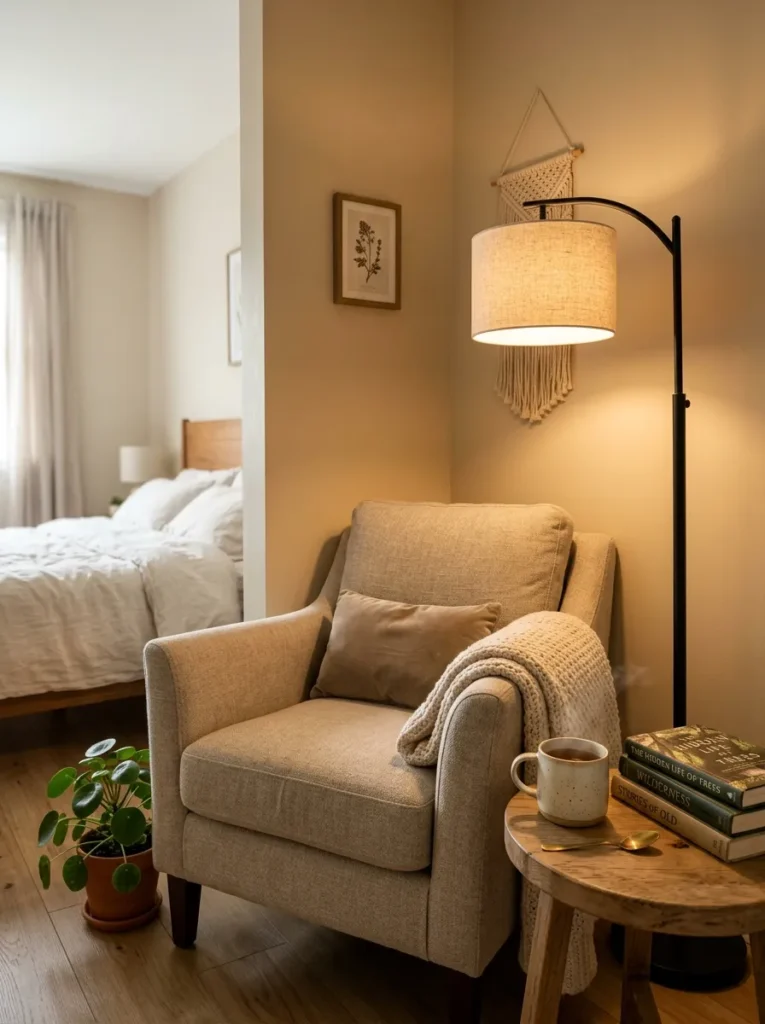
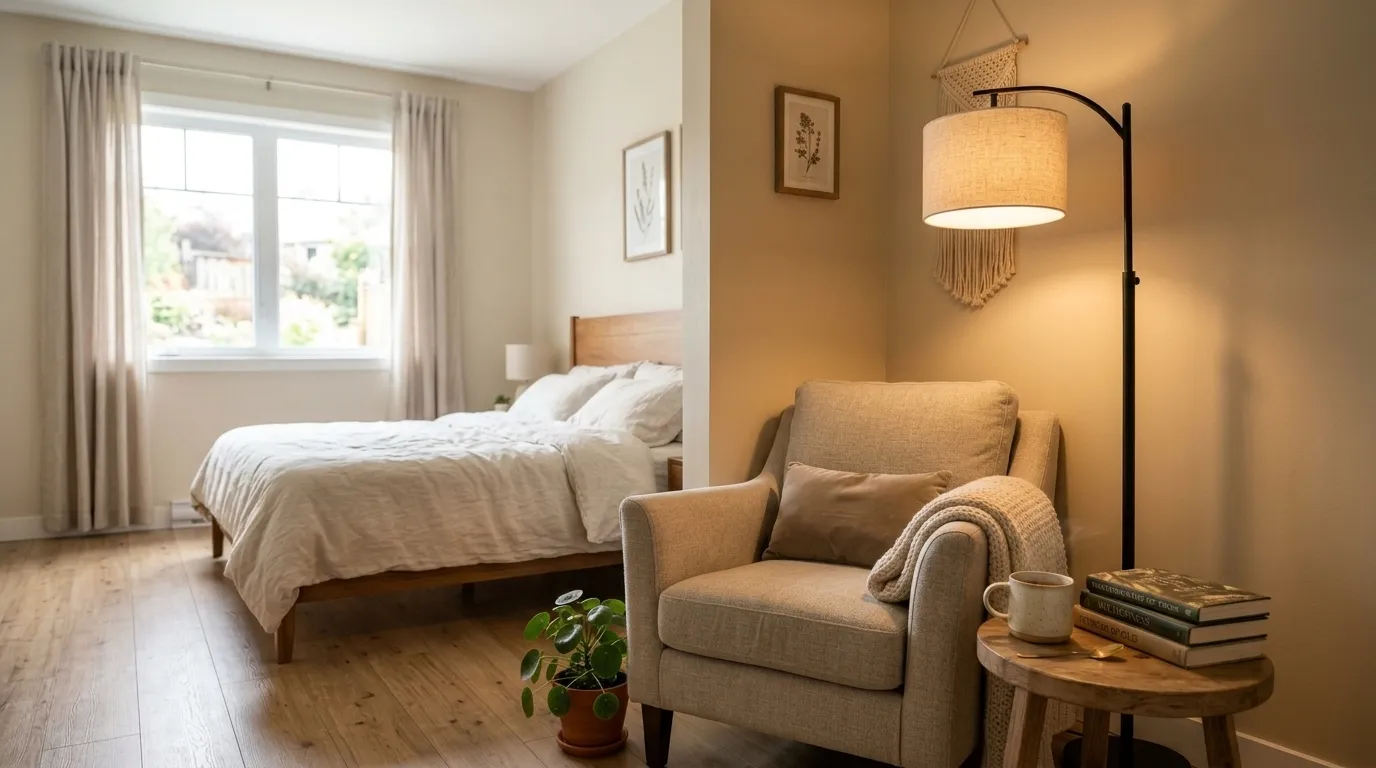
Vibe: The corner is intimate — a dedicated reading nook within the bedroom creates a transitional space between wakefulness and sleep where the body can begin its decompression process without the full commitment of the bed, using the specific calm of reading to gradually lower cognitive arousal.
Why it works: Sleep research consistently shows that pre-sleep activities have a significant effect on sleep onset time and sleep quality. Reading physical books (not screens) in the 30–60 minutes before attempting sleep reduces cognitive arousal, lowers heart rate, and reduces the mental activity that delays sleep onset — the fictional or non-urgent content of most reading material occupies the mind gently without the problem-solving, information-processing, or social-comparison activities that screens produce. A dedicated reading chair in the bedroom that is not the bed creates the spatial separation that reinforces reading as a pre-sleep activity rather than a bed activity — sleep psychology research recommends that the bed be associated only with sleep and sex, with all other activities (including reading, working, and watching television) performed elsewhere to strengthen the bed’s role as a sleep cue.
How to get it: The minimum bedroom reading corner: one deep armchair (24-inch minimum seat depth, with arms at the correct height for reading) in a warm linen or boucle upholstery, one floor lamp positioned at shoulder height to illuminate the reading surface without reaching to a side table for light, and one small side table for a book, a mug, and glasses. The chair should face away from the bed if possible — this prevents the visual pull of the bed from shortening the reading session and reinforces the functional separation between the two zones.
Shop The Look
- Deep linen armchair bedroom reading
- Floor lamp adjustable warm shade reading
- Small round side table compact bedroom
- Linen throw blanket armchair drape
- Small plant floor level ceramic pot
7. Natural Scent Environment with Essential Oils and Beeswax Candles

Vibe: The corner is calming — a natural scent environment built from lavender essential oil, beeswax candlelight, and dried botanical fragrance creates a sensory bedroom layer that works directly on the limbic system’s stress-response pathways, providing evidence-based sleep support through olfactory stimulation.
Why it works: The olfactory system has a direct neural pathway to the amygdala and hippocampus — the brain’s emotional processing and memory centers — making scent the fastest-acting environmental mood modifier available. Lavender essential oil (linalool and linalyl acetate as the primary bioactive compounds) has the strongest evidence base of any aromatherapy intervention for sleep support, with multiple randomized controlled trials showing reduced anxiety, lower heart rate, and improved sleep quality scores when diffused in the 30–60 minutes before sleep. Beeswax candles are the correct candle choice for a bedroom scent environment because they produce a natural honey fragrance rather than the synthetic fragrance compounds of most commercially scented candles, and they emit negative ions when burning that are associated with reduced airborne dust and allergen load in the immediate environment.
How to get it: Use an ultrasonic ceramic diffuser (rather than a heat diffuser, which degrades aromatic compounds) with 100% pure essential oil — not fragrance oil, which contains synthetic compounds with no documented aromatherapy effect. A combination of 3 drops lavender, 2 drops cedarwood, 1 drop bergamot in the diffuser 30 minutes before sleep provides a broad-spectrum calming effect. Use beeswax candles from small apiary producers — genuine 100% beeswax burns more slowly, cleaner, and more fragrantly than paraffin or beeswax-blend alternatives. Never sleep with a burning candle; extinguish before sleep and use only the diffuser overnight.
Shop The Look
- Ceramic ultrasonic diffuser bedroom mist
- Lavender essential oil 100 percent pure
- Beeswax pillar candle natural unscented
- Ceramic candle holder simple minimal
- Dried lavender bundle bedroom decor
8. Weighted Blanket Integration for Deep Pressure Comfort
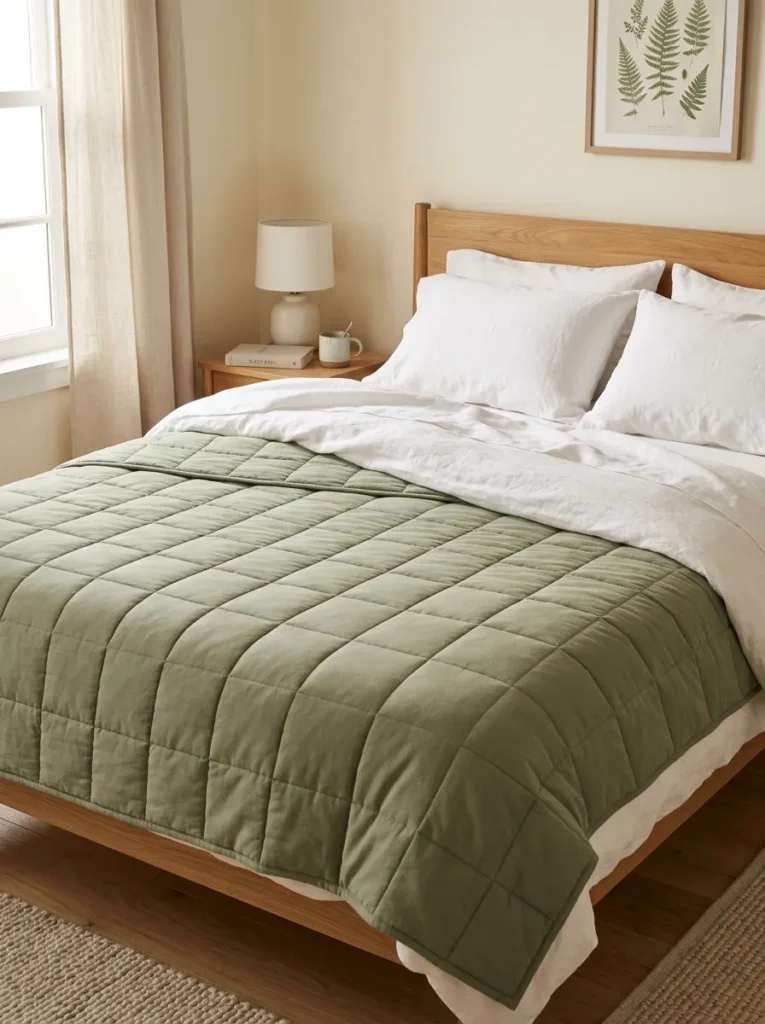
Vibe: The bed is deeply restful — a weighted blanket integrated into the bedding system provides the deep pressure stimulation that occupational therapists have long used for anxiety and sleep disorders, now made available as a bedroom design element that is as aesthetically considered as it is functionally effective.
Why it works: Weighted blankets work through a mechanism called deep pressure stimulation — the evenly distributed pressure of a weighted blanket (correctly sized at approximately 10% of body weight) activates the parasympathetic nervous system, reducing cortisol and stimulating the release of serotonin and melatonin. Multiple clinical trials have demonstrated that weighted blankets reduce anxiety, improve sleep onset time, increase sleep duration, and improve subjective sleep quality in both clinical populations (anxiety disorders, autism spectrum conditions, insomnia) and in the general adult population. The key design integration principle is that the weighted blanket covers the lower two-thirds of the bed rather than the full surface — this allows the upper body to remain free, which prevents the claustrophobic feeling that some weighted blanket users experience when fully covered, while providing deep pressure at the legs, hips, and lower abdomen where its physiological effects are most pronounced.
How to get it: Choose a weighted blanket at 10% of body weight — approximately 15 pounds for a 150-pound person. Cotton fill (glass or steel bead weighted) is the correct material for bedroom use — breathable cotton prevents the overheating that some heavier weighted blanket users experience with polyester fill. The blanket should be sized to cover the bed’s width comfortably (a queen-size weighted blanket for a queen bed, rather than a throw-size weighted blanket centered on the bed) for even distribution of the pressure. Wash in a front-loading commercial washer or large-capacity home washer — most household top-loading washers cannot safely cycle a weighted blanket.
Shop The Look
- Weighted blanket 15 lb cotton queen
- Cotton weighted blanket warm sage
- Duvet cover linen white queen
- Weighted blanket inner cover washable
- Glass bead weighted blanket premium
9. Warm Wood Bedside Table with Thoughtful Object Curation
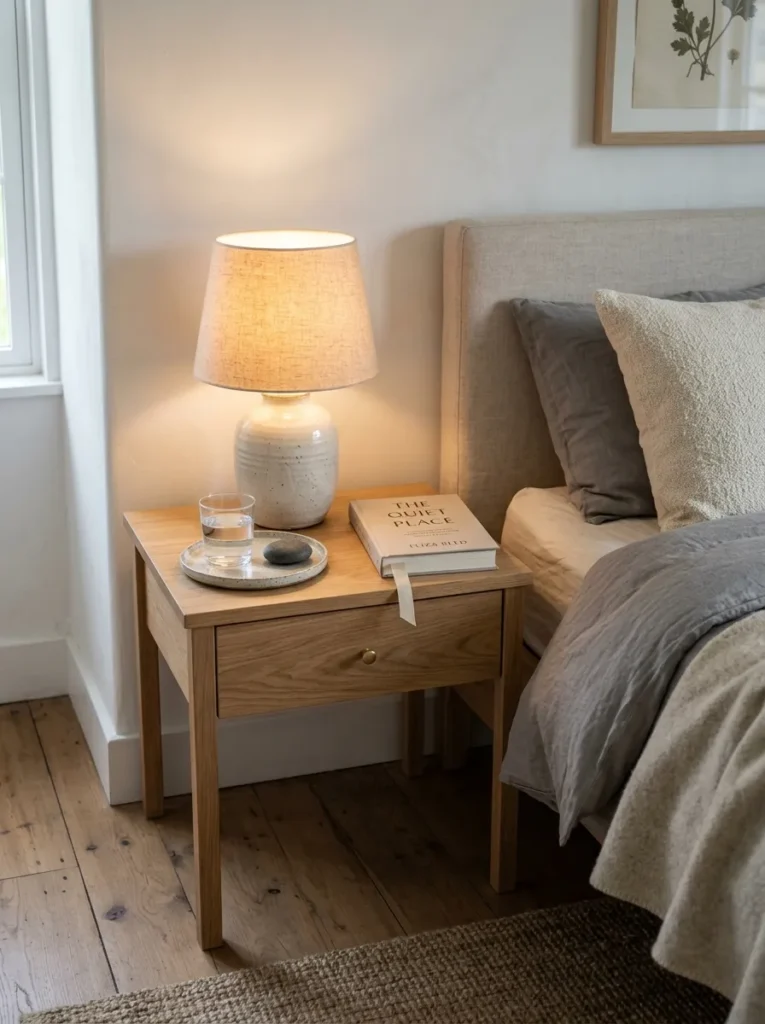
Vibe: The bedside is considered — a nightstand styled with exactly three objects (lamp, water, book) creates the specific calm of a surface that has been edited to its functional essentials, where nothing competes for attention and the mind can rest without processing visual complexity from the last viewing position before sleep.
Why it works: The last visual experience before sleep significantly affects sleep onset and sleep quality — visual complexity (cluttered surfaces, multiple screens, many competing objects) maintains a state of cognitive processing that delays sleep onset. The three-object rule for bedside tables (one light source, one hydration vessel, one reading object) is the practical application of sleep psychology’s recommendation to make the bedroom environment as visually simple as possible in the sleep-adjacent zone. A smooth river stone on the bedside tray is not merely decorative — it is a tactile mindfulness object that provides a non-screen, non-stimulating sensory experience available in the final moments before reaching for the lamp switch. A glass of water rather than a water bottle communicates the same message in material form: the bedside is a place of calm, not a place of productivity or activity.
How to get it: Start by removing everything from the current bedside table and returning only three categories of object: the light source (lamp), the hydration vessel (glass of water or ceramic cup), and the reading object (physical book or journal). Everything else — phone, remote control, supplements, chargers — either finds a designated drawer location or is relocated. A small ceramic tray ($15–$40) groups the smaller objects (water glass, stone, any small daily-use items) into a single visual unit that reads as one object rather than many separate pieces.
Shop The Look
- White oak nightstand single drawer minimal
- Ceramic table lamp warm linen shade
- Small ceramic tray bedside display
- Smooth river stone single grey
- Physical book journal bedside reading
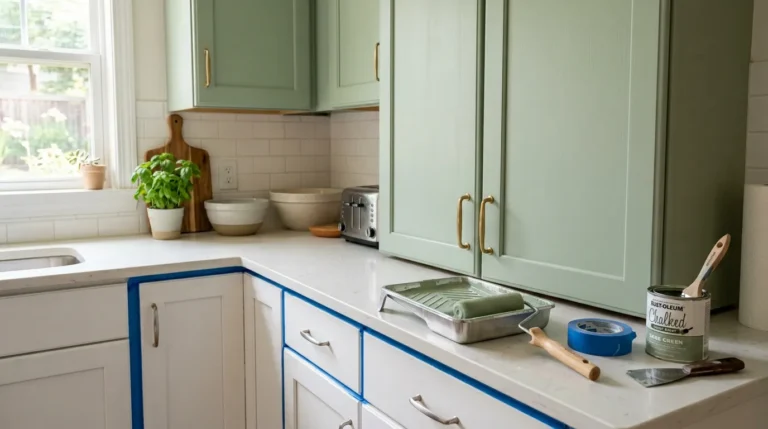
10. Warm Greige or Sage Wall Color for Visual Calm
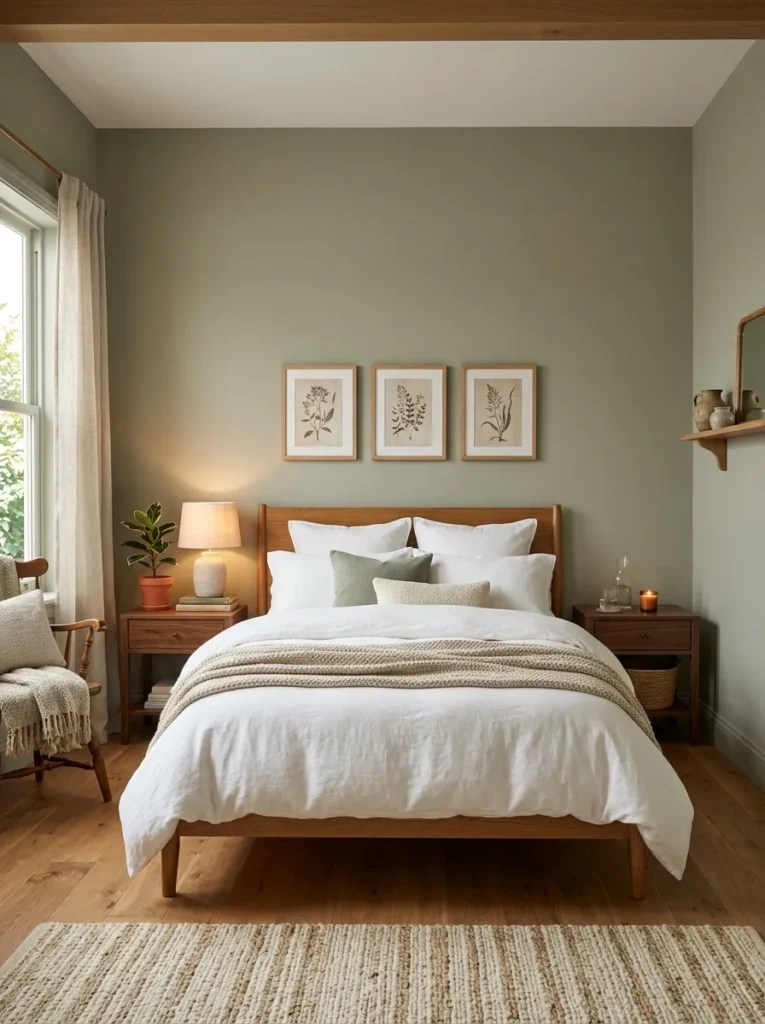
Vibe: The room is calm — a warm greige or dusty sage bedroom creates the most universally soothing wall color environment available, where the warm undertone of both tones prevents the visual stimulation of cool grays and blues while the muted saturation prevents the energizing effect of stronger warm colors.
Why it works: Bedroom wall color research in environmental psychology shows a consistent finding: warm-undertoned, medium-low saturation colors (warm greige, dusty sage, terracotta blush, soft warm white) produce faster physiological relaxation responses than cool-toned colors (cool grey, blue, lavender) in bedroom environments. This is counterintuitive to many people who associate blue and grey with calm — but the psychological calmness of blue is appropriate for high-arousal environments (hospitals, gyms) where it reduces overstimulation, while bedroom calm is better supported by warm tones that actively signal comfort and safety rather than merely reducing arousal. Warm greige (LRV 40–60, yellow-red undertone) and dusty sage (LRV 40–55, grey-green with warm yellow base) are the two tones that most reliably create bedroom calm across varied natural light conditions.
How to get it: Test the chosen wall color in the bedroom’s specific natural light across a full day before committing — both greige and sage tones shift significantly between morning cool light, afternoon warm light, and artificial warm light in the evening. Greige specifically can read as pink in certain light conditions; sage can read as grey-green or warm khaki depending on light direction. Paint a 12×18 inch test patch and observe at all times of day. Apply in flat or matte finish — any sheen level on bedroom walls creates light reflections that can be stimulating rather than calming.
Shop The Look
- Warm greige interior paint sample matte
- Dusty sage interior paint bedroom matte
- Warm white trim paint complement
- Bedroom paint roller set application
- Paint color sample card comparison set
11. Technology-Free Zone Commitment with Phone Charging Station Outside
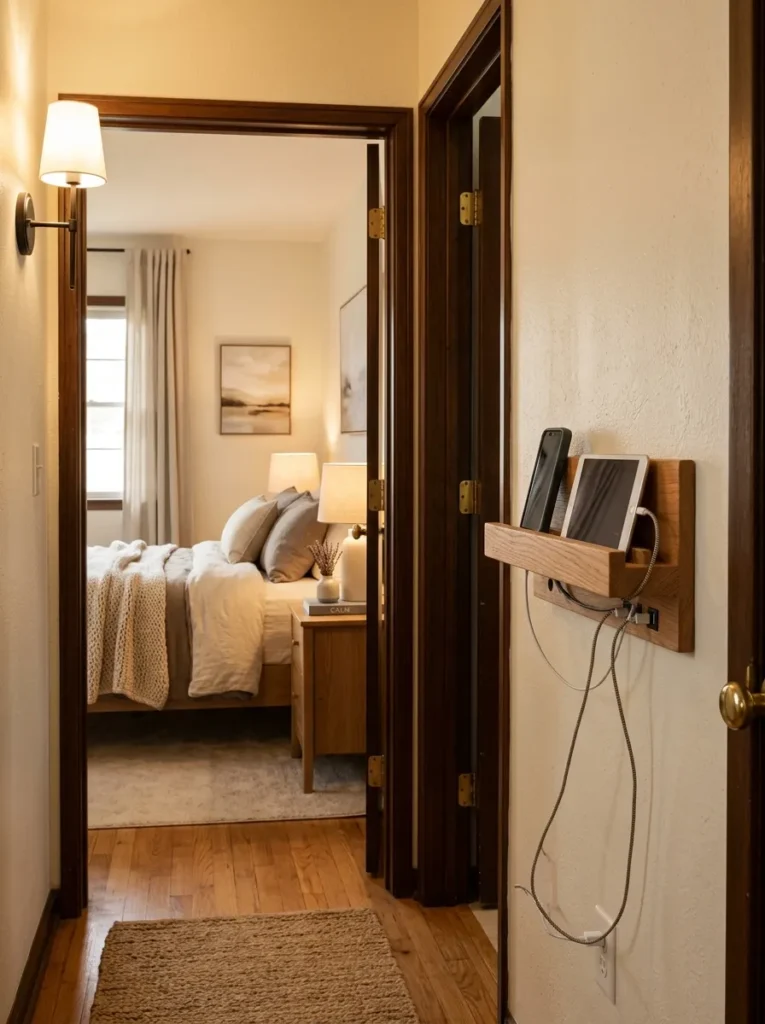
Vibe: The bedroom is peaceful — a phone charging station outside the bedroom door makes the technology-free bedroom commitment physical and visible, creating a clearly maintained boundary between the bedroom’s restorative function and the alertness-maintaining associations of digital devices.
Why it works: The presence of a smartphone in the bedroom — even when the phone is face-down, silenced, and not actively used — has been shown to reduce sleep quality through multiple mechanisms: the anticipation of notifications maintains a state of partial alertness that prevents the full autonomic downregulation required for deep sleep; the blue light emitted by the standby screen (even at low brightness) suppresses melatonin; and the alarm-clock function (the primary reason most people cite for keeping phones in the bedroom) can be replaced by a simple dedicated alarm clock at negligible cost. Research from the University of Texas found that even the presence of a phone on a desk (face-down, turned off) reduced available cognitive capacity in the adjacent person — the cognitive reach of a smartphone extends beyond its screen when it is physically present in the awareness field.
How to get it: Install a small wall-mounted shelf in the hallway or outside the bedroom door with a multi-port USB charging station ($20–$35) mounted to the shelf or wall. Establish the habit of placing phones in the charging station at the bedroom threshold on the way to bed. Replace the phone alarm function with a dedicated alarm clock ($15–$40 for a quality sunrise alarm or simple analog clock). The physical charging station is as important as the intention — the commitment needs a specific designated place to be consistently maintained.
Shop The Look
- Multi port USB charging station wall mount
- Small wood wall shelf charging station
- Sunrise alarm clock bedroom dedicated
- Analog alarm clock simple bedroom
- Charging station organization cable tidy
12. Bedroom Fireplace or Flameless Alternative for Warmth
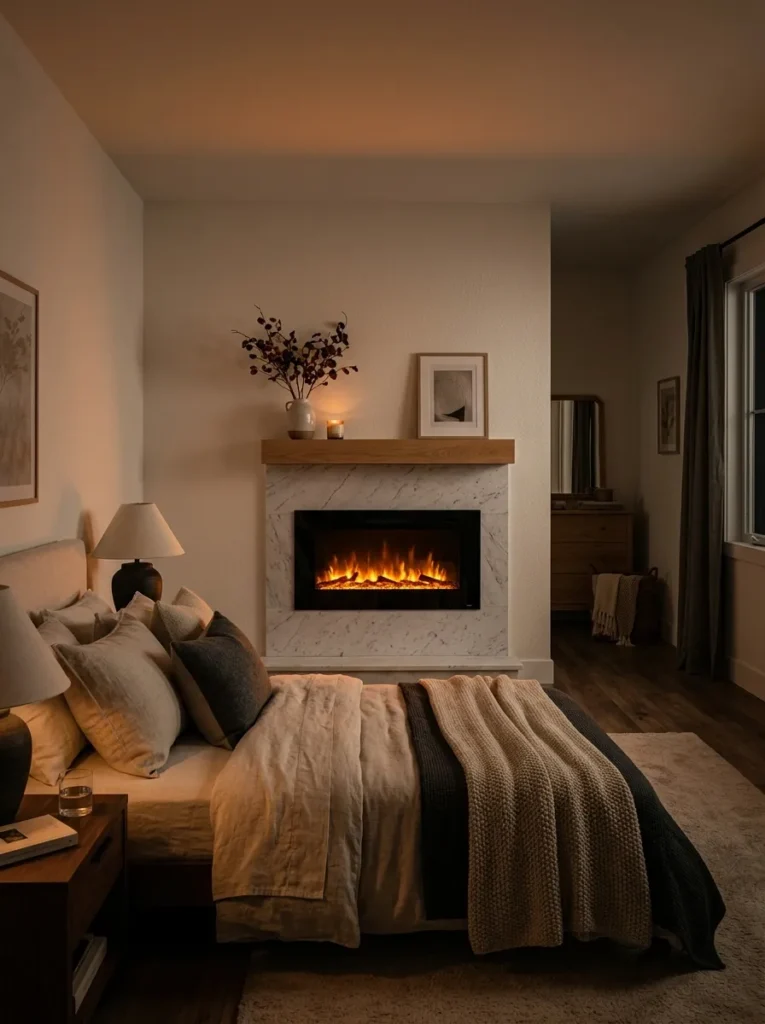
Vibe: The room is deeply cozy — a bedroom with a flickering fireplace as the primary evening light source creates the most physiologically and psychologically complete relaxation environment available, where the moving warm light at the correct color temperature mimics the campfire and hearth environments that human nervous systems evolved around.
Why it works: Firelight is the ambient light environment in which human beings evolved — the warm amber tones (approximately 1800K color temperature), the slight flicker pattern, and the specific frequencies of visible and infrared light produced by combustion are all stimuli that the human nervous system has processed for hundreds of thousands of years as a signal of safety, warmth, and the appropriate transition from activity to rest. Research from the University of Alabama found that firelight reliably reduces blood pressure and promotes social connection and relaxation, with the flickering light pattern specifically identified as the mechanism distinct from simply warm-colored static light. Electric fireplaces with realistic flame effects provide approximately 70% of this benefit at no fire risk — the visual stimulus of moving warm light at the correct color temperature produces measurable physiological relaxation responses even when the heat element is disabled.
How to get it: Wall-mounted electric fireplaces with realistic 3D flame effects (Dimplex, ClassicFlame, MagikFlame) are available at $300–$800 for bedroom-appropriate 24–36-inch widths. Use the fireplace in flame-only mode (no heat) during warm months and flame-plus-heat mode during cold months. Position on the bedroom wall that is directly visible from the bed — the goal is for the flickering flame to be the last visual stimulus before sleep rather than overhead light or a screen. Add a simple marble or stone tile surround ($50–$150 in materials) for the full architectural effect.
Shop The Look
- Electric fireplace wall mount realistic flame
- Marble tile hearth surround simple
- Electric fireplace insert 3D flame effect
- Fireplace mantel shelf simple white
- Ambient flame effect lamp alternative
13. Bed Canopy or Ceiling-Mounted Drape for Enclosure
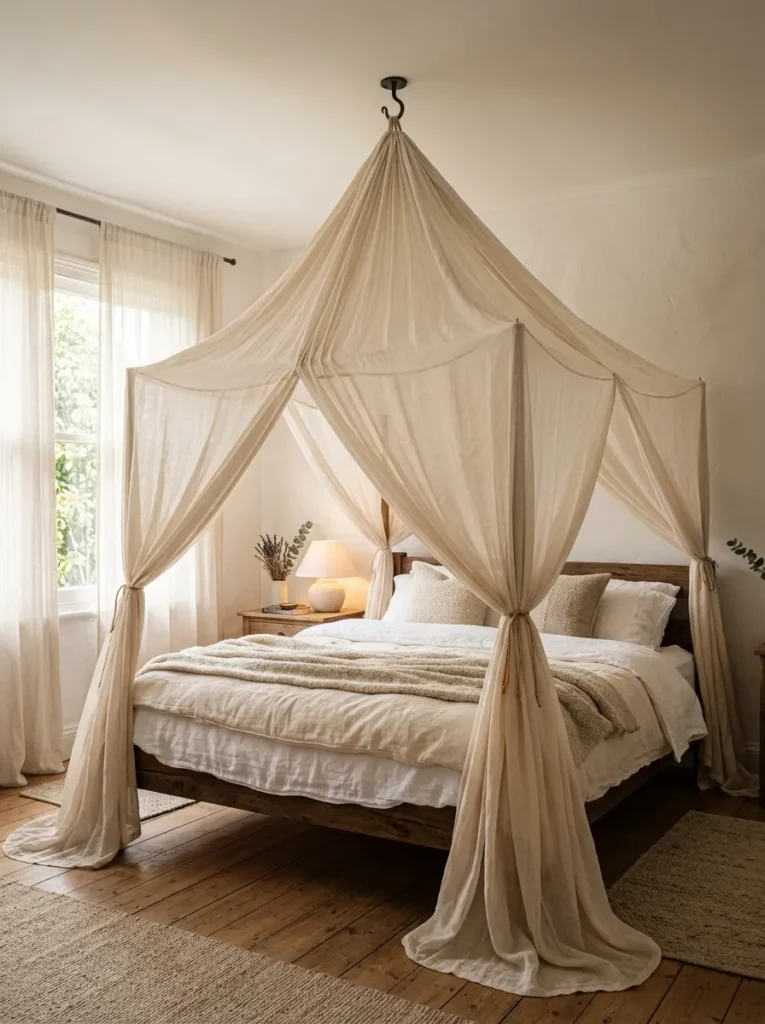
Vibe: The bed is enclosed — a ceiling-mounted linen canopy creates the specific sense of being in a contained, protected sleeping space within the larger room, which environmental psychology research identifies as a primary comfort preference in sleeping environments — the preference for “refuge” conditions (enclosed, protected, oriented toward the room’s primary access point) that our evolutionary history as sleeping creatures has produced.
Why it works: The preference for sleeping in an enclosed space is one of the most consistently documented findings in environmental psychology — research by Roger Ulrich and colleagues at the Karolinska Institute identified “refuge” quality (the sense of being in a sheltered, protected position with visibility of the surrounding environment) as a primary contributor to subjective comfort ratings in sleeping and resting spaces. A bed canopy creates this refuge quality by defining the sleeping zone as a semi-enclosed space within the larger bedroom, providing a visual and psychological boundary between the sleeping space and the surrounding room. The sheer linen material is specifically effective because it provides this enclosure quality while maintaining the visibility that refuge theory identifies as important — the canopy is transparent enough to see through, providing the environmental awareness that a fully opaque enclosure would deny.
How to get it: Install a ceiling hook or small canopy frame above the bed’s center point (rated for at least 15 pounds — heavier than it sounds when accounting for fabric weight and movement). Drape four sheer linen panels ($20–$40 per panel) from the central hook to the four corners of the bed frame, gathering each panel at the corner and securing with a simple ribbon tie. The panels should be 1.5 times the distance from the ceiling hook to the corner post in length to allow for the drape and the floor pool. A single canopy ring (10–14 inches diameter) at the ceiling hook creates a cleaner gathering point than a simple hook alone.
Shop The Look
- Canopy bed drape ceiling hook ring
- Sheer linen panel canopy cream white
- Ceiling hook heavy duty canopy mount
- Canopy ring 12 inch circular mount
- Sheer fabric canopy cut panel set
14. Morning Light Optimization with East-Facing Positioning
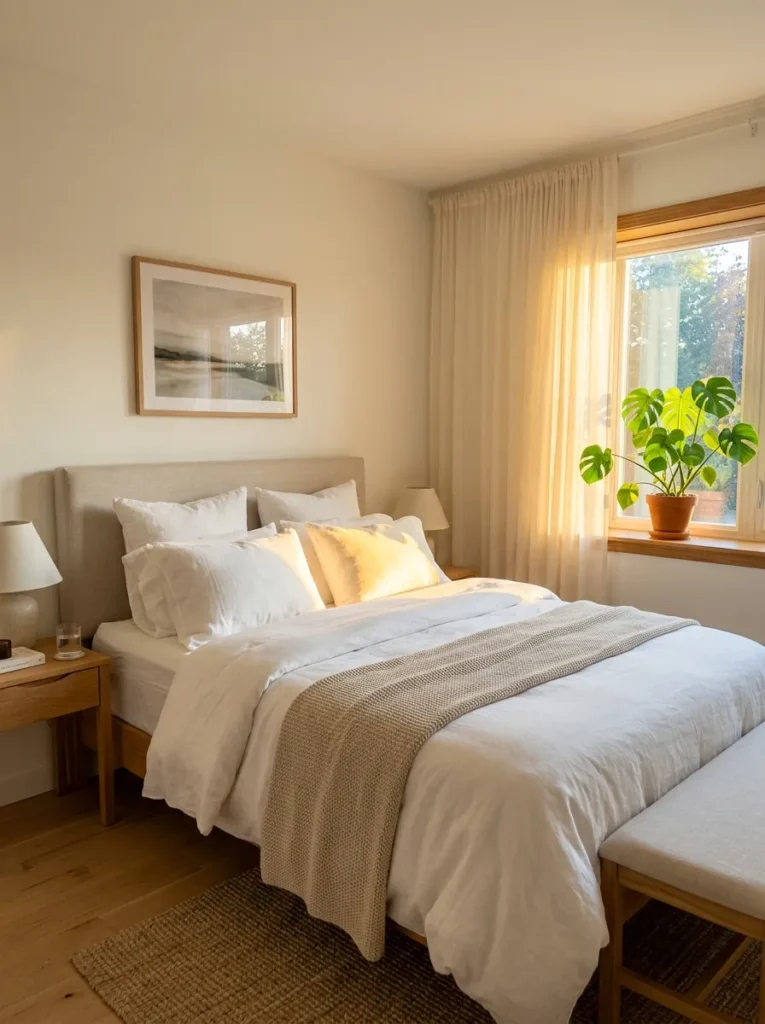
Vibe: The morning is energizing — a bedroom positioned so that the bed receives direct morning light through the east-facing window provides the single most powerful natural circadian reset available: bright morning light in the 6–10am window that suppresses residual melatonin, raises serotonin, and sets the body’s internal clock for a 14–16-hour wake cycle that supports both daytime energy and nighttime sleep quality.
Why it works: Morning light exposure is the primary circadian zeitgeber (time-giver) available to the human body — the bright, blue-rich light of morning sun (even on cloudy days) suppresses melatonin production, triggers cortisol release in its natural morning peak, and sets the suprachiasmatic nucleus (the brain’s master clock) to a specific 24-hour cycle that determines sleep onset time, sleep depth, and morning wakefulness quality. The bedroom’s bed position relative to its windows is the architectural variable that determines whether morning light reaches the occupant at the right time (on the pillow immediately upon natural waking, or shortly after alarm waking) and in the right amount (direct or near-direct, not filtered through heavy curtains). If east-facing windows are not available, a full-spectrum morning light therapy lamp positioned at the bedside ($30–$80) and programmed to activate at wake time provides approximately 10,000 lux of the same blue-rich spectrum.
How to get it: Position the headboard on the wall that places the sleeping position closest to the east-facing window. Use sheer curtains (not blackout) on the east window — the sheer filters the morning light to a comfortable level while allowing sufficient bright-light exposure for circadian benefit. Leave a narrow gap in any outer blackout curtain to allow a shaft of morning light to enter the room at wake time as a natural alarm. Place a trailing plant on the east windowsill — it benefits from the morning light and adds a biophilic quality to the morning light experience.
Shop The Look
- Full spectrum morning light therapy lamp
- Sheer linen panel east window morning
- Sunrise alarm clock bedroom natural wake
- Trailing pothos plant east window light
- Linen curtain sheer morning light filter
15. Layered Rug Approach for Floor Warmth and Acoustic Softness
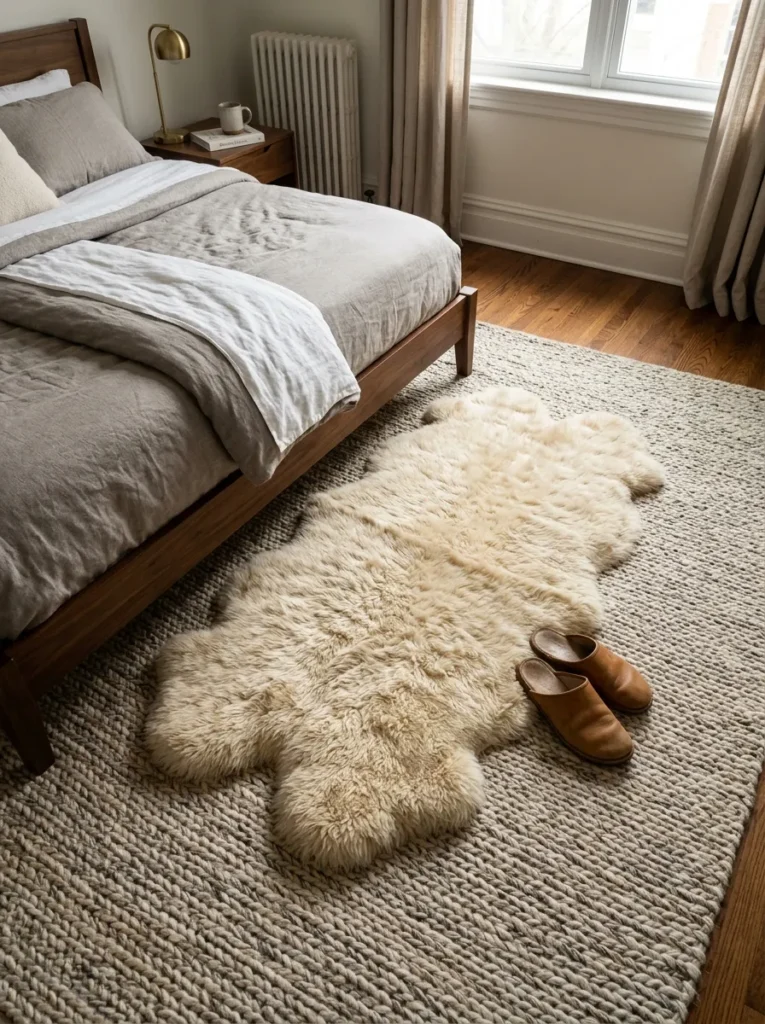
Vibe: The floor is warm — a layered rug approach that positions a sheepskin or particularly soft smaller rug precisely at the bed’s primary exit point creates the morning experience of stepping onto something warm and soft rather than onto a cold hard floor — a daily comfort detail with an effect on morning mood that is disproportionate to its simplicity.
Why it works: The tactile experience of the first floor contact in the morning — the temperature and texture of the surface beneath bare feet immediately upon leaving the bed — is one of the most consistently and immediately mood-influencing sensory experiences of the day. Cold, hard floor surfaces activate thermal receptors in the feet that trigger a mild stress response (increased cortisol, elevated heart rate) that can persist for several minutes and affect the morning’s emotional tone. A warm, soft floor surface at the bed’s exit point provides the opposite physiological response — it maintains the parasympathetic state of rest slightly longer into the morning, which is associated with lower cortisol, better emotional regulation, and a more positive subjective assessment of the morning’s start. The sheepskin specifically (natural wool) maintains a surface temperature approximately 15–20°F above the ambient room temperature, providing genuine thermal warmth rather than mere softness.
How to get it: Layer a large natural wool or jute rug (9×12 feet for a standard bedroom, $100–$400) as the base layer covering the full bedroom floor area. Add a genuine sheepskin rug ($60–$150 for a single large sheepskin) or a smaller (3×5 foot) soft wool or vintage rug positioned precisely at the primary bed exit point — the side where the first foot contacts the floor every morning. The position of this smaller rug (perfectly aligned with the bed’s edge rather than centered in the room or placed decoratively) communicates that this is a designed comfort element rather than a decoration.
Shop The Look
- Natural wool area rug bedroom 9×12
- Genuine sheepskin rug ivory natural
- Vintage style wool rug 3×5 overlay
- Rug pad felt non slip bedroom
- Wool rug washable bedroom natural
16. Minimal Furniture Layout with Generous Negative Space
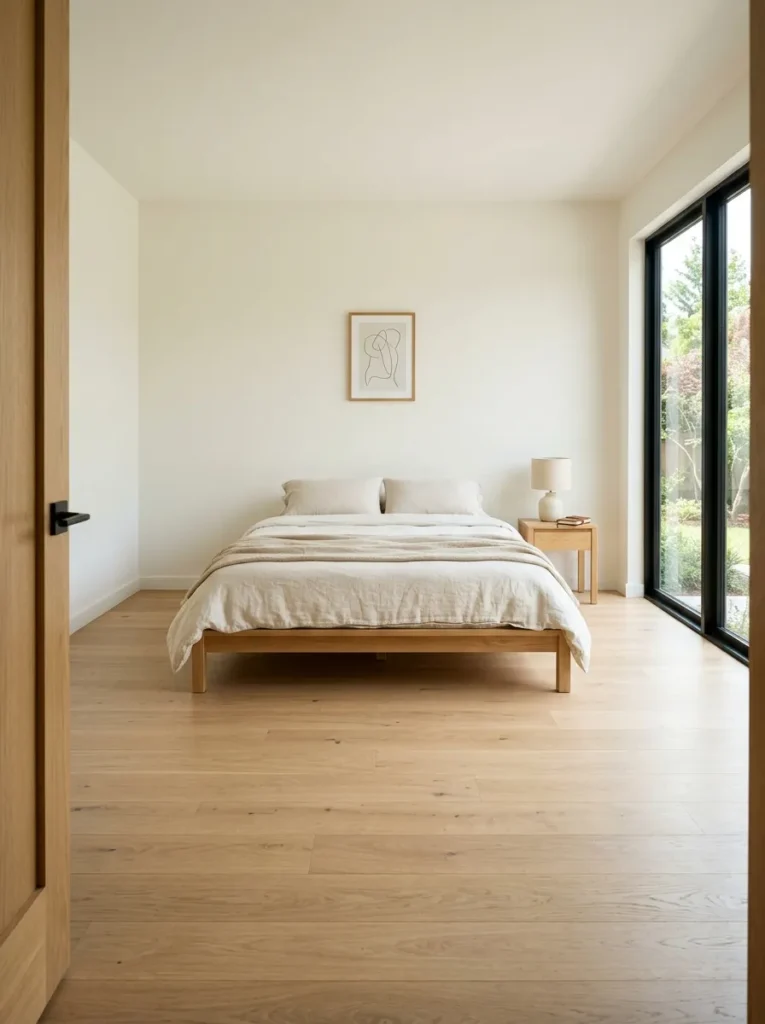
Vibe: The room is open — a bedroom with deliberate generous negative space around the bed and clear floors in all corners creates the specific quality of a room that is easy to breathe in, easy to be in, and easy to rest in — where the mind does not process spatial complexity upon entering but can immediately begin to release the day’s accumulated cognitive load.
Why it works: The amount of furniture and the quantity of objects in a bedroom has a measurable effect on the subjective experience of rest — research in environmental psychology consistently shows that people rate rooms with lower furniture density and greater negative space as more relaxing, more restorative, and more comfortable than the same rooms with higher furniture density, even when the furniture quality is identical. The bedroom specifically benefits from negative space because the sleeping body needs unobstructed circulation pathways (for nocturnal bathroom visits, for morning stretching, for the basic physical freedom of being in the room) and the resting mind benefits from an environment that does not require continuous spatial navigation and visual processing. A minimum of 24 inches of clear space on both sides of the bed is the practical standard — this allows comfortable access, changing of bedding, and a physical sense of generous proportion around the sleeping position.
How to get it: Remove any furniture that does not serve the bedroom’s primary function — sleeping and dressing. A dresser that could be relocated to a hallway closet or a built-in wardrobe opens significant floor area. A second nightstand that provides minimal additional function (duplicating the accessible nightstand’s phone-charging and water-glass functions for a solo sleeper) can be replaced by a small wall-mounted shelf. Clear all floor surfaces of any stored objects (boxes under the bed, items on the floor beside the dresser) — a bedroom with clear visible floor in all four corners reads as 30% larger than the same room with objects on the floor.
Shop The Look
- Platform bed minimal low profile queen
- Single nightstand minimal small drawer
- Wall mounted shelf nightstand alternative
- Bedroom storage system wardrobe built in
- Clear floor organizer under bed storage
How to Start Your Comfortable Bedroom Transformation
The single most important first move in a bedroom comfort transformation is addressing the light temperature before any other change. Every other bedroom comfort element — the bedding, the wall color, the furniture arrangement — is experienced in the context of the room’s light quality, and warm light makes all of them look and feel better while cool overhead light undermines all of them regardless of their individual quality. Replace every bedroom light bulb with a warm 2700K or 2200K LED version this week, add one floor or table lamp for low-level ambient evening light, and assess the room again under the new lighting conditions. Most people are surprised to discover that problems they attributed to the bedding, the paint color, or the furniture were actually problems of light temperature — cold light was making everything look cold.
The most common bedroom comfort mistake is purchasing more things rather than editing existing things. The bedroom that feels uncomfortably furnished — too busy, too visually stimulating, too cognitively demanding to relax in — almost never needs more objects. It needs fewer. The most consistently effective bedroom upgrade is a systematic removal: take everything off the bedside tables and return only the lamp, water, and book; remove all objects from the floor (leaving only rugs); and take all screens out of the room. Assess the room after this subtraction and identify what is genuinely missing — in almost every case, the answer is one or two specific additions of higher quality rather than the accumulation that was removed.
Three bedroom comfort upgrades under $60 that produce immediate, significant improvements in sleep and relaxation quality: replacing the current bedside bulbs with warm 2700K LED filament versions ($10–$20 for a two-pack) that immediately warm the room’s evening atmosphere; adding a chunky knit wool throw at the foot of the bed ($30–$60 from craft markets, H&M Home, or discount retailers) that adds visual warmth and a practical comfort layer; and placing a smooth river stone on the bedside tray ($0 from a creek or garden, or $5–$8 from a garden center) as a tactile mindfulness object that replaces the reflex reach for the phone with a brief intentional sensory experience before sleep.
A complete bedroom comfort transformation — warm lighting ecosystem, organic linen bedding, blackout curtains, warm wall paint, acoustic rugs, reading nook, natural scent environment, and minimal furniture layout — is achievable over 2–3 months of sequential implementation at a total cost of $400–$900 without any new furniture. Adding one quality furniture piece (platform bed, reading armchair) brings the total to $700–$1,500. The most important investment priority: put the most money and effort into the elements you interact with directly and daily (bedding, lighting, sound environment) rather than into decorative elements that create visual beauty but minimal direct sensory contact. A bedroom designed for how it feels to be in rather than how it looks from the doorway is a bedroom that genuinely improves sleep — and improved sleep is the highest-return health investment available.
Frequently Asked Questions About Creating a Comfy Bedroom
What is the single most important factor for a comfortable bedroom?
Temperature — both the room’s ambient temperature and the bedding system’s thermal management — is the most physiologically important factor in bedroom comfort and sleep quality. The optimal sleeping temperature for most adults is 65–68°F (18–20°C), a range that is cooler than most people maintain in their bedrooms during waking hours and significantly cooler than bedrooms heated throughout the night. At this temperature range, the body’s core temperature drops at the rate required for initiating and maintaining deep sleep stages — above 72°F, deep sleep is measurably reduced; above 75°F, the sleep cycle architecture changes significantly. The bedding system’s thermal management (natural fiber breathability, layered covers for precise adjustment, the separation of a weighted blanket from the main duvet for individual control) is the primary intervention available for thermal regulation within the sleeping environment itself.
What is the best color to paint a bedroom for maximum comfort?
Warm-undertoned, medium-low saturation tones produce the most consistently restful bedroom environments across varied lighting conditions. The three most reliably effective bedroom colors are warm greige (a warm brown-grey, LRV 40–60, with yellow-red undertone), dusty sage (a muted, warm-based green-grey, LRV 40–55), and terracotta blush (a very soft, desaturated version of terracotta, LRV 60–70). All three share the critical property of having warm undertones — no cool blue or purple base — that produce physiological warmth and comfort rather than the alertness associated with cool-toned neutrals. Cool grays and blues, despite cultural associations with calm, are physiologically stimulating in bedroom environments because their cool temperature registers neurologically as similar to the cool light of morning — the opposite of the warm light of evening that signals sleep approach. The worst bedroom colors for comfort are pure white (high contrast, visually stimulating), bright yellow or orange (energizing, raises alertness), and cool blue-grey (physiologically activating despite perceptual associations with calm).
How do I make a small bedroom feel more comfortable?
Small bedrooms become more comfortable through three specific interventions that are counterintuitive to many people. First, invest more in the bed itself (bedding quality, mattress quality, headboard warmth) rather than in additional furniture — a small bedroom with one quality piece (a beautiful bed with excellent bedding in a mostly clear room) feels more comfortable and more generous than the same room crowded with additional storage furniture and decorative objects. Second, hang curtains at ceiling height spanning the full wall width rather than only the window width — this makes both the window and the ceiling appear larger and creates the spatial generosity of a well-designed room rather than the constriction of a small room with curtains that draw attention to the window’s actual modest size. Third, use a single warm lamp rather than an overhead ceiling fixture for evening light — the warm pool of light creates an intimate, cocooning quality in a small space that makes the room’s limited size feel like a feature rather than a limitation.
What bedding materials are best for sleeping comfort?
For most adults in temperate climates, 100% natural linen or organic long-staple cotton for sheets provides the optimal combination of breathability, temperature regulation, and durability. Linen is specifically preferable for warm sleepers — its fiber structure wicks moisture more effectively than cotton, feels cooler to the touch initially, and softens with every wash to a texture that becomes more comfortable over time rather than less. For duvets, a natural down fill at 600-fill power or higher provides the best warmth-to-weight ratio and compresses with body weight for the conforming quality that synthetic alternatives cannot match. The duvet cover should be natural linen or organic cotton with a close weave (thread count less meaningful than fiber quality for cotton; gram weight more relevant for linen). A wool or cashmere blanket as a secondary layer provides warmth without the breathability limitation of additional down and can be precisely added or removed for temperature adjustment without full duvet management.
How do I reduce noise in a bedroom for better sleep?
Acoustic comfort in the bedroom is achieved through two distinct strategies that work best in combination. First, surface absorption — adding soft surfaces that absorb sound energy rather than reflecting it: a large wool area rug (the most impactful single addition), heavy curtains, an upholstered headboard, a wall tapestry or textile panel, and an upholstered armchair or bench. Each addition reduces the room’s reverberation time and ambient noise floor. Second, sound masking — using a consistent broadband noise source (a white noise machine, a brown noise app, or a bedroom fan) to mask the variable intermittent sounds (traffic, neighbors, HVAC cycling) that the brain is most prone to attending to during sleep. White noise and brown noise are both effective; brown noise (lower frequency bias) is preferred by many people as more natural-sounding and less fatiguing than white noise’s equal-frequency distribution. A dedicated white noise machine ($30–$60) is preferable to a phone app for this function — it operates without a screen and without the phone’s other notification-triggering functions.
Ready to Create Your Comfortable Bedroom?
These 16 ideas cover the full range of what a genuinely comfortable bedroom can be — from the physiological precision of a warm 2200K lighting system that supports melatonin production and the organic linen bedding layering that manages sleep temperature, to the psychological depth of an enclosed bed canopy that creates refuge quality and the sensory completeness of a natural scent environment with lavender diffusion and beeswax candlelight, from the acoustic intelligence of layered textile wall and floor treatments to the behavioral wisdom of a phone charging station outside the bedroom door that protects the room’s restorative function. You do not need all 16 to create a bedroom that genuinely improves your sleep and your rest — you need the three or four that most directly address the specific ways your current bedroom is not serving your nervous system’s recovery needs. Start tonight with the bulbs: replace the bedside lamp bulbs with warm 2200K versions, turn off the overhead light, and experience your bedroom under the lighting conditions it was always meant to have. Every other decision will feel clearer from that starting point — a room seen in warm light looks and feels different from the same room seen in cool light, and the correct decisions for it become more obvious. Pin the ideas that named what your bedroom is currently missing — those are the ones worth starting with first.