17 Organic Modern Dining Decor Ideas for Every Home
Organic modern dining decor ideas are styling, material, and furniture strategies that bring the warmth of natural textures, organic forms, and living elements into a dining space while maintaining the clean lines and visual calm of contemporary design — creating dining rooms that feel genuinely welcoming, beautifully considered, and completely livable for everyday use. This article gives you exactly 17 organic modern dining decor ideas that work in every home, from a studio apartment dining nook to a formal open-plan dining room, with specific styling guidance and curated product tables for every idea.
There is a particular quality that the best dining rooms share across every size, budget, and architectural style — a warmth that is felt before it is seen, a sense that the space was designed not just to be admired but to be inhabited fully, that conversations will naturally run long and no one will want to be the first to stand. Organic modern dining decor creates this quality through a specific and entirely learnable combination of natural materials, warm neutrals, considered lighting, and the kind of restraint that makes every object in the room feel chosen. Here are 17 ideas worth saving — and stealing.
Why Organic Modern Dining Decor Works So Well
Organic modern dining decor draws its design lineage from three distinct but deeply compatible traditions: the Scandinavian modernist conviction that everyday objects should be both beautiful and functional, expressed most powerfully in the mid-century furniture of Hans Wegner and Alvar Aalto; the Japanese aesthetic philosophy of wabi-sabi, which locates beauty in natural imperfection, material authenticity, and the visible passage of time; and the contemporary biophilic design movement, which draws on environmental psychology research demonstrating measurable improvements in human wellbeing, stress reduction, and social connection when living spaces maintain direct contact with natural materials, living plants, and organic forms. The synthesis of these three traditions produces a dining aesthetic that is simultaneously intellectually rigorous and deeply human.
The materials that define organic modern dining decor are specific and consistently recurring across the most admired examples of the style: solid hardwood in white oak, walnut, and ash for tables and furniture; natural stone in honed travertine, limestone, and marble for surfaces and accents; hand-thrown and slip-cast ceramics in matte white, warm sand, terracotta, and sage green for tableware and decorative vessels; natural fiber textiles in undyed linen, raw cotton, hand-woven wool, and woven rattan for seating, table linen, and window treatments; dried and living botanicals including olive branches, pampas grass, eucalyptus, trailing pothos, and sculptural fig trees for organic living elements; and brushed brass, aged copper, unlacquered bronze, and matte black metal for lighting hardware and decorative accents. Color palettes hold consistently within the warm neutral spectrum — warm white, natural greige, undyed linen, warm sand, dusty sage, terracotta blush, and the deep natural tones of walnut and dark oak.
The cultural moment for organic modern dining decor is exceptionally strong and shows every sign of sustained longevity rather than trend-cycle ephemerality. The aesthetic’s resistance to the specific visual indicators that date interiors — no millennial pink, no shiplap, no farmhouse chevron — means that organic modern dining rooms photographed today will read as current in a decade in a way that more trend-dependent aesthetics cannot. Pinterest data confirms that organic modern dining content has maintained consistent year-over-year growth in saves for four consecutive years, outperforming every competing dining aesthetic including farmhouse, maximalist, and industrial.
Small dining spaces and open-plan kitchen-diners benefit most from organic modern decor principles because the style’s foundational commitment to warm neutrals, natural materials, and edited object counts produces rooms that feel spacious, calm, and visually cohesive regardless of their actual square footage — the opposite of the cramped, cluttered quality that results from applying maximalist or heavily patterned approaches to compact dining spaces.
Style at a Glance
| Element | Trait 1 | Trait 2 |
|---|---|---|
| Philosophy | Natural materials refined by form | Warmth through restraint |
| Materials | White oak, travertine, linen, rattan | Brushed brass, hand-thrown ceramic, dried botanical |
| Color Palette | Warm white, greige, undyed linen | Dusty sage, terracotta, warm walnut |
17 Organic Modern Dining Decor Ideas for Every Home
1. Dried Botanical Centerpiece as Table Foundation
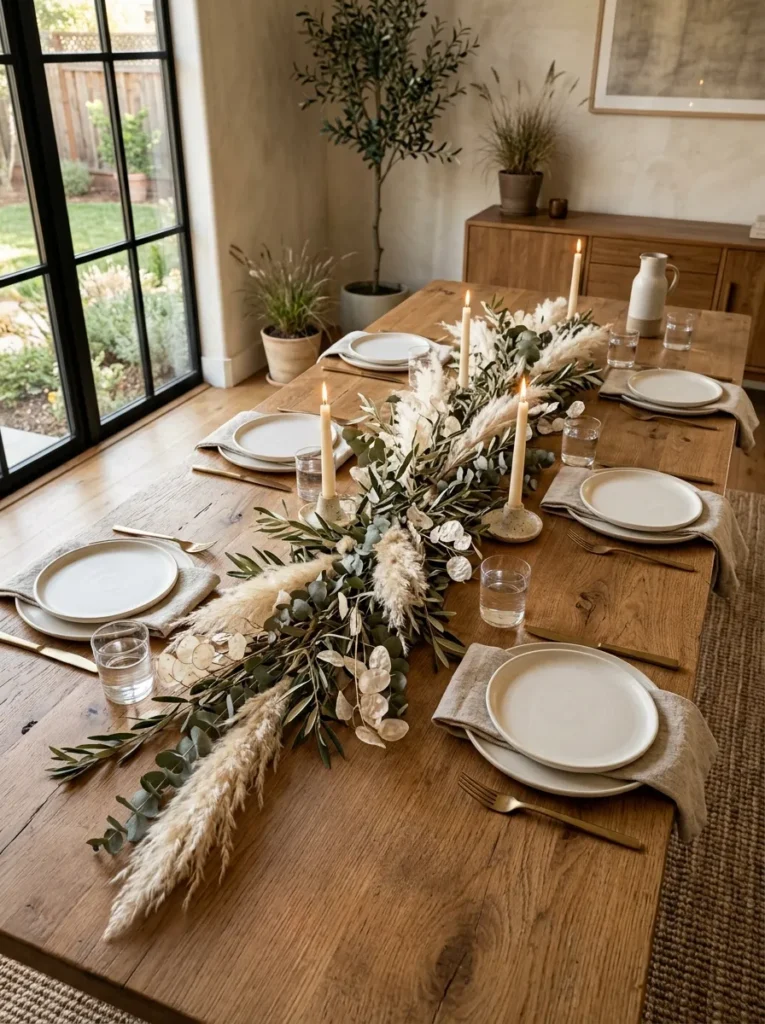
Vibe: The table feels abundantly natural and effortlessly composed — a centerpiece that looks gathered from a field and laid with complete intention.
Why it works: A dried botanical centerpiece laid flat along the full table length rather than arranged vertically in a vase is the most distinctively organic modern table styling technique because it prioritizes horizontal organic abundance over the conventional vertical centerpiece format. The design principle is natural scatter: stems laid in overlapping, directionally varied groupings create the visual quality of botanicals as they appear in nature — low, spreading, horizontal — which is fundamentally more organic than the upright vase arrangement that references florist convention rather than natural form. Interspersing small ceramic candle holders between botanical elements adds warm light at table level during evening dining, creating an intimate light quality that overhead pendants alone cannot achieve.
How to get it: Lay the longest stems first — dried olive branches or eucalyptus — running parallel to the table’s long axis and slightly off-center for an asymmetric quality. Layer shorter elements — pampas grass clusters, lunaria pods, small dried flower heads — over and between the longer stems, varying direction and height to create depth. Place three small ceramic holders at irregular intervals along the arrangement, interspersed rather than evenly spaced. The arrangement should feel loose and slightly imperfect — any tendency toward symmetry or precision should be corrected by introducing deliberate asymmetry.
Quick Win: A single large dried pampas grass stem ($8–$12) broken into three unequal sections and laid flat along a dining table center with two small ceramic candle holders creates a complete organic modern centerpiece for under $20, requiring no arranging skill and lasting indefinitely.
Shop The Look
| Product |
|---|
| Dried pampas grass stem large natural white bunch |
| Dried eucalyptus stems bunch silver dollar natural |
| Dried olive branch large natural stem centerpiece |
| Small ceramic candle holder set 3 piece matte white |
| Dried lunaria silver dollar seedpod bunch natural |
Also view: 15 Organic Modern Dining Rooms with Timeless Style
2. Hand-Thrown Ceramic Tableware Collection (ACCESSORIES)
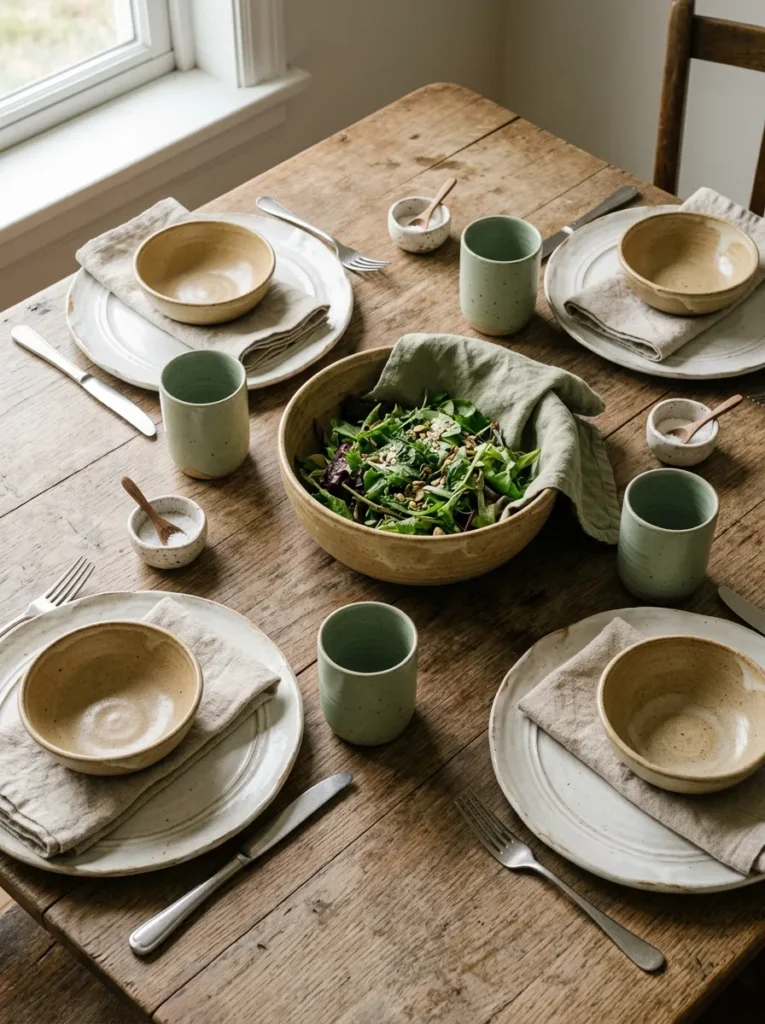
Vibe: The table setting feels artisanal and deeply considered — every piece carrying the warmth of someone’s hands in its surface.
Why it works: Hand-thrown ceramic tableware is the organic modern dining table’s most significant material upgrade because it changes the sensory experience of dining at the most intimate level — the plates, bowls, and cups that guests actually touch and hold. The visible evidence of hand-throwing — the slight irregularity of rim profiles, the throwing rings visible on interior surfaces, the variation in wall thickness — communicates material authenticity that no industrially manufactured tableware can replicate, and creates a tactile warmth that makes every meal feel more considered. The matte glaze in warm white and sand tones makes food appear at its most vibrant and appetizing, and the organic forms of hand-thrown pieces create natural variation between individual place settings that reads as personally curated rather than mass-produced.
How to get it: Build a hand-thrown tableware collection incrementally rather than purchasing a matched set — the slight variation between pieces from different production runs is an asset rather than a consistency failure in organic modern table styling. Source from studio potters on Etsy, local craft markets, and small ceramic studios rather than homewares retailers, which carry manufactured pieces regardless of how they are described. Mix scales within a collection: large dinner plates, medium pasta bowls, small side plates, and irregular-rim mugs from the same maker’s palette create cohesion through glaze family rather than identical form.
Shop The Look
| Product |
|---|
| Hand thrown matte white ceramic dinner plate set 4 |
| Handmade ceramic bowl warm sand set of 4 |
| Ceramic tumbler sage green set of 4 handmade |
| Small ceramic pinch pot salt cellar set natural |
| Large ceramic serving bowl matte white organic |
Also view: 14 Young Boys Bedroom Designs Full of Style and Storage
3. Woven Rattan Pendant Light with Warm Bulb (LIGHTING)
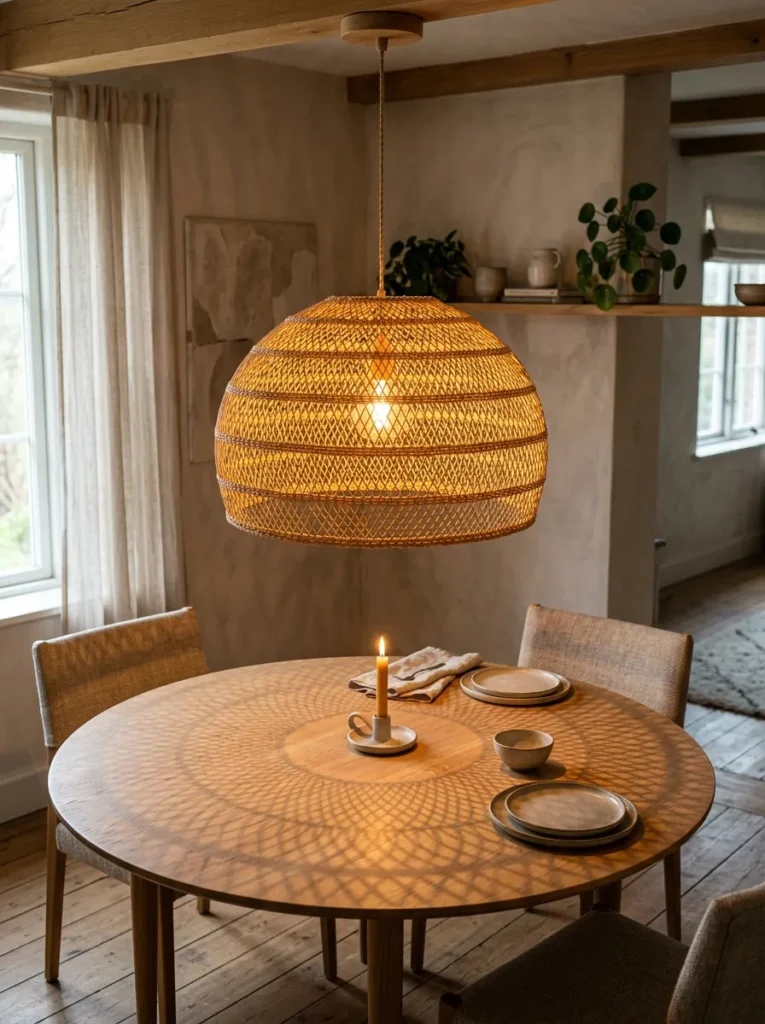
Vibe: The table feels warm and enveloping — the woven rattan casting a shadow lace across the table surface that makes every dinner feel like it is happening somewhere special.
Why it works: A woven rattan pendant light performs a lighting function that no other shade material can achieve: as light passes through the woven fiber gaps, it casts a complex, organic shadow pattern across the table surface and surrounding walls — a natural lace of light and shadow that changes character as the day’s ambient light shifts and as the overhead bulb’s output is dimmed or brightened. This shadow-casting quality is the rattan pendant’s most distinctive contribution to organic modern dining atmospherics. The warm amber color of natural rattan also adds warmth to the light passing through the shade, eliminating the harsh quality of bare bulb LED light and producing the most flattering possible illumination for both food and faces.
How to get it: Install the rattan pendant at 80cm above the table surface — the standard dining pendant height that creates intimate light without impeding sightlines. For a rattan pendant specifically, err toward the lower end of the 75–85cm hanging range because the rattan shade diffuses and softens the light as it descends, allowing slightly lower hanging than glass or metal shades without creating glare. Specify a warm white dimmable LED bulb at 2700K for the most flattering light through the rattan weave — cool white bulbs above 3500K produce an institutional quality that the organic rattan shade cannot compensate for.
Shop The Look
| Product |
|---|
| Woven rattan pendant light 70cm natural large |
| Warm white dimmable LED bulb E27 2700K |
| Dimmer switch rotary standard dining circuit |
| Pendant light ceiling canopy brass fitting |
| Pendant cord grip adjuster height setting |
4. Natural Linen Table Runner and Napkin Set (MATERIAL / COLOR)
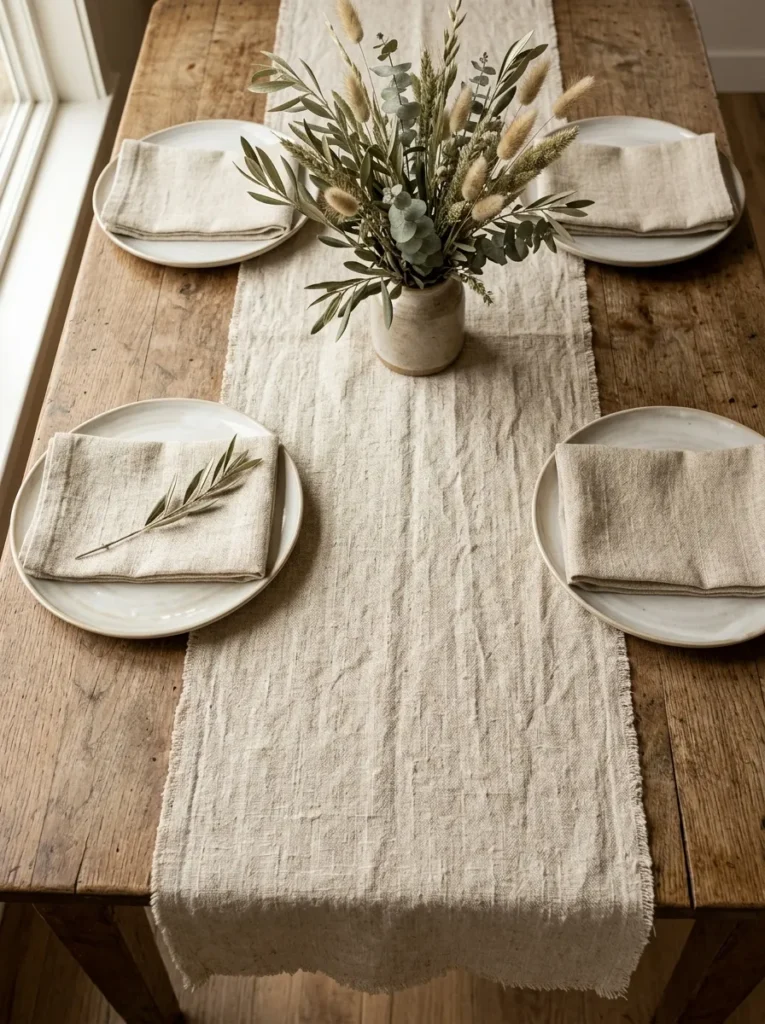
Vibe: The table feels naturally textile-warm — the particular softness of undyed linen that makes every other material in the room look more considered by proximity.
Why it works: Natural undyed linen is the organic modern dining room’s most versatile and most texturally rich textile material because its irregular weave structure — visible slubs, natural color variation, and slight surface irregularity — provides a level of tactile and visual warmth that no uniform textile can replicate. The design principle is textile authenticity: undyed linen carries the visual history of its plant origin in its natural color variation and surface character, which is precisely the quality that makes it appropriate for the organic modern aesthetic. A matched runner and napkin set in the same undyed linen creates textile coherence across the table setting while maintaining the natural variation that prevents the arrangement from reading as too studied or coordinated.
How to get it: Source undyed or natural-washed linen rather than bleached or pre-dyed linen for the most authentic organic modern quality — the natural color is a warm ivory rather than pure white, which reads as genuinely natural rather than artificially brightened. Wash linen textiles in cool water before first use to soften the fiber and develop the natural drape that unwashed linen lacks. Size the runner to overhang 15–20cm at each table end — this proportional overhang creates the casual, generous quality that distinguishes a styled table from a utilitarian one.
Shop The Look
| Product |
|---|
| Natural linen table runner undyed 180cm dining |
| Natural linen napkin set 4 piece undyed dining |
| Linen napkin ring set natural wood organic |
| Linen tablecloth undyed natural large dining |
| Linen placemat set 4 piece natural woven dining |
5. Organic Modern Color Palette: Terracotta and Warm White (COLOR)
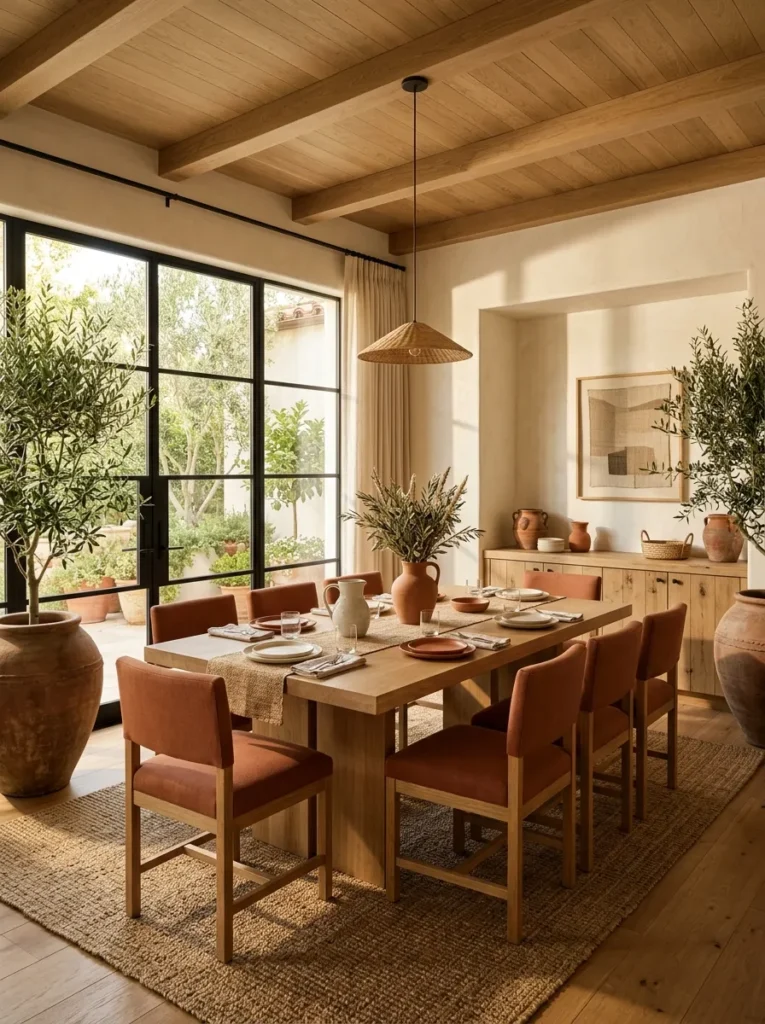
Vibe: The room feels warmly Mediterranean and grounded — terracotta’s earth tone creating the most immediately welcoming dining atmosphere of any organic modern palette.
Why it works: The terracotta and warm white color palette is the most emotionally warming of all organic modern dining color combinations because terracotta — the warm red-orange of fired clay — carries deep cultural associations with earth, food, warmth, and communal gathering across every Mediterranean, Middle Eastern, and Latin American tradition. In an organic modern context, terracotta works as an accent color rather than a dominant one: upholstered chair fabric, ceramic accessory groupings, and terracotta plant pots introduce the color in material form rather than wall paint, which maintains the material authenticity that makes organic modern spaces feel genuinely considered rather than merely color-coordinated. The warm white plaster wall tone amplifies the terracotta’s warmth by providing the lightest possible neutral ground against which the clay color reads at its most vibrant.
How to get it: Introduce terracotta in three material forms — textile (chair upholstery), ceramic (tableware and accessories), and planted (terracotta pots with living plants) — before considering wall paint. This three-material approach creates tonal cohesion without the commitment of painted walls and maintains the material authenticity that distinguishes organic modern from color-trend decorating. Specify matte or clay-finish fabrics for terracotta upholstery rather than smooth or shiny finishes — the matte texture reads as naturally clay-like, while smooth finishes read as synthetic regardless of color.
Shop The Look
| Product |
|---|
| Terracotta upholstered dining chair clay matte set 4 |
| Large terracotta plant pot 30cm indoor outdoor |
| Terracotta ceramic water jug matte dining table |
| Terracotta ceramic accessory set dining sideboard |
| Warm white interior paint low sheen natural plaster |
6. Live-Edge Wood Shelving as Dining Room Display (MATERIAL / LAYOUT)
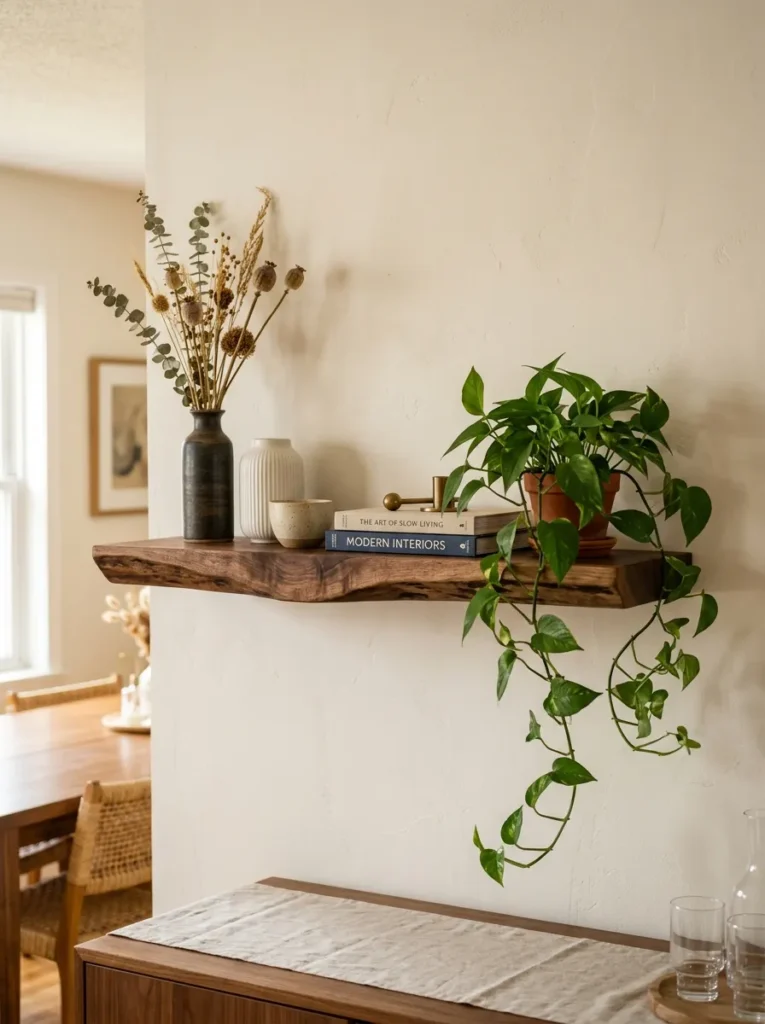
Vibe: The shelf feels organically anchored and warm — a single piece of live-edge wood that makes the entire dining room wall feel permanently considered.
Why it works: A live-edge shelf in a dining room performs a double design function: as a display surface for ceramics, botanicals, and art objects, and as a material statement in its own right — the preserved natural edge of the wood slab introducing a direct reference to the tree’s organic form into the dining room’s vertical surface. The live edge’s organic undulation creates a visual tension with the wall’s flat geometry that makes the shelf look simultaneously natural and architecturally deliberate. The design principle is material authenticity at vertical scale: where a live-edge dining table brings natural form to the horizontal plane, a live-edge shelf brings it to the vertical wall, creating a dialogue between the two planes that reinforces the organic modern material philosophy throughout the room’s full spatial volume.
How to get it: Source a live-edge walnut or oak shelf slab from a local sawmill, specialty lumber yard, or online live-edge supplier — specify a minimum 5cm thickness for adequate structural depth at typical dining room display weights. Mount using two heavy-duty floating shelf brackets into wall studs, positioned so the brackets are invisible from the front — the shelf’s visual effect depends on the appearance of floating from the wall without visible support. Apply a hard-wax oil finish to the slab before mounting, working into the live edge’s grain and ensuring the natural edge is sealed to prevent moisture absorption.
Shop The Look
| Product |
|---|
| Live edge walnut floating shelf slab natural |
| Heavy duty floating shelf bracket hidden steel |
| Hard wax oil natural wood finish clear |
| Tall narrow ceramic vase white matte 35cm |
| Trailing pothos plant small hanging pot display |
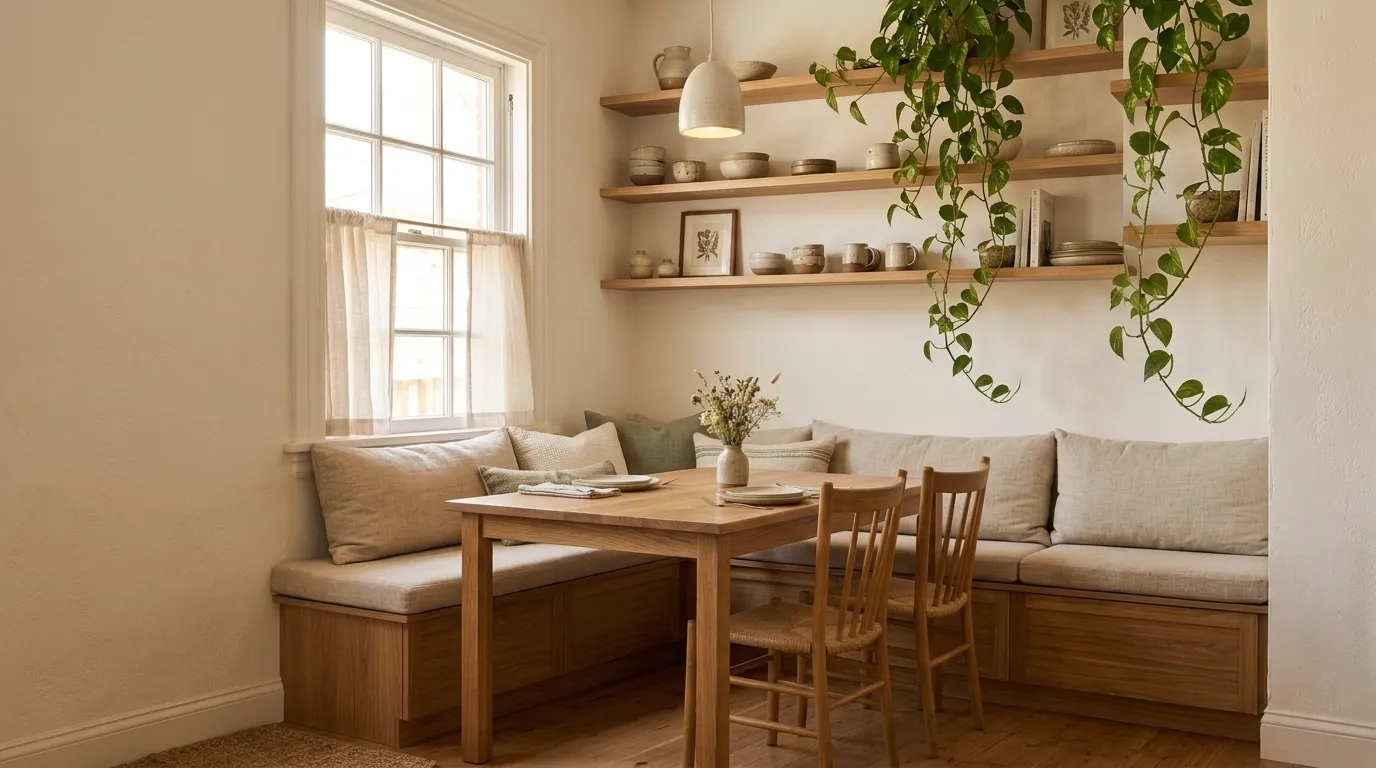
7. Organic Modern Dining Nook with Built-in Bench (SMALL SPACE / LAYOUT)
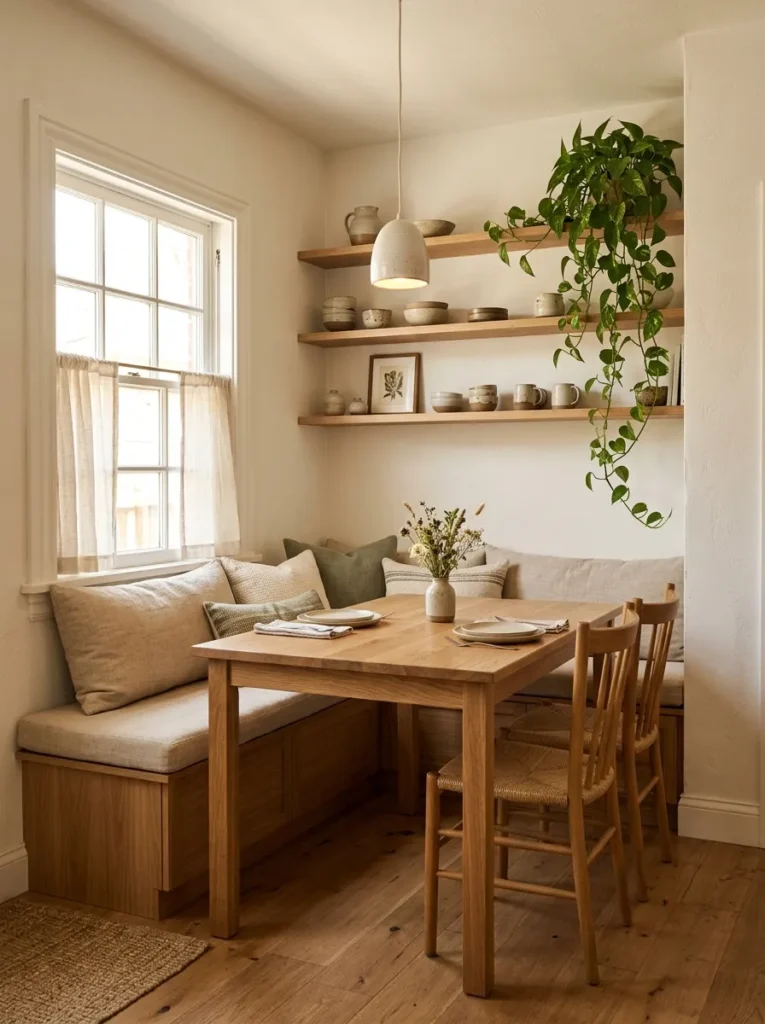
Vibe: The nook feels cozy and efficiently intimate — the most socially generous dining space available within the smallest possible footprint.
Why it works: A dining nook with built-in bench seating is the organic modern answer to the small dining room challenge because it delivers a complete, comfortable dining experience for four within a footprint that a conventional dining table and four-chair arrangement cannot match by 30–40% in floor area. The built-in bench’s specific advantages are spatial efficiency (no chair pull-back clearance on the bench side), social warmth (bench seating creates a more communal, intimate dining atmosphere than individual chairs), and styling opportunity (the bench cushion and back cushions introduce large areas of natural linen textile into the dining space that individual chair seats cannot provide). The open shelving on the nook’s rear wall — accessible while seated — creates a naturally curated display backdrop that makes the nook feel designed and considered rather than merely compact.
How to get it: Build the bench at standard seat height (45cm) with a seat depth of 48–52cm for adult dining comfort — shallower than a sofa seat but deeper than a dining chair seat, which creates the appropriate comfort level for extended dining. Specify a removable linen cushion in a zip-off washable cover for practical dining use — dining bench cushions require washing frequency that fixed upholstery cannot accommodate. Install open shelving on the nook wall at 30cm depth — deep enough for ceramics and small plant pots but not so deep that it intrudes on seating headroom.
Shop The Look
| Product |
|---|
| Natural linen bench cushion washable cover dining |
| White oak dining table compact rectangular 120cm |
| White oak dining chair matching set of 2 |
| Small ceramic pendant light dining nook natural |
| Open shelf bracket natural steel wall mount |
8. Sculptural Ceramic Vase as Dining Room Accent (ACCESSORIES)
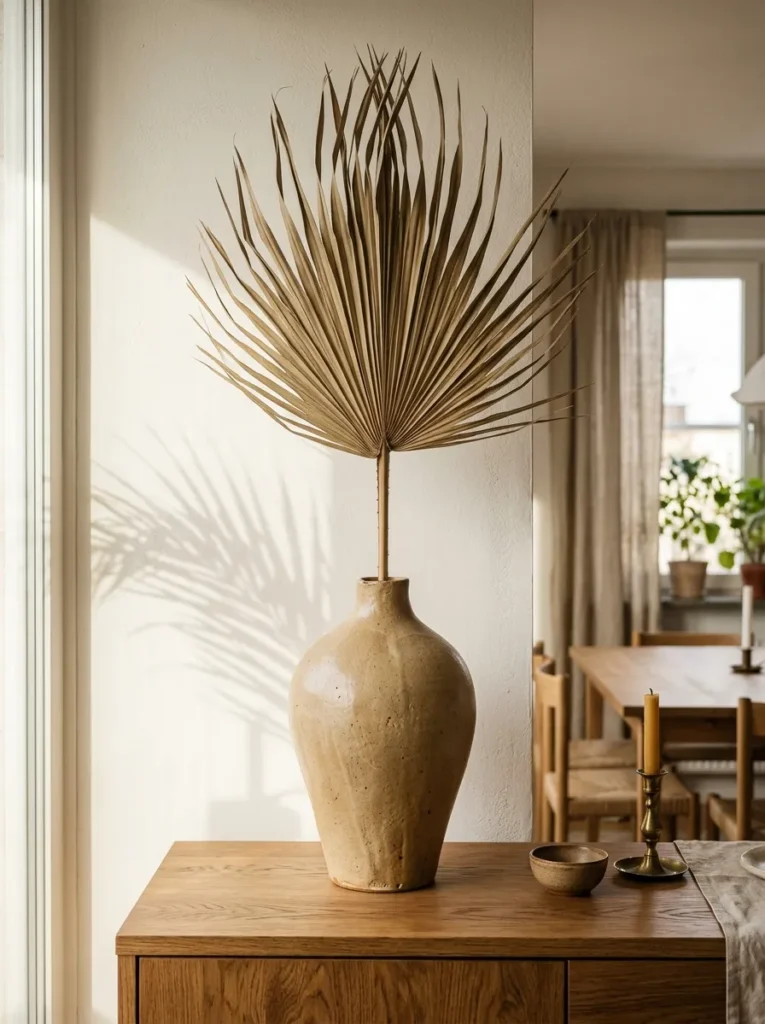
Vibe: The sideboard corner feels sculptural and quietly dramatic — a single large ceramic vessel with one stem doing the work of an entire styled vignette.
Why it works: A large sculptural ceramic vase used as a dining room accent object is the organic modern design principle of less-more applied to decorative display — one generous, beautifully formed object of significant scale outperforms a collection of smaller objects in organic modern dining rooms because it creates a clear visual focal point with minimum clutter. The organic asymmetric vessel form is specifically appropriate because its imperfect geometry references hand-making and natural form simultaneously, which is the material language of organic modern design. The single oversized botanical stem — a large dried palm leaf, a sculptural magnolia branch, or a tall dried grass stem — adds vertical drama without introducing the arrangement complexity of a multi-stem composition.
How to get it: Choose the vessel first, then find the stem that suits its scale — not the reverse. A 40–50cm tall vessel requires a stem of at least 60–80cm to maintain the correct proportion between vessel and botanical element. Place the vase slightly off-center on the sideboard surface rather than centered — the off-center position creates asymmetry that reads as considered arrangement rather than symmetrical balance, which is more appropriate for the organic modern aesthetic. Allow the dried stem to lean naturally rather than positioning it upright — a natural lean creates the organic quality that upright positioning eliminates.
Quick Win: A single large dried palm leaf ($8–$15) placed in any ceramic vessel already owned — even a simple white ceramic jug — creates an organic modern dining room accent of immediate visual impact and near-zero cost, lasting indefinitely without water or maintenance.
Shop The Look
| Product |
|---|
| Large sculptural ceramic vase 45cm warm sand matte |
| Dried palm leaf large natural dramatic stem |
| Low walnut sideboard dining room storage natural |
| Small ceramic object set 3 piece natural accent |
| Ceramic tray natural matte sideboard organization |
9. Organic Modern Window Treatment: Linen Curtains (COLOR / LAYOUT)
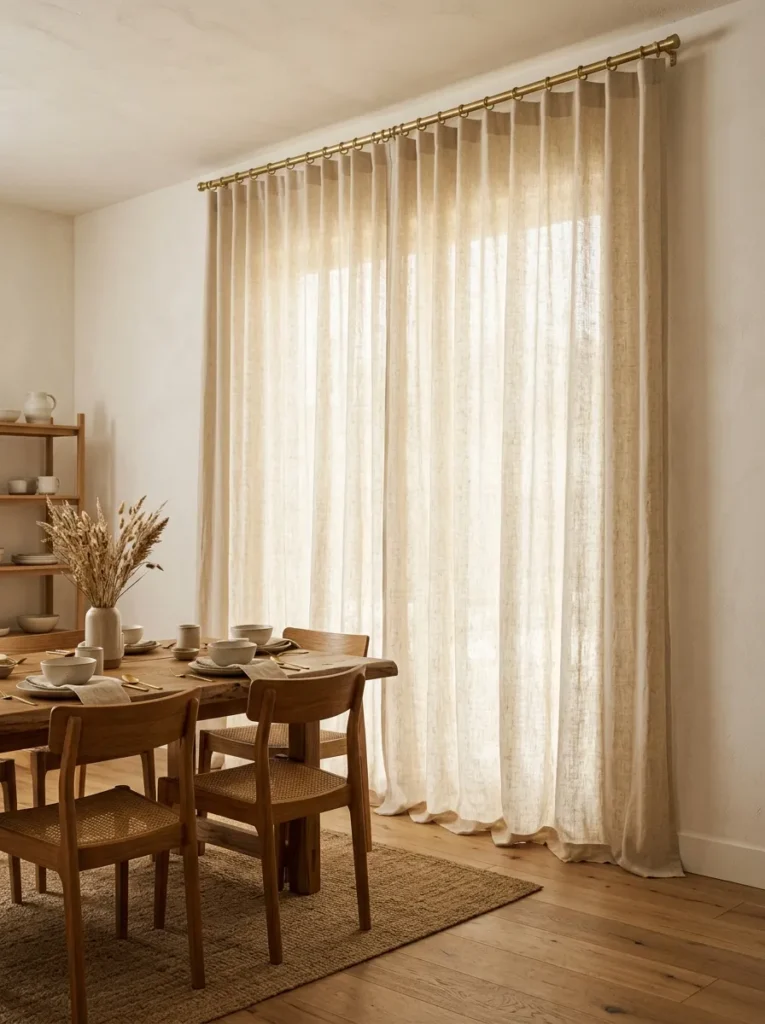
Vibe: The dining room feels softly luminous and warmly enclosed — linen curtains transforming natural light from direct to diffused, making the room feel like it glows from within.
Why it works: Floor-to-ceiling natural linen curtains are the organic modern dining room’s most spatially transformative window treatment because they perform three simultaneous functions: they soften and diffuse harsh direct natural light into the warm, even ambient glow that flatters food and faces most effectively; they extend the room’s apparent ceiling height by mounting the rod at ceiling level and allowing the curtain to pool slightly on the floor, creating a generous vertical proportion regardless of actual ceiling height; and they introduce the largest area of organic natural textile in the room, providing a textural warmth and acoustic softening that hard wall surfaces cannot provide. Natural linen is the only window textile that achieves all three functions simultaneously — it diffuses light beautifully, hangs with natural weight and drape, and improves in character with every wash cycle.
How to get it: Mount the curtain rod at ceiling height — not at window frame height, which limits the curtain’s height to the window dimension and eliminates the vertical proportion benefit. Use a simple brass rod with ring clips rather than a track or pocket rod, which allows the linen’s natural texture to be visible at the hanging point rather than hidden in a pocket. Specify curtain panels in a width of 2.5 times the window opening for generous, full gathering when closed — underfull curtains read as mean regardless of fabric quality.
Shop The Look
| Product |
|---|
| Natural linen curtain panel floor length warm ivory |
| Brass curtain rod 200cm ceiling mount dining |
| Brass curtain ring clips set 12 piece dining |
| Linen curtain tie back natural woven set of 2 |
| Ceiling curtain bracket set brass wall mount |
10. Organic Modern Dining Room Rug Selection (LAYOUT / COLOR)
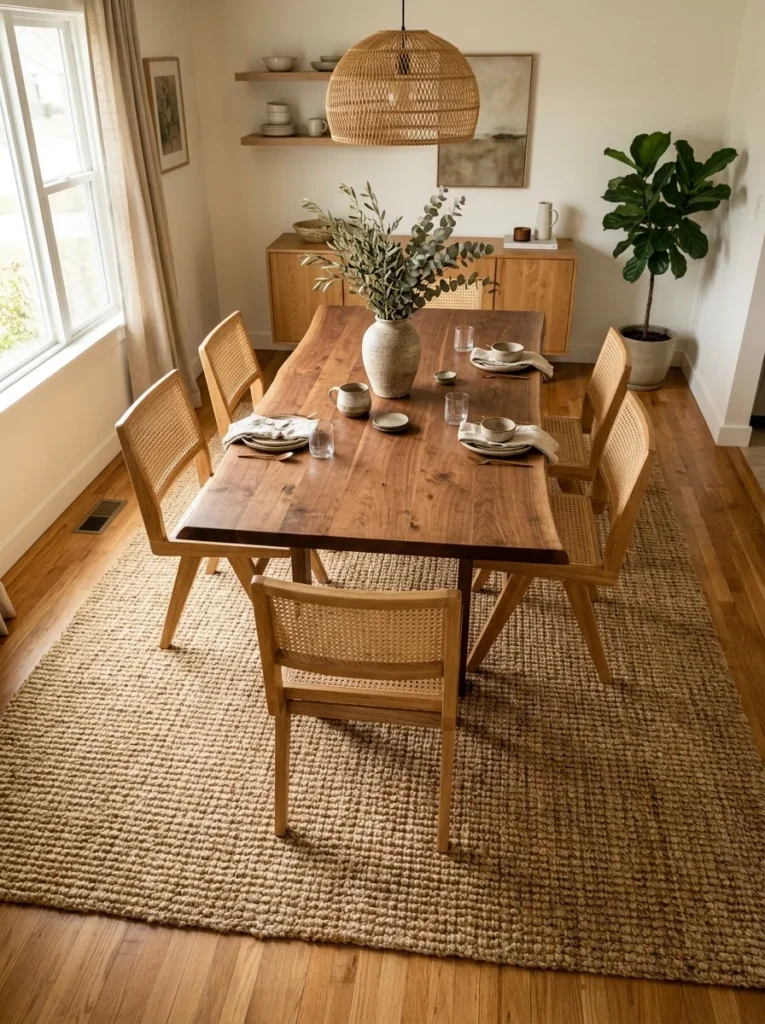
Vibe: The dining room floor feels grounded and warm — the jute rug anchoring the entire furniture arrangement and defining the dining zone with natural fiber authority.
Why it works: A natural fiber area rug beneath the dining table and chairs is the organic modern dining room’s most fundamental layout and comfort decision because it defines the dining zone within a larger open-plan space, provides acoustic dampening that prevents the hard surface reverberation that makes dining rooms feel loud and uncomfortable for extended conversation, and introduces a large area of natural organic texture at floor level that grounds the room’s material palette in its most earthbound element. Natural jute is the most appropriate rug material for an organic modern dining room — its honey-amber color coordinates with every warm neutral palette, its coarse weave texture is visually rich without being visually dominant, and its natural fiber origin aligns with the organic material philosophy throughout.
How to get it: Size the rug so it extends a minimum of 60cm beyond the dining table edge on all four sides — this ensures all chair legs remain on the rug when chairs are pulled out for seating and pushed back after, preventing the chair-leg-on-rug-edge catching that occurs with undersized rugs. For a standard 180cm six-seater dining table, this requires a minimum rug size of 300cm long by 240cm wide. Natural jute rugs shed loose fibers for the first several weeks of use — this is a normal characteristic of the material and reduces with vacuuming; place a rug pad underneath to prevent slipping on hard floors.
Shop The Look
| Product |
|---|
| Natural jute area rug large 300x240cm dining |
| Rug pad non-slip thin hard floor dining room |
| Natural seagrass area rug large dining alternative |
| Hand woven wool rug natural undyed large dining |
| Jute rug stain protector spray natural fiber |
11. Brass Hardware and Fixture Accents (ACCESSORIES)
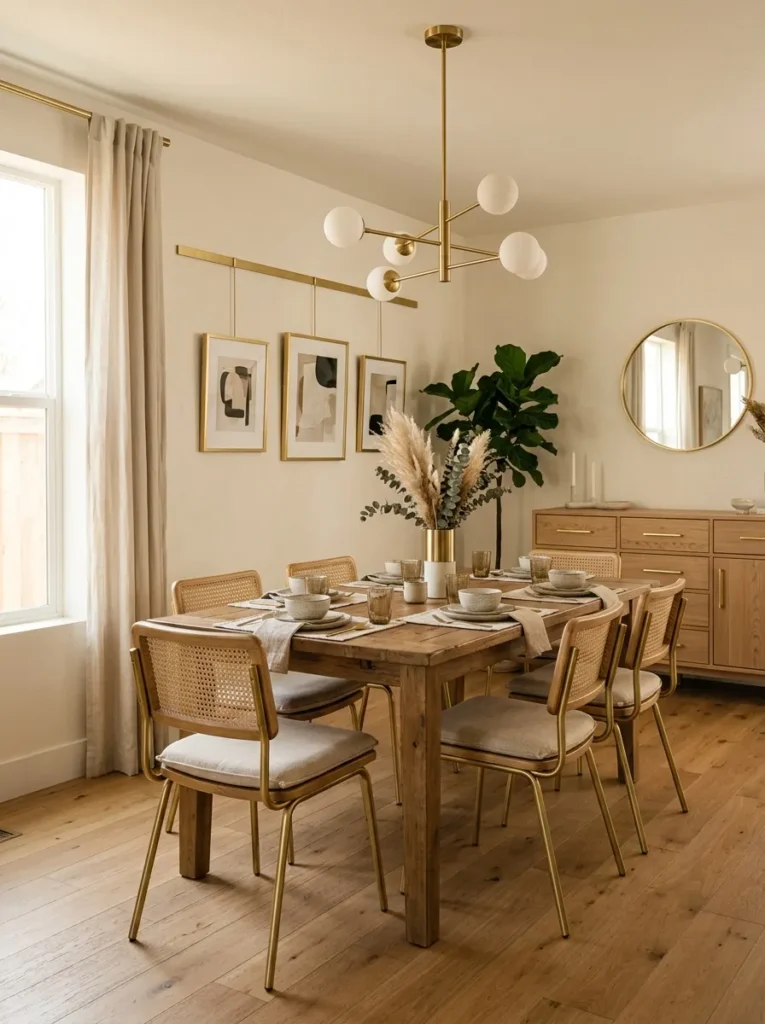
Vibe: The room feels warmly unified — brushed brass threading through every element like a warm metallic seam connecting furniture, lighting, and architecture.
Why it works: Coordinated brushed brass hardware and fixtures across a dining room creates a metallic accent system that unifies all the room’s elements — furniture, lighting, wall fixtures, and cabinetry — through a single warm metal tone applied consistently at multiple scales and positions. The design principle is tonal metallic repetition: when the same metal tone appears in the pendant, the chair legs, the picture rail, and the sideboard handles, the room’s visual composition gains a coherent accent system that reads as deliberately designed rather than accidentally coordinated. Brushed rather than polished brass is the critical specification — polished brass creates glare and reads as formal; brushed brass absorbs and softens light, creating the warm, lived-in metallic quality appropriate for the organic modern aesthetic.
How to get it: Specify brushed brass rather than polished brass at every hardware and fixture decision point, working from largest to smallest: pendant light first, then chair or table leg details, then sideboard and cabinet hardware, then smaller accessories. The consistency of the brushed finish is more important than the exact brass tone — slightly different brass tones (yellow brass, rose brass, antique brass) can coexist harmoniously if all are matte-brushed, but a single polished piece among matte-brushed pieces will read as discordant regardless of tone.
Shop The Look
| Product |
|---|
| Brushed brass dining pendant light natural |
| Brushed brass sideboard cabinet handle set 4 |
| Brass picture rail hanging system dining room |
| Brushed brass dining chair leg set replacement |
| Brass candle holder set 3 heights dining table |
12. Organic Modern Dining Wall: Plaster and Limewash (COLOR / MATERIAL)
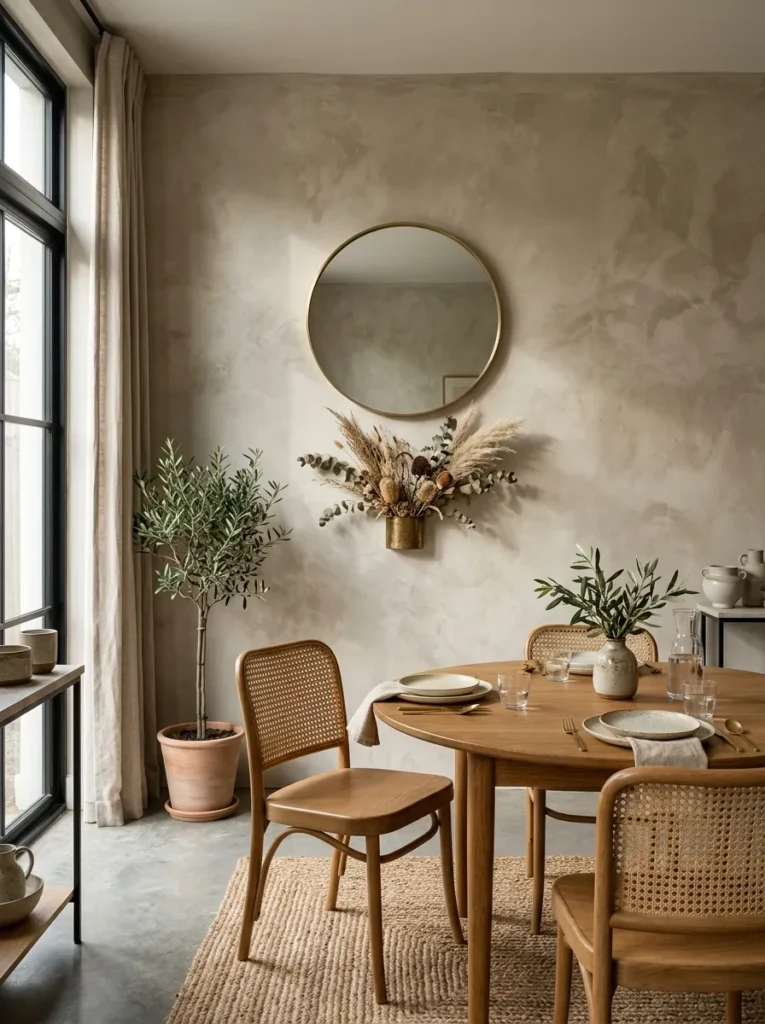
Vibe: The dining room wall feels organically alive — limewash creating the one painted finish that looks genuinely better in person than in photographs.
Why it works: Limewash paint is the organic modern dining room’s most materially authentic wall finish because its application method — a thin mineral wash applied by brush in multiple directions and partially wiped off while wet — creates a surface of genuine depth and variation that no conventional paint can replicate. The color variation inherent in limewash — some areas of the wall lighter, some deeper, dependent on the angle of application and the wiping pressure — creates a wall surface with the quality of aged Italian plaster or ancient stone, which is organically appropriate for the material language of the rest of the room. Unlike wallpaper or print patterns, limewash variation is subtle enough to serve as a neutral background while being visually rich enough to qualify as a genuine design choice.
How to get it: Apply limewash paint in two coats using a wide, natural-bristle brush in cross-hatch strokes — horizontal and vertical strokes crossing each other — for the most authentic variation. While the first coat is still slightly wet (15–20 minutes after application), use a damp cloth to partially wipe the surface in random areas, removing some of the limewash and revealing the base wall tone in patches. Allow to dry fully before the second coat. The second coat follows the same process but at lighter application pressure — the variation deepens with successive coats. Farrow and Ball, Portola Paints, and Pure and Original all produce quality limewash formulations specifically designed for interior dining room use.
Shop The Look
| Product |
|---|
| Limewash interior wall paint warm greige natural |
| Natural bristle wall brush wide limewash application |
| Round brass mirror 60cm dining room limewash wall |
| Dried botanical wall arrangement natural stem |
| Limewash paint applicator set brush cloth tool |
13. Dining Room Plant Styling: Statement Floor Tree (ACCESSORIES / LAYOUT)
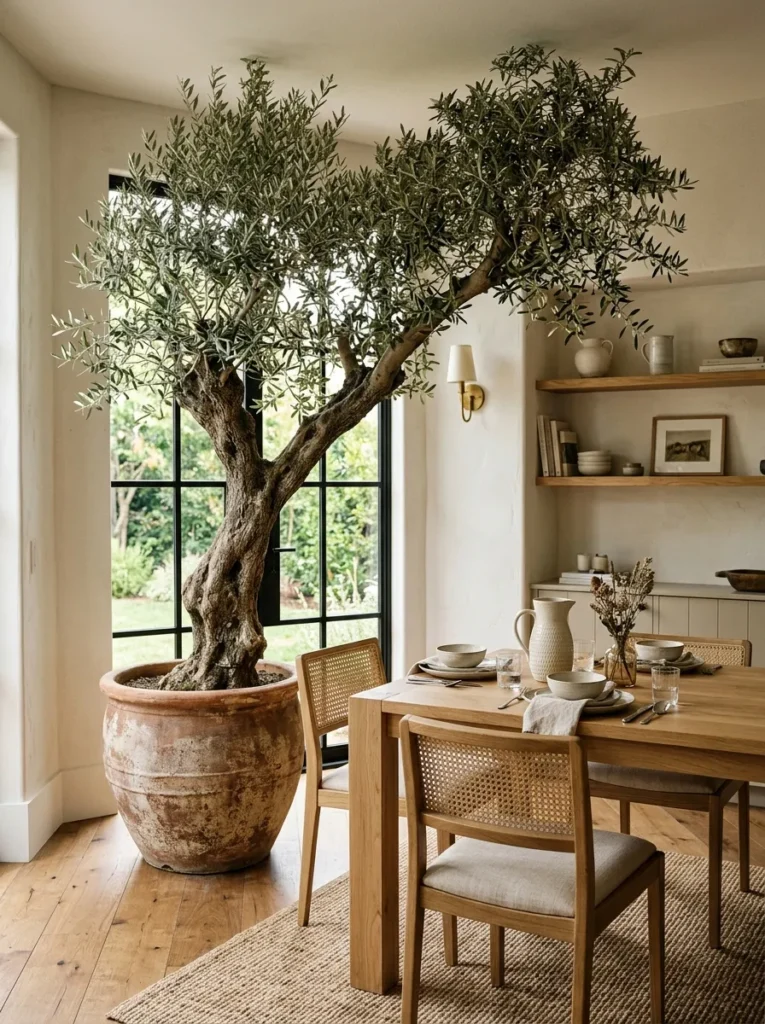
Vibe: The dining room corner feels alive and genuinely extraordinary — a full-scale living tree bringing the presence of the outdoors into the dining interior at its most powerful.
Why it works: A large statement floor tree in the dining room corner — an olive tree, fiddle leaf fig, or large monstera — introduces living nature at a scale that transforms the room’s spatial quality rather than merely adding a decorative accent. The design principle is scale empathy: a tree-scale plant in a dining room creates the biophilic equivalent of dining outdoors under a canopy — the overhead presence of living leaves, the organic form of a natural trunk, and the soft movement of leaves in air circulation create a genuinely outdoor quality within an indoor space. The olive tree is the most appropriate choice for an organic modern dining room specifically: its silvery-green leaf color coordinates with the warm neutral palette, its gnarled trunk is sculptural without being exotic, and it tolerates the lower light levels of interior spaces better than most Mediterranean trees.
How to get it: Position the tree in the brightest corner of the dining room — a corner that receives direct or bright indirect light for at least four hours daily. Place a large terracotta saucer under the pot and check drainage weekly — olive trees in indoor pots are sensitive to overwatering, which is the primary cause of indoor olive tree decline. Rotate the pot 90 degrees monthly to ensure even light exposure across the canopy and prevent the one-sided lean that occurs when trees consistently face a single light source.
Shop The Look
| Product |
|---|
| Olive tree large indoor pot mature natural |
| Large terracotta pot 35cm indoor tree planting |
| Large terracotta saucer drainage indoor tree |
| Indoor tree potting mix well draining natural |
| Plant mister bottle glass brass pump indoor |
14. Open Dining Shelving as Display and Storage (LAYOUT / SMALL SPACE)
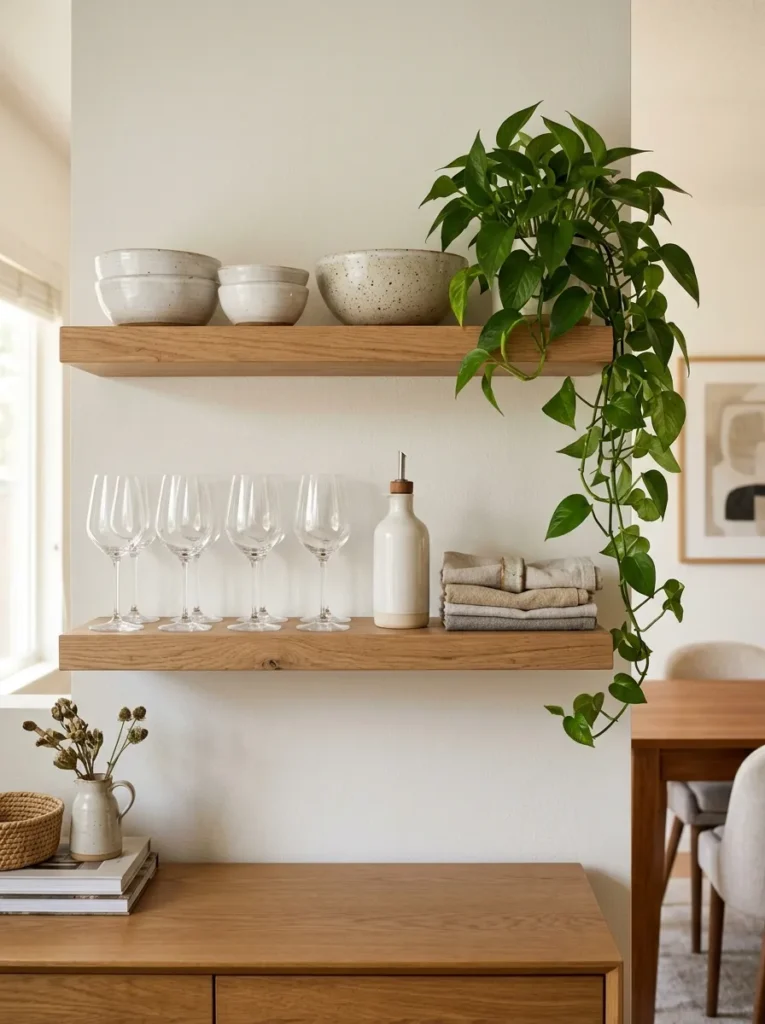
Vibe: The dining room wall feels warmly functional — shelves that serve every meal while looking beautiful between them.
Why it works: Open dining shelving that serves both practical storage and curated display functions is the organic modern approach to dining room storage because it makes the practical objects of dining — tableware, glassware, linens, serving pieces — part of the room’s visual composition rather than hidden behind closed doors. The design principle is beautiful utility: when the objects of dining service are genuinely beautiful in themselves — hand-thrown ceramic bowls, natural linen napkins, clear wine glasses, ceramic oil bottles — displaying them openly is both practically efficient (dining service objects are immediately accessible without opening cabinet doors) and aesthetically enriching. The key editing discipline is maintaining display quality over time: any object that is not beautiful enough to display must be stored out of sight, which creates a positive pressure toward consistently curating the quality of everyday dining objects.
How to get it: Mount floating oak shelves at two heights — the upper shelf at approximately 180cm from the floor for display objects (ceramics, botanicals, art objects), the lower shelf at 140–150cm for accessible service objects (glasses, napkins, frequently used ceramics). Specify 25–30cm shelf depth — enough for standard ceramic bowls and glasses without excessive visual depth. Style the upper shelf as pure display and allow the lower shelf to carry practical service items presented beautifully — the functional-decorative division between the two shelves creates a visual organization that is easy to maintain.
Shop The Look
| Product |
|---|
| Floating oak shelf set 2 piece dining room natural |
| Large ceramic serving bowl white matte display |
| Clear wine glass set 4 piece stem dining display |
| Ceramic oil bottle dining service natural |
| Linen napkin set folded display natural dining |
15. Organic Modern Dining Room in All-White Palette (COLOR)
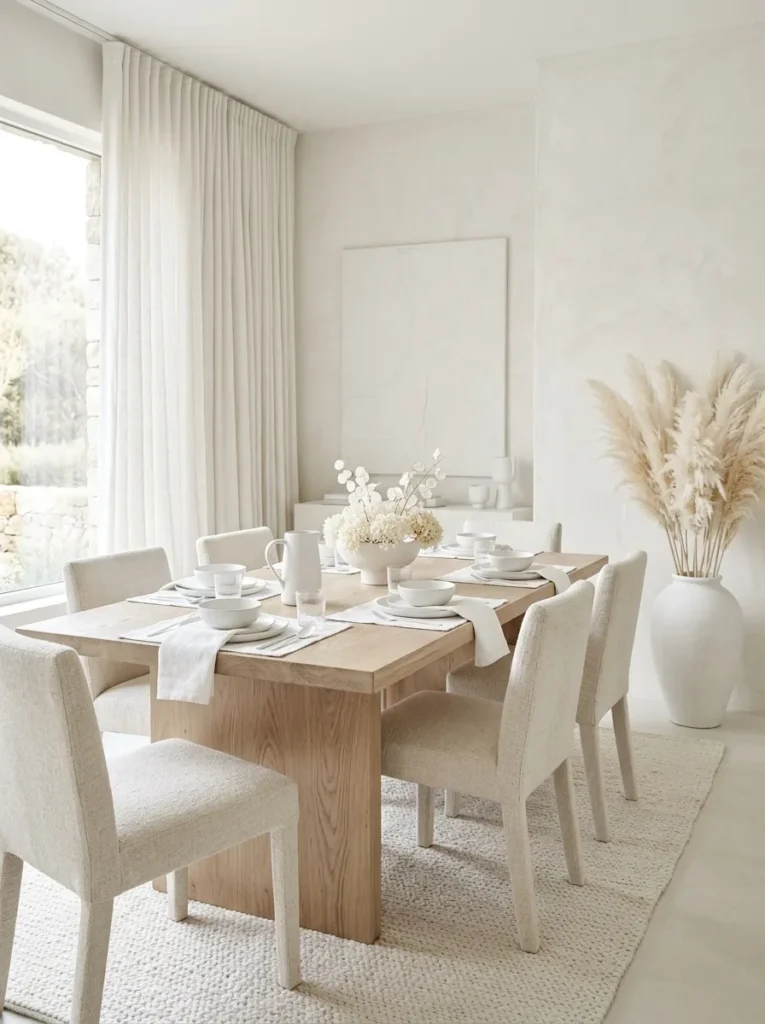
Vibe: The room feels luminous and deeply serene — the discovery that white is not one color but many, and that their difference creates all the visual richness needed.
Why it works: An all-warm-white organic modern dining room is the most technically demanding palette because its success depends entirely on the quality of material selection and the consistency of undertone across every surface — and it is simultaneously the most visually powerful when executed correctly. The design principle is textural color: in a monochromatic warm white room, the visual interest comes entirely from the varied textures of different white materials — the roughness of plaster against the smoothness of bleached oak against the softness of linen against the matteness of ceramic — creating a room that is visually rich in a fundamentally different way from a multi-toned room. The critical technical requirement is undertone consistency: every white in the room must share the same warm (yellow-beige) undertone family — a single cool-toned white introduced into an otherwise warm white room reads as a mistake rather than a variation.
How to get it: Test every white in the room under the specific dining room’s light conditions before committing — the same warm white paint chip that appears correct under a paint store’s artificial light may read differently under north light in winter or south light in summer. Specify matte finishes throughout — gloss white reads as clinical in a dining room context, while matte white reads as natural plaster and organic material. Introduce warm white pampas grass, dried bleached palm, or dried white protea as the botanical element — white-dried botanicals maintain the palette while providing the organic form that makes an all-white room feel alive rather than sterile.
Shop The Look
| Product |
|---|
| Bleached white oak dining table natural pale |
| White linen dining chair upholstered set of 4 |
| White matte ceramic dinner plate set 4 |
| White pampas grass stem dried large natural |
| Warm white interior paint matte natural plaster |
16. Mixed Seating: Chairs and Bench Combination (LAYOUT / FURNITURE)
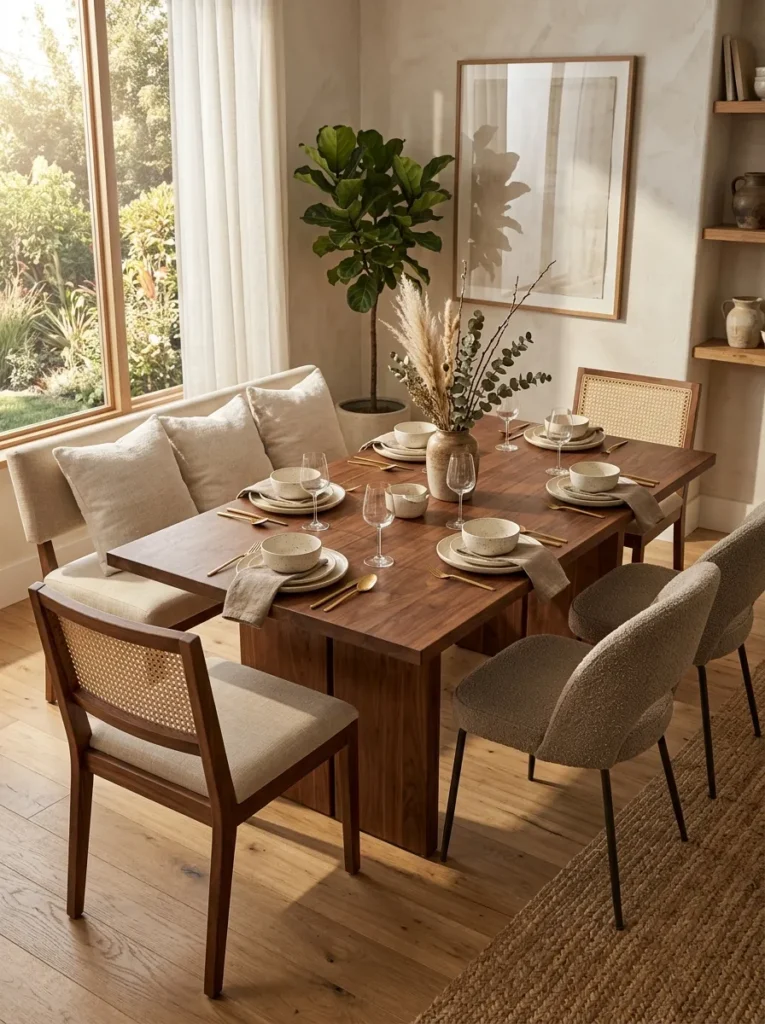
Vibe: The dining room feels warmly social and visually rich — mixed seating creating the particular interest of a table where not every seat is the same.
Why it works: Mixed seating — combining a bench, two chair types, and an end chair at the same dining table — is the organic modern dining room’s most socially sophisticated arrangement because it creates visual variety that communicates genuine consideration for the dining experience rather than efficient furniture procurement. The design principle is seating hierarchy: the bench side creates the most social, communal seating position for the most guests; the upholstered side chairs create the most comfortable seated position for adult guests who will remain at table longest; and the distinct end chairs create a subtle head-of-table definition that gives the table orientation without formality. The material variation between the three seating types — rattan, linen, boucle — creates the most natural material layering available in dining furniture without any additional styling effort.
How to get it: Begin with the bench selection, as it determines one full side of the table’s seating. Choose a bench length that matches the table’s long side exactly, with no overhang beyond the table legs. Select the opposite side chairs in an upholstered fabric that relates to the bench fabric in tone but differs in texture — linen bench and boucle chairs, or boucle bench and linen chairs, both create the harmonious material variation this arrangement requires. Choose the end chairs as the most distinctly different seating type — a rattan-back or fully wooden chair at the table end creates the clearest visual punctuation of the mixed seating arrangement.
Shop The Look
| Product |
|---|
| Natural linen dining bench upholstered long natural |
| Greige boucle dining chair upholstered set of 2 |
| Rattan back dining chair end position natural |
| Solid walnut dining table rectangular large |
| Mixed seating dining rug jute large natural |
17. Seasonal Dining Table Refresh with Natural Elements (ACCESSORIES / COLOR)
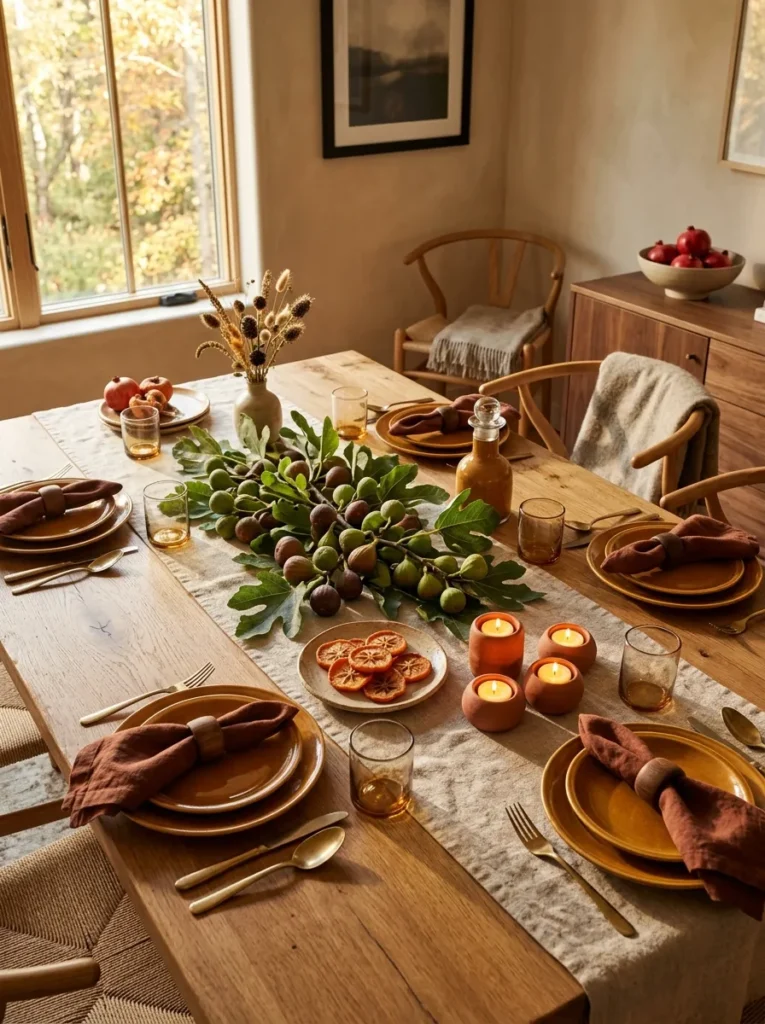
Vibe: The table feels abundantly seasonal — the pleasure of a dining room that changes with the natural world rather than remaining static throughout the year.
Why it works: A seasonal dining table refresh using natural organic elements — fresh branches with fruit or blossom, seasonal dried materials, produce as decoration, and seasonal candle arrangements — is the organic modern dining approach to seasonal decorating because it uses the natural world’s own seasonal cycle as the decorating calendar rather than commercially produced seasonal merchandise. The design principle is natural seasonality: spring blossom branches and tulip stems, summer herb bundles and fresh citrus, autumn fig branches and dried persimmons, winter bare branches and forced narcissus bulbs — each season produces its own organic dining table palette that cannot be replicated by any manufactured product. This approach to seasonal refresh costs almost nothing (foraged or grocery-purchased natural materials), takes under 30 minutes, and produces a dining table that is genuinely of its seasonal moment.
How to get it: Identify one local natural material available in each season that can serve as the dining table’s seasonal centerpiece element — cherry blossom branches in spring, fresh eucalyptus and lavender bundles in summer, fig or apple branches in autumn, pine and holly in winter. Source from your own garden, a local market, or a grocery store’s produce and floral section rather than a specialist florist, which keeps costs minimal and maintains the direct nature-connection that makes seasonal organic decorating meaningful. Change the centerpiece material four times per year at the seasonal transitions — equinox and solstice dates provide natural markers.
Quick Win: A single branch of seasonal fruit or blossom ($3–$8 from a grocery store or garden) laid flat along the center of the dining table requires no arranging skill, no vase, and no additional materials — and creates a seasonal dining table moment of immediate organic beauty that no purchased decorative product can replicate.
Shop The Look
| Product |
|---|
| Small terracotta tea light holder set 6 piece |
| Natural beeswax tea light candle set 20 piece |
| Amber ceramic tableware set 4 piece seasonal |
| Dried persimmon slice set natural seasonal decor |
| Warm linen runner natural seasonal table dining |
How to Start Your Organic Modern Dining Decor Transformation
Your single best first move is to replace your current dining table textile — whatever tablecloth, runner, or place mats currently occupy the table surface — with a single length of natural undyed linen. This one textile change, costing $20–$40, immediately establishes the warm, natural material ground from which every other organic modern dining decor decision builds, and it requires no furniture change, no painting, and no installation. The quality of natural linen against a dining table surface changes the perception of every object placed on it — ceramics look more handmade, food looks more natural, candlelight looks warmer — making it the highest-leverage single material investment available at any budget level.
The most common beginner mistake in organic modern dining decor is purchasing multiple small decorative objects — small candle holders, small vases, small ceramic bowls — before establishing the room’s material foundation in furniture, lighting, and textiles. The result is a room with an abundance of small organic-looking accessories that sits on a laminate table under a harsh light on a synthetic rug — the accessories communicate organic modern aspiration while the foundational elements undermine it entirely. Fix this by spending the full budget on two or three foundational elements — the dining table surface material, the pendant light, the floor rug — before purchasing a single decorative object.
Three specific items under $50 that create the most immediate organic modern dining decor transformation: a set of four natural linen napkins in undyed ivory ($18–$28) that replace synthetic alternatives and elevate the material quality of every table setting; a single large dried botanical stem — olive branch, pampas grass, or eucalyptus — laid flat as a table centerpiece ($10–$18) requiring no vase, no arrangement skill, and lasting indefinitely; and a warm white dimmable LED bulb at 2700K ($8–$12) installed in the existing dining pendant, which transforms evening dining light quality from harsh to genuinely flattering without any fixture replacement.
A starter organic modern dining decor transformation — new linen textiles, a natural centerpiece, and a pendant bulb replacement — takes one afternoon and costs $50–$80. A full room transformation including a natural fiber rug, linen curtains, complete hand-thrown ceramic tableware, brass hardware updates, and a statement floor plant runs $400–$1,200 depending on rug size and tableware source. The dining table itself — if replacement is needed — represents the largest single investment and the longest-lasting, with a solid white oak or walnut table remaining current, functional, and beautiful for decades rather than years.
Frequently Asked Questions About Organic Modern Dining Decor
What makes a dining room feel organic modern versus just natural or rustic?
The distinguishing quality of organic modern dining decor versus natural or rustic styles is the presence of contemporary restraint alongside the natural materials. A rustic dining room uses natural materials — wood, stone, textile — but allows them to accumulate in abundance, with visible patina, imperfection, and a density of objects that creates warmth through quantity. An organic modern dining room uses the same materials but applies a contemporary editing discipline: fewer objects, more negative space, cleaner furniture forms, and a color palette held within the warm neutral range rather than the full natural spectrum. The natural materials provide the warmth; the modern restraint provides the elegance — organic modern is the precise balance between the two.
How do I choose the right dining table size for an organic modern room?
The organic modern dining table sizing rule prioritizes generous clearance over maximum seating capacity — the table should be sized to leave at least 90cm of clearance between the table edge and the nearest wall or obstruction on all sides. This clearance allows chairs to be pulled back fully for comfortable seating and rising, creates the sense of generous spatial proportion that makes organic modern dining rooms feel luxurious rather than cramped, and accommodates the addition of a dining bench or extra chairs without creating traffic problems. If the room cannot accommodate a standard six-seater (typically 180–200cm long) with 90cm clearance on all sides, choose a smaller table with full clearance rather than a larger table with tight clearance — a smaller table in adequate space always feels more comfortable than a larger table that fills the room.
What is the most important lighting change for an organic modern dining room?
Installing a dimmer switch on the dining room pendant circuit is the single most impactful lighting change available, because it transforms the pendant’s function from a fixed output light to a continuously adjustable atmospheric tool — from bright task lighting for daytime dining to intimate low-level ambient for evening dinner. The second most impactful change is replacing any cool-white bulb above 3500K with a warm white dimmable LED at 2700K — this single bulb change transforms the color quality of dining light from institutional to genuinely flattering. Both changes combined cost under $30 and require no new fixtures, making them the highest-return lighting investment available.
Can organic modern dining decor work with existing furniture that is not natural wood?
Yes — organic modern dining decor is an approach to material layering and styling rather than a furniture replacement prescription. A dining table in a non-organic material (painted MDF, glass, or laminate) can be significantly improved by surrounding it with organic modern textiles, ceramics, lighting, and botanicals that collectively shift the room’s material weight toward the natural. A linen table runner, hand-thrown ceramic tableware, a woven rattan pendant light, and a large dried botanical centerpiece will collectively transform the perception of an existing non-organic table by establishing natural material dominance in every element that surrounds and overlays it. Furniture replacement is the ideal long-term goal but is not a prerequisite for beginning an organic modern transformation.
How do I maintain an organic modern dining room’s visual calm with children or everyday use?
The key to maintaining organic modern dining decor’s visual calm under the practical pressures of daily family life is closed-storage discipline for non-display items. Every dining room object that is functional but not beautiful enough to display — children’s school bags, bills, charging cables, miscellaneous household items — must have a designated closed storage home outside the dining room or in closed sideboards within it. The dining room’s open surfaces — the table, the sideboard top, the open shelves — should hold only the objects that meet the dual qualification of functional and beautiful. This editing discipline, consistently applied, is the single practice that preserves organic modern visual calm regardless of how intensively the space is used.
Ready to Create Your Dream Organic Modern Dining Room?
These 17 ideas span the full depth of organic modern dining decor — from the foundational material warmth of a dried botanical table centerpiece and the hand-thrown ceramic table setting, through the atmospheric power of woven rattan pendant lighting and layered beeswax candlelight, to the spatial confidence of a biophilic plant corner, the textural richness of limewash plaster walls, and the quiet discipline of the all-warm-white palette — covering every design dimension from the smallest table accessory to the largest room-defining material choice, and every home from the smallest dining nook to the most generously proportioned open-plan room. Begin with the textile — a length of natural linen laid across the dining table today, before any other change is made — and allow that single material decision to reveal what the rest of the room is asking for. When your dining room has finally achieved the particular quality of warmth that makes guests slow down before sitting, that makes conversations outlast the food, that makes the table feel like a genuine destination rather than a piece of furniture — you will understand why organic modern dining decor is not a trend but a permanent shift in how beautiful domestic life can feel. Save your favorites now, especially the dried botanical centerpiece and the seasonal table refresh — they are the two ideas that, practiced regularly, turn dining into something your household looks forward to rather than simply performs.