22 Easy Kids Closet Organization Ideas for Busy Families
Kids closet organization refers to the intentional systems, storage solutions, and spatial planning strategies used to make a child’s wardrobe and belongings accessible, manageable, and maintainable — so that getting dressed in the morning takes two minutes instead of twenty, and the closet stays organized through the chaos of daily family life. This article gives you 22 practical, budget-friendly kids closet organization ideas that work for every closet size, every age group, and every level of organizational ambition — from toddler to teen, reach-in to walk-in.
Picture a Monday morning where every uniform is where it should be, every shoe has a partner, and your child can actually find their own things without your help. No avalanche of clothes when the door opens. No missing left shoe. No drawer that requires both hands and a knee to close. A well-organized kids closet is not a luxury — it is a daily time-saving system that pays back its setup investment every single morning. Here are 22 ideas worth saving — and stealing.
Why Kids Closet Organization Works So Well
A well-organized kids closet operates on one foundational principle: every item has a permanent, logical, and accessible home that a child can find independently and return to without adult intervention. This idea draws from the Montessori philosophy of prepared environment — the belief that children thrive when their physical space is organized at their scale, with everything visible, reachable, and clearly designated. Applied to closet design, this philosophy produces spaces that children can use independently from as young as three years old, building self-sufficiency while dramatically reducing the daily organizational load on parents.
The materials that make kids closet systems work are practical and durable: adjustable double-hang rods in powder-coated steel, open-face canvas or woven fabric bins in neutral tones, clear stackable drawers for small items, over-door shoe organizers, labeled wicker baskets, pegboard panels for accessories, and low-height hooks that children can reach independently. Colors stay calm and functional — warm white, natural linen, sage green, and soft gray — so the closet interior recedes visually and the clothing and belongings become the focus.
The children’s closet organization trend has accelerated significantly alongside the broader home organization movement, driven by the practical reality that families with organized children’s spaces report meaningfully less morning stress, fewer lost items, and children who develop genuine organizational habits earlier than peers whose spaces are managed entirely by adults. The key insight driving the trend is developmental rather than aesthetic: organization systems designed for adult use fail in children’s closets because they prioritize storage capacity over child accessibility.
Even the smallest reach-in closet — a single rod, a shelf above, and a floor below — can be transformed into a fully functional children’s wardrobe system. For tight footprints, the principle is simple: lower the hanging rod to child height, add a second rod above for adult-managed seasonal storage, and use the floor and door for the shoe and accessory storage that typically creates the most visual chaos.
Style at a Glance
| Element | Trait 1 | Trait 2 |
|---|---|---|
| Philosophy | Child-accessible, independently usable systems | Montessori-inspired prepared environment at child scale |
| Materials | Adjustable steel rods, canvas bins, clear drawers, wicker baskets | Over-door organizers, pegboard, labeled hooks, fabric dividers |
| Color Palette | Warm white, natural linen, sage green, soft gray | Natural wood, powder-coat white, woven neutral, clear acrylic |
1. Double Hang Rod System for Small Clothes
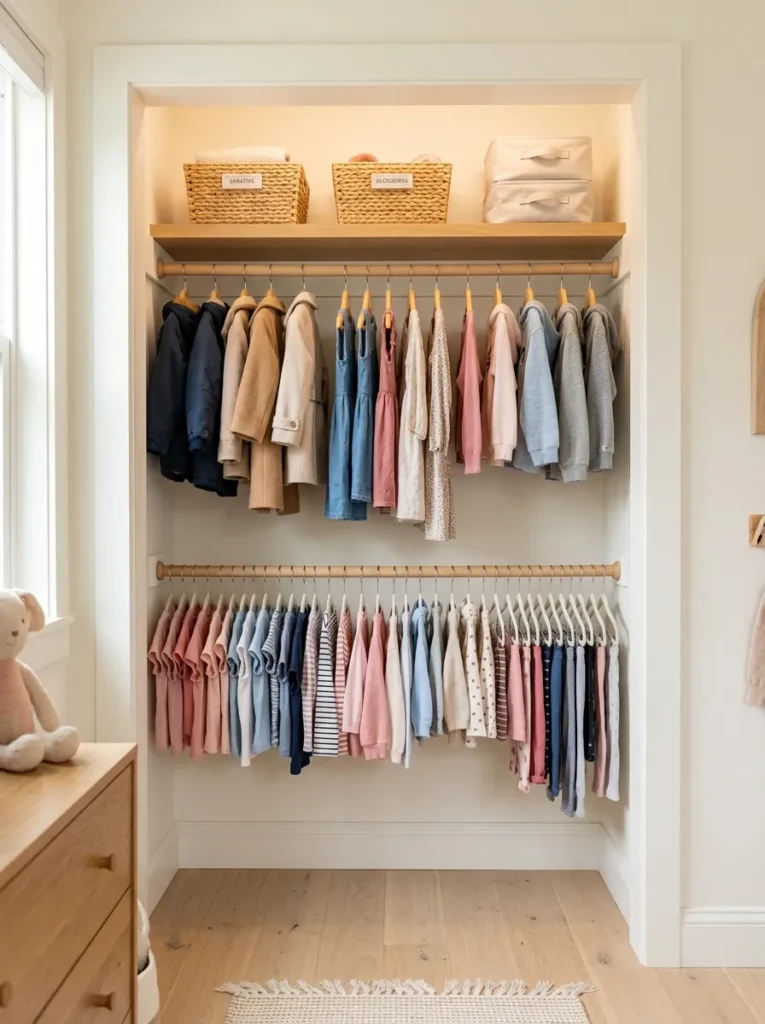
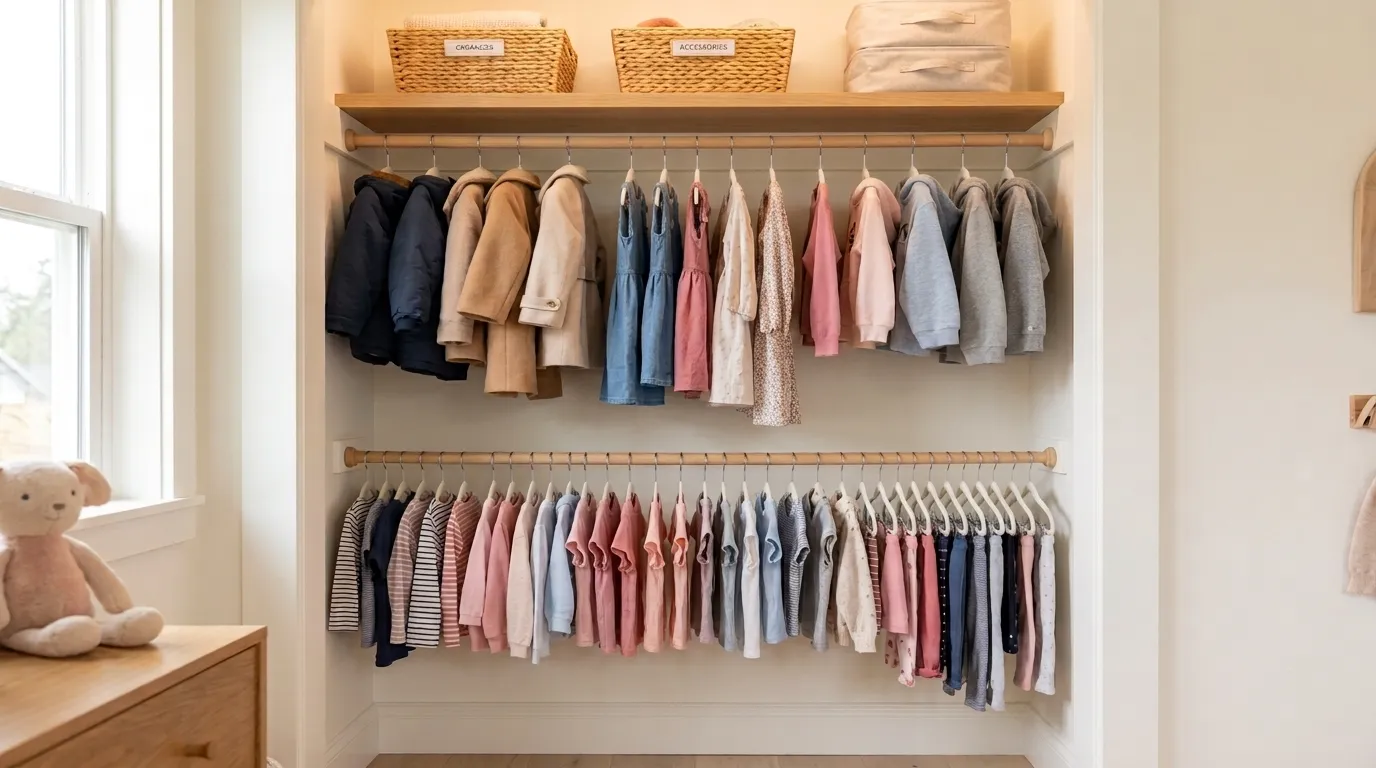
Vibe: Clean and efficient — the closet configuration that doubles storage without adding a single inch of floor space.
Why it works: The double hang rod system applies the principle of vertical space maximization — children’s clothing is short, meaning a single standard-height rod wastes the bottom 24–36 inches of hanging space beneath every garment. Installing a second rod below the first at child height (approximately 36 inches from the floor for toddlers, 42 inches for school-age children) immediately doubles hanging capacity while simultaneously placing the lower rod within the child’s independent reach. The upper rod becomes parent-managed storage for seasonal items, school uniforms not in current rotation, and occasion wear that doesn’t need daily child access.
How to get it: Purchase a double hang rod closet organizer kit — freestanding versions require no installation and work in any reach-in closet, while wall-mounted bracket versions provide more stability for larger closets. Set the lower rod height to the child’s shoulder level plus 2 inches — this is the ergonomic reach height at which a child can independently remove and replace hanging items without straining. Standardize to matching slim velvet hangers on the lower rod — the uniform hanger creates visual order and prevents the bunching that wire hangers cause.
| Product |
|---|
| Double hang rod closet organizer freestanding white |
| Slim velvet hanger set 50 pack white |
| Closet rod bracket set adjustable |
| Closet shelf bracket white powder coat |
| Felt hanger set non-slip children’s size |
Also view: 17 Organic Modern Dining Decor Ideas for Every Home
2. Clear Stackable Bins for Folded Items
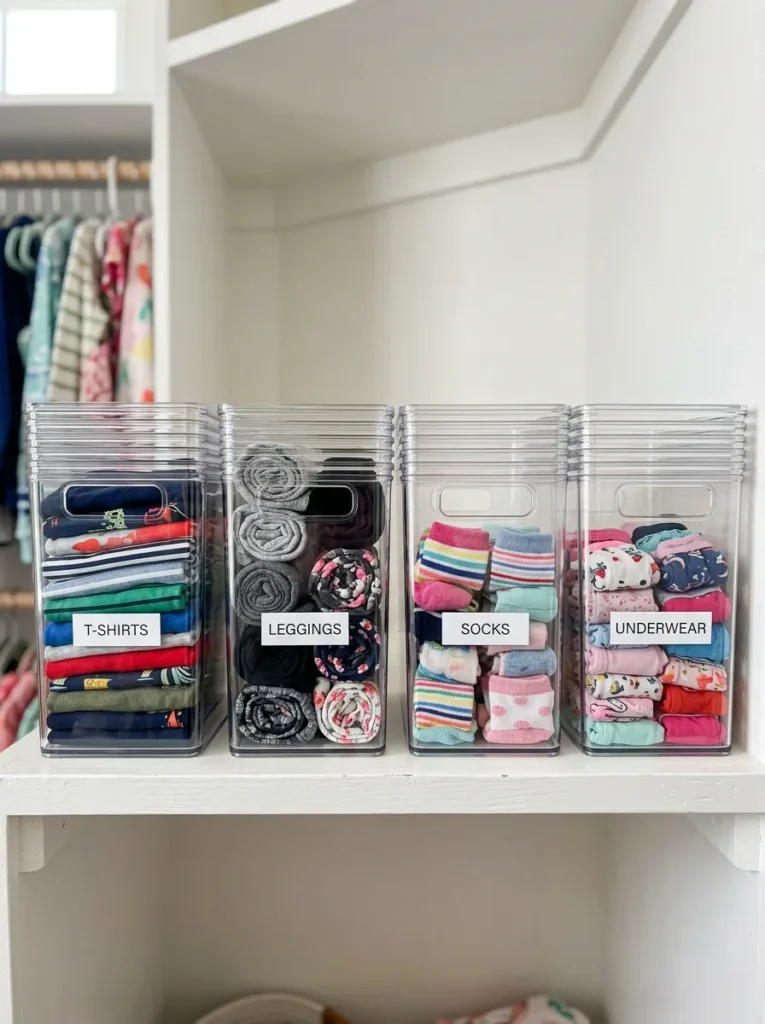
Vibe: Ordered and visible — the shelf system that ends the excavation of folded clothing piles.
Why it works: Clear stackable bins solve the fundamental problem with folded clothing storage for children: items buried under a stack of folded clothes are functionally invisible to a child, who will pull everything out to find the specific shirt they want rather than carefully lifting and replacing items above it. Clear bin walls make every item visible from the front without disturbing the stack, and the file-folding method — standing folded items vertically like files in a filing drawer rather than stacking them flat — makes every garment simultaneously visible and individually accessible without disturbing its neighbors. This is the Marie Kondo folding principle applied to children’s storage.
How to get it: Choose clear bins with a width of 10–12 inches and a depth of 14–16 inches to fit standard closet shelf dimensions. File-fold all t-shirts, leggings, and pajamas — fold each garment into a neat rectangle, then fold in half again so it stands upright on its own edge. Stand file-folded items in rows from front to back of the bin. Print simple category labels using a label maker and apply to the front face of each bin at child eye level so your child can identify contents independently.
| Product |
|---|
| Clear stackable storage bin set with lids |
| Label maker handheld with tape refill |
| Closet shelf organizer divider set |
| File fold storage bin open front white |
| Drawer organizer insert set adjustable |
Also view: 15 Organic Modern Dining Rooms with Timeless Style
3. Over-Door Shoe Organizer for Footwear
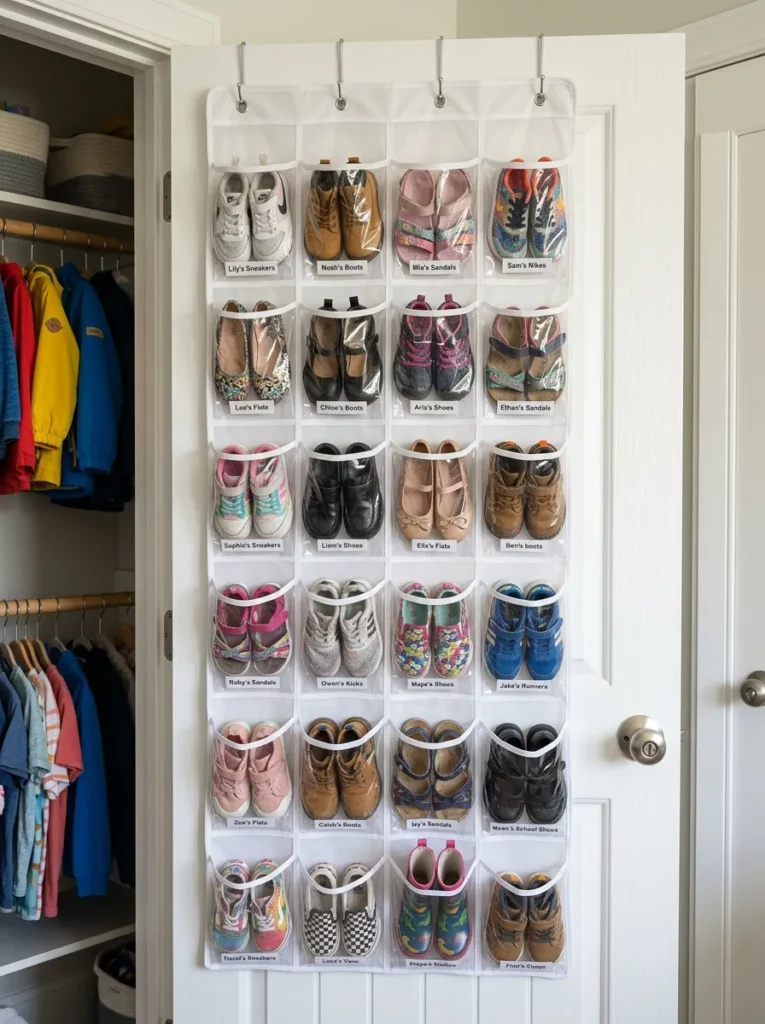
Vibe: Accessible and tidy — the shoe solution that ends the one-shoe mystery permanently.
Why it works: Shoe storage is the most common source of kids closet chaos because shoes are rarely put away as pairs — one shoe lands on the floor, one gets kicked under the bed, and the morning scramble begins. An over-door clear pocket organizer solves the pairing problem through designated pair-specific pockets: each pocket holds exactly one pair, and a child can see at a glance whether both shoes are present before the morning rush begins. The over-door position uses completely wasted space — the interior face of a closet door — and keeps the closet floor clear for hampers, toy bins, or additional storage.
How to get it: Choose a clear pocket organizer with pockets sized for children’s shoes — standard adult shoe organizer pockets are often too large for small children’s footwear and allow shoes to fall sideways. For school-age children, involve them in assigning specific pockets to specific shoes — children who participate in the system setup are significantly more likely to maintain it independently. Label each pocket with a small picture label (a drawing or sticker of the shoe type) rather than a text label for pre-readers.
| Product |
|---|
| Over-door clear pocket shoe organizer 24 pocket |
| Picture label sticker set for kids |
| Over-door hook set heavy duty |
| Small basket over-door hook organizer |
| Command over-door hook set large |
4. Labeled Wicker Baskets for Accessories
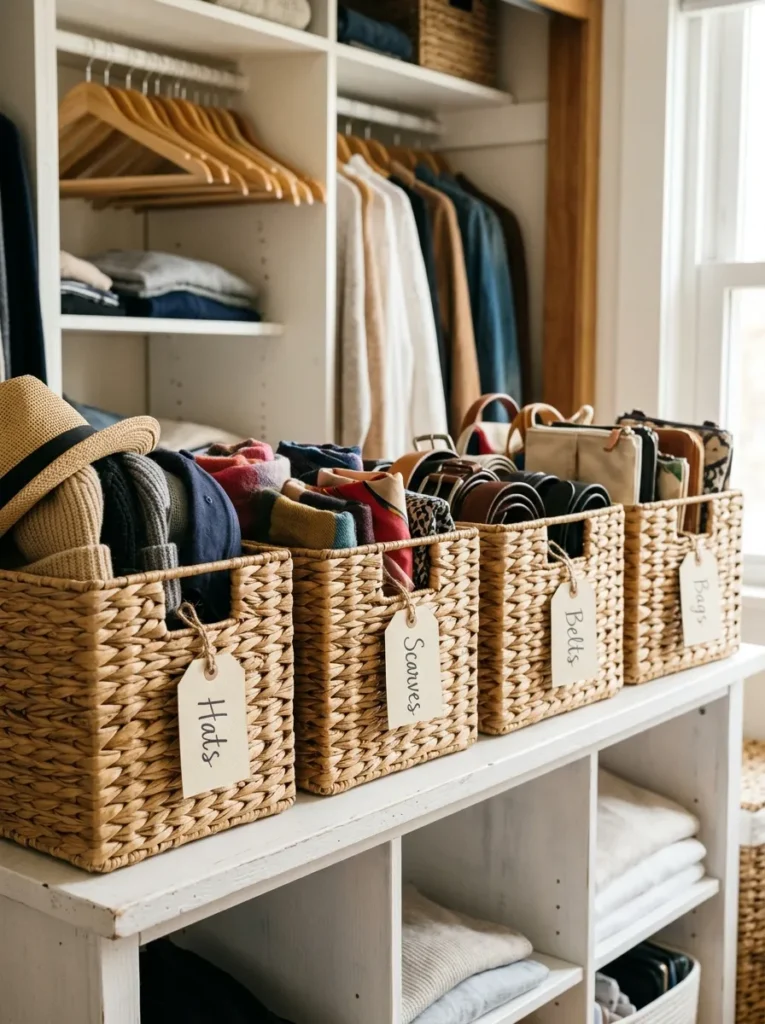
Vibe: Warm and organized — the shelf system that makes accessories findable without making the closet look clinical.
Why it works: Wicker baskets for accessory storage apply the principle of contained category grouping — rather than individual hooks, hangers, or drawers for each accessory type, a single basket corrals an entire category into one retrievable unit. When a child needs a hat, they reach for the hat basket rather than scanning multiple storage locations. The natural wicker material adds warmth to the closet interior that wire or plastic storage cannot, and the consistent basket format creates visual rhythm across the shelf that reads as organized even when basket contents are not perfectly arranged. Kraft label tags tied with jute are the decorative element that converts functional storage into a considered visual system.
How to get it: Choose wicker baskets with straight sides rather than tapered sides — straight sides maximize usable interior volume and allow baskets to sit flush against each other on a shelf without wasted gap space between them. Size baskets to the volume of the category they contain: a large basket for school bags, medium for hats and scarves, small for belts and hair accessories. Write labels on kraft tags using a fine-tip black marker — handwritten labels add personal warmth that printed labels lack in a children’s space.
| Product |
|---|
| Wicker storage basket set matching natural |
| Kraft paper label tag set with jute twine |
| Fine-tip black marker permanent |
| Closet shelf basket liner set |
| Label holder adhesive strip set clear |
5. Color-Coded Clothing System by Day
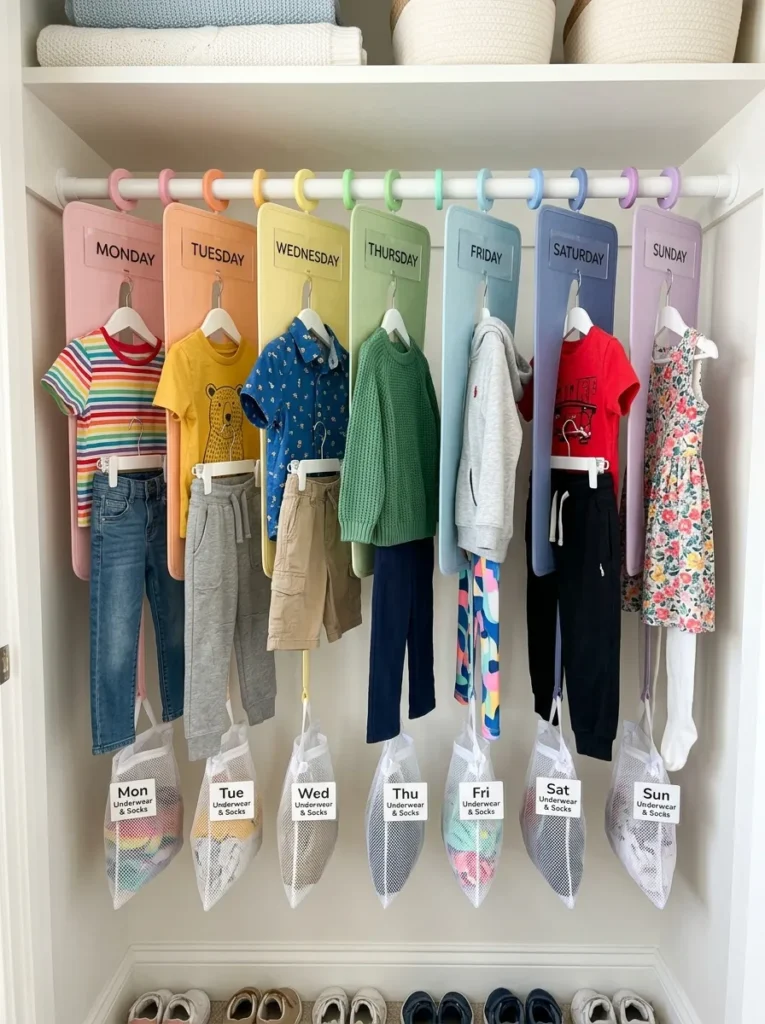
Vibe: Clear and empowering — the system that makes a child genuinely independent in the morning.
Why it works: A day-of-week outfit system eliminates the single most time-consuming morning decision in a family household — what to wear today — by moving that decision to the weekend when time pressure is absent. The child (or parent, for younger children) selects and hangs seven complete outfits on Sunday evening, and each morning the child simply takes the current day’s section without any decision-making required. The design principle is decision elimination through pre-planning: by separating the planning function from the execution function in time, the morning routine loses its most significant time cost. Research on decision fatigue supports this approach — eliminating small daily decisions meaningfully reduces cognitive load across the full day.
How to get it: Purchase closet rod dividers with day-of-week labels — these are sold specifically for this purpose and clip directly onto the existing closet rod between outfit sections. For children old enough to choose their own outfits, involve them completely in the Sunday evening outfit selection — the investment of 15 minutes on Sunday saves 5–10 minutes every morning, a net weekly time saving of 20–50 minutes. Add a small zippered mesh bag clipped to each day’s hanger for the underwear and socks belonging to that outfit.
| Product |
|---|
| Closet rod divider set days of week labeled |
| Small mesh zipper bag set for socks underwear |
| Children’s slim hanger set colored pastel |
| Weekly outfit planner closet kit |
| Hanging closet organizer with pockets daily |
6. Low Hooks for Independent Dressing
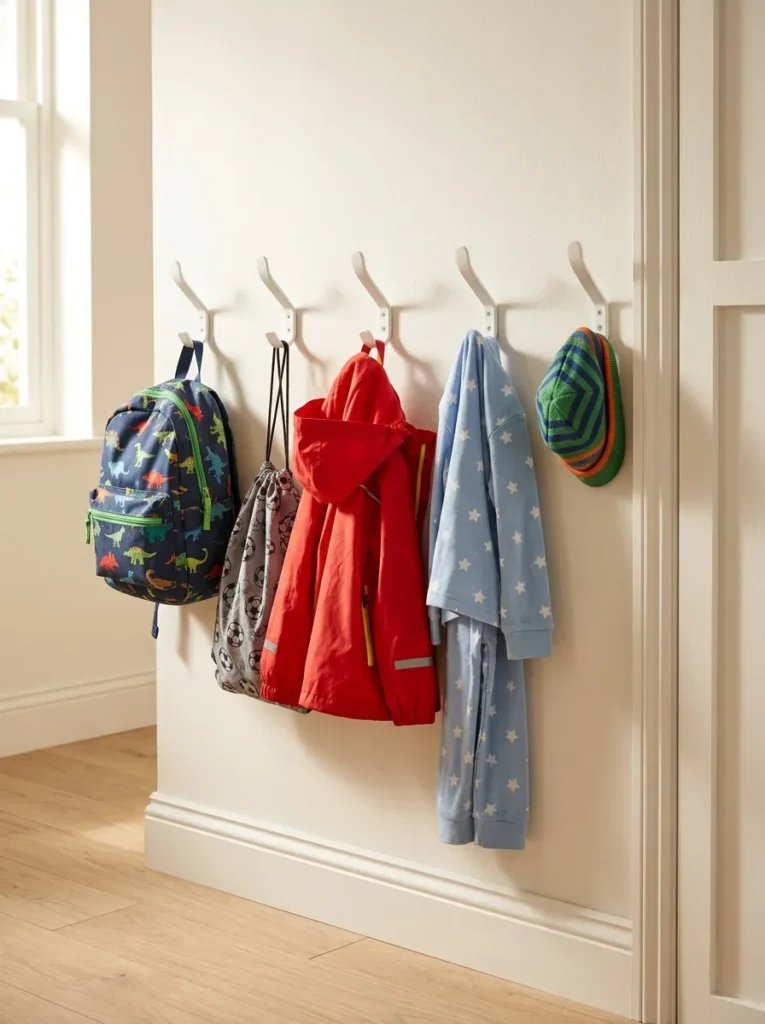
Vibe: Accessible and purposeful — the row of hooks that teaches a child where everything lives.
Why it works: Low wall-mounted hooks at child height apply the Montessori principle of accessible independence most directly of any closet organization idea — a hook at the right height is a hook a child can use every single day without adult assistance, which means the organization system maintains itself through the child’s own daily actions rather than requiring parental enforcement. Each hook has a designated purpose rather than being a general “hang something here” hook — the specificity of assignment (this hook is for the backpack, this one for tomorrow’s jacket) prevents the hook rail from becoming an undifferentiated pile of hanging things. Five specific hooks can replace five chaotic daily conversations about where things are.
How to get it: Install hooks at the child’s shoulder height — measure from the floor to the child’s shoulder and subtract 2 inches for the ideal hook height at which they can reach and hang items without straining. Use heavy-duty wall anchors for backpack hooks — a fully loaded school backpack can weigh 5–8 kg, which requires anchor-supported mounting rather than drywall screw-only installation. Label each hook with a small picture label below it identifying the designated item — visual labels are more effective than text labels for children under seven.
| Product |
|---|
| Matte white wall hook set of 5 |
| Heavy-duty wall anchor kit drywall |
| Picture label sticker set kids items |
| Coat hook rail mounted five hook white |
| Adhesive hook set heavy duty removable |
7. Pegboard Accessory Wall Inside Closet
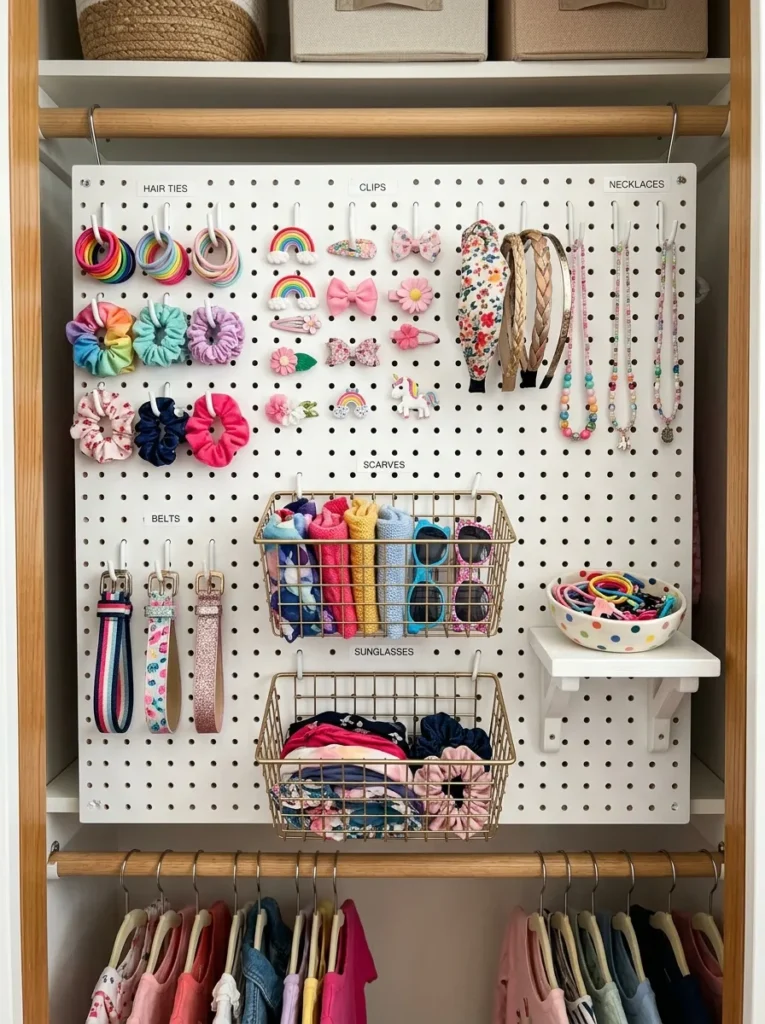
Vibe: Visual and organized — the back wall solution that makes accessories findable in seconds.
Why it works: A pegboard panel on the back wall of a reach-in closet converts the most underutilized surface in the closet — the back wall, typically completely bare — into a fully functional accessory organization system. The pegboard principle is visual inventory: every item displayed on hooks or in wire baskets is immediately visible without opening a drawer or searching a bin, which is the critical difference between an organization system a child will use and one they will abandon. The infinite reconfigurability of pegboard means the accessory layout can evolve as the child’s interests and wardrobe change without replacing the storage system.
How to get it: Mount a 2×4 foot pegboard panel to the closet back wall using 1-inch furring strips between the board and wall — the gap is essential for hook insertion. Paint the board white before mounting for a clean finish that reflects light into the closet interior. Begin with a basic hook and wire basket combination before adding specialty attachments — see how the child actually uses the space for two weeks before finalizing hook placement.
| Product |
|---|
| White pegboard panel 2×4 ft |
| Pegboard hook set assorted sizes |
| Pegboard wire basket set small |
| Pegboard shelf bracket set |
| Pegboard mounting furring strip kit |
8. Fabric Cube Shelf Organizer for Floor Storage
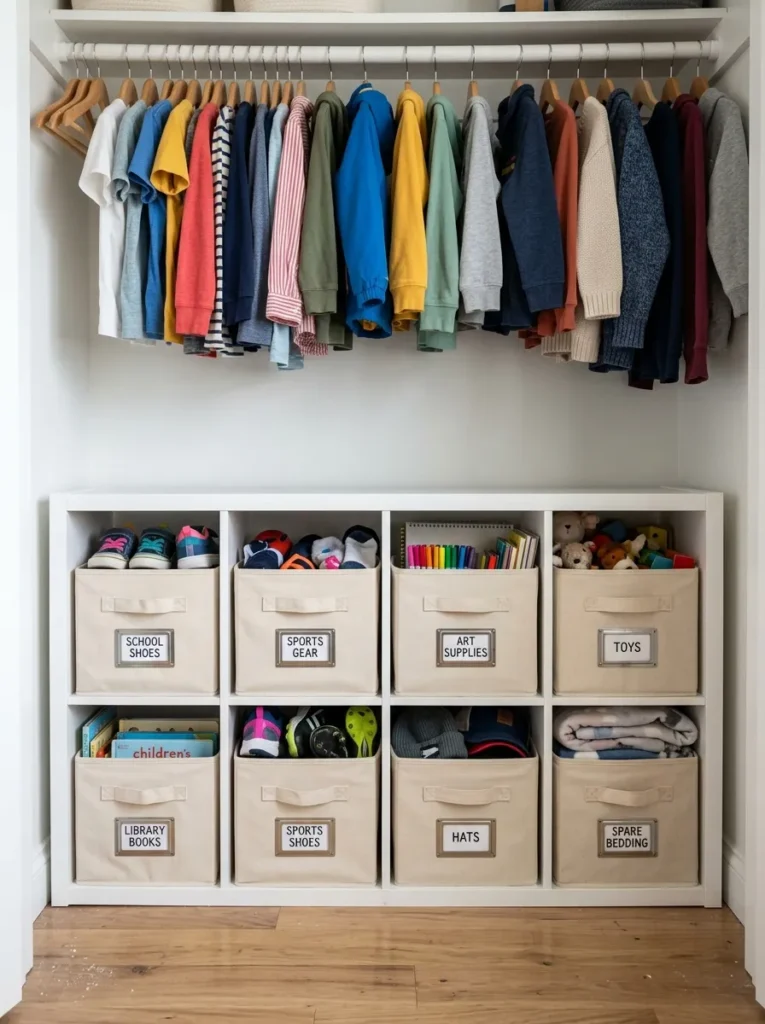
Vibe: Efficient and contained — the floor solution that makes the bottom of the closet as useful as the top.
Why it works: A fabric cube shelf organizer on the closet floor maximizes the floor space beneath hanging children’s clothes — which, on a double-hang system, is typically 24–30 inches of clear vertical space, enough to accommodate a two-row cube organizer without any clearance conflict with hanging items. The cube format is ideal for children’s closet floor storage because each cube is a contained, labeled category that a child can retrieve and replace as a unit — the entire sports gear cube comes out for practice and goes back in when gear is packed, rather than individual items being hunted across the closet floor. Canvas bins within cubes allow the specific category contents to be removed and carried to where they are needed.
How to get it: Measure the floor depth of the closet and the clearance between the floor and the lowest hanging garment on the lower rod before purchasing a cube organizer — these two dimensions determine the maximum organizer height and depth that will fit. Choose cube organizers with removable canvas bins that have label window inserts — these allow category labels to be changed as the child grows and storage needs evolve without replacing the bins.
| Product |
|---|
| Fabric cube shelf organizer 8-cube white |
| Canvas storage bin with label window natural |
| Label insert card set for bin windows |
| Cube shelf organizer 6-cube floor standing |
| Waterproof liner mat for cube shelf base |
9. Hanging Sweater and Jeans Shelves
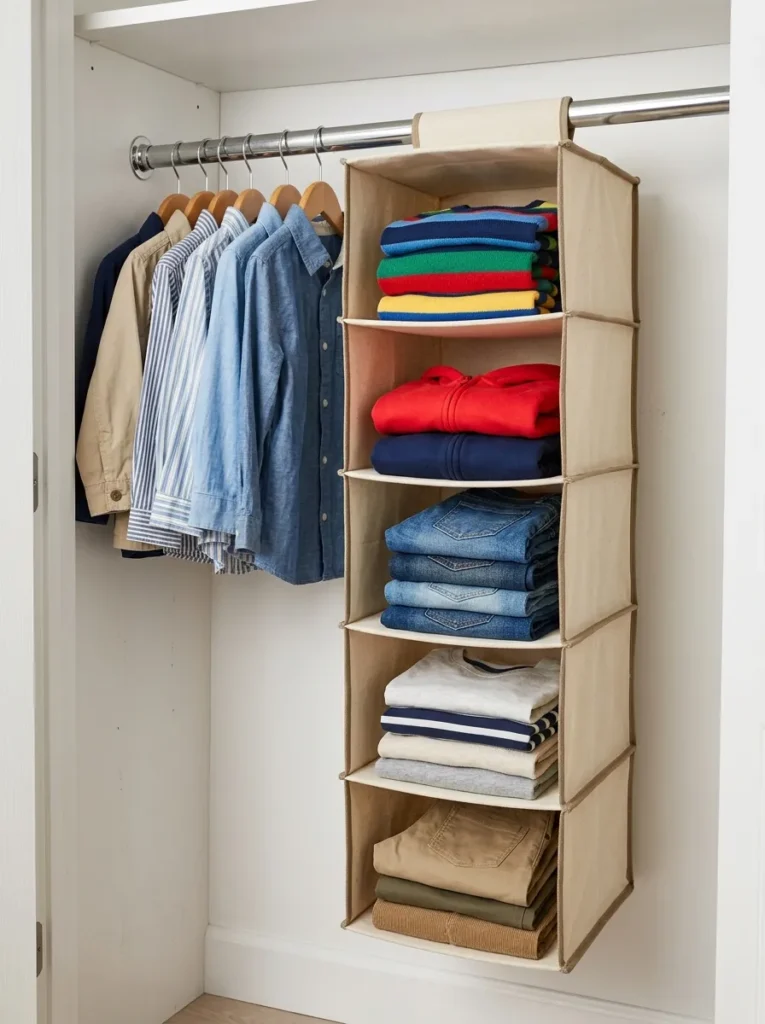
Vibe: Practical and space-smart — the hanging shelf that converts rod space into folded storage without using a single inch of floor or shelf space.
Why it works: Hanging fabric shelf organizers convert rod hanging space into folded storage space — they suspend from the closet rod itself, using the rod as their structural anchor rather than requiring shelf installation or floor space. This makes them the most installation-free closet storage upgrade available, working in any closet with a rod regardless of available wall or floor space. For bulky items like sweaters, jeans, and hoodies that are too thick to hang efficiently but too large to file-fold neatly in a drawer, the hanging shelf format provides accessible stacking storage at exactly the right location — beside the hanging clothes they coordinate with.
How to get it: Choose hanging shelf organizers with at least five shelves and reinforced shelf edges — reinforced edges prevent folded items from gradually pushing the shelf fabric sideways under their weight over time. Limit each shelf to 3–4 folded items of the same category — overloading causes shelf sag that makes retrieval and replacement difficult, defeating the organizational purpose. Dedicate one organizer to sweaters and one to jeans and heavier bottoms rather than mixing categories across shelves.
| Product |
|---|
| Hanging fabric shelf organizer 5-shelf canvas |
| Closet rod hanging shelf organizer deep |
| Hanging sweater shelf organizer with dividers |
| S-hook set chrome for rod hanging |
| Closet rod extension bar add-on |
10. Drawer Dividers for Small Item Chaos
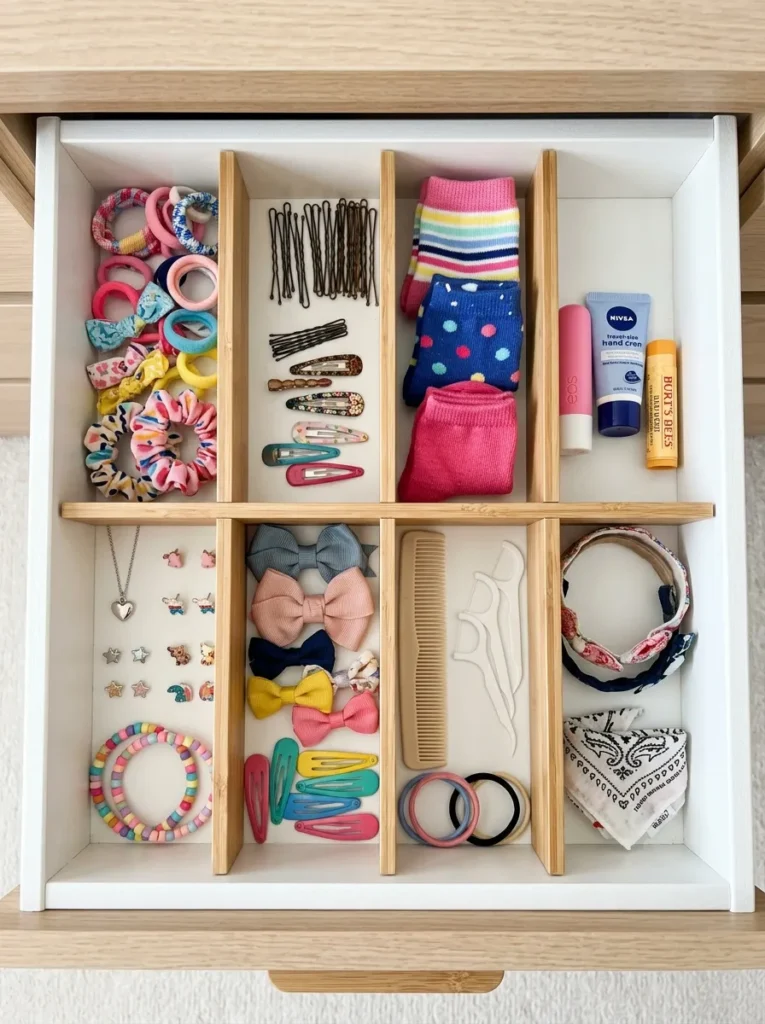
Vibe: Ordered and satisfying — the drawer that makes small items findable instead of lost forever.
Why it works: Drawer dividers apply the principle of contained micro-categorization — without dividers, a drawer of small items (hair ties, bobby pins, small socks, accessories) becomes a single undifferentiated container where items migrate and mix with every opening and closing of the drawer. Dividers create permanent geographic zones within the drawer that items cannot migrate between, maintaining category separation passively without requiring the child to actively organize. The adjustable format allows cell sizes to be matched precisely to the categories they contain rather than forcing items into fixed, arbitrary compartments.
How to get it: Measure the interior dimensions of the target drawer before purchasing dividers — drawer interior dimensions vary significantly between furniture pieces and many divider sets do not fit drawers shallower than 2 inches or narrower than 10 inches. Bamboo adjustable dividers are the most versatile option, fitting drawer widths from 10 to 20 inches by adjusting the divider length. Involve the child in deciding which categories get their own cell — children who participate in the categorization decision maintain the system more reliably.
| Product |
|---|
| Bamboo adjustable drawer divider set |
| Acrylic drawer organizer set small cells |
| Expandable drawer divider set white |
| Small item drawer organizer tray set |
| Velvet drawer liner non-slip |
11. Seasonal Rotation Bins on High Shelf
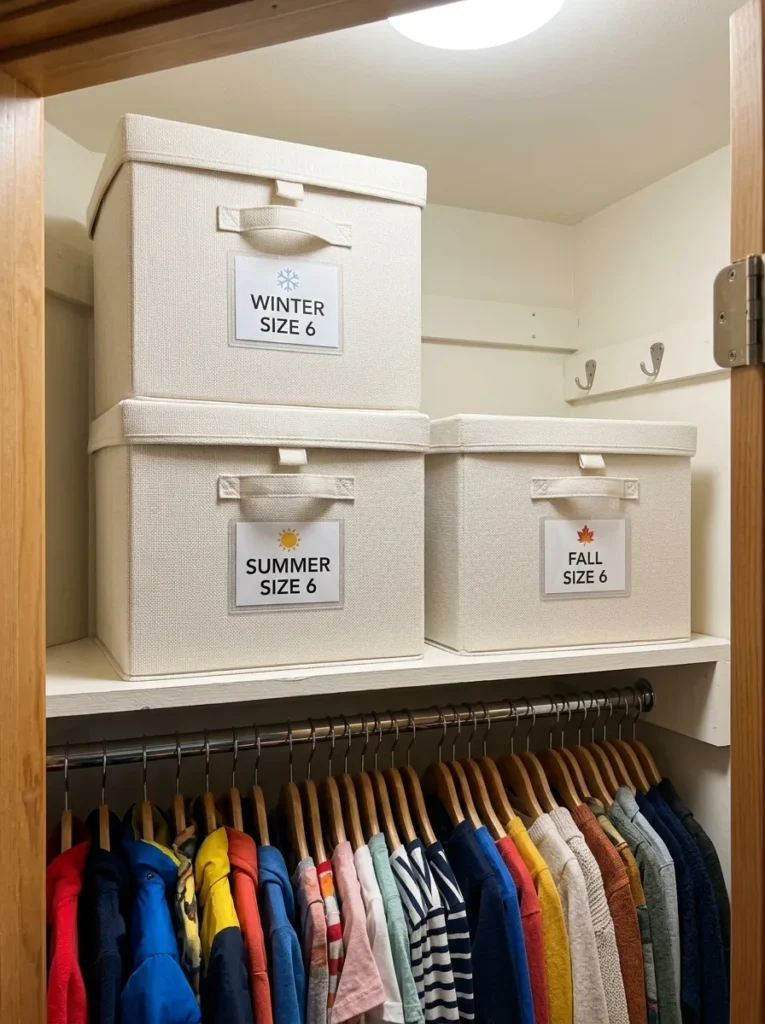
Vibe: Systematic and space-smart — the high-shelf solution that keeps out-of-season clothes accessible without cluttering active storage.
Why it works: Seasonal rotation bins on the high shelf apply the principle of tiered access — items needed every day live in the most accessible locations (child-height rod, low shelves, floor bins) while items needed only seasonally or occasionally live in the least accessible location (the high shelf above the closet rod). This vertical access hierarchy means the active-use zone of the closet stays uncluttered and efficiently organized, while the passive-storage zone holds the full wardrobe inventory without competing for space with daily-use items. Labeling bins with both season and size creates a complete historical wardrobe archive — next winter’s clothes are pre-sorted and labeled before they go up, ready to swap without additional sorting.
How to get it: Purchase large lidded bins with handles that allow one-handed retrieval from a high shelf while standing on a step stool — lids with integrated handles are significantly safer to retrieve from height than separate lid-and-bin combinations. Label every bin with both season and current size using a label maker before storing — when the bin comes down next season, the size label confirms immediately whether the contents still fit before the entire bin is sorted.
| Product |
|---|
| Large lidded storage bin with handle set |
| Label maker with large font tape |
| Step stool folding non-slip adult |
| Vacuum storage bag set for seasonal bulky items |
| Clear lidded bin set large stackable |
12. Mini Hamper Inside the Closet
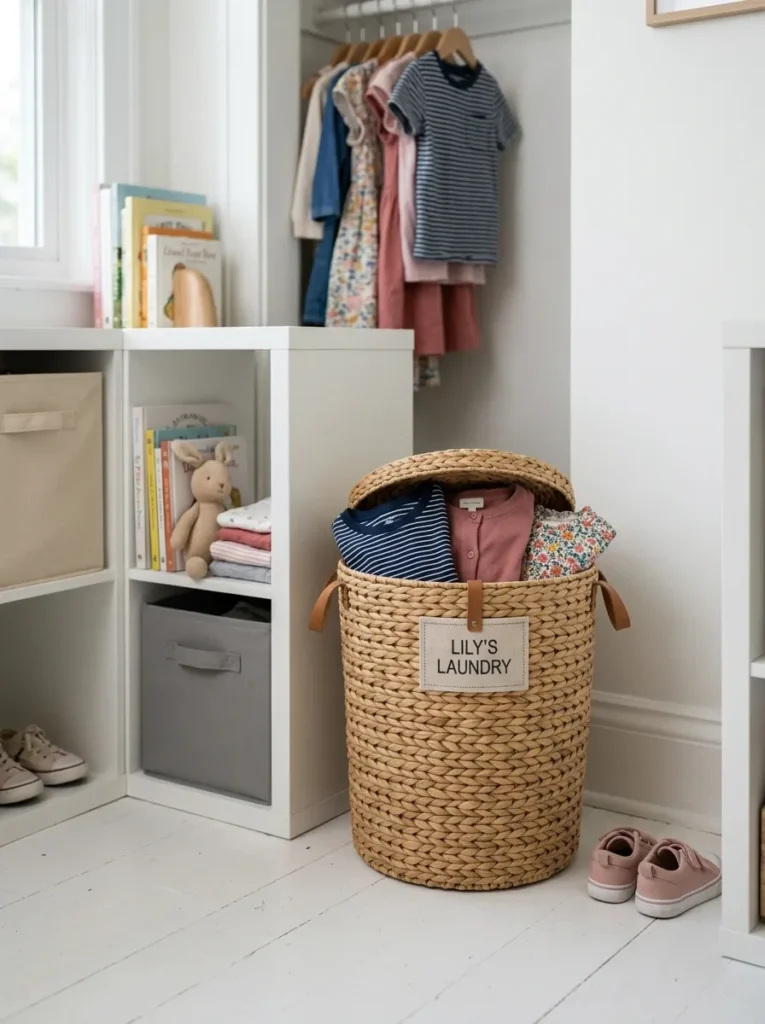
Vibe: Practical and tidy — the simple addition that stops dirty clothes from living on the floor.
Why it works: A hamper inside the closet rather than in the bedroom applies the principle of proximity to the point of use — dirty clothes come off at the closet, and a hamper at that exact location means the distance between removing a garment and depositing it correctly is zero steps rather than the ten or fifteen steps to a bedroom corner hamper. That distance reduction is the behavioral key: children (and adults) deposit dirty clothes on the nearest available horizontal surface, and placing the hamper at the point of undressing makes the correct behavior the path of least resistance. A compact, closet-sized hamper rather than a full bedroom-scale basket keeps the closet floor usable for other storage.
How to get it: Choose a hamper with a maximum diameter of 12–14 inches to fit within the available closet floor space alongside a cube organizer. Removable canvas liner bags within a wicker or fabric hamper outer make laundry transfer easier — the liner lifts out and goes directly to the laundry room. Personalize with the child’s name tag immediately — named objects in children’s spaces have measurably higher use rates than unnamed ones because the naming creates psychological ownership.
| Product |
|---|
| Small closet hamper wicker with liner |
| Canvas laundry bag with handles |
| Mini pop-up hamper foldable |
| Name tag set children’s personalized |
| Hamper bag with shoulder carry straps |
13. Shoe Rack on Closet Floor for Daily Shoes
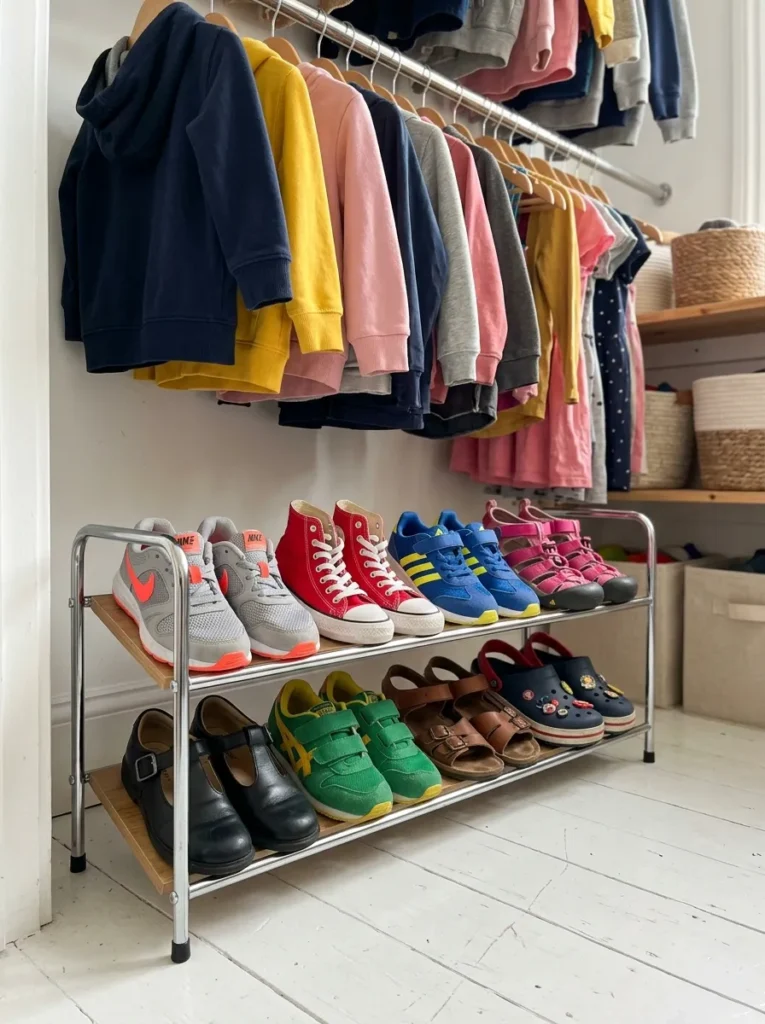
Vibe: Tidy and accessible — the floor solution that makes every shoe immediately identifiable and paired.
Why it works: A floor shoe rack inside the closet solves the missing shoe problem through designated pair-specific positioning — each pair has an assigned spot on the rack, and the toe-facing-outward convention makes every shoe immediately identifiable by its toe shape and color without picking it up. This is the adult equivalent of the over-door pocket system, scaled for school-age children who have outgrown small pocket sizes. The under-hanging-clothes position uses exactly the floor space that the hanging clothes’ extra clearance creates, making the shoe rack an efficient use of space that doesn’t compete with the cube organizer or hamper for closet floor real estate.
How to get it: Measure the floor space between the hanging clothes clearance and the closet door before purchasing — you need at least 12 inches of floor depth for a standard shoe rack. Choose adjustable-tier racks whose vertical spacing can be set to match children’s shoe heights — a fixed-spacing rack designed for adult shoes wastes vertical space between children’s smaller footwear. Assign specific rack positions to specific shoe pairs during setup and label with small adhesive dots or shoe silhouette stickers if the child needs visual prompting.
| Product |
|---|
| Two-tier adjustable shoe rack white |
| Children’s shoe rack stackable |
| Shoe rack with non-slip mat base |
| Shoe silhouette sticker label set |
| Expandable shoe rack adjustable width |
14. Hanging Jewelry and Hair Accessory Organizer
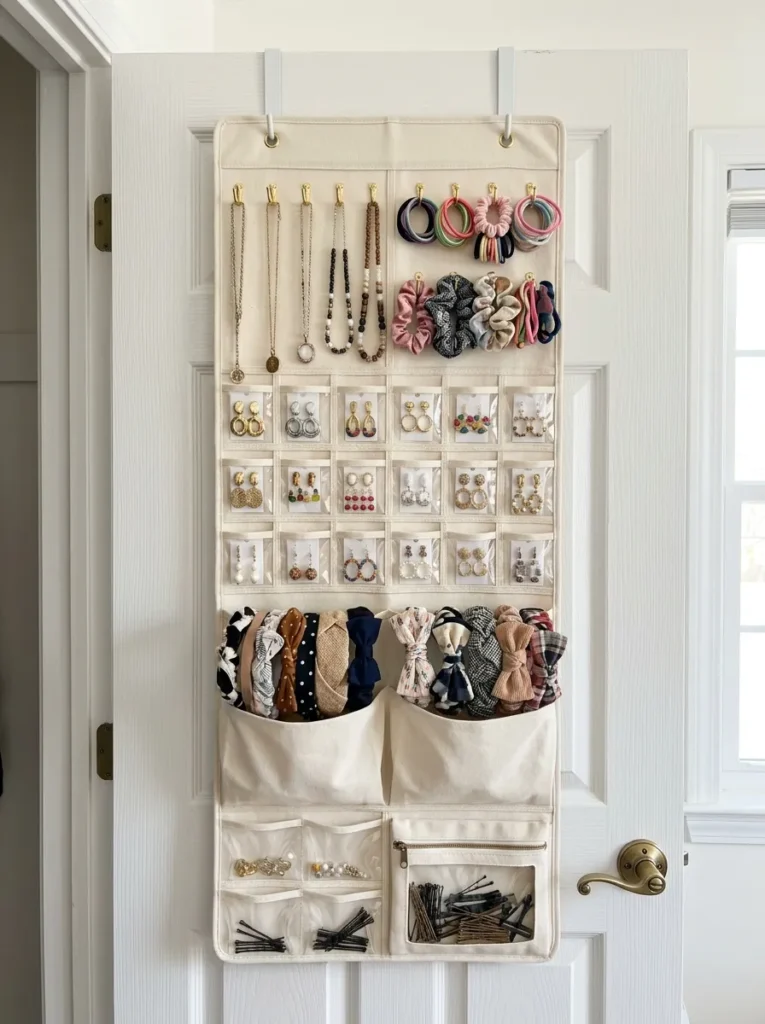
Vibe: Visual and complete — the accessory organizer that makes getting ready feel effortless.
Why it works: Hair accessories and jewelry are the category of children’s belongings most likely to end up scattered across every surface in the house — bathroom counter, bedroom floor, kitchen table — because there is typically no designated, accessible storage for them in the closet. An over-door hanging organizer with dedicated compartments for each accessory type solves the scattering problem by providing a specific, convenient home at the point where accessories are most often used: the closet, during dressing. Clear pocket fronts allow visual inventory — a child can see immediately that the purple hair tie is in the third pocket without opening every compartment.
How to get it: Choose a hanging organizer with a variety of compartment types rather than all-identical pockets — hair ties need small hooks, headbands need wide open-top pockets, necklaces need individual hooks to prevent tangling, and bobby pins need small contained compartments. Clear pocket fronts are non-negotiable for children’s accessory storage — opaque pockets require opening to see contents, which breaks the visual accessibility that makes the system work.
| Product |
|---|
| Hanging jewelry and accessory organizer clear pockets |
| Over-door hook set for organizer |
| Hair tie holder hook set rotating |
| Headband holder wall mount hoop |
| Jewelry organizer wall mount grid |
15. Closet Rod Dividers for Clothing Categories
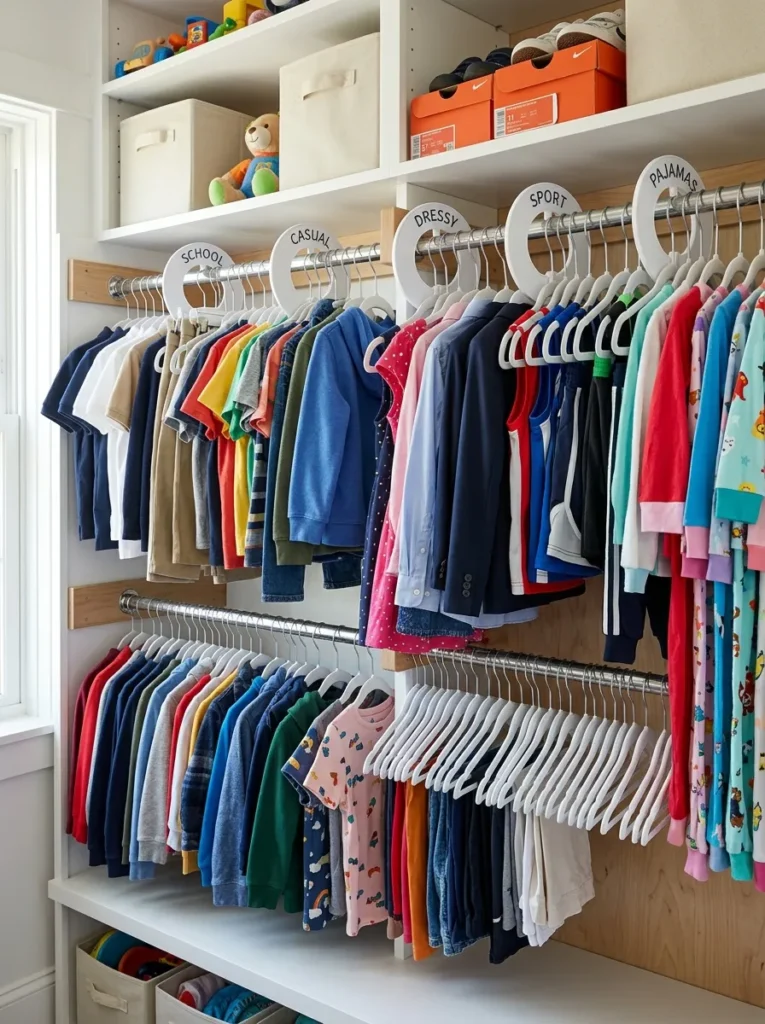
Vibe: Clear and systematic — the rod dividers that turn a clothing rod into a navigable wardrobe.
Why it works: Closet rod category dividers apply the principle of spatial labeling — rather than a single undifferentiated rod of hanging clothes that a child must scan entirely to find what they want, labeled dividers create defined sections that allow instant navigation to the correct category. A school-age child who knows their school uniform is always between the School and Casual dividers can retrieve it independently in seconds rather than sliding every hanger along the rod. The same divider system also simplifies putting clothes away after laundry — each freshly laundered item goes back into its designated section without requiring the child to decide where it belongs.
How to get it: Choose closet rod dividers that clip onto the rod without requiring any modification to the rod itself — clip-on dividers work on any rod diameter and can be repositioned easily as the wardrobe evolves. Label dividers in the child’s own handwriting or with their input to increase their ownership of and engagement with the organizational system. Start with five broad categories and add more specific subcategories only if the child demonstrates consistent use of the initial system.
| Product |
|---|
| Closet rod divider set labeled categories |
| Closet section divider clip-on set |
| Hanging category label set closet rod |
| White slim velvet hanger set 50 pack |
| Closet rod organizer with label clips |
16. Stackable Clear Shoe Boxes for Special Footwear
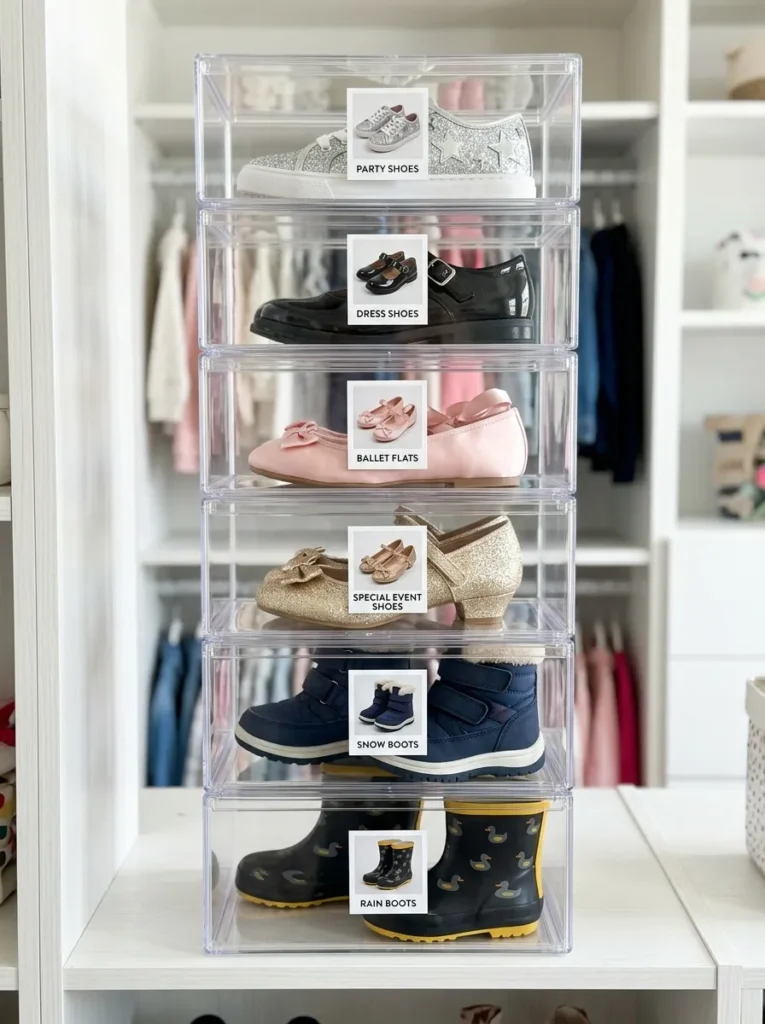
Vibe: Organized and protective — the shelf solution that keeps special shoes findable, protected, and paired.
Why it works: Clear stackable shoe boxes solve the special footwear storage problem that neither floor racks nor over-door pockets handle well — bulky seasonal footwear like snow boots and rain boots, and delicate occasion footwear like ballet flats and dress shoes, need protection from dust and crushing while remaining identifiable without removing every box from the stack. Clear walls allow instant visual identification, lidded tops protect from dust, and the stackable format maximizes shelf height efficiency. Photo labels on each box front add a second identification layer — even a pre-reader can match the photo label to the shoe they are looking for.
How to get it: Measure children’s footwear before purchasing shoe boxes — children’s snow boots and rain boots often require a deeper or taller box than standard clear shoe boxes accommodate. Choose boxes with drop-front openings rather than fully removable lids if the boxes will be stacked more than three high — drop-front access allows retrieval of a lower box without destabilizing the entire stack. Photograph each shoe pair before boxing and print as a 5x3cm photo to laminate and adhere to the box front as the identification label.
| Product |
|---|
| Clear stackable shoe box set drop-front |
| Clear lidded shoe box large size |
| Photo label laminating pouch set small |
| Adhesive label holder strip clear |
| Shoe box stack organizer shelf |
17. Magnetic Memo Board for Outfit Notes
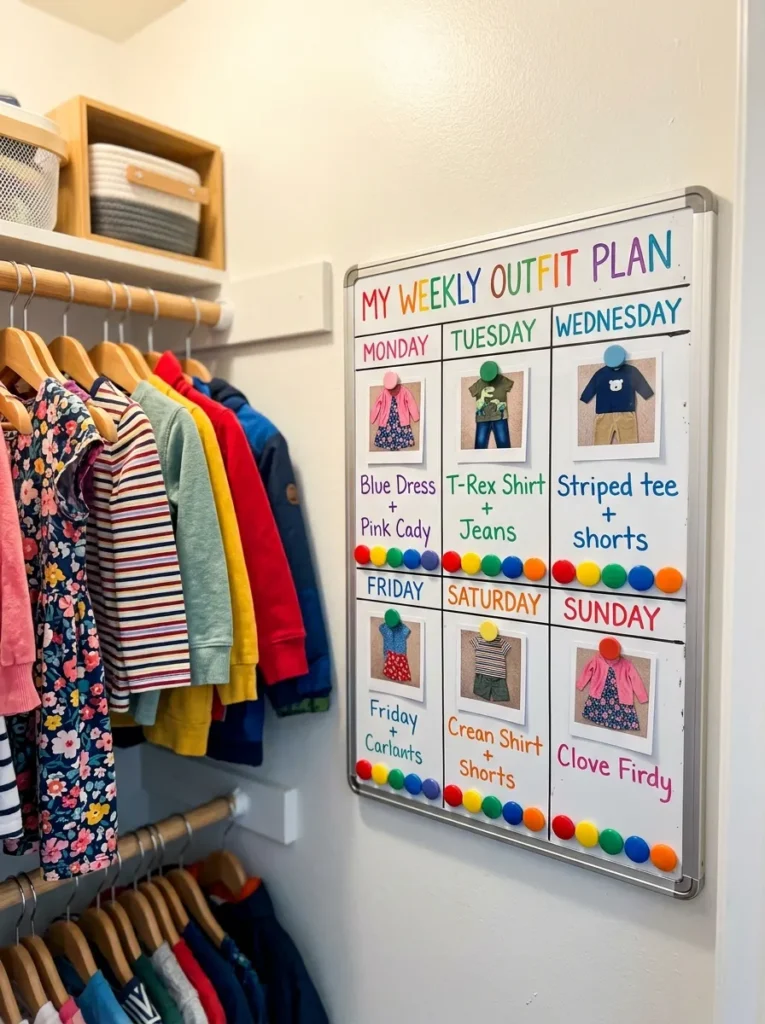
Vibe: Fun and organized — the closet addition that makes planning outfits feel like a game rather than a chore.
Why it works: A magnetic memo board inside the closet applies the principle of visible planning at the point of use — the outfit plan is displayed exactly where the clothes are, eliminating the disconnect between a planning system elsewhere in the room and the clothing location where decisions are executed. For children who are learning to plan ahead and develop organizational habits, a visible board they have written themselves creates accountability and engagement with the planning process that a parent-maintained system cannot. Colored markers and magnetic photo pins make the planning tool appealing enough to use voluntarily rather than feeling like a parental organizational imposition.
How to get it: Choose a small magnetic whiteboard — 30x20cm is sufficient for a weekly grid — with an included marker tray that attaches to the board frame rather than sitting loose. Mount with removable adhesive strips to avoid wall damage inside the closet. Set up the weekly grid together with the child on the first use and let them write the day names in their own style — ownership of the board’s appearance increases ownership of the system it supports.
| Product |
|---|
| Small magnetic whiteboard 30×20 cm |
| Colored dry-erase marker set thin tip |
| Photo magnet set small print size |
| Colored magnetic dot set |
| Whiteboard adhesive mounting strip set |
18. Canvas Hanging Organizer for Folded Extras
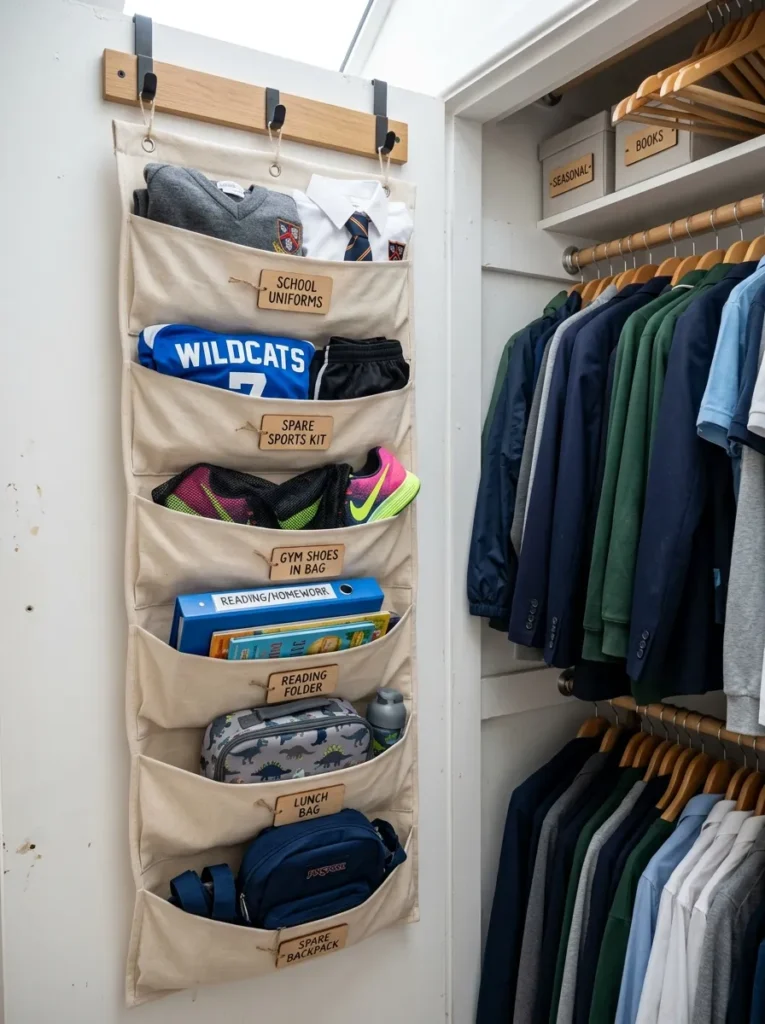
Vibe: Efficient and comprehensive — the wall organizer that handles the category of things that don’t fit anywhere else.
Why it works: A canvas wall hanging organizer with multiple pockets handles the most organizationally challenging category of children’s belongings — the irregular, medium-sized items that are too big for drawer compartments, too awkward for hanging rods, and too numerous for individual shelf assignments. Spare school uniforms, sports kit, library bags, lunch bags, and reading folders all belong to this category, and without a designated storage system they migrate to the floor, the chair, and every other horizontal surface in the room. Wall-mounted pockets keep these items contained, labeled, and at child-accessible height without consuming floor or shelf space.
How to get it: Choose canvas wall organizers with pockets of varying depths rather than all-identical pocket sizes — the variety accommodates the irregular sizes of the items this organizer category is designed to hold. Mount at a height where the bottom pocket is at the child’s waist level — this ensures every pocket is within independent reach. Label each pocket with a handwritten or printed tag describing its designated category before filling.
| Product |
|---|
| Canvas hanging wall organizer 6 pocket |
| Over-door canvas organizer multi-pocket |
| Canvas pocket organizer wall mount |
| Label tag set for pocket organizer |
| Adhesive hook set for wall mounting |
19. Uniform or Sports Kit Dedicated Section
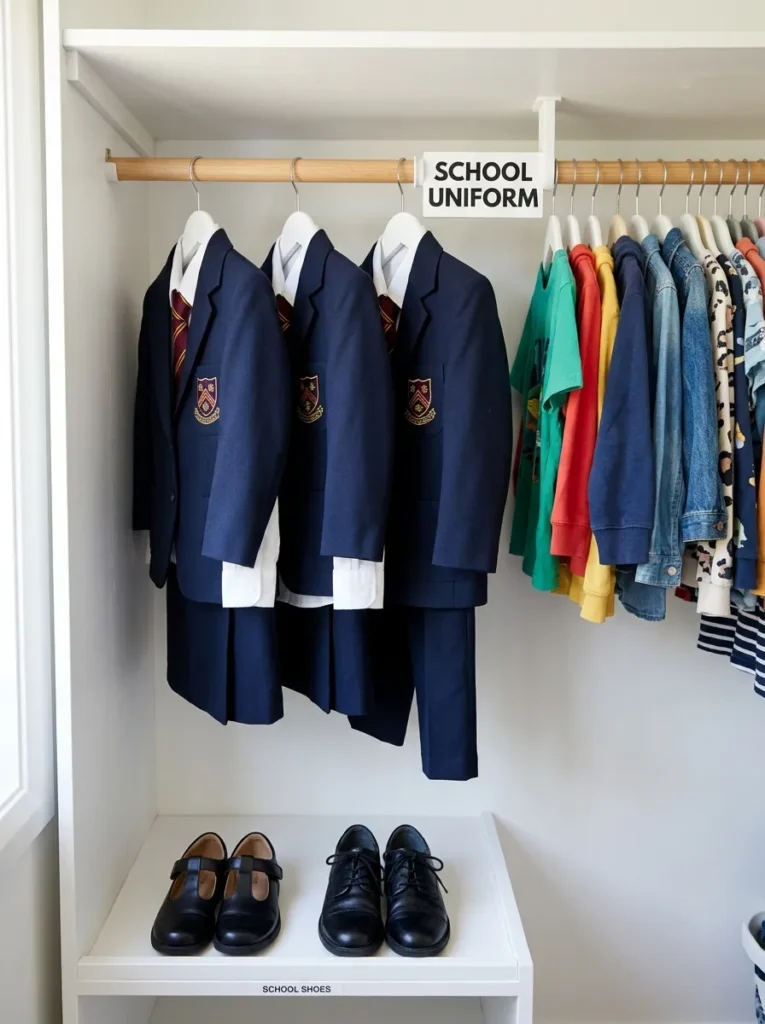
Vibe: Ready and organized — the dedicated section that means school morning is never a scramble.
Why it works: A dedicated uniform or sports kit section applies the principle of use-context grouping — organizing by occasion or activity rather than by garment type, keeping everything needed for school in one location and everything needed for sport in another. When a child needs their school uniform, they go to one section of the closet and everything required is there — uniform shirt, trousers or skirt, and shoes on the shelf below — rather than assembled from multiple locations across the closet. This single-location retrieval principle reduces morning preparation time more than any other organizational change because it eliminates the multi-location search that creates time pressure.
How to get it: Designate one end of the closet rod as the school uniform or sports kit zone and mark the boundary with a labeled rod divider. Keep only currently fitting, clean, and ready-to-wear items in this section — do not use it as overflow uniform storage. Position the dedicated shoe storage (floor rack position or small shelf) directly below the uniform section so the complete outfit including footwear is retrieved from a single closet location.
| Product |
|---|
| Closet rod section divider labeled uniform |
| Small wall shelf for shoe storage below rod |
| Matching white slim hanger set 20 pack |
| Uniform garment bag set breathable |
| Sports kit bag hanging hook |
20. Closet Door Mirror with Hook Rail
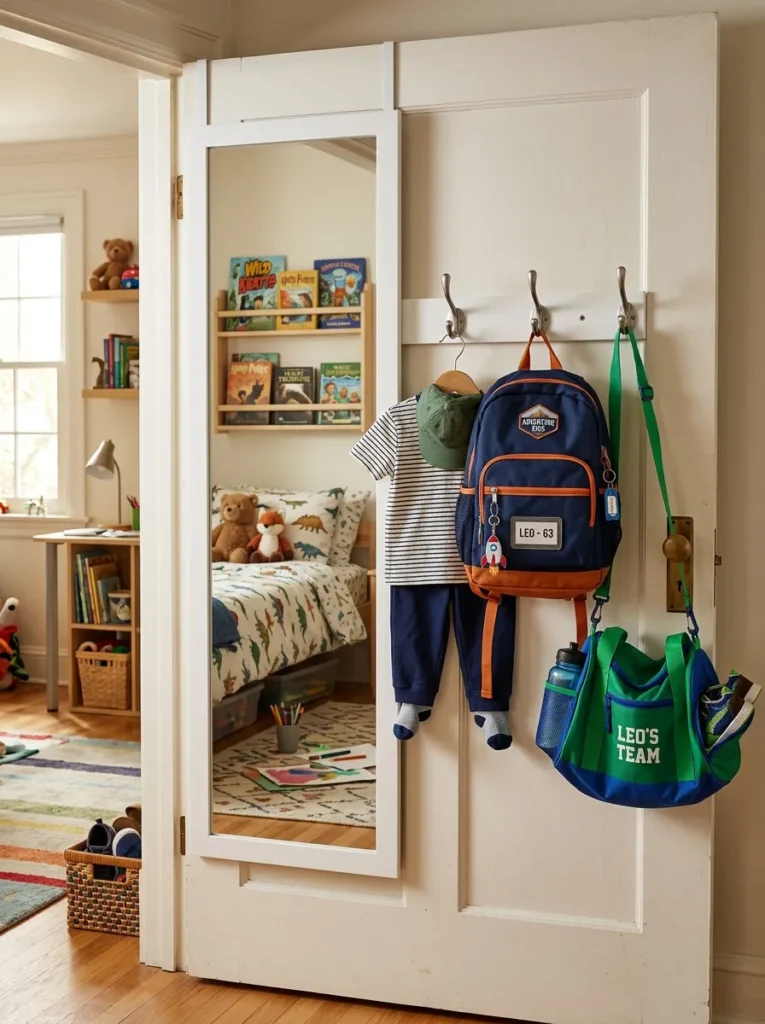
Vibe: Functional and practical — the door addition that consolidates the entire morning routine into one location.
Why it works: A full-length mirror with an integrated hook rail converts the closet door into a complete morning preparation station — the mirror for checking the outfit, the hooks for staging the next day’s items the evening before. The design principle is morning preparation consolidation: everything needed for the morning transition from home to school is staged in one location the night before, eliminating the real-time searching that creates morning stress. For children developing self-care independence, a full-length mirror at their height is a developmental tool as much as a practical one — the ability to check their own appearance before school builds self-assessment skills that adult-height mirrors do not support.
How to get it: Choose an over-door mirror with hook rails rated for door weight — full-length mirrors are heavy, and the over-door mounting must be rated for the combined weight of the mirror and hung items without pulling the door off its hinges. Position the hook rail on the hinge side of the door rather than the latch side — items hung on the latch side can prevent the door from closing fully. Include at least three hooks: one for the next-day outfit on a hanger, one for the school bag, and one for a sports or activity bag.
| Product |
|---|
| Over-door full-length mirror with hook rail |
| Full-length door mirror large |
| Over-door hook rail set 3 hook |
| Mirror mounting safety strip set |
| Over-door hook heavy duty set of 4 |
21. Labeled Photo Bins for Toy Overflow Storage
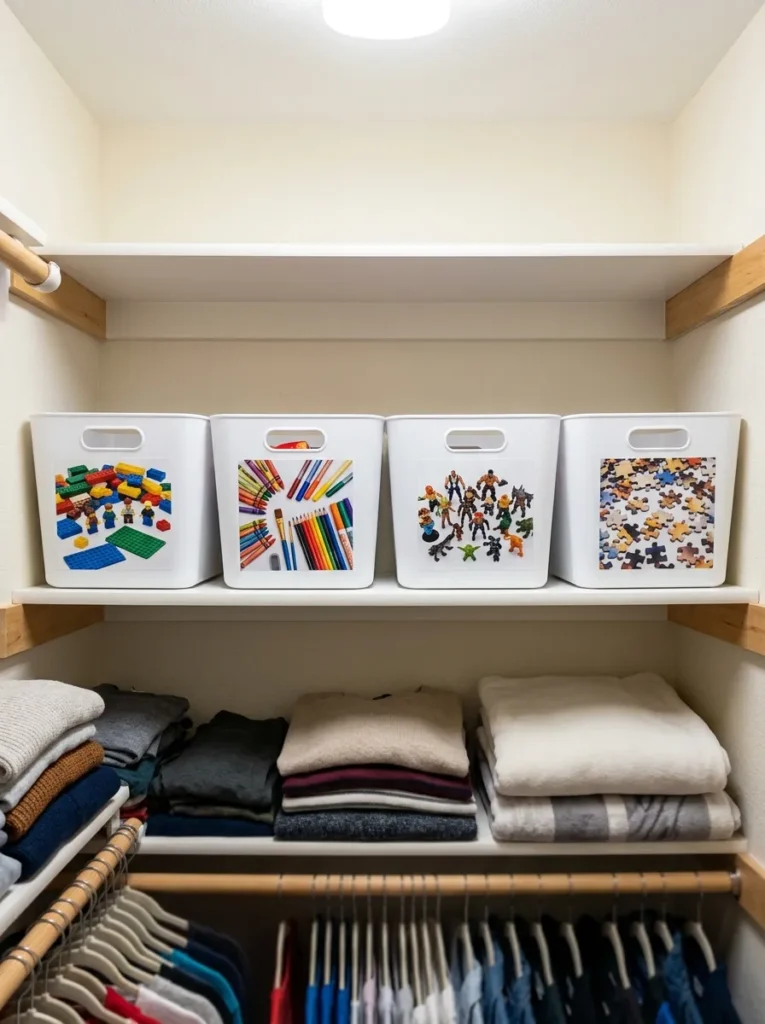
Vibe: Visual and practical — the toy overflow system that children can actually use independently.
Why it works: Photo-labeled bins for toy overflow storage in the closet apply the principle of visual literacy in organization systems — a photograph of the bin’s contents communicates to pre-readers and reluctant readers with equal effectiveness as a text label, and communicates faster than text labels to readers of any age because image recognition is faster than word decoding. The closet shelf position keeps toy overflow out of the active play area while maintaining accessibility — a child can retrieve the Lego bin for an afternoon of play and return it to the shelf without adult assistance. This keeps the bedroom cleaner and the closet organized simultaneously.
How to get it: Photograph each toy category in its bin before labeling — a photograph of actual Lego pieces in the bin creates more effective recognition than a generic Lego box image. Print photos at 8x6cm, laminate with self-adhesive laminating pouches, and attach to the bin front using adhesive velcro — the velcro mounting allows the photo label to be replaced as bin contents change over time without damaging the bin surface.
| Product |
|---|
| White storage bin set with label panel |
| Self-adhesive laminating pouch set small |
| Adhesive velcro dot set for label mounting |
| Photo printing paper matte 4×6 |
| Open-top storage bin set white large |
22. Adjustable Closet System for Growing Children
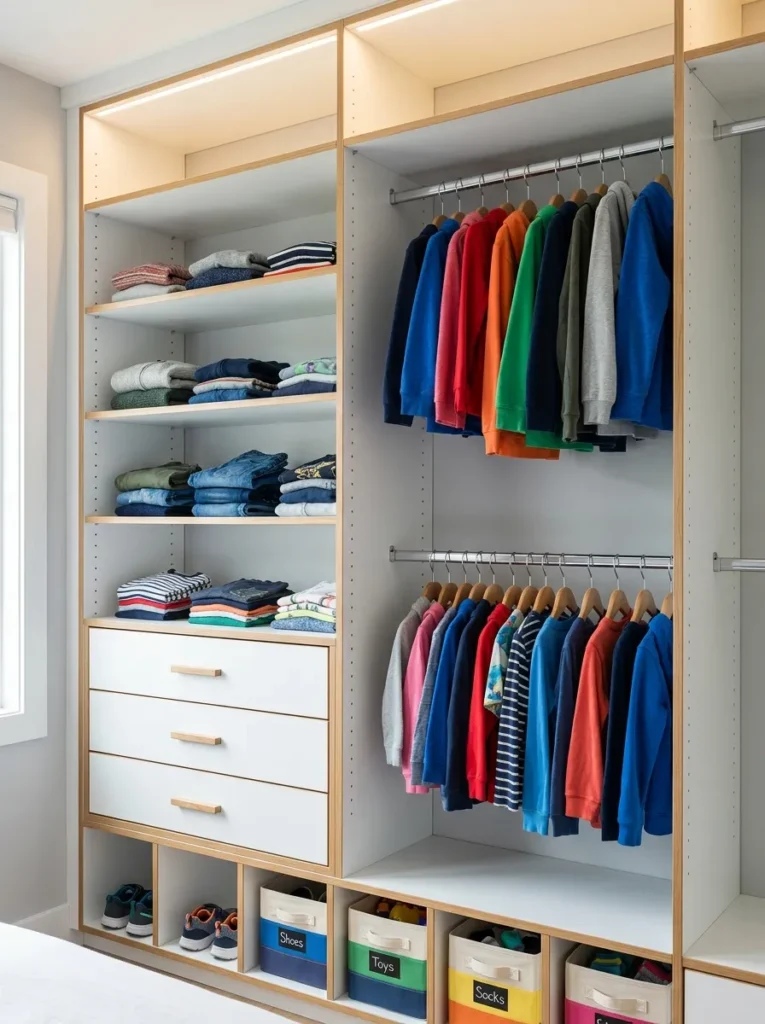
Vibe: Organized and adaptable — the closet system that grows with the child so you never have to replace it.
Why it works: An adjustable modular closet system is the single highest-return investment in children’s closet organization because it eliminates the need to replace or reconfigure the storage infrastructure as the child grows — rod heights adjust upward as the child’s reach increases, shelf heights adapt as storage categories change from toddler toy bins to teenage shoe collections, and drawer units can be added or removed as folded storage needs evolve. The design principle is future-proofed adaptability: rather than optimizing for the child’s current age and replacing in 3–4 years, an adjustable system is configured for current needs and reconfigured in 15 minutes when those needs change.
How to get it: Measure the closet opening width and depth precisely before purchasing any modular system — most systems are designed for standard closet widths of 24, 48, 60, or 72 inches, and fitting a system to a non-standard width requires cutting panels, which voids most warranties. Choose systems with shelf pin holes at 2-inch intervals rather than 4-inch intervals — finer adjustment increments allow more precise shelf height optimization. Install the system yourself using the manufacturer’s instructions and a single helper — most modular closet systems are designed for two-person installation without specialized tools.
| Product |
|---|
| Adjustable modular closet system white |
| Closet organizer kit adjustable rod shelves |
| Modular closet shelf unit add-on |
| Closet rod adjustable width chrome |
| Modular drawer unit closet insert |
How to Start Your Kids Closet Organization Transformation
Start by lowering the hanging rod. Before purchasing a single bin, basket, or organizer, lower the existing closet rod to your child’s shoulder height — or add a second rod below the existing one at that height. This single structural change, which costs nothing if you already have a double-hang kit or under $25 if you need to purchase one, makes every subsequent organizational addition more effective because it establishes child accessibility as the foundational principle of the space. A perfectly organized closet at adult height is still a closet a child cannot use independently.
The most common mistake parents make when organizing a kids closet is organizing the space for how they want it to look rather than for how the child will actually use it. A beautifully folded stack of clothes in an open shelf looks organized for approximately one retrieval before the child pulls out the bottom item and destroys the entire stack. A file-folded stack in a clear bin looks less immediately impressive but survives 200 retrievals without losing its organization because the file-fold system allows any item to be removed without disturbing others. Always test every organizational decision against the question: can my child use this correctly independently, every single day?
Three items under $50 that make an immediate impact: A 50-pack of slim white velvet hangers ($14) that immediately makes any hanging rod look organized by replacing the wire, plastic, and mismatched hangers that accumulate in every kids closet over time; a set of six clear stackable bins with label holders ($18) that transforms any shelf from a stacking zone into a navigable organized system; and an over-door 24-pocket clear shoe organizer ($12) that solves the missing shoe problem permanently on day one of installation.
Realistic expectations: Organizing a small reach-in kids closet from scratch — clearing, categorizing, installing a double-hang rod, adding bins and labels — takes one focused 3–4 hour session and typically costs $50–$120 in organizational products depending on starting condition. A mid-level closet overhaul adding a modular system, canvas bins, pegboard, and door organizers runs $150–$300 in materials and takes a full weekend. A full walk-in kids closet transformation with a custom adjustable system, built-in drawers, and complete accessory organization typically costs $400–$800 DIY installed — a fraction of the $1,500–$3,000 cost of professional children’s closet installation at equivalent quality.
Frequently Asked Questions About Kids Closet Organization Ideas
At what age can children start maintaining their own closet organization?
Children as young as three can independently retrieve and replace items from a properly designed organizational system — one where rods are at shoulder height, bins are at floor level, and every category has a visual label they can recognize. At this age, the child maintains the system rather than designing or setting it up. By ages five to seven, children can participate meaningfully in category decisions and begin to understand the logic of the organizational system beyond pure procedural memory. By ages nine to twelve, children can design and set up their own organizational systems with parental guidance, which is the developmental milestone that organizational skills training is working toward.
What is the most important first change to make in a disorganized kids closet?
Lower the hanging rod to child-accessible height above every other change. A closet organized at adult height is one that requires adult participation for every retrieval and return, which means the organization depends on parental maintenance rather than child participation. Child-height accessibility is the single prerequisite that makes every other organizational system in the closet self-maintaining — once the child can independently use the space, the space stays organized through daily use rather than weekly parental restoration sessions.
How do I organize a kids closet when two children share it?
Divide the closet into clearly defined personal zones using color-coded systems — assign each child a specific color for their hangers, bin labels, and shelf sections, and maintain that color association consistently across every organizational element in the shared closet. Physical dividers like labeled closet rod dividers at the center point of the rod, combined with separate bin sets for each child’s shelf sections, create visual boundaries that children respect more consistently than verbal rules alone. Each child should have at least one zone that is entirely theirs and entirely private — a personal bin or basket that the other child’s belongings never enter.
How often should a kids closet organization system be reset or reorganized?
A well-designed kids closet system needs a full reorganization approximately twice per year — at the seasonal clothing changeover points in spring and fall — to rotate seasonal items, assess size changes, and retire items that no longer fit. Minor adjustments happen naturally: when a child moves up a clothing size, the relevant bin labels are updated; when a new category of belongings appears (a new sport, a new hobby), a new bin or hook is added. The organizational system is working correctly when these minor adjustments can be made in under 15 minutes without disrupting the overall structure — a system that requires a full overhaul more than twice per year is a system whose category structure does not match the family’s actual storage needs.
What is the best way to label a kids closet organization system for pre-readers?
Photo labels outperform both text labels and icon/symbol labels for pre-readers because photographic recognition is faster and more accurate than symbol interpretation for children under five. Take photographs of actual items that belong in each bin or basket — a photo of the child’s actual pajamas for the pajama bin, a photo of their actual shoes for the shoe rack location. Print at 8x6cm, laminate, and attach with adhesive velcro so labels can be easily updated. Picture labels serve pre-readers effectively, remain useful as a quick-scan system for emerging readers, and become redundant naturally as full reading develops — at which point simple text labels replace them without any other system change required.
Ready to Create Your Dream Kids Closet Organization System?
These 22 ideas cover the full range of what a kids closet can become — from the foundational double-hang rod and clear bin systems that work in even the smallest reach-in closet, to the adjustable modular system that grows with the child across every developmental stage from toddler to teenager. Every kids closet transformation begins with a single decision, and lowering the hanging rod to child height this weekend is a complete, meaningful first step that will change how your child interacts with their space from the very next morning. Right now, measure the distance from your child’s shoulder to the floor, walk to your closet, and assess whether the current rod is accessible to them without adult help — if it is not, that is the first thing to change, and everything else builds from there. Once your child can use their closet independently, the room stays cleaner, the mornings run faster, and the organizational habits they build in their own space follow them for the rest of their lives. Save the ideas that match your closet size, your child’s age, and your family’s daily rhythm — and start from that first rod adjustment.