17 Festive Christmas Wall Art Ideas for Every Home
Christmas wall art refers to decorative pieces — framed prints, DIY painted canvases, fabric hangings, botanical installations, paper art, and dimensional arrangements — displayed on walls specifically for the Christmas season to create festive atmosphere, visual warmth, and the specific sense of occasion that distinguishes the holiday home from its year-round state. This article gives you 17 Christmas wall art ideas across framed prints, DIY painted pieces, botanical installations, textile hangings, paper and shadow box art, gallery wall arrangements, and small-space solutions so every wall in your home contributes to the season’s warmth and character.
A Christmas wall that is genuinely beautiful rather than merely seasonal requires the same design intelligence as any other wall treatment — the right scale for the space, the right material quality for the aesthetic, the right relationship between the wall art and the room’s existing color palette and furniture. The difference between Christmas wall art that elevates a room and Christmas wall art that makes a room look decorated is the same difference that separates good interior design from decoration in every other context: intention, quality, and compositional restraint. Here are 17 ideas worth saving — and hanging.
Why Christmas Wall Art Transforms the Holiday Home
Christmas wall art draws from the ancient tradition of seasonal threshold and wall marking — the Roman practice of hanging evergreen boughs on doorways and walls at the winter solstice, the medieval tapestry tradition that transformed stone castle walls into warm textile environments for winter gatherings, and the Victorian Christmas card culture that elevated printed seasonal imagery to a domestic art form. What all these traditions share is the recognition that the visual environment of winter gathering spaces directly shapes the emotional quality of the gatherings themselves — a wall bearing evidence of seasonal care creates a room that feels designed for the occasion rather than merely available for it.
The material palette of sophisticated Christmas wall art is wider than the conventional red-and-green commercial holiday aesthetic suggests. Deep forest green and rich burgundy remain the most seasonally resonant colors, but their most elegant expression is in matte, desaturated versions — the dark green of preserved cedar and pine, the deep burgundy of dried cranberry and dogwood — rather than the bright, saturated red-and-green of commercial Christmas decoration. Natural materials — preserved botanicals, dried citrus, beeswax, raw linen, natural rope, and unfinished wood — provide the material warmth that mass-produced plastic and metallic alternatives cannot. Warm gold (specifically unlacquered brass and natural beeswax tones rather than bright chrome gold) is the metallic accent that reads as genuinely festive without the tinsel-and-garland excess of conventional Christmas decoration.
The contemporary Christmas aesthetic — increasingly characterized by the Scandinavian-influenced preference for warm neutrals, natural botanical materials, and quiet handmade quality — has created the cultural space for Christmas wall art that is simultaneously festive and sophisticated, seasonal without being garish, and specific to the holiday without being clichéd. The plaid wool banner, the botanical wreath on the gallery wall, the framed vintage seed catalogue print of a Christmas rose — these are wall art choices that Christmas-design-literate homeowners make with the same consideration they give to their year-round gallery walls.
Small spaces respond particularly well to Christmas wall art because vertical surfaces are the most space-efficient decorating canvas — a single significant piece on the primary wall of a small living room or apartment creates more visual impact than a crowded surface arrangement at floor level. One well-chosen framed print, a single botanical swag, or a small gallery of holiday prints makes a complete Christmas statement in a 400-square-foot apartment without consuming any floor space.
Style at a Glance
| Element | Detail |
|---|---|
| Philosophy | Seasonal intention expressed through quality materials and considered composition rather than commercial holiday cliché |
| Key Materials | Preserved botanicals, natural linen, raw wood, dried citrus, beeswax, unlacquered brass, matte black frames |
| Key Colors | Deep forest green, rich burgundy, warm cream, natural gold, matte black, dusty sage |
17 Festive Christmas Wall Art Ideas for Every Home
1. Framed Vintage Botanical Christmas Print Gallery
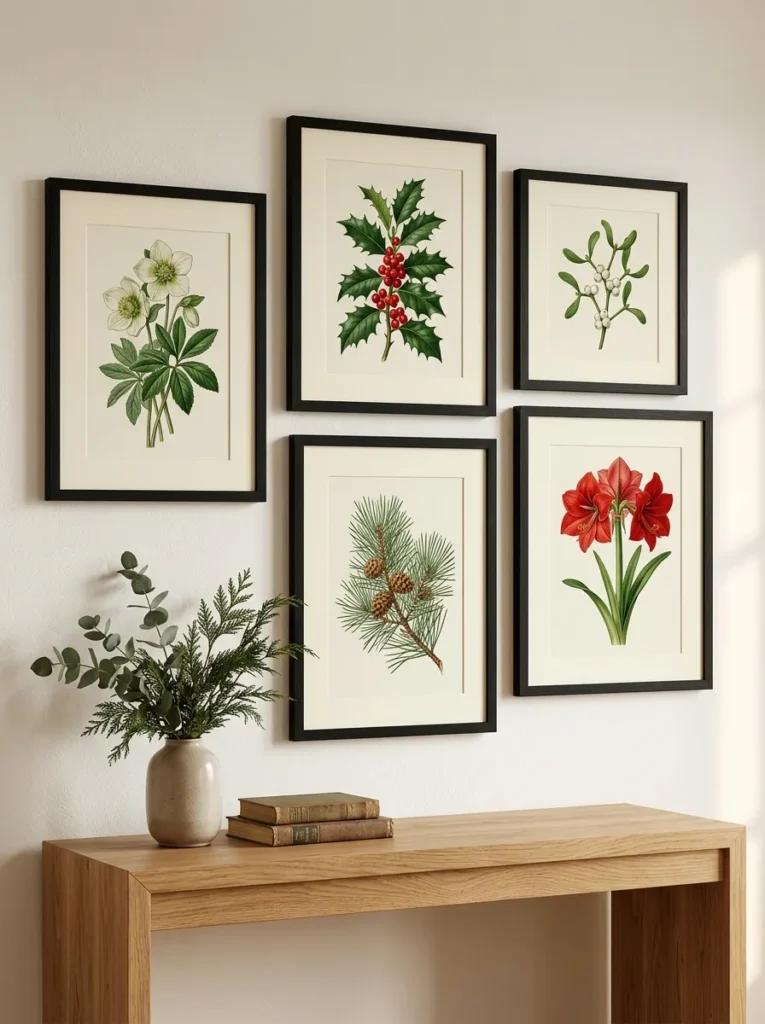
Vibe: The gallery is sophisticated — vintage botanical Christmas prints in matched matte black frames with wide cream mats create a wall that reads as a curated art collection that happens to celebrate the season, where the botanical illustration quality elevates the Christmas subject matter to genuine wall art.
Why it works: Vintage botanical illustration is one of the most consistent entry points for sophisticated Christmas wall art because the genre — which dates to the 18th and 19th centuries of European natural history illustration — carries inherent visual authority that transforms seasonal subjects (holly, mistletoe, hellebore, pine) from commercial Christmas symbols into genuinely beautiful natural objects. The wide cream mat and matte black frame combination is the gallery installation choice that most consistently elevates printed content to art-gallery status — the mat creates visual breathing room and signals intentionality, while the matte black frame provides graphic weight without the decorative complexity of ornate or colored frames. A gallery of five prints in this treatment reads as a considered seasonal installation rather than a decoration.
How to get it: Source vintage botanical Christmas prints from public domain archives — the Biodiversity Heritage Library (biodiversitylibrary.org), the Smithsonian Institution’s digital collections, and the Royal Horticultural Society’s image archive all offer free high-resolution downloads of vintage botanical illustrations including hellebore, holly, mistletoe, and amaryllis. Print at 8×10 or 11×14 inches on matte archival photo paper ($0.50–$2.00 per print at most photo printing services). Frame with pre-cut wide cream mat boards in matte black frames ($8–$20 per frame from craft stores or online retailers). Arrange in the asymmetric gallery pattern with the largest print (11×14) at the composition’s visual center and smaller prints organized around it.
Quick Win: A single large framed vintage botanical holly or hellebore print (11×14 inches, $1–$3 to print, $12–$18 for the frame) hung above a fireplace or console creates an immediate sophisticated Christmas wall art moment for under $25 in total materials.
Shop The Look
- Matte black picture frame 8×10 set
- Wide cream mat board pre-cut 8×10
- Matte photo paper archival print quality
- Vintage botanical print frame set
- Console table natural wood below art
Also view: 15 Dream Room Decor Ideas That Look Expensive
2. DIY Painted Christmas Canvas with Nordic Motifs
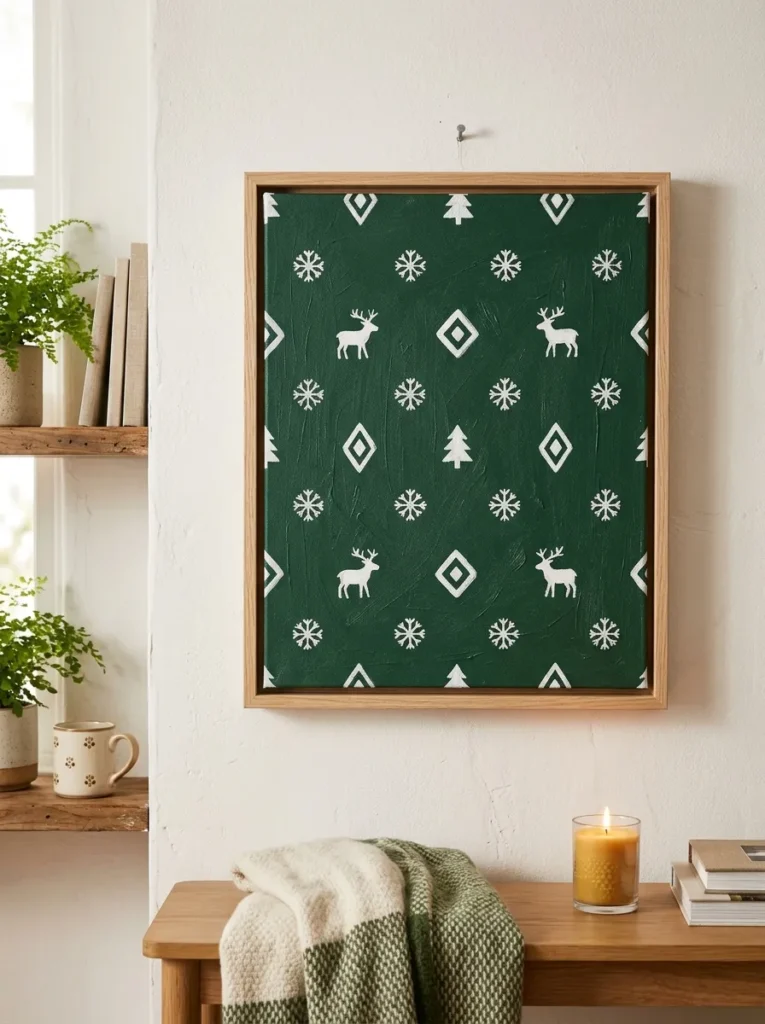
Vibe: The canvas is handcrafted — a DIY Nordic-motif painted canvas with hand-applied pattern imperfection has a warmth and authenticity that printed reproductions of the same design cannot replicate, where the slight variation in each hand-painted element confirms that a person made this for a specific space.
Why it works: The Nordic or Scandinavian Christmas aesthetic — characterized by simple geometric motifs, limited palette (typically white on dark green, red, or charcoal), and folk art simplicity — is specifically well-suited to DIY painting because its design language is inherently simple and tolerant of the slight imperfection that hand-painting produces. The snowflake, reindeer, and spruce tree forms that characterize Nordic textile and ceramic design are all achievable with basic brushwork — the snowflake as six crossing strokes with small crossbars, the reindeer as a simple silhouette, the spruce tree as a triangle of horizontal strokes. The slight variation between hand-painted repetitions of these motifs is not a flaw but a quality marker — evidence of hand craft that printed alternatives permanently lack.
How to get it: Purchase a pre-stretched canvas ($4–$12 for a 16×20-inch standard size from any art supply store). Apply two coats of deep forest green acrylic paint ($3–$6 per tube) as the background, allowing full drying between coats. Trace or free-draw the motif positions lightly in chalk before painting. Apply white motifs (titanium white acrylic, $3–$5) using a small detail brush for snowflakes and fine line work, and a medium flat brush for the geometric elements and tree forms. No special skill is required — the Nordic aesthetic actively embraces folk art simplicity. Frame in a simple natural wood frame ($10–$20) and hang.
Shop The Look
- Pre-stretched canvas 16×20 art supply
- Deep forest green acrylic paint tube
- Titanium white acrylic paint small tube
- Detail brush set fine tip art
- Simple natural wood frame 16×20
Also view: 22 Easy Kids Closet Organization Ideas for Busy Families
3. Fresh Cedar and Pine Swag Wall Installation
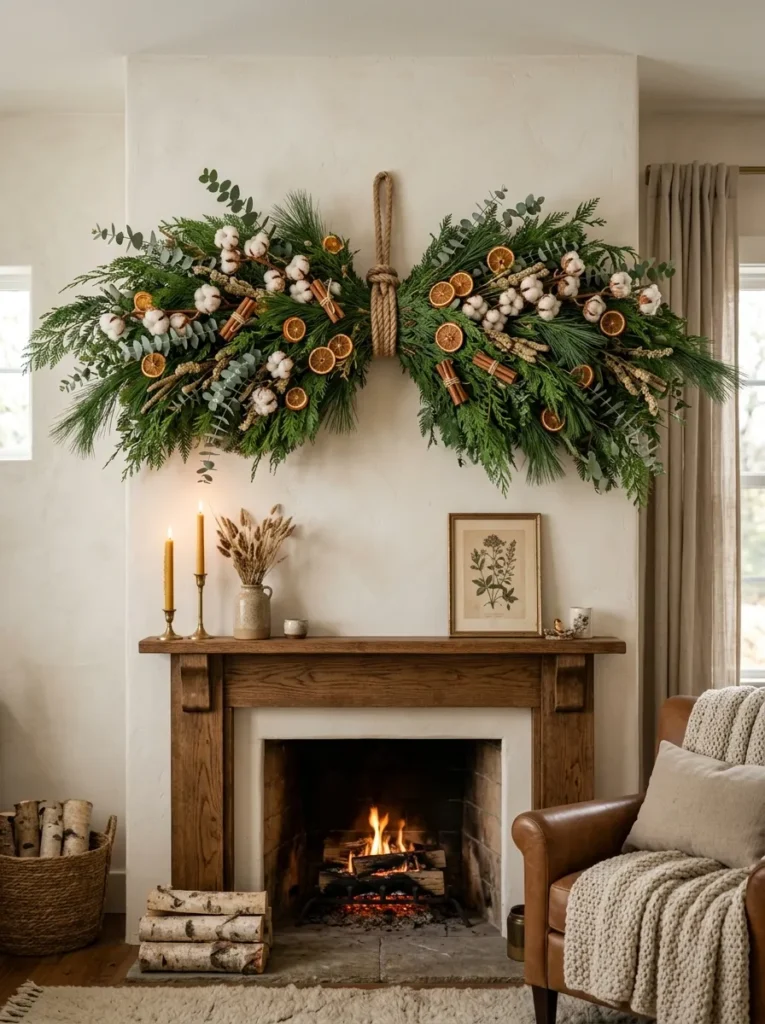
Vibe: The swag is fragrant — a fresh cedar and pine botanical swag on a wall is the Christmas decoration that most fully engages the senses, where the fragrance of fresh evergreen and cinnamon creates the specific olfactory signature of Christmas that no visual decoration alone can approach.
Why it works: A botanical swag as wall art exploits the horizontal surface above the sofa or mantel as a botanical installation zone rather than a picture-hanging zone — the swag’s natural form (loose, asymmetric, abundant) is inherently different from a framed piece and creates an organic, installation-art quality that formal wall art cannot achieve. The mixture of fresh botanicals (cedar, pine) with dried elements (cotton bolls, dried citrus, cinnamon) creates visual texture variety and extends the installation’s lifespan — the dried elements last indefinitely, while the fresh evergreen branches remain beautiful for 3–4 weeks before beginning to dry. The fragrance of the combination (cedar resin, pine essential oils, cinnamon, dried orange) creates the strongest possible sensory Christmas environment in the room where it hangs.
How to get it: Lay cedar, pine, and eucalyptus branches on a flat surface, overlapping and arranging to achieve the desired swag length (48–60 inches for above a standard sofa). Bind the arrangement at its center with a length of natural jute rope, tying in a visible bow or knot that becomes part of the design. Add dried orange slices ($8–$12 for an oven-dried bag from a craft store, or oven-dry fresh oranges at 200°F for 4–6 hours), cinnamon sticks, and dried cotton stems into the greenery at intervals. Mount with two Command strips (one near each end of the swag) rated for the combined weight of the branches and accessories.
Shop The Look
- Fresh cedar branch bunch holiday
- Fresh pine bough bundle seasonal
- Dried orange slice bag craft natural
- Cinnamon stick bundle natural decor
- Natural jute rope craft botanical swag
4. Christmas Typography Print in a Statement Frame
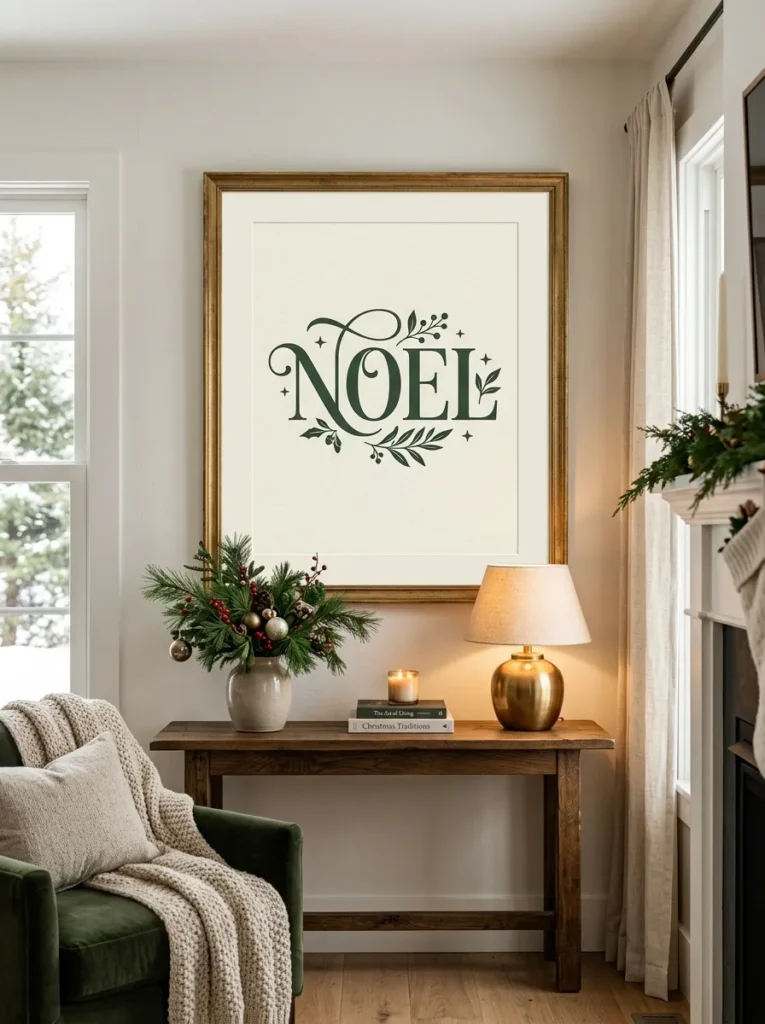
Vibe: The print is elegant — a single large typography print with a well-chosen seasonal phrase in a quality typeface on a cream background makes a Christmas wall statement that reads as graphic design rather than seasonal decoration, communicating sophistication through restraint.
Why it works: Typography-based Christmas wall art succeeds when three design decisions are correct simultaneously: the phrase choice (a single word or short, genuinely meaningful phrase rather than a cheerful slogan), the typeface (elegant serif or refined script rather than decorative holiday fonts with excessive flourishes), and the scale (large enough to be a genuine wall statement — 20×24 inches minimum on a wall that accommodates it). The combination of warm gold ink on cream background is the most universally sophisticated Christmas typography palette — it references the gold-and-cream of traditional Christmas cards, candlelight, and straw in a way that reads as genuinely festive while remaining visually refined.
How to get it: Design a simple typographic print using a free tool (Canva, Adobe Express) by selecting a single elegant typeface (Bodoni, Garamond, or a quality script like Pinyon Script or Great Vibes in Google Fonts) and a single seasonal phrase. Export at 300dpi for print quality at the desired dimensions. Print at a local print shop or online service ($5–$15 for a 24×30-inch print on matte paper). Frame in a wide matte black frame ($20–$50 for a 24×30) or an aged gold frame from a thrift store. Hang as a single statement piece at eye level.
Shop The Look
- Matte black large frame 24×30 inch
- Aged gold decorative frame large
- Matte print paper large format sheet
- Typography art print seasonal frame
- Picture hanging strip large frame
5. Yarn Wrapped Christmas Tree Wall Art
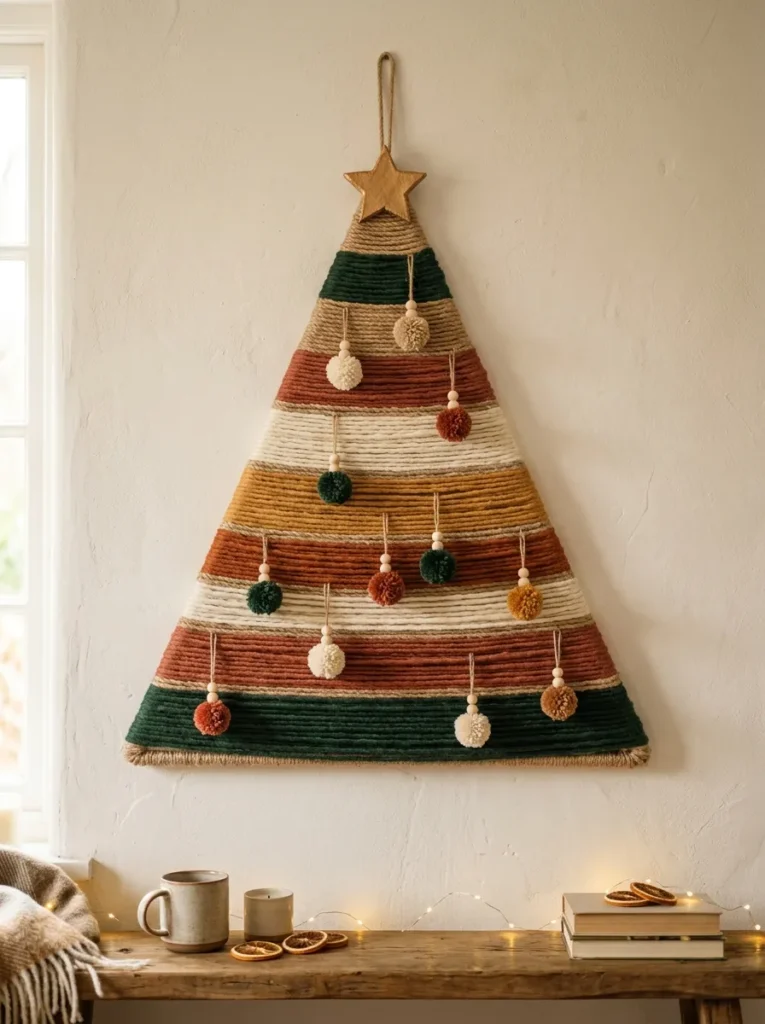
Vibe: The tree is handcrafted — a yarn-wrapped Christmas tree wall art installation creates a textile interpretation of the tree form that is simultaneously the room’s Christmas decoration and its most tactilely interesting wall element, where the varied yarn textures and warm colors create a genuinely beautiful alternative to a physical tree.
Why it works: The yarn-wrapped tree form uses the triangle as a universally recognized Christmas tree silhouette that is immediately legible at wall scale without requiring any literal tree details — the shape alone communicates the season. Wrapping the triangular form in horizontal yarn bands creates the visual rhythm of tree branches at each level while introducing the color and texture variety of a decorated tree. The technique requires no knitting or crochet skill — the yarn is simply wrapped around a triangular frame in horizontal passes, changing color at each level — making it one of the most accessible yarn-based Christmas wall art projects available. For apartments or small homes where a physical tree is impractical, a yarn-wrapped tree wall installation provides the Christmas tree visual presence without the floor footprint.
How to get it: Create the triangular frame from three pieces of 1/4-inch natural wood dowel (approximately 30 inches for the two sides and 20 inches for the base), joined at the corners with strong craft glue or thin wire. Suspend from the apex with a single nail. Wrap yarn horizontally across the frame, working from the base upward, changing colors every 3–4 rows to create the layered band effect. Tie small yarn pom-poms (made by winding yarn around two fingers and tying at the center, then cutting the loops) to the wrapped bands at irregular intervals as ornaments. Glue a small gold cardboard or craft foam star to the apex point.
Shop The Look
- Chunky yarn set Christmas colors mixed
- Natural wood dowel 1/4 inch craft
- Yarn pom pom maker small medium
- Small gold star craft cardboard
- Natural jute rope frame craft
6. Shadow Box Christmas Vignette Wall Art
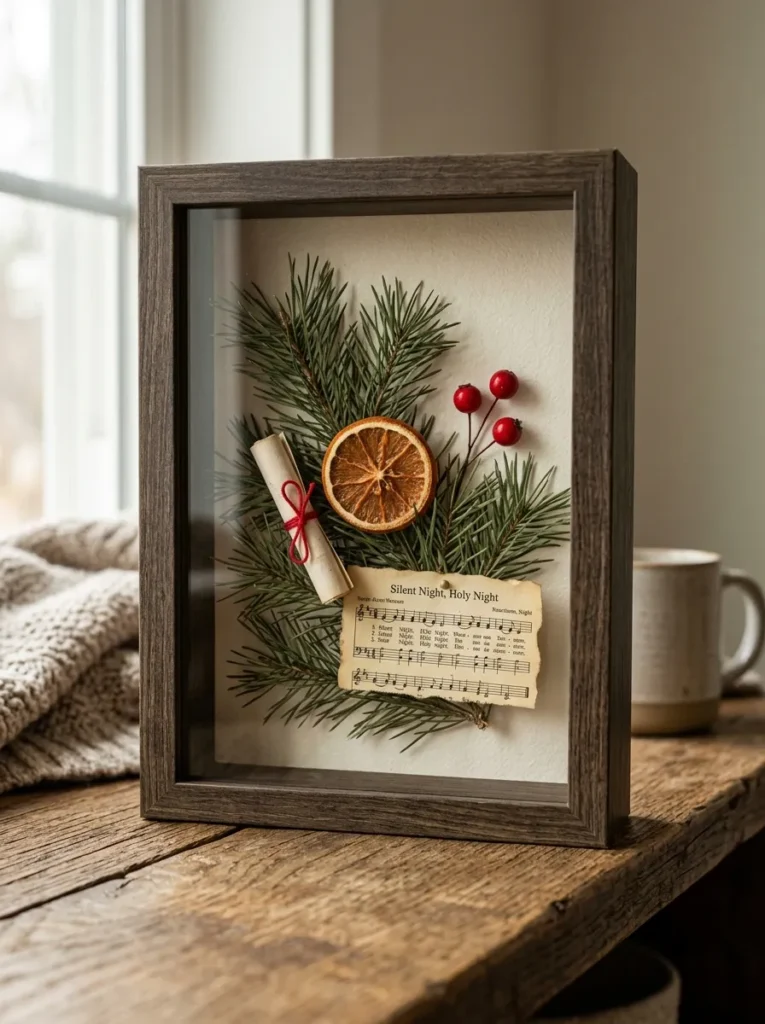
Vibe: The vignette is intimate — a Christmas still life shadow box with preserved botanicals, dried citrus, and a fragment of sheet music creates a dimensional wall art piece of unusual personal quality, where the contained world within the deep frame invites close inspection and rewards it.
Why it works: The shadow box format creates a fundamentally different kind of wall art from flat framed pieces — the depth of the box (typically 1.5–3 inches) allows three-dimensional objects to be composed within the frame, and the shadow they cast on the background and on each other creates a visual complexity that no flat print can approach. A Christmas shadow box vignette works specifically well because the season’s most beautiful material elements — preserved pine, dried citrus, red berries, cinnamon, spices, sheet music fragments, small handwritten notes — are all small enough to compose within a shadow box while being sufficiently varied in texture and material to reward the sustained close-range looking that shadow box art encourages. The sheet music fragment is a specific Christmas detail that references both the musical tradition of the season and the Victorian Christmas card aesthetic from which so much Christmas imagery derives.
How to get it: Purchase a deep shadow box frame in matte black or natural wood ($15–$35 for an 8×10 inch or 11×14 inch deep frame). Gather small Christmas elements: preserved pine or cedar sprigs, dried orange or lemon slices, small berry stems, cinnamon sticks, a fragment of sheet music or vintage handwriting on cream paper. Arrange elements in the shadow box without adhesive first, photographing the arrangement before committing. Secure elements with small dots of hot glue or craft glue, working from the back layer forward. The background paper (visible behind all elements) can be replaced with warm cream linen fabric, a piece of vintage music, or a warm-toned watercolor wash for an elevated effect.
Shop The Look
- Deep shadow box frame 8×10 black
- Preserved mini pine sprig natural
- Dried citrus slice bag orange lemon
- Small berry stem wire artificial
- Vintage sheet music fragment decor
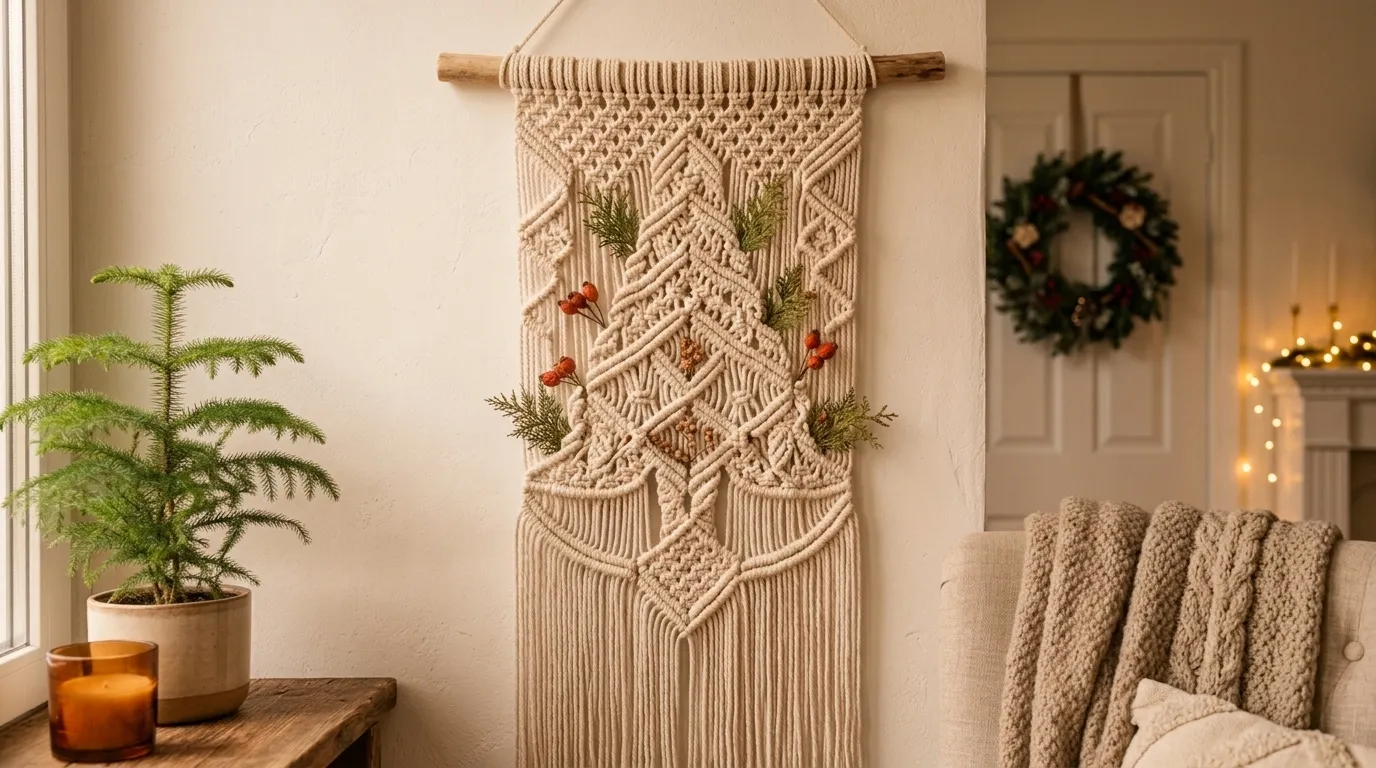
7. Macramé Christmas Wall Hanging with Holiday Motifs
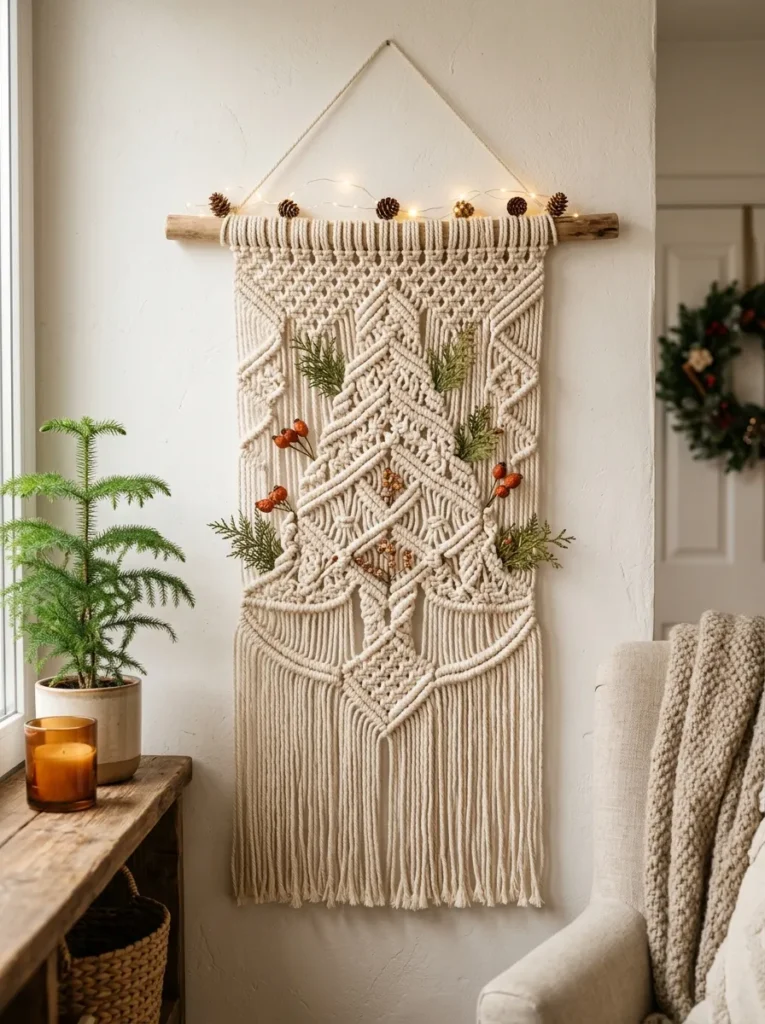
Vibe: The hanging is natural — a macramé Christmas wall hanging with botanical accents woven in is the fiber art piece that most directly connects the holiday season to its botanical roots, where the knotted natural cotton and dried botanical elements together create a Christmas wall art piece of genuine craft character.
Why it works: Macramé wall hangings specifically designed for Christmas occupy an interesting design space — they are unmistakably seasonal in their botanical decoration (cedar, rose hips, dried cranberry stems) while remaining year-round appropriate in their core material (natural cotton rope) and basic form (knotted hanging from a wood dowel). This dual legibility is useful: a macramé Christmas hanging that is beautiful as a fiber art piece can remain displayed into January without reading as seasonal-decoration-past-its-date, transitioning naturally into a general winter wall hanging as the specifically Christmas botanical elements are replaced with dried grasses or eucalyptus. The macramé Christmas tree motif (achievable by varying knot density within the hanging to create a triangular denser zone in the piece’s center) is a design innovation specific to the medium.
How to get it: Cut 3mm natural cotton macramé cord into lengths appropriate for the hanging’s desired dimensions (approximately 8 times the finished length for most macramé techniques). Mount lengths on a natural wood dowel using lark’s head knots. Work the body of the hanging in square knots, varying the knot density to create a Christmas tree-shaped denser zone at the center. Add a fringe at the base by cutting and unraveling the cord ends. Weave small cedar sprigs and dried rose hip stems into the knotwork at intervals before final arrangement. Hang from a single wall nail through a loop of additional cord at the dowel’s center.
Shop The Look
- Natural cotton macramé cord 3mm roll
- Natural wood dowel macramé hanging
- Dried rose hip stem bunch natural
- Preserved cedar sprig small bundle
- Macramé knot guide card reference
8. Christmas Wreath as Wall Art Installation
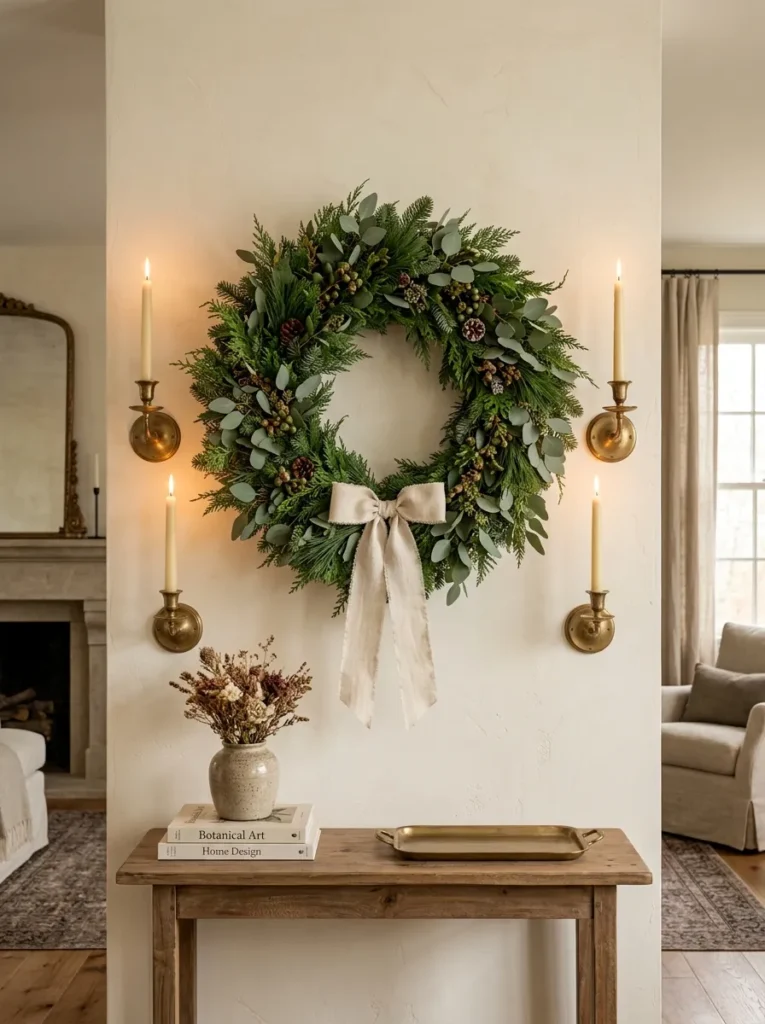
Vibe: The wreath is elegant — a large botanical wreath used as a primary interior wall art piece rather than a door decoration creates a Christmas wall installation of genuine natural abundance, where the circular wreath form and the flanking candle holders together create a composition with the authority of an architectural installation.
Why it works: Moving a Christmas wreath from the front door to an interior wall transforms it from a threshold marker to a primary room art piece — the wreath’s scale (a 24-inch wreath that reads as appropriately sized on a door often reads as a significant installation when displayed on an interior wall at eye level) and the viewer’s close-range relationship to the piece in an interior context creates a very different quality of experience. The wreath’s circular form has a specific compositional authority — it contains visual attention within its ring while the botanical abundance of its surface rewards close inspection. Flanking the wall-mounted wreath with two small wall-mounted brass candle holders creates a symmetrical composition that gives the wreath the formal weight of an altar or focal point — appropriate for the season’s gathering-around-a-center quality.
How to get it: A 24-inch botanical wreath (fresh or preserved, $30–$80 from a florist, garden center, or farm market) makes a stunning interior wall installation. Mount with a over-door wreath hook reversed to grip the top of a picture frame nail. Tie a wide natural linen ribbon (4-inch width, 36-inch total length) in a large bow at the wreath’s base. Mount two small brass wall-mounted candle holders ($15–$25 each) on the wall flanking the wreath at the wreath’s center height. Use battery-operated LED taper candles ($8–$15 for two) in the brass holders for safety.
Shop The Look
- Large botanical wreath 24 inch preserved
- Wide linen ribbon 4 inch cream bow
- Brass wall mount candle holder pair
- Battery LED taper candle realistic pair
- Wreath hook wall mount interior
9. DIY Chalkboard Christmas Art Panel
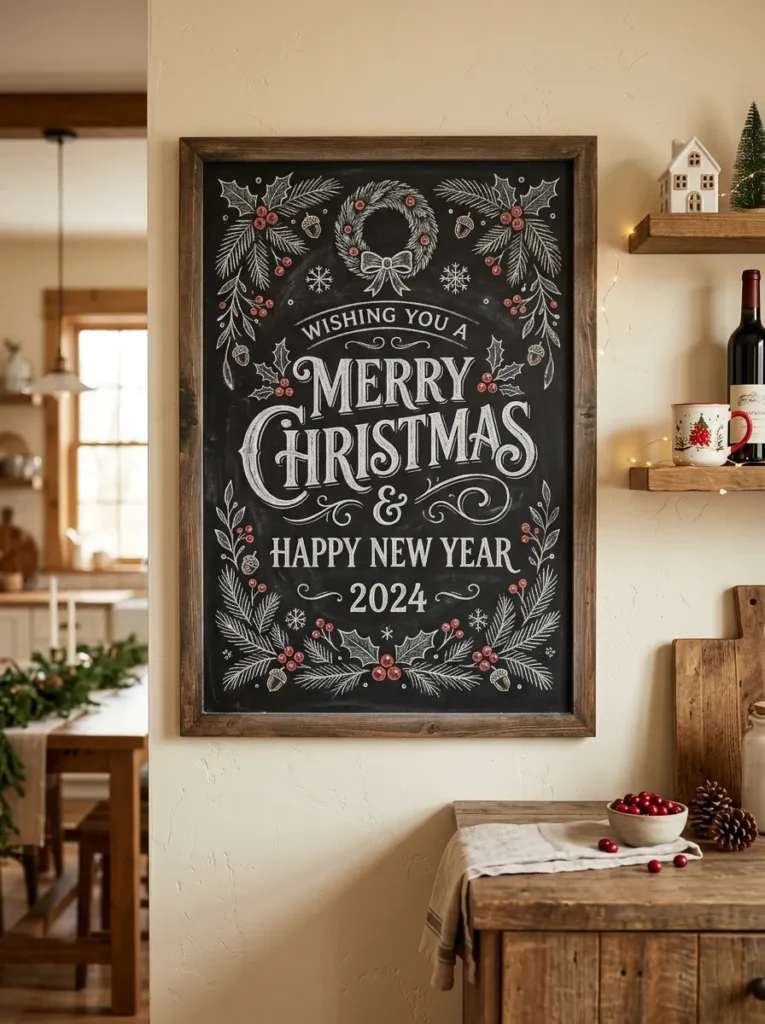
Vibe: The panel is handcrafted — a large chalkboard Christmas art panel with hand lettering and chalk-drawn botanical illustrations creates the most personally expressive Christmas wall art available, where the hand of the maker is directly visible in every element of the finished piece.
Why it works: Chalkboard art is specifically well-suited to Christmas wall decoration because the medium’s characteristic quality — white on black, with the slight texture of chalk on slate creating a soft-edged line — references the visual aesthetic of vintage Christmas cards and early 20th-century holiday poster art. The medium is also forgiving in a way that most art-making is not: chalk errors wipe away cleanly, the composition can be rearranged until it reads correctly, and the final design can be sealed with hairspray to prevent smudging without changing the chalk’s appearance. The chalkboard panel’s season-specific content can be erased and redrawn for each Christmas with a new message or composition, making it a reusable wall art format that is specifically appropriate for seasonal use.
How to get it: Paint a piece of 1/4-inch MDF board with two coats of chalkboard paint ($8–$12 per can, covering approximately 6 square feet per can) in a pine or simple wood frame. Season the chalkboard by rubbing the entire surface with the side of a piece of chalk and then erasing — this prevents ghost images. Plan the composition on paper first. Apply lettering and illustration using chalk sticks (for bold elements) and chalk markers (for fine detail work). Seal with a light coat of hairspray if the panel will be handled or if the chalk is extremely fine. Re-draw with a new design each Christmas season.
Shop The Look
- Chalkboard paint black small panel
- Chalk marker white fine tip set
- Raw chalk stick white drawing
- MDF board 1/4 inch panel craft
- Simple black frame 20×30 panel
10. Textile Advent Calendar Wall Hanging
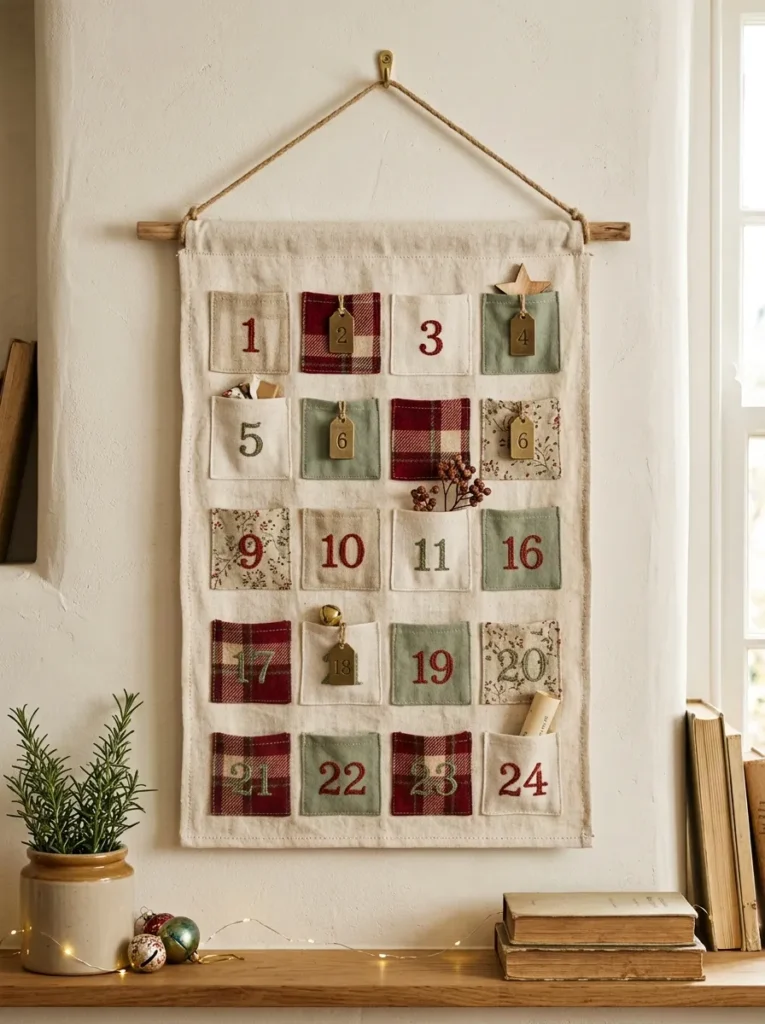
Vibe: The calendar is warm — a handmade fabric advent calendar wall hanging that uses natural linen, varied fabric pockets, and brass number tags creates a December wall art piece of genuine textile warmth that functions simultaneously as a functional countdown object and as a beautiful wall hanging.
Why it works: A handmade fabric advent calendar works as wall art rather than mere decoration because the textile materiality of a well-made linen-and-fabric panel is genuinely beautiful independently of its seasonal function — the varied fabric pockets, the visible stitching, and the warm color palette of natural linen and plaid fabrics create a textile composition that would be attractive on a wall even without the numbered advent content. The calendar’s functional dimension (the daily ritual of opening a pocket and finding a small treat or note) adds an interactive quality to the wall art that purely decorative pieces lack — the calendar is actively engaged with rather than passively viewed, giving it a participatory presence in the household’s daily Christmas experience.
How to get it: Cut a 24×36-inch rectangle from natural linen fabric for the backing. Cut 24 small pocket pieces from varied fabric scraps (4×4-inch squares, lined and turned to create self-finished pockets). Arrange in a 4×6 grid on the backing and sew each pocket along three sides, leaving the top open. Attach a brass number tag ($5–$8 for a set of 1–24 from craft suppliers) to each pocket. Hem the top edge of the backing over a wooden dowel and hang with jute rope. Fill pockets with small treats, notes, or tiny wrapped gifts for December 1–24.
Shop The Look
- Natural linen fabric by the yard backing
- Plaid cotton fabric scraps pocket mix
- Brass number tag set 1-24 craft
- Natural wood dowel 1 inch advent hanger
- Natural jute rope hanging cord
11. Stacked Christmas Book Styling with Art Print
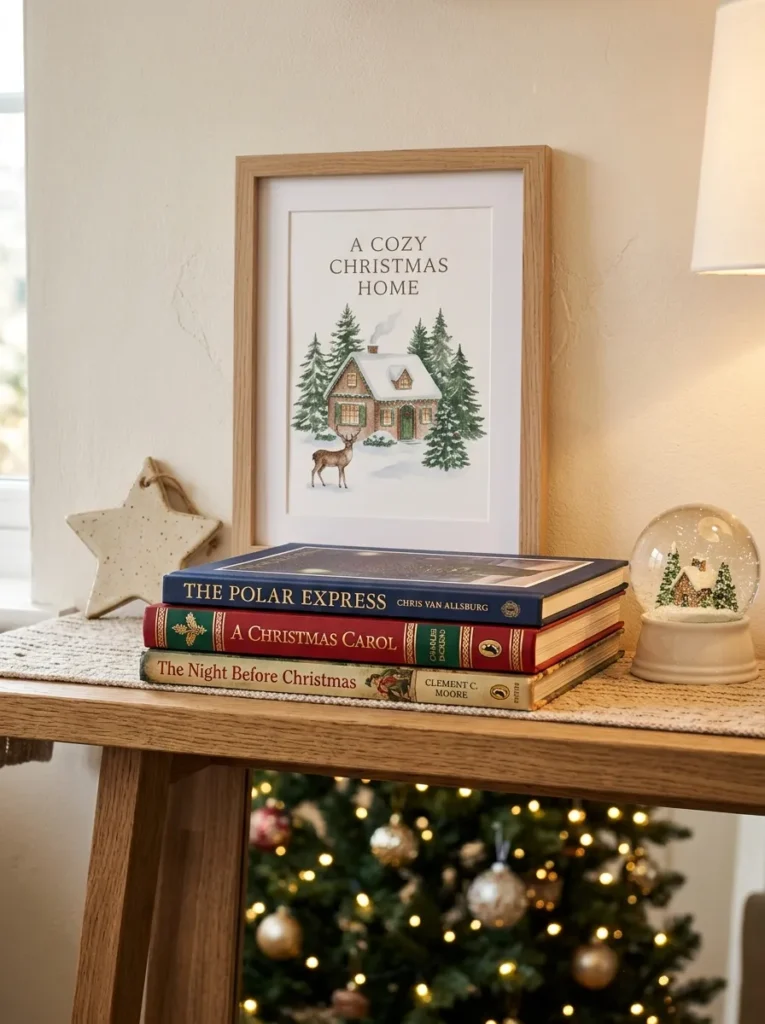
Vibe: The vignette is literary — a seasonal book stack combined with a small framed Christmas print creates the specific quality of a literary Christmas, where the season is celebrated through its finest narrative and visual traditions simultaneously.
Why it works: The combination of physical books and framed art in a shelf or console vignette creates a Christmas wall-adjacent installation that references the intellectual and narrative dimension of the holiday season — the stories, the music, the poetry — alongside the visual art. Classic Christmas titles with beautiful cover design (A Christmas Carol in a Penguin Clothbound edition, The Night Before Christmas in any of several beautifully illustrated editions, The Polar Express in its iconic Van Allsburg format) are genuinely beautiful objects in their own right, and stacking them with covers partially visible creates a layered seasonal display that changes in texture and color with each book’s specific design. The framed print above the stack provides the wall-mounted vertical element that gives the vignette its room-scale presence.
How to get it: Select two or three Christmas classic books with beautiful cover design — editions from Penguin Clothbound Classics, Macmillan Collector’s Library, or similarly quality-conscious publishers provide the most beautiful covers. Stack horizontally with the most beautiful cover facing upward. Place a small framed Christmas print (4×6 or 5×7 in a simple frame, $5–$15 total) leaning against the wall above the book stack or hung directly on the wall above it. Add one small ceramic or porcelain object beside the stack — a small star, a tiny snow globe, or a simple ceramic vessel with a single sprig of evergreen.
Shop The Look
- A Christmas Carol Penguin Clothbound
- The Night Before Christmas illustrated
- Small picture frame 5×7 matte black
- Ceramic star small display object
- Small snow globe classic minimal
12. Paper Quilling Christmas Ornament Frame
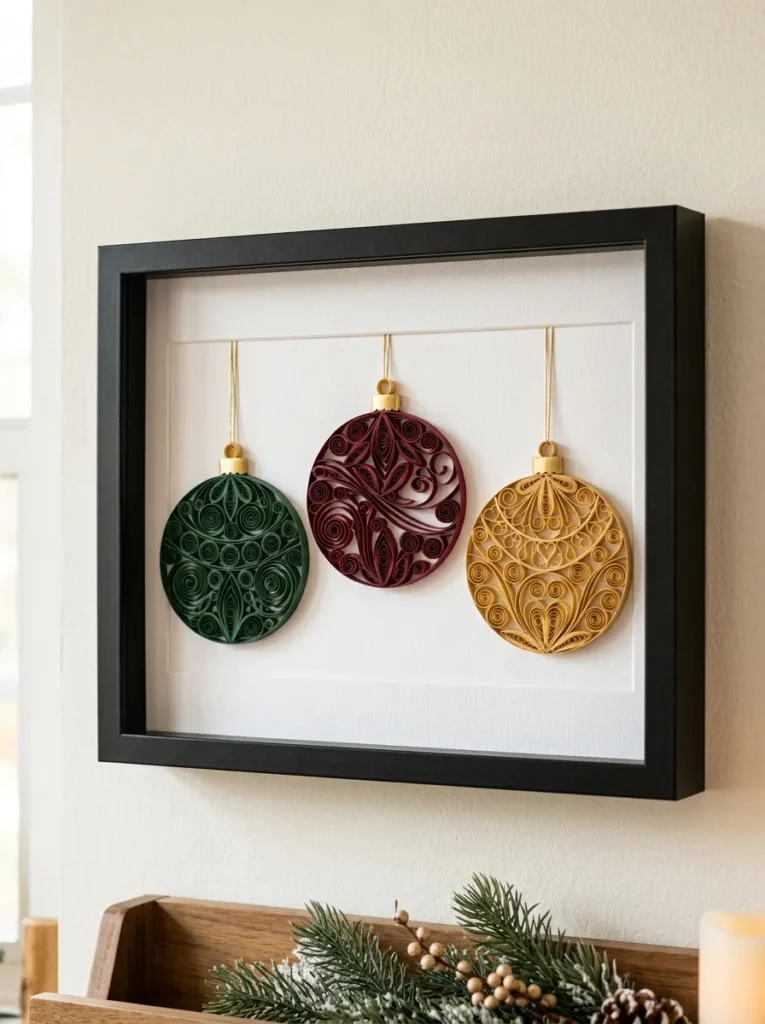
Vibe: The piece is intricate — paper quilled Christmas ornament art in a shadow box creates a dimensional wall piece of genuine craft complexity, where each coiled paper element catches light differently and the overall composition rewards the close inspection that the ornament subject naturally invites.
Why it works: Paper quilling is the craft technique that most effectively creates dimensional Christmas ornament wall art because the quilled coil’s circular form mirrors the ornament’s own round shape, allowing a visual pun between medium and subject that gives the piece an additional layer of wit and craftsmanship. The three-ornament composition creates a simple, balanced still-life within the shadow box frame — the varied colors (one green, one burgundy, one gold) reference the Christmas color palette in a sophisticated, deep-toned version rather than a bright commercial version. The shadow cast by each quilled coil against the white mat creates a secondary grey pattern around each ornament that adds depth without any additional elements.
How to get it: Create three quilled ornament forms from 1/8-inch quilling strips in deep green, burgundy, and gold acid-free paper. Build each ornament from a combination of tight center coils surrounded by graduated teardrop and marquise shapes arranged in a circular pattern — each ornament requires approximately 30–50 individual quilled elements. Mount each ornament on a white backing mat using archival PVA glue applied with a fine-tip applicator. Add a small gold cap (a tiny folded paper triangle or a small brass brad) at the top of each ornament with a short thread suggesting the hanging loop. Display in a deep shadow box frame (1.5-inch depth minimum) to accommodate the quilling’s dimensional height.
Shop The Look
- Quilling paper strips acid free set
- Quilling tool slotted tip precision
- Shadow box frame deep 8×10 black
- Archival PVA glue fine applicator
- Gold quilling paper strips set
13. DIY Christmas Letter Sign in Wooden Cutouts
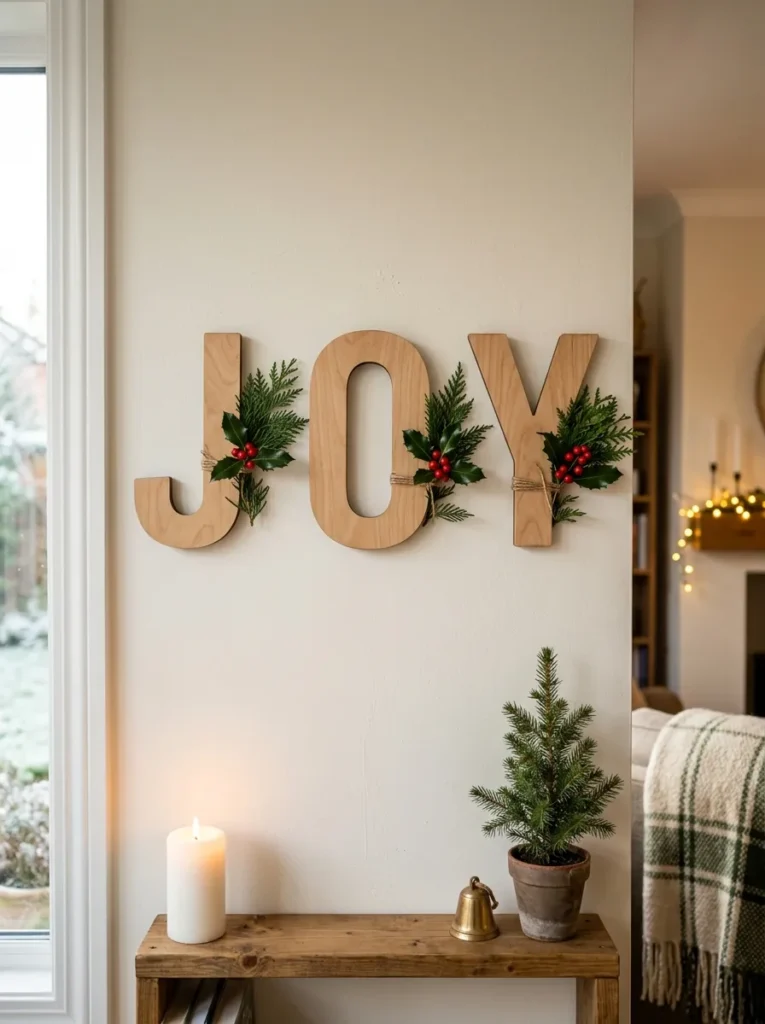
Vibe: The sign is simple — individual wooden letter cutouts spelling a single meaningful Christmas word with small botanical accents beside each letter is the most compositionally restrained Christmas wall art possible, where the beauty comes from the typographic form itself and the organic botanical additions rather than from decorative complexity.
Why it works: Single-word typographic Christmas wall signs (NOEL, JOY, PEACE, HOPE) are the most enduring of all Christmas wall art formats because they communicate seasonal meaning through typography rather than imagery — a well-chosen single word in quality dimensional letter form is both more visually sophisticated and more emotionally resonant than a complex decorative scene. The natural birch wood or clean white-painted letter in an 8-inch scale reads as genuinely architectural at wall scale rather than as a craft-store decoration — the material quality and the scale are what determine whether a letter sign reads as art or as novelty. The small botanical accents (cedar sprig, holly stem) tucked beside each letter introduce the natural material quality without changing the sign’s typographic clarity.
How to get it: Purchase individual wooden letter cutouts from a craft store or order a custom word set online ($3–$10 per letter in 8-inch size). Paint in warm white chalk paint (two coats) or leave in natural birch for a more contemporary look. Mount on the wall using Command strips appropriate for the letter’s weight, spacing letters 1/2 inch apart for visual breathing room. Tuck small fresh or preserved cedar sprigs or holly stems beside each letter using a small piece of Command adhesive putty or simply wedged between the letter and the wall.
Shop The Look
- Wooden letter cutout 8 inch craft set
- White chalk paint small pot craft
- Fresh cedar sprig bunch holiday
- Holly branch stem artificial craft
- Command strip large adhesive letter
14. Framed Vintage Christmas Postcard Collection
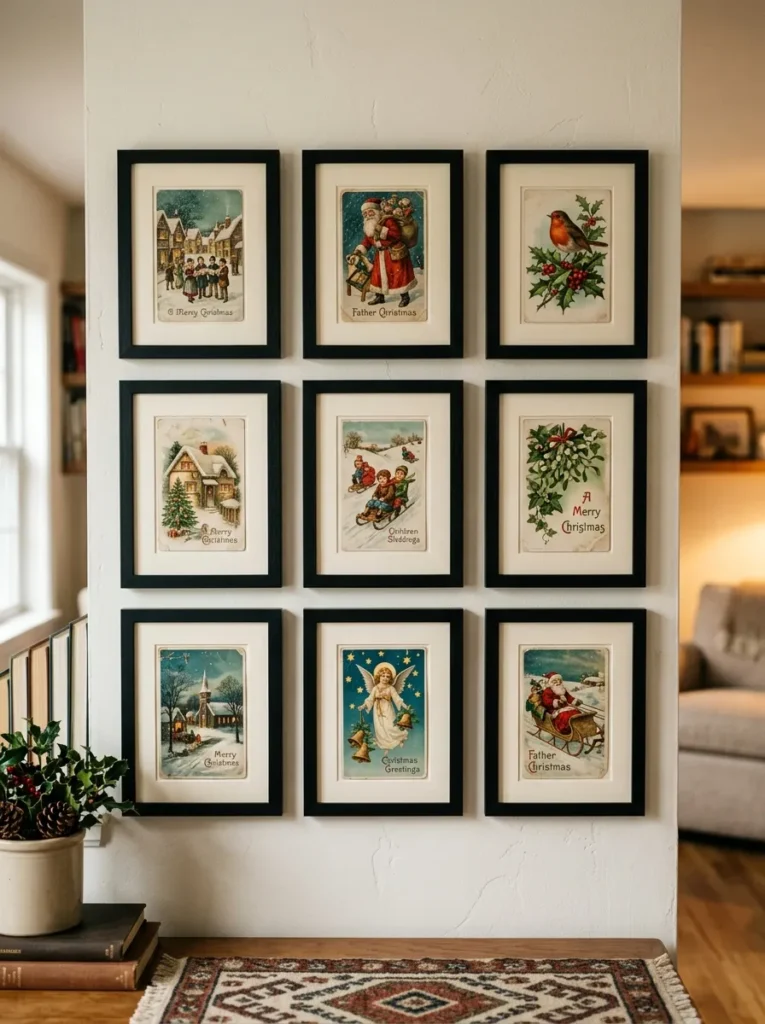
Vibe: The collection is nostalgic — a grid of framed vintage Christmas postcards creates a wall installation that references the entire visual history of the holiday’s graphic tradition, where each small postcard contains a miniature world of Victorian or Edwardian Christmas imagery.
Why it works: Vintage Christmas postcards from the late Victorian period (1880–1910) and early 20th century represent the original graphic flowering of Christmas visual culture — the period when Christmas cards and postcards became a mass cultural phenomenon and when illustrators from Britain, Germany, and America created the visual language of snow-covered villages, robins on holly, Father Christmas figures, and winter botanicals that still defines Christmas imagery today. These postcards are simultaneously charming historical documents and genuinely beautiful small-format art pieces. Displayed in a tight grid of matched small frames, a collection of 8–10 vintage postcards creates a wall installation with the visual richness of a curated archive exhibition — each frame a small window into a specific Christmas moment in visual history.
How to get it: Download high-resolution scans of vintage Christmas postcards from the New York Public Library’s digital collection (free), the British Library’s digital repository, or Wikimedia Commons (all free public domain). Print at 4×6 or 5×7 inches on matte photo paper ($0.30–$1.00 per print). Frame in matched small matte black frames ($3–$8 each) without mats for a tight, grid-appropriate presentation. Arrange in a 3×3 or 4×2 grid with 1-inch gaps between frames, using a laser level or paper template system to ensure precise alignment.
Shop The Look
- Small matte black frame 4×6 set
- Vintage Christmas postcard print set
- Matte photo paper small format
- Grid gallery wall template paper
- Level magnetic picture hanging tool
15. Christmas Star or Starburst Dimensional Wall Art
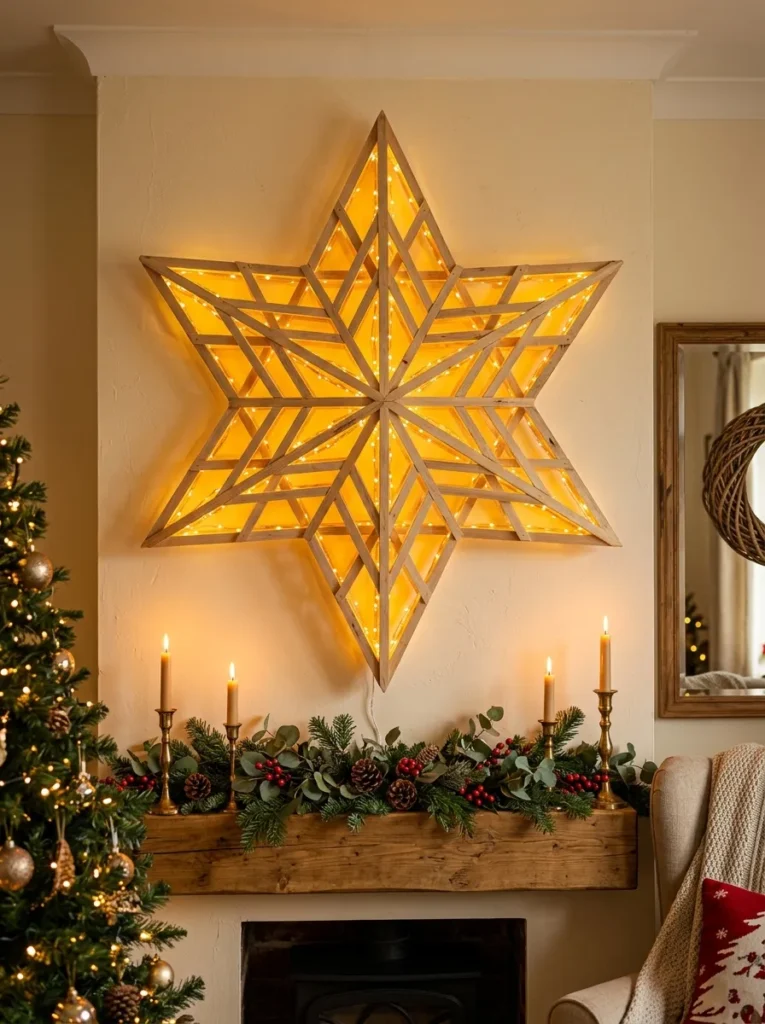
Vibe: The star is luminous — a large dimensional wood star with warm fairy lights wound through its structure is the Christmas wall art piece that most directly references the season’s celestial symbols, where the glowing star installation creates the specific magic of Christmas light at its most ancient and most beautiful.
Why it works: The star is the most architecturally significant of Christmas symbols — the Star of Bethlehem, the star at the top of the tree, the eight-pointed Nordic star — and a large-scale dimensional star installation on a primary wall gives this symbol the space and materiality it deserves as a design element rather than a tree topper. A 24-inch wood star at the correct wall position (primary focal wall at eye level) reads as a significant room-scale installation rather than a decorative accessory. The fairy lights wound through the structure extend the star’s visual presence into an ambient light source — at dusk and into the evening, the glowing star becomes the room’s primary light source in its zone, transforming the room’s atmosphere.
How to get it: Cut 1×2-inch natural wood strips into the appropriate lengths for the star’s points (for a six-pointed star, all points are equal length; for an eight-pointed starburst, alternate between two lengths). Join at the center with a single bolt through all strips, tightened to hold position. Finish in natural beeswax or warm gold spray paint. Wound with a 15–20 foot strand of warm amber fairy lights (battery-operated for flexibility). Mount on the primary wall at eye level using two wall anchors through the back of the center joint. Total cost in materials: $20–$50.
Shop The Look
- Natural wood strips 1×2 inch star craft
- Warm gold spray paint metallic natural
- Warm amber fairy lights battery fine wire
- Wall anchor set heavy duty
- Beeswax finish natural wood polish
16. Embroidered Christmas Hoop Art Collection
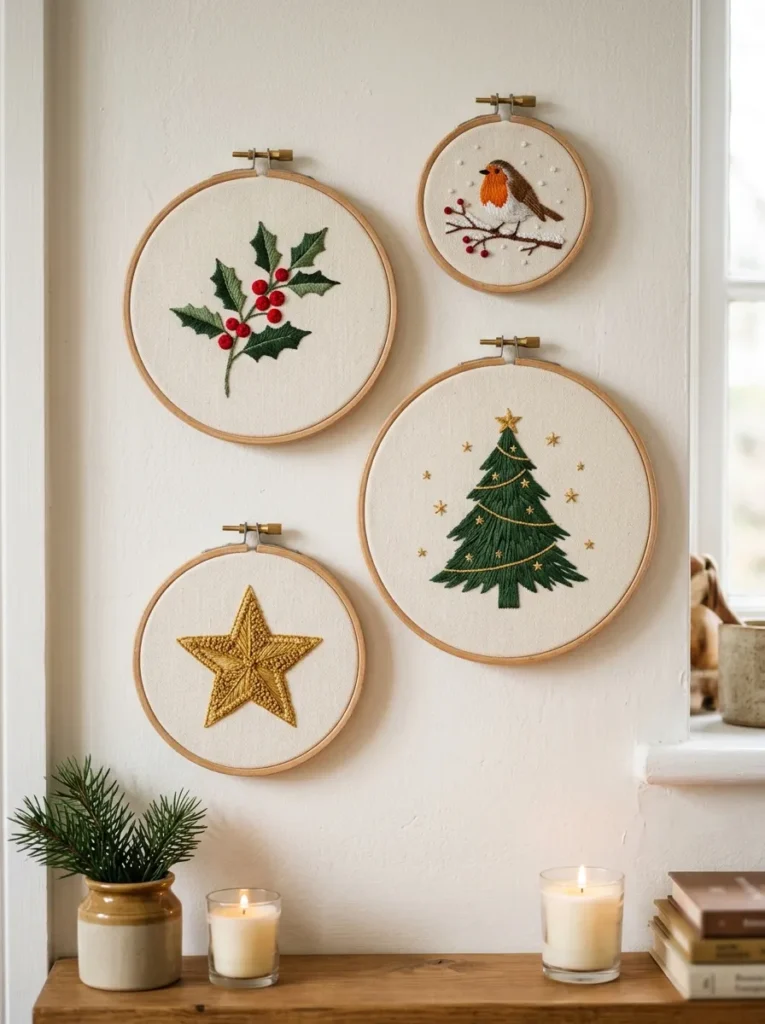
Vibe: The collection is intimate — a cluster of embroidered Christmas hoop art pieces creates the most personally handmade Christmas wall installation available, where the visible hand stitching on cream linen in natural wood hoops creates a quality of intimate craft that no other Christmas wall art medium replicates.
Why it works: Embroidered hoop art has become the most accepted form of contemporary craft wall art precisely because the hoop serves simultaneously as the craft’s working frame and its display frame — the combination communicates that the textile is displayed in its most honest, unembellished form, which is both a craft integrity signal and a design decision. For Christmas specifically, the small scale of hoop art (4–8-inch hoops are standard) and the intimacy of the stitch work — the visible individual stitch marks, the slight variation in tension across a hand-stitched robin breast or holly leaf — creates a quality of closeness and care that larger decorative pieces cannot achieve. A cluster of three or four hoops in varied sizes creates the composed arrangement quality of a small gallery wall while maintaining the personal intimacy of individual handmade objects.
How to get it: Select natural wood embroidery hoops in three or four varied sizes (4-inch, 6-inch, 7-inch, 8-inch). Stretch cream linen fabric tightly in each hoop. Transfer simple Christmas motif designs (holly sprig, simple tree, five-pointed star, winter robin) using a water-soluble pen. Embroider each motif using two strands of embroidery thread in seasonal colors — holly leaves in dark green satin stitch, berries in red French knots, tree in long-stitch forest green, star in satin stitch gold, robin breast in orange satin stitch with brown back in long stitch. Trim the fabric to 1 inch behind the hoop edge and secure to the hoop back with a running stitch. Mount the cluster using small picture-hanging nails or Command strips.
Shop The Look
- Natural wood embroidery hoop set varied
- Cream linen embroidery fabric
- DMC embroidery thread Christmas set
- Water soluble transfer pen embroidery
- Embroidery needle set mixed sizes
17. Pinecone and Natural Material Geometric Wall Art
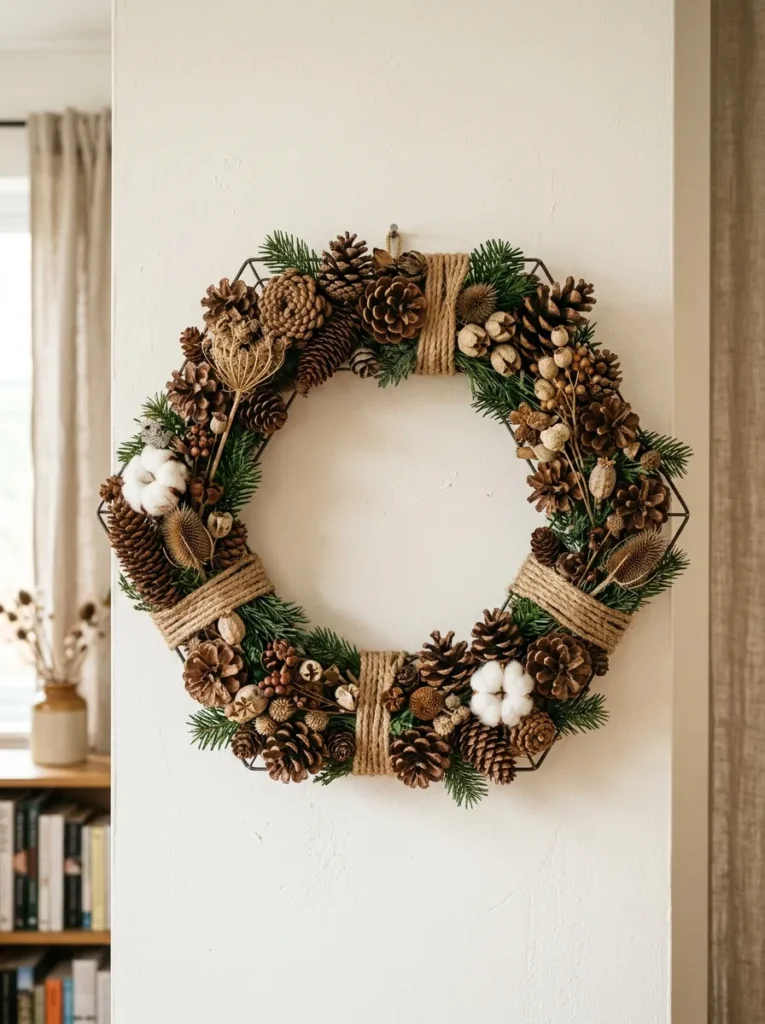
Vibe: The piece is textural — a geometric frame densely covered with varied natural materials creates a Christmas wall art piece of extraordinary tactile and visual richness, where the combination of pine cones, dried seed heads, cotton bolls, and evergreen within a geometric structure produces a naturalist’s Christmas installation.
Why it works: The geometric frame format (hexagonal or circular wire armature) elevates what would otherwise be a wreath into a more contemporary, design-conscious form — the geometric structure communicates deliberate design intent that the traditional circular grapevine wreath base does not, while the dense natural material covering maintains the botanical warmth that makes Christmas wall art feel genuinely connected to the season’s natural heritage. Pine cones are the most texturally rich natural material available for Christmas wall art — their scaled surface creates extraordinary light-catching complexity at every scale, from the macro composition of the full piece to the micro detail of individual scale surfaces. The varied scale of natural pine cones (from large 4-inch cones to small 1-inch cones) creates the visual depth that uniform material installations lack.
How to get it: Source or bend a wire frame into the desired geometric form (a metal macramé hoop ring in the correct diameter, $4–$8, works for circular forms; bend heavy-gauge wire for hexagonal or other geometric shapes). Attach natural materials using a hot glue gun — begin with the largest pine cones as anchor elements, fill with medium cones, then tuck smaller cones, dried seed heads, and cotton bolls into remaining gaps. Add small preserved evergreen sprigs last as textural fill. Wrap occasional sections of the wire frame in natural jute rope for visible structural interest. Mount with a single nail through the wire frame at the top center.
Shop The Look
- Mixed pine cone bag natural varied size
- Wire macramé hoop large frame
- Dried cotton stem boll set
- Dried seed head assortment natural
- Natural jute rope frame wrapping
How to Create Christmas Wall Art That Lasts Through the Season
The single most important principle in Christmas wall art selection and installation is to choose pieces that look as beautiful in the second week of December as they do on December 1st — and as beautiful on Christmas Day as they did on the first of the month. This durability standard eliminates the most common Christmas wall art mistake: choosing fresh-cut botanical pieces (unpreserved greenery, live flower arrangements) without a maintenance plan for their 3–4-week display period. Fresh-cut botanicals for Christmas wall art must either be replaced weekly (cut fresh branches, fresh flower arrangements), be selected specifically for their long uncut life (properly dried and preserved botanicals from a florist or specialty craft supplier), or be managed actively with daily light misting to extend their display period.
The most common Christmas wall art installation mistake is hanging pieces at the wrong height — specifically, too high. Christmas wall art above mantels, consoles, and sideboards should follow the standard art-hanging rule of 57–60 inches from the floor to the visual center of the piece, regardless of the furniture below it. The instinct to hang Christmas art higher to accommodate seasonal arrangements on the furniture below it almost always results in pieces that float disconnected from the room rather than anchoring it. If the furniture arrangement below is particularly tall (a tall holiday floral arrangement on the console, for example), the correct solution is a taller art piece that scales to the combined height rather than a higher hanging position for a standard-sized piece.
Three Christmas wall art installations under $30 that create immediate, significant visual impact: a single large framed vintage botanical Christmas print (free to download and print, $12–$18 for the frame) hung as a statement piece above a fireplace or sofa; a fresh cedar branch swag ($8–$15 in branches from a garden center or Christmas tree lot) mounted above a doorway or console with a simple jute twine tie; and a cluster of three identical small frames with Christmas postcard prints ($3–$6 per frame, $1–$2 per print) arranged in a tight trio on a hallway wall. Each of these three installations creates a complete, resolved Christmas wall art moment for under $30 in total materials and under 30 minutes of installation time.
A complete Christmas wall art program for a home — a botanical swag above the sofa, a framed print gallery in the hallway, an embroidered hoop cluster in the bedroom, and a handmade yarn-wrapped tree in a child’s room — is achievable over two December weekends of intentional making and hanging, with a total investment ranging from $50–$150 for a combination of DIY and purchased elements. The most sustainable approach is to build a core collection of reusable Christmas wall art pieces (embroidered hoops, macramé hangings, framed prints, geometric natural art) that returns each year supplemented by one new fresh botanical element (the cedar swag, the fresh wreath) that provides the annual olfactory and botanical renewal that makes Christmas feel like a living seasonal event rather than a stored-decoration deployment.
Frequently Asked Questions About Christmas Wall Art
What size Christmas wall art works best in different rooms?
The scaling principle for Christmas wall art follows the same guidelines as year-round wall art: the piece’s width should be at minimum two-thirds of the furniture it sits above, and its height should be proportionate to the wall area available. For a standard 6-foot sofa, a Christmas swag or gallery arrangement should span at least 48 inches in total width. For a fireplace mantel, the art above should be between 50–70% of the mantel’s width. For hallways, single pieces in the 16×20 to 20×24 inch range read well at close viewing distances. The most common small-space Christmas wall art mistake is choosing pieces too small for their wall — a 12×16 framed print above a 60-inch console reads as insufficient regardless of how beautiful the print content is.
How do I create Christmas wall art that coordinates with my existing year-round decor?
The most reliable coordination strategy for Christmas wall art in a designed home is to work within the room’s existing material palette rather than introducing the traditional commercial Christmas palette (bright red, bright green, metallic gold). If the room’s year-round palette is warm neutral (white oak, linen, warm white walls), choose Christmas wall art in the same warm neutral family with seasonal additions: cream linen macramé hangings with cedar accents, natural linen advent calendars, botanical prints in forest green and burgundy. If the room’s palette is dark and moody (forest green walls, walnut furniture, matte black fixtures), Christmas wall art in deep botanical tones — preserved evergreen swags, deep burgundy quilling, dark gold typography prints — integrates without the contrast that bright traditional Christmas colors would create. The principle is that Christmas wall art should read as the room’s seasonal evolution rather than its seasonal replacement.
What Christmas wall art is appropriate for a rental apartment without nail holes?
Several Christmas wall art approaches work without any wall penetration in rental contexts. Command strips (rated up to 16 pounds for large picture-hanging strips) support most framed Christmas wall art including gallery walls of small frames. Adhesive picture-hanging strips (3M Command Picture Hanging Strips) support framed prints up to 16×20 inches without nails and remove without wall damage. Botanical swags can be mounted with a single adhesive Command hook rather than a nail. Leaning art (large framed prints leaned against the wall on a console or mantel) requires no wall contact at all. Fabric hangings (macramé, advent calendars, textile banners) mount on a single adhesive hook. For renters, the combination of leaning art, adhesive-hook-mounted hangings, and Command-strip-supported small frames covers the full range of Christmas wall art formats without any permanent wall modification.
How far in advance should I plan and hang Christmas wall art?
The correct timing for Christmas wall art installation depends on the materials used. DIY projects (embroidered hoops, yarn-wrapped trees, quilling art, painted canvases) should be made 2–4 weeks before the intended display date to allow for the time that craft projects realistically require. Fresh botanical installations (cedar swags, pine branch arrangements, fresh wreath wall installations) should go up no earlier than 10 days before Christmas to ensure they remain beautiful through the holiday — or on December 1st if you have a maintenance plan for misting and branch replacement. Preserved botanical and non-perishable installations (framed prints, macramé hangings, shadow box art, textile advent calendars) can go up any time in November or December without any display-period concern. The practical guideline: start making any DIY Christmas wall art in mid-November, hang all non-perishable pieces on December 1st, and add fresh botanical elements in mid-December.
What is the most impactful single Christmas wall art piece for a small apartment?
A single large botanical wreath (20–24 inches in diameter) hung on the primary interior wall of a small apartment’s main living space creates the most complete Christmas atmosphere with the least installation complexity and the smallest space footprint. The wreath’s circular form, botanical fragrance, and natural material quality create a Christmas wall installation that is immediately recognizable as seasonal, genuinely beautiful in material terms, and complete in itself — it does not require accompanying pieces, gallery arrangements, or additional wall treatments to read as a considered Christmas design decision. For the smallest apartments (under 400 square feet), a single well-chosen wreath on the primary wall, a few taper candles on the table, and seasonal bedding in the bedroom provide the entire seasonal decoration program without any additional floor-space consumption or storage-heavy decoration collection.
Ready to Decorate Your Walls for Christmas?
These 17 ideas cover the full spectrum of what Christmas wall art can be — from the curatorial sophistication of a framed vintage botanical print gallery and the handcrafted intimacy of an embroidered hoop cluster, to the natural abundance of a fresh cedar and pine botanical swag and the luminous magic of a fairy-light wound wood star, from the functional beauty of a fabric advent calendar and the DIY satisfaction of a Nordic-painted canvas, to the dimensional complexity of a quilled Christmas ornament shadow box and the textural richness of a pinecone geometric installation. You do not need all 17 to create a Christmas home that is genuinely beautiful — you need three or four chosen deliberately from the same aesthetic register (natural and botanical, graphic and typographic, or handmade and textile) and installed with the same care given to any year-round wall treatment. Start this December with the single idea that most directly addresses the wall in your home that most deserves seasonal attention — the one you see most often, from the position you occupy most regularly. A Christmas wall genuinely worth looking at is a Christmas home genuinely worth gathering in. Pin the ideas that made you want to start immediately — those are the ones your home is already asking for.