15 Timeless Neutral Bathroom Ideas for a Fresh Look
Timeless neutral bathroom ideas use warm whites, natural stones, warm beiges, soft greiges, and the full range of earth-toned ceramic, natural wood, and matte mineral finishes to create bathrooms that feel simultaneously fresh and permanent — interiors that do not rely on trend-driven color or pattern for their visual interest but instead draw on the enduring warmth of natural materials, considered proportion, and the specific quality of well-chosen fittings to create spaces that improve with age rather than dating. This article gives you exactly 15 ideas spanning material palettes, tile treatments, fixture choices, lighting, storage, and the small decisions that distinguish a timeless neutral bathroom from a merely beige one so every bathroom size, every budget, and every renovation scope finds a direction that is genuinely achievable and genuinely lasting.
A timeless neutral bathroom is not a safe bathroom. It is a confident one — confident enough in the intrinsic quality of its materials to not require color or trend for visual interest, and confident that the warm stone, the natural oak, and the matte aged brass will look as considered in fifteen years as they do today. Here are 15 ideas worth implementing.
Why Timeless Neutral Bathroom Ideas Work for a Fresh Look
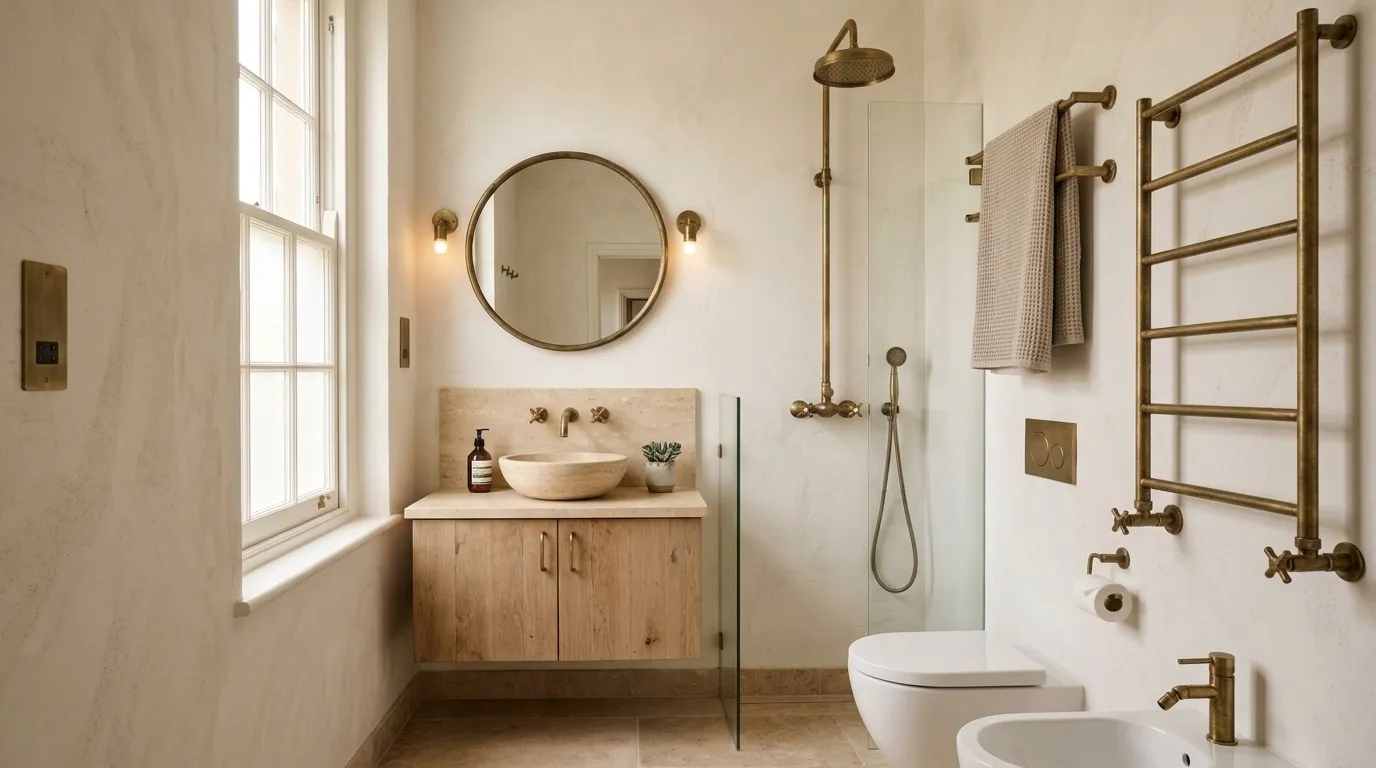
The design case for a neutral bathroom is specifically different from the case for a neutral room in any other part of the house. The bathroom’s function — daily personal ritual, from the morning wake-up shower through evening skincare routines to the occasional genuinely restorative bath — is enhanced by an environment that provides sensory calm rather than stimulation. The specific quality of a neutral bathroom that supports this function is the absence of the visual noise (competing colors, strong pattern, high contrast) that requires active visual processing from the occupant: a warm white and natural stone bathroom is experienced as restful because the materials reference natural environments (stone, wood, water) that the human visual system processes without effort, rather than manufactured pattern or strong color that requires sustained attention to resolve.
The commercial argument for a neutral bathroom is equally robust: neutral bathrooms consistently achieve higher property valuations than strongly colored or heavily patterned ones, specifically because their neutrality is universally legible as quality (warm stone and natural oak read as expensive material investment in a way that navy tiles or patterned cement tiles do not to all viewers) and because they require no repainting or retiling to suit a new occupant’s taste. Estate agents in multiple markets consistently report that the bathroom — alongside the kitchen — has the highest impact on property valuation, and that the neutral, quality-material bathroom achieves maximum valuation premium regardless of the overall property size.
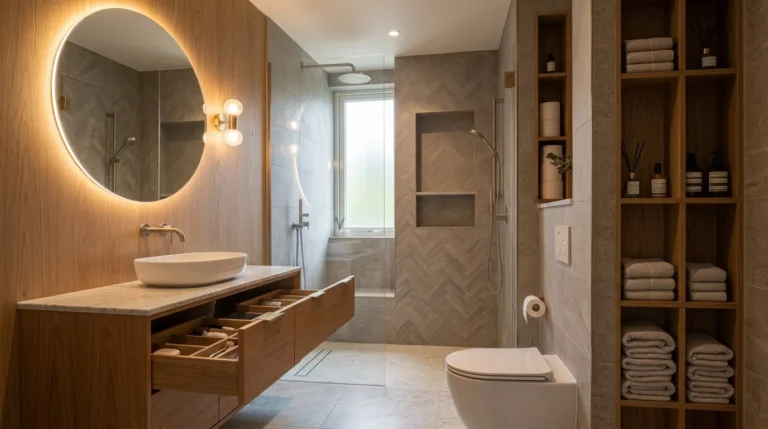
The specific risk of a neutral bathroom is the undifferentiated beige: the bathroom that reads as neutral not because of considered material quality but because of a lack of any design decision. A beige wall tile with a beige grout and a chrome tap and a white vanity unit produces a bathroom that reads as absent rather than timeless — the neutrality here is the absence of decision rather than the product of considered material selection. The fifteen ideas in this list specifically address this risk, providing the material, fixture, and finish decisions that distinguish a timeless neutral bathroom from a default one.
Style at a Glance
| Element | Timeless Neutral Core | Fresh Look Edge |
|---|---|---|
| Philosophy | Natural material quality, not color, creates visual interest | The neutral bathroom earns its calm |
| Materials | Warm stone, natural oak, warm white plaster, ceramic | Aged brass, matte black, concrete, limewash |
| Key Decisions | Grout color, tap finish, towel material, light source |
15 Timeless Neutral Bathroom Ideas for a Fresh Look
1. Warm White Subway Tile with Warm Grout — The Classic Rethought
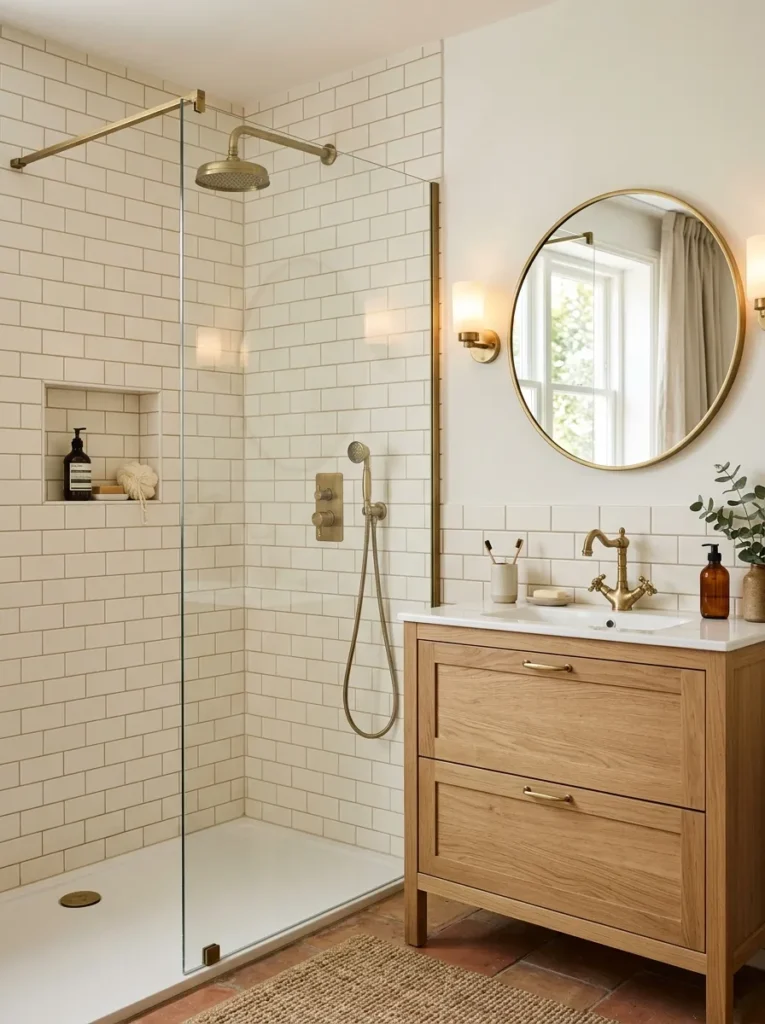
Vibe: The warm white subway tile bathroom feels like the classic form understood that its best interpretation was always warmth, not brightness — the putty grout and aged brass making a familiar tile choice feel genuinely considered.
Why it works: Warm white subway tile with a warm putty grout applies the grout color optimization principle — the most significant visual difference between an ordinary subway tile bathroom and an exceptional one is frequently not the tile itself but the grout color. Standard bright white grout creates a high-contrast grid pattern that visually dominates the tiled surface, making the grout more prominent than the tile. Dark gray grout creates a deliberately graphic grid that dates the bathroom to a specific trend moment. Warm putty or beige grout creates a cohesive tiled surface where the tile’s warm white tone and the grout’s warm neutral tone are close enough in value that the grout reads as a texture rather than a pattern — the tile surface reads as a single warm material with subtle relief rather than a two-tone grid.
Tile specification: The warm white specification is specific — tiles with a slight cream or yellow undertone rather than the blue-white undertone of standard bright white. Manufacturers including Fired Earth, Marlborough Tiles, and Topps Tiles produce warm white subway tiles specifically described as “off-white,” “ivory,” or “warm white” that provide this undertone quality.
Shop The Look
| Product |
|---|
| Warm white subway tile 75x150mm |
| Warm putty or beige grout |
| Aged brass tap basin set |
| Natural oak vanity unit |
| Warm white grout seal |
Also view: 14 Stylish Kids Closet Storage Ideas for Every Home
2. Travertine Tile — Natural Stone Warmth
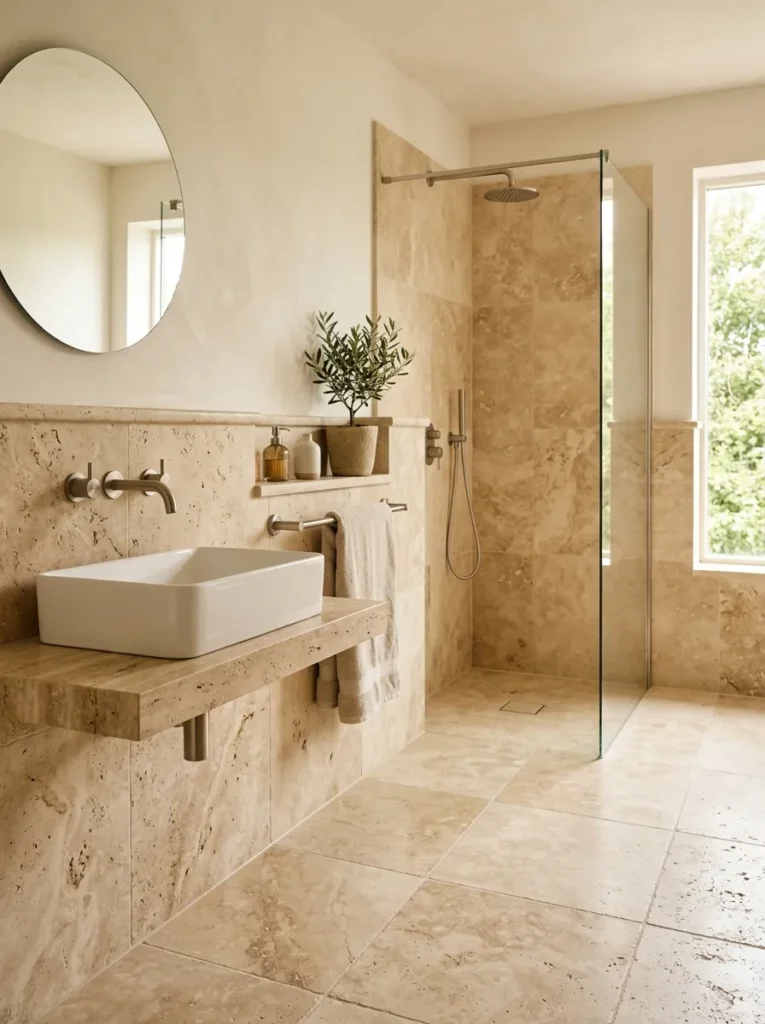
Vibe: The travertine bathroom feels like the natural world decided to be a bathroom — the stone’s geological warm cream and the natural pitting creating a material richness that no ceramic equivalent replicates.
Why it works: Travertine tile applies the geological material richness principle — travertine (a form of limestone formed by the precipitation of calcium carbonate from natural spring water) has been used in domestic and public interiors continuously for approximately 2,000 years, appearing in ancient Roman architecture and in contemporary luxury residential design with equal appropriateness. Its endurance in design history is attributable to its specific material qualities: the warm cream-beige base color (referencing ancient Mediterranean stone and warm earth tones), the natural vein patterns (each slab unique, creating a material individuality that ceramic cannot replicate), and the characteristic pitting (small natural cavities in the stone that can be left unfilled for an authentic textured surface or filled with grout for a smoother appearance).
Specification: Honed (matte) finish is more appropriate for bathroom floors than polished — the polished surface becomes slippery when wet and shows water marks. Seal travertine before use and reseal annually with a penetrating stone sealer. Fill the travertine’s natural pitting with a matching grout before sealing to prevent soap and product accumulation in the cavities.
Shop The Look
| Product |
|---|
| Travertine floor tile 60cm honed |
| Travertine dado tile matching |
| Penetrating stone sealer natural |
| Wall-mounted basin white |
| Brushed nickel wall tap pair |
3. Limewash Painted Walls — The Textured Neutral
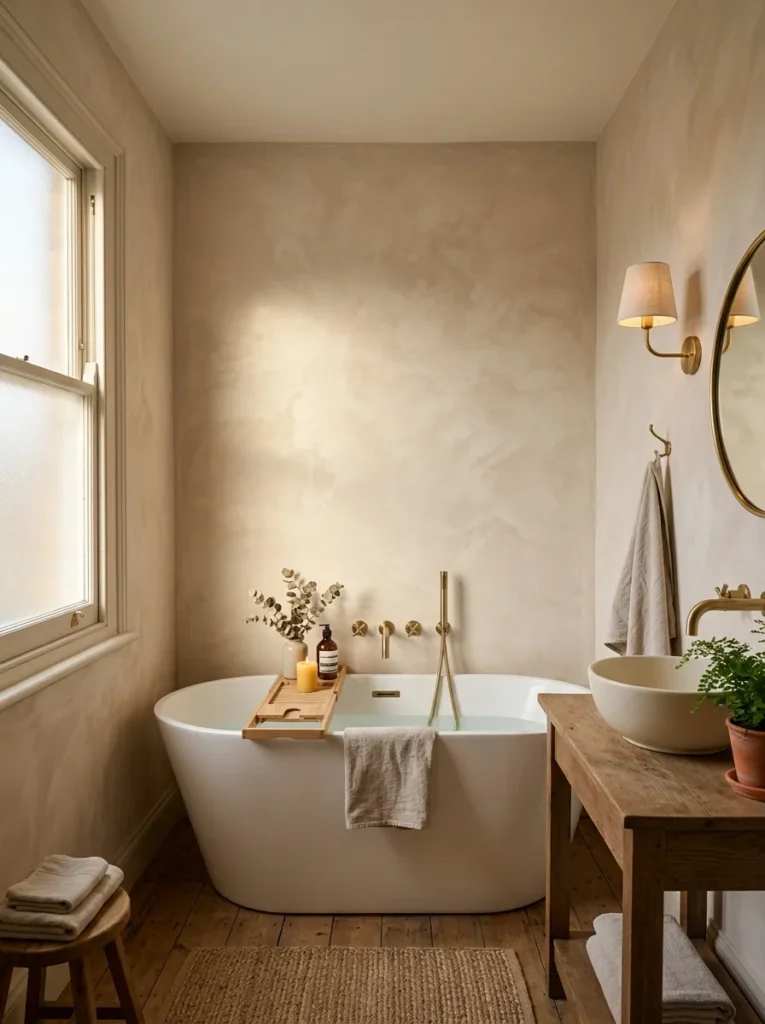
Vibe: The limewash bathroom feels like the walls have absorbed light over decades and are releasing it slowly — the varied depth of the wash creating a surface warmth that no flat paint achieves.
Why it works: Limewash paint in a bathroom applies the artisanal surface texture principle — limewash (a thin wash of slaked lime and pigment applied in overlapping translucent strokes) produces a surface whose color depth varies across the wall depending on the thickness of application. In a bathroom context, this variation creates the specific quality of a room whose walls appear to glow from within in warm light conditions — the multiple translucent limewash layers interact with light at different depths, producing a luminous quality that flat paint’s single opaque layer cannot replicate. The bathroom specifically benefits from this quality because the warm water vapor and shifting steam of a shower or bath environment dynamically changes the light in the room, and the limewash surface responds to these changes visually.
Bathroom specification: Standard limewash is not inherently waterproof — in a bathroom application, specify a lime-based paint with an added waterproofing additive for walls not directly splashed by water, and use a conventional waterproof surface for direct splash zones (around the basin, bath, and shower), painting the limewash up to but not over the water-contact zone. Alternatively, apply limewash only to the walls that do not receive direct water contact (typically the wall opposite the shower and the ceiling) and use a coordinating neutral tile or waterproof paint in the wet zones.
Shop The Look
| Product |
|---|
| Limewash paint warm white |
| Limewash waterproofing additive |
| Freestanding bathtub white cast iron |
| Brushed brass bath tap floor mount |
| Natural wood bath caddy bamboo |
4. Aged Brass Fixtures Throughout — The Hardware Decision
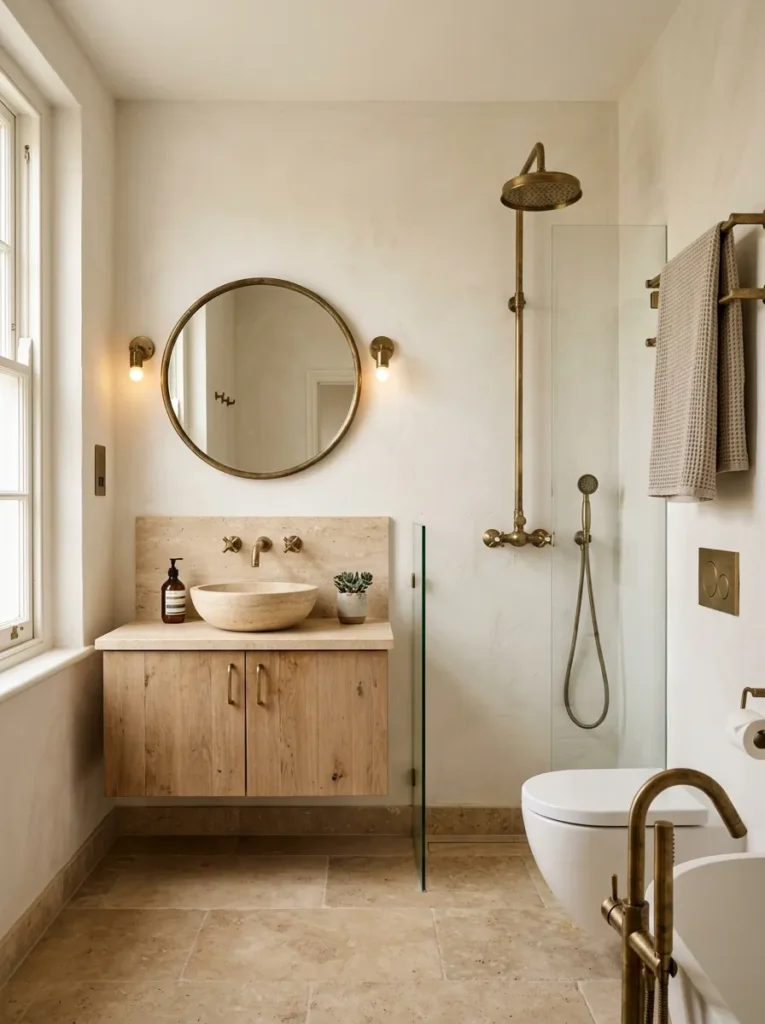
Vibe: The consistent aged brass bathroom feels like a hardware decision made once and applied completely — the cohesion of matching every metallic surface in the same warm antique finish creating a quality of completeness that mixed finishes cannot achieve.
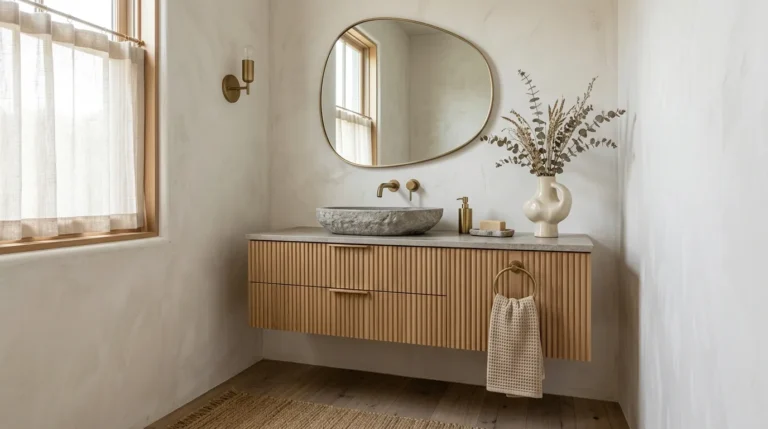
Why it works: Consistent aged brass fixtures throughout a bathroom apply the material finish cohesion principle — the most common bathroom hardware mistake is accumulating fixtures in different metallic finishes (chrome tap, nickel towel rail, brushed steel toilet roll holder) that each individually seem inoffensive but collectively create a finish inconsistency that reads as a lack of decision. Specifying a single metallic finish — specifically aged brass — across every hardware category in the bathroom (taps, shower, towel rails, accessories, cabinet hardware, light switches, mirror frame) creates a cohesion of warm metallic tone that reads as a deliberate design decision and elevates the entire bathroom’s perceived quality.
Aged brass specification: “Aged brass” is not a precise industry-standard finish name — it refers to a patinated brass finish that references naturally aged brass rather than polished or satin brass. Specify “unlacquered brass” for fixtures that will naturally patinate over time (the finish will continue to develop character with use), or “antique brass” or “heritage brass” from manufacturers who apply an artificial aging treatment. Leading suppliers including Perrin & Rowe, Samuel Heath, and Crosswater produce coordinated aged brass ranges across all fixture categories.
Shop The Look
| Product |
|---|
| Aged brass basin tap set |
| Aged brass shower head and control |
| Aged brass towel rail heated |
| Aged brass toilet roll holder |
| Aged brass cabinet pull set |
5. Terrazzo Floor — Warm Aggregate Natural Material
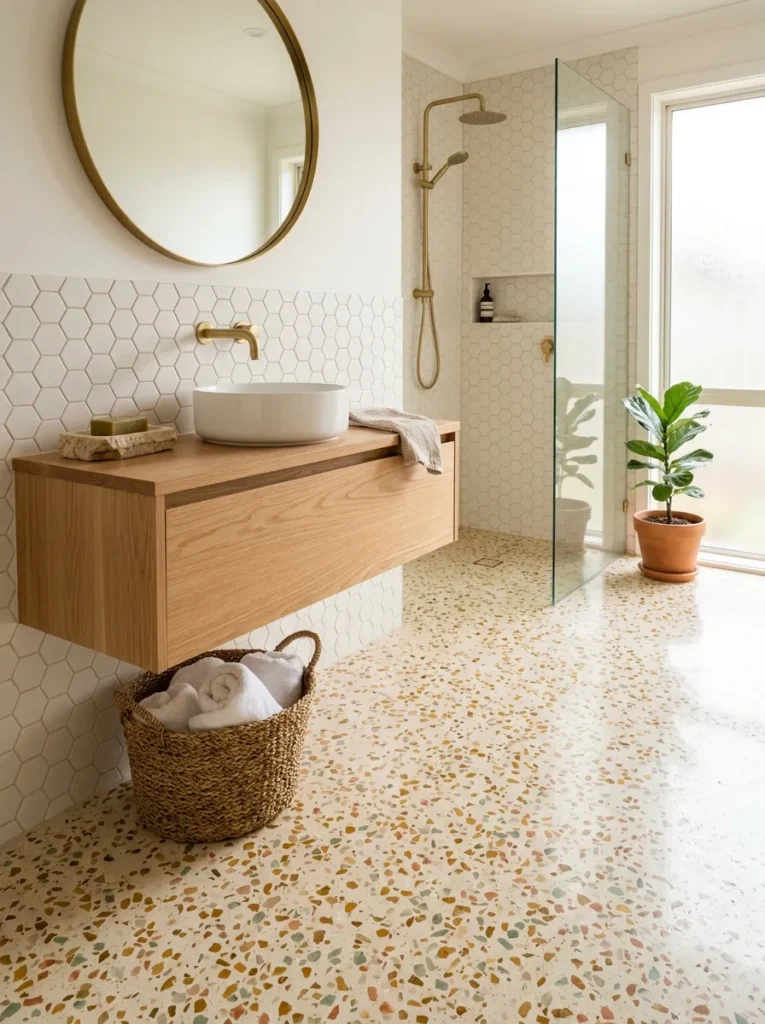
Vibe: The terrazzo bathroom floor feels like the floor contains the whole warm color palette in miniature — the aggregate chips providing all the visual interest the space requires without any additional pattern.
Why it works: A warm-toned terrazzo bathroom floor applies the aggregate material richness principle — terrazzo (marble, glass, or quartz chips set in a cement or resin matrix, ground smooth and polished) provides a floor surface of extraordinary visual complexity at close range (each individual chip is a distinct piece of colored material) while reading as a warm neutral at room distance (the dominant matrix color sets the room’s floor tone). A warm terrazzo specification (cream or warm white matrix with gold, coral, and soft green chips rather than the cooler gray matrix and darker aggregate of industrial or mid-century terrazzo) creates a floor with the specific warmth of natural material that reads as a premium selection while remaining within the neutral palette.
Specification: Contemporary residential terrazzo is available in two formats: poured resin terrazzo (requires professional installation, seamless, the highest quality result) and terrazzo tiles (pre-made tiles in standard formats, similar visual quality but with visible tile joints). For bathrooms, the seamless poured resin version provides the most authentic and most beautiful result, with no grout joints to manage.
Shop The Look
| Product |
|---|
| Terrazzo resin pour specialist |
| Warm aggregate chip mix set |
| Terrazzo tile alternative warm |
| Hexagonal wall tile white |
| Natural stone soap dish |
6. Natural Oak Vanity — Wood in the Wet Room
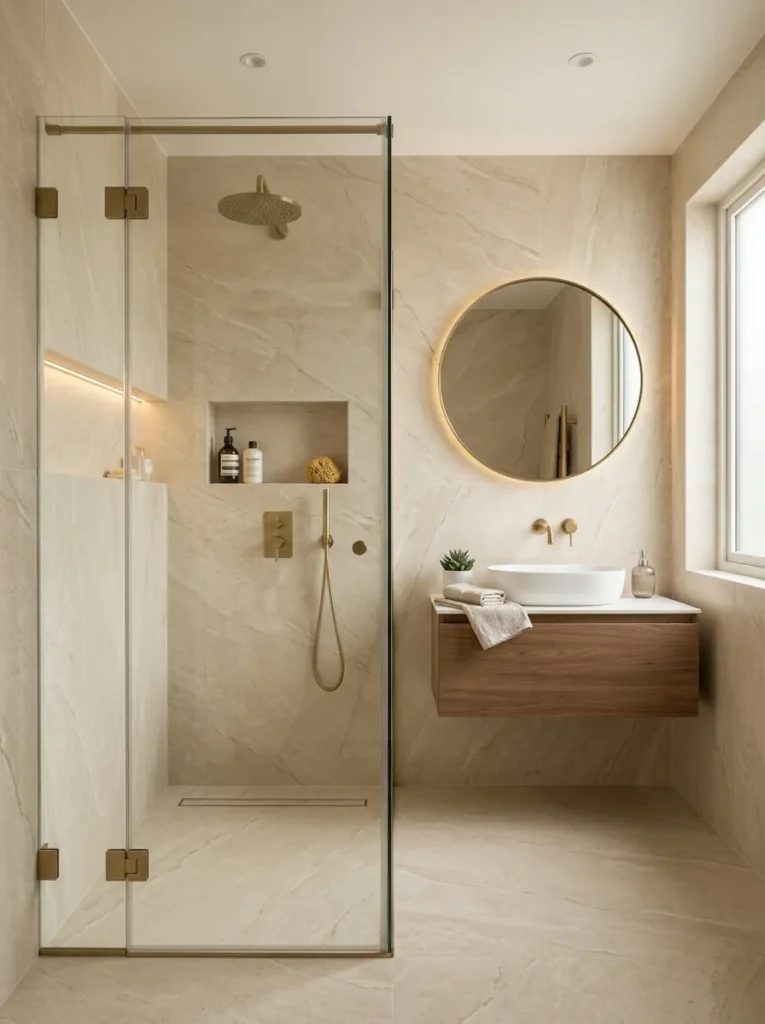
Vibe: The oak vanity bathroom feels like a wet room that was given a piece of furniture — the natural wood introducing warmth and domestic quality that the bathroom’s ceramic and stone surfaces alone cannot provide.
Why it works: A natural oak vanity in a neutral bathroom applies the warm material anchor principle — a bathroom composed entirely of ceramic, stone, and paint surfaces can read as beautiful but cold regardless of the warmth of the tile colors chosen. The introduction of natural wood — specifically oak, which has a warm honey tone and a clearly legible grain that communicates natural material quality immediately — creates the specific domestic warmth that prevents a neutral bathroom from reading as a hotel lobby rather than a personal space. Oak’s use in a bathroom requires appropriate sealing and specification — the wood should be solid oak or a high-quality oak veneer on waterproof substrate (marine ply rather than standard MDF), sealed with a hard-wearing water-resistant oil or lacquer.
Specification: Use a marine-grade plywood carcass for any wooden bathroom vanity to protect against the moisture exposure that standard particleboard cannot tolerate. Seal all surfaces with two to three coats of a bathroom-appropriate hard oil or lacquer, paying particular attention to the areas around the basin cutout and any areas adjacent to the tap positions. Reseal every two to three years or when water is no longer beading on the surface.
Shop The Look
| Product |
|---|
| Natural oak vanity unit basin |
| Oak waterproof oil sealer bathroom |
| White ceramic undermount basin |
| Aged brass basin tap |
| Marine ply carcass vanity |
7. Large-Format Porcelain Slab — Seamless Neutral Surfaces
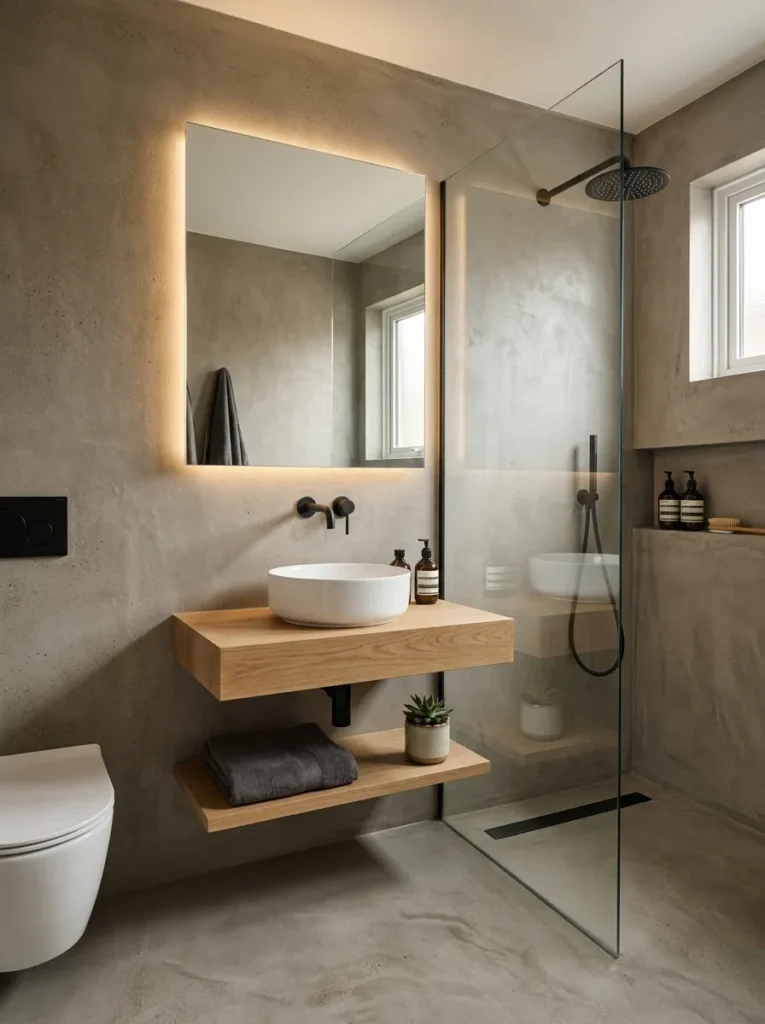
Vibe: The large-format slab bathroom feels like the wall and floor were formed rather than tiled — the minimal grout lines creating a surface that reads as continuous material rather than an arrangement of individual tiles.
Why it works: Large-format porcelain slab tiles applied to a neutral bathroom apply the visual simplicity through scale principle — standard tile formats (300×300mm, 600×300mm) create a visible tile grid (grout lines every 30–60cm) that the eye reads as pattern regardless of the tile’s color. A 1200×600mm large-format tile creates grout lines every 60–120cm, reducing the tile grid to a background texture at room distance. At the largest format (1200×1200mm or larger), the grout lines are so infrequent that the surface reads as a single continuous material, particularly when the stone-effect pattern is printed with pattern variation rather than repeat. This near-seamless quality is the specific visual advantage of the large-format specification: the stone-effect print reads as genuine stone rather than as a printed repeat.
Installation: Large-format tiles require flat, correctly prepared walls and floors (large tiles reveal surface irregularities that smaller tiles bridge). Specify full-bed adhesive coverage (the adhesive must contact the full tile back — not spot adhesive) to prevent lippage (one tile edge sitting higher than adjacent tiles, visible on large-format tiles). Use an experienced tiler with large-format experience.
Shop The Look
| Product |
|---|
| Large format porcelain 120x60cm warm |
| Large format adhesive full bed |
| Brushed brass shower fixtures |
| Recessed shower niche matching tile |
| Large format tile level clips |
8. Concrete Effect — Industrial Warmth
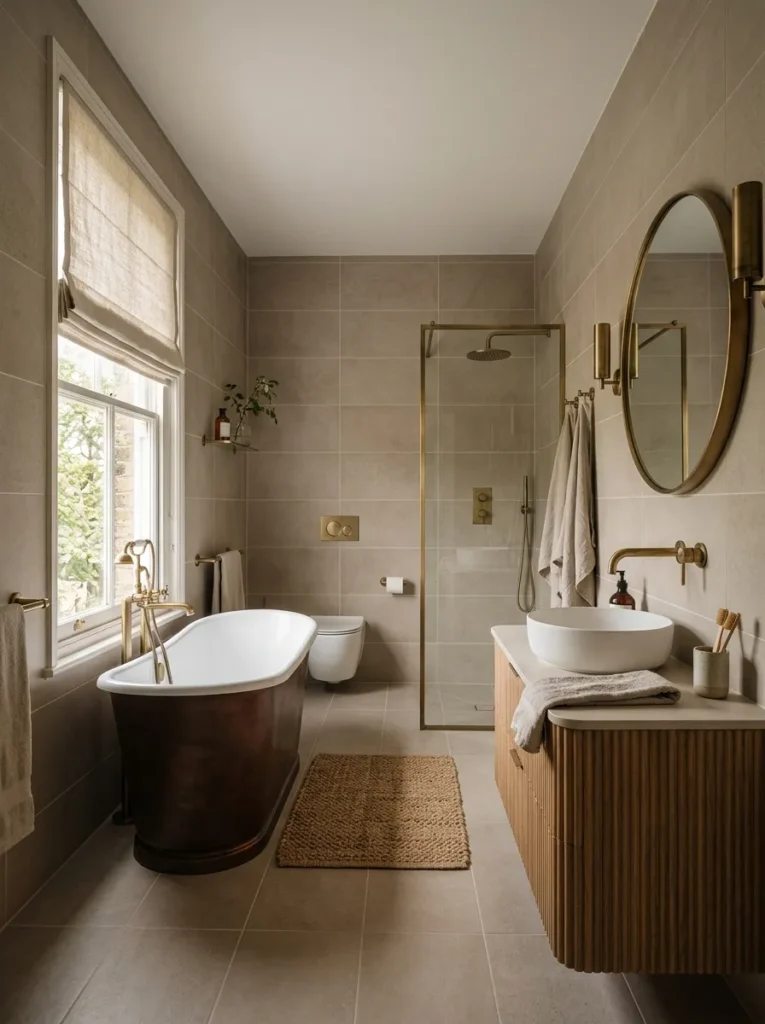
Vibe: The concrete bathroom feels like the industrial material found its ideal domestic application — the continuous warm gray-taupe surface creating a monolithic warmth that the material achieves nowhere else as completely as in a small enclosed bathroom.
Why it works: A warm concrete-effect bathroom applies the monolithic material principle — a bathroom where walls, floor, and ceiling are all covered in the same material (whether genuine micro-cement or concrete-effect porcelain) reads as a sculpted space rather than a tiled one. The monolithic quality (one material, one color, one texture throughout) creates the specific bathroom typology of the high-end day spa and the luxury hotel suite, where the material’s continuity provides visual calm through the complete absence of material transitions. The warm gray-taupe specification (rather than the cool industrial gray of genuine raw concrete) is the color decision that places the concrete-effect bathroom in the warm neutral palette — the taupe’s yellow-brown undertone prevents the gray from reading as cold.
Micro-cement versus porcelain: Genuine polished micro-cement (a cementitious material applied in multiple thin layers over any surface, polished to a smooth finish) achieves the most authentic seamless concrete quality but requires professional application and annual resealing. Warm concrete-effect porcelain (a tile printed to replicate micro-cement) achieves a very similar visual result with more accessible installation and lower maintenance requirements.
Shop The Look
| Product |
|---|
| Warm gray-taupe micro-cement |
| Micro-cement specialist applicator |
| Concrete-effect porcelain alternative |
| Matte black basin fixture |
| White ceramic basin undermount |
9. Mushroom and Warm Greige — The New Neutral
Vibe: The mushroom greige bathroom feels like the most sophisticated possible answer to the question of what neutral means in a bathroom — the color neither obviously warm nor obviously cool, reading as natural mineral at its most restrained.
Why it works: A mushroom or warm greige bathroom tile applies the sophisticated neutral principle — greige (a blend of gray and beige with a warm brown undertone) occupies the specific chromatic territory between warm neutral and cool neutral that reads as timeless because it carries neither the association of “beige” (which trends label as dated) nor the association of “gray” (which has specific trend associations from the 2010s). Mushroom specifically (a mid-value greige with enough warmth to read as organic and enough gray to read as contemporary) is the most versatile neutral tile specification because it coordinates equally well with aged brass (which amplifies its warm undertone), brushed nickel (which amplifies its gray component), and natural wood (which references its earthy quality).
Color undertone verification: Before purchasing, hold the tile sample against both a warm white and a cool white surface to verify the undertone — a mushroom tile with a warm undertone should appear warmer against the cool white than against the warm white. A tile that appears unchanged regardless of background has a true neutral undertone; a tile that appears slightly purple-gray has an undertone that will conflict with warm accessories.
Shop The Look
| Product |
|---|
| Mushroom greige matte tile 30x60cm |
| Aged brass bathroom accessory set |
| Natural linen roman blind bathroom |
| Natural fiber bath mat |
| Mushroom grout coordinating |
10. Wet Room with Curbless Shower — Seamless and Clean
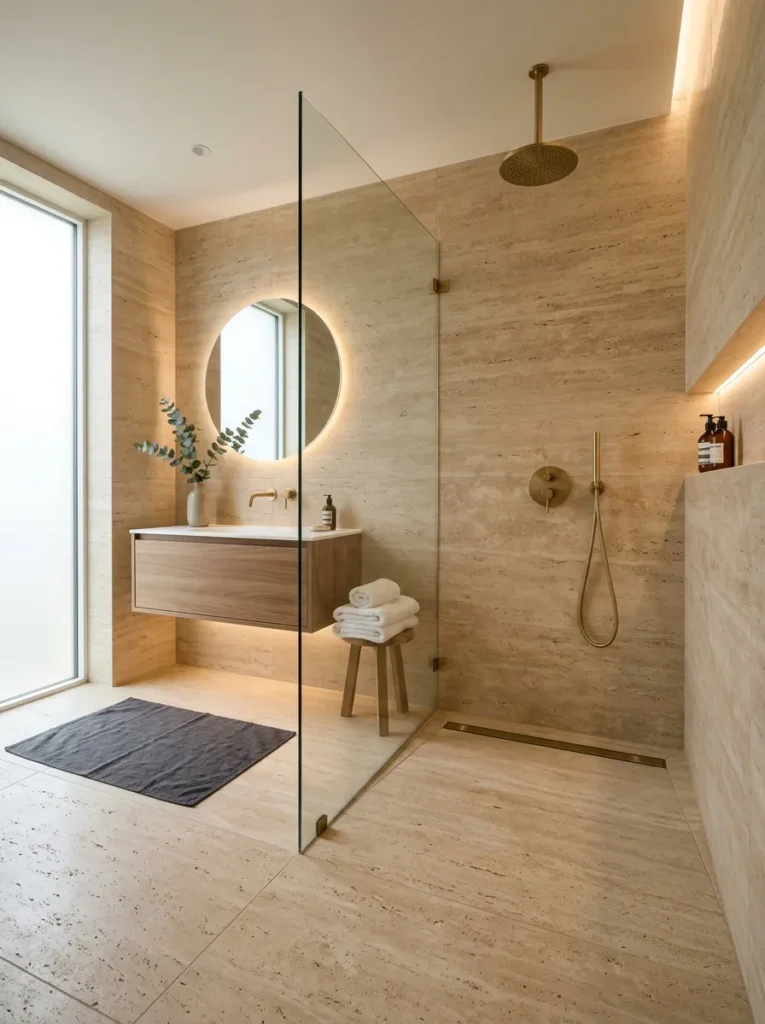
Vibe: The curbless wet room feels like a bathroom that removed every barrier between the person and the water — the continuous floor and the single glass panel creating a spatial generosity that the standard shower tray cannot achieve.
Why it works: A curbless wet room with a concealed linear drain applies the spatial continuity principle — the conventional shower tray and its raised curb creates a visual and physical interruption in the bathroom floor that divides the space into distinct zones with different materials and different heights. Removing the curb and continuing the floor tile through the shower area creates a continuous floor plane that makes the bathroom appear significantly larger than its actual dimensions and reads as significantly more resolved from an interior design perspective. The single glass panel (replacing the standard shower door and frame) is the accompanying decision that maintains the wet zone separation with minimum visual intrusion.
Technical requirement: A curbless shower requires the bathroom subfloor to be lowered by approximately 40–50mm in the shower zone to accommodate the tile slope toward the drain while maintaining a continuous floor surface level with the surrounding bathroom. This modification is most easily achieved in new construction or major renovation — retrofitting requires cutting into the existing floor structure, which is possible but more complex.
Shop The Look
| Product |
|---|
| Concealed linear drain shower |
| Continuous floor tile warm stone |
| Single glass shower panel frameless |
| Rain shower head brushed brass |
| Curbless shower substrate system |
11. Vintage-Style Freestanding Bath — The Sculptural Centrepiece
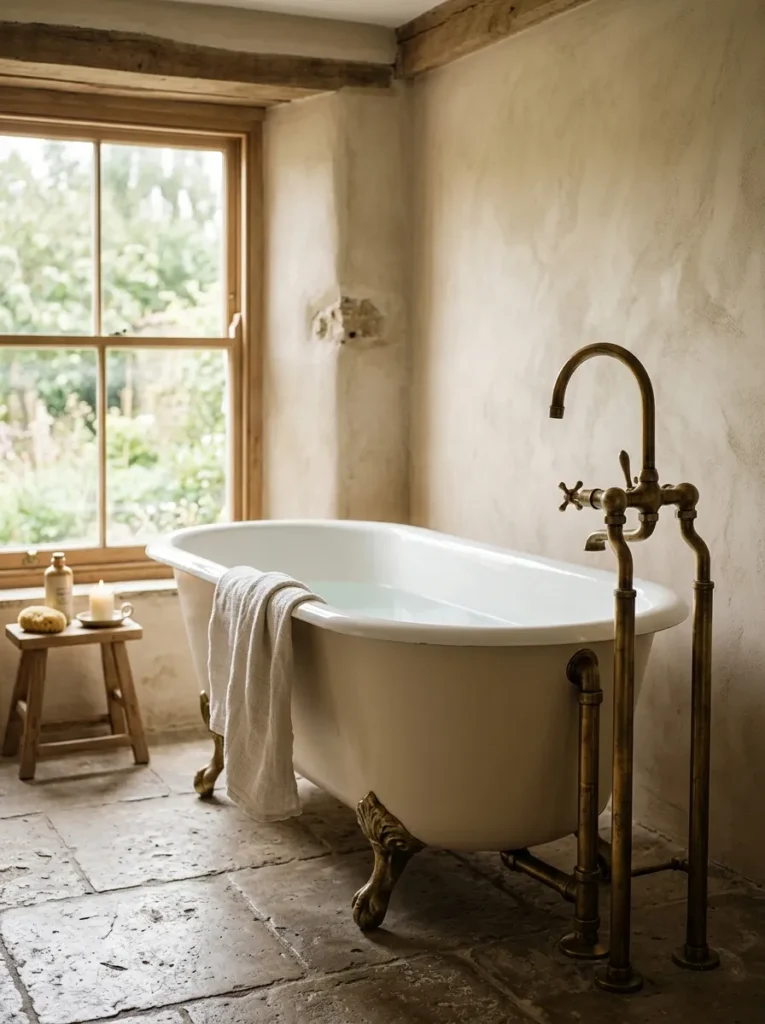
Vibe: The freestanding bath feels like a piece of furniture the bathroom was designed around — the sculptural form of the tub creating an architectural focal point that makes the bathroom a destination rather than a utility.
Why it works: A vintage-style freestanding bath applies the sculptural furniture principle — the freestanding bath is the one bathroom fixture that functions simultaneously as a plumbing installation and as a piece of room-defining sculpture. Its placement (freestanding in the room rather than recessed into an alcove) means it is experienced as an object in space rather than as a fitted element, and its form (the classic slipper or double-ended silhouette) carries the architectural quality of a designed object rather than a functional appliance. In a neutral bathroom where the material palette is restrained and the colors quiet, the freestanding bath’s sculptural presence provides the visual focal point that the bathroom’s other elements intentionally avoid competing with.
Material specification: Cast iron (the traditional and most thermally retentive material) provides the most authentic period quality and the best temperature maintenance during bathing; it is heavy (typically 150–200kg), requiring structural floor assessment before installation. Acrylic is lighter and more affordable but lacks the thermal mass; composite stone acrylic provides a middle ground of weight and warmth. A stone-effect exterior finish (painted or cast in a stone-colored composite) provides a warm neutral external appearance that coordinates with the stone tile and stone accessory palette.
Shop The Look
| Product |
|---|
| Freestanding slipper bath warm white |
| Floor-mounted vintage bath tap brass |
| Aged brass tap leg pair |
| White linen bath towel thick |
| Bath mat natural linen |
12. Recessed Shelving and Niche Storage — The Built-In Luxury
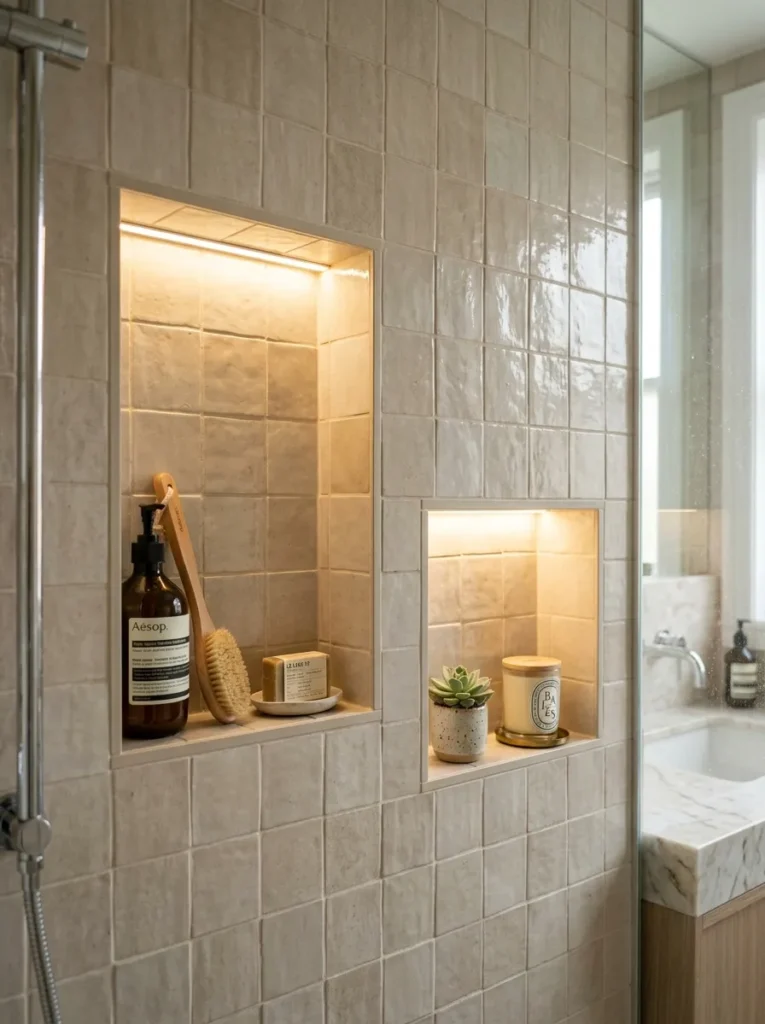
Vibe: The recessed bathroom niches feel like the wall was given something to do besides be a wall — the tiled-in storage creating the sense of a bathroom that was designed with care from the structure outward.
Why it works: Built-in recessed bathroom niches apply the architectural storage principle — a surface-mounted shelf or shower caddy is an addition to the bathroom; a recessed niche is part of the bathroom’s architecture. This distinction — addition versus architecture — is the design quality difference that makes a recessed niche read as a considered detail of a well-designed bathroom rather than an organizational afterthought. The consistent tile finish (the niche interior tiled in the same material as the surrounding wall surface) makes the niche appear as though it belongs to the wall rather than having been cut into it — the niche recedes as a shadow rather than advancing as a feature.
LED specification: A warm white LED strip (2700K) recessed in the niche’s top edge (behind a small overhanging tile lip) illuminates the niche interior without the strip itself being visible. This minimal illumination creates a warm glow within the niche that makes its contents (products in the shower niche, a small plant or candle in the decorative niche) appear warm and deliberately displayed rather than practically stored.
Shop The Look
| Product |
|---|
| Niche former waterproof set |
| Recessed niche tile to match wall |
| LED strip warm 2700K niche |
| Small succulent bathroom niche |
| Niche waterproofing kit |
13. Japandi Bathroom — East Meets Scandi Neutral
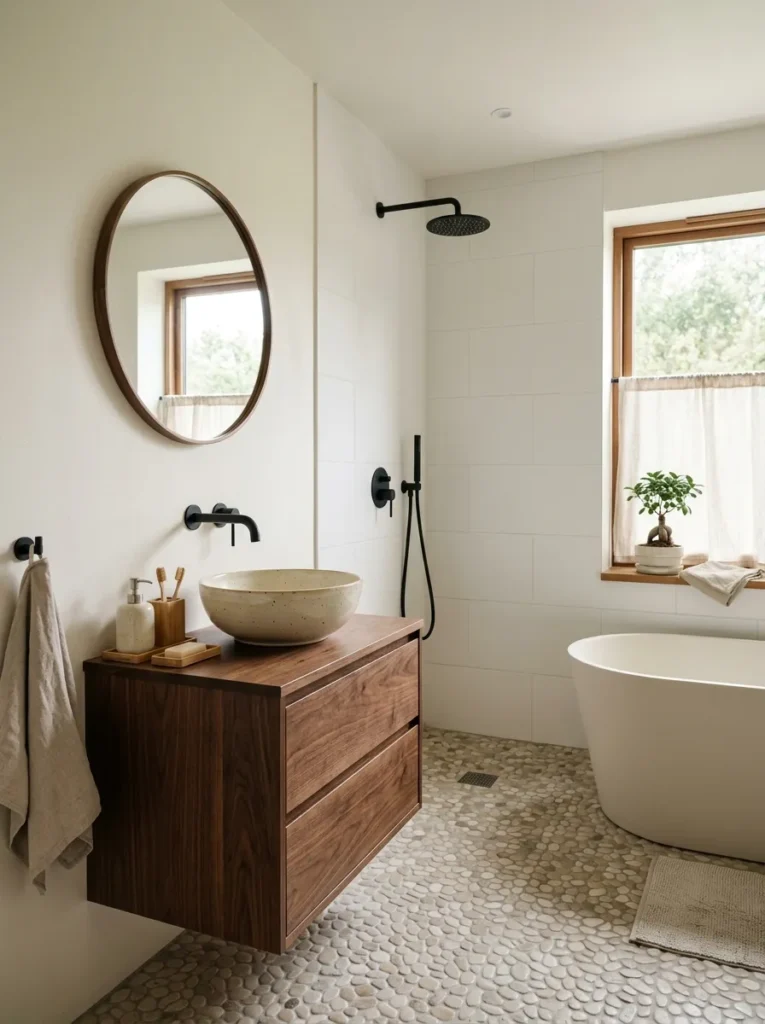
Vibe: The Japandi bathroom feels like a meditation practice that was given a room — the deliberate reduction of every element to its essential form creating a calm that is active rather than absent.
Why it works: A Japandi bathroom applies the wabi-sabi material principle — the Japanese concept of wabi-sabi (the beauty of imperfection, impermanence, and incompleteness) and the Scandinavian concept of hygge (the warmth and comfort of simple, honest materials and spaces) share a fundamental design principle: that beauty exists in natural materials used honestly, in forms reduced to their functional essence, and in spaces that support human wellbeing through simplicity rather than decoration. A Japandi bathroom applies this shared principle through: natural materials with visible material quality (the walnut vanity’s grain, the hand-thrown ceramic basin’s slight imperfection, the pebble floor’s varied natural form), reduced functional forms (the lower bath height referencing the Japanese soaking bath tradition, the minimal vanity without decorative fronts), and a restricted palette of warm neutrals.
Shop The Look
| Product |
|---|
| Wall-hung walnut vanity unit |
| Hand-thrown ceramic vessel basin |
| Matte black tap minimal |
| Bamboo accessory set bathroom |
| Pebble mosaic shower floor |
14. Warm White Paneling — The Classic Detail
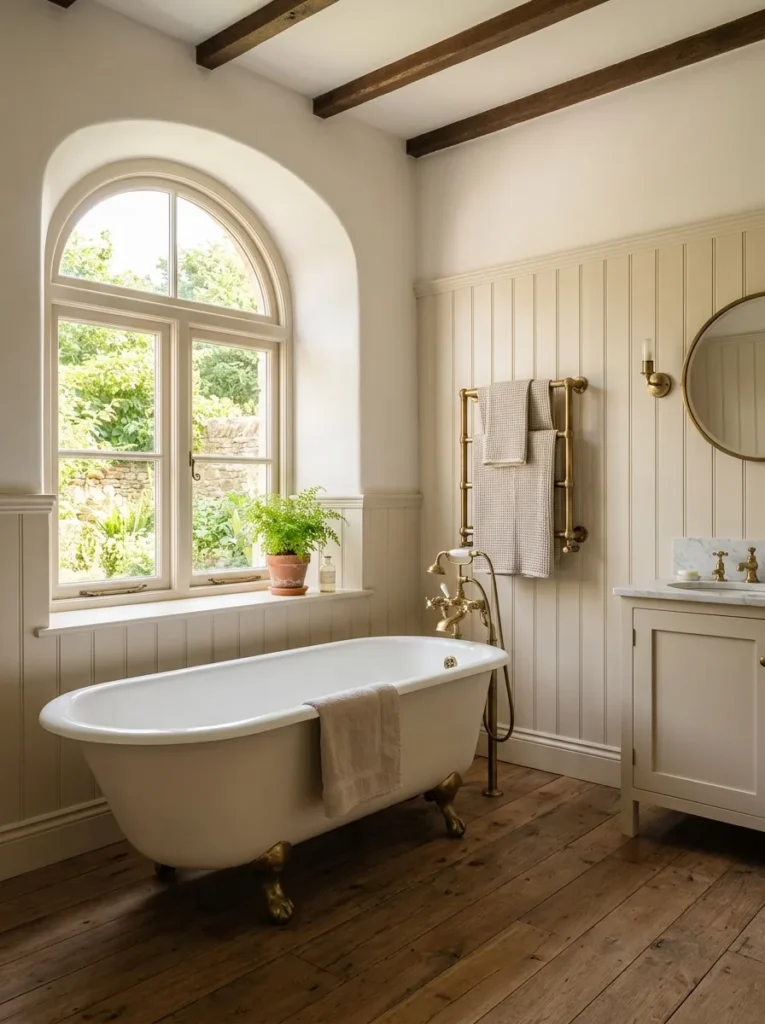
Vibe: The tongue-and-groove bathroom paneling feels like architectural detail that the bathroom earned through its age — the vertical shadow lines of the paneling creating textural warmth at the zone where the walls are most experienced at close range.
Why it works: Warm white tongue-and-groove or shiplap wall paneling at dado height applies the heritage architectural detail principle — traditional bathroom paneling (tongue-and-groove boards installed vertically to dado-rail height and painted) provides the shadow-line texture and architectural detail that a plain plaster or tiled wall cannot replicate at the bathroom wall’s most-experienced zone (the lower 120cm that is at eye and hand level for most of the time spent in the bathroom). The shadow lines between each tongue-and-groove board create a regular but subtle texture that the warm white paint unifies into a warm architectural surface — the light catches each shadow line differently throughout the day as the bathroom’s natural light source shifts.
Specification: MDF tongue-and-groove paneling (pre-primed, available from most timber merchants in 90mm and 120mm widths) provides a smooth paint-ready surface that is more appropriate for a painted bathroom finish than natural pine (which shows grain irregularities through paint). Waterproofing: in bathrooms with showers, the paneling should be sealed with a bathroom-grade eggshell paint on all surfaces (front, back, and both edges) before installation to prevent moisture ingress at cut edges.
Shop The Look
| Product |
|---|
| MDF tongue-and-groove panel set |
| Warm white eggshell paint bathroom |
| Dado rail traditional profile |
| Aged brass bathroom accessories |
| Panel adhesive bathroom waterproof |
15. Spa-Inspired Pebble and Natural Stone Mix
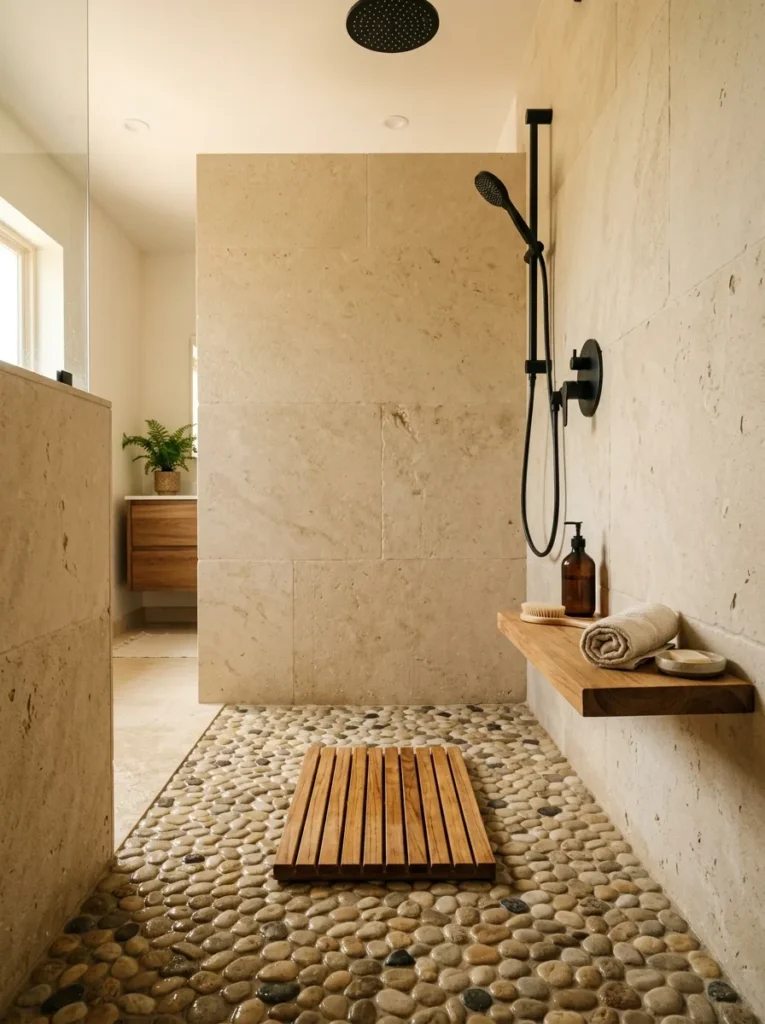
Vibe: The pebble and stone spa bathroom feels like showering in a natural thermal spring — the varied textures and natural materials making the shower an environment to be experienced rather than used.
Why it works: A spa-inspired bathroom with mixed natural stone and pebble materials applies the sensory multi-texture principle — the most sophisticated natural material bathrooms create sensory richness through the combination of multiple natural materials in the same space rather than through a single repeated material. The specific combination of large-format limestone wall tile (smooth, warm, large-scale) and pebble mosaic shower floor (tactile, irregular, small-scale) creates a textural contrast between wall and floor that references the natural environment of a riverbed — smooth stone faces above, pebbled ground below. The teak shower mat and natural wood shelf introduce the warmth of plant material into the mineral palette, completing the natural material triad (stone, pebble, wood) that characterizes the spa reference most directly.
Pebble floor maintenance: The pebble mosaic floor requires regular sealing (every six months in a shower that receives daily use) to prevent soap scum accumulation in the spaces between the pebbles. A silicon-based impregnating sealer applied to all natural stone and pebble surfaces prevents staining while allowing the stone to breathe.
Shop The Look
| Product |
|---|
| Warm limestone wall tile large |
| River pebble mosaic shower floor |
| Teak shower mat slat |
| Natural teak wood shower shelf |
| Stone and pebble impregnating sealer |
How to Start Your Neutral Bathroom Transformation
The single best first move before beginning any neutral bathroom renovation or refresh is collecting physical material samples — not digital images or screen swatches, but actual tiles, fabric swatches, and hardware samples — and assessing them together in the specific bathroom’s light conditions. The most common neutral bathroom specification mistake is choosing tiles, grout, and hardware from digital images that show materials in photography studio lighting rather than in the warm-white or cool fluorescent light of the actual bathroom. A warm beige tile that appears perfectly coordinated with an aged brass tap in a well-lit product photograph may appear as a conflicting yellow-beige under cool bathroom lighting — or as a perfectly beautiful warm honey tone under the warm lamp light that the same bathroom produces at evening bathing time. This assessment of physical samples in the specific bathroom’s actual light conditions takes a single afternoon and prevents the specification error that most commonly results in renovation disappointment.
The most common mistake in neutral bathroom design is confusing neutrality with absence — specifying materials that are neutral in the sense of having no particularly interesting quality (a standard white tile, a chrome tap, a white vanity unit) rather than neutral in the sense of having a quality that reads as timeless regardless of trend (a warm travertine tile, an aged brass tap, a natural oak vanity). The distinction between these two neutrality definitions is the difference between a bathroom that reads as undecorated and one that reads as considered — and the only tool that navigates between them is material quality. The most reliable guide to material quality in bathroom specification is to choose materials whose specific qualities (grain, texture, color variation, patina) are inherent to the material itself rather than applied to it: natural stone rather than stone-print laminate, genuine oak rather than oak-effect vinyl, aged brass rather than chrome with a brass-colored coating.
Three specific changes under $200 that immediately improve any existing neutral bathroom: replacing all bathroom hardware in mismatched metallic finishes with a consistent aged brass or brushed nickel finish ($40–80 for a towel ring, toilet roll holder, and robe hook in a consistent finish, from retailers including Simple Human, Vado, and Bristan); replacing the existing white or gray grout with a warm putty grout (the grout between existing tiles can be raked out and replaced with a new grout color in a single afternoon using a grout rake tool and replacement grout — $15–30 in materials, transforming the visual quality of any white subway tile installation); and replacing existing white bath towels with warm white or natural linen towels in two identical sizes ($30–80 for a set of two bath towels and two hand towels in matching natural linen or warm white, from retailers including Piglet in Bed, Parachute, or Brooklinen). These three changes combined for under $200 address the hardware, the grout, and the textiles — three of the most visible elements in any bathroom.
Frequently Asked Questions About Timeless Neutral Bathroom Design
What is the difference between a timeless neutral bathroom and a boring one?
The distinction between a timeless neutral bathroom and a boring one lies entirely in material quality and considered detail. A boring neutral bathroom uses materials chosen for their inoffensive absence of character — standard bright white tiles, chrome fixtures, white flat-pack vanity — that together create a bathroom with no positive qualities, only the absence of negative ones. A timeless neutral bathroom uses materials chosen for their intrinsic quality — warm stone with natural vein variation, oak with visible grain, aged brass with genuine patina — that together create a bathroom whose warmth and character are attributable to the materials themselves rather than to applied decoration or trend-dependent color. The test: would this bathroom still read as beautiful if every trend photograph from the year it was designed disappeared? The timeless neutral bathroom would; the boring neutral bathroom would read as merely adequate.
Which neutral grout color works best in a neutral bathroom?
For a warm neutral bathroom palette, the most consistently successful grout color is warm putty or warm greige — a grout with a slight warm beige-brown undertone rather than the standard cool gray or bright white. Standard bright white grout creates a high-contrast grid that dominates any tile it joins, regardless of the tile color; standard mid-gray grout creates a cooler temperature overall and has specific trend associations; warm putty grout creates a cohesive surface where the tile’s warm tone and the grout’s coordinating tone read together as a unified warm material rather than as a tile-and-grout grid. The grout should be approximately half to one value lighter than the tile — dark tiles with dramatically lighter grout create an unwanted emphasis on the grid, while same-value grout disappears entirely at room distance.
Is natural wood suitable in a bathroom environment?
Natural wood is suitable in bathroom environments when specified and maintained correctly. The three requirements for a successful natural wood bathroom specification are: appropriate substrate (solid oak or quality oak veneer on marine-grade plywood or exterior-grade MDF, not standard interior MDF or particleboard which deteriorate with moisture exposure), appropriate sealing (two to three coats of a hard-wearing water-resistant oil — Osmo Polyx-Oil, Fiddes Hard Wax Oil, or equivalent — to all surfaces including back faces and cut edges), and appropriate positioning (away from direct water contact such as shower splash zones — wood can tolerate the ambient humidity of a bathroom but not repeated direct saturation and drying cycles). With these three requirements met, natural oak in a bathroom will perform for 10–15 years before requiring refinishing, developing a warm patina over that period that improves the material’s character.
How do you choose between aged brass and brushed nickel for bathroom fixtures?
The choice between aged brass and brushed nickel as the bathroom’s fixture finish depends on the specific neutral palette being used. Aged brass coordinates most naturally with warm neutral palettes — travertine, warm limestone, warm white, natural oak, terracotta, and earthy mushroom tones all share the warm yellow-orange undertone that aged brass amplifies. Brushed nickel coordinates with cooler neutral palettes — gray concrete, cool white marble, charcoal slate, and gray-dominant greige tones all share the cool or silver undertone that brushed nickel coordinates with rather than conflicting. The simplest guide: if your tile sample looks warmer when held against a warm white background than against a cool white background, choose aged brass; if it looks cooler, choose brushed nickel. Whatever metallic finish is chosen, it must be applied consistently to every fixture in the bathroom — mixing aged brass and brushed nickel produces a visual inconsistency that undermines both finishes.
What is the most cost-effective upgrade to a neutral bathroom?
The single most cost-effective upgrade to an existing neutral bathroom is the grout replacement — raking out the existing white or gray grout from a tiled surface and regrouting with a warm putty or greige grout color transforms the visual quality of the tile installation at a materials cost of $20–40 (a grout rake tool and a bag of warm putty grout). This single change addresses the most visually dominant aspect of a tiled bathroom (the grout color and the grid it creates or suppresses) and is achievable by any competent DIY-er in a single day for a standard-sized bathroom. The second most cost-effective upgrade is hardware replacement — changing a mismatched or chrome hardware set to a consistent aged brass or brushed nickel set ($40–120 from mass-market homeware retailers) provides the material quality signal that the fixture finish creates across every surface it occupies in the bathroom.
Ready to Refresh Your Bathroom?
These 15 ideas move through every dimension of what makes a neutral bathroom timeless rather than merely beige — from the foundational warmth of subway tile with putty grout and consistent aged brass hardware, through the natural material richness of travertine and terrazzo and natural oak, to the architectural sophistication of curbless wet rooms, recessed niches, and floor-to-ceiling paneling, to the considered cultural references of Japandi minimal and spa natural stone. Starting with the sample collection — an afternoon spent assembling physical tiles, hardware samples, and fabric swatches and assessing them together in the actual bathroom’s actual light — is the beginning that prevents the most expensive and most common neutral bathroom mistake: the mismatch that only appears after the tiles are grouted and the fittings are installed. Collect the samples this week. Hold them together in the morning light and the evening light. Note which combination reads as most genuinely warm and most genuinely resolved in both conditions. That combination is the bathroom that will still look considered in fifteen years — and that is the specific promise that a timeless neutral bathroom makes and keeps.