14 Stylish Kids Closet Storage Ideas for Every Home
Playful Scandinavian kids closet storage combines low, child-reachable systems with a soft color palette so organization becomes something kids can actually maintain themselves. This guide gives you 14 stylish kids closet storage ideas for every home, from color-coded bins to growth-chart walls.
Picture a closet where a three-year-old can reach their own socks, where labeled bins in soft pastel tones replace mismatched cardboard boxes, where a pegboard wall holds today’s chosen outfit before it even gets asked for. The mood is bright, low to the ground, and just playful enough to make putting things away feel like part of the fun. Here are 14 ideas worth saving — and stealing.
Why Playful Scandinavian Kids Storage Works So Well
Playful Scandinavian kids storage borrows its low-height, child-accessible logic from Reggio Emilia classroom design and its clean material palette from Scandinavian minimalism — the idea that a child who can reach and see their own things will actually put them away. What separates it from generic kids’ organization is scale: everything sits at a child’s eye and arm height first, adult convenience second.
The palette leans on birch plywood and warm white as the neutral base, with soft pastels like dusty blue, blush, and buttery yellow used in bins, labels, and hooks. Materials stay simple and durable — birch, cotton canvas, powder-coated metal — chosen to survive years of small hands rather than looking precious.
This style is trending as more parents move away from themed, character-branded storage toward flexible, neutral systems that grow with a child, and Pinterest search data shows steady interest in “Montessori closet” and “kids capsule wardrobe” searches as families favor fewer, better-organized items over overflowing bins.
Small closets handle this style well. Prioritize a low double hanging rod and door-back storage first, since both add real capacity without requiring any new floor footprint.
Style at a Glance
| Element | Trait 1 | Trait 2 |
|---|---|---|
| Philosophy | Child-height access first | Fewer items, clearly placed |
| Materials | Birch plywood, canvas | Powder-coated metal |
| Color palette | Warm white, birch tan | Dusty blue, blush, buttery yellow |
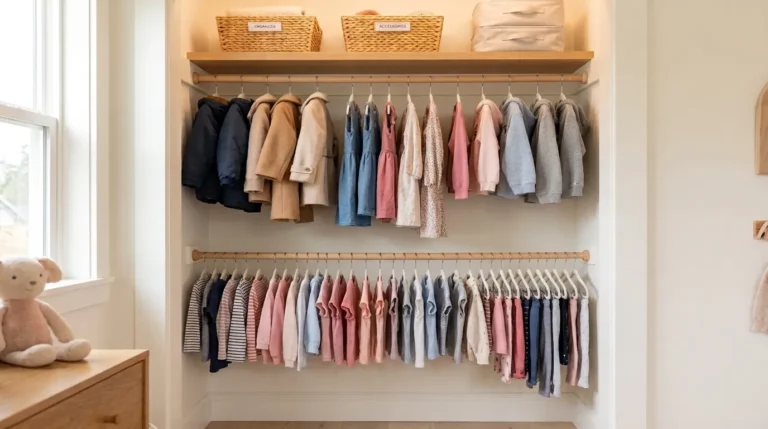
1. Low Double Hanging Rod
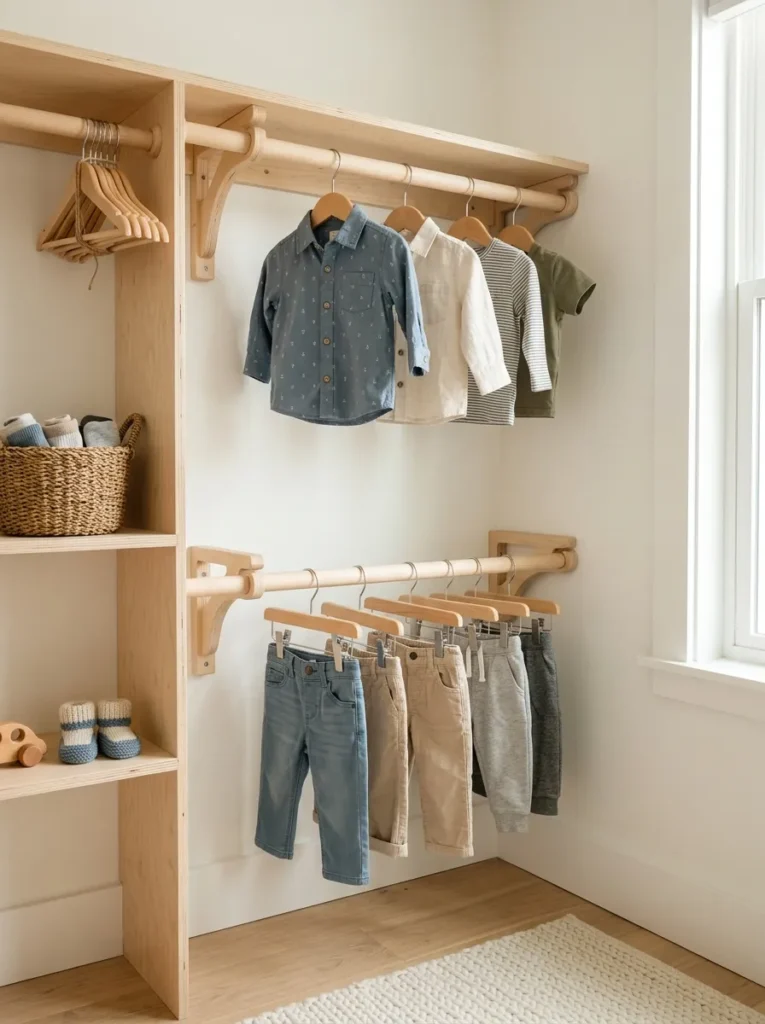
Vibe: The closet feels airy and genuinely usable, hung right at a child’s own height.
Why it works: Splitting one tall rod into two shorter rods stacked at child and near-child height uses proportion deliberately — the lower rod sits within a four-year-old’s actual reach, so getting dressed independently becomes physically possible, not just a nice idea.
How to get it: Mount the lower rod at roughly 30 inches from the floor and the upper rod at 52 inches, using birch wood brackets rated for at least 15 pounds per side.
Quick Win: A $25 tension rod adapter adds a second low rod to an existing closet without any drilling.
Shop The Look
- Birch wood closet rod bracket set
- Double hang closet rod kit
- Small wood kids hangers set
- Tension rod adapter
- Soft-close rod end caps
Also view: 15 Stylish Green Living Room Designs for Every Home
2. Rainbow-Sorted Bin Wall
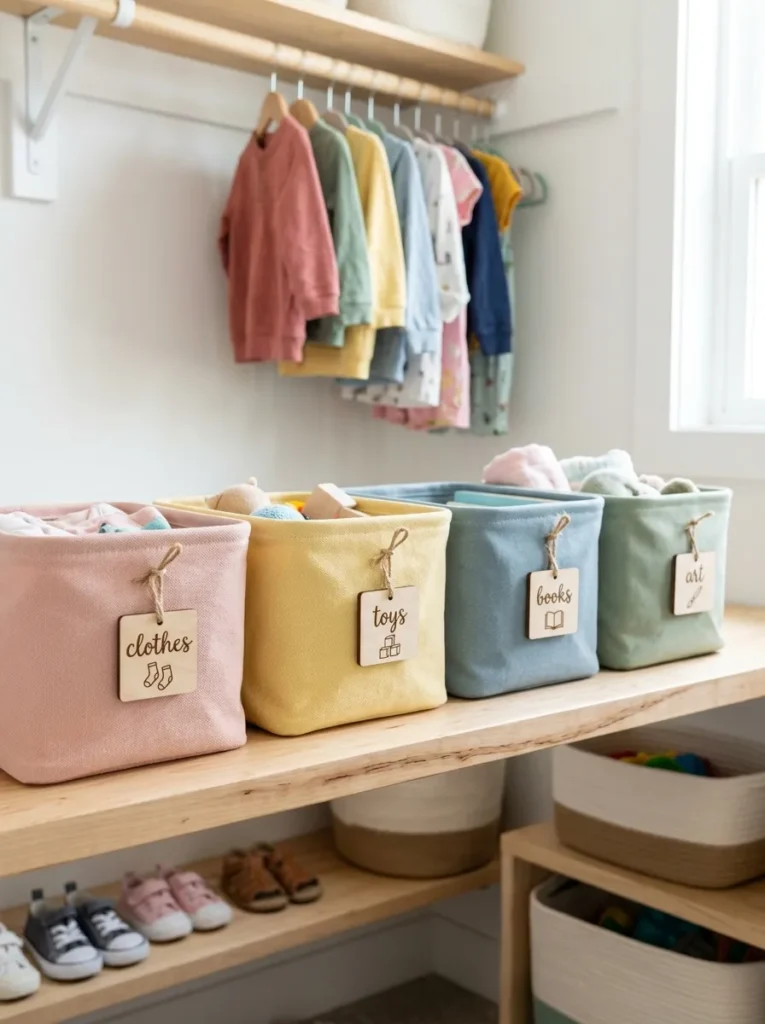
Vibe: The shelf feels luminous and inviting, like a color wheel a child could read without knowing letters yet.
Why it works: Arranging bins in a soft pastel gradient rather than bright primary colors lets color still function as a sorting cue for pre-readers, while keeping the closet visually calm instead of loud — a principle borrowed straight from the ribbon-drawer gradient technique, scaled up to bin size.
How to get it: Choose canvas bins in one pastel per category — blush for socks, buttery yellow for pajamas, dusty blue for accessories — and keep the gradient order consistent across every shelf.
Shop The Look
- Canvas storage bin pastel set of 6
- Birch open shelving unit
- Wood label tag set
- Shelf edge label holder
- Small drawer divider insert
Also view: 15 Stylish Kids Closet Storage Ideas for Small Spaces
3. Birch Plywood Cubby System
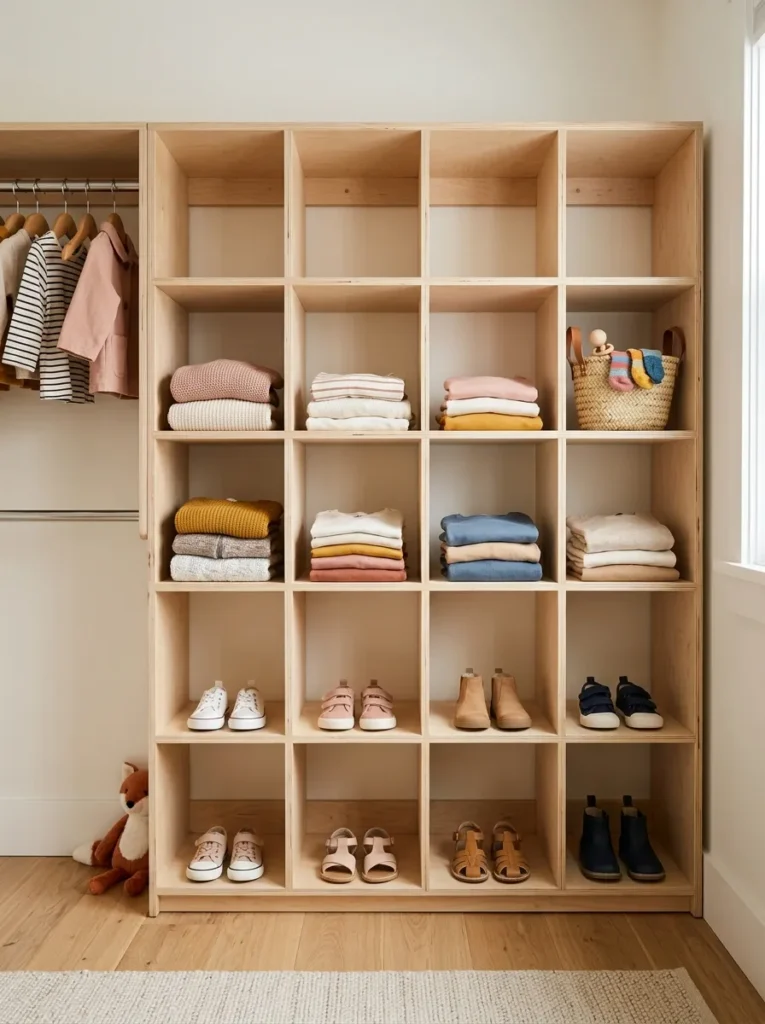
Vibe: The closet feels grounded and orderly, each cubby doing one clear job.
Why it works: Open square cubbies sized to hold exactly one category — shoes, folded shirts, pajamas — apply the design principle of visual containment without doors, so a child can see and choose without needing to open anything, reducing the friction that leads to piles on the floor.
How to get it: Build or install birch cubbies sized roughly 12 by 12 inches, positioning the lowest row at floor level for shoes and the next row up at chest height for folded items.
Shop The Look
- Modular birch cubby storage unit
- Small woven basket insert
- Wood shoe divider tray
- Cubby label tag set
- Birch trim edge banding
4. Warm Closet Light with a Pull Cord
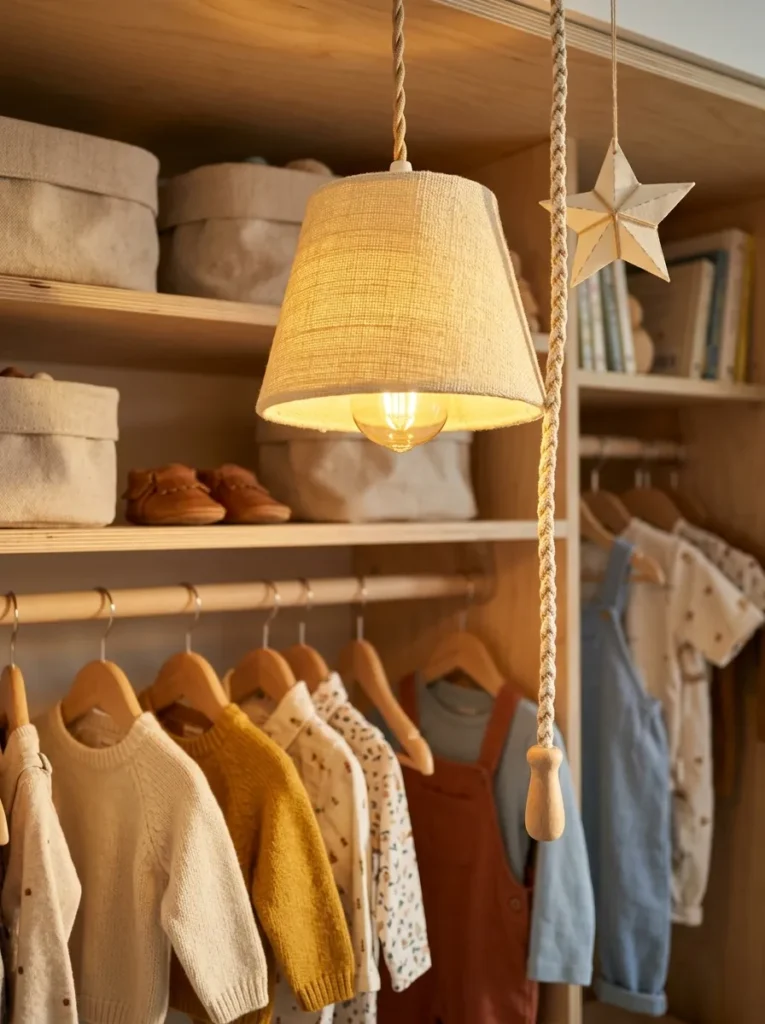
Vibe: The closet feels warm and a little magical, like its own small room instead of a dark corner.
Why it works: A warm-toned pendant with a reachable fabric pull cord solves a genuine lighting behavior problem in closets — most rely on a single harsh overhead bulb or no light at all — while the cord height makes it a fixture a child can actually operate themselves.
How to get it: Install a small warm-white pendant rated near 2700K with the pull cord trimmed to hang at a height a child can reach without stretching, roughly 48 inches from the floor.
Quick Win: A $15 battery-operated warm puck light with a tap switch skips wiring entirely.
Shop The Look
- Small pendant light warm white
- Fabric pull cord extension
- Battery tap light puck
- Closet light switch cover
- Paper star hanging accent
5. Labeled Hook Rail at Child Height
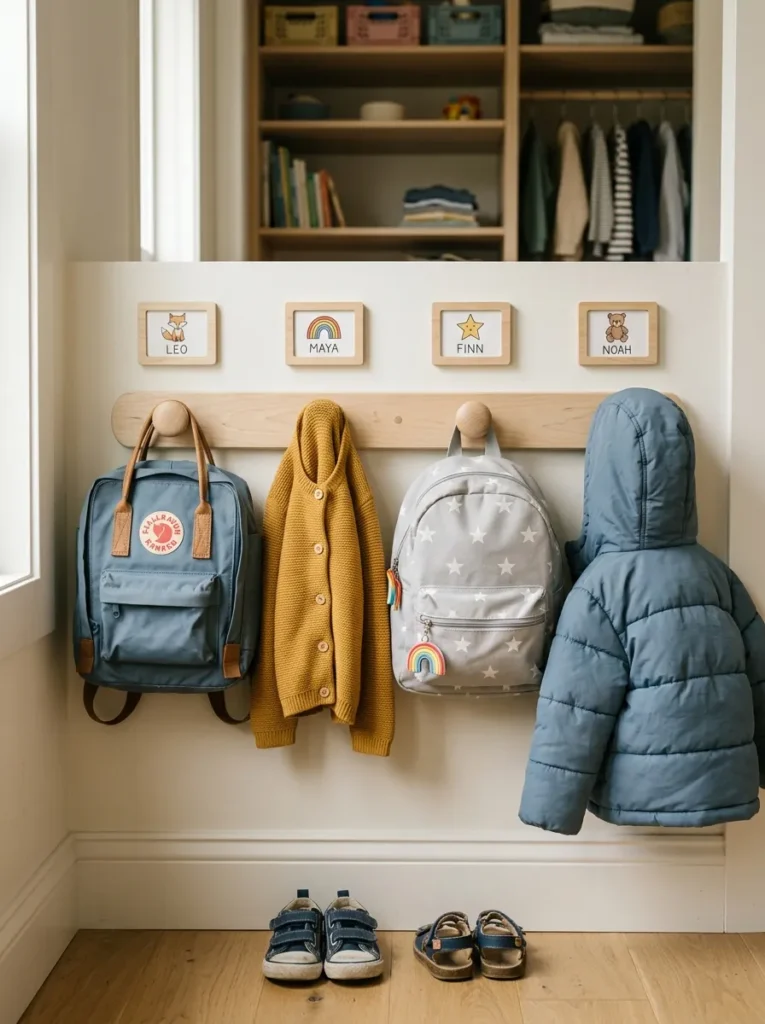
Vibe: The wall feels still and dependable, every hook doing exactly one job.
Why it works: Mounting hooks at child shoulder height rather than adult height, paired with a picture label instead of just text, uses proximity and pre-literacy visual cues together — a child can match the picture to the object without needing to read.
How to get it: Mount rounded birch hooks at roughly 36 inches from the floor, spaced six inches apart, with a small printed picture icon above each one.
Shop The Look
- Birch wood hook rail
- Rounded child-safe hook set
- Picture label card set
- Small backpack hook extender
- Wall anchor hardware kit
6. Zoned Layout by Morning Routine
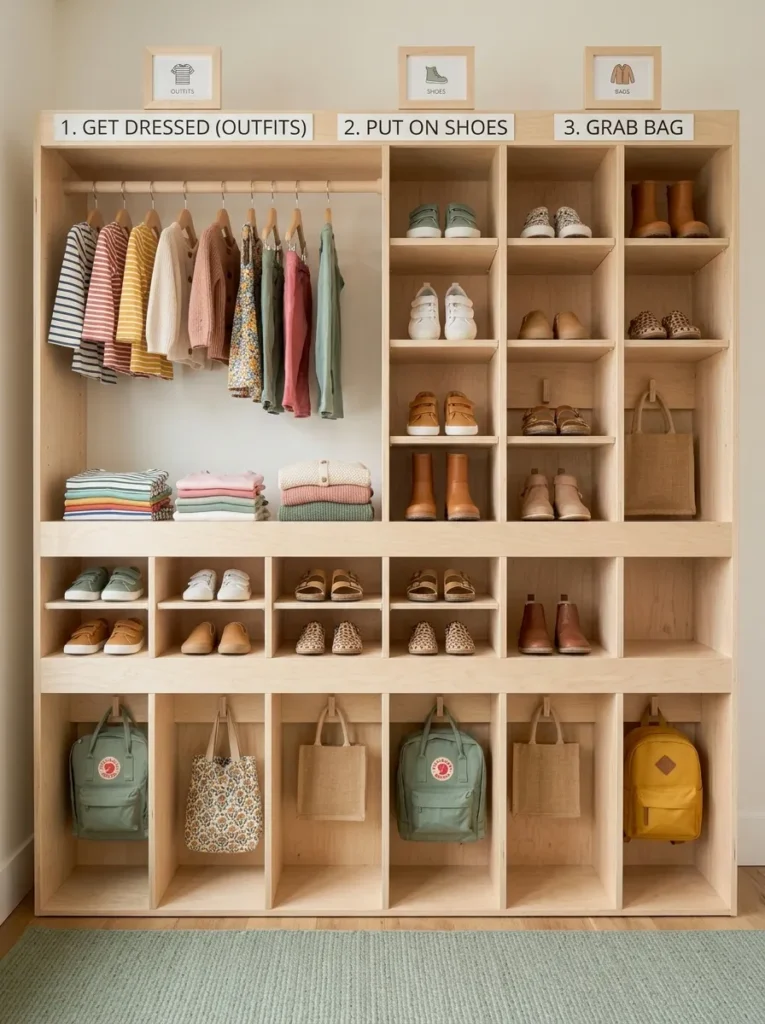
Vibe: The closet feels grounded and logical, laid out like a small routine map.
Why it works: Arranging zones left to right in the actual sequence of getting dressed — clothes, then shoes, then bag — applies a layout principle used in classroom design, turning the closet itself into a visual routine a child can follow without being told each step.
How to get it: Position the clothing zone nearest the door, shoes in the middle, and bags or accessories last, matching the physical layout to the order items get put on.
Shop The Look
- Adjustable birch shelving unit
- Zone picture label set
- Shoe rack tray birch
- Small accessory basket
- Floor mat for shoe zone
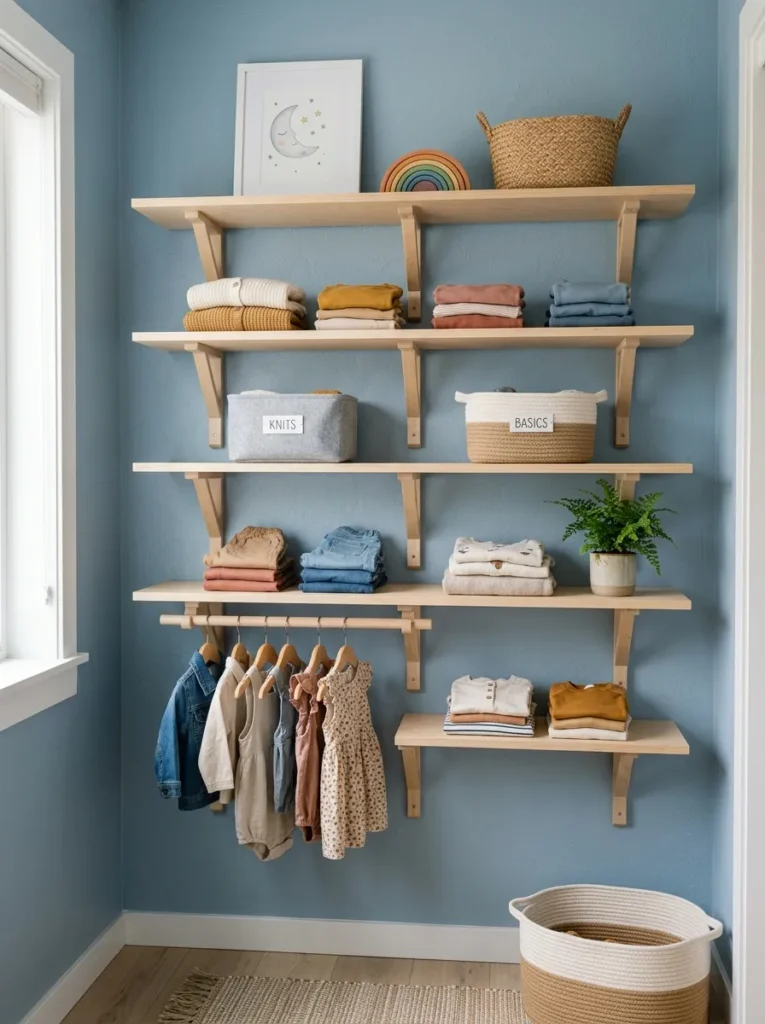
7. Soft Pastel Wall Behind Open Shelving
🖼️ Image prompt: A photorealistic kids closet photograph of open birch shelving mounted against a soft dusty blue painted back wall, holding folded clothes and bins. Lighting: soft diffused light. Camera angle: eye-level. Mood: serene. Key details: painted wall texture, birch shelf brackets. Decor accents: single small framed print. Color palette: dusty blue, warm white, birch tan. Style tags: photorealistic, 8K resolution, interior design photography, Pinterest vertical 2:3 ratio, no people, magazine quality.
Vibe: The closet feels serene rather than sterile, one soft wall color doing quiet work behind the shelving.
Why it works: Painting only the closet’s back wall in a muted pastel rather than the whole room uses color as a contained accent, so the birch shelving and bins stand out clearly against it without competing with a busy, multi-color scheme.
How to get it: Paint the closet’s back interior wall in a soft dusty blue like Benjamin Moore Woodlawn Blue, keeping the door and closet trim in warm white for contrast.
Quick Win: A $20 quart of sample paint covers most closet back walls with a single coat.
Shop The Look
- Sample-size interior paint dusty blue
- Birch open shelf bracket set
- Small framed art print
- Painter’s tape roll
- Foam paint roller kit
8. Over-the-Door Vertical Pocket Organizer
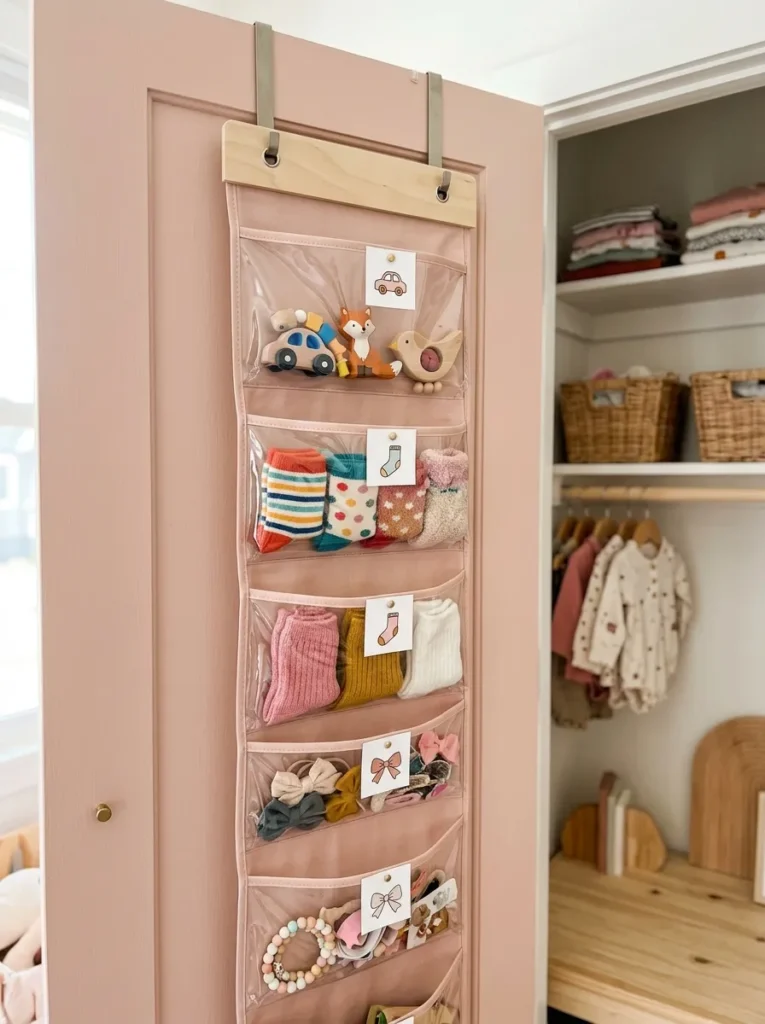
Vibe: The door feels productive instead of wasted, an entire extra storage wall appearing for free.
Why it works: An over-the-door pocket organizer claims space most closets waste entirely, solving the real limitation of small kids’ closets — limited floor and shelf area — without touching the interior footprint at all.
How to get it: Hang a clear-pocket organizer with a birch top rail over the closet door, reserving lower rows for items a child accesses daily, like socks and hair accessories.
Shop The Look
- Over-the-door clear pocket organizer
- Birch top rail mounting hook
- Picture label sticker set
- Small pocket divider insert
- Door cushion bumper set
9. Canvas Fabric Bins for Toys and Extras
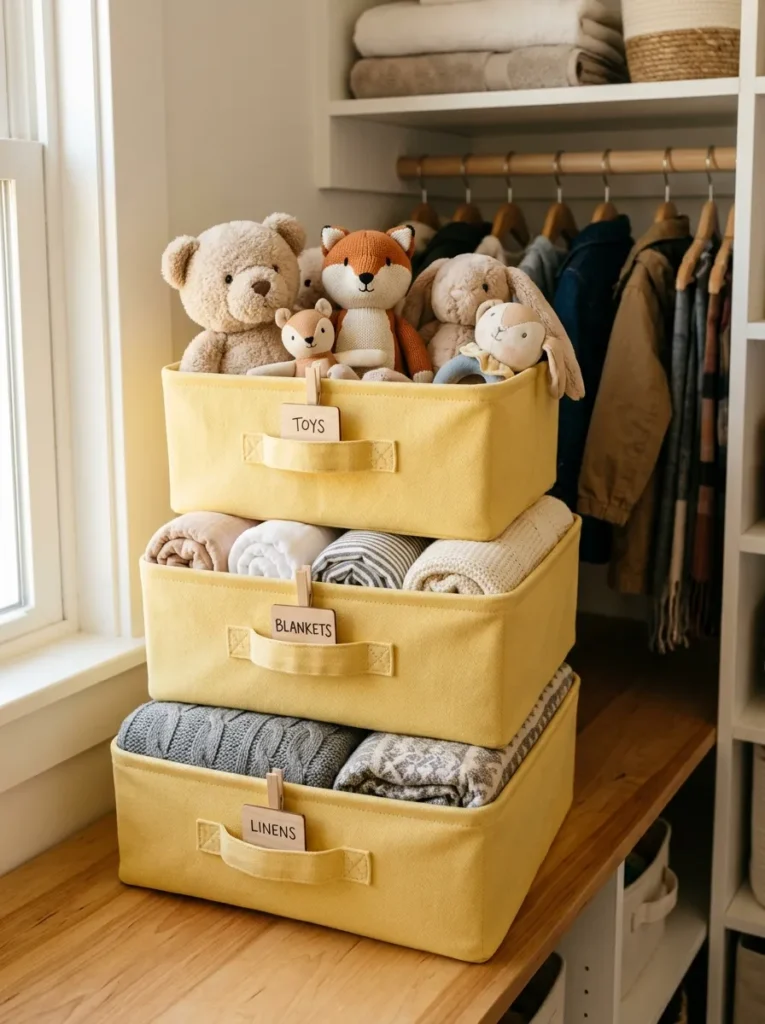
Vibe: The shelf feels warm and soft, nothing sharp-edged or cold to the touch.
Why it works: Choosing soft canvas over hard plastic bins matters specifically in a kids’ space — the fabric won’t scratch or bruise on contact, and the collapsible sides make the bin easy for a small child to pull and push back into place.
How to get it: Use canvas bins with reinforced fabric handles sized for one lower shelf each, placing the heaviest items — like extra blankets — in the bottom row only.
Shop The Look
- Canvas fabric storage bin set
- Reinforced fabric handle bins
- Wood label clip set
- Soft-sided toy basket
- Fabric bin liner insert
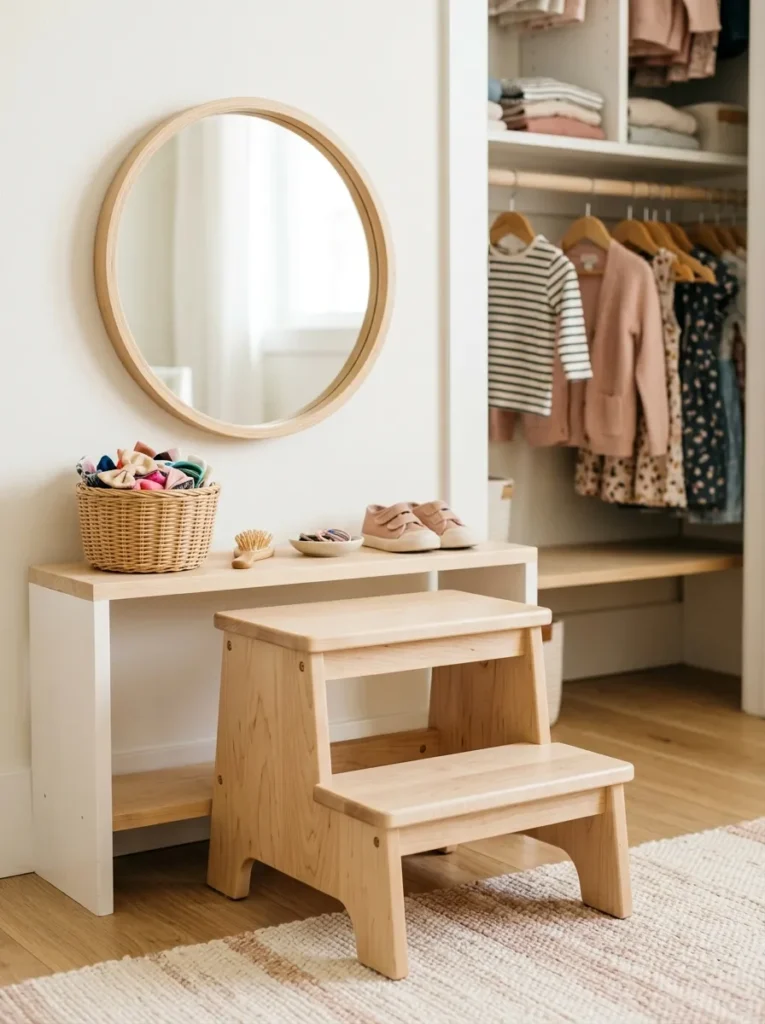
10. Mini Step Stool Dressing Station
Vibe: The corner feels airy and capable, built entirely around a child managing it alone.
Why it works: Pairing a step stool with a low mirror and shelf turns the closet into a genuine self-service dressing station — the stool bridges the height gap between where a child stands and where slightly higher rods or shelves sit, extending the usable reach zone without lowering everything.
How to get it: Position a sturdy birch step stool directly in front of a low, unbreakable acrylic mirror mounted at child height, with one shelf just above stool-reach for accessories.
Shop The Look
- Birch wood step stool
- Low unbreakable acrylic mirror
- Small accessory basket
- Non-slip stool grip pads
- Birch accessory shelf
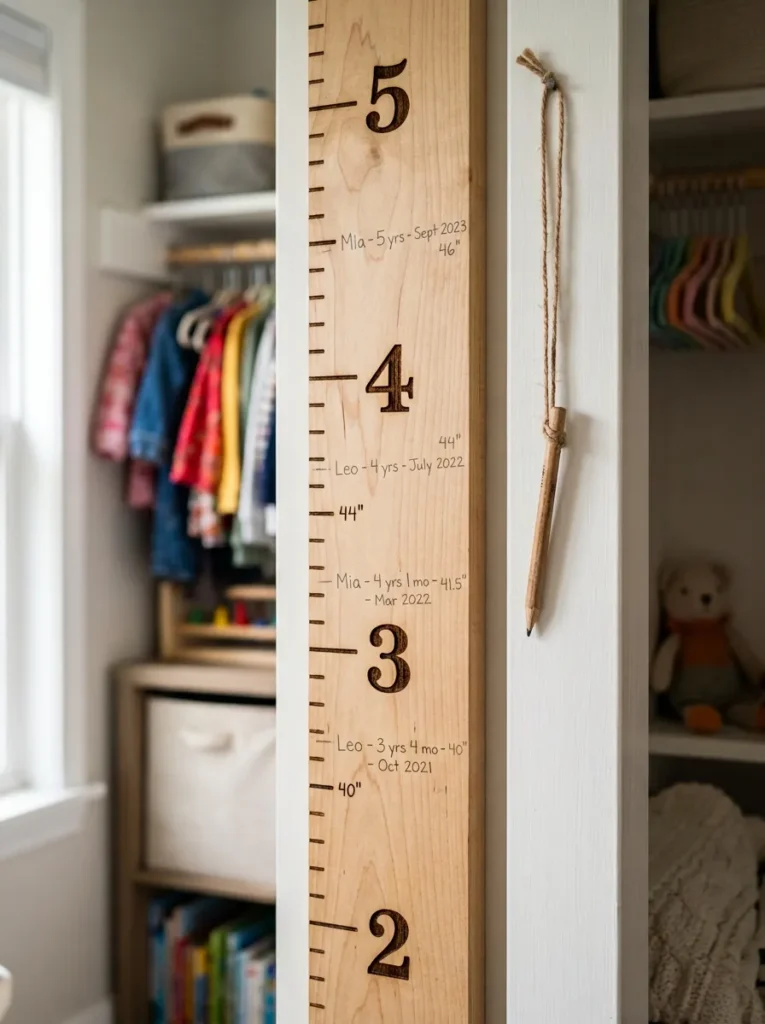
11. Growth Chart Wall Inside the Closet Door
Vibe: The door feels layered with memory, a quiet record building up year over year.
Why it works: Mounting a growth chart inside the closet door rather than on an open wall keeps a sentimental, non-storage element from cluttering the closet’s main visual field, while still making it easy to access during a quick height check.
How to get it: Attach a birch wood growth ruler vertically to the inside of the closet door with screws rather than adhesive, so it can be removed and kept if you move.
Shop The Look
- Wood growth chart ruler
- Small pencil on string
- Mounting screw kit
- Birch door trim accent
- Wall anchor set
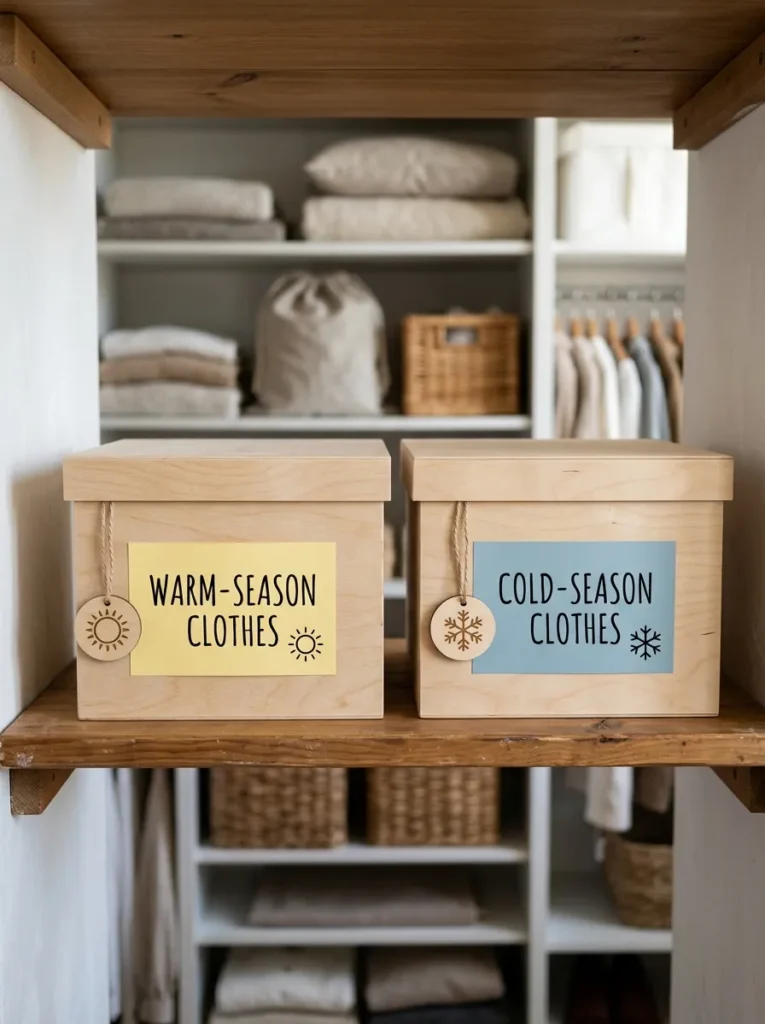
12. Seasonal Color-Coded Rotation System
Vibe: The high shelf feels still and settled, off-season clothes waiting quietly out of the way.
Why it works: Assigning one color to warm-season storage and another to cold-season storage lets a parent — or an older child — locate the right box instantly without reading, applying the same color-as-sorting-logic used in the bin wall, scaled to a seasonal system.
How to get it: Label off-season storage boxes in buttery yellow for summer items and dusty blue for winter items, storing them on the highest shelf out of daily reach.
Shop The Look
- Birch lidded storage box pair
- Wood tag label set
- Seasonal packing tissue
- High shelf storage bracket
- Step stool for shelf access
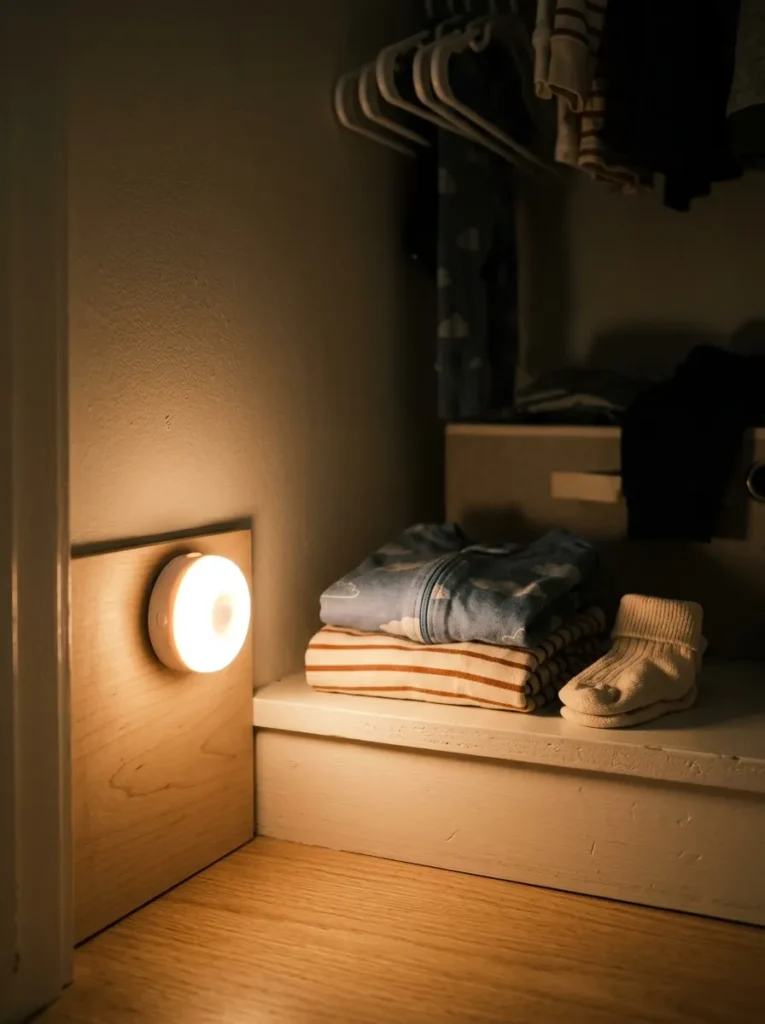
13. Motion-Sensor Night Light Near the Floor
Vibe: The lower shelf feels hushed and gentle, lit just enough for an early morning outfit grab.
Why it works: Placing a motion-sensor light near the floor rather than at the standard switch or ceiling level solves the specific behavior of early-morning or middle-of-the-night closet visits, activating automatically so a child never needs to find a switch in the dark.
How to get it: Mount a battery motion-sensor puck light near the floor baseboard, angled to illuminate the lower shelf where pajamas and daily outfits live.
Quick Win: A $12 stick-on motion light needs no wiring and installs in under five minutes.
Shop The Look
- Battery motion-sensor puck light
- Adhesive light mounting pad
- Warm white LED bulb replacement
- Birch baseboard trim
- Small night light diffuser cover
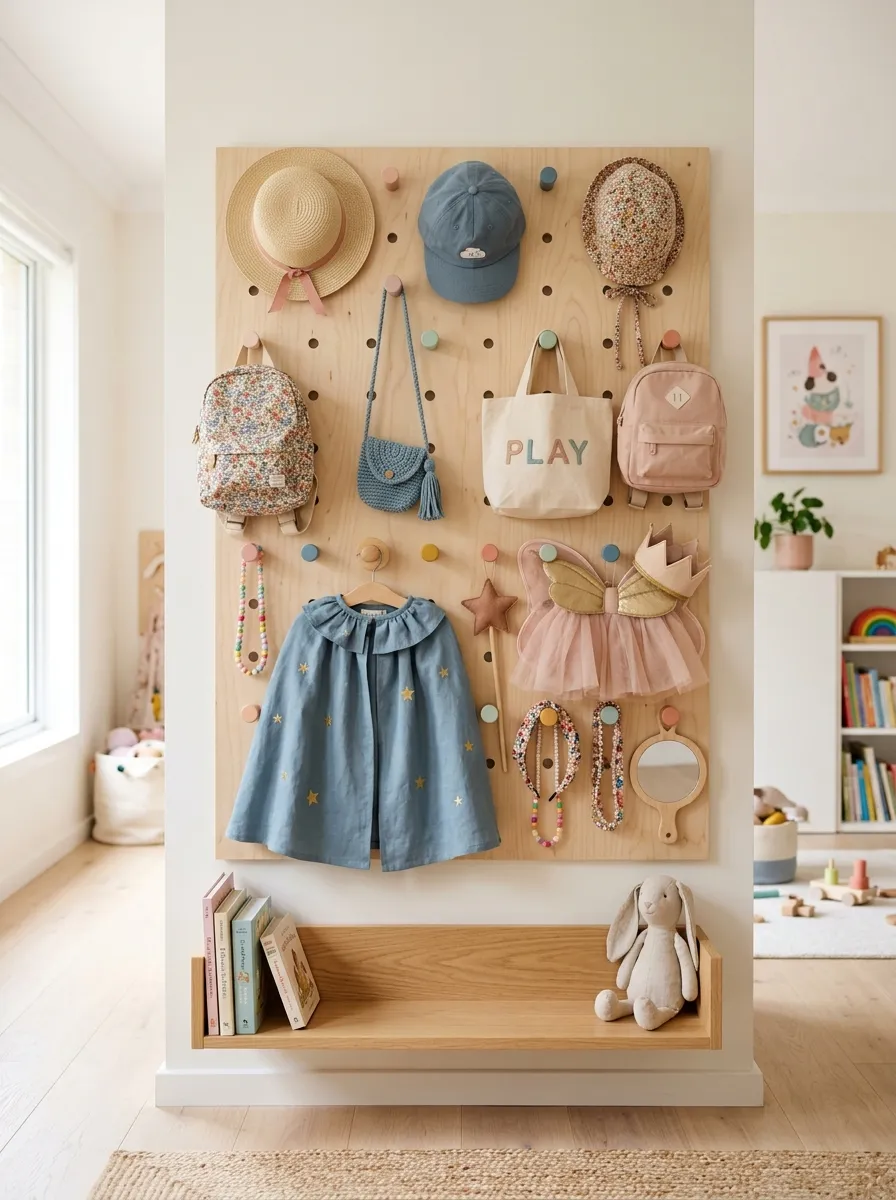
14. Pegboard Wall for Accessories and Dress-Up
Vibe: The wall feels playful and open-ended, ready for whatever a child wants to grab next.
Why it works: A pegboard’s rearrangeable grid handles the unpredictable, ever-changing nature of kids’ accessories and dress-up items far better than fixed shelving, letting the storage adapt as interests shift from dinosaurs to dress-up capes without any new furniture.
How to get it: Mount a birch pegboard panel at child height and use pastel-colored peg hooks in varied lengths to accommodate everything from small hats to longer dress-up capes.
Shop The Look
- Birch plywood pegboard panel
- Pastel pegboard hook set
- Small dress-up cape hook
- Pegboard bin attachment
- Wall mounting hardware kit
How to Start Your Kids Closet Storage Transformation
The single best first move is installing a low double hanging rod. Since dressing independence is the core goal of this whole style, getting clothes within a child’s actual reach anchors every other system — bins, hooks, and cubbies — around that same accessible height.
The most common mistake is organizing entirely at adult height and expecting a child to use it — resulting in clothes that always end up on the floor because the rod or shelf was never actually reachable. Fix it by measuring your child’s own arm reach standing flat-footed, not the closet’s existing hardware height.
Three items under $50 that make an immediate difference: a $25 tension rod adapter for a second low rod, a $12 stick-on motion-sensor night light, and a set of picture label stickers for hooks and bins.
A full transformation realistically takes one to two weekends for rod height, bins, and labels, or a single afternoon if you’re only lowering the rod and adding pastel bins. Budget $100–$200 for a starter version using an existing closet frame, or $400–$700 for a full birch cubby and pegboard build-out.
Frequently Asked Questions About Kids Closet Storage
What’s the difference between kids closet storage and adult closet storage?
Kids storage prioritizes reachable height and pre-literacy visual cues — picture labels, color-coded bins, low rods — over the maximized hanging space and drawer depth that adult systems favor. The goal shifts from fitting the most items in to making items usable by someone under four feet tall.
What colors work best for a kids closet?
Keep the base in warm white and birch tan, then use two or three soft pastels — dusty blue, blush, buttery yellow — for bins and labels. Bright primary colors can work for sorting cues, but softer pastel tones keep the closet from feeling overstimulating in daily use.
How much does it cost to organize a kids closet?
A basic setup with a lowered rod, canvas bins, and hooks runs about $100–$180. Adding a full birch cubby system, pegboard wall, and lighting typically brings the total to $400–$600, while custom built-ins can reach $900 or more.
Does this system work in a very small kids closet?
Yes — start with the over-the-door pocket organizer and a low single hanging rod, since both add function without needing extra floor space. A closet as narrow as 24 inches can still support a pegboard wall mounted on the back panel.
What’s the most important element to set up first?
The rod height matters most, since it determines whether a child can dress themselves at all. Get that right before investing in bins, labels, or a pegboard, since even the best-organized closet won’t get used if the clothes themselves stay out of reach.
Ready to Create Your Dream Kids Closet?
These 14 ideas cover everything from rainbow bin walls and pegboard accessory zones to growth charts and motion-sensor night lights, so there’s a starting point whether your child is still in footie pajamas or picking out their own outfits. This kind of setup doesn’t need to happen in one weekend — lowering just the hanging rod this week is a genuine, usable first step. Today, measure how high your child can comfortably reach a hanger, and adjust one rod to that exact height. Once it’s done, you’ll watch your child hang up their own jacket without being asked — proof that the right height matters more than any amount of styling. Pin your favorite pastel bin or pegboard idea now, before the next growth spurt changes what “reachable” even means.