13 Cute Room Ideas for a Fun Stylish Vibe
Cute room ideas are intentional design choices — color, texture, lighting, furniture, and accessories — that create a space feeling simultaneously playful and considered, personal and polished, fun without tipping into juvenile. Here are 13 ideas for making any room feel genuinely cute and stylish in a way that lasts longer than a trend.
A cute room isn’t decorated — it’s composed. The difference is in the intentionality: a cute room has a point of view, a consistent warmth, and objects that feel chosen rather than accumulated. It makes people feel something the moment they walk in — usually a mix of delight and the faint wish that they lived there. Getting there is less about buying the right things and more about making the right decisions. Here are 13 ideas worth saving — and stealing.
Why Cute Room Ideas Work So Well
What makes a room genuinely cute rather than just decorated? Cute room design sits at a specific intersection of warmth, personality, and restraint — it is the aesthetic category that most directly connects a room to the emotional life of its inhabitant. As a design approach, it draws from the broader principles of maximalist warmth (layering, personal objects, color confidence) and filters them through a considered editing process that prevents the room from tipping into clutter or chaos. The best cute rooms share a quality that designers call “livability” — they look like someone actually lives there, happily and thoughtfully, which is a more difficult quality to achieve than the stripped-back perfection of minimalism.
Core materials and colors. Cute room design works with a material palette that prioritizes warmth and texture over cool modernism: rattan and wicker in natural honey tones, linen and cotton in warm cream and blush, velvet in dusty rose and warm sage, painted furniture in soft but confident colors, and natural wood in lighter oak and pine finishes. Color approaches range from soft and warm (blush, cream, warm white, dusty rose) to bold and joyful (warm coral, mustard yellow, sage green, terracotta) — but in all cases the palette maintains warmth as its constant. Cool greys, stark whites, and industrial materials work against the cute room aesthetic in the same way that excessive minimalism does: by removing the emotional warmth that makes a space feel personally inhabited.
Why cute room aesthetics are having a sustained moment. The rise of “cozy maximalism” — documented extensively in Pinterest trend reports and across interior design social media — reflects a cultural correction away from the cold, performative minimalism that dominated aspirational interiors for much of the 2010s. People increasingly want homes that feel warm, personal, and emotionally honest rather than aesthetically defensible. Cute room design is the domestic expression of that shift: it prioritizes how a room makes you feel over how it photographs for an audience, which is precisely why it photographs so well for an audience. Searches for “cute room ideas,” “cozy aesthetic bedroom,” and “fun room decor” consistently rank among the highest-volume interior design searches on Pinterest year over year.
Can adults have genuinely cute rooms without them reading as childish? Absolutely — and the distinction lies entirely in material quality, color sophistication, and editing discipline. A cute adult room uses muted, sophisticated versions of warm colors (dusty rose rather than hot pink, warm sage rather than lime green), invests in quality materials (real linen rather than polyester, solid wood rather than particleboard), and maintains a consistent design logic that prevents the room from reading as a collection of cute objects rather than a composed space.
Style at a Glance
| Element | Detail |
|---|---|
| Philosophy | Warmth, personality, and restraint in equal measure |
| Key Materials | Rattan, linen, velvet, cotton, natural oak, painted wood |
| Key Colors | Blush, warm cream, dusty rose, sage green, mustard, terracotta |
13 Cute Room Ideas for a Fun Stylish Vibe
1. Canopy Bed with Sheer Curtain Draping
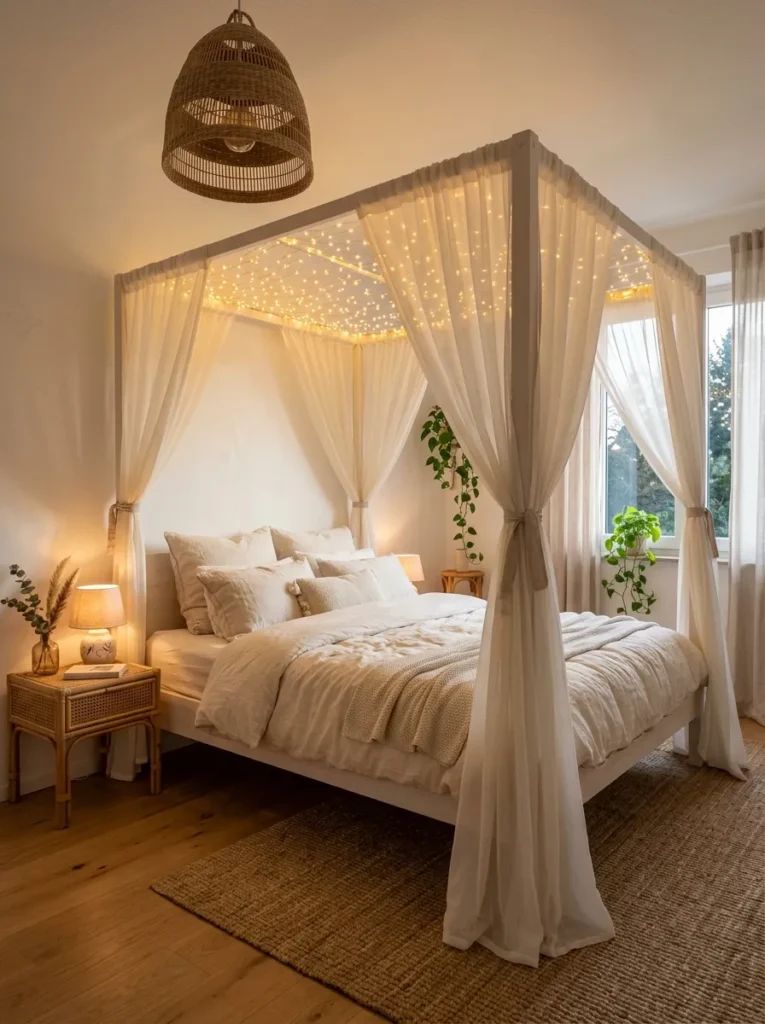
Vibe: A canopy bed with sheer curtains feels dreamy — a room within the room, soft and completely personal.
Why it works: The canopy bed is the single furniture piece with the highest cute-room impact because it transforms the bed from a sleeping surface into an architectural moment — a defined, enclosed zone that immediately communicates that the room has been thought about and not just furnished. The design principle is vertical space activation: most bedroom design operates at the horizontal level (rugs, furniture, art at eye height), while the canopy extends the design intention upward to the ceiling, filling the room’s vertical dimension with warmth and visual interest. Sheer voile panels rather than heavy curtains maintain the light-filled quality essential to the cute room aesthetic — they soften the bed’s silhouette without blocking natural light or making the room feel smaller.
How to get it: A freestanding canopy bed frame in white or natural wood is the most versatile foundation — it works in rooms without ceiling hooks and accepts any curtain style. Choose sheer ivory or white voile panels at 1.5–2 times the floor-to-rail height measurement for generous draping. Weave warm white fairy lights (2700K, not cool white) along the top rail of the canopy before hanging the curtains, so the lights glow through the sheer fabric when the room is dimly lit.
Quick Win: A DIY canopy can be created by mounting a curtain rod 12 inches from the ceiling above the head of any existing bed and hanging two panels of sheer voile to pool on the floor on each side — total cost under $40 and achievable in under two hours.
Shop The Look
| Product |
|---|
| White canopy bed frame queen with four posts |
| Sheer ivory voile curtain panel set long |
| Warm white fairy lights 10m bedroom |
| Cream linen duvet cover queen |
| Rattan pendant light shade ceiling |
Also view: 15 Dreamy Cozy Bedroom Ideas for Better Rest
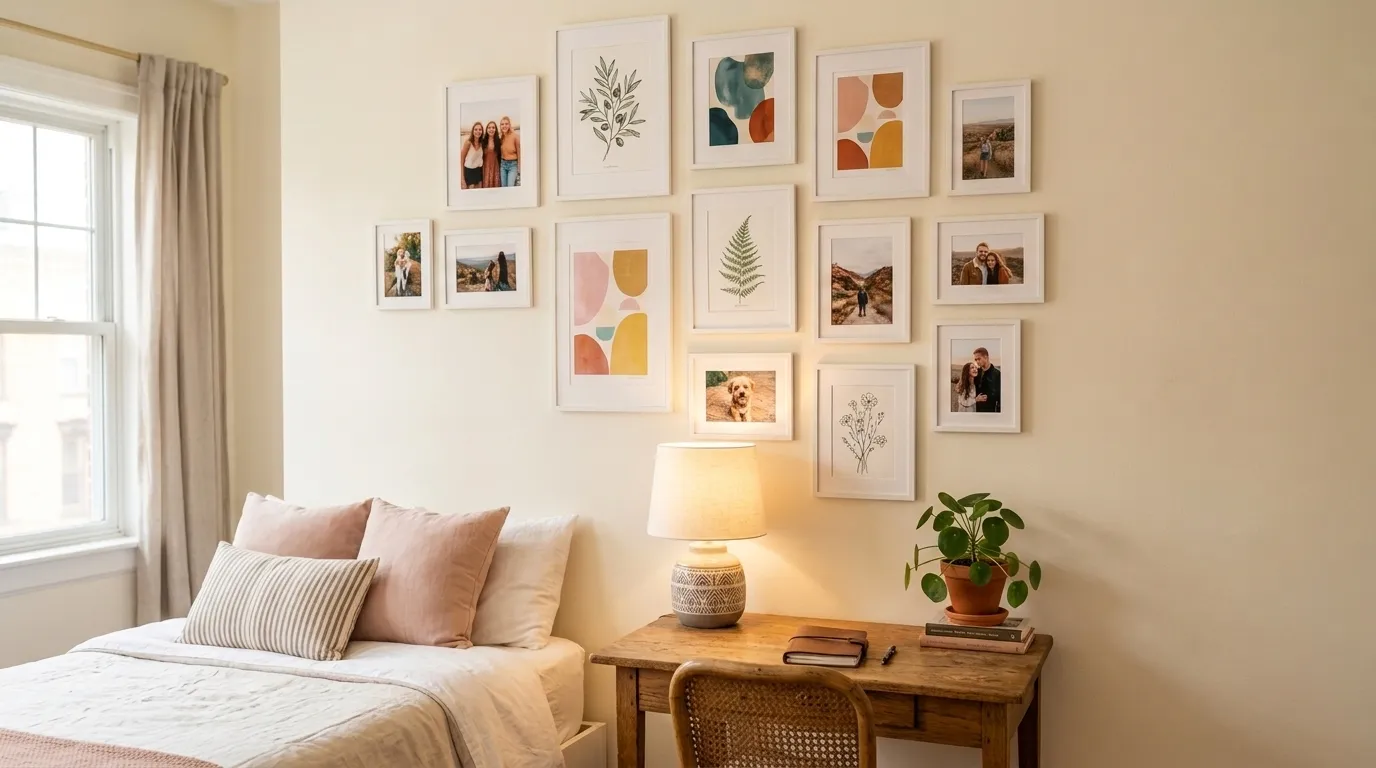
2. Gallery Wall of Framed Illustrations and Personal Photos
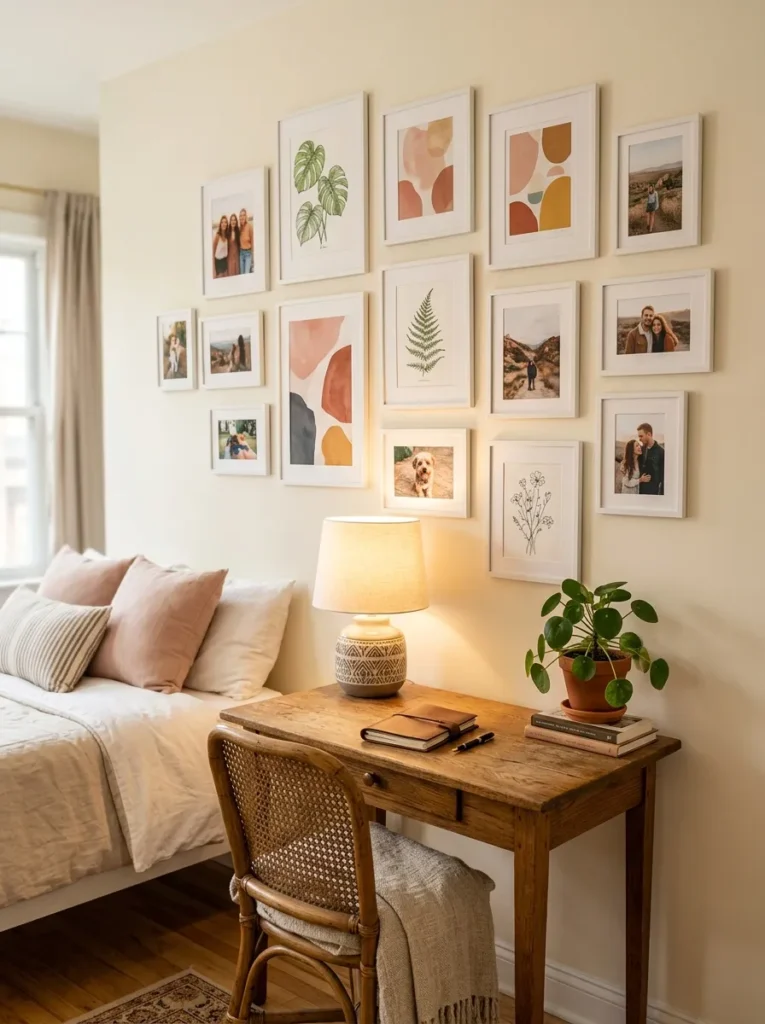
Vibe: A personal gallery wall feels autobiographical — a room that introduces its inhabitant before anyone speaks.
Why it works: A gallery wall is the cute room element with the highest personality-per-square-inch ratio — it is the wall that tells the story of the person who sleeps or works in the room. The design principle is curated personal narrative: mixing illustration prints (which add color and whimsy), meaningful art (which adds aesthetic depth), and personal photographs (which add emotional weight) creates a gallery wall that reads as genuinely personal rather than aesthetically assembled. Matching all frames in the same slim white finish provides the visual coherence that prevents a personal gallery from reading as a random collection of stuck-up things — the frame system is the curator’s hand, making a diverse collection read as a single composed statement.
How to get it: Print personal photographs at 4×6 and 5×7 inches at a local print service. Source illustration prints from independent artists on Etsy or Society6 in sizes that complement your photographs. Frame everything in the same slim white frame style and arrange on the floor before committing to the wall — photograph the floor arrangement and use it as your hanging guide. Hang with picture-hanging strips for a damage-free installation.
Shop The Look
| Product |
|---|
| Slim white picture frame set mixed sizes |
| Botanical illustration art print set of 4 |
| Picture hanging strip set damage free |
| Personal photo print service square format |
| White pre-cut mat board assorted sizes |
3. Colorful Bookshelf Styling with Rainbow Organization
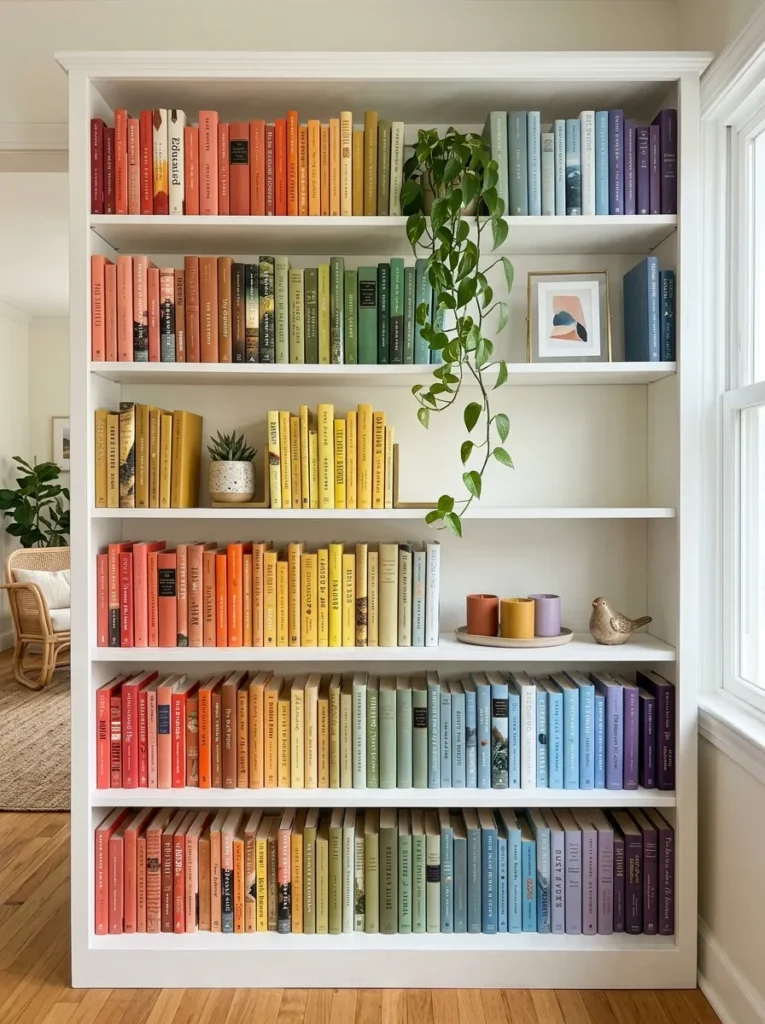
Vibe: A rainbow-organized bookshelf feels joyful — the room element that makes people smile before they’ve read a single title.
Why it works: Color-organizing a bookshelf is the styling technique that most efficiently converts a storage piece into a decorative feature — it takes an existing collection and reframes it as a color installation without adding any new objects. The design principle is found composition: the books you already own, reorganized by spine color into a gradient, create a color story that reads as deliberately artistic. The warm rainbow gradient — moving from coral and rust through mustard and sage to dusty teal and periwinkle — is more sophisticated than a strict ROYGBIV rainbow because the muted, warm tones of the individual spines blend into each other at their edges rather than creating jarring jumps between primary colors.
How to get it: Remove all books and sort into color families — warm reds, oranges, yellows, greens, blues, and purples. Arrange each color family within its section from lightest to darkest, creating a gradient within each color group as well as across the full shelf. Punctuate every three to four books with a single small object — a ceramic figure, a small plant, a candle — to give the eye resting places and prevent the color organization from reading as a graphic exercise rather than a styled shelf.
Shop The Look
| Product |
|---|
| White bookshelf 5 shelf tall living room |
| Small ceramic figurine set decorative |
| Mini succulent plant set of 3 small pots |
| Small pillar candle set warm tones |
| Small framed art print for shelf leaning |
4. String Lights and Warm Ambient Bedroom Lighting Layer
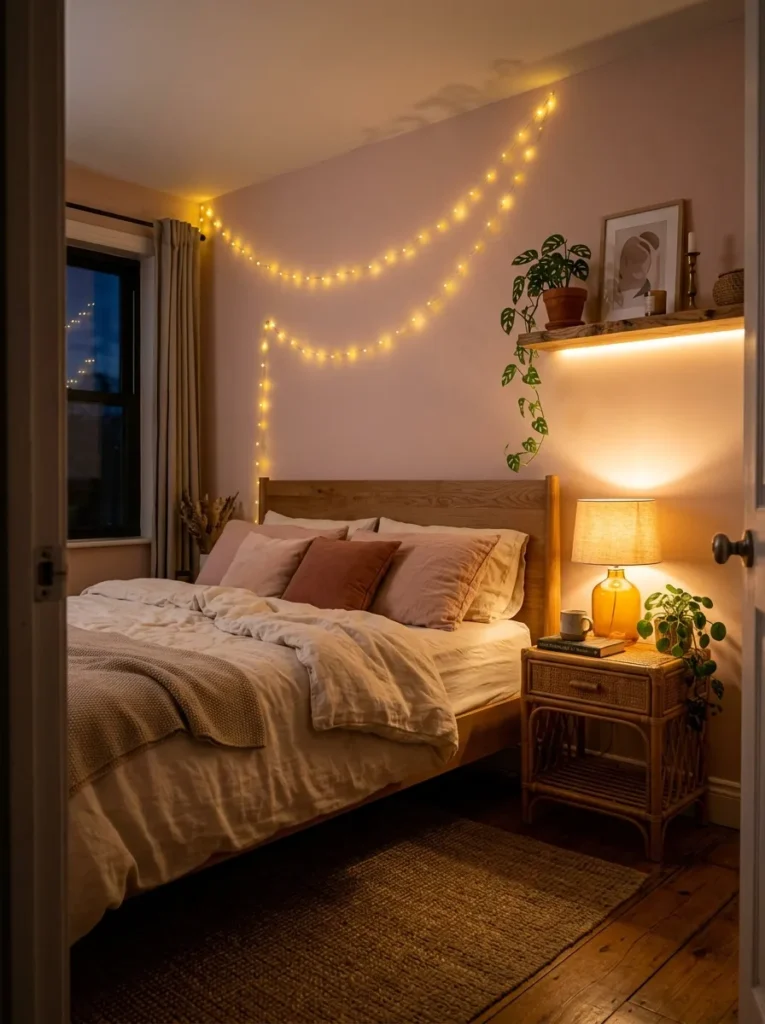
Vibe: A layered warm lighting bedroom feels intimate — the room that holds you in amber the moment the overhead light goes off.
Why it works: Lighting is the cute room element with the highest emotional impact per dollar — the same room with overhead cool fluorescent lighting versus multiple sources of warm amber light are genuinely different emotional experiences, not merely visual preferences. The design principle is multi-source warmth: overhead lighting provides even, functional illumination but eliminates the shadow and visual texture that make a room feel warm and personal. A minimum of three warm light sources at different heights (fairy lights at the wall, a table lamp at the nightstand, strip lighting behind a shelf) creates the layered ambient glow that every cute bedroom depends on for its atmosphere. The 2700K or warmer (2200K) color temperature is non-negotiable — cooler light temperatures, regardless of how many sources, will never produce the warm amber glow that the cute bedroom aesthetic requires.
How to get it: Install warm white (2700K) fairy lights along the headboard wall using adhesive clips, draping in a loose horizontal pattern at two heights. Replace any cool-white bedside lamp bulbs with warm LED filament bulbs at 2200K. Add LED strip lighting behind one floating shelf for an indirect glow that warms the wall surface without visible light source. Install all lamps on individual dimmer plugs so each light source can be adjusted independently to find the room’s correct ambient balance.
Quick Win: Replacing a single cool-white bedside lamp bulb with a warm LED filament bulb at 2200K ($5–$8) is the most immediately impactful single change available to any bedroom — the color temperature shift from 4000K to 2200K changes the room’s entire emotional register in a single twist of a bulb.
Shop The Look
| Product |
|---|
| Warm white fairy lights 10m indoor bedroom |
| LED filament bulb 2200K E26 warm amber |
| Warm LED strip lights 2700K with remote |
| Adhesive cable clip set for fairy light hanging |
| Dimmer plug in socket for lamp |
5. Blush and Sage Color Palette with Textured Layers
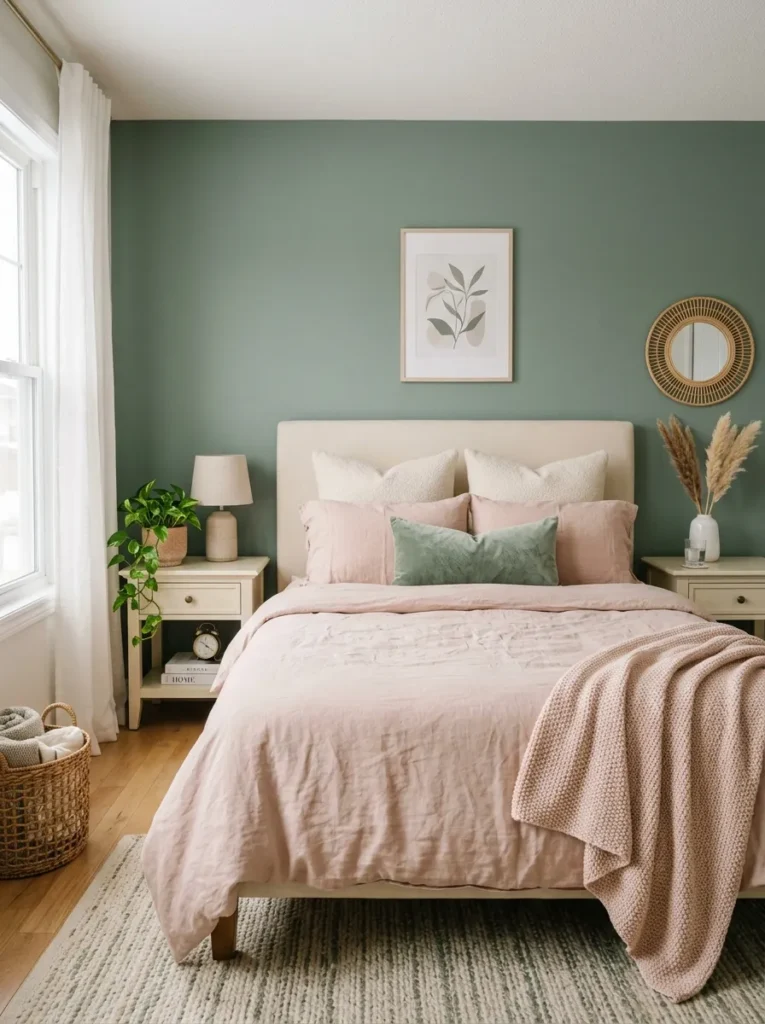
Vibe: A blush and sage room feels soft and quietly confident — color that wraps around you rather than demanding attention.
Why it works: Blush and dusty sage is one of the most enduringly successful cute room color combinations because both colors occupy the same tonal register — muted, warm, and slightly desaturated — which means they harmonize naturally without requiring a neutral mediator. The design principle is warm color harmony through desaturation: by choosing soft, muted versions of both colors (dusty rose rather than bright pink, sage rather than emerald), the combination reads as sophisticated and restful rather than sweet or juvenile. Textural layering is what elevates this palette from a color combination to a room — using blush in washed linen (the bedding), sage in velvet (the accent pillow), and cream in bouclé (the euro shams) introduces material variation that keeps the similar-toned palette visually interesting.
How to get it: Start with the accent wall — paint the headboard wall in dusty sage matte (Benjamin Moore’s Saybrook Sage or Farrow & Ball’s Mizzle are the benchmark tones). Build the bed textiles in the blush-cream-sage palette, ensuring each element is in a different fabric — washed linen duvet, velvet pillow, bouclé euro sham, cotton throw. Add natural rattan and dried botanical accents as the bridge between the two colors.
Shop The Look
| Product |
|---|
| Blush washed linen duvet cover queen |
| Sage green velvet throw pillow cover 20×20 |
| Cream bouclé euro sham set of 2 |
| Blush cotton waffle throw blanket |
| Dusty sage matte wall paint quart |
6. Rattan and Wicker Furniture Cluster for Boho Warmth
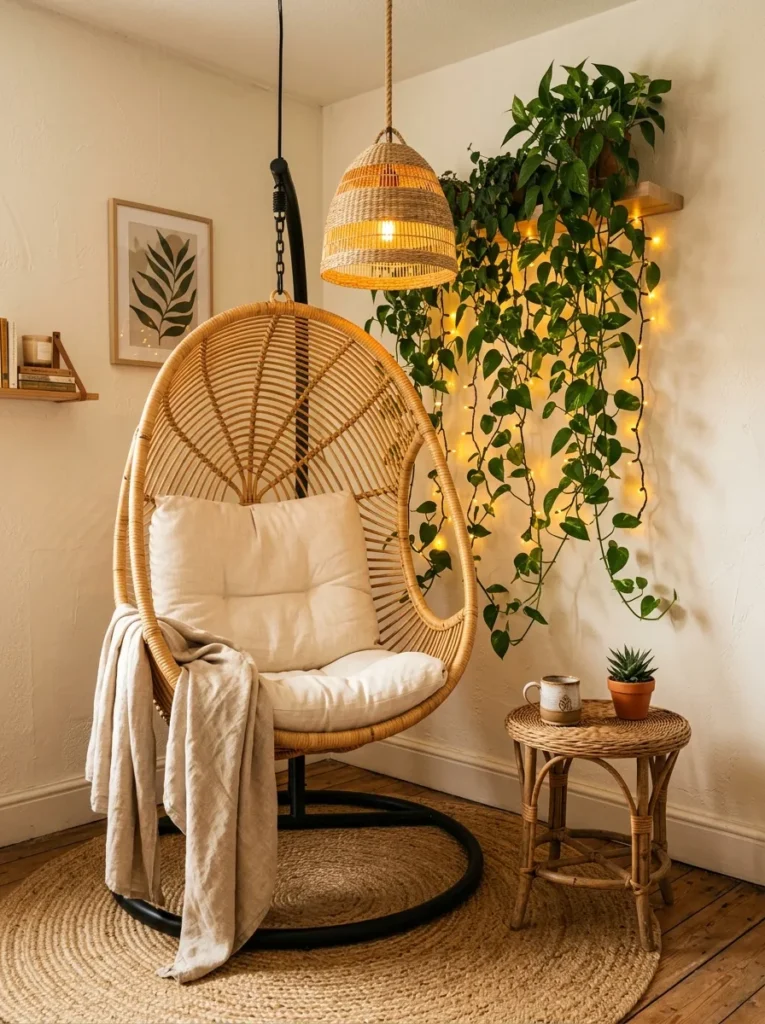
Vibe: A rattan corner cluster feels warm and utterly inhabitable — the corner of the room everyone gravitates toward without being invited.
Why it works: Rattan furniture’s appeal in the cute room context comes from its material honesty — natural woven fiber in honey tones is intrinsically warm, organic, and handcrafted in quality, which makes it read as considered regardless of its price point. The design principle is material clustering: grouping multiple rattan pieces in the same room zone (pendant above, chair as the primary piece, side table as the supporting piece) creates a material ecosystem where the natural rattan tone anchors and unifies the corner composition. A jute rug beneath the cluster reinforces the natural fiber palette at the floor level, completing the vertical composition from floor to ceiling in a consistent material language.
How to get it: Choose a corner of the room with ceiling access for the pendant (or use a plug-in pendant that hooks over a ceiling hook) and enough floor space for the egg chair’s generous footprint (typically 80×80 cm plus clearance). Position the chair so it faces into the room rather than the corner — it becomes a seating zone rather than a corner filling. The side table should be at armrest height, and the pendant should hang so its bottom sits at 180–190 cm from the floor.
Shop The Look
| Product |
|---|
| Rattan egg chair with stand cream cushion |
| Rattan pendant light shade plug in or wired |
| Small wicker side table round |
| Natural jute area rug 5×8 |
| Trailing pothos plant medium indoor |
7. Peel-and-Stick Wallpaper Accent Wall
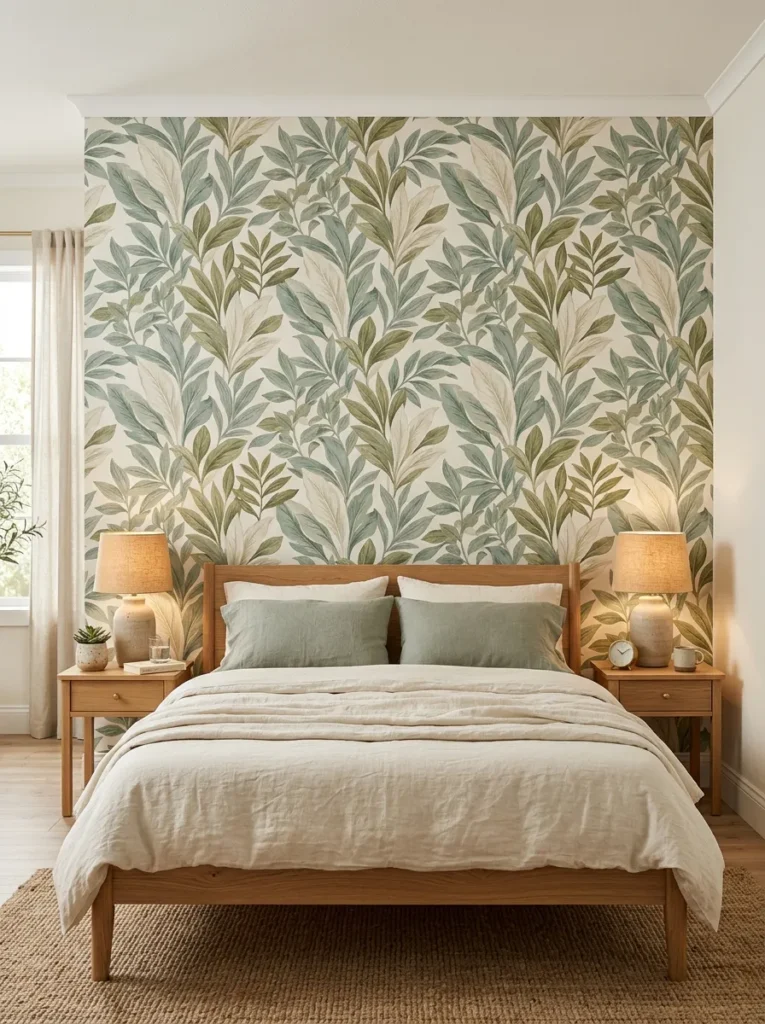
Vibe: A botanical wallpaper accent wall feels lush — the room that brought the garden inside and made it stay.
Why it works: Peel-and-stick wallpaper is the cute room upgrade with the best renter-friendly credentials — it transforms a wall more dramatically than any paint color while being completely removable without damage, which makes it the highest-impact temporary change available to any room. The design principle is pattern scale relative to wall scale: a large-leaf botanical pattern on a bedroom headboard wall reads as bold and confident because the pattern’s scale matches the wall’s scale; the same pattern on a small wall or in a small room would read as overwhelming. Botanical prints specifically serve the cute room aesthetic by introducing the warmth and organic quality of natural forms in a controlled, decorative context.
How to get it: Measure the headboard wall precisely and order peel-and-stick panels with a 10% overage to account for pattern matching at seams. Prepare the wall surface by cleaning with a damp cloth and allowing to dry completely — any dust or grease will reduce adhesion. Apply from the top corner, using a level to keep the first panel perfectly vertical (all subsequent panels align to the first). Use a smoothing tool to press out air bubbles as you go. The pattern repeat on botanical prints typically ranges from 24–36 inches — factor this into your panel calculation.
Shop The Look
| Product |
|---|
| Botanical peel and stick wallpaper large leaf |
| Wallpaper smoothing tool trim kit |
| Level small for first panel alignment |
| Low natural wood bed frame queen platform |
| Ceramic table lamp pair warm white shade |
8. Velvet Accent Chair in a Statement Color
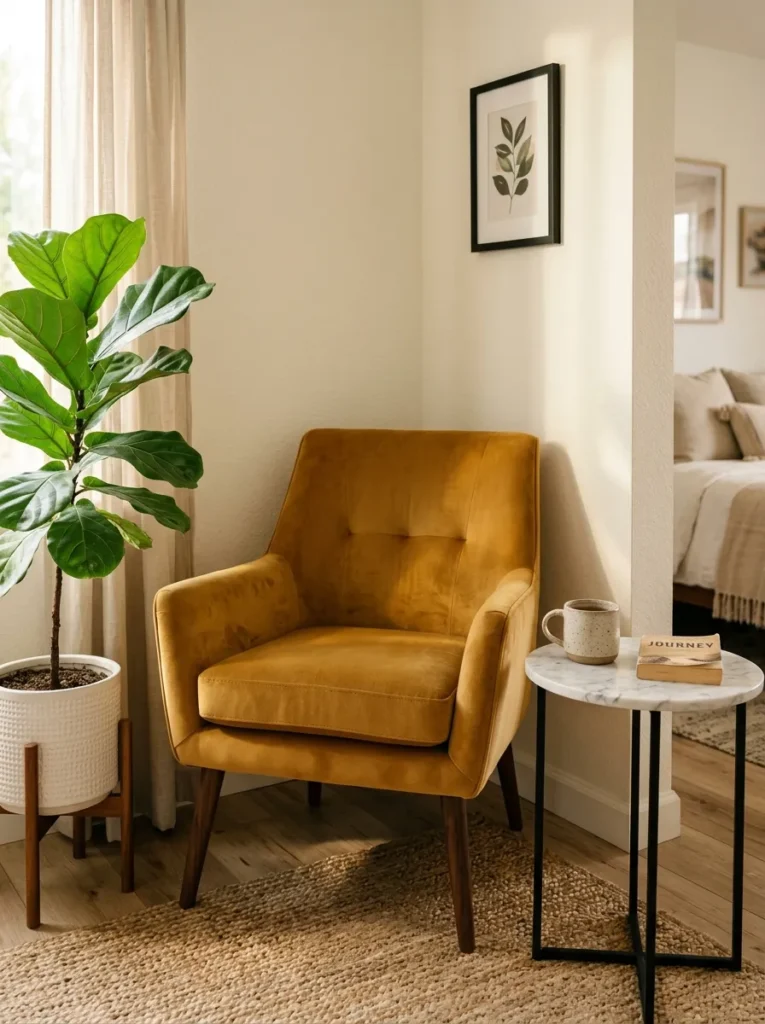
Vibe: A mustard velvet accent chair feels confident — the one piece in the room that takes a strong position and holds it.
Why it works: A velvet accent chair in a saturated warm color — mustard, terracotta, sage, blush — is the cute room’s statement furniture piece, the element that most directly signals that the room has a point of view. The design principle is singular color confidence: one bold color in one key piece creates more visual impact than the same color distributed across multiple smaller objects, because concentration amplifies the color’s effect. Velvet is the optimal fabric for this role because its pile creates a depth and sheen that changes with viewing angle, making the chair visually dynamic throughout the day as natural light shifts. Tapered wooden legs ground the velvet’s luxurious quality with a natural material note that prevents the piece from reading as overly formal.
How to get it: Position the accent chair in a bedroom corner or the corner of a home office or reading area. The chair should face into the room at a slight angle — not pushed flat into the corner, which makes it read as furniture placed rather than furniture arranged. A small side table at armrest height and a floor plant beside or behind the chair complete the reading corner vignette that makes the chair feel like a destination rather than an overflow seat.
Quick Win: A secondhand accent chair in a neutral fabric, reupholstered with a remnant piece of mustard or sage velvet (typically 1.5–2 meters for a chair seat and back), creates the same impact as a new velvet chair for significantly less — fabric remnants in velvet are widely available at fabric stores for $15–$30.
Shop The Look
| Product |
|---|
| Mustard yellow velvet accent chair tapered legs |
| Small round marble side table bedroom |
| Tall fiddle leaf fig tree indoor potted |
| Jute area rug 5×8 natural bedroom |
| Small framed art print for wall beside chair |
9. Floating Shelves Styled as a Curiosity Display
Vibe: A curiosity shelf feels personal — the three-dimensional autobiography of whoever curated it.
Why it works: Floating shelves styled as curiosity displays apply the design principle of personal object elevation — small, meaningful objects placed on a shelf at eye height read as intentional display rather than accumulated clutter. The difference between a cluttered surface and a curated shelf is entirely in the curation discipline: three to five objects per shelf maximum, a consistent material and color palette across the full arrangement, and deliberate height variation within each shelf (one tall object, one medium, one low) that creates visual rhythm. A blush wall behind white shelves provides the warmth that makes the displayed objects read as warm-toned even when they are neutral in color.
How to get it: Install three floating shelves at staggered heights — not aligned horizontally, but offset so each shelf is at a different height and slight horizontal position. Style each shelf with a maximum of five elements in a consistent warm palette: one plant, one ceramic object, one candle, one small framed print or photograph, and one personal object (a crystal, a small figurine, a meaningful small item). The personal object is the element that distinguishes a cute curiosity shelf from a generic styled shelf.
Shop The Look
| Product |
|---|
| White floating shelf set of 3 with brackets |
| Small ceramic figure set decorative |
| Mini scented candle set warm fragrance |
| Small crystal set amethyst rose quartz display |
| Mini frame set 4×4 for personal photos |
10. Oversized Floor Mirror with Decorative Leaning
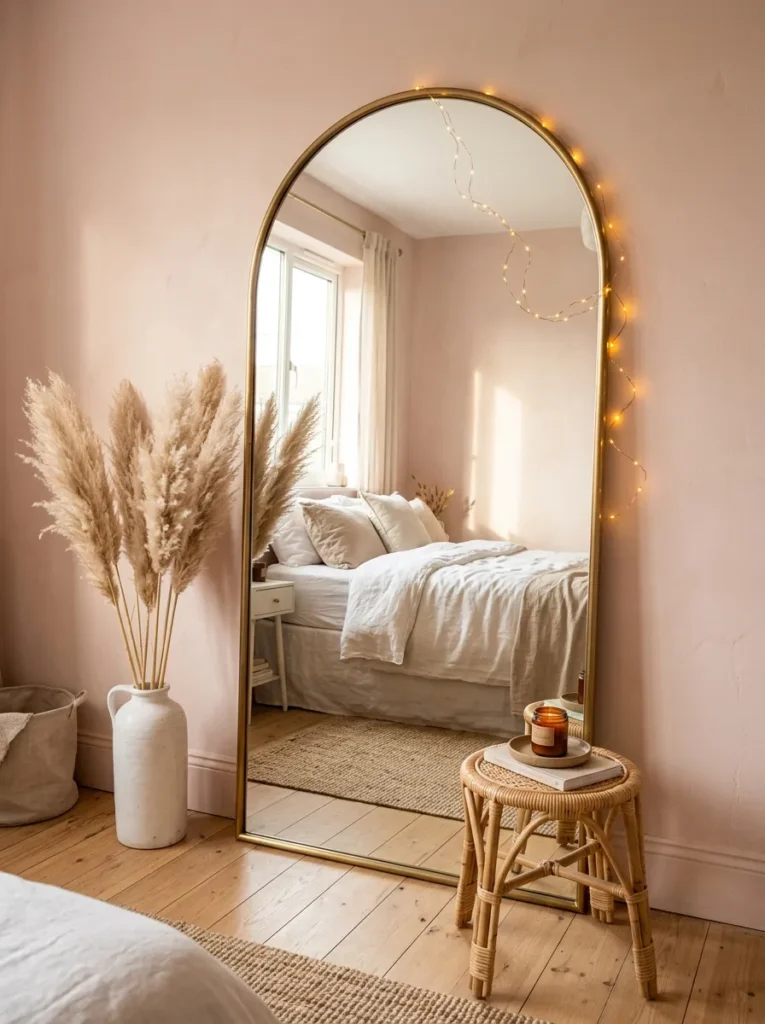
Vibe: A large leaning mirror with fairy lights feels luminous — the room element that doubles the light and halves the visual density simultaneously.
Why it works: A large floor mirror performs three distinct functions in a cute room: it amplifies natural light by reflecting it across the room, it increases the perceived space by creating depth behind the mirror’s surface, and it provides a full-length reflection that is both functional and aesthetically pleasing. The design principle is reflective amplification: positioning a large mirror to reflect the room’s warmest light source (a window, a fairy light cluster, a warm lamp) effectively doubles the light in the room without adding any additional electrical load. The arch-top format — a mirror with a curved rather than rectangular top — adds the organic line quality that connects the mirror to the cute room aesthetic and prevents it from reading as a gym or dressing room mirror.
How to get it: Position the floor mirror at a slight lean against the wall — 10–15 degrees from vertical — which creates the relaxed, styled quality that a perfectly upright mirror lacks. Style around it with objects that the mirror will reflect — a tall vase of dried pampas to one side, a small rattan stool or bench in front, and one cluster of fairy lights draped over the top corner of the frame so their glow appears both in the room and in the mirror’s reflection.
Shop The Look
| Product |
|---|
| Large arch floor mirror brass frame full length |
| Tall white ceramic floor vase for pampas |
| Dried pampas grass bundle natural white |
| Small rattan stool footstool bedroom |
| Warm white fairy lights 5m for mirror draping |
11. Maximalist Throw Pillow Stack in Coordinated Prints
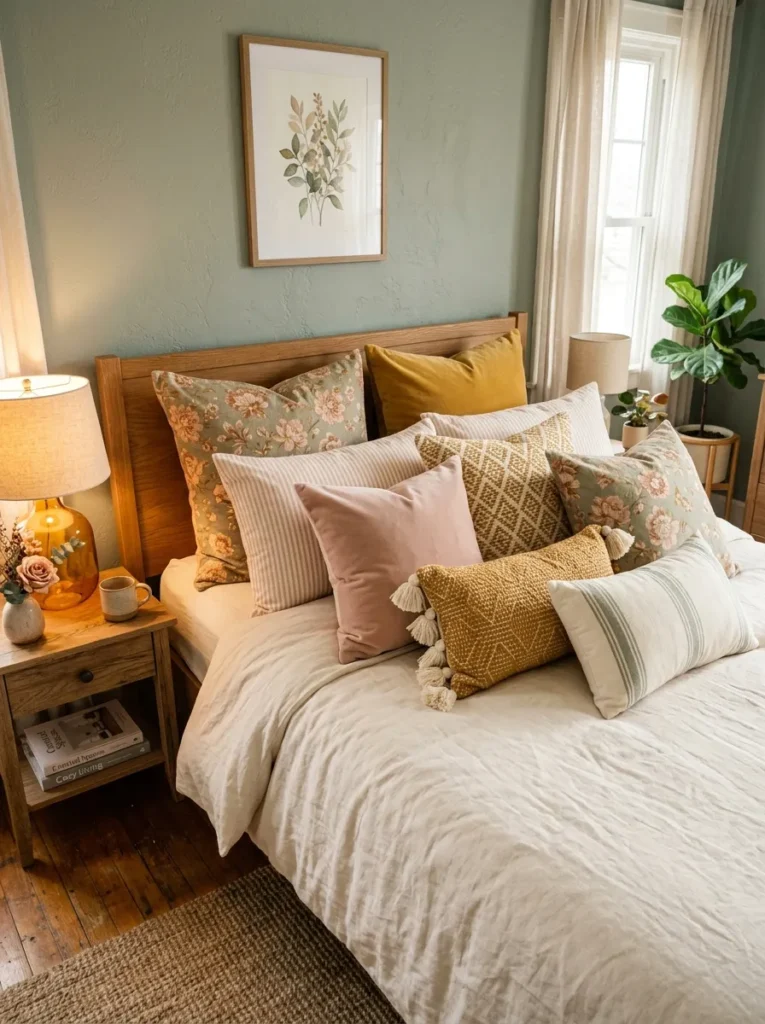
Vibe: An abundant pillow arrangement feels maximally cozy — the bed that looks like it was made by someone who genuinely loves their bedroom.
Why it works: The maximalist throw pillow stack is the cute room’s most direct expression of cozy confidence — it communicates that the room’s inhabitant prioritizes comfort and warmth over restraint and minimalism, which is precisely the attitude that makes a room feel genuinely cute rather than merely styled. The design principle is coordinated variety: using multiple different patterns (floral, stripe, geometric, solid) within a single consistent color palette creates the richness of maximalism without the chaos of competing color stories. The key constraint is palette discipline — every pillow, regardless of pattern, must draw from the same warm family (blush, cream, mustard, sage) so the arrangement reads as composed despite its abundance.
How to get it: Build the pillow arrangement in four layers: two large euro shams at the back (26×26 inches), two standard sleeping pillows in cases that match the duvet in front of those, two decorative accent pillows (20×20 inches) in pattern in front of those, and one lumbar pillow at center front. Alternate pattern and solid across the decorative layer — never two patterned pillows of the same type adjacent to each other. Keep all patterns within the same warm color palette regardless of how different the patterns themselves are.
Shop The Look
| Product |
|---|
| Floral linen pillow cover blush cream 20×20 |
| Mustard stripe cotton pillow cover set of 2 |
| Sage green velvet pillow cover 18×18 |
| Woven geometric pillow cover cream mustard |
| Natural linen lumbar pillow cover 14×22 |
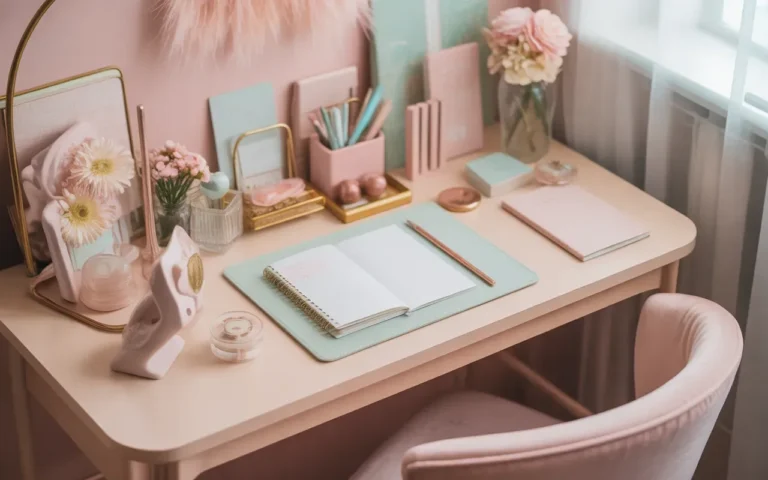
12. Desk Setup Styled as a Productive and Pretty Workspace
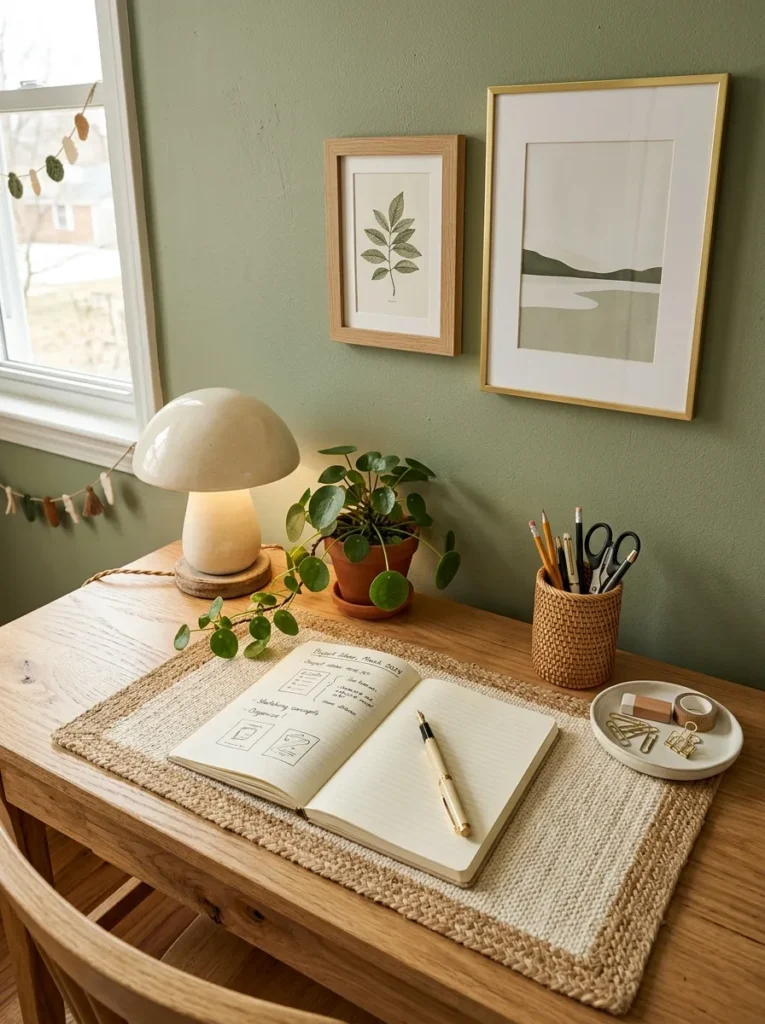
Vibe: A styled cute desk setup feels productive and pretty simultaneously — the workspace that makes you want to sit down and start something.
Why it works: A styled desk in a cute room applies the design principle of functional aesthetics — every object on the desk surface serves both a practical purpose and a visual one, which prevents the desk from reading as either a cluttered work surface or an unusable display. The ceramic desk lamp provides warm directional light and visual warmth; the small plant provides the organic life quality that prevents the workspace from feeling sterile; the rattan pencil cup provides supply storage while reinforcing the natural material palette; the ceramic catch-all tray creates a contained zone for small items that would otherwise scatter. Each object earns its place twice — once for function, once for appearance.
How to get it: Start with a warm wood or painted desk in a size appropriate to the room (a compact 100×50 cm desk works in most bedrooms). Install a small gallery of two to three framed prints directly above the desk at comfortable eye level when seated. Style the desk surface using a tray as the organizing anchor — everything that belongs on the desk daily sits either on the tray or within arm’s reach. Keep the desk surface to a maximum of six objects to prevent the styling from tipping into clutter.
Quick Win: A ceramic or rattan desk organizer tray costs $15–$25 and immediately transforms a scattered desk surface into a styled workspace — it’s the organizational tool that doubles as the desk’s visual centerpiece.
Shop The Look
| Product |
|---|
| Small warm wood desk compact 100x50cm |
| Ceramic mushroom desk lamp warm white |
| Rattan pencil cup organizer desk |
| Ceramic catch-all tray small desk |
| Small trailing plant for desk in mini pot |
13. Small-Space Cute Room: Maximizing a Tiny Room with Smart Color and Light
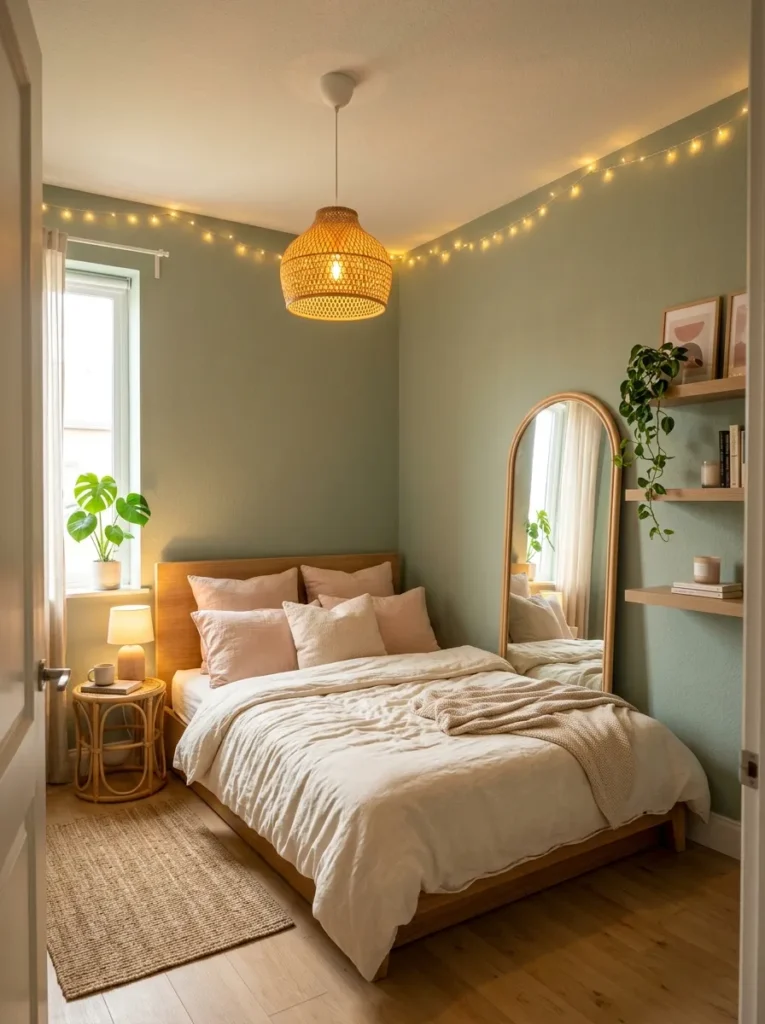
Vibe: A tiny room done right feels cozy in the best sense — not cramped, but intentionally close, like a space that was designed to hold you.
Why it works: Small cute rooms require a specific set of design decisions that work differently from their larger counterparts — the goal is not to make the room look larger (a common small-room design objective that often produces sterile, under-furnished spaces) but to make it feel warmly complete within its actual dimensions. The design principle is intentional compression: using color, light, and appropriately scaled furniture to make the small space feel deliberate rather than limited. Sage green on all four walls (rather than just an accent wall) creates a color envelope that makes the room feel defined and cozy rather than constrained. The low platform bed maximizes the apparent ceiling height by keeping the primary furniture element close to the floor. The large floor mirror amplifies the limited natural light. Floating shelves replace a dresser, preserving floor space while maintaining storage.
How to get it: In a room under 120 square feet, apply sage green on all four walls — the full-room color creates a contained warmth that a single accent wall cannot achieve in a small space. Choose a low platform bed (maximum 18 inches from floor to mattress surface) to maximize the vertical room. Replace any floor-standing storage with wall-mounted floating shelves. Install a large leaning arch mirror on the wall opposite the window to double the natural light. Run warm fairy lights along the ceiling perimeter at the wall-ceiling junction for the ambient glow that makes the room feel intimate rather than cramped.
Shop The Look
| Product |
|---|
| Dusty sage green matte paint quart |
| Low platform bed frame queen cream finish |
| Floating wall shelf set of 3 white |
| Large arch floor mirror slim frame leaning |
| Rattan pendant light plug in shade |
How to Start Your Cute Room Transformation
The single first move is to change your room’s lighting — specifically, to replace every cool-white or daylight-temperature bulb in the room with warm LED filament bulbs at 2200–2700K, and to add one string of warm fairy lights along a wall or headboard. This single intervention changes the room’s entire emotional register before a single piece of furniture is moved or a single object is added or removed. Cute rooms are warm rooms, and warmth in interior design is primarily a function of light color temperature — everything else (color, texture, objects) layers onto the foundation that warm light establishes. The cost is under $30 for most rooms and the installation takes under 20 minutes, making it the highest-return starting point in any cute room transformation.
The most common mistake in cute room design is confusing accumulation with curation — adding more objects, more prints, more decorative items to a room that already has enough, in the belief that more = cuter. The result is a room that reads as cluttered rather than cozy, busy rather than warm. The fix is editing: for every new object added to the room, remove one existing object that doesn’t actively contribute to the room’s color palette or emotional warmth. Cute rooms feel full without feeling cluttered because everything in them has been chosen — the negative space between objects is as deliberate as the objects themselves.
Three items under $50 that create the most immediate cute room atmosphere: a 10-meter string of warm white fairy lights ($10–$18) that transforms any bedroom wall into an ambient light feature, a single velvet throw pillow in the room’s accent color ($20–$35) that introduces the material richness and color confidence that differentiates a cute room from a simply decorated one, and a small trailing plant in a ceramic or rattan pot ($8–$15) that adds the organic, living quality that makes a room feel genuinely inhabited rather than staged. Together these three additions — totaling $38–$68 — create the warmth, color, and life that are the foundation of any cute room aesthetic.
Realistic expectations: a basic cute room refresh — new lighting, a few new pillows and a throw, a plant, and some shelf styling — takes one weekend and $100–$200. A full cute room transformation including a statement wallpaper wall, new furniture pieces, a large mirror, and a complete lighting overhaul represents a $400–$1,000 investment depending on the room’s size and the quality of the pieces chosen. The most successful cute rooms are almost never completed in a single shopping session — they develop over time as personally meaningful objects are added and less meaningful ones are edited out, which is precisely what gives them their authentic, inhabited quality.
Frequently Asked Questions About Cute Room Ideas
What makes a room look cute without looking childish?
The distinction between a cute room and a childish room lies in three specific design decisions: color sophistication (muted, warm tones rather than bright primary colors), material quality (linen, velvet, rattan, and natural wood rather than plastic or polyester), and editing discipline (a curated selection of meaningful objects rather than an accumulation of decorative items). A room with dusty rose walls, cream linen bedding, and rattan furniture reads as cute and adult; the same room with hot pink walls, polyester bedding, and plastic decorative accessories reads as juvenile. The colors and materials are the signals that distinguish the two registers.
What color palette works best for a cute room?
The most versatile cute room palette is built around one warm neutral foundation (warm cream, warm white, or very soft blush) and one to two accent colors in warm, muted tones. The most consistently successful accent color combinations are blush and sage, cream and mustard, terracotta and warm white, and dusty rose and natural rattan. In all cases, choosing the desaturated, muted version of each color (dusty sage rather than bright green, warm terracotta rather than orange, blush rather than pink) is what keeps the palette reading as sophisticated rather than playful in a childish sense. Cool greys, stark whites, and industrial tones work against the cute room aesthetic.
How do I make a small room look cute without it feeling cluttered?
The key to a cute small room is the three-surface rule: style a maximum of three surfaces in the room as display surfaces (one wall, one shelf unit, one desk or nightstand top) and keep all other surfaces clear or functional only. This constraint forces curation — you must choose which objects matter most — while preventing the small room from reading as overcrowded. Vertical storage (floating shelves instead of floor-standing furniture) and a large leaning mirror (which amplifies light and creates depth) are the two furniture decisions that most improve small cute rooms without adding visual clutter.
What furniture pieces make the biggest impact in a cute room?
The five furniture pieces with the highest cute room impact are, in rough priority order: a canopy or upholstered bed (the room’s primary visual statement), a velvet or bouclé accent chair in a warm color (the room’s personality piece), a large leaning arch mirror (the room’s light amplifier), a rattan pendant light (the room’s overhead warmth provider), and a well-styled floating shelf arrangement (the room’s autobiographical element). Investing in quality in these five categories and keeping all other furniture simple and neutral produces the most effective cute room outcome at any budget.
Can I create a cute room aesthetic in a rental without permanent changes?
Yes — the entire cute room aesthetic is achievable through non-permanent interventions. Peel-and-stick wallpaper on the headboard wall creates the pattern accent without damage. Command strips and adhesive hooks allow gallery walls and fairy lights without drilling. A large leaning mirror requires no wall mounting. Rattan furniture pieces add the material warmth without requiring installation. Throw pillows, velvet blankets, and layered rugs are entirely moveable. The one area where rentals require creativity is lighting — replacing overhead fixture bulbs with warm-toned alternatives (if the landlord permits) and supplementing with multiple floor and table lamps covers the lighting warmth requirement without any permanent electrical modification.
Ready to Create Your Dream Cute Room?
These 13 cute room ideas span every dimension of the transformation — from the canopy bed and botanical wallpaper wall to the velvet accent chair, the curiosity shelf, the layered lighting system, and the small-room complete overhaul — so whether you’re starting from a completely blank space or refining a room that already has good bones, there is a specific and achievable starting point here for exactly where you are. The most important thing to understand about cute room design is that it is less about things and more about decisions — every object in the room should be there because it adds warmth, personality, or genuine comfort, and everything that does none of those three things is a candidate for removal rather than addition. Today, change your lightbulbs to 2200K, add one string of warm fairy lights, and stand in the room for five minutes at dusk — that simple change will show you what your room is capable of becoming. Pin the ideas that made you feel something, and let those be the ones you build toward first.