14 Handmade Decor Ideas Full of Artisan Charm
Handmade decor refers to home accessories, wall art, and functional objects crafted by hand — using traditional techniques like weaving, pottery, woodworking, macramé, block printing, and natural dyeing — that bring irreplaceable human touch, material warmth, and one-of-a-kind character to a living space. This article gives you 14 artisan-inspired handmade decor ideas that work across every room and every budget, whether you make them yourself, source them from independent makers, or find affordable versions that honor the aesthetic without the price tag.
Picture a home where nothing looks like it came off a factory conveyor belt. Where a ceramic vase carries the slight asymmetry of someone’s hands. Where a woven wall hanging holds the memory of the person who knotted every strand. Where the imperfections are the point — the thumbprint in the glaze, the uneven warp in the weave, the grain of real wood showing through a hand-rubbed finish. That is what artisan charm actually means in a room. Here are 14 ideas worth saving — and stealing.
Why Handmade Decor Works So Well
Handmade decor occupies a design category that no mass-produced object can fully enter: the territory of material honesty and human presence. Every handmade piece carries embedded evidence of its making — the tool marks, the glaze drips, the irregular edge — and this evidence is precisely what gives it visual and emotional resonance in a room full of machine-perfect objects. The design philosophy draws from the Arts and Crafts Movement of the late 19th century, which argued that objects made by hand carry inherent beauty that industrial production destroys, and from the contemporary slow living movement, which reclaims that argument for modern interiors.
The materials that define authentic artisan decor are honest and earthbound: unglazed stoneware clay, undyed wool roving, reclaimed timber, cold-process beeswax, hand-spun linen thread, raw cotton rope, natural indigo, iron oxide pigments, copper wire, and beeswax encaustic. Colors emerge from natural sources rather than synthetic dyes — terracotta from iron-rich clay, indigo blue from fermented plant vats, ochre from mineral pigments, cream from undyed wool, and the warm gray of naturally weathered wood. These are colors that exist in the landscape, which is why they feel immediately right in a room.
The handmade decor movement has surged in the years since 2018, driven by a cultural reaction against the visual sameness of algorithm-curated interiors and the growing awareness that mass-market “artisan-inspired” products — machine-stamped with faux hammer marks, printed with faux grain texture — deliver the look without the soul. Pinterest searches for handmade home decor, artisan ceramics, and woven wall art have grown consistently year over year, with buyers increasingly willing to pay a premium for genuine maker provenance and pieces with documented human origin.
Even modest, budget-conscious interiors benefit immediately from the introduction of a single handmade object. One wheel-thrown ceramic vase on a shelf of mass-produced objects changes the entire visual conversation in that corner of the room. The handmade piece does not need to be expensive — a hand-poured beeswax candle, a block-printed linen tea towel, or a simple macramé plant hanger all carry genuine artisan character at accessible price points and lift the perceived quality of everything around them.
Style at a Glance
| Element | Trait 1 | Trait 2 |
|---|---|---|
| Philosophy | Human presence through material honesty | Imperfection as beauty, not flaw |
| Materials | Stoneware clay, undyed wool, reclaimed timber, raw cotton rope | Beeswax, linen thread, natural indigo, iron oxide pigment |
| Color Palette | Terracotta, indigo blue, ochre yellow, warm cream | Natural linen, iron gray, beeswax amber, forest green |
1. Wheel-Thrown Ceramic Vase Cluster
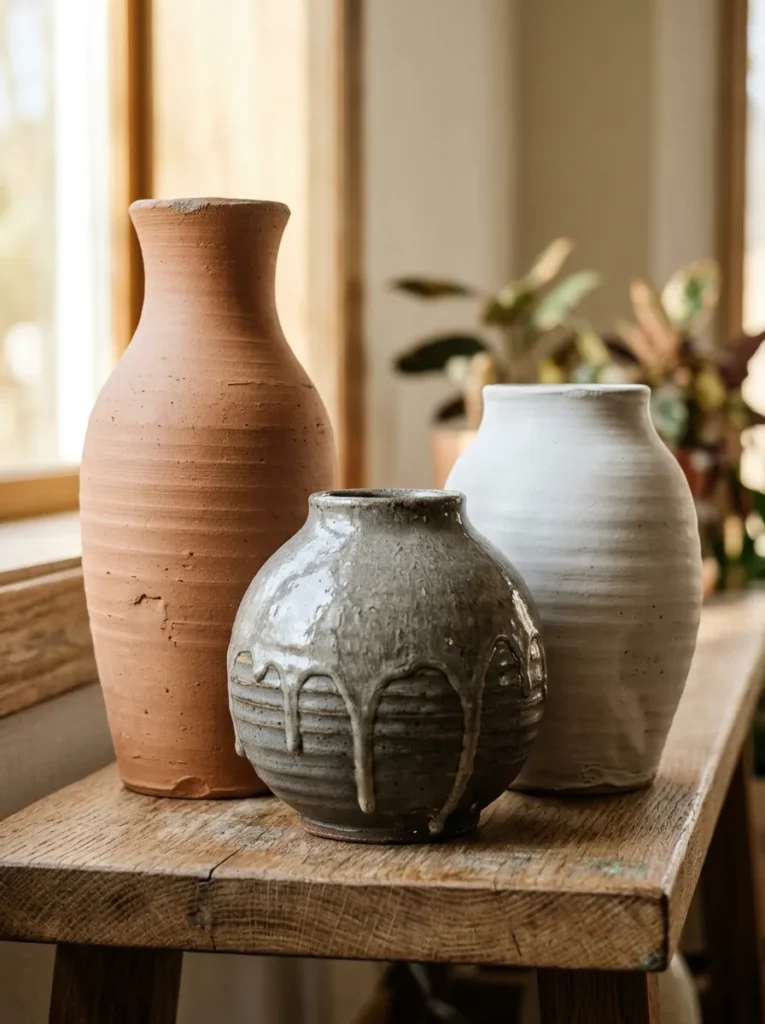
Vibe: Warm and grounded — three objects that make a shelf feel like a considered collection.
Why it works: Clustering wheel-thrown ceramics of graduated heights applies the design principle of grouped visual weight — three objects of different scales create a conversation between forms that a single object cannot. The slight asymmetry inherent in wheel-throwing means no two pieces sit identically on the shelf, producing a dynamic, living arrangement that machine-cast ceramics — perfectly identical, perfectly symmetric — can never replicate. The mixing of glazes within a tonal family (terracotta, iron gray, matte white) creates color harmony through material variation rather than matching, which reads as collected and organic rather than purchased as a set.
How to get it: Source wheel-thrown ceramics from local pottery studios, weekend craft markets, or platforms like Etsy that filter specifically for handmade stoneware. Look for pieces where throwing rings are visible on the exterior surface — these horizontal ridges left by the potter’s hands during throwing are the clearest evidence of genuine wheel work rather than slip casting. Cluster in odd numbers (three or five pieces) and vary height by at least 30% between the shortest and tallest piece for the most visually satisfying grouping.
Quick Win: A single wheel-thrown ceramic vase from a local pottery market costs $18–$45 and immediately changes the perceived quality of any shelf or table surface it joins — start with one piece in terracotta or iron glaze before building a full cluster.
Shop The Look
- Wheel-thrown stoneware vase set handmade ceramic
- Natural oak floating shelf wall mounted
- Dried pampas grass stem natural
- Beeswax taper candle set natural ivory
- Linen table runner natural undyed
Also view: 15 Stylish Shelf Decor Ideas for Every Room
2. Macramé Wall Hanging with Driftwood Bar
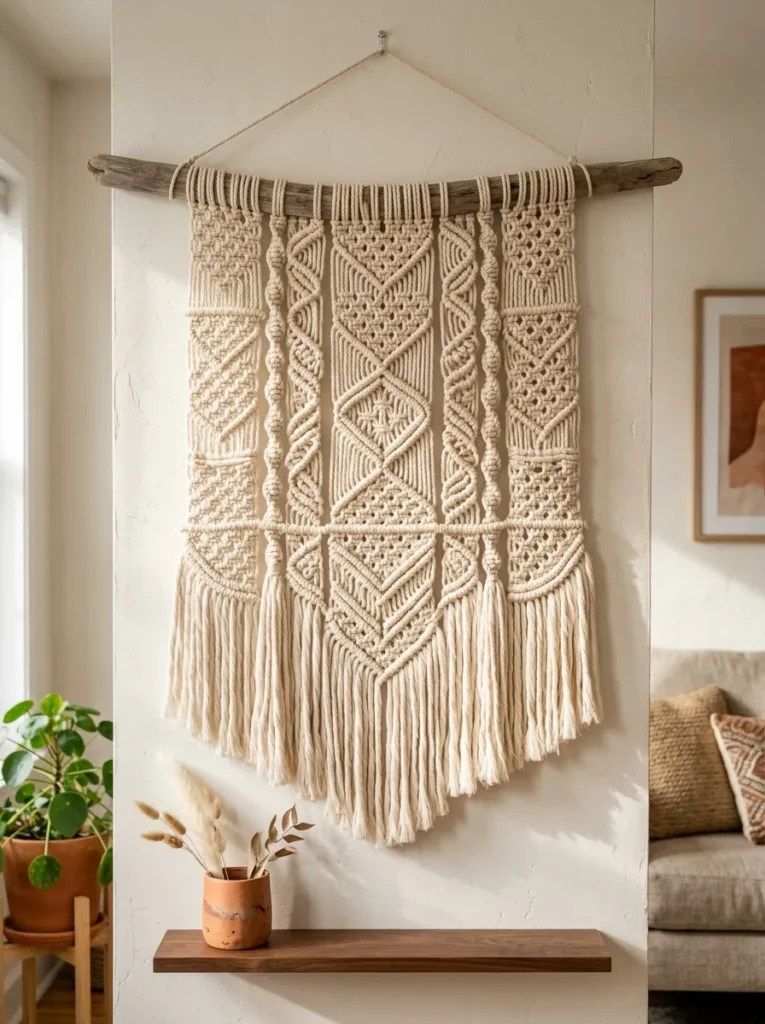
Vibe: Layered and sun-warmed — the wall piece that makes a blank space feel inhabited.
Why it works: A macramé wall hanging introduces the most complex category of handmade texture available in wall decor — the knotted structure creates genuine three-dimensionality, projecting 1–3 inches from the wall surface and casting soft shadows that shift throughout the day as light direction changes. This shadow-casting property is the design principle that sets macramé apart from any printed or woven flat wall art: the piece literally draws on the wall with light, creating a dynamic installation that looks different at every hour. The driftwood bar adds a second layer of natural material honesty — the weathered grain, irregular shape, and sea-worn texture complement the rope perfectly.
How to get it: For DIY macramé, use 3–5mm single-strand or three-ply natural cotton rope — single-strand separates into beautiful fringe, three-ply holds knot structure more rigidly. Begin with a simple alternating square knot pattern before attempting spiral or lark’s head combinations. For sourced pieces, look for makers who use natural undyed cotton rather than dyed synthetic rope — the undyed cream is the colorway that works in the widest range of interior contexts.
Shop The Look
- Natural cotton macramé rope 3mm single strand
- Macramé wall hanging driftwood bar large
- Driftwood branch natural wall hanging bar
- Square knot macramé beginners kit
- White plaster wall paint matte finish
Also view: 16 Luxurious Master Bedroom Ideas with Spa Vibes
3. Hand-Poured Beeswax Taper Candles
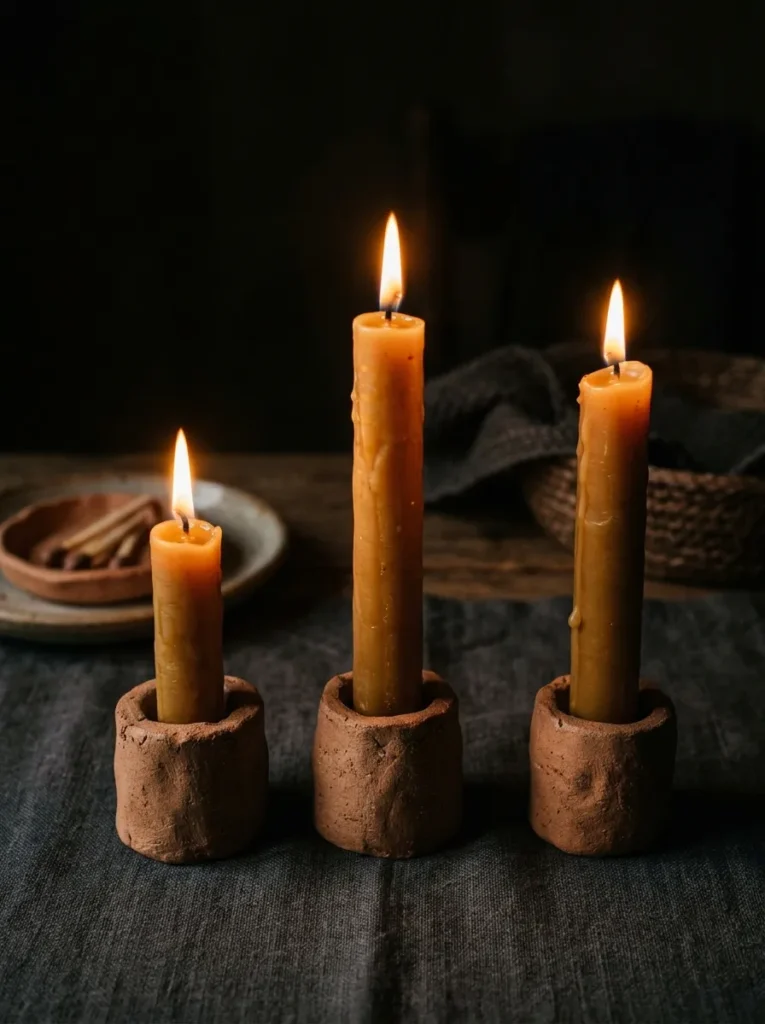
Vibe: Warm and intimate — light that makes every surface in a room look better than it is.
Why it works: Hand-poured beeswax candles represent the intersection of functional object and genuine craft artifact — the honey amber color, slight surface irregularity from hand-dipping, and natural honeyed scent of burning beeswax are all properties that machine-produced paraffin candles cannot replicate. The design principle at play is material authenticity through sensory layering: a beeswax candle contributes to a room through sight (warm amber light, honey color), smell (natural honey and faint flora), and tactile suggestion (the slight texture of hand-dipped wax visible on the surface). Grouped in odd numbers in raw clay holders, they create the most compelling artisan table vignette available at under $30 total.
How to get it: Pour beeswax tapers at home using a beeswax taper candle kit — the process involves repeatedly dipping cotton wick into a narrow container of melted beeswax, building up layers over 20–30 dips. Use only 100% pure filtered beeswax (available in pellet form) rather than beeswax blended with paraffin — the blend loses both the honey color and the natural scent that make beeswax candles worth making. Pair with unglazed terracotta candleholders for the most cohesive artisan presentation.
Quick Win: A 1-lb bag of beeswax pellets ($12) and a spool of #2/0 square-braided cotton candle wick ($8) produce approximately 12 hand-dipped taper candles — the entire material cost for a set of candlesticks is under $20, and the dipping process takes under an hour once the wax is melted.
Shop The Look
- Pure beeswax pellets 1 lb natural filtered
- Cotton candle wick square braided size 2/0
- Unglazed terracotta taper candleholder set
- Linen table runner undyed natural
- Beeswax candle dipping pot tall narrow
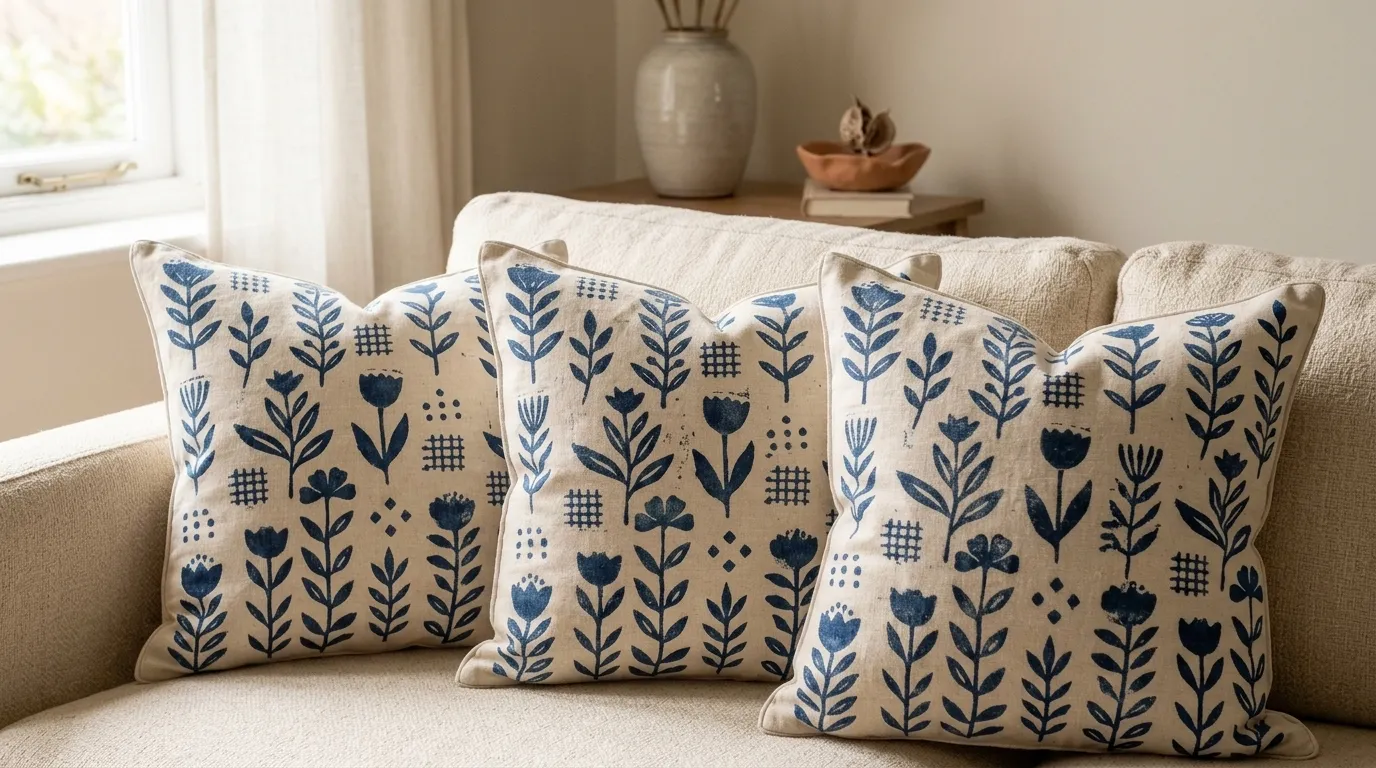
4. Block-Printed Linen Cushion Covers
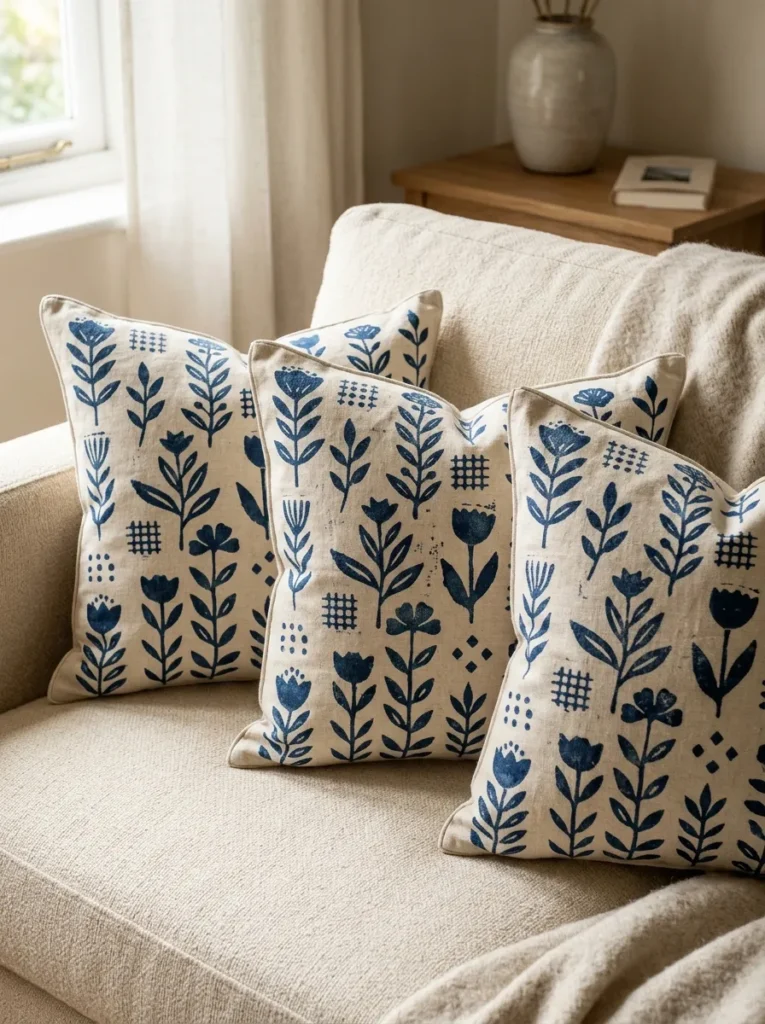
Vibe: Considered and sun-warmed — cushions that look like they came from a Jaipur textile studio.
Why it works: Block printing on linen applies the principle of controlled imperfection — each impression of the carved wooden stamp onto fabric carries slightly different ink density, slightly different alignment, and slightly different edge definition, creating a repeat pattern that reads as artisan rather than manufactured because no two repeats are identical. This variability is not a flaw in the making process — it is the authentic signature of the technique, and it is precisely what distinguishes hand-block-printed textiles from digitally printed fabric that merely simulates the same pattern. Natural indigo on undyed linen is the colorway combination with the deepest craft tradition globally, associated with textile cultures from India to Japan to West Africa.
How to get it: Carve simple botanical shapes into a firm rubber eraser or lino block using a V-gouge linocut tool — leaves, simple stems, and small geometric shapes are achievable for beginners. Use fabric-specific screen printing ink or natural indigo textile ink rather than regular craft ink, which washes out of fabric immediately. Pre-wash and iron linen fabric before printing to eliminate sizing and shrinkage that would distort the pattern after the first launder.
Shop The Look
- Lino block carving tool set V-gouge
- Natural indigo fabric printing ink
- Undyed natural linen fabric yard
- Fabric cushion cover blank 18×18 inch
- Textile fixative heat press iron-on
5. Woven Seagrass Basket Wall Gallery
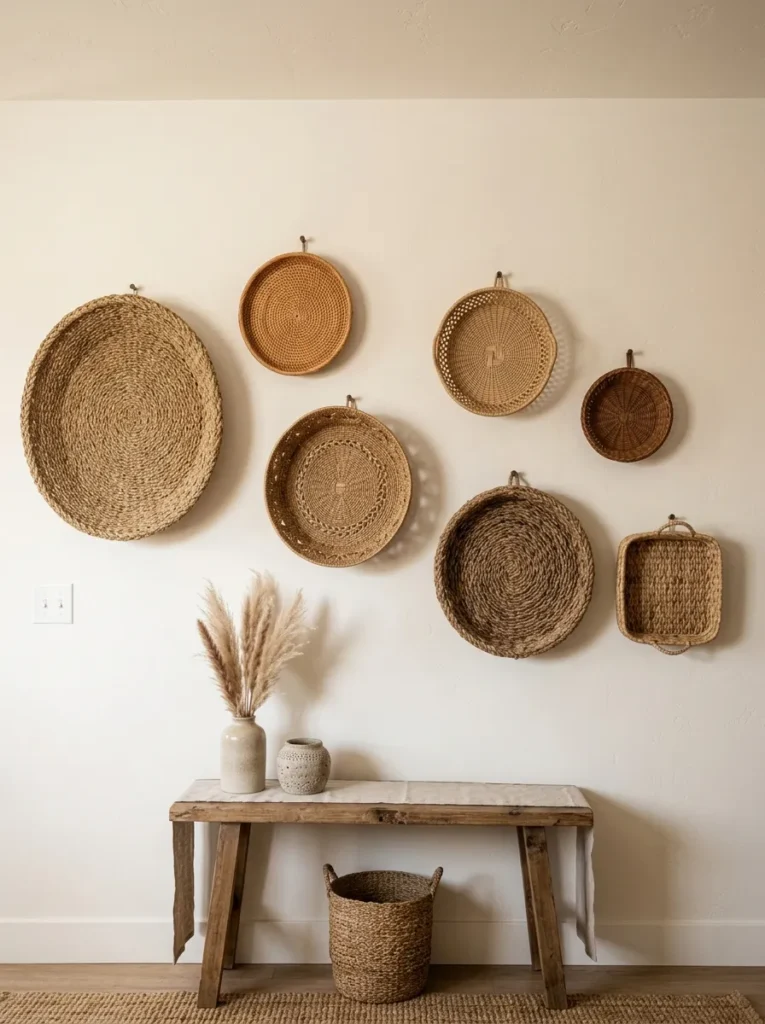
Vibe: Textural and warm — a gallery wall that feels gathered rather than planned.
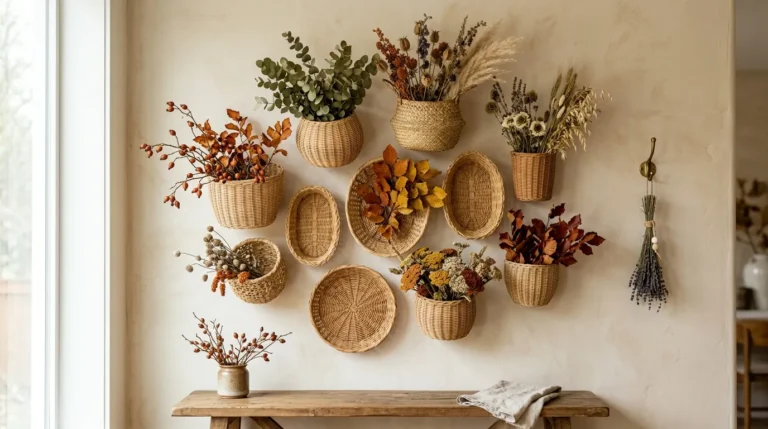
Why it works: A basket wall gallery applies the design principle of natural material accumulation — the visual interest comes not from any single basket but from the conversation between different weave patterns, rim treatments, and natural material tones arranged together. Each basket casts a distinctive circular shadow onto the wall behind it, creating a secondary layer of visual texture that shifts throughout the day as light moves — the wall effectively becomes part of the installation. The slightly asymmetric arrangement, with baskets hung at marginally different angles, amplifies the gathered, collected feeling that makes artisan gallery walls compelling.
How to get it: Collect baskets over time from different sources — craft markets, import stores, estate sales, and online makers — rather than purchasing a matching set. Visual coherence comes from staying within a natural material palette (seagrass, rattan, water hyacinth, wicker) and a tonal range (natural tan to warm brown) rather than from matching exactly. Arrange on the floor before hanging to test the composition — aim for a roughly circular or rectangular overall shape with varied basket sizes distributed evenly rather than grouped by size.
Shop The Look
- Seagrass wall basket set assorted sizes
- Rattan round wall basket large woven
- Water hyacinth decorative basket small
- Picture hanging strip set no-nail
- Wicker oval wall basket medium
6. Hand-Dyed Indigo Linen Table Runner
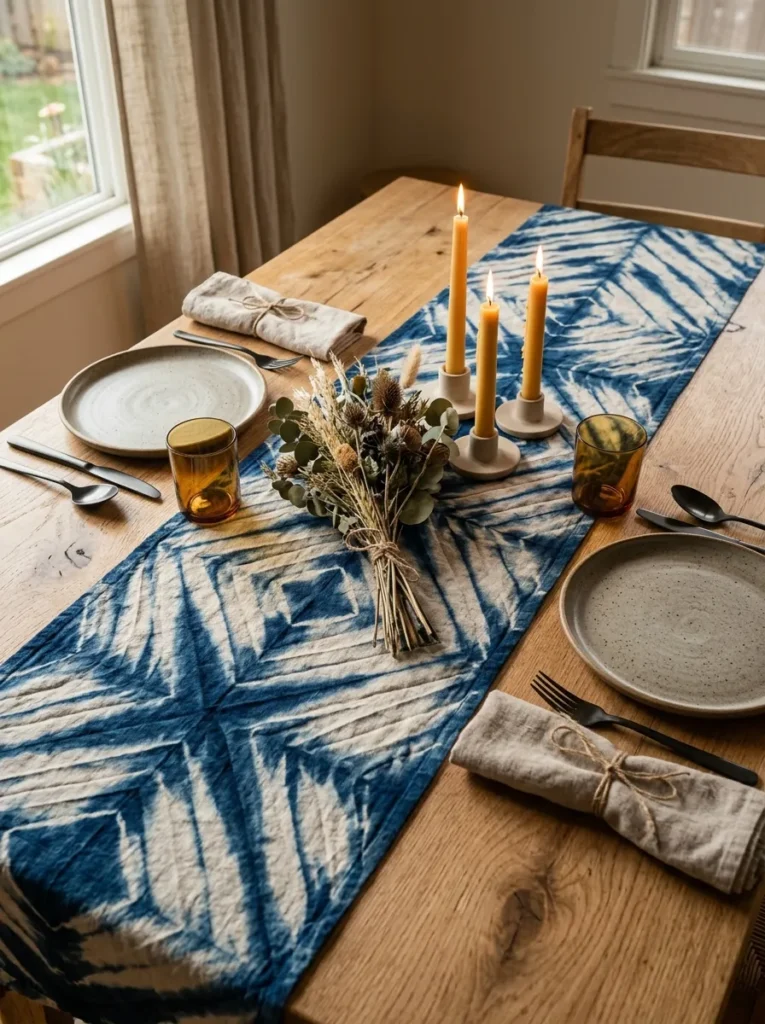
Vibe: Considered and deep — the table setting detail that makes dinner feel like an occasion.
Why it works: Shibori indigo dyeing on linen produces a pattern that cannot be exactly replicated — each fold, bind, or stitch resist creates a unique dye resist mark in the fabric, meaning every table runner produced by this technique is genuinely one of a kind. The design principle is controlled natural process: the maker establishes the fold structure and the dye concentration, but the precise pattern that emerges from the vat is co-created with the material itself. Deep indigo against natural linen creates one of the most historically resonant color combinations in global textile culture — found in everything from Japanese boro patchwork to Malian bogolanfini cloth — which gives the piece immediate cultural depth beyond its decorative function.
How to get it: Shibori indigo dyeing at home uses a pre-reduced indigo dye kit — the most accessible entry point for home textile dyeing. Accordion-fold a length of pre-washed undyed linen, clamp between two small wooden boards with rubber bands, and submerge in the prepared indigo vat for 3–5 minutes. The magic happens when you remove the fabric and unfold — the oxidation of the indigo as it contacts air turns the fabric from yellow-green to deep blue in real time, and the resist areas remain natural linen.
Shop The Look
- Indigo shibori dye kit pre-reduced vat
- Undyed linen fabric yard natural
- Wooden clamp board set shibori resist
- Unglazed ceramic dinner plate set
- Dried botanical bundle lavender wheat
7. Handmade Macramé Plant Hangers
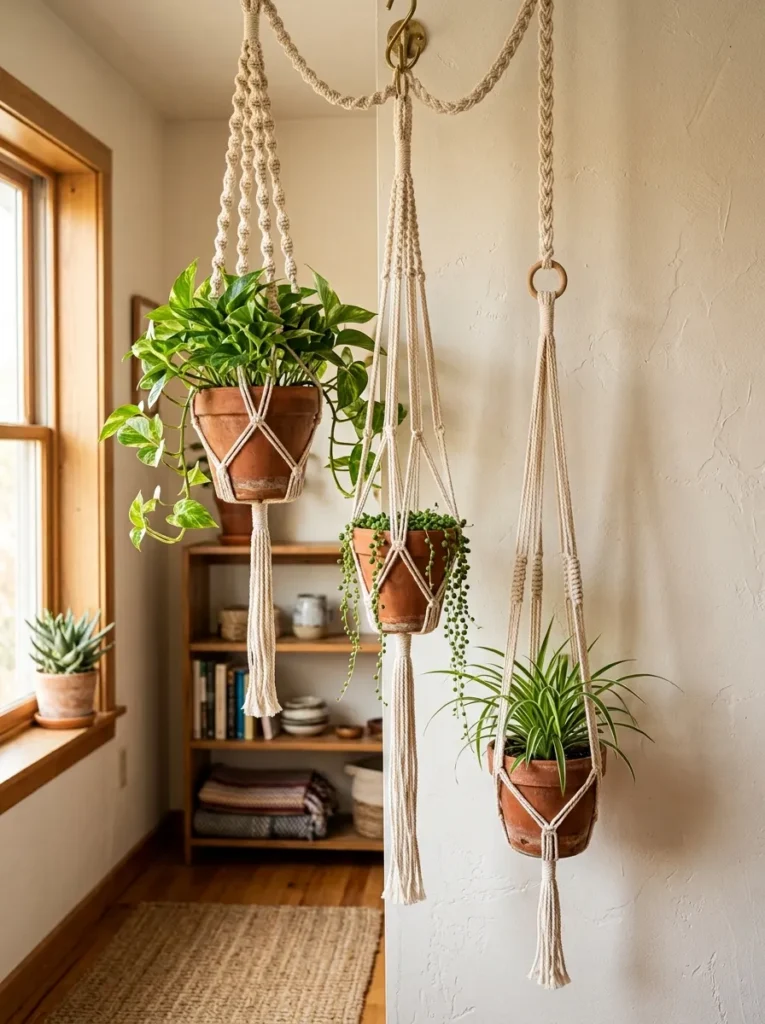
Vibe: Living and warm — the corner that grows more interesting the longer you look at it.
Why it works: Grouped macramé plant hangers at varied heights apply the principle of vertical layering — by occupying different height zones in a corner (ceiling level, mid-wall, and lower third), the three hangers create a complete vertical plant installation that fills the corner’s full volume rather than sitting at a single level. Each hanger’s distinct knot pattern creates enough visual differentiation that the grouping reads as collected rather than matching, amplifying the artisan quality. The combination of knotted rope texture and living plant material creates a layered sensory richness — soft rope, rough terracotta, and the varied green textures of trailing foliage — that no single material achieves alone.
How to get it: Cut six lengths of 5mm natural cotton rope to 8 feet each for a basic single-pot hanger — gather at center, knot at 4 inches, divide into pairs and tie alternating square knots at 3-inch intervals, then gather all strands and knot 4 inches above the pot placement point. The pot rests in the gathered knot naturally. For beginners, start with the simple gathered wrap style — no knotting required — before progressing to square knot spirals.
Quick Win: A 100-foot roll of 5mm natural cotton macramé rope ($14) makes 4–5 basic plant hangers — the materials for a full three-hanger corner display cost under $20, making this the most impactful low-budget artisan decor project on this list.
Shop The Look
- Natural cotton macramé rope 5mm 100 ft
- Terracotta plant pot set 4-6 inch
- Pothos trailing indoor plant small
- Ceiling swivel hook plant hanger
- Macramé plant hanger beginner kit
8. Hand-Carved Wooden Serving Board
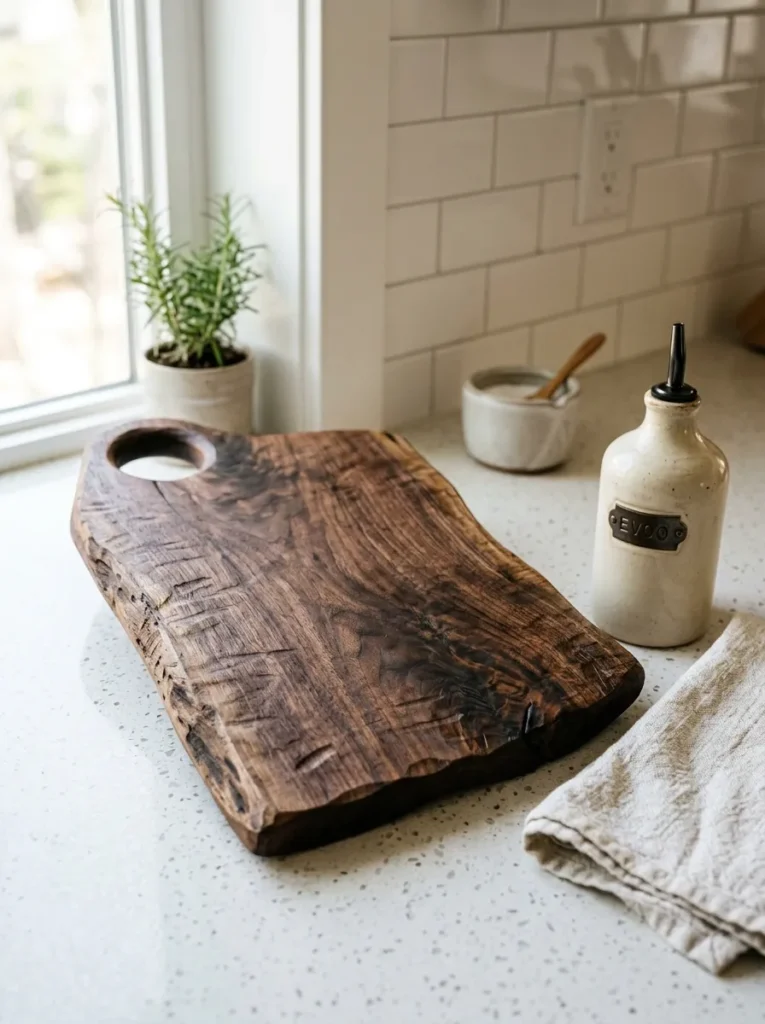
Vibe: Warm and purposeful — the kitchen object that makes the counter look considered even when it’s empty.
Why it works: A hand-carved wooden board carries the tool marks of its making — chisel paths, grain-following cuts, the slightly uneven surface left by hand work rather than machine planing — and these marks are both the evidence of craft and the source of the board’s visual interest. The design principle is functional texture: unlike a smooth, machine-finished board that reads as purely utilitarian, a hand-carved board has enough surface character to function as decorative object when not in use — leaning against a backsplash, it reads as sculpture. Walnut is the wood of choice for this application because its deep chocolate grain provides immediate visual richness without staining or finishing beyond natural food-safe oil.
How to get it: Carve a serving board from a kiln-dried walnut blank (available from woodworking suppliers in 12x8x1-inch blanks for $15–$25) using a palm chisel and mallet to rough out an organic edge, then a flat chisel to texture the serving surface with deliberate tool marks. Finish with two applications of food-safe walnut oil or beeswax board cream, buffed in with a cotton cloth. The organic edge — the quality that most distinguishes handmade from machine-made boards — is achieved by marking a freehand curved line and cutting with a jigsaw before the chisel work begins.
Shop The Look
- Kiln-dried walnut wood blank 12×8 inch
- Palm chisel set wood carving
- Food-safe walnut oil board conditioner
- Beeswax board cream food safe
- Linen dish towel set natural undyed
9. Hand-Thrown Ceramic Oil Diffuser
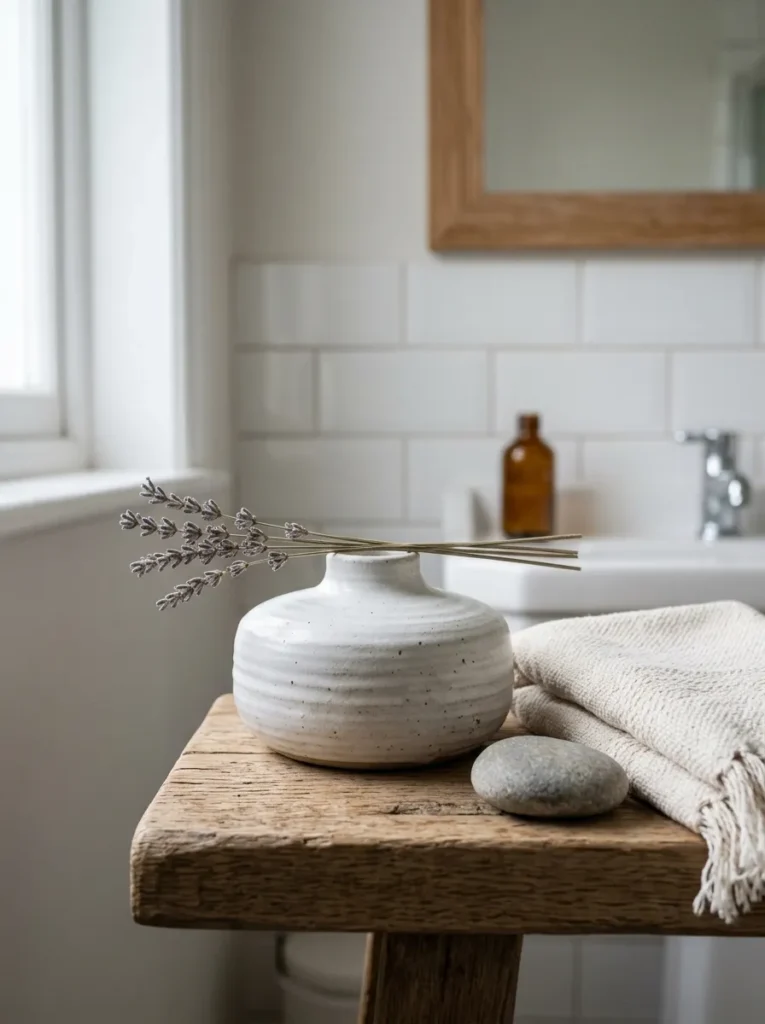
Vibe: Still and serene — the bathroom shelf object that makes the space feel like a spa without trying.
Why it works: A hand-thrown ceramic diffuser vessel does something no commercially produced glass or plastic diffuser bottle achieves: it makes a functional object — something designed primarily to hold liquid and emit scent — visually beautiful enough to be the focal point of a shelf arrangement. The design principle is object elevation through material upgrade: replacing a standard glass reed diffuser bottle with a wheel-thrown stoneware vessel in matte white slip glaze keeps the function identical while transforming the aesthetic entirely. The narrow mouth is a functional requirement (it controls evaporation rate and holds reeds upright), and the low, wide vessel form creates the visual stability that makes the object read as anchor rather than accessory.
How to get it: Source hand-thrown ceramic diffuser vessels from pottery studios or independent ceramic makers — specify a vessel with a mouth diameter of 1.5–2 inches to accommodate standard reed diffuser sets. Alternatively, any small-mouthed wheel-thrown bud vase serves the same function when filled with a carrier oil and essential oil blend. Matte white slip glaze, iron brown, and unglazed stoneware are the three finishes that best complement the bathroom context.
Shop The Look
- Hand-thrown stoneware bud vase narrow mouth
- Reed diffuser sticks natural rattan
- Lavender essential oil 100% pure
- Fractionated coconut oil diffuser carrier
- Cream linen hand towel set
10. Natural Dye Woven Wall Art on Dowel
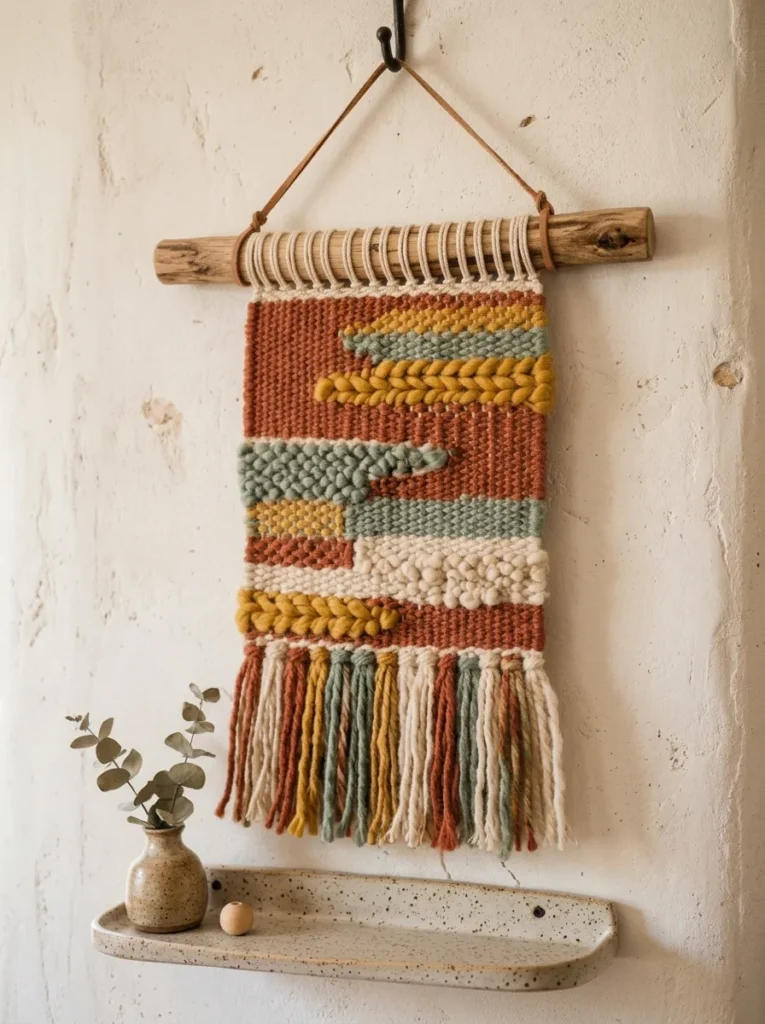
Vibe: Warm and handcrafted — the wall piece that makes people ask if you made it.
Why it works: A naturally dyed woven tapestry introduces the most complex intersection of artisan techniques available in wall decor — the piece carries the evidence of both the dyeing process (natural color ranges, subtle dye lot variation between skeins) and the weaving process (texture changes between yarn weights, warp visibility at the top, fringe ends at the bottom). The color palette of natural dyes occupies a specific tonal register that synthetic dyes cannot replicate — terracotta from madder root, ochre from goldenrod or onion skins, sage from various botanicals — producing hues that carry warmth and slight unpredictability within each color.
How to get it: A simple frame loom can be built from four pieces of 1×2 lumber nailed at the corners and strung with natural cotton warp thread at 8–10 threads per inch. Weave with naturally dyed wool yarn using a simple over-under plain weave, changing yarns to create horizontal color blocks. For natural dyeing, onion skin (gold to ochre), avocado pit (dusty pink to terracotta), and black walnut hull (warm brown) are the most accessible and colorfast dye materials available in most kitchens and backyards.
Quick Win: Naturally dyed wool yarn from indie dyers on Etsy costs $12–$20 per skein and provides the authentic natural dye color palette without the dyeing process — purchase three complementary skeins in terracotta, ochre, and cream to begin a tapestry with an immediately cohesive color story.
Shop The Look
- Naturally dyed wool yarn terracotta skein
- Tapestry weaving frame loom small
- Natural cotton warp thread cone
- Tapestry weaving shuttle tool set
- Natural wood dowel rod 12-inch length
11. Hand-Stamped Clay Gift Tags and Ornaments
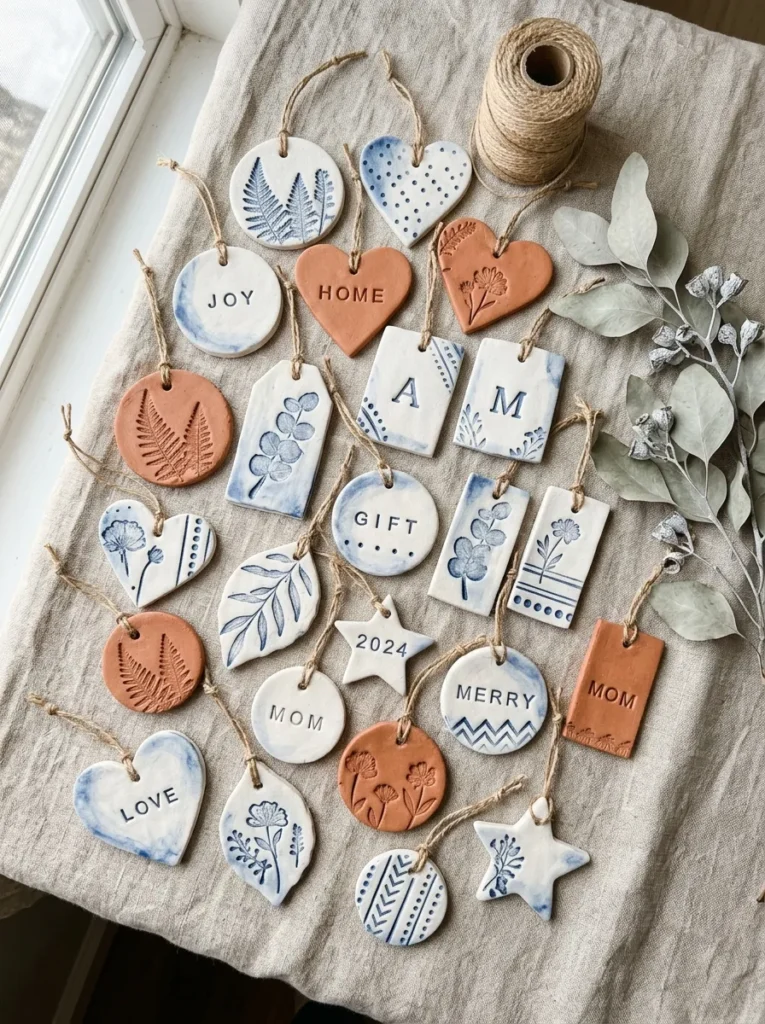
Vibe: Creative and warm — the small handmade objects that make a home feel like someone genuinely lives in it.
Why it works: Hand-stamped clay ornaments and gift tags represent the most accessible entry point into ceramic artisan decor — requiring no kiln, no wheel, and no specialized skill — while still producing objects with genuine handmade character through the stamp impression process. The design principle is texture transfer: rubber or wooden botanical stamps pressed into soft air-dry clay leave a crisp negative impression that fires permanently into the clay surface as it dries, creating objects that read as intentionally ceramic rather than craft-project. Displayed in a bowl, hung on a wall, or used as actual gift tags, these small objects punch far above their material cost in perceived artisan quality.
How to get it: Roll air-dry clay to 5mm thickness on a linen-textured surface — the linen weave transfers a subtle texture to the clay back that adds authenticity. Cut shapes with a craft knife or cookie cutter, press botanical stamps or alphabet stamps firmly and evenly into the surface, poke a twine hole at the top with a toothpick, and allow to dry flat for 24–48 hours. Apply a thin wash of diluted acrylic paint in indigo or ochre to dry pieces and immediately wipe back with a damp cloth — the wash settles into the stamped impressions and dramatically enhances their visibility.
Shop The Look
- Air-dry clay white 2 lb pack
- Botanical rubber stamp set leaves and botanicals
- Alphabet letter stamp set small
- Natural jute twine roll thin
- Diluted indigo acrylic paint wash set
12. Poured Concrete Geometric Planter
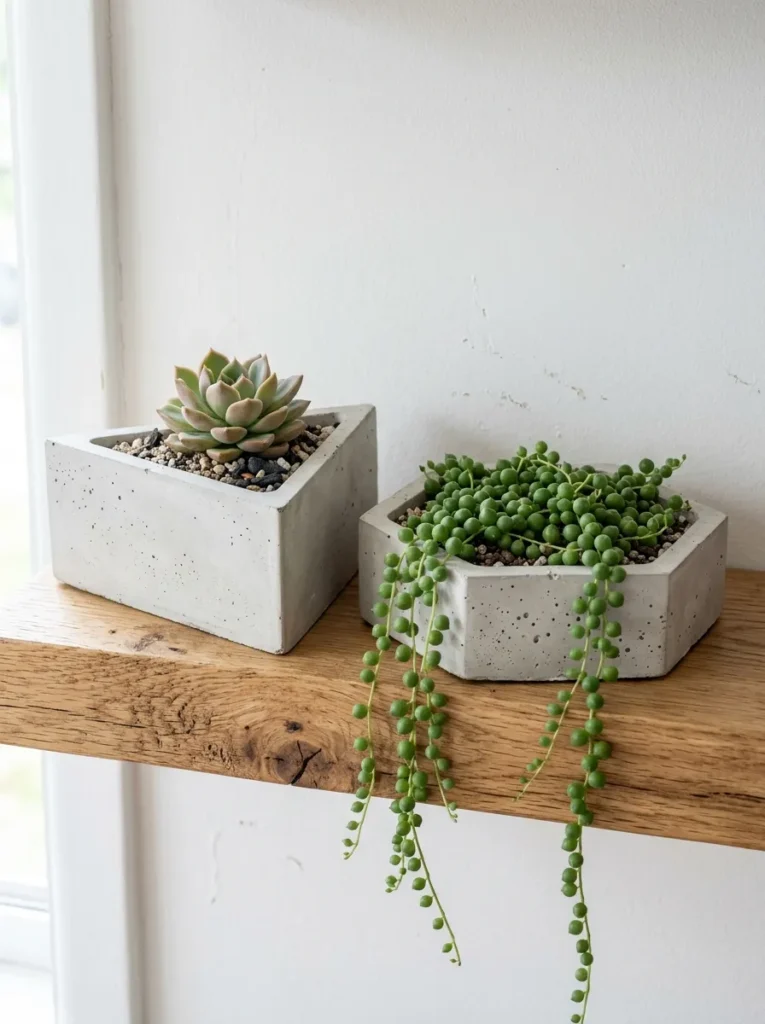
Vibe: Clean and grounded — the planter that makes a succulent look like a sculpture.
Why it works: Hand-poured concrete geometric planters demonstrate the design principle of material contrast through form — the industrial weight and cool gray of concrete juxtaposed against the soft organic form of a succulent or trailing plant creates a visual tension that makes both elements more interesting than either would be alone. The geometric mold shape (triangular, hexagonal, or rectangular prism) is achievable with cardboard or foam mold construction and produces a planter that reads as architecturally sophisticated rather than craft-project. The slight air bubble texture and pour marks visible on the concrete surface are the handmade evidence that distinguishes a poured piece from a cast commercial concrete product.
How to get it: Mix rapid-setting concrete with water to a thick peanut butter consistency. Pour into a cardboard or foam mold (a small milk carton for triangular form, an assembled foam board for hexagonal) lined with a plastic bag for release. Insert a smaller mold (an oiled plastic cup) in the center to create the planting cavity. Tap the mold firmly on the table repeatedly to bring air bubbles to the surface — this is the critical step that both removes large voids and creates the characteristic small bubble texture on the concrete surface. Demold after 24 hours and allow to cure fully for 7 days before planting.
Shop The Look
- Rapid-setting concrete mix small bag
- Geometric concrete planter mold set
- Succulent plant assortment small pots
- Concrete sealer matte finish spray
- Natural oak shelf floating wall mounted
13. Hand-Stitched Linen Wall Panels
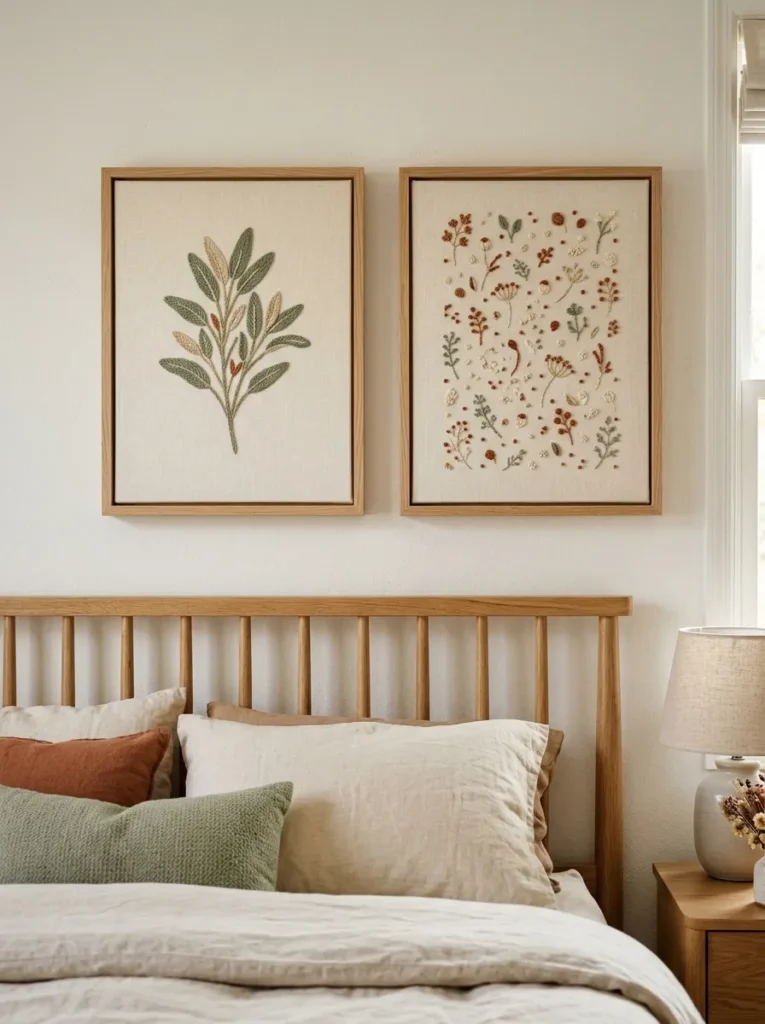
Vibe: Serene and hand-crafted — the bedroom wall art that makes the room feel made rather than decorated.
Why it works: Hand-embroidered linen panels apply the principle of intimate scale in wall art — the small, close-up nature of embroidery stitches means these pieces reward proximity in a way that printed or painted art does not. From across the room they read as soft, textural neutral wall art. From beside the bed, the individual stitches, the slight variation in thread tension, and the tactile presence of wool on linen become visible, creating a genuinely intimate art experience. Chain stitch and French knot are the two most visually interesting embroidery stitches for wall panel work — chain stitch creates bold linear definition for stems and outlines, while French knots produce dimensional dot clusters that photograph beautifully.
How to get it: Stretch undyed linen onto a 10-inch embroidery hoop for working, then transfer to a simple box frame after completion. Use 100% wool embroidery thread rather than standard cotton embroidery floss — wool thread has a matte, chunky quality that reads as artisan rather than craft-kit on linen. Transfer botanical motifs by tracing onto the linen with a water-soluble fabric pen — the line disappears completely after the first misting with water, leaving only the embroidery visible.
Quick Win: A ready-stretched linen panel in a simple oak frame ($15–$22) from a craft supplier allows you to embroider directly onto a finished, frameable surface without the additional steps of framing and stretching — begin embroidering the same day the materials arrive.
Shop The Look
- Undyed natural linen fabric embroidery panel
- 100% wool embroidery thread set neutral tones
- Embroidery needle set size 3-9
- Natural oak box frame 8×10 inch
- Water-soluble fabric marker pen
14. Handmade Beeswax Wrap Kitchen Set
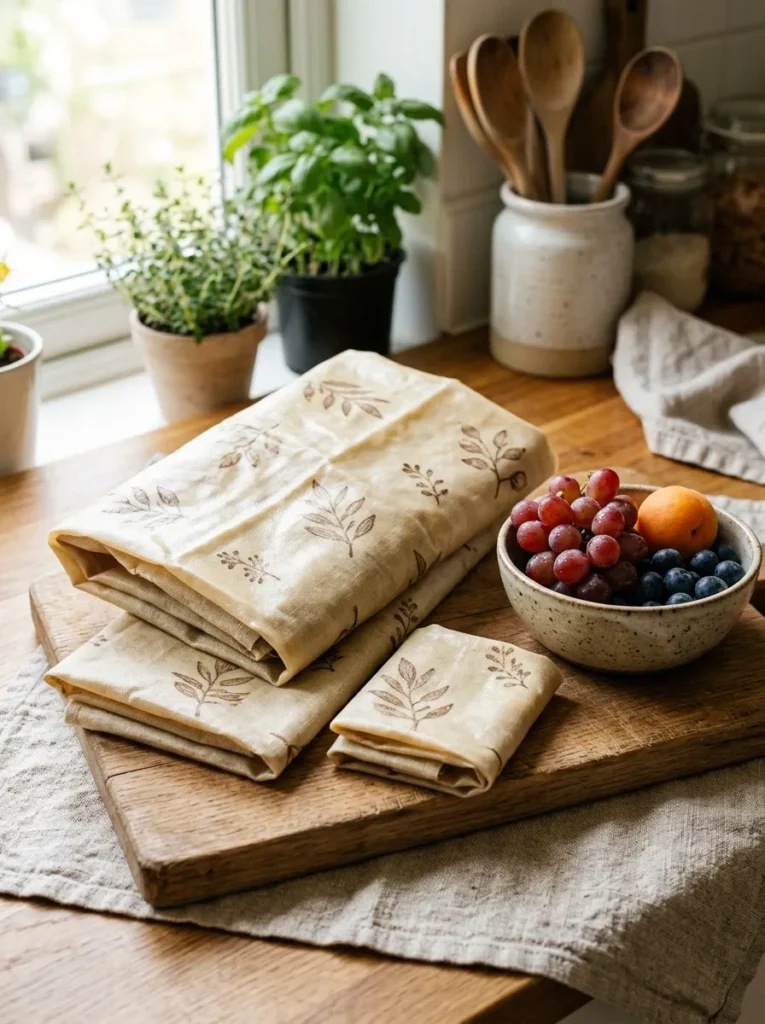
Vibe: Warm and purposeful — the kitchen objects that make sustainability look like a design choice.
Why it works: Handmade beeswax wraps occupy the rare category of functional craft objects that serve both an aesthetic and an ethical purpose simultaneously — they replace plastic wrap with a renewable, biodegradable material while introducing the warm honey color of beeswax and the hand-stamped botanical pattern into the kitchen’s daily visual environment. The design principle is functional beauty: these are objects used every day, seen every day, and handled every day, which means their material and aesthetic quality is experienced more intimately than any purely decorative object in the home. The slight translucency of the beeswax coating, visible as a soft sheen on the linen surface, is the handmade quality indicator that distinguishes a carefully crafted wrap from a commercial version.
How to get it: Cut undyed linen or cotton fabric to desired sizes (small 20x20cm, medium 30x30cm, large 35x35cm). Block-stamp a simple botanical pattern onto each piece using fabric ink before waxing — the stamps will show through the finished wax coating as a subtle design. Lay the stamped fabric on a sheet of baking parchment on a baking tray, sprinkle pure beeswax pellets evenly across the surface, and melt at 80°C (175°F) in a low oven for 3–4 minutes until the wax flows fully across the fabric. Remove, lift with tongs, and wave in the air for 30 seconds until the wax sets. The finished wrap is pliable at room temperature and hardens when cool — body warmth from the hands softens it to mold around any food or bowl.
Shop The Look
- Pure beeswax pellets 1 lb food grade
- Undyed cotton fabric yard preshrunk
- Botanical rubber stamp set small
- Natural fabric ink stamp pad
- Beeswax wrap storage tin flat
How to Start Your Handmade Decor Transformation
Start with a single wheel-thrown ceramic vase on your most visible shelf. Before making anything or committing to any larger project, purchase one genuinely handmade ceramic piece — from a local pottery studio, a weekend craft market, or a verified independent maker on Etsy — and place it on the shelf or surface where you spend the most time. This one object changes the visual conversation of everything around it immediately, and the degree to which it does will tell you exactly how hungry your space is for more artisan material. It costs $20–$45 and requires no skill, no tools, and no time beyond the choosing.
The most common mistake people make when introducing handmade decor is mixing too many techniques and materials at once — a macramé wall hanging beside block-printed cushions beside hand-carved wood beside concrete planters beside embroidered panels creates visual noise rather than artisan warmth. The principle that makes handmade decor work in a room is material family coherence: choose two or three natural materials as your foundation (for example, unglazed ceramic, natural cotton rope, and undyed linen) and build every handmade object around that material family. Every piece then reinforces the others rather than competing, and the room reads as intentionally curated rather than eclectically cluttered.
Three items under $50 that make an immediate impact: A set of three unglazed terracotta taper candleholders with natural beeswax tapers ($22 total) that creates an instant artisan table vignette; a 100-foot roll of 5mm natural cotton macramé rope ($14) that is the complete material investment for three plant hangers and a small wall hanging; and a single naturally dyed wool yarn skein in terracotta from an indie dyer ($16) that begins a woven tapestry or embroidered panel with an immediately authentic natural color story.
Realistic expectations: A single handmade object — one ceramic vase, one macramé plant hanger, one block-printed cushion cover — takes one afternoon to source or make and costs $15–$45 in materials. A full room introduction of handmade decor across walls, surfaces, and textiles typically evolves over 2–6 months when built gradually, which is the appropriate pace — artisan decor should feel accumulated rather than installed. A fully transformed room where every surface carries genuine handmade presence typically represents a total investment of $150–$400 in materials and maker purchases, and it will look and feel categorically different from any room furnished entirely from mass-market retail.
Frequently Asked Questions About Handmade Decor Ideas
What is the difference between handmade decor and artisan decor?
The terms are related but carry different implications. Handmade decor refers specifically to the production method — any object made by human hands rather than machine. Artisan decor implies both handmade production and a level of craft skill, material knowledge, and design intention that elevates the object beyond functional craft into the territory of applied art. A child’s clay pinch pot is handmade. A wheel-thrown stoneware vase with a deliberate iron glaze finish is artisan. In practice, the distinction matters most when sourcing rather than making — look for makers who can describe their specific technique, material sourcing, and design process, as this transparency is the most reliable indicator of genuine artisan practice.
What are the most beginner-friendly handmade decor projects to start with?
Macramé plant hangers and hand-stamped clay ornaments are the two most accessible starting points because both require minimal equipment, produce results that are genuinely beautiful on a first attempt, and involve techniques that build transferable skills. Macramé requires only rope, scissors, and a ceiling hook to practice on — the square knot, which is the foundation of 80% of macramé patterns, can be learned in 20 minutes. Air-dry clay stamping requires only a block of clay, rolling pin, and rubber stamps — no kiln, no wheel, no specialized tools. Both projects can be completed in under two hours and cost under $20 in materials for a first attempt.
How do I make handmade decor look intentional rather than craft-project?
The single most important variable is material quality rather than skill level. A macramé wall hanging in high-quality natural undyed cotton rope reads as intentional design. The same knots in cheap acrylic yarn read as craft project. A ceramic piece in real stoneware clay with a considered glaze reads as artisan. The same form in air-dry white clay with store-bought acrylic paint reads as children’s craft. Invest in the best quality natural materials your budget allows — 100% natural cotton rope, genuine stoneware clay, real wool yarn, undyed linen fabric — and even beginner-level technique produces objects with genuine material presence. The second variable is restraint: one considered handmade object on a clean surface reads as design. Ten craft projects on the same surface reads as clutter.
Where is the best place to source genuine handmade decor if I don’t want to make my own?
Local craft markets and independent maker fairs are the highest-quality sourcing environments because you can see the maker, ask about their technique and materials, and often watch work being made. For online sourcing, Etsy remains the most comprehensive platform for independent makers globally — filter specifically by “handmade” in the item specifications and look for sellers who show their studio, describe their materials in detail, and have a consistent body of work across multiple pieces rather than a random collection of unrelated products. Instagram is increasingly valuable for discovering ceramicists, textile artists, and woodworkers who sell directly from their studio accounts without platform fees, often at better prices than marketplace listings.
How do I mix handmade decor with existing mass-produced furniture without the room looking inconsistent?
The principle is material bridge building — introducing handmade objects that share a material language with existing furniture. If your furniture is oak and linen, introduce handmade objects in stoneware, natural rope, and undyed cotton — all materials that share the warm, natural character of wood and undyed fabric. If your furniture is darker walnut and leather, introduce handmade objects in iron-glazed ceramics, dark woven baskets, and beeswax-finished wood. The handmade objects don’t need to match the furniture — they need to speak the same material language. One object that shares material DNA with your existing furniture anchors the handmade piece visually and makes it read as belonging rather than intruding.
Ready to Create Your Dream Handmade Decor Home?
These 14 ideas span the full range of artisan charm — from the tactile complexity of a macramé wall hanging and the functional beauty of beeswax wraps to the quiet confidence of a wheel-thrown ceramic cluster and the deep cultural resonance of shibori-dyed linen. Every handmade transformation begins with a single object, and placing one genuine wheel-thrown ceramic vase on your most-used shelf this week is a complete, meaningful first step — not a compromise, not a placeholder, but a real design decision that begins to shift the character of your home. Right now, look at your most visible shelf or table surface and ask what single handmade object — ceramic, woven, carved, or poured — would make that surface feel more alive. Start there, with that one piece, sourced or made. Once the first genuinely handmade object is in the room, you will understand immediately why it changes everything around it — and you will want more. Save the ideas that match your skills, your materials, and your space, and let the collection grow at its own pace.