15 Study Room Makeover Ideas for Stylish Learning
A study room makeover transforms a functional learning or working space through deliberate choices in furniture, lighting, storage, color, and organization — creating an environment that supports focused productivity while feeling genuinely personal and visually considered. Here are 15 ideas for making your study room work harder, look better, and feel like a space you actually want to spend time in.
A great study room doesn’t just hold the things you need — it actively supports the kind of thinking you’re trying to do. The right light at the right angle, the right amount of visual calm on the walls, the right balance between storage-that-hides and display-that-inspires. Getting this balance right is less about following a design formula and more about making a series of honest decisions about how you actually work, learn, and think. Here are 15 ideas worth saving — and stealing.
Why Study Room Makeovers Work So Well
What makes a study room genuinely effective? A well-designed study room sits at the intersection of environmental psychology and interior design — it draws from research on how physical environments affect cognitive performance (lighting quality, acoustic conditions, visual complexity, thermal comfort) and applies those findings through the lens of deliberate aesthetic choice. The most effective study rooms are not sterile or clinical — they are warm, personally meaningful spaces where every design decision has been made with the specific cognitive and creative demands of the room’s user in mind. The distinction between a study room that supports deep work and one that merely contains the equipment for it is almost entirely a matter of intentional design.
Core materials and colors. The study room makeover palette that most consistently supports both focus and aesthetic warmth leans toward natural materials and grounded neutrals: warm white oak and natural pine for shelving and desk surfaces, linen and cotton in warm cream and warm greige for soft furnishings, matte paint in dusty sage, warm charcoal, forest green, or deep navy for accent walls, and natural materials like rattan, jute, and cork for organizational and decorative elements. Metals trend toward matte black and brushed brass — matte black for the structured, no-nonsense quality it brings to desk lamps and shelving systems, brushed brass for the warmth it adds to lighting fixtures and hardware. Avoid high-gloss surfaces and cool-toned neutrals (cool grey, stark white) in study rooms — they create visual environments that feel clinical rather than intellectually warm.
Why study room makeovers are trending now. The post-pandemic normalization of remote work and home-based learning has transformed the study room from an occasional-use space to a room that many people spend more waking hours in than any other. This shift in use frequency has elevated the design standard for home study spaces — people who previously tolerated a bare desk in a spare room are now actively investing in environments that support sustained daily performance. Pinterest data shows consistent growth in searches for “home office makeover,” “study room aesthetic,” and “productive workspace decor” year over year since 2020.
Can a study room makeover work in a small or shared space? Consistently yes — and some of the most effective study room design interventions are specifically calibrated for small or shared spaces. Vertical storage (floating shelves, wall-mounted systems) preserves floor space; room dividers (bookshelves, curtain panels, planting screens) create functional separation in shared rooms; deliberate lighting zoning (a desk lamp that creates a defined work pool distinct from ambient room light) creates a psychological study environment even within a larger, multipurpose room.
Style at a Glance
| Element | Detail |
|---|---|
| Philosophy | Design for the mind first, the eye second — then make both happy |
| Key Materials | White oak, natural pine, linen, rattan, cork, matte black steel |
| Key Colors | Dusty sage, warm charcoal, forest green, navy, warm cream, warm white |
15 Study Room Makeover Ideas for Stylish Learning
1. Dedicated Task Lighting System — Desk Lamp Plus Ambient Layer
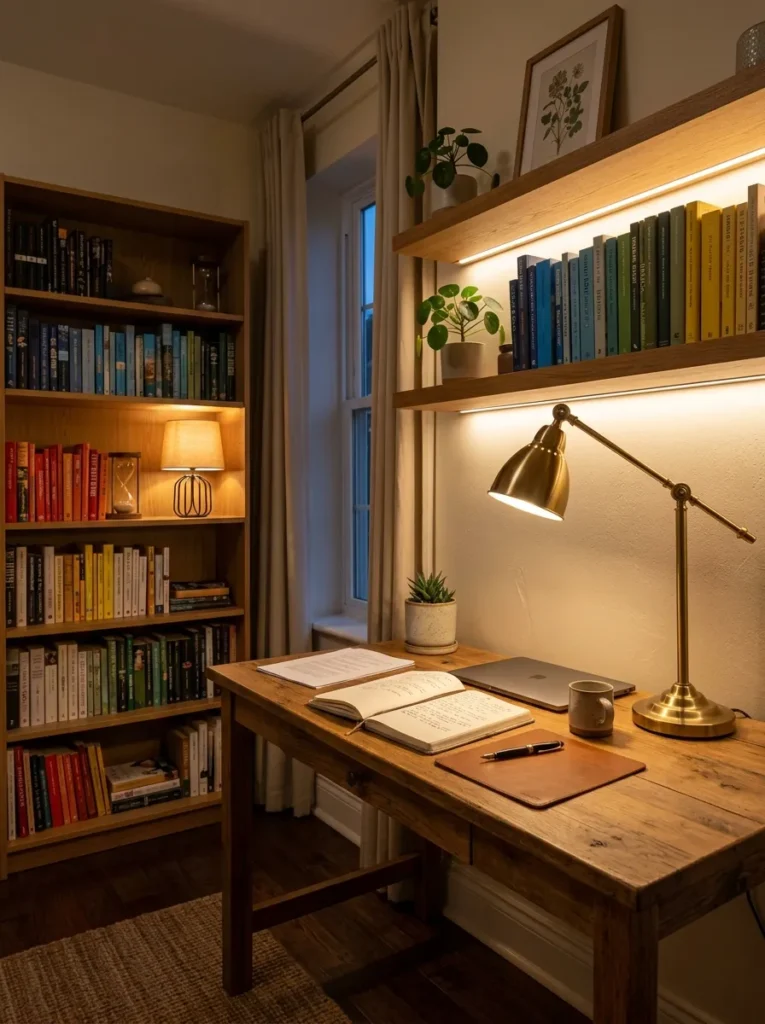
Vibe: A three-source study room lighting system feels focused and warm simultaneously — the workspace that makes you want to sit down and start.
Why it works: Lighting is the study room element with the greatest direct impact on cognitive performance — research consistently demonstrates that task lighting quality affects reading accuracy, sustained attention, and eye fatigue more than almost any other environmental variable. The design principle is layered light for layered tasks: a single overhead light source creates flat, shadowless illumination that is neither adequate for focused task work nor warm enough for the ambient atmosphere that makes long study sessions psychologically sustainable. Three light sources at different heights and purposes — a directional desk lamp for the task surface, indirect strip lighting under a shelf for medium-ambient fill, and a small warm lamp on the bookshelf for atmospheric warmth — create the layered illumination that supports both focused work and the psychological comfort that sustains it.
How to get it: Choose a desk lamp with a fully articulating arm (adjustable at the base, midpoint, and head) in brushed brass or matte black — articulation allows precise positioning for different task types (reading versus writing versus screen work). The desk lamp bulb should be 4000K (cool white, for task accuracy) during active work hours, switchable to 2700K (warm white) for the wind-down period. Install a 2700K LED strip light under the lowest floating shelf above the desk, facing the wall rather than the desk surface, for a warm indirect fill. Add a small warm table lamp on the nearest bookshelf for the third atmospheric layer.
Quick Win: A plug-in LED strip light in 2700K warm white, mounted under a floating shelf with double-sided tape, costs $12–$20 and immediately adds the indirect ambient layer that converts a study desk from a functional work surface to a warm, designed workspace.
Shop The Look
| Product |
|---|
| Articulating brass desk lamp adjustable arm |
| LED strip light 2700K warm white plug in |
| Small warm table lamp for bookshelf |
| 4000K LED bulb E26 for desk lamp task lighting |
| Dimmer plug-in socket for ambient lamp |
Also view: 14 Creative Home Decor Ideas to Refresh Your Space
2. Built-In Look Bookshelf Wall with IKEA Billy Hack
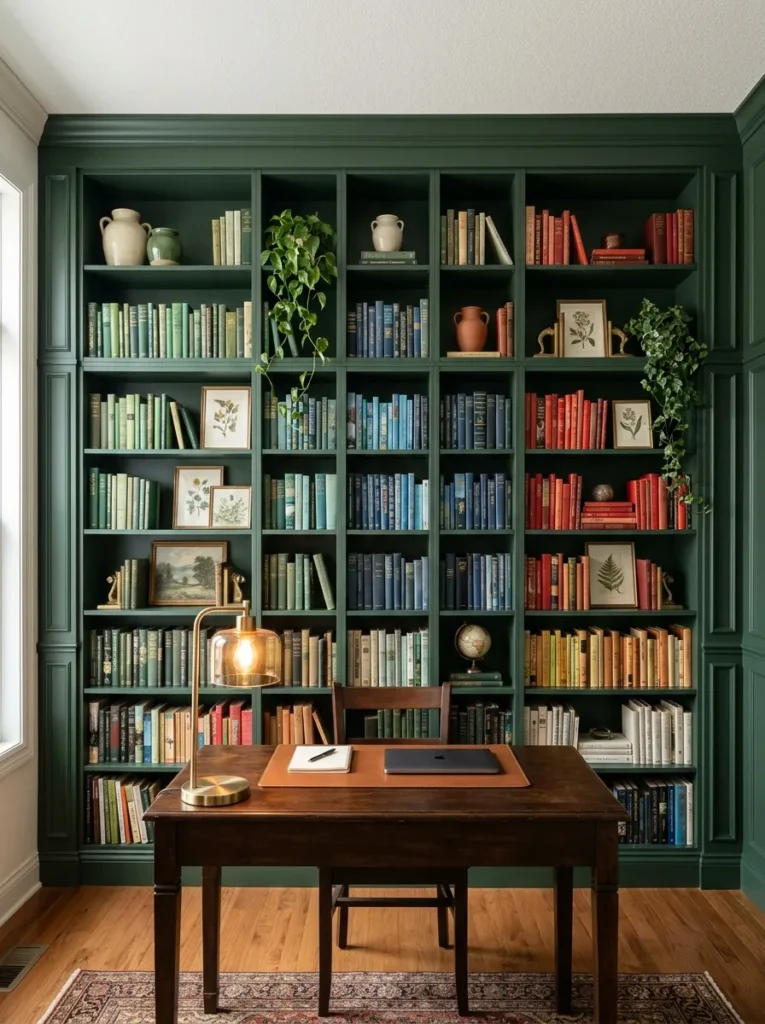
Vibe: A floor-to-ceiling painted bookcase wall feels intellectual and completely considered — the study room that means business before anyone sits down.
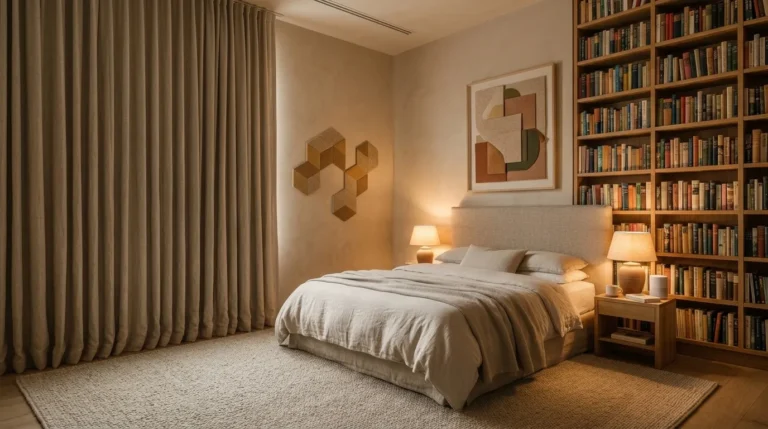
Why it works: A full-wall bookcase system in a study room performs multiple simultaneous functions — it provides substantial book and material storage, creates an intellectually rich visual backdrop, improves the room’s acoustic quality by breaking up flat wall surfaces, and establishes the room’s identity as a place of serious thinking. The IKEA Billy hack that converts the system into a convincing built-in applies three interventions: a continuous MDF plinth base that eliminates the raw floor gap, crown molding at the ceiling that eliminates the gap between the top of the cases and the ceiling, and a single unifying paint color across all units and the wall behind them that makes the individual cases read as a single architectural element. Forest green is the optimal study room color for this application — it is associated with focus, intellectual depth, and the visual quality of library spaces across centuries of institutional design.
How to get it: Install Billy bookcases side by side across the full wall, shimming for level. Build a continuous MDF plinth base at 5–6 inches height across the full unit width and paint to match. Apply crown molding along the top of all units. Fill all gaps between units and at corners with paintable caulk. Paint the entire wall — cases, back panels, plinth, and adjacent wall sections — in forest green matte paint. The color unity is what makes the hack convincing.
Shop The Look
| Product |
|---|
| IKEA Billy bookcase white 80x28x202cm |
| MDF board 3/4 inch for plinth base |
| Crown molding MDF paintable for top trim |
| Forest green matte paint quart |
| Paintable caulk white for seam filling |
3. Ergonomic Desk Chair That Doesn’t Look Clinical
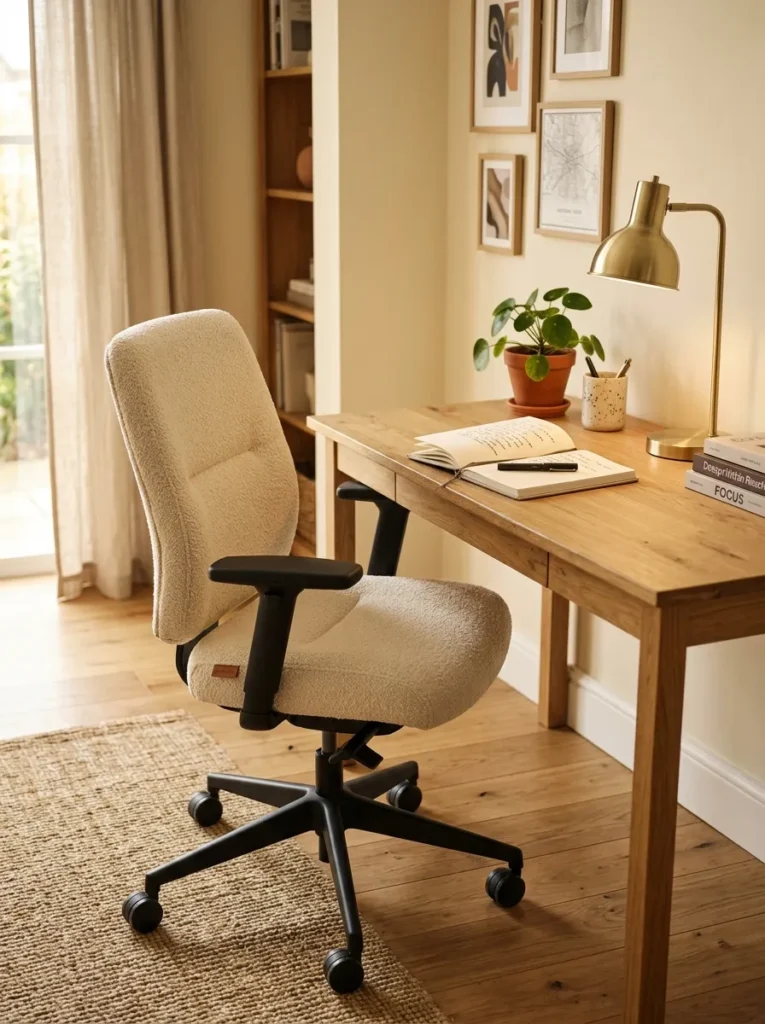
Vibe: A stylish ergonomic chair feels legitimately comfortable — the desk chair that doesn’t make you choose between your back and your aesthetic.
Why it works: The desk chair is the study room’s most physically consequential purchase — poor ergonomic support produces the musculoskeletal discomfort that ends study sessions prematurely and creates chronic discomfort over extended periods of regular use. Yet most ergonomically effective chairs are designed for commercial office environments where aesthetics are secondary to adjustability specifications, producing chairs that look clinical and industrial in a domestic study context. The design principle here is ergonomic function in domestic aesthetic: chairs that meet genuine ergonomic standards (adjustable seat height, lumbar support, armrest height and width) while using upholstery materials (bouclé, linen, warm-toned mesh) that belong to a residential rather than commercial design vocabulary.
How to get it: Prioritize three non-negotiable ergonomic specifications regardless of aesthetic: seat height adjustability (to achieve 90-degree knee angle with feet flat on the floor), lumbar support (adjustable in height and depth to support the natural lumbar curve), and armrest height (positioned so shoulders are relaxed, not raised, when arms rest on them). Within chairs that meet these three specifications, choose upholstery in cream, warm grey, or sage bouclé, linen, or warm-toned mesh for aesthetic integration with a residential study room.
Shop The Look
| Product |
|---|
| Ergonomic task chair cream upholstered adjustable |
| Lumbar support cushion for desk chair |
| Footrest adjustable for desk ergonomics |
| Anti-fatigue mat for standing desk option |
| Chair mat for hard floor desk area |
4. Sage Green or Forest Green Accent Wall for Focus
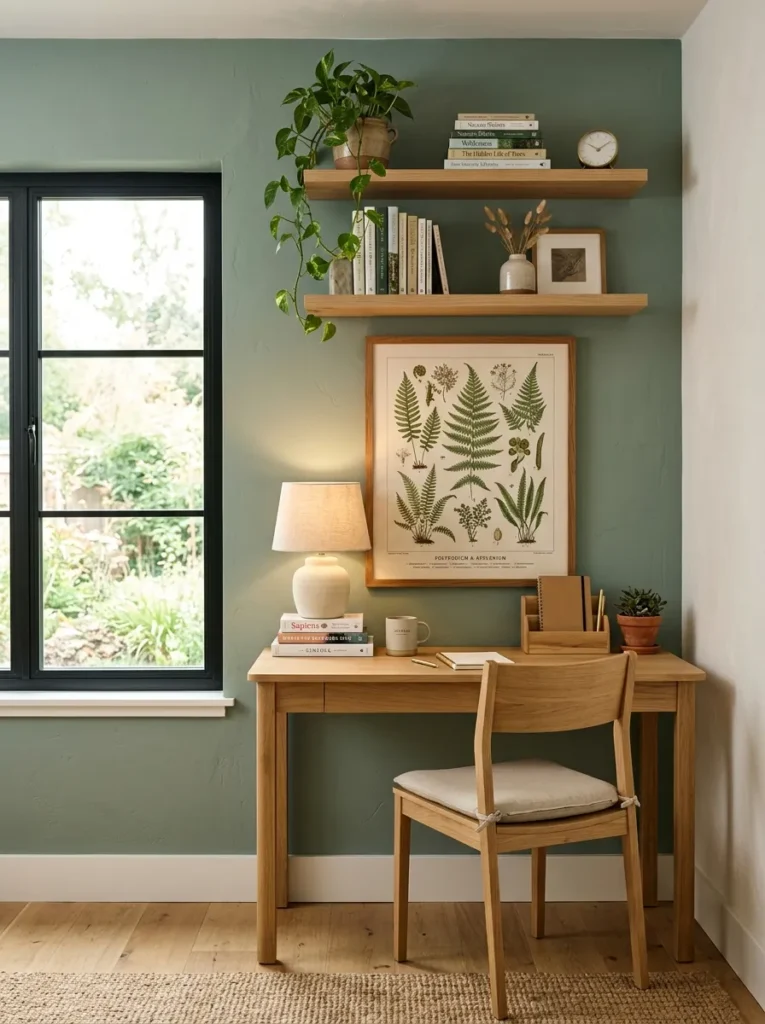
Vibe: A sage green study wall feels calm and intellectually grounded — the color that makes thinking feel like less of an effort.
Why it works: Green is the optimal accent wall color for a study room based on both environmental psychology research and centuries of institutional library and study space design tradition. Studies consistently demonstrate that green environments reduce cortisol levels and improve sustained attention compared to neutral or cool-toned environments — effects attributed to the evolutionary association between green environments and safety and resource availability. Dusty sage specifically (a muted, grey-toned green) is the correct study room register: too bright a green creates visual stimulation that competes with focus; too dark reads as oppressive in a room requiring extended visual attention. The design principle is background color as cognitive support: the wall the desk faces (the primary visual background during study) should be a color that supports rather than competes with the cognitive task at hand.
How to get it: Paint only the wall the desk directly faces — the wall you look at during work — in dusty sage matte. Keep adjacent walls in warm white to prevent the study room from feeling enclosed. Add natural oak floating shelves to the sage wall to extend the wall’s visual function from simple backdrop to active storage and display surface. A large botanical print above the desk connects the sage wall to the natural world that the color references, completing the visual logic of the choice.
Shop The Look
| Product |
|---|
| Dusty sage matte wall paint quart |
| Natural oak floating shelf 60cm set of 2 |
| Large botanical art print warm frame |
| Ceramic desk organizer warm white |
| Trailing plant small for shelf display |
5. Pegboard Organization System Above the Desk
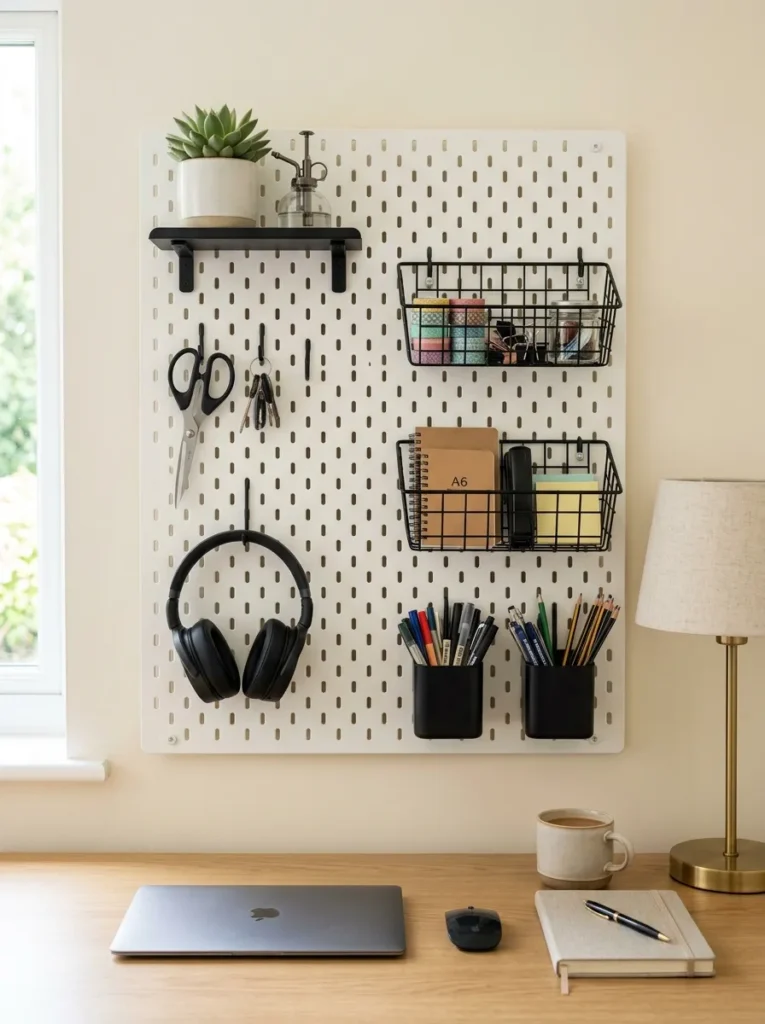
Vibe: A pegboard organization system above the desk feels purposeful — every supply visible, accessible, and exactly where it belongs.
Why it works: The pegboard study room system is the organizational solution that most directly addresses the cognitive cost of cluttered desk surfaces — research in environmental psychology consistently demonstrates that visual clutter in the immediate work environment increases cognitive load and reduces the working memory capacity available for the primary task. Moving all desk supplies off the horizontal work surface and onto a vertical pegboard above it eliminates this cognitive tax while keeping all supplies within arm’s reach. The design principle is vertical displacement of horizontal clutter: everything that currently occupies desk space and is used regularly belongs on the pegboard; the desk surface should contain only the items actively in use for the current task.
How to get it: Mount a 24×48-inch pegboard (painted white for a clean aesthetic, or left natural birch for warmth) using standoff mounts that create a 2-inch gap between the board and the wall — this gap is what allows the pegs to engage. Populate with a mix of J-hooks for headphones and scissors, straight hooks for frequently used tools, wire baskets for grouped supplies, and one small shelf bracket for a plant or organizational object. Use painter’s tape to plan the layout before committing peg positions.
Quick Win: A white pegboard panel and a starter pack of matte black accessories cost $30–$50 combined — mounted above an existing desk, the system converts a cluttered surface into an organized one in a single afternoon.
Shop The Look
| Product |
|---|
| White pegboard panel 24×48 inch |
| Matte black pegboard accessory set hooks baskets |
| Pegboard shelf bracket small |
| Standoff mount kit for pegboard wall gap |
| Small succulent pot for pegboard shelf |
6. Natural Wood Desk with Cable Management System
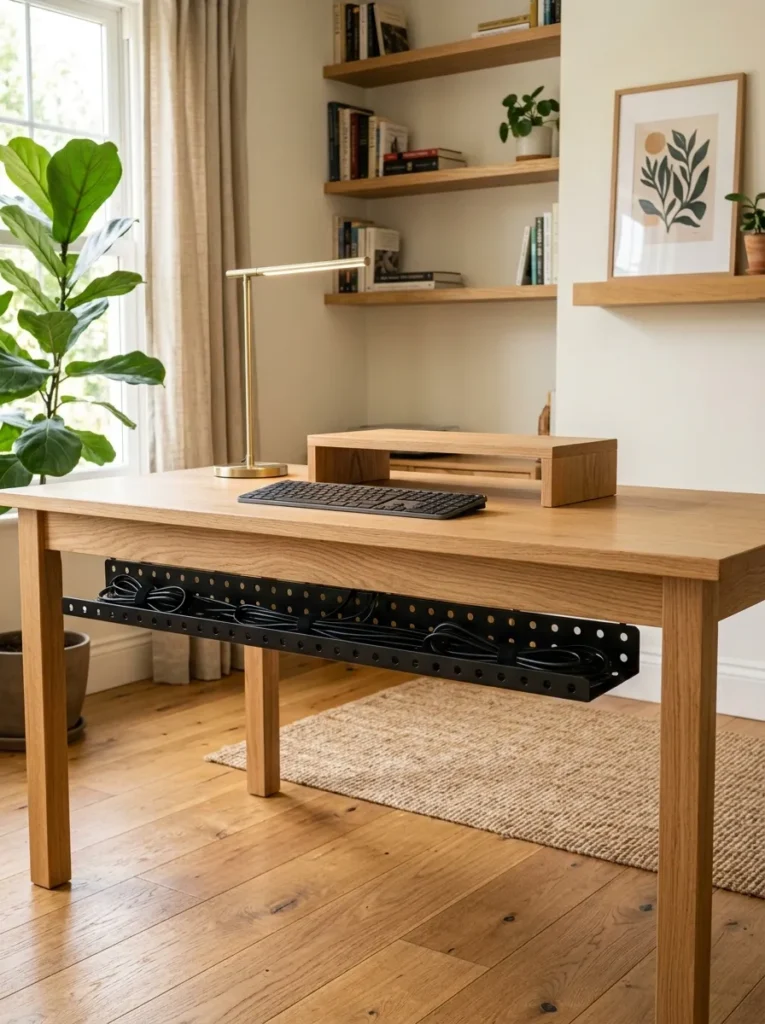
Vibe: A cable-free natural wood desk surface feels clean — the study room equivalent of a clear mind before the work begins.
Why it works: Cable management is the study room makeover intervention with the greatest visual impact-to-effort ratio — a desk with visible cable chaos reads as disorganized regardless of how thoughtfully every other element has been chosen, while the same desk with hidden cables reads as deliberately designed. The design principle is visual noise elimination: cables on a desk surface are among the highest-density sources of visual complexity in a study room, and their elimination removes a significant source of subconscious visual distraction from the work environment. A solid white oak desk surface is the material choice that most rewards cable management — the warm grain and natural material quality of oak reads as genuinely beautiful when the surface is clear, which is a reward the cable management work delivers.
How to get it: Install an under-desk cable management tray (a powder-coated steel mesh tray that mounts to the desk underside) to collect all power strips, cables, and adapters off the floor. Route individual device cables through a cable spine or raceway on the nearest desk leg. Use Velcro cable ties (not zip ties, which are permanent and resist reorganization) to bundle cables in groups by device. Mount a power strip to the underside of the desk itself rather than placing it on the floor — this is the single change that has the greatest impact on under-desk visual organization.
Shop The Look
| Product |
|---|
| Solid white oak desk 120x60cm natural finish |
| Under desk cable management tray steel |
| Cable spine raceway for desk leg |
| Velcro cable tie pack reusable |
| Under desk power strip mounting bracket |
7. Gallery Wall of Inspirational Maps, Prints, and Personal Work
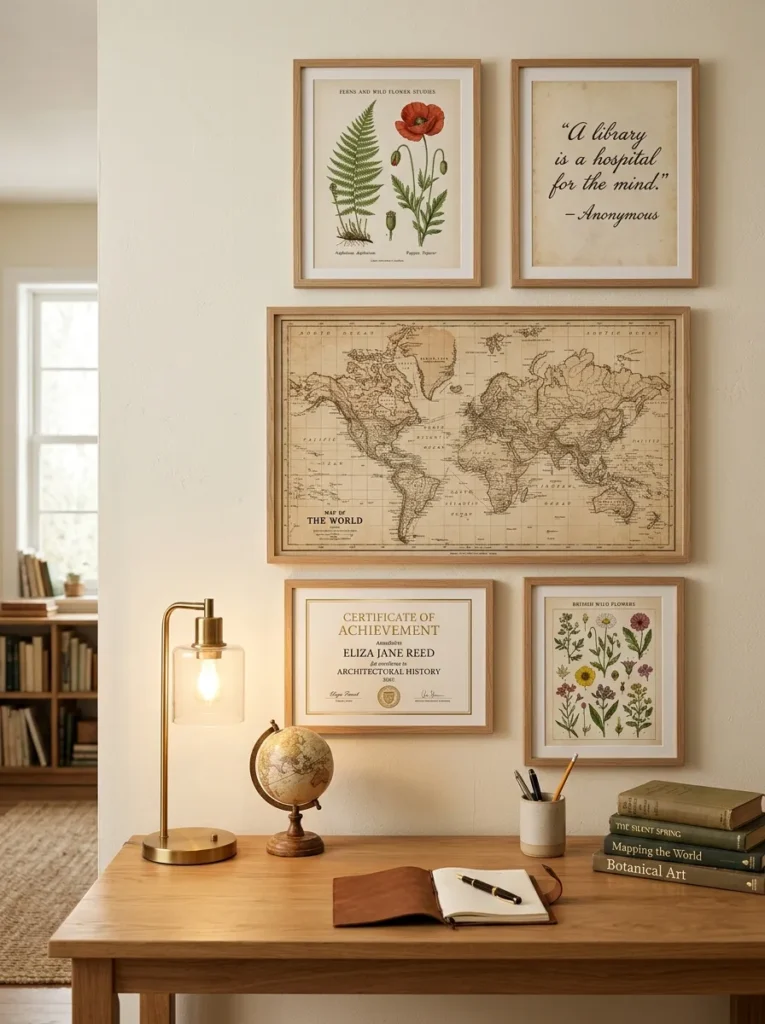
Vibe: A study room gallery wall feels inspiring — art and maps that make the space feel like thinking happens here, and has for some time.
Why it works: The study room gallery wall performs a specific function distinct from gallery walls in other rooms: it provides motivational and aspirational visual content that connects the daily work happening at the desk to broader intellectual and creative contexts. A vintage world map references curiosity about the world; botanical prints reference the natural world as a source of wonder; a framed handwritten quote provides daily philosophical grounding; a personal achievement certificate makes the study room’s purpose visible and personally meaningful. The design principle is inspirational curation: unlike living room gallery walls where the art is primarily aesthetic, study room gallery walls should contain imagery that actively supports the cognitive and motivational life of the person who works there.
How to get it: Center the largest piece (the map) at 57 inches from the floor above the desk center. Build outward from the map with smaller pieces, maintaining 3-inch spacing throughout. All frames in the same natural oak finish create the coherence that allows such a diverse collection of content types to read as a composed installation. The personal achievement certificate — a degree, an award, a meaningful milestone — is the element that distinguishes a study room gallery wall from a general wall and makes the room feel genuinely personal.
Shop The Look
| Product |
|---|
| Vintage world map print large sepia |
| Slim natural oak frame set mixed sizes |
| Botanical illustration print set of 2 |
| Small decorative globe brass accent desk |
| Picture hanging strip set damage free |
8. Floating Corner Desk for Small Study Room Spaces
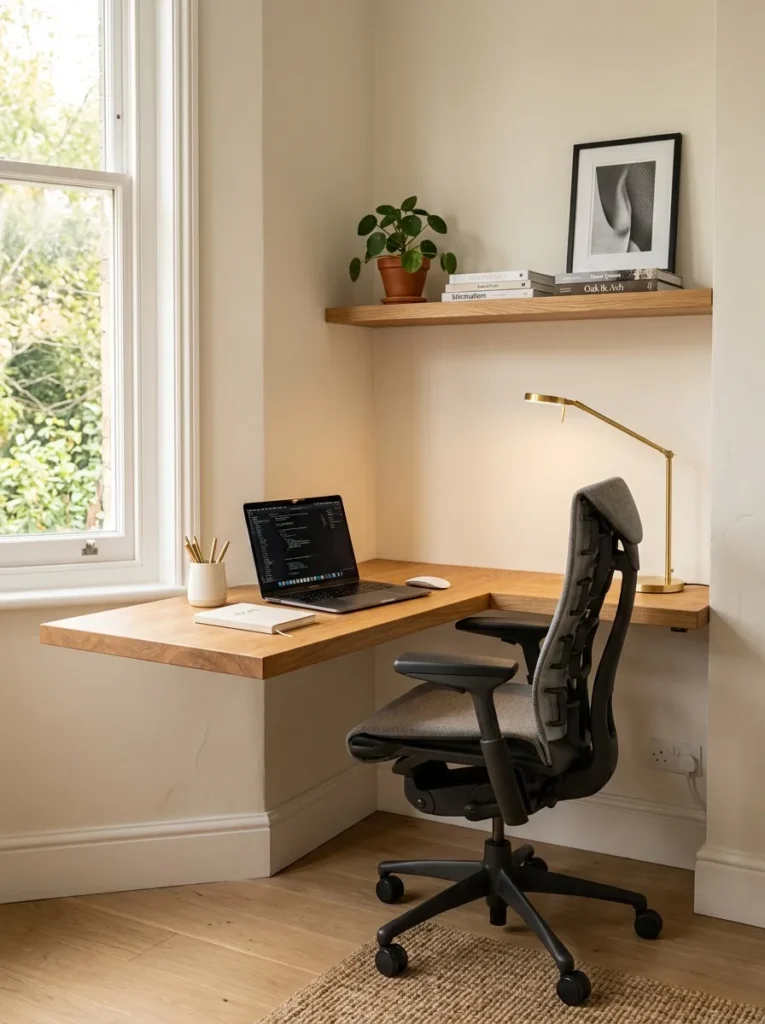
Vibe: A floating corner desk setup feels ingenious — a complete study environment in a corner that most rooms have been ignoring.
Why it works: The floating corner desk is the small study room solution with the highest space efficiency per square meter — by mounting the desk surface directly to the wall on heavy-duty brackets and eliminating the desk legs, it reclaims the entire floor space beneath the desk surface as open room. This visual openness makes the room feel significantly larger than floor-standing furniture of equivalent desk area. The L-shaped corner configuration maximizes the usable desk surface in a footprint that a standard rectangular desk cannot match — corner space that is typically wasted in a small room becomes the primary work surface. The design principle is vertical displacement of furniture: when floor space is limited, moving furniture from floor-standing to wall-mounted reclaims room proportional to the furniture’s footprint.
How to get it: Install floating desk brackets rated for at least 50 kg per bracket — for an L-shaped desk, this typically requires four brackets minimum (two per desk segment). Use 3/4-inch solid oak or oak-veneered plywood cut to the desired L-shape dimensions. Sand to 220 grit and finish with Danish oil or matte polyurethane for a work-ready surface. Mount the brackets into wall studs, not just drywall — the loaded desk weight requires stud mounting for safety.
Quick Win: A single wall-mounted floating desk surface in natural oak, 120×50 cm, on two heavy-duty brackets costs $60–$120 in materials and replaces a floor-standing desk that would occupy three times the perceived space — this is the most impactful single intervention in any small study room.
Shop The Look
| Product |
|---|
| Heavy duty floating shelf bracket 50cm set of 4 |
| Solid oak board 3/4 inch for desk surface |
| Danish oil natural finish for oak surface |
| Slim brass wall-mount desk lamp adjustable |
| Ceramic pen and pencil holder warm white |
9. Cork Board or Linen Pin Board as a Working Wall
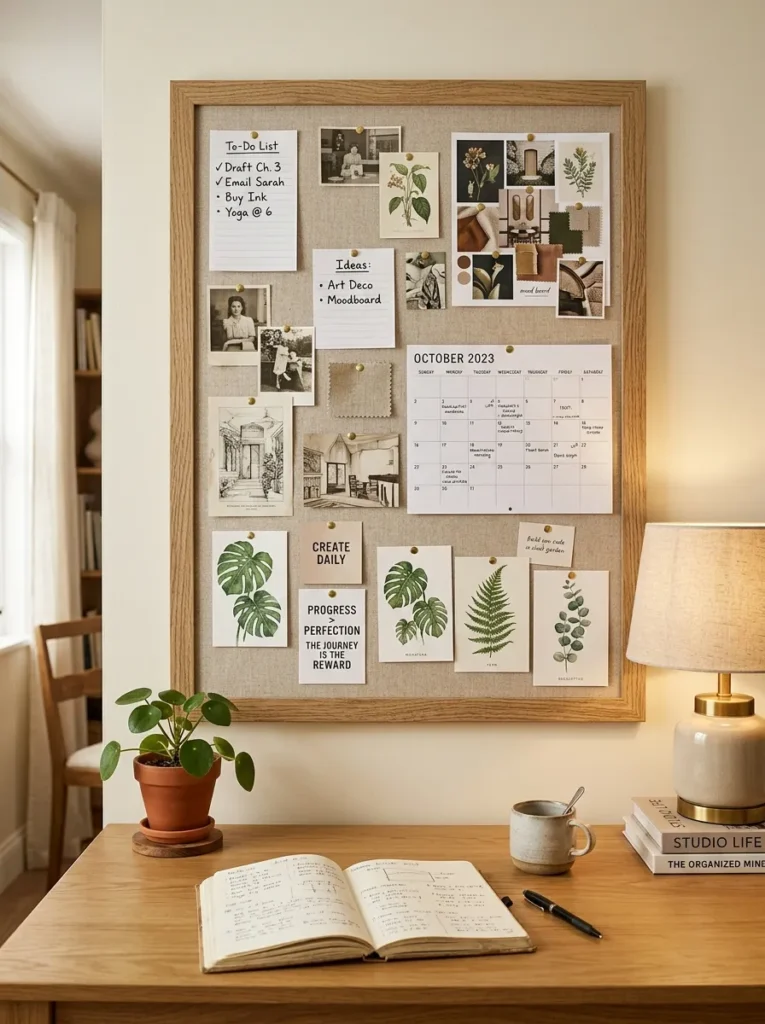
Vibe: A large linen pinboard feels intellectually alive — the study room element that shows thinking in progress.
Why it works: A working pinboard in a study room serves a cognitive function that digital tools cannot replicate — the ability to physically arrange, rearrange, and make visible the relationships between ideas, references, tasks, and goals in a persistent spatial format. Research in spatial cognition suggests that the physical arrangement of information on a working surface activates different cognitive processes than the linear, sequential display of information on a screen — particularly for creative and analytical tasks that benefit from seeing multiple elements simultaneously. The design principle is cognitive externalization: the pinboard extends the study room user’s working memory into the physical environment, allowing the brain to process relationships between pinned items rather than holding all information in active memory simultaneously.
How to get it: Choose a linen-covered pinboard rather than standard cork — the linen surface reads as a designed element rather than a utility board, and the warm natural fiber texture integrates with the study room’s warm material palette. Frame in natural oak for material consistency with the desk and shelving. Size generously — a minimum of 60×90 cm for an active working board; 90×120 cm for extensive reference display. Position at a height where the center sits at seated eye level — typically 130–140 cm from the floor to the pinboard center.
Shop The Look
| Product |
|---|
| Linen pinboard large natural oak frame |
| Brass pushpin set gold for pinboard |
| Cork board tiles adhesive for custom size |
| Printable calendar template A4 monthly |
| Botanical postcard set for pinboard display |
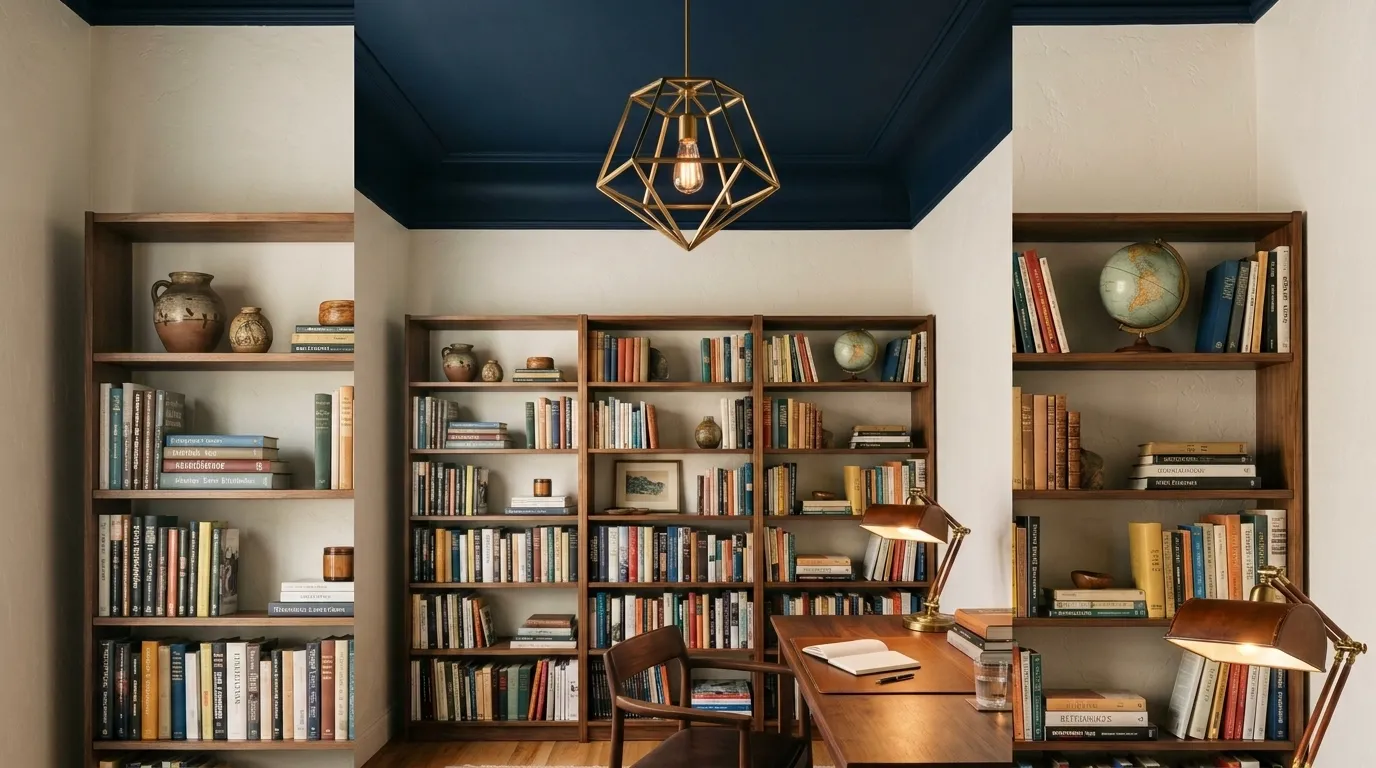
10. Deep Navy or Charcoal Painted Ceiling for Focused Enclosure
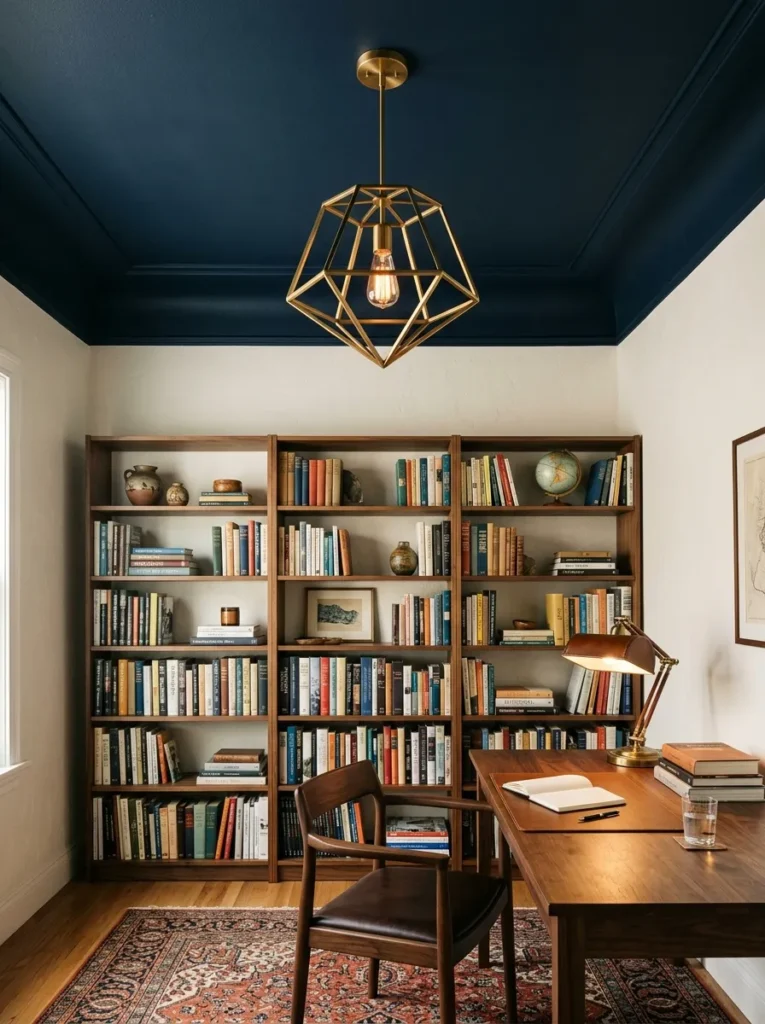
Vibe: A deep navy painted ceiling feels enclosed in the most intellectually comfortable sense — the study room that draws the mind inward and downward to the work.
Why it works: A painted ceiling in a deep, saturated color is the study room’s most dramatic single intervention and the one most consistently associated with the aesthetic of serious, established library and study spaces — the painted ceiling of a private library or gentlemen’s study has been a signifier of intellectual seriousness across two centuries of interior design tradition. The design principle is visual enclosure through ceiling color: a dark ceiling lowers the room’s apparent visual height, which creates a sense of intimate enclosure that the study room specifically benefits from — the overhead darkness draws the eye downward to the work surface rather than upward to the ceiling, which is the correct directional emphasis for focused cognitive activity. Deep navy is the optimal study ceiling color because its cool-blue depth reads as intellectual and calm rather than moody or heavy.
How to get it: Paint only the ceiling — ceiling painting is dramatically less labor-intensive than wall painting and requires no furniture moving. Use ceiling paint in a matte finish to prevent the ceiling from reflecting light in ways that create glare on the work surface below. Apply two coats with a ceiling roller, cutting in at the ceiling-wall junction with a brush. A warm brass or gold pendant light against a navy ceiling creates the contrast that makes both the ceiling and the fixture read with maximum visual impact.
Shop The Look
| Product |
|---|
| Deep navy matte ceiling paint quart |
| Brass pendant light ceiling mount warm |
| Ceiling paint roller set extension handle |
| Painter’s tape 2 inch for ceiling edge |
| LED warm bulb E26 pendant compatible |
11. Botanical and Nature-Inspired Decor for Mental Refreshment
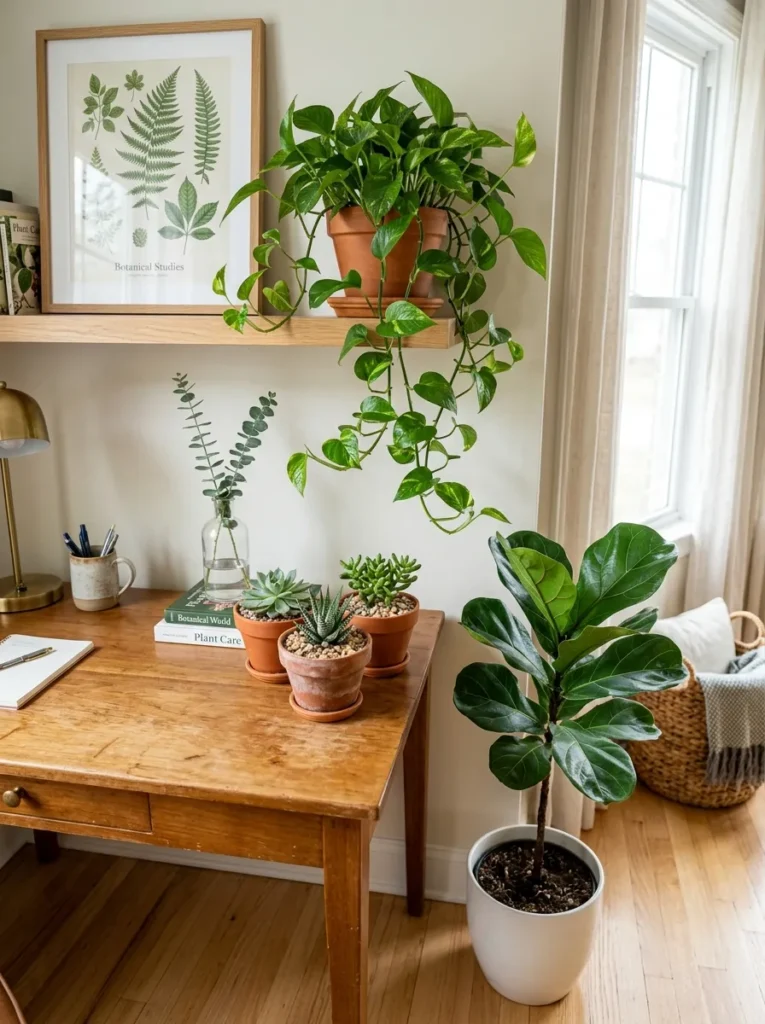
Vibe: A plant-rich study room corner feels alive — the cognitive reset available every time the eye lifts from the screen.
Why it works: Plants in study rooms are not merely decorative — they perform measurable cognitive and psychological functions supported by research: a 2014 study published in the Journal of Experimental Psychology demonstrated that offices with plants showed a 15% increase in productivity compared to lean, plantless workspaces. The design principle is biophilic cognitive support: the human brain evolved in natural environments and responds to the presence of living plants with measurable stress reduction (lower cortisol) and attention restoration (improved directed attention capacity after depletion). Positioning plants at the edges of the primary visual field — beside the monitor, on the shelf above, and at floor level beside the desk — means the eye encounters living green in its natural peripheral resting zones without plants occupying primary task visual space.
How to get it: Choose plants for their low-maintenance requirements relative to their visual impact — a small fiddle leaf fig (dramatic visual presence, weekly watering), trailing pothos (abundant growth, forgiving of irregular watering), and a succulent cluster (minimal water, maximum textural interest) cover the full study room plant arrangement with one substantial statement plant, one trailing element, and one desk-appropriate cluster. All three in white ceramic or terracotta pots maintain the warm natural material palette.
Shop The Look
| Product |
|---|
| Small fiddle leaf fig tree indoor potted |
| Trailing golden pothos indoor plant |
| Succulent assortment set 3 small terracotta |
| White ceramic plant pot set small medium |
| Botanical print framed for study wall |
12. Warm-Toned Rug to Define the Study Zone
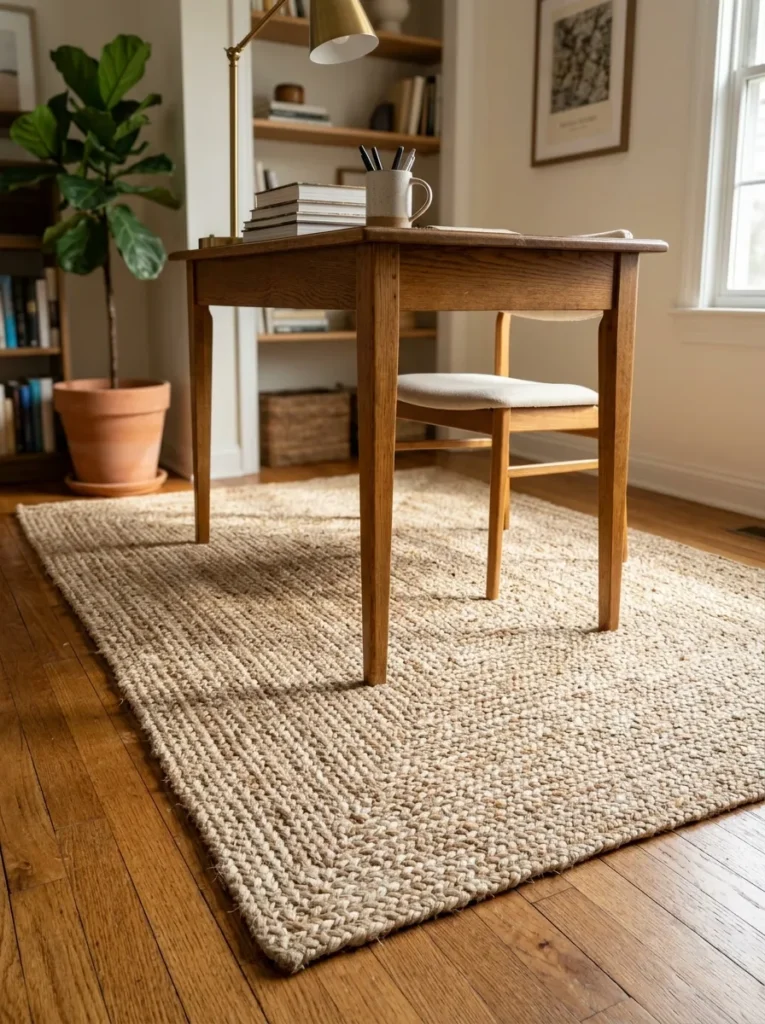
Vibe: A warm rug under the study desk feels grounding — the textural signal that this is a defined zone designed for a specific kind of thinking.
Why it works: A rug under the study desk performs both psychological and acoustic functions — it defines the study zone as a distinct spatial entity within a larger room (particularly valuable in multi-purpose rooms where the study area shares space with other activities), reduces ambient noise through sound absorption (hard floor surfaces reflect sound while textiles absorb it, improving the acoustic quality of the study environment), and provides the tactile warmth underfoot that makes extended desk sessions more physically comfortable. The design principle is zone definition through material contrast: the rug creates a visual and tactile boundary between the study zone and the surrounding room that communicates the zone’s specific purpose and helps the brain shift into focused mode when entering it.
How to get it: Size the rug so that both the desk and the chair — when pulled out to sitting position — rest fully on the rug surface. For a standard 120×60 cm desk, a minimum 160×230 cm rug is required to achieve this. A jute-wool blend rug in natural cream or warm beige tones provides the right material warmth, acoustic absorption, and visual neutrality for a study zone rug — it doesn’t compete visually with the desk and organizational elements above it.
Quick Win: A natural jute rug in the correct size can be found for $40–$90 at most home goods retailers — it is the study room makeover element that most immediately improves both the room’s visual warmth and its acoustic quality per dollar spent.
Shop The Look
| Product |
|---|
| Jute wool blend rug natural cream 160x230cm |
| Non-slip rug pad for study chair rolling |
| Low pile rug suitable for rolling chair use |
| Natural fiber rug anti-slip backing |
| Rug gripper tape for hard floor anchor |
13. Designated Book Display with Vertical and Horizontal Styling

Vibe: A deliberately styled book display feels personal and intellectual — the shelves of someone who actually reads rather than merely owns books.
Why it works: Book display styling is the study room’s most personal design element because it is the only element that directly reveals the intellectual life of the room’s occupant — what someone reads tells you who they are in a way that paint colors and furniture choices cannot. The design principle is rhythmic variation: alternating between vertical shelving (standard and most space-efficient), horizontal stacking (creates visual platforms for objects and adds horizontal rhythm to an otherwise vertical arrangement), and angled leaning (introduces the relaxed quality that distinguishes a lived-in intellectual space from a showroom) creates a shelf composition that reads as both curated and genuinely used.
How to get it: On each shelf, plan a ratio of approximately 60% vertically shelved books, 20% horizontally stacked books, and 20% objects and decorative elements. Organize vertically shelved books by spine color in warm-toned groupings — this creates the visual coherence that makes even a small book collection read as a considered display. Use horizontal book stacks as risers for ceramic objects or small plants, positioning the stack at a shelf end or between color groups to create visual anchors in the arrangement.
Shop The Look
| Product |
|---|
| Natural oak floating shelf 80cm set of 3 |
| Brass bookend set decorative minimal |
| Small ceramic vessel for shelf display |
| Trailing plant small for shelf |
| Mini framed art print for shelf leaning 5×7 |
14. Acoustic Panel or Sound-Absorbing Wall Element
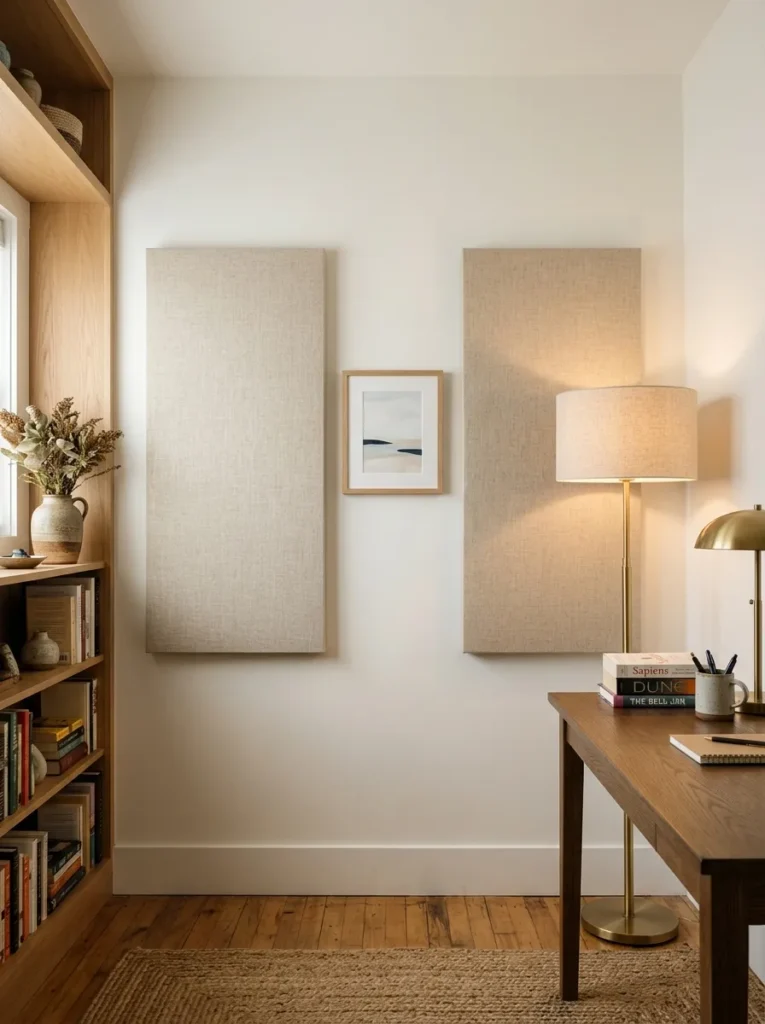
Vibe: Fabric acoustic panels feel calm — the study room element you benefit from without consciously noticing it’s there.
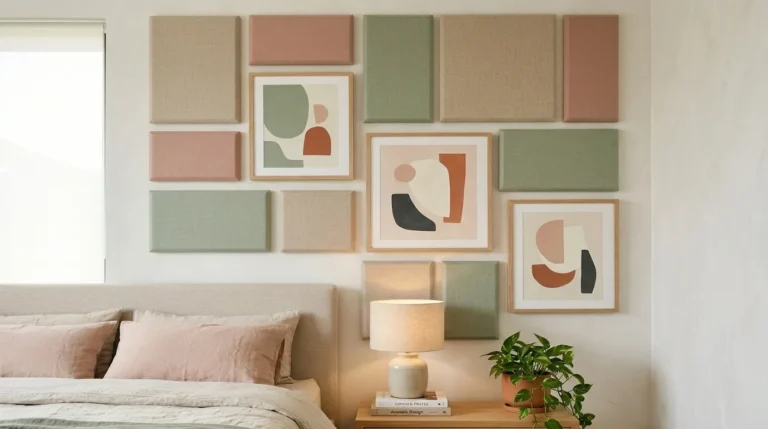
Why it works: Acoustic quality is the study room makeover consideration most consistently overlooked and most directly consequential for sustained cognitive performance — hard-surfaced rooms (bare walls, hard floors, glass windows) create acoustic environments with significant reverberation that increases cognitive load during tasks requiring auditory processing (reading, listening to lectures, taking calls). Fabric-wrapped acoustic panels reduce room reverberation by absorbing reflected sound energy, producing a measurably quieter and more acoustically comfortable study environment. The design principle is functional aesthetics: panels in natural linen fabric mounted flush to the wall read as large textile art panels rather than obvious acoustic treatment — they contribute both to the room’s acoustic performance and its visual warmth simultaneously.
How to get it: Build DIY acoustic panels from 2-inch-thick rigid mineral wool or acoustic foam boards cut to 60×90 cm, wrapped in natural linen fabric and stapled to a thin plywood backing frame. The linen fabric allows sound to pass through to the absorptive core while presenting a warm, residential surface to the room. Mount two to four panels on the wall perpendicular to or opposite the desk for maximum acoustic benefit at the listening position.
Shop The Look
| Product |
|---|
| Acoustic mineral wool board 2 inch thick |
| Natural linen fabric by yard for panel wrapping |
| Staple gun for acoustic panel construction |
| Picture rail hook set for panel mounting |
| Thin plywood sheet for panel backing frame |
15. Small-Space Study Room Makeover: Murphy Desk and Fold-Away System
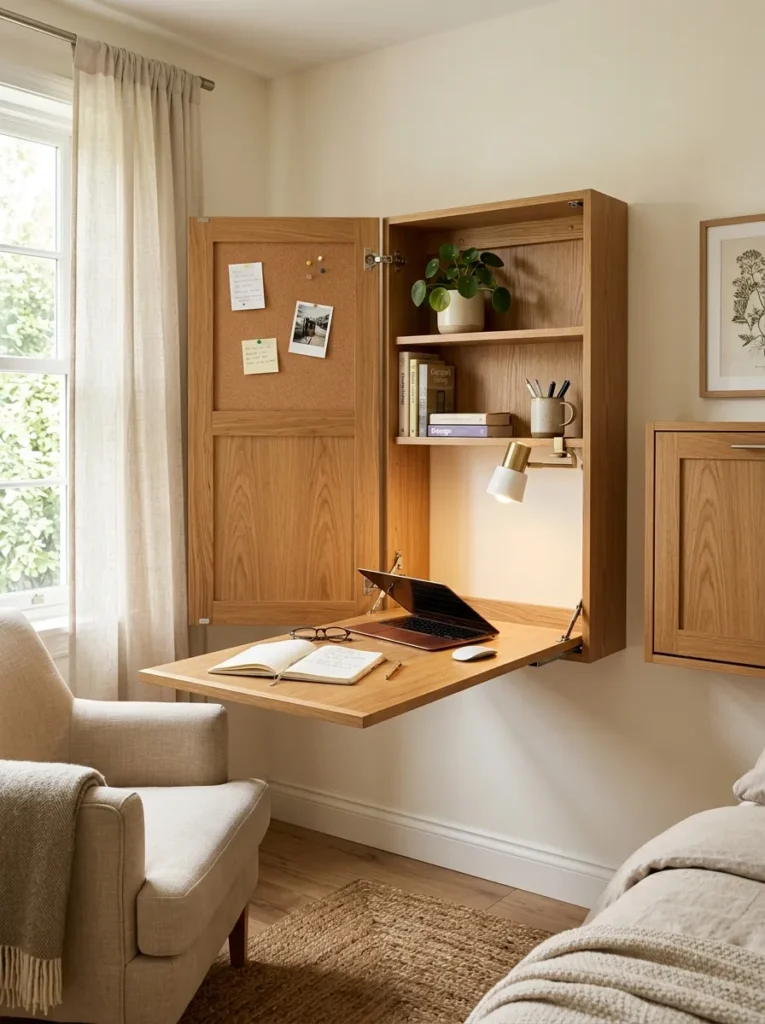
Vibe: A murphy desk system feels ingenious — the study room that disappears when the work is done and returns when you’re ready to begin.
Why it works: The murphy desk is the small-space study room solution that most directly solves the dual-purpose room problem — a room that needs to serve both as a bedroom (or living room) and as a dedicated study space requires a desk system that visually and functionally recedes when not in use, preventing the study zone from dominating the room’s primary living function. The design principle is spatial time-sharing: the murphy desk occupies the room fully during study hours and recedes to a flush wall panel during non-study hours, allowing the room to function as a bedroom, guest room, or living space without permanent study zone visual dominance. The integrated shelves and pinboard above the fold-down desk surface ensure that study materials remain organized and accessible without requiring the desk to be open — books, materials, and ongoing projects are visible and reachable even when the desk surface is folded away.
How to get it: Murphy desk systems in natural oak or white finish are available from several manufacturers in the $400–$900 range for wall-mounted units including installation hardware. The wall mounting requires stud anchoring for the system’s full loaded weight — always mount through studs rather than drywall anchors alone. Personalize the integrated shelving with a linen pinboard insert and a clip-on LED desk lamp that folds away with the desk surface.
Quick Win: A fold-down wall desk bracket set (two heavy-duty hinged wall brackets that support a floating desk surface when open and fold flush when closed) costs $40–$70 and creates a functional fold-away desk from any solid wood panel — the lowest-cost small-space study desk solution that provides genuine fold-away functionality.
Shop The Look
| Product |
|---|
| Murphy wall desk fold down oak finish |
| Fold down desk bracket set heavy duty hinge |
| Clip-on LED desk lamp for fold-away desk |
| Linen pinboard insert for murphy desk shelf |
| Floating shelf set for murphy desk surround |
How to Start Your Study Room Makeover
The single first move is to address your desk lighting — specifically, to add a properly positioned articulating desk lamp with a 4000K bulb for task hours and a warm-toned lamp behind or beside the monitor for ambient fill. This single intervention addresses the environmental variable with the most direct measurable impact on study room performance: task lighting quality. A poorly lit desk forces the eyes to work harder to resolve text and detail, accelerating visual fatigue and reducing the sustainable study session length. The correct desk lamp positioned at the correct angle (coming from the side opposite your dominant hand, at approximately 45 degrees above the work surface) changes the quality of every study session that follows — before the paint has dried, before the shelves are installed, before any other makeover element has been considered.
The most common mistake in study room makeovers is prioritizing aesthetics over ergonomics — specifically, choosing a beautiful but non-adjustable desk chair that compromises posture over a less photogenic but correctly specified ergonomic chair that supports sustained focus. The fix is to treat the chair as the study room’s primary functional investment (budget $200–$500 for a genuinely ergonomic chair) and the aesthetic elements (paint, shelving, decor) as the secondary layer that makes the functional foundation look good. A study room that looks beautiful but produces physical discomfort after 45 minutes of use has failed at its primary purpose regardless of its aesthetic success.
Three items under $50 that create immediate study room improvement: a plug-in LED strip light in 2700K mounted under a floating shelf for instant ambient fill ($12–$20), a large linen pinboard for the working wall above the desk ($25–$45), and a jute or natural fiber desk mat that defines the immediate work surface zone and reduces the visual noise of a bare desk ($15–$30). Together these three additions — totaling $52–$95 — immediately improve the study room’s lighting, organizational functionality, and visual warmth in a single afternoon installation.
Realistic expectations: a basic study room refresh — improved lighting, a new chair, a pinboard, and some organizational tools — costs $200–$400 and takes one weekend. A complete study room makeover including floating shelves, a full bookcase wall, painted accent wall, new desk, acoustic panels, and full decor layer represents a $600–$1,500 investment over three to four weekends of project work. The productivity and quality-of-life return on a well-designed study room is among the highest available from any home improvement investment — the room where your best thinking happens deserves the same quality of design investment as any other room in the home.
Frequently Asked Questions About Study Room Makeover Ideas
What color should I paint my study room for maximum focus?
The colors with the strongest evidence base for supporting focused cognitive performance in study environments are muted greens (dusty sage, forest green, olive) and deep neutrals (warm charcoal, deep navy). Green tones specifically have the strongest research support for focus and stress reduction — multiple studies in environmental psychology demonstrate measurable improvements in sustained attention and lower cortisol responses in green environments compared to neutral or cool-toned ones. For an accent wall (the wall the desk faces), dusty sage or forest green in matte finish is the optimal choice. For full-room paint in a small study, warm white walls with one green accent wall prevents the all-green enclosure from feeling visually heavy.
What is the best desk size for a home study room?
The minimum comfortable desk size for sustained study work is 120×60 cm — this provides enough surface area for a laptop or monitor plus an open notebook plus a small organizational zone without cramping the work surface. For dual-monitor setups or work that requires spreading physical materials, 150×70 cm is the minimum comfortable size. In small rooms where floor space is limited, a wall-mounted floating desk at 120×50 cm is preferable to a smaller floor-standing desk — the floating mount’s visual lightness (no legs) makes the smaller depth feel less constraining than the equivalent footprint of a floor-standing desk.
How do I make a study room feel less clinical and more personal?
The three interventions that most reliably warm a clinical study room are natural materials (replacing synthetic or metal surfaces with wood, linen, rattan, and cork wherever possible), warm lighting (replacing cool-white or daylight bulbs with 2700–3000K warm white LEDs and adding layered light sources beyond the single overhead), and personal display (a gallery wall, a working pinboard, and a book display that reflects the room occupant’s actual intellectual life rather than generic decorative objects). Each of these interventions addresses one of the three dimensions of clinical coldness — material, light, and personality — and together they transform the same room into a warm, personal intellectual space.
How many plants should a study room have?
Research on plant density in workspaces suggests that one medium-to-large plant per 6–8 square meters of floor space produces measurable cognitive benefits without introducing the maintenance overhead that a higher plant density requires. For a typical study room of 10–15 square meters, two to three plants is the optimal range: one larger statement plant (fiddle leaf fig, snake plant, or pothos trained on a moss pole) that provides significant visual presence, one trailing plant on a shelf or high surface that adds organic movement to the vertical composition, and one small desk-appropriate plant (a compact succulent, a small cactus, or a single propagation in a glass vessel) that brings living green within the immediate visual field during desk work.
What is the best flooring for a study room?
Hard flooring (hardwood, engineered wood, or LVP) is the most practical study room flooring choice for maintenance and longevity, with a large area rug layered on top providing the acoustic absorption and zone definition that hard floor alone cannot provide. The rug is the acoustic element — hard floors reflect sound and increase reverberation; a large natural fiber rug absorbs a significant portion of that reflected sound energy, producing a measurably quieter and more acoustically comfortable study environment. If the study room has existing carpet, adding a natural fiber flatweave rug over it provides additional acoustic benefit and defines the study zone visually without requiring floor replacement.
Ready to Transform Your Study Room?
These 15 study room makeover ideas cover every dimension of the transformation — from the foundational lighting system and ergonomic chair to the full bookcase wall, the acoustic panels, the fold-away murphy desk, and the botanical corner — so whether you are starting from a bare spare room or refining a space that already functions but doesn’t inspire, there is a specific, actionable starting point here for exactly where you are. The most important thing to understand about study room design is that it serves a fundamentally different purpose from every other room in the home — it is the room where the quality of your thinking is directly affected by the quality of the environment, which means the design investment here returns measurable daily dividends in focus, productivity, and intellectual pleasure. Today, position a task lamp correctly on your desk and notice the difference in how long you can work comfortably — that single observation will show you exactly where your study room makeover should begin. Pin the ideas that made you picture a space where you’d genuinely want to think, and let those be the ones you build toward first.