15 Modern Indoor Fountain Ideas for Every Home
Modern indoor fountain ideas for every home use recirculating water pump systems — housed in ceramic vessels, natural stone basins, concrete troughs, glass containers, timber frames, and purpose-built cascade structures — to introduce the specific sensory qualities of moving water into domestic interiors: the sound of flowing water (documented to reduce physiological stress markers and mask intrusive ambient noise), the slight increase in local humidity (beneficial in heated indoor environments), the visual dynamic of light on moving water, and the biophilic quality of a natural element in an artificial environment. This article gives you exactly 15 ideas spanning tabletop scale, floor-standing installations, wall-mounted systems, garden room and conservatory applications, and the specific design decisions that distinguish a modern indoor fountain of genuine aesthetic quality from the mass-produced resin cascades of the domestic gift market.
A modern indoor fountain done well is not an ornament with water in it — it is a designed sensory installation whose specific combination of water sound, visual movement, material quality, and spatial position creates a genuine and continuously functioning contribution to the room’s atmosphere. Here are 15 ideas worth installing.
Why Modern Indoor Fountain Ideas Work for Every Home
The human response to moving water is among the most consistently documented phenomena in environmental psychology. Research across multiple study contexts — hospital settings, workplace environments, domestic interiors, and public spaces — documents that the presence of audible moving water reduces physiological markers of stress (cortisol levels, blood pressure, heart rate) and improves subjective measures of relaxation, cognitive recovery, and wellbeing. The specific mechanism is multifaceted: the sound of moving water functions as a form of broadband acoustic masking (comparable to white or brown noise) that reduces the arousability of the attention system, preventing it from being triggered by the intermittent sounds (passing traffic, building mechanical systems, voices) that generate the low-level background stress of occupied domestic environments; the visual dynamic of moving water activates what attention restoration theorists call “soft fascination” — the effortless, gently engaging attention that allows directed attention systems to recover without requiring cognitive effort; and the physical proximity to a water element triggers the biophilic response that evolutionary psychology associates with water source proximity — a deeply rooted positive response to the presence of fresh, clean, accessible water.
The contemporary design case for indoor fountains specifically addresses the aesthetic barrier that has prevented many design-conscious homes from including water features — the mass-market resin cascade, the stacked slate wall mount, the tiered basin in Chinese-restaurant aesthetic that characterized the domestic fountain market for much of the 1990s and 2000s. The current generation of indoor water feature design uses the same material language as contemporary interior design (matte concrete, natural stone, handmade ceramic, solid timber, clear glass, brushed brass) to create water installations that are simultaneously design objects and sensory installations, contributing to the room’s aesthetic character rather than conflicting with it.
Style at a Glance
| Element | Sensory Function | Modern Design Edge |
|---|---|---|
| Philosophy | Moving water as a continuous sensory contribution | Material quality and pump quality determine the result |
| Materials | Ceramic, concrete, natural stone, timber, glass | Handmade vessel, recirculating pump, visible water path |
| Sound Quality | Volume, pitch, and splash character all designable |
15 Modern Indoor Fountain Ideas for Every Home
1. Handmade Ceramic Bowl Fountain — The Tabletop Statement
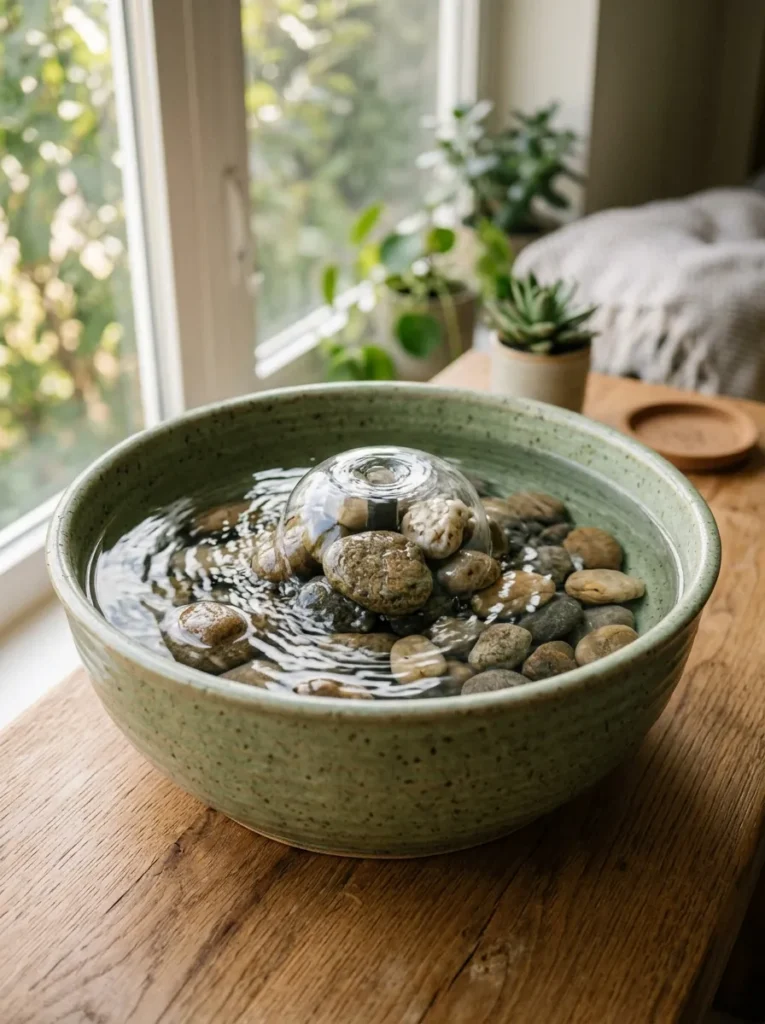
Vibe: The ceramic bowl fountain feels like a spring that found itself indoors and made peace with it — the handmade bowl’s glaze variation and the gentle water dome creating a tabletop object of genuine contemplative quality.
Why it works: A handmade ceramic bowl with a submersible dome pump applies the minimal water feature principle — the fountain effect is achieved through the most restrained possible intervention: a small recirculating pump creates a gentle dome of water at the bowl’s center surface, the water rising and returning without any cascade, jet, or tiered structure. This restraint produces the specific sound quality most appropriate for a domestic interior (a soft, continuous rippling rather than the more dramatic cascade sound of multi-tiered structures) and the visual quality most compatible with contemporary interior design (a single material — the handmade ceramic — as the dominant object, with the water as a dynamic property of the bowl rather than as a separate element).
Pump selection: The correct pump for a tabletop bowl fountain is a submersible micro-pump rated at 50–80 litres per hour with a variable flow dial. At this flow rate, the pump produces a gentle dome rather than a jet — increase the flow for a more animated fountain, decrease for a quieter, more meditative one. The pump sits at the bowl’s base beneath the decorative stones, with the pump’s outlet nozzle pointing straight up. The power cable exits at the bowl’s edge and travels discreetly to a nearby outlet.
Making: Fill the bowl to within 3cm of the rim, place the pump at the base, arrange three to five smooth river stones around the pump concealing it from above (the pump outlet nozzle should protrude just above the stone tops), fill with additional water to the intended level, and plug in.
Quick Win: A single handmade ceramic bowl from a potter (or a secondhand glazed ceramic bowl of appropriate depth) with a $15–25 micro pump from an aquatics supplier converts any beautiful vessel into a working tabletop fountain in under 15 minutes.
Shop The Look
| Product |
|---|
| Submersible micro pump 50–80 L/hr |
| Handmade ceramic bowl 35cm glaze |
| Smooth river stone set small |
| Variable flow pump nozzle |
| Pump outlet extension tube |
Also view: 14 Stylish Landscaping Ideas for Front and Back Yards
2. Concrete Trough Cascade — The Architectural Installation
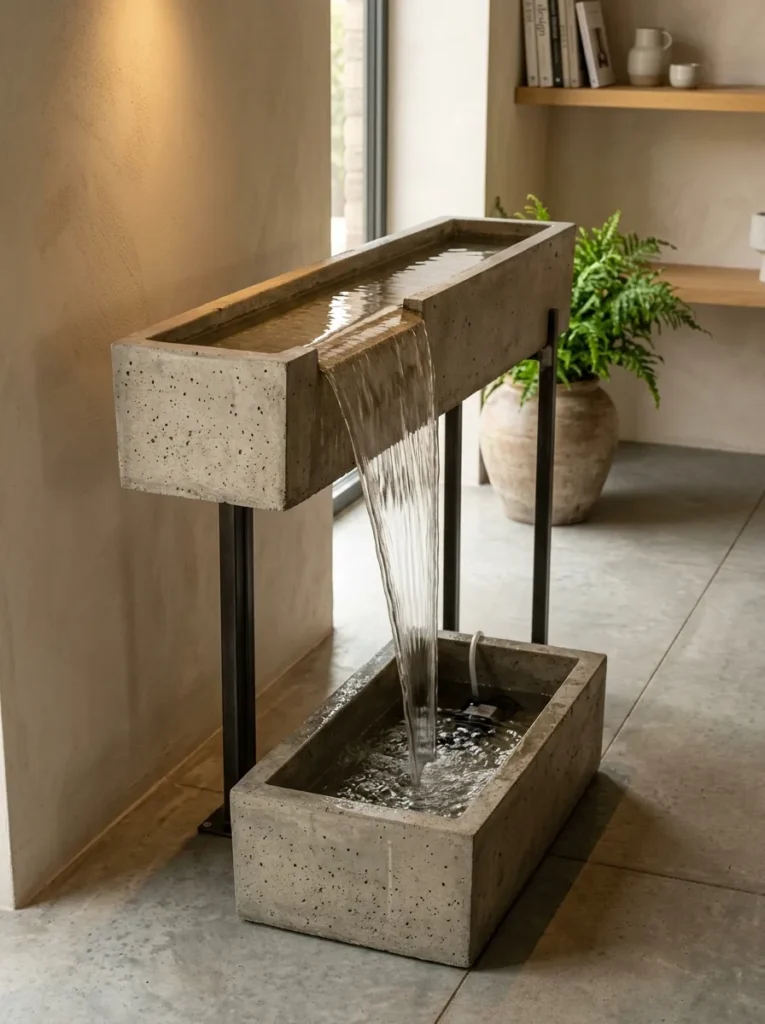
Vibe: The concrete trough cascade feels like a fountain that was designed by an architect rather than a craft market vendor — the laminar water sheet and the paired concrete volumes creating a water installation of genuine spatial authority.
Why it works: A concrete trough cascade with laminar water flow applies the architectural water feature principle — the laminar water sheet (a thin, unbroken sheet of water flowing over a smooth lip in a controlled, non-turbulent film) is the specific water form used in high-quality architectural fountains because it provides maximum visual impact (the thin water sheet catches and refracts light dramatically) with minimum sound intrusion (laminar flow is quieter than turbulent cascade, producing a smooth, continuous sound rather than a percussive splash). The concrete material (cast in-situ or purchased as a premade concrete garden trough) provides the specific material weight and permanence that distinguishes an architectural water installation from a decorative tabletop object.
Laminar flow specification: The laminar water sheet requires a smooth, level lip and a controlled flow rate. The pump must be set to produce a flow rate sufficient to fill the trough evenly to the lip level without turbulence — typically 80–120 litres per hour for a 15cm wide trough. The lip must be perfectly level (checked with a spirit level) to produce a uniform water sheet across its full width.
Budget: Pre-cast concrete trough and basin: $150–350. Submersible pump and fittings: $40–80. Total: $190–430.
Shop The Look
| Product |
|---|
| Pre-cast concrete trough 80cm |
| Concrete basin collection lower |
| Submersible pump 100 L/hr |
| Copper or brass pipe concealed |
| Spirit level fitting tool |
Also view: 14 Stylish Living Room Ideas That Look Expensive
3. Stacked Stone Rill — The Japanese Garden Reference
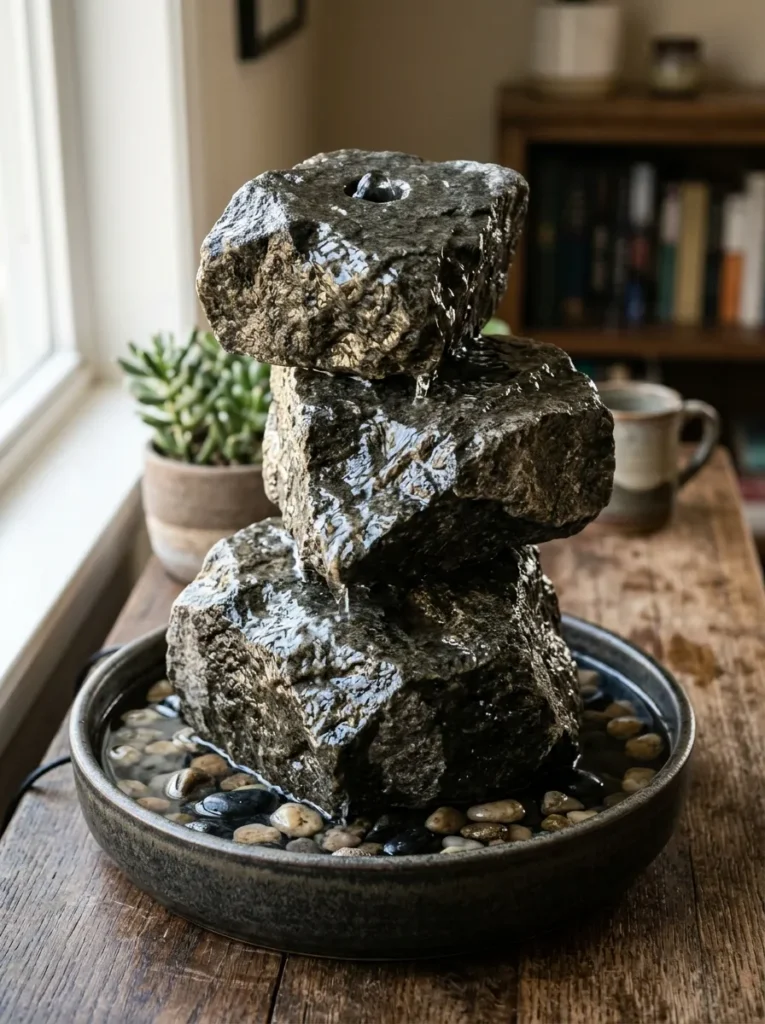
Vibe: The stacked stone rill feels like a mountain spring that agreed to move indoors — the water following the natural imperfections of each stone’s surface creating an endlessly varied organic water path.
Why it works: A stacked stone fountain with water flowing over each stone’s natural surface applies the material authenticity water principle — the specific visual quality of water flowing over natural stone (the way the water sheet thins over raised areas and deepens in surface hollows, following the stone’s geological topology) is the most authentic and most meditative of all indoor water feature forms because it replicates the specific water-on-stone relationship of natural streams and springs more directly than any other indoor fountain format. The imperfect, varied surfaces of natural granite or basalt stones create an endlessly varied water flow that catches light differently at each point — no two moments in the water’s path are identical.
Drilling specification: Drilling through natural stone requires a diamond-tipped core drill bit (available from tile and stone supply shops at $15–25) and a power drill with water cooling (the drill bit must be kept wet during cutting to prevent bit wear and stone cracking). Drill slowly at low speed with continuous water cooling. The through-hole diameter should match the pump outlet nozzle or the connecting tube diameter — typically 8–12mm.
Budget: Natural stones (3): $20–60 from garden centre or quarry. Base dish: $20–50. Pump: $20–35. Diamond drill bit: $15–25. Total: $75–170.
Shop The Look
| Product |
|---|
| Natural granite or basalt stone set |
| Diamond core drill bit 10mm |
| Dark ceramic base dish 35cm |
| Small submersible pump 60 L/hr |
| Pump to stone connection tube |
4. Ceramic Vessel Wall Fountain — The Wall-Mounted Feature
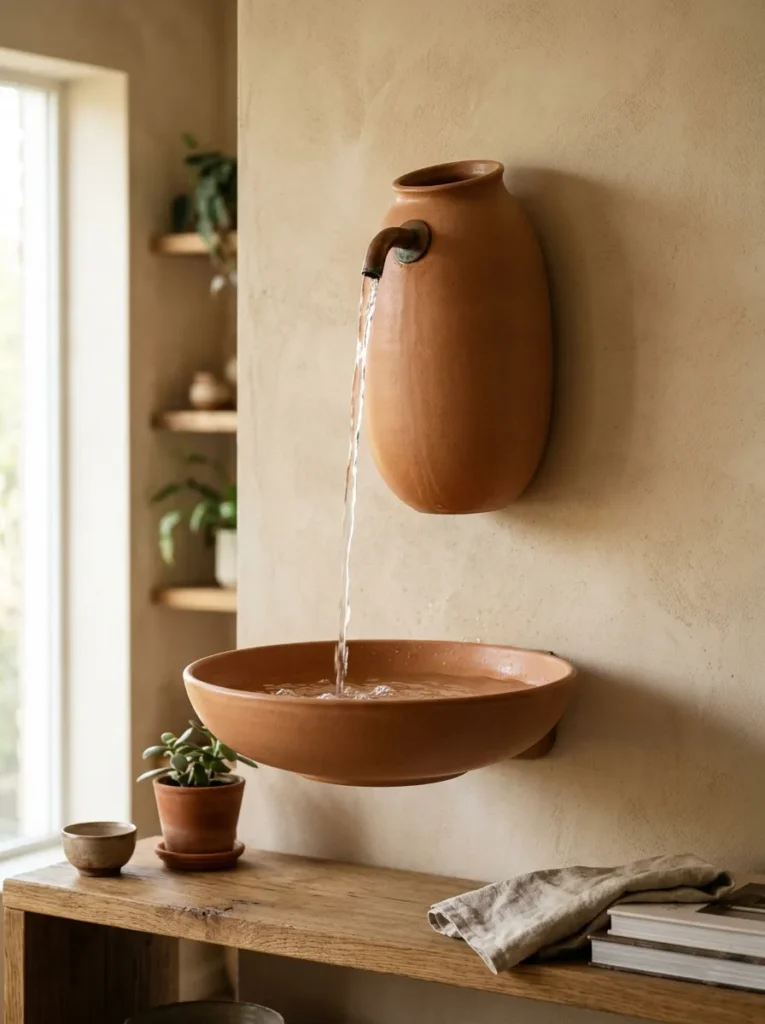
Vibe: The wall-mounted ceramic fountain feels like a functional sculpture that happens to include water as one of its materials — the two ceramic vessels and the water fall between them creating a wall composition of genuine artistic quality.
Why it works: A wall-mounted ceramic vessel fountain with a hidden recirculation system applies the composed wall object principle — by mounting the fountain’s components (the upper vessel and the lower dish) directly on the wall rather than on a surface, the fountain occupies wall space rather than floor or counter space, making it appropriate for rooms where horizontal surface area is limited. The two ceramic vessels in coordinated glazes read as a composed wall-mounted artwork at room distance, with the water fall between them providing the kinetic element that distinguishes it from a conventional ceramic wall installation.
Wall mounting specification: Each ceramic vessel and dish must be mounted on the wall using fixings appropriate for the combined weight of the ceramic and the water it contains — the upper vessel typically weighs 2–4kg (ceramic) plus 0.5–1.5kg (water within the vessel), requiring wall plugs into masonry or fixings into studs. Use L-bracket shelf supports rated for minimum 10kg per bracket, positioned at the vessel’s back face.
Budget: Two handmade ceramic vessels: $80–200. Copper spout and fittings: $20–40. Pump and pipe: $25–50. Total: $125–290.
Shop The Look
| Product |
|---|
| Handmade ceramic vessel elongated |
| Wide ceramic dish base 40cm |
| Copper spout fitting exit |
| Wall mount L-bracket rated 10kg |
| Concealed pipe pump fitting |
5. Glass and Stone Water Table — The Furniture Integration
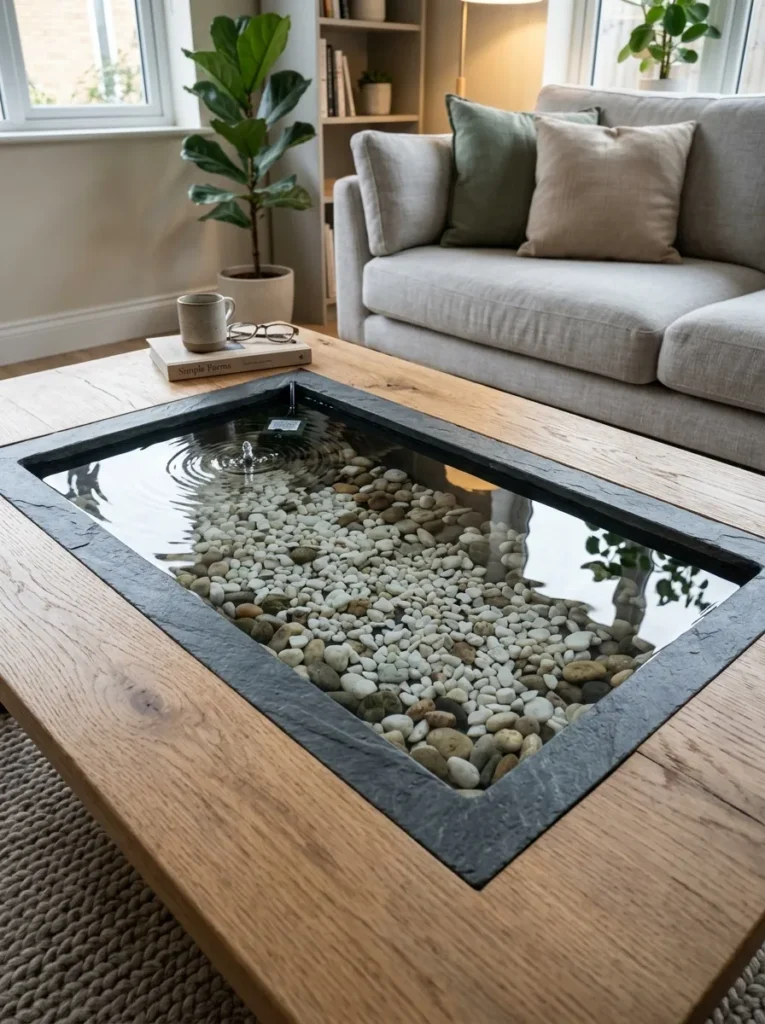
Vibe: The water table feels like the most serene possible coffee table — the still water surface with its barely perceptible ripple creating a reflective element at the room’s center that mirrors the room above it in a continuously shifting image.
Why it works: A recessed water basin integrated into a table surface applies the furniture-as-water-feature principle — rather than adding a fountain as a separate object to a room, the water is integrated into an existing furniture piece’s function (the table surface), creating a water element with no additional floor or surface footprint. The very gentle pump action (set at the minimum flow rate that prevents the water from becoming stagnant, creating barely perceptible surface movement rather than a visible fountain) produces the specific quality of an almost-still water surface that reflects the room above it — a quality closer to a mirror than to a conventional fountain, and one that creates extraordinary visual depth and calm at the room’s center.
Water hygiene: A table-integrated water basin requires water hygiene management — add a small amount of aquatic plant safe algae inhibitor (available from aquatics retailers) to prevent algae growth in the still water, and fully change the water every four to six weeks. Keep the basin away from direct sunlight which accelerates algae growth.
Budget: Custom water table with basin: $600–2,000 (custom build). DIY approach (modifying an existing table): $200–500 in materials.
Shop The Look
| Product |
|---|
| Dark slate or granite basin tile |
| Submersible pump minimum flow |
| Smooth white quartz pebble set |
| Aquatic algae inhibitor safe |
| Natural oak table surround |
6. Bamboo Spout Fountain — The Zen Garden Reference
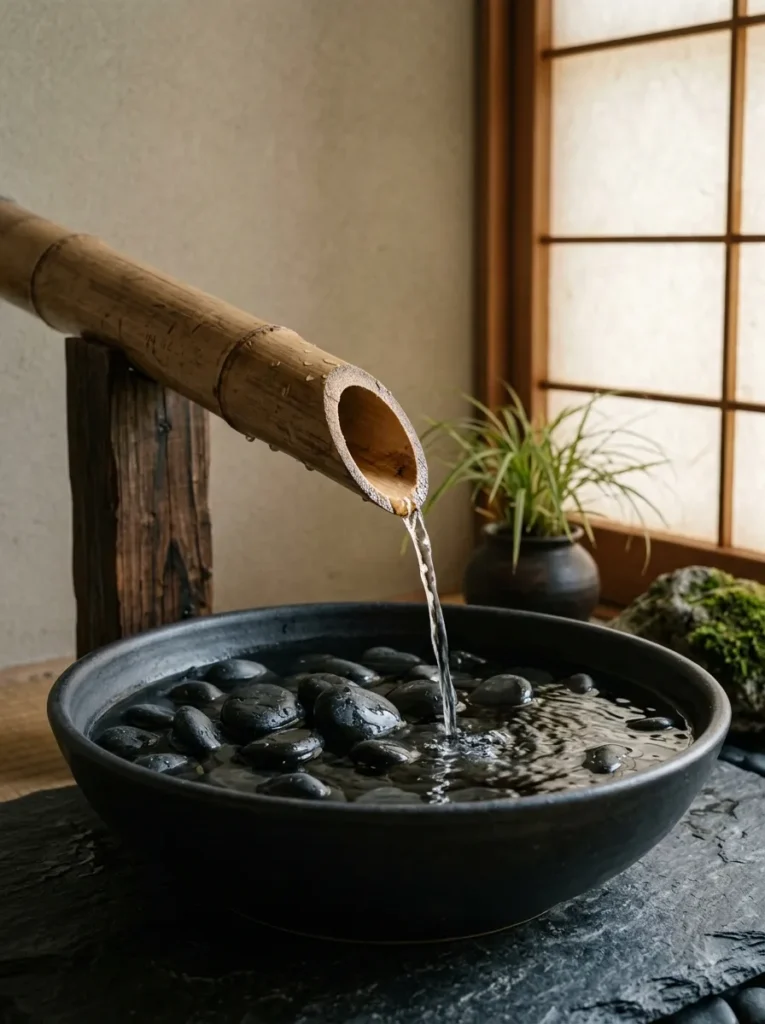
Vibe: The bamboo spout fountain feels like a Japanese garden teaching the room what calm sounds like — the specific material of natural bamboo and the angled pour creating an indoor water feature with centuries of meditative garden design behind it.
Why it works: A bamboo spout fountain references the Japanese tsukubai (a stone water basin used for ritual cleansing at the approach to a tea ceremony garden) through its most characteristic formal element — the bamboo spout (kakei in Japanese garden design) mounted horizontally at a slight downward angle, pouring in a single gentle stream into a basin below. This specific fountain form has been refined over several centuries of Japanese garden design to produce the optimal balance of sound quality (the angled bamboo cut creates a specific pitch and volume of water pour), visual quality (the single clean stream rather than a spray or cascade), and material quality (natural bamboo’s warm color and organic surface). As a domestic interior fountain, it produces the quietest and most meditative of the sound qualities available — the single clean pour is the most easily managed volume and the least likely to be experienced as intrusive.
Bamboo sourcing and preparation: Natural bamboo poles are available from garden centres and Asian import suppliers in various diameters. Cut the angled end at approximately 45 degrees using a sharp saw or blade — the angle determines the pour’s direction and spread. Seal the closed end with a wooden plug and epoxy to prevent water entry. The pump sits in the collection bowl and the water is returned to the bamboo’s closed end through a thin hose running behind the mounting structure.
Budget: Natural bamboo pole: $5–15. Dark ceramic bowl: $25–60. Pump and fittings: $20–35. Total: $50–110.
Shop The Look
| Product |
|---|
| Natural bamboo pole 3–4cm diameter |
| Dark ceramic bowl 35cm fountain |
| Smooth black river stone set |
| Submersible pump 60 L/hr |
| Thin silicone hose pump to bamboo |
7. Copper Pipe Industrial Fountain — The Contemporary Craft
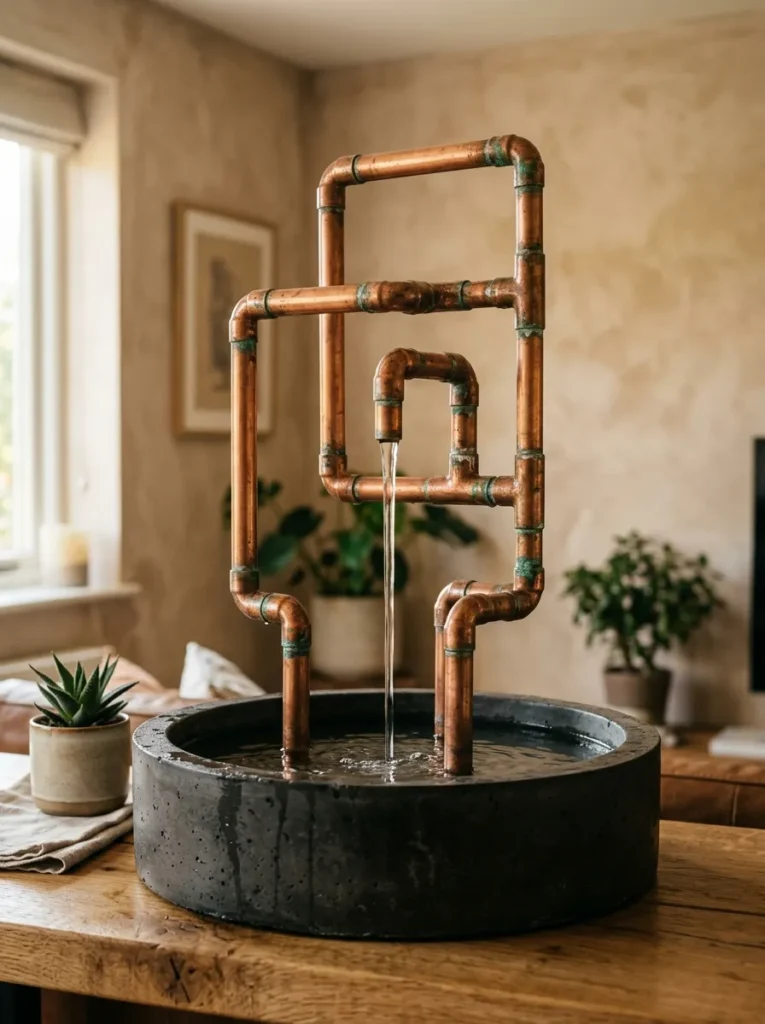
Vibe: The copper pipe fountain feels like a plumber and a sculptor collaborated on a water feature — the visible pipe architecture and the warm copper material creating an industrial design object of genuine aesthetic character.
Why it works: A copper pipe fountain with visible pipe structure applies the industrial material honesty principle — the plumbing system that is conventionally concealed within walls (copper pipe, fittings, valves) is instead exposed as the fountain’s primary architectural and aesthetic element. Copper’s natural material properties — the warm orange-gold of new copper, the progressive development of the blue-green verdigris patina that appears at joints and exposed surfaces over months and years, the specific reflective quality of the metal surface — make it a design material of genuine interest when used at a visible domestic scale. The fountain’s pipe structure (which can be configured in any geometric arrangement using standard copper pipe and fittings soldered together) is both the fountain’s plumbing system and its sculptural form.
Copper pipe soldering: Standard 15mm copper pipe and fittings are soldered using a propane torch, solder, and flux — a skill achievable by any competent DIY maker with basic instruction. The finished solder joints create the specific material joint character (the small silver ring of solder at each fitting) that is part of the fountain’s aesthetic. Alternative (non-soldering): compression fittings create mechanical joints without heat, though they are visually less refined than soldered joints.
Budget: Copper pipe and fittings: $40–80. Dark concrete or slate basin: $30–70. Pump: $20–35. Total: $90–185.
Shop The Look
| Product |
|---|
| Copper pipe 15mm 1 metre |
| Copper elbow fitting set |
| Copper tee fitting set |
| Dark concrete basin fountain |
| Propane torch soldering kit |
8. Living Wall Water Feature — The Botanical and Aquatic Combination
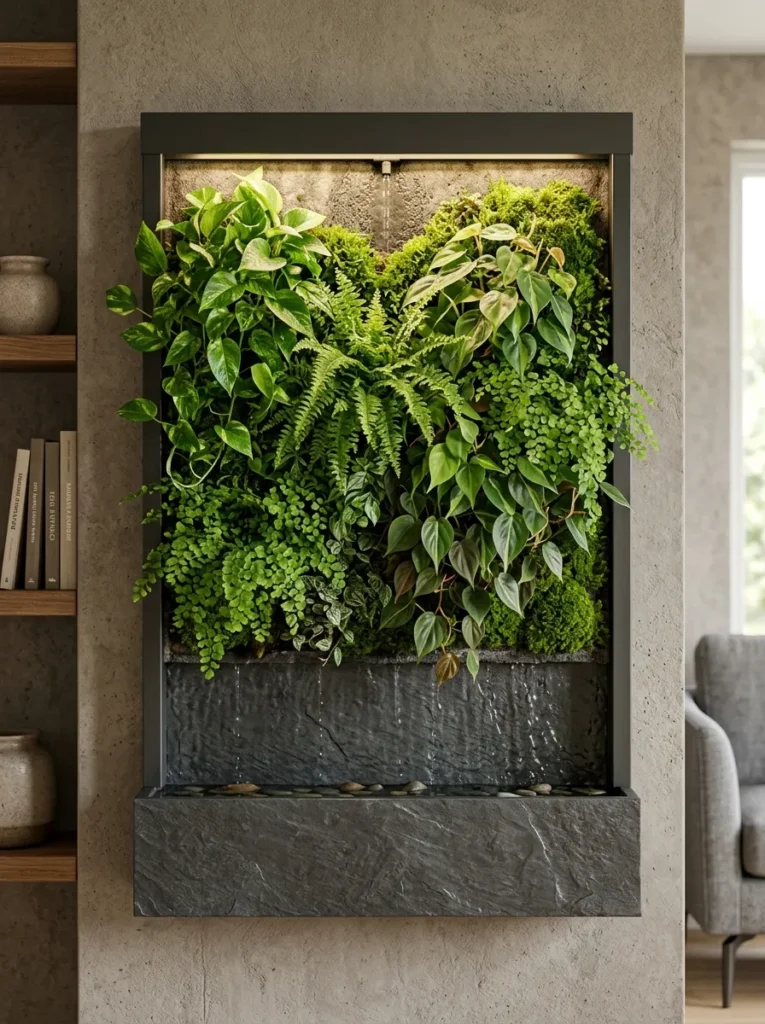
Vibe: The living wall water feature feels like a rainforest wall section that agreed to function as a room decoration — the thin water film over the planted face creating a continuously self-maintaining green installation that is simultaneously a plant display and a water feature.
Why it works: A living wall panel with an integrated water film applies the combined biophilic system principle — the combination of living plants and moving water provides multiple simultaneous biophilic benefits in a single wall-mounted installation: the visual and psychological benefits of living plant contact, the acoustic masking of a continuously flowing water film, the humidity contribution of both the evapotranspiring plants and the moving water, and the visual complexity of a densely planted living surface. The water film that flows down the panel face serves a dual function: it is the water feature element (providing the visual and acoustic contribution of moving water) and the irrigation system (keeping the planting medium and plant roots continuously moist without requiring manual watering).
Water quality management: A living wall water feature requires the addition of a dilute aquatic fertilizer to the recirculating water to supply nutrients to the plants — use a balanced liquid fertilizer at one-quarter the recommended concentration added to the reservoir monthly. Change 25% of the water volume monthly to prevent salt accumulation.
Budget: Living wall panel and planting: $200–500. Integrated water pump and trough: $50–100. Total: $250–600.
Shop The Look
| Product |
|---|
| Living wall panel system 60×80cm |
| Pothos and fern small pocket plant |
| Dark slate trough lower section |
| Submersible pump living wall |
| Aquatic dilute fertilizer liquid |
9. Aged Brass Bowl Fountain — The Warm Metallic
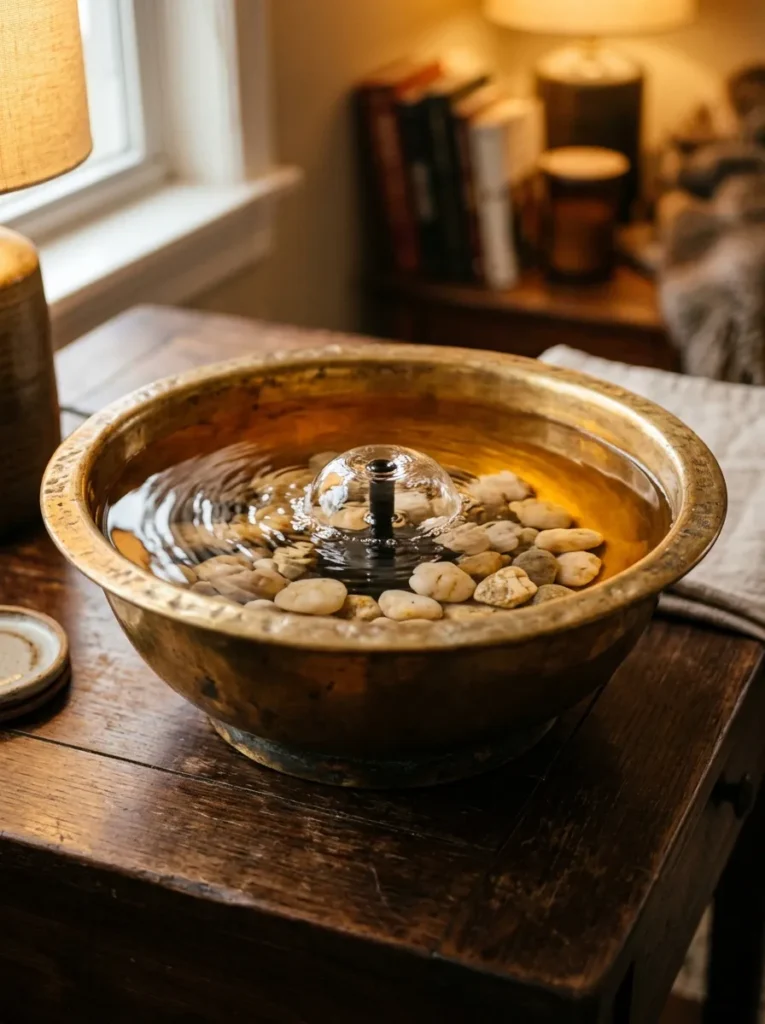
Vibe: The aged brass bowl fountain feels like a hammered water vessel from an antique market that someone gave a pump and a second life — the aged brass patina and the water dome creating a warm metallic object of genuine material character.
Why it works: An aged brass bowl as a fountain vessel applies the found vessel repurposing principle — a brass bowl (a hammered or spun brass vessel from an antique, import, or specialist homeware retailer) provides the most immediately warm and most materially specific container for a tabletop fountain because brass’s natural aged patina (the progressive darkening from bright gold through warm orange-brown to the specific two-tone quality of handled brass — darker where the patina builds, brighter at the high-touch areas) creates a material character that develops and improves over time. Unlacquered brass in contact with water will develop a specific wet patina (darker, more uniform) that then dries to the aged brass quality — each use of the fountain gradually builds the vessel’s material character.
Brass bowl sourcing: Hammered brass bowls are available from Indian and Middle Eastern import retailers, antique markets, and specialist homeware retailers. Sizes appropriate for a tabletop fountain range from 25–40cm diameter. Ensure the bowl has adequate depth (minimum 8cm) for the water volume and the pump to operate without cavitation.
Budget: Aged brass bowl: $30–80 from import or antique retailer. Micro pump: $15–25. Total: $45–105.
Shop The Look
| Product |
|---|
| Hammered aged brass bowl 30cm |
| Micro pump 50 L/hr submersible |
| Smooth pale quartz stone set |
| Dark walnut display surface |
| Unlacquered brass cleaner natural |
10. Floor-Standing Slate Column Fountain — The Architectural Room Element
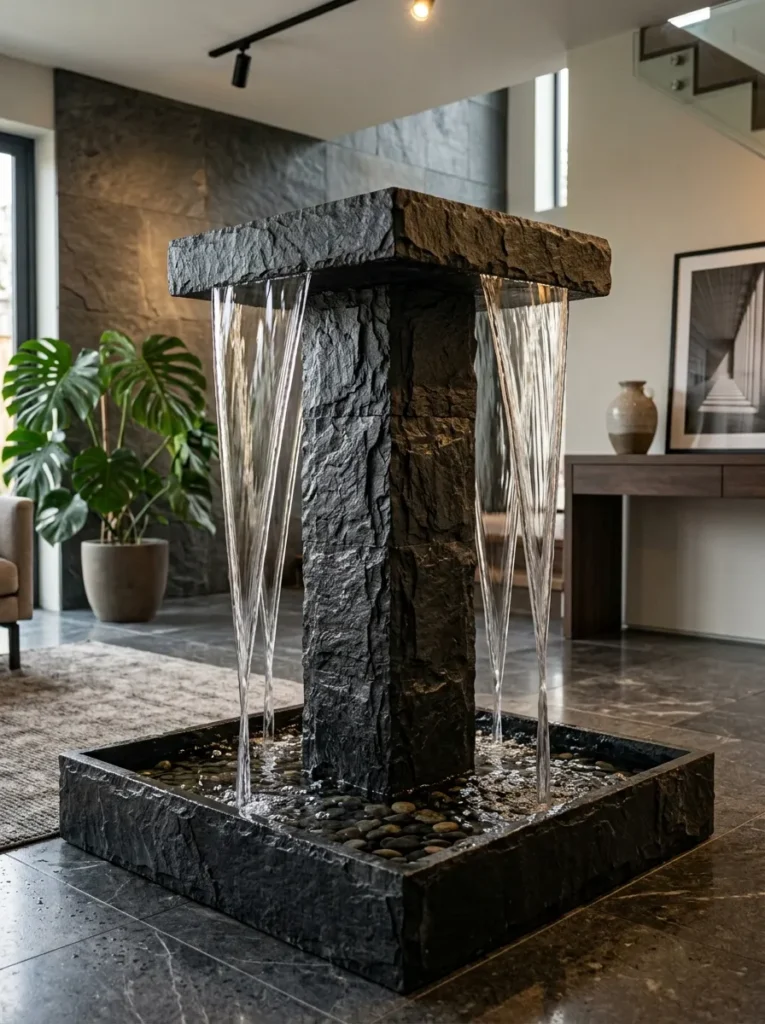
Vibe: The slate column fountain feels like a room-scale water sculpture rather than a decorative accessory — the four simultaneous laminar water sheets falling from the elevated basin creating a visual installation that occupies and defines the room space around it.
Why it works: A floor-standing slate column with four-sided overflow applies the room-scale installation principle — a floor-standing fountain at 60cm height is experienced differently from a tabletop fountain or a wall-mounted feature because it occupies the room’s floor plane and is encountered as part of the room’s spatial composition rather than as an object on a surface. The four-sided overflow (water falling from all four edges of the upper basin simultaneously) creates a visual curtain of water that surrounds the central column, making the fountain the room’s most dynamic visual element from any viewing angle. The rough-split slate surface (natural slate cleaved along its geological grain, exposing the irregular silver-gray cleavage face) is the specific material choice that gives the fountain its geological authority — the material reads as formed by geological process rather than manufactured, creating the specific material quality of genuine natural stone.
Budget: Purpose-built slate column fountain: $400–900 commercial. DIY construction with pre-cut slate tiles: $200–400.
Shop The Look
| Product |
|---|
| Dark natural slate tile set |
| Slate adhesive waterproof |
| Submersible pump 150 L/hr |
| Copper pipe upper basin supply |
| Slate column square frame |
11. Reclaimed Timber and Basin Fountain — The Rustic Contemporary
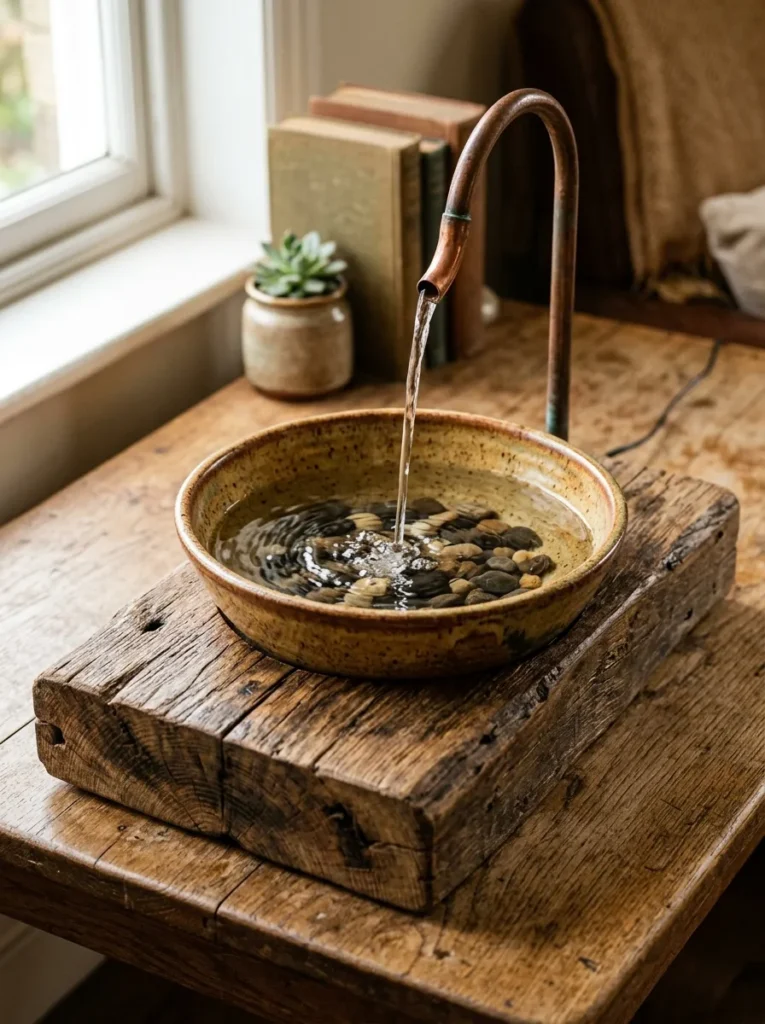
Vibe: The reclaimed timber and copper fountain feels like an artisan made this specific object for this specific room — the aged timber, the warm ceramic, and the copper spout creating a material combination of genuine handmade warmth.
Why it works: A reclaimed timber base with copper spout applies the material conversation principle — three materials with distinct characters (reclaimed timber with its aged grain and imperfections, ceramic with its glazed warmth, copper with its metallic warmth and natural patination potential) are brought into a composed material relationship where each enhances the character of the others. The reclaimed timber’s rustic quality is elevated by the precision of the copper spout; the ceramic basin’s warmth is grounded by the aged timber beneath it; and the copper spout’s industrial quality is softened by the organic materials surrounding it. This material conversation creates a fountain with a specific character that none of the materials alone or in less considered combination could achieve.
DIY construction: The pump is housed within the timber section — a cavity routed or chiseled into the timber’s interior, accessed through the timber’s base, provides the pump chamber. The power cable and water supply pipe both exit at the timber base and travel to the nearest outlet and to the copper spout respectively. The copper spout is formed from standard 10mm copper pipe bent to the desired arc using a pipe bender.
Budget: Reclaimed timber section: $10–30 (from salvage or reclaim source). Ceramic basin: $25–60. Copper pipe and fittings: $15–30. Pump: $20–35. Total: $70–155.
Shop The Look
| Product |
|---|
| Reclaimed timber section aged oak |
| Ceramic basin warm glaze 30cm |
| Copper pipe 10mm spout |
| Pipe bender 10mm copper |
| Submersible pump compact |
12. Minimalist Clear Glass Sphere Fountain — The Transparent Form
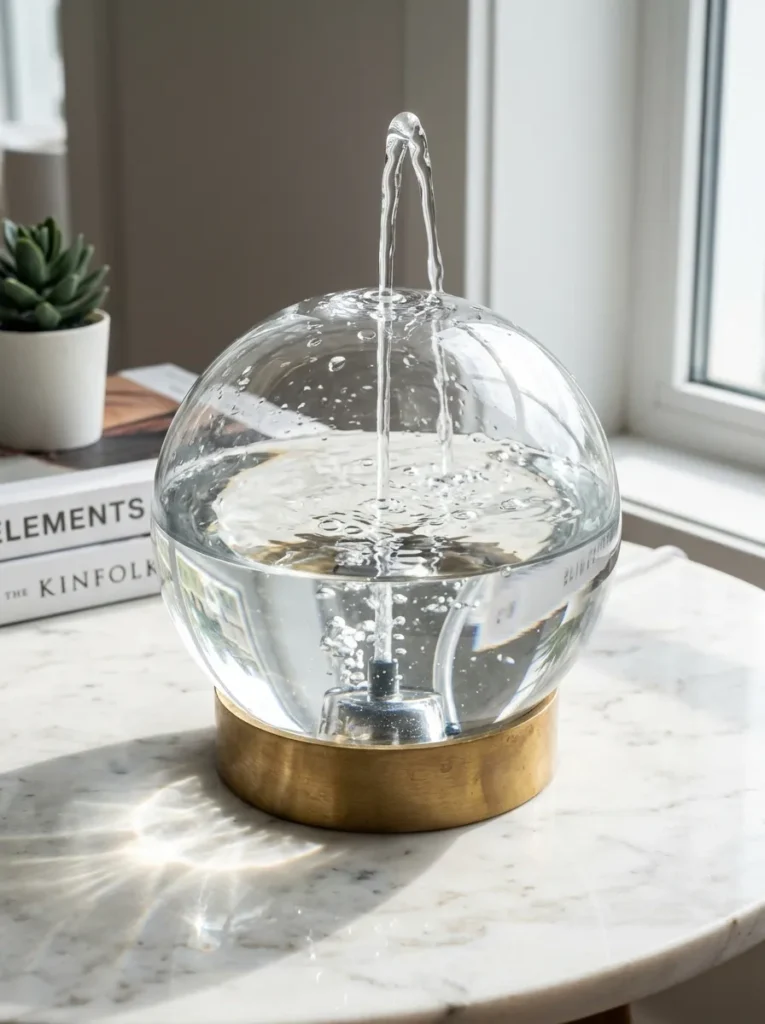
Vibe: The glass sphere fountain feels like a water experiment that became a design object — the glass magnification and the lens light effect creating visual phenomena that no opaque container can produce.
Why it works: A clear glass sphere fountain applies the optical water principle — a glass sphere half-filled with water functions simultaneously as a fountain vessel and as an optical instrument: the curved glass surface creates a lens effect that projects the water jet’s movement both visually (the magnified water movement visible through the glass from outside) and optically (the lens projects a moving light pattern onto the surface below and the wall behind when directional light passes through the sphere). This optical quality creates visual phenomena that are continuously changing with the changing light angles throughout the day — the fountain is a different visual object in morning sun than in afternoon shade.
Sphere sourcing: Large clear glass spheres (25–30cm diameter) are available from specialty glass suppliers, aquarium supply companies (fish bowl round format), and garden ornament suppliers. The hole at the sphere’s apex can be drilled using a diamond-tipped drill bit with water cooling, though many suitable round glass vessels already have an opening.
Budget: Clear glass sphere 25cm: $30–70. Brass ring stand: $15–30. Micro pump: $15–25. Total: $60–125.
Shop The Look
| Product |
|---|
| Clear glass sphere 25cm round |
| Brass ring stand display |
| Micro pump sphere internal |
| Diamond drill bit glass 8mm |
| Light marble display surface |
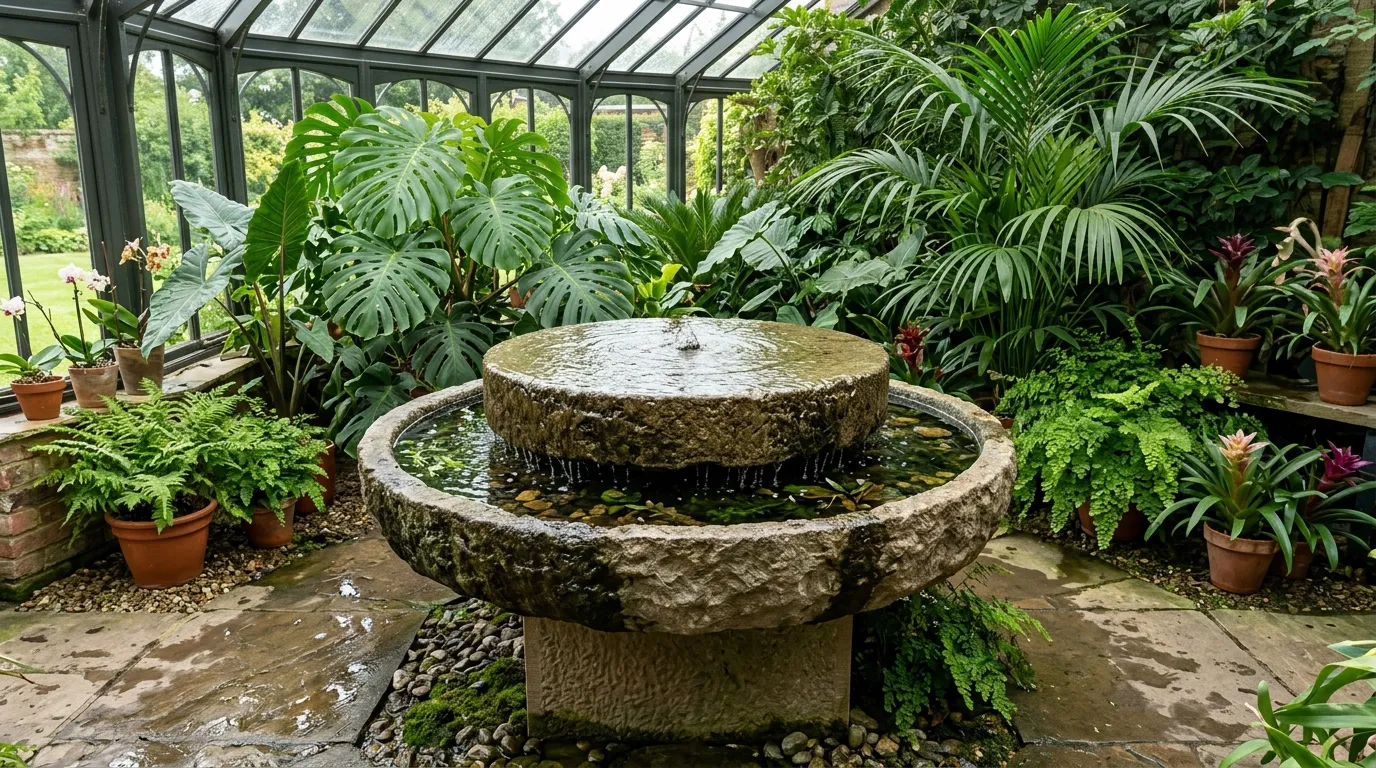
13. Outdoor-to-Indoor Transition Fountain — The Conservatory Feature
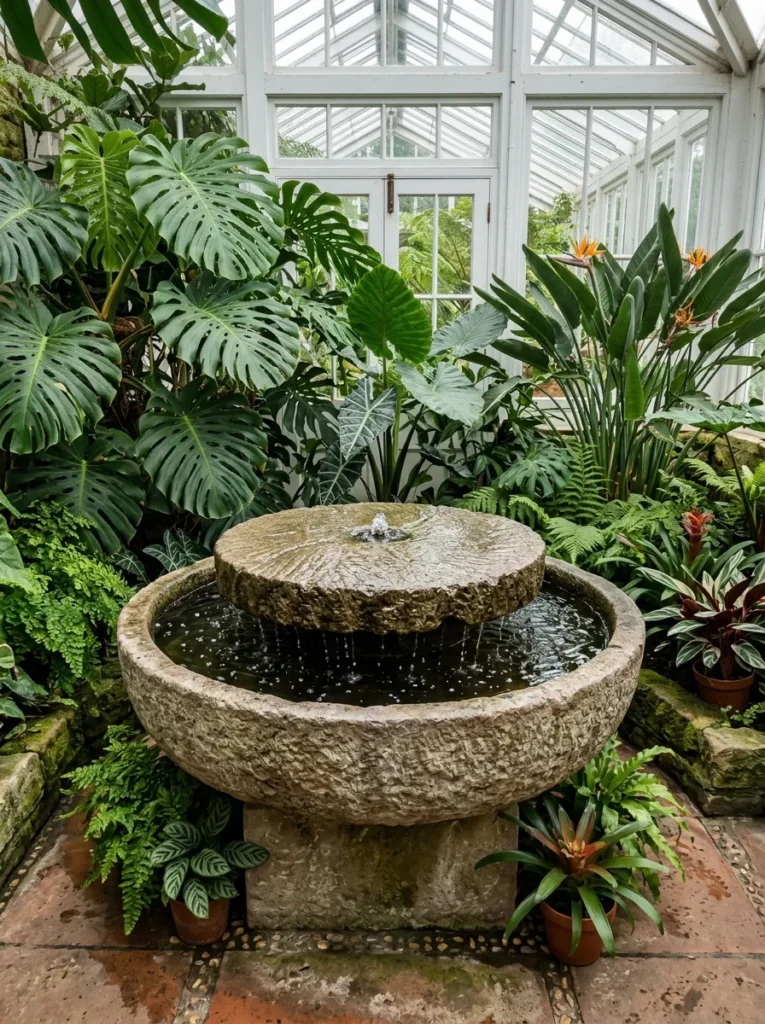
Vibe: The conservatory millstone fountain feels like the garden’s water element followed the plants inside — the millstone’s natural material and the tropical planting context creating an indoor garden water feature of genuine landscape quality.
Why it works: A millstone fountain in a conservatory or garden room applies the scale-appropriate installation principle — the conservatory or garden room is the one domestic interior space where a floor-standing water feature at landscape scale (80cm basin diameter, 30cm depth) is spatially appropriate rather than overwhelming. The millstone fountain specifically (a genuine or replica millstone with the central hole that characterizes authentic millstones, mounted over a pump outlet) is the garden water feature with the strongest natural material reference — the rough granite surface, the circular form, and the specific water behavior over a rough horizontal stone surface create a fountain that reads as a genuine landscape element brought indoors. The thin water film that spreads evenly over the millstone’s entire top surface before falling from the edge creates the specific sound and visual quality of water spreading over a flat natural stone — one of the most calming of all water feature sound profiles.
Budget: Millstone (genuine or reproduction): $80–250. Wide concrete basin: $100–300. Pump and fittings: $40–80. Total: $220–630.
Shop The Look
| Product |
|---|
| Millstone fountain genuine reproduction |
| Wide concrete basin 80cm |
| Stone plinth 30cm height |
| Submersible pump 200 L/hr |
| Large-leaf tropical plant conservatory |
14. Tabletop Zen Waterfall — The Multi-Tier Cascade
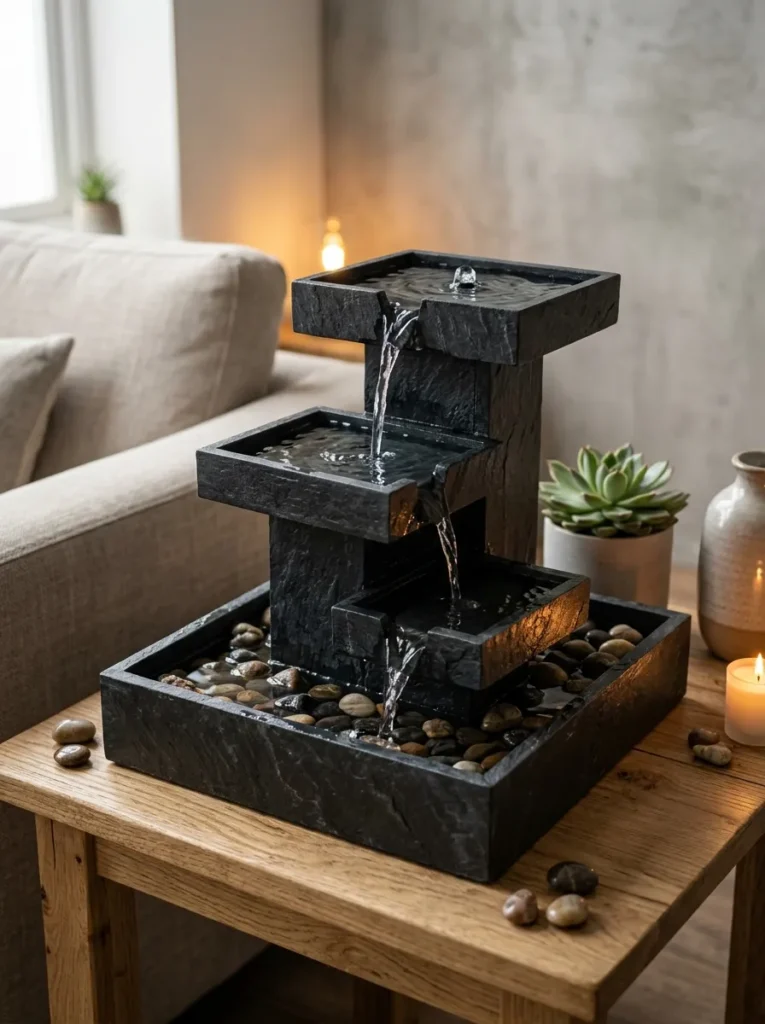
Vibe: The stepped zen waterfall feels like the traditional tiered fountain redesigned by someone who studied Mies van der Rohe — the same cascading sequence expressed through minimal forms and a restrained dark material palette.
Why it works: A three-tier stepped cascade in dark slate or ceramic applies the minimal reinterpretation principle — the tiered cascade is one of the oldest and most widespread fountain forms (from Roman garden fountains through Baroque garden installations to the contemporary garden water feature), and its modern reinterpretation uses the same formal logic (water flowing by gravity from one level to the next) expressed through contemporary material restraint (dark slate or matte ceramic rather than white marble or terracotta, simple rectangular basins rather than scalloped bowls, narrow channels rather than wide spouts). The result is a fountain form that references an ancient design tradition while reading as unambiguously contemporary.
Channel construction: The connecting channels between tiers (the 2cm wide passages through which the water flows from one basin to the next) must be formed with a smooth, slightly downward-angled base to direct the water flow cleanly rather than allowing it to spread across the tier face. For slate construction, the channels are cut using an angle grinder with a diamond cutting disc.
Budget: Pre-made slate or ceramic three-tier fountain: $80–200 commercial. DIY slate construction: $60–150 in materials.
Shop The Look
| Product |
|---|
| Dark slate three-tier fountain |
| Matte ceramic modern alternative |
| Submersible pump 80 L/hr |
| Angle grinder diamond disc |
| Wide collection base dark slate |
15. Outdoor Wall-Mount Brought Indoors — The Repurposed Garden Feature
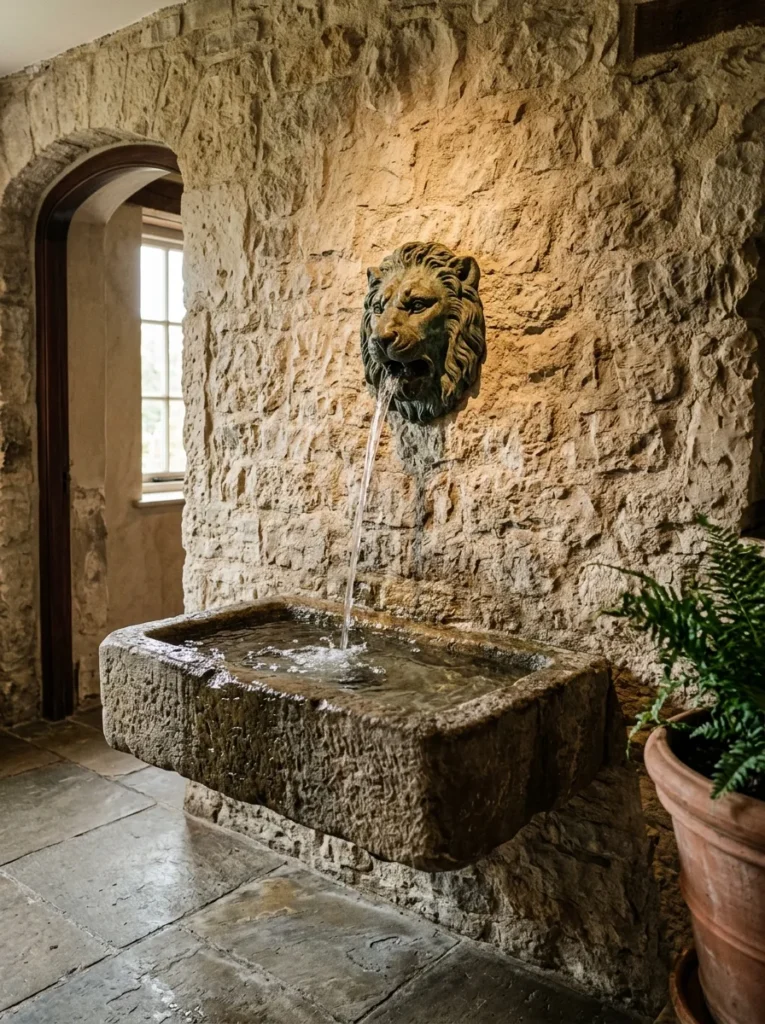
Vibe: The indoor garden wall fountain feels like a courtyard was given a single interior wall and chose to spend it on water — the stone spout and the falling water creating the specific spatial quality of a Mediterranean or Georgian courtyard fountain in a domestic room.
Why it works: A garden wall fountain installed in an interior applies the context elevation principle — a stone wall fountain designed for outdoor use (made in materials and at a scale appropriate to garden walls and stone exterior surfaces) reads with greater visual authority when installed in an interior setting than outdoors, because the contrast between the rough, heavy garden material (natural stone or cast concrete) and the refined domestic interior context creates a deliberate material tension that makes both elements more interesting. The fountain’s garden-quality material (rough-hewn stone, aged bronze spout) in an interior setting communicates the same design confidence as a piece of industrial furniture in a domestic interior — the material is out of its conventional context, and that displacement creates a more interesting design statement than a conventionally domestic fountain would.
Installation considerations: A wall-mounted stone fountain in an interior requires wall fixings appropriate for the combined weight of the stone housing and the water in the basin — typically 30–60kg. Fix to masonry or to multiple studs using appropriate masonry fixings or stud fixings rated for the weight. Waterproof the wall immediately behind the basin and spout using a self-adhesive waterproof membrane before installation.
Budget: Garden wall fountain stone: $150–400. Installation and waterproofing: $50–100. Total: $200–500.
Shop The Look
| Product |
|---|
| Stone or concrete wall spout fountain |
| Bronze or brass outdoor spout |
| Rectangular stone basin 60cm |
| Wall mounting bracket heavy rated |
| Waterproof membrane wall behind |
How to Start Your Indoor Fountain Project
The single most important first move before purchasing any indoor fountain — whether a commercial product or a DIY component set — is deciding on the specific sound character and volume level appropriate for the room and position in which the fountain will be installed. The three principal indoor fountain sound types are the dome (a gentle, low-volume ripple produced by a micro pump creating a water dome in a vessel — the quietest indoor fountain option, appropriate for bedrooms and reading rooms), the pour (a medium volume, specific pitch sound produced by water falling from a spout into a collection vessel — the most tonally interesting of the fountain sounds, appropriate for living rooms and home offices), and the cascade (a continuous, higher-volume, broadband sound produced by water falling multiple distances through a tiered structure — the most effective acoustic masking option, appropriate for rooms with intrusive ambient noise). Sound volume is also a function of the pump’s flow rate (higher flow rate = more water movement = louder sound) and the fall height (greater height = louder splash at the receiving surface). These variables are designable — choosing the pump, the flow rate, and the fall height allows the fountain’s sound level to be calibrated to the room’s requirements before any material or aesthetic decisions are made.
The most common mistake in indoor fountain installation is choosing a pump that is too powerful for the fountain’s scale — a pump rated at 400 litres per hour in a 30cm ceramic bowl creates a turbulent, noisy water surface rather than the gentle dome intended, overshoots the vessel edges creating water mess, and generates the humming sound that cheap pumps at high flow rates produce. Match the pump’s flow rate to the fountain’s scale using the guideline: a tabletop bowl fountain of 30–40cm diameter requires 50–80 litres per hour; a medium cascade or pour fountain requires 80–150 litres per hour; a floor-standing installation or large cascade requires 150–300 litres per hour. All pumps should be variable-flow (with a flow adjustment dial) to allow fine-tuning of the sound and water movement after installation.
Three specific items that enable any fountain project from this list: a quality variable-flow submersible pump in the correct size range ($20–40 from an aquatics or pond supplier — the pump is the most critical single component of any indoor fountain, and a quality pump from a reputable aquatics supplier will last significantly longer and run quieter than a cheap equivalent); a bag of smooth river stones in the 2–4cm size range ($8–15 from a garden centre — the most versatile fountain component, useful for pump concealment in bowl fountains, base material in stone fountains, and sound dampening in cascade fountains); and a tube of aquarium-safe silicone sealant ($8–12 — essential for waterproofing any joins, sealing any drilled holes, and securing any components that contact water). These three items combined for under $70 provide the core toolkit for building any fountain in this list at the DIY level.
Frequently Asked Questions About Modern Indoor Fountains
How do you prevent indoor fountain water from developing algae or odors?
Indoor fountain water management requires addressing the two primary causes of algae growth and water quality deterioration: light exposure and nutrient availability. Position indoor fountains away from direct sunlight — UV exposure is the primary driver of algae growth, and a fountain in direct sun will develop visible algae within one to two weeks regardless of maintenance. Add a small amount of aquatic plant-safe algae inhibitor to the fountain water (available from aquatics retailers — follow the concentration guidelines precisely, as excessive concentration harms pumps and plant life). Change 20–25% of the fountain water weekly (adding fresh water to replace evaporation losses and partially diluting accumulated minerals and nutrients). Fully empty, clean with a mild vinegar solution, and refill the fountain every four to six weeks. In fountains without adequate flow, biofilm (the slimy film that develops on wetted surfaces) can be prevented by wiping all wetted surfaces with a soft cloth during the monthly cleaning.
What is the best pump for an indoor fountain?
The best pump for an indoor fountain is a variable-flow submersible pump from a reputable aquatics supplier (manufacturers including Bermuda, Blagdon, Jebao, and Ubbink produce quality submersible pumps appropriate for indoor fountains) in the correct flow rate range for the fountain’s size. Key specifications to look for: variable flow control (the ability to adjust the pump’s output from minimum to maximum using a dial or slide — essential for calibrating the fountain’s sound and water movement after installation), a low-noise motor (some pumps specify a noise level in dB — choose the lowest available for the required flow rate), an accessible pre-filter (a removable sponge pre-filter that prevents debris from entering the pump impeller — clean monthly), and a long power cable (1.8–3m — short power cables require a junction box or extension in most room positions).
How much electricity does an indoor fountain use?
Small submersible pumps used in indoor fountains are among the lowest-power domestic electrical appliances available. A typical variable-flow submersible pump rated at 80 litres per hour maximum flow draws approximately 5–10 watts at maximum and 2–4 watts at partial flow (the setting used for most domestic fountain applications). Running 24 hours per day at 5 watts: 5W × 24hrs × 365 days = 43.8 kilowatt-hours per year — at a typical residential electricity rate, this represents approximately $5–8 per year in running costs. The cost of running an indoor fountain continuously is genuinely negligible for most household budgets.
Can indoor fountains be turned off at night?
Indoor fountains can be turned off at night using a standard electrical timer (plug-in timers available from hardware retailers for $8–15 set the pump’s on/off schedule automatically). However, leaving the pump running continuously is generally better for the pump’s longevity than repeated on/off cycling — submersible pumps are designed for continuous operation, and the motor’s thermal cycling through repeated starts creates more wear than continuous running at low power. If the fountain’s sound is the reason for turning it off at night (sound from the bedroom), consider positioning the fountain in a room with a door that can be closed at night, or using a pump with a very low minimum flow rate that produces only the most minimal water movement and sound during night hours.
How do you stop an indoor fountain from losing water?
Water loss in an indoor fountain occurs through two mechanisms: evaporation (gradual, inevitable, rate dependent on room temperature, humidity, and the fountain’s water surface area) and splash (water landing outside the vessel from excessive flow rate or incorrect nozzle direction). Evaporation is managed by topping up the fountain with fresh water every three to five days — the rate depends on the fountain’s size and the room conditions. Splash is managed by reducing the pump’s flow rate (the most common cause of excessive splash is a pump set too high for the vessel’s size) and by adjusting the nozzle direction (the pump outlet should direct water toward the vessel center, not toward the vessel walls or edges). Using a fountain cover or lid when the fountain is not in use (overnight or during absence from home) significantly reduces evaporation losses.
Ready to Install Your Modern Indoor Fountain?
These 15 ideas move through every dimension of what makes a modern indoor fountain a genuinely designed sensory installation rather than a purchased decorative accessory — from the contemplative restraint of the handmade ceramic bowl dome and the geological authenticity of the stacked stone rill, through the architectural precision of the concrete trough cascade and the botanical-aquatic combination of the living wall water feature, to the material warmth of the aged brass bowl and the optical phenomena of the glass sphere, to the landscape scale of the conservatory millstone and the contextual authority of the indoor garden wall fountain. Starting with the sound specification — deciding on the desired sound character (dome, pour, or cascade) and the appropriate volume for the intended room — is the beginning that makes every subsequent material and scale decision purposeful rather than aesthetic-first. Decide on the sound first. Choose the fountain form that produces that sound. Select the material that makes that form most beautiful in the specific room. Purchase the pump that produces that sound at that flow rate. Then build or install, fill, adjust the flow rate until the sound is exactly right, and let the fountain begin the continuous sensory contribution to the room’s atmosphere that it will make every day.