16 Charming Beach Cottages with Coastal Style
Beach cottages with coastal style are small to medium-scale residential homes — typically characterized by weathered wood siding, wraparound porches, shiplap interiors, and a relaxed, sun-bleached aesthetic — that draw their design language directly from their proximity to the ocean, translating the textures, colors, and materials of the shoreline into livable, deeply atmospheric domestic spaces. This article gives you 16 charming beach cottage style ideas that work whether you own a waterfront property, a landlocked home longing for coastal character, or anything in between — from exterior architecture and porch design to interior palette, texture, and material choices.
Picture a home where the boundary between inside and outside blurs at the screen door. Where the walls carry the soft gray of driftwood and the floors are worn smooth like sea glass. Where a shell sits on a windowsill not as decoration but as evidence of a life lived close to water. Where the air, even on a still day, seems to carry a suggestion of salt. Coastal style at its best is not a decorating theme — it is a way of building and furnishing a home that makes the ocean feel present even when the water is out of sight. Here are 16 ideas worth saving — and stealing.
Why Beach Cottage Coastal Style Works So Well
Beach cottage coastal style draws from one of the longest-running residential design traditions in American and Northern European architectural history — the vernacular building vocabulary of fishing villages, seaside resort towns, and working harbor communities that developed practical, climate-responsive building forms over centuries before they became aesthetic references. The white clapboard siding, the elevated foundation, the deep overhanging porch, the louvered shutters, the metal roof — every characteristic element of the coastal cottage began as a functional response to salt air, storm surge, humid heat, and strong prevailing winds, and became beautiful precisely because of that functional integrity.
The materials that define authentic coastal cottage interiors are weathered and honest: white-painted shiplap boards, unfinished white oak or reclaimed pine flooring, natural linen and cotton in undyed or ocean-washed tones, woven seagrass and jute, aged rattan and cane furniture, hand-thrown ceramic in sand and sea tones, and glass in the blue-green family — sea glass, aqua glazed tile, rippled antique mirror. Colors follow the shoreline palette with specificity: not the saturated navy and white of nautical cliché, but the nuanced tones of an actual beach — warm sand, driftwood gray, seafoam green, bleached linen, oyster white, soft sky, and the particular washed-out quality of colors that have spent years in strong coastal light.
The coastal cottage aesthetic has maintained cultural relevance across generations because it satisfies a deep and broadly shared aspiration — the desire for a simpler, more sensory, more physically present way of living than modern urban life typically provides. Recent years have seen the style evolve significantly beyond its nautical cliché period: anchors, rope, and lighthouse motifs have been replaced by a more sophisticated material approach that references the coast through texture, palette, and natural material rather than literal marine iconography. The result is a coastal aesthetic that works in any home regardless of proximity to water.
Even landlocked interiors can achieve genuine coastal atmosphere through material choice alone. Shiplap wall paneling in soft white, natural seagrass area rugs, linen slipcover sofas in warm white, and collected sea glass in a glass bowl on a windowsill sill create a coastal room without a single piece of nautical decoration — because the materials themselves carry the sensory memory of the coast in their texture, color, and organic character.
Style at a Glance
| Element | Trait 1 | Trait 2 |
|---|---|---|
| Philosophy | Functional vernacular beauty — form following coastal climate | Material honesty through weathered, organic, ocean-toned surfaces |
| Materials | White shiplap, reclaimed pine, seagrass, linen, rattan, cane | Sea glass, rippled glass, hand-thrown ceramic, driftwood, jute |
| Color Palette | Warm sand, driftwood gray, seafoam green, oyster white | Bleached linen, soft sky blue, washed sage, weathered teak |
1. White Clapboard Exterior with Dark Shutters
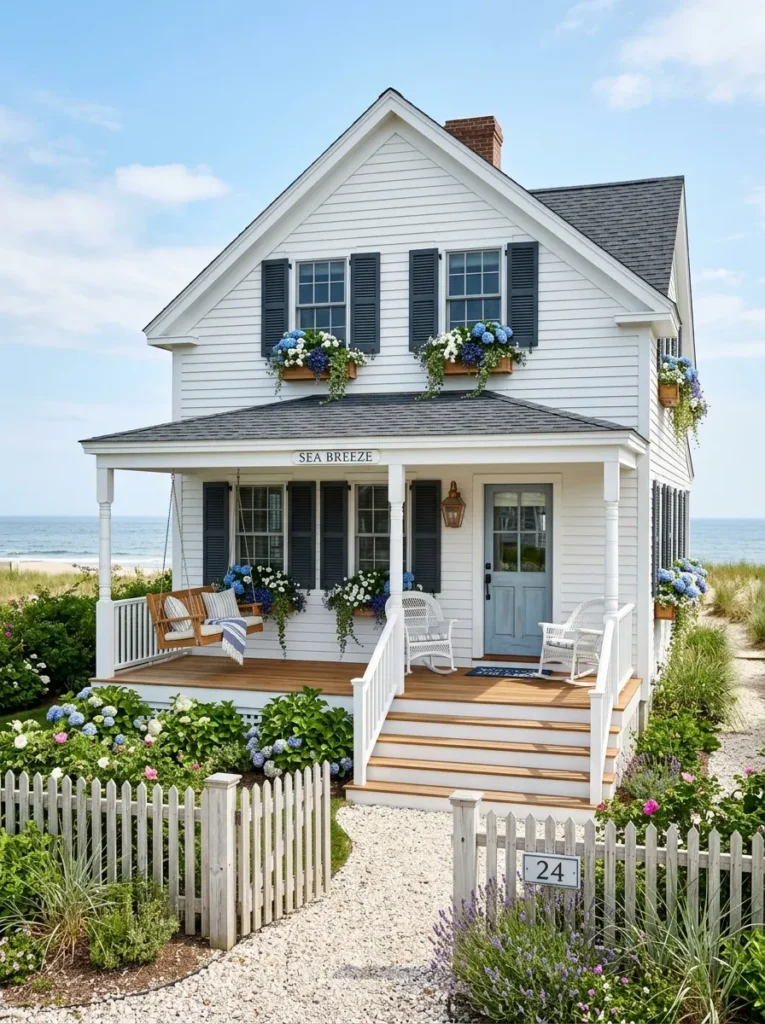
Vibe: Bright and welcoming — the exterior that makes you slow down when you drive past it.
Why it works: White clapboard siding with dark shutters is the foundational architectural composition of the American coastal cottage because it exploits the most powerful visual contrast available in exterior design — pure white against near-black — while using materials that have proven their weather resistance in salt air and coastal humidity over two centuries of real-world performance. The horizontal rhythm of the clapboard boards creates a visual connection to the horizontal lines of the ocean and horizon, grounding the cottage in its coastal setting without any literal marine reference. Deep charcoal shutters — rather than the more common black — carry a softness that reads as weathered rather than stark, which is exactly the right tone for a beach cottage exterior.
How to get it: Paint clapboard siding in a warm white rather than a blue-white — Benjamin Moore Chantilly Lace (OC-65) and Sherwin-Williams Alabaster (SW 7008) are the two whites most used in coastal cottage renovations because both carry a warm undertone that prevents the siding from looking clinical in strong coastal light. Paint shutters in Sherwin-Williams Urbane Bronze (SW 7048) or Benjamin Moore Wrought Iron (2114-30) for the deep, slightly warm dark tone that distinguishes charcoal shutters from cold black ones.
| Product |
|---|
| White exterior paint premium satin finish |
| Deep charcoal exterior shutter paint |
| Louvered wood shutter set exterior |
| Porch swing natural wood hanging |
| Window box planter set white cast iron |
Also view: 17 Festive Christmas Wall Art Ideas for Every Home
2. Wraparound Porch with Rocking Chairs
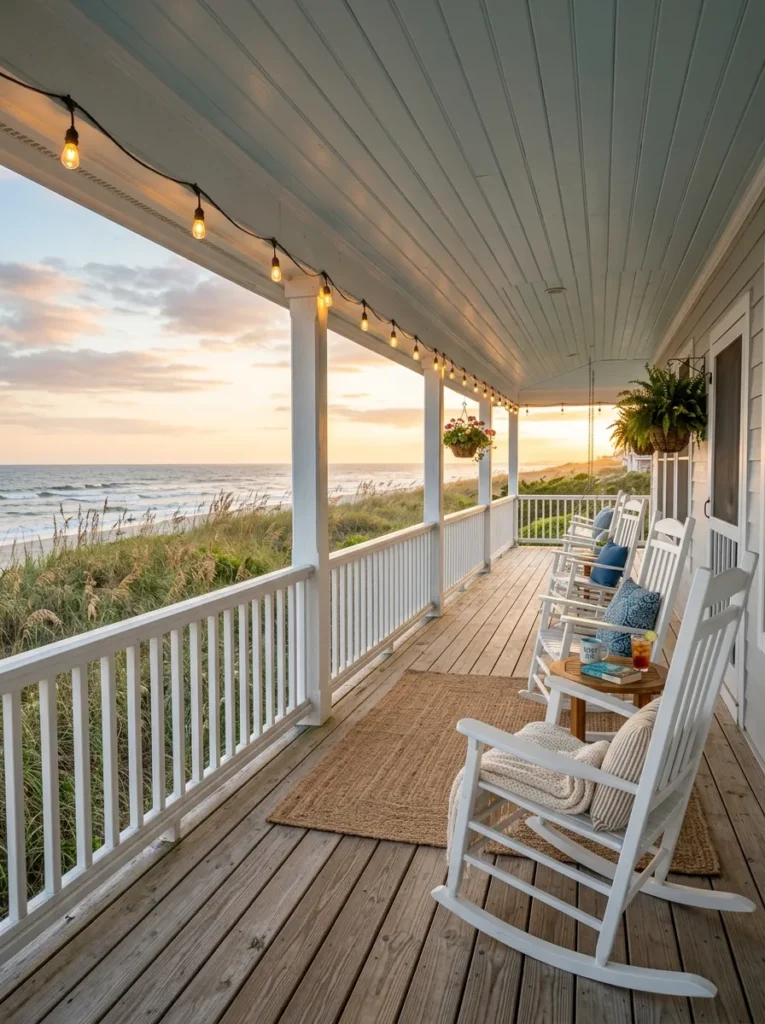
Vibe: Warm and serene — the porch that makes everything that was bothering you feel small.
Why it works: A wraparound porch with rocking chairs is the single architectural element most associated with coastal cottage living because it creates an intermediate zone between inside and outside — sheltered from rain and direct sun, open to prevailing sea breezes, positioned to capture the full sensory environment of the coast without full exposure to it. The haint blue porch ceiling is the traditional finishing element of Southern coastal porch design: the color — a blue-green in the family of Sherwin-Williams Watery (SW 6478) or Benjamin Moore Breath of Fresh Air (806) — was originally painted to repel insects and evil spirits, and has persisted because the blue ceiling reflects the sky and creates a luminous, airy quality that a white ceiling cannot. White rocking chairs complete the composition as the quintessential coastal porch furniture — their gentle movement in a sea breeze makes the porch itself feel alive.
How to get it: Haint blue ceiling paint is available in any paint color, but the most historically accurate formulations use Sherwin-Williams Watery (SW 6478), Benjamin Moore Palladian Blue (HC-144), or Farrow and Ball Mizzle (No.266) — all three read as the distinctive blue-green that defines this tradition. Pair white painted rocking chairs (solid teak or pressure-treated pine construction for weather resistance) with a natural jute or seagrass porch rug under a side table arrangement between chair pairs.
| Product |
|---|
| White wooden rocking chair outdoor porch |
| Haint blue exterior ceiling paint |
| Natural jute outdoor area rug |
| Outdoor cafe string lights warm white |
| White porch railing baluster set |
Also view: 17 Organic Modern Dining Decor Ideas for Every Home
3. Shiplap Interior Walls in Warm White
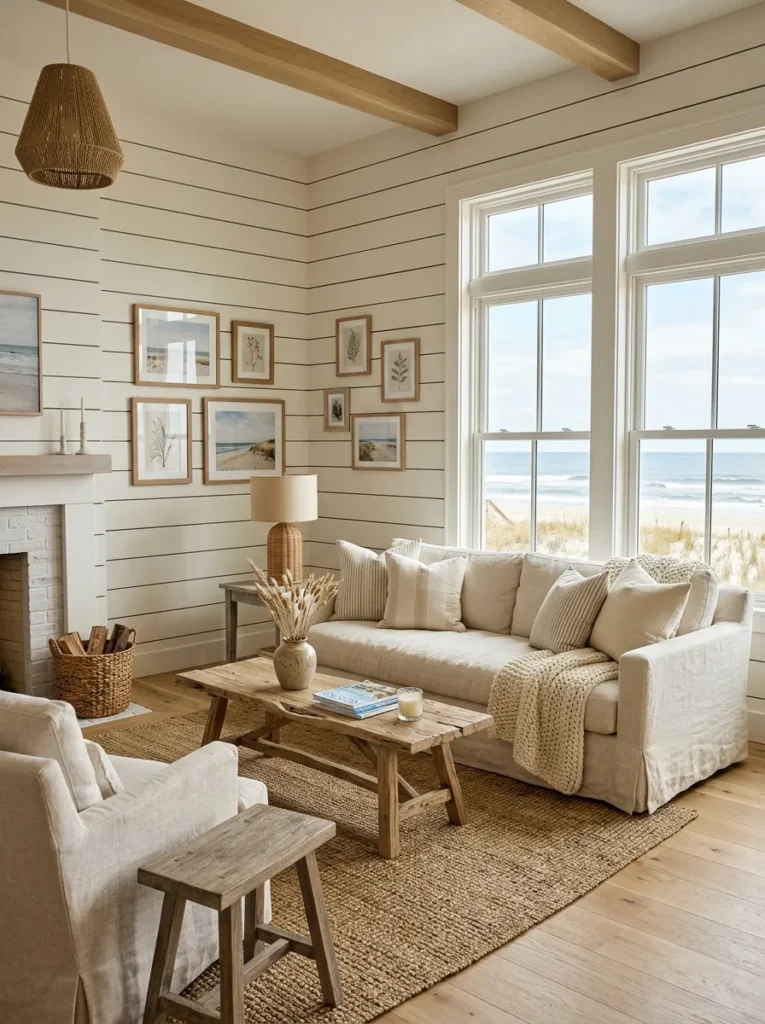
Vibe: Bright and airy — the interior that makes every room feel like a deep breath.
Why it works: Shiplap wall paneling is the defining interior surface of the coastal cottage because it references the horizontal board construction of historic beach buildings — fishing shacks, boat houses, and seaside outbuildings — while providing a surface texture that flat-painted drywall cannot achieve. The shadow gap between each board creates a horizontal rhythm that visually widens narrow rooms, connects interior surfaces to the horizontal coastal landscape visible through the windows, and provides enough surface interest to make a room feel complete with minimal additional decoration. Warm white is the essential colorway — specifically a white with a slight yellow or pink undertone that reads as bleached and sun-warm rather than clinical and cool.
How to get it: Install 1×6 or 1×8 shiplap boards horizontally with a 1/8-inch shadow gap between boards using a nickel coin as a consistent spacer. Pre-prime all four sides of each board before installation to prevent future warping from moisture — particularly important in coastal environments with high humidity. Paint with Benjamin Moore White Dove (OC-17) in an eggshell finish — the slight sheen makes the surface easier to clean while the warm white tone produces the characteristic coastal interior glow.
Quick Win: Peel-and-stick shiplap panels ($25–$40 per panel) install directly over existing drywall without carpentry skills or tools — a single accent wall behind a sofa or bed creates the full coastal shiplap effect in under two hours as a rental-friendly alternative to full wall installation.
| Product |
|---|
| Shiplap wall panel primed pine 1×6 |
| Warm white interior paint eggshell finish |
| Peel and stick shiplap panel set |
| Shiplap installation brad nail set |
| Wood filler paintable for shiplap gaps |
4. Sea Glass and Driftwood Collected Display
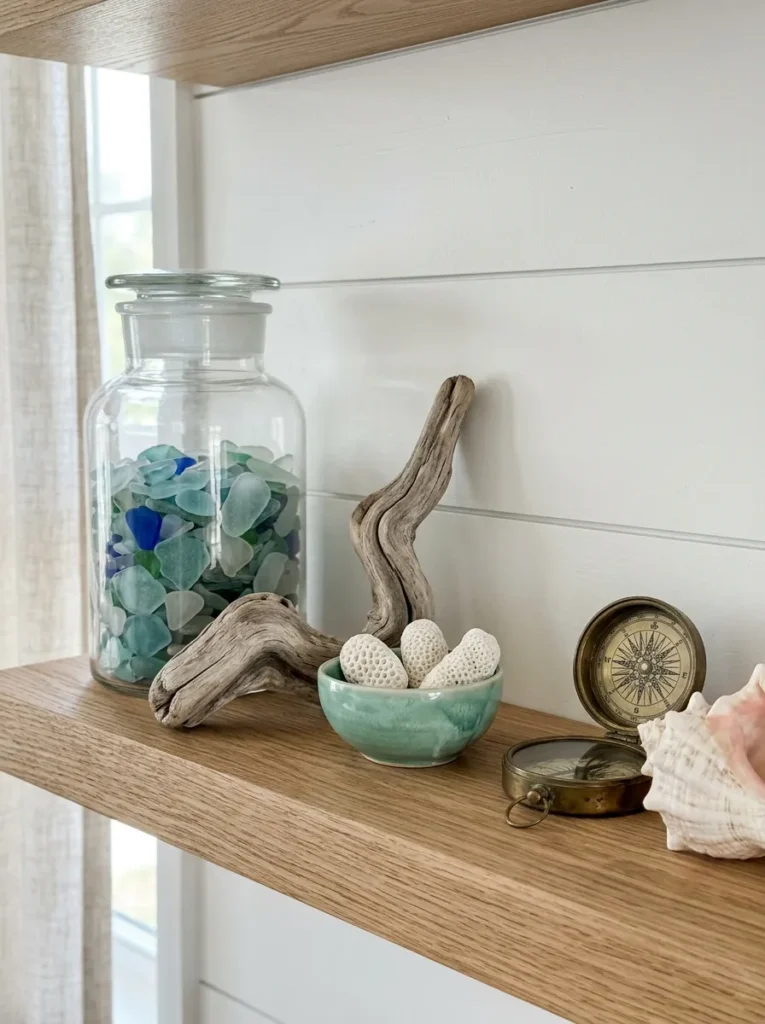
Vibe: Serene and collected — the shelf that tells the story of a life spent near water without saying a word.
Why it works: A curated sea glass and driftwood display applies the design principle of natural material collection as narrative decoration — the objects on this shelf are not purchased decorations but found objects, and that origin story gives the display an authenticity and personal resonance that no retail accessory can replicate. The design logic is object curation rather than object accumulation: each piece earns its place through its form, its texture, or its color contribution to the group, and generous negative space between groupings allows each piece to be seen and appreciated individually. The clear apothecary jar holding sea glass is both a storage solution and a display element — the glass catches and refracts light through the sea glass pieces in a way that makes the jar the most visually active element on the shelf.
How to get it: Organize collected coastal objects into three category groups — glass (sea glass, beach glass, driftwood fragments), organic structure (coral, shells, dried kelp forms), and functional antiques (brass compass, old nautical instruments, weathered glass floats) — and arrange in a composition of odd-numbered groupings with 6–8 inches of negative space between each group. Never place more than one “statement” object (the conch shell, the largest driftwood piece) per shelf — it needs the surrounding space to read as a statement rather than one item in a crowd.
| Product |
|---|
| Clear glass apothecary jar large with lid |
| Sea glass assorted colors collected set |
| Natural driftwood piece sculptural |
| Hand-thrown ceramic bowl seafoam glaze |
| Natural oak floating shelf wall mounted |
5. Coastal Kitchen with Subway Tile and Open Shelving
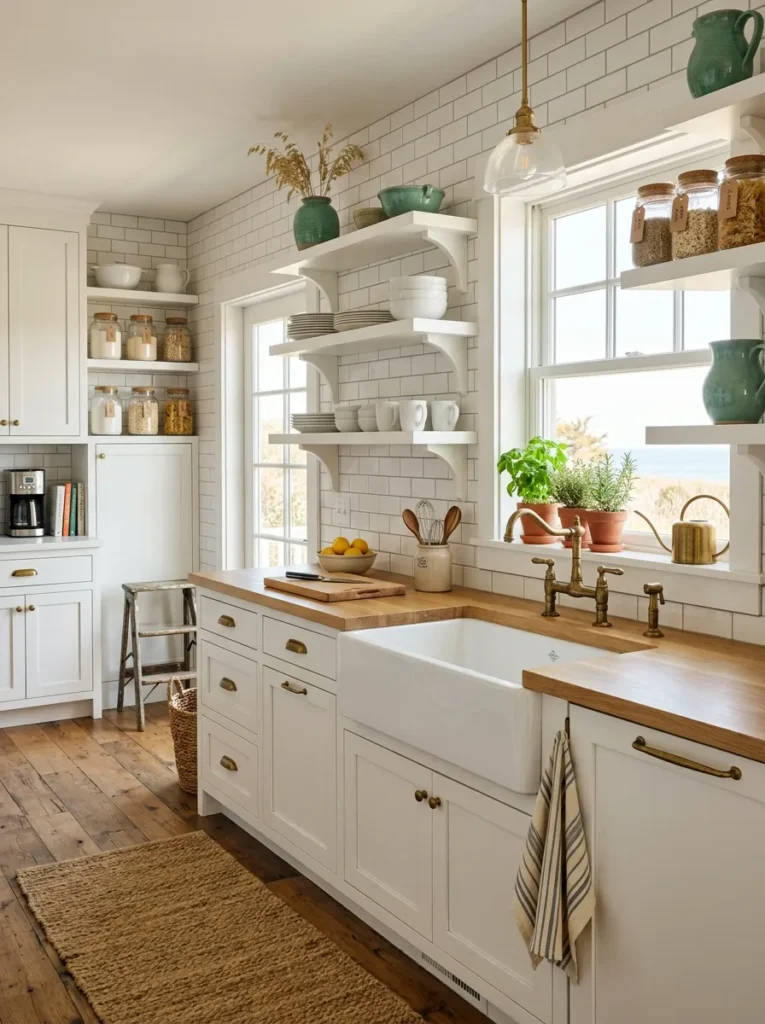
Vibe: Clean and warm — the kitchen that makes cooking feel like part of the vacation.
Why it works: A white subway tile backsplash with open wood shelving is the coastal cottage kitchen configuration that balances the style’s two competing demands — the need for a clean, practical cooking surface and the desire for a warm, collected, lived-in aesthetic. Subway tile satisfies the practical demand: it is easy to clean, highly durable, and visually recedes to let the collected ceramics and natural wood materials carry the room’s character. Open shelving satisfies the aesthetic demand: displayed ceramics, glass jars, and coastal pottery serve as the room’s decoration while remaining fully functional storage. The aged brass faucet provides the warm metallic accent that connects the kitchen’s clinical surfaces to the cottage’s organic material palette.
How to get it: Install white 3×6 subway tile in a classic horizontal brick pattern with a medium gray grout — grout color is the critical decision that most homeowners get wrong in coastal kitchens. White grout reads as sterile and shows staining immediately. Dark gray grout creates too strong a grid that dominates the backsplash. A medium warm gray (Mapei Warm Gray or similar) creates the shadow line that gives the classic subway pattern its definition without dominating the surface. Pair with natural white oak or butcher block countertops rather than white quartz — the wood warmth grounds the kitchen in the cottage’s natural material language.
| Product |
|---|
| White subway tile 3×6 ceramic set |
| Warm gray tile grout sanded |
| Farmhouse apron front sink white |
| Aged brass kitchen faucet single handle |
| Open wall shelf bracket set natural wood |
6. Natural Fiber Rugs Throughout
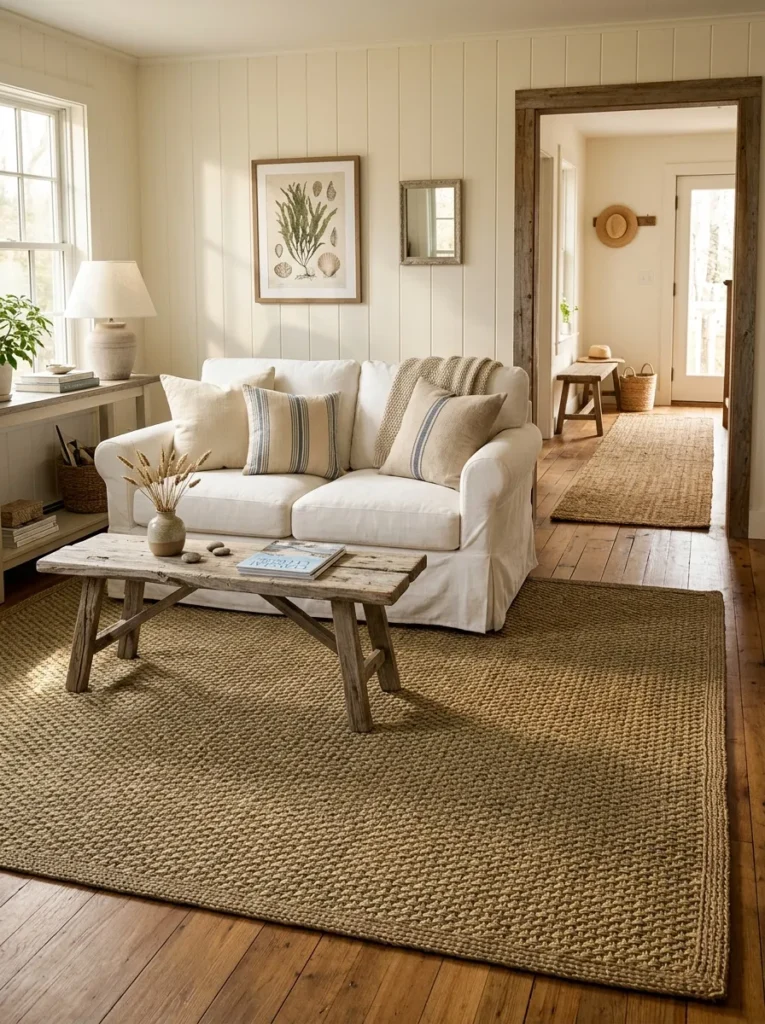
Vibe: Warm and grounded — the floor layer that connects a coastal room to the beach it references.
Why it works: Natural fiber rugs — seagrass, jute, sisal, and coir — are the floor covering that most authentically references coastal living because they are made from the same family of plants that grow in and around coastal ecosystems globally. Their natural tan-green tones match the color of dried beach grass, their woven texture resembles the weave of traditional fishing baskets and lobster traps, and their practical durability — natural fibers handle tracked-in sand far better than wool or synthetic pile rugs — makes them functionally appropriate as well as aesthetically correct. A seagrass rug in a coastal room works on every level simultaneously: it looks right, it feels right underfoot, and it performs correctly for the environment.
How to get it: Choose seagrass over jute for living areas that receive high traffic — seagrass is more water-resistant than jute and handles spills and humidity better in coastal environments. Size the rug to anchor the full seating arrangement — the front legs of all sofas and chairs should sit on the rug, with at least 18 inches of rug extending beyond the sofa front edge. A bordered seagrass rug with a simple cotton canvas border reads as more finished and intentional than an unbordered seagrass rug.
| Product |
|---|
| Natural seagrass area rug bordered 8×10 |
| Jute area rug natural woven 5×8 |
| Sisal rug with cotton border 6×9 |
| Natural fiber rug pad non-slip |
| Jute runner natural 2.5×8 hallway |
7. Bead Board Ceilings and Wainscoting
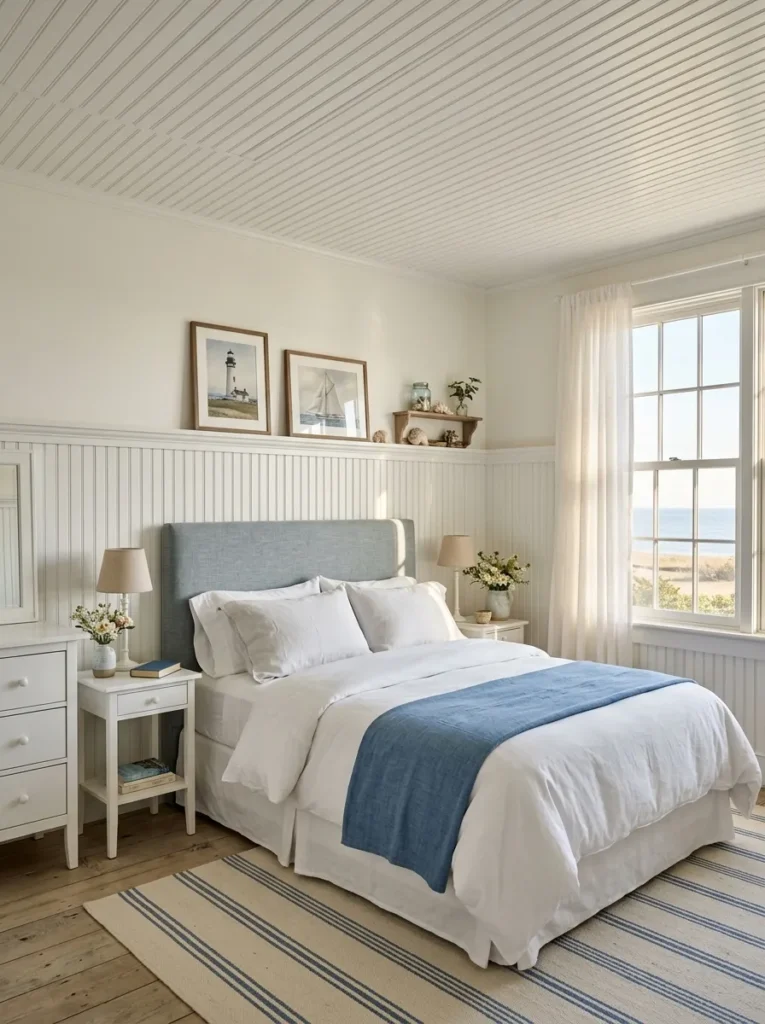
Vibe: Serene and bright — the bedroom that makes waking up feel unhurried.
Why it works: Bead board paneling — narrow tongue-and-groove boards with a rounded bead at each joint — is the historic interior wall and ceiling treatment of coastal cottage architecture, used in New England fishing cottages and Florida beach houses alike for over a century. The narrow vertical groove pattern of bead board adds surface texture to walls and ceilings that both references the vertical board construction of historic coastal buildings and creates a surface that diffuses light softly rather than reflecting it flatly. On ceilings specifically, painted white bead board adds the kind of quiet architectural interest that makes a low-ceilinged coastal cottage bedroom feel considered rather than cramped.
How to get it: Install bead board wainscoting to 36-inch chair rail height on all bedroom walls using pre-primed MDF bead board panels — 4×8 foot panels are the most installation-efficient format. Cap the top with a simple 1×3 chair rail in the same white as the bead board. Paint the wall above the chair rail in a soft gray-blue — Benjamin Moore Quiet Moments (AF-780) or Sherwin-Williams Rainwashed (SW 6211) — to create the traditional wainscot-above division that defines coastal cottage bedroom character.
| Product |
|---|
| Pre-primed MDF bead board panel 4×8 |
| Chair rail molding white primed |
| Soft gray-blue interior paint bedroom |
| White cotton percale duvet cover set |
| Blue linen throw blanket coastal |
8. Outdoor Shower Station with Cedar Surround
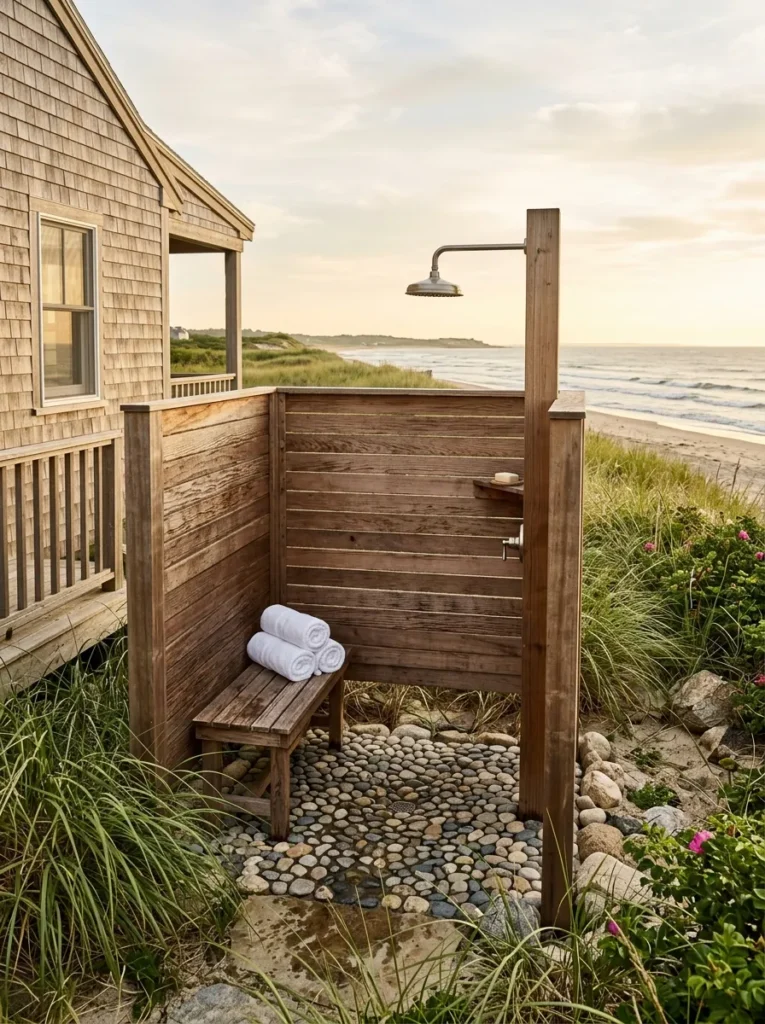
Vibe: Warm and fresh — the outdoor addition that makes coming back from the beach part of the pleasure.
Why it works: An outdoor cedar shower station beside a beach cottage is both a practical necessity and a design statement — the practical necessity of rinsing sand and salt before entering the house is transformed by a well-designed cedar surround into a ritual moment that extends the outdoor coastal experience rather than interrupting it. Cedar is the ideal material for this application: its natural oils provide inherent resistance to moisture, salt air, and UV exposure without any chemical treatment, and its warm honey-brown color weathers gradually to the silver-gray of driftwood — making the shower structure more beautiful as it ages rather than less. The horizontal slat configuration provides privacy while admitting ocean breezes and coastal light.
How to get it: Build the cedar surround from 1×4 or 1×6 western red cedar boards with 1-inch gaps between horizontal slats — the gap provides airflow that helps the cedar dry between uses, preventing mold and extending the wood’s life. Set posts in concrete or use post anchor brackets on a concrete pad base. Install a river stone pebble floor within the enclosure over a gravel drainage bed — the stones provide drainage while being comfortable and warm underfoot. A simple brushed nickel rain shower head on a tall cedar post provides the primary rinse without requiring complex plumbing.
| Product |
|---|
| Western red cedar fence board 1×6 |
| Outdoor rain shower head brushed nickel |
| River pebble stone floor tiles |
| Cedar bench outdoor natural oiled |
| Outdoor shower enclosure kit cedar |
9. Screened Sleeping Porch with Day Bed
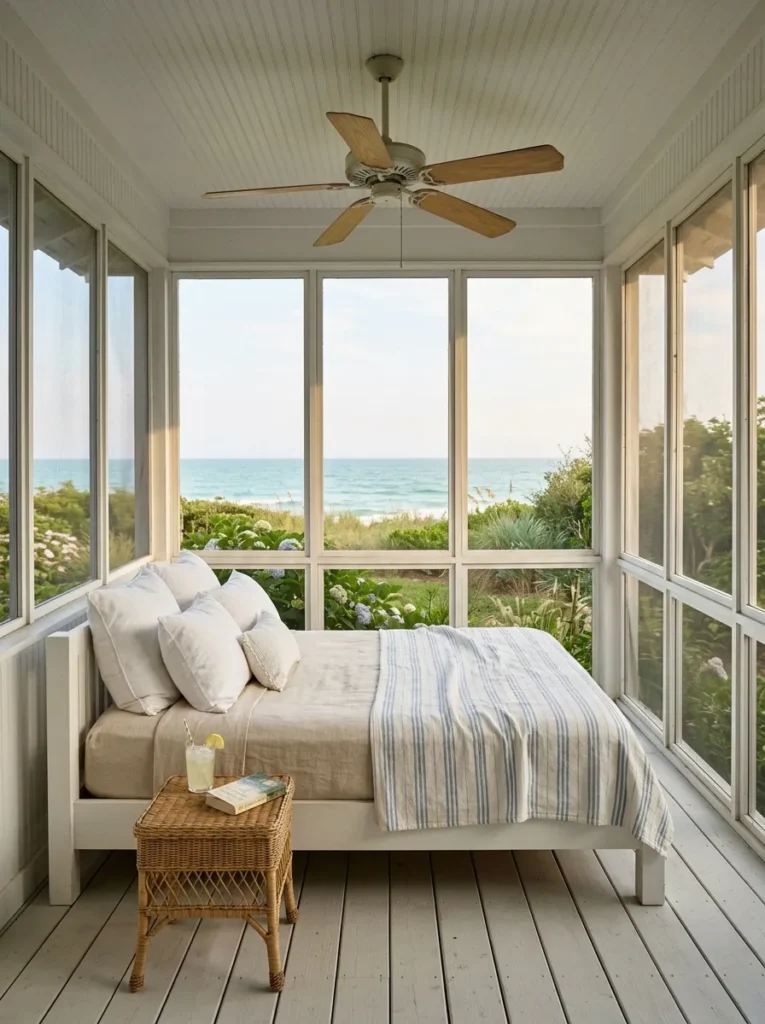
Vibe: Drowsy and serene — the porch that makes an afternoon nap feel like the most productive thing you could possibly do.
Why it works: The screened sleeping porch is the quintessential coastal cottage feature because it solves the fundamental tension of coastal summer living — the desire to sleep outdoors in warm salt air while protected from insects and weather. The screen panels admit every sensory quality of the coastal environment (breeze, sound, light, scent) while filtering out the elements that make outdoor sleeping impractical. A day bed on a sleeping porch rather than an outdoor chaise longue extends the porch’s usability from daytime lounging to genuine overnight sleeping, making it one of the most functionally versatile spaces in the cottage. The faded blue stripe blanket is the textile detail that most efficiently signals the coastal context — the stripe pattern references sailor and maritime textile traditions without any literal nautical iconography.
How to get it: Frame the sleeping porch with 2×6 structural lumber posts and headers, then fit fiberglass insect screen in aluminum framing between posts — fiberglass screen is more durable in coastal salt air than aluminum screen, which corrodes over time. Build or purchase a wide day bed frame (minimum 48 inches wide for adult sleeping comfort) in painted white wood or natural teak. Top with an outdoor-grade cushion at least 4 inches thick in a natural linen or Sunbrella fabric.
| Product |
|---|
| Fiberglass insect screen roll 36 inch wide |
| White painted wood porch day bed |
| Outdoor linen cushion daybed size |
| Faded blue stripe cotton blanket |
| Ceiling fan with natural wood blades |
10. Whitewashed Wood Floors Throughout
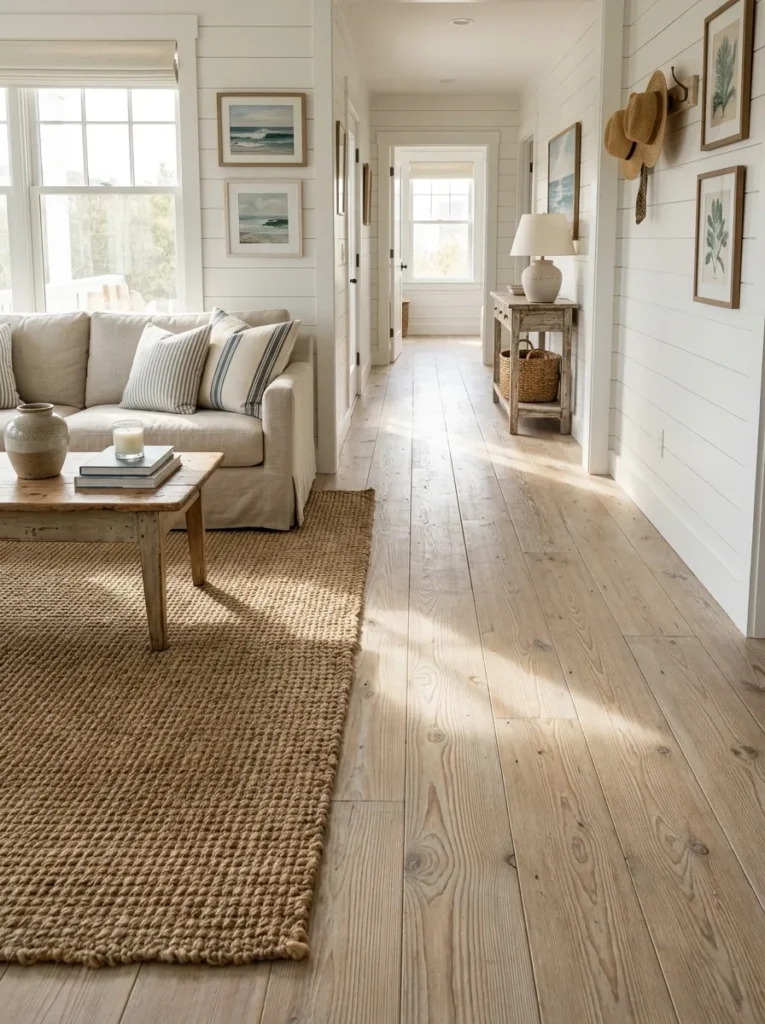
Vibe: Bright and bleached — the floor that makes every room feel like it is already on vacation.
Why it works: Whitewashed or lime-washed wood floors achieve the visual quality most essential to coastal cottage interiors — the bleached, sun-worn appearance of wood that has spent years in strong coastal light — without the visual heaviness of natural dark wood or the coldness of painted white floors. The specific quality produced by lime washing is grain transparency: the lime penetrates into the wood grain and sits in the open grain channels while remaining almost transparent on the grain ridges, creating a floor that reads as both white and natural simultaneously. Wide plank format (5 inches minimum, 8–12 inches for maximum coastal character) maximizes the visibility of the wood grain beneath the wash and minimizes the number of seams that interrupt the floor’s visual continuity.
How to get it: Apply lime wash or white pickling stain to raw or lightly sanded existing wood floors using a wide brush in long strokes following the wood grain. Work in 4-foot sections, applying the wash and immediately wiping back with a damp cloth to control the density of the white layer — more wipe-back produces a lighter, more transparent effect. Seal with a matte water-based polyurethane (two coats) for durability. On new floors, specify wide-plank pine, white oak, or Douglas fir rather than strip flooring — wider planks respond better to the whitewash technique and read more authentically as historic coastal cottage flooring.
| Product |
|---|
| Lime wash wood floor treatment white |
| White pickling stain wood floors |
| Wide plank white oak flooring 7 inch |
| Matte water-based floor polyurethane |
| Wide paint brush set floor staining |
11. Blue and White Ceramic Tile Bathroom
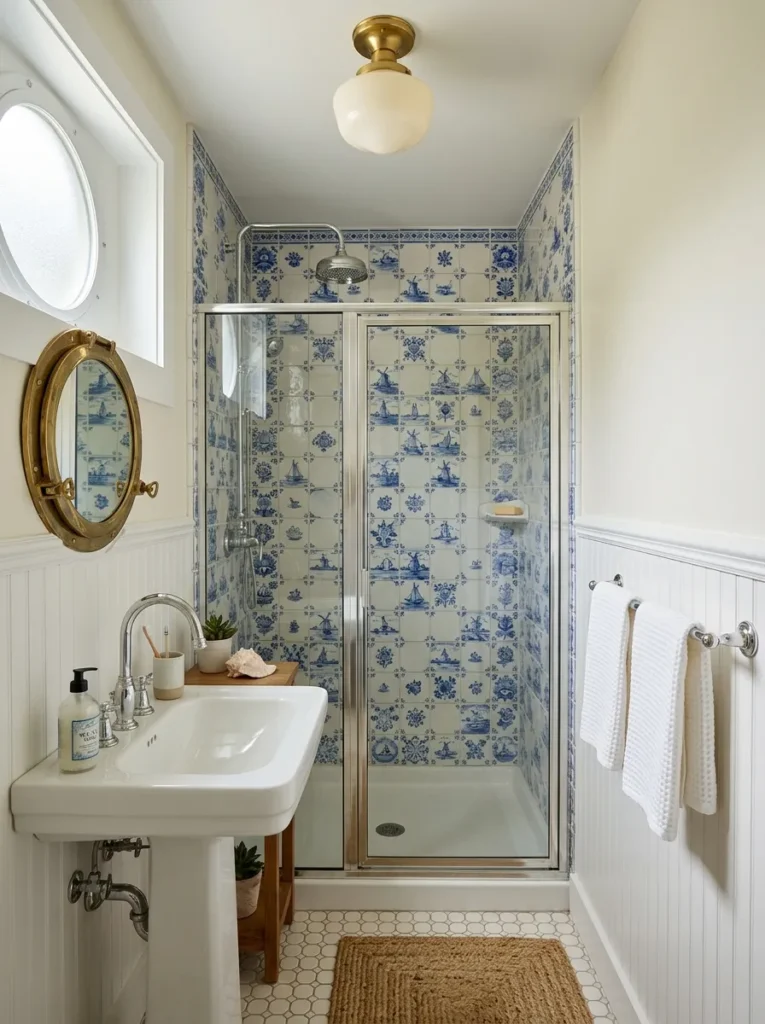
Vibe: Clean and charming — the bathroom that guests photograph and ask about.
Why it works: Blue and white ceramic tile in a coastal cottage bathroom references the oldest and most geographically widespread ceramic tradition in the world — the blue-and-white earthenware and porcelain produced in China, the Netherlands, Portugal, and Turkey over five centuries — while connecting directly to the coastal color palette through the blue’s association with ocean and sky. In a small cottage bathroom, blue and white tile creates enough visual interest to make the space feel complete without additional decoration — the tile is simultaneously the functional surface, the color palette, and the room’s decorative statement. A round porthole mirror above a pedestal sink extends the maritime reference with restraint — a single iconic form rather than a collection of nautical motifs.
How to get it: Use hand-painted blue and white tile on the shower walls only — floor-to-ceiling patterned tile in a small bathroom creates visual overwhelm that conflicts with the cottage’s relaxed atmosphere. Pair with a simple white subway or white fish scale tile on the shower floor and any remaining wall areas to balance the patterned tile visually. The porthole mirror should be a genuine circular form — 20–24 inches in diameter — rather than an oval or arch shape that merely suggests the porthole form.
| Product |
|---|
| Blue and white hand-painted ceramic tile set |
| White pedestal sink classic style |
| Round porthole mirror 22 inch brass frame |
| Chrome vintage style bathroom faucet |
| White cotton waffle weave towel set |
12. Rattan and Cane Furniture Throughout
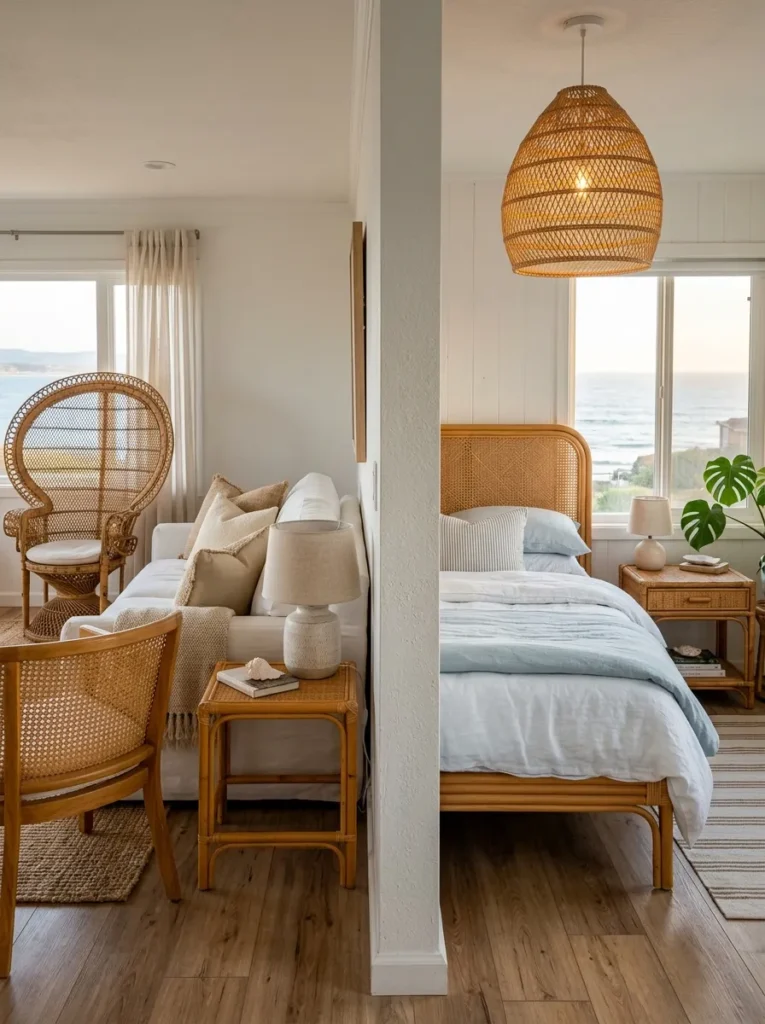
Vibe: Warm and relaxed — the furniture that makes a room feel like it has been slowly accumulating the right things for decades.
Why it works: Rattan and cane furniture belongs in coastal cottage interiors on every functional and aesthetic level — the materials are literally derived from tropical coastal plant species, they are lightweight enough to be rearranged easily for social flexibility, their open woven structure allows air circulation in warm coastal climates, and their warm honey tone sits perfectly in the coastal palette between the white walls and the natural fiber rugs. The peacock chair specifically — with its dramatically scaled fan back — provides the one moment of furniture-as-sculpture that every coastal cottage interior needs: a piece whose form is bold enough to hold a corner of the room visually without any additional decoration around it.
How to get it: Mix rattan and cane across multiple furniture categories rather than purchasing a matching set — a rattan armchair beside a white linen sofa, a cane-back dining chair at a bleached wood table, a rattan pendant lamp above a linen bed — to achieve the accumulated, collected character of an authentic beach cottage rather than the showroom-matched look of a themed interior. Natural honey rattan reads as warm and organic; avoid dark-stained rattan, which reads as heavy and dated in a coastal context.
| Product |
|---|
| Natural rattan peacock chair indoor |
| Cane back accent chair natural honey |
| Rattan side table with shelf |
| Rattan woven pendant lamp shade |
| Cane headboard queen natural finish |
13. Dutch Door Entry for Coastal Breeze
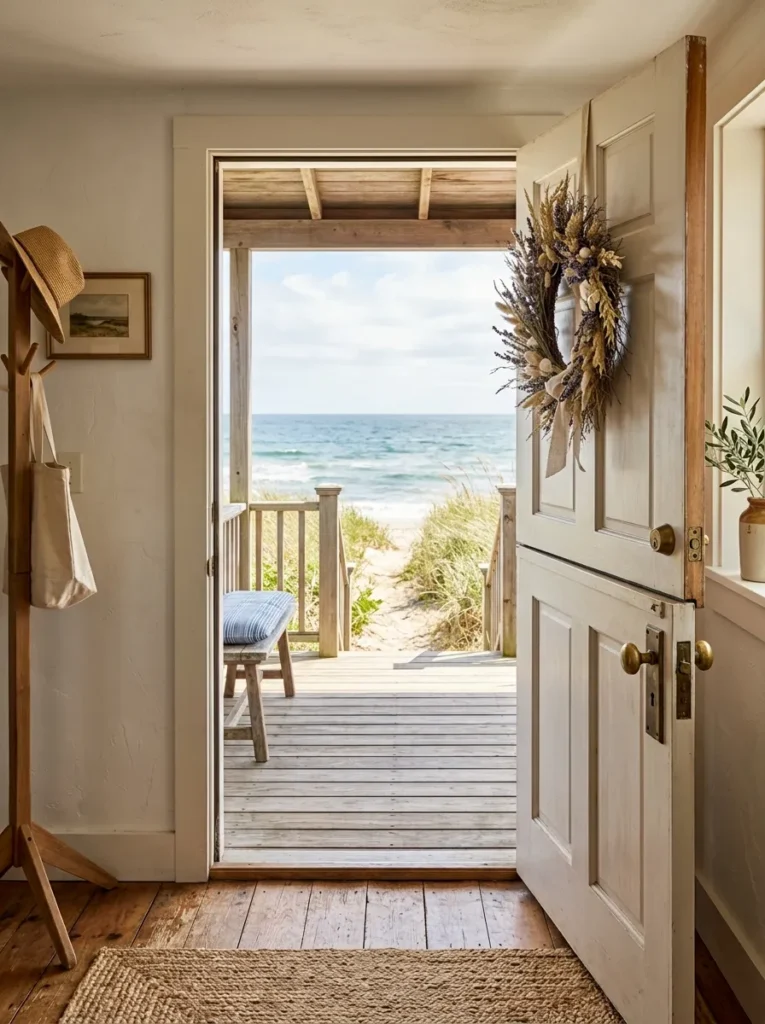
Vibe: Open and inviting — the door that makes a home feel like it is always expecting you.
Why it works: The Dutch door is the most functionally perfect entry solution for coastal cottage living because it solves the specific tension of beach house daily life — the need to let in breeze and light while keeping sand, pets, and small children in their appropriate zones. With the upper half open, the cottage entry becomes a conduit for coastal air, sound, and light that a solid door cannot provide. The split door also creates a framing device — the open upper half acts as a picture frame for whatever coastal view lies beyond the porch, transforming the act of entering the house into a moment of architectural anticipation. Aged brass hardware on a white Dutch door is the detail combination most associated with authentic New England and Southern coastal cottage character.
How to get it: Dutch doors can be purchased as pre-hung units or converted from existing solid doors by cutting an existing door horizontally at mid-height and adding a second set of hinges and a separate handle-and-latch set for the upper section. For coastal climate installations, specify a fiberglass Dutch door rather than solid wood — fiberglass is dimensionally stable in high-humidity coastal environments and will not swell or warp with seasonal moisture changes. Paint in Benjamin Moore White Dove (OC-17) or Sherwin-Williams Alabaster (SW 7008).
| Product |
|---|
| Dutch door fiberglass pre-hung white |
| Aged brass door hardware set knob latch |
| Dried botanical door wreath coastal |
| Door threshold weather strip coastal |
| Dutch door conversion kit hardware |
14. Coastal Color Palette — Sand, Seafoam, and Sky
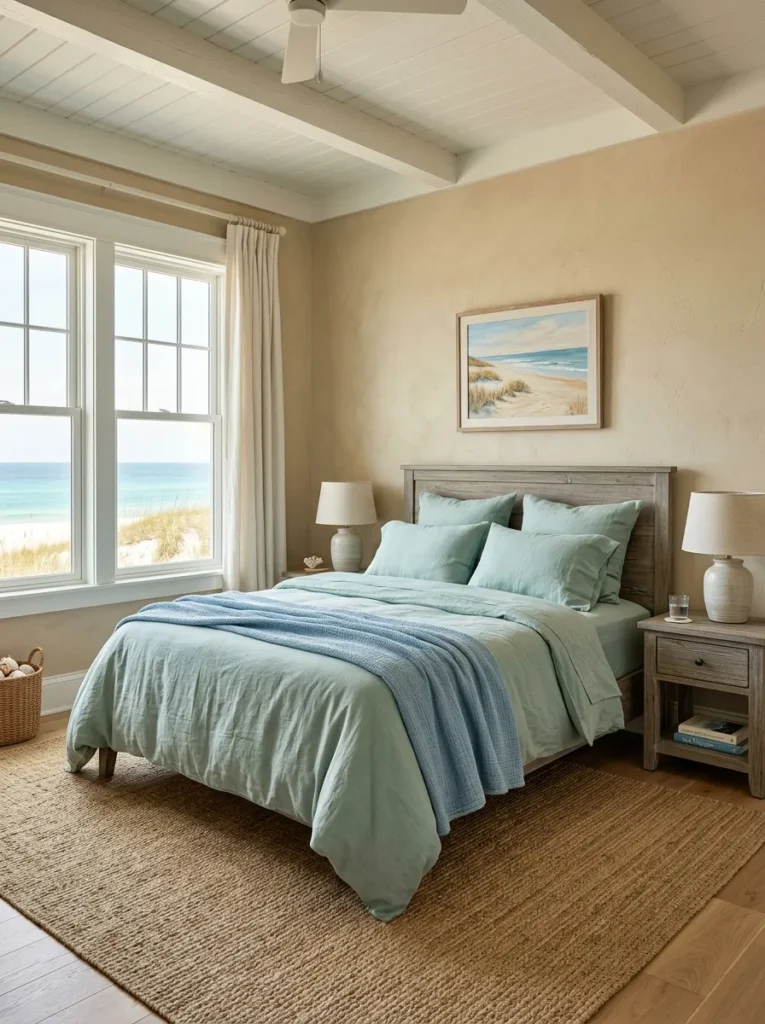
Vibe: Warm and serene — the bedroom that feels like sleeping inside a sunset.
Why it works: The coastal color palette of sand, seafoam, and sky works in interior design for the same reason it works at the beach: the three tones are naturally analogous — all carrying the same warm-cool balance, the same mid-range saturation, and the same quality of being colors that exist in strong natural light rather than in artificial interior conditions. Sand and seafoam are warm-neutral and warm-green respectively, sharing the same yellow-green undertone family. Sky blue is the cool complement that prevents the warm palette from reading as merely beige. Together, the three colors create a room that reads as simultaneously warm and fresh — the defining quality of a successful coastal interior.
How to get it: Paint walls in Sherwin-Williams Accessible Beige (SW 7036) or Benjamin Moore Sand Dollar (OC-30) for the warm sand tone. Specify seafoam in a linen fabric rather than a painted surface — the color works best as a soft furnished element rather than a wall color. Use sky blue exclusively as an accent throw, pillow, or artwork element — at full wall intensity, sky blue overwhelms the sand-seafoam foundation rather than complementing it.
| Product |
|---|
| Warm sand interior wall paint |
| Seafoam green linen duvet cover set |
| Sky blue linen throw blanket |
| Oyster white trim paint satin finish |
| Driftwood gray nightstand natural wood |
15. Metal Roof with Ceiling Fan Porch
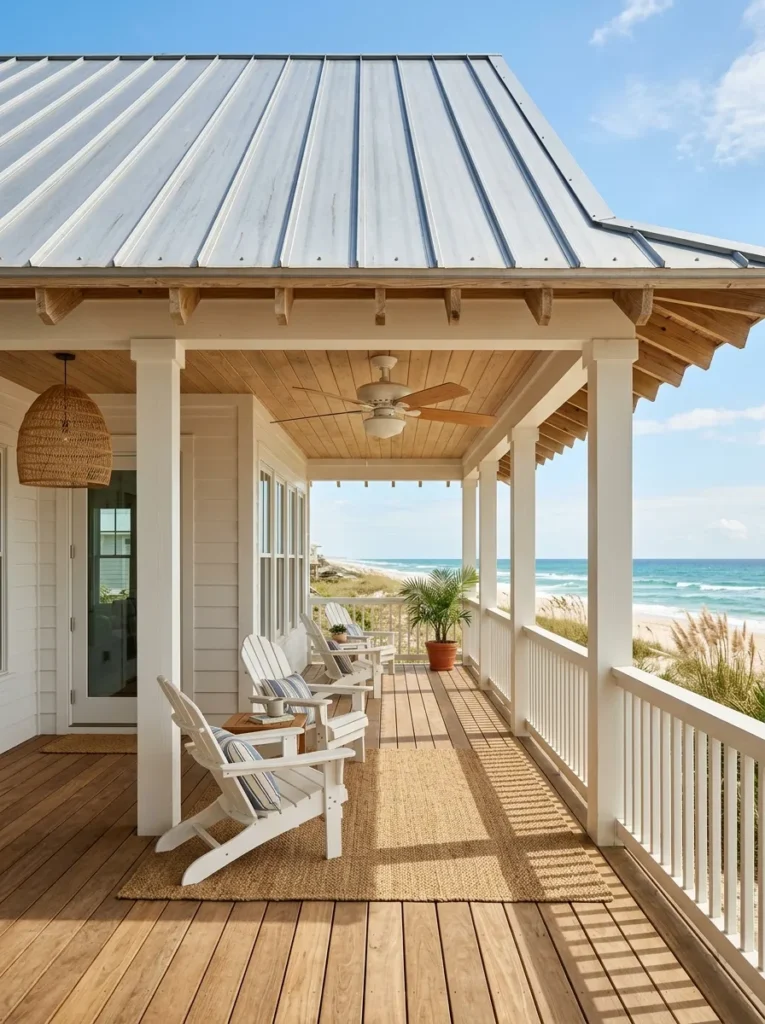
Vibe: Warm and sheltered — the porch under a metal roof that makes you want to sit out in the rain.
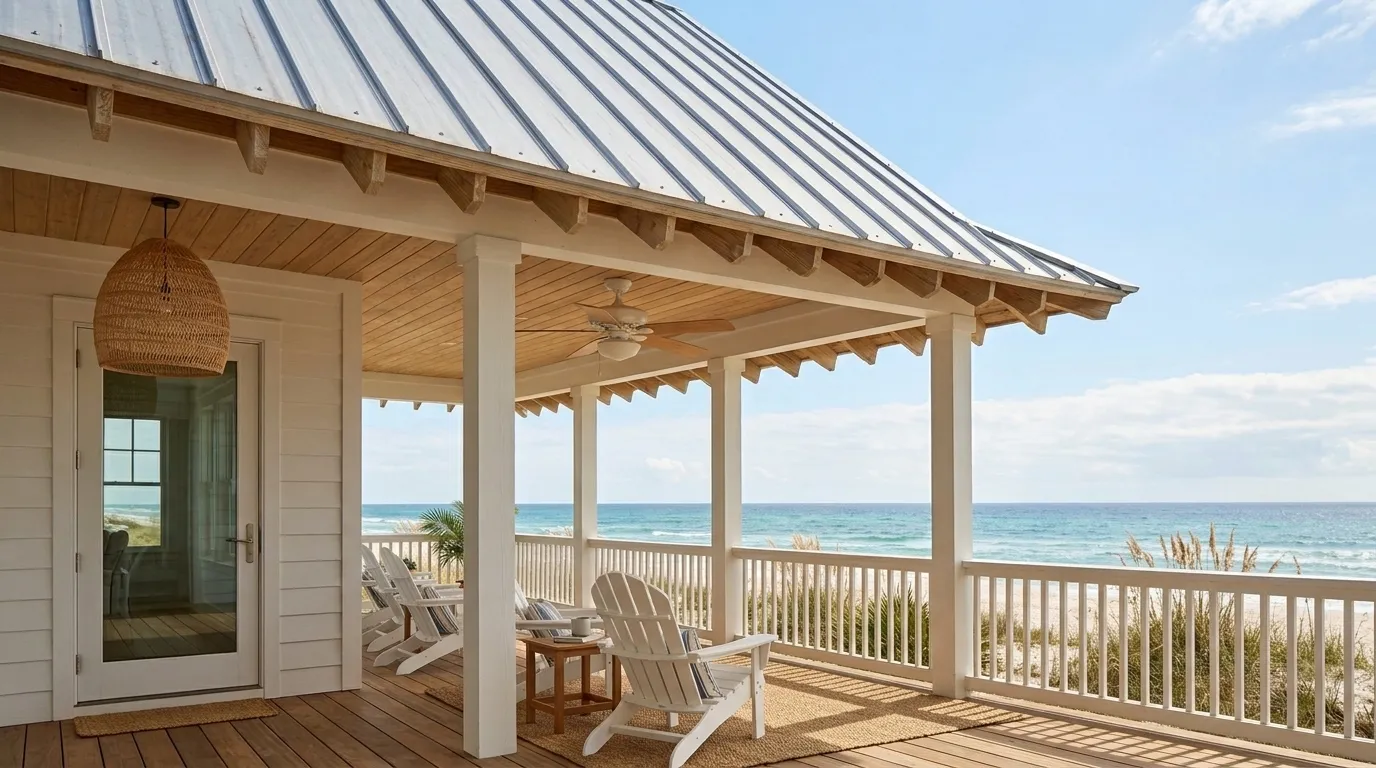
Why it works: A standing seam metal roof is the most historically authentic and climatically appropriate roofing material for coastal cottage architecture — its longevity in salt air and high-wind conditions far exceeds asphalt shingle, its heat reflectivity reduces cooling loads in warm coastal climates, and the sound of rain on a metal roof is one of the most universally beloved sensory experiences associated with cottage living. On a porch specifically, the metal roof’s low-pitch profile and visible rafter tail details at the eave line create an architectural expression that reinforces the cottage character far more than a simple flat soffit ceiling. The ceiling fan beneath the metal roof porch is the comfort element that extends the porch’s usability through the hottest coastal summer days.
How to get it: Specify Galvalume or pre-weathered Corten standing seam metal roofing for coastal installations — standard galvanized steel corrodes in salt air environments within 10–15 years, while Galvalume and Corten develop a protective patina that extends their coastal life to 40–60 years. Install with exposed natural wood rafter tails visible at the porch eave rather than boxing in the rafter ends — the visible structural members are the detail that most effectively communicates the cottage’s architectural character.
| Product |
|---|
| Standing seam metal roof panel Galvalume |
| Outdoor ceiling fan damp-rated natural blades |
| White painted porch column set 8 ft |
| Adirondack chair set white painted wood |
| Rattan pendant light outdoor rated |
16. Coastal Bedroom with Linen and Driftwood
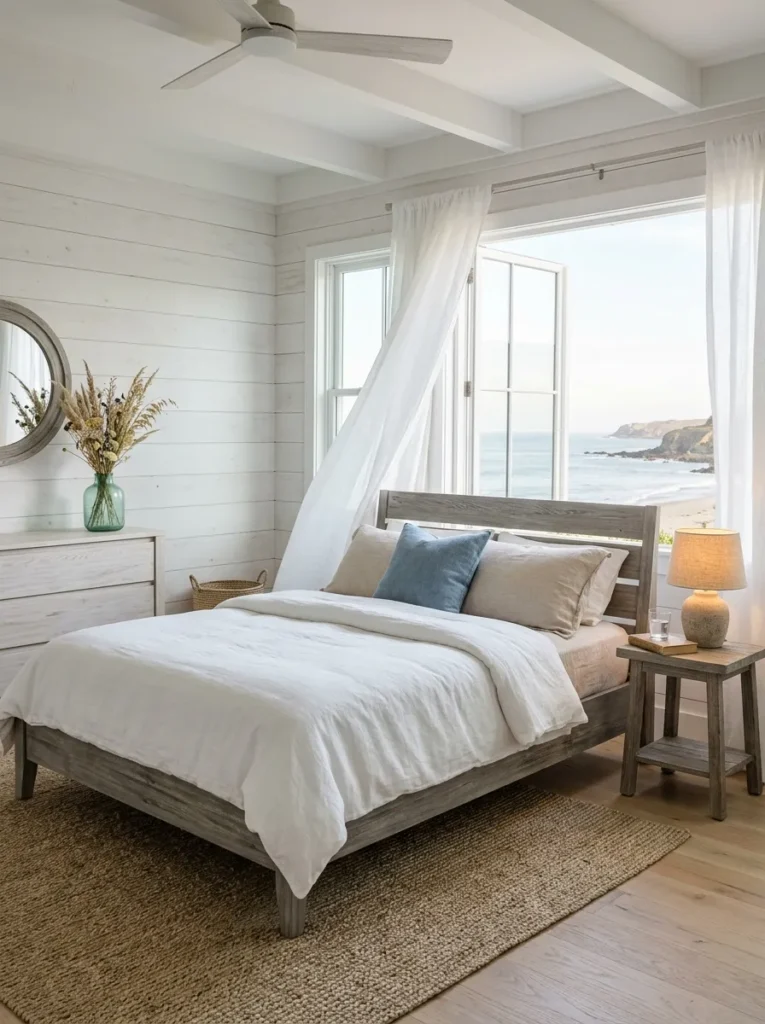
Vibe: Serene and breathable — the bedroom that makes sleep feel restorative before you even close your eyes.
Why it works: A coastal bedroom built around linen and driftwood finishes achieves the most sophisticated expression of the beach cottage aesthetic because it translates the material language of the shoreline into bedroom furnishing without a single literal coastal reference. The driftwood-finish bed — a weathered gray-brown that replicates the color and texture of wood worked by salt water and sun — connects directly to the natural material found on any beach without being a piece of actual driftwood. White linen bedding carries the texture and warmth of natural fiber while the unwashed, slightly irregular weave surface reads as organically coastal rather than hotel-crisp. The single faded blue linen pillow provides the coastal color note that confirms the room’s identity while the rest of the palette stays within the warm neutral range.
How to get it: Achieve driftwood finish on a wood bed frame using a multi-step technique: apply a base coat of gray-brown paint (mix equal parts warm gray and raw umber acrylic), allow to dry, dry-brush a lighter warm gray over the surface following the wood grain direction, then sand very lightly with 220-grit sandpaper to reveal the base coat in recessed areas. The result replicates the two-tone weathered quality of genuine driftwood more convincingly than any single-color gray stain. Top with white linen duvet from a brand that uses unwashed rather than preshrunk linen — the slight irregular drape of unwashed linen beds better than perfectly flat preshrunk versions and reads as more authentically coastal.
| Product |
|---|
| Driftwood finish platform bed queen |
| White linen duvet cover natural fiber |
| Natural linen pillow sham set |
| Faded blue linen throw pillow |
| Sea glass green ceramic vase |
How to Start Your Beach Cottage Coastal Style Transformation
Start with shiplap on one wall. Before repainting, refurnishing, or replacing any flooring, install or apply a shiplap treatment to the single most visible wall in your main living space — the wall behind the sofa, the bedroom wall behind the headboard, or the entry wall that greets you when you walk in. This one surface change establishes the entire material character of the coastal cottage aesthetic in a room and makes every subsequent decision — furniture, color, textiles — easier and more accurate because it gives you the room’s foundational material register to work from. Shiplap on one wall costs $80–$200 in materials and one afternoon to install, and it changes the room more than any furniture purchase at ten times the price.
The most common mistake people make when attempting coastal cottage style is defaulting to the nautical cliché palette — saturated navy and white stripes, red buoys, rope-wrapped accessories, anchor motifs — which references maritime decoration rather than actual coastal cottage architecture and produces a result that reads as themed rather than authentic. The specific quality that distinguishes genuine coastal cottage style from nautical decoration is palette restraint: real coastal cottage interiors use the bleached, sun-worn, salt-washed version of every color — warm white rather than bright white, washed sage rather than kelly green, faded sky rather than cobalt navy — because these are the colors that actually exist in a coastal environment after years of weather and strong light. Replace every saturated color choice with its sun-bleached equivalent and the room immediately gains the authenticity that nautical cliché lacks.
Three items under $50 that make an immediate impact: A natural seagrass area rug in the living room ($35–$45 for a smaller size) that grounds the room in the coastal material palette and replaces the most common wrong choice in coastal interior attempts — a blue and white striped synthetic rug that reads as nautical theme rather than coastal material; a set of white sheer linen curtain panels ($28–$38) that replaces any existing opaque or synthetic window treatment with the light-filtering quality most essential to coastal cottage atmosphere; and a large clear glass apothecary jar filled with collected or purchased sea glass ($8–$15 for the jar, $10–$20 for a sea glass collection) that creates an instant coastal vignette on any shelf or windowsill.
Realistic expectations: A single-room coastal cottage refresh — shiplap accent wall, natural fiber rug, linen curtains, and a collected object vignette — takes one weekend and typically costs $150–$350 in materials. A mid-level cottage interior transformation adding whitewashed floors, bead board wainscoting, rattan furniture, and a full coastal palette throughout a main living area typically costs $600–$1,200 DIY over two to three weekends. A full cottage exterior and interior transformation — clapboard painting, porch furniture, Dutch door, shiplap walls, whitewashed floors, and a complete coastal furnishing scheme — ranges from $3,000–$8,000 DIY for a small to medium cottage, representing significant savings compared to professionally designed and renovated coastal cottage interiors, which typically begin at $15,000–$25,000 for equivalent scope.
Frequently Asked Questions About Beach Cottage Coastal Style
What is the difference between coastal style and nautical style in home decor?
Coastal style draws its design language from the architecture, materials, and natural environment of actual coastal communities — shiplap walls, whitewashed wood, natural fiber rugs, rattan furniture, driftwood, sea glass, and a bleached, sun-worn color palette that references the beach’s actual colors rather than representing them symbolically. Nautical style is a themed decorating approach that uses marine iconography — anchors, rope, compasses, sailor stripes, buoys, lighthouses, and ship wheels — to symbolically represent the sea without necessarily referencing authentic coastal building traditions. Coastal style is architectural and material; nautical style is decorative and symbolic. The most sophisticated coastal interiors contain no nautical accessories whatsoever — the coast is present entirely through materials, palette, and light.
What colors define the authentic coastal cottage palette?
The authentic coastal cottage palette is built from the specific tones produced when the beach environment’s primary colors are weathered and bleached by years of salt air and strong coastal light. These are: warm white (not blue-white — a white with yellow or pink undertone like Benjamin Moore White Dove OC-17), driftwood gray (a warm gray-brown with visible wood grain beneath, not cool blue-gray), seafoam green (a warm, slightly gray green like Sherwin-Williams Sea Salt SW 6204, not saturated green), warm sand (the color of dry beach sand, approximately Sherwin-Williams Accessible Beige SW 7036), and soft sky blue (a pale, slightly gray blue like Benjamin Moore Breath of Fresh Air 806, not cobalt or navy). Saturated versions of any of these colors read as nautical theme rather than coastal authenticity.
How do I achieve coastal cottage style in an inland home with no ocean views?
Coastal cottage style is a material and spatial aesthetic that does not require ocean views or coastal proximity to be convincing — it is achieved entirely through interior material choices. The four most impactful material decisions for a landlocked coastal cottage interior are: shiplap or bead board wall paneling in warm white (the defining architectural surface of the style), natural fiber floor coverings in seagrass or jute (the defining floor texture), white linen slipcovers on upholstered furniture (the defining textile), and collected natural object displays — sea glass, driftwood, shells — on open shelving (the defining accessory category). These four elements create a complete coastal cottage material environment regardless of what is visible through the windows.
What furniture materials are most appropriate for beach cottage interiors?
The furniture material hierarchy for authentic coastal cottage interiors is: natural rattan and cane first (the defining furniture material of the style — lightweight, airy, warm-toned, and genuinely connected to coastal plant ecology), painted white wood second (the historic furniture finish of coastal cottage bedrooms and dining rooms — simple forms in white paint read as clean and unpretentious), slipcover linen upholstery third (the only upholstered furniture finish that reads as genuinely coastal — the slight imprecision of a slipcovered sofa is part of its cottage character), and reclaimed or whitewashed timber fourth (for coffee tables, dining tables, and shelving where natural wood character is more appropriate than paint). Avoid: leather (too urban and formal), dark stained wood (too heavy for the bleached coastal palette), and chrome or glass (too contemporary and commercial for the vernacular cottage character).
How do I make a small beach cottage feel larger without structural changes?
The five design moves that most effectively expand the perceived size of a small beach cottage without structural work are: whitewash or lime-wash the floors in warm white (light floors make any room appear 30–40% larger than dark floors through light reflection); install shiplap horizontally on the longest wall (horizontal lines visually widen narrow rooms); replace any solid window treatments with white sheer linen panels that allow full natural light diffusion (natural coastal light is the most effective room-expander available); use one large natural fiber rug rather than multiple small rugs (a single large rug anchors the room as one unified space rather than fragmenting it into smaller visual zones); and keep walls and large furniture in the same warm white family (tone-on-tone rooms appear significantly larger than rooms with high contrast between walls and furniture because the eye cannot easily distinguish where one surface ends and another begins).
Ready to Create Your Dream Beach Cottage Coastal Style?
These 16 ideas span the complete range of what coastal cottage style can achieve — from the foundational architectural decisions of clapboard exteriors and shiplap walls to the sensory details of an outdoor cedar shower, a screened sleeping porch, and a bedroom where linen curtains move in a salt breeze. Every coastal transformation begins with a single material decision, and shiplap on one wall this weekend is a complete and meaningful first step — not a preliminary gesture toward something grander, but a genuine beginning that establishes the material character from which every subsequent design decision will flow naturally. Right now, look at the most prominent wall in your living room or bedroom and ask whether it carries any of the warmth, texture, and material honesty that makes a coastal cottage feel like a coastal cottage — if it does not, that is where you begin. Save the ideas that match your space, your budget, and the version of the coast that lives most vividly in your memory, and start building toward it from that first wall.