14 Modern Bathroom Designs That Look Luxurious
A modern luxurious bathroom is a designed bathing environment that uses material quality, spatial discipline, lighting precision, and finish coherence to create the sensory experience of a high-end hotel or spa — regardless of the room’s actual footprint or budget — by concentrating investment in the decisions that most determine perceived quality and eliminating expenditure on elements that contribute minimally to the room’s experiential richness. This article gives you 14 genuinely creative, achievable modern bathroom designs that deliver the visual and sensory quality of luxury at every budget level, from a rental apartment refresh to a complete architectural renovation.
Most attempts at a luxurious bathroom fail not because the budget is insufficient but because the budget was concentrated in the wrong places — an expensive freestanding bath in a room with poor lighting, quality tiles undermined by cheap tapware, a beautiful vanity beside an unresolved ceiling. The bathrooms in this list spend the design budget with precision, knowing that five considered decisions produce more genuinely luxurious results than fifteen undirected purchases. Here are 14 ideas worth saving — and designing.
Why Modern Luxury Bathroom Design Works So Well
The psychology of perceived luxury in a bathroom is more specifically studied than in any other domestic room because the hospitality industry — hotels, spas, and resorts — has invested substantially in understanding exactly which design qualities produce the perception of luxury in bathing environments and which do not. The research consistently identifies that bathroom luxury perception is driven primarily by three qualities: material coherence (the sense that all surfaces in the room belong to the same material family and tonal register, creating a unified material experience rather than a collection of independent finish choices), lighting warmth and control (the presence of warm, dimmable light sources that make the room feel intimate and spa-like rather than clinical and bright), and spatial discipline (the restraint to leave counter surfaces, floor areas, and visual fields clear of objects that would make the room feel cluttered regardless of the individual quality of those objects).
The materials that most reliably produce a luxurious bathroom aesthetic at accessible price points are those whose visual quality is determined by natural variation and tactile richness rather than by manufacturing cost alone. Large-format stone-look porcelain tiles — available at $30–80 per square meter — are visually indistinguishable from genuine marble or limestone at normal bathroom observation distances, and their practical advantages (imperviousness to water, resistance to staining, dimensional stability) make them superior to genuine stone in a high-humidity bathroom environment. Matte black and brushed brass tapware are the finish choices that most reliably elevate a bathroom’s perceived quality because they read as selected and deliberate rather than as the default chrome that signals a builder’s specification. Timber-effect vanity cabinetry in a warm oak or walnut tone introduces the material warmth that hard, reflective bathroom surfaces alone cannot provide.
The contemporary luxury bathroom aesthetic has been shaped by three converging influences: the European spa tradition (particularly the Nordic and Japanese bathing cultures that have informed the wellness design movement), the hospitality design industry (which has progressively raised the baseline expectation for bathroom quality across all market segments), and the social media design community (which has made editorial-quality bathroom photography one of the most-shared categories of interior design content globally). The intersection of these three influences has produced the contemporary luxury bathroom aesthetic: large-format stone-effect tile, matte black or brushed brass hardware, a freestanding or wall-mounted bath, deep soaking or walk-in shower, warm ambient lighting, and a restrained material palette of two to three finishes throughout.
Small bathrooms benefit specifically from the luxury bathroom design approach because the principles that create perceived luxury — material coherence, spatial discipline, lighting quality — are all more achievable and more impactful in a small bathroom than in a large one. A small bathroom with genuinely beautiful large-format tiles, correct tapware finishes, and well-designed lighting will consistently feel more luxurious than a large bathroom with poor material coherence and inadequate lighting.
Style at a Glance
| Element | Detail |
|---|---|
| Philosophy | Five considered decisions produce more genuinely luxurious results than fifteen undirected purchases — identify the decisions that most determine perceived quality and concentrate investment there |
| Key Materials | Large-format stone-look porcelain, honed marble, warm timber vanity, matte black and brushed brass hardware, frameless glass, warm stone mosaic |
| Three Principles | Material coherence, lighting warmth and control, spatial discipline |
14 Modern Luxury Bathroom Designs
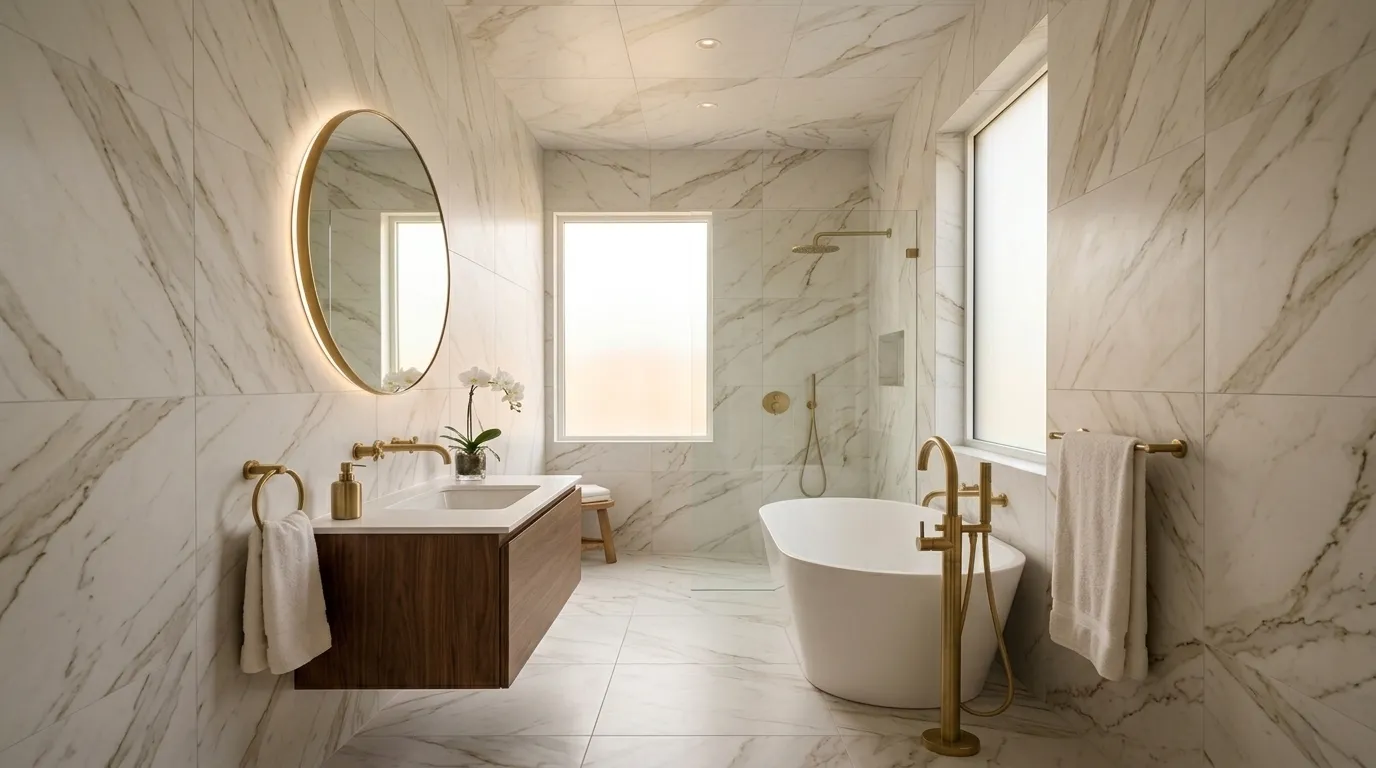
1. Floor-to-Ceiling Marble-Look Porcelain with Brass Hardware
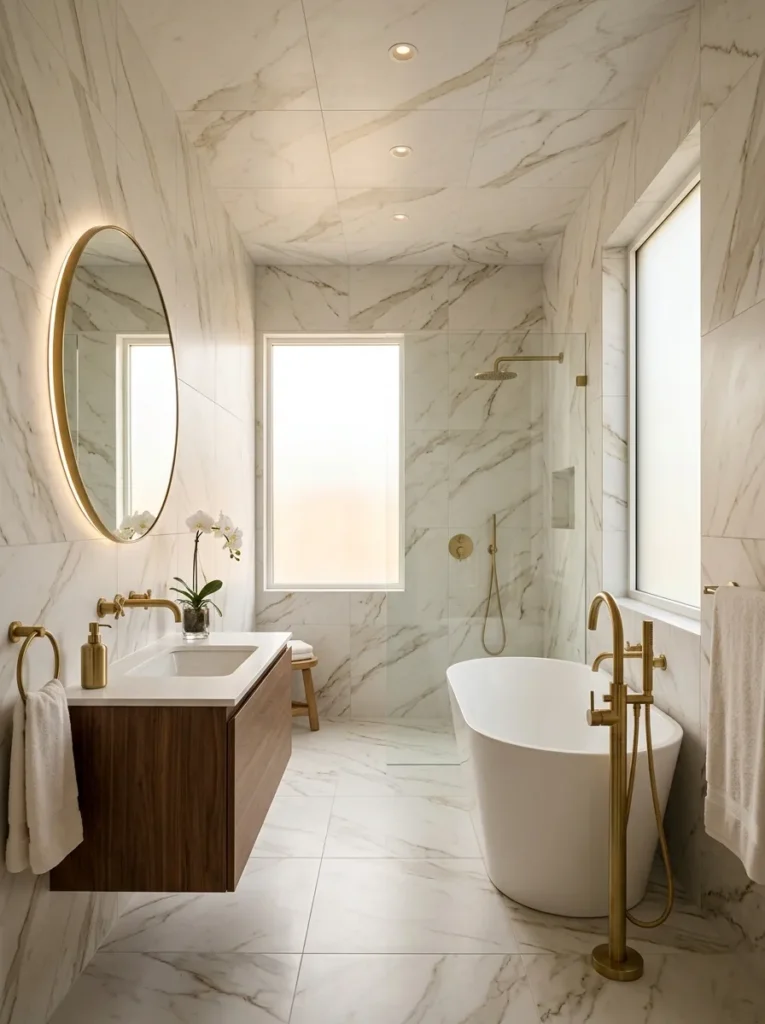
Vibe: Warm and seamlessly luxurious — the bathroom that makes every morning feel like the first morning of an expensive holiday.
Why it works: Floor-to-ceiling tile in a single large-format marble-look porcelain is the single bathroom renovation decision with the highest perceived luxury return per square meter — it creates the material continuity of a stone-clad room without the cost or maintenance complexity of genuine stone. The critical design specification is the absence of any tile break or border between the floor tile and the wall tile — when the same tile runs continuously from floor to ceiling without interruption, the room reads as a unified stone environment rather than a tiled room, and this reading is the specific quality that creates the genuine hotel bathroom experience. The brushed brass hardware throughout compounds this material coherence: brushed brass on every functional element — mixer, shower head, soap dispenser, towel hook — creates the unified metallic register that reads as deliberately specified rather than randomly assembled.
How to get it: Specify the same tile on floor and walls — the floor tile must be specified in the slip-resistant surface finish (R10 or R11 rating) version of the same visual pattern used on the walls, or use the same tile on both but apply a slip-resistant treatment to the floor area. Large-format tiles (1200mm × 600mm or larger) require precision substrate leveling and professional installation — minor substrate inconsistencies that are invisible under small format tiles become visible lippage problems under large format tiles. Source brushed brass tapware as a complete set from a single manufacturer (Brodware, Astra Walker, or Watermark are all quality Australian suppliers; Vola, Dornbracht, and Kohler Purist are quality international alternatives) to guarantee finish consistency across all hardware pieces.
Quick Win: Replacing a standard chrome basin mixer and toilet roll holder with brushed brass equivalents ($80–200 per piece) in an otherwise unremarkable bathroom immediately introduces the warm metallic quality that signals designed rather than specified — the single most cost-effective luxury bathroom upgrade available without any structural or tiling work.
Shop the Look
| Product |
|---|
| Calacatta marble look porcelain 1200×600 |
| Brushed brass basin mixer |
| Brushed brass shower mixer concealed |
| Brushed brass floor standing bath filler |
| White undermount basin |
Also view: 15 Timeless Neutral Bathroom Ideas for a Fresh Look
2. Freestanding Soaking Bath as the Room’s Primary Object
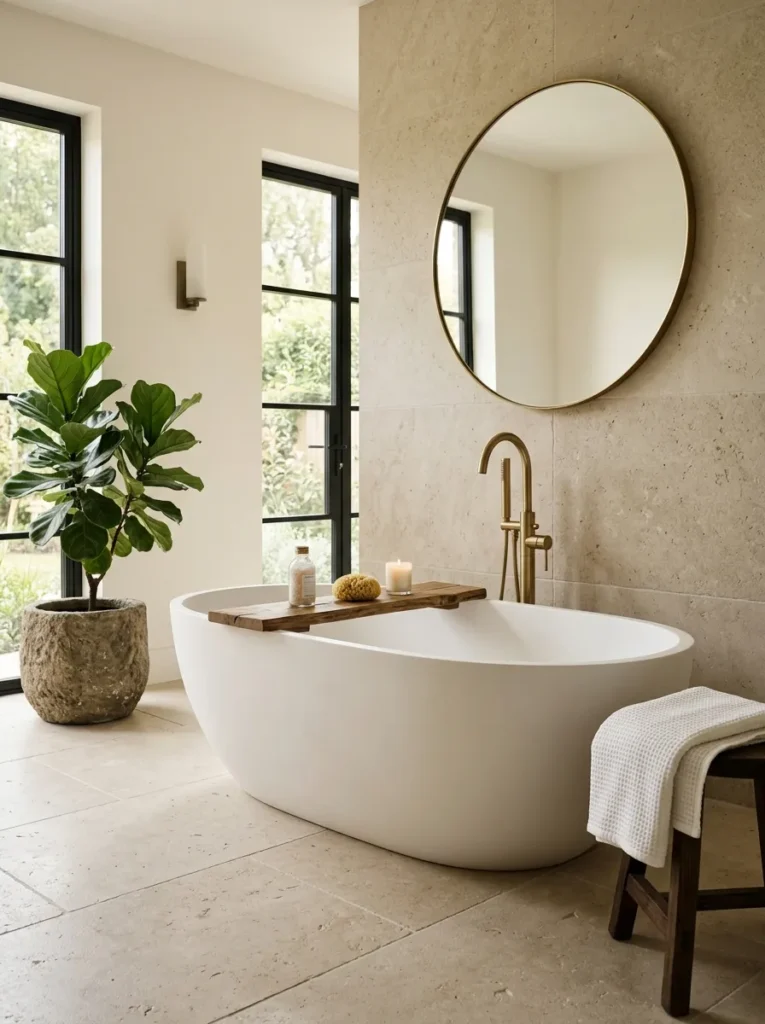
Vibe: Serene and spa-like — the bathroom organized around bathing as a genuine ritual rather than a daily requirement.
Why it works: The freestanding soaking bath positioned as the room’s primary object — with generous clear space on all four sides — is the bathroom design decision that most powerfully communicates that bathing is the room’s primary purpose and primary pleasure. Standard bath installations (built-in alcove baths) position the bath as a utilitarian tub integrated into the room’s perimeter; the centrally positioned freestanding bath inverts this logic entirely, making the bath a sculptural focal point around which the rest of the room is organized. The deep soaking form (minimum 550mm interior depth for a genuine soaking experience — significantly deeper than a standard alcove bath) is the functional specification that creates the genuine spa quality: a bath deep enough to allow full shoulder submersion changes the bathing experience from a practical routine to a restorative ritual. The generous clear space around the bath — minimum 600mm on each side, ideally 900mm — is the spatial discipline that makes the bath read as designed rather than installed.
How to get it: A stone resin or cast iron freestanding bath is the material specification that provides both the weight and the heat retention that make a freestanding soaking bath genuinely superior to an acrylic equivalent — stone resin and cast iron hold the water’s heat for 3–4 times longer than acrylic, which is the practical quality that makes the soaking bath experience genuinely luxurious. Position the bath at least 600mm from all walls and obstacles — a freestanding bath positioned too close to a wall loses its sculptural, room-object quality and reads as an installed fixture.
Shop the Look
| Product |
|---|
| Freestanding soaking bath stone resin |
| Floor standing brass bath filler |
| Honed limestone floor tile |
| Round mirror brushed brass frame |
| Timber bath tray |
3. Double Vanity with Integrated Stone Basin
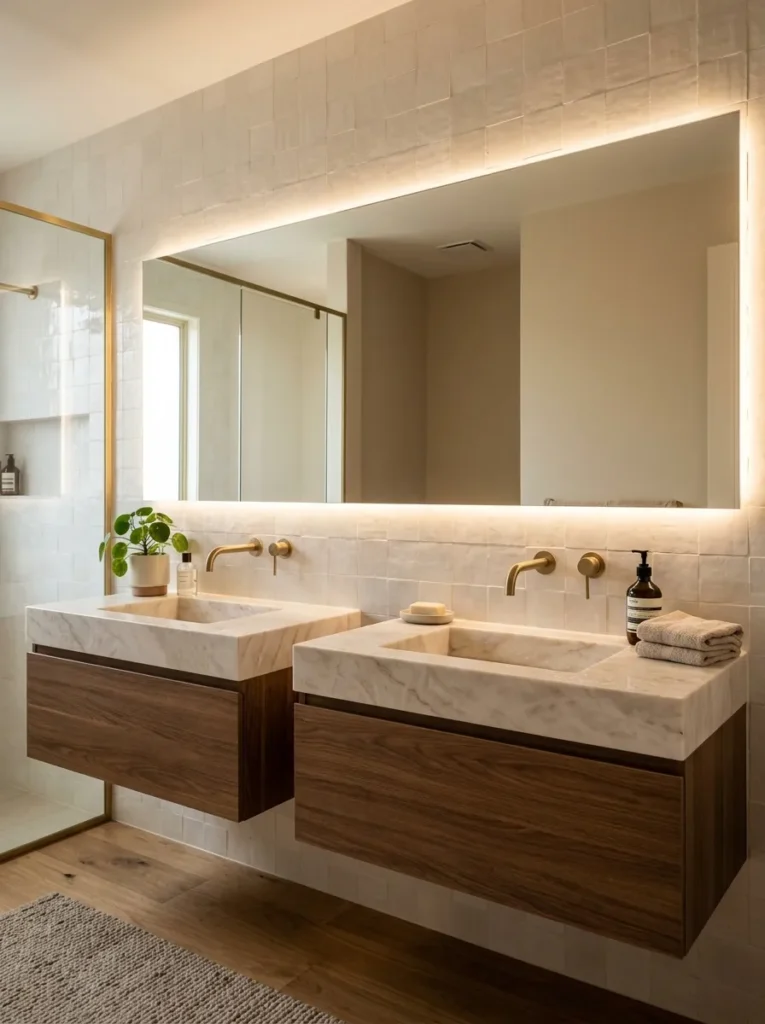
Vibe: Warm and considered — the master bathroom vanity that makes two people sharing a bathroom feel like a luxury rather than a compromise.
Why it works: The double vanity with integrated stone basin is the master bathroom design element that most powerfully communicates material investment and considered design — the stone basin carved from a single piece of travertine or marble is the bathroom object whose material quality is immediately perceivable at close range, where the natural variation of the stone, the quality of the carving, and the warmth of the material surface are experienced directly rather than observed from across the room. The integration of the basin into the stone counter surface (rather than a drop-in or undermount ceramic basin) eliminates the junction between basin and counter that in standard vanities creates a visible and hard-to-clean material transition — the seamless stone surface reads as a genuinely premium material specification. The warm smoked oak vanity cabinet introduces the material warmth that the stone and brass require as their counterpoint — a white vanity or a grey cabinetry finish would create a cold, clinical register that the warm materials above cannot fully overcome.
How to get it: Source integrated stone basins from specialist stone suppliers and bathroom stone specialists — the single-piece stone basin with integrated counter is available in travertine, marble, and limestone from specialty suppliers at $600–2,500 per basin unit. Wall-mounted vanity cabinets in smoked or natural oak are available from specialist bathroom vanity suppliers at $800–2,500 per unit. The mirror with integrated LED perimeter lighting is the lighting decision most specific to this application — the perimeter LED creates a warm, even face-level light that eliminates the unflattering overhead-only lighting of standard bathroom installations.
Shop the Look
| Product |
|---|
| Integrated stone basin travertine |
| Smoked oak wall hung vanity |
| Brushed brass wall mount mixer |
| Mirror with LED perimeter light |
| Warm linen hand towel set |
4. Walk-In Shower with Frameless Glass and Niche Lighting
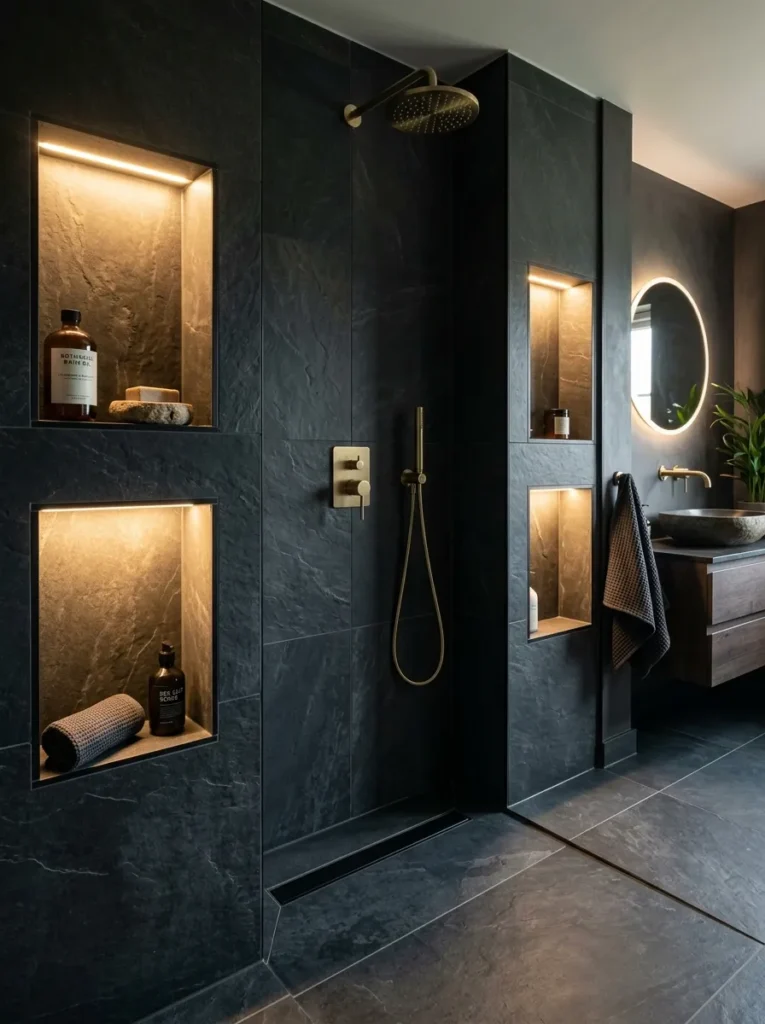
Vibe: Dramatic and considered — the shower that makes every morning routine feel like a moment worth taking time over.
Why it works: The walk-in shower without a door or screen — a fully tiled wet room with a linear drain — is the shower configuration that most powerfully creates the sense of spatial generosity and material immersion that defines the luxury shower experience. The elimination of the shower screen removes the glass barrier that in standard shower installations creates a visual division of the bathroom floor plan and a physical threshold that must be negotiated on every entry and exit. Without a screen, the shower zone and the bathroom floor plan merge into a continuous wet room that reads as a genuinely larger and more spatially resolved space. The recessed niches with integrated LED lighting are the detail that elevates this shower from functional to designed — the warm pools of downlit light within the niches create the layered ambient lighting that makes the shower feel atmospheric rather than simply well-lit.
How to get it: A wet room shower configuration requires a professionally waterproofed substrate beneath the tile layer — the waterproofing system (tanking membrane applied over a correctly sloped concrete substrate) is the structural requirement that prevents moisture damage to the surrounding structure. Specify a linear drain rather than a central floor drain — the linear drain allows the floor tiles to run continuously in a single direction without the disruption of a central drain rose, creating the clean, designed floor surface that reads as most luxurious. The minimum wet room shower zone width for comfortable use is 1000mm; 1200mm or wider is preferable for the generous, unconfined quality that defines the luxury shower experience.
Shop the Look
| Product |
|---|
| Dark slate look porcelain tile large |
| Linear drain stainless brushed |
| Rainfall shower head brushed brass |
| Recessed shower niche LED strip |
| Brushed brass wall shower mixer |
5. Japandi Bathroom with Warm Timber and Deep Soaking Bath
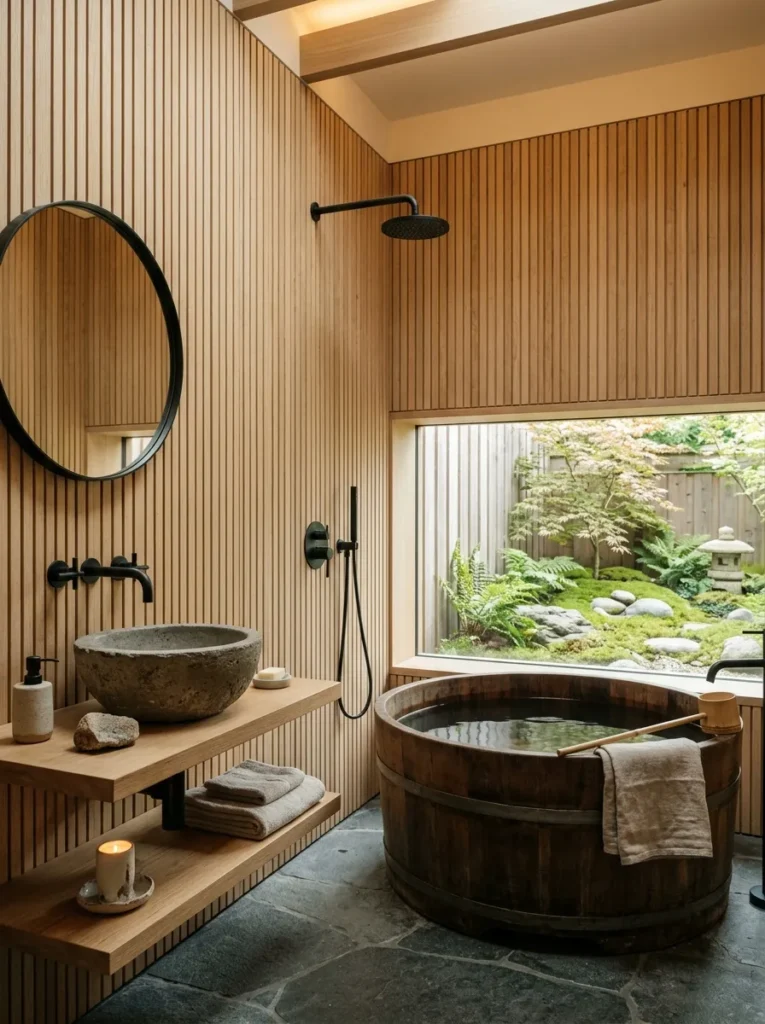
Vibe: Meditative and warm — the bathroom that makes bathing a practice rather than a hygiene routine.
Why it works: The Japandi bathroom with timber wall cladding and a deep soaking bath is the bathroom design that most completely resolves the tension between Western material comfort and the Eastern bathing philosophy that prioritizes depth, warmth, and sensory immersion over the quick-rinse functionality of a standard Western bathroom. The Japanese ofuro bath — a short, deep bath designed for full shoulder submersion with the knees drawn up, rather than the long, shallow Western bath designed for reclined reclining — requires water only to shoulder height at seated position, making it a more water-efficient deep-soaking experience. The vertical timber batten wall cladding connects the bathroom interior to the Japanese tradition of timber-framed onsen bathing environments, creating the material warmth and organic character that the hard, reflective surfaces of a standard tiled bathroom cannot achieve.
How to get it: Vertical timber battens on bathroom walls require a waterproof substrate behind the timber and a durable hardwood or thermally modified timber species that withstands bathroom humidity without warping — thermally modified ash or black butt in narrow 40–50mm batten sections applied over a waterproof ply substrate provides the best combination of visual quality and moisture resistance. The deep soaking bath should be specified at minimum 550mm interior depth — genuine Japanese ofuro baths range from 550mm to 700mm interior depth, significantly deeper than standard Western freestanding baths.
Shop the Look
| Product |
|---|
| Japanese soaking bath teak resin |
| Thermally modified timber batten |
| Concrete basin wall hung |
| Matte black wall mixer |
| Bamboo bath accessory set |
6. Terrazzo Feature Bathroom with Vintage Brass
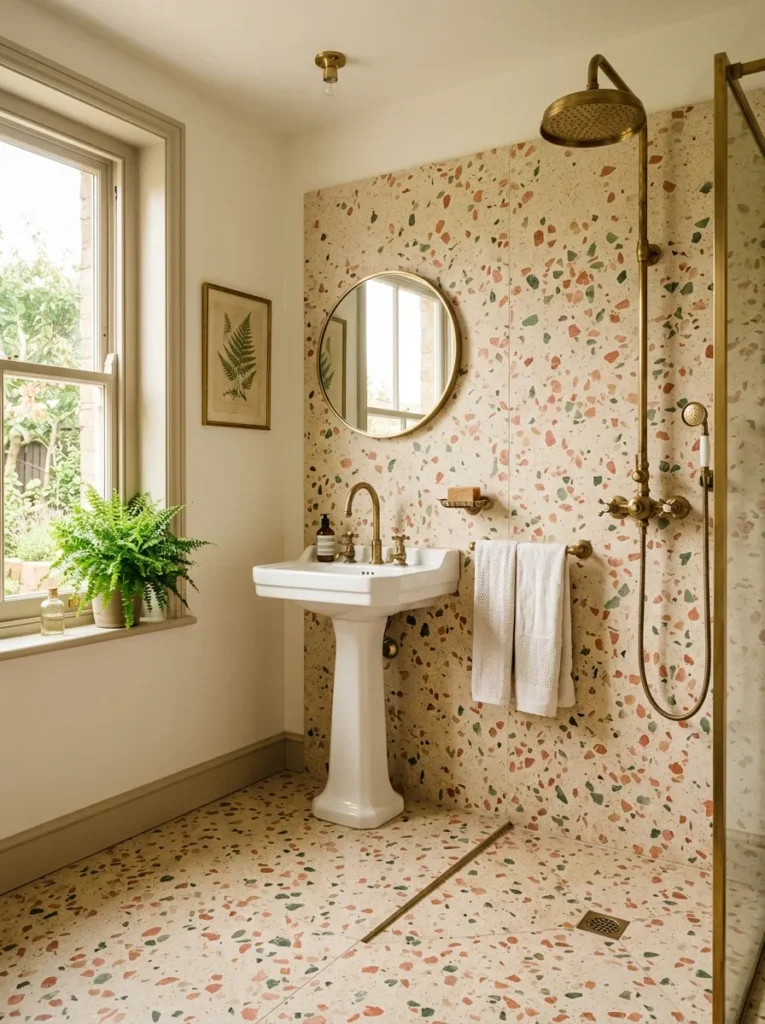
Vibe: Warm and retro-contemporary — the bathroom that bridges the 1950s and the present day and makes both look better for the connection.
Why it works: A terrazzo feature bathroom with vintage brass is the bathroom design that most playfully and most successfully combines contemporary material investment with historical reference — the terrazzo’s mid-century origins and the vintage brass tapware’s classical forms create a bathroom that reads as time-collapsed in the most appealing possible way, suggesting both material quality (terrazzo is a genuinely premium material) and personal design intelligence (the combination of terrazzo and vintage brass requires the confidence to make a specific, historically informed choice). The warm cream base of the terrazzo — rather than the grey base of contemporary commercial terrazzo — is the specific material specification that gives this bathroom its warmth and its vintage-Florida-meets-Italian-villa character. The coral pink and sage green aggregate are the color choices that most specifically reference the mid-century terrazzo color palette without reading as retro pastiche.
How to get it: Commission custom terrazzo from a specialist terrazzo contractor specifying the exact aggregate color combination and chip size — fine aggregate (3–5mm chip) produces a smoother, more refined surface appropriate for a bathroom vanity wall panel, while medium aggregate (8–12mm chip) reads as more boldly patterned and is more effective for a floor application. Source vintage-style brass cross-handle tapware from specialist tapware importers (Nicolazzi, Brodware’s Industrica range, or Watermark Designs all produce vintage-inspired brass collections).
Shop the Look
| Product |
|---|
| Custom terrazzo floor tile warm |
| Vintage brass cross handle mixer |
| Pedestal basin white ceramic |
| Exposed shower rose vintage brass |
| Brass towel rail |
7. Dark and Dramatic Bathroom with Matte Black and Stone
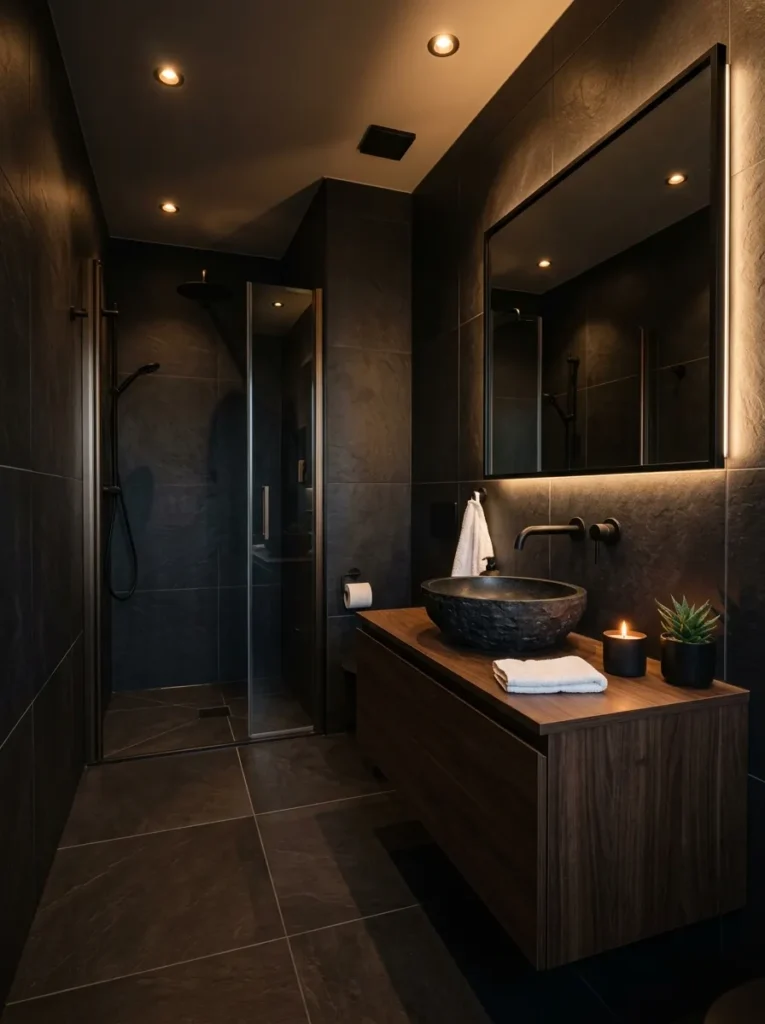
Vibe: Dramatic and intimate — the bathroom that makes the daily ritual of bathing feel like the most private luxury in the house.
Why it works: The all-dark bathroom — floor, walls, and ceiling in a single deep charcoal or black tile — is the bathroom design that most completely creates the sense of intimate, spa-like enclosure through color and material. Dark bathroom tiles work differently from dark room walls in other domestic spaces: in a living room or bedroom, dark walls create a sense of spatial compression that can read as oppressive in a small room; in a bathroom, the same dark surfaces create a cave-like intimacy that is specifically appropriate for the private, sensory nature of bathing — the room retreats visually around the occupant rather than advancing toward them. The amber warm lighting — from recessed downlights specified at 2200K and a backlit mirror at the same warm color temperature — provides the necessary luminosity that prevents the dark room from becoming genuinely dark rather than dramatically intimate.
How to get it: The all-dark bathroom requires the correct tile surface finish — a honed or satin finish rather than polished, which would create mirror-like reflections of every light source and create a disorienting, over-bright visual environment. Matte black tapware is the hardware specification that most coherently extends the dark material palette into the bathroom’s functional elements — chrome or brushed brass tapware would create a discordant metallic note in an otherwise tonally unified dark environment. Specify warm amber LED downlights (2200K) at maximum 600mm ceiling spacing across the bathroom ceiling for even warm illumination of the dark tile surfaces.
Shop the Look
| Product |
|---|
| Deep charcoal slate look porcelain |
| Matte black basin mixer |
| Dark timber floating vanity |
| Backlit bathroom mirror |
| Matte black towel rail |
8. Outdoor-Indoor Bathroom with Garden View and Natural Stone
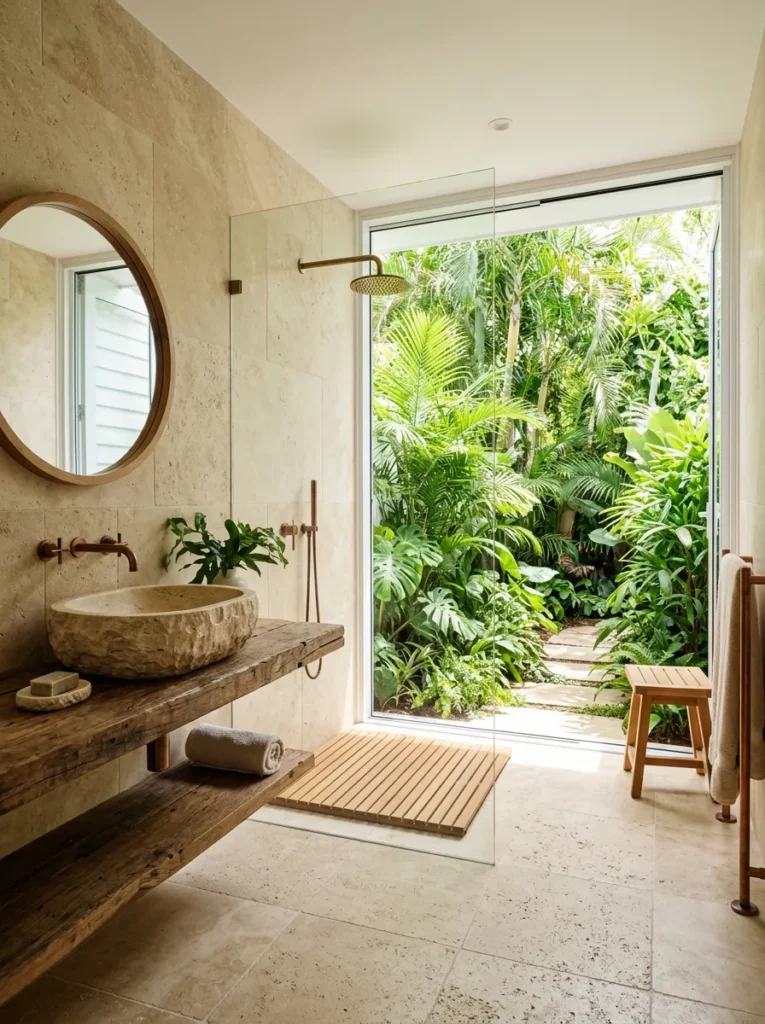
Vibe: Open and resort-like — the bathroom that makes you feel like you are showering in a private corner of a five-star Balinese resort.
Why it works: The indoor-outdoor bathroom with a glass wall opening to a private garden is the bathroom design that most powerfully creates the resort experience in a residential context — it is the design approach used by the world’s best resort hotels (Amanjiwo, Six Senses, Como Shambhala) to make the bathing environment feel connected to the natural landscape rather than isolated from it. The natural limestone flooring that runs continuously from the bathroom interior through the glass door threshold to the outdoor shower or garden transition zone is the material detail that most completely removes the boundary between inside and outside — when the same stone runs under your feet both inside and outside, the glass wall reads as a climate control element rather than a room boundary. The prerequisite for this design is a completely private garden enclosure — the design only works when the outdoor garden zone is genuinely private from adjacent properties.
How to get it: Specify a full-height sliding glass door system (minimum 2100mm height, ideally 2400mm for resort-quality proportions) from a specialist glazing contractor — bifold or sliding systems allow the glass wall to open fully to one side, creating a completely open indoor-outdoor connection. The garden zone adjacent to the glass wall should be planted densely enough to create complete privacy from any overlooking position — a combination of tall screening trees at the boundary and mid-height tropical planting within the garden zone provides the privacy screen that makes the glass wall viable.
Shop the Look
| Product |
|---|
| Honed limestone floor tile |
| Full height glass sliding door |
| Freestanding stone basin |
| Rainfall shower head large |
| Timber shower stool teak |
9. Spa-Inspired Bathroom with Heated Towel Rails and Ambient Lighting
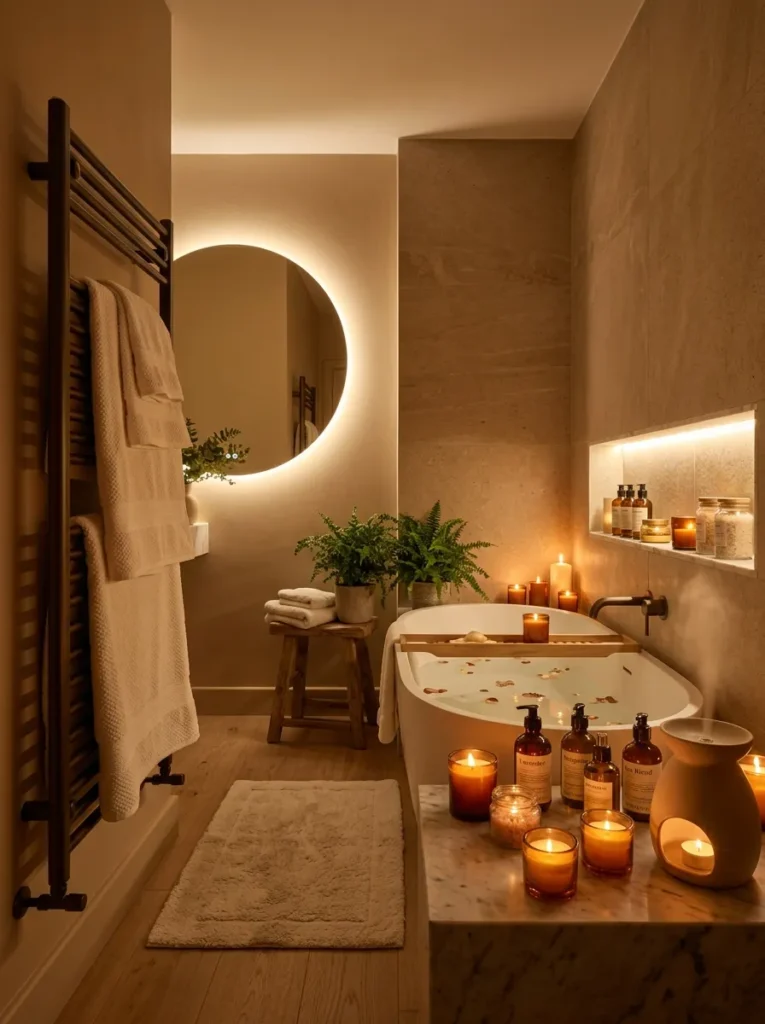
Vibe: Warm and deeply spa-like — the bathroom that activates all five senses and makes leaving it feel like a genuine sacrifice.
Why it works: The spa-inspired bathroom is the design approach that most completely understands that bathroom luxury is a sensory experience rather than a visual one — a room that looks beautiful in a photograph but provides warm towels, correctly temperatured air, candle-quality lighting, and a signature scent is objectively more luxurious as an experience than a photographically stunning room that provides none of these sensory qualities. The heated towel rail is the single most impactful spa quality addition to any bathroom — the sensation of wrapping in a warm towel immediately after bathing is a physical luxury that no visual or decorative element can replicate. The multi-source warm LED lighting at low levels — from multiple recessed downlights, a backlit mirror, and LED strips in any bath niche — is the lighting specification that most accurately replicates the candlelit atmosphere of a genuine spa environment.
How to get it: Install a heated towel rail on a dedicated circuit with a timer that brings the rail to operating temperature 30 minutes before the bathroom is typically used — a heated towel rail that is only switched on when entering the bathroom provides warm towels after a 20–30 minute warm-up period rather than immediately. The multi-source lighting system should be controlled by a single dimmer switch (or a smart lighting system) that allows all sources to be dimmed simultaneously to create the spa atmosphere from a single action. Commission a signature bathroom scent from a specialist aromatherapy supplier — the same scent used consistently in the bathroom creates the Pavlovian relaxation response that turns the bathroom into a genuinely restorative environment over time.
Shop the Look
| Product |
|---|
| Heated towel rail large |
| LED dimmer smart controller |
| Candle collection ceramic holders |
| Bath oil luxury set |
| Aroma diffuser ceramic |
10. Minimalist White and Travertine Bathroom
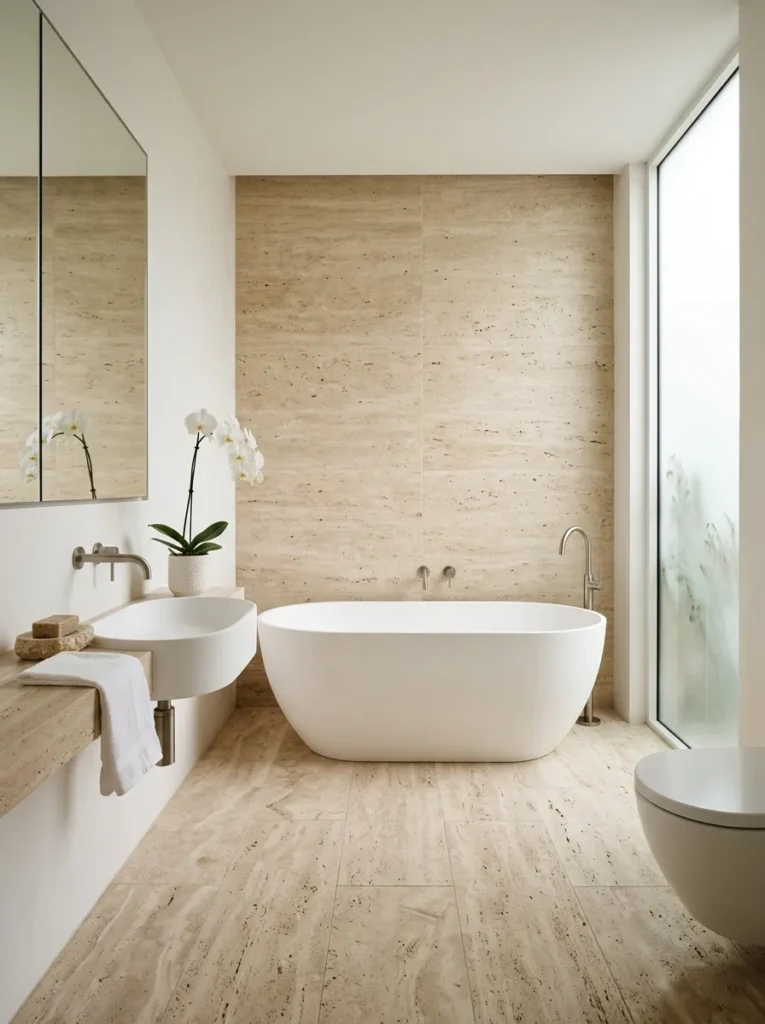
Vibe: Calm and refined — the bathroom that proves that restraint is its own form of luxury.
Why it works: The minimalist white and travertine bathroom is the design approach that most completely applies the principle that luxury in a bathroom is achieved through the quality of individual materials rather than through the quantity of design decisions. Travertine is the material that most eloquently demonstrates this principle — its natural pore structure, its warm cream-to-honey color range, and its characteristic vein patterns make it visually richer and more interesting at close range than almost any manufactured material, while remaining warm and calm as an overall room tone. The combination of travertine and matte white eliminates every visual distraction from the material quality of these two surfaces, creating a room where the viewer’s attention naturally rests on the stone’s natural beauty.
How to get it: Honed travertine (rather than polished) is the correct specification for a bathroom application — polished travertine’s glassy surface reflects overhead lighting in a way that reads as commercial rather than residential, while honed travertine’s matte surface reads as natural stone rather than polished slab. Fill the travertine’s natural pores with a matching grout before sealing — unfilled travertine pores trap soap scum and cleaning products, creating maintenance problems that undermine the material’s natural beauty. Seal with a penetrating stone sealer (not a surface sealer) that protects the stone without changing its natural matte surface character.
Shop the Look
| Product |
|---|
| Honed travertine floor tile |
| Travertine wall tile feature |
| Matte white freestanding bath |
| Brushed nickel wall mount mixer |
| Natural stone soap dish |
11. Black and White Graphic Tile Bathroom with Gold Accents
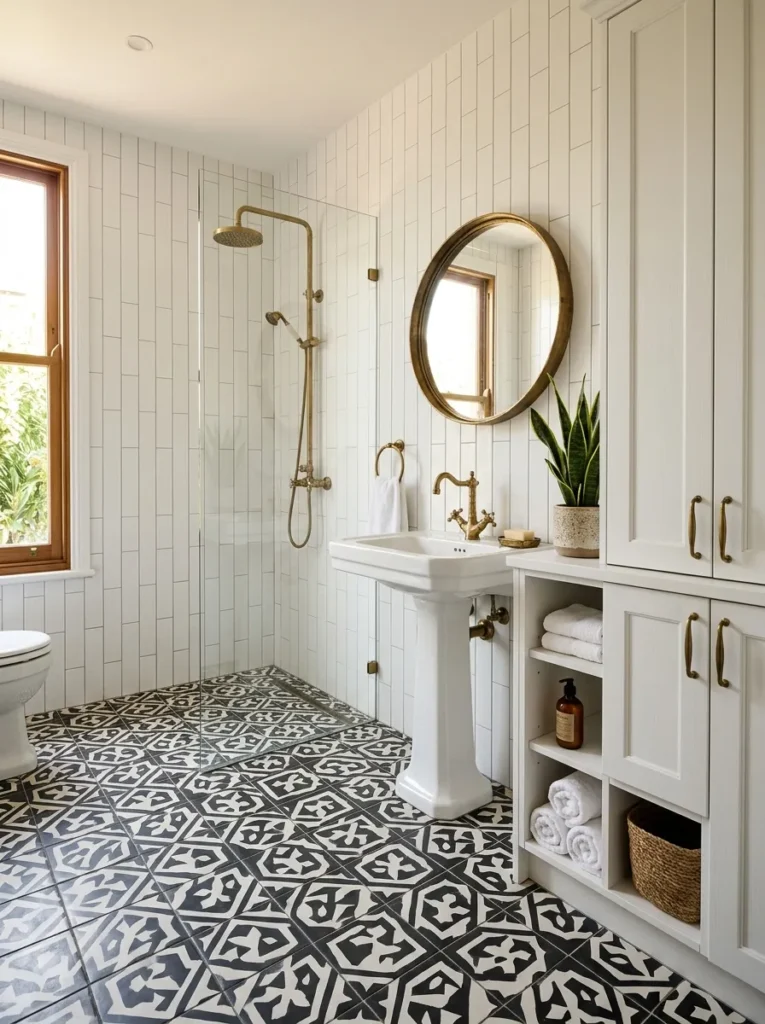
Vibe: Graphic and warm — the bathroom that looks as good in a black and white photograph as it does in color.
Why it works: The black and white encaustic cement tile floor with gold accents is the bathroom design that most classically demonstrates the power of a strong graphic pattern to make a simple material palette feel complete and considered — the geometric floor tile provides sufficient visual interest and design content to eliminate the need for additional decorative elements, and the restrained white subway wall tile provides the neutral backdrop that allows the floor pattern to read at maximum clarity. Gold tapware is the hardware choice that most naturally complements a black and white tile scheme because gold occupies the warm middle ground between the cold black of the tile’s dark element and the cool white of the tile’s light element, introducing warmth into a graphic palette that would otherwise read as stark.
How to get it: Source encaustic cement tiles from specialist suppliers (Moroccan Mosaic, Cement Tile Shop, or Albion Park in Australia) rather than ceramic or porcelain imitations — genuine cement tiles have a natural matte surface, slight color variation between individual tiles, and a material depth that ceramic imitations consistently fail to replicate. Seal cement tiles with a penetrating sealer before grouting and before installation in a high-traffic bathroom — unsealed cement tiles absorb water, cleaning products, and colored liquids that permanently stain the tile surface within weeks of installation.
Shop the Look
| Product |
|---|
| Encaustic cement tile geometric |
| White subway tile vertical bond |
| Polished gold basin mixer |
| White pedestal basin |
| Round aged gold mirror |
12. Luxury Ensuite with Built-In Storage and Integrated Lighting
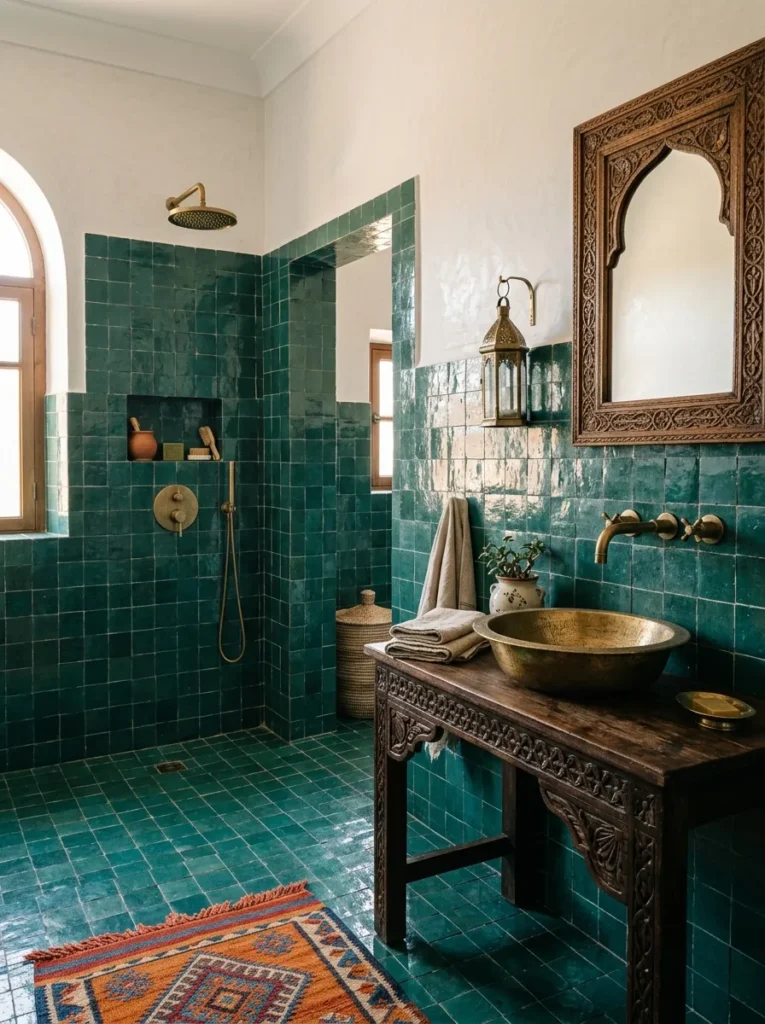
Vibe: Unified and resolved — the ensuite that looks like every decision was made before the first tile was laid and not one was changed afterward.
Why it works: The luxury ensuite with fully integrated built-in storage is the bathroom design that most clearly demonstrates that bathroom luxury is achieved through spatial discipline and the elimination of visual clutter as much as through material quality — a bathroom with exposed plumbing, surface-mounted storage, visible electrical outlets, and counter clutter reads as undesigned regardless of the quality of its individual materials, while a bathroom with concealed plumbing, integrated storage, and disciplined surfaces reads as professionally designed regardless of the individual material price points. The floor-to-ceiling smoked oak cabinetry is the element that most powerfully creates this spatial discipline: it accommodates all storage requirements within a unified, architecturally considered cabinetry system that reads as part of the room’s architecture rather than furniture placed in the room.
How to get it: Commission the built-in cabinetry from a specialist bathroom joiner or custom cabinetry maker — standard flatpack bathroom cabinetry cannot achieve the floor-to-ceiling integration and the material quality of custom joinery. Specify smoked or fumed oak veneer on MDF substrate for the cabinetry doors and faces — solid timber is not appropriate for floor-to-ceiling bathroom cabinetry due to the timber movement in high-humidity environments that causes door alignment problems over time. Conceal all plumbing within the wall substrate behind the cabinetry and vanity — visible plumbing pipes beneath a vanity are the single most visible signal of an incompletely resolved bathroom design.
Shop the Look
| Product |
|---|
| Smoked oak bathroom cabinetry |
| Integrated LED mirror |
| Frameless shower screen |
| Stone basin integrated counter |
| Hidden niche LED strip |
13. Moroccan-Inspired Bathroom with Zellige Tile and Brass
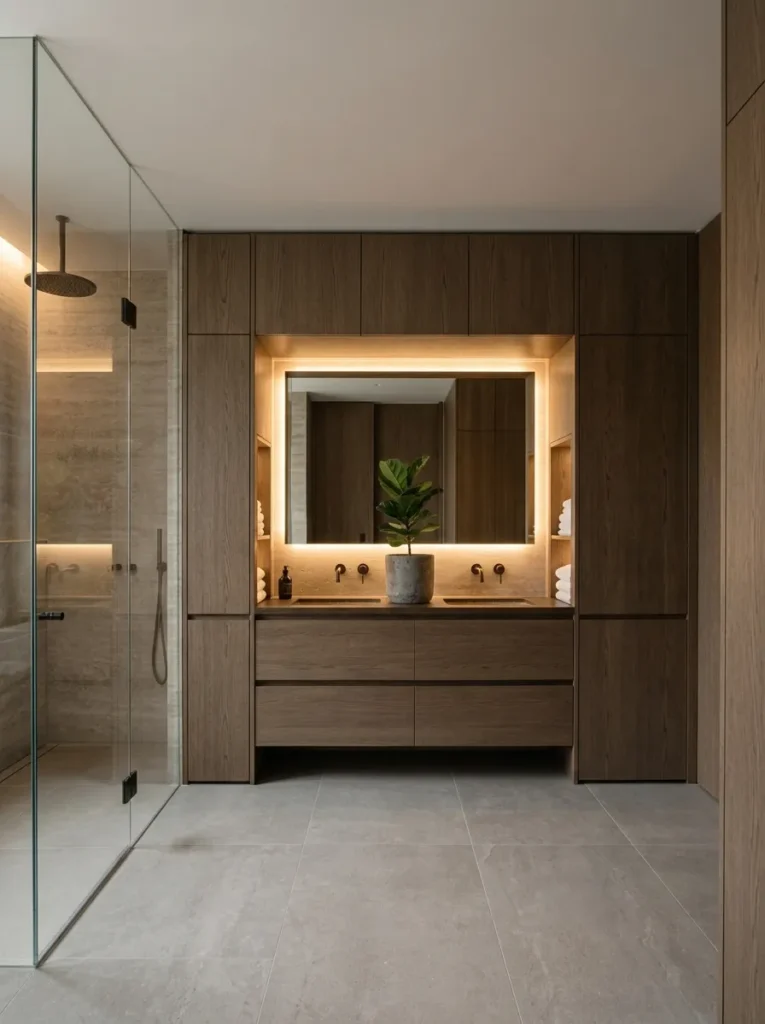
Vibe: Warm and artisanal — the bathroom that makes daily bathing feel like a ritual that has been practiced in this room for centuries.
Why it works: The Moroccan zellige tile bathroom with antique brass is the design approach that most powerfully introduces genuine artisanal material quality into the bathroom environment — genuine handmade zellige tiles, with their characteristic surface variation, slightly irregular glaze application, and faceted form that catches and reflects light differently at each individual tile, create a surface quality that no manufactured tile can replicate because the variation itself is the quality. Each zellige tile is uniquely glazed by the artisan who made it, which means a zellige tile wall or floor is literally unique — it cannot be reproduced, replicated, or duplicated exactly. This irreproducibility is the specific quality that gives zellige its design authority and its luxury status: in an era when all manufactured materials are reproducible, a material that cannot be reproduced is genuinely precious.
How to get it: Source genuine handmade zellige tiles from specialist Moroccan ceramic importers — zellige is produced primarily by artisans in Fès, Morocco, and genuine product is distinguishable from imitations by its characteristic surface variation (slight differences in glaze depth, color, and texture between individual tiles), its weight (genuine zellige is thicker and heavier than ceramic imitations), and its price (genuine zellige costs $80–200 per square meter, reflecting the labor of its hand production). The deep teal-green is the zellige color that most powerfully demonstrates the tile’s light-catching quality — the varied glaze depth creates zones of deeper and lighter teal across each tile surface, producing a wall that appears to shift in color as the viewer’s position changes.
Shop the Look
| Product |
|---|
| Zellige handmade tile teal |
| Hammered brass basin |
| Antique brass wall mixer |
| Carved wooden mirror |
| Brass lantern bathroom |
14. Hotel-Inspired Bathroom with Symmetry and White Marble
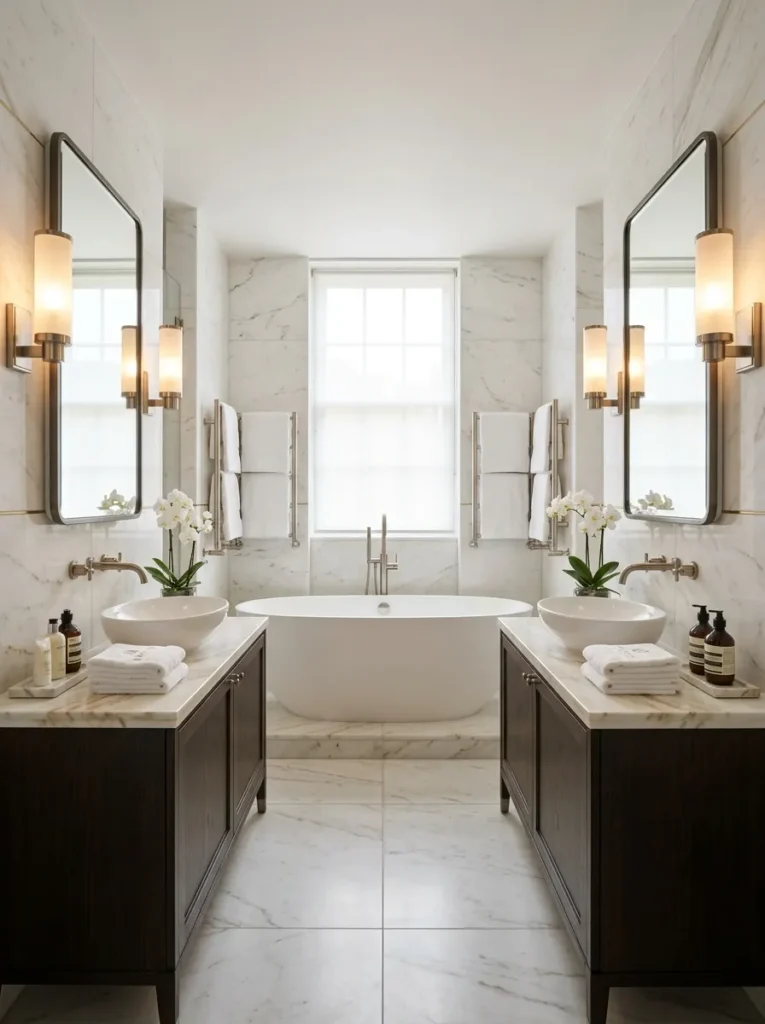
Vibe: Formal and luxurious — the master bathroom that makes you feel like a guest in the world’s best hotel every single morning.
Why it works: The hotel-inspired bathroom organized around strict bilateral symmetry is the design approach that most reliably communicates formal luxury — symmetrical compositions read as deliberate, planned, and invested because they require the design intention and the spatial generosity to place identical elements on both sides of a central axis, which is achievable only in rooms of sufficient width and within design briefs of sufficient commitment. The twin vanity configuration — the most common expression of bathroom symmetry in luxury hotel design — simultaneously solves the master bathroom’s primary practical problem (two people sharing a bathroom without conflict) and creates the formal architectural composition that defines the luxury hotel bathroom aesthetic. White marble is the specific material choice that reads most powerfully in a symmetrical bathroom composition because marble’s natural veining creates a directional visual energy that symmetrical placement amplifies — when the same marble vein pattern appears on both sides of the central axis, the composition reads as both deliberately designed and naturally beautiful.
How to get it: The minimum room width for a symmetrical twin vanity bathroom is 2400mm — narrower than this and the twin vanities read as cramped rather than formal. The central axis should be clearly defined by the freestanding bath or the shower as the composition’s culminating element on the main wall — without a defined terminus to the central axis, the symmetrical composition reads as incomplete. Source matching marble from a single slab — two pieces of marble from different slabs will have different vein patterns and color tones that break the symmetrical reading.
Shop the Look
| Product |
|---|
| White marble vanity counter twin |
| Matching wall sconce pair |
| Twin basin mixer matched set |
| Freestanding bath white central |
| White orchid plant pair |
How to Start Your Luxury Bathroom Transformation
Your single first move is to audit your bathroom’s existing lighting before making any material, tile, or fixture decision — because the most common reason that an expensive bathroom renovation fails to achieve the luxury quality that was intended is that the lighting specification was treated as an afterthought rather than a primary design decision. Stand in your bathroom at 7pm with only the existing light sources operating and assess honestly: does the room feel warm, intimate, and spa-like, or does it feel bright, clinical, and functional? If the answer is bright and clinical, no amount of beautiful tile or expensive tapware will overcome the lighting deficit — the tiles and tapware will look exactly as ordinary under fluorescent or cool overhead lighting as they did before the renovation. The correct luxury bathroom lighting specification includes a minimum of three light sources at different positions and levels: warm ambient downlights at 2700K in the ceiling, a backlit mirror or face-level sconces at vanity height, and a dimmable controller that allows all sources to be reduced simultaneously to create the spa atmosphere.
The most common luxury bathroom renovation mistake is over-specifying the visible surfaces and under-specifying the infrastructure — investing in expensive tiles and tapware while accepting builder-grade shower screens, standard toilet suites, and basic plumbing rough-in positions that prevent the designed layout from being achieved. The bathroom infrastructure decisions (waterproofing system quality, plumbing rough-in positions, electrical rough-in positions for heated towel rails and lighting circuits, drainage slope precision) are invisible in the finished room but determine whether the visible elements read as professionally executed or compromised — a beautiful large-format tile installation on a poorly waterproofed substrate will fail; a heated towel rail without a dedicated circuit will be unreliable; a bath that drains slowly because the drainage slope was insufficiently specified undermines every luxury material invested in above it.
Three specific investments under $200 that create immediate luxury bathroom impact: (1) Replacing the existing ceiling downlights with warm white LED equivalents at 2700K ($15–25 per bulb) immediately shifts the room’s atmospheric quality from clinical to warm — this is the single lowest-cost, highest-impact luxury bathroom upgrade available in any bathroom without structural work. (2) Replacing the existing chrome basin mixer with a brushed brass or matte black equivalent ($80–200 from quality tapware suppliers) introduces the designed metallic quality that distinguishes a considered bathroom from a builder-specification one — the tapware is the jewelry of the bathroom and its finish quality is perceived at the intimate distance of daily use. (3) A large format mirror (minimum 1000mm × 700mm, ideally frameless or in a simple brass or black frame) replacing an existing small or decorative mirror immediately transforms the vanity zone’s spatial quality by reflecting more of the room and appearing to expand the bathroom’s available light — the single most space-expanding and most luxurious visual upgrade available for the bathroom’s vanity wall.
Realistically, a complete luxury bathroom renovation — new tiles throughout, a freestanding bath, a custom double vanity, a walk-in shower, heated towel rail, quality tapware, and a professional lighting design — costs $25,000–80,000 for a standard master bathroom depending on the material specifications and the structural changes required. A focused luxury upgrade of an existing bathroom — new tapware, a backlit mirror, warm LED lighting, a heated towel rail, and quality bath accessories — costs $1,500–4,000 and produces a room that reads as significantly more luxurious than its original condition without any structural or tiling work. Most homeowners begin with the tapware and the lighting — the two highest-impact, most cost-effective luxury bathroom upgrades — use the improved bathroom through one renovation cycle to understand which structural changes are most needed, and invest in the full renovation with the benefit of having lived with the space and identified its genuine priorities.
Frequently Asked Questions About Modern Luxury Bathroom Design
What makes a bathroom look luxurious without spending a lot of money?
The three qualities that most reliably make a bathroom look luxurious regardless of actual spending are material coherence (all surfaces and fixtures in the same tonal and finish family), spatial discipline (counter surfaces cleared to a maximum of three objects, no visible storage inadequacy), and lighting warmth (warm 2700K light sources that replace standard cool fluorescent or LED bathroom lighting). These three qualities can all be achieved without structural work or tile replacement — material coherence through matching the finish of replacement accessories and tapware, spatial discipline through removing unnecessary objects and installing adequate storage for the items currently living on the counter, and lighting warmth through replacing existing bulbs with warm LED equivalents and adding a plug-in sconce or backlit mirror where existing lighting is inadequate.
What tile size makes a bathroom look most luxurious?
Large format tiles — 600mm × 600mm and larger — consistently make a bathroom look more luxurious than small format tiles at the same price point because they reduce the number of visible grout lines, creating a surface that reads as continuous stone rather than a collection of individual tiles. The largest tile that can be practically installed in a specific bathroom — limited by the room’s own dimensions and by the substrate’s ability to support the tile’s weight — is almost always the correct choice for a luxury aesthetic. In very small bathrooms (under 2 square meters), an exception applies: tiles that are proportionally very large relative to the room can read as spatially awkward, and a medium format tile (300mm × 600mm or similar) may read as more resolved in these compact dimensions.
What tapware finish is most luxurious for a bathroom?
Brushed brass and matte black are the two tapware finishes that most consistently read as luxurious in contemporary bathroom design, with brushed brass providing a warm, historically referenced quality and matte black providing a graphic, contemporary quality. Both are superior in perceived luxury to polished chrome — which reads as the builder’s default specification — and to polished brass, which reads as dated. Brushed nickel occupies a middle position that reads as quality without a strong aesthetic statement in either direction. The most important specification is finish consistency across all tapware pieces in the bathroom — mixing finishes (a brushed brass mixer with a chrome shower head and a polished nickel towel rail) reads as unresolved regardless of the individual quality of each piece.
How do I make a small bathroom feel luxurious?
Small bathrooms feel most luxurious when the design principles of luxury interiors are applied at reduced scale: full-height tiles without tile breaks (making the room read as a continuous tiled environment rather than a small room with tiles), a single large mirror that reflects the maximum amount of the room and available light (visually expanding the space significantly), warm multi-source lighting at low levels (creating an intimate atmosphere that makes a small room feel deliberately contained rather than merely small), and disciplined surface editing (a maximum of three objects on any surface, with all storage concealed within cabinetry). The most important principle for a small luxury bathroom specifically is quality over quantity — one genuinely beautiful material (zellige tile, honed travertine, integrated stone basin) in a small bathroom reads as more luxurious than several average materials in the same space.
What is the most important investment in a bathroom renovation?
The waterproofing system and the plumbing rough-in are the most important investments in any bathroom renovation — not because they are visible (they are completely hidden in the finished room) but because their quality determines whether every visible element above them performs correctly and durably for the renovation’s intended lifespan. A bathroom renovation with a $5,000 waterproofing and plumbing investment and a $10,000 visible material investment will outlast and outperform a bathroom renovation with a $1,000 waterproofing investment and a $14,000 visible material investment by two to three renovation cycles — the expensive tiles and tapware on a failed waterproofing system will require complete replacement within 5–10 years, while the same tiles and tapware on a quality waterproofing system will remain functional and beautiful for 20–30 years.
Ready to Create Your Luxury Bathroom?
These 14 designs span the full range of what a modern luxury bathroom can be — from a floor-to-ceiling marble-look porcelain room with brushed brass hardware that reads as a genuine five-star hotel bathroom and a Japandi timber-and-stone retreat that makes bathing a meditative practice, to a dramatic all-dark charcoal enclave that turns the daily ritual into the most private luxury in the house and a Moroccan zellige bathroom whose handmade tiles create a surface of irreplaceable artisanal quality — so whether you are planning a complete architectural renovation of a master ensuite or a focused upgrade of an existing bathroom that needs to work harder for its daily use, there is a genuinely achievable, genuinely luxurious bathroom design here for your specific room, your specific budget, and the specific quality of bathing experience you are working toward. The transformation begins not with the tile selection but with the lighting audit — the honest assessment of whether the existing bathroom feels warm and intimate or bright and clinical, because the answer to that question determines whether any subsequent material investment will achieve its intended effect. Today’s specific action: replace every bulb in your bathroom with a warm white LED at 2700K, turn off all other lights in the house, and observe the bathroom in that single changed lighting quality for five minutes. That five-minute observation will show you more clearly than any mood board or tile sample what your bathroom is capable of becoming — and which of the 14 designs in this list belongs on the wall of the room you are going to create.