15 Stylish Shelf Decor Ideas for Every Room
Stylish shelf decor ideas are deliberate, design-led approaches to arranging objects, art, plants, and accessories on shelving — transforming functional storage surfaces into curated visual displays that reflect personality, anchor a room’s aesthetic, and create the layered, lived-in quality that distinguishes genuinely well-designed interiors from merely furnished ones. This article gives you exactly 15 stylish shelf decor ideas that work across every room in the home, with specific styling techniques, material guidance, and curated product tables for every idea.
There is a particular kind of satisfaction that comes from a shelf that has been properly styled — one where every object earns its place, the heights vary with intention, and the whole arrangement reads as effortless even though it required considerable thought. Shelf styling is one of the highest-leverage decorating skills available to anyone working within a fixed space and a fixed budget, because it costs almost nothing to rearrange what you already own. These ideas range from a 20-minute beginner refresh to a fully considered room-anchoring bookcase transformation. Here are 15 ideas worth saving — and stealing.
Why Stylish Shelf Decor Works So Well
Shelf styling as a considered interior design discipline has roots in the cabinet of curiosities tradition — the Wunderkammer of 16th and 17th century European collectors, who displayed natural specimens, art objects, and scientific instruments together on open shelving as a demonstration of intellectual range and aesthetic sensibility. The modern incarnation of this impulse appears across every design movement from mid-century modernism (where shelves displayed sculptural ceramics alongside functional books) to the maximalist eclecticism of the 1980s to the restrained, object-focused minimalism of contemporary Japandi interiors. What persists across all these traditions is the core idea: a shelf is a curated statement, not a storage solution.
The materials that define stylish shelf decor are varied but share a commitment to quality of texture and form: unglazed and glazed ceramics in matte white, sage green, and warm terracotta; natural wood objects in unfinished oak, walnut, and bamboo; books with spines organized by color or grouped by subject; living and dried botanical elements from trailing pothos and sculptural fiddle-leaf figs to dried pampas grass and eucalyptus; woven baskets in rattan, seagrass, and jute; art prints and framed photographs; sculptural objects in brass, aged copper, and raw concrete; and candles in natural beeswax and soy wax. Color palettes lean toward the warm and neutral — warm white, natural linen, dusty sage, terracotta, antique brass, and warm walnut — with occasional deep accent tones of forest green, navy, or matte black.
Shelf styling trends are currently shaped by three intersecting forces: the influence of Scandinavian and Japanese minimalism (which privileges negative space, natural materials, and functional objects elevated to art status), the cottagecore and maximalist revival (which embraces layering, botanical abundance, and the collected-over-time aesthetic), and the social media visual culture of platforms like Pinterest and Instagram (which has created a broadly shared visual literacy for what constitutes a “well-styled” shelf). The result is a design moment that simultaneously values both restraint and abundance — the key is intentionality, not quantity.
Small spaces gain the most from expert shelf styling because shelving is one of the only vertical storage and display solutions available in rooms where floor space is genuinely limited. A single well-styled floating shelf in a small bathroom or hallway delivers more visual impact per square foot than almost any other decorating investment.
Style at a Glance
| Element | Trait 1 | Trait 2 |
|---|---|---|
| Philosophy | Curated display over storage | Intentional over abundant |
| Materials | Ceramics, natural wood, botanicals | Brass, concrete, woven fiber |
| Color Palette | Warm white, sage, terracotta | Walnut, antique brass, forest green |
15 Stylish Shelf Decor Ideas for Every Room
1. The Rule of Three Ceramic Grouping
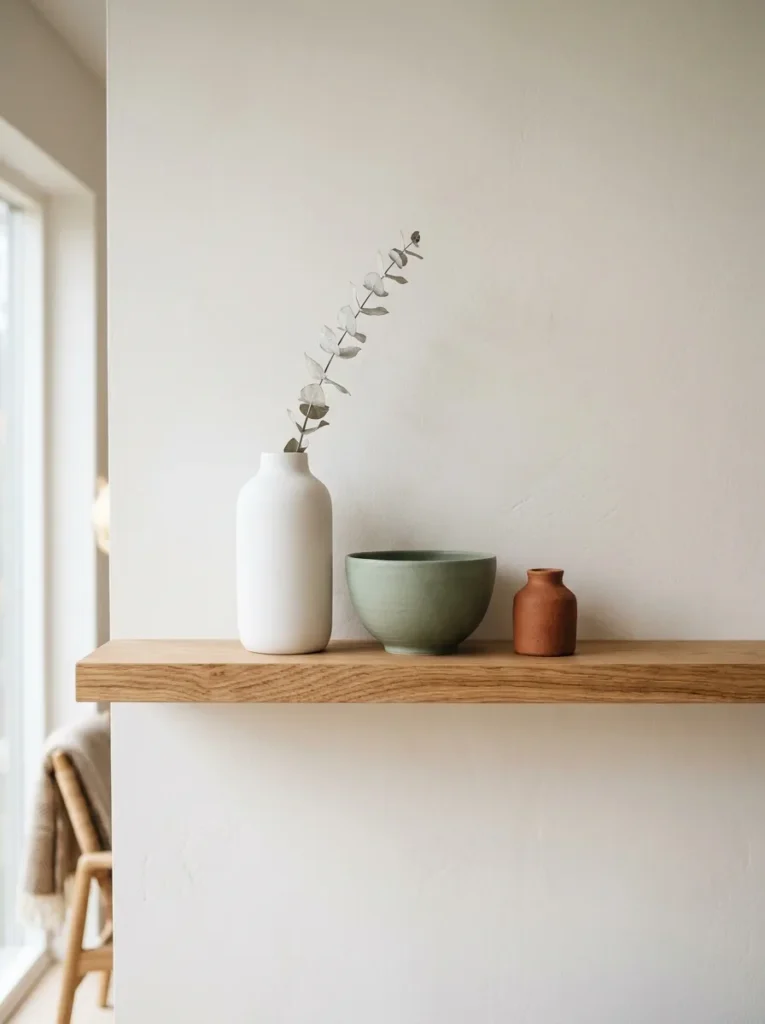
Vibe: The shelf feels serene and quietly authoritative — three objects so well-chosen they make the wall around them look considered.
Why it works: The rule of three is the most reliable principle in shelf styling because the human eye reads odd-numbered groupings as dynamic and intentional rather than symmetrical and static. Three ceramic vessels at graduated heights — tall, medium, short — create a triangular visual silhouette that draws the eye upward and across, producing movement within a static arrangement. The critical refinement is material cohesion with tonal variation: all three pieces should share the same surface quality (all matte, or all glazed) while differing in color and form. This combination of material unity and formal variety is the exact formula that produces the most visually sophisticated shelf groupings.
How to get it: Place the tallest piece first, positioning it at the back of the shelf and slightly off-center. Place the medium piece at the front and to one side of the tall piece, creating depth by using the shelf’s front-to-back dimension rather than just its left-to-right span. Add the smallest piece at the opposite side from the medium piece, slightly forward. Step back and check that the three pieces form a triangle when viewed at eye level — adjust until the silhouette is clear and the negative space on either side feels equal and intentional.
Quick Win: Three ceramic vessels from a single charity shop visit — chosen for height variation and a shared matte surface finish, regardless of color — cost $6–$15 total and produce a shelf grouping that reads as deliberately curated from the moment they are arranged together.
Shop The Look
| Product |
|---|
| Tall matte white ceramic vase minimalist modern |
| Sage green ceramic bowl medium matte glaze |
| Small terracotta bud vase handmade organic shape |
| Floating oak shelf wall mount natural wood |
| Dried eucalyptus stems bunch silver dollar natural |
Also view: 15 Creative Big Boy Bedroom Ideas for Growing Kids
2. Color-Blocked Book Spine Arrangement (COLOR)
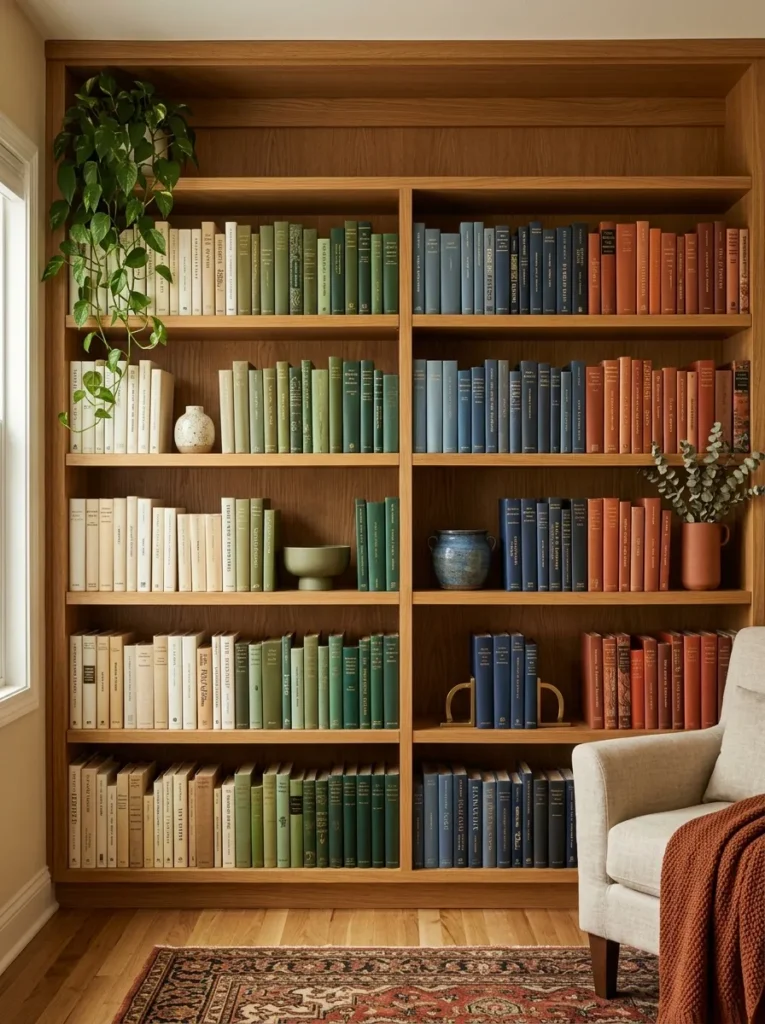
Vibe: The bookcase feels warm and visually organized — the kind of wall that pulls focus the moment you enter the room.
Why it works: Color-blocking book spines transforms a bookcase from a functional storage unit into a large-scale color field that operates as the room’s dominant visual element. The design principle is the same one that governs color-blocked textile design and abstract art: adjacent color fields create visual rhythm and movement across the wall, and the slight variation in height and width within each color section prevents the arrangement from reading as too rigid or artificial. The critical technique is grouping within color families rather than matching exact shades — a “green section” that contains mint, sage, forest, and olive reads as richer and more organic than one limited to a single green tone.
How to get it: Remove all books from the shelves and sort into color families on the floor before replacing. Arrange color sections to flow in a way that avoids harsh contrasts between adjacent sections — warm tones (cream, terracotta, rust) sit naturally beside each other, as do cool tones (sage, blue, navy). Place ceramic objects or small sculptures at the transition points between color sections to create visual punctuation that prevents the blocks from feeling too mechanical. Remove any books with very busy or garish spine designs — these break the color-field effect.
Shop The Look
| Product |
|---|
| Brass bookend set decorative modern minimalist pair |
| Trailing pothos plant live indoor hanging shelf |
| Small white ceramic sculpture object shelf decor |
| Adjustable bookcase natural wood five shelf unit |
| Book display ledge shelf floating picture rail oak |
Also view: 16 Luxurious Master Bedroom Ideas with Spa Vibes
3. Layered Art and Object Vignette (ACCESSORIES)
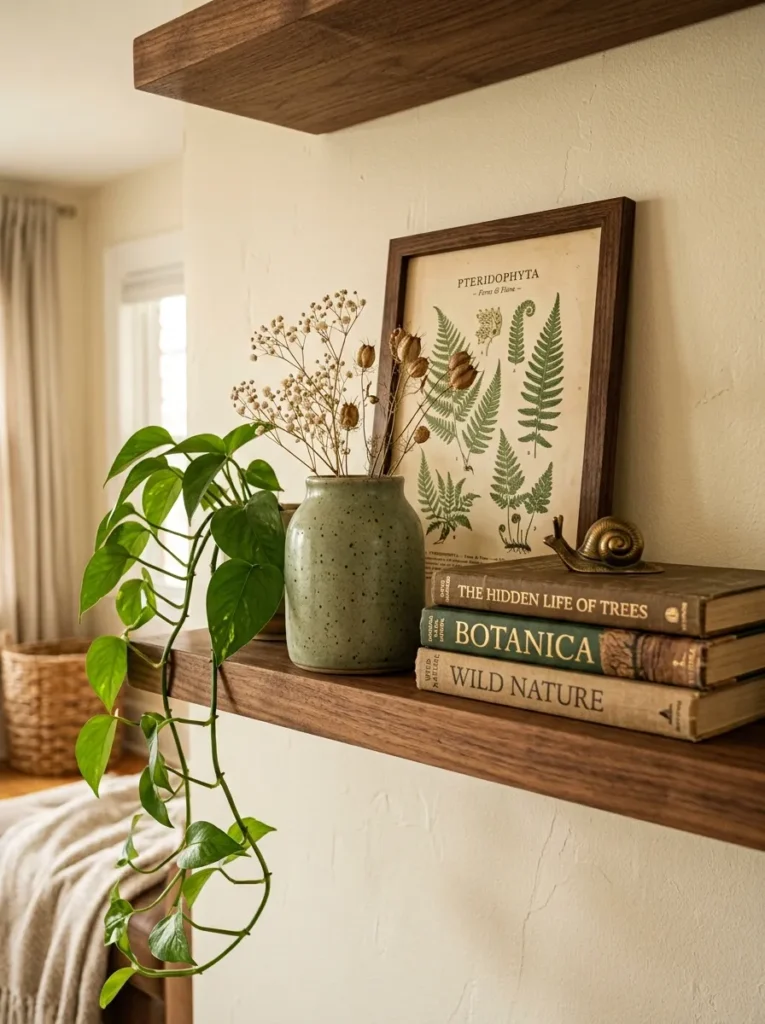
Vibe: The shelf feels layered and genuinely lived-in — the kind of arrangement that looks like it accrued naturally over years of good taste.
Why it works: The layered vignette technique creates depth on a shelf by deliberately using all three spatial dimensions — height, width, and depth from front to back — rather than lining objects along a single plane at the shelf’s back edge. The visual principle is the same one that makes stage set design work: foreground, middle ground, and background elements at different distances from the viewer create the illusion of a much larger, more complex space than the shelf’s actual 30–40cm depth. The leaning art print is the single most impactful layering technique — it immediately adds depth and creates the casual, collected quality that distinguishes professional shelf styling from amateur arrangements.
How to get it: Begin by leaning one or two small framed prints or art cards against the back wall of the shelf — this establishes the background plane. Place the largest object (a ceramic vessel or sculptural piece) at the middle depth, slightly in front of the print and to one side. Add a small stack of books at the opposite side, with a tiny object on top to give the stack a finished quality. Finally, introduce a trailing or drooping plant element at one end of the shelf, allowing it to break the shelf’s horizontal edge line — this single detail transforms a flat arrangement into a living one.
Shop The Look
| Product |
|---|
| Small botanical art print framed A5 natural wood |
| Medium sage ceramic vessel organic shape matte |
| Hardcover coffee table book set decorative natural |
| Small brass decorative object sculpture shelf |
| Trailing ivy or pothos small pot indoor shelf plant |
4. Bathroom Shelf Spa Styling (SMALL SPACE / ACCESSORIES)
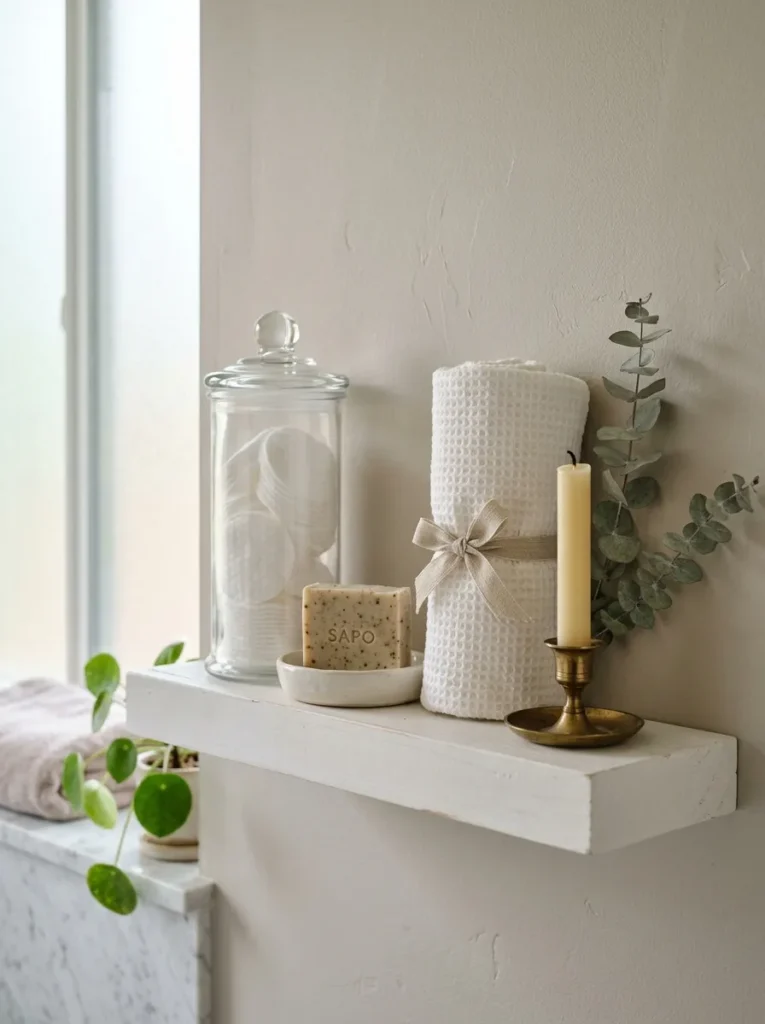
Vibe: The bathroom shelf feels spa-like and serene — the particular calm of a surface where every object belongs and nothing is out of place.
Why it works: Bathroom shelf styling succeeds when it transforms functional objects into display objects through container choice and presentation method. The apothecary jar principle — placing everyday consumables (cotton rounds, bath salts, hair ties) into clear glass vessels with clean lines — converts clutter into an intentional display without removing any functionality. The rolled towel tied with linen ribbon is the single most impactful bathroom shelf gesture: it signals spa-level attention to presentation and costs nothing beyond five minutes and a piece of ribbon. The key constraint for bathroom shelves is strict object editing — every item must earn display status, and any purely functional item that cannot be made beautiful through its container must be stored behind a closed door.
How to get it: Start by removing everything from the bathroom shelf and returning only items that serve both a functional and visual purpose. Place the largest functional container (apothecary jar, soap dispenser, or candle) first as the anchor. Add the rolled towel as a soft, textural counterpoint to the hard vessel surfaces. Introduce one botanical element — a sprig of dried eucalyptus, a small trailing plant, a single stem in a bud vase — to add organic irregularity to what would otherwise be a too-perfectly ordered surface. Keep the total object count between four and six — bathroom shelves tip from spa to cluttered at seven objects and above.
Quick Win: Three clear glass apothecary jars ($12–$18 for a set of three in varying sizes) filled with cotton rounds, bath salts, and hair accessories transform any bathroom shelf from a cluttered surface to a styled vignette in under ten minutes — the most immediate shelf improvement available for under $20.
Shop The Look
| Product |
|---|
| Clear glass apothecary jar set 3 sizes bathroom |
| Natural beeswax candle small brass holder set |
| White linen hand towel natural weave set of 2 |
| Ceramic soap dish white matte minimalist bathroom |
| Dried eucalyptus sprig bunch small natural bathroom |
5. Floating Shelf Kitchen Herb Display (LAYOUT / ACCESSORIES)
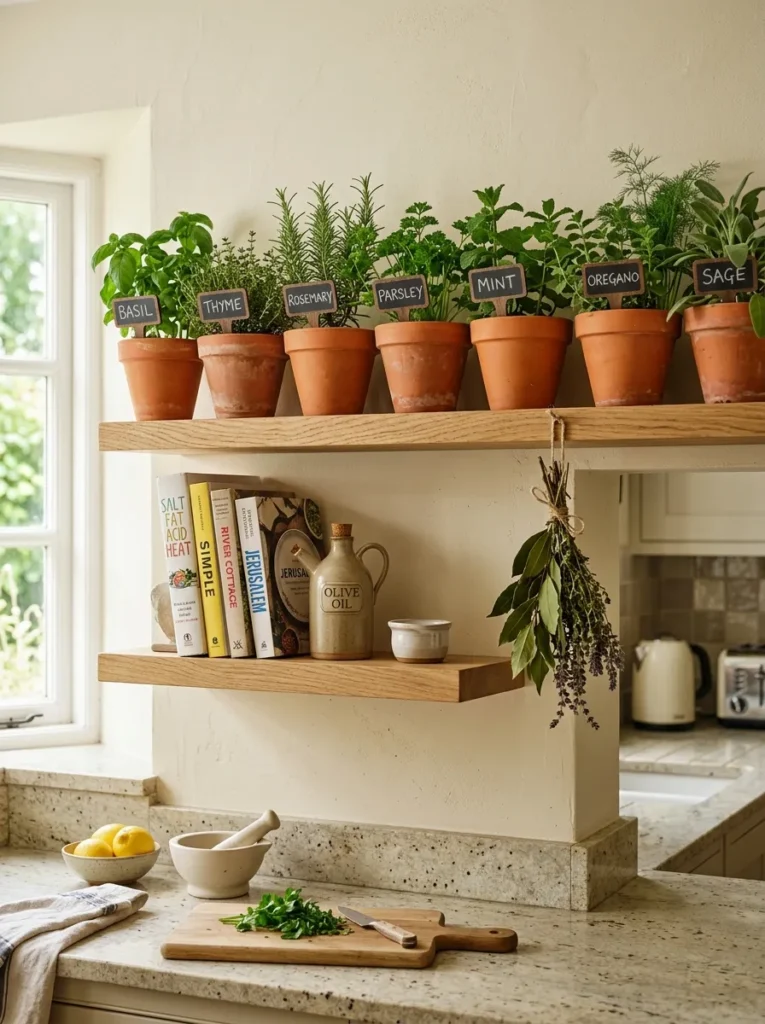
Vibe: The kitchen shelves feel warm and genuinely useful — the domestic pleasure of growing things alongside the things needed to cook with them.
Why it works: Floating kitchen shelves succeed aesthetically when they unify the functional and the beautiful through consistent containment. A row of matching terracotta herb pots with uniform labeling creates the impression of a thoughtfully designed kitchen system rather than a collection of random plant pots, and the visual rhythm of identical containers with varied plant heights creates the pleasing organic irregularity that makes botanical displays work. The two-shelf arrangement follows a clear visual hierarchy: active, living display on the upper shelf, static, functional objects on the lower shelf — a distinction that prevents the arrangement from feeling cluttered while maintaining full practical utility.
How to get it: Space herb pots at consistent intervals — 8–10cm between each pot — for a rhythm that reads as intentional rather than crowded. Use chalk paint or a chalk pen to label each pot directly on the terracotta rather than using adhesive labels, which lift and look messy in a kitchen environment. On the lower shelf, limit the object count to three functional items — an oil pourer, a recipe book stack, a small bowl or jar — and allow 20% of the shelf surface to remain empty as breathing space.
Shop The Look
| Product |
|---|
| Terracotta herb pots small set of 6 matching |
| Chalk paint pen white fine tip ceramic labeling |
| Floating oak shelf wall mount bracket natural |
| Ceramic olive oil pourer bottle kitchen natural |
| Fresh herb plant set basil rosemary thyme small |
6. Bedroom Shelf Nightstand Alternative (SMALL SPACE / LAYOUT)
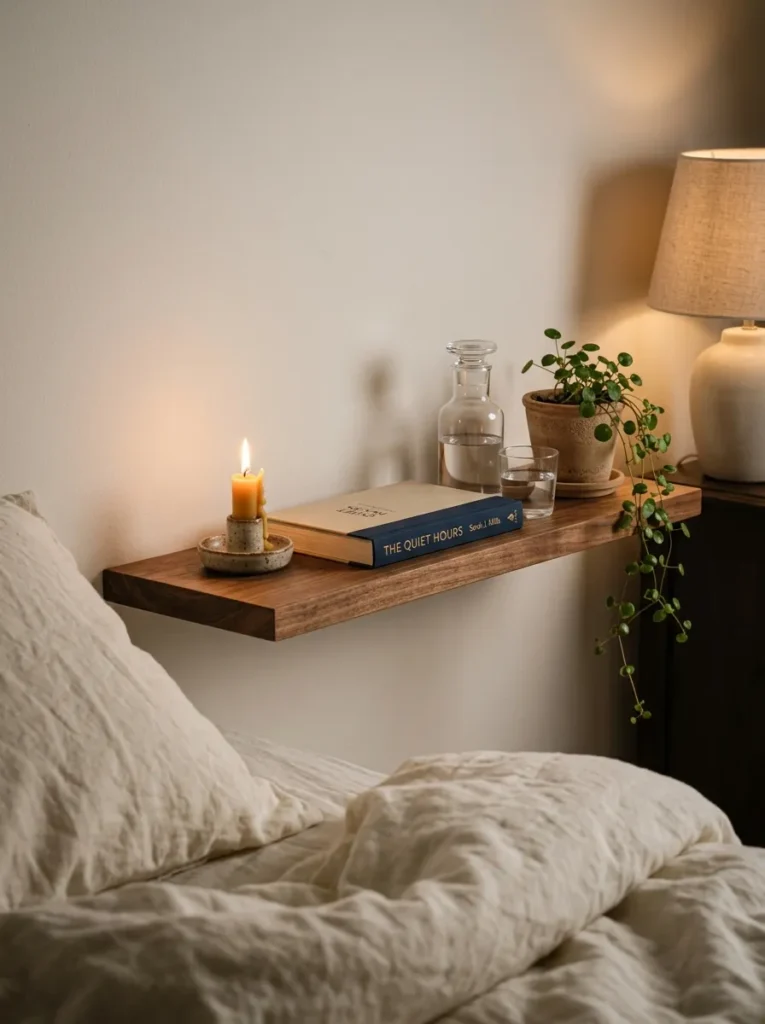
Vibe: The shelf feels intimate and calm — a nightstand that takes up zero floor space and looks more considered than any bedside table.
Why it works: A floating shelf used as a nightstand alternative solves the most common small bedroom problem — the floor space consumed by a conventional bedside table — while simultaneously creating a more visually refined surface than most bedside tables allow. The styling constraint imposed by the shelf’s narrower depth (typically 20–25cm versus a bedside table’s 40–50cm) forces an editing discipline that produces better results: only the four most essential bedside objects fit, which is precisely the number required for a genuinely calm, uncluttered sleeping environment. The visual principle is horizontal simplicity — a single uncluttered plane at eye level from bed creates the most restful visual experience in a bedroom.
How to get it: Mount the shelf at the height of the mattress top plus 25–30cm — this positions objects at a natural reaching height from both sitting and lying positions. Use a shelf depth of at least 20cm to accommodate a standard glass carafe. Strict object limit of four: one light source or candle, one current reading book, one water vessel, one small plant or natural object. Anything beyond four objects on a floating nightstand shelf reads immediately as cluttered — the constraint is the design.
Shop The Look
| Product |
|---|
| Floating walnut shelf 60cm wall mount bedroom |
| Small beeswax candle ceramic holder matte white |
| Glass water carafe bedside small 500ml clear |
| Single hardcover book decorative linen cover spine |
| Trailing string of pearls small ceramic pot shelf |
7. Maximalist Collected Display Shelf (ACCESSORIES / COLOR)
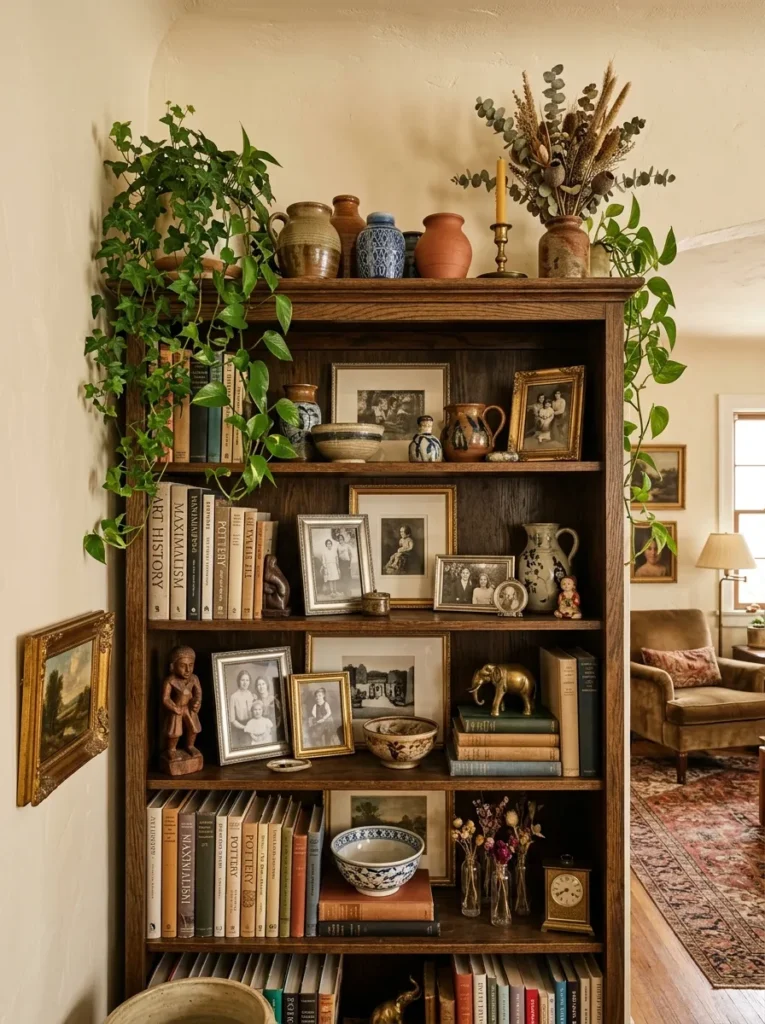
Vibe: The shelf feels richly layered and confidently abundant — the visual equivalent of a conversation that keeps revealing new things.
Why it works: Maximalist shelf styling succeeds through the rigorous application of a single organizing principle: material diversity within tonal cohesion. Every object on a maximalist shelf should be from a different material family — ceramic, brass, glass, wood, natural fiber, paper — but all objects should share a common tonal palette of warm neutrals with one or two consistent accent colors. Without the material diversity rule, a densely filled shelf looks merely cluttered; without the tonal cohesion rule, it looks chaotic. The combination of these two constraints — maximum material variety, maximum tonal restraint — produces the rich, layered quality that distinguishes a genuinely maximalist shelf from simple overcrowding.
How to get it: Begin with the two anchor pieces — the largest object and the tallest object — placed at opposite ends of the shelf to create a visual frame. Fill the space between them by alternating material types with every object added: ceramic next to wood next to metal next to natural fiber. Step back after every third object added and assess whether the material variety rule is being maintained and whether the tonal palette is remaining coherent. The arrangement is complete when no two adjacent objects share a material family and the overall tonal palette reads as unified despite the material density.
Shop The Look
| Product |
|---|
| Antique brass candlestick tall vintage style shelf |
| Mixed ceramic vessel set vintage eclectic display |
| Small bronze sculpture decorative object shelf art |
| Art book set decorative hardcover design large |
| Trailing ivy plant indoor climbing shelf display |
8. Japandi Minimalist Shelf Composition (COLOR / LAYOUT)
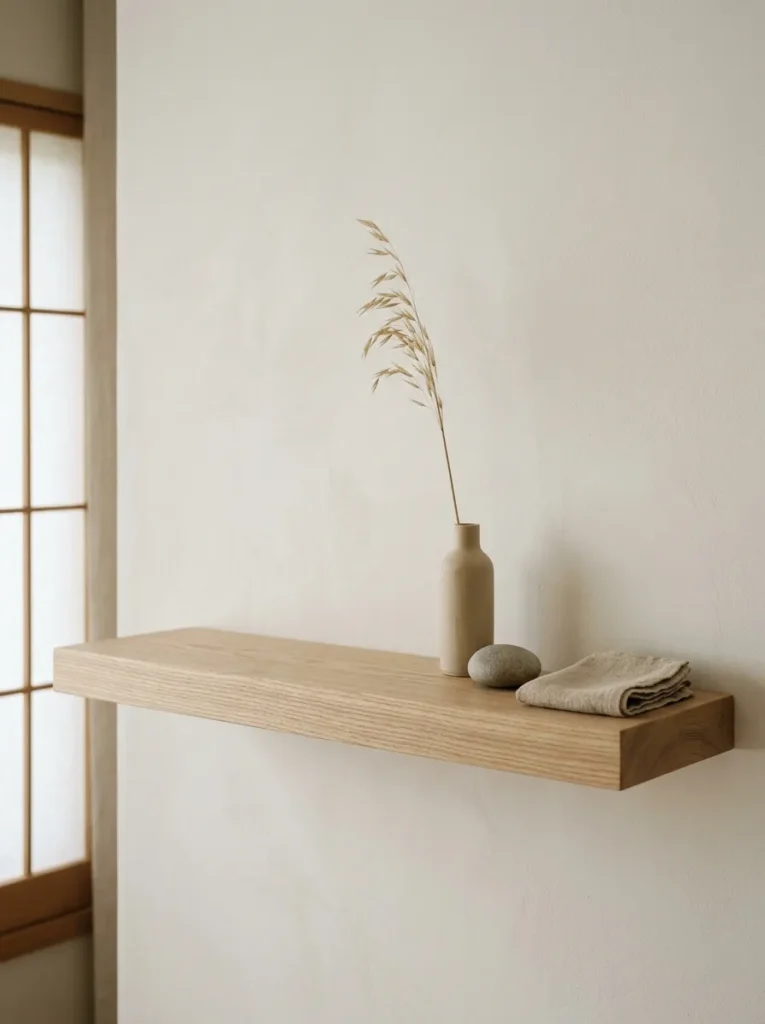
Vibe: The shelf feels meditative and still — the quietest possible arrangement that somehow says the most.
Why it works: Japandi shelf styling draws from both Japanese wabi-sabi (which finds beauty in imperfection, impermanence, and incompleteness) and Scandinavian functionalist minimalism (which values form derived from function and the dignity of natural materials). The result is a shelf aesthetic that treats negative space as a positive design element — the empty shelf surface is not waiting to be filled but is itself a considered part of the composition. Three objects maximum is the Japandi shelf rule: any more dilutes the meditative quality that makes this approach so visually compelling. Each object must justify its presence through a combination of form, material, and personal meaning.
How to get it: Choose three objects that represent three different sensory qualities: something visual (a dried stem or small botanical), something tactile (a smooth river stone, a small ceramic object with interesting surface texture), and something conceptual (a folded piece of beautiful linen, a small book). Place them with significant physical separation — at least 15cm between each object — and resist every instinct to add more. The visual discomfort of “not enough” that you may feel during styling is precisely the quality that makes this approach work for viewers: it creates a calm, spacious feeling that busy shelves never can.
Quick Win: A smooth river stone collected from a garden, park, or beach ($0) placed beside a single dried stem on an otherwise empty shelf is the most powerful and accessible Japandi shelf composition available — it costs nothing and takes thirty seconds to arrange, and its effect on a room’s atmosphere is immediate and significant.
Shop The Look
| Product |
|---|
| Floating ash wood shelf minimalist wall mount |
| Tall narrow ceramic vase matte white minimalist |
| Smooth river stone large natural decorative |
| Dried pampas stem single natural tall shelf |
| Natural linen cloth folded shelf object decorative |
9. Home Office Shelf Functional Styling (LAYOUT)
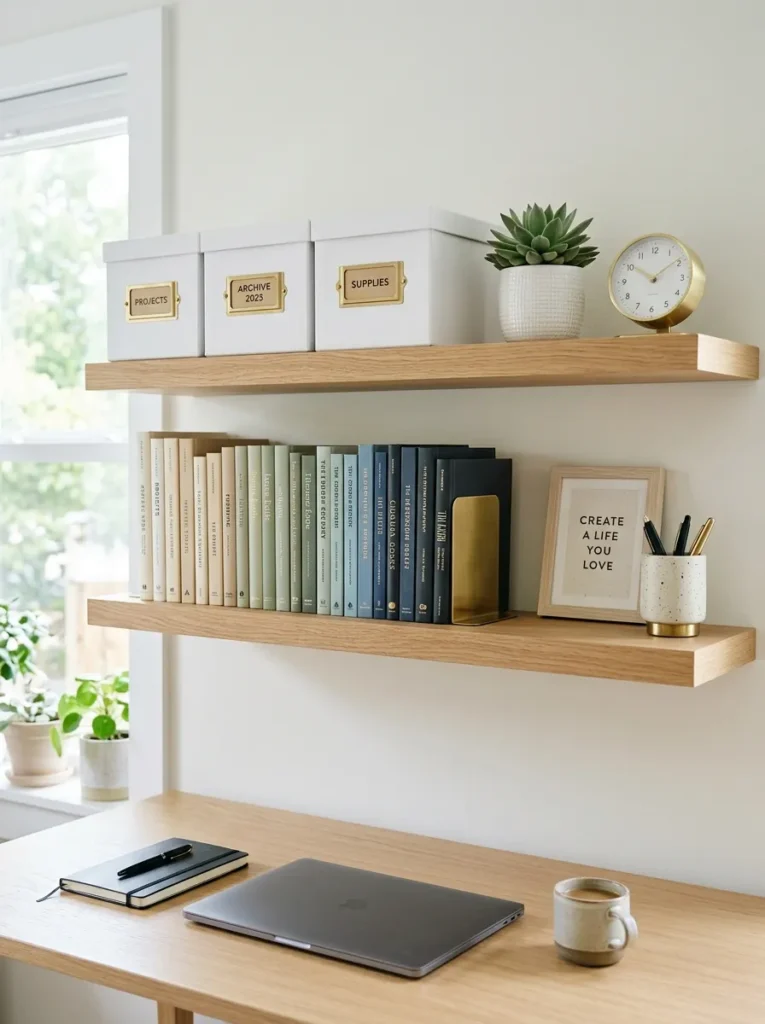
Vibe: The office shelves feel organized and calm — the kind of workspace that makes clear thinking feel like the natural result of being there.
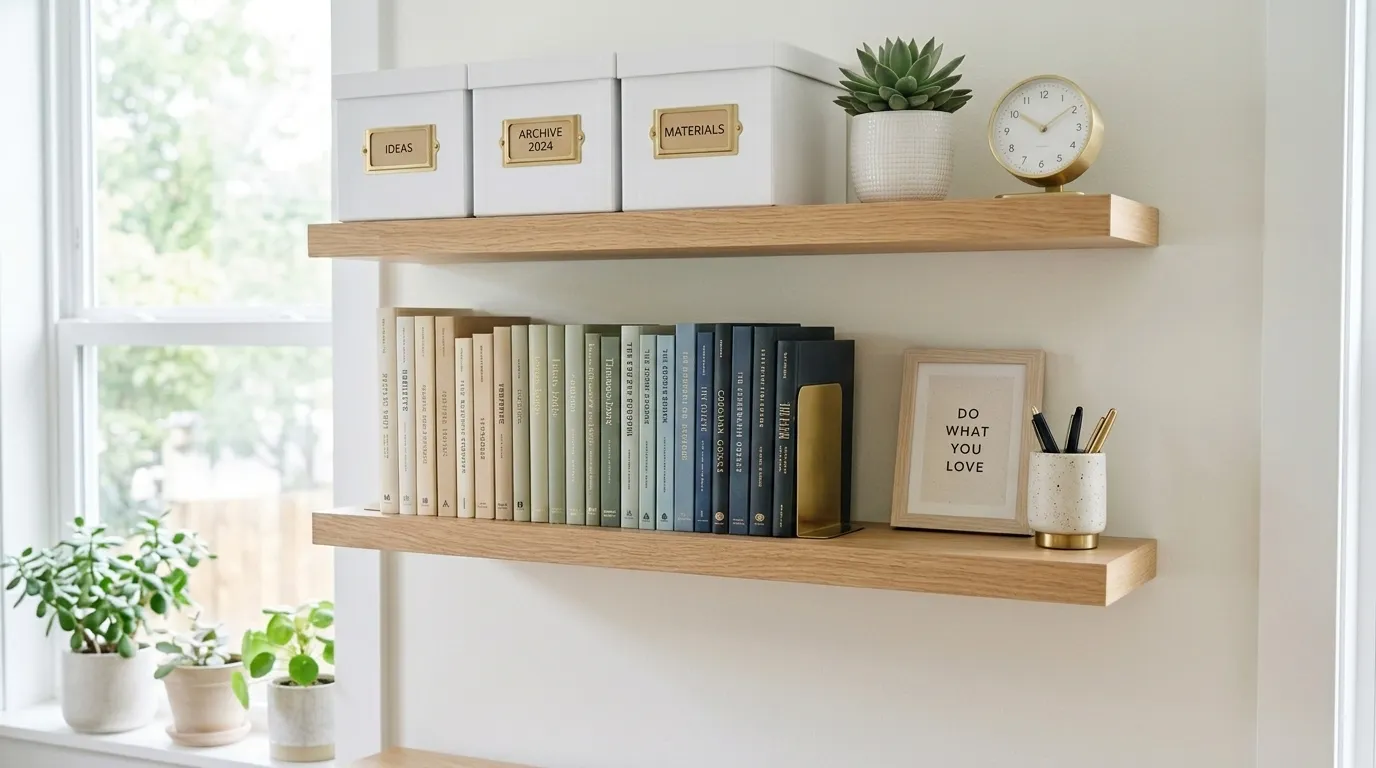
Why it works: Home office shelf styling requires a different design logic from decorative shelf styling — here, the primary function is cognitive organization rather than visual display, and the styling goal is a surface that reduces visual noise rather than creating visual interest. The key principle is containment: matching storage boxes or baskets that group related items behind a uniform visual surface eliminate the chaos of scattered office supplies and documents without requiring them to be stored elsewhere. The visual harmony of three identical boxes — same material, same color, different labels — creates the impression of a deliberately designed storage system rather than a collection of random containers.
How to get it: Dedicate the upper shelf entirely to closed storage — matching boxes, baskets, or binders — with brief kraft labels identifying contents. Reserve the lower shelf for open display: a curated selection of reference books, one small plant, and one or two functional-but-beautiful desk objects (a ceramic pen holder, a brass clock, a small framed piece). The ratio should be 60% closed storage to 40% open display on home office shelves — enough visual interest to feel designed, enough containment to feel calm.
Shop The Look
| Product |
|---|
| White storage box set lid and label 3 piece desk |
| Kraft label sticker set plain adhesive office |
| Small succulent plant ceramic white pot desk |
| Brass desk clock round minimalist home office |
| Ceramic pen holder matte white desk organizer |
10. Children’s Room Low Shelf Montessori Display (SMALL SPACE)
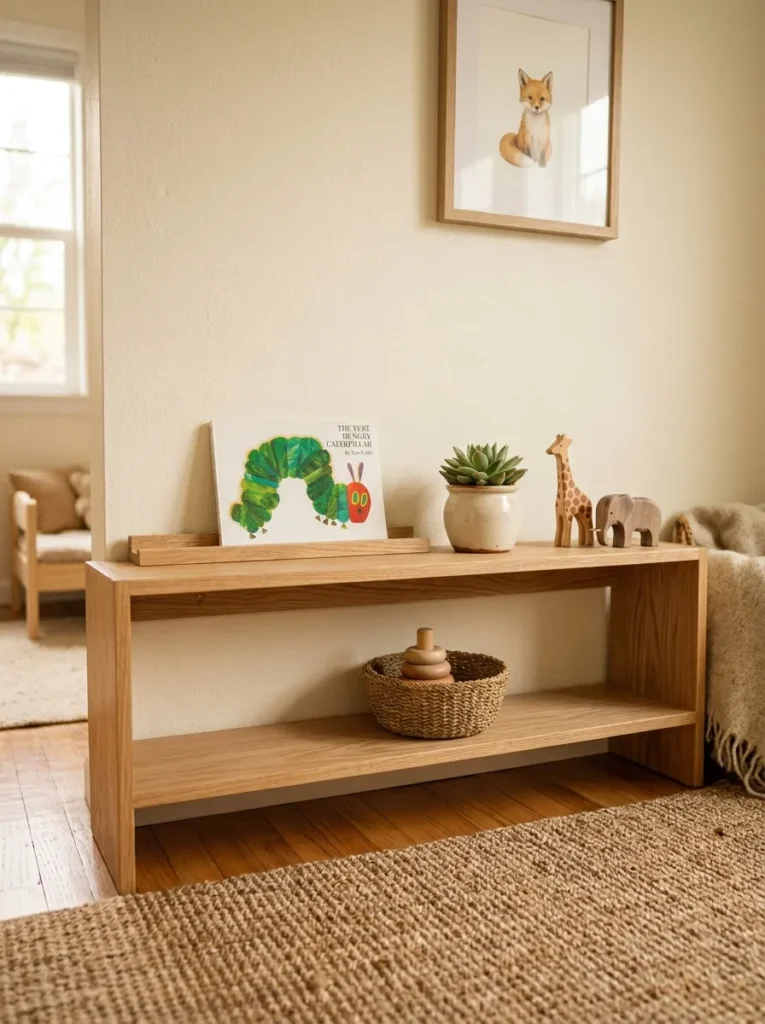
Vibe: The shelf feels inviting and child-scaled — a world arranged at exactly the right height for small hands and curious eyes.
Why it works: Montessori shelf styling for children’s rooms applies the same principles that make adult minimalist shelves work — generous negative space, face-forward display, limited object count — but at child height and with the specific functional goal of supporting independent play and choice. Displaying books face-forward (cover visible rather than spine) rather than spine-out is the single most impactful Montessori shelf technique: children select books by cover recognition, and face-forward display makes independent selection possible in a way that spine-out shelving never achieves for pre-readers. The limited object count — no more than 8–10 items total — prevents the sensory overwhelm that dense toy storage creates and significantly increases the depth and duration of children’s independent play with each available object.
How to get it: Mount the shelf at 30–40cm from the floor — reachable for a standing toddler or seated older child. Place books face-forward using a small ledge shelf or by propping them against the back wall. Limit the shelf to one complete activity or toy set per category (one puzzle, one set of building blocks, one art supply container) rather than partial sets of multiple items. Rotate objects monthly, storing the off-rotation items, to maintain novelty and engagement without increasing the total displayed count.
Shop The Look
| Product |
|---|
| Low wooden bookshelf children Montessori style natural |
| Small woven seagrass basket set children’s room |
| Wooden toy figure set natural finish small |
| Face forward book ledge shelf natural wood child |
| Small succulent plant child safe non-toxic pot |
11. Entryway Shelf Command Center (LAYOUT / SMALL SPACE)
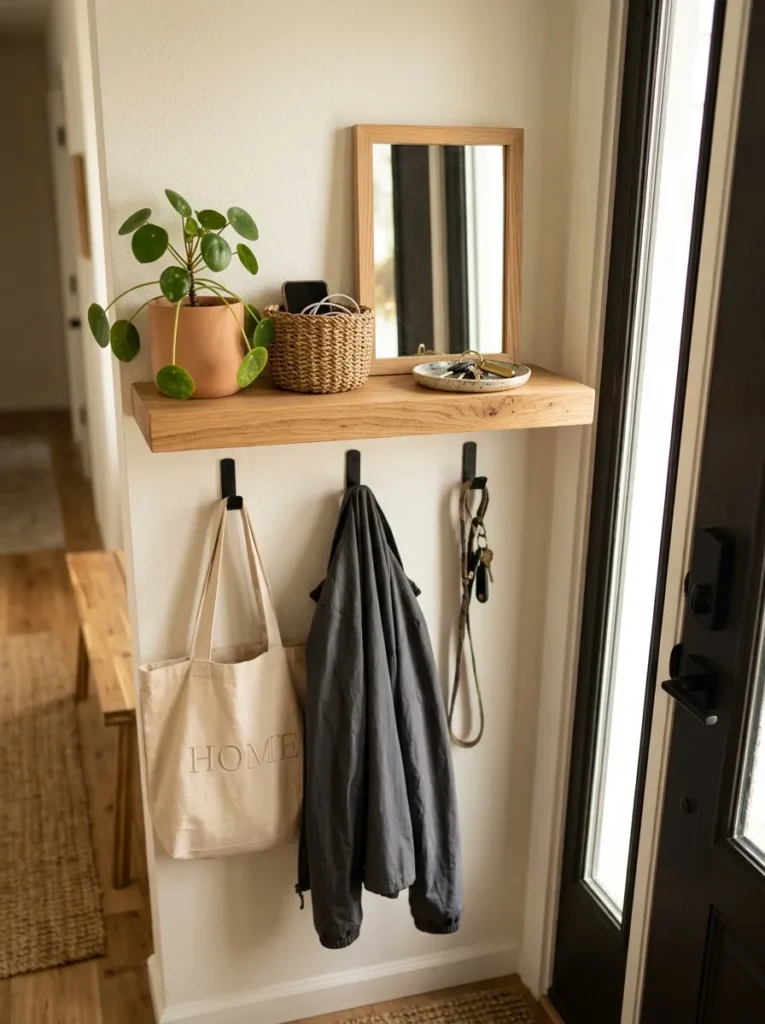
Vibe: The entryway shelf feels organized and welcoming — the calm of arriving home to a space that has a place for everything you carry.
Why it works: An entryway shelf styled as a functional command center solves the most common domestic friction point — the arrival and departure transition — by placing every needed item exactly where it is required at the moment it is needed. The design principle is friction reduction: a key dish at the front edge of the shelf eliminates key searching; hooks immediately below the shelf end bag-on-floor habits; a charging station in a woven basket makes phone charging invisible while remaining accessible. The small mirror propped at the shelf’s back wall serves both a functional purpose (a final appearance check on departure) and a spatial one — it reflects light from the front door, making a typically dark entryway feel significantly larger and brighter.
How to get it: Mount the shelf at 130–140cm from the floor — shoulder height for most adults, which makes key dropping and picking up a one-motion action requiring no bending. Install coat hooks at 160–170cm height (just above the shelf on the same wall surface, or below the shelf edge) for adult coat and bag hanging. Place the key dish at the front-right edge of the shelf (or front-left for left-handed households) so it is the first object reached on entry. Keep the total decorative object count to two — a plant and one additional object — everything else on this shelf should be functional.
Shop The Look
| Product |
|---|
| Ceramic key dish small round matte entryway |
| Matte black wall hook set 4 piece coat bag |
| Floating oak shelf 80cm entryway wall mount |
| Woven seagrass basket small lidded charging station |
| Small framed mirror round simple wall entryway |
12. Vintage and Found Object Shelf (ACCESSORIES / MATERIAL)
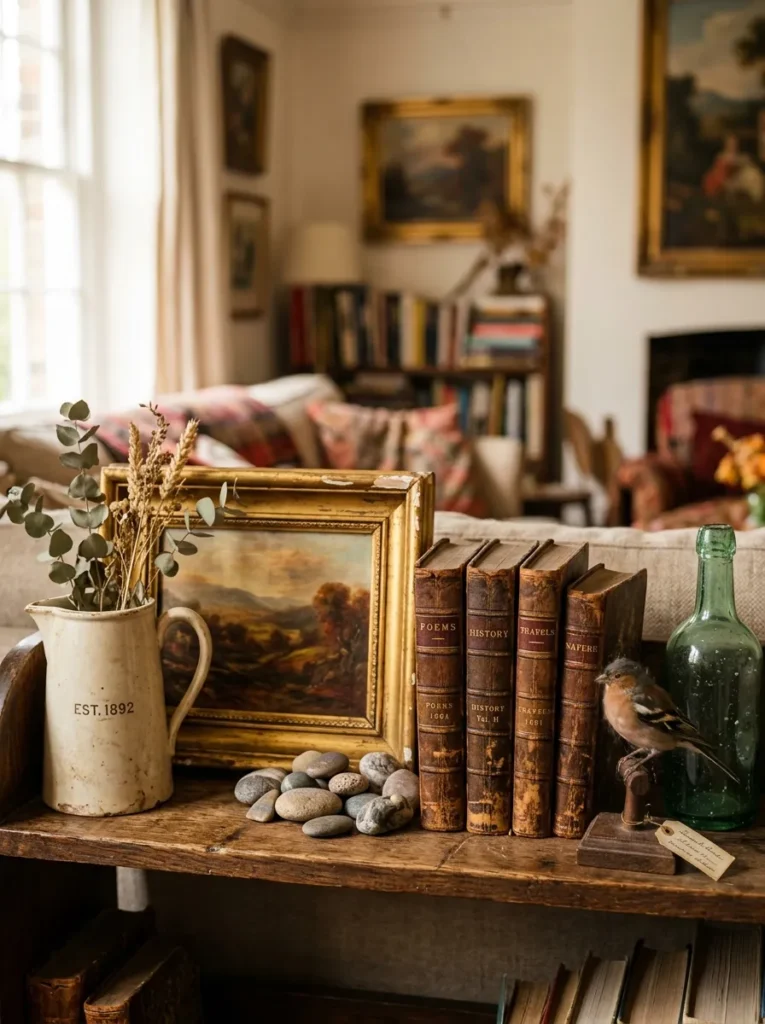
Vibe: The shelf feels deeply personal and unhurried — the kind of collection that looks like it took twenty years to find and five minutes to arrange.
Why it works: Vintage and found object shelf styling succeeds through the unifying quality of patina — the visual evidence of age, use, and time that all genuinely old or naturally weathered objects share. When every object on a shelf has been touched by time in some way — the crazing glaze of old ironstone, the worn gold of a picture frame, the smooth surface of a beach pebble, the cracked spine of an old book — the collection reads as naturally unified regardless of how diverse its sources. The design principle is material memory: objects that carry their history visibly in their surface create a narrative quality that new objects, however carefully selected, cannot replicate.
How to get it: Source objects from three channels: charity shops and antique markets for ceramics, frames, and small decorative objects; nature (beaches, forests, gardens) for stones, seed heads, shells, and botanical materials; and personal archives for objects with specific meaning — old photographs, inherited objects, items from significant places. Arrange without overthinking — the natural visual coherence of aged materials means these objects tend to organize themselves with minimal intervention. Resist the urge to supplement with new purchases, which immediately disturb the patina unity.
Shop The Look
| Product |
|---|
| White ironstone jug small vintage style ceramic |
| Vintage style gilt frame small 10x15cm aged |
| Smooth river pebble set decorative natural large |
| Dried botanical seedhead bunch natural shelf decor |
| Leather bookmark antique style decorative reading |
13. Bathroom Floating Shelf Towel and Vessel Display (MATERIAL)
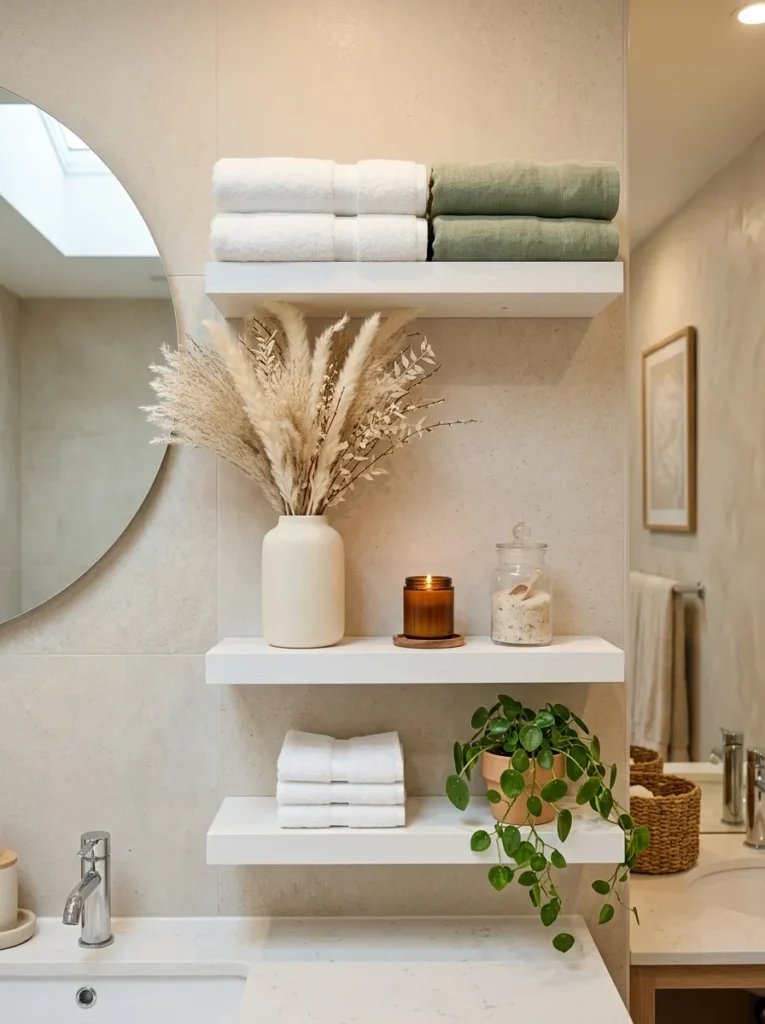
Vibe: The bathroom shelves feel clean and spa-like — a layered textile and object display that makes the room feel designed rather than merely equipped.
Why it works: A ladder arrangement of floating bathroom shelves creates the opportunity to assign a different content category to each level, which is the organizational principle that prevents multi-shelf bathroom displays from feeling cluttered. The visual rule is alternating content type between shelves: textiles on one shelf, botanical and ceramic objects on the next, textiles again on the third. This alternation creates rhythm and prevents any single material from dominating the arrangement while ensuring the overall display has variety and visual movement across its vertical span. The towel folding method matters significantly: folding with the open fold (the loose edge) facing the wall and the smooth fold facing forward creates a clean, hotel-quality edge line that makes even basic supermarket towels look luxurious.
How to get it: Fold towels into thirds lengthwise, then into thirds again widthwise, finishing with the smooth fold facing outward. Stack in groups of two or three per shelf section — odd numbers create more natural arrangements than even. On the display shelf, limit the object count to three maximum: one tall element (a vase or tall bottle), one horizontal element (a candle or small bowl), and one organic element (a plant or botanical). The visual tension between the rigid geometric folds of the towels and the organic forms of ceramics and botanicals is precisely what makes the arrangement work.
Shop The Look
| Product |
|---|
| White linen bath towel set 2 piece natural weave |
| Sage green face cloths set of 4 natural cotton |
| Tall ceramic vase white matte bathroom shelf |
| Dried pampas grass stem small natural bathroom |
| Floating white shelf bathroom set 3 piece ladder |
14. Dining Room Sideboard Shelf Display (COLOR / ACCESSORIES)
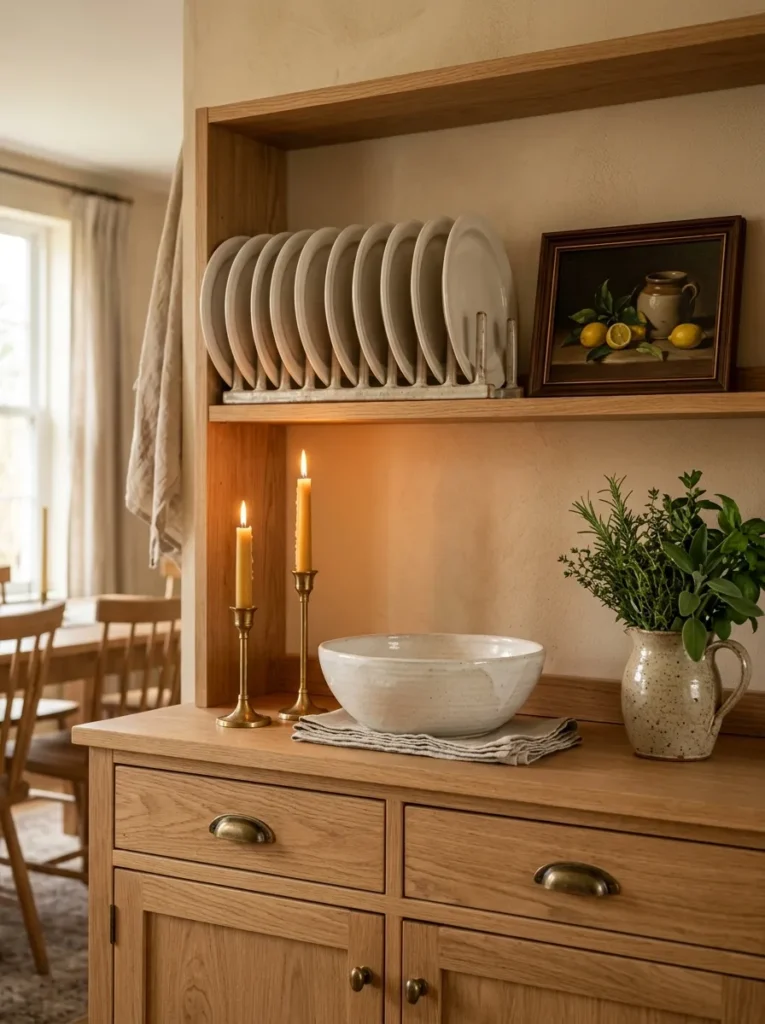
Vibe: The sideboard feels warm and genuinely domestic — a display that celebrates the pleasure of the table without a single meal in progress.
Why it works: Sideboard shelf styling for dining rooms succeeds when it draws from the functional objects of the dining table — plates, serving vessels, candles, table linens — and elevates them to display status through arrangement and context. Standing dinner plates upright in a display rack transforms purely functional objects into a repeating geometric pattern of considerable visual impact, and the uniform color of a matching dinner plate set creates a strong vertical graphic element that anchors the entire sideboard composition. Fresh herbs in a ceramic jug introduce the same living, aromatic quality into the dining display that they contribute to cooking — connecting the aesthetic of the room to its purpose.
How to get it: Position the plate rack at the back of the shelf as the primary vertical element. Place the largest serving vessel (a wide ceramic bowl or a large jug) as the central foreground anchor. Add two candlesticks of noticeably different heights — the height variation creates asymmetry that prevents the arrangement from feeling too formal or symmetrical. Introduce one piece of art, propped rather than hung, to add the layered quality that wall-hung pieces cannot provide. Change the fresh herb or botanical element seasonally to keep the arrangement visually alive throughout the year.
Shop The Look
| Product |
|---|
| White ceramic dinner plate set 4 piece simple modern |
| Wooden plate display rack standing tabletop natural |
| Large ceramic serving bowl white matte wide |
| Taper candlestick pair unequal heights natural wood |
| Small framed still life art print kitchen dining |
15. Outdoor Shelf and Garden Potting Station (LAYOUT / MATERIAL)
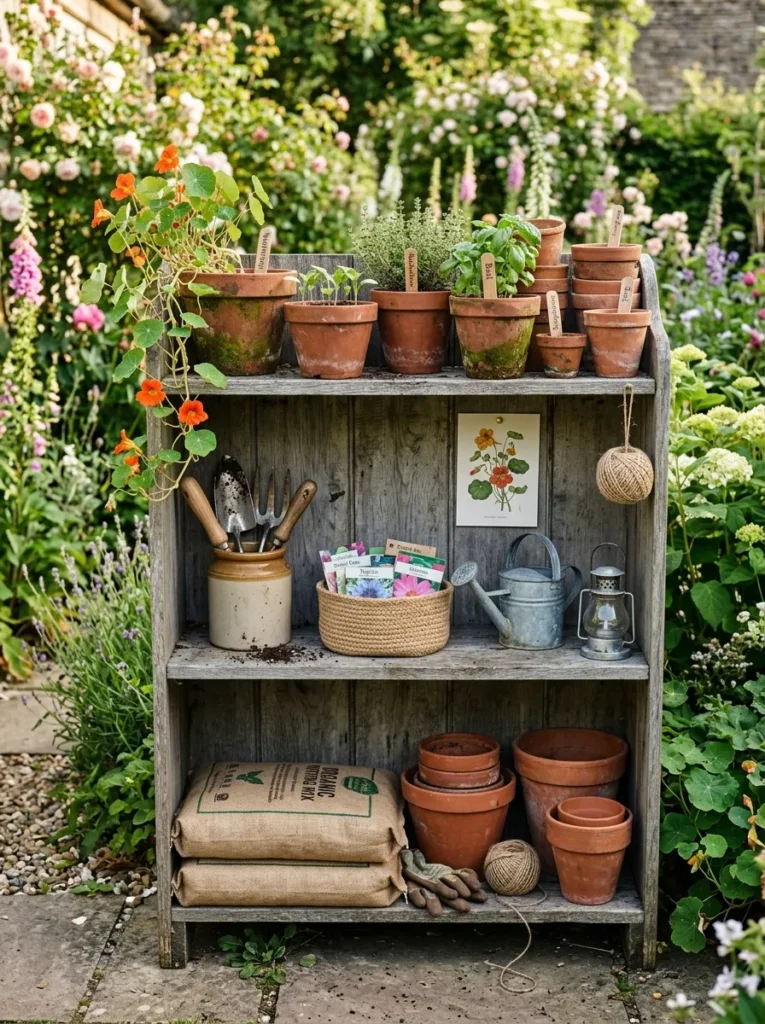
Vibe: The potting shelf feels warm and purposeful — a working garden surface that also reads as the most charming corner of the garden.
Why it works: Outdoor shelf styling for a garden potting station succeeds when it applies the same design logic used for indoor shelves — varied heights, consistent containment, alternating content types between levels — to a fully functional outdoor work surface. The visual principle is elevation: placing garden tools in ceramic crocks rather than a toolbox, displaying seed packets in a woven basket rather than loose on a surface, and arranging terracotta pots at varied planting stages as an active display transforms the potting station from a utilitarian corner into a garden focal point. Weathered wood’s natural patina provides the same unifying quality for outdoor objects that aged ceramics provide for indoor vintage displays — time’s touch makes everything on the shelf look as if it belongs together.
How to get it: Assign a clear content category to each shelf level: active planting and in-progress work at the top (where it is most accessible and most visually prominent), tools and small supplies at the middle, and bulk materials and large empty containers at the bottom. Display tools in ceramic crocks or terracotta pots rather than storing them lying flat — vertical tool display is both more practical (tools are visible and reachable without rummaging) and more visually elegant. Add one non-functional decorative element per shelf — a small lantern, a botanical print, a single decorative pot — to signal that the space is designed, not merely functional.
Quick Win: Three mismatched terracotta pots ($1–$2 each from a garden center) used as tool holders for small hand trowels, scissors, and stakes create an immediate potting station display for under $10, transforming a flat shelf of scattered tools into a visually organized and styled surface in under five minutes.
Shop The Look
| Product |
|---|
| Weathered wood outdoor shelf unit garden three tier |
| Terracotta pot set assorted sizes garden display |
| Woven jute basket small seed packet storage garden |
| Small watering can metal copper finish garden |
| Garden tool set hand trowel fork cultivator small |
How to Start Your Stylish Shelf Decor Transformation
Your single best first move is to completely clear one shelf — remove every object currently on it — before making a single purchasing decision. The most common reason shelf styling fails is not a lack of objects but a failure to edit: most shelves in most homes already contain enough interesting pieces to create a genuinely stylish arrangement, but those pieces are buried under functional clutter and accidental accumulation that prevents any individual object from being seen. Clearing the shelf entirely and replacing only the best five to seven pieces — chosen from what you already own — costs nothing and frequently produces a transformation as significant as any purchasing decision.
The most common beginner mistake in shelf styling is arranging all objects at the same height along the back edge of the shelf, creating a flat, one-dimensional lineup that has no depth, no movement, and no hierarchy. The fix is the three-plane rule: always use the shelf’s front-to-back depth to create foreground, middle ground, and background placement positions, and always vary the height of objects so the silhouette when viewed at eye level is irregular rather than level. These two adjustments — depth variation and height variation — transform any shelf from a flat lineup into a composed arrangement, and both are completely free.
Three specific items under $50 that create immediate shelf styling impact across any room: a bundle of dried eucalyptus stems ($8–$12) that add organic height, natural fragrance, and botanical texture to any shelf regardless of its current contents; a set of three apothecary-style glass jars in varying heights ($12–$18) that transform loose functional items into a display in any room from bathroom to kitchen to home office; and a single art print in a simple natural wood frame ($15–$22) that creates an instant background layer for any shelf vignette and establishes the color palette that all other objects can reference.
A single shelf refresh using existing objects takes 20–40 minutes and costs nothing. A curated shelf transformation with two to three new purposefully chosen objects costs $20–$60 and produces a result that anchors the room’s aesthetic at a fundamental level. A full bookcase styling project — color-blocking books, adding ceramics and botanicals, installing lighting — takes one full weekend and a budget of $60–$150, and delivers the single largest visual impact available to any room without structural change.
Frequently Asked Questions About Stylish Shelf Decor
What is the rule of three in shelf decorating and why does it work?
The rule of three is a visual composition principle derived from both classical art theory and the psychology of visual perception — the human eye finds odd-numbered groupings more dynamic and interesting than even-numbered ones, because odd groups resist perfect symmetry and create the slight visual tension that holds attention. In shelf styling specifically, groupings of three objects at graduated heights create a triangular silhouette that gives the eye a clear visual path to follow — bottom to middle to top and back — producing the sense of movement and composition that makes a shelf arrangement feel designed rather than assembled. The rule applies at every scale: three objects on a single shelf, three shelves in a bathroom ladder arrangement, three color sections in a color-blocked bookcase.
How do I style shelves that are both functional and beautiful?
The key to shelves that are both functional and beautiful is the closed-storage-to-open-display ratio. Dedicate 60–70% of shelf space to contained, organized storage — matching boxes, baskets, or lidded vessels that hide functional clutter behind a uniform visual surface — and reserve 30–40% for open decorative display. This ratio ensures the shelf carries its full functional load while maintaining enough visual breathing space for the display elements to read clearly. Every open display item on a functional shelf should also justify its presence through usefulness — a ceramic dish that holds keys, a jar that contains scissors, a plant that improves air quality — because purely decorative objects on functional shelves feel out of place under daily use.
What plants work best for shelf styling?
The best shelf plants share three characteristics: tolerance for indoor light levels, a form that adds vertical or trailing visual interest, and a scale appropriate to the shelf’s depth and the objects around them. Trailing plants — pothos, string of pearls, tradescantia, ivy — work on the middle and lower shelves of a multi-shelf arrangement, where their trailing form breaks the horizontal shelf edge in a way that no upright plant can replicate. Upright architectural plants — small snake plants, ZZ plants, single-stem fiddle leaf cuttings — work as vertical accents on wider shelves. Dried botanicals — pampas grass, dried eucalyptus, dried seed heads — work on any shelf and require zero maintenance, making them the most practical choice for shelves in rooms with low light or high display density.
How many objects should be on a shelf?
The optimal object count depends entirely on shelf width and the styling approach. For a 60cm floating shelf in a minimalist Japandi or Scandinavian-influenced room, three objects maximum is the correct count. For a 90–120cm shelf in a standard living room, five to seven objects produces a balanced arrangement with sufficient variety and adequate negative space. For a full-width bookcase shelf (150–200cm), eight to twelve objects including books is the appropriate range. As a general rule, 20–30% of any shelf surface should remain visually empty as breathing space — the arrangement needs room to be seen as well as objects to see. Shelves that feel overcrowded almost always improve immediately when one-third of their current objects are removed.
What is the best way to add height variation to a flat shelf arrangement?
The fastest technique for adding height variation to a flat shelf arrangement is the book stack plinth method: stack two or three hardcover books horizontally to create a raised platform, then place a small object on top of the stack. This immediately creates a height differential of 10–15cm with objects you already own, at zero cost. Additional height variation techniques include using objects of genuinely different scales (a 40cm vase beside a 10cm ceramic bowl), leaning art prints at the back of the shelf to create an implied vertical background, and introducing trailing plants whose cascading form creates implied height below the shelf level. The combination of one tall element, one medium element, and one low element — the three-height rule — applied to every shelf section produces the most visually satisfying arrangement regardless of the specific objects used.
Ready to Create Your Dream Stylish Shelf Decor?
These 15 ideas span the full range of shelf styling approaches — from the meditative restraint of the Japandi three-object composition and the clean functionality of the Montessori children’s shelf through to the richly layered maximalist display, the warm domestic pleasure of the kitchen herb shelf, and the outdoor practicality of the garden potting station — covering color, material, layout, small-space solutions, and room-specific strategies across every idea. Begin with the one shelf in your home that currently frustrates you most — the one that always looks cluttered or incomplete regardless of how you arrange it — and apply the single rule of clearing it completely before making any decisions about what belongs on it. Today’s specific action: identify that one shelf, set a 30-minute timer, remove everything from it, and replace only the objects that you would genuinely choose to display if you were starting from nothing. When you step back from a shelf that finally feels considered — where every object has earned its place, the heights vary with intention, and the negative space breathes — you will understand exactly why shelf styling earns its dedicated corner of every serious interior design Pinterest board. Save your favorites now, especially the layered vignette and the Japandi composition — they are the two ideas that, once understood, change the way you see every shelf in every room for good.