14 Cozy Laundry Room Decor Ideas for Every Home
A cozy laundry room is a functional utility space deliberately designed with warmth, personality, and visual consideration — transforming one of the home’s most overlooked rooms into a space that makes a genuinely tedious chore feel less like an interruption and more like a moment in a room you actually like being in. Here are 14 ideas for making your laundry room feel warm, considered, and genuinely worth the square footage it occupies.
The laundry room is the room most people design last and least. It gets the leftover paint, the mismatched shelving, the utility lighting that was never meant to be permanent. And then it stays that way for years, because there is always something more important to address. The homes that get this room right understand something the others don’t: a room you visit every day deserves better than an afterthought. Here are 14 ideas worth saving — and stealing.
Why Cozy Laundry Room Decor Works So Well
What makes a laundry room genuinely cozy rather than simply functional? A cozy laundry room applies the same design principles that make any room feel warm and personal — deliberate color choices, quality lighting, natural materials, and objects chosen for their appearance as much as their function — to a space that convention has traditionally treated as purely utilitarian. The distinction between a functional laundry room and a cozy one is not primarily a matter of budget or size: it is a matter of design intention. A laundry room with a carefully chosen paint color, proper task and ambient lighting, and consistently styled storage reads as a designed space regardless of its square footage.
Core materials and colors. The cozy laundry room palette leans toward the same warm, natural aesthetic that works in kitchens and bathrooms — spaces that share the laundry room’s combination of hard surfaces, utility function, and high daily use frequency. White shaker cabinetry, natural wood open shelving in white oak or pine, subway tile or zellige tile backsplashes in warm white or soft sage, warm linen storage baskets, and matte black or brushed brass hardware create the material foundation. Color approaches range from clean and bright (warm white walls with natural wood accents and black hardware) to bold and warm (deep sage, dusty blue, or warm terracotta as a full-room color with white cabinetry and brass hardware). Avoid cool greys and stark white in isolation — they amplify the laundry room’s utilitarian quality rather than counteracting it.
Why laundry room design is getting serious attention now. The laundry room has emerged as one of the most frequently renovated secondary spaces in the home renovation market, driven by several converging factors: the growth of home design social media content that demonstrates what these rooms can become, the increased time spent at home post-pandemic that elevated awareness of every room’s quality, and the practical recognition that a well-organized laundry room genuinely reduces the time and friction of one of the household’s most regular tasks. Pinterest data shows consistent growth in “laundry room decor,” “laundry room makeover,” and “small laundry room ideas” searches year over year.
Can a small or closet laundry space achieve a cozy aesthetic? Consistently yes — and some of the most compelling laundry room transformations are in the smallest spaces, where the design decisions are concentrated onto a few surfaces and every choice has maximum impact. A laundry closet with a bold paint color, proper lighting, and styled open shelving above the machines can achieve a cozy atmosphere in 12 square feet that rivals a full laundry room with no design intention in 80 square feet.
Style at a Glance
| Element | Detail |
|---|---|
| Philosophy | Every room you visit daily deserves deliberate design |
| Key Materials | Shaker cabinetry, white oak shelving, linen baskets, subway tile |
| Key Colors | Warm white, dusty sage, navy, terracotta, warm greige, soft black |
14 Cozy Laundry Room Decor Ideas for Every Home
1. Bold Paint Color on All Four Walls
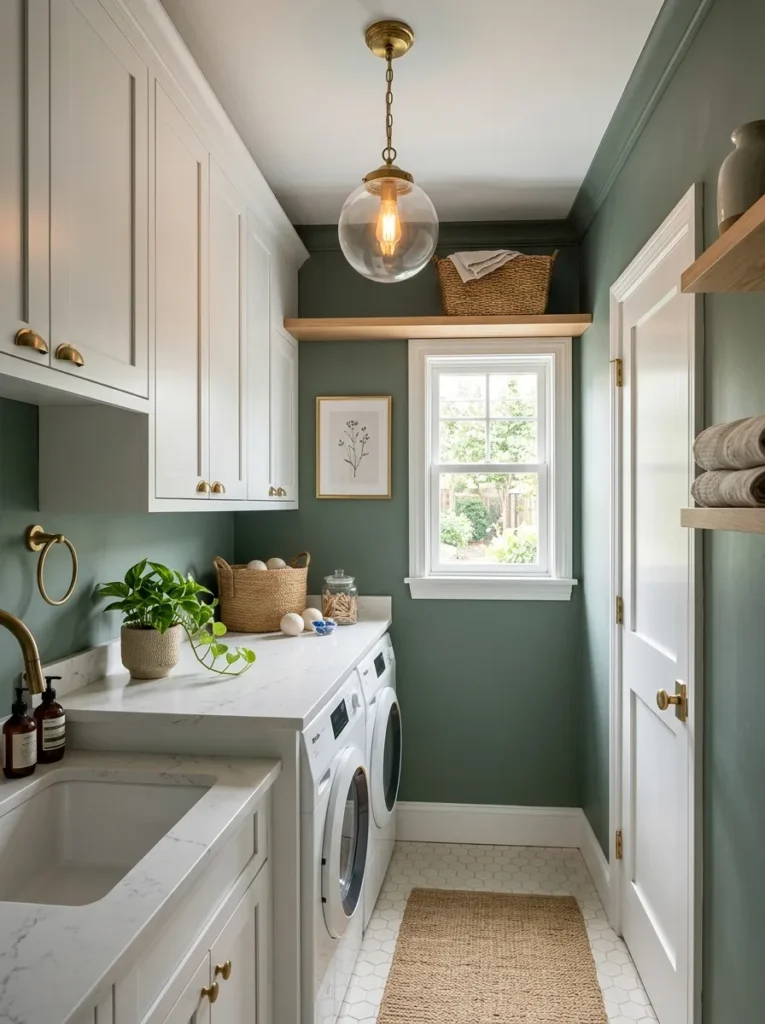
Vibe: A deep sage laundry room feels intentionally designed — the room that makes you stop and notice it the first time you walk in after the paint has dried.
Why it works: Painting all four walls of a laundry room in a bold, saturated color is the highest-impact single intervention available to this space — it converts a utilitarian room into one that reads as a deliberate design decision. The design principle is color envelope as spatial identity: when all four walls share the same bold color, the room acquires a coherent character that transcends its functional content — the machines, the plumbing, and the utility elements become secondary to the room’s overall color atmosphere. Deep dusty sage is the optimal laundry room bold color because it reads as sophisticated and warm rather than clinical, pairs naturally with white cabinetry and brass hardware, and creates the organic, natural quality that makes the room feel calm rather than demanding attention.
How to get it: Apply a matte or eggshell finish in your chosen bold color to all four walls including any walls partially occupied by cabinetry or utility panels — the consistency of color across all surfaces is what creates the envelope effect. Benjamin Moore’s Saybrook Sage, Sherwin-Williams’ Pewter Green, or Farrow & Ball’s Mizzle are the benchmark dusty sage tones for this application. Pair with white shaker upper cabinets, brushed brass hardware, and white countertops for the maximum warm contrast against the sage walls.
Quick Win: A single quart of paint in a bold color costs $18–$28 and covers a small laundry room in two coats — the highest-return design investment per dollar in any laundry room makeover, achievable in a single weekend afternoon.
Shop The Look
| Product |
|---|
| Dusty sage matte wall paint quart |
| White shaker cabinet door replacement |
| Brushed brass cup pull set of 8 |
| White quartz countertop cut to size |
| Small linen pot plant cover indoor |
Also view: 14 Large Wall Decor Ideas for Bold Interiors
2. Open Wooden Shelving for Styled Storage Display
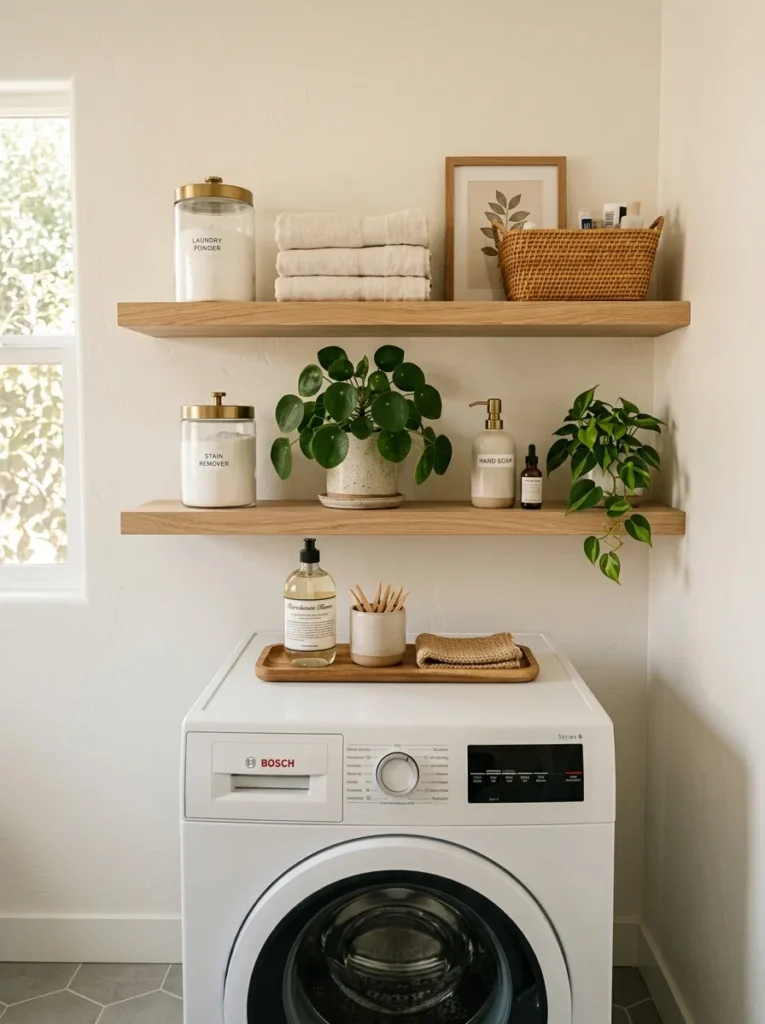
Vibe: Styled open shelving in a laundry room feels warm and considered — storage that earns its place visually as much as functionally.
Why it works: Open wooden shelving in a laundry room converts functional storage into a display opportunity — when laundry supplies are decanted into attractive containers and organized alongside folded linens and small plants, the shelf becomes a composed vignette rather than a utility storage area. The design principle is functional aesthetics through material elevation: glass canisters with brass lids, woven rattan baskets, and ceramic plant pots replace the visual chaos of branded detergent bottles and product packaging with a consistent warm-neutral material palette that reads as interior design rather than utility organization. White oak specifically is the correct shelving material for a cozy laundry room — its warm grain and light color bridge the white of appliances and cabinetry and the natural warmth of basket and linen storage elements.
How to get it: Install two floating white oak shelves (24–30-inch length, 10-inch depth) above the washing machine at 18 inches above the machine top and 12 inches above that for the second shelf. Decant all powdered detergents into glass canisters with matching lids, keep liquid detergents in their bottles but grouped behind a woven basket so the front of the shelf shows only the styled elements. Add one small plant and one to two personal decorative objects to complete the composition.
Shop The Look
| Product |
|---|
| White oak floating shelf 30 inch wall mount |
| Glass canister set with brass lid for laundry |
| Woven rattan storage basket small set of 2 |
| Ceramic plant pot small white matte |
| Cream linen hand towel set |
3. Peel-and-Stick Tile Backsplash Behind the Machines
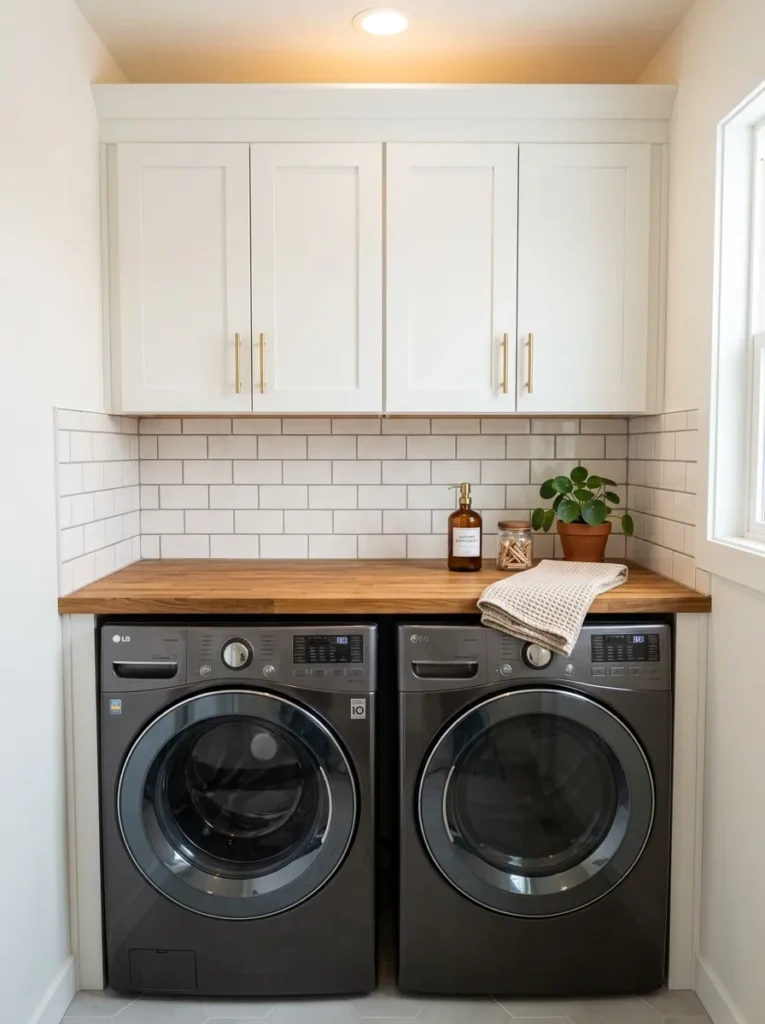
Vibe: A tiled backsplash behind the machines feels finished — the detail that makes a laundry room look like someone actually planned it.
Why it works: A backsplash in the laundry room performs the same design function as a kitchen backsplash — it creates a defined, finished zone behind the work area that signals intentional design while providing a practical, wipeable surface. The design principle is zone completion: the area between the machine tops and the cabinetry above is the laundry room’s equivalent of the kitchen’s backsplash zone, and leaving it as plain painted drywall leaves the room’s composition incomplete. Peel-and-stick subway tiles in warm white with realistic grout lines create the appearance of genuine ceramic tile installation at a fraction of the cost and installation complexity — they are removable, making them ideal for rental laundry spaces.
How to get it: Clean the wall surface thoroughly with a degreaser before applying peel-and-stick tiles — any grease or dust will compromise the adhesive. Apply from the center of the backsplash zone outward, maintaining level rows throughout using a spirit level. Cut tiles to fit edges with sharp scissors or a craft knife. The warm white with grey grout option reads as most genuinely ceramic — avoid bright white tiles that read as plastic rather than porcelain.
Shop The Look
| Product |
|---|
| Peel and stick subway tile warm white grey grout |
| Spirit level small for tile alignment |
| Craft knife and cutting mat for tile trimming |
| Tile adhesive primer for difficult surfaces |
| Grout pen white for touching up lines |
4. Vintage-Style Laundry Sign and Typographic Prints
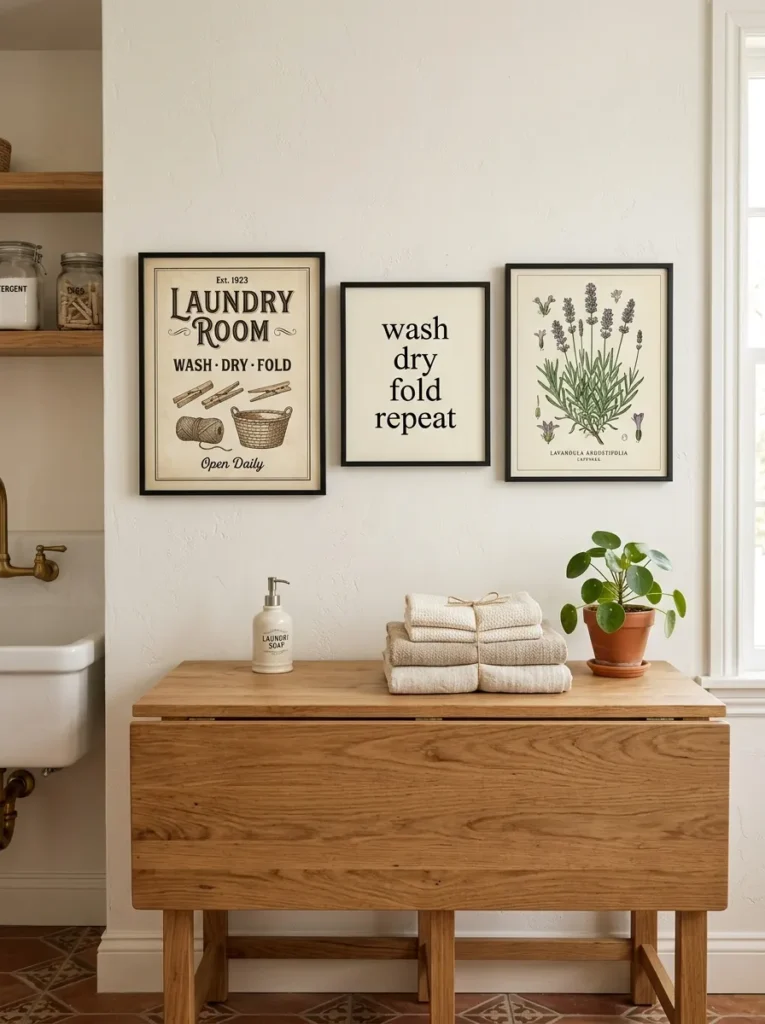
Vibe: Typographic laundry prints feel charming and warm — the acknowledgment that even a utility room deserves a sense of humor and personality.
Why it works: Typographic prints in a laundry room apply the principle of personality through text — they give the room a voice that its functional contents cannot provide, communicating that the space has been thought about and that the person who designed it has a point of view. Vintage-style laundry typography specifically references the graphic tradition of early 20th-century commercial laundry signage — a tradition with genuine aesthetic heritage that adds historical warmth to a contemporary domestic space. The design principle is personality as design element: a laundry room with framed typographic prints that acknowledge the room’s function reads as self-aware and warm rather than simply functional.
How to get it: Source typographic laundry room prints from Etsy digital download sellers — printable files in the $3–$8 range provide immediate access to a wide range of vintage and contemporary laundry typography styles. Print at home or at a local print shop in sizes that fit your chosen frames. Arrange three prints in a horizontal row with consistent bottom-edge alignment — the most visually settled arrangement for a small, multi-print grouping — above the folding counter or ironing area.
Shop The Look
| Product |
|---|
| Vintage laundry room art print digital download |
| Slim black picture frame set 5×7 8×10 |
| Botanical illustration print for laundry room |
| White mat board pre-cut for small frames |
| Picture hanging strip small damage free |
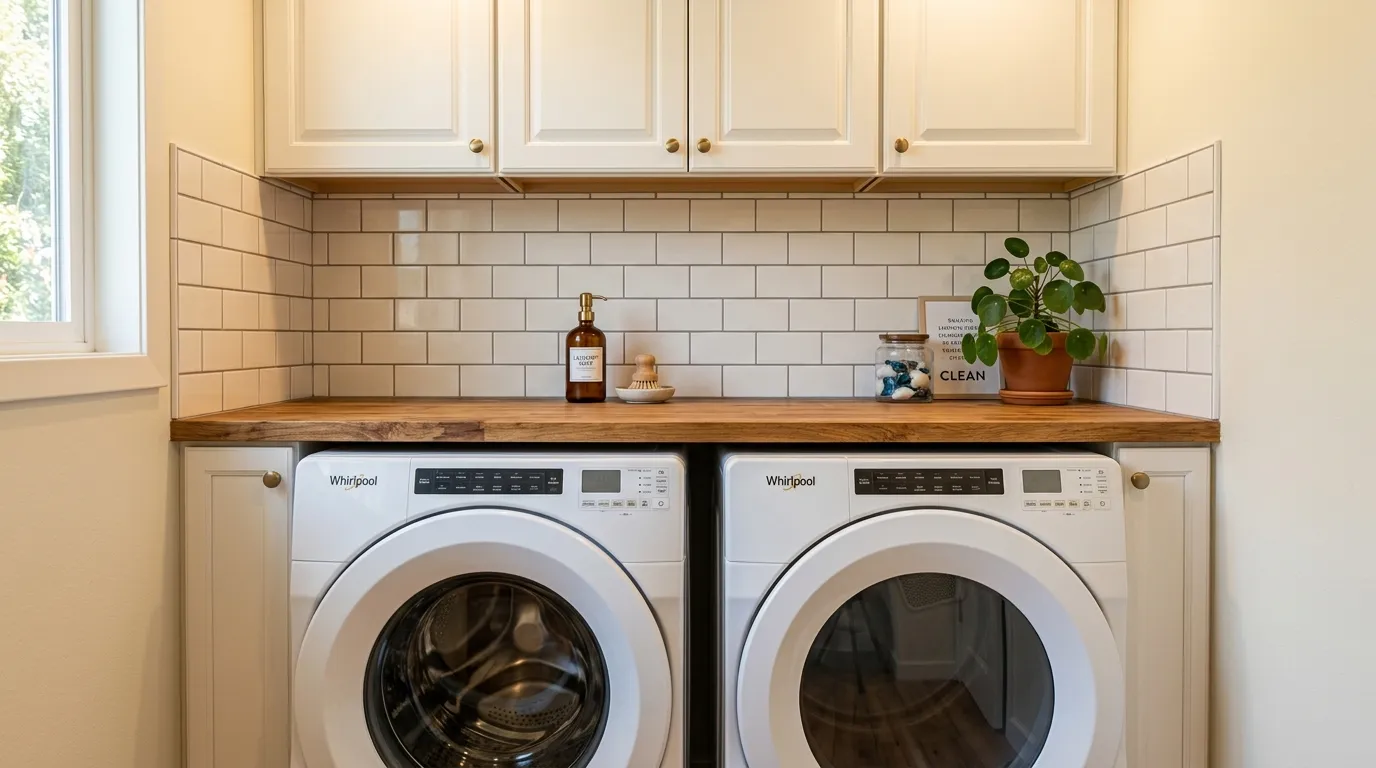
5. Butcher Block or Wood Counter Above the Machines
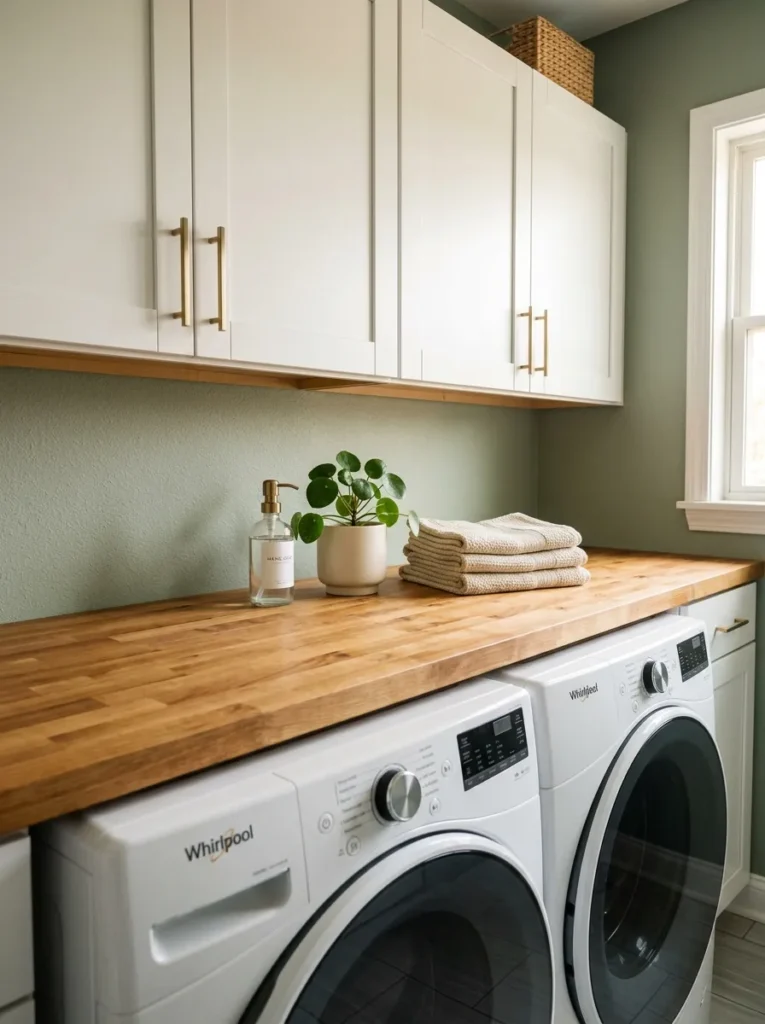
Vibe: A butcher block counter above the machines feels warm and genuinely domestic — the detail that converts appliances into furniture.
Why it works: A continuous wood counter spanning the full width above front-load machines is the laundry room upgrade with the highest functional and aesthetic return simultaneously — it creates a dedicated folding surface (improving laundry workflow), conceals the machines beneath a designed surface (improving the room’s visual quality), and introduces the warmth of natural wood into a space that would otherwise be dominated by white appliances and utility fixtures. The design principle is material warmth as functional upgrade: butcher block in warm honey or golden tones bridges the cold functionality of washing machines and the warm residential quality the laundry room is trying to achieve. A properly sealed butcher block surface (food-grade mineral oil or tung oil finish) resists moisture, which is essential in a laundry room environment.
How to get it: Measure the combined width of your machines plus any gap between them and the walls. Purchase a butcher block panel (IKEA KARLBY or similar) cut to that dimension, or order a custom cut from a lumber supplier. Seal with three coats of food-grade mineral oil or tung oil, allowing 24 hours between coats, before installation. Support the counter on L-brackets mounted to the wall studs on each side, or on the machine tops directly if the machines are appropriately sized and level.
Shop The Look
| Product |
|---|
| Butcher block counter panel 74 inch natural |
| Food grade mineral oil for wood counter sealing |
| Glass soap dispenser with brass pump |
| L-bracket shelf support set heavy duty |
| Small indoor plant ceramic pot white |
6. Warm Pendant Light or Rattan Shade Fixture
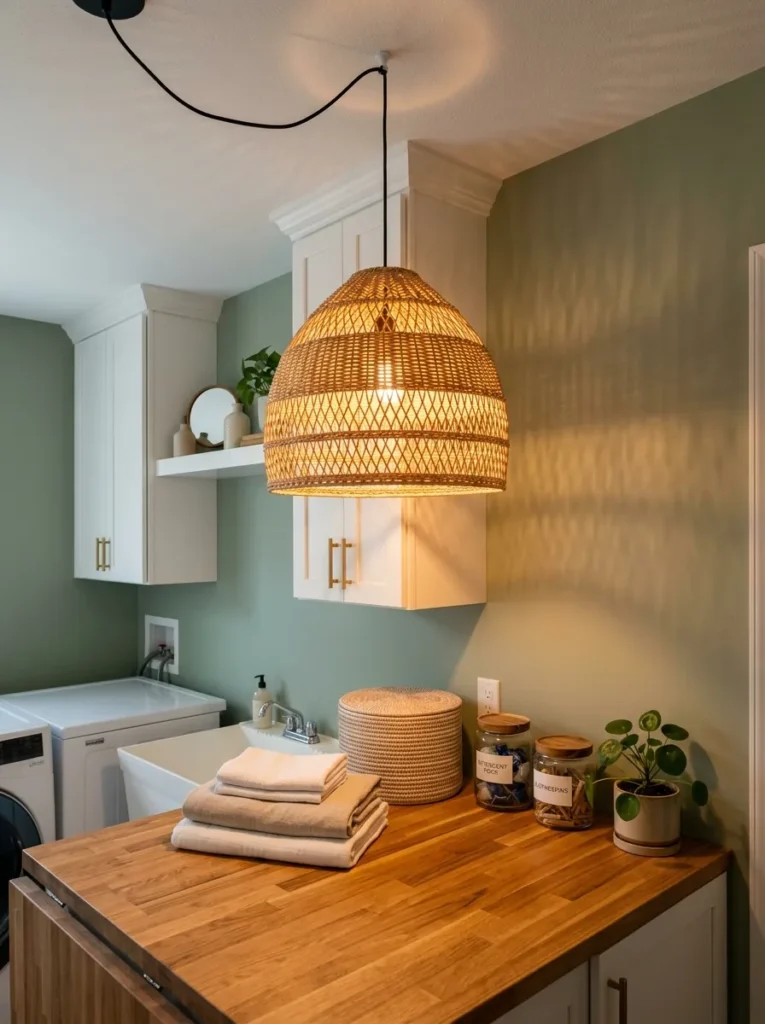
Vibe: A rattan pendant in a laundry room feels unexpectedly warm — the light fixture that makes everyone who enters reconsider what this room could be.
Why it works: Lighting is the laundry room’s most consistently neglected design element — most laundry rooms rely on a single recessed or surface-mounted fluorescent or LED fixture that provides adequate task light and zero warmth or atmosphere. Replacing this with a warm pendant light, or supplementing it with one, converts the room’s light from purely functional to warmly atmospheric. A rattan pendant shade is the optimal choice for a laundry room because its natural material connects the room’s warm material palette (wood shelving, linen baskets, wood counter), its woven structure creates dappled shadow patterns on surfaces below, and its warm amber glow through the weave produces exactly the quality of intimate, pool-of-light atmosphere that makes a small utility room feel cozy rather than clinical.
How to get it: Install a pendant light on a swag hook over the folding counter area — a plug-in pendant (which requires only a ceiling hook and an outlet, not hardwired installation) is the most accessible option for renters or anyone without electrical experience. Choose a bulb at 2700K warm white and 600–800 lumens for adequate task lighting with warm color temperature. A rattan or woven shade in natural honey tones is the most versatile option for warm laundry room palettes — it works with sage, navy, white, and terracotta equally.
Quick Win: A plug-in swag pendant with a rattan shade costs $40–$75 and requires only a ceiling hook and an outlet — it is the single most atmospheric upgrade available to any laundry room and installs in under 30 minutes.
Shop The Look
| Product |
|---|
| Rattan woven pendant light shade plug in |
| Swag ceiling hook for plug in pendant |
| LED warm white bulb 2700K pendant compatible |
| Pendant light cord cover fabric for swag |
| Ceiling hook anchor for pendant weight |
7. Linen and Wicker Storage Basket System
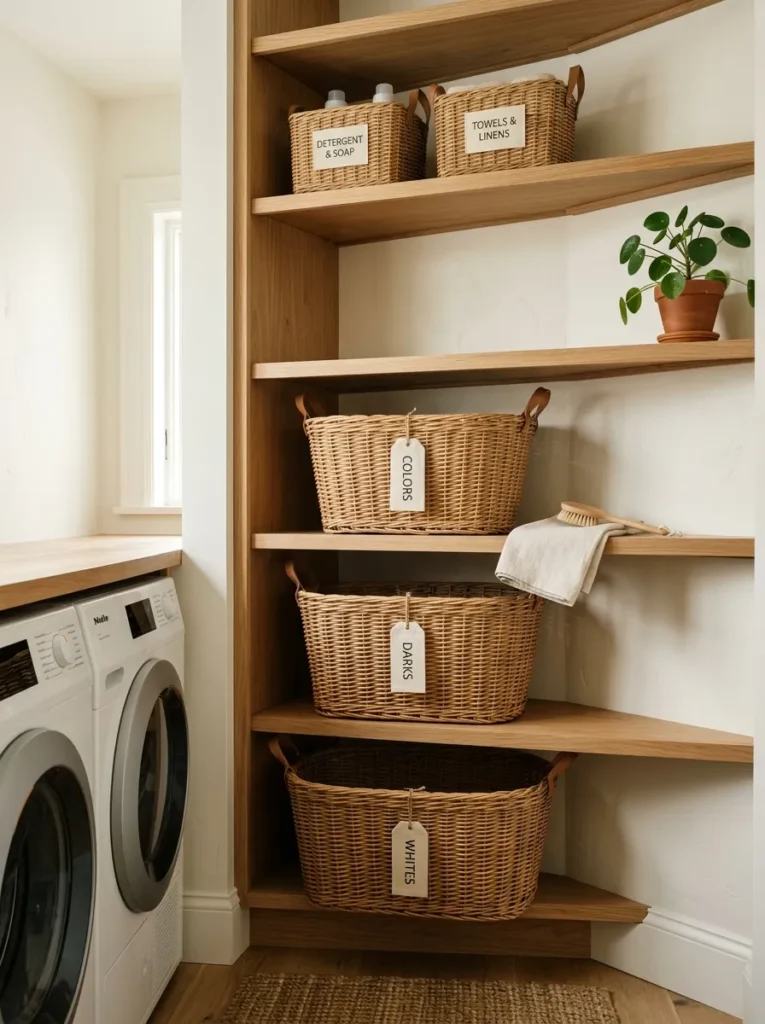
Vibe: A labeled wicker basket laundry system feels organized and warm — the organizational solution that makes sorting laundry feel like something a calm, competent person does.
Why it works: A labeled basket storage system is the laundry room organizational intervention with the greatest daily workflow improvement — it creates the pre-sorting infrastructure that eliminates the decision-making overhead at laundry time by giving each category of laundry a permanent, visually identifiable home. The design principle is categorical containment with aesthetic coherence: matching wicker baskets in two sizes (large for laundry sorting, small for supplies) on consistent shelving creates a system that is simultaneously functional and visually calm. Natural wicker is the optimal material for this application because it breathes (important for clothing awaiting laundering), reads as warm and domestic rather than utilitarian, and is available in consistent sizes that create the visual uniformity a basket system requires to look designed rather than accumulated.
How to get it: Identify your laundry categories first — typically three to four sorting categories (whites, darks, colors, delicates) plus one to two supply categories (cleaning products, ironing supplies). Purchase matching wicker baskets in two sizes for these categories. Install open oak shelves sized to fit the baskets snugly — baskets should slide in and out easily but not rattle. Add linen label tags (hand-lettered or printed and attached with a short length of jute twine through a small brass grommet in the tag) identifying each basket’s category.
Shop The Look
| Product |
|---|
| Wicker storage basket large laundry set of 3 |
| Small wicker basket with handle set of 2 |
| Linen label tag set with jute twine |
| White oak shelf board 36 inch |
| Brass grommet set for label tags |
8. Wallpaper or Peel-and-Stick Pattern on One Accent Wall
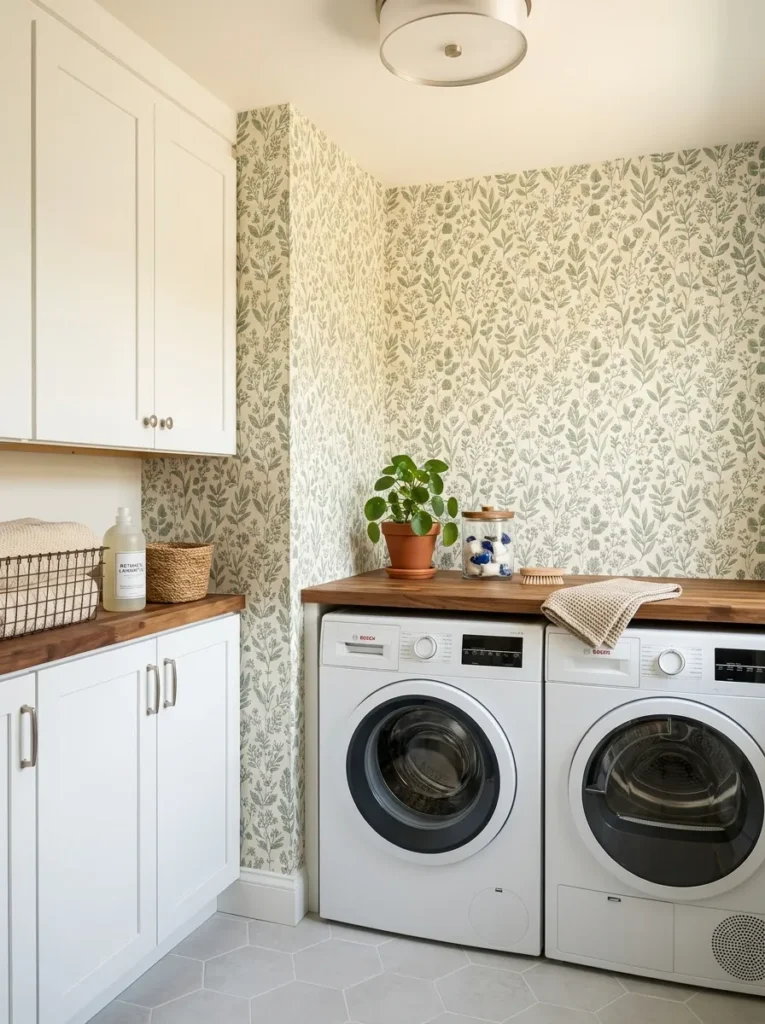
Vibe: A botanical wallpaper accent wall in a laundry room feels delightfully unexpected — the pattern that makes an ordinary task feel like it’s happening somewhere worth being.
Why it works: A single wallpapered accent wall in a laundry room creates the disproportionate design impact characteristic of pattern in a small space — in a room where every surface is seen simultaneously, one patterned wall transforms the entire room’s character without requiring the full-room commitment that could overwhelm a small space. The design principle is pattern concentration: applying a botanical or geometric pattern to the wall most visible from the room’s primary work position (the wall behind the machines, which faces the person doing laundry) maximizes the pattern’s visual impact during the activity it’s designed to support — making laundry time more pleasant. Peel-and-stick botanical wallpaper in sage and cream is the most versatile choice for a laundry room accent wall because it complements white appliances and cabinetry while introducing the organic warmth that the room’s utility surfaces cannot provide.
How to get it: Measure the accent wall precisely and order peel-and-stick panels with a 5% overage for trimming. Clean the wall surface thoroughly before application — any residue will compromise adhesion. Apply panels vertically from top to bottom, matching the pattern repeat at each seam. The small-scale botanical pattern (repeat under 10 inches) is most forgiving for a first-time wallpaper installer because pattern-matching errors are less visible than with large-scale patterns.
Shop The Look
| Product |
|---|
| Botanical peel and stick wallpaper sage cream |
| Wallpaper smoothing tool seam roller |
| Craft knife and cutting mat for trimming |
| Plumb bob for first panel alignment |
| Wallpaper seam repair adhesive |
9. Countertop Herb or Plant Display for Living Warmth
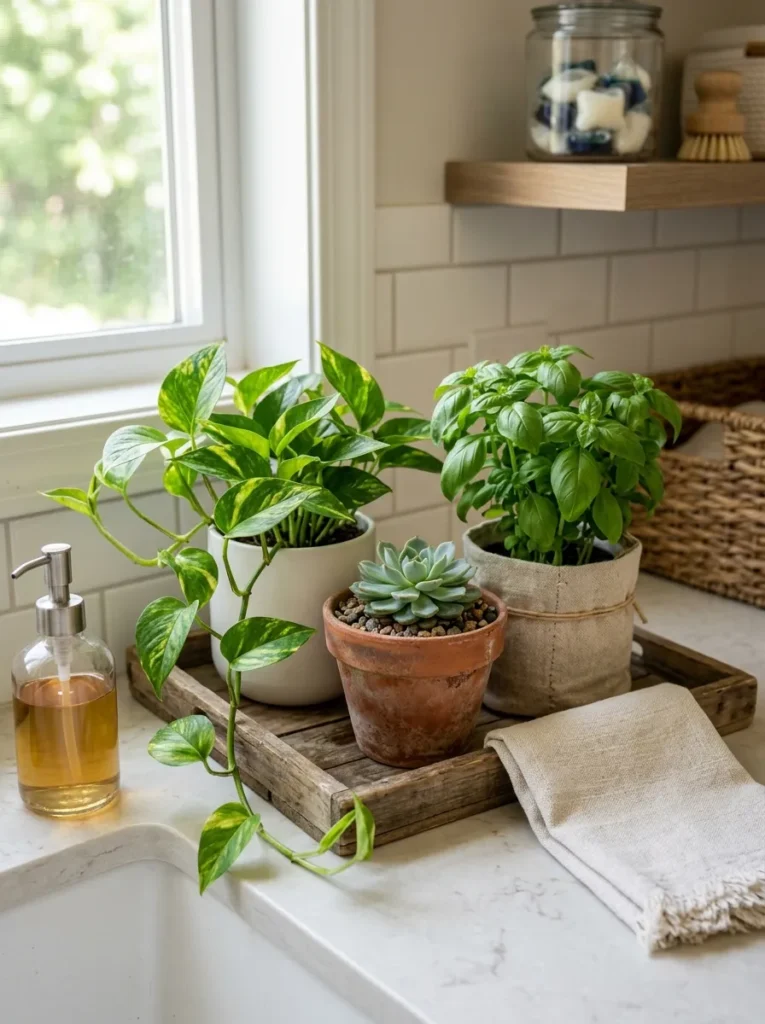
Vibe: A small plant cluster in a laundry room feels alive — the most immediate signal that this room has been thought about as a place rather than just a function.
Why it works: Plants in a laundry room perform a specific atmospheric function beyond their general design contribution — they introduce the living, organic quality that a room full of machines and utility supplies fundamentally lacks. The design principle is contrast through life: a potted plant beside a washing machine creates a material and categorical contrast (living versus mechanical, organic versus manufactured) that makes both elements more interesting and makes the room feel less exclusively utilitarian. Laundry rooms typically have sufficient natural light from small windows or ceiling fixtures to support a trailing pothos (one of the most light-tolerant indoor plants available) and a compact succulent (which thrives in the slightly humid environment that laundry rooms often provide).
How to get it: Choose plants appropriate for laundry room conditions — typically lower light and slightly elevated humidity from machine operation. Trailing pothos, spider plants, peace lilies, and compact ferns all perform well in laundry room environments. Group three plants on a small wooden tray beside the soap dispenser or on a shelf — the tray creates the containing element that makes the plant cluster read as a composed display rather than plants placed randomly on a surface.
Shop The Look
| Product |
|---|
| Trailing golden pothos plant small indoor |
| Compact succulent assortment small terracotta |
| Small linen plant pot cover set of 2 |
| Small wooden display tray for counter |
| Ceramic soap dispenser glass pump white |
10. Folding Station with Hooks, Rail, and Hanging Space
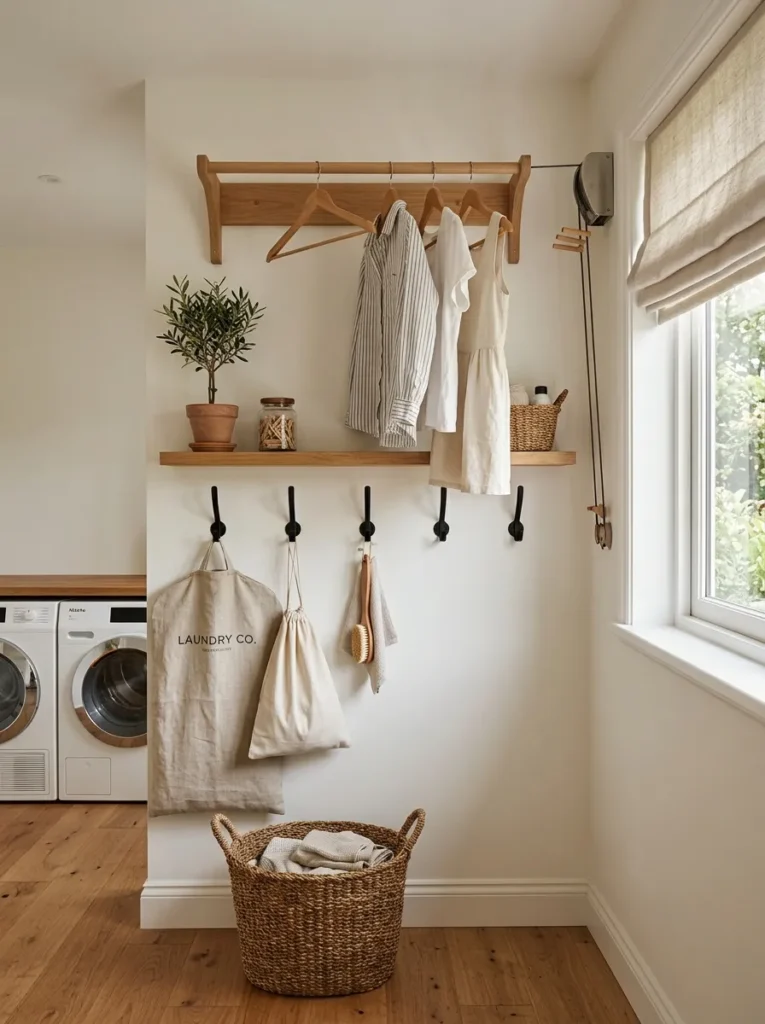
Vibe: A dedicated folding and hanging station feels genuinely useful — the laundry room upgrade that reduces the time between machine and wardrobe by half.
Why it works: The folding and hanging station is the laundry room upgrade with the greatest practical return — it creates the physical infrastructure that makes laundry completion (folding, hanging, organizing) happen at the point of washing rather than being deferred to a pile on the bed or a chair in the bedroom. The design principle is workflow completion: a laundry room that supports the full laundry cycle from washing through to hung and folded garments eliminates the intermediate pile stage that is the primary source of laundry-as-ongoing-burden. Wooden wall-mounted drying rails and wooden hangers (rather than wire or plastic hangers) contribute to the warm, residential aesthetic while being more functional — wooden hangers maintain garment shape and don’t leave marks.
How to get it: Install a wall-mounted wooden drying rail (available in extending or fixed versions) at a height that allows standard garments to hang without touching the counter or floor below. Mount five matte black double-coat hooks in a row below a short shelf for immediate-hang items (freshly ironed shirts, delicate garments). Install a retractable clothesline at the far end of the room for items that need air drying in a longer format. The combination of these three hanging solutions covers every garment type in the laundry cycle.
Shop The Look
| Product |
|---|
| Wall mounted wooden clothes drying rail extending |
| Wooden clothes hanger set of 12 |
| Matte black wall hook double set of 5 |
| Retractable clothesline indoor wall mount |
| Linen garment bag for delicates |
11. Framed Artwork and Personal Prints for Personality
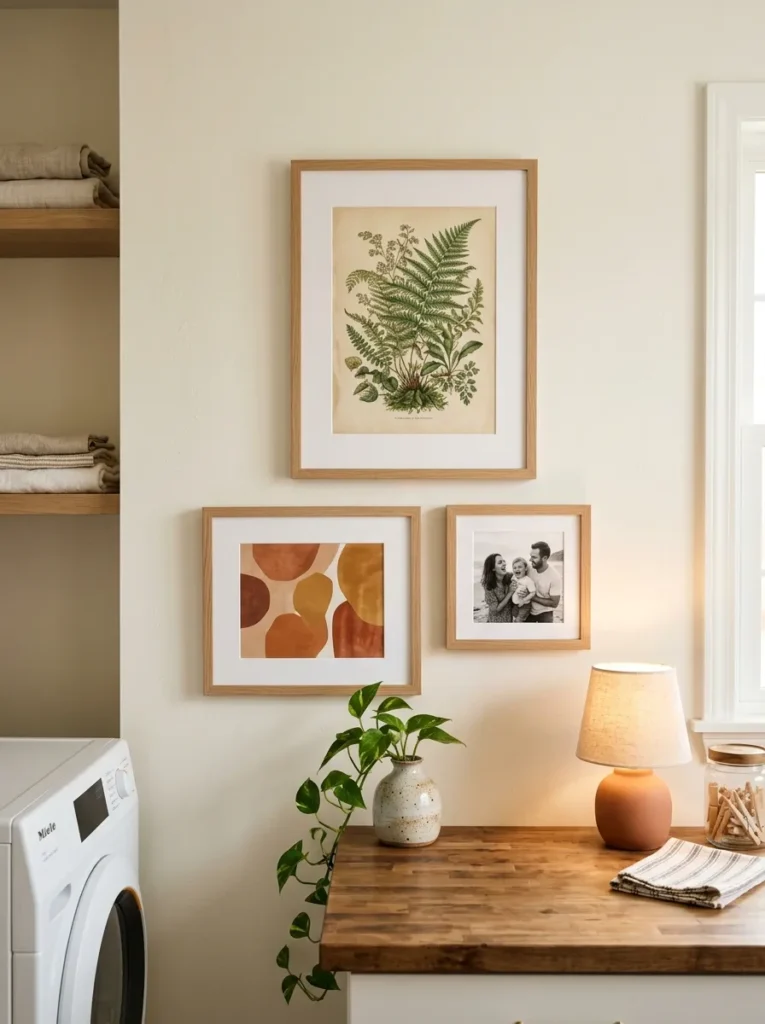
Vibe: Personal artwork in a laundry room feels genuinely warm — the room that reveals its inhabitant even in the most functional corner of the home.
Why it works: Artwork in a laundry room applies the principle of personal presence in utility spaces — it signals that the room’s inhabitant has thought about the experience of being in this space rather than merely the tasks performed in it. A laundry room with framed artwork reads as an extension of the home’s living spaces rather than a separate, lesser utility zone. The design principle is spatial continuity through personal objects: when the laundry room contains the same quality of personal display (artwork, meaningful objects, styled storage) as the rest of the home, it reads as part of the home’s designed whole rather than its undesigned appendage.
How to get it: Choose artwork that belongs in the same tonal family as the rest of the home’s displayed pieces — botanical illustrations work in almost any interior palette, abstract prints in warm earth tones bridge laundry room utility and living room warmth, and one personally meaningful photograph makes the room feel uniquely inhabited. Frame all pieces in the same slim natural wood or matte black finish for visual coherence. Hang in a loose organic grouping rather than a rigid grid — the organic arrangement reads as more personal and less institutional.
Shop The Look
| Product |
|---|
| Slim natural wood frame set 5×7 8×10 11×14 |
| Botanical illustration print large for laundry |
| Abstract art print warm earth tones small |
| Picture hanging strip damage free small |
| Small ceramic decorative object for counter |
12. Warm-Toned Tile or Patterned Floor
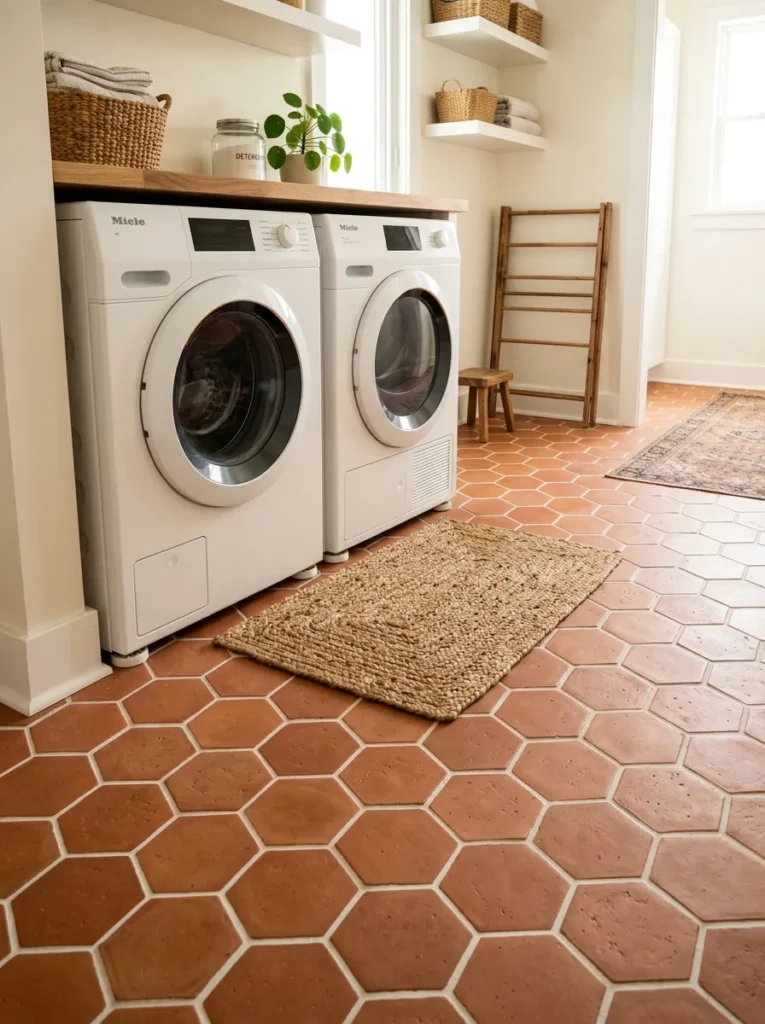
Vibe: Warm terracotta hex tile underfoot in a laundry room feels grounded — the floor that makes the room feel like someone designed it from the bottom up.
Why it works: The laundry room floor is the most consistently overlooked surface in laundry room design — it is typically left in whatever flooring material the home builder specified, which is usually the least expensive resilient tile available. A patterned floor in warm terracotta, cement-look tile, or graphic black and white introduces the pattern and material warmth that the laundry room’s vertical surfaces alone cannot fully achieve. The design principle is floor as feature: in a small room where the full floor is visible simultaneously from any position, the floor pattern creates a visual foundation that elevates every element above it. Terracotta hex tile specifically — whether genuine fired clay or a high-quality porcelain in terracotta tones — introduces the warm, artisanal quality that bridges the laundry room’s utility function and the warm domestic aesthetic the room is working toward.
How to get it: Terracotta hex tile at 4-inch diameter is a manageable DIY tile installation in a small laundry room — the hex format is more forgiving of slight installation inconsistencies than running bond patterns because its omnidirectional joints distribute minor alignment errors visually. Use a warm grey or white unsanded grout to reinforce the terracotta tones. Seal both the tile and grout upon completion with a penetrating tile sealer rated for laundry room moisture conditions.
Quick Win: Peel-and-stick vinyl floor tiles in a terracotta or warm geometric pattern cost $1.50–$3.00 per square foot and create the patterned floor impact without adhesive installation or grout — ideal for rental laundry rooms where floor modification is not permitted.
Shop The Look
| Product |
|---|
| Terracotta hex floor tile 4 inch porcelain |
| White unsanded grout for hex tile |
| Tile sealer penetrating for laundry room |
| Notched trowel for tile adhesive application |
| Natural fiber anti-fatigue mat small |
13. Ironing Board Storage That Doubles as Decor
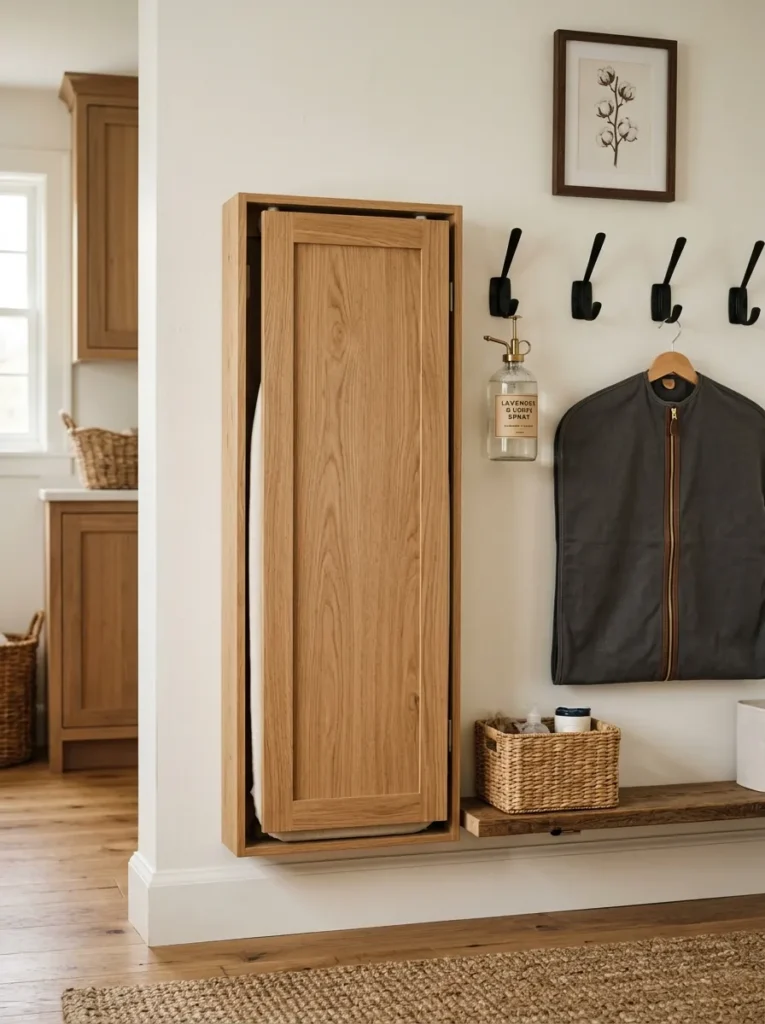
Vibe: A wall-mounted fold-down ironing board feels ingeniously resolved — the laundry room problem that finally has an answer that doesn’t involve a closet.
Why it works: The ironing board is the laundry room’s most awkward storage problem — too large and unwieldy for standard cabinetry, too frequently used for deep storage, and visually disruptive when leaned against a wall. A wall-mounted fold-down ironing board with a natural wood frame resolves all three issues simultaneously: it stores flush to the wall occupying only 4 inches of depth, deploys in a single motion for immediate use, and when closed, reads as a warm wood panel rather than a stored utility item. The design principle is dual-function concealment: the ironing board is simultaneously stored and displayed, which is the organizational philosophy that distinguishes a designed laundry room from a merely organized one.
How to get it: Wall-mounted fold-down ironing board units with decorative wood panel fronts are available from specialty laundry and kitchen storage suppliers in the $150–$350 range. Mount into wall studs using the included hardware — the unit’s loaded weight when in use (ironing board plus garment plus steam iron) requires stud mounting for safety. Install at a height that allows ironing in a standing position — typically 90–95 cm from the floor to the board surface when deployed.
Shop The Look
| Product |
|---|
| Wall mounted fold down ironing board wood frame |
| Ironing board cover cream linen replacement |
| Matte black hook set wall mount 5 piece |
| Linen water spray bottle for ironing |
| Garment bag linen for delicates hanging |
14. Small-Space Laundry Room: Maximizing a Closet Laundry with Full-Design Treatment
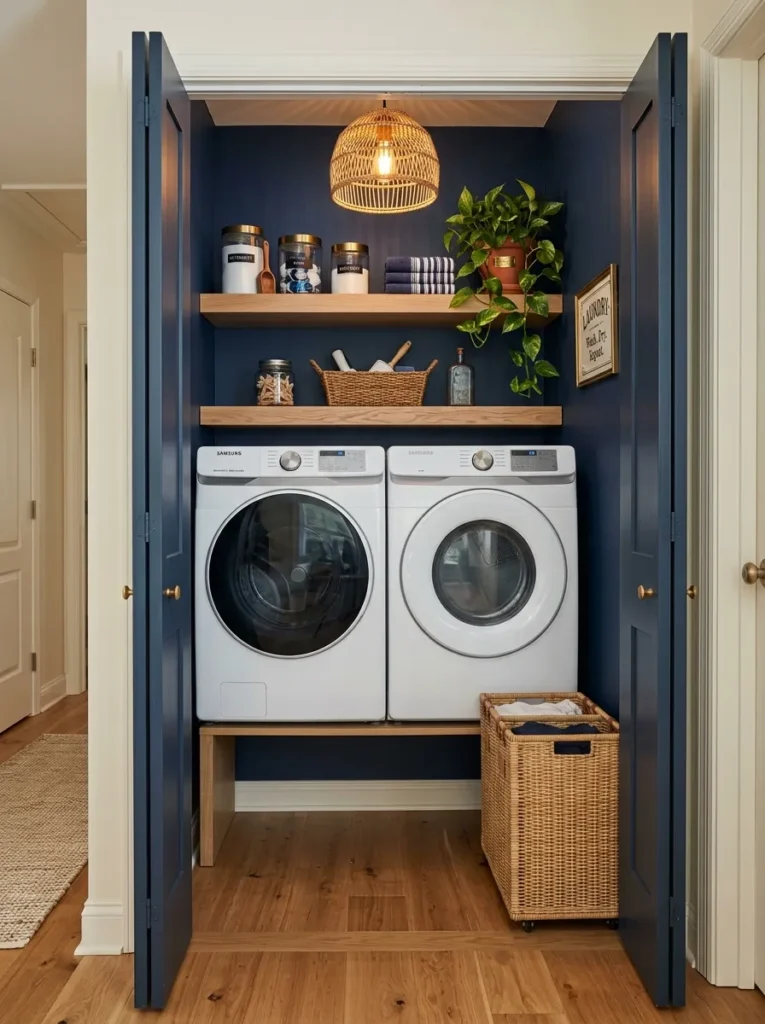
Vibe: A fully designed laundry closet feels unexpectedly wonderful — the moment the doors open is a small domestic delight rather than a utility reveal.
Why it works: The laundry closet is the small-space laundry room scenario where full-design treatment has the most disproportionate impact — because the space is so small (typically 24–60 inches wide), every design decision affects nearly every square inch simultaneously, and a cohesive design approach creates an atmosphere that exceeds what its square footage would suggest possible. The design principle is concentrated design impact: in a space small enough to see in its entirety from a single standing position, painting all three walls in a deep bold color, adding proper warm lighting, and styling the available shelving creates a fully realized interior in a footprint where compromise is usually the default. Deep navy on the walls of a laundry closet reads as a dramatic, considered design choice that makes opening the doors each time a small moment of pleasure.
How to get it: Paint all three interior walls of the laundry closet in deep navy — the color’s depth conceals the visual busyness of pipes, machine backs, and utility elements that a light color would highlight. Install two floating white oak shelves above the machines (or above a stacked unit) at 14 and 28 inches above the machine top. Install a plug-in rattan pendant on a swag hook at the closet ceiling. Add a small framed print on the most visible side wall. Store all supplies in glass canisters on the upper shelf and a wicker pull-out basket below the machines for sorting.
Shop The Look
| Product |
|---|
| Deep navy matte paint quart for closet |
| White oak floating shelf 24 inch set of 2 |
| Rattan pendant light plug in small |
| Pull-out wicker laundry basket under machine |
| Glass canister set brass lid for supplies |
How to Start Your Laundry Room Makeover
The single first move is to decant your laundry supplies — detergent, fabric softener, stain remover, dryer sheets — out of their original branded packaging and into a set of three to four matching glass canisters with brass or black lids, placed on your existing shelf or counter surface. This single intervention costs $20–$35, takes under 20 minutes, and immediately converts the laundry room’s primary visual clutter source (bright branded packaging in competing colors and sizes) into a composed, warm-toned display. It is the fastest demonstration that the laundry room can be designed rather than merely organized — and it typically motivates the next intervention by showing what the room is capable of becoming.
The most common mistake in laundry room makeovers is attempting to improve the space through organization alone — adding more storage, more labels, more systems — without addressing the room’s visual and atmospheric quality. Organization makes a laundry room more functional; design makes it more enjoyable. Both matter, and they operate on different dimensions of the room’s quality. The fix is to treat one design intervention (paint, lighting, a shelf material upgrade) as equal in priority to one organizational intervention (basket system, supply decanting, folding station) — the combination of functional improvement and aesthetic improvement in the same project produces the compounded result that either alone cannot achieve.
Three items under $50 that create immediate cozy laundry room impact: a plug-in rattan pendant light with a swag hook ($40–$75) that replaces the room’s flat overhead light with warm atmospheric glow, a set of three glass canisters with matching brass lids ($20–$35) that converts supply storage from visual noise to styled display, and a small trailing plant in a white ceramic pot ($8–$15) that adds the living, organic quality that makes any utility room feel like a room rather than a space. Together these three additions — totaling $68–$125 — address the laundry room’s three most persistent quality deficits: lighting warmth, visual organization, and human warmth.
Realistic expectations: a basic laundry room refresh — new paint color, supply decanting, a rattan pendant, and one framed print — takes one weekend and $80–$180. A complete laundry room makeover including new cabinetry, butcher block counter, patterned tile floor, full open shelving system, and fold-down ironing board represents a $600–$2,500 investment depending on the scope of cabinetry work and whether tile installation is DIY or professional. The quality-of-life return on a cozy laundry room is immediate and daily — it is the home improvement investment with the most consistent emotional payoff relative to its cost, because the room is used every single day of the year.
Frequently Asked Questions About Cozy Laundry Room Decor
What is the best paint color for a small laundry room?
Deep, saturated colors consistently outperform light neutrals in small laundry rooms — they create a color envelope that makes the small space feel intentionally intimate rather than accidentally cramped. The three most successful small laundry room paint colors are deep dusty sage (warm, sophisticated, and natural-looking against white appliances), deep navy (dramatic and considered, creates maximum contrast with white machines and cabinetry), and warm terracotta (earthy and warm, bridges natural materials and utility surfaces most organically). All three work best in a matte finish, which absorbs light and makes the color read as richer than eggshell or semi-gloss in a small space.
How do I make a laundry room feel less like a utility space?
The three interventions that most rapidly reduce a laundry room’s utility-space quality are lighting (replacing a cool-white overhead fixture with a warm pendant or adding warm task lighting at the folding counter level), supply organization (decanting all branded packaging into uniform glass or ceramic containers so the visible storage reads as consistent and considered rather than chaotic), and natural materials (adding at least one natural wood surface — a shelf, a counter — and one natural fiber element — a basket, a plant pot — that introduce organic warmth the machines and cabinetry cannot provide). Each of these addresses one of the three primary signals of utility-space quality: clinical lighting, visual packaging chaos, and absence of natural material warmth.
What storage works best in a small laundry room?
Vertical storage is the highest-efficiency solution for small laundry rooms — floating shelves above the machines, wall-mounted cabinet units, and over-door organizers use the wall surface rather than the floor area that is typically already fully occupied by machines. Open shelving is more space-efficient than closed cabinetry in very small laundry rooms because it doesn’t require door clearance — a 10-inch-deep open shelf is accessible in its full depth from a standing position, while a cabinet requires the same 10-inch depth plus the door swing clearance to open. The combination of open shelving for frequently used items (supplies, folded items) and one closed cabinet or basket system for less attractive utility items (cleaning products, spare parts) provides the optimal balance of accessibility and visual calm.
Can I add a laundry room to a closet or alcove without major renovation?
Yes — a closet laundry setup with stacked washer-dryer units, floating shelves above, plug-in pendant lighting on a swag hook, and painted walls can be completed without any structural modifications beyond the existing plumbing and electrical connections. The most important non-structural considerations are ventilation (dryer exhaust must vent to the exterior or through a ventless condensation dryer) and door clearance (bifold or pocket doors are the most space-efficient options for a laundry closet). Within these functional constraints, the full design treatment described in idea 14 of this list applies directly to any closet laundry configuration.
What is the best flooring for a laundry room in terms of both practicality and aesthetics?
Porcelain tile is the optimal laundry room flooring material for a balance of practical performance and aesthetic quality — it is waterproof, highly durable, easy to clean, and available in a wide range of patterns and colors including terracotta-look, cement-look, and graphic geometric designs that contribute significantly to the room’s aesthetic. Luxury vinyl plank or tile is the best alternative for rental situations or DIY installations where tile setting is not practical — high-quality LVP in warm wood looks or terracotta-adjacent tones provides the aesthetic warmth of natural materials with 100% water resistance. Avoid natural hardwood in laundry rooms — even sealed hardwood is susceptible to the moisture exposure inherent in the laundry environment and will eventually warp or discolor.
Ready to Transform Your Laundry Room into a Space You Actually Love?
These 14 cozy laundry room decor ideas cover every dimension of the transformation — from a bold all-walls paint color and a warm rattan pendant light to a butcher block counter, a botanical wallpaper accent wall, a complete basket organization system, and the full closet laundry maximization — so whether you have a generous dedicated laundry room or a 5-foot-wide closet with a stacked unit, there is a specific, achievable, and warmly considered starting point here for exactly where you are. The most important thing to understand about laundry room design is that this is the room you visit more days of the year than almost any other, which means the quality of its atmosphere has a cumulative effect on your daily experience that far exceeds what its square footage would suggest. Today, decant your laundry supplies into matching glass canisters — that single act of visual consistency will show you exactly what the room is capable of becoming. Pin the ideas that made you look at your laundry room differently, and let those be the ones you transform first.