19 Minimal White Bedroom Ideas for a Calm Retreat
Minimal white bedroom ideas create restful, intentionally simple sleeping environments using a restricted palette of warm whites, natural materials, and deliberate negative space — where the design’s power comes from what is absent as much as from what is present, and where every object earns its place through functional necessity or genuine beauty. This article gives you exactly 19 ideas spanning wall treatments, bedding, lighting, furniture, storage, textiles, and small-room adaptations so every bedroom size and every taste finds a minimal white approach that genuinely calms.
A minimal white bedroom done well is not an empty room with white paint. It is a room that has been edited — where the decision about what to remove was taken as seriously as the decision about what to keep, and where the remaining objects are revealed by the space around them rather than obscured by it. The result is the specific stillness that makes a bedroom feel like somewhere you can actually rest. Here are 19 ideas worth saving — and living inside.
Why Minimal White Bedroom Ideas Work So Well for a Calm Retreat
The minimal white bedroom draws from two distinct but converging design traditions: the Japanese Zen interior aesthetic (which uses spatial emptiness, natural materials, and a near-absence of decoration as an active vehicle for calm rather than as simple reduction) and the Scandinavian hygge domestic tradition (which uses warm whites, natural timber, and restrained material layering to create environments of comfort and safety). Contemporary minimal white bedroom design sits at the intersection of both — it has the spatial discipline of Zen and the sensory warmth of Scandinavian design, producing a result that is calming without being austere and refined without being cold.
The material palette that defines a successful minimal white bedroom is more specific than “white and wood.” The whites must be warm whites — those with a yellow, pink, or gray undertone rather than a blue or green undertone, which read as clinical, cold, or simply institutional rather than calm and enveloping. Benjamin Moore Chantilly Lace OC-65, Farrow & Ball All White No. 2002, and Little Greene Loft are among the most widely specified warm whites in minimal bedroom design for exactly this reason. The natural materials must be genuinely natural — solid white oak rather than oak-print laminate, 100% linen rather than linen-look polyester, genuine wool or cotton knit rather than acrylic yarn — because the sensory quality of authentic natural materials (the slight irregularity of real linen weave, the warmth of solid timber, the responsiveness of genuine wool) is the detail that separates a calming environment from a simply pale one.
The minimal white bedroom as a specific design category has generated consistently high engagement in the design media since approximately 2017, when the broader minimalist movement began to shift from the cold, high-contrast minimalism of the early 2010s (all-white, reflective surfaces, architectural severity) toward the warmer, more sensory, and more livable minimalism that defines the contemporary moment. Publications including Kinfolk, Apartamento, and ELLE Decoration have consistently documented the warm minimal bedroom as a design ideal, and the category’s Pinterest engagement — “minimal white bedroom,” “Scandinavian white bedroom,” “zen bedroom ideas” — shows sustained strong year-over-year growth because the visual content rewards the simple quality it promises: images of beds in warm white rooms with morning light, with nothing competing for attention.
Small bedrooms and rented rooms benefit most dramatically from the minimal white approach because the restriction of the palette creates the illusion of greater spatial volume and the absence of visual complexity makes tight spaces read as deliberate rather than cramped. A 9×11 foot bedroom with warm white walls, a white bed linen, a white oak bedside table, and a simple pendant light is genuinely calming in a way that the same room with three different paint colors, a busy duvet pattern, and multiple different furniture finishes is not — the palette restriction performs a spatial function, making the room’s actual dimensions less visible than its deliberate calm. The honest consideration: minimal white bedrooms in rooms with no natural light require careful warm artificial lighting design to prevent the palette from reading as flat and depressing rather than bright and calm.
Style at a Glance
| Element | Minimal Function | White Bedroom Edge |
|---|---|---|
| Philosophy | Edited space, deliberate calm | Warmth through restriction |
| Materials | Linen, solid oak, wool, ceramic | Limewash, Japanese cotton, hand-thrown pottery |
| Color Palette | Warm white, oat, greige | Warm gray, pale sage undertone, natural linen |
1. Warm White Limewash Accent Wall Behind the Bed
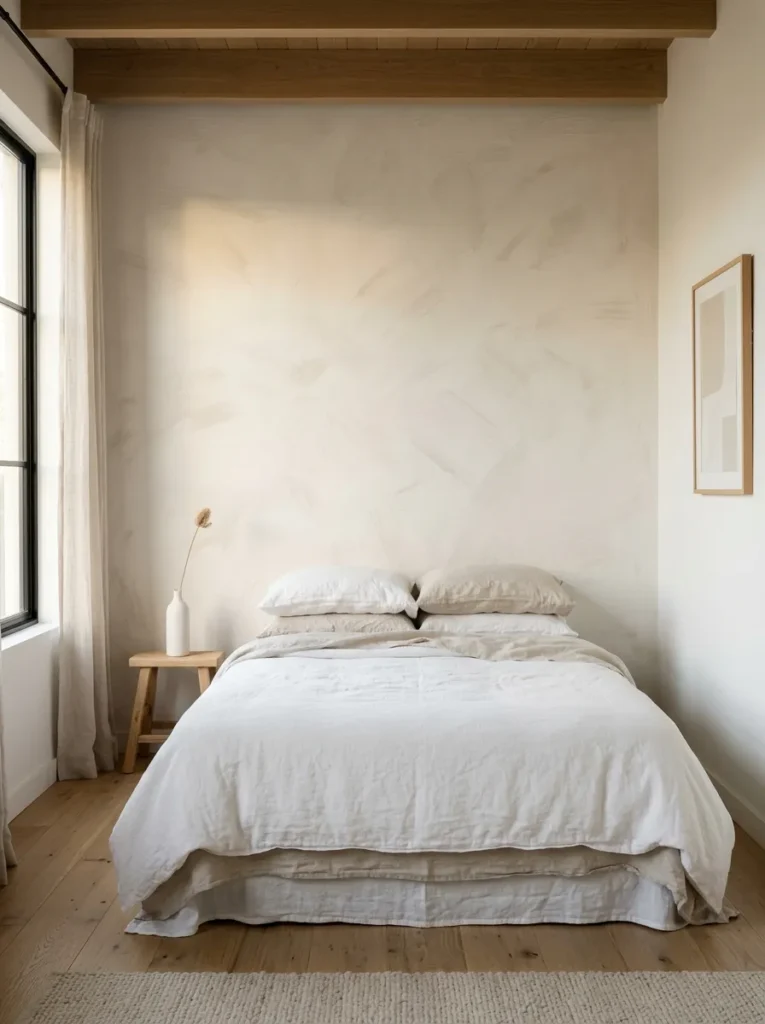
Vibe: The wall behind the bed feels alive with warmth — the texture visible only where the morning light rakes across it.
Why it works: A warm white limewash accent wall behind the bed applies the design principle of textural focal point — in a room where color contrast is deliberately absent (all walls are within the warm white family), the only available source of visual interest is surface quality rather than color difference. Limewash’s dimensional, slightly uneven surface creates exactly this textural focal point — interesting enough to hold the eye at close range, calm enough to recede at distance. The limewash technique specifically references the Cycladic and Mediterranean whitewashed architecture that forms one of the fundamental visual sources of the minimal white interior aesthetic, carrying that architectural reference into the bedroom’s most significant surface.
How to get it: Apply limewash paint (Bauwerk Colour or Portola Paints’ Roman Clay range both produce genuine mineral limewash qualities) to the bed wall only, leaving the remaining three walls in a smooth warm white. Apply in a minimum of two coats using a wide natural-bristle brush in random, overlapping directional strokes, intentionally allowing the first coat to show through the second in places for the characteristic layered depth. The bed wall limewash should be slightly more opaque (more paint applied per square metre) than a typical limewash application, to read as the same warm white family as the smooth walls rather than as a color accent.
Quick Win: A single pot of limewash paint in warm white ($35–55) applied to the bed wall only creates the full textural focal point effect for the cost of approximately one standard paint tin — the highest atmospheric impact per material cost in this entire list.
Shop The Look
| Product |
|---|
| Limewash paint warm white mineral pot |
| Wide natural bristle wall brush |
| White linen fitted sheet set natural |
| Slim white ceramic vase single stem |
| Dried botanical stem single natural |
2. White Linen Bedding System with Layered Textures
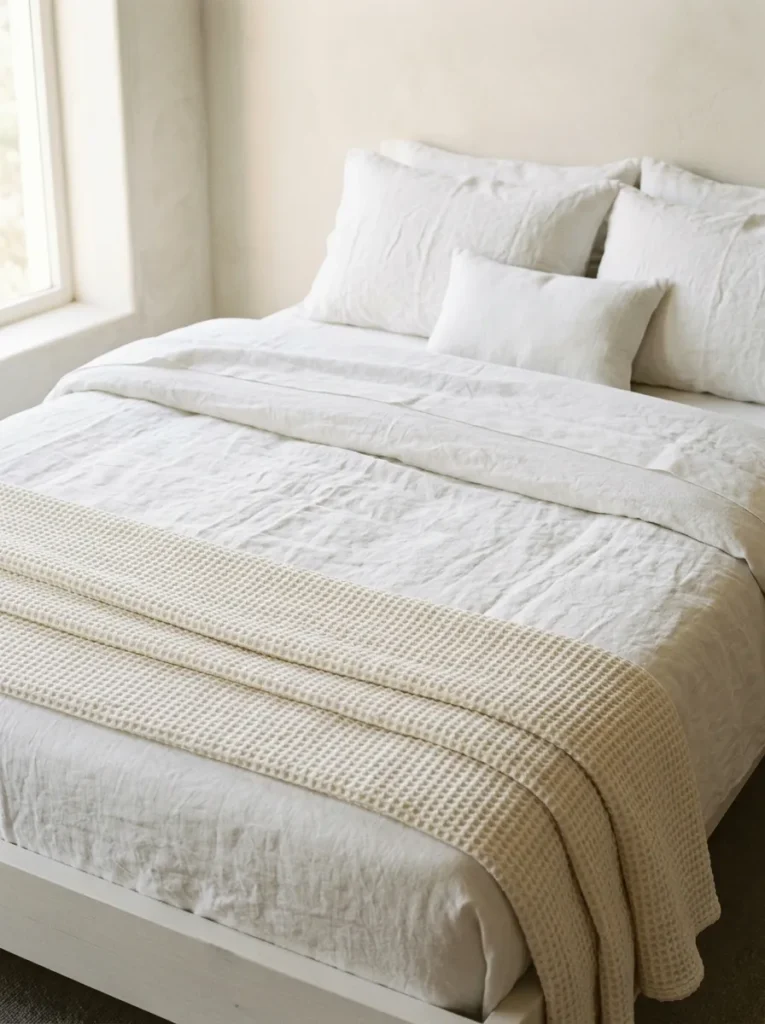
Vibe: The bed feels genuinely comfortable — the linen’s natural crease quality making it look lived-in and welcoming rather than hotel-formal.
Why it works: A layered white linen bedding system applies the textile design principle of tonal texture variation — in a monochromatic palette, the only available visual richness comes from varied surface textures within the same color family. White washed linen (soft, with a slight slub), crisp white cotton percale (smooth, with a thread-count reflectiveness), waffle cotton (deeply textured, with a geometric weave pattern), and natural cream knit (dimensional, with visible stitch construction) all read as different materials at close range while maintaining the same warm white palette at room scale. This combination is visually calmer than multicolored bedding because there is no color contrast for the eye to resolve, but more interesting than single-material monochrome because the texture variation provides sensory and visual depth.
How to get it: Build the bedding system in 100% linen or high-quality cotton — no synthetic blends, which read as flat and inert rather than warm and organic. The specific layering order: fitted sheet in white linen, flat sheet in white linen or 400-thread-count cotton percale, duvet cover in white washed linen, a waffle cotton or cellular cotton blanket folded across the foot third of the bed, two standard linen pillowcases, and one small linen or bouclé cushion in the same white-cream family. Wash and air-dry linen bedding without ironing — the natural crease quality is part of the aesthetic and ironing eliminates it.
Shop The Look
| Product |
|---|
| Washed linen duvet cover set white |
| Waffle cotton blanket white fold foot |
| White linen pillowcase set natural |
| Linen flat sheet white 100 percent |
| Bouclé cushion cover small white cream |
3. Solid White Oak Bedframe for Warm Natural Material
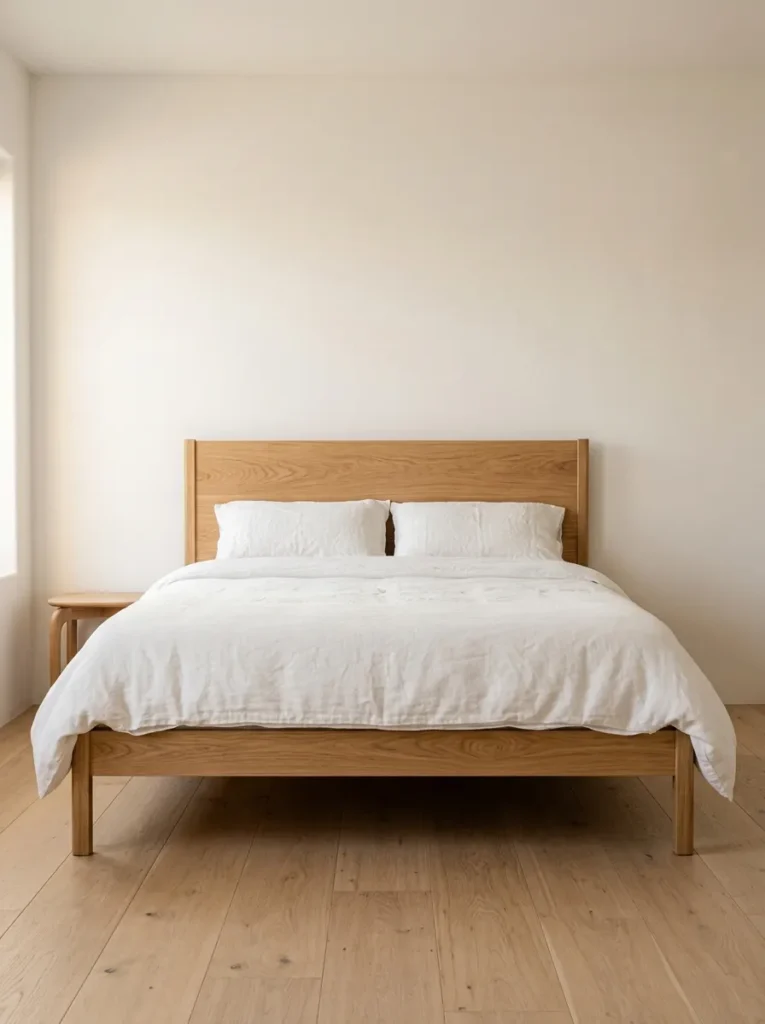
Vibe: The bedframe feels structurally honest — wood that is clearly wood, grain visible, nothing pretending to be anything other than what it is.
Why it works: A solid white oak bedframe applies the material honesty principle that defines quality minimal design — in a minimal interior where there is nowhere for a material to hide, the difference between solid timber and a wood-print laminate is not merely aesthetic but conceptual. Solid oak’s grain variation, its slight warmth in direct light, and its tactile quality when touched all contribute to the calm, authentic atmosphere that defines the best minimal white bedrooms. The specific choice of white oak (with its tight, consistent grain and warm blond tone) rather than a darker oak or walnut maintains the room’s bright palette while introducing the organic warmth that distinguishes a minimal white bedroom from a clinical white space.
How to get it: Specify a solid white oak bedframe from a furniture maker or retailer using genuinely solid oak (not MDF with oak veneer, which has the same visual quality at a distance but a different material quality at close range and over time). A simple frame profile — rectangular headboard, no decorative detail, clean joints — maintains the minimal register. Finish in a clear matte oil or hardwax oil rather than a lacquer, which would add a synthetic glossiness inconsistent with the natural material palette. The frame’s leg height should position the mattress top at 55–65cm from the floor for the most visually resolved proportion relative to a standard European ceiling height.
Shop The Look
| Product |
|---|
| Solid white oak bedframe double natural |
| Clear matte hardwax oil wood finish |
| White oak bedside table small natural |
| White linen duvet cover washed set |
| Warm white paint eggshell bedroom |
4. Concealed Storage Wardrobe for Visual Calm
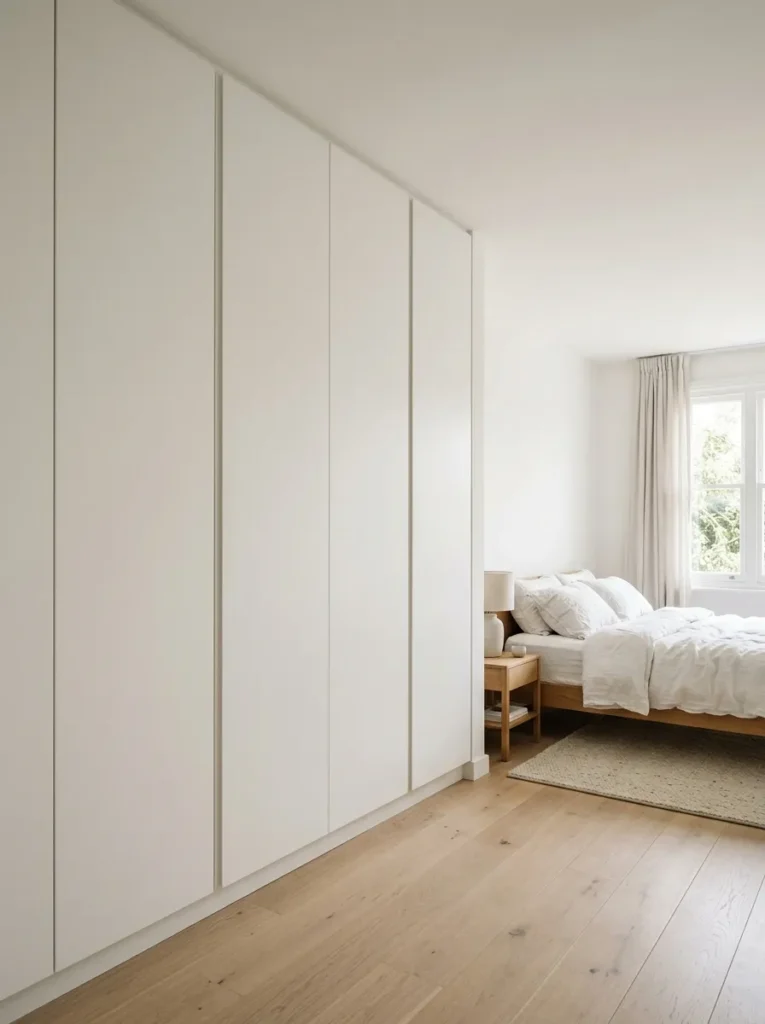
Vibe: The wall feels like architecture rather than furniture — the storage invisible until needed, the room reading as pure space.
Why it works: A floor-to-ceiling push-to-open wardrobe painted in exactly the same warm white as the surrounding wall applies the design principle of concealment through visual continuity — when the wardrobe doors match the wall color precisely and have no visible hardware, the eye reads the entire wall as a single continuous surface rather than as a piece of furniture placed against a wall. This visual continuity is the single most effective storage strategy available for a minimal white bedroom because it accommodates a large storage volume (a full-width floor-to-ceiling wardrobe) without introducing any visual complexity into the room. The specific mechanism required is push-to-open (rather than standard door handles or even recessed pulls) — any visible hardware breaks the wall continuity and undermines the concealment effect.
How to get it: Specify wardrobes with push-to-open mechanisms (Blum TIPMATIC or equivalent) and door fronts in moisture-resistant MDF that can be painted to exactly match the bedroom’s wall color. Use the same paint formulation on both the wall and the door fronts — different paint formulations produce slightly different sheen levels even at the same color specification, creating a visible difference that the eye reads as a material transition rather than a continuous surface. Caulk all door reveal lines with flexible white caulk and paint over — the reveal line should be the only visible indication of the door’s location.
Shop The Look
| Product |
|---|
| Push-to-open wardrobe hinge rebound set |
| Warm white cabinet paint satin eggshell |
| Flexible white caulk paintable trim |
| Interior wardrobe LED strip warm |
| Wardrobe interior organizer shelf set |
5. Single Architectural Pendant Above the Bed for Focused Light
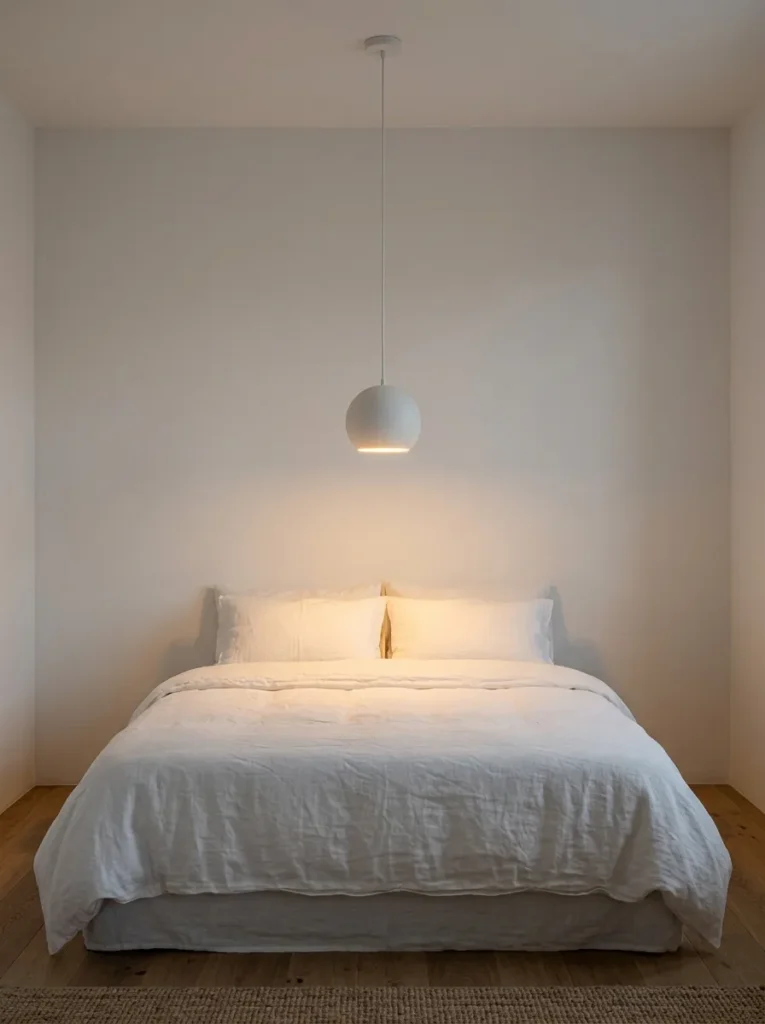
Vibe: The pendant feels like a single candle made permanent — focused, warm, the only illumination the room needs for an evening.
Why it works: A single simple ceramic pendant above the bed center applies the lighting design principle of singular light source authority — in a minimal room, multiple light sources compete for attention and create a complexity that undermines the calm the space is designed to provide. A single carefully positioned pendant (hung lower than standard ceiling height — 120–140cm above the mattress rather than the standard 210cm from the floor) creates a focused pool of warm light that makes the bed the room’s visual and functional center without requiring any other fixture. The specific choice of matte white ceramic (rather than glass, metal, or fabric) maintains the room’s material palette consistency while providing a sculptural quality that purely functional lighting fixtures lack.
How to get it: Source a simple matte white ceramic pendant from a specialist ceramics or lighting supplier — the pendant’s form should be simple and resolved (a sphere, an ovoid, a simple cylinder) rather than decorative or complex. Hang from a white ceiling rose on a white fabric-covered cord at 120–140cm above the mattress surface, wired to a dimmer switch that allows the pendant’s intensity to be varied from bright for reading to warm ambient for pre-sleep calm. Specify a 2200–2700K warm white bulb for the most calming light quality.
Shop The Look
| Product |
|---|
| Matte white ceramic pendant light sphere |
| White fabric ceiling pendant cord |
| Dimmer switch compatible LED |
| Warm white LED bulb 2200K small |
| White ceiling rose junction cover |
6. Bare Floorboards in White Oak with a Single Natural Fiber Rug
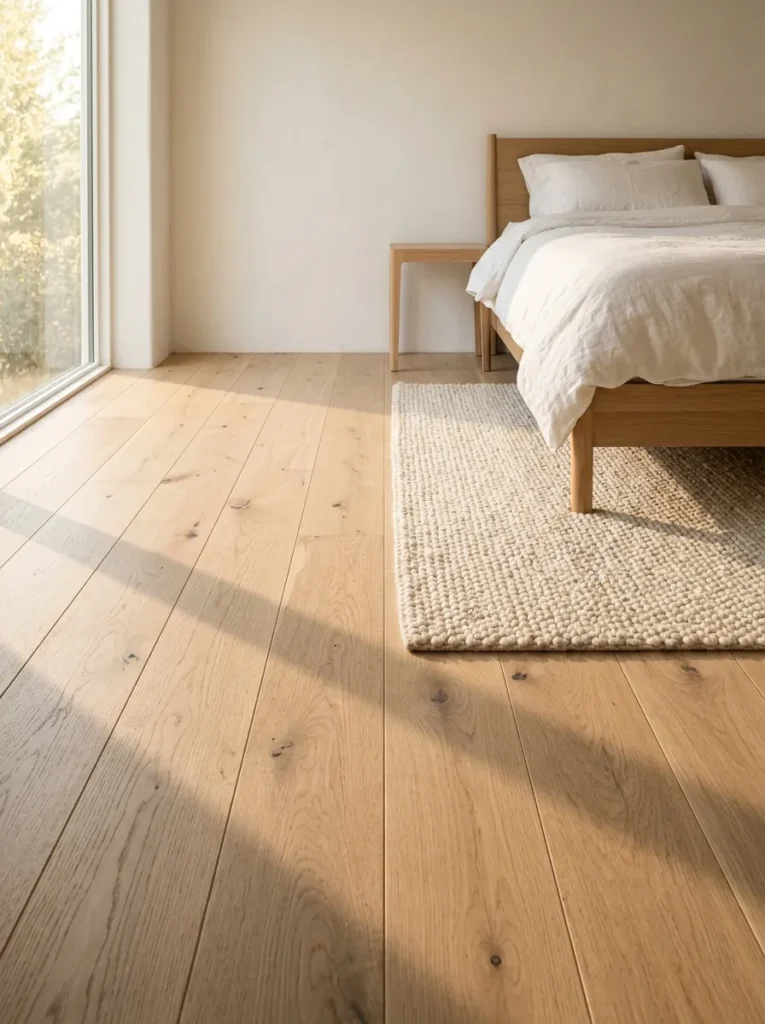
Vibe: The floor feels considered and still — the single rug’s precise positioning making the bare floor around it feel as deliberate as the rug itself.
Why it works: Bare white oak floorboards with a single bedside wool rug applies the minimal design principle of deliberate restraint — rather than covering the floor with a large area rug that fills the available space, the minimal white bedroom uses the floor itself as the primary surface material (the warm grain of white oak is visually rich enough to carry the room without additional textile coverage) and introduces only a small rug at the specific functional location where bare feet land first in the morning. This restraint makes the single rug’s position feel like an architectural decision rather than a decorative addition — it is placed precisely, for a specific functional reason, at the specific location where it is needed.
How to get it: Specify wide-plank white oak flooring (minimum 180mm plank width for the proportion that reads as appropriate in a minimal bedroom) in a clear matte hardwax oil finish that allows the wood’s natural warmth to be visible without adding gloss. Position a single undyed natural wool rug (approximately 60×90cm) precisely aligned with one side of the bed base, extending from the side of the headboard to the foot of the bed. Undyed natural wool in its natural creamy white tone coordinates with the floor and walls without introducing a new color, while the wool’s soft texture provides the sensory warmth that bare oak flooring does not.
Shop The Look
| Product |
|---|
| Wide plank white oak flooring 180mm |
| Clear matte hardwax oil floor finish |
| Undyed natural wool rug 60x90cm |
| Non-slip rug pad small set |
| Oak floor maintenance oil natural |
7. Minimalist Open Bedside Shelf Instead of a Table
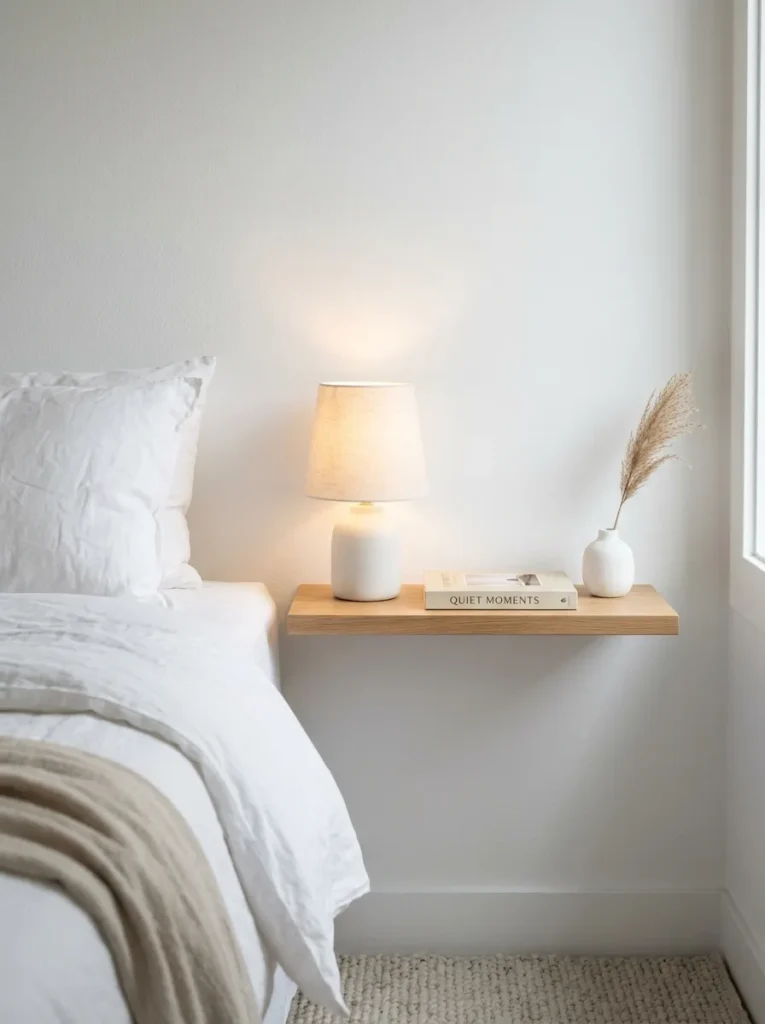
Vibe: The bedside shelf feels precisely enough — exactly what is needed and nothing that isn’t.
Why it works: A floating shelf as a bedside surface rather than a freestanding bedside table applies the minimal design principle of dimensional reduction — a slim wall-mounted shelf consumes no floor space (critical in small bedrooms where every square foot of visible floor contributes to the perception of spaciousness), has no visual bulk beneath the shelf surface (a freestanding table has legs, a drawer body, and a visible footprint that all contribute to the room’s visual complexity), and can be mounted at precisely the correct height for the specific mattress and bedframe combination. The three-object rule on the bedside shelf (lamp, one book, one small object) is the discipline that keeps the surface from accumulating the clutter that is a bedside table’s natural entropy.
How to get it: Mount a 30cm deep white oak floating shelf (IKEA LACK or a custom-cut oak shelf on concealed brackets) at the precise height of the mattress top — not at standard table height (approximately 65cm) but at the specific height of the mattress as it sits on the specific frame in the specific room. The mattress-height mounting means the shelf surface reads as a continuous extension of the bed’s horizontal plane rather than as a separate piece of furniture placed beside it. Allow only three objects on the shelf simultaneously — the discipline of removing a fourth object whenever a fourth is added maintains the minimal quality of the surface.
Shop The Look
| Product |
|---|
| White oak floating shelf 30cm deep |
| Concealed shelf bracket set wall mount |
| Small ceramic table lamp linen shade |
| Slim ceramic vase single stem white |
| Dried botanical stem single natural |
8. Minimal Gallery — Single Large-Format Print or Painting
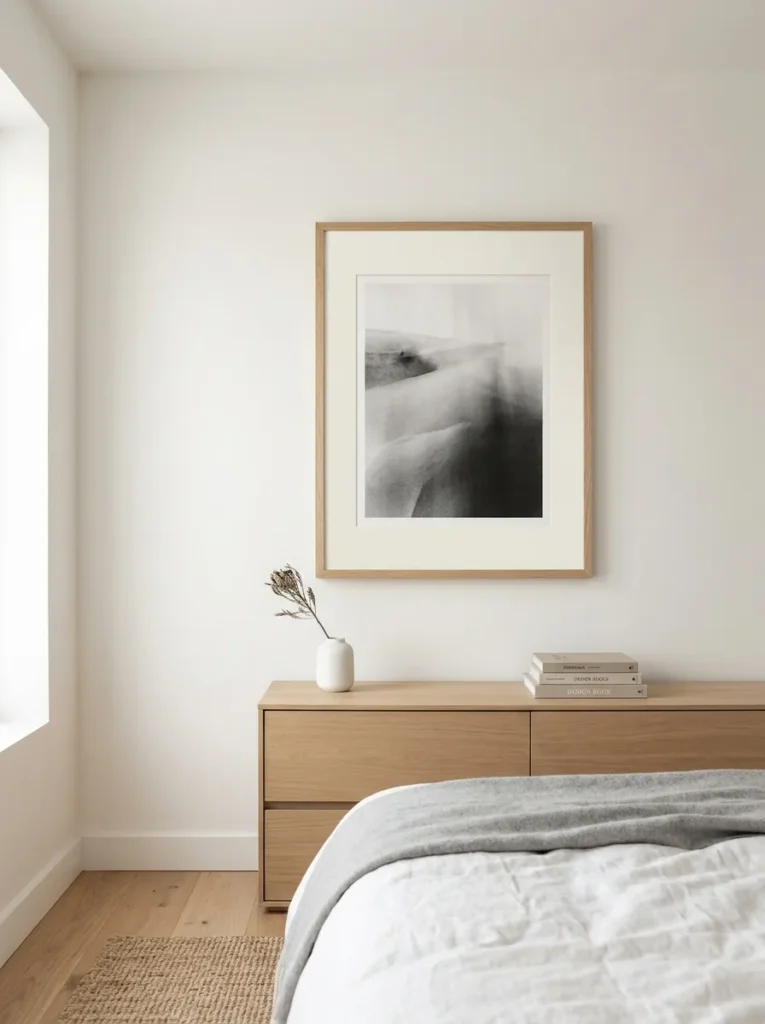
Vibe: The single artwork feels authoritative — given enough space, one piece of art occupies a room more powerfully than twenty.
Why it works: A single large-format artwork on a bedroom wall applies the gallery principle of breathing space — the visual impact of any artwork is a function not only of the work itself but of the space surrounding it. A single large piece with significant white wall space on all sides has more visual authority than multiple smaller pieces covering the same wall area, because the eye can engage with the single work completely without the distraction of adjacent pieces. In a minimal white bedroom specifically, the artwork is the room’s single decorative decision, which means it needs to earn that singular status through genuine quality and considered selection rather than filling a wall planning gap.
How to get it: Select a single artwork that works in the warm white context — watercolor, drawing, or photography in monochrome, warm gray, or gently tonal rather than multicolored or highly saturated. Size the artwork to at least 50% of the wall’s width for sufficient visual authority. Leave a minimum of 30cm of white wall on all sides of the frame. Hang at the standard gallery height of 145–150cm to the center of the artwork, regardless of the room’s furniture arrangement — this height is optimal for viewing while standing, which is the primary way bedroom wall art is seen on entering and leaving the room.
Shop The Look
| Product |
|---|
| Single watercolor print large format art |
| Warm oak simple frame 80x100cm |
| White mount board deep art framing |
| Picture hanging strip damage free |
| Small white console below artwork |
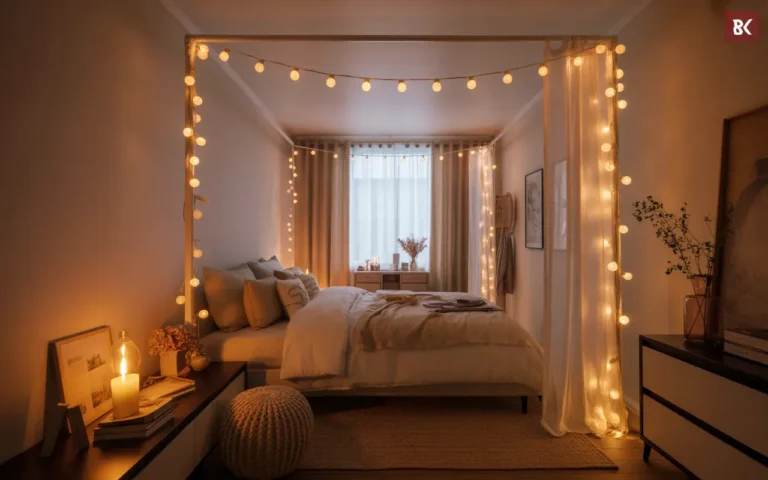
9. Sheer White Linen Canopy Above the Bed
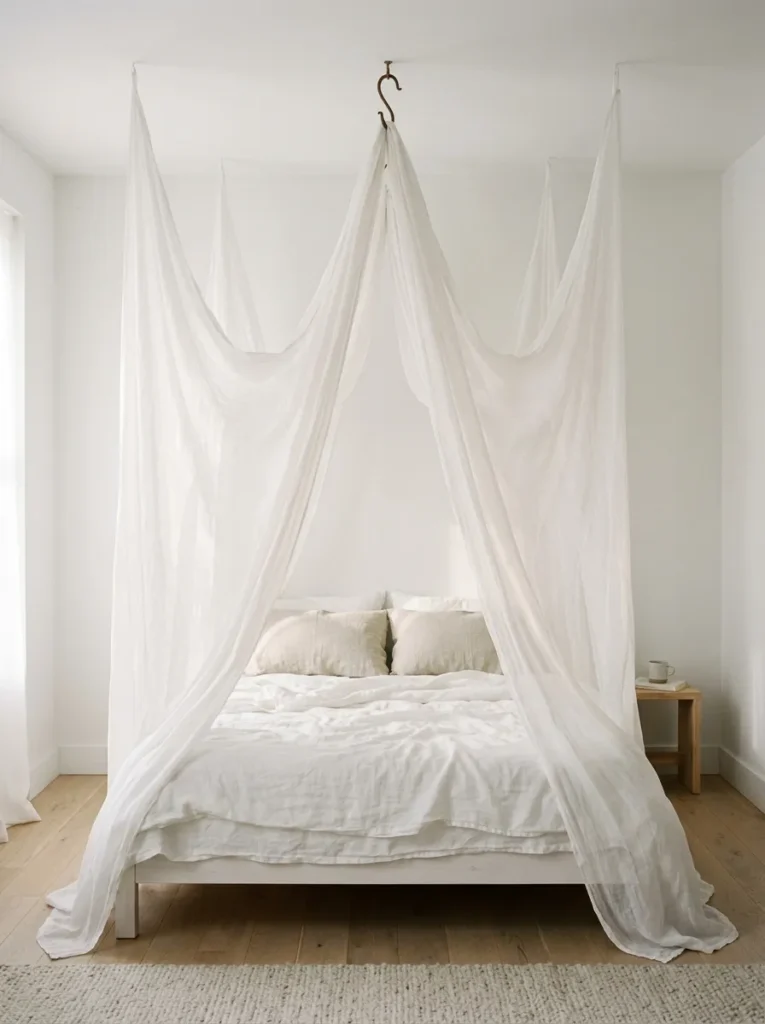
Vibe: The canopy feels like sleeping inside morning cloud — softly enclosed without being closed, the light arriving through fabric rather than through glass.
Why it works: A simple sheer linen canopy above the bed applies the architectural design principle of soft enclosure — the four hanging panels create a visual enclosure around the bed that references the historical privacy function of bed hangings while maintaining the open, airy quality of a minimal room. The sheer fabric diffuses the light entering through any nearby window into the same quality of soft, directional glow that limewash walls produce on their surfaces — both techniques take direct light and make it intimate. The loose, unstructured hang (no rigid frame or canopy ring) is the minimal interpretation that distinguishes a contemporary canopy from a more elaborately structured four-poster — the fabric alone provides the effect without any visible hardware structure.
How to get it: Use a very lightweight sheer linen or cotton voile (maximum 80 gsm — heavier fabric loses the translucent quality that allows morning light diffusion). Cut four panels, each approximately 250cm long and 100cm wide. Gather all four panels at their midpoint and tie to a simple ceiling hook (installed directly above the bed’s center, into a joist) with a simple white cotton rope or a metal curtain ring. Allow the panels to fall naturally — no ironing, no precise positioning. The natural drape of unironed sheer linen produces the loosely graceful form the installation requires.
Shop The Look
| Product |
|---|
| Sheer linen voile fabric white lightweight |
| Ceiling hook simple white wall mount |
| Cotton rope thin white ceiling tie |
| White linen pillow case set natural |
| Linen flat sheet white natural |
10. Warm White Walls with Subtle Tonal Variation Across Surfaces
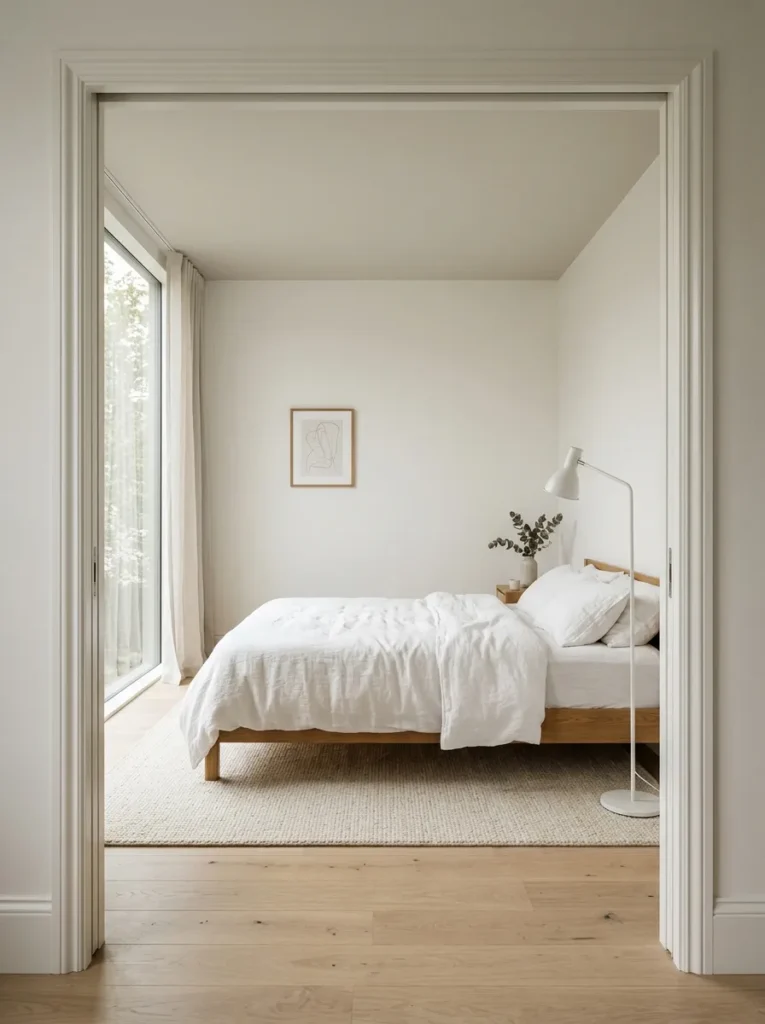
Vibe: The room feels warm at every angle — different whites doing different things, none of them competing, all of them contributing.
Why it works: Using subtly different warm whites on different surfaces — walls, ceiling, and trim — applies the sophisticated color principle of tonal layering within a single hue family. The ceiling in a slightly warmer, more recessive tone (warm greige-white rather than pure white) visually lowers the ceiling slightly, creating a more enclosed and intimate feeling than a pure white ceiling, which reads as receding and spatially distant. The trim in the same white as the walls but in a satin finish (rather than the matte walls) creates a subtle differentiation that reads as architectural refinement — a detail appreciated close up that maintains the overall reading of “white room” from a distance.
How to get it: Select three whites from the same warm white family: Farrow & Ball All White No. 2002 for walls (warmest and most matte), Farrow & Ball Dimity No. 2008 for the ceiling (slightly more yellow-warm, creating the slight ceiling recession), and the same All White in an eggshell finish for all trim (the increased sheen creating the subtle trim differentiation). Apply to walls, ceiling, and trim in sequence, allowing each surface to dry fully before the adjacent surface is painted to ensure a clean boundary at each transition line.
Shop The Look
| Product |
|---|
| Warm white matte emulsion wall paint |
| Warm greige ceiling paint slightly yellow |
| Warm white eggshell trim paint |
| Simple matte white floor lamp tall |
| White linen duvet cover washed set |
11. Organic Shaped Ceramic Bedside Objects
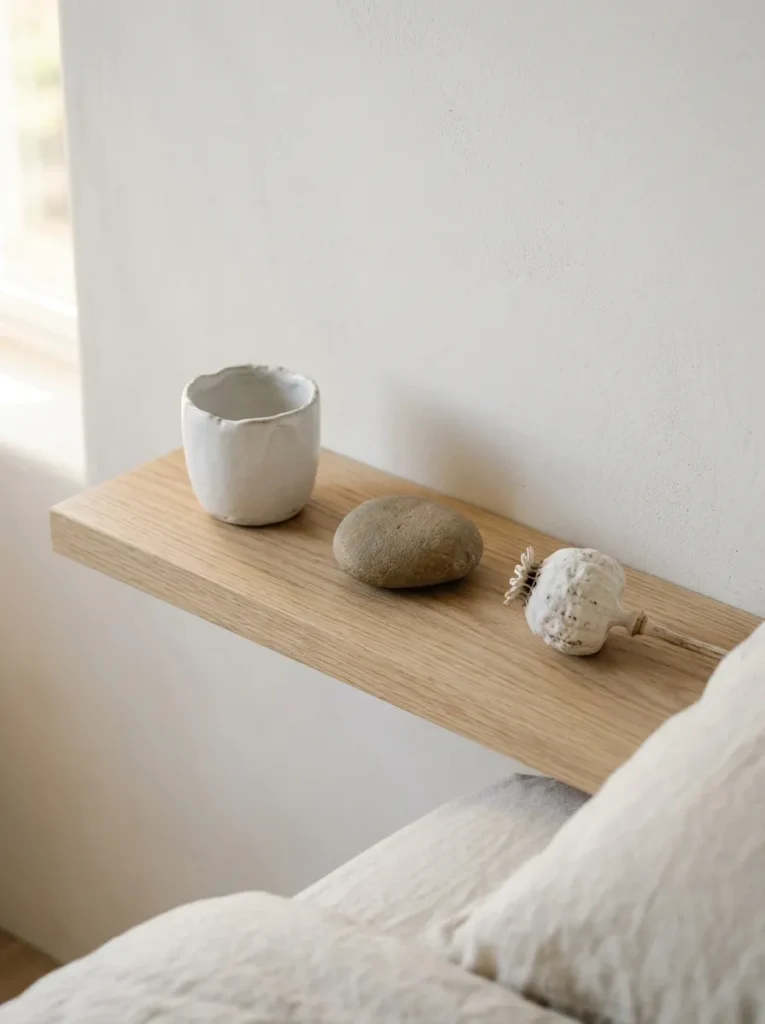
Vibe: The shelf composition feels like a small altar to specific things — the objects chosen and spaced as deliberately as words in a short poem.
Why it works: Organic shaped ceramic objects as bedside accents apply the Japanese wabi-sabi aesthetic principle at the small object scale — the slight imperfection of a hand-thrown rim, the natural variation of a river stone’s surface, the dried form of a seed head all embody the aesthetic of beauty found in the imperfect, the aged, and the natural. In a minimal white bedroom where there are no decorative objects anywhere else, these three small items on the bedside shelf carry significant visual weight precisely because of the negative space around them. The selection principle is deliberate: one made object (the ceramic), one found natural object (the stone), and one dried botanical (the seed head) creates a composition that tells a small story about different categories of beauty.
How to get it: Source hand-thrown or handmade ceramic objects specifically — the slight asymmetry and surface variation of genuinely hand-thrown pottery is the quality that distinguishes a wabi-sabi bedside display from a simply pale decorative arrangement. Gather smooth river stones from outdoor locations (or source from aquarium suppliers in larger natural sizes). Collect or source dried seed heads and botanical forms from countryside walks, foragers’ markets, or specialty botanical suppliers. Apply the three-object maximum — any additional object on the bedside surface moves the composition from deliberate to accumulated.
Shop The Look
| Product |
|---|
| Hand-thrown white ceramic vessel small |
| Smooth river stone decorative single |
| Dried poppy seed head natural white |
| White oak floating shelf 30cm |
| Concealed shelf bracket pair |
12. Floor-Level Bed or Futon for Japanese-Inspired Minimal Ground Plane
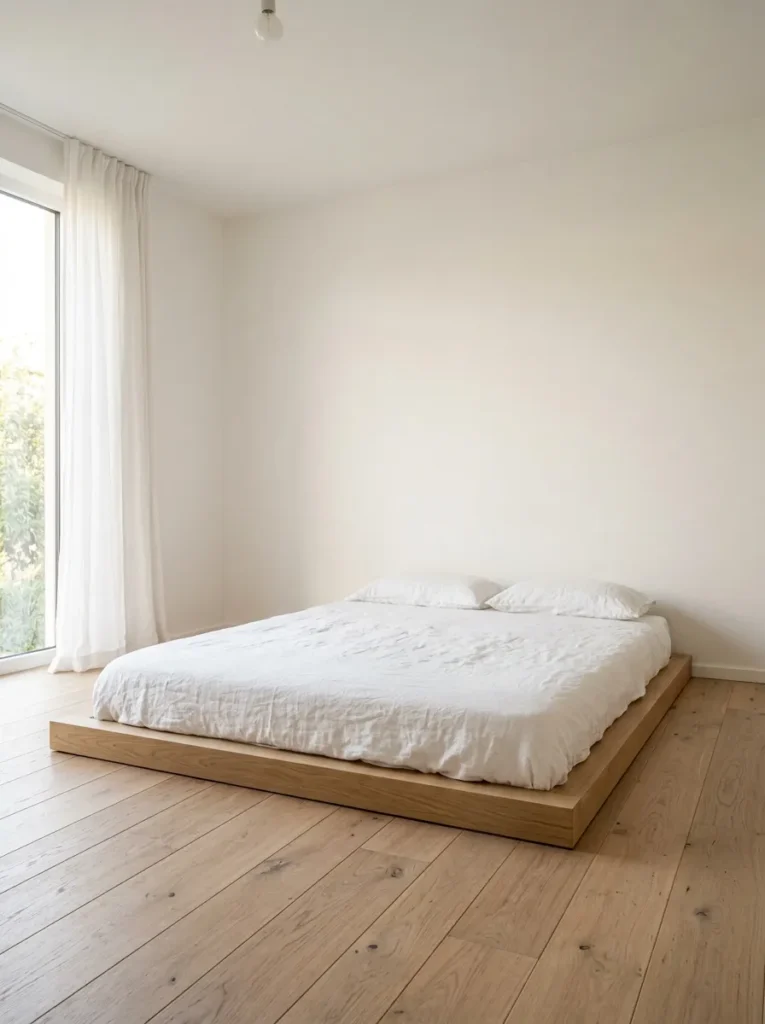
Vibe: The floor-level bed feels grounded and open simultaneously — lower to the floor, the room above it vast and still.
Why it works: A floor-level or very low platform bed applies the Japanese interior design principle of visual horizon lowering — when a room’s primary furniture sits close to the ground, the visual horizon is lowered, making the ceiling appear higher and the upper portion of the room more visible and spatially generous. This effect is amplified in white rooms because the large expanse of white wall above the low bed creates an impression of vertical spaciousness that raised bedframes cannot achieve. Floor-level sleeping is also specifically documented in Japanese wellness culture as contributing to improved sleep quality through the association of the sleeping position with earthedness and calm — a value that aligns directly with the minimal white bedroom’s calm retreat objective.
How to get it: Build a simple platform from 18mm solid white oak boards (or a purpose-made Japanese-style bed platform from a specialist supplier) at 8–15cm from the floor. Size the platform to the mattress dimensions plus 10cm on each side. Finish with clear matte hardwax oil. Use a firm Japanese-style mattress (futon mattress or a compact innerspring mattress in the 15–20cm depth range — thick memory foam mattresses are too deep for a floor-level bed to read as deliberately low). Dress with white linen bedding only — no headboard, no side tables at this height.
Shop The Look
| Product |
|---|
| Low platform bed frame Japanese white oak |
| Japanese style mattress firm 15cm |
| White linen bedding set platform bed |
| Clear matte hardwax oil wood platform |
| Single folded blanket cream wool foot |
13. Minimal White Bedroom in a Small Room Using Mirrors
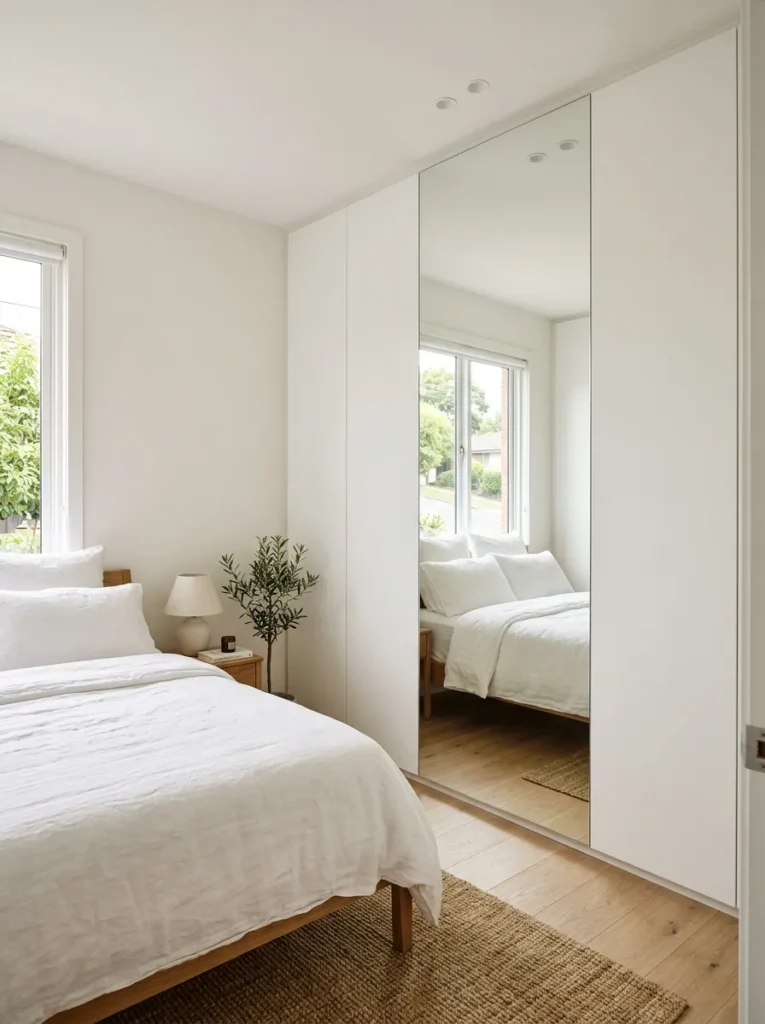
Vibe: The small room feels twice its actual width — the mirror performing the spatial work that renovation cannot.
Why it works: A full-height integrated mirror in a small minimal white bedroom applies the spatial design principle of reflective expansion — a floor-to-ceiling mirror that reads as an architectural element rather than a decorative object (frameless, integrated into a wardrobe wall, spanning from floor to ceiling) reflects the room back on itself in a way that the eye initially processes as a continuation of the space rather than a reflection of it, effectively doubling the perceived width of the room. In a minimal white bedroom where the palette is already working to maximize apparent spaciousness, the mirror adds a second and more dramatic spatial expansion tool. The frameless specification is essential — any frame reads as a decorative object (a mirror) rather than an architectural surface (an extension of the room).
How to get it: Source a frameless mirror panel cut to floor-to-ceiling height and the desired width (a 90cm wide panel integrating into a wardrobe wall section is the most common format) from a glazier. Mount using mirror adhesive and two mirror safety clips at the top and bottom. The mirror’s lower edge should rest on the floor finish, with a thin silicone bead sealing the floor junction. If integrating into a wardrobe wall, position the mirror as one of the door surfaces or as a panel between doors for the most architecturally resolved appearance.
Shop The Look
| Product |
|---|
| Frameless mirror panel full height glass |
| Mirror adhesive heavy duty wall |
| Mirror safety clip set top bottom |
| Silicone sealant clear floor junction |
| White linen bed set small room |
14. Thoughtful Storage — Woven Linen Storage Boxes on Open Shelf
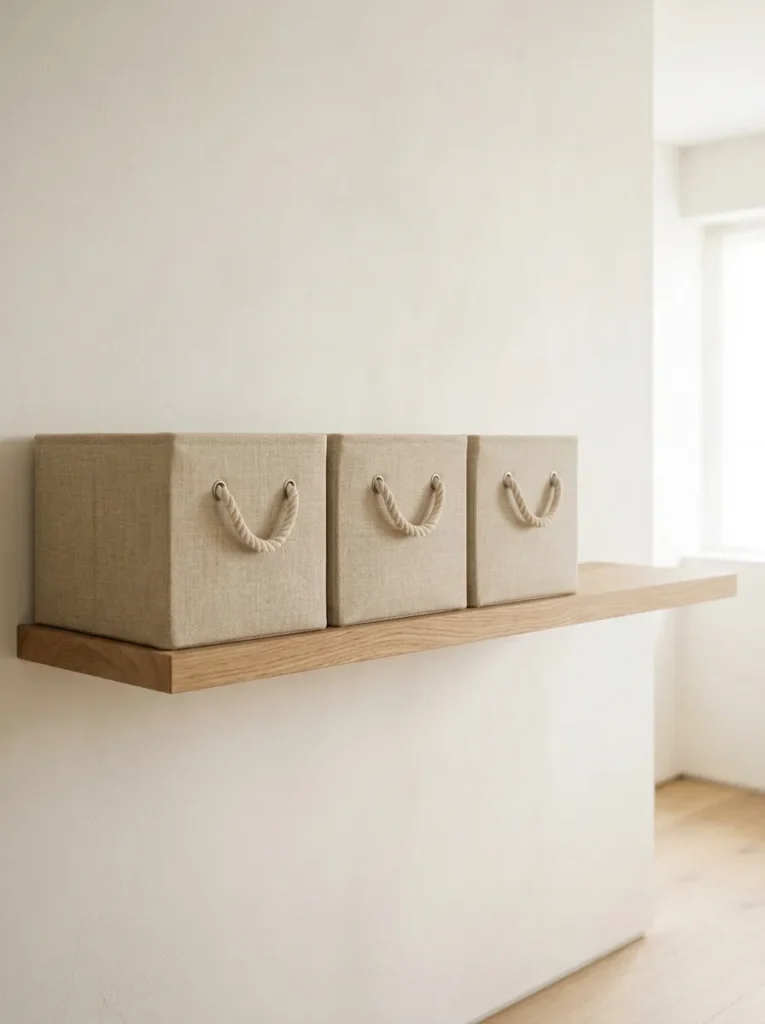
Vibe: The shelf feels resolved — three identical objects in a line communicating order without effort.
Why it works: Identical matching storage boxes on an open bedroom shelf apply the design principle of disciplined repetition — three objects of the same form, material, and size in a precise line create a more calming visual impression than three varied objects because the eye resolves the pattern immediately and can move on rather than spending processing time managing visual variation. The natural linen material of the boxes maintains the room’s material palette consistency, and the rope handles add a small tactile detail that references the natural fiber throughout the room without introducing a new material category. The discipline of using the shelf for only these three boxes — nothing else — is the display philosophy that makes the shelf feel designed rather than stored-on.
How to get it: Source three identical linen storage boxes in the same natural undyed linen, the same size, and the same rope handle style from a single supplier to guarantee absolute visual consistency. Stack-test the boxes before purchasing to confirm they sit level without lean. Mount the shelf at a height that makes the boxes accessible to an adult stretching (180–200cm from floor) to reinforce the sense that the shelf’s function is seasonal storage rather than daily access, which allows it to be the primary visual element on the wall without accumulating additional daily-use objects.
Shop The Look
| Product |
|---|
| Natural linen storage box rope handle set 3 |
| White oak floating shelf 90cm natural |
| Concealed shelf bracket pair white oak |
| Natural rope handle box replacement |
| Shelf anchor wall fixing kit |
15. Warm Ambient Floor Lamp with a Simple Linen Shade
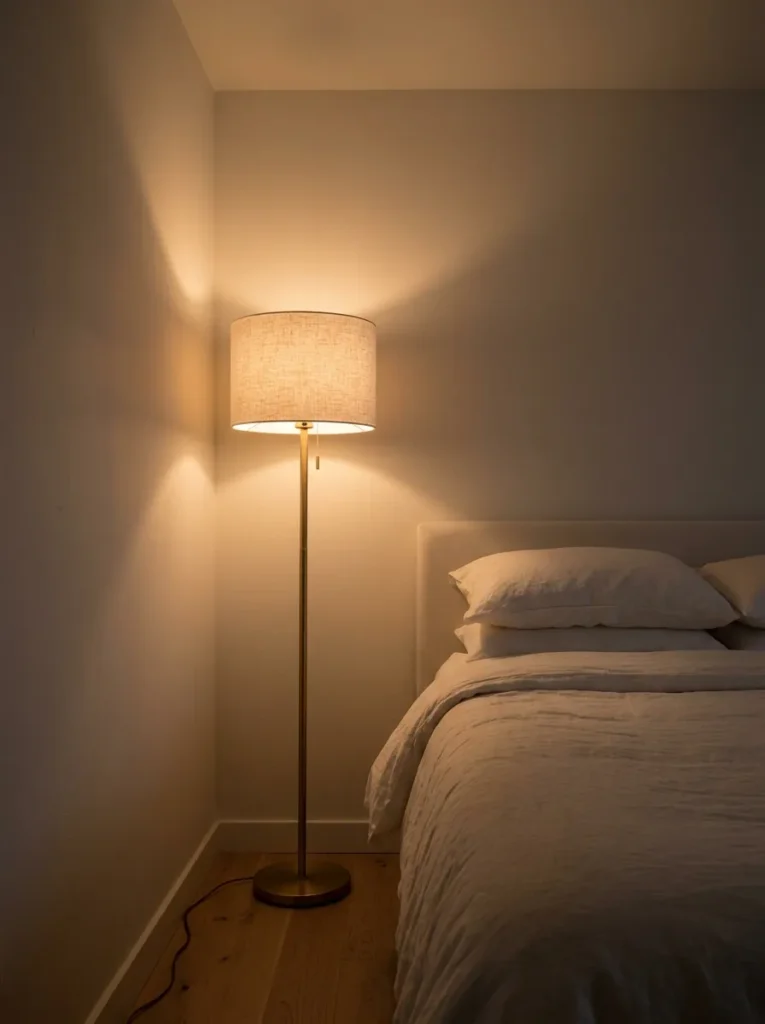
Vibe: The floor lamp in the corner feels like the room’s warmth concentrated in one place — a single source of evening light that makes the whole room feel complete.
Why it works: A single floor lamp with a linen shade in a bedroom corner applies the hospitality lighting principle of low-source warm light — light that originates from below eye level (from a floor lamp rather than a ceiling fixture) creates a fundamentally different atmospheric quality from overhead lighting, because the shadows it casts fall upward and the light it provides reads as warm and intimate rather than functional and directional. The linen shade specifically provides the same light diffusion quality as linen curtains — the natural fiber allows warm light to pass through with a slight amber-warm toning that enhances any bulb’s 2700K warmth. A single floor lamp as the bedroom’s primary evening light source is the minimal lighting philosophy — one lamp, one light, one source of evening warmth.
How to get it: Source a simple floor lamp in matte white or warm brass (these are the two finishes that most consistently coordinate with a warm white bedroom) with a white linen drum shade (not a solid opaque shade — the translucent quality of natural linen is essential for the warm ambient glow). Position in one bedroom corner, slightly behind the bed frame’s corner to create the most enveloping light distribution. Wire to a wall dimmer switch or specify a floor lamp with an integrated dimmer for adjustable intensity from reading brightness to pre-sleep ambient.
Shop The Look
| Product |
|---|
| Simple floor lamp matte white tall |
| White linen drum shade replacement |
| Warm white LED bulb 2700K floor lamp |
| Dimmer switch inline cord lamp |
| Warm brass floor lamp alternative |
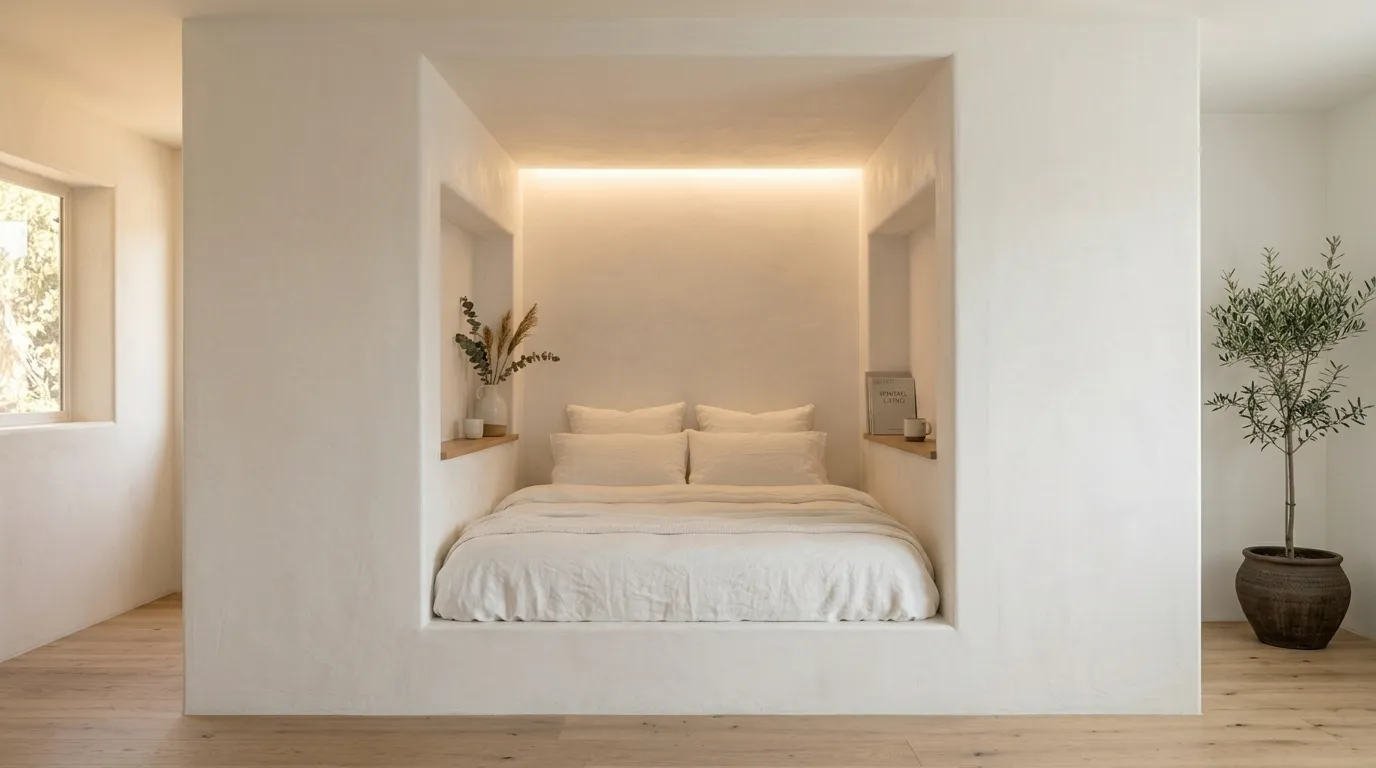
16. Architectural Bedroom Alcove with Built-In Bed
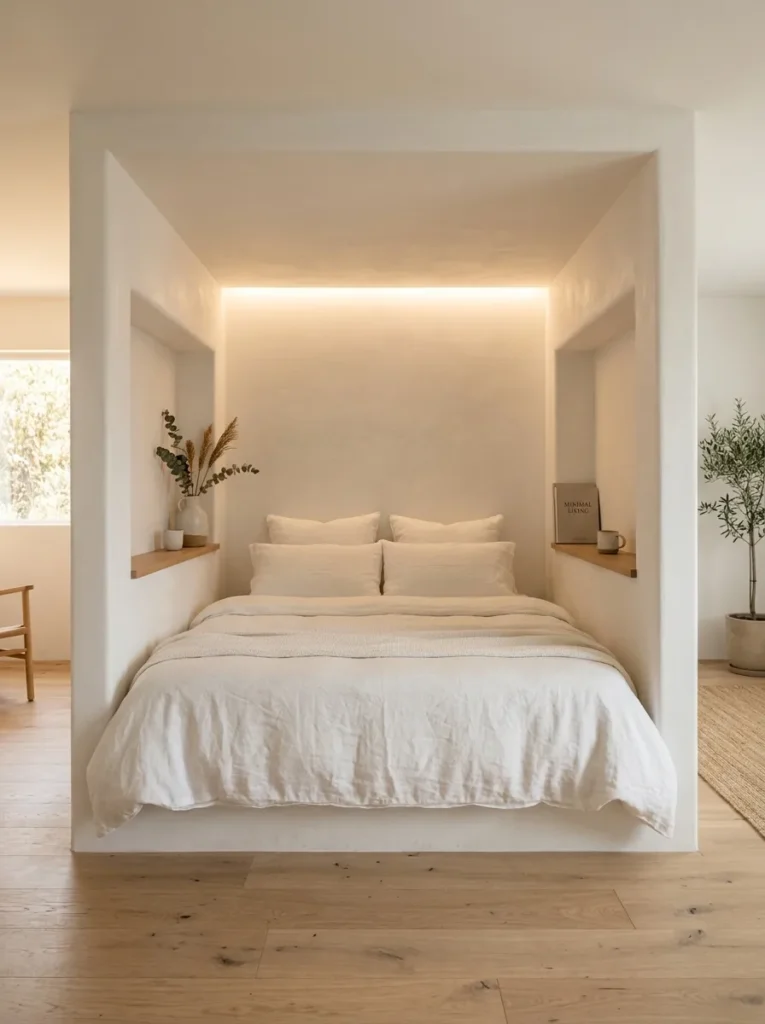
Vibe: The alcove feels like a room within the room — the enclosed three-wall surround of the bed creating the specific calm of a space designed for sleeping.
Why it works: A built-in bed alcove applies the architectural design principle of spatial compression for psychological safety — the specific quality of sleeping within a partially enclosed space (lower ceiling, three surrounding walls, recessed from the main room floor) references the fundamental human preference for sleeping in protected, enclosed environments that evolutionary psychology documents consistently. Contemporary built-in bed alcoves draw from the Scandinavian box-bed tradition (the enclosed wooden sleeping platforms used in traditional Nordic homes for thermal efficiency and privacy) and adapt it to the smooth plaster aesthetic of contemporary minimal design. The plaster alcove’s smooth white surfaces also create a significant visual enclosure without the visual complexity of materials, maintaining the minimal palette within the most intimate zone of the room.
How to get it: Build the alcove frame from steel stud framing (most easily constructed by a competent builder as part of a bedroom renovation) and plasterboard, setting the bed’s footprint recessed from the main room floor by 30–40cm (the depth of the alcove’s projecting walls on either side). Skim-plaster all alcove surfaces smooth and paint in the same warm white as the room. Install small LED strip lights at the alcove ceiling edge (where the alcove ceiling meets the room ceiling) for the warm internal ambient glow. Construct integral bedside shelves from 18mm MDF within the alcove side walls, painted to match.
Shop The Look
| Product |
|---|
| LED strip warm 2700K alcove lighting |
| Smooth plaster skim finish white |
| Warm white alcove paint matte mineral |
| Small ceramic vase alcove shelf white |
| White linen fitted sheet alcove bed |
17. Textile Layering — Adding Warmth Through Weave Variation
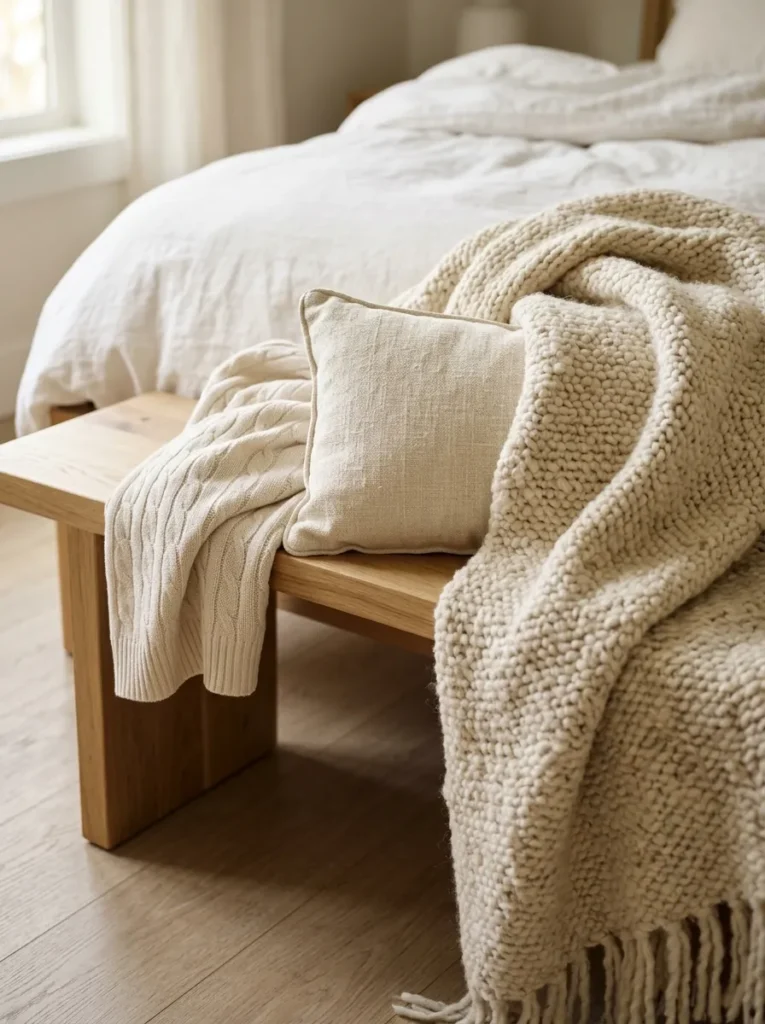
Vibe: The bench layering feels like warmth accumulated rather than arranged — three textiles that happened to land in the same place and became a composition.
Why it works: Textile layering at the foot-of-bed position applies the minimal design principle of warmth through material contrast rather than color contrast — three textiles in the same tonal family (warm off-white) but in different fiber materials and weave structures (smooth wool blanket, woven linen, knit cotton) create a composition that the eye reads as rich and sensory without the visual complexity of multiple colors. The foot-of-bed bench position is the correct location for this layering because it is seen from the room’s entry point (the most common viewing angle of the bed) and frames the bedding beyond it as a complete textile composition. The bench’s visible white oak grain adds a fourth material to the composition without adding a new color.
How to get it: Source all three textiles from natural fiber only — no acrylic or synthetic yarns, which lose the sensory warmth that is the entire functional purpose of the layering exercise. A 100% merino or lambswool blanket, a 100% linen cushion cover, and a 100% cotton knit throw are the minimum material specifications for the sensory quality this composition requires. All three in the warm off-white family — not pure white, which reads as pristine and untouchable rather than warm and inviting.
Shop The Look
| Product |
|---|
| Natural wool blanket off-white fold bench |
| Linen cushion cover cream small |
| Cotton knit throw natural white small |
| White oak bench simple foot bed |
| Clear matte oil bench finish natural |
18. White Bedroom with a Single Indoor Tree or Large Botanical
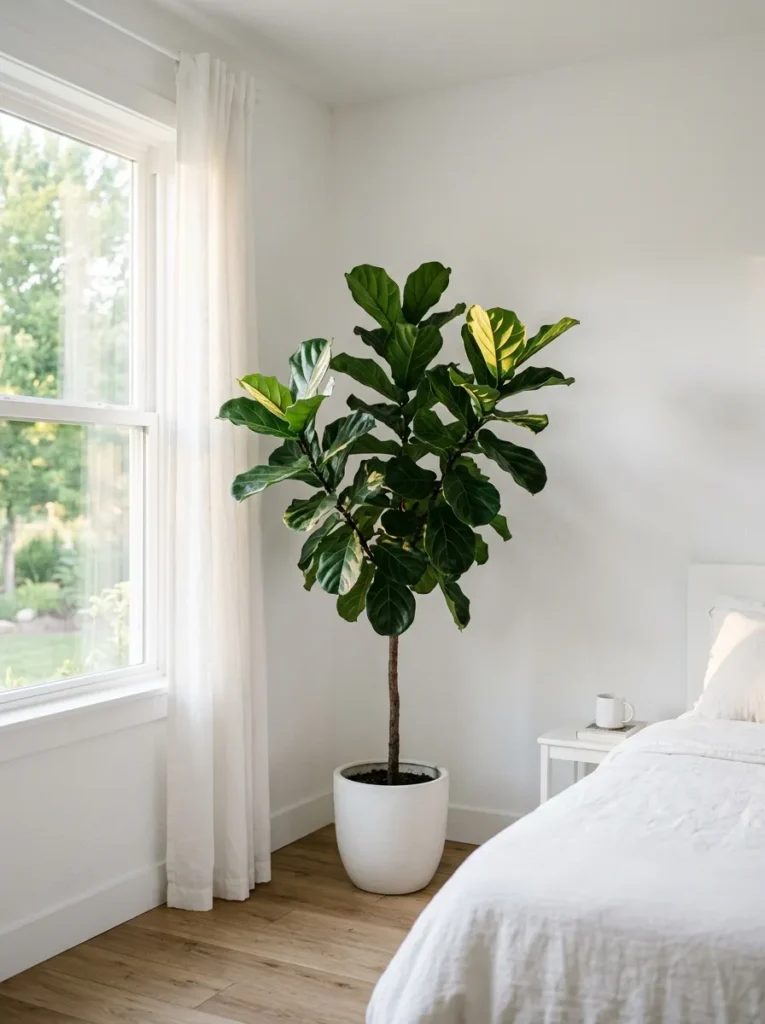
Vibe: The single tree feels like the room’s lung — the only living thing in a white space, and the thing that makes everything else in the room make sense.
Why it works: A single large indoor botanical in a minimal white bedroom applies the biophilic design principle of nature as focal point contrast — in a room where all surfaces are warm white and all materials are in the neutral family, a single dark green tree provides the maximum available contrast with minimal visual complexity. One large botanical (rather than multiple small plants) maintains the minimal philosophy of deliberate singularity, while the tree’s organic form and living quality introduce a dimension that no designed object can provide. The specific visual quality of dark green leaves against a white wall in morning light is one of the most calming visual compositions available in a domestic interior, documented repeatedly in biophilic design research as a significant positive mood modulator.
How to get it: Select a large indoor tree with upright form and dark green leaves — fiddle-leaf fig (Ficus lyrata), olive (Olea europaea var. dwarf), rubber plant (Ficus elastica), or large monstera are all appropriate for this application. Pot in the simplest possible white ceramic pot (no texture, no surface detail — a purely cylindrical or slightly tapered form) sized to the tree’s root ball plus 5cm on each side. Position in a corner that receives bright indirect light — fiddle-leaf figs and rubber plants require bright indirect light to remain healthy and maintain their form without staking.
Shop The Look
| Product |
|---|
| Fiddle leaf fig indoor tree large |
| Simple white ceramic pot 30cm diameter |
| Terracotta saucer white glazed large |
| Potting mix indoor large tree |
| Indoor tree fertiliser liquid organic |
19. Minimal White Bedroom for a Small Room — Complete Design System
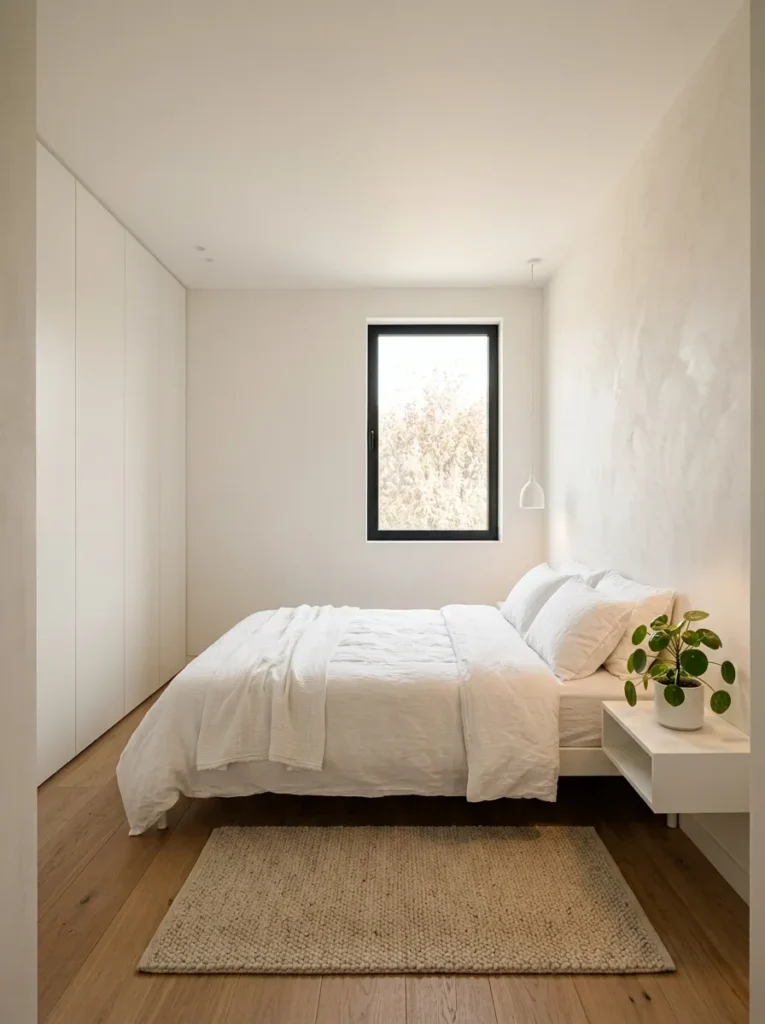
Vibe: The small room feels complete and calm — every element present, everything unnecessary absent, the result more than the sum of its parts.
Why it works: A complete minimal white bedroom design system applied to a small room demonstrates the cumulative power of design consistency — each individual element (the limewash wall, the concealed wardrobe, the floating shelves, the linen bedding, the single pendant, the wool rug, the single botanical) contributes to the room’s calm atmosphere individually, but their combination and consistency creates a result that is significantly more than the sum of its parts. The small room reads as larger than its actual dimensions because the consistent palette (warm white throughout) eliminates the visual fragmentation that occurs when multiple colors, materials, and furniture styles compete for attention in a tight space. The minimal white approach is simultaneously the most spatially generous and the most calming design system available for a small bedroom.
How to get it: Implement the complete system in sequence: limewash the bed wall first (establishing the room’s atmospheric direction), install the concealed wardrobe second (resolving the storage question before any furniture is placed), position the bed and floating shelves third (the functional center of the room), add the bedding and textiles fourth, the pendant lighting fifth, the rug sixth, and the botanical last (the living element that brings the completed system to life). Add nothing that is not in this sequence — the discipline of the system requires that every element serves the whole rather than existing independently.
Shop The Look
| Product |
|---|
| Limewash paint warm white complete system |
| White linen bedding complete set |
| Matte white ceramic pendant light |
| Undyed natural wool rug bedside 60×90 |
| Single large botanical white ceramic pot |
How to Start Your Minimal White Bedroom Transformation
The single best first move before purchasing any new furniture, bedding, or accessories for a minimal white bedroom is editing the existing room — removing every object that does not earn its place through functional necessity or genuine beauty. This editing process (which costs nothing and takes a single afternoon) typically reveals that 40–60% of the objects currently in a standard bedroom are not necessary for its function and do not contribute meaningfully to its atmosphere. The objects removed are not always bad objects; they are simply objects that belong in a different room or a different context. The editing act is the minimal bedroom’s defining skill — not the addition of white paint or linen bedding, but the removal of everything that is not essential.
The most common mistake in a minimal white bedroom is choosing the wrong white. The wrong white has a blue or green undertone that reads as cold, hospital-like, or laboratory-adjacent rather than warm, calm, and enveloping. The fix is warm undertone specification: always select the paint sample that reads as slightly yellow, pink, or gray in comparison to adjacent samples — this is the warm undertone that the minimal white bedroom requires. Test the selected paint on the specific wall in the specific room at morning, afternoon, and evening light before committing — the same paint reads differently in rooms facing different compass directions, and the warm undertone that reads correctly under north-facing gray light may read as too yellow under south-facing afternoon light.
Three specific items under $50 that create immediate minimal white bedroom quality: a set of four white washed linen pillowcases ($22–35) replacing existing cotton or synthetic pillowcases — the natural crease and weave quality of linen instantly communicates the warm minimal aesthetic; a single dried botanical stem in the simplest possible white ceramic vase ($8–15 combined) as the room’s sole bedside object; and a pot of warm white limewash paint ($35–55) for a single accent wall behind the bed. These three items cost under $100 combined and produce a measurably different atmospheric quality in the bedroom before any furniture or lighting is changed.
A surface refresh — limewash accent wall, new linen bedding, editing existing accessories to three objects maximum — is achievable over a single weekend for $80–200 in materials. A mid-range minimal white bedroom — new bedframe, new lighting, concealed storage, complete bedding system, and a botanical — runs $600–1,500. A complete minimal white bedroom renovation — limewash walls throughout, wire-brushed oak flooring, bespoke concealed wardrobe, custom bed alcove, and complete natural material palette — represents a $4,000–12,000 investment depending on room size and specification. The editing, the limewash, and the linen pillowcases are achievable this weekend; the flooring and bespoke alcove follow a renovation sequence determined by budget and scope.
Frequently Asked Questions About Minimal White Bedroom Ideas
How do you make a white bedroom feel warm rather than cold and clinical?
The warmth of a white bedroom comes from three specifications working together: the undertone of the white (which must be warm — yellow, pink, or gray rather than blue or green), the material palette (natural materials including linen, solid timber, wool, and ceramic rather than synthetic or mass-manufactured alternatives), and the quality of the lighting (warm-white bulbs at 2700K in concealed, low-source fixtures rather than cool-white overhead fluorescents). A white room with a blue-undertone paint, polyester bedding, and cool overhead fluorescent lighting will read as clinical regardless of how minimal the arrangement is. The same room with a warm-undertone limewash paint, washed linen bedding, and a single warm pendant at 2700K will read as genuinely calming regardless of how similar the two situations appear in a paint color description.
What is the minimal number of objects that a bedroom requires?
A bedroom’s functional minimum is: a bed (including mattress and bedding), a surface for bedside essentials (a phone, a glass of water, a book), a light source for reading, and storage for clothing. Every other object in a standard bedroom is either decorative (serving only atmospheric function) or a remnant of accumulated possession rather than a deliberate choice. The minimal white bedroom aesthetic does not eliminate all decorative objects — it restricts them to those that genuinely contribute to the room’s atmosphere rather than simply occupying space. The practical discipline is a maximum of three objects on any visible surface (the bedside, the dresser top, an open shelf) and a rule of one per category for wall art (one print, not a gallery; one mirror, not several).
Can a minimal white bedroom work with color accents?
Yes — but color accents in a minimal white bedroom should be introduced through natural material rather than through decoration. A single large dark-green botanical (the room’s only non-white color) works because it is living, specific, and singular. A warm brass pendant light introduces a warm-metal color accent through function rather than decoration. A woven natural fiber rug in its undyed honey tone introduces a warm organic accent at floor level. What does not work is color introduced decoratively — a colorful cushion “for a pop of color,” a colored throw chosen for chromatic variety, or a gallery wall with varied colored prints. The minimal white palette’s power comes from its restriction, and color introduced for its own sake rather than through material necessity undermines that restriction.
How do you store clothes in a minimal white bedroom without visible wardrobe clutter?
The minimal white bedroom’s clothing storage solution is the concealed wardrobe — a floor-to-ceiling wardrobe with push-to-open doors painted exactly the same warm white as the surrounding walls, so the wardrobe visually disappears into the wall surface and the room reads as having no storage at all. This requires that the wardrobe is custom or semi-custom (allowing the door fronts to be painted to exactly match the wall color) and that the opening mechanism is push-to-open rather than handle-based (any visible hardware breaks the visual continuity that makes the concealment effective). If a bespoke concealed wardrobe is outside the project’s budget, a temporary solution is placing freestanding wardrobe units behind floor-to-ceiling curtain panels in the same warm white as the walls — the curtained alcove reads as architectural rather than as furniture, maintaining the visual calm of the wall surface.
What bedding is best for a minimal white bedroom?
100% linen bedding in washed white or natural white is the optimal specification for a minimal white bedroom because linen’s natural properties — temperature regulation (cool in summer, warm in winter), breathability, natural crease quality, and softening with each wash rather than pilling or fading — align precisely with both the minimal aesthetic (it improves with age rather than requiring replacement) and the wellness function (it produces better sleep quality than synthetic alternatives according to independent sleep research). Cotton percale at 300–400 thread count is the alternative for those who find linen’s initial texture too rough — percale’s smooth surface and durability make it a functional and aesthetic compromise that reads correctly in a minimal white bedroom. Avoid polyester, microfiber, and sateen finishes — all three read as flat and synthetic in a minimal room where material quality is the primary aesthetic content.
Ready to Create Your Dream Minimal White Bedroom?
These 19 ideas move through every dimension of what makes a minimal white bedroom genuinely calming rather than simply pale — from the foundational atmospheric warmth of limewash walls and warm-undertone paint specifications, to the sensory depth of linen bedding systems and layered natural fiber textiles, to the spatial intelligence of concealed storage and floating shelves that clear the room of furniture bulk, to the living quality of a single large botanical that gives the white room its only point of biological warmth. Starting with the edit — removing before adding, clearing before considering what comes next — is the correct first act of the minimal white bedroom transformation, because the calm the style promises arrives not through what you put in but through what you take out. Choose the warm white, limewash the bed wall, replace the pillowcases with linen, and remove everything from the bedside except three objects. The room will already be closer to what it should be. Pin the ideas that felt like the room settling into itself as you read them — those are the ones that belong in your specific white space.