15 Creative Big Boy Bedroom Ideas for Growing Kids
Big boy bedroom ideas for growing kids transform the space from a baby or toddler room into an environment that genuinely reflects a child’s expanding personality, supports their developmental needs, and grows with them through multiple childhood stages — using furniture, color, storage, and design decisions that remain appropriate from ages five through twelve rather than becoming outgrown within a year. This article gives you exactly 15 ideas spanning themes, furniture systems, study zones, storage, lighting, and small-room adaptations so every family, every budget, and every child’s interests find a big boy bedroom approach that truly works.
A big boy bedroom done right is the first room a child feels genuinely belongs to them — where their interests are honored on the walls, where they can find their own things, where a friend can sleep over and the homework can happen and the Lego can be built on the floor without anyone having to move first. That particular combination of function and personality, in a space that has room to grow, is what every idea in this list is built around. Here are 15 ideas worth saving — and designing together.
Why Big Boy Bedroom Ideas for Growing Kids Work So Well
The transition from a baby or toddler room to a genuine “big boy bedroom” is one of the most significant design moments in a family home — it marks the shift from a parent-designed space to one that begins to reflect the child’s own developing identity, interests, and need for both activity and rest. Child development research consistently documents that children aged five and above benefit measurably from environments that provide: a sense of personal ownership and agency (the room feels like theirs, not just assigned to them), functional zones for different activities (sleeping, studying, playing, and sometimes social space), adequate and well-organized storage that allows the child to manage their own belongings independently, and age-appropriate visual stimulation that honors their interests without overstimulating the sleeping environment.
The materials and design choices that make a big boy bedroom succeed through multiple developmental stages include: modular furniture systems that can be reconfigured as needs change (IKEA’s KALLAX, TROFAST, and HEMNES ranges are specifically appropriate here), desk and study zones sized for primary school and secondary school tasks alike, bed configurations that transition from single-child sleeping to sleepover-capable arrangements (bunk beds, trundle configurations, and loft beds with a study zone beneath all accomplish this), storage systems that accommodate the dramatically changing inventory of a child’s possessions from age five to twelve (action figures to gaming consoles, picture books to textbooks, toy cars to sports equipment), and a color and theme approach that acknowledges current interests without locking the room into a single graphic theme that will be outgrown in two years.
The big boy bedroom category generates strong and consistent engagement in the parenting and interior design media because it represents a genuine creative collaboration between parent and child — the design decisions are more complex than a toddler’s room (the child has strong opinions, but those opinions change rapidly) and more consequential than an adult bedroom (the room must function as bedroom, study, playroom, and social space simultaneously). Publications including Junior magazine, Dezeen’s interiors coverage, and specialist children’s design platforms like Smallable and Lulu & Georgia’s kids collection consistently document the same themes: adventure, curiosity, quality materials, and design that respects children’s intelligence enough to avoid the purely novelty-driven approaches that dominate mass-market children’s furniture.
Small bedrooms — the second or third bedrooms that are home to most children in urban homes — require particular design intelligence to function successfully as big boy bedrooms because the multi-functional demands of the space (sleeping, studying, playing, storage) must be compressed into a limited footprint. Loft bed configurations, wall-mounted storage, fold-down desk surfaces, and the elimination of floor-standing furniture in favor of wall-mounted alternatives are the design tools that make small rooms work well for older children. The honest consideration: any bedroom under 80 square feet (approximately 7.5 square metres) requires a loft bed or bunk configuration to provide adequate floor space for both study and play — floor space is the resource a school-age child uses most, and a standard single bed occupying 30% of a small room’s floor area at a single-use height is the single most common spatial waste in children’s room design.
Style at a Glance
| Element | Functional Core | Design Edge |
|---|---|---|
| Philosophy | The room grows with the child | Interests honored, not imposed |
| Materials | Solid pine, MDF, cotton, plywood | Natural timber, linen, quality ceramic |
| Color Palette | Warm white, navy, forest green | Dusty sage, warm gray, terracotta |
1. Loft Bed with Study Zone Beneath for Space Efficiency
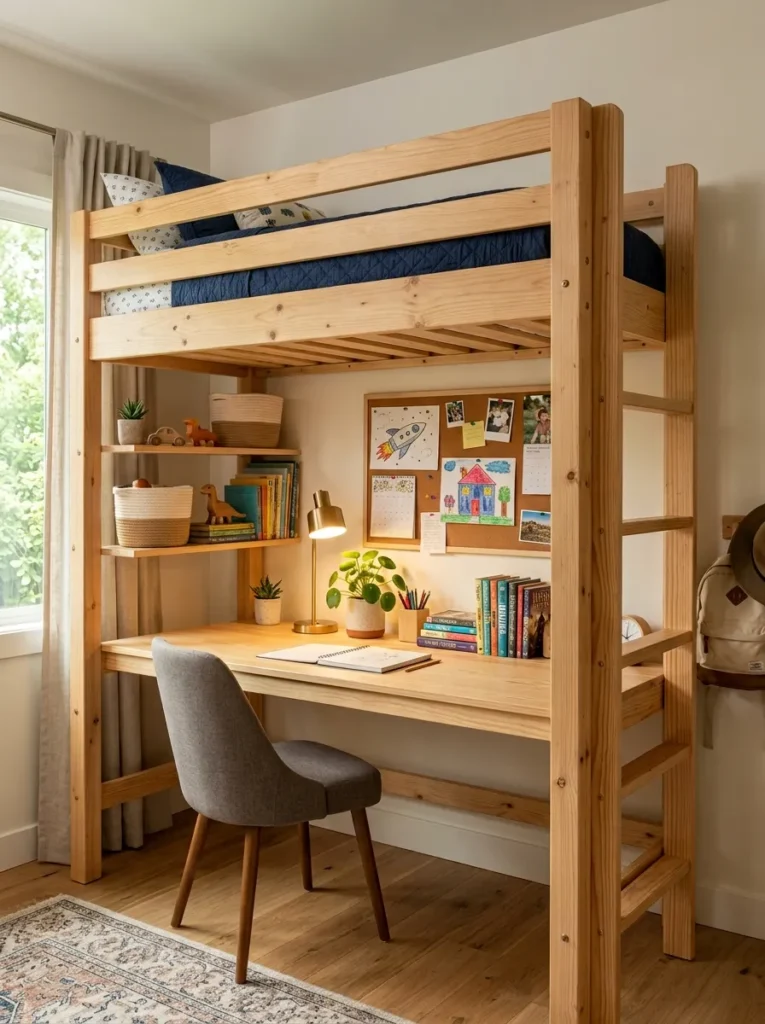
Vibe: The loft bed setup feels genuinely clever — the room working twice as hard by stacking sleep above work.
Why it works: A loft bed with a study zone beneath applies the vertical space utilization principle that children’s room design requires most urgently — by elevating the sleeping surface to 150cm above the floor, the full floor-level footprint of the bed (typically 90×200cm for a single) is converted into usable, active floor area. This is the single most impactful spatial intervention available in a small bedroom because it replaces the room’s lowest-value use of floor space (a single-height bed that is only used for eight to ten hours a day) with its highest-value use (a study desk and chair that is used daily for homework, creative projects, and learning). For a bedroom under 100 square feet, a loft bed configuration is the design intervention that makes the room genuinely functional as both sleeping and study space.
How to get it: Source a solid pine or solid birch loft bed at a height that allows comfortable seated desk use below (the desk surface should be at 75cm from the floor, with approximately 120cm clear height above the chair for a child aged 7–12). IKEA’s KURA and STUVA ranges, as well as specialist children’s furniture brands including Maxtrix, Flexa, and Oliver Furniture, all produce quality loft bed systems with study zone integration. The desk surface should be at minimum 100cm wide for homework and a monitor or device if needed, with at least 40cm of depth. Install a pinboard (cork or magnetic) above the desk for displaying work, schedules, and notes.
Quick Win: A clip-on LED desk lamp ($18–28) providing at least 400 lux of warm-white task lighting (3000K) at desk surface level eliminates the eye strain and reading difficulty that inadequate desk lighting causes — the single most impactful accessory purchase for any existing desk setup.
Shop The Look
| Product |
|---|
| Solid pine loft bed single with ladder |
| Ergonomic desk chair adjustable height child |
| Warm LED desk lamp adjustable arm |
| Cork pinboard large desk above |
| Desk shelf unit small above surface |
2. Navy Blue Accent Wall with White Furniture for Classic Confidence
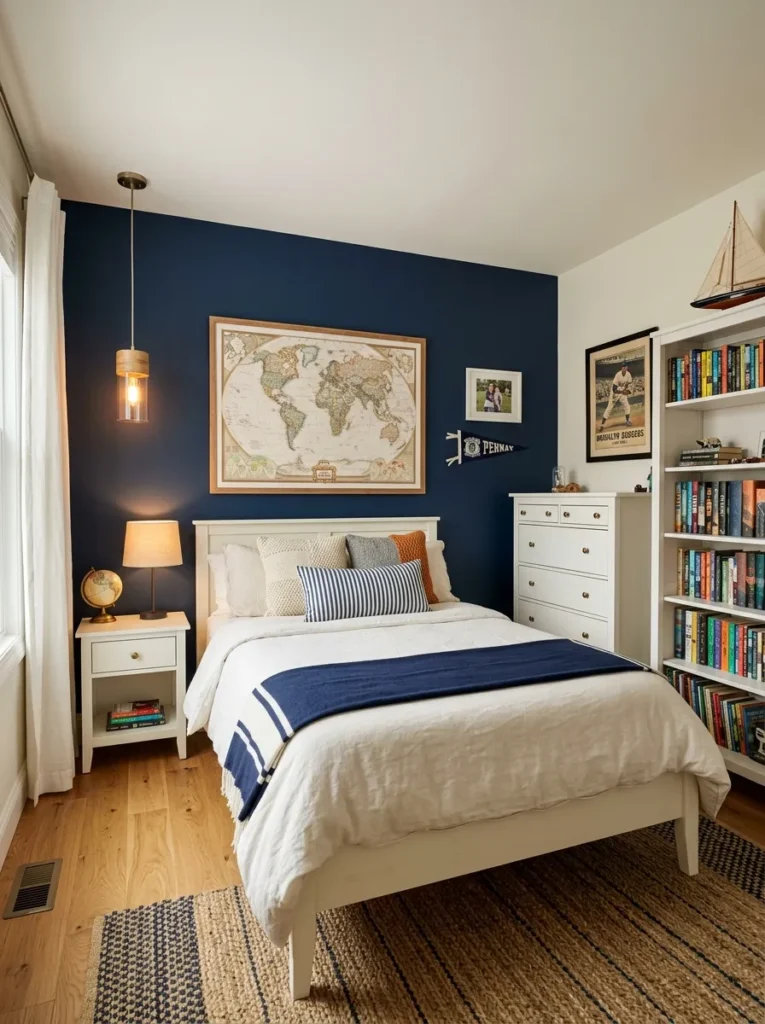
Vibe: The navy accent wall feels serious and confident — a room that takes a child seriously enough to give them a genuinely designed space.
Why it works: A deep navy accent wall with white furniture applies the design principle of confident color with material calm — navy is simultaneously the most child-appropriate bold color (it references school, sport, geography, adventure, and the night sky — all things that resonate across ages five to twelve) and the most design-sophisticated (it reads as refined rather than novelty-dependent, ensuring the room ages well as the child develops). White furniture against a navy wall creates the maximum luminosity contrast that makes both elements read more clearly than they would in a lesser contrast pairing, and white furniture has the additional practical advantage of being repaintable or refaceable as the child’s preferences change.
How to get it: Paint the bed wall in Benjamin Moore Hale Navy HC-154 or Farrow & Ball Hague Blue No. 30 — both are warm-toned navies that read as rich and considered rather than flat and cool. The remaining three walls should be in warm white — this maintains the room’s light levels, which would be significantly reduced if all four walls were navy. Mount a large-format world map or vintage-style map print at a scale that fills at least 50% of the navy wall’s width — a map at this scale reads as an educational feature and a design anchor simultaneously.
Shop The Look
| Product |
|---|
| Deep navy bedroom wall paint eggshell |
| White painted MDF bookshelf bedroom |
| Large world map framed print natural wood |
| Small globe decorative desk |
| Navy stripe accent pillow cover |
Also view: 19 Minimal White Bedroom Ideas for a Calm Retreat
3. Natural Timber Bunk Beds for Sleepovers and Sibling Sharing
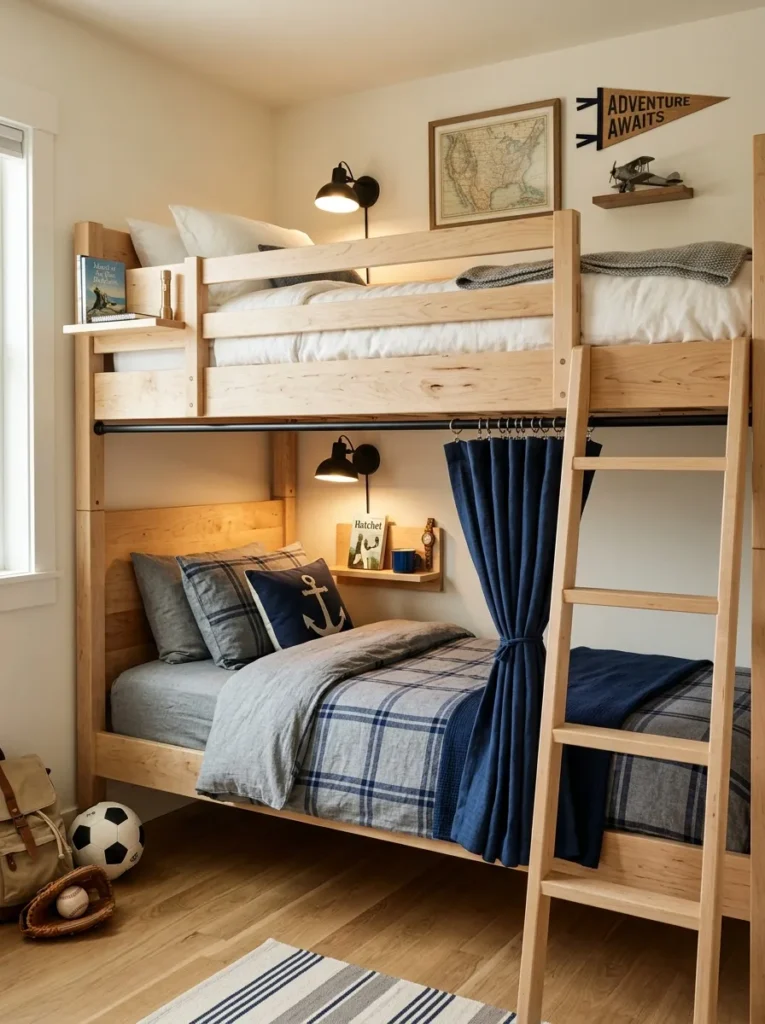
Vibe: The bunk bed feels genuinely exciting — the kind of bed that makes a friend want to sleep over and a child want to go to bed.
Why it works: A natural timber bunk bed applies the children’s bedroom design principle of spatial multiplication — a bunk bed converts the floor space of one bed into the sleeping capacity of two, making sleepovers and sibling sharing possible in a room that would otherwise accommodate only a single standard bed. The timber construction is the critical quality specification: solid wood bunk beds have measurably greater structural integrity, sound insulation between levels, and longevity than MDF or metal alternatives, and they read as furniture rather than equipment — an important distinction in a room where design quality is the goal. A privacy curtain on the lower bunk (a simple curtain rod and panel that can be drawn closed) gives the lower bunk occupant a sense of their own enclosed space — a strong behavioral preference in children that timber bunk designs can accommodate.
How to get it: Specify a solid birch or pine bunk bed with a safety rail on the upper bunk that is at minimum 20cm above the mattress top (the standard safety minimum), and a fixed ladder rather than a detachable one (detachable ladders present a climbing hazard for younger children who are not the primary occupant). Oliver Furniture, Flexa, and IKEA’s MYDAL range all produce well-engineered timber bunk beds at varied price points. Install a clip-on warm LED reading light at each bunk level — these should be specifically children’s bedroom reading lights with a warm (2700K) output and a flexible positioning arm.
Shop The Look
| Product |
|---|
| Solid pine bunk bed set single |
| Clip-on LED reading light warm children |
| Curtain rod tension mount bunk privacy |
| Warm gray single duvet cover bedding |
| Bunk bed small headboard shelf set |
4. Adventure Theme Using Map, Compass, and Explorer Motifs
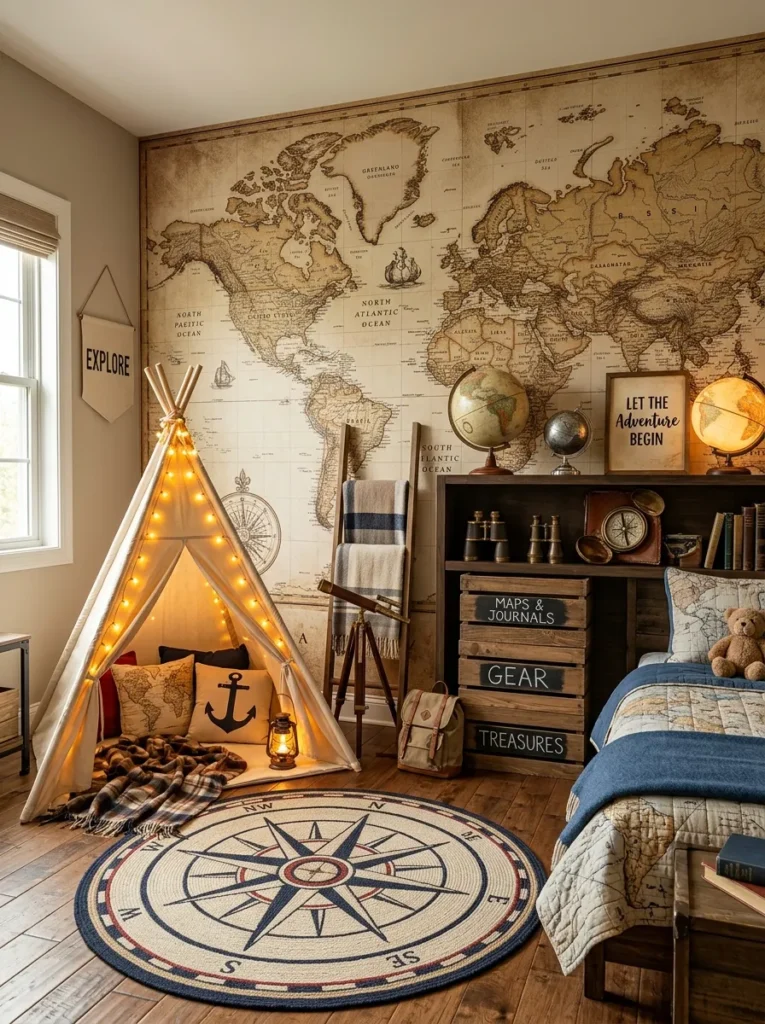
Vibe: The bedroom feels like a base camp — a space organized for exploration, where imagination is the equipment.
Why it works: An adventure explorer theme applies the children’s bedroom design principle of interest-based narrative environment — when a bedroom’s visual theme is built around a genuine intellectual interest (geography, exploration, the natural world, travel) rather than a licensed character, it has two design advantages: it remains relevant longer (a child’s interest in exploration develops and deepens from age five through twelve; a licensed character theme is typically outgrown in one to three years) and it actively stimulates intellectual curiosity (maps, globes, compasses, and explorer equipment are real learning tools as well as decorative elements). The vintage aesthetic of the materials (sepia maps, canvas, natural wood crates) also resists the aggressive primary-color visual noise that character-licensed themes typically produce.
How to get it: Source a large-format vintage world map print or wallpaper panel (Etsy has hundreds of independent mapmakers producing high-quality vintage-style world map prints at accessible prices) as the primary wall feature. Combine with a compass rose floor rug, wooden crate storage (customized with chalkboard label paint on the front panels for category organization), and a small canvas reading teepee or tent in a room corner for an enclosed reading and play zone. Display genuine educational objects — a globe model, a children’s atlas, a set of exploration books — as both decor and use objects.
Shop The Look
| Product |
|---|
| Vintage world map print large format |
| Compass rose floor rug warm |
| Canvas reading teepee children indoor |
| Wooden crate storage set natural |
| Globe model desk decorative children |
5. KALLAX Storage Wall Painted in Forest Green for Bold Organization
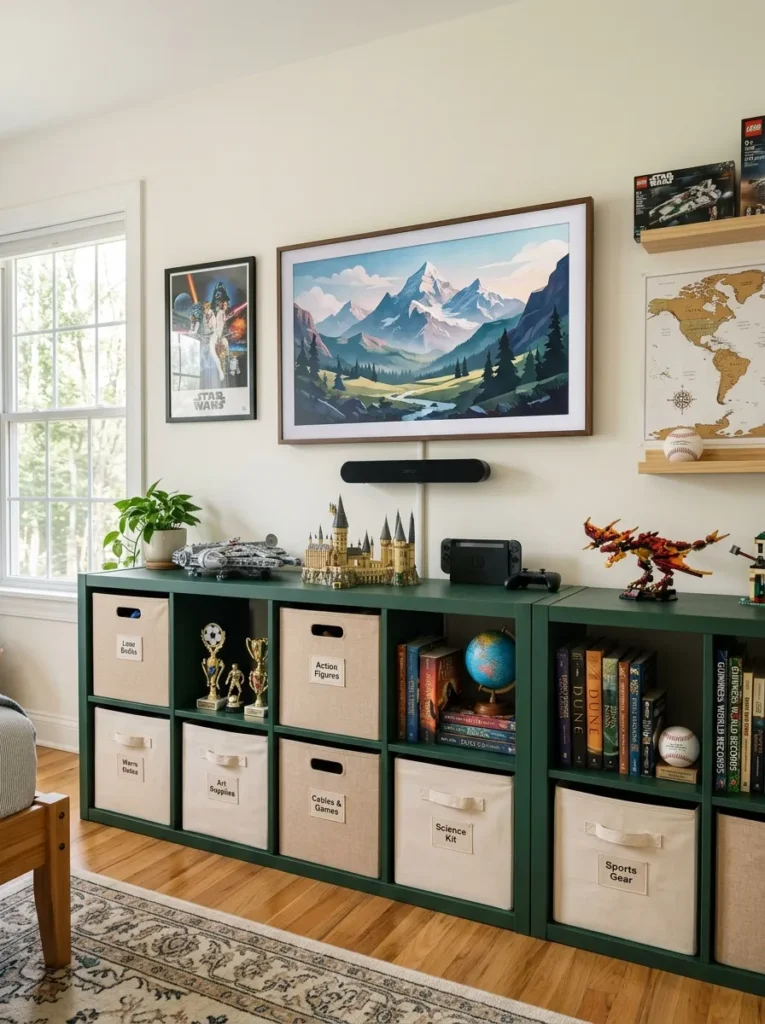
Vibe: The storage wall feels bold and genuinely organized — the green making a functional storage system look like a deliberate design choice.
Why it works: A forest green KALLAX storage wall applies the design principle of functional furniture as room feature — by painting the KALLAX in a strong, room-defining color rather than leaving it in the default white or birch, the storage system becomes the room’s primary design statement rather than a background element. Forest green is particularly appropriate for a big boy bedroom because it references nature, adventure, and sport (all age-appropriate interest categories) while being sophisticated enough to remain appropriate as the child moves into adolescence. The KALLAX format provides the categorical organization that school-age children benefit from — each cubby a category, each bin a container for that category, the face of each open cubby a display opportunity for objects the child wants to see.
How to get it: Paint assembled KALLAX units with Zinsser BIN shellac primer (essential for IKEA’s factory finish to prevent peeling) and two coats of Little Greene Obsidian Green or Farrow & Ball Studio Green No. 93. Fill cubbies with a mix of oat or natural canvas fabric bins (for categories requiring containment — small Lego pieces, sports accessories, charging cables), open display sections (for built Lego models, trophies, and display-worthy objects), and KALLAX drawer inserts (for small-part categories requiring containment). Label fabric bins with a consistent chalk marker label system.
Shop The Look
| Product |
|---|
| Forest green furniture paint chalk 750ml |
| Oat fabric cube bin KALLAX size set |
| KALLAX drawer insert natural wood |
| Chalkboard label set KALLAX bin |
| Wall mount bracket TV KALLAX above |
6. Sports Theme — Framed Jersey Display and Activity Organization
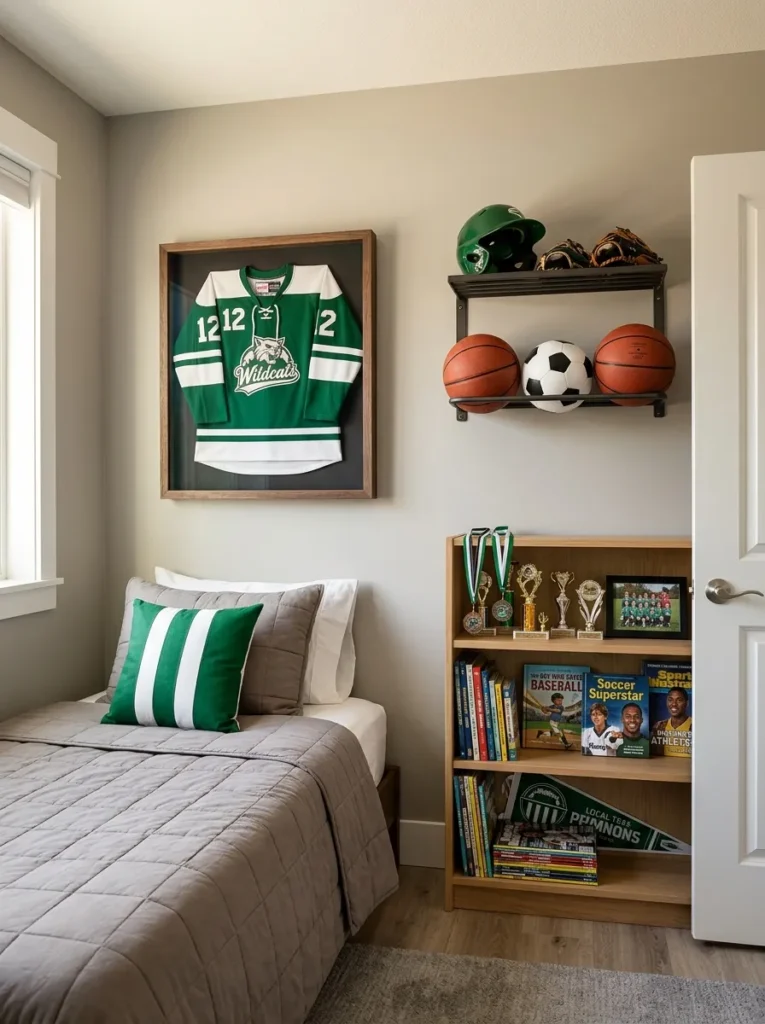
Vibe: The sports-themed room feels genuinely enthusiastic rather than commercially exploited — the child’s real interests honored rather than replaced by generic sports iconography.
Why it works: A sports theme built around the child’s actual team interests rather than generic sports graphics applies the design principle of personal specificity — a framed jersey from a team the child genuinely loves, combined with their actual trophies and their specific sport’s equipment, creates a room that is about this child’s specific sports life rather than about “sports” as a generic decorative category. This specificity is what makes sports-themed rooms genuinely meaningful for children rather than simply themed — the child sees their own experience reflected in the room rather than a commercial version of a generic interest. The wall-mounted equipment organization (ball rack, helmet shelf, bag hooks) is equally functional and decorative, solving the most common child sports storage problem (equipment left on the floor) while contributing to the room’s theme.
How to get it: Mount a shadow box frame (at least 60×90cm) on the room’s primary wall to display a favorite jersey, framed against a backing of the team’s primary color. Install a wall-mounted sports equipment rack beside the door for balls, helmets, and bags — this creates the crucial habit of equipment being stored at the room’s exit/entry point rather than scattered across the floor. Choose the room’s accent color from the child’s team’s palette — one accent color, in bedding and one pillow only, rather than attempting to decorate the entire room in the team’s colors.
Shop The Look
| Product |
|---|
| Sports jersey shadow box frame large |
| Wall-mounted ball rack storage sport |
| Helmet shelf wall mount bracket |
| Sports trophy display shelf set |
| Team color accent pillow cover |
7. Under-Bed Storage System for Maximizing Floor Space
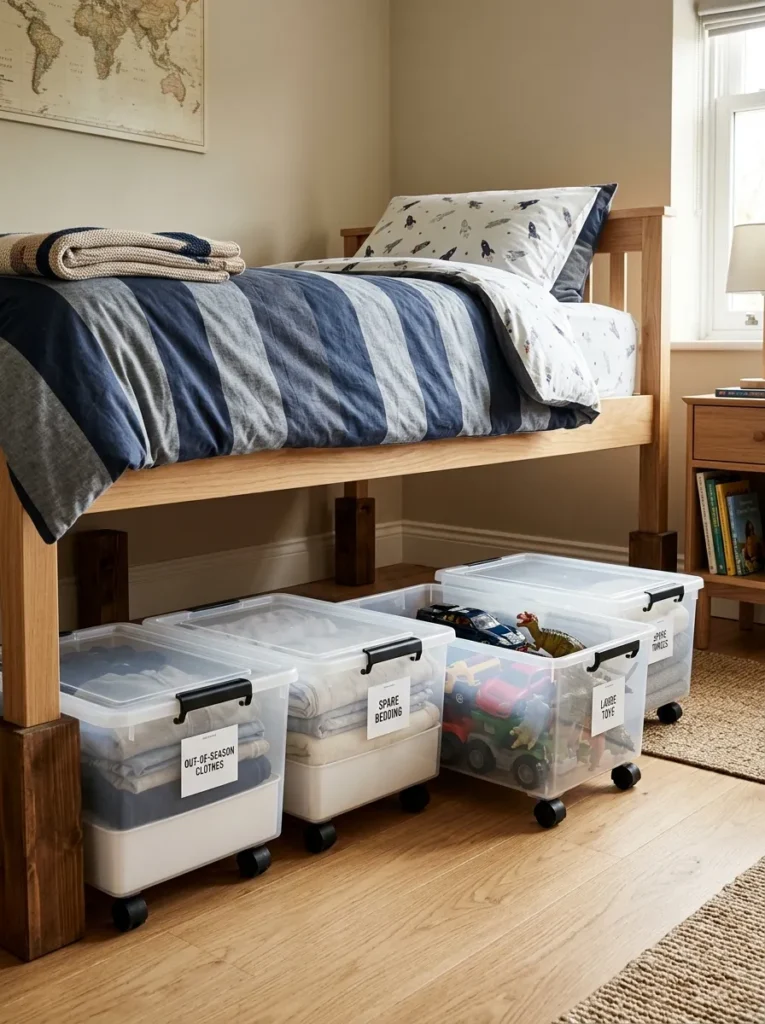
Vibe: The under-bed zone feels genuinely productive — the largest dead space in most children’s rooms finally working as storage.
Why it works: A comprehensive under-bed storage system applies the spatial efficiency principle of dead zone activation — the space beneath a standard single bed (typically 25–40cm clear height) is the most commonly wasted storage volume in a child’s bedroom. With bed risers adding 10–15cm of additional clearance, the under-bed zone can accommodate flat storage boxes with a total capacity equivalent to a medium-sized chest of drawers, without occupying any additional floor space. For seasonal items (out-of-season clothing), spare bedding, large toy sets, and sports equipment, under-bed storage is the correct location because these items are accessed infrequently — the slight effort of rolling out the box is an appropriate friction for low-frequency access while the zero-additional-floor-space cost is appropriate for items that don’t need daily access.
How to get it: Install wooden or plastic bed risers at each bed leg to raise the bed to a total clearance of 30–40cm (standard risers add 10–15cm to existing clearance, and most standard single beds have 20–25cm of natural clearance). Purchase flat under-bed storage boxes with smooth-rolling wheels and full-extension pull-out capability (boxes without rollers slide poorly and are typically unused within weeks). Label each box on its short end (the visible face when the box is pushed under the bed) with the category: WINTER CLOTHES, SPARE BEDDING, BOARD GAMES. Assign one box to each category and maintain the discipline of one box per category without overflow.
Shop The Look
| Product |
|---|
| Wooden bed riser set 4 piece |
| Flat under-bed storage box roller set |
| Under-bed box divider organizer |
| Label maker tape set bedroom |
| Under-bed storage bag zipper breathable |
8. Gallery Wall of Personal Achievements and Interests
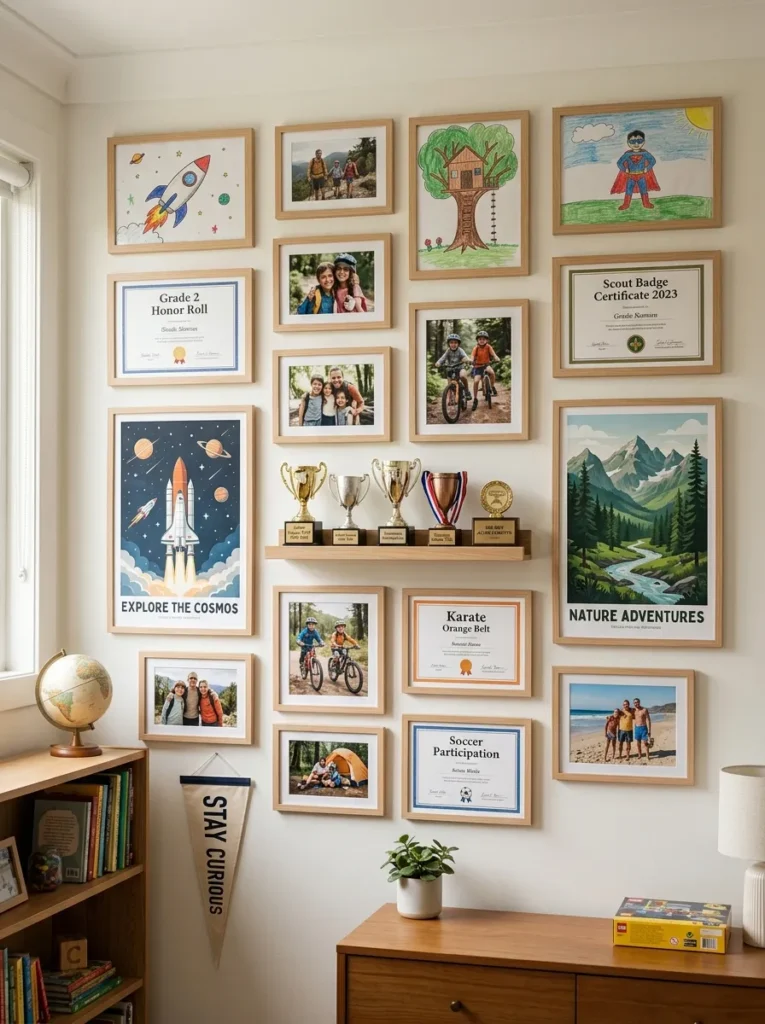
Vibe: The gallery wall feels like a portrait of this specific child — no generic sports print could compete with their own actual achievements and adventures.
Why it works: A personal achievement and interest gallery wall applies the child development principle of environmental self-representation — children who see their own achievements, interests, and relationships reflected in their bedroom environment demonstrate higher self-concept, greater room ownership, and stronger motivation to use the room for both study and creative activity. A gallery wall that includes the child’s own artwork, their sports certificates, photographs of their adventures and friendships, and objects representing their specific interests communicates to the child (and to every visitor to the room) that this is a space designed for them specifically, not a commercial product installed in their room. This specificity is more design-effective than any purchased theme or motif.
How to get it: Begin with a consistent simple frame specification (natural wood or matte black in consistent sizes — 5×7, 8×10, and one 11×14 as an anchor) for every piece in the gallery. Include at minimum: two pieces of the child’s own artwork, two personal photographs (of friends, family events, or adventures), two achievement certificates, and two purchased prints of the child’s genuine interest subjects. Install a small floating shelf (approximately 40cm, natural wood) at the gallery’s center for displaying three-dimensional objects — a small trophy, a meaningful stone from a hike, a small model. Arrange starting from the anchor print and building outward with 3cm gaps between frames.
Shop The Look
| Product |
|---|
| Natural wood simple frame set assorted |
| Small floating shelf natural wood 40cm |
| Certificate frame set A4 natural |
| Photograph print service local |
| Frame hanging strips set damage free |
9. Chalkboard Wall for Creative Expression and Organisation
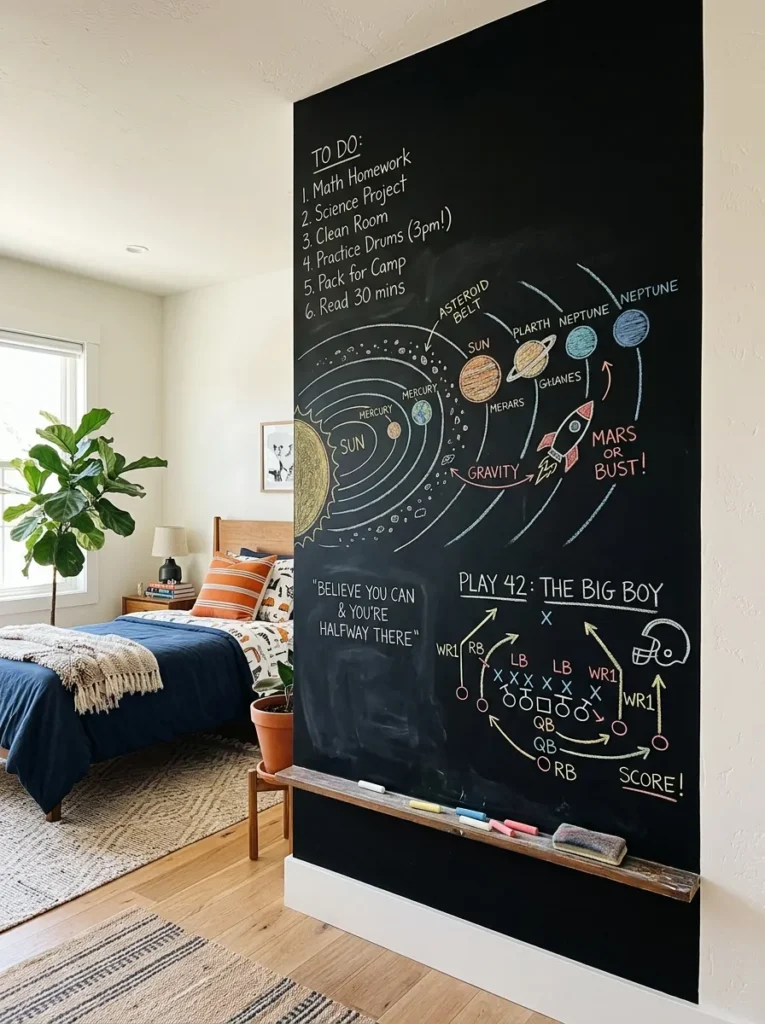
Vibe: The chalkboard wall feels alive with activity — the most honest record of a child’s thinking available on a wall surface.
Why it works: A full chalkboard wall applies the child development principle of provided creative medium — children given a designated, parent-approved surface for drawing, writing, planning, and experimenting are significantly less likely to use unauthorized surfaces (the rest of the wall, furniture) for the same purposes. The chalkboard wall’s specific advantage over a whiteboard or magnetic board is its scale (a full wall of drawing space is genuinely generous) and its material quality (chalk on slate-finish chalkboard paint reads as designed rather than institutional). The functional uses of a chalkboard wall in a school-age child’s bedroom extend beyond creative drawing to include revision timetables, homework planning, sports schedules, and ongoing project notation — making it a functional study support tool as well as a creative outlet.
How to get it: Apply chalkboard paint (Rust-Oleum Chalkboard Paint or equivalent) in two to three coats using a short-nap roller for the smoothest chalk-writing surface — brush marks create an uneven texture that makes writing and erasing less satisfying and reduces the wall’s usability. Season the wall before first use by rubbing the side of a white chalk piece over the entire surface and erasing — this prevents the first use from ghosting permanently. Install a slim ledge shelf (a picture rail or a purpose-made chalk tray) at the wall’s base, 60–80cm from the floor, to hold chalk and an eraser without requiring a separate ledge surface elsewhere in the room.
Shop The Look
| Product |
|---|
| Chalkboard paint black two litre |
| Chalk set colored and white |
| Chalk tray ledge shelf wall mount |
| Chalkboard eraser felt |
| Chalk marker liquid fine tip set |
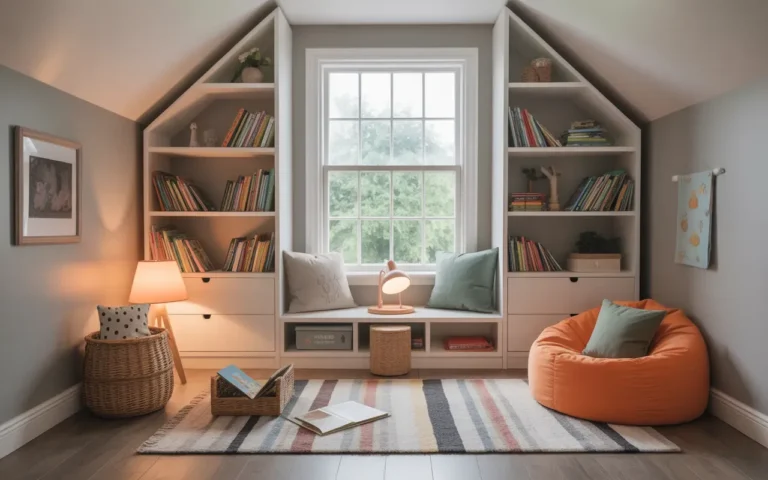
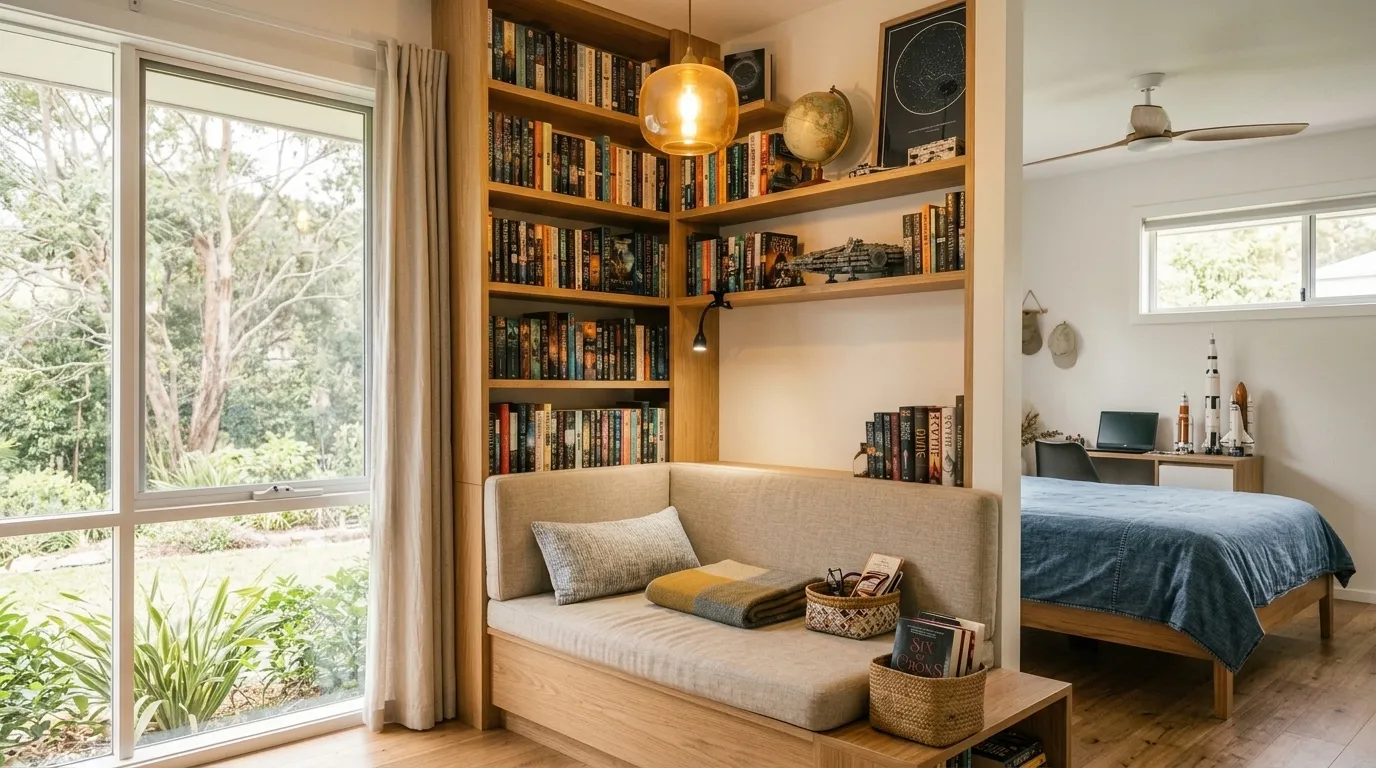
10. Reading Nook with Built-In Bookshelf and Cushioned Seat
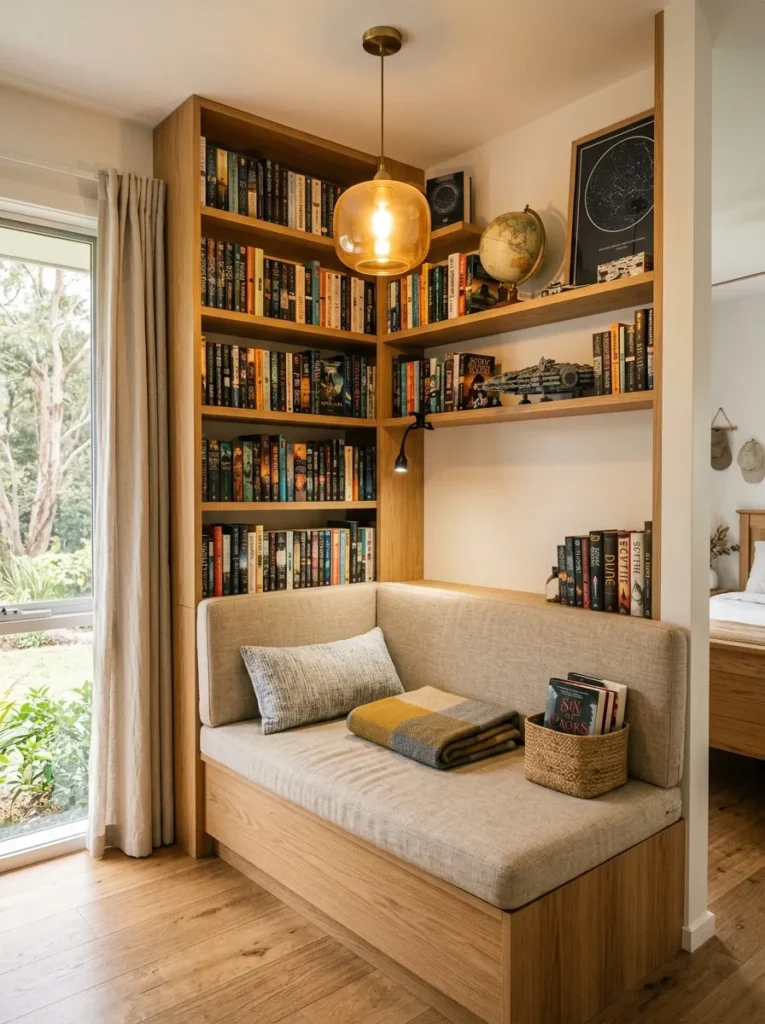
Vibe: The reading nook feels genuinely inviting — a designated space for reading that a child will actually use because it was designed to be used.
Why it works: A built-in reading nook with bookshelves applies the child development principle of prepared literacy environment — children who have a comfortable, designated, well-lit space specifically for reading and surrounded by accessible books develop reading habits more consistently than those for whom reading is a floor-or-bed activity competed with by toys and screens. The nook’s physical enclosure (defined by the bookshelf walls and the bench seat) creates a psychologically distinct zone within the bedroom, signaling to the child’s behavioral system that this space is for a specific activity (reading) in the same way a desk signals study and a bed signals sleep. The pendant light above the nook is the critical lighting element — it creates a pool of warm focused light at exactly the right intensity and position for comfortable reading.
How to get it: Build the bench seat from 18mm MDF on a simple 2×4 timber frame at 45cm height, with a hinged lid for additional storage beneath. Top with a 5cm high-density foam cushion covered in a durable, washable fabric (outdoor-grade cotton canvas or a vinyl-backed fabric for spill resistance). Install floor-to-ceiling open shelving on the walls above and flanking the bench using adjustable shelf brackets — the face-out book display (covers visible rather than spines) at the child’s eye height is particularly important for encouraging book selection. Install a simple pendant or hanging lamp directly above the nook center.
Shop The Look
| Product |
|---|
| Adjustable bookshelf bracket set wall |
| High density foam cushion bench 5cm |
| Washable cushion cover durable fabric |
| Warm pendant light small nook |
| Face-out book display rail shelf |
11. STEM and Science Theme for the Curious Learner
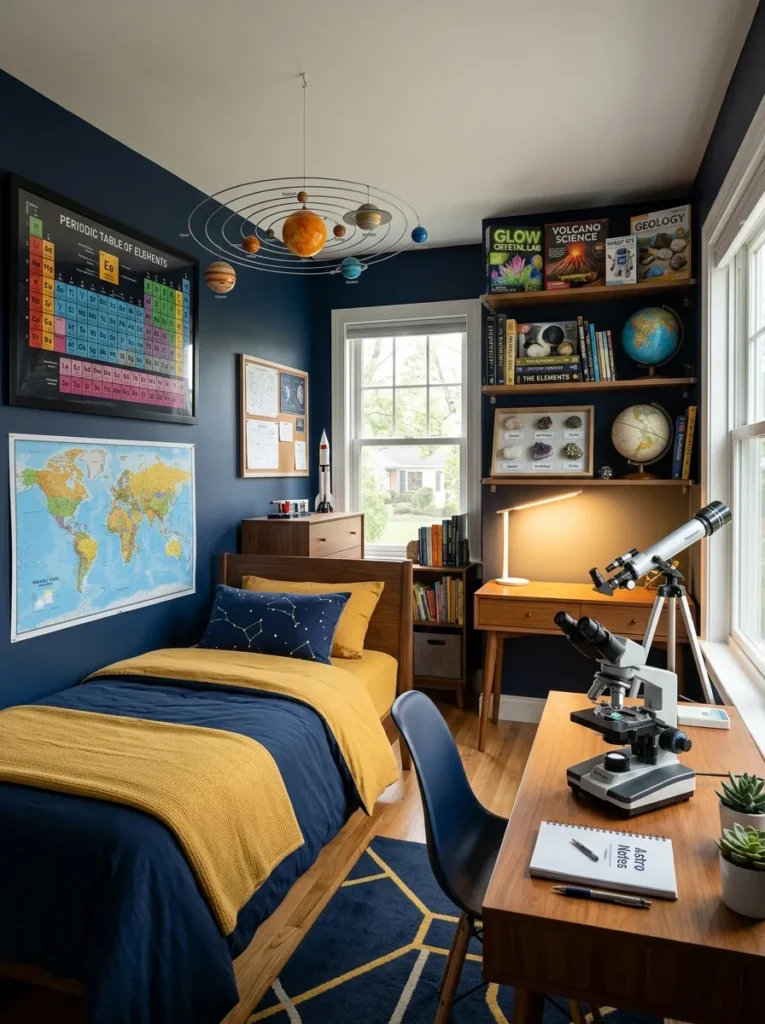
Vibe: The STEM room feels genuinely curious — a bedroom that looks like it might produce a scientist, or at least a very interested person.
Why it works: A STEM and science-themed bedroom applies the environmental learning principle of interest amplification — a room that reflects and honors a child’s intellectual interests in science, technology, and investigation actively supports the development of those interests by making them continuously visible, accessible, and validated. The specific design distinction is that the “STEM theme” is built from real objects (an actual microscope, a genuine rock and mineral collection, working science kits, a functional telescope) rather than graphic representations of those objects (space pattern wallpaper, robot print bedding). Real objects serve both as decoration and as tools, extending the room’s function into active learning rather than decorative theme. This distinction matters significantly for how long the theme remains relevant as the child develops — real science tools don’t become babyish in the way that illustrated science prints can.
How to get it: Begin with the room’s color scheme in deep navy and warm yellow (referencing the classic science text and blackboard educational environment), then equip the room with real learning tools: a children’s microscope ($45–95) as a desk object, a rock and mineral collection starter kit displayed in a small wooden tray, a framed periodic table poster (printed at A1 or A0 scale for maximum impact), and a small solar system mobile from the ceiling above the bed. Dedicate one shelf section to current science project kits and books, rotating as interests develop.
Shop The Look
| Product |
|---|
| Framed periodic table print large |
| Children’s microscope starter kit |
| Rock mineral collection display tray |
| Solar system ceiling mobile children |
| Science experiment kit assorted set |
12. Fold-Down Wall Desk for Small Bedrooms
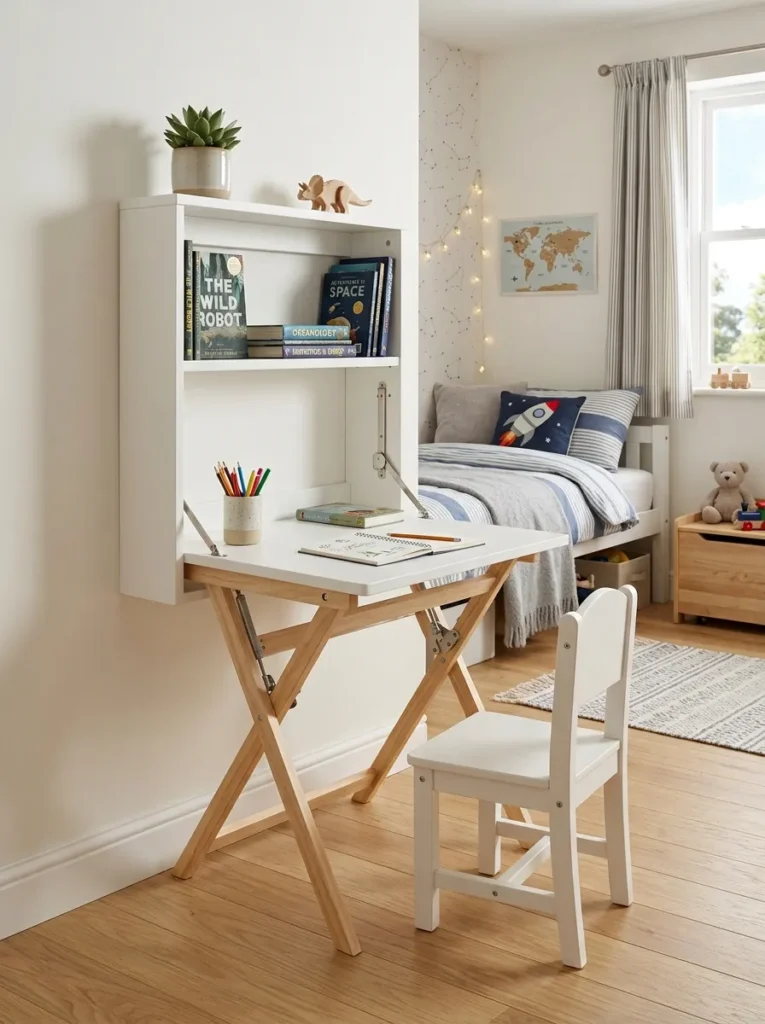
Vibe: The fold-down desk feels like a good solution — the kind of functional intelligence that makes a small room livable rather than compromised.
Why it works: A fold-down wall desk applies the small-room storage principle of temporal zoning — a desk that folds flat against the wall when not in use occupies zero floor space during the hours when floor space is needed for play (the majority of a school-age child’s active hours at home), while providing a fully functional study surface during the homework hours when floor-level play is not happening. This single piece of furniture resolves the most common space conflict in a small boy’s bedroom: the competition between floor space for active play and desk space for study. A fold-down desk at 75cm height is appropriate for children from approximately age 7 through secondary school with the correct chair height adjustment.
How to get it: Source a wall-mounted fold-down desk from a specialist small-space furniture supplier (Ori Living, Resource Furniture, and specialist Scandinavian children’s furniture makers all produce quality fold-down desk options). The desk should be at minimum 80cm wide when open (adequate for homework plus a device) and fold to a maximum depth of 10cm when closed. Mount into wall studs (not drywall anchors — the full weight of the desk plus a child leaning on it must be borne by the wall fixings). Install a small fixed bookshelf immediately above the fold-down desk’s mounting position, which serves as the desk’s display and storage zone whether the desk is open or closed.
Quick Win: A NORBO fold-down desk from IKEA ($55–85) mounted at 75cm on a solid stud-fixed wall bracket provides a complete homework surface that folds to 20cm wall depth — the most budget-accessible fold-down desk solution available and a genuine quality option for a small room.
Shop The Look
| Product |
|---|
| Fold-down wall desk white painted |
| Wall mounting bracket desk heavy duty |
| Compact desk chair adjustable height |
| Small fixed shelf above desk mount |
| Pencil cup ceramic small desk |
13. Warm Gray and Timber Palette for Sophisticated Neutral
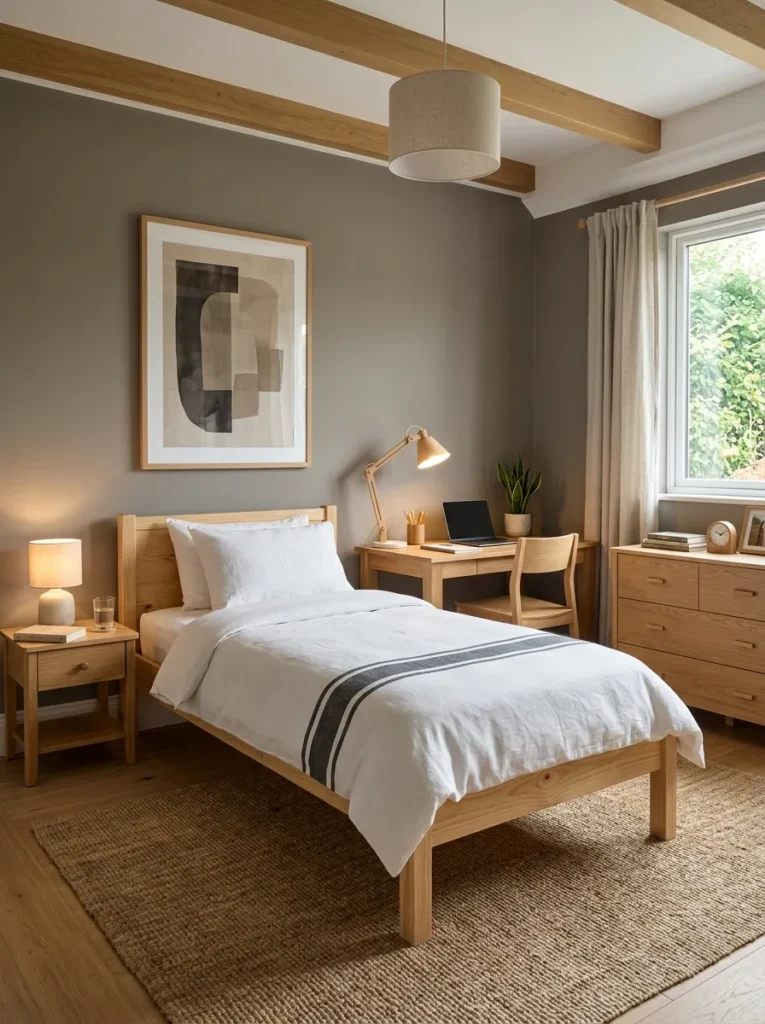
Vibe: The warm gray room feels age-appropriate in both directions — sophisticated enough for a twelve-year-old, warm enough for a six-year-old.
Why it works: A warm gray and natural timber palette applies the design principle of future-proofed neutrality — warm gray (specifically the gray with a brown or warm undertone, often called greige or warm gray, rather than the cool blue-gray that reads as contemporary adult design) combined with natural pine and oak furniture creates a room that reads as genuinely designed for a child’s specific age range while being flexible enough to remain appropriate as the child grows from primary to secondary school age. The palette’s neutrality also allows the room’s themed elements (sports accents, science objects, map prints, achievement galleries) to be updated as the child’s interests change without requiring the entire room to be repainted or refurnished.
How to get it: Select a warm gray with a clear warm (yellow-brown) undertone — Benjamin Moore Revere Pewter HC-172, Farrow & Ball Elephant’s Breath No. 229, or Dulux’s Warm Stone are all appropriate warm grays for a child’s bedroom. The gray should read as warm from across the room, not cool or blue. Pair with natural solid pine or oak furniture (IKEA’s HEMNES range in white stain or natural pine is a cost-appropriate option) and white linen bedding with a single solid-color stripe accent in the room’s dark gray or navy family.
Shop The Look
| Product |
|---|
| Warm gray bedroom paint eggshell |
| Natural pine bedroom furniture HEMNES |
| White stripe single duvet cover set |
| Natural fiber floor rug honey |
| Abstract framed print warm charcoal |
14. Custom Name or Initial Wall Feature for Personal Identity
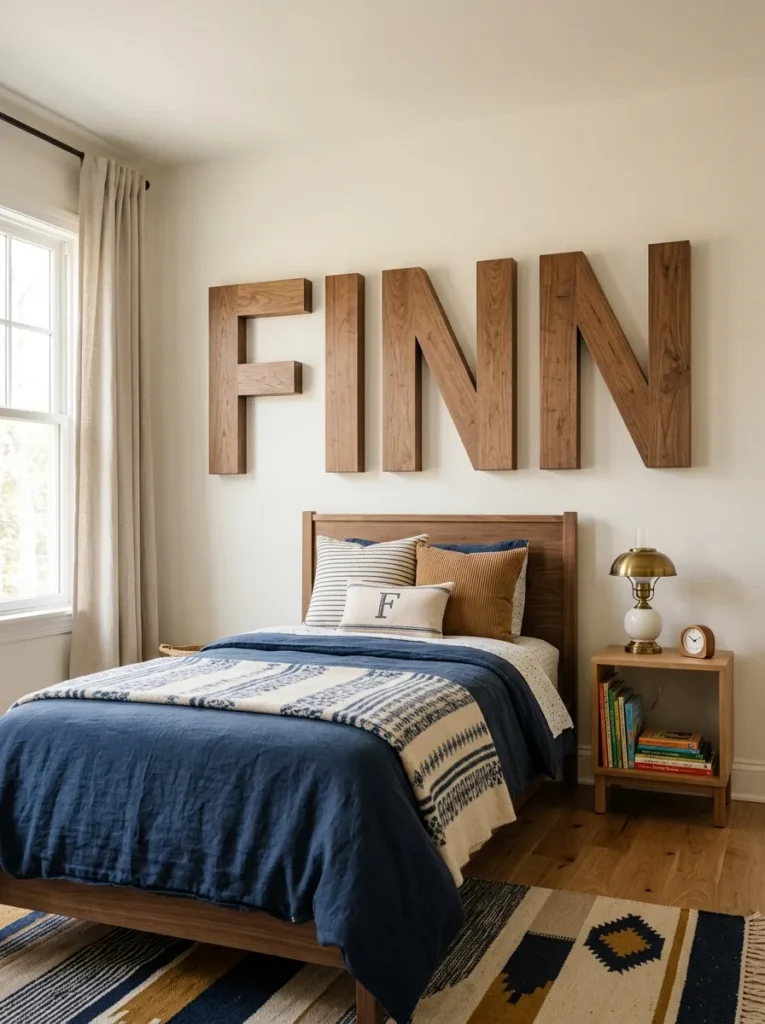
Vibe: The name feature feels unmistakably personal — the most direct possible statement that this room belongs to one specific child.
Why it works: A large-scale personal name or initial feature above the bed applies the child development principle of identity affirmation through environment — a child who sees their own name as the room’s primary design element experiences an immediate and powerful message that this space is specifically theirs, which is associated in research with greater room ownership, better self-regulation (treating their own things with more care), and a stronger sense of personal identity. The scale of the letters is the critical design decision: letters that span 60–80% of the wall width read as architectural typographic elements rather than small decorative objects — they have the visual authority of signage rather than the tentative quality of name-plate-sized lettering.
How to get it: Source large wooden letters in the desired font (serif fonts read as warmer and more traditional; bold sans-serif fonts read as more contemporary and graphic) from a specialist wooden letter maker or laser-cut supplier — the letters should be minimum 30cm tall for adequate wall impact. Mount directly to the wall using appropriate fixings for the letter weight (heavy wooden letters may require wall anchors into studs). Alternatively, specify metal letters cut from 3mm sheet steel in a matte powder-coat finish — these are lighter, stronger, and maintain their finish longer than painted MDF alternatives.
Shop The Look
| Product |
|---|
| Large wooden letter set natural 30cm |
| Matte black metal letter set 30cm |
| Wall anchor fixing set heavy |
| Letter spacing template craft |
| Warm white paint touch-up small pot |
15. Transition-Ready Room Design — Flexible for Ages 5 to 12
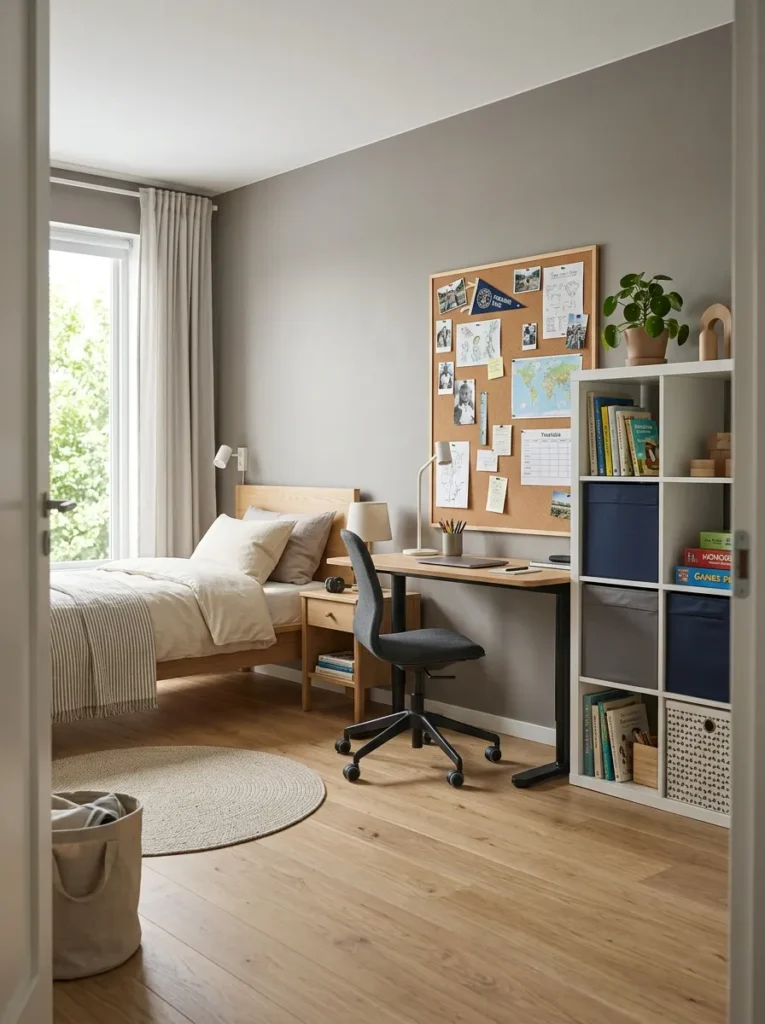
Vibe: The room feels ready for anything — a space that will serve the child through five different phases of interest without requiring a single tin of paint.
Why it works: A transition-ready bedroom design applies the long-range planning principle of built-in flexibility — by separating the room’s permanent, structural elements (wall color, bed, core storage) from its changeable, personalizable elements (pinboard content, bin colors, display objects, desk accessories), the room can absorb dramatic changes in the child’s interests and developmental stage without requiring physical renovation. The cork pinboard above the desk is the central mechanism of this flexibility — it is the room’s “personality layer,” updated continuously with whatever the child is currently interested in (sports fixtures, science diagrams, friendship photos, artwork, schedules) without any paint, adhesive, or wall modification. Every few months, the pinboard refreshes completely, and the room feels genuinely new without anything permanent changing.
How to get it: Specify all structural room elements in the most neutral versions available: warm gray walls (repaints to any bold color later), a simple solid oak single bed (no theme specificity), a white or gray KALLAX with fabric bins (bins are $6.99 each and immediately replaceable). The desk zone requires only an adjustable-height chair and a large cork pinboard (minimum A0 size, 84×119cm) mounted above the desk surface. Store spare fabric bins in a different color in a box — as the child’s interests shift, a complete color change of the KALLAX bins refreshes the room in minutes for under $60.
Shop The Look
| Product |
|---|
| Large cork pinboard A0 84x119cm |
| Adjustable height desk chair child |
| KALLAX unit white 2×4 |
| Fabric bin KALLAX replaceable set |
| Warm gray bedroom wall paint eggshell |
How to Start Your Big Boy Bedroom Transformation
The single best first move in any big boy bedroom transformation is asking the child one specific question: if you could change one thing about your bedroom right now, what would it be? The answer — which is almost always about a specific missing function (a place to build Lego, somewhere for a friend to sleep, a proper desk for homework) rather than a decorative preference — tells the designer (the parent) which of the 15 ideas in this list to prioritize first. Designing from the child’s stated functional need rather than from an adult’s aesthetic preference produces a room the child genuinely uses and values, rather than one the parent finds satisfying to photograph. The child’s enthusiasm for their bedroom is the metric that matters most.
The most common mistake in big boy bedroom design is planning a room around the child’s current interest in a specific licensed character or media property rather than their broader and more durable interests (sport, science, adventure, music, gaming). A bedroom themed around a specific film franchise or television show is typically outgrown within 12–24 months, requiring a complete redecoration investment at significant cost and the child’s temporary embarrassment. The fix is to identify the underlying interest category rather than the current specific expression of it: a child passionate about Minecraft is interested in construction, creativity, and world-building — themes that can be honored through design (map walls, building storage, maker-space desk) without using a single piece of licensed Minecraft merchandise.
Three specific items under $50 that immediately improve any existing boy’s bedroom: a large cork pinboard (A0 size, approximately $25–35) mounted above the desk for the child’s own content curation; a clip-on warm LED reading light ($15–22) at the bedside that finally makes pre-sleep reading comfortable; and a set of matching fabric storage bins in a single color ($6.99 each, four for $28) that replace mismatched storage containers and immediately make the room’s storage system read as organized and considered.
A surface refresh — new bedding, a painted accent wall, a pinboard, and matching storage bins — is achievable over a single weekend for $80–200 and produces a dramatically different room without touching the furniture. A mid-range transformation — loft bed or bunk bed, new storage wall, reading nook, and complete lighting update — runs $800–2,500 depending on furniture quality. A full bedroom renovation — new flooring, custom wardrobe, built-in reading nook, desk zone with full shelving, and new lighting — represents a $3,000–8,000 investment for a standard second bedroom. The pinboard, the reading light, and the matching bins are achievable this weekend; the loft bed and reading nook follow as budget and scheduling allow.
Frequently Asked Questions About Big Boy Bedroom Ideas
At what age should a child’s room transition from a toddler room to a big boy bedroom?
The developmental transition from toddler room to big boy bedroom typically happens between ages four and six, when the child begins primary school and the room’s requirements shift dramatically: the child now needs a desk zone for homework, storage systems they can operate independently, a study-appropriate lighting setup, and (usually) their first request to have a friend sleep over. The visual transition (removing toddler-specific decor, adding age-appropriate wall art and themes) can happen simultaneously or in stages — there is no single right moment, and many children benefit from being actively involved in the transition as a milestone event that marks their developmental progress.
How do you design a bedroom that works for siblings of different ages sharing a room?
A shared bedroom for siblings at different developmental stages requires the bunk bed configuration (providing each child with their own sleeping level and ideally their own reading light and side storage), separate study zones (if floor space allows, two desk zones side by side; if not, a shared desk with a temporal use agreement), and a storage system that has clearly physically separate sections for each child’s belongings. The color and theme decisions are the most difficult aspect of sibling room sharing — the most successful approach is a shared base palette (warm gray or warm white walls, natural timber furniture) with each child having their own clearly defined section of the wall or pinboard for personal content, rather than attempting to find a theme both children equally agree on.
What storage is most important for a school-age boy’s bedroom?
The three storage types most important for a school-age boy’s bedroom are: a categorized bin or cubby system (for toys, sports equipment, and active play accessories — categories that benefit from contained, labeled storage that the child can manage independently), a desk zone with specific storage for school supplies (homework materials, stationery, and current schoolwork in progress — storage that is specifically academic rather than play), and a clothes storage system at the child’s reachable height with clear organization (a wardrobe with the hanging section at child height, rather than adult height, and a drawer system the child can operate without assistance). The most common storage failure in children’s bedrooms is systems that require adult assistance to access or return items — any storage that is too high, too heavy, or too complicated for the child to use independently will simply not be used.
How do you choose a theme for a boy’s bedroom that won’t be outgrown quickly?
The themes with the longest design lifespan in a boy’s bedroom are those built around broad interest categories rather than specific licensed characters or media properties. Adventure and exploration (geography, travel, the natural world), STEM and science (space, biology, technology), sport (the child’s actual sport, not a generic sports graphic), and making/building (construction, model-making, LEGO, engineering) are all interest categories that develop and deepen through the full primary and secondary school years rather than being outgrown with the current media cycle. Implementing these themes through real objects (actual maps, working scientific instruments, genuine sports equipment, real construction toys) rather than through graphic prints and licensed merchandise extends the theme’s relevance and avoids the replacement cost cycle that character-licensed themes create.
What lighting setup works best for a boy’s bedroom to support both sleep and study?
A big boy bedroom requires three distinct lighting zones operating on separate circuits: bright white task lighting at the desk (minimum 400 lux at desk surface level, 3000–4000K color temperature, specifically directed at the work surface with no glare — a quality adjustable LED desk lamp achieves this), warm ambient lighting for evening and pre-sleep hours (a single warm pendant or bedside lamp at 2700K, on a dimmer switch, providing enough light for general room use without the sleep-disrupting blue light that higher color temperatures produce), and personal reading light at the bedside (a clip-on or wall-mounted directional warm LED that provides sufficient reading illumination without lighting the full room — 2700K at approximately 150–200 lux at book level). These three zones should never be on the same circuit — the ability to use desk task lighting without activating warm ambient lighting, and vice versa, is the operational distinction that makes a bedroom’s lighting functional across all the activities it must support.
Ready to Design Your Dream Big Boy Bedroom?
These 15 ideas move through every dimension of what makes a big boy bedroom genuinely work for a growing child — from the spatial intelligence of loft beds and fold-down desks that make small rooms genuinely functional, to the identity affirmation of personal gallery walls and name features that make children feel their room truly belongs to them, to the long-range design wisdom of transition-ready neutrals and interest-based themes that remain relevant as children grow and change. Starting with the conversation — asking the child what one thing they want their room to do — is not a small beginning. It is the beginning that makes everything else in the list purposeful, because a room designed around a child’s stated need is one they will actually use, value, and return to. Order the cork pinboard this week, install the reading light this weekend, and let the child fill the pinboard with whatever matters to them right now. The rest of the room can follow in the sequence that makes sense for your family’s budget and timing. Pin the ideas that made the child in your life lean forward while reading, and return to the loft bed and reading nook plans when the budget and the weekend align. When the room is right, a child doesn’t just sleep there — they retreat there, create there, and grow there, and the room grows with them.