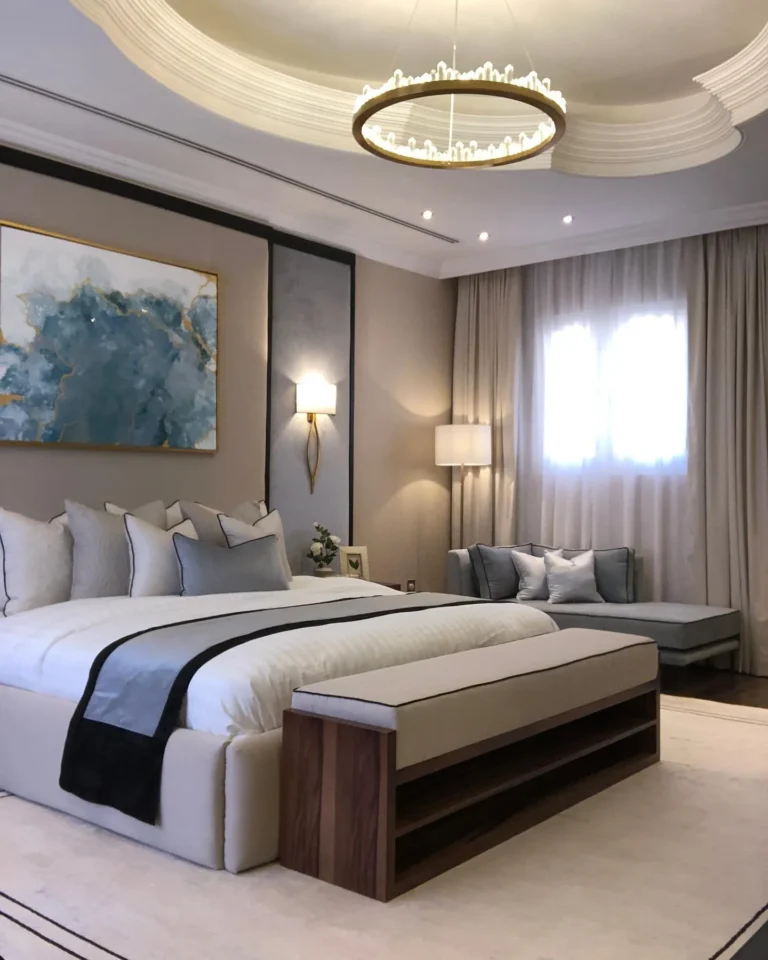
16 Luxurious Master Bedroom Ideas with Spa Vibes
A spa-vibe master bedroom is a sleep and retreat environment designed around the same sensory principles that define great hotel and day spa spaces — layered natural materials, warm light at controllable intensities, tactile textiles that reward touch, a palette of deep neutrals and earthy tones, and a deliberate reduction of visual clutter that allows the nervous system to genuinely rest. This article gives you 16 genuinely creative, buildable luxurious master bedroom ideas that transform a standard sleeping room into a private retreat that feels qualitatively different from every other room in the house.
The bedroom is the room most people spend the most time in and the room most people invest in last. The homes in this list reverse that priority — they treat the master bedroom as the most important design project in the house, the space that most directly affects daily quality of life through the quality of sleep and the quality of waking up. Here are 16 ideas worth saving — and building.
Why Spa-Vibe Master Bedroom Design Works So Well
The spa-vibe bedroom aesthetic draws from three distinct design traditions that have converged in contemporary residential interior design. The first is the Japanese ryokan tradition — the minimalist timber, washi paper, and natural textile environment of the traditional Japanese inn, which prioritizes material authenticity, controlled natural light, and the elimination of decorative excess in favor of spatial generosity. The second is the Scandinavian hygge interior philosophy, which centers warmth, layered textiles, warm low light, and the psychological safety of an enclosed, beautifully made domestic space. The third is the contemporary luxury hotel design movement — the aesthetic of designers including André Fu, Yabu Pushelberg, and Ilse Crawford, who consistently center natural materials, bespoke joinery, and considered lighting in their hotel room designs. The spa-vibe master bedroom synthesizes all three: the material honesty of Japanese design, the warmth of Scandinavian textiles, and the considered luxury of the best hotel room you have ever slept in.
The materials that define a spa-vibe master bedroom are specific and non-negotiable. Linen — in warm white, oatmeal, and natural — is the bedding fabric that most reliably delivers the tactile quality that the aesthetic requires: it is simultaneously cool to the touch in summer, warm in winter, and develops a softness through washing that no synthetic fabric can replicate. Natural stone — honed marble, travertine, or limestone — for bedside surfaces, bathroom thresholds, and feature details introduces the coolness and materiality weight that distinguishes a spa-quality space from a merely comfortable one. Unfinished white oak, smoked ash, and warm walnut for joinery and furniture provide the warm, natural wood tones that are the material backbone of every spa environment. Boucle, mohair, and cashmere for cushions, throws, and occasional chairs add the layered tactile complexity that makes a bedroom genuinely sensory-rich.
The trend reflects a cultural shift in how homeowners conceptualize the bedroom’s purpose. The pandemic made explicit what design researchers had long documented: the bedroom is not only a sleeping room but a retreat, a restorative environment, and increasingly a workspace, exercise space, and media room that must simultaneously serve multiple purposes without any of them compromising the primary sleep function. The spa-vibe bedroom design response to this complexity is deliberate simplicity — a room stripped of unnecessary objects, equipped with furniture and textiles of genuine quality, and lit with the precision that allows it to transition from a functional morning space to a deeply restful evening retreat. Houzz’s 2024 Bedroom Trends Report found that 67% of renovating homeowners cited “creating a calming retreat” as their primary bedroom renovation goal, up from 41% in 2019.
Small master bedrooms can achieve the full spa-vibe aesthetic at any scale — in fact, the constrained dimensions of a compact bedroom often produce a more intimate, cocoon-like quality than a large bedroom can achieve without deliberate design effort to counteract the emptiness that excessive floor area creates in a bedroom context. The key principle for small spa bedrooms is material quality over quantity: two exceptional pieces of furniture, one genuinely beautiful bedding set, one layer of excellent lighting, and a considered palette deliver the spa experience far more reliably than a large room furnished with average-quality pieces at greater quantity.
Style at a Glance
| Element | Detail |
|---|---|
| Philosophy | The master bedroom is the most important room in the house — designed with the material quality and sensory precision of the best hotel room you have ever slept in |
| Key Materials | Linen bedding, honed marble, unfinished white oak, smoked ash, boucle, mohair, cashmere, natural travertine, warm walnut |
| Color Palette | Warm white, oatmeal, soft greige, warm charcoal, deep sage, dusty blush, aged brass, warm walnut |
16 Luxurious Master Bedroom Ideas
1. Linen Bedding Layer System with European Pillowcases
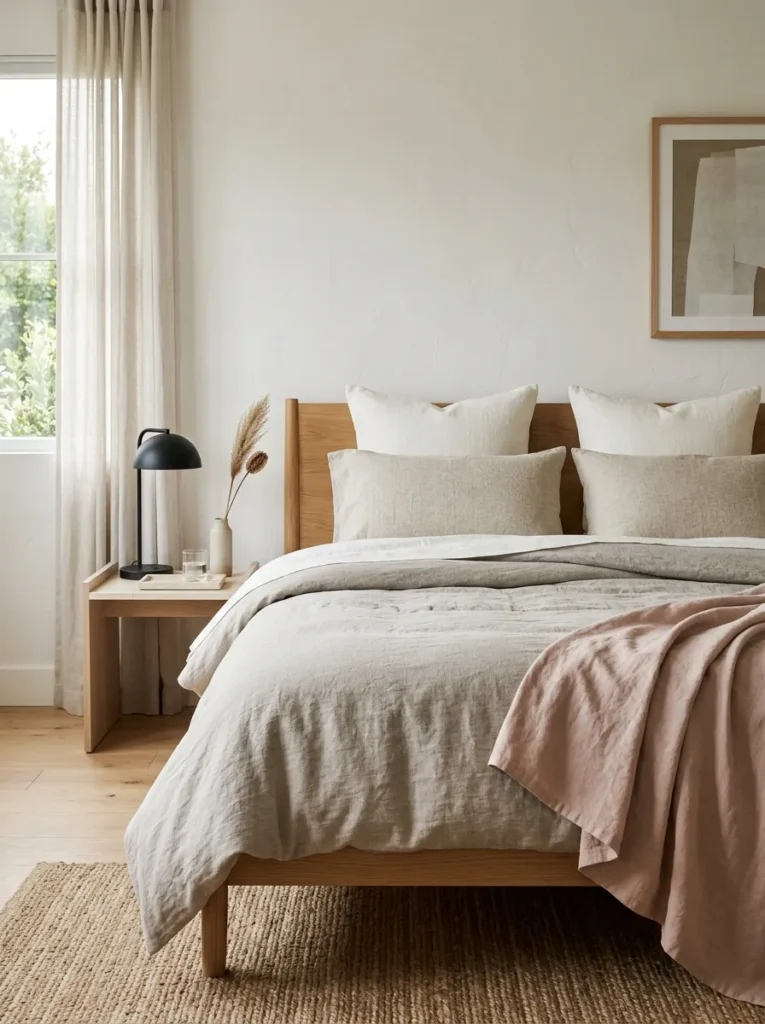
Vibe: Serene and textural — the bed that makes you want to get back into it the moment you leave it.
Why it works: The European pillowcase layer system is the single bedding arrangement that most reliably creates the visual depth and hotel-quality presentation that defines a spa-vibe master bedroom because it adds a third dimension to the bed’s headboard zone — the large square European pillows behind the standard sleeping pillows create a visual backdrop that makes the bed read as architecturally considered rather than simply made. The linen fabric choice compounds this effect: linen’s characteristic slight wrinkle and soft texture creates the lived-in luxury quality that photography-perfect smooth cotton cannot achieve because it looks inhabited and comfortable rather than staged and untouchable. The tonal layering system — warm white fitted sheet, soft greige duvet, dusty blush folded blanket at the foot — introduces color graduation that reads as styled rather than assembled, moving from the lightest tone at the sheets to a slightly deeper duvet to a distinctly warm accent at the foot.
How to get it: Source all bedding from a single linen supplier to guarantee fabric weight and weave consistency across the layer system — mixing linen from different suppliers produces visible variations in weave density and color temperature that undermine the tonal coherence the system relies on. Cultiver, Bed Threads, and Libeco are the three suppliers with the most consistent tonal systems across their linen ranges. Wash linen bedding before first use and tumble dry on low — pre-washed linen has the softness and slight relaxed texture that makes the layer system look inhabited rather than brand new.
Quick Win: Adding two European square pillowcases ($40–80 per pair) in the same linen tone as existing standard pillowcases — placed behind the standard pillows against the headboard — creates the full visual depth of the hotel pillow system with no other changes to the existing bedding.
Shop the Look
| Product |
|---|
| Linen European pillowcase pair warm white |
| Linen duvet cover soft greige king |
| Linen fitted sheet warm white |
| Linen blanket dusty blush throw |
| Travertine bedside tray small |
Also view: 15 Creative Big Boy Bedroom Ideas for Growing Kids
2. Limewash Plaster Accent Wall Behind the Bed
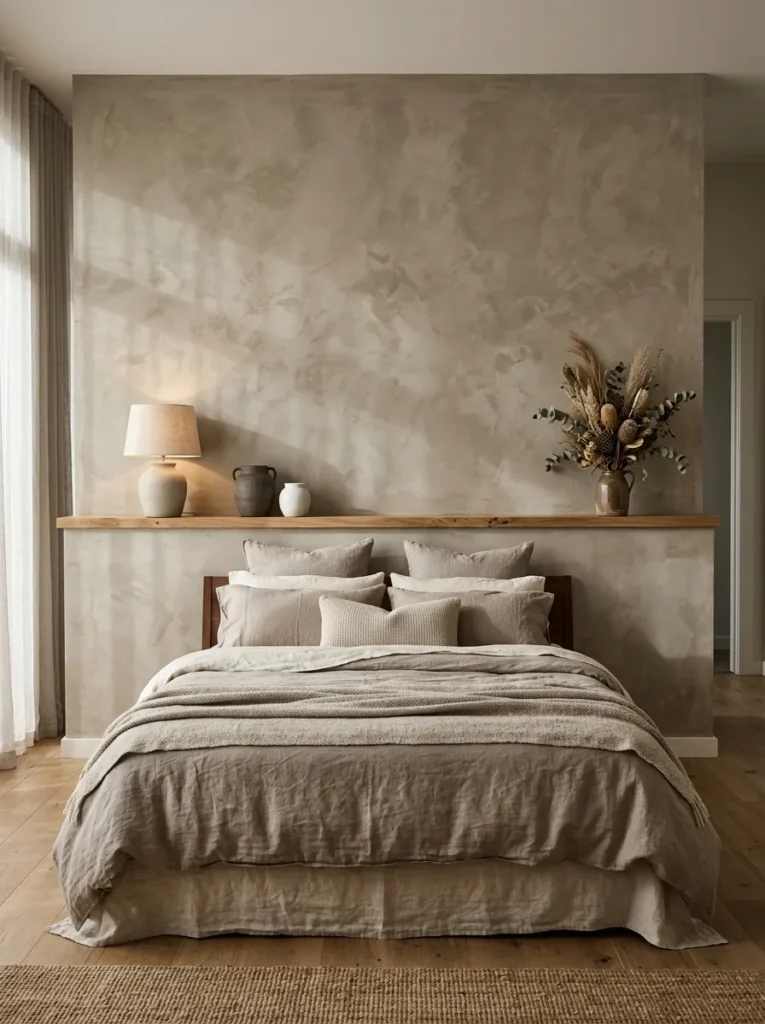
Vibe: Warm and textural — a wall that makes the whole room feel like it was designed by someone who has stayed in too many beautiful hotels and decided to bring one home.
Why it works: Limewash plaster is the wall finish that most powerfully creates the spa and boutique hotel atmosphere in a residential master bedroom because its characteristic surface — a translucent, multi-layered calcium carbonate finish that appears to have depth rather than opacity — has the same warm, ancient quality as the stone and plaster walls of Moroccan riads, Italian farmhouses, and Aegean island hotels that define the aspirational spa-travel aesthetic. The finish is simultaneously unpredictable (no two sections of the wall look exactly alike because the brush texture varies with each application stroke) and cohesive (the monochrome palette means variation reads as depth rather than inconsistency). The floating bedhead shelf at 600mm height is the functional detail that activates the limewash wall: it creates a horizontal element that relates the vertical wall to the bed below, providing a surface for the bedside objects that would otherwise sit on a table beside the bed.
How to get it: Apply limewash in two or three translucent layers rather than a single opaque coat — the depth and variation that defines the finish is produced by layering, and a single heavy coat reads as textured paint rather than genuine limewash. Romabio, Portola Paints, and Bauwerk all produce ready-mixed limewash products in residential-appropriate tones. Apply with a wide natural bristle brush in crossing directions — the crossing brush marks are the specific texture that distinguishes limewash from other textured wall finishes.
Shop the Look
| Product |
|---|
| Limewash paint warm greige |
| Natural bristle wide brush limewash |
| Floating timber bedhead shelf |
| Matte ceramic table lamp |
| Dried botanical arrangement tall |
Also view: 19 Minimal White Bedroom Ideas for a Calm Retreat
3. Boucle Upholstered Bedhead with Integrated Lighting
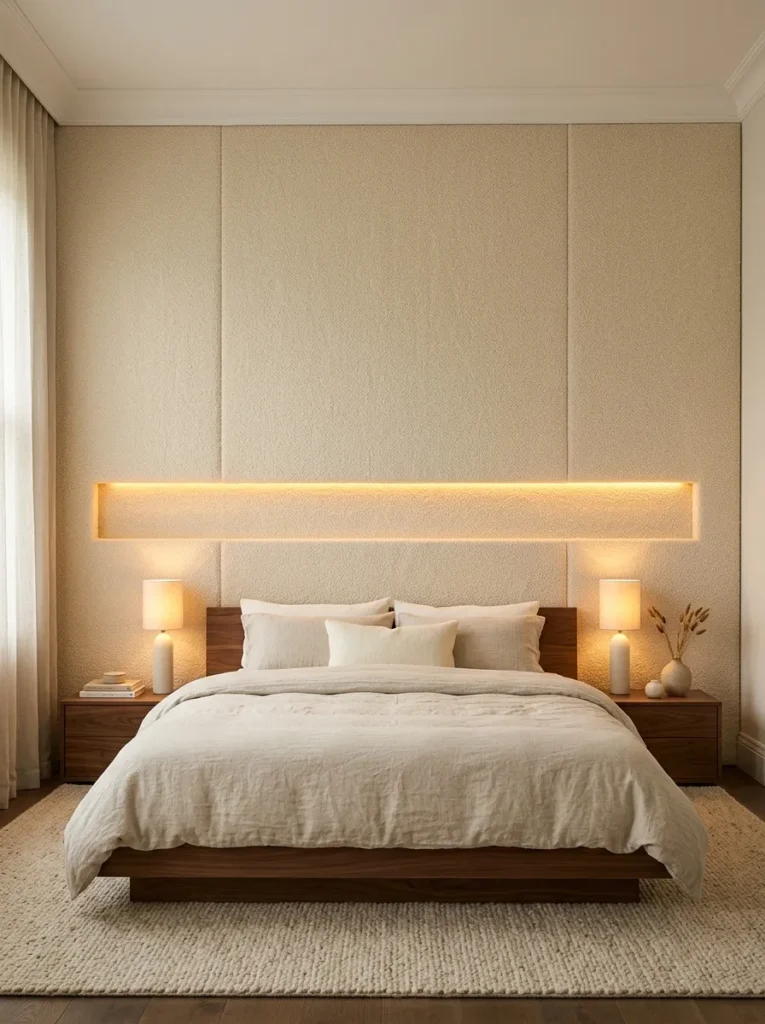
Vibe: Warm and cocoon-like — a bedhead that makes the entire wall feel like an embrace.
Why it works: The floor-to-ceiling boucle upholstered bedhead panel is the master bedroom design element that most dramatically transforms the spatial quality of the room at the highest sensory impact per square meter — it converts the bed wall from a painted flat plane into a soft, textured, acoustically absorbing surface that changes the room’s character at a physical level. Boucle upholstery on a large panel reduces reverberation time in the room, which is the acoustic quality that makes a space feel quieter and more intimate than its actual dimensions suggest. The integrated LED lighting recessed at mid-panel height is the detail that elevates the upholstered bedhead from a standard furniture element to a designed lighting feature: the warm amber glow raking across the boucle loops from a concealed channel produces a shadow pattern in the textile that makes the texture three-dimensional and deeply warm, creating the exact quality of light that spa environments seek through candles, diffused wall sconces, and backlit panels.
How to get it: Build the bedhead panel from a 75mm deep timber frame, padded with 50mm high-density foam and 25mm Dacron wadding before covering in boucle fabric — the layered padding produces the slight give and depth of surface that distinguishes a genuinely upholstered panel from a flat fabric-covered board. Rout the LED channel at 900mm height from the floor (the mid-panel position on a 1800mm high panel) as a 25mm wide × 25mm deep recess, and fit an aluminum LED extrusion with diffuser cover for a linear, even glow rather than visible individual LED dots.
Shop the Look
| Product |
|---|
| Boucle fabric ivory upholstery |
| High density foam sheet 50mm |
| LED extrusion with diffuser channel |
| Warm white LED strip 2200K |
| Low profile platform bed walnut |
4. Japanese Soaking Tub Positioned in the Bedroom Zone
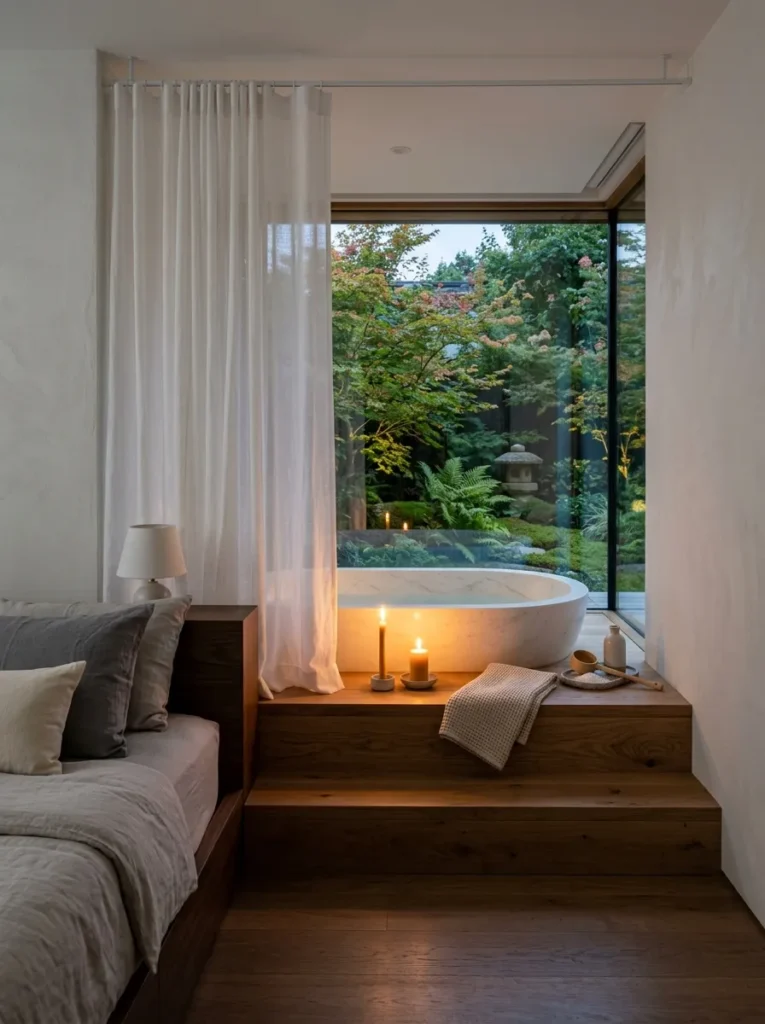
Vibe: Deeply serene and indulgent — the bedroom feature that redefines what “going to bed” means.
Why it works: Positioning a Japanese soaking tub within the master bedroom — separated from the bedroom proper by a sheer linen curtain rather than a solid bathroom wall — is the design move that most completely transforms the bedroom from a sleeping room into a private retreat experience. The Japanese soaking tub (ofuro) tradition is specifically relevant here: the ofuro is designed for contemplative soaking rather than utilitarian bathing, and its depth (typically 600–700mm, allowing shoulder-level immersion) and compact footprint (typically 800mm × 800mm) make it proportionally appropriate within a bedroom alcove in a way that a full-size Western bathtub is not. The sheer linen curtain provides psychological separation between sleeping and bathing zones without the visual weight of a wall, maintaining the spatial generosity of the combined room while allowing each zone to read as distinct.
How to get it: The soaking tub requires a waterproof wet zone constructed on the timber platform — a recessed tile or stone liner within the platform base, properly waterproofed and drained, prevents moisture damage to the surrounding bedroom floor. Consult a licensed plumber for the drainage and hot water supply installation, and a structural engineer if the platform is to be positioned away from an existing wet wall. The platform height of 200–300mm raises the tub rim to a comfortable seated-edge height that makes the tub visually present from the bed without dominating the room.
Shop the Look
| Product |
|---|
| Japanese soaking tub stone composite |
| Sheer linen curtain panel floor length |
| Ceiling mounted curtain rod |
| Beeswax candle set unscented |
| Stone bath salt tray |
5. Concealed Storage Joinery Wall with No Visible Hardware
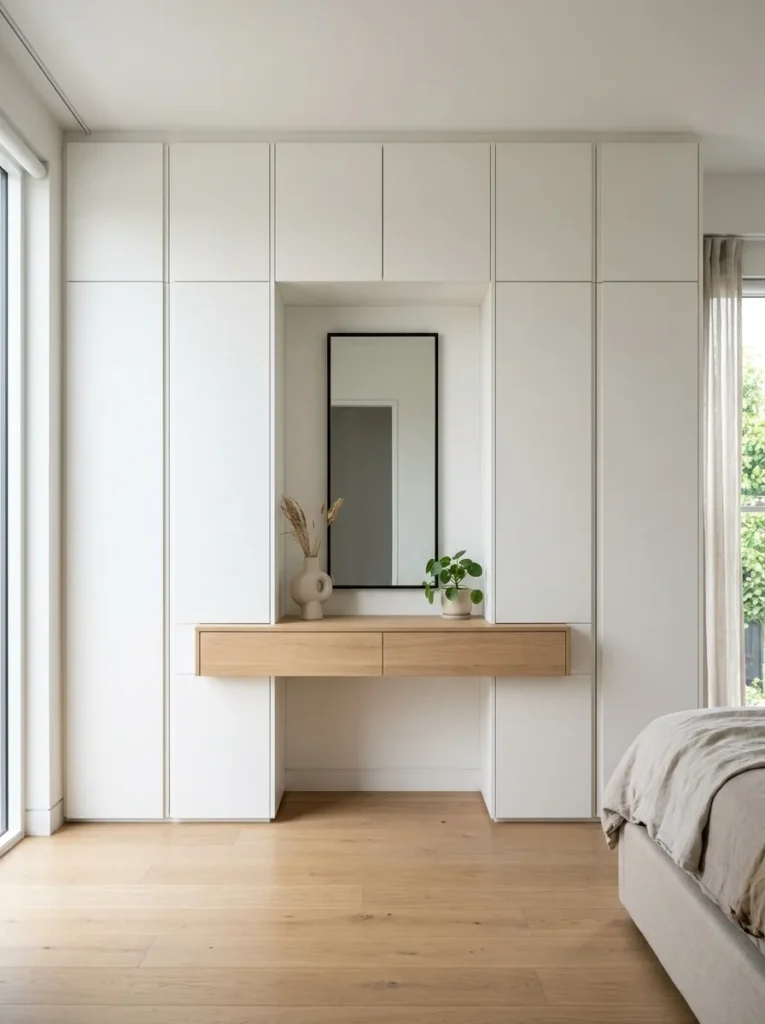
Vibe: Clean and resolved — a bedroom wall that looks like a design decision rather than a storage solution.
Why it works: Concealed storage joinery with no visible hardware is the master bedroom design intervention that most powerfully creates the spa-quality visual calm that defines the aesthetic because it eliminates the visual clutter that conventional bedroom furniture — a wardrobe with handles, a dresser with knobs, a bedside table with drawers — inevitably introduces. When all storage is concealed behind a continuous, handleless door system in a single paint color that matches or closely coordinates with the adjacent wall, the bedroom reads as a room with one wall of generous, calm storage rather than a room filled with furniture. Push-to-open magnetic catches replace handles entirely, preserving the unbroken wall plane. The floating vanity section integrated into the joinery run at a specific height is the functional detail that makes the joinery practical as well as beautiful — it provides the makeup and grooming surface that a spa-quality master bedroom needs without requiring a freestanding vanity table that occupies floor space.
How to get it: Build the joinery from 18mm MDF with face frames applied to achieve the 3mm shadow reveal between doors that prevents the wall from reading as a single flat panel — a reveal gap is the detail that makes flush joinery look considered rather than factory-produced. Specify magnetic push-to-open catches at two points per door for larger panels — single-catch doors tend to bow slightly at the unconstrained edge over time, which makes the seamless wall plane degrade. Paint in the same color as the adjacent walls for the most seamless appearance, or in a tone one step darker for a subtle tonal variation that reads as intentional.
Quick Win: Replacing existing visible wardrobe handles with magnetic push-to-open catches ($8–15 per door) on existing handleless-profile doors — or applying new handleless door fronts to existing cabinet boxes — achieves most of the visual impact of new joinery at a fraction of the cost by eliminating the single most visually disruptive element of standard bedroom storage furniture.
Shop the Look
| Product |
|---|
| Magnetic push to open catch pair |
| 18mm MDF sheet interior |
| Warm white interior paint eggshell |
| Floating vanity timber section |
| Slim wall mirror frameless |
6. Heated Bathroom Floor That Extends Into the Bedroom Threshold
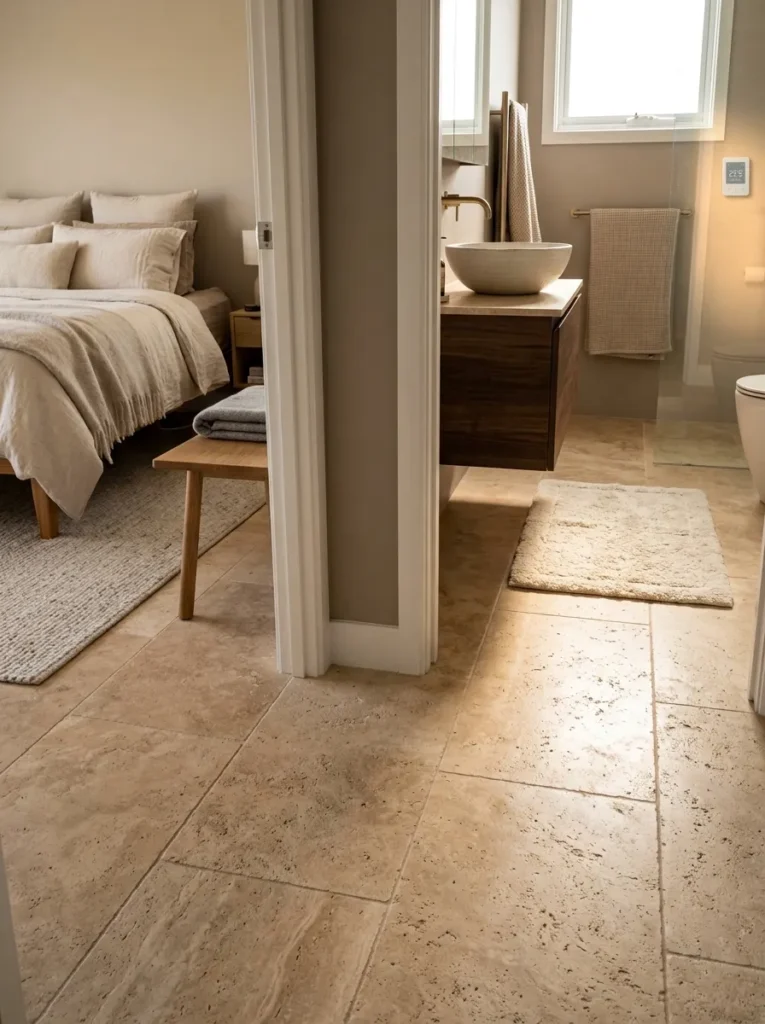
Vibe: Warm and seamless — a floor that makes the boundary between bedroom and bathroom disappear entirely.
Why it works: A continuous floor material — honed travertine, limestone, or concrete — running without interruption from the master bedroom into the ensuite bathroom is the architectural detail that most powerfully creates the spa-suite quality that distinguishes a designed master bedroom from a standard residential one. Standard residential bedrooms have a carpet-to-tile transition at the bathroom threshold — a join that visually and physically announces the boundary between the two rooms and breaks the spatial flow between them. Eliminating this transition by extending the same stone floor from bathroom to bedroom creates a single, continuous space that reads as a suite rather than two adjacent rooms — the same spatial quality that luxury hotel suites use to create their distinctive sense of spatial generosity. The hydronic underfloor heating beneath the stone is the practical element that makes this material choice viable in a bedroom context: cold stone underfoot between bed and bathroom at 3am is a sensory disruption that ruins the spa experience the design is trying to create.
How to get it: Install the underfloor heating system before laying the stone — the heating mat must sit directly beneath the stone bed on a concrete slab or on a heat-conductive screed over a timber subfloor. Specify honed rather than polished travertine for the bedroom-zone floor — polished stone is slippery in bare feet, which is both a safety issue and a sensory one that conflicts with the relaxed, spa-quality experience the floor is designed to support.
Shop the Look
| Product |
|---|
| Honed travertine floor tile 600x600mm |
| Hydronic underfloor heating mat |
| Underfloor heating thermostat smart |
| Stone floor sealer penetrating |
| Soft bath mat natural cotton |
7. Ceiling-Mounted Canopy Drape Over the Bed
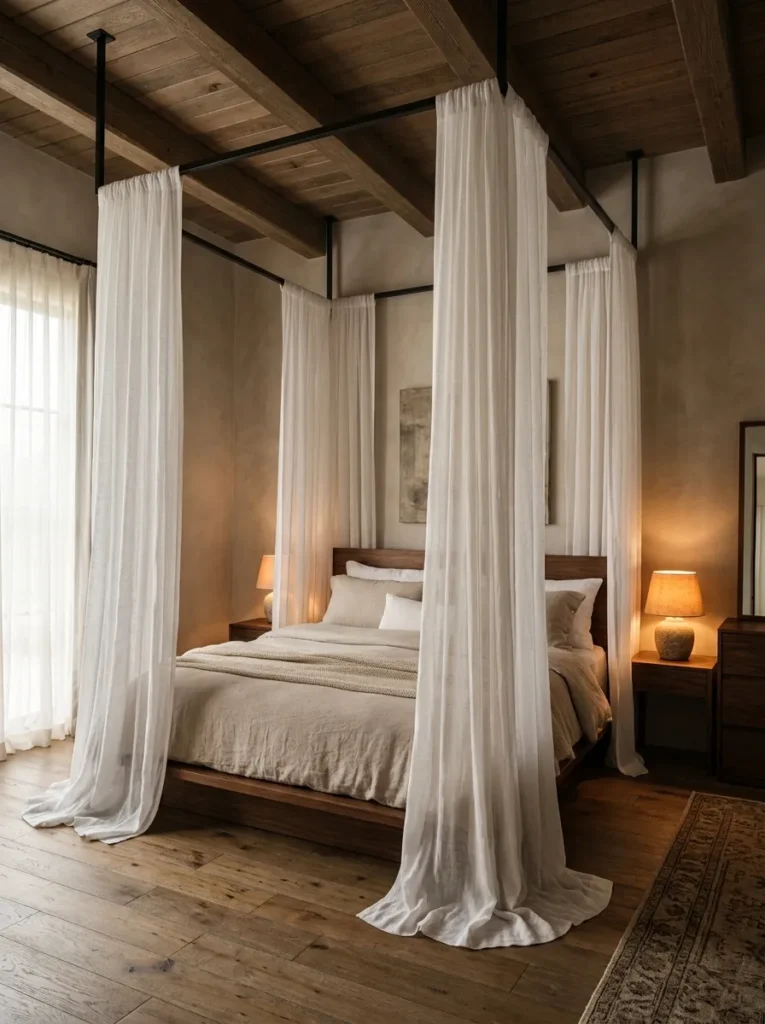
Vibe: Romantic and cocoon-like — a bed that feels like its own private room within the room.
Why it works: A ceiling-mounted canopy drape is the master bedroom design element with the highest romantic and atmospheric impact relative to its structural complexity — four panels of sheer fabric hanging from a simple ceiling-mounted square frame transform the spatial experience of the bed from a piece of furniture in a room to an enclosed destination within the room, creating the psychological sense of shelter and privacy that is the defining quality of great sleeping environments. The sheer linen fabric is the correct material choice specifically because it diffuses rather than blocks — the bed remains visually connected to the surrounding room through the translucent panels, so the canopy adds enclosure without creating claustrophobia. The matte black ceiling frame is the hardware choice that reads as a designed architectural element rather than a decorative accessory: it is visible but confident, and its geometric precision contrasts with the softness of the hanging fabric in the way that all great fabric-and-metal compositions depend on.
How to get it: Mount the ceiling frame using four M10 ceiling anchors into the ceiling joists — the frame must be structurally anchored into timber or steel structure, not plasterboard alone, as the combined weight of the frame and fabric, plus any occasional accidental loading, exceeds plasterboard’s pull-out capacity. Size the frame at the bed width plus 300mm on each side — a frame too close to the bed dimensions reads as constraining; the 300mm extension on each side creates the generous draping that distinguishes a luxury canopy from a functional mosquito net.
Shop the Look
| Product |
|---|
| Matte black ceiling canopy frame |
| Sheer linen fabric panel white |
| Ceiling mounting anchor M10 |
| Low profile platform bed walnut |
| Stone table lamp bedside |
8. Integrated Bedside Niche with Recessed LED and Stone Shelf
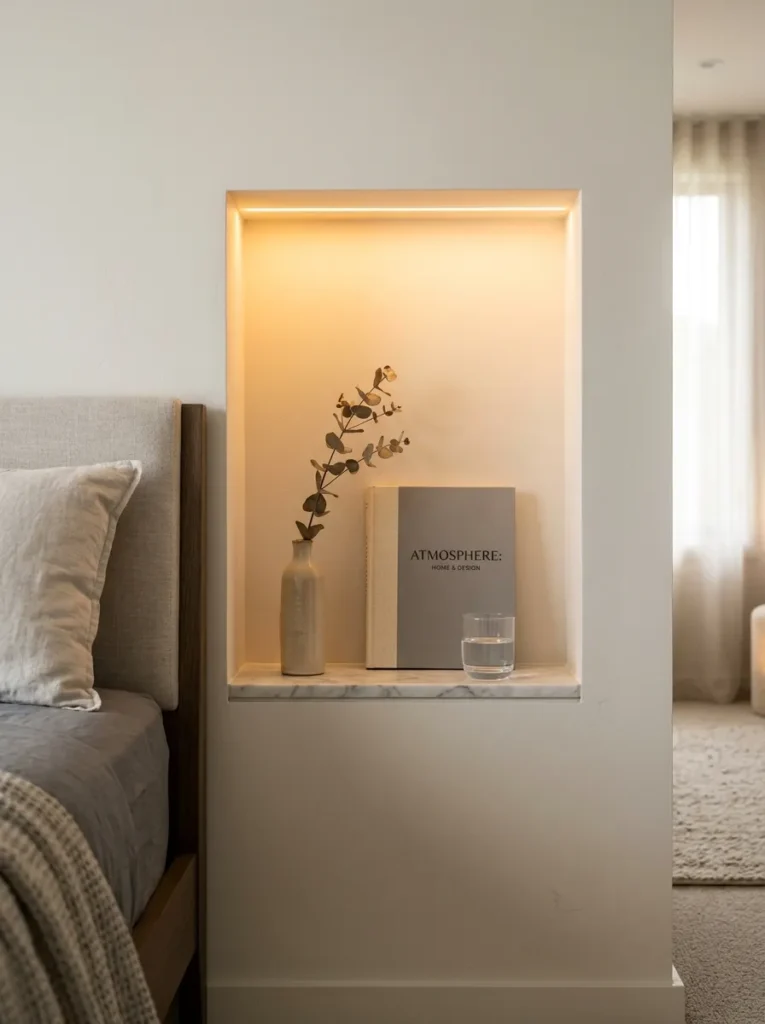
Vibe: Warm and intimate — the bedside detail that makes reaching for a glass of water feel like an aesthetic experience.
Why it works: The recessed bedside niche with a stone shelf replaces the freestanding bedside table — which occupies floor space and reads as furniture — with an architectural element that is part of the wall itself, eliminating the floor-level visual clutter that multiple bedside tables create and replacing it with a designed feature that improves the wall as well as providing the bedside storage function. The recessed LED strip along the niche ceiling is the lighting detail that makes the niche work as a spa-quality element rather than simply a practical recess: at 2200K, the warm amber glow illuminating the objects on the marble shelf from above creates the same intimate quality as the glow in a museum display case, making the bedside object arrangement — a book, a glass of water, a ceramic vase — read as a considered composition rather than practical accumulation.
How to get it: Recess the niche between wall studs on a non-load-bearing bedroom wall — the standard 90mm stud wall produces a niche depth of 70mm after plasterboard lining, which is sufficient for a glass or a slim ceramic vase but not for a lamp. For a deeper niche (150–200mm), build a stud wall section with 140mm studs or frame a dedicated niche cavity projecting from the standard wall plane. Line the niche interior in a contrasting material — honed marble, polished plaster, or a deep paint tone — to create the visual depth that makes the niche read as designed.
Shop the Look
| Product |
|---|
| LED strip warm amber 2200K recessed |
| Honed marble shelf cut to size |
| Slim ceramic vase single stem |
| LED extrusion niche profile |
| Recessed niche tile liner |
9. Statement Chandelier with Dimmer Control System
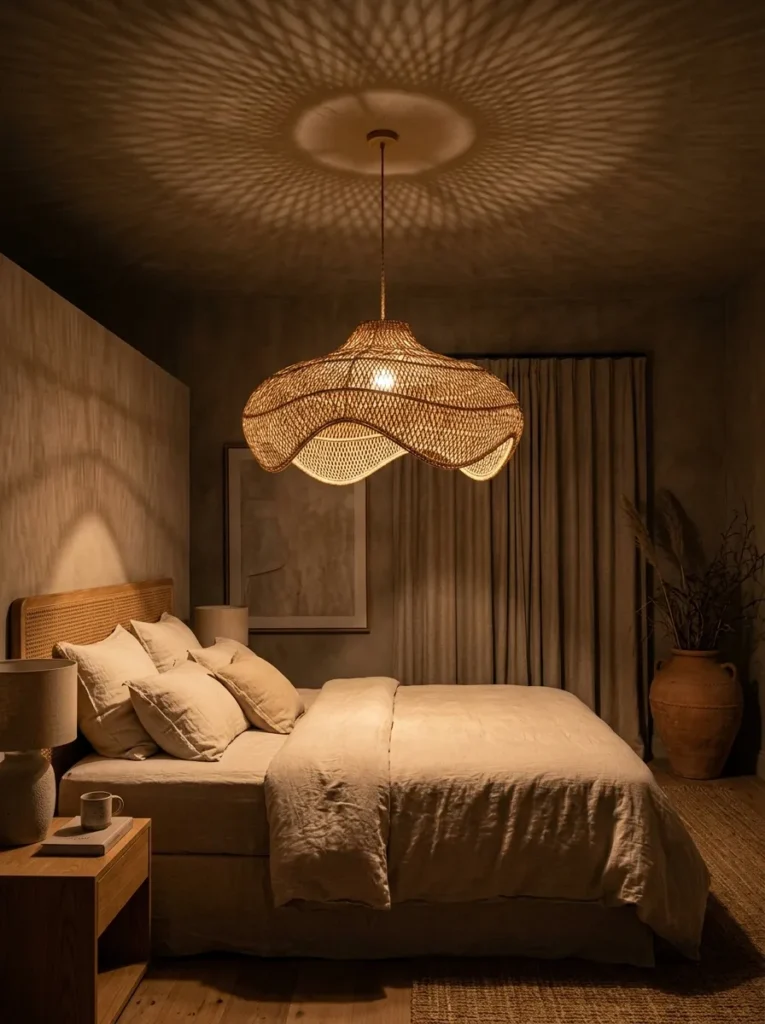
Vibe: Warm and sculptural — the ceiling fixture that makes the whole room feel like it was designed from above.
Why it works: A large-format chandelier on a dimmer control system is the lighting element that most completely transforms the evening quality of a master bedroom because it provides a single, central, warm light source of sufficient visual presence to define the room’s character at the lowest functional light levels — a characteristic that the table lamps and wall sconces that most bedrooms rely on cannot match individually but that a large-format pendant or chandelier achieves from a single fixture. The natural rattan or woven seagrass chandelier is the correct material choice for a spa-vibe bedroom because it introduces organic texture at ceiling level — the most visually neglected surface in most interiors — and produces a patterned shadow across the ceiling above that is the most compelling decorative ceiling detail achievable without paint or wallpaper. The dimmer control is the non-negotiable functional specification: a chandelier without dimmer control is either too bright for the intimate quality the spa aesthetic requires or too dim for functional room use, and only the continuous adjustment of a dimmer resolves this tension.
How to get it: Size the chandelier at approximately 60% of the bed width for proportional correctness — a king bed at 1.8 meters benefits from a chandelier of approximately 1 meter diameter. Hang at 2 meters above the mattress surface for the correct visual relationship between fixture and bed — lower and the fixture feels oppressive; higher and it loses its spatial connection to the room. Install a trailing-edge LED dimmer compatible with the specific LED driver in the chandelier — leading-edge dimmers cause flickering with most LED light sources.
Shop the Look
| Product |
|---|
| Rattan pendant chandelier large |
| LED trailing edge dimmer switch |
| Ceiling rose outlet cover |
| Pendant cord set adjustable |
| Warm white LED globe bulb 2200K |
10. Spa-Quality Ensuite with Walk-In Rainfall Shower
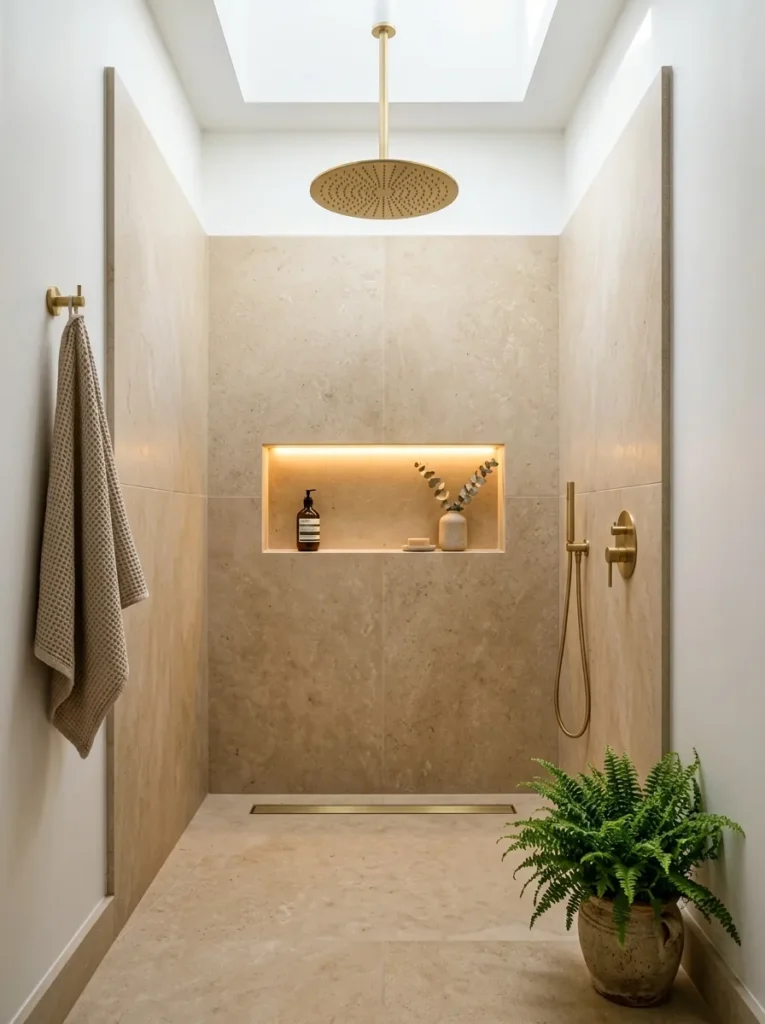
Vibe: Clean and resort-like — the shower that makes every morning feel like the first morning of a holiday.
Why it works: The walk-in rainfall shower without a screen or door is the ensuite feature that most powerfully communicates spa-quality design because it requires the greatest confidence in both the spatial planning and the construction quality — an open shower is only achievable when the floor gradient is precise (1:80 minimum to contain water within the shower zone), the shower footprint is generous (1200mm × 1200mm minimum), and the rainfall showerhead is positioned to direct water downward rather than outward (ceiling-mounted directly above the shower base center rather than wall-mounted at an angle). The 800mm diameter ceiling-mounted brass rainfall showerhead is the fixture that defines the experience — larger than standard domestic shower roses, it provides full-body coverage with a low-pressure, rainfall-mimicking flow that is qualitatively different from the directed pressure of a standard shower head and specifically associated with luxury hotel and spa shower experiences.
How to get it: Build the shower base with a 50mm fall across the 1200mm floor dimension — a gradient that is steep enough to prevent water escape beyond the shower zone but not steep enough to be perceptible to bare feet. Use a 110mm linear drain at the back wall rather than a central floor drain — the linear drain allows the floor tile to run in a single continuous direction without the gradient disruption that a central drain requires, producing a cleaner visual floor plane.
Shop the Look
| Product |
|---|
| Ceiling mount rainfall showerhead 800mm brass |
| Honed limestone tile 600x600mm |
| Linear drain 1100mm stainless |
| Built-in niche tile insert |
| Brushed brass towel hook single |
11. Floating Timber Platform Bed with Perimeter LED Base
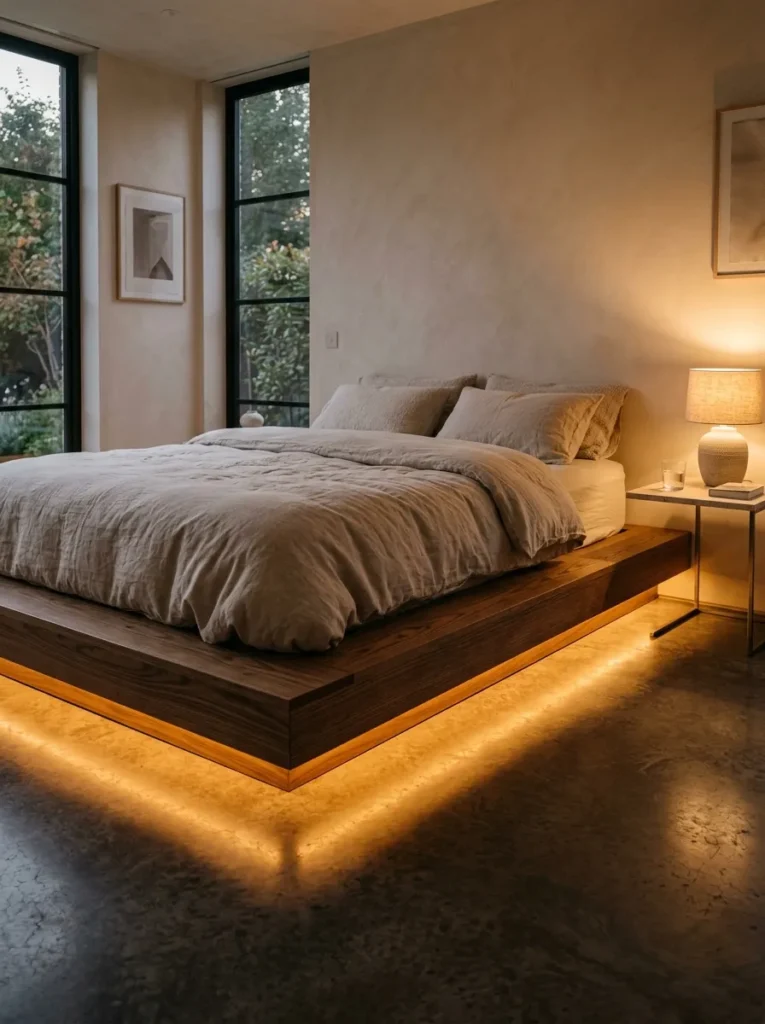
Vibe: Warm and architectural — a bed that looks like it was designed by an architect who really loves sleep.
Why it works: The floating timber platform bed with perimeter LED lighting is the bedroom furniture element that most powerfully creates the atmosphere of a high-end hotel suite at the residential scale, because it uses the same design technique that luxury hotel designers apply to their bed zones — elevating the bed on a platform to give it spatial presence and weight, and using recessed perimeter lighting at the platform base to create a warm, floating ambiance that is the defining evening quality of a great hotel room. The 400mm platform extension beyond the mattress edge is the proportional specification that makes the platform read as architectural — too close to the mattress edge and it reads as a bed base; 400mm wider on each side and it reads as a designed platform that the bed sits within. The smoked ash timber surface coordinates with the natural palette of linen, travertine, and limewash that defines the spa-vibe aesthetic.
How to get it: Build the platform from 18mm structural plywood with a smoked ash veneer face applied over the visible surfaces — solid smoked ash would be prohibitively heavy and expensive at the dimensions required. Rout the LED channel into the underside of the platform perimeter edge as a 25mm × 25mm recess, and install an aluminum LED extrusion with diffuser for an even, linear glow. The platform must be raised a minimum of 80mm from the floor to allow the LED glow to spread across the floor surface effectively — lower than this and the light is confined to the immediate shadow beneath the platform edge.
Shop the Look
| Product |
|---|
| Smoked ash veneer sheet |
| Structural plywood 18mm platform |
| LED strip warm amber 2200K perimeter |
| Aluminum LED extrusion with diffuser |
| Travertine bedside table top |
12. Acoustic Panel Gallery Wall with Integrated Art
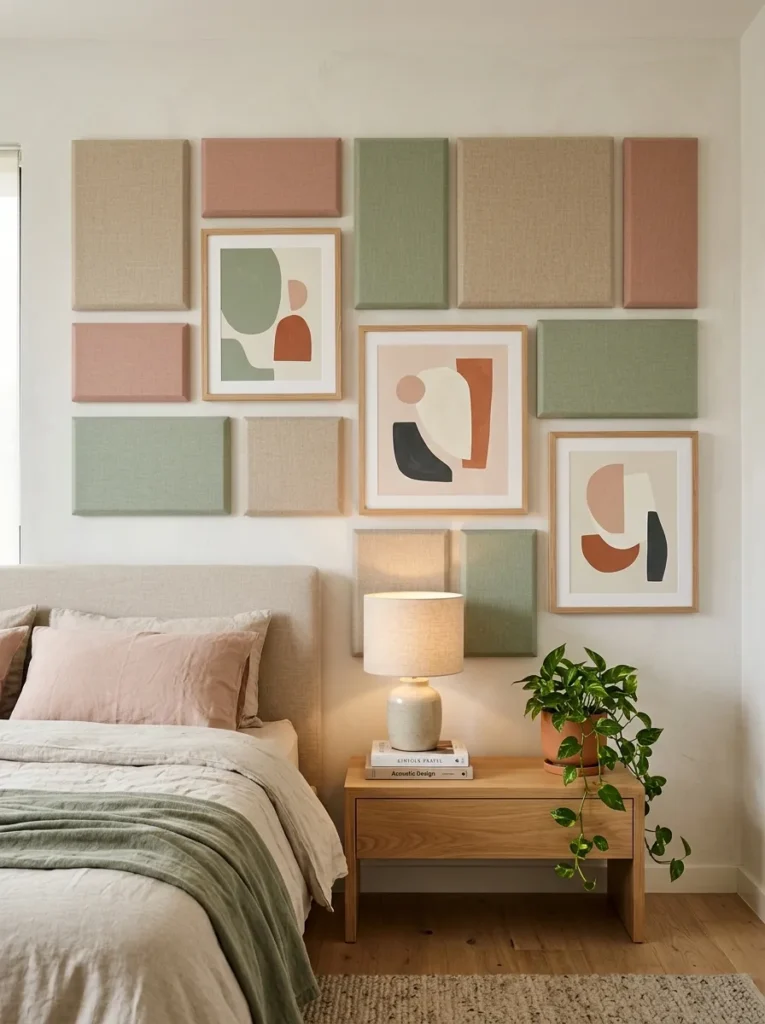
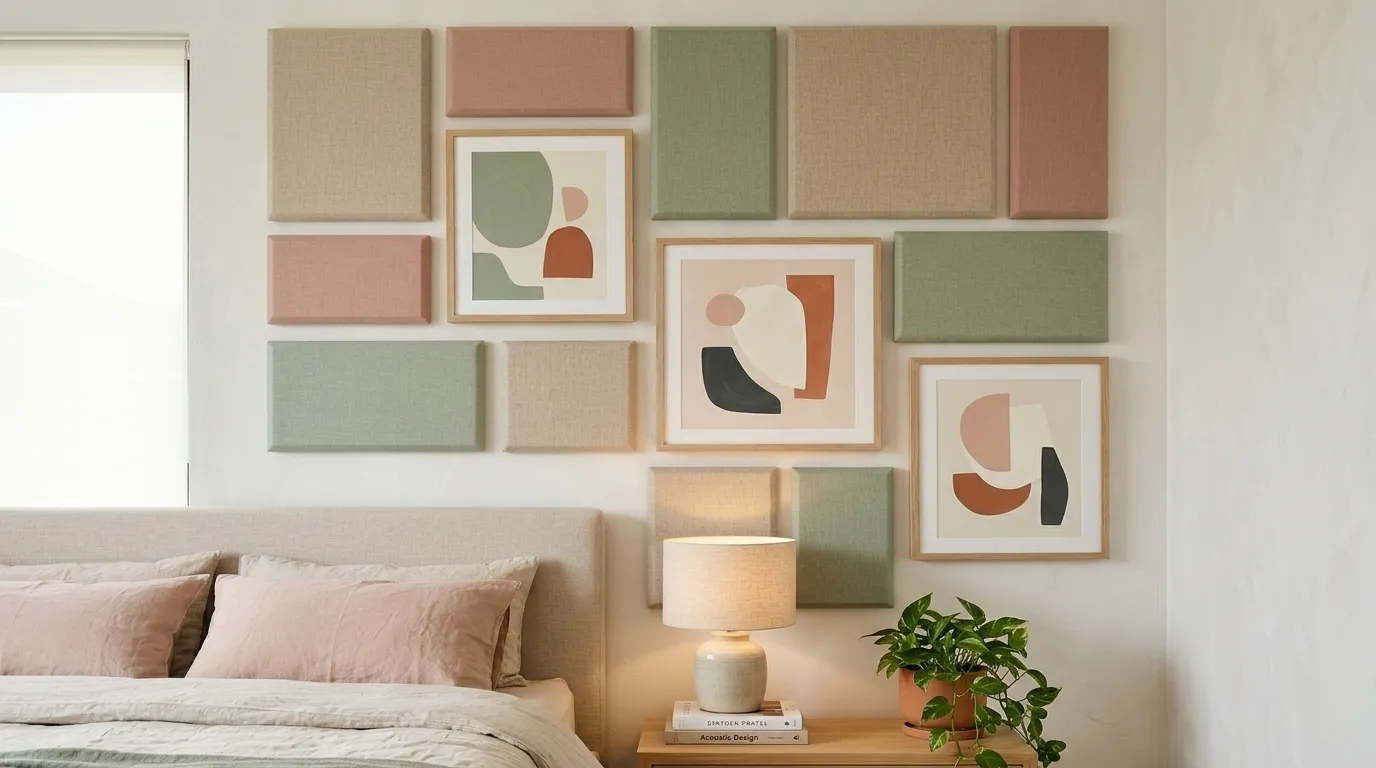
Vibe: Warm and considered — a bedroom wall that looks beautiful and makes the room genuinely quieter at the same time.
Why it works: The acoustic panel gallery wall is the bedroom design intervention that improves the room’s quality at the most fundamental level — the acoustic environment — while also serving as a visual design feature. Bedrooms in standard residential construction have almost no acoustic treatment: hard plasterboard walls, timber floors, and glass windows reflect sound freely, producing reverberation that extends the decay time of noise (traffic, household sounds, a partner’s movement) and specifically degrades sleep quality by preventing the acoustic quiet that the nervous system needs for deep sleep onset. Upholstered acoustic panels absorb mid and high-frequency sound energy, reducing reverberation time and creating the hushed quality that dedicated sleep environments require. Integrating framed artworks within the panel arrangement — treating the acoustic panels and the artworks as components of a single gallery wall composition — eliminates the clinical, office-ceiling-tile quality that acoustic panels typically project in non-specialist applications.
How to get it: Source acoustic panels from specialist acoustic panel suppliers (Autex, BASWA Acoustic, or custom fabricators) or DIY from 50mm Rockwool acoustic slab covered in fabric — the Rockwool core is the effective acoustic absorption material, and the fabric covering is purely aesthetic. Specify fabric covers in the bedroom’s existing palette — the acoustic panels should read as upholstered art objects within the gallery wall composition rather than a separate acoustic treatment applied to the wall.
Quick Win: Two or three large upholstered acoustic panels in 600mm × 900mm format, mounted symmetrically beside the bed on the side wall, reduce bedroom reverberation meaningfully for $150–400 in DIY materials — the acoustic benefit is immediate and the visual contribution to the spa-vibe aesthetic is significant.
Shop the Look
| Product |
|---|
| Rockwool acoustic slab 50mm |
| Linen upholstery fabric warm white |
| Timber picture frame natural set |
| Abstract art print quality paper |
| Upholstery staple gun heavy duty |
13. Outdoor-Connected Master Bedroom with Sliding Glass Wall
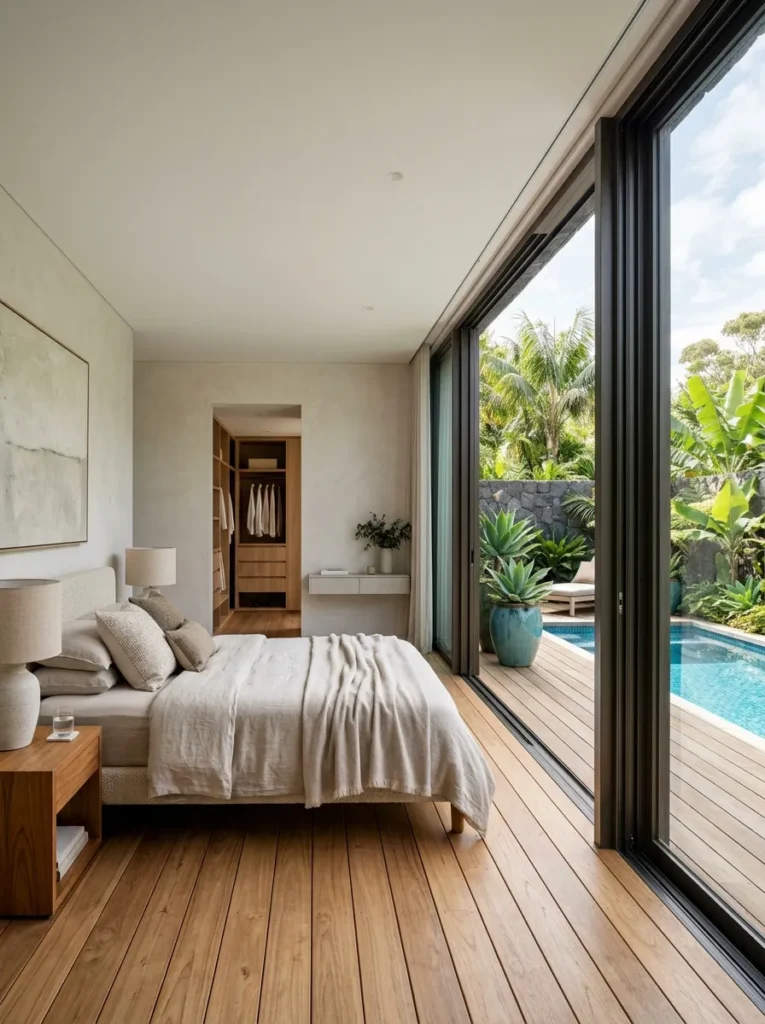
Vibe: Open and luminous — a bedroom that begins at the bed and ends at the garden.
Why it works: A full-width sliding glass wall system that opens the master bedroom to a private garden or terrace creates the most complete indoor-outdoor living experience available in residential architecture — the bedroom dissolves its fourth wall entirely, and the garden becomes a natural extension of the sleeping environment. This is the design move that defines the luxury residential bedroom aesthetic of contemporary Australian, Balinese, and Californian architecture, where climatic conditions allow the bedroom to operate as an open-air sleeping pavilion for significant portions of the year. The acoustic and visual qualities that result from a fully open bedroom wall — birdsong, moving air, the scent of garden planting, direct sun on the bedding in the morning — are the exact sensory experiences that the spa-vibe aesthetic attempts to replicate through materials and light quality in enclosed rooms. An outdoor-connected bedroom achieves them directly.
How to get it: Specify a commercial-grade stacking sliding door system (Centor, Stacker Sliding Doors, or similar) with thermally broken aluminium frames for energy performance — standard residential sliding doors do not provide the weather sealing or panel weight capacity required for a full-wall system. The threshold must be flush between bedroom floor and terrace floor — a step at the threshold breaks the spatial continuity that makes the indoor-outdoor connection feel complete.
Shop the Look
| Product |
|---|
| Stacking sliding glass door system |
| Thermally broken aluminium frame |
| Teak terrace decking board |
| Potted agave large outdoor |
| Floor to ceiling sheer curtain track |
14. Spa-Scent Diffuser System with Essential Oil Blend
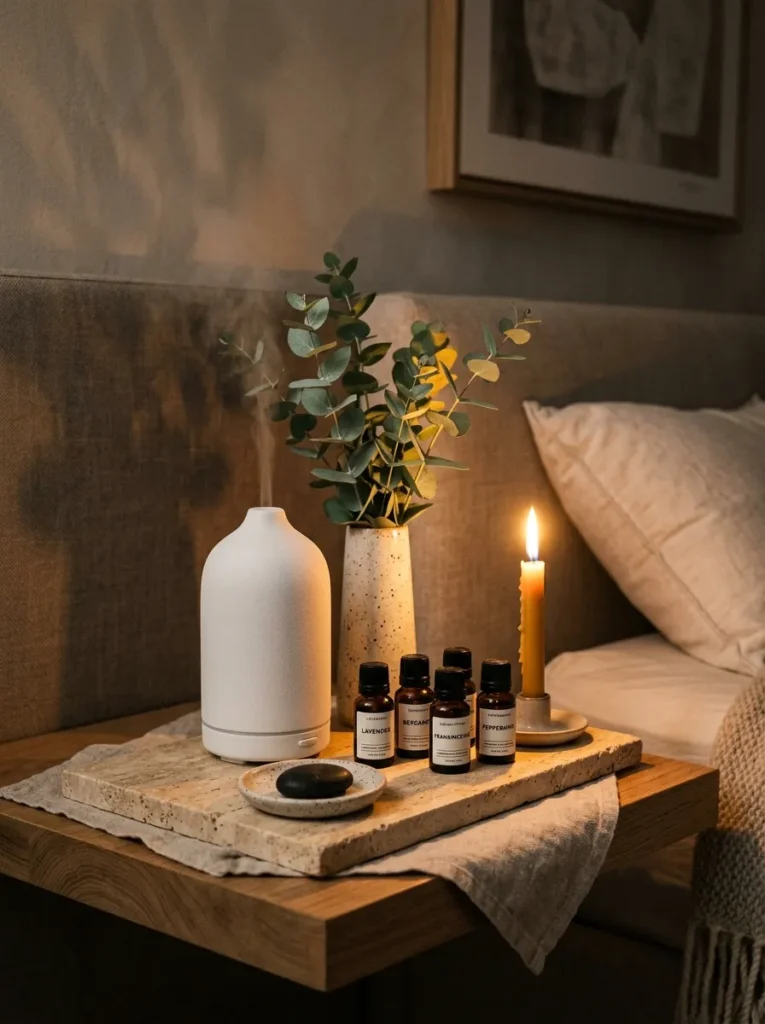
Vibe: Warm and fragrant — the bedside arrangement that makes going to bed a sensory ritual rather than a default.
Why it works: Scent is the most directly connected sensory modality to the limbic system — the brain region responsible for emotional processing and memory — which is why the olfactory environment of a bedroom has a more immediate and powerful effect on the nervous system’s state of rest or alertness than any visual or tactile element in the room. The spa scent experience is specifically defined by a small range of aromatic compounds: lavender (linalool and linalyl acetate), eucalyptus (1,8-cineole), sandalwood (santalol), and bergamot (bergapten) are the four compounds with the strongest evidence base for parasympathetic nervous system activation — the physiological shift toward rest and relaxation. A cold-air diffuser — which disperses essential oil molecules without heat, preserving the aromatic compounds’ molecular integrity — is the correct delivery method for a bedroom application, as ultrasonic diffusers add humidity and heat-based diffusers degrade the aromatic molecules.
How to get it: The spa-scent blend for a master bedroom sleep environment is: 3 drops lavender + 2 drops bergamot + 1 drop sandalwood per 100ml of distilled water. This combination provides the lavender dominant note that scent research consistently associates with sleep onset, the bergamot brightness that prevents the blend from reading as pharmaceutical, and the sandalwood depth that provides the warm, woody character of the best hotel room scent systems. Run the diffuser for 30 minutes before sleep rather than continuously — continuous diffusion desensitizes the olfactory receptors and reduces the physiological effect.
Shop the Look
| Product |
|---|
| Cold air ceramic diffuser white |
| Lavender essential oil organic |
| Bergamot essential oil |
| Sandalwood essential oil |
| Amber glass essential oil bottle set |
15. Custom Linen Curtains from Ceiling to Floor with Blackout Lining
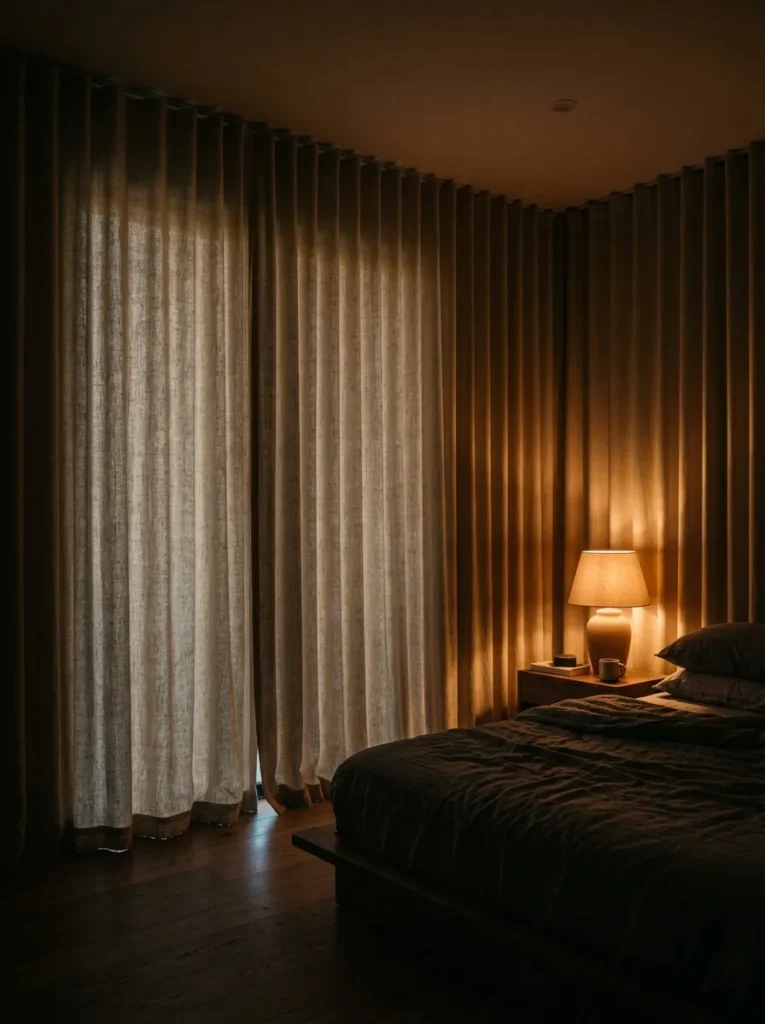
Vibe: Deeply restful — a bedroom that goes completely dark when you need it and completely beautiful when the curtains open.
Why it works: Ceiling-to-floor linen curtains with an integrated blackout lining are simultaneously the most visually impactful and the most physiologically important single element in a spa-vibe master bedroom. The physiological importance is specific and well-documented: complete darkness during sleep is the environmental condition most strongly associated with melatonin production and sleep quality maintenance — even low-level light exposure through inadequately lined curtains suppresses melatonin production and reduces both sleep depth and duration. The visual importance is equally significant: curtains that hang from the ceiling to the floor make the room appear taller and more spatially generous than their actual dimensions, and linen curtains specifically — with their characteristic drape, texture, and slight translucency when backlit — have a softening effect on the room’s hard architectural planes that no other window treatment achieves at the same scale.
How to get it: Mount the curtain track directly on the ceiling rather than on the wall above the window — ceiling-mounted tracks allow the curtain to cover the full window area plus the wall sections on each side, which eliminates the light leak at the curtain edges that wall-mounted tracks cannot prevent. Specify the curtain width at 2.5–3 times the window width for the full, gathered drape that makes the curtain read as luxurious rather than mean. The blackout lining should be sewn directly to the face fabric as an integrated lining rather than a separate curtain — separate blackout curtains behind the face curtain add visual bulk and reduce the clean drape quality that makes linen curtains exceptional.
Quick Win: Replacing existing short curtains with floor-length versions that mount at ceiling height — even using the same fabric as the existing curtains — creates the single most impactful visual improvement achievable in a master bedroom without changing any other element, and the blackout lining addition costs $15–25 per meter of curtain width at any fabric alteration service.
Shop the Look
| Product |
|---|
| Warm ivory linen curtain fabric |
| Ceiling mount curtain track system |
| Blackout lining fabric sewn in |
| Curtain heading tape pinch pleat |
| Curtain hook set stainless |
16. Bedside Reading Nook with Built-In Banquette and Cashmere Throw
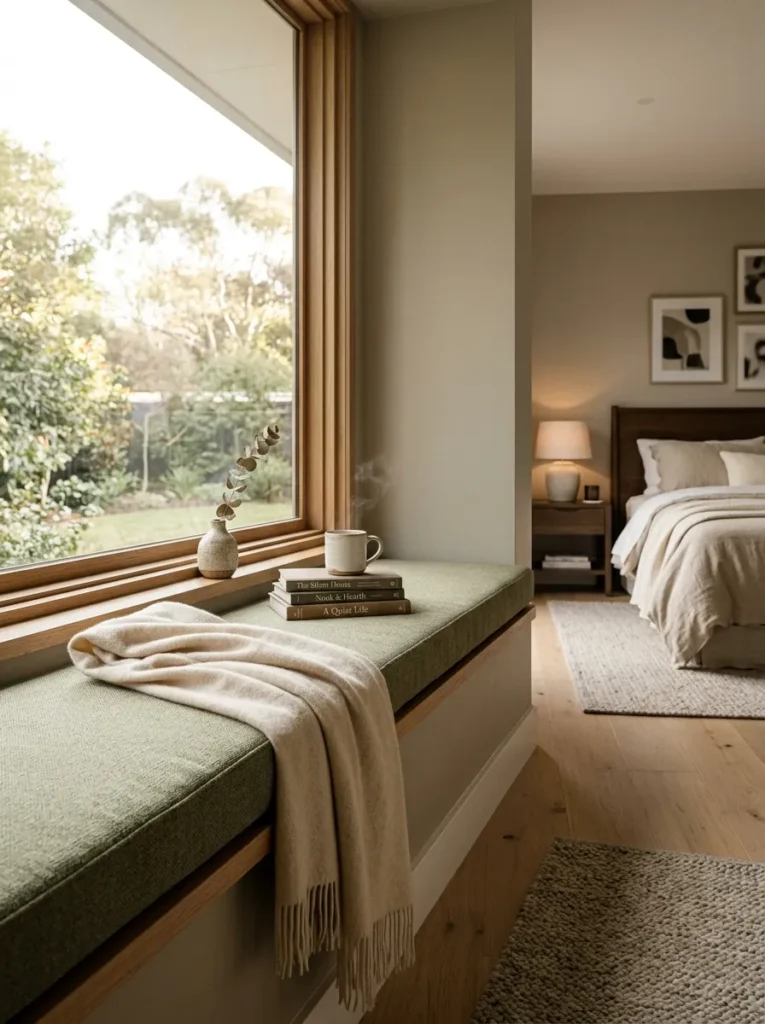
Vibe: Warm and intimate — the corner of the bedroom that you will choose over every other chair in the house.
Why it works: The built-in window reading nook within the master bedroom is the design element that most completely fulfills the spa-vibe bedroom’s aspiration to be a genuine retreat — a space where the primary activity is not just sleeping but the range of restorative activities (reading, morning coffee, evening reflection, afternoon napping) that constitute genuine rest from the demands of daily life. A built-in banquette at window height — positioned to receive the maximum natural light for reading during the day and to offer the most intimate evening view of the garden or garden at dusk — creates a secondary destination within the bedroom that makes the room feel spatially richer and behaviorally more complete than a room with only a bed. The cashmere throw is the specific material choice that makes the nook a sensory destination rather than a functional seat: cashmere’s warmth-to-weight ratio and its characteristic softness against bare skin are qualities that no synthetic alternative replicates, and the experience of sitting in a deep-cushioned nook wrapped in a cashmere throw is the spa-quality tactile experience that the entire aesthetic is designed to deliver.
How to get it: Build the banquette at 450mm seat height and 550mm seat depth — both dimensions are specific to comfort for extended sitting rather than brief perching. Use a 100mm high-density foam seat base topped with 25mm memory foam for the tactile quality that distinguishes a genuinely comfortable banquette from a merely decorative one. Upholster in a performance fabric (Sunbrella’s indoor range includes a sage tone that reads as natural linen at a glance) for durability in a seat that will receive daily use including the moisture and heat of morning coffee cups and evening wine glasses.
Shop the Look
| Product |
|---|
| Performance fabric sage indoor |
| High density foam sheet 100mm |
| Memory foam sheet 25mm topper |
| Cashmere throw blanket warm ivory |
| Slim timber shelf sill height |
How to Start Your Spa-Vibe Master Bedroom Transformation
Your single first move is to upgrade your bedding to a complete linen layer system — fitted sheet, duvet cover, two standard pillowcases, and two European square pillowcases — in a single tonal family from a single supplier, before changing any other element of the room. The bedding is the first thing you experience when you enter the bedroom and the last thing you see before you sleep, and its material quality and visual organization determines the room’s character more powerfully than any other single element. A room with exceptional linen bedding in a considered arrangement reads as a spa-quality bedroom regardless of what surrounds it; a room with extraordinary architecture and poor-quality bedding reads as a missed opportunity. The linen layer system is the foundation that every other idea in this list builds from, and it is the one transformation that requires no construction, no tradespeople, and no planning approval — only the commitment to purchase at the quality level the room deserves.
The most common mistake in spa-vibe bedroom transformations is investing in visual elements before resolving the bedroom’s lighting system. A beautifully styled bedroom that is lit with a single overhead downlight on a fixed switch is not a spa-quality space regardless of the quality of its materials — the overhead downlight is the one light source that most completely fails to create the warm, multi-directional, dimmable illumination that the spa aesthetic requires, because it casts unflattering, high-angle shadows across faces and textiles, cannot be dimmed without specialized dimmer installation, and produces none of the warm, horizontal light that sconces, bedside lamps, and recessed perimeter lighting provide. Resolve the lighting first: install dimmer switches on all bedroom circuits, add bedside lamps at 400–500mm above mattress height, and remove or supplement the overhead light with a statement chandelier on a dimmer before purchasing any decorative object or textile.
Three specific investments under $150 that create immediate spa-vibe bedroom impact: (1) A set of two European square linen pillowcases ($40–80 per pair) placed behind the existing standard pillows against the headboard creates the hotel pillow depth that is the most recognizable visual signature of a spa-quality bed. (2) A warm ivory cashmere or cashmere-blend throw ($60–120) draped across the foot of the bed introduces the specific tactile warmth that makes a bedroom feel retreat-quality — the combination of weight and softness is the sensory quality that no other material matches at any price point. (3) A cold-air essential oil diffuser in white ceramic ($35–80) placed on the bedside table with a lavender and bergamot blend run for 30 minutes before sleep creates the olfactory signature of a spa environment and has the strongest evidence base of any sensory intervention for improving sleep onset speed and sleep quality.
Realistically, a complete spa-vibe master bedroom transformation — new linen bedding, a boucle upholstered bedhead panel, limewash accent wall, ceiling-to-floor curtains with blackout lining, a statement chandelier, integrated bedside niches, and a platform bed with perimeter LED — costs $8,000–25,000 in materials and installation depending on room size and specification level. A focused mid-range transformation — new linen bedding, a chandelier with dimmer, ceiling-to-floor curtains, and a scent diffuser system — costs $1,500–4,000. The minimum investment that creates a genuine spa-quality shift in the room’s character — exceptional linen bedding, dimmer switches on all circuits, a cashmere throw, and a scent diffuser — costs $300–600 and can be completed without any tradespeople or construction work, producing a bedroom that feels measurably different to sleep in from the first night.
Frequently Asked Questions About Spa-Vibe Master Bedroom Design
What is a spa-vibe bedroom and how is it different from a standard luxury bedroom?
A spa-vibe bedroom is specifically designed around the sensory conditions that promote rest, relaxation, and nervous system recovery — layered natural materials with tactile warmth, warm light at low and controllable intensities, acoustic quiet, and a palette of deep neutrals that reduces visual stimulation. A standard luxury bedroom may prioritize visual opulence — rich colors, decorative detail, statement furniture — without the specific sensory conditions that the spa aesthetic targets. The practical difference is experiential: a spa-vibe bedroom makes you feel differently — calmer, more rested, more restored — than a room that is visually impressive but acoustically live, brightly lit, and sensorially complex. The test of a spa-vibe bedroom is not how it photographs but how you feel in it at 10pm on a Tuesday.
What colors work best for a spa-vibe master bedroom?
The palette that most reliably creates the spa-quality calm that the aesthetic targets is built from warm neutrals with depth rather than brightness: warm white (Benjamin Moore’s White Dove OC-17 or Farrow & Ball’s All White No. 2), soft greige (Farrow & Ball’s Elephant’s Breath No. 229 or Dulux’s Natural White), warm charcoal (Farrow & Ball’s Down Pipe No. 26 or Benjamin Moore’s Kendall Charcoal HC-166), and deep sage (Farrow & Ball’s Mizzle No. 266 or Dulux’s Tranquil Retreat). The most important palette decision is tonal continuity across walls, ceiling, and soft furnishings — a spa-quality bedroom reads as a single, immersive tonal environment rather than a collection of contrasting surfaces. Painting the ceiling in the same tone as the walls (rather than the standard ceiling white) is the single paint decision that most dramatically shifts the spatial quality of a bedroom toward the enveloping, cocoon-like quality the spa aesthetic targets.
How much does a spa-vibe master bedroom transformation cost?
A complete spa-vibe master bedroom — limewash accent wall, boucle upholstered bedhead panel, ceiling-to-floor blackout linen curtains, statement chandelier with dimmer, platform bed with LED perimeter, integrated bedside niches, and a complete linen bedding layer system — costs $8,000–25,000 at the mid-to-high specification level. A focused transformation hitting the most impactful elements (linen bedding, chandelier with dimmer, ceiling-to-floor curtains, limewash accent wall) costs $2,000–6,000. A minimum investment transformation that creates a genuine spa-quality experiential shift (linen bedding layer system, cashmere throw, essential oil diffuser system, dimmer switch installation) costs $300–800 and requires no construction or trade work. The highest-value investments in order of sensory impact are consistently lighting (a dimmable chandelier and bedside lamps on dimmers), bedding (the complete linen layer system), and acoustic treatment (ceiling-to-floor curtains with blackout lining).
What bedroom lighting is most effective for a spa-vibe master bedroom?
The lighting system that most reliably creates the spa-quality evening atmosphere a master bedroom needs is a layered scheme with at least three independently dimmable circuits: a statement ceiling fixture (chandelier or large pendant) on a trailing-edge LED dimmer for the primary ambient source, bedside lamps at 400–500mm above mattress height for reading and intimate task light, and a recessed perimeter or architectural lighting element (integrated bedhead LED, platform perimeter LED, or niche lighting) for the warm, low, horizontal light that creates depth and warmth at the lowest functional levels. All three circuits should be specifiable to 2200K color temperature — the warmest end of the standard residential LED range — and all three should be dimmable to below 10% of full output. The ability to operate at very low light levels — below 50 lux, which is approximately the light level of a candle at arm’s length — is the specific lighting quality that distinguishes a spa-quality bedroom environment from a standard residential one.
How do I make a small master bedroom feel like a spa?
The five most impactful spa-quality interventions for a small master bedroom, in order of sensory effect, are: ceiling-to-floor curtains in warm linen with blackout lining (which makes the room appear taller and creates complete darkness for sleep); a single dimmable bedside lamp per side in place of overhead lighting (which eliminates the unflattering, high-angle overhead light that makes small rooms feel clinical); a complete linen bedding layer system in a single warm tonal family (which creates the hotel-quality visual and tactile quality that small rooms are often denied through budget compromise); acoustic panel treatment on one side wall (which reduces the reverberation that makes small rooms feel acoustically busy); and an essential oil diffuser with a lavender and bergamot blend (which creates the olfactory signature of a spa environment immediately and at zero construction cost). Together these five interventions cost $600–1,500 and create a bedroom that is experienced as a qualitatively different space from the first evening of use.
Ready to Create Your Dream Spa-Vibe Master Bedroom?
These 16 ideas span the full spectrum of what a luxurious spa-vibe master bedroom can be — from a linen bedding layer system and a boucle upholstered bedhead with integrated LED, to a Japanese soaking tub positioned within the bedroom zone, a floating platform bed with perimeter amber glow, a ceiling-mounted linen canopy that encloses the bed in its own private room, and a sliding glass wall that dissolves the boundary between bedroom and garden entirely — so whether you are working with a standard suburban bedroom or a master suite with architectural features to build on, there is a genuinely buildable starting point here for your space, your budget, and the specific quality of rest you are trying to create. The transformation works best when it follows the correct sequence: bedding first, lighting second, acoustic treatment third, and decorative elements last — because the experiential quality of a spa-vibe bedroom is built from the inside out, from what you feel before you see it. Today’s specific action: install a dimmer switch on your bedroom’s primary light circuit this weekend — a standard trailing-edge LED dimmer costs $15–35 and takes 20 minutes to install — and use only bedside lamp light in the bedroom from this evening onward. The difference in how the room feels at 9pm will make every other idea in this list feel not just desirable but necessary. Save the ideas that matched your bedroom’s specific dimensions, your material preferences, and the quality of rest you most need — those are the ones that will transform not just how the room looks but how you feel every morning when you wake up in it.