15 Beautiful Room Decor Ideas for Every Home
Beautiful room decor ideas for every home use considered material choices, layered lighting, thoughtful color, and the specific placement and proportion decisions that make a room feel genuinely designed rather than assembled from individually nice pieces. This article gives you exactly 15 ideas spanning living rooms, bedrooms, kitchens, bathrooms, and home offices — each applicable across a range of budgets, aesthetics, and room sizes — so every home finds a decor direction that is both achievable and genuinely beautiful.
Beautiful decor is not the most expensive version of a room. It is the most considered one — where the lamp’s warmth coordinates with the rug’s tone, where the plant is the right size for the corner, where the throw is folded rather than draped because that is what the specific sofa asks for. That quality of consideration is what this list is built around. Here are 15 ideas worth saving — and applying.
Why Beautiful Room Decor Ideas Work for Every Home
The category of “beautiful room decor” is broader and more democratically accessible than its aspirational framing might suggest — the design principles that make a room genuinely beautiful (material cohesion, appropriate scale, layered lighting, considered negative space, the right quantity of objects on a surface) are not functions of budget but of knowledge and decision-making. A $15 plant in the right corner of a $400 sofa contributes more to the room’s beauty than a $200 sculpture in the wrong position; a $8 warm-white bulb in an existing lamp produces more atmospheric warmth than an additional $150 lamp at the wrong color temperature. The principles are consistent across all budget levels — only the materials change.
The design media has documented this consistently: the rooms featured in Architectural Digest and the rooms featured in Apartment Therapy share the same organizational design principles (scale, proportion, layering, material cohesion, negative space) despite existing at dramatically different budget levels. What distinguishes a beautifully decorated room from an expensively furnished one is typically not cost but intention — the evidence that someone thought carefully about how each element would interact with the others before placing it. This article translates that intention into specific, actionable ideas applicable to real rooms in real homes.
The fifteen ideas in this list were selected to span the full range of room types, decorating budgets, and aesthetic directions while sharing a common currency: each produces a measurable improvement in the room’s perceived beauty, warmth, and considered quality when applied, regardless of the room’s existing furnishings or overall style. Each idea addresses a specific, commonly neglected design principle that most rooms would benefit from attending to — not because their current version is wrong but because applying the principle would make it more itself, more resolved, more genuinely beautiful.
Style at a Glance
| Element | Core Principle | Beautiful Result |
|---|---|---|
| Philosophy | Consideration over cost | Intention makes the design, not the budget |
| Materials | Natural fiber, warm light, living plant | Linen, ceramic, solid wood, beeswax |
| Approach | One principle, one room, one weekend |
15 Beautiful Room Decor Ideas for Every Home
1. The Warm Light Transformation — Switching Every Bulb to 2700K
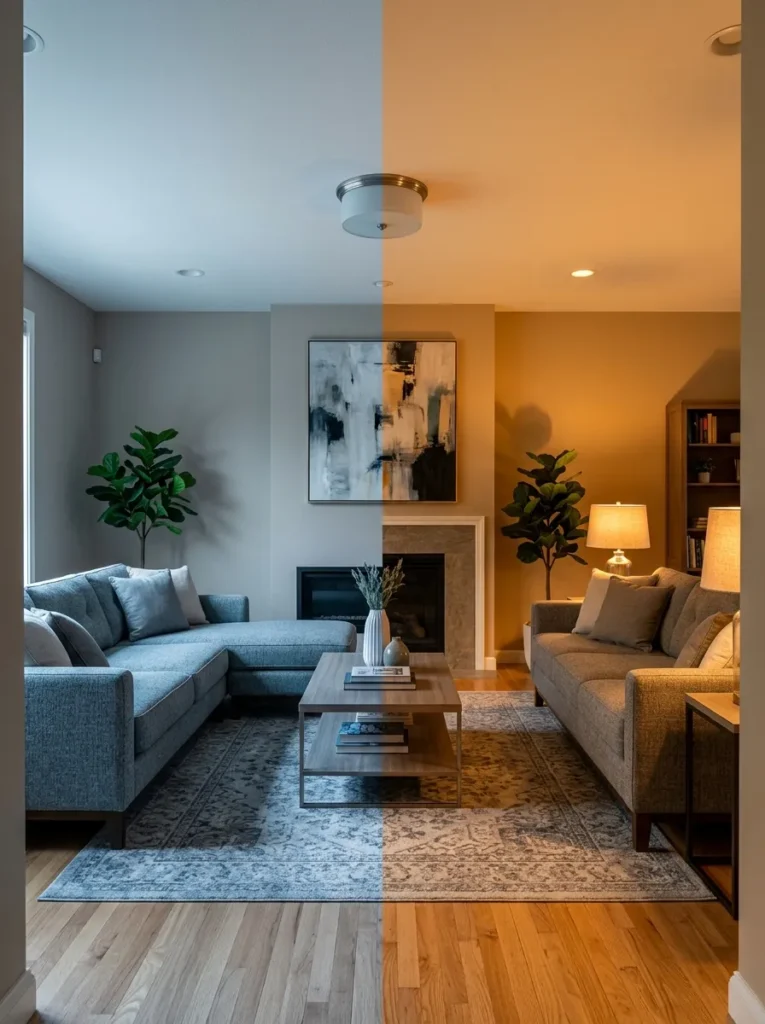
Vibe: The warm light transformation makes the right half of the room feel like a completely different and vastly superior space — without changing a single piece of furniture.
Why it works: The color temperature of a room’s light source determines the warmth of every surface, material, and color in the room simultaneously — a single bulb change affects the perceived tone of the walls, the rug, the sofa upholstery, the wooden furniture, and the skin of any person sitting in the room at once. Cool-white light (4000K and above) adds a blue-gray cast that makes warm materials appear cold, wood appear gray, linen appear white, and skin appear pallid. Warm-white light (2700K) does the inverse — it adds an amber warmth that makes all warm materials appear richer, wood appear honey-toned, linen appear cream, and the room feel genuinely inhabited and welcoming. This is the highest single-action-to-impact ratio in the entire list.
How to get it: Replace every bulb in a room with 2700K warm-white LEDs in the appropriate wattage and base fitting for each fixture. Specify “warm white 2700K” specifically — “soft white” is a US marketing term that can vary between 2700K and 3000K, and 3000K is noticeably cooler than 2700K in a domestic setting. For rooms where different light sources (overhead fixtures, table lamps, floor lamps) currently have different color temperatures, the inconsistency is itself a visual problem — consistent 2700K throughout produces a cohesive warmth that mixed temperatures cannot.
Quick Win: A single $8 warm-white 2700K LED bulb replacing a cool-white bulb in the room’s primary lamp creates an immediately perceptible warmth improvement — the fastest single-purchase room decor improvement in this entire list.
Shop The Look
| Product |
|---|
| Warm white LED bulb 2700K E27 set |
| Warm white LED bulb 2700K E14 set |
| Dimmer switch compatible LED |
| Lamp shade replacement warm tone |
| Floor lamp warm bulb compatible |
Also view: 15 Cool Room Ideas to Upgrade Your Style
2. The Large Rug Rule — Going Bigger Than Instinct Suggests
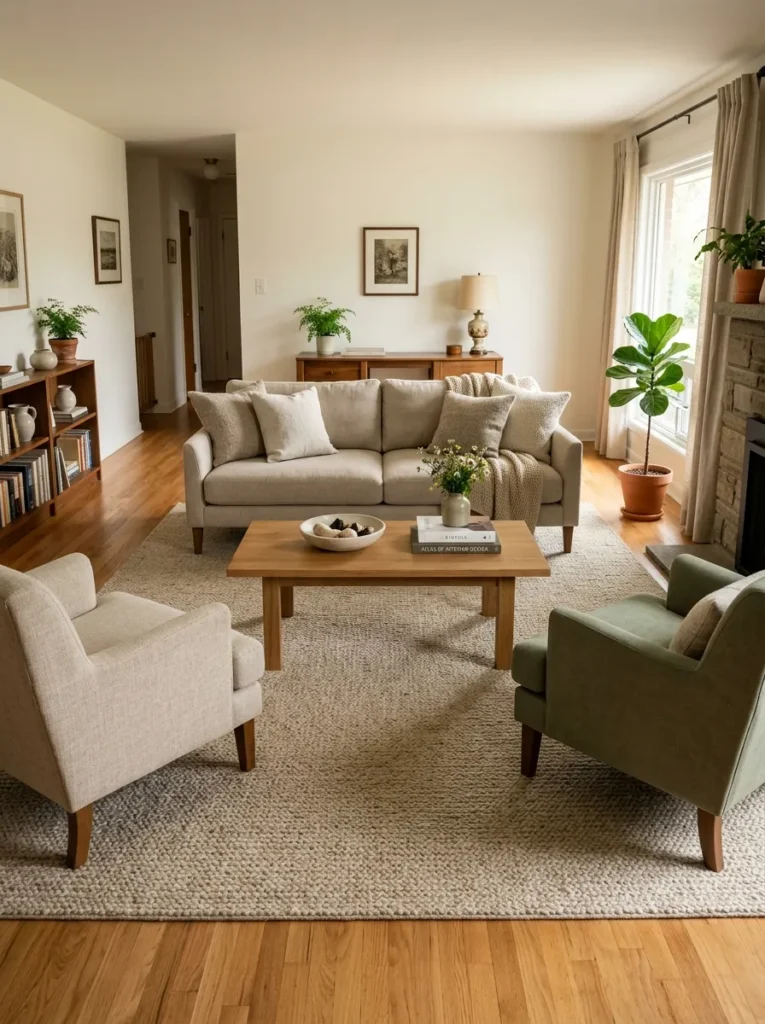
Vibe: The correctly sized rug makes the entire seating arrangement appear designed — the rug’s boundary defining the seating zone as clearly as a room-within-a-room.
Why it works: The most common rug sizing mistake in living rooms is purchasing a rug that is too small — typically one that only fits under the coffee table or only under the front legs of the sofa, which leaves the seating arrangement visually floating on the surrounding floor rather than anchored within a defined zone. A correctly sized rug (large enough for all four legs of all seating to rest on it) creates a unified seating zone that the eye reads as a deliberate composition, making the room’s furniture arrangement appear designed rather than placed. A large rug in a small room also makes the room appear larger — not smaller, as intuition sometimes suggests — because the rug’s continuous surface area is less visually complex than the competing floor and rug sections that a small rug creates.
How to get it: For a standard three-seater sofa with two armchairs, the correct rug size is typically 230×300cm or larger. Measure the seating arrangement’s total footprint (the area enclosed by all four pieces of furniture) and choose a rug at least 45cm larger in each dimension. Before purchasing, mark the intended rug outline on the floor using painter’s tape and live with it for 24 hours — the taped outline reveals the rug’s relationship to the room’s dimensions in a way that measurements on paper do not.
Shop The Look
| Product |
|---|
| Large area rug 230x300cm natural |
| Non-slip rug pad large format |
| Rug tape corner hold flat |
| Jute natural fiber rug large |
| Wool area rug warm tone large |
Also view: 15 Beautiful Luxury Dining Room Inspirations
3. Botanical Layering — Using Plants at Three Height Levels
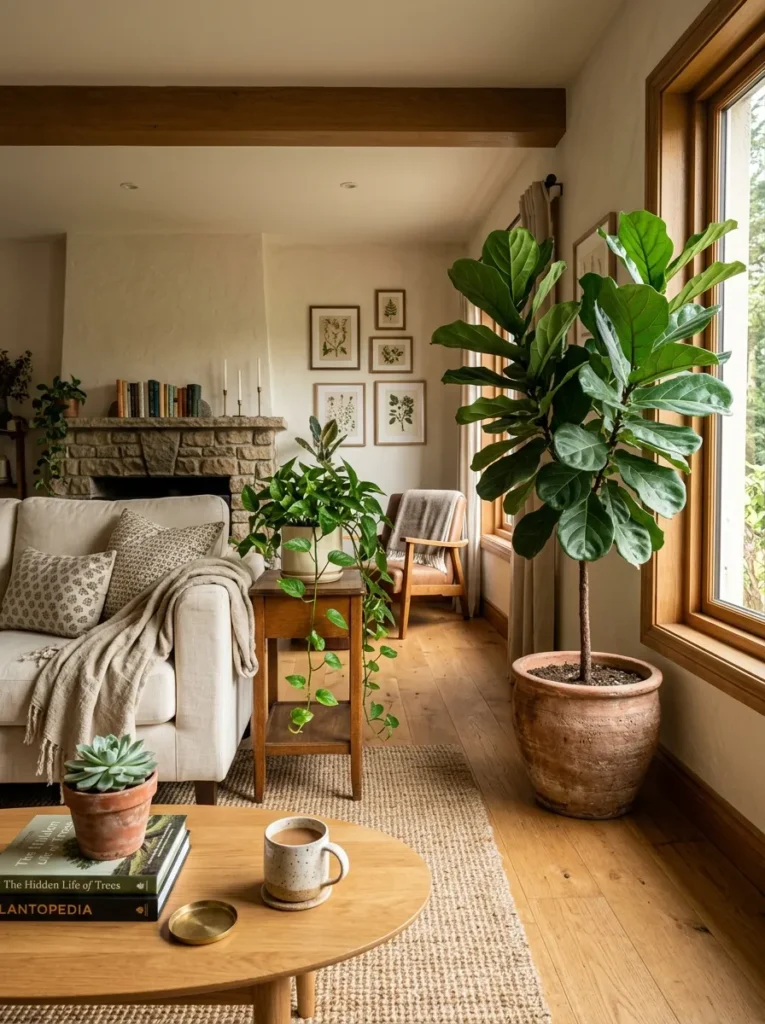
Vibe: The three-height plant arrangement feels like the room has absorbed the principle of a well-planted garden — variety at different levels making the space feel genuinely inhabited by living things.
Why it works: Botanical layering at three height levels applies the landscape design principle of canopy, understory, and ground layer to a domestic interior — a single plant in a room reads as an accessory; plants at three distinct heights read as an intentional botanical environment. The floor plant (at 100–180cm) fills the room’s upper vertical zone with organic form that no purchased decoration can replicate; the mid-height plant (at 60–90cm) provides the room’s eye-level greenery that integrates with furniture scale; the small plant at surface level (on a coffee table, desk, or windowsill) brings the botanical element into the close-range zone where it is experienced in the most tactile detail. Together they create vertical diversity that makes the room feel simultaneously fuller and more alive.
How to get it: Select plants appropriate for the room’s specific light conditions rather than for their visual appeal alone — a plant that is wrong for the light will decline and undermine the room’s quality faster than no plant at all. Bright indirect light: fiddle-leaf fig, monstera, pothos. Low indirect light: snake plant, ZZ plant, peace lily. Deep shade: cast iron plant, heartleaf philodendron. Choose pots that share a material palette (terracotta, ceramic, or woven rattan — not all three simultaneously) at the correct scale for each plant: the pot diameter should be approximately one-third the plant’s visible height.
Shop The Look
| Product |
|---|
| Fiddle-leaf fig large indoor floor |
| Trailing pothos medium indoor |
| Small succulent set surface display |
| Terracotta pot large floor plant |
| White ceramic pot medium side table |
4. The Art of the Styled Bookshelf
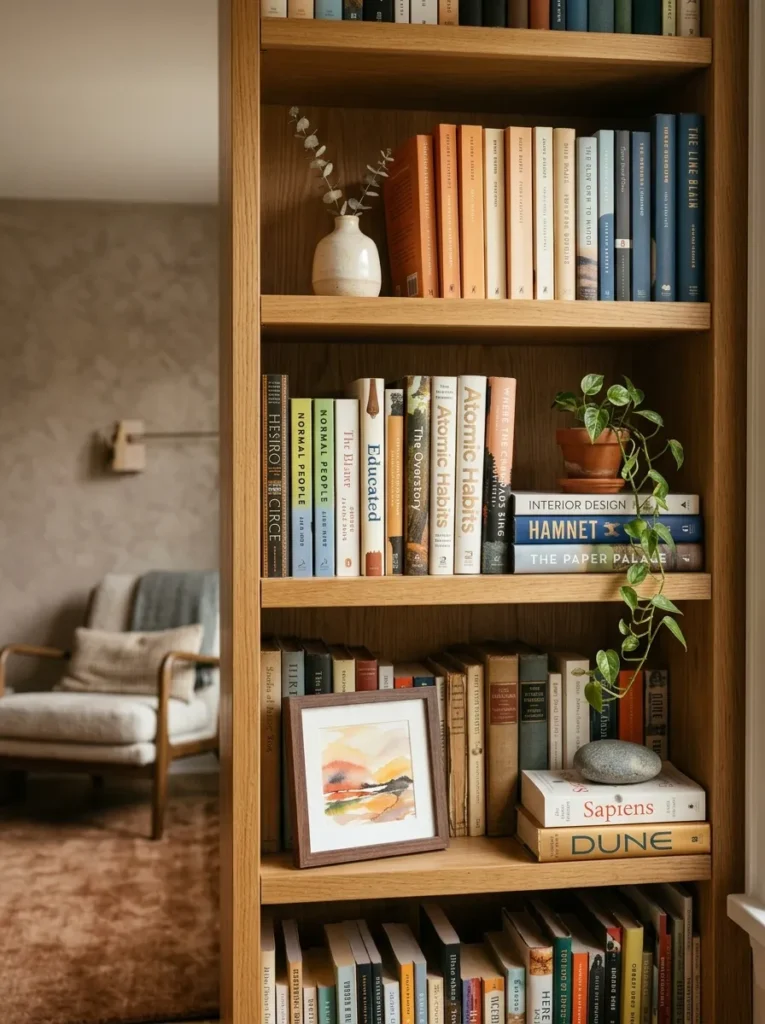
Vibe: The styled bookshelf feels like evidence of a specific, lived life — the books and objects together telling a story that the books alone cannot.
Why it works: A styled bookshelf applies the display design principle of object-and-book integration — a shelf filled entirely with books (regardless of how many and how varied) reads as a library; a shelf where books are interspersed with a small collection of curated non-book objects reads as a personality. The non-book elements do not need to be expensive — a smooth stone from a beach, a small ceramic bought for $12, a dried botanical in a simple vase, a small framed photograph — but they need to be deliberately chosen and deliberately placed at intervals that prevent the bookshelf from reading as wall-to-wall printed spines. The standard ratio that produces the most resolved bookshelf composition is approximately 80% books to 20% non-book objects, with each non-book element positioned so it is visible without being obscured by the books beside it.
How to get it: Remove everything from the shelf and start from scratch. Return books first, in organized sections: group by color in one section (all warm-toned spines together), by size in another (large format art books horizontally stacked), and by genre in a third. Place one non-book object per visible shelf section — a maximum of one plant, one ceramic, one framed piece, and one natural object per total shelf unit. Vary the book arrangement within each shelf: some books standing vertically (the default), some stacked horizontally with an object resting on the stack, and some stored spine-inward for visual texture.
Shop The Look
| Product |
|---|
| Small ceramic vase shelf display |
| Mini plant pot trailing shelf edge |
| Small framed art piece leaning |
| Smooth river stone decorative |
| Book collection curated spines |
5. Linen Bedding — The Bedroom’s Most Impactful Material Change
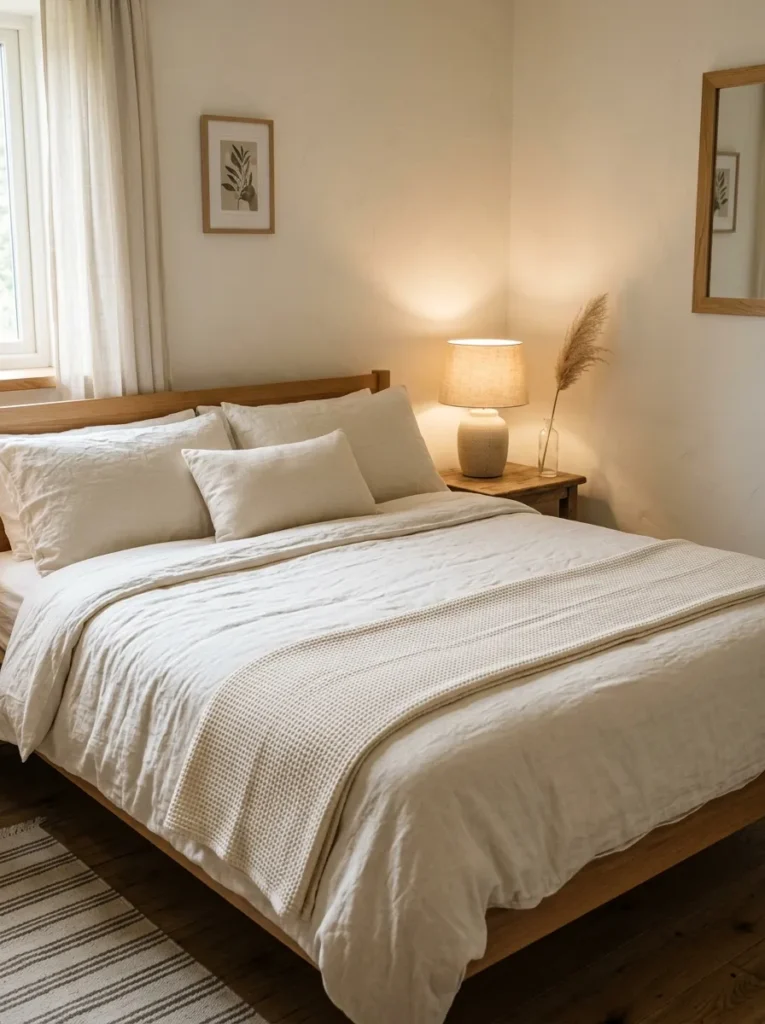
Vibe: The linen bed feels like the specific warmth of a very good hotel that also happens to be yours — natural crease quality communicating relaxed quality rather than effort.
Why it works: Linen bedding applies the material honesty principle — 100% linen’s natural crease quality (it wrinkles without ironing and the wrinkles communicate the fabric’s natural fiber structure rather than carelessness) gives the bed the relaxed, genuine warmth that heavily pressed cotton or synthetic smooth bedding cannot replicate. Linen’s specific material properties — it is cooler than cotton in summer, warmer in winter, softer with each wash, and visually more complex at close range (the slight slub of the natural fiber visible in raking light) — make it the material that most consistently improves both the aesthetic and the physical experience of sleep. The warm-white specification (not bright white, not gray, not ecru) coordinates with the widest range of bedroom wall colors and furniture tones.
How to get it: Source 100% washed linen (pre-washed during manufacturing to remove the initial stiffness of raw linen and allow the natural softness to emerge) from specialist linen bedding retailers — Piglet in Bed, The Linen Works, and Cultiver are specialist linen bedding brands; IKEA’s PUDERVIVA range provides a more accessible entry point at lower price. Wash the linen at 40°C and remove from the dryer while slightly damp, pulling the seams straight before air-drying — this minimal care produces the natural crease quality that is the aesthetic signature of linen bedding.
Shop The Look
| Product |
|---|
| Washed linen duvet cover white natural |
| Washed linen pillowcase pair natural |
| Waffle cotton blanket cream fold |
| Small ceramic bedside lamp warm |
| Dried botanical stem slim vase bedside |
6. Curtain Height — Always Hang from the Ceiling
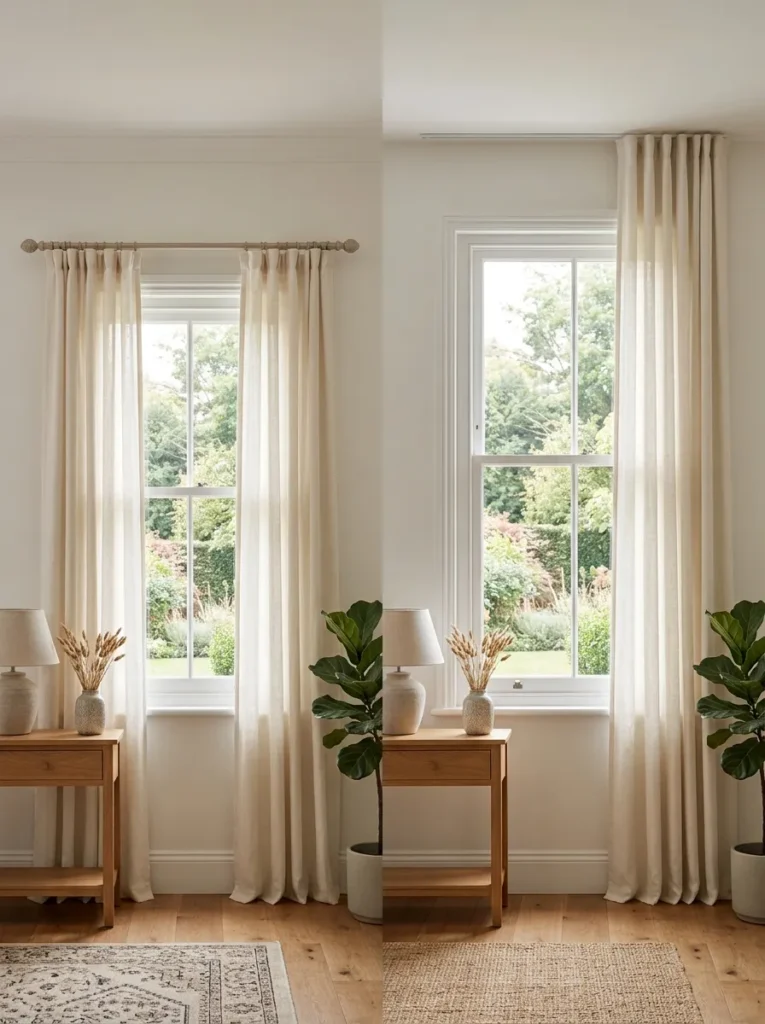
Vibe: The ceiling-height curtains make the right side of the comparison room feel as though it has been architecturally renovated — without touching a single wall or window.
Why it works: Curtain mounting height applies the spatial exaggeration principle of vertical emphasis — when curtain rods are mounted at the ceiling (or within 5–10cm of it) rather than just above the window frame, the curtains appear to begin at the ceiling and end at the floor, creating the visual impression that the room’s ceilings are as tall as the curtain’s full drop. In a standard 240cm ceiling room, ceiling-mounted curtains create the apparent height of a 270–280cm ceiling because the eye follows the continuous curtain fabric from the ceiling junction downward, registering the full distance as the room’s height. The window itself also appears dramatically larger, because the curtain panel extends both above and beside the actual window glass, making the window appear to occupy a greater proportion of the wall.
How to get it: Mount the curtain rod bracket within 5cm of the ceiling (or on the ceiling itself using a ceiling-mount bracket). The rod should extend 25–35cm beyond the window’s visible edge on each side — this allows the curtains, when open, to clear the window glass entirely and stack beside rather than obscuring any of the window’s light. The curtain’s drop should be floor length (ending 1–2cm above the floor for a clean break, or 5–10cm of puddle for a relaxed look). Never hem curtains to the window-frame height — if the standard curtain length is too long, puddle the excess rather than hemming.
Shop The Look
| Product |
|---|
| Ceiling mount curtain bracket set |
| Floor-length linen curtain panel pair |
| Curtain rod extending 280-300cm |
| Curtain ring clip set ceiling rod |
| Level tool ceiling bracket install |
7. The Coffee Table Composition — Three Objects and One Rule
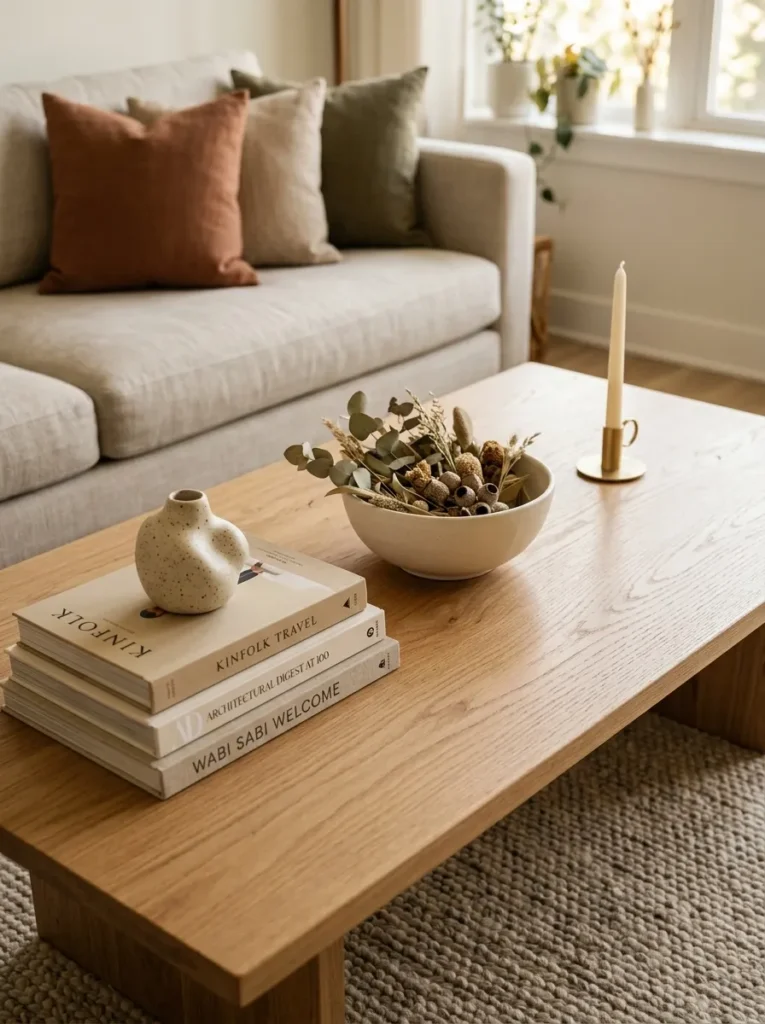
Vibe: The coffee table feels composed — the four objects and the empty space between them communicating that someone thought about this specifically rather than simply placing things down.
Why it works: A coffee table composition with three to four objects and deliberate negative space applies the display design principle of visual breathing room — a coffee table that is fully covered with objects reads as a cluttered surface regardless of the quality of the individual objects; the same table with three to four objects and a clear majority of surface space reads as a composed still life. The specific four-element system (books as a plinth, a ceramic object on top, a central bowl or tray, and a candle at the opposite corner) creates a composition with visual hierarchy (the raised book-and-object element is the tallest and most prominent), a center of gravity (the bowl at the table’s center), and a counterpoint (the candle at the opposite corner). The rule of one: only one of each category — one candle, one plant element, one tray or bowl, one decorative object.
How to get it: Clear the coffee table entirely. Return objects using the four-element system: books first (two to three large format books stacked flat in one corner as a platform, with their spines facing the room’s primary seating position), then the ceramic or sculptural object on top of the books, then the central bowl or tray with two to three small items inside it (a few smooth stones, a dried botanical, a small candle), and finally the single standing candle in a simple holder at the opposite corner. Leave at minimum 50% of the table surface empty — the negative space is as important as the objects.
Shop The Look
| Product |
|---|
| Large format coffee table book set |
| Small ceramic sculpture display |
| Simple ceramic bowl or tray |
| Dried botanical stem small arrangement |
| Simple candle holder single clean form |
8. Bathroom Upgrade — Decanting into Uniform Containers
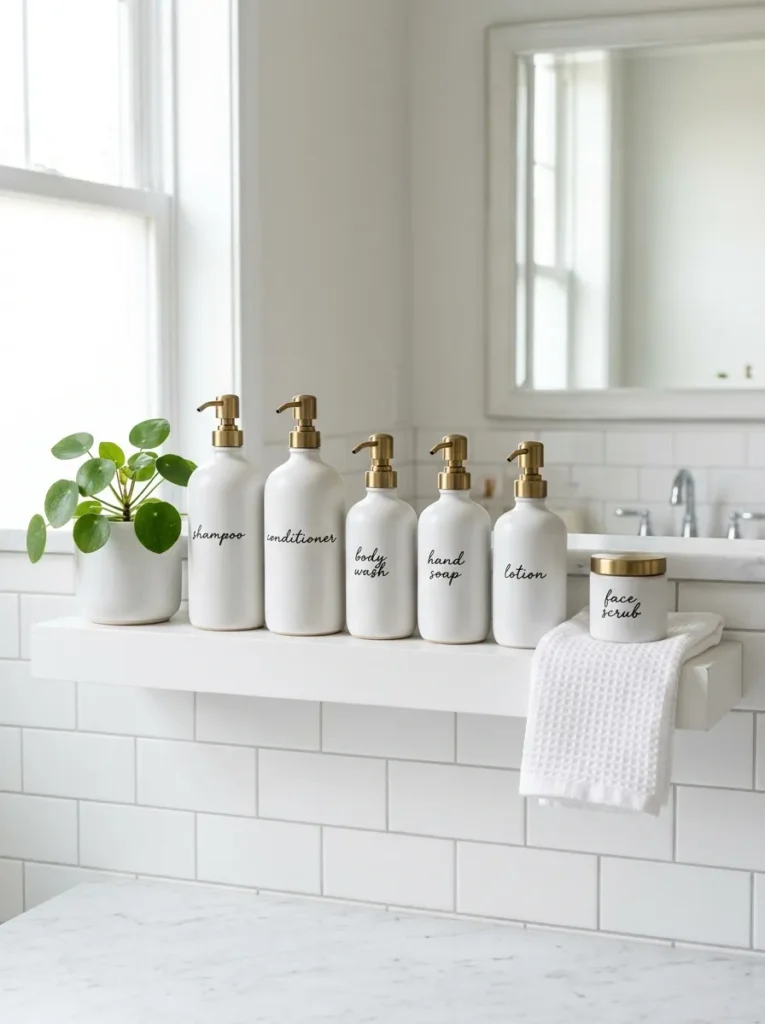
Vibe: The decanted bathroom feels like the products inside have been upgraded alongside the containers — the visual clarity of the uniform set communicating quality that the original commercial packaging undermined.
Why it works: Decanting bathroom products into uniform containers applies the visual noise reduction principle — commercial product packaging is designed to attract attention on a retail shelf, using varied colors, fonts, sizes, and shapes that compete with each other for visual dominance. In a domestic bathroom, this competition between packaging designs creates the visual clutter that makes even a clean, tidily arranged bathroom surface read as busy and disorganized. Replacing the commercial packaging with a uniform set of dispensers and containers (all in the same material, same finish, same color family) eliminates this visual competition entirely, converting the bathroom surface from a collection of marketing objects to a composed arrangement of functional containers. The products inside are unchanged; the experience of the space is transformed.
How to get it: Source a matching dispenser and container set (matte white, ceramic, or brushed metal — not translucent plastic, which shows product residue) with sufficient capacity for the bathroom’s primary products: pump dispenser for liquid soap, pump dispenser for lotion, pump dispenser for shampoo and conditioner, and a hinged or cork-topped jar for cotton pads or small accessories. Decant all products on the first day and discard or store the original packaging. Refill the dispensers when empty using the original products in bulk or replacement products — the dispenser becomes product-agnostic, which is itself a liberating simplification.
Shop The Look
| Product |
|---|
| Matte white pump dispenser set bathroom |
| Ceramic dispenser set matching finish |
| Small ceramic pot cotton pad storage |
| Small plant white ceramic pot bathroom |
| Folded linen hand towel white |
9. The Throw Blanket — Folded, Not Draped
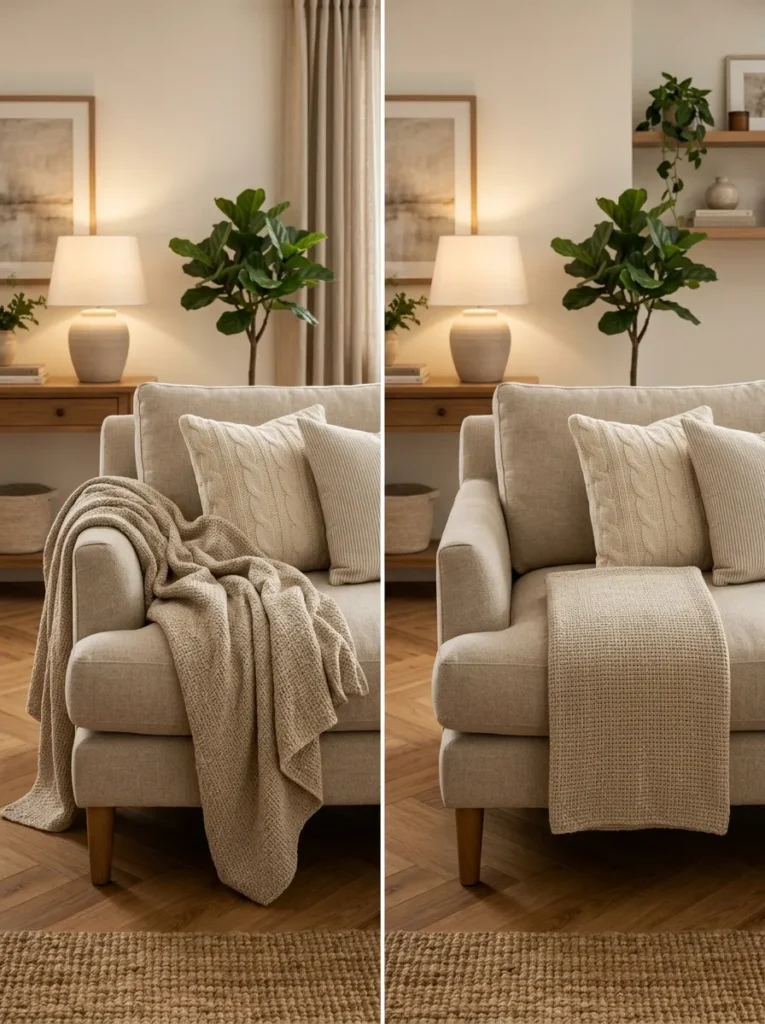
Vibe: The folded throw reads as a design decision rather than a discarded object — one simple choice about how to place an existing piece creating a visible difference in the room’s composed quality.
Why it works: Folding rather than draping a throw blanket applies the precision styling principle — a casually draped throw communicates informality and comfort but also communicates that the throw has been used and not tidied, which is appropriate for an actively inhabited sofa in a family home but undermines the composed quality of a room that is intended to read as designed. A folded throw, placed deliberately across the lower third of the sofa’s seat cushion, communicates both the warmth and comfort of the blanket’s presence (the material quality is still visible and inviting) and the design intention of the person who placed it (the fold is clearly a choice rather than an accident). The fold also reveals more of the sofa’s upholstery and cushions, allowing the sofa’s primary design to be the dominant visual element with the throw as a supporting accent.
How to get it: Fold the throw lengthwise into thirds (fold each long edge to the center, then fold the resulting strip in half or thirds to a width equal to approximately half the sofa’s seat depth). Place across the lower third of the sofa’s seat cushions, centered on the sofa’s width. The throw should extend from one sofa arm to the other at this width, or just shorter than arm-to-arm — not spilling over the armrests. Smooth the fold lines to ensure the visible fold edges are clean and straight.
Shop The Look
| Product |
|---|
| Chunky knit throw oat cream |
| Wool throw warm gray natural |
| Linen throw warm white |
| Sofa cushion coordinating set |
| Sofa arm cover protective |
10. Gallery Wall That Actually Works — The Paper Template Method
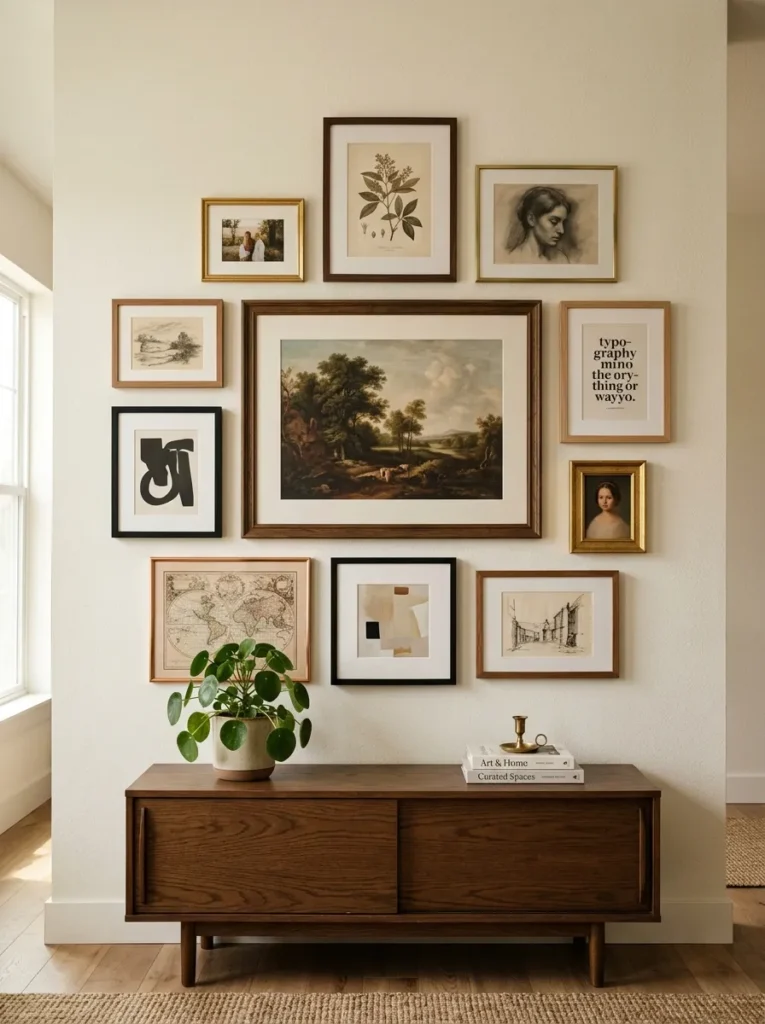
Vibe: The gallery wall feels deliberately arranged rather than randomly hung — the consistent gaps and centered anchor piece communicating that someone planned this arrangement before committing a single nail.
Why it works: A gallery wall assembled using paper templates rather than direct hanging applies the planning-before-commitment principle — the most common gallery wall failure is beginning with a hammer and making incremental adjustments that leave the wall with multiple unnecessary holes and an arrangement that still doesn’t feel quite right. The paper template method (tracing each frame onto paper, cutting out the template, and arranging the templates on the wall using painter’s tape before drilling any holes) allows the entire arrangement to be planned, adjusted, and finalized without any permanent commitment. This removes the anxiety from gallery wall installation and consistently produces better-composed results than direct hanging, because it allows the maker to step back from the full arrangement, assess it from the room’s normal viewing distance, and make adjustments without consequences.
How to get it: Trace each frame onto kraft paper or newspaper and cut out the template. Write the frame’s name and hanging hardware position on each template. Tape the templates to the wall using low-tack painter’s tape, beginning with the largest/anchor piece centered at 145–150cm from the floor. Build the arrangement outward from the anchor, maintaining 3–5cm gaps between all templates. Step back to the room’s primary viewing distance (typically 2–3 metres) and assess the overall shape and balance. Adjust tape positions until satisfied. Mark the hanging hardware position through each template directly onto the wall. Remove templates and install hardware at marked positions.
Shop The Look
| Product |
|---|
| Kraft paper roll template gallery |
| Painter’s tape low-tack set |
| Picture hook set assorted |
| Frame set gallery wall assorted |
| Level tool small gallery hanging |
11. Kitchen Counter Edit — The 70/30 Surface Rule
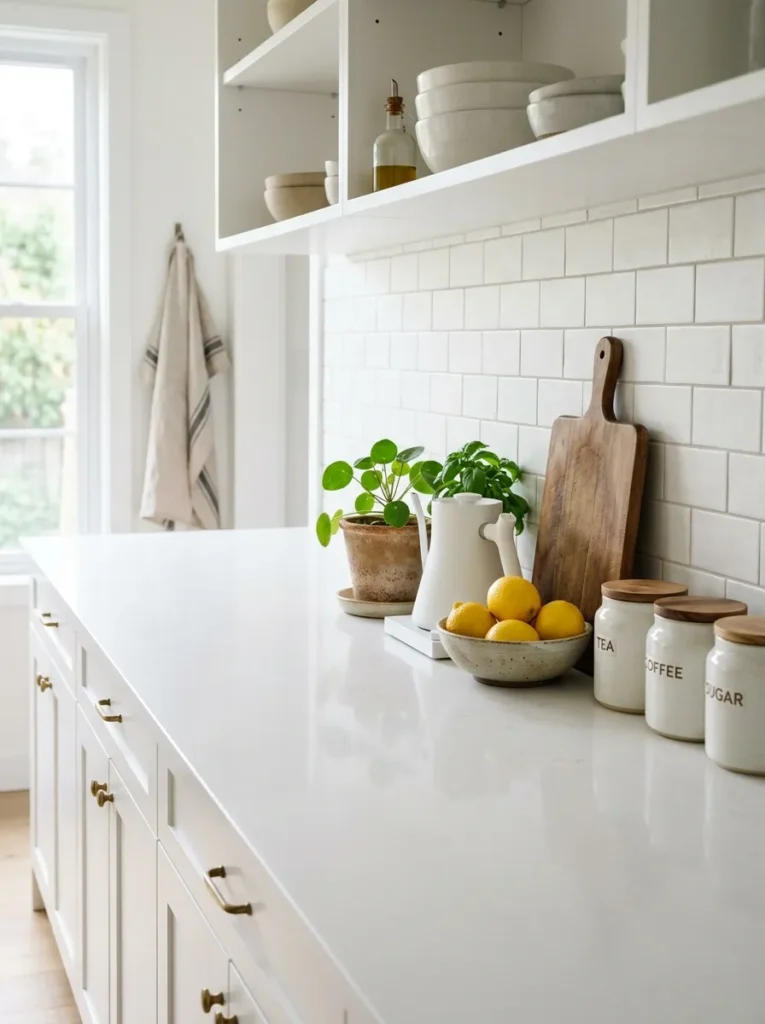
Vibe: The edited kitchen counter feels twice as large as before the edit — the clear majority of surface creating the spaciousness that no renovation could have provided.
Why it works: The 70/30 kitchen counter rule applies the negative space principle at the kitchen’s most used horizontal surface — a worktop covered wall-to-wall with appliances, utensils, containers, and miscellaneous objects reads as small and cluttered regardless of the kitchen’s actual size; the same worktop with 70% of its surface clear reads as generous and functional regardless of the kitchen’s size. The 30% that remains on the worktop is grouped and composed rather than distributed, so it reads as a curated collection rather than accumulated clutter — the difference between objects deliberately arranged and objects that happen to be there. This is the room decor idea with the highest ratio of impact to cost in the entire list, since it costs nothing and requires no purchase.
How to get it: Remove everything from the kitchen worktop. Return only items that meet two criteria: they are used at minimum once daily, and they cannot be stored in a cupboard without creating a significant daily inconvenience. For most kitchens, this means the kettle, the toaster (if used daily), one or two canisters for coffee and sugar, and the chopping board — everything else returns to a cupboard. Group the retained objects at one end or one section of the worktop rather than distributing them across the full surface. Add one aesthetic element (a small plant in a ceramic pot, a bowl of fruit) to the composed group. Assess after 48 hours — the items that have drifted back onto the cleared surface during normal use are the items that genuinely need worktop placement.
Shop The Look
| Product |
|---|
| Ceramic canister set kitchen coordinated |
| Wooden chopping board natural |
| Small plant ceramic pot kitchen |
| Ceramic fruit bowl simple form |
| Clear worktop organization tray |
12. The Reading Corner — Creating Functional Intimacy
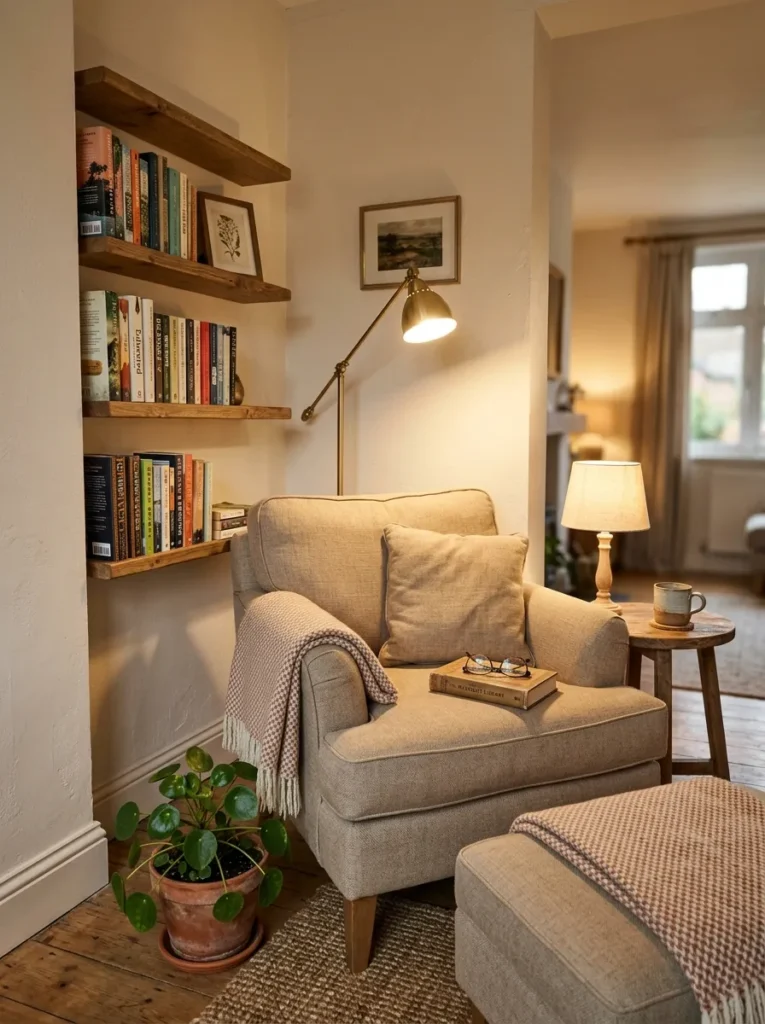
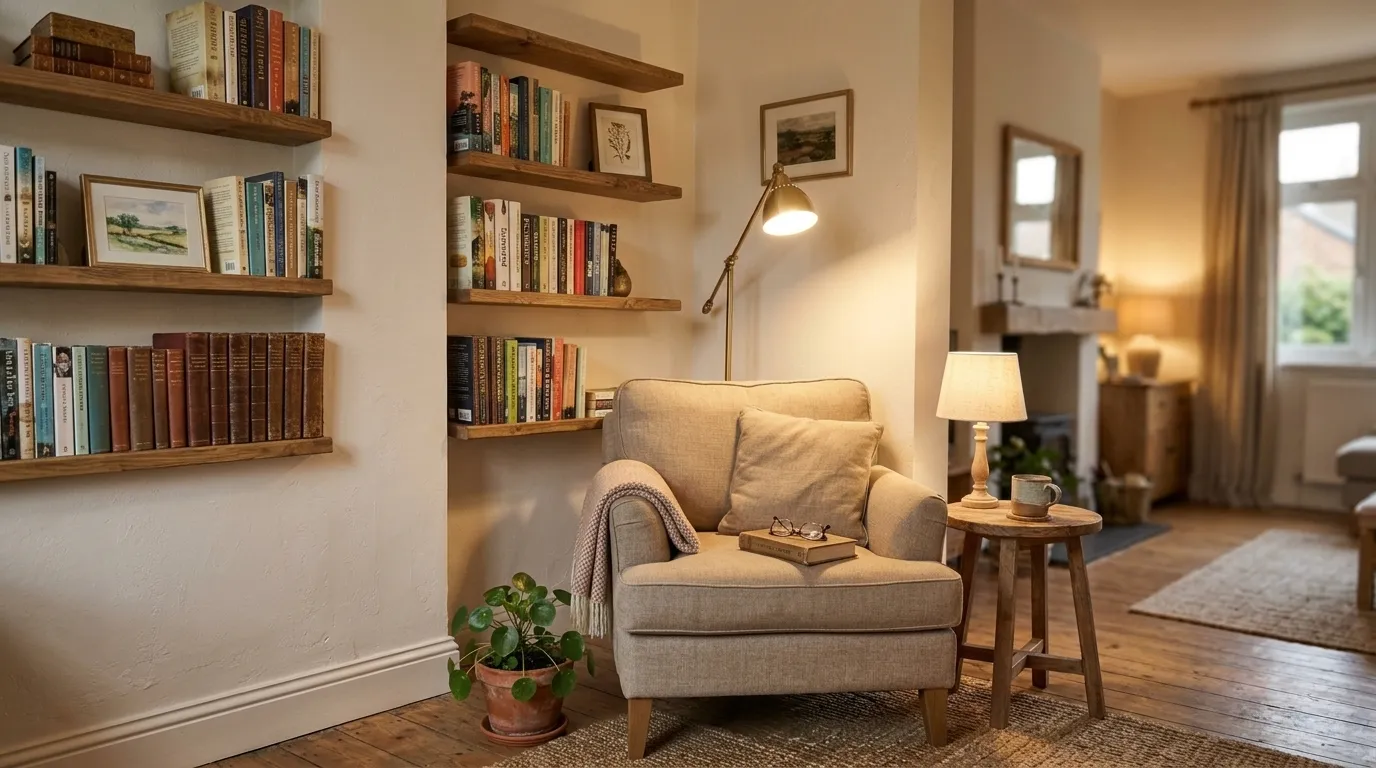
Vibe: The reading corner feels like the most specific invitation in the home — the composed elements communicating not just that sitting here is possible but that sitting here is specifically what this corner is designed for.
Why it works: A reading corner applies the designed-zone principle — a room where every area is multipurpose has no specific invitation; a room with one deliberate single-purpose zone (reading, writing, making tea) has a specificity that gives the room a character it otherwise lacks. The reading corner’s requirements are precise: a comfortable chair, a light source positioned for reading (behind and above the reader’s head, not in front), a surface at arm height for a drink and a book, and books within reach. These four elements together create a zone whose function is immediately legible to anyone entering the room — the reading corner says “someone reads here, specifically, in this chair, in this light” in a way that a sofa in a general living room does not.
How to get it: Identify a room corner that receives natural light during the reading hours (typically morning or afternoon) and is slightly separated from the room’s main traffic flow. Place a comfortable single chair (high back, deep seat, generous arm height) in the corner. Position a floor lamp behind and to one side of the chair at shoulder height — the light should illuminate the reading surface (the lap and any hand-held book) without creating glare. Add a small side table at armrest height on the opposite side of the chair from the floor lamp. Place three to five books on a small wall shelf or in a small stack on the floor beside the chair — these should be current or recent reading, not a permanent display.
Shop The Look
| Product |
|---|
| Linen armchair comfortable deep seat |
| Arc floor lamp warm bulb |
| Small side table armrest height |
| Footstool matching or complementary |
| Small terracotta plant pot floor |
13. Bedroom Mirror Placement — Doubling the Light
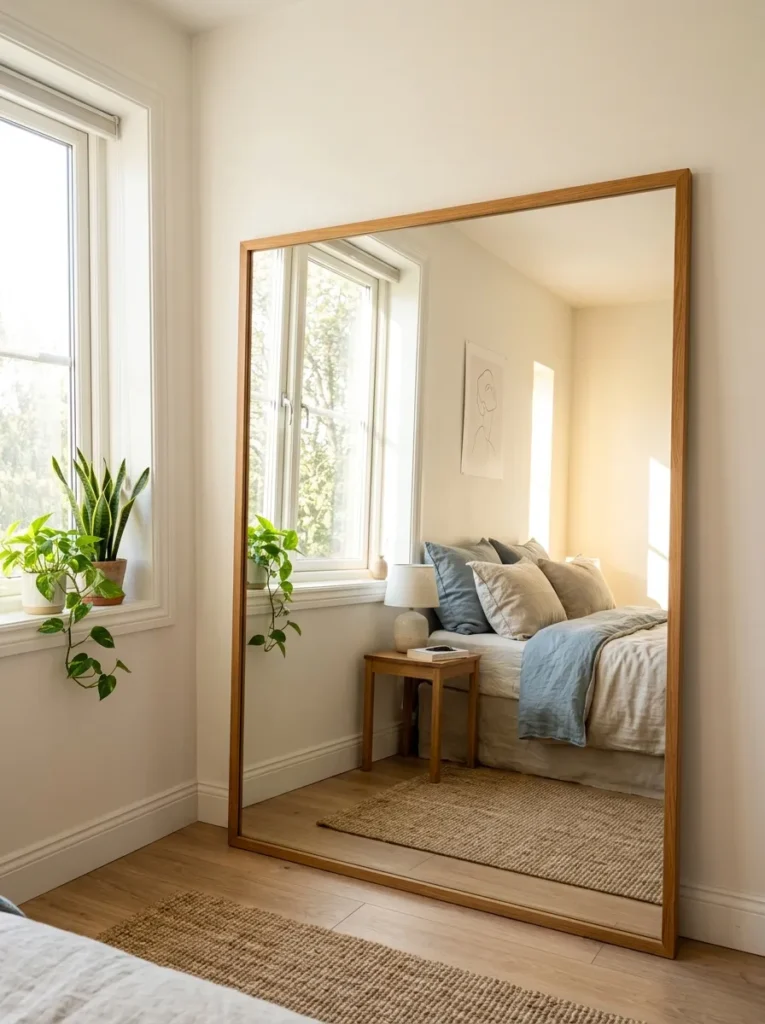
Vibe: The strategically placed bedroom mirror feels like someone added a second window — the reflected light fundamentally changing the room’s brightness and quality.
Why it works: Strategic mirror placement to reflect natural light applies the optical amplification principle — a large mirror positioned at 90 degrees to a window (on the wall perpendicular to the window wall) captures the window’s incoming daylight and reflects it across the room’s depth, creating a second apparent light source at the point of the mirror’s reflection. This dramatically increases the room’s perceived brightness — particularly in bedrooms where the primary window is the room’s only natural light source — without any structural modification. The mirror is also simultaneously a functional bedroom object (for dressing), a spatial enlarger (reflecting the room back on itself creates the impression of greater depth), and a decorating element (a well-chosen mirror frame contributes to the room’s material palette).
How to get it: Position the mirror on the wall that is perpendicular to the room’s primary window (the wall that faces the window from a 90-degree angle). A full-length mirror (at least 150cm tall) captures and reflects a larger portion of the incoming light than a smaller mirror. The mirror’s distance from the window is less important than its perpendicular angle — any mirror at approximately 90 degrees to the window will reflect the daylight effectively. Lean the mirror or hang it, with the mirror face angled very slightly toward the window (1–2 degrees tilt from the wall) for maximum light capture.
Shop The Look
| Product |
|---|
| Full length floor mirror 150cm |
| Simple warm frame large mirror |
| Mirror lean back safety strap |
| Small windowsill plant natural light |
| Linen bedding set white natural |
14. Dining Table Always-Set — Treating Daily Meals as Occasions
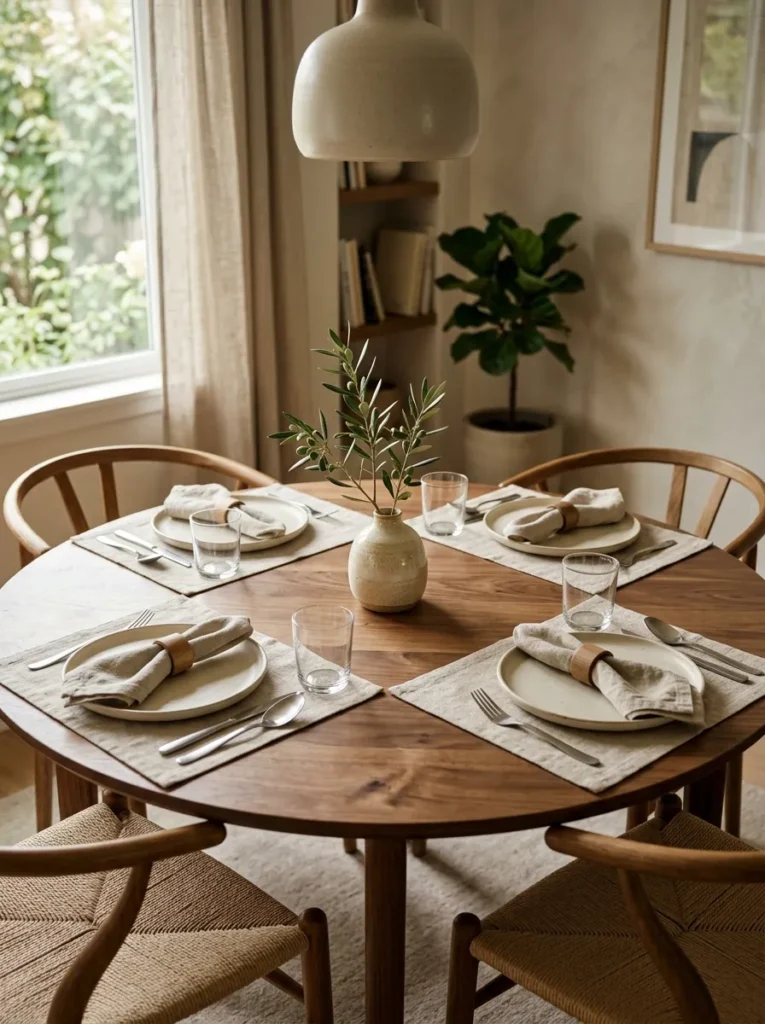
Vibe: The always-set dining table feels like the home values the daily meal as a genuine occasion — the simple quality of the setting elevating every meal eaten at it.
Why it works: A consistently set dining table applies the behavioral environment design principle — spaces set up for a specific, positive activity invite that activity more readily than spaces that must be set up for each use. A dining table that is cleared of everything after each meal requires the resetting effort before every subsequent meal, which creates a small but real friction against using the table for meals (versus eating at the sofa, at a desk, or standing). A table that maintains a simple, consistent setting (placemats always in place, a centrepiece always present, napkins always available) invites daily meal use without additional setup, making the physical environment an ally of the behavioral intention to eat at the table rather than an obstacle.
How to get it: Identify the table’s permanent elements (the elements that remain set between meals): linen or cotton placemats at each seat position, a consistent centrepiece in the table center (a ceramic vase with seasonal botanical stems, changed monthly), and one cloth napkin per seat position folded simply beside the placemat. The variable elements (plates, cutlery, glasses) are set for each meal and cleared afterward, but the permanent elements create the table’s consistent visual identity that makes it always read as “set” rather than “empty.”
Shop The Look
| Product |
|---|
| Linen placemat set 4 natural |
| Ceramic dinner plate set 4 white |
| Simple cloth napkin set 4 |
| Low ceramic vase centrepiece |
| Botanical stem dried seasonal |
15. The Scent Layer — Making Rooms Beautiful Through Smell
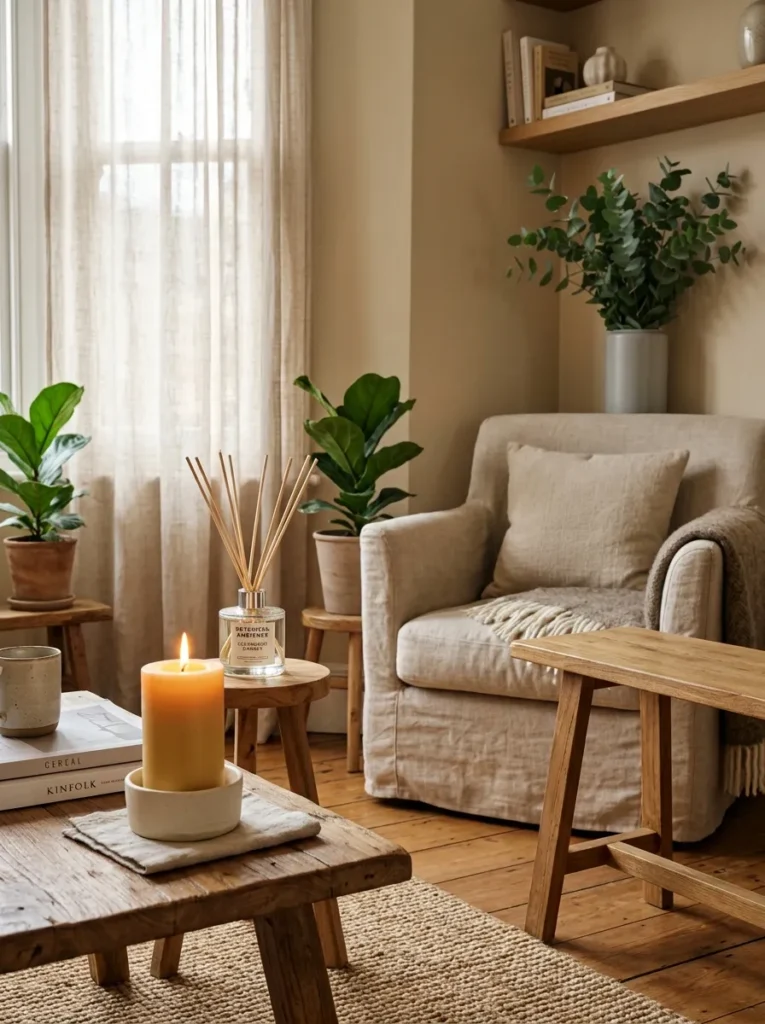
Vibe: The scented room feels welcoming before it has been looked at — the botanical fragrance registering as warm and specific before any visual assessment of the room has been made.
Why it works: The scent layer applies the multi-sensory environment principle — a room that is beautiful to look at but has no specific scent character leaves the olfactory dimension of the environment unaddressed, which means the room is experienced as less complete than its visual quality suggests. A room with a consistent, pleasant, natural scent is experienced as warmer, more personal, and more genuinely inhabited than the same room without scent — because scent is the sense most directly connected to memory and emotion, a room that smells specific and pleasant registers as a place with a personality. Natural botanical scents (beeswax, eucalyptus, cedarwood, lavender, lemon) are the most appropriate scent palette for domestic rooms because they reference genuinely pleasant natural environments rather than manufactured fragrance.
How to get it: Layer scent from three to four sources simultaneously rather than relying on a single candle or diffuser: a beeswax pillar candle (for evening use — the natural honey fragrance of beeswax is among the most pleasant and most universally appreciated domestic scents), a botanical diffuser with a natural oil blend (for continuous background fragrance), a fresh or dried botanical element (eucalyptus, lavender, or rosemary in a vase — the subtle scent releases when disturbed), and a linen spray for textiles (misting the sofa, cushions, and curtains periodically with a natural botanical spray adds the scent dimension to the room’s primary soft furnishings). All scent sources should be from the same botanical fragrance family for coherence rather than competing.
Shop The Look
| Product |
|---|
| Natural beeswax pillar candle |
| Reed diffuser botanical natural set |
| Fresh eucalyptus bunch large |
| Natural linen spray botanical |
| Ceramic candle holder simple form |
How to Start Your Beautiful Room Transformation
The single best first move across all 15 ideas in this list is the easiest and the cheapest — replacing the room’s bulbs with 2700K warm-white LEDs (Idea 1). This single change costs $15–30 and takes under twenty minutes, but it determines the success of every subsequent decorating decision in the room, because the warmth or coolness of a room’s light source affects how every material, color, and surface in the room is perceived. A linen sofa in cool light reads as gray; in warm light it reads as cream. A wooden floor in cool light reads as cold; in warm light it reads as honey. The plant in cool light reads as green; in warm light it glows. Everything that follows in this list — the rug, the plants, the linen bedding, the gallery wall — performs better and reads more beautifully against a warm light background than a cool one. The bulb change is the foundation.
The most common mistake in room decor is purchasing additional objects when the existing objects are already sufficient and the problem is arrangement, not quantity. Most rooms benefit from subtraction (removing objects that compete with each other or accumulate without contributing) rather than addition before any new purchase is made. The coffee table composition rule (Idea 7) and the kitchen counter edit (Idea 11) are both free — they require only the willingness to remove objects that are present more through inertia than through decision. The most beautiful rooms are consistently those with the fewest objects in the most considered positions, not those with the most objects in good positions. Before purchasing anything from this list, spend one hour removing objects from the three surfaces in your home that feel most cluttered. The result will be more immediately beautiful than anything you could add.
Three specific items under $50 that immediately improve any room across multiple ideas in this list: a pack of 2700K warm-white LED bulbs in the appropriate base fittings ($15–25, enabling Idea 1 and improving the effect of Ideas 3, 7, 12, and 15 simultaneously); one large area rug in a natural fiber (jute, sisal, or a natural-colored wool blend — available from $35–90 in the correct large format from IKEA, Dunelm, or marketplace retailers, enabling Idea 2 and transforming the seating zone’s cohesion); and a trailing indoor plant in an appropriate pot ($8–18 from a garden centre, enabling Ideas 3 and 12 and adding the living organic element that no purchased decoration can replicate). These three items combined for under $60 apply three of this list’s most impactful principles simultaneously.
A surface-level room refresh (bulbs, edited surfaces, repositioned furniture, throw refolding) is achievable in a single afternoon at zero cost. A mid-range room transformation (large rug, curtains hung at ceiling height, linen bedding, three-level plant arrangement, gallery wall) takes a weekend and costs $150–450 depending on existing items available. A complete room overhaul applying all applicable principles from this list represents two to three weekends of work across $300–800, depending on the room and the level of material upgrade involved. The bulb change and the surface edit happen today; the rug and the curtain rehang follow this weekend, and everything else takes its time and arrives as the room reveals what it needs next.
Frequently Asked Questions About Beautiful Room Decor Ideas
What makes a room feel beautiful rather than just well-furnished?
A room feels beautiful when its elements appear to have been chosen and arranged in deliberate relationship to each other rather than selected independently and placed wherever space permitted. The specific qualities that create this relational quality are: material coherence (the rug, the cushions, the curtains, and the plant pots share a color family or material palette even if they are different objects), appropriate scale (each object is the right size for its position — not too small to read from the room’s natural viewing distance, not too large to overwhelm its immediate context), layered lighting (at least two warm light sources at different heights, so the room is not entirely dependent on overhead illumination), and the presence of at least one living element (a plant, a fresh flower, a seasonal botanical) that provides the organic quality no manufactured object can replicate.
How do you choose a color palette for a room?
The most reliable approach to room color palette selection begins with one anchor material — the rug, the sofa, or the flooring — and builds outward from its tones rather than starting with a paint color and working forward. Identify the two or three tones within the anchor material and use those tones as the palette’s reference: the dominant tone becomes the wall color (or its closest appropriate paint equivalent), the secondary tone appears in the curtains or bedding, and the accent tone appears in the cushions and smaller accessories. This reverse-engineering approach ensures that the room’s colors are in genuine relationship to each other because they originate from the same material source. The most common palette mistake is selecting all elements independently (paint from one inspiration, sofa from another, rug from a third) and discovering that the colors share no underlying tone relationship.
What is the most impactful single decor change for a small room?
For a small room, the most impactful single change is curtain height — specifically, mounting the curtain rod at the ceiling rather than above the window frame (Idea 6). This change costs nothing if the existing curtains are already floor-length, or the cost of a new rod position if they need to be rehung, and it produces an apparent increase in ceiling height and window size that no furniture purchase or decoration can replicate. The second most impactful change for a small room is a large rug (Idea 2) — counterintuitively, a large rug makes a small room appear larger because it creates a single coherent floor surface rather than the competing floor/rug boundary that a small rug creates. Both changes improve the room’s apparent dimensions rather than its content, which is always the highest-leverage intervention in a small space.
How do you make a rented room or apartment feel beautifully personal without permanent changes?
The most impactful non-permanent room decor changes available in a rental context are: ceiling-height curtains (which require only a new rod positioned using removable ceiling-mount brackets rather than drilling), large rugs (which sit on the floor without any fixing), plants (which add organic life without touching the walls), and the coffee table and shelf styling approaches (Ideas 4 and 7) which require no wall changes. For gallery walls specifically (Idea 10), 3M Command strips (rated for 3.5–7.5kg per pair depending on the strip specification) allow picture hanging without permanent holes in most rental wall surfaces. The scent layer (Idea 15) is entirely non-structural. In total, eleven of the fifteen ideas in this list are fully achievable in a rental without any permanent modification.
How often should room decor be refreshed?
The most useful frame for thinking about decor refresh frequency is seasonal rather than annual — four refreshes per year, each taking a single afternoon and requiring minimal new purchases. The seasonal refresh updates the botanical element (the centrepiece, the plant selections, the dried botanical arrangements) to reflect the current season, swaps one or two cushion covers in the seasonal palette (deeper tones in autumn and winter, lighter tones in spring and summer), and adjusts the scent layer to seasonal botanical preferences (woody/spiced in winter, fresh/green in summer). These four micro-refreshes maintain the room’s sense of currency and attention without requiring the effort or cost of a full room overhaul, and they keep the room’s connection to the natural world’s seasonal rhythm — which is the specific quality that makes rooms feel alive rather than static.
Ready to Make Every Room More Beautiful?
These 15 ideas move through every dimension of what makes a room genuinely beautiful — from the foundational atmospheric impact of warm light and the spatial intelligence of correctly sized rugs and ceiling-height curtains, to the material warmth of linen bedding and botanical layering, to the organizational elegance of edited surfaces and composed coffee tables, to the sensory completeness of scent layering and reading corners that genuinely invite reading. Starting with the bulb change — this evening, with the warm-white LEDs switched in before dinner — is not a modest beginning. It is the beginning that makes everything else in this list possible, because every principle in this article is experienced through light, and the quality of that light determines whether the room’s materials appear warm or cold, its arrangement appears composed or cluttered, its colors appear rich or flat. Change the light first. Then look at the room and see what it is asking for next. Pin the ideas that felt most true to the specific room you were thinking about while reading, and return to the gallery wall and the reading corner when the light is right and the room has shown you what it needs. When the room is warm and considered and genuinely, completely itself — that is when the decorating is finished.