15 Beautiful Luxury Dining Room Inspirations
Beautiful luxury dining room inspirations use premium materials, considered lighting, architectural detail, and the specific quality of furniture and textile that reads as designed rather than assembled — creating dining rooms where every element has earned its place and the room communicates abundance, craft, and intention without relying on cost alone to signal quality. This article gives you exactly 15 ideas spanning material palettes, lighting design, furniture, wall treatments, table styling, and small dining room transformations so every home and every budget finds a luxury dining direction that is genuinely achievable.
A truly luxurious dining room is not the most expensive version of a room — it is the most considered one. The distinction between expensive and luxurious is the difference between a room that announces its cost and a room that communicates its quality, and the second reading is always more compelling than the first. Here are 15 ideas worth saving — and realizing.
Why Beautiful Luxury Dining Room Inspirations Work So Well
The dining room occupies a specific position in the hierarchy of domestic spaces — it is the room most used for social performance (entertaining guests, hosting significant family occasions, celebrating milestones), and its design quality is therefore both the most visible and the most consequential of any room in the house. The history of the dedicated dining room as a specific designed space begins in the late 18th century, when the separation of dining from other domestic activities became a marker of social status in European and American households. The Georgian dining room established many of the design conventions that still define the luxury dining room today: a central table capable of extending to seat significant numbers, substantial upholstered seating, a sideboard or buffet for serving and display, a statement chandelier providing the room’s primary illumination, and wall treatment of sufficient quality to read as architectural rather than decorative.
Contemporary luxury dining room design draws from this historical foundation while incorporating the material and aesthetic preferences of the current moment: large-format stone and porcelain wall cladding (particularly book-matched marble and veined porcelain in a dining room’s feature wall), architectural lighting design that layers ambient, accent, and decorative sources rather than relying on a single statement fixture, upholstered dining chairs in high-performance luxury fabrics (boucle, velvet, high-count linen) that reference hospitality design rather than domestic furniture, and the specific color palette that has dominated premium residential interior design since approximately 2018 — deep warm greens, warm charcoals, warm navies, dusty blush, and the full range of earthy terracottas and warm neutrals that replaced the cooler gray-dominant palette of the previous decade.
The luxury dining room category drives significant commercial engagement in the design media — publications including Architectural Digest, House & Garden, Elle Decoration, and World of Interiors consistently cover high-specification dining rooms as among the most aspirationally resonant residential interiors, and the design decisions documented in this coverage have a well-documented trickle-down effect into the accessible luxury market that most homeowners inhabit. The specific design moves that define the contemporary luxury dining room — the fluted panel feature wall, the statement pendant over an extension table, the boucle or velvet upholstered chairs, the linen napkin with a botanical tied detail, the decanted wine in a crystal decanter on a marble sideboard — all originated in high-specification residential and hospitality design and have become achievable at significantly more accessible price points through mass-market interpretation.
Small dining rooms and dining areas within open-plan living spaces benefit particularly from luxury design investment because the concentrated footprint means that individual element quality is experienced at close range and the total number of elements requiring investment is smaller. A 3×4 metre dedicated dining room requires only: a table, six chairs, a sideboard or buffet, one or two light fixtures, and wall treatment — five categories of investment compared to the fifteen or twenty that a living room or kitchen requires. This concentration of investment creates the opportunity for significantly higher individual element quality within the same total budget.
Style at a Glance
| Element | Luxury Core | Contemporary Edge |
|---|---|---|
| Philosophy | Every element considered, nothing incidental | Quality over quantity, material honesty |
| Materials | Marble, velvet, linen, oak, brass | Fluted panel, boucle, book-matched stone |
| Color Palette | Deep green, warm charcoal, warm navy | Dusty blush, terracotta, warm greige |
15 Beautiful Luxury Dining Room Inspirations
1. Deep Forest Green Walls with Antique Brass Fixtures
Vibe: The forest green dining room feels like dining in a private members’ club — the enveloping dark walls creating a focused, intimate atmosphere that large pale rooms cannot achieve.
Why it works: Deep forest green walls in a dining room apply the enclosure principle of chromatic immersion — when all four walls of a dining room are the same deep, warm-toned color, the room reads as a contained, atmospheric environment rather than a decorated domestic space. The specific quality of forest green in a dining room context is its ability to make both the table setting and the faces of the people seated at it appear warmer and more luminous by contrast, a property documented by professional photographers and lighting designers who specifically recommend deep warm-tone wall colors for dining rooms where candlelight photography is anticipated. Antique brass fixtures (chandelier and sconces) are the specifically appropriate metallic in this color context because brass’s warm yellow-orange tone shares the same chromatic family as forest green’s yellow-green undertone, creating a cohesive warm metallic-botanical palette.
How to get it: Specify walls in Farrow & Ball Studio Green No. 93, Little Greene Obsidian Green, or Benjamin Moore Hunter Green in a dead flat or matte finish — the matte surface absorbs rather than reflects light, deepening the color’s perceived richness. Use the same green on all four walls including the window reveals and the door reveals — the consistency of green across all surfaces (interrupted only by the white ceiling and white trim) creates the immersive quality that a feature wall approach does not. Specify antique brass (not polished or satin brass) for all fixtures — the aged quality of genuine antique brass or a convincing aged-brass finish reads as authentic material rather than metallic decoration.
Quick Win: Deep forest green paint applied to a single dining room wall as a feature behind the sideboard (rather than all four walls) creates the luxury green dining room reference at the cost of one tin of paint and one afternoon’s work — the most immediately transformative luxury dining room intervention available at minimum cost.
Shop The Look
| Product |
|---|
| Deep forest green matte wall paint |
| Antique brass chandelier dining room |
| Velvet dining chair set 6 green blush |
| Marble-topped sideboard natural stone |
| Brass wall sconce set dining room |
Also view: 16 Contemporary Dining Room Decor Ideas Worth Saving
2. Book-Matched Marble Feature Wall Behind the Dining Table
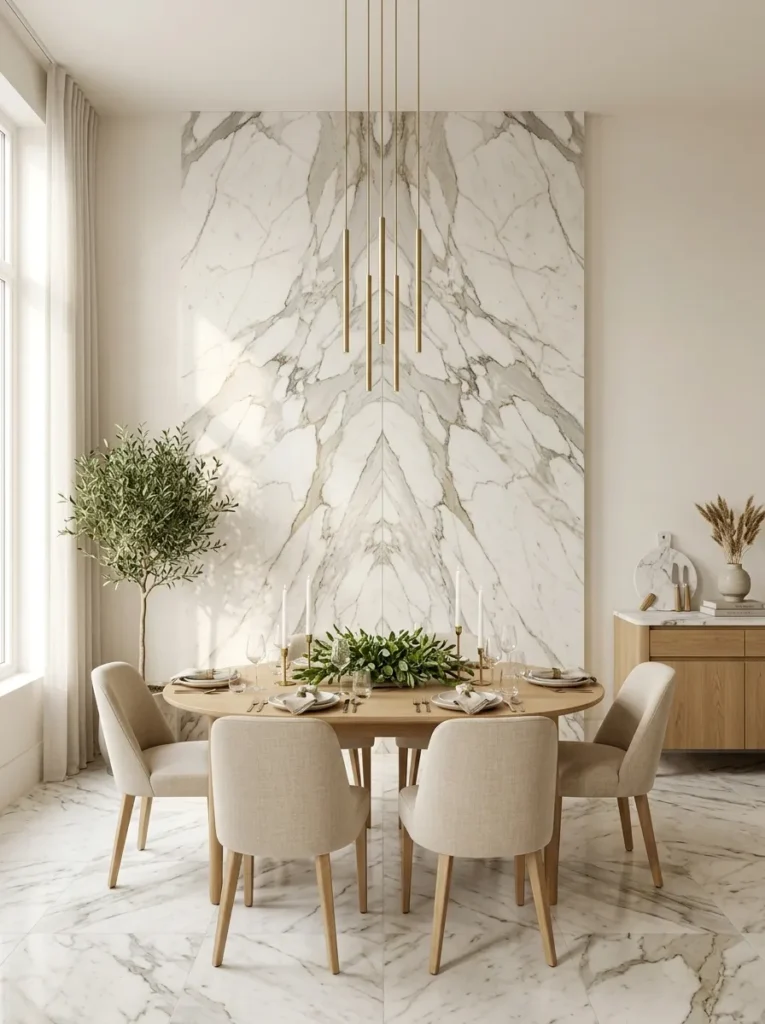
Vibe: The marble feature wall feels like the dining room has a painting that the building made — the book-matched veining a composition of natural stone that no artist could replicate.
Why it works: A book-matched marble feature wall behind the dining table applies the luxury material principle of nature as designer — book-matching (installing two panels of stone or porcelain cut from the same slab, rotated to face each other and creating a mirror-image of the natural veining pattern) produces a symmetrical composition unique to each specific slab, making the installation genuinely one of a kind. The wall behind the dining table is the most consistently viewed surface in the room — every person seated at the table looks toward it throughout the meal — making it the highest-value surface for material investment in the room. Book-matched marble or high-quality marble-effect porcelain (which has reached a visual fidelity in contemporary printing technology that makes distinction from natural stone effectively impossible at room scale) on this wall creates an art-equivalent installation that operates as the room’s primary aesthetic statement.
How to get it: Specify large-format porcelain slabs (1200×2400mm or 1200×3000mm) in a book-matched format from a specialist tile supplier — order the panels in pairs, specifying that they should be from the same production run and installed as book-matched. Install using a specialist large-format tile adhesive with full-bed coverage (partial coverage causes slab stress fractures in large formats). Use a professional installer experienced in large-format slab installation — this is not a DIY project at this scale and material quality. The floor-to-ceiling installation (from the floor marble tile to the ceiling plaster line) produces the most architecturally resolved result.
Shop The Look
| Product |
|---|
| Large format marble effect porcelain slab |
| Book-matched porcelain specialist install |
| Slim brass pendant cluster dining |
| Linen dining chair set 6 natural |
| Light oak oval dining table |
Also view: 14 Stylish IKEA Round Mirror Ideas for Every Room
3. Statement Chandelier as the Room’s Defining Element
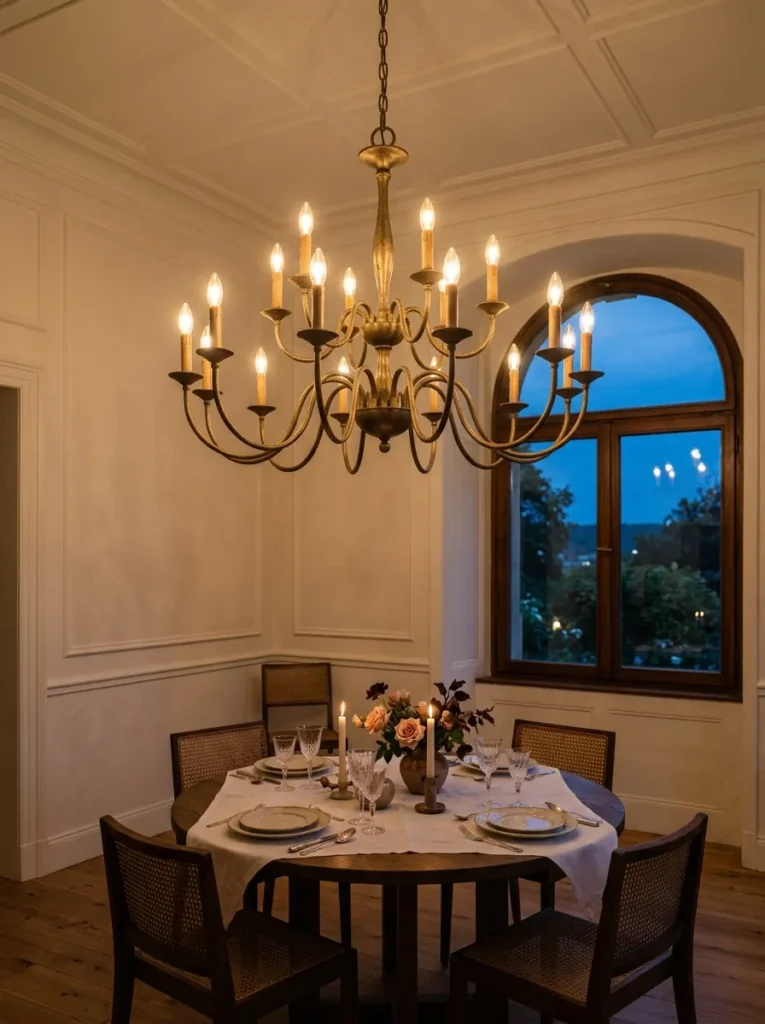
Vibe: The statement chandelier dining room feels like entering a special occasion — the scale and warmth of the chandelier signaling that this room is used for important things.
Why it works: A statement chandelier as the dining room’s defining element applies the design principle of singular focal point authority — in a room where every other element is restrained and supporting, a single oversized, architecturally significant light fixture reads with the authority of sculpture rather than of decorative object. The proportion rule for a dining room chandelier is specific and important: the chandelier diameter (in centimeters) should be approximately equal to the room’s dimensions in metres added together (a 4×5 metre room suits a 90–100cm diameter chandelier), and the bottom of the chandelier should hang at least 75cm above the tabletop for unobstructed sightlines between seated diners. Aged brass or bronze is the most consistently appropriate finish for a traditional-inflected statement chandelier because its patina reads as authentic material history rather than metallic decoration.
How to get it: Size the chandelier correctly before purchase — measure the room’s dimensions and the ceiling height and consult the fixture supplier’s sizing guide specific to the chandelier model. Commission an electrician to install an appropriate ceiling mounting point (a chandelier of this scale requires a secure ceiling box into a joist or beam, not a standard surface mounting) before the chandelier is delivered. Specify flame-shaped LED bulbs at 2200K (the warmest color temperature available, closely approximating genuine flame) for each of the chandelier’s arms — the bulb selection is as important as the fixture selection in determining the quality of light produced.
Shop The Look
| Product |
|---|
| Aged brass multi-arm dining chandelier |
| Flame LED bulb 2200K E14 set |
| Round dining table dark oak 140cm |
| Dining chair set 6 oak upholstered |
| Chandelier ceiling mount professional |
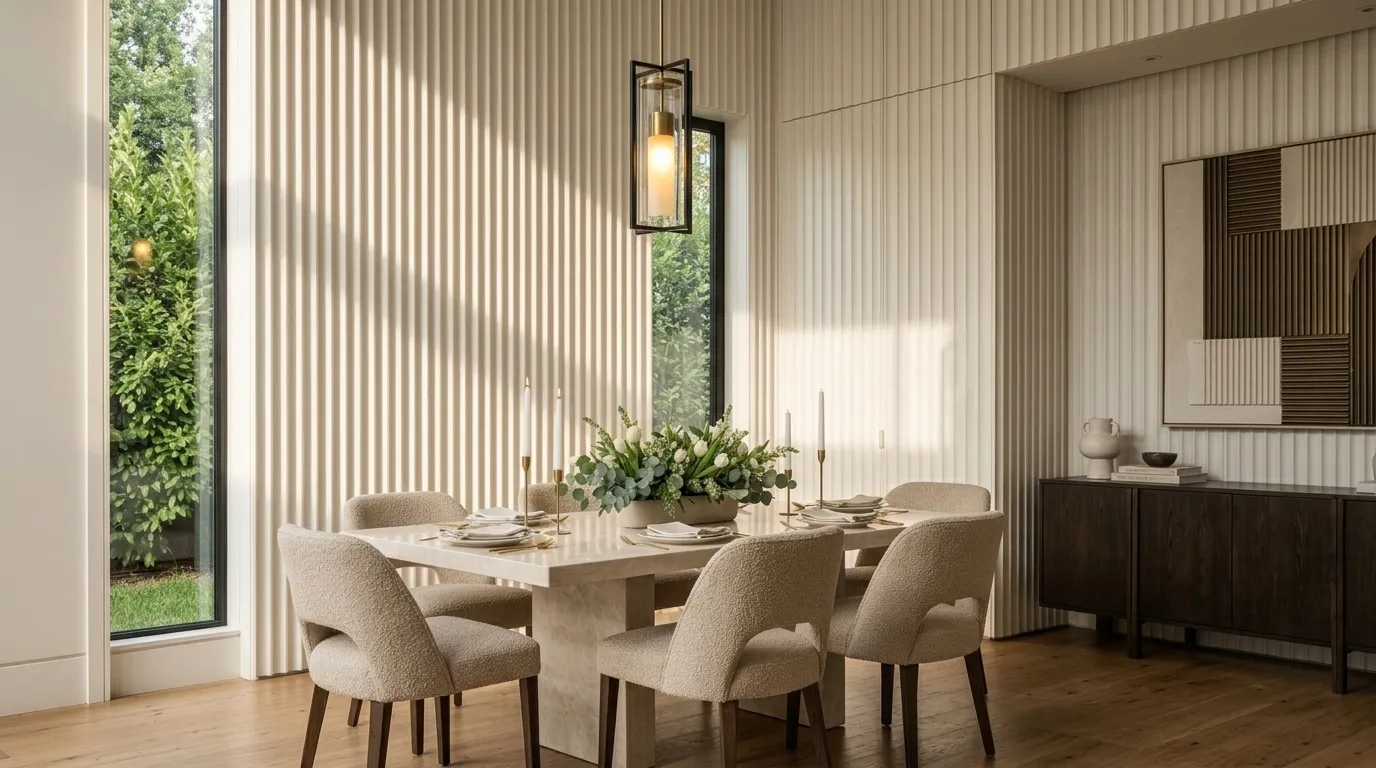
4. Fluted Wall Paneling for Architectural Texture
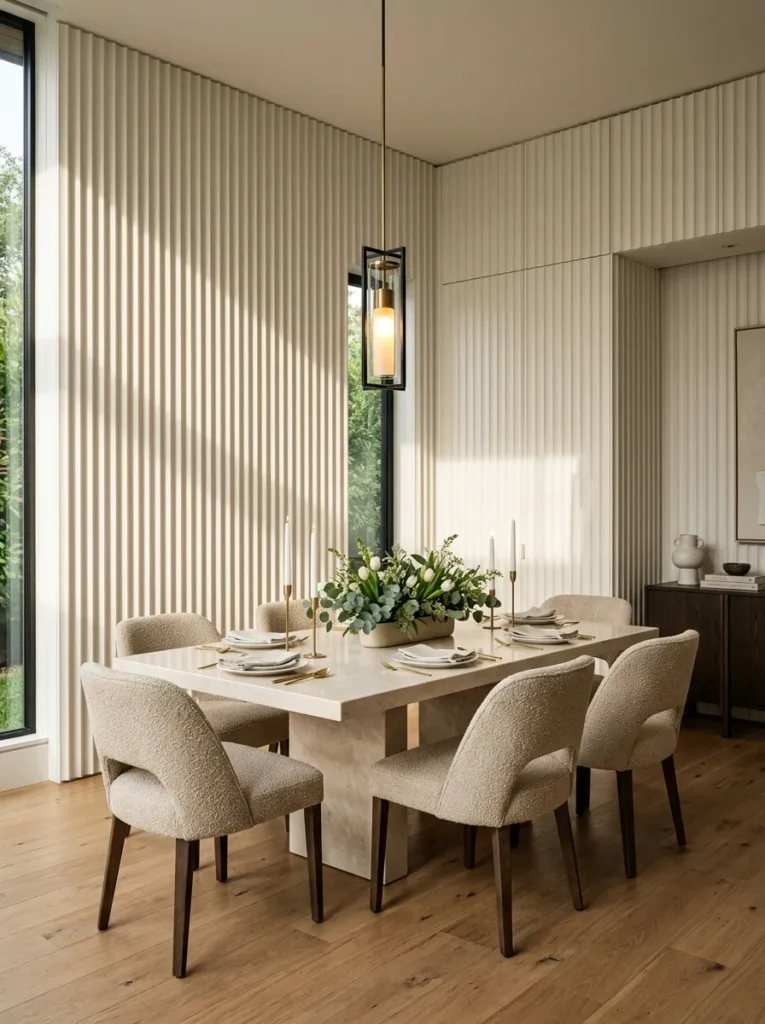
Vibe: The fluted panel dining room feels tactile before it has been touched — the vertical groove detail catching light at an angle that makes the wall appear to be moving.
Why it works: Fluted wall paneling in a dining room applies the architectural principle of surface texture as three-dimensional element — the vertical grooves of a fluted panel create shadow lines that shift throughout the day as the light source angle changes, making the wall surface visually dynamic in a way that flat paint, wallpaper, and even most textured surfaces cannot replicate. This dynamism is particularly appropriate in a dining room because it changes with the light source shift from natural daylight to evening candlelight and artificial fixtures, producing a different atmospheric quality in the room at each meal occasion. Warm white fluted panels are the most commercially and critically successful color for this application — the white both amplifies the shadow contrast in the grooves (dark groove against bright flat) and maintains the room’s brightness while providing the textural richness that a plain white wall lacks.
How to get it: Specify fluted MDF panels (available as pre-made sheets in standard profiles from specialist joinery suppliers and timber merchants) and install over a framed substrate to the full floor-to-ceiling height. The joint between panels (where one sheet meets the next) should be positioned within a groove rather than between grooves, making it invisible in the continuous surface. Paint all panels in a single coat of eggshell paint in the chosen warm white — the semi-reflective surface of eggshell emphasizes the groove shadow more effectively than matte. For a higher-specification result, specify plaster fluted panels (cast in gypsum or lime plaster to the grooved profile) which provide both the texture and the authentic plaster surface quality that painted MDF does not.
Shop The Look
| Product |
|---|
| Fluted MDF panel sheet white installation |
| Boucle dining chair set 6 oat warm |
| Pale stone quartz dining table |
| Slim pendant lantern dining brass |
| Wide plank oak flooring warm |
5. Oval Table with Curved Upholstered Chairs for an Intimate Arrangement
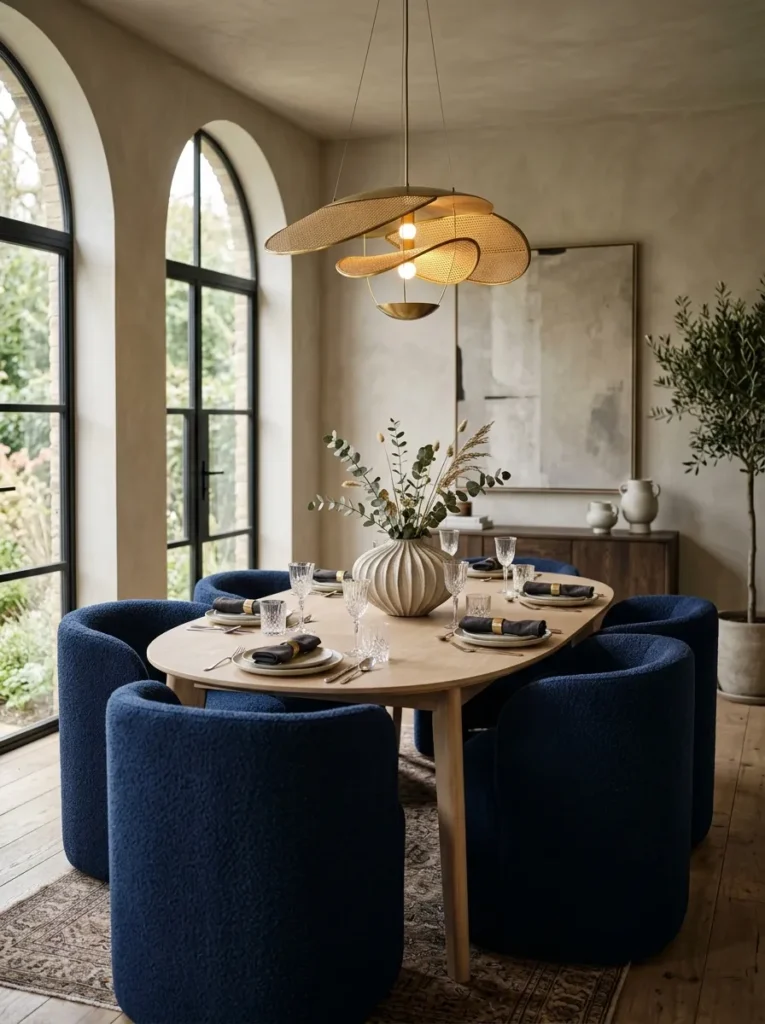
Vibe: The oval table arrangement feels socially intelligent — the curved form and close chair spacing creating the sense that everyone at the table is equidistant from the conversation, regardless of where they sit.
Why it works: An oval dining table with curved upholstered chairs applies the social design principle of proxemic equity — the oval table’s form eliminates the hierarchical head-of-table positioning of a rectangular table, placing all diners in a perceptually equal relationship to the center. The curved-back upholstered chairs (where the chair back curves gently to follow the user’s shoulder profile) are the specifically luxury interpretation of the dining chair — they provide greater physical comfort than a flat-back chair (important for long social dining occasions), are more visually sophisticated than a simple upright back, and echo the oval table’s curved geometry in a way that straight-backed chairs do not. The boucle fabric specification for the chair upholstery references the premium textile of the contemporary interior design moment — its looped, slightly irregular weave communicates material richness at close range.
How to get it: Specify an oval dining table in solid oak or an oak-veneered top in the appropriate size (a 180–220cm oval seats six comfortably; a 220–270cm seats eight). The curved upholstered chair is available from multiple luxury and accessible furniture retailers — key specifications are: the radius of the back curve (tighter curves read as more contemporary; shallower curves read as more traditional), the seat depth (minimum 45cm for dining comfort), and the fabric’s durability rating (dining chairs require a minimum 30,000 Martindale rub count, ideally 50,000+ for upholstery used at every meal).
Shop The Look
| Product |
|---|
| Pale oak oval extension dining table |
| Curved boucle dining chair set 6 |
| Sculptural ceramic vessel large centrepiece |
| Warm greige plaster wall paint |
| Sculptural resin or metal pendant dining |
6. Dark Drama — Midnight Navy Dining Room with Gold Accents
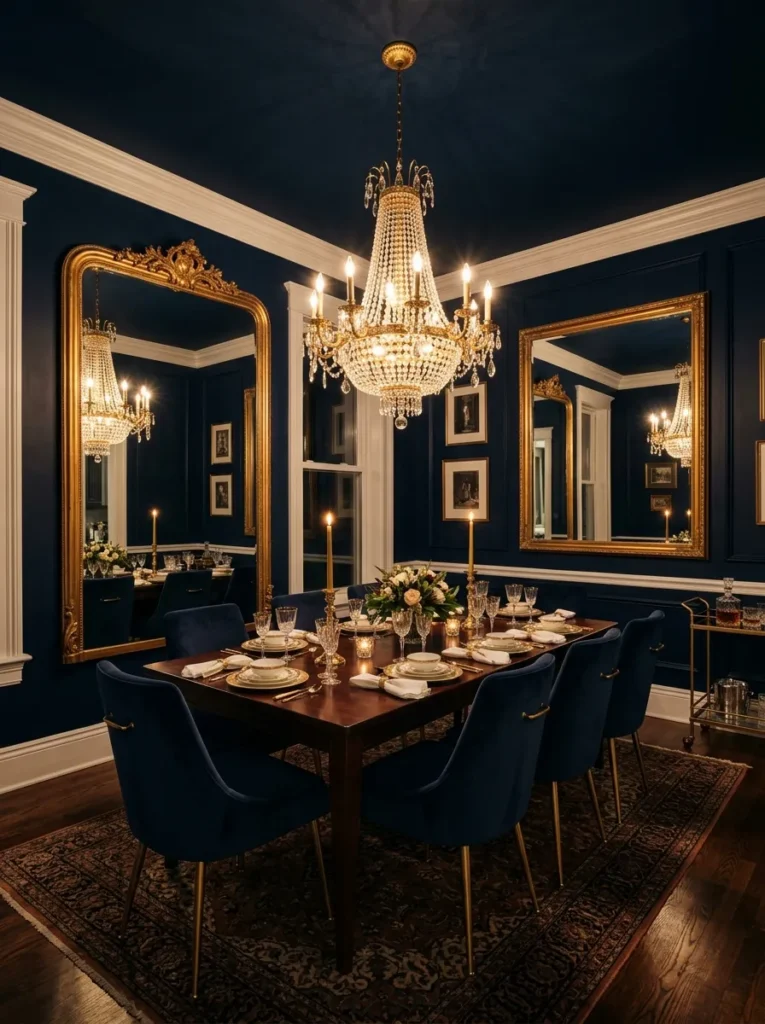
Vibe: The midnight navy dining room feels like the inside of a jewelry box — the depth of the dark walls and the gold light creating an interior that has no outside equivalent.
Why it works: A midnight navy dining room with all four walls and ceiling in the same deep tone applies the luxury interior design principle of complete chromatic immersion — when the ceiling is the same deep color as the walls, the room’s physical boundaries (where wall meets ceiling) visually dissolve, creating the impression of a continuous dark enclosure rather than a box with a white lid. This ceiling color continuity is the specific detail that converts a dark-walled dining room from dramatically decorated to genuinely luxurious, and it is the most commonly missed element in dark room interpretations at all budget levels. Gold accents (chandelier, mirrors, candlestick holders) in a midnight navy room operate as the only warm-toned elements in a room dominated by cool depth, creating the maximum possible contrast between warm gold and cool navy — the most visually luxurious contrast available in the dark dining room palette.
How to get it: Specify walls and ceiling in the same Farrow & Ball Hague Blue No. 30, Little Greene Hicks Blue, or Benjamin Moore Van Deusen Blue HC-156 — using the same paint on both surfaces and caulking the ceiling-wall joint before painting creates the seamless dark envelope effect. Two mirrors on facing walls amplify the limited light in a dark room exponentially — the first mirror reflects what is on the opposite wall, the second reflects the reflection of the first, creating an apparent depth that significantly increases the perceived size of the room. Specify genuine gold (not brass) for fixtures — in a navy room, brass reads warm but yellow; gold reads warm and bright, maintaining its luminosity against the deep navy background more effectively.
Shop The Look
| Product |
|---|
| Midnight navy paint walls and ceiling |
| Gold multi-light chandelier dining |
| Gold frame wall mirror large set 2 |
| Navy velvet dining chair set 8 |
| Gold taper candlestick holder set |
7. Limestone or Stone Floor as a Luxury Foundation
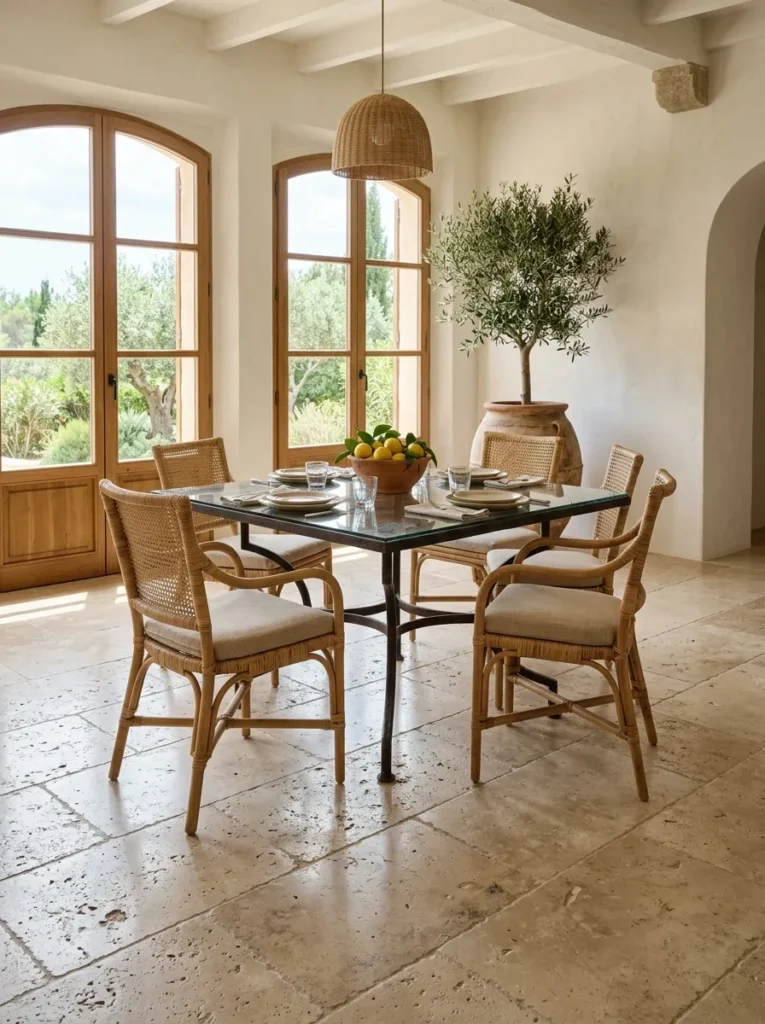
Vibe: The limestone floor dining room feels sun-warmed — the stone’s specific quality of absorbed and released warmth making the room feel like a Mediterranean farmhouse regardless of its actual geography.
Why it works: Natural limestone or travertine flooring in a dining room applies the luxury material principle of geological time as material value — natural stone’s visual complexity (the vein patterns, the natural pitting of travertine, the color variation within a single tile) is the product of millions of years of geological formation, which gives it a material richness that no manufactured surface can replicate. In a dining room specifically, the stone floor’s thermal mass (its ability to absorb and slowly release heat) creates a physical warmth that contributes to the dining environment’s comfort over long meals. The specific choice of unfilled travertine (leaving the natural pitting open rather than filling with grout) is the most authentic and most beautiful interpretation of the material — the pitting catches candlelight and warm morning light in a way that smooth, filled stone does not.
How to get it: Specify natural travertine in unfilled, honed (not polished) finish for maximum grip and non-reflective warmth. The honed surface reads as more residential and less commercial than polished stone, and provides better grip in a room where spilled liquids are a regular occurrence. Seal the travertine with a penetrating stone sealer before use and reseal annually — natural travertine in its unsealed state is porous and will absorb red wine and oil stains within seconds of contact. Use large format tiles (minimum 60×60cm, ideally 80×80cm or 100×100cm) in the dining room — small format stone tiles (30×30cm and below) read as bathroom tile rather than floor stone at this scale.
Shop The Look
| Product |
|---|
| Natural travertine floor tile honed 60×60 |
| Penetrating stone sealer natural |
| Dark iron dining table base glass top |
| Rattan linen dining chair set 6 |
| Terracotta large planter olive tree |
8. Velvet Curtains Floor to Ceiling for Material Richness
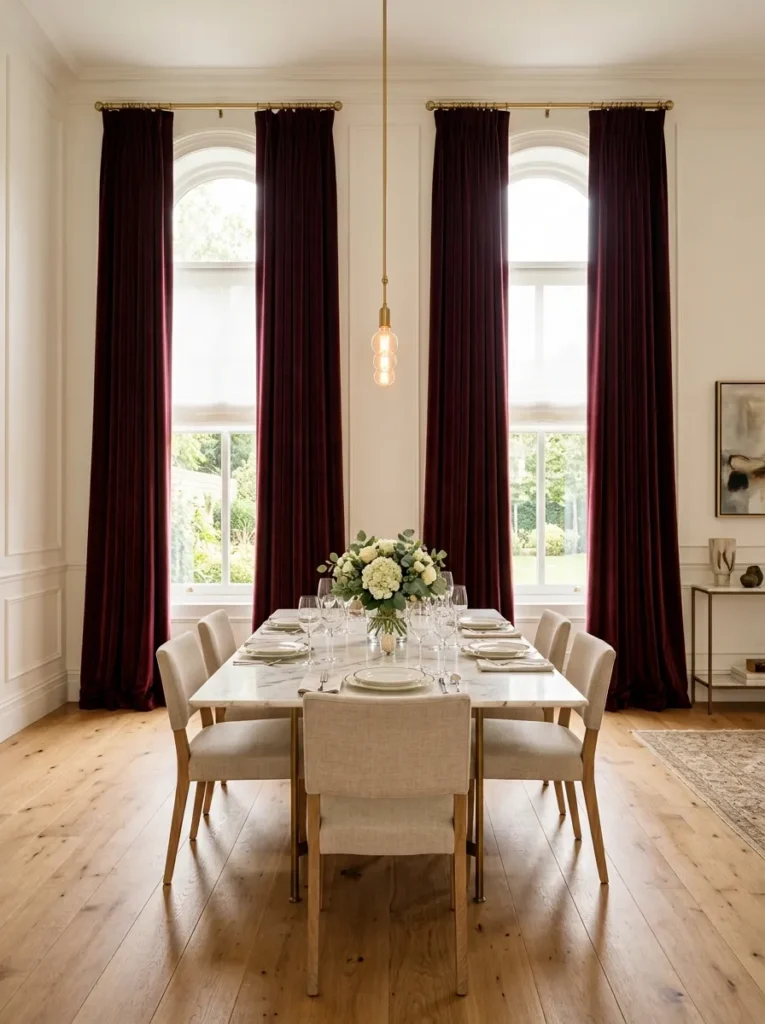
Vibe: The velvet curtain dining room feels like entering a different gravity — the floor-to-ceiling fabric creating a sense of enclosure and warmth that changes the room’s apparent scale.
Why it works: Floor-to-ceiling velvet curtains in a luxury dining room apply the spatial design principle of vertical dimension exaggeration — curtains hung from a ceiling-mounted rod (rather than from a rod positioned above the window frame) appear to begin at the ceiling and end at the floor, creating the optical illusion that the room’s ceiling is as tall as the curtain’s full drop. In a standard room with 240cm ceilings, ceiling-mounted curtains create the appearance of 280–300cm ceilings. Velvet is the most luxurious curtain fabric available for this application because its pile structure creates a directional sheen that changes quality from different viewing angles and in different light conditions — it appears darker when the pile faces toward the viewer and lighter when it faces away, creating a living surface quality that no flat-weave fabric replicates.
How to get it: Specify velvet curtains in the widest available width (double the window width, for a gathered fullness that reads as generous and considered) and the precise floor-to-ceiling drop for the specific room (measure from ceiling to floor and add 15–20cm for the puddle). Mount the curtain rod at the ceiling or within 5cm of the ceiling — any gap between the rod and the ceiling reads as a deliberate but suboptimal design decision. Specify a ceiling-mounted bracket rather than a wall-mounted bracket for the most precise ceiling-to-rod positioning.
Shop The Look
| Product |
|---|
| Deep velvet curtain fabric custom length |
| Ceiling mount curtain rod bracket |
| Curtain pole simple brass or black |
| Crystal wine glass set dining |
| Pale marble dining table or top |
9. Long Banquette Seating for a Dining Room Wall
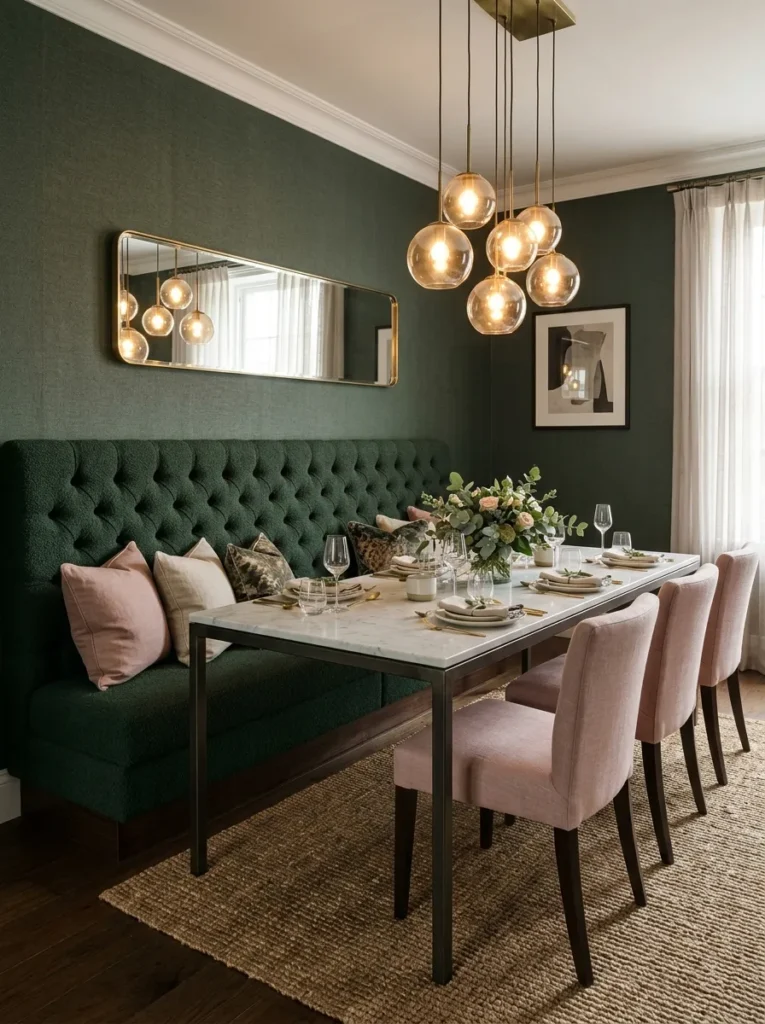
Vibe: The banquette dining room feels like a restaurant booth that decided to be a home — the long upholstered seat creating a social dynamic that individual chairs alone cannot.
Why it works: A wall banquette in a luxury dining room applies the hospitality design principle of casual formality — banquette seating references the restaurant booth and the brasserie bench, creating a social context (communal seating where conversation flows along the seat as well as across the table) that individual dining chairs do not provide. The custom upholstered version (built for the specific wall width, at the specific height of the specific table, in a premium fabric) is the genuinely luxurious interpretation — a purchased banquette bench reads as furniture; a custom-built upholstered banquette reads as architecture. The combination of banquette seating on one side and individual chairs on the other is both more comfortable (individual chairs allow more adjustable seating for varied guests) and more visually interesting (the visual contrast between the long upholstered bench and the individual chairs creates compositional richness that matching chairs on both sides does not).
How to get it: Commission a bespoke banquette from a joinery or furniture upholstery specialist — the specific requirements are: the frame built from 18mm birch plywood on a 3×2 timber frame, the seat foam at minimum 10cm high-density foam (60kg/m³ density) for proper support during multi-hour dining occasions, the back foam at 5–8cm medium-density foam, and the upholstery fabric at minimum 50,000 Martindale rub count (dining upholstery receives significantly more friction than standard upholstery). The standard seat depth for a dining banquette is 45–55cm, and the standard seat height is 45cm to match standard dining table and chair heights.
Shop The Look
| Product |
|---|
| Custom banquette commission upholstery |
| Deep green bouclé upholstery fabric |
| Dining chair set 4 dusty blush linen |
| Pale stone top dining table |
| Long mirror above banquette |
10. Terrazzo Floor and Curved Furniture for Playful Luxury
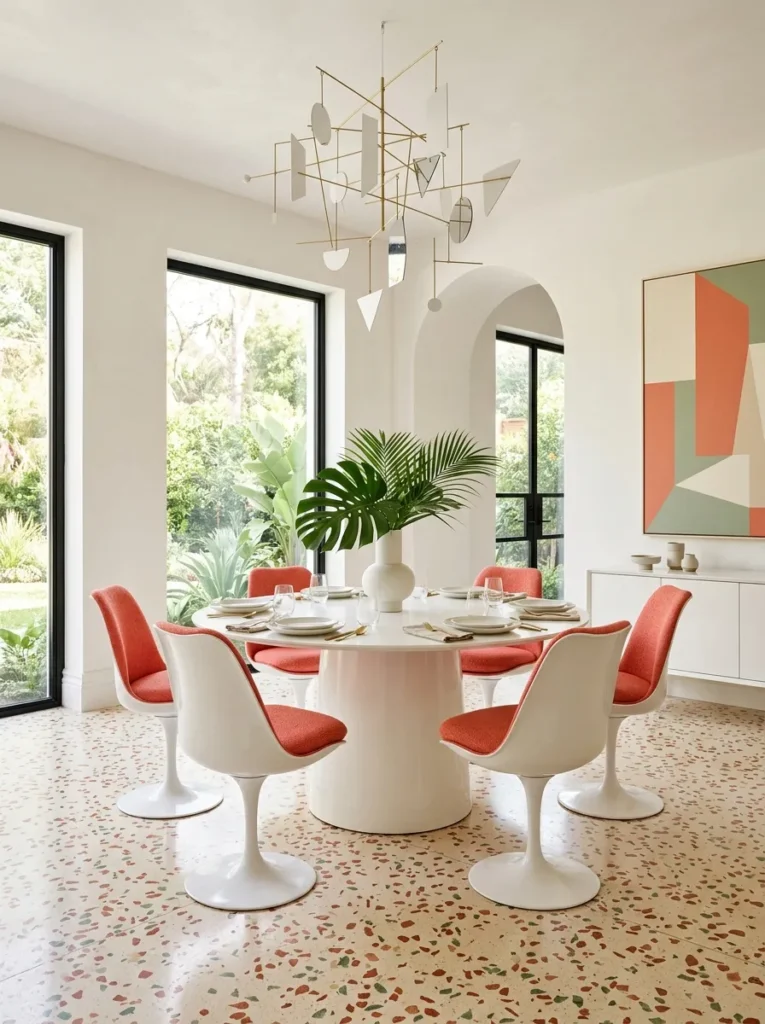
Vibe: The terrazzo and curved dining room feels like a 1960s Milan apartment reimagined for today — the playful floor material and sculptural furniture creating a luxury that feels joyful rather than serious.
Why it works: Terrazzo flooring with curved furniture in a luxury dining room applies the design principle of material and formal playfulness — the contemporary luxury dining room does not require severity or weight to communicate quality; terrazzo’s geological material composition (aggregates set in cement or resin, polished to reveal the embedded chips) gives it a genuine material luxury that is simultaneously visually playful (the scattered chip pattern references abstract art) and historically significant (terrazzo is one of the oldest decorative flooring techniques, with continuous use from ancient Rome through to the present). Curved furniture (round tables, tulip chairs, soft-edged sideboards) in a room with a terrazzo floor creates a consistent visual language of softness and geometry that reads as a designed aesthetic position rather than a default choice.
How to get it: Specify contemporary terrazzo in a resin (rather than traditional cement) binder for a more consistent, easier-to-maintain surface in a residential dining room. The chip color selection (the aggregates suspended in the terrazzo matrix) is the primary design decision — specify chips in a color family that coordinates with the room’s textile palette (warm cream matrix with coral and sage chips suits a room with coral and natural textile accents). Pour terrazzo is the most authentic and most seamless result; terrazzo tiles are more accessible but have visible grout lines between panels.
Shop The Look
| Product |
|---|
| Terrazzo floor resin pour specialist |
| Round white lacquered dining table |
| Sculptural curved dining chair set 6 |
| Abstract art piece large dining wall |
| White ceramic vase large tropical leaf |
11. Intimate Breakfast Room — Luxury in a Small Scale
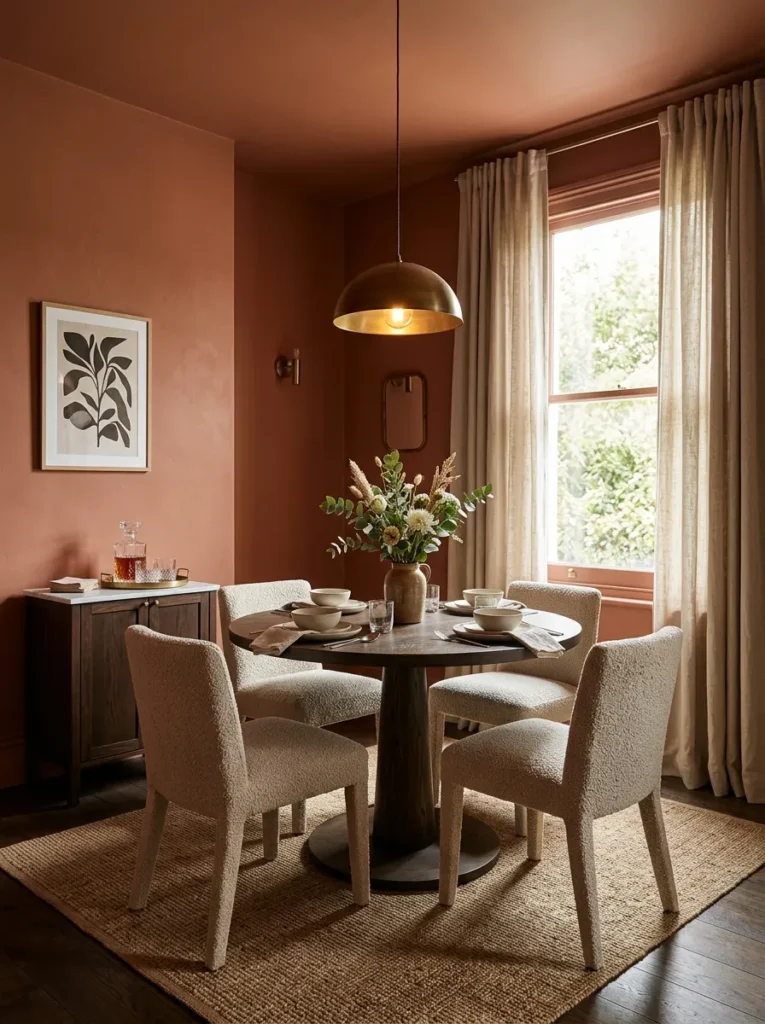
Vibe: The intimate breakfast room feels like the warmest corner of the house elevated to a room in its own right — the small scale and enveloping terracotta creating a dining environment where the conversation is always close.
Why it works: An intimate small dining room in dusty terracotta applies the luxury design principle of scale-appropriate immersion — a small dining room (3×3 metres or under) benefits from bold wall color treatment in a way that large dining rooms do not, because the small scale means the enveloping color is experienced at close range from every seat. Dusty terracotta (terracotta desaturated toward clay and dust rather than orange) is among the most warm and flattering dining room wall colors because its red-orange component is the same hue family as human skin tones and candlelight, creating a room in which both the table setting and the faces of the people at it appear warm and well-lit. The round pedestal table in a small four-person dining room provides the maximum seating in the minimum footprint — a pedestal base eliminates the legs that a four-leg table would place at each corner, which can obstruct leg room in a small room.
How to get it: Specify walls in Farrow & Ball Pompeian Ash, Little Greene Terracotta, or Benjamin Moore’s Tucson Clay in a dead flat or limewash finish for the warmest, most immersive result. A domed pendant in aged brass (rather than a chandelier, which requires ceiling height clearance) is the most appropriate single fixture for a 3×3 metre room — size it at 30–40cm diameter for the correct proportion. The oat bouclé dining chair is the material combination (the warmth of oat against the terracotta wall, the texture of bouclé against the smooth terracotta paint) that most effectively amplifies the room’s warmth.
Shop The Look
| Product |
|---|
| Dusty terracotta limewash wall paint |
| Domed pendant aged brass 35cm |
| Round pedestal table dark oak 110cm |
| Oat bouclé dining chair set 4 |
| Marble-topped drinks cabinet small |
12. Art-Focused Dining Room with Gallery Wall
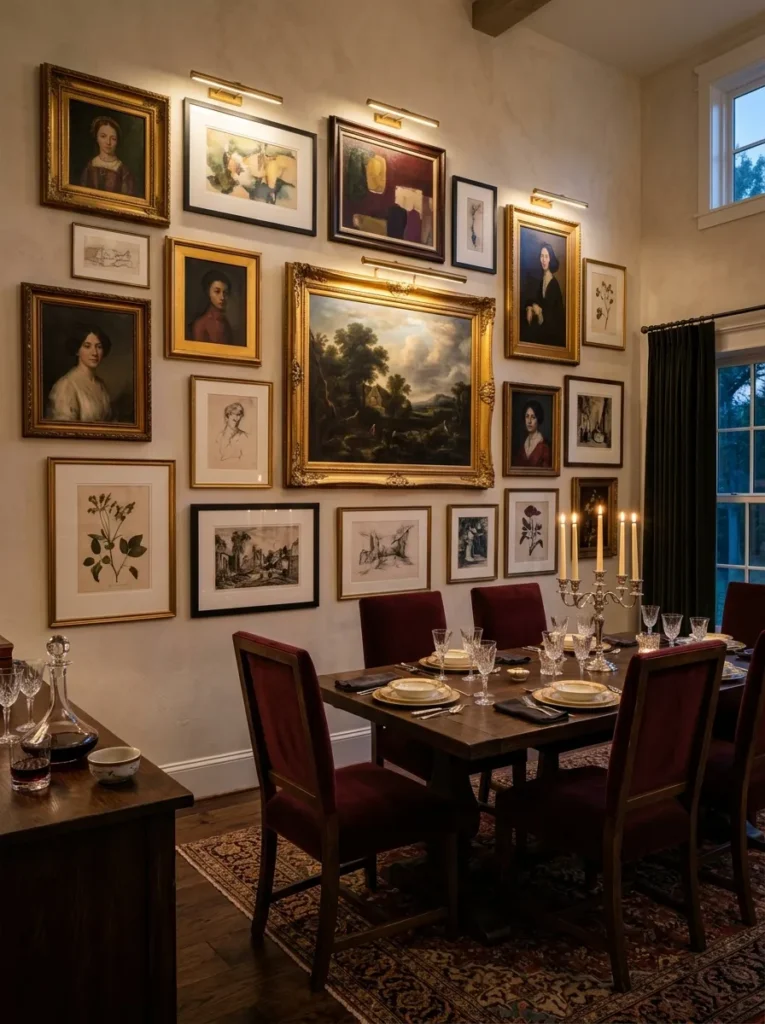
Vibe: The art-focused dining room feels like eating inside a private collection — the gallery wall creating the sense that the room was designed around the art, making the meal part of a cultural experience.
Why it works: An art gallery wall in a luxury dining room applies the cultural capital design principle — a dining room that displays a personal art collection communicates the inhabitant’s visual culture and collecting history in a way that no other room decoration approach can. The gallery format (multiple works in a single wall composition) is specifically appropriate for a dining room because the long meal occasions (dinner parties, family Sunday lunches) provide extended opportunity for close examination of individual works that a brief corridor or foyer encounter does not. Picture lights mounted above key works (small adjustable picture rail lights in aged brass or bronze) convert the gallery wall from an art display into an illuminated collection — the directed light source on each painting creates the museum reference that elevates the domestic gallery to an institutional register.
How to get it: Build the gallery wall around one significant anchor piece (minimum 60×80cm) positioned at eye height (145cm to the canvas center) in the wall’s visual center. Build the remaining arrangement outward from this anchor, maintaining 3–5cm gaps between frames and varying the frame finish (gilt for oil paintings, dark wood for prints and watercolors, simple black for photography) without introducing more than three different frame finishes into the total arrangement. Add picture rail lights (available from specialist picture lighting retailers) above each significant work on the wall.
Shop The Look
| Product |
|---|
| Picture rail light aged brass dining |
| Large statement artwork dining room |
| Gilt picture frame set varied sizes |
| Dark wood picture frame set |
| Silver candelabra multi-arm dining |
13. Natural Rattan and Organic Material Luxury Dining
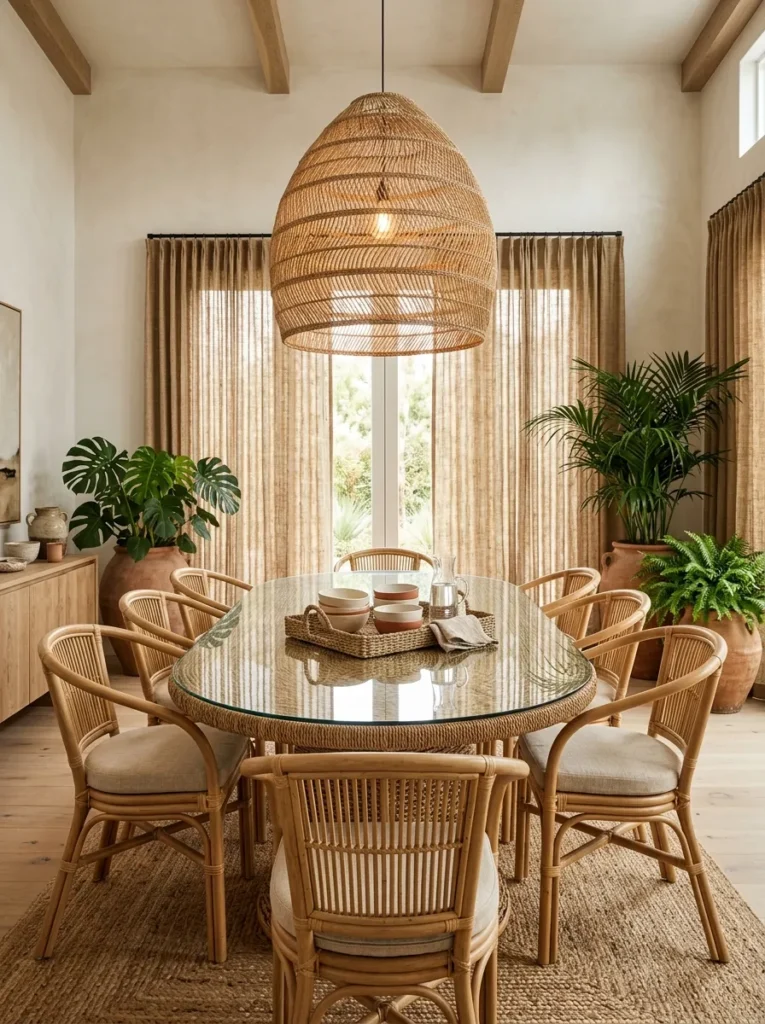
Vibe: The organic luxury dining room feels like the best possible beach house dining room — the all-natural material palette creating warmth and texture without any of the heaviness of more conventional luxury material choices.
Why it works: A natural rattan and organic material dining room applies the luxury design principle of material consistency as quality signal — when every element in a room is from the same natural material family (rattan, linen, jute, limewash, bleached oak, terracotta), the room reads as a considered aesthetic position rather than an accumulated selection of individually nice objects. The organic material palette’s specific luxury lies in the quality of natural materials that are simultaneously humble in origin and rich in character — rattan is inexpensive as a raw material but beautiful in skilled weaving; linen is simply a plant fiber but extraordinarily sensuous as a textile; limewash is mineral on plaster but uniquely atmospheric as a wall finish. The glass table top on the rattan base is the contemporary detail that prevents the natural material palette from reading as entirely rustic — the transparency of glass against the organic rattan base creates a material contrast that elevates both.
How to get it: Source a large oval or round rattan dining table from specialist natural material furniture retailers — Serena & Lily, Anthropologie Home, and specialist rattan furniture importers all produce dining table-height rattan bases. Specify a custom-cut tempered glass top (toughened 10mm glass, appropriate for dining table use) from a glass supplier. Source organic-form rattan dining chairs with a seat cushion in natural linen — the cushion is the comfort provision that converts a statement chair into a usable dining chair for multi-course occasions.
Shop The Look
| Product |
|---|
| Rattan oval dining table with glass top |
| Organic rattan dining chair set 8 |
| Natural linen chair cushion set |
| Large organic fiber pendant natural |
| Terracotta large floor planter set |
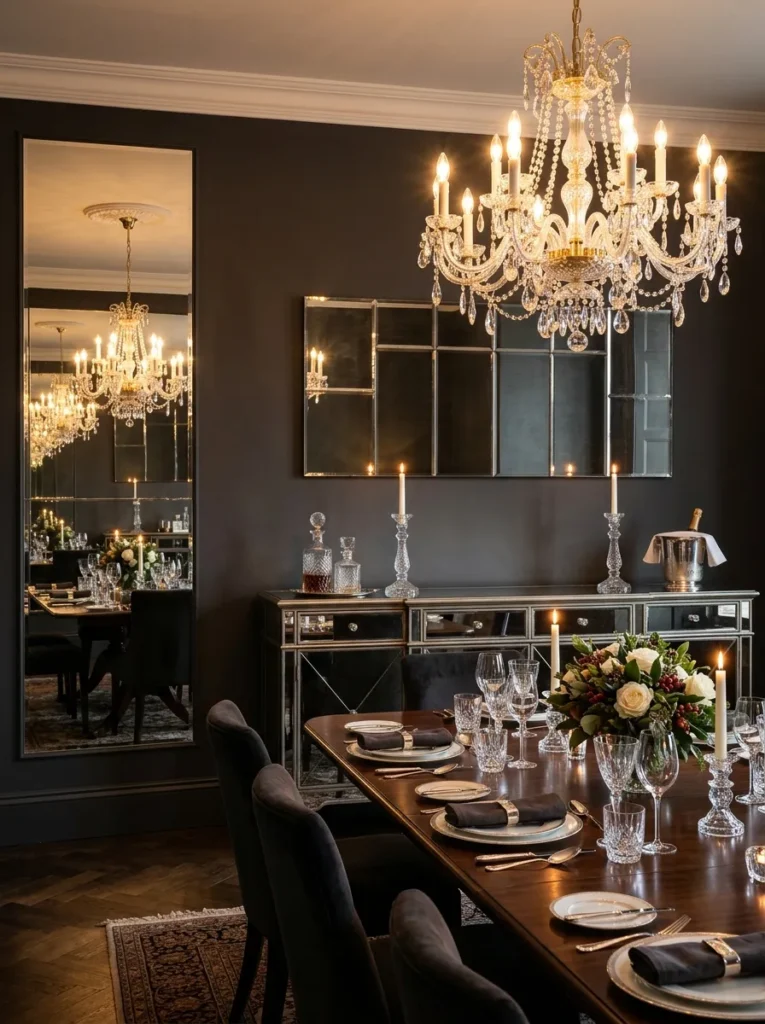
14. Mirrored Sideboard and Reflective Surfaces for Light Amplification
Vibe: The mirrored dining room feels lit from within — the reflective surfaces multiplying the warm chandelier light into a room that glows from every angle.
Why it works: A mirrored sideboard and reflective surfaces in a luxury dining room apply the lighting amplification principle of strategic reflection — in a room where the primary luxury experience is evening candlelight and chandelier warmth, reflective surfaces (mirrored panels, crystal glassware, polished silver candlesticks, gilt picture frames) multiply the apparent light output of each warm source by reflecting it back across the room. A chandelier over a dining table with a mirrored sideboard on the opposite wall is experienced as twice as warm and twice as luminous as the same chandelier in a room with a matte-painted wall on the same wall, because the mirrored sideboard reflects the chandelier back at eye height, creating a second apparent chandelier at the viewer’s level. Crystal glassware on the dining table refracts and scatters the chandelier light across the tablecloth and faces at the table, contributing an additional layer of warm light distribution.
How to get it: Source a mirrored sideboard (available from luxury furniture retailers including Wayfair, Made.com, and luxury secondhand markets) in a length appropriate to the dining room wall (typically 150–200cm for a standard dining room). Position the sideboard on the wall directly opposite the room’s primary window for maximum daylight reflection, or opposite the chandelier for maximum evening light reflection. Add crystal or heavy glass decanters, crystal candlestick holders, and gilt-framed mirrors on the adjacent wall to compound the reflective effect.
Shop The Look
| Product |
|---|
| Mirrored sideboard long dining room |
| Crystal decanter set wine spirit |
| Tall crystal candlestick holder pair |
| Crystal wine glass set 8 |
| Large gilt frame wall mirror dining |
15. Maximalist Floral Wallpaper for Dramatic Dining
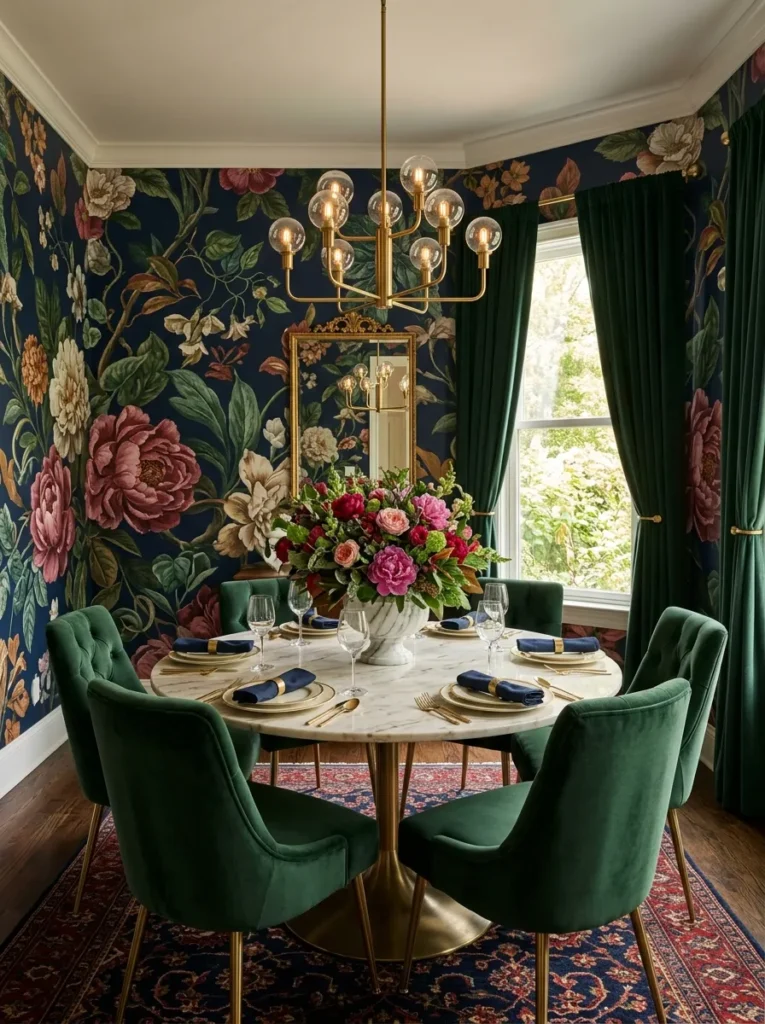
Vibe: The maximalist botanical dining room feels like dining inside a garden — the large-scale wallpaper botanicals creating an immersive environment where the table arrangement is a continuation of the walls.
Why it works: Maximalist botanical wallpaper in a luxury dining room applies the decorative arts principle of pattern at architectural scale — the difference between decorative wallpaper and genuinely luxurious wallpaper is largely a function of pattern scale. A botanical pattern whose individual flower forms are 30–50cm in diameter creates an entirely different visual experience from the same pattern at 10cm — at architectural scale, the pattern reads as a mural-equivalent, with each botanical form large enough to be examined and appreciated individually while the overall pattern creates an immersive field of decoration. The specific advantage of this approach in a dining room (compared to a living room or bedroom) is that the long duration of dining occasions allows guests the time to actually look at and discuss the wallpaper, making it a genuine conversation object rather than merely a background pattern.
How to get it: Specify large-scale botanical wallpaper from specialist wallpaper designers — Cole & Son, House of Hackney, de Gournay, and Graham & Brown’s luxury ranges all produce large-scale botanical patterns with the design quality appropriate for a luxury dining room. For the highest specification, de Gournay’s hand-painted wallpaper panels represent the apex of the botanical dining room tradition (panels painted to the specific dimensions of the room’s walls, each unique). More accessible equivalents from House of Hackney or Cole & Son provide similar visual impact at a fraction of the cost. Install on all four walls for maximum immersion — a single feature wall with a large-scale botanical produces a different (and generally less successful) effect.
Shop The Look
| Product |
|---|
| Large-scale botanical wallpaper luxury |
| Deep forest green velvet dining chair 6 |
| Pale marble round dining table |
| Simple brass chandelier dining |
| Low profile marble vase table centrepiece |
How to Start Your Luxury Dining Room Transformation
The single best first move in any luxury dining room transformation is addressing the lighting — specifically, replacing any cool-white overhead lighting with a warm-white source at the correct hanging height above the dining table before any other change is made. No material upgrade, no paint color, no fabric specification produces its full luxury effect in a dining room lit by cool fluorescent or LED overhead light at ceiling height. Warm light at table height (a pendant hanging 75cm above the tabletop) fundamentally changes the quality of every material in the room — the velvet on the chairs appears richer, the stone on the table appears warmer, the crystal on the table scatters the light across the surface, and the faces of the people at the table appear more luminous. The lighting change costs $30–80 in a simple pendant and warm bulb and produces an atmospheric change of orders of magnitude greater than the same investment in any other element.
The most common mistake in luxury dining room design is confusing expensive materials with luxurious ones. An expensive table in a poorly lit room with mismatched chairs reads as expensive furniture placed in a room; a less expensive table in a beautifully lit room with coordinated chairs in a considered palette reads as a designed dining room. The design decisions — what goes with what, what color is used where, how the light falls on the table — are more significant determinants of luxury quality than the price tag of individual elements. The most impactful luxury dining room design investments are always in the three areas that affect the entire room simultaneously: lighting (the quality and source of light affects every surface, every material, and every person in the room), wall color or treatment (the largest visible surface area, determining the room’s fundamental atmosphere), and table setting (the objects closest to the people at the table and most directly experienced during the meal itself).
Three specific items under $50 that immediately improve any dining room’s luxury quality: a pair of tall taper candles in brass candlestick holders ($15–25, which — when lit during a meal — provide the warm, directional, flattering light that is the most immediately identifiable quality of a luxury dining occasion); a set of linen napkins in a consistent color family ($18–30 for four to eight napkins, which replace paper or cotton napkins and immediately signal the investment of care that cloth napkins represent); and a decanter for wine or water ($15–35 from homeware retailers, which converts a bottle of wine or a jug of water from a utilitarian vessel to a composed table object). These three additions combined for under $60 create the table atmosphere of a significantly more expensive dining occasion before any furniture or decoration is changed.
A simple luxury dining room refresh — wall color, a new pendant, a coordinated table setting — is achievable over a single weekend for $150–400. A mid-range luxury dining transformation — reupholstered chairs, wall paneling or wallpaper, a statement light fixture, and a curated sideboard — takes two to three weekends and costs $800–2,500. A full luxury dining room renovation — new flooring, custom paneling or stone feature wall, bespoke banquette, statement chandelier, velvet curtains, and custom table — represents a $5,000–20,000 investment depending on material specification. The candles, the linen napkins, and the decanter are achievable tonight; the wall color follows this weekend, and the chandelier and the stone wall take their time and arrive when the budget and the design are both fully ready.
Frequently Asked Questions About Luxury Dining Room Design
What makes a dining room feel truly luxurious?
A truly luxurious dining room communicates quality through the consistency and consideration of its design decisions rather than through the expense of its individual elements alone. The specific characteristics that create the luxury quality are: materials that improve with close examination (velvet whose pile shifts in the light, natural stone with genuine vein variation, linen that wrinkles naturally and hangs with weight), lighting that flatters both the room and the people within it (warm-toned, at table height rather than ceiling height, from multiple sources), and a sense that every element belongs — that the chair fabric was chosen with specific reference to the wall color and the table material, rather than being selected independently.
How large does a dining room need to be to feel luxurious?
There is no minimum size for a luxurious dining room — some of the most beautifully considered dining rooms documented in design publications are under 10 square metres. What is required is a minimum clearance around the dining table for comfortable seating and circulation: 90cm from the table edge to any wall (the minimum for pulling a chair back and standing from a seated position) and 120cm from the table edge to any wall if the space behind the chair is also a circulation route. A dining table that is correctly sized for the room — neither too small (which reads as provisional) nor too large (which prevents comfortable circulation) — is the spatial decision that most determines whether a small dining room feels luxuriously intimate or simply cramped.
What is the best dining table shape for a luxury dining room?
The dining table shape most appropriate for a luxury dining room is determined by the room’s proportions and the social dynamic intended. Round tables (available in sizes from 90cm for four to 180cm for eight) eliminate the head-of-table hierarchy and create the most socially democratic dining experience — every seat is equidistant from every other seat. Oval tables provide the social dynamic of a round table at a larger scale, accommodating more diners while maintaining curved ends that feel softer than rectangular. Rectangular tables are the most space-efficient format for long, narrow rooms and accommodate the widest range of guest numbers through extension mechanisms. The specific luxury specification is in the table’s material and construction quality — a solid stone top, a hand-applied lacquer finish, or a genuine solid timber surface communicates material investment that veneered or laminated equivalents cannot.
What dining chair upholstery is most appropriate for a luxury dining room?
The most appropriate dining chair upholstery for a luxury dining room balances aesthetic quality with practical durability — a fabric that looks beautiful but marks easily, stains permanently, or pills after minimal use is not appropriate for a dining environment. The specific fabric specifications that meet both criteria are: boucle in a high-pile, tight-weave version (minimum 50,000 Martindale rub count, scotch-guarded or Teflon-treated for spill resistance), high-performance velvet (Crypton or Aquaclean-treated velvet reads identically to untreated velvet but cleans with water), and high-count linen (minimum 200 thread count, pre-washed, Teflon-treated). Leather and faux leather are practical but increasingly less desired in luxury residential dining rooms because their thermal conductivity (cold in winter, warm in summer) makes them less comfortable than textile upholstery for long dining occasions.
How do you light a luxury dining room correctly?
The correct luxury dining room lighting system has three components operating on independent dimmer circuits: a statement pendant or chandelier centered over the dining table at 75cm above the tabletop (the primary atmospheric source), table-level supplementary lighting from candles or LED candles in candlestick holders on the table surface (the intimacy and flattery source), and indirect ambient lighting from wall sconces or uplighters on the room’s perimeter (the fill source that prevents the contrast between the lit table and the dark periphery from reading as dramatic rather than intimate). All artificial light sources in the dining room should be specified at 2200–2700K color temperature — this warm-white range is the only color temperature at which the dining room’s materials (stone, velvet, linen, timber) appear warm and inviting rather than cool and institutional. A dimmer switch on every circuit is not optional in a luxury dining room — it is the tool that converts a bright functional room into an intimate dining environment on a per-occasion basis.
Ready to Create Your Dream Luxury Dining Room?
These 15 ideas move through every dimension of what makes a dining room genuinely luxurious — from the enveloping warmth of deep forest green walls and midnight navy ceilings, to the material drama of book-matched marble and terrazzo floors, to the social intelligence of oval tables and banquette seating, to the sensory richness of velvet curtains and maximalist botanical wallpaper. Starting with the warm pendant and the taper candles — this evening, at dinner, converting a routine meal into a lit occasion — is not a small beginning. It is the beginning that reveals what the room is capable of becoming when the light is right, and it happens tonight for under $50 in materials. Order the warm pendant this week, light the candles at every dinner, and let the room show you which of these 15 ideas will make it genuinely, completely itself. Pin the wall color and the material ideas that felt most true to your home’s character while reading, and return to the stone floor and the custom banquette plans when the budget and the confidence are both fully ready.