14 Creative Home Decor Ideas to Refresh Your Space
Creative home decor ideas are imaginative, design-led approaches to transforming the look and feel of a living space — using paint, textiles, botanical elements, repurposed objects, and deliberate arrangement to create rooms that feel personally expressive, visually considered, and genuinely alive without requiring structural renovation or unlimited budget. This article gives you exactly 14 creative home decor ideas to refresh your space, spanning every room, every budget, and every aesthetic from minimalist Japandi to maximalist eclectic, with specific guidance and curated product tables for every idea.
There is a particular kind of creative satisfaction that comes from transforming a familiar space — the moment a room that has felt static and uninspiring for months becomes suddenly alive through a single considered change: a new paint color on one wall, a cluster of plants in an otherwise bare corner, a piece of art moved from one room to another. Home decor creativity is not about spending money; it is about applying attention, intention, and a willingness to experiment to the spaces that contain daily life. These ideas range from a 20-minute rearrangement to a weekend transformation of genuine impact. Here are 14 ideas worth trying — and saving.
Why Creative Home Decor Ideas Work So Well
The impulse to decorate and personalize living spaces is one of the most ancient and universal human behaviors — evidence of deliberate interior decoration, from painted cave walls to arranged shells and feathers, appears in human habitation sites across every continent and every archaeological period, long predating any concept of professional design. Contemporary home decorating draws from this same fundamental impulse — the desire to make the space of daily life beautiful, expressive, and personally meaningful — while benefiting from the accumulated design knowledge of every tradition from Scandinavian functionalism to Japanese wabi-sabi, from English Arts and Crafts to Brazilian tropicalism, that has shaped interior aesthetics across the centuries.
The materials and approaches that define the most successful creative home decor transformations share specific qualities: they use natural materials whose inherent beauty does not require expensive processing (raw linen, dried botanicals, unfinished wood, natural stone, hand-thrown ceramic); they apply color with confidence and intention rather than defaulting to safe neutrals throughout; they layer texture systematically — rough against smooth, matte against sheen, hard against soft — to create the sensory richness that makes rooms feel genuinely considered; and they introduce living elements — plants, flowers, herbs — that bring the organic unpredictability of the natural world into the designed indoor environment. The color palettes that most consistently produce successful creative home decor refreshes sit within the warm neutral spectrum — warm white, greige, natural linen, dusty sage, warm terracotta, antique brass — with occasional deeper accent tones in forest green, navy, or warm charcoal used to create visual definition and depth.
Creative home decor is experiencing its strongest cultural moment in decades, driven by several converging forces: the post-pandemic revaluation of the home as a place of genuine nourishment, creativity, and personal expression; the democratization of design knowledge through platforms like Pinterest, Instagram, and dedicated design publications that have given millions of people access to the design vocabulary and visual references previously available only to trained professionals; the maker movement’s rehabilitation of handmade, imperfect, and personally crafted objects as more desirable than perfect, mass-produced alternatives; and the growing sustainability consciousness that makes creative repurposing, DIY transformation, and considered long-term purchasing more culturally appropriate than disposable fast-décor consumption.
Small spaces and rental homes gain the most from creative home decor ideas because many of the most impactful creative decorating approaches — botanical styling, textile layering, gallery wall installation, and paint interventions — require no structural change and are fully reversible, allowing renters and small-space dwellers to create genuinely beautiful, personally expressive interiors within the constraints of their specific situation.
Style at a Glance
| Element | Trait 1 | Trait 2 |
|---|---|---|
| Philosophy | Intention over expenditure | Personal expression over trend compliance |
| Materials | Natural linen, dried botanical, raw ceramic | Vintage textile, living plant, reclaimed wood |
| Color Palette | Warm white, dusty sage, terracotta | Antique brass, forest green, warm charcoal |
14 Creative Home Decor Ideas to Refresh Your Space
1. Limewash Paint Feature Wall
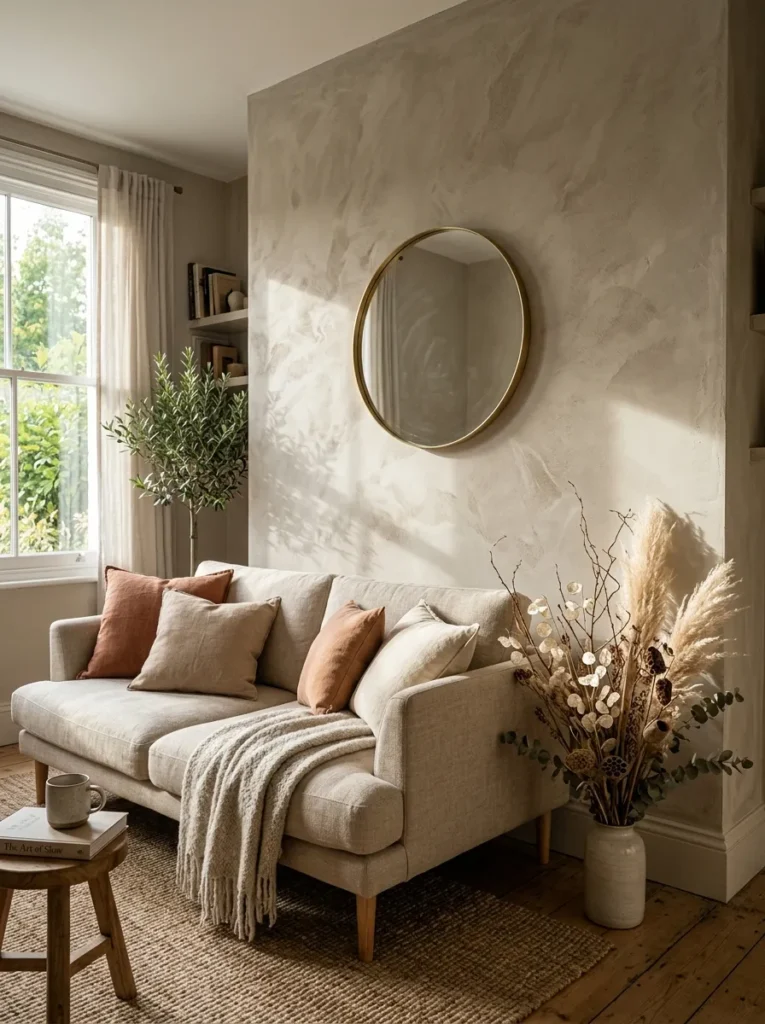
Vibe: The limewash wall feels organically alive — the one painted finish that looks genuinely better in the room than in any photograph.
Why it works: Limewash paint is the most transformative single decorating intervention available in a living room because its application method — a thin mineral wash applied in multiple directions and partially wiped while wet — creates a surface of genuine depth and organic variation that no conventional paint finish can replicate. The color variation inherent in limewash (some wall areas lighter, others deeper, dependent on application pressure and wiping) produces a wall that reads as having the age and character of ancient Italian plaster or stone — qualities that immediately elevate the perceived sophistication of the entire room. The design principle is surface as texture: limewash makes the wall itself a decorative element rather than merely a background, reducing the room’s dependence on furniture and accessories to create visual interest.
How to get it: Apply limewash in two coats using a wide natural-bristle brush in cross-hatch strokes — horizontal and vertical strokes crossing each other — for the most authentic variation. While the first coat is still slightly wet (15–20 minutes after application), use a damp cloth to partially remove paint in random areas, revealing the base wall tone. Allow full drying before the second coat. Choose a warm greige or warm white — limewash in cool grey tones can read as cold rather than warm. Farrow and Ball, Portola Paints, and Pure and Original all produce quality limewash formulations for residential interior walls.
Quick Win: Painting only one wall in limewash — the wall behind the sofa, bed, or main seating area — rather than all four walls creates the maximum visual impact at one-quarter the material cost and time investment, while preventing the enclosed quality that limewash on all four walls can create in smaller rooms.
Shop The Look
| Product |
|---|
| Limewash interior wall paint warm greige natural |
| Natural bristle wall brush wide limewash application |
| Round brass mirror 60cm dining living wall |
| Dried pampas stem large floor arrangement natural |
| Linen sofa cushion cover warm ivory set of 2 |
Also view: 15 Dreamy Cozy Bedroom Ideas for Better Rest
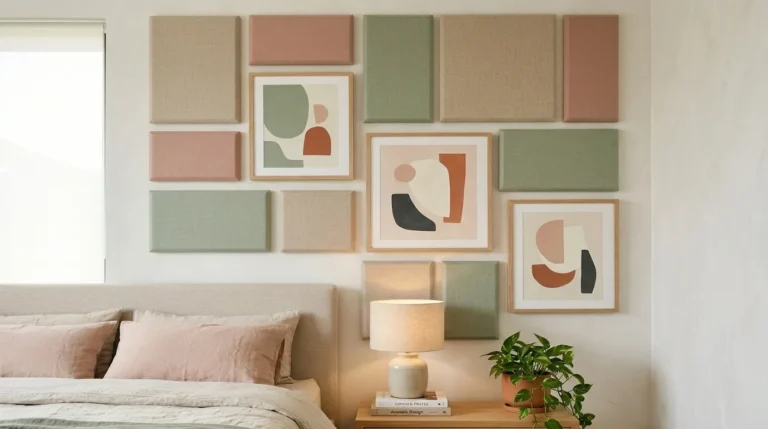
2. Gallery Wall with Leaning Art (LAYOUT / ACCESSORIES)
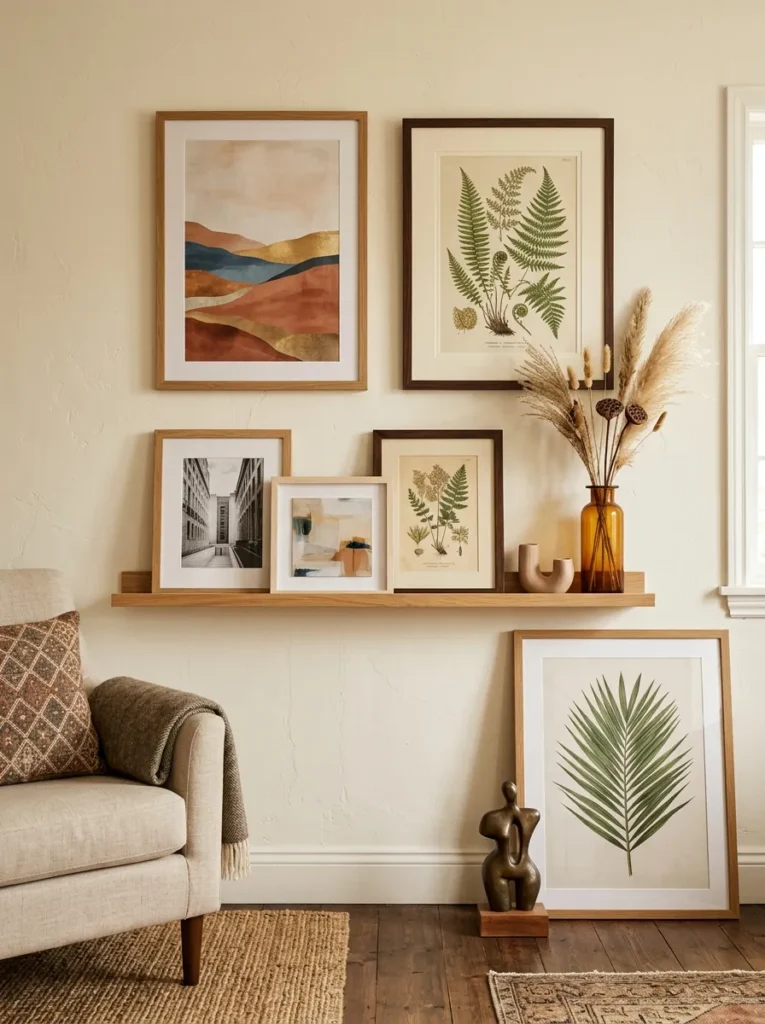
Vibe: The layered gallery wall feels casually collected — the combination of hung and leaning art creating a depth and informality that a conventional gallery wall cannot achieve.
Why it works: A gallery wall that combines hung art with leaning art — frames propped on shelves, floors, and mantels rather than fixed to the wall — creates a visual depth and casual sophistication that a purely wall-hung arrangement cannot replicate. The design principle is dimensional layering: hung pieces establish the background plane, shelf-leaning pieces create the middle ground, and floor-leaning pieces create the foreground, producing a composition with three distinct spatial planes rather than the flat, single-plane quality of conventional gallery walls. The leaning format also signals impermanence and editability — a quality that reads as confident design ease rather than fixed installation, suggesting a space that is being actively curated rather than permanently arranged.
How to get it: Begin with the two largest pieces hung at standard height on the wall — these establish the gallery wall’s scale and anchor. Install one or two floating shelves below the hung pieces and lean three or four smaller framed works on the shelf, varying heights by propping some against the wall and leaving others slightly forward. Finally, lean the largest available piece (a 60cm+ print or painting) directly on the floor against the wall at one end of the composition, and place one small sculptural object or book stack in front of it to create the foreground plane. The combination of three distinct depth planes — hung, shelf-leaning, floor-leaning — produces the most visually dynamic gallery wall format available.
Shop The Look
| Product |
|---|
| Floating shelf natural wood 90cm wall mount |
| Art print set botanical abstract framed A4 |
| Natural wood picture frame set assorted sizes |
| Small ceramic sculpture decorative object shelf |
| Dried eucalyptus stem bunch tall vase natural |
3. Textile Wall Hanging as Room Anchor (MATERIAL / COLOR)
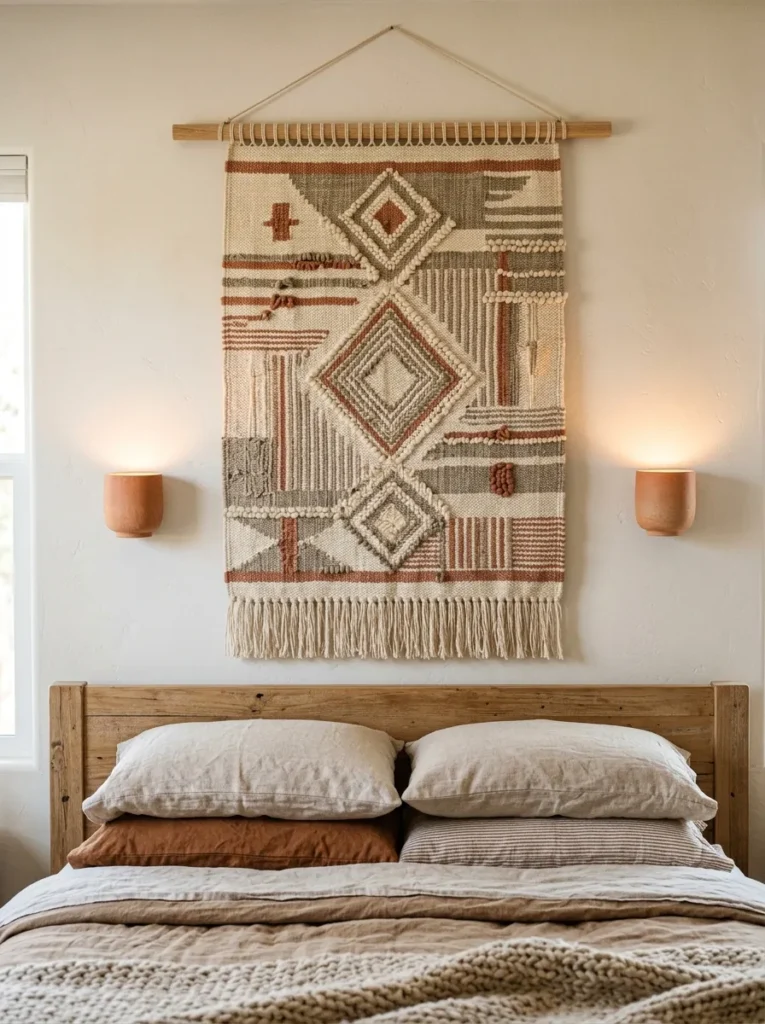
Vibe: The textile wall hanging feels warmly anchoring — the woven surface providing a tactile richness that no framed print can replicate as a bedroom focal wall.
Why it works: A hand-woven textile wall hanging used as a room anchor performs a visual function distinct from framed art — its large textile surface introduces a material warmth and acoustic softening quality that hard-framed prints and paintings cannot provide. The woven surface absorbs sound, reducing the reverberant quality of hard-walled rooms, and introduces a tactile visual richness (visible thread texture, warp and weft variation, slight dimensional irregularity) that gives the wall surface a depth that photographically reproduced flat images cannot achieve. Above a bed, a large textile hanging provides the visual headboard equivalent that many contemporary beds lack, anchoring the sleeping space with appropriate visual weight.
How to get it: Source hand-woven wall hangings from independent textile artists on Etsy or craft markets — the handmade quality is essential, as machine-woven alternatives lack the thread variation and slight irregularity that give hand-woven textiles their warmth. Mount on a natural wooden dowel (20mm diameter, 10cm wider than the hanging) with two small screw hooks in the ceiling or a wall-mounted bracket. Center above the headboard or main piece of furniture the hanging is anchoring, with the dowel’s bottom at approximately 170cm from the floor — this positions the hanging’s visual center at comfortable viewing height from a seated or lying position.
Shop The Look
| Product |
|---|
| Hand woven wall hanging large cotton wool natural |
| Wooden dowel 20mm natural wall hanging mount |
| Ceramic wall sconce plug in pair bedroom |
| Linen duvet cover set warm ivory natural |
| Dowel mounting bracket set wall ceiling hook |
4. Indoor Botanical Corner (ACCESSORIES / LAYOUT)
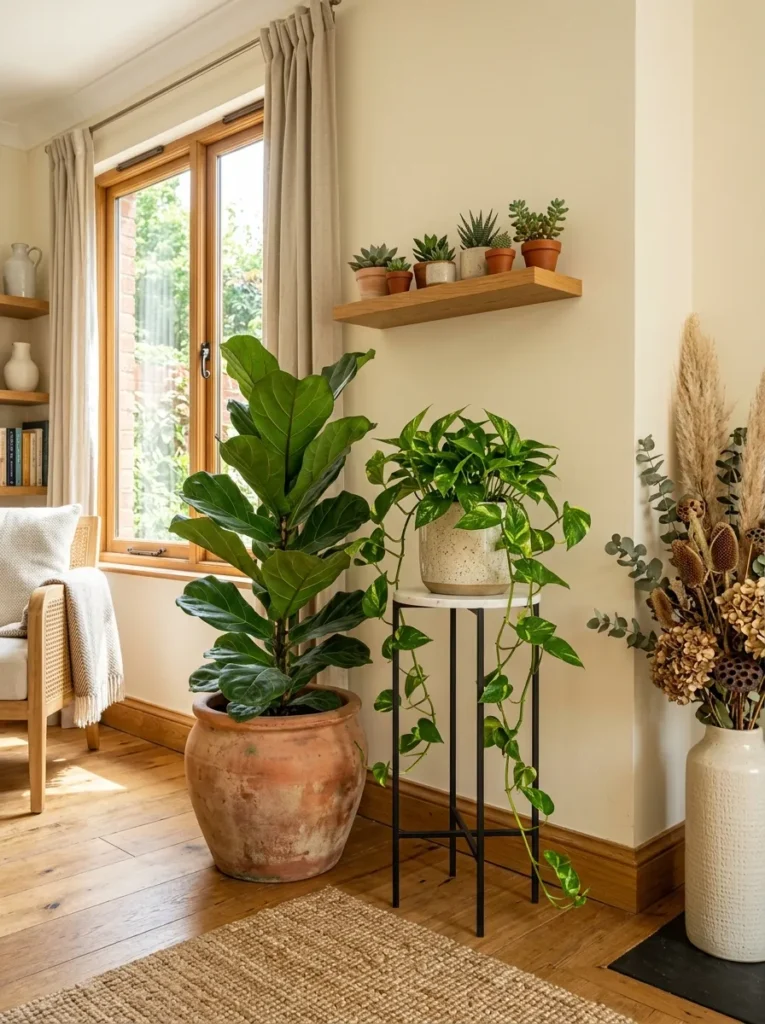
Vibe: The botanical corner feels lushly alive — a room corner transformed from dead space into the most biophilically compelling focal point in the home.
Why it works: A deliberately composed indoor botanical corner is the home decor intervention that delivers the greatest ratio of visual transformation to cost because plants are simultaneously the most visually impactful and most cost-accessible decorating material available. The design principle is height stratification: by placing plants at four distinct height levels — floor (large specimen plant), mid-height (trailing plant on a stand), upper-mid (plant on a shelf), and corner accent (dried botanical in a tall vase) — the designer creates a botanical composition that fills the full vertical volume of the corner and creates the appearance of a lush, layered plant wall within a 60x60cm floor footprint. The four-height formula produces a corner that reads as genuinely lush rather than a collection of individual pots.
How to get it: Choose the four plants before choosing their containers — the plants’ mature sizes and light requirements must be compatible with the chosen corner’s available light. The floor specimen should be the most structurally dominant plant in the home (fiddle leaf fig, large monstera, or olive tree); the mid-height plant should be a trailing or cascading variety (pothos, string of hearts, or ivy) that creates downward visual movement from the stand; the shelf plant should be a compact, upright form; and the corner accent should be a dried botanical that provides year-round structure without light requirements. Unify the container palette — terracotta, ceramic, and natural rattan in the same tonal family — to ensure the corner reads as designed rather than collected.
Shop The Look
| Product |
|---|
| Large fiddle leaf fig plant indoor terracotta |
| Marble plant stand white mid-height indoor |
| Trailing pothos plant set hanging display |
| Floating shelf plant display natural wood |
| Dried pampas arrangement ceramic vase tall |
5. Maximalist Bookcase Styling (COLOR / LAYOUT)
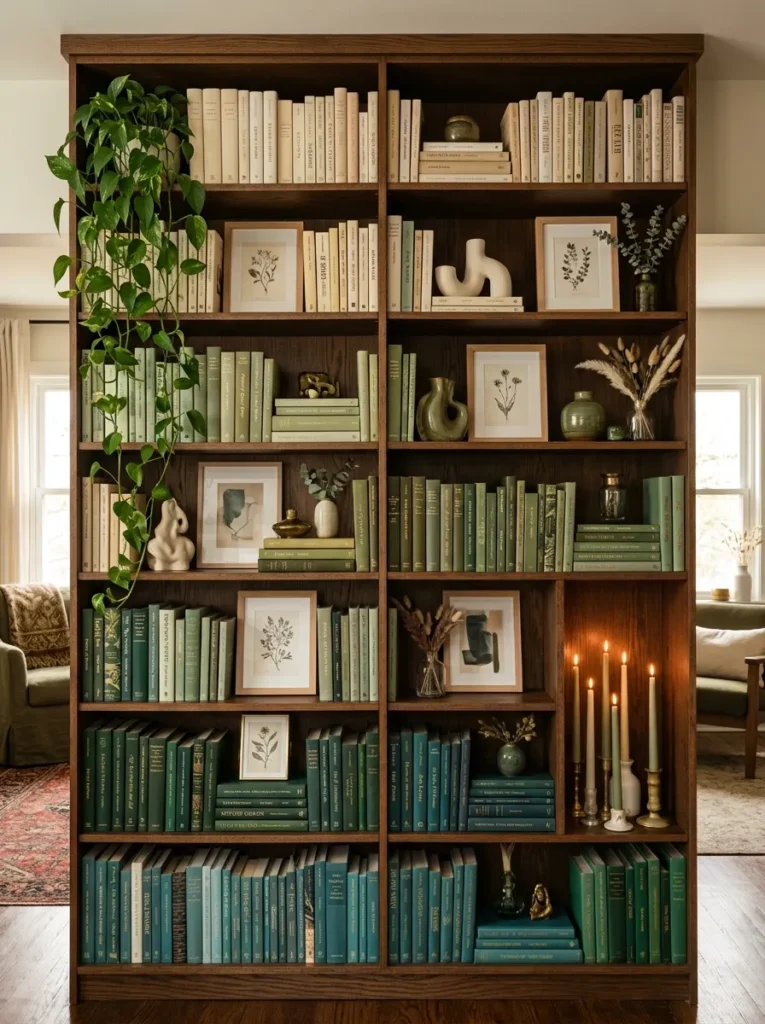
Vibe: The maximalist bookcase feels richly abundant and warmly confident — a display that rewards longer looking with progressively more interesting detail.
Why it works: Maximalist bookcase styling is the home decor intervention that most powerfully uses an existing piece of furniture — the bookcase that most homes already contain — as a complete, self-contained interior design statement. The color-blocked book arrangement (grouping books by spine color into sections that create a large-scale color gradient across the full bookcase) transforms a functional storage unit into a wall-scale color composition, while the strategic placement of ceramic objects, small sculptures, and botanical elements creates the material layering that distinguishes a designed bookcase from a merely organized one. The design principle is controlled abundance: the maximalist bookcase succeeds because every added element follows a consistent material and tonal logic — warm neutrals, natural materials, botanical references — which prevents the abundance from reading as clutter.
How to get it: Remove all books from the bookcase and sort into color families on the floor. Arrange sections to flow in a pleasing sequence — warm tones (ivory, cream, yellow) at one end, transitioning through sage and olive to deeper greens or navies at the other. Before replacing books, place ceramic objects at the transition points between color sections — these serve as visual punctuation. Leave one-third of each shelf’s depth available for objects placed in front of the books — this creates the foreground layer that adds depth. Add a trailing plant to the topmost shelf and allow it to cascade naturally downward over two or three shelves below.
Shop The Look
| Product |
|---|
| Ceramic object set assorted white matte display |
| Trailing pothos large plant bookcase display |
| Small ceramic vase set bookcase botanical |
| Brass bookend set decorative minimalist pair |
| Dried botanical stem set bookcase accent |
6. Repurposed Vintage Object Display (MATERIAL / ACCESSORIES)
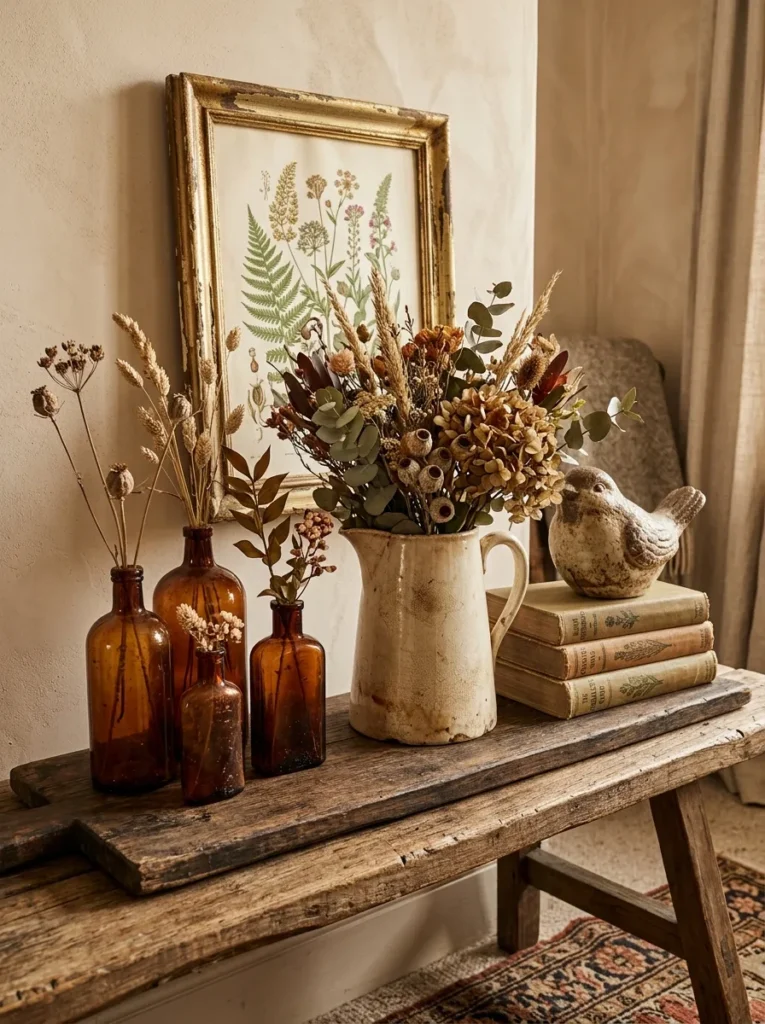
Vibe: The vintage display feels deeply patinated and collected — the kind of arrangement that looks like it took twenty years to assemble and forty-five minutes to style.
Why it works: A repurposed vintage object display is the creative home decor idea with the highest ratio of visual impact to financial cost because the objects that make it most successful — amber glass bottles, ironstone crockery, worn wooden boards, aged frames — are among the most abundant and least expensive items available at charity shops, car boot sales, and antique markets, typically costing $1–$8 per piece. The design principle is patina unity: when every object on a display surface carries visible evidence of age — the crazing glaze of old ironstone, the worn gold of a picture frame, the amber-toned glass of vintage bottles — the collection reads as naturally unified regardless of how diverse its individual origins, because time’s touch provides the cohesive aesthetic thread that links all the objects.
How to get it: Source objects from charity shops, antique markets, and car boot sales rather than homeware retailers — the genuine patina of authentic vintage objects is irreplaceable by manufactured distressing techniques. Group amber glass bottles in clusters of three or five, filling with dried stems rather than fresh flowers (which require water that can damage vintage wood and ironstone surfaces). Use an aged wooden board or slate tile as the tray element that organizes the composition and creates a defined border for the display. Prop a single piece of vintage printed matter — a botanical illustration, a map page, a magazine cover — in a worn frame at the back of the composition to create the background plane.
Shop The Look
| Product |
|---|
| Vintage amber glass bottle set 3 piece display |
| White ironstone pitcher vintage style ceramic |
| Aged wooden serving board natural patina |
| Dried botanical stem set amber bottle display |
| Worn gilt picture frame small vintage style |
7. Statement Ceiling Treatment (COLOR)
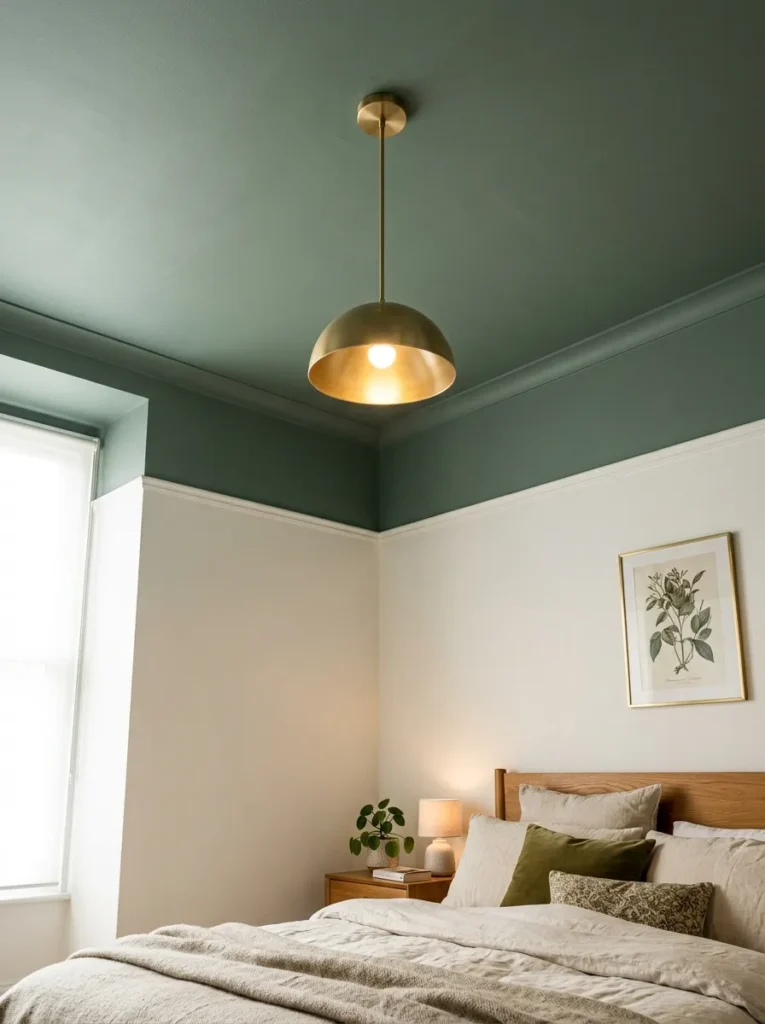
Vibe: The painted ceiling feels boldly intimate — the room suddenly acquiring a canopy quality that makes it feel protected and warmly enclosed in a completely new way.
Why it works: Painting the ceiling a deeper or more saturated tone than the surrounding walls is the creative home decor intervention that most dramatically changes a room’s spatial quality because it creates a canopy effect — the visual impression of a room with a lower, more intimate ceiling height — which makes rooms feel more enveloping and personal without any structural change. The design principle is visual enclosure: a colored ceiling draws the eye upward and creates a sense of being within a defined space (rather than simply under an undifferentiated white surface), making rooms feel more intentionally designed and more atmospherically rich. Dusty sage green is the ceiling color that most consistently produces beautiful results across varied wall tones because its muted, slightly grey quality reads as sophisticated rather than primary, and its warmth coordinates with natural materials throughout.
How to get it: Paint the ceiling only — no wall treatment required, though extending the ceiling color 15–20cm down the walls at the ceiling-wall junction creates the most seamless canopy effect. Use ceiling paint rather than wall paint for a matte, non-reflective finish — any sheen on a ceiling paint amplifies imperfections and creates unflattering light bounce. Apply two coats with a wide roller on an extension pole, cutting in carefully at the ceiling-wall junction with a 50mm brush. The ceiling color should be two to three values deeper than the wall color — a relationship that creates depth without darkness.
Shop The Look
| Product |
|---|
| Dusty sage green ceiling paint matte finish |
| Ceiling paint roller set extension pole large |
| Ceiling cutting brush angled 50mm painter |
| Brass pendant light ceiling fitting warm |
| Painter’s tape premium edge ceiling wall |
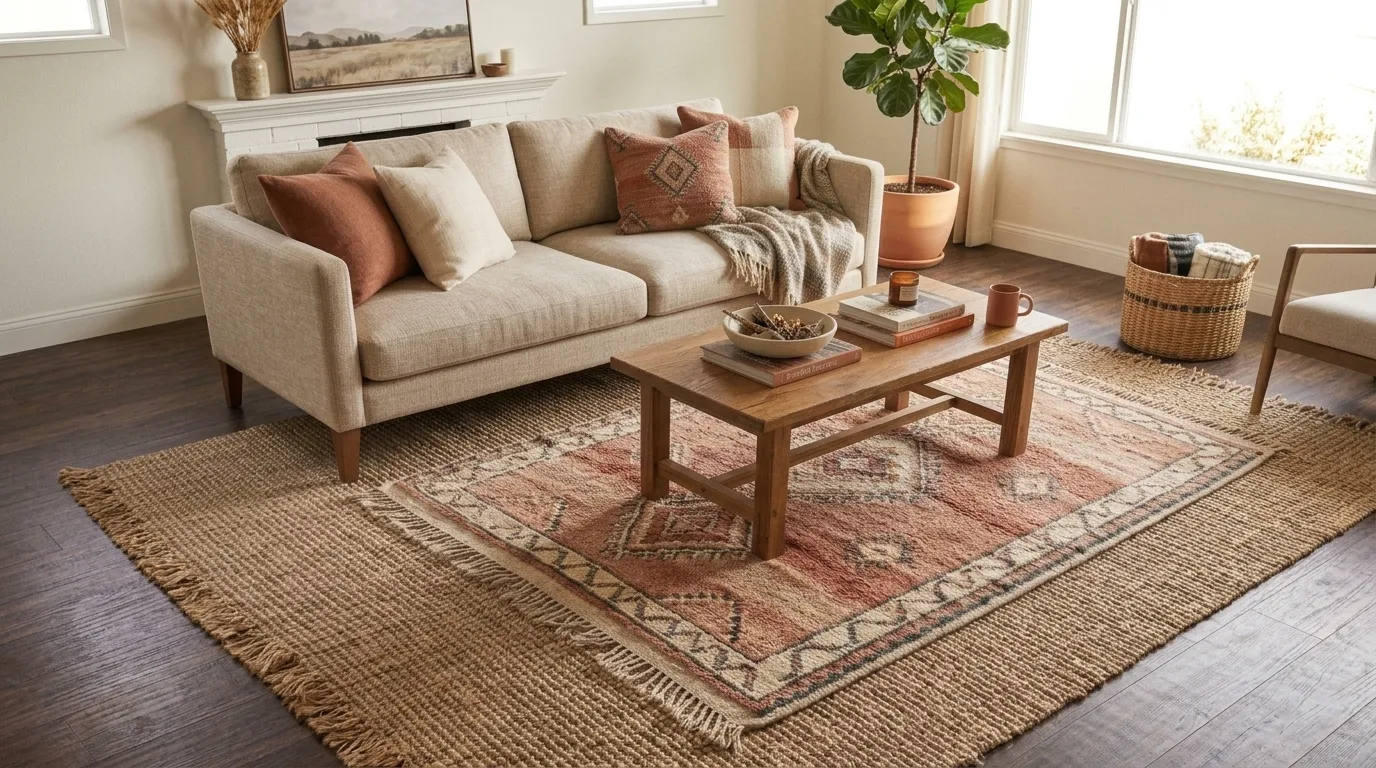
8. Layered Rug Technique (LAYOUT / MATERIAL)
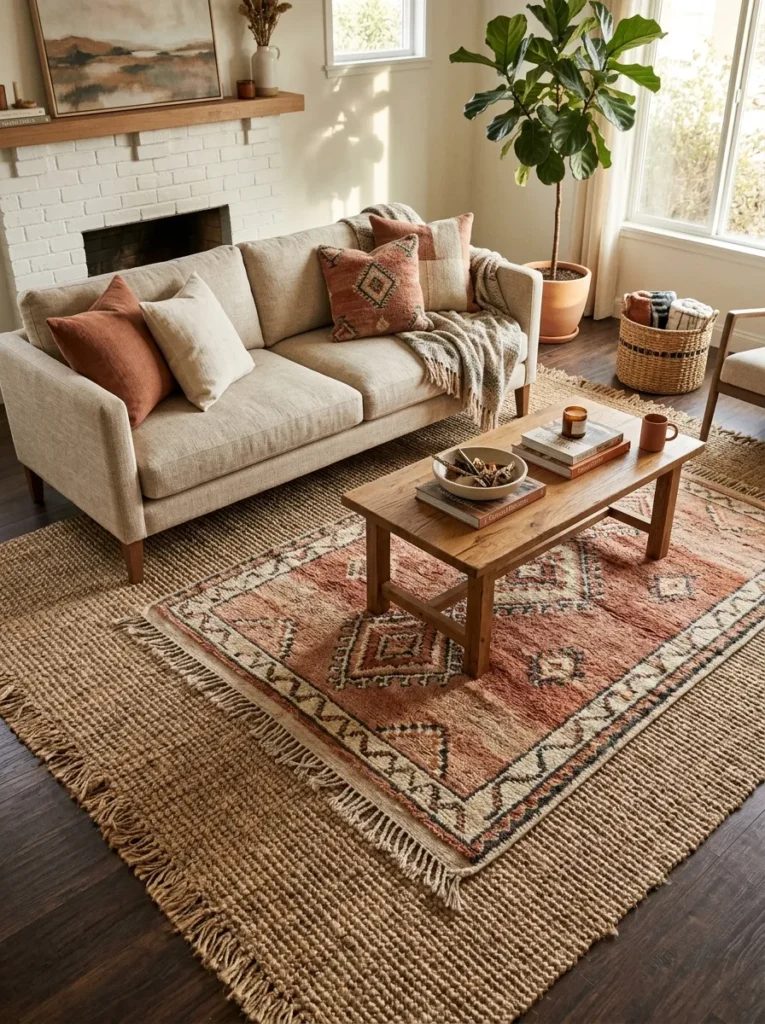
Vibe: The layered rugs feel warmly abundant — the most immediate floor transformation available, adding texture, color, and visual interest in one simple layering move.
Why it works: Layering rugs — placing a smaller, more decorative rug on top of a larger, neutral base rug — is the living room floor treatment that creates the most visual richness and the most practical floor coverage in the fewest purchasing decisions. The design principle is material contrast: the natural, rough texture of a jute base rug against the woven, patterned surface of a Moroccan or flat-weave accent rug creates the textural tension that makes both rugs look more interesting individually than either would appear alone. The layering technique also allows the use of a smaller, more expensive decorative rug (which might be too small to anchor the full room alone) over a larger, less expensive natural fiber base, achieving full-room coverage at a lower combined cost than a single large decorative rug.
How to get it: Choose a base rug that covers the majority of the floor space — at minimum, large enough for all furniture legs to rest on it. Choose the accent rug at approximately 60–70% of the base rug’s dimensions — large enough to be visually significant, small enough to show the base rug on all sides. Place the accent rug slightly off-center or at a gentle angle (5–10 degrees) from the room’s axis — this prevents the layered arrangement from reading as two rugs aligned by accident and creates the casual, deliberate quality that distinguishes styled layering from indecisive arrangement. Use a rug pad between the layers to prevent the accent rug from shifting.
Shop The Look
| Product |
|---|
| Natural jute area rug large base layer neutral |
| Moroccan wool rug muted terracotta cream pattern |
| Rug pad non-slip between layers thin |
| Rug tape double sided layer grip anti-slip |
| Linen sofa cushion cover warm ivory accent |
9. DIY Limewashed Terracotta Pot Display (COLOR / ACCESSORIES)
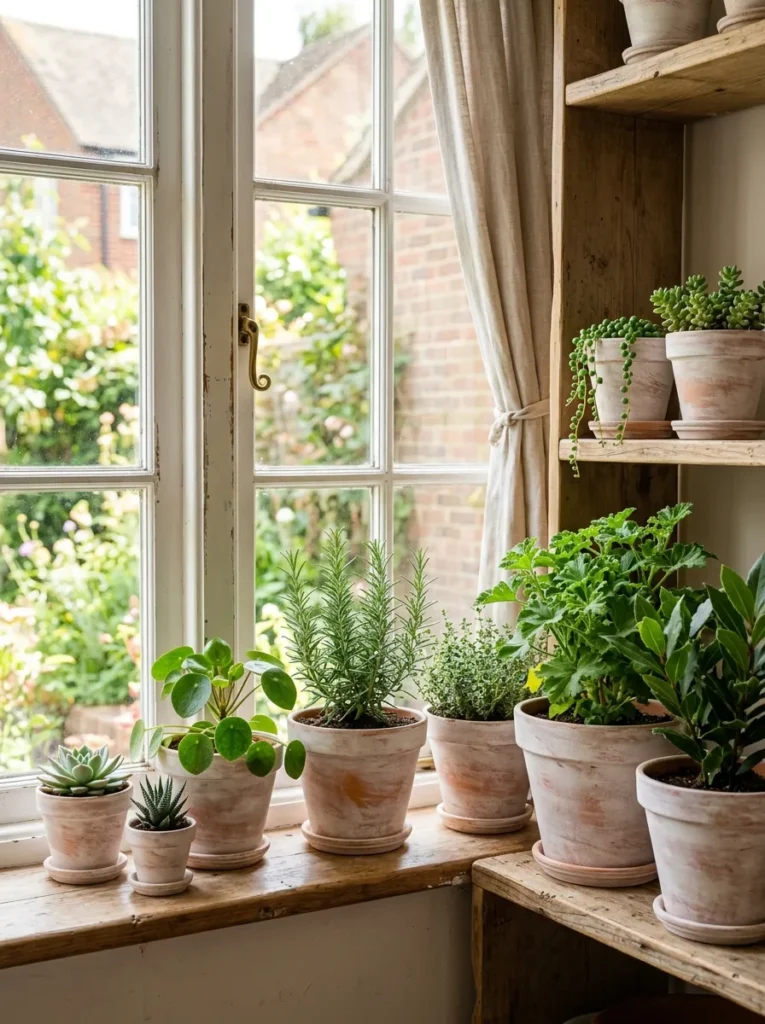
Vibe: The limewashed pot collection feels warmly artisanal — a set of ordinary terracotta pots transformed by a 20-minute DIY treatment into a cohesive, home-integrated display.
Why it works: DIY limewashed terracotta pots are the creative home decor project with the highest visual transformation relative to skill and time required — diluting chalk paint or exterior white paint with water to a wash consistency and brushing it over standard terracotta pots, then partially wiping it back while wet, produces a limewash effect that instantly elevates cheap commercial pots into objects with the quality of expensive artisan ceramics. The design principle is treatment unity: the consistent limewash finish applied across a varied collection of pot sizes and shapes creates visual cohesion from a group of individually mismatched objects, demonstrating that a single consistent treatment can unify the most disparate collection into a curated display.
How to get it: Dilute chalk paint or exterior white paint 1:1 with water in a small container — the consistency should be like thin cream rather than yogurt. Apply with a wide natural brush in all directions across the pot surface, working into the textured terracotta surface. While still wet (work one pot at a time), use a damp cloth to partially remove the wash in a random pattern — removing more from the raised areas and less from the recesses creates the most authentic limewash quality. Allow to dry completely (30 minutes) before planting. Apply a thin coat of exterior matte varnish if the pots will sit outside or in a wet environment.
Shop The Look
| Product |
|---|
| Terracotta pot set assorted sizes 6 piece natural |
| White chalk paint craft pot limewash DIY |
| Natural bristle brush set craft application |
| Exterior matte varnish spray pot protection |
| Succulent plant set assorted 6 pack small |
10. Seasonal Botanical Tablescaping (ACCESSORIES)
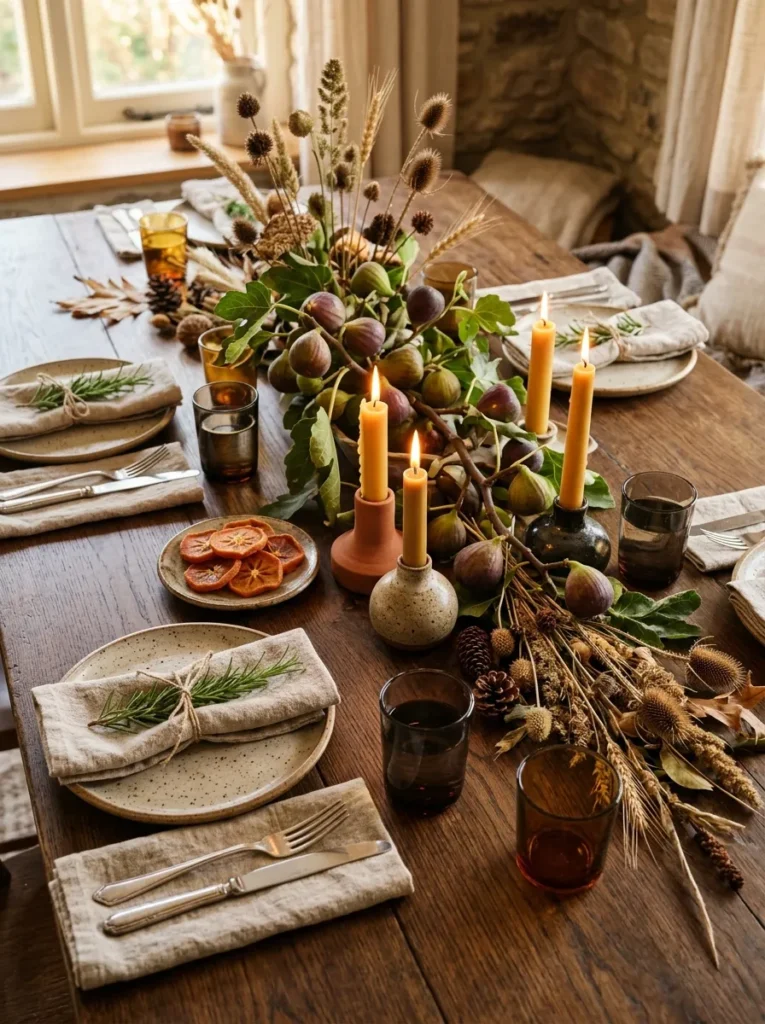
Vibe: The tablescaping feels abundantly seasonal — a dining table that changes with the natural world, making every meal feel like it is specifically of its moment.
Why it works: Seasonal botanical tablescaping using natural organic elements — fresh branches with fruit or blossom, seasonal dried materials, fresh herbs, and natural candles — is the creative home decor approach to the dining table that produces the most emotionally resonant results because it connects the interior space to the external natural world’s seasonal rhythm. The design principle is natural seasonality: each season provides its own organic material palette — cherry blossom in spring, fresh herbs and citrus in summer, fig branches and dried seedheads in autumn, bare branches and forced bulbs in winter — that no manufactured seasonal decoration can replicate with the same authenticity. A seasonal tablescaping practice also requires virtually zero investment in permanent accessories — the materials change with the season and most cost under $15 per seasonal refresh.
How to get it: Build the seasonal table composition in height order from the center outward — the tallest element (fresh branch or large botanical stem) at the center, medium elements (candles, ceramic dishes with dried material) along the table’s length, and the smallest elements (herb sprigs, dried flower heads, small stones or seeds) at each place setting as a personal touch for each diner. Change the composition four times per year at the seasonal transitions, sourcing the centerpiece element from a garden, grocery store, or market rather than a specialist florist — seasonal produce aisles often provide the most authentic and least expensive seasonal botanical materials.
Shop The Look
| Product |
|---|
| Natural beeswax taper candle set 6 ivory |
| Ceramic candle holder set 3 heights natural |
| Natural linen napkin set 4 piece undyed |
| Dried persimmon slice natural seasonal decor |
| Small ceramic plate set 3 piece display |
11. Curtain Upgrade: Floor-to-Ceiling Linen (COLOR / LAYOUT)
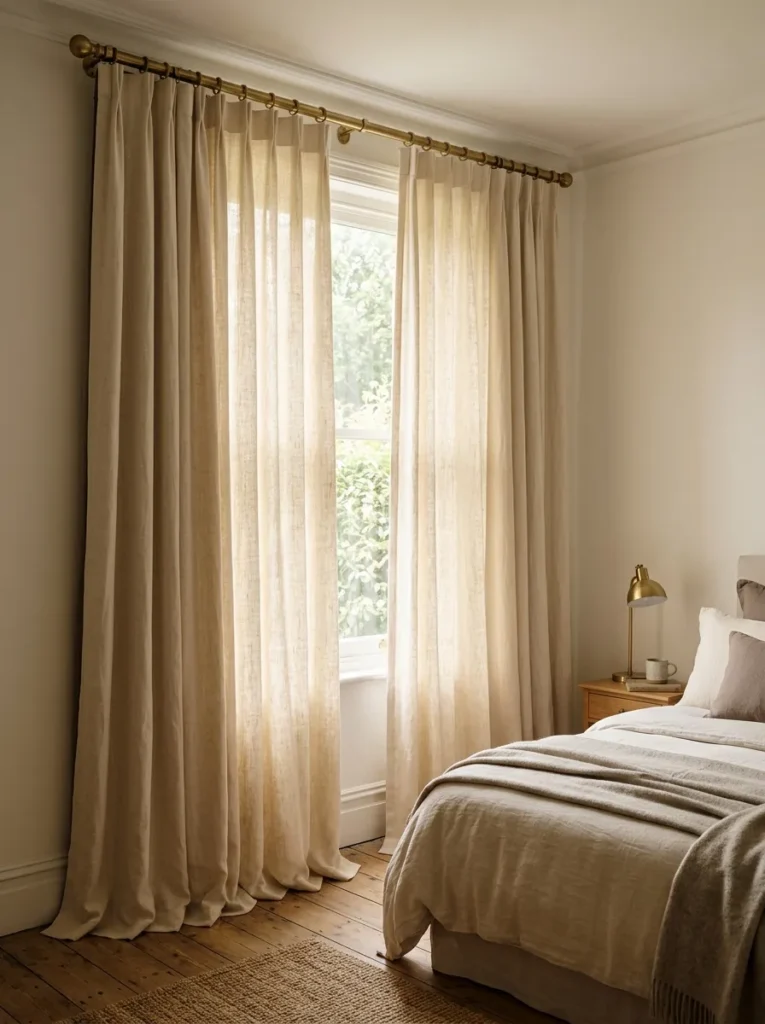
Vibe: The floor-to-ceiling linen curtains feel warmly transformative — the single window treatment change that most dramatically improves a room’s perceived height, light quality, and overall sophistication.
Why it works: Upgrading curtains to floor-to-ceiling natural linen panels hung at ceiling height — rather than window-frame height with synthetic fabric — is the single window treatment change that most dramatically transforms a room’s spatial quality and material atmosphere. The ceiling-height mounting creates an apparent doubling of the window’s vertical dimension, making both the windows and the room appear significantly taller than their actual dimensions. The natural linen fabric diffuses harsh direct light into the warm, even ambient glow that flatters every material and human face equally — and improves in character with every wash cycle, developing the natural drape and subtle color variation that makes aged linen one of the most beautiful textiles available. The design principle is height illusion through vertical proportion: curtains that run from ceiling to floor make every room feel taller and more architecturally generous than curtains constrained to the window frame dimensions.
How to get it: Mount the curtain rod at ceiling height — install the brackets as close to the ceiling as the wall structure allows. Specify curtain panels in a width of 2.5 times the window opening for full, generous gathering when closed — underfull curtains read as mean regardless of fabric quality. Choose natural linen in warm ivory or undyed natural — avoid pre-bleached brilliant white linen, which can read as cold rather than warm. Layer a simple white or cream blackout lining behind the linen for functional light control in bedrooms, using a separate track or rod mounted inside the window recess.
Shop The Look
| Product |
|---|
| Natural linen curtain panel floor length ivory |
| Brass curtain rod ceiling mount 200cm |
| Brass curtain ring clip set 12 piece |
| White blackout lining panel curtain layer |
| Ceiling curtain bracket set brass mount pair |
12. Arched Mirror Statement Piece (SMALL SPACE / LAYOUT)
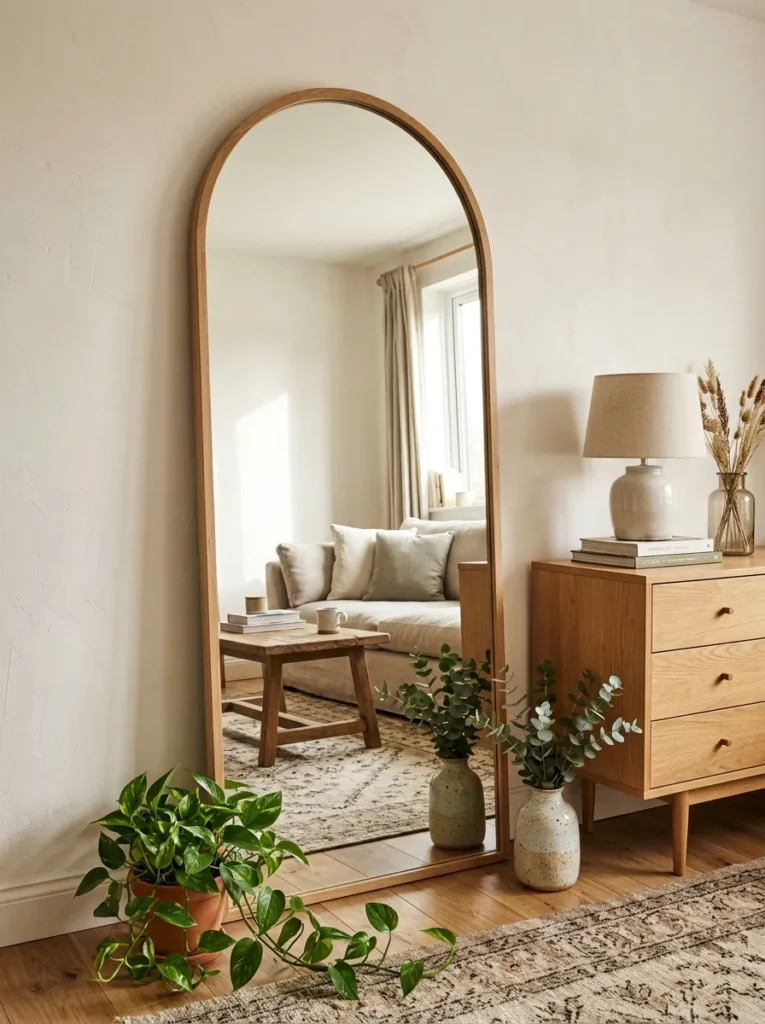
Vibe: The arched floor mirror feels architecturally generous — a single object that simultaneously adds height, amplifies light, and introduces the most elegant silhouette available in decorative furniture.
Why it works: A large arched floor mirror is the creative home decor purchase with the broadest and most immediate transformative effect because it performs five simultaneous design functions: it amplifies natural light by reflecting the room’s window back across the space; it creates the illusion of additional room depth through the reflected spatial perspective; it introduces the arch form — the most humanly resonant architectural shape — as a decorative silhouette; it defines a wall area as the most naturally photogenic and visually dynamic surface in the room; and its leaning (rather than wall-hung) position signals the casual editorial confidence that distinguishes a styled interior from a conventionally furnished one. The design principle is multifunctional beauty: the arched mirror is the single object that contributes most design value per square foot of floor space.
How to get it: Size the mirror to a minimum of 160cm height for a floor-leaning statement piece — below this height, a leaning mirror reads as a secondary accent rather than a primary statement. The arch top should begin at approximately 130cm from the floor, creating a narrow rectangular lower section and an arched upper section. Lean the mirror against the wall at a very slight angle — 5–7 degrees from vertical — and secure the base against a rubber or cork anti-slip mat to prevent movement. Place one or two small objects at the mirror’s base — a trailing plant, a ceramic vase, a small stack of books — to create the foreground element that frames the leaning mirror as a styled composition rather than an unsecured object.
Shop The Look
| Product |
|---|
| Arched floor mirror large brass natural wood |
| Anti-slip rubber mat mirror floor base |
| Small trailing plant ceramic pot mirror base |
| Ceramic vase narrow tall mirror side accent |
| Floating shelf natural wood beside mirror |
13. Wabi-Sabi Shelf Vignette (MATERIAL / ACCESSORIES)
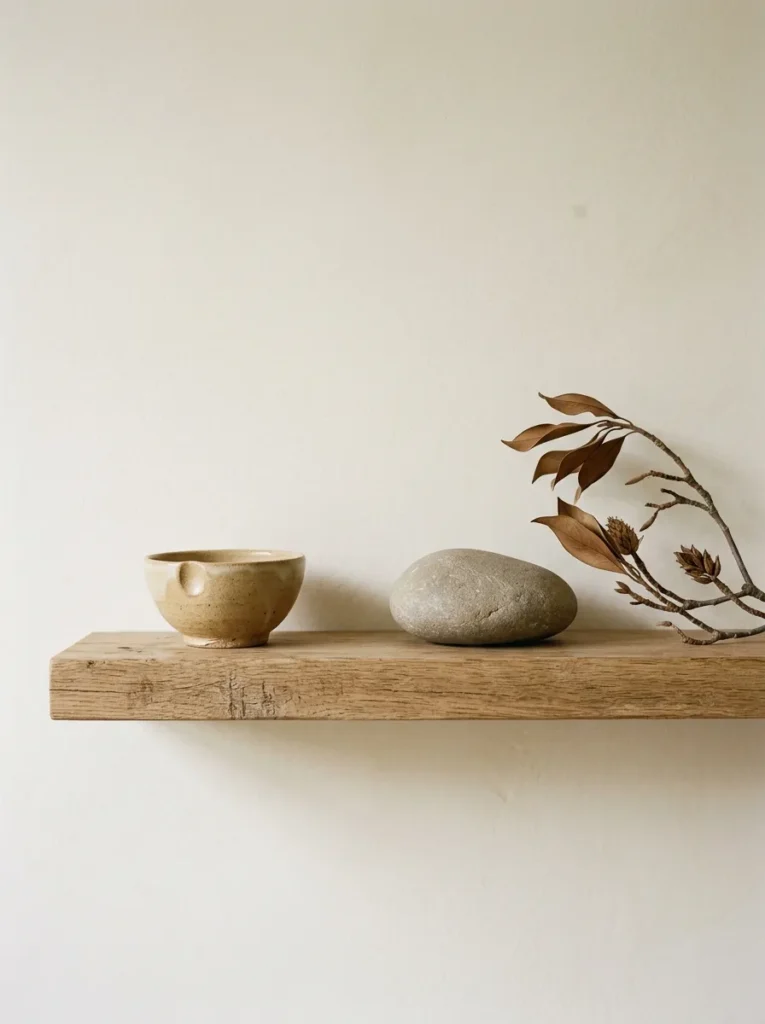
Vibe: The wabi-sabi shelf feels meditative and complete — three objects so carefully chosen that adding a fourth would immediately diminish all three.
Why it works: A wabi-sabi shelf vignette applies the Japanese aesthetic philosophy of finding beauty in natural imperfection, impermanence, and incompleteness to the domestic display shelf — treating the empty shelf surface as a positive design element and limiting objects to those that carry visible evidence of natural origin or human making. The three-object maximum is the wabi-sabi shelf’s most important constraint: any arrangement with fewer than three objects can feel underdressed; any arrangement with more than three begins to lose the meditative quality that makes the wabi-sabi approach so visually powerful. Each of the three chosen objects should represent a different material and sensory quality — tactile (smooth stone), visual (dried botanical), and conceptual (imperfect handmade ceramic).
How to get it: Clear the shelf completely before beginning — the wabi-sabi vignette cannot be created by adding to an existing display, only by starting from emptiness. Choose the three objects using three criteria: natural origin or hand-making, visible imperfection or material character, and material variety. Place the largest object first, slightly off-center. Place the second object at the opposite end of the shelf at a different distance from the wall edge, creating depth variation. Place the third object between or in front of the first two, completing a triangular visual relationship. Step back and look — if the arrangement feels complete with slight discomfort at its simplicity, it is correct.
Shop The Look
| Product |
|---|
| Hand thrown ceramic bowl warm sand matte glaze |
| Smooth river stone large natural decorative |
| Dried magnolia branch single stem natural |
| Floating ash wood shelf minimalist 60cm |
| Hard wax oil natural shelf surface finish |
14. Upcycled Furniture Paint Transformation (COLOR / MATERIAL)
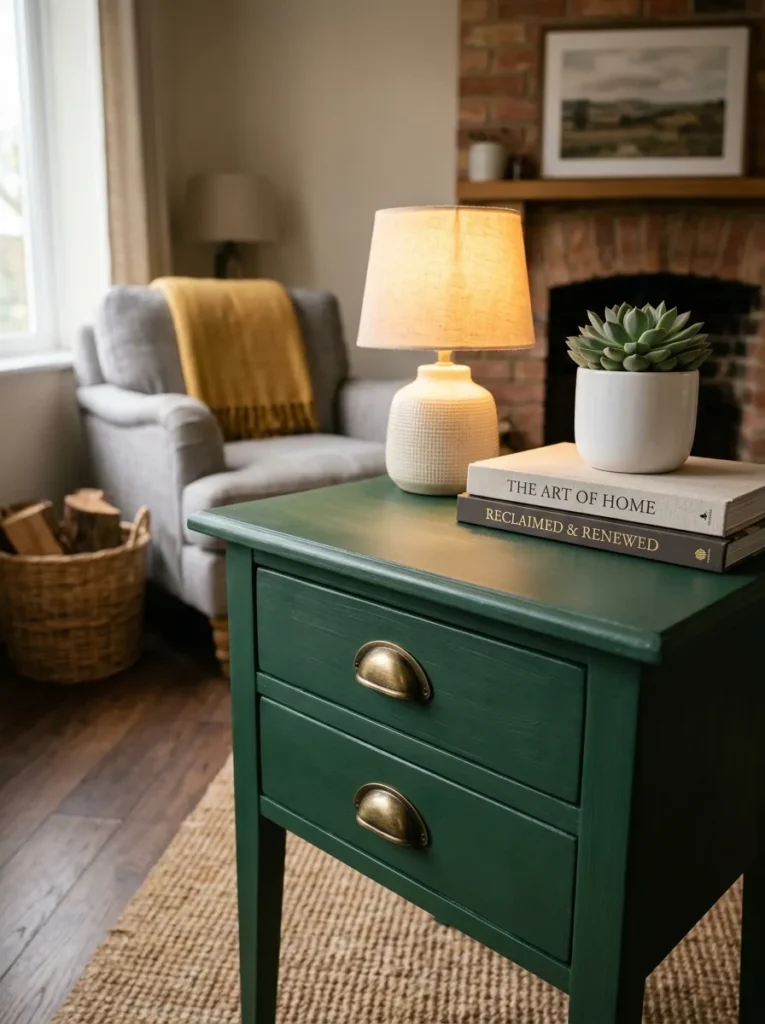
Vibe: The painted table feels boldly transformed — the most dramatic furniture rescue available with paint, a brush, and an afternoon.
Why it works: Painting an existing piece of furniture in a bold, considered color — deep forest green, warm terracotta, dusty navy, or rich ochre — is the creative home decor transformation with the highest visual impact per dollar spent because chalk paint adheres to most furniture surfaces without sanding or priming and dries to a matte finish that reads as deliberately chosen and artisanal rather than manufactured. The design principle is color elevation: a piece of furniture that is visually unremarkable in its original pale wood or laminate finish becomes a room-defining statement object when painted in a deeply saturated, sophisticated tone. The hardware replacement — swapping original handles for brass cup pulls or ceramic knobs — is the finishing detail that signals the transformation was intentional and considered rather than improvisational.
How to get it: Clean the furniture surface thoroughly and remove all hardware before painting. Apply chalk paint directly to the surface with a wide flat brush in long, consistent strokes — two thin coats produce a more even result than one thick coat, with 30-minute drying between coats. The slight brush direction visible in chalk paint’s texture is a quality, not a flaw — it signals hand-painting rather than machine finishing. Seal with clear furniture wax applied with a lint-free cloth and buffed to a soft sheen after 24 hours — wax provides durability and a subtle depth that matte spray sealer cannot replicate. Replace hardware last, using a paper template to ensure consistent placement across all drawers.
Shop The Look
| Product |
|---|
| Deep forest green chalk paint furniture indoor |
| Brass cup hardware pull set furniture |
| Clear furniture wax matte finish protection |
| Chalk paint brush flat set furniture application |
| Furniture wax cloth lint free application |
How to Start Your Home Decor Refresh Transformation
Your single best first move is to spend 20 minutes walking through your home with fresh eyes — entering each room as if for the first time and noting the three things that most consistently bother you about the space, whether that is a dark corner that has never been addressed, a wall that has been bare for two years, or a piece of furniture whose original color has always felt wrong for the room. These three observations across your full home will generate a prioritized creative brief that is more specific and more actionable than any mood board or Pinterest collection, because they are grounded in the actual daily experience of the space rather than aspirational images of rooms that bear no relation to your specific architectural context, light quality, or lifestyle.
The most common mistake in creative home decor is purchasing multiple small decorative objects — additional cushion covers, new candles, small ceramic pieces — in an attempt to refresh a space that actually needs one or two significant creative interventions rather than an accumulation of minor additions. The result is a room with more objects on its surfaces but no fundamental change to its visual quality or atmosphere. Fix this by identifying whether your space needs a creative intervention (a bold paint decision, a significant furniture transformation, a floor-to-ceiling curtain upgrade) or a styling refresh (a botanical corner, a gallery wall, a shelf vignette) — and spending the budget accordingly rather than defaulting to small additions that never accumulate to genuine transformation.
Three specific items under $50 that create the most immediate and broadly applicable creative home decor impact: a pot of chalk paint in a bold, unexpected color ($12–$18) that can transform any piece of furniture, any set of terracotta pots, or any surface that needs a creative reinvention; a bundle of dried pampas grass or eucalyptus stems ($10–$18) that immediately adds organic height, texture, and natural warmth to any corner, shelf, or table surface without requiring a water source or maintenance routine; and a roll of natural linen fabric ($14–$22 for a half-meter) from which curtain panels, table runners, wall hangings, and cushion covers can all be cut without sewing — simply torn along the grain for naturally fringed edges that are themselves a decorative quality.
A single room refresh using one significant creative intervention — a limewash feature wall, a floor-to-ceiling curtain upgrade, or a painted furniture piece — takes one weekend and costs $30–$120 in materials. A complete whole-home creative refresh across all 14 ideas in this article would be approached over 2–3 months at a comfortable pace, costing $400–$800 in total across all projects — equivalent to one or two pieces of mid-range commercial furniture but producing a home that is entirely personally expressive, visually cohesive, and genuinely transformed rather than merely newly furnished.
Frequently Asked Questions About Creative Home Decor Ideas
What is the most impactful creative home decor change for a small budget?
Limewash paint on one feature wall delivers the largest visual transformation per dollar of any single creative home decor intervention — a full feature wall can be limewashed for $20–$35 in paint materials and completely transforms the perceived quality and character of the room. The second most impactful low-budget intervention is rearranging existing furniture — moving the sofa to a different wall, repositioning art to a different room, or rotating the dining table 90 degrees — which costs nothing and forces a fresh assessment of the space that frequently reveals better configurations than the original arrangement. Both interventions require time and attention rather than significant financial outlay.
How do I choose a creative home decor style that feels genuinely personal?
Personal home decor style emerges from collecting rather than deciding — spending six months photographing rooms, objects, and details that produce a spontaneous positive response (Instagram saves, Pinterest boards, photographs taken in other people’s homes or in shops) and then analyzing what those saved images have in common. Most people discover that their instinctive responses cluster around two or three consistent material preferences, a consistent color temperature preference (warm or cool), and a consistent density preference (abundant or restrained) that constitute the real foundations of their personal style regardless of the named aesthetic trend they identify with. The named styles — Japandi, organic modern, cottagecore, maximalist — are useful vocabularies for communication but are poor substitutes for the primary research of one’s own consistent visual responses.
How do I make creative home decor changes in a rented home?
The most impactful creative home decor interventions available without permanent wall damage are: large leaning floor mirrors (no wall fixings required); floor-leaning art (propped rather than hung); botanical corners built entirely from plant stands, floor pots, and floating shelves hung with removable picture strips; ceiling-height curtains using tension rods or adhesive ceiling-mounted curtain tracks; and furniture paint transformations using chalk paint on renter-owned furniture pieces. Gallery walls using command strips or small picture hooks (which leave minimal damage repairable with white wall filler on departure) are accepted by most landlords when the damage is minimal and repaired on departure. Check the specific tenancy agreement and landlord guidance before any intervention that contacts the wall surface.
What plants are best for a botanical corner that requires minimal care?
Pothos (Epipremnum aureum) is the most universally appropriate botanical corner plant because it tolerates a wider range of light conditions than almost any other trailing indoor plant, grows rapidly enough to create visible cascading effect within weeks, recovers from irregular watering better than any other popular indoor plant, and is available everywhere at low cost. Fiddle leaf figs (Ficus lyrata) are the most architecturally impactful floor specimens but require consistent bright indirect light and consistent watering — appropriate for bright corners but not forgiving of neglect. ZZ plants (Zamioculcas zamiifolia) are the most genuinely low-maintenance floor or shelf plants, tolerating low light and irregular watering while maintaining a handsome dark green glossy leaf structure. Dried botanicals — pampas grass, eucalyptus, dried palm — require zero maintenance and provide year-round structural botanical interest.
How do I know when a room is finished rather than just adequately furnished?
A room feels finished when every surface has been consciously considered and every object has been chosen rather than defaulted to — when there are no surfaces that are empty because of indecision rather than intentional negative space, and no objects present because they have not yet been replaced rather than because they belong. The practical test is this: walk into the room and note how many objects you see that you would change if you could change one thing about the room right now. When that number reaches zero, the room is finished. When it remains above zero, the objects or surfaces at the top of your mental change list are the next creative intervention priority. Home decoration is not completed once but maintained through the same ongoing attention that keeps every other living system vital and current.
Ready to Refresh Your Space with Creative Home Decor?
These 14 ideas span the full range of creative home decor possibility — from the atmospheric power of limewash paint and painted ceilings, through the material warmth of textile wall hangings and layered rugs, to the organic abundance of botanical corners and seasonal tablescaping, the artisanal beauty of wabi-sabi vignettes and vintage object displays, and the bold creative satisfaction of furniture paint transformations and repurposed vintage styling — covering every room, every budget, every skill level, and every degree of creative ambition from a 20-minute arrangement to a weekend transformation of genuine lasting impact. Begin with the observation walk — 20 minutes, fresh eyes, three specific things that most bother you about the space most in need of creative attention — because that list is your specific creative brief, and no article, mood board, or shopping list can substitute for the knowledge of your own space that only sustained observation reveals. Today’s specific action: identify the one wall, corner, or surface in your home that has been bothering you the longest without being addressed, and commit to it as the first creative intervention of this refresh — because the space that has been waiting the longest will produce the greatest satisfaction when it is finally given the creative attention it deserves. When your home finally feels genuinely expressive of who you are — when guests notice something specific and beautiful rather than simply comfortable and adequate — you will understand exactly why creative home decor earns its devoted, growing community of makers and the permanent place it holds at the top of every interior design Pinterest board. Save your favorites now, especially the limewash feature wall and the wabi-sabi shelf vignette — they are the two ideas that, once realized in your own home, change permanently how you see every other surface in the house.