14 Elegant Modern Bathroom Ideas That Feel Luxurious
Elegant modern bathroom ideas that feel luxurious draw from the specific intersection of contemporary design discipline and premium material specification — creating bathrooms where the restraint of modern design (clean lines, minimal ornament, resolved proportion) is expressed through materials of genuine quality (natural stone, solid timber, brushed metal, handmade ceramic) rather than through quantity of decoration or complexity of form, producing spaces that feel genuinely expansive, calm, and considered regardless of their actual square footage.
This article gives you exactly 14 ideas spanning material palettes, fixture specification, lighting strategy, storage integration, and the specific design decisions that distinguish a luxurious modern bathroom from a merely expensive one so every bathroom size, every renovation scope, and every budget finds a direction that produces genuine luxury rather than its simulation.
A luxurious modern bathroom is not defined by its price tag but by the quality of its design decisions — and the most expensive-looking decisions are frequently not the costliest to implement. Here are 14 ideas worth specifying.
Why Elegant Modern Bathroom Ideas Feel Luxurious
The perception of luxury in a contemporary bathroom is produced by a specific constellation of sensory and spatial qualities that design research and hospitality industry studies consistently identify: a sense of spatial generosity (the feeling that the room is larger or more open than its actual dimensions, produced by material continuity, minimal visual interruption, and appropriate scale of elements); material authenticity (the presence of materials whose specific properties — stone’s temperature and vein variation, timber’s grain and warmth, ceramic’s glaze variation — communicate genuine material investment rather than manufactured simulation); lighting quality (warm, directional, multi-source light that illuminates materials at their most beautiful rather than at their most uniform); and sensory calibration (a scent, temperature, acoustic, and visual environment that supports the bathroom’s function as a space of daily restoration rather than daily routine).
The specific challenge of the modern luxury bathroom is that it must achieve these qualities while maintaining the design restraint that the modern aesthetic requires — no excessive ornament, no decorative complexity, no historical reference used as decoration. The luxury must emerge from the quality of the materials themselves, the precision of the detailing, and the considered proportion of the spatial composition rather than from applied decoration. This is a more demanding design challenge than the traditional luxury bathroom (where richness can be added through ornamental pattern, carved detail, and historical reference) and produces, when successful, a more enduring and more universally appreciated result.
Style at a Glance
| Element | Modern Luxury Core | Elegant Design Edge |
|---|---|---|
| Philosophy | Material quality, not decoration, creates luxury | Restraint is not the absence of luxury — it is its highest form |
| Materials | Natural stone, solid timber, handmade ceramic, brushed metal | Warm white, warm stone, deep charcoal, warm sage |
| Key Decisions | Material continuity, lighting layering, proportion, detail |
14 Elegant Modern Bathroom Ideas That Feel Luxurious
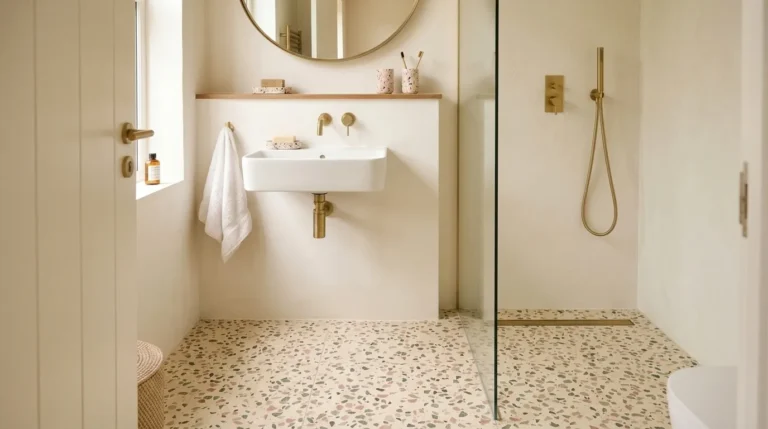
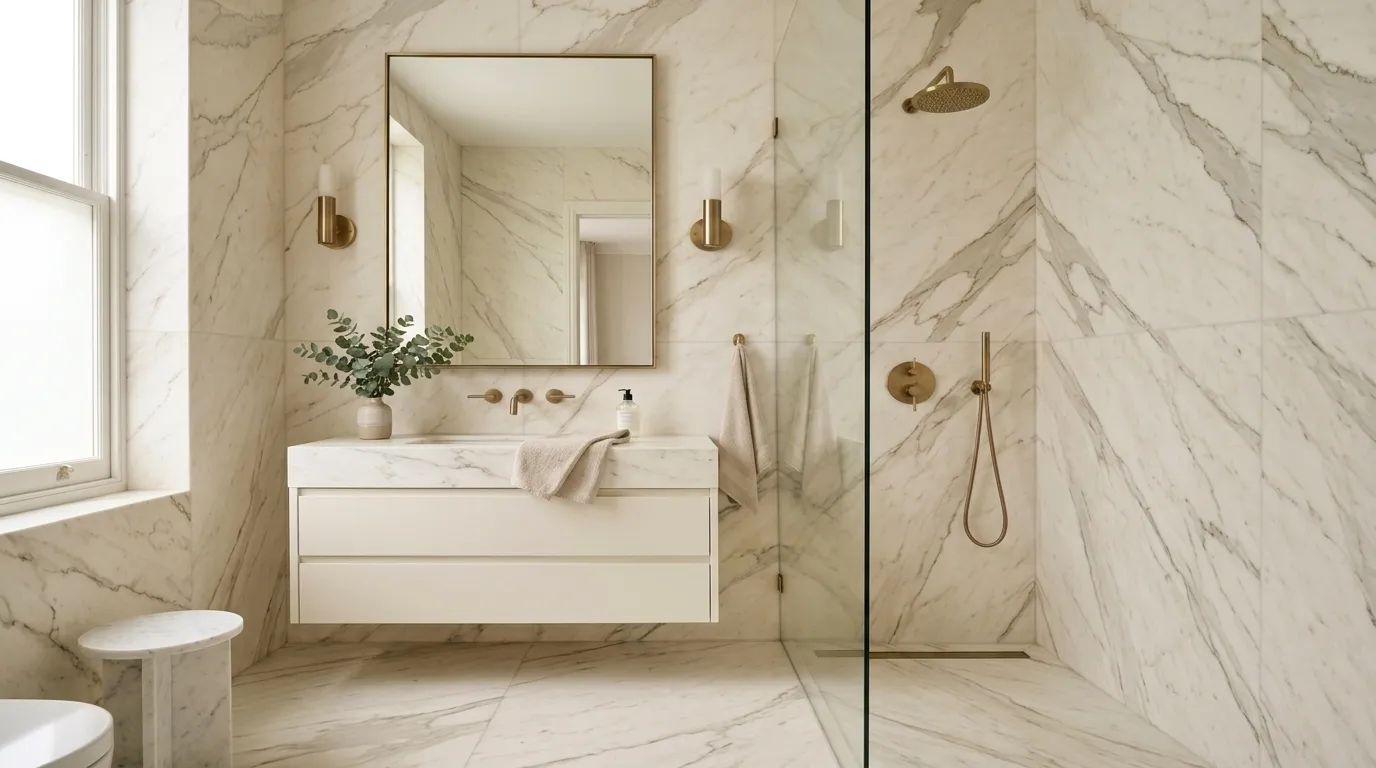
1. Continuous Natural Stone — Material Immersion
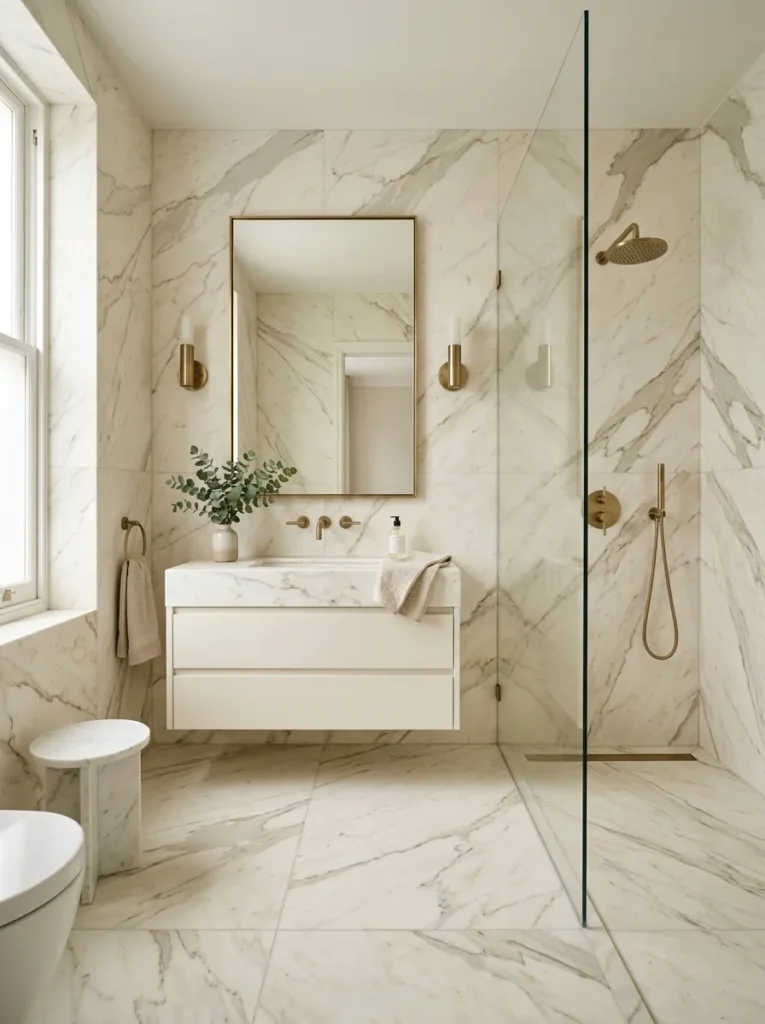
Vibe: The continuous stone bathroom feels like the inside of a warm geological formation — the material immersion of stone on every surface creating an enveloping warmth that no painted, tiled, or otherwise decorated bathroom can replicate.
Why it works: Continuous natural stone applied to floor, walls, and shower in the same material applies the monolithic material immersion principle — when one high-quality natural material covers all the surfaces of a room without interruption, the room reads as a carved space rather than a decorated one, creating the specific quality of an environment that was formed rather than assembled. The vein matching across surface transitions (the stone’s natural vein pattern continuing from the floor up the wall as though the slab were folded rather than cut and jointed) is the technical detail that most decisively produces this formed-space quality — it requires careful material selection (choosing adjacent slabs from the same block for consistent veining), precise installation planning (laying out the slab positions on a floor plan and confirming vein continuity before cutting), and an experienced stone installer who understands vein-matching techniques.
Specification: Warm cream limestone or Calacatta marble at 750×1500mm or larger slab format. Honed (matte) finish on floors (polished is dangerously slippery when wet), polished on walls (the polished surface shows vein depth and color at maximum quality). Seal all stone surfaces with a penetrating impregnating stone sealer before use and reseal annually.
Quick Win: Vein-matched stone applied to the shower walls and floor only (without extending to the full bathroom walls) creates the stone immersion effect in the most-experienced zone of the bathroom at a fraction of the full room cost.
Shop The Look
| Product |
|---|
| Calacatta marble slab large format |
| Warm limestone slab 750x1500mm |
| Brushed brass shower fixtures |
| Floating vanity warm white lacquer |
| Penetrating stone sealer annual |
Also view: 14 Creative Home Decor Ideas to Refresh Your Space
2. Warm Timber Vanity with Integrated Lighting
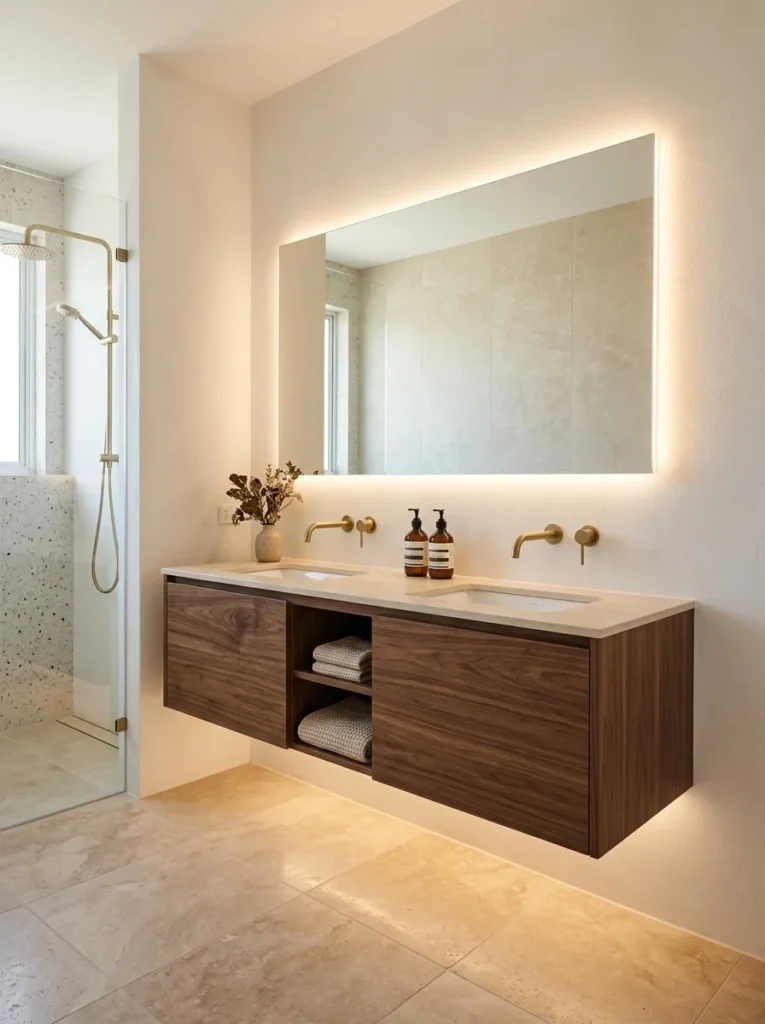
Vibe: The floating timber vanity feels like furniture that has forgotten it is furniture — the under-vanity LED creating the specific quality of illuminated suspension that converts the vanity from a fitted unit into a levitating warm timber installation.
Why it works: A wall-hung timber vanity with integrated under-vanity LED illumination applies the floating architecture principle — the wall-hung specification (no visible legs, no contact with the floor) already creates a visual lightness that floor-standing units cannot achieve; the warm LED strip beneath the vanity base amplifies this quality by creating a halo of warm amber light between the vanity’s bottom surface and the floor, visually separating the vanity from the floor plane and reinforcing the floating effect. This combination of suspension (from the wall) and illuminated separation (from the floor) creates the specific quality of luminous architecture that high-end hospitality bathrooms have deployed since the mid-2000s.
Timber specification for bathrooms: Solid walnut or walnut veneer on marine-grade plywood substrate, finished with minimum three coats of a hard-wearing water-resistant lacquer (Osmo Polyx 3054 Clear Satin or equivalent). Seal all cut edges particularly at the basin cutouts with silicone before basin installation. Maintain by wiping dry after splashing and reapplying lacquer topcoat every three to five years.
Shop The Look
| Product |
|---|
| Solid walnut vanity wall-hung 120cm |
| Undermount basin ceramic pair |
| Brushed brass basin tap pair |
| Warm LED strip under-vanity |
| LED mirror integrated halo |
3. Frameless Glass Shower with Ceiling Rain Head
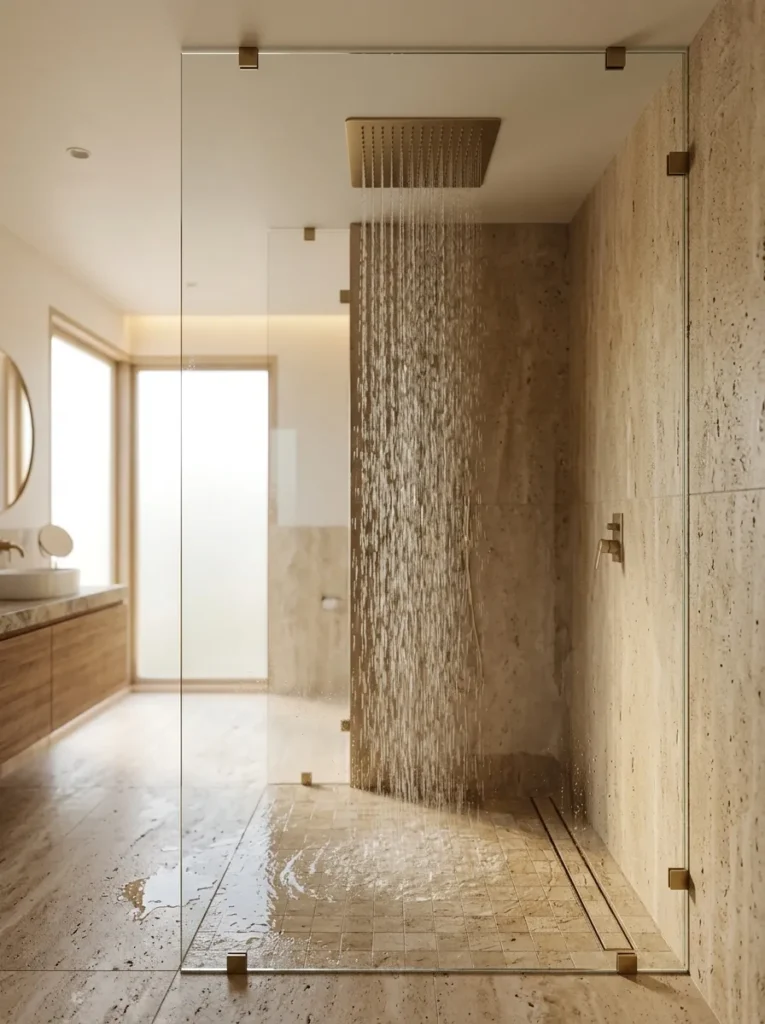
Vibe: The frameless glass shower feels like the bathroom decided that the shower zone should be defined by light and water rather than by frames and doors — the minimal glass enclosure creating openness where conventional shower doors create enclosure.
Why it works: A frameless glass shower panel with a ceiling rain head applies the minimum barrier maximum experience principle — the frameless glass panel (a single pane of toughened and tempered glass 10mm thick, fixed to the floor and ceiling using minimal point-fixings rather than a surrounding frame) creates a visual boundary that defines the shower zone without creating a physical enclosure. The shower head specified at ceiling level — a 30×30cm panel rain head that distributes water over the full body width simultaneously — creates the specific experience of total body water coverage that handheld or wall-mounted heads cannot replicate, converting the daily shower from a functional rinse to a genuinely restorative experience.
Glass specification: 10mm toughened and tempered safety glass with a factory-applied hydrophobic coating (such as Ritec ClearShield or Diamon-Fusion) that prevents water mineral deposit adhesion, reducing cleaning frequency and maintaining the glass’s optical clarity over time. The glass should be specified and installed by a glass specialist who can confirm the structural adequacy of the floor and ceiling fixing points.
Shop The Look
| Product |
|---|
| Frameless glass shower panel 10mm |
| Ceiling rain shower head 30cm brass |
| Point-fixing glass hardware minimal |
| Concealed linear drain shower |
| Hydrophobic glass coating factory |
4. Warm LED Mirror Lighting — The Vanity Illumination System
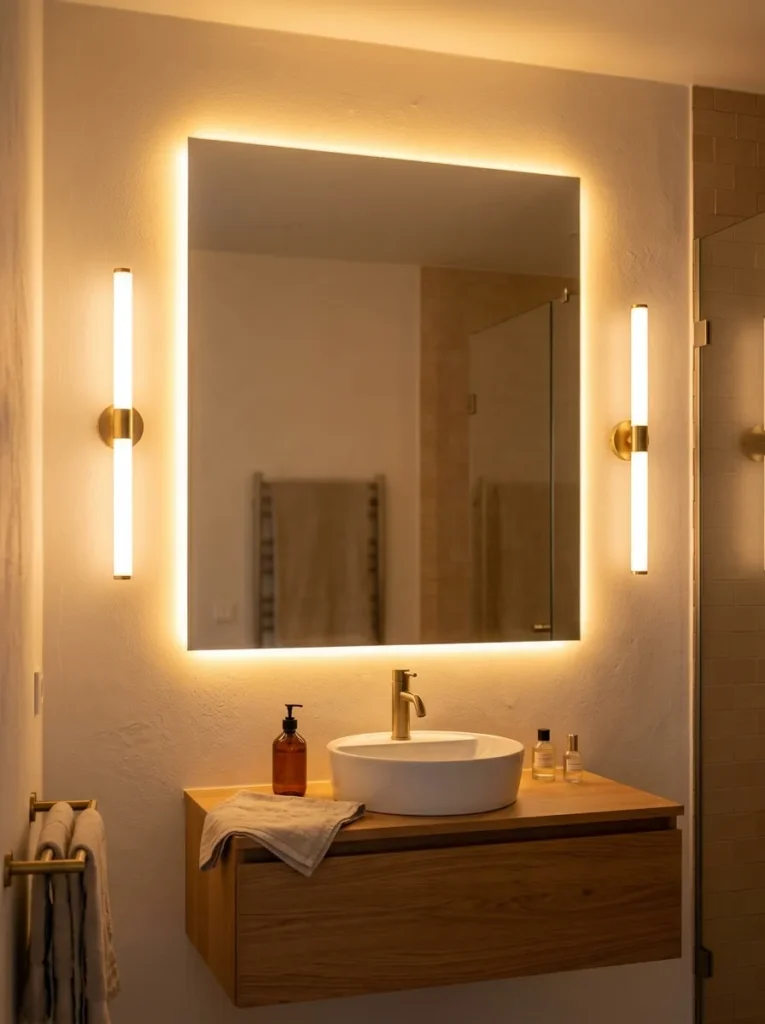
Vibe: The three-source mirror lighting feels like a professional makeup room that became a bathroom — the even, shadow-free illumination from three warm angles creating genuinely useful facial light that no single overhead source can produce.
Why it works: A three-source mirror lighting system (backlit halo plus two vertical bars) applies the shadow-elimination illumination principle — the most common bathroom lighting failure is a single overhead source (a ceiling downlight or overhead strip above the mirror) that creates unflattering downward shadows on the face by illuminating from above only. A backlit halo mirror provides ambient fill light from behind the mirror’s perimeter; two vertical light bars mounted at face height on each side of the mirror provide horizontal fill light from both sides simultaneously. The combination of these three warm (2700–3000K) sources produces even, shadow-free illumination that enhances rather than flattens facial features, making the bathroom mirror experience genuinely pleasant rather than merely functional.
Color temperature specification: All three mirror lighting sources should be identical in color temperature — warm white at 2700–3000K for a flattering skin-tone rendering. Avoid mixing color temperatures (cool overhead with warm side lights) as the mixed light sources create chromatic inconsistency that is visible in the mirror.
Shop The Look
| Product |
|---|
| LED backlit mirror 100x70cm warm |
| Vertical LED bar light 60cm pair |
| Warm LED 2700K mirror lighting |
| Mirror mounting bracket wall |
| LED driver dimmable compatible |
5. Freestanding Bath on Natural Stone Floor — The Focal Object
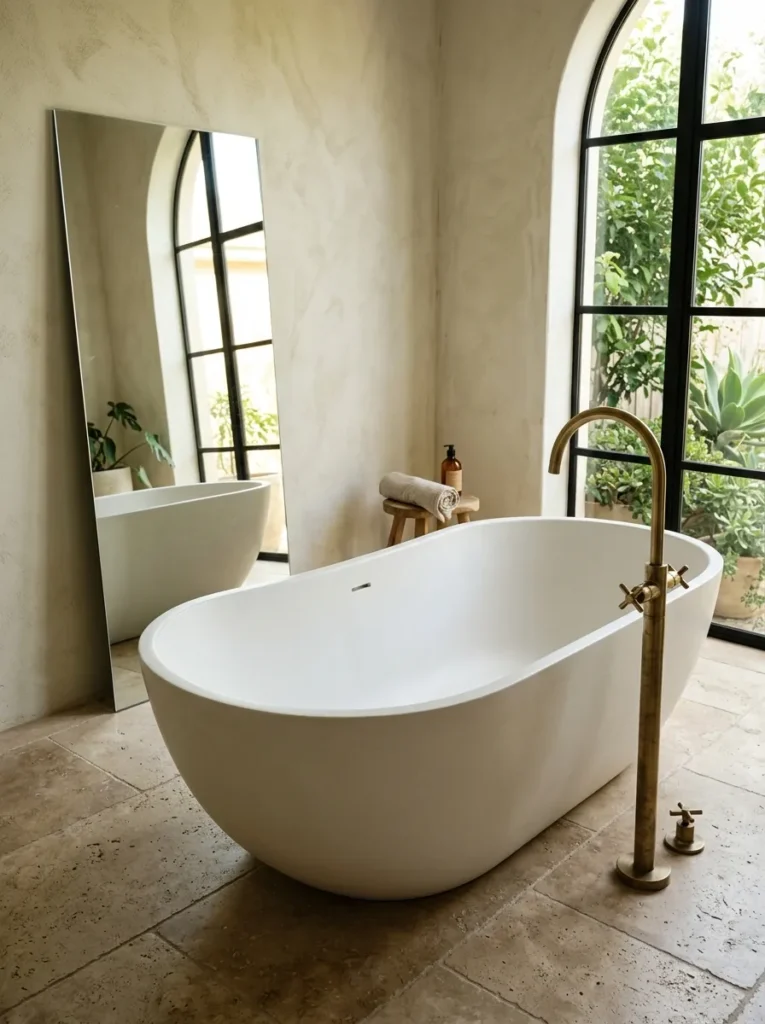
Vibe: The freestanding stone bath feels like a sculpture that happens to hold water — the composite stone’s weight and matte surface creating a material gravity that acrylic can never achieve regardless of the form it takes.
Why it works: A composite stone freestanding bath as the bathroom’s primary focal object applies the single sculptural statement principle — in a modern luxury bathroom where surfaces are kept calm and minimal, the freestanding bath is positioned as the room’s sole decorative object: a three-dimensional form of significant material quality whose silhouette, surface texture, and relationship to the floor create a complete spatial composition without any supporting decorative elements. Composite stone (a mixture of natural stone minerals and resin) provides the matte surface quality, the thermal mass (it retains water temperature significantly longer than acrylic), and the apparent visual weight that make it the premier material for contemporary freestanding baths.
Floor-mounted tap: The floor-mounted tap specification (rather than wall-mounted or deck-mounted) is essential to the composition’s integrity — it provides the tall, sculptural brass form that relates to the bath’s organic silhouette without attaching to it or to the wall, maintaining the bath’s freestanding purity.
Shop The Look
| Product |
|---|
| Composite stone freestanding bath |
| Warm travertine floor tile honed |
| Floor-mounted brass bath spout |
| Separate brass bath filler pair |
| Leaning mirror frameless large |
6. Heated Towel Rail as Design Feature — Form and Function
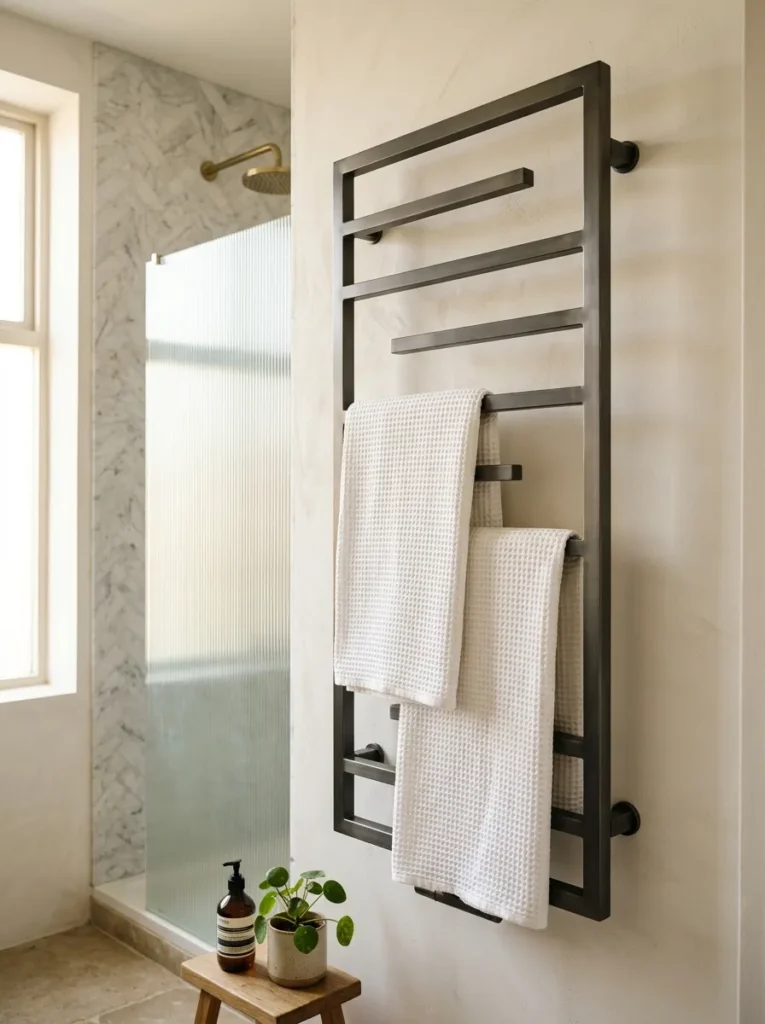
Vibe: The sculptural heated towel rail feels like the bathroom’s one functional object that unambiguously earns its decorative presence — the bold architectural form of the rail making it readable as a designed wall element rather than installed equipment.
Why it works: A sculptural heated towel rail as a bathroom design feature applies the functional-decorative object principle — the heated towel rail is one of the bathroom’s few guaranteed-functional elements (it genuinely improves the bathing experience by providing a pre-warmed, rapidly dried towel) and one of the largest vertical wall elements in the bathroom. A ladder rail specified in brushed brass at 120cm tall and 60cm wide occupies significant wall space, and its visual quality — the warm metallic surface, the precise spacing of the horizontal bars, the proportion of the overall form — contributes directly to the bathroom’s aesthetic character. Specifying the towel rail as a statement piece (larger, in a premium finish, with a bold or architecturally precise form) converts it from a utility installation to a designed element.
Electrical versus hydronic: An electrical heated towel rail (with an electric element, independent of the central heating system) provides warm towels year-round regardless of heating season, is easier to install in renovations where central heating modification is not practical, and can be controlled independently. A hydronic version (connected to the central heating circuit) is more economical to run but is only warm when the central heating is operating.
Shop The Look
| Product |
|---|
| Heated towel rail brushed brass ladder |
| Heated towel rail charcoal sculptural |
| White waffle towel large set |
| Towel rail thermostat timer |
| Wall-fixing kit heated rail |
7. Integrated Shelf Niche with Warm Interior Lighting
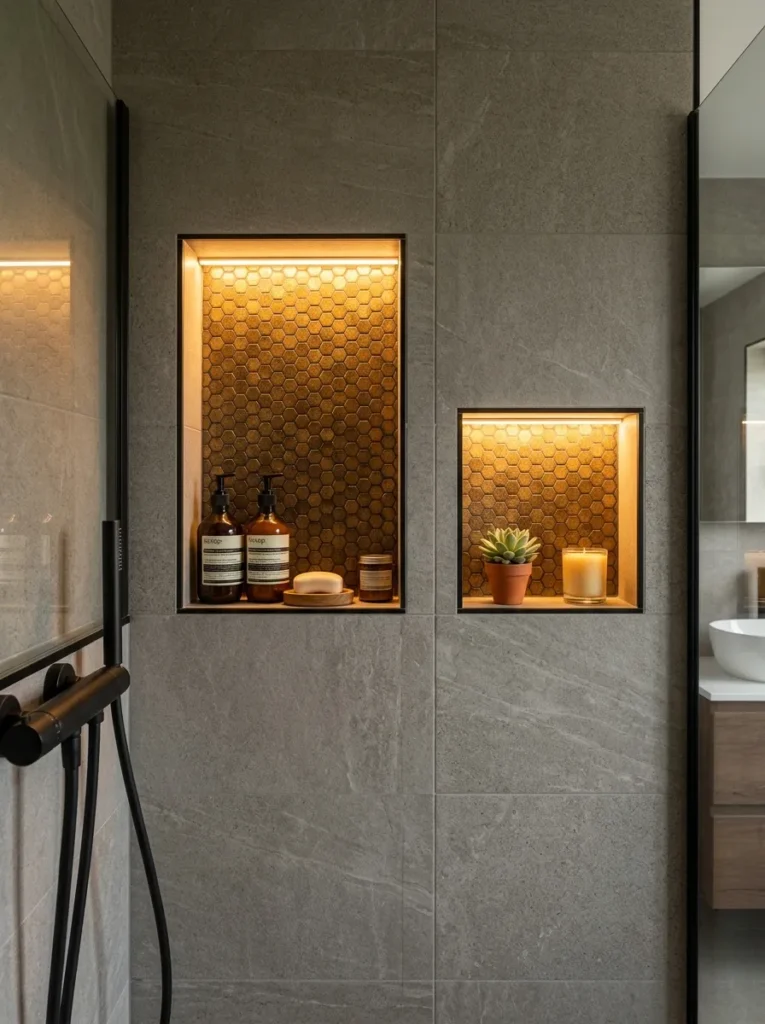
Vibe: The illuminated niche bathroom feels like someone understood that a storage recess can also be a light source — the warm LED in each niche converting functional storage into an atmospheric element.
Why it works: Integrated shower niches with warm LED illumination and contrasting tile interiors apply the architectural detail luxury principle — a niche tiled in a contrasting warm mosaic tile (small hexagonal gold or bronze mosaic against the larger format stone or porcelain of the surrounding wall) with warm LED illumination creates a three-dimensional architectural detail with its own material identity, read as a designed element rather than a storage recess. The warm LED (positioned at the niche’s top edge behind a small concealing tile lip) illuminates the products or objects within the niche in warm amber light, creating a glowing interior that reads at room distance as a warm accent in the bathroom’s overall lighting composition.
Construction timing: Niches must be constructed before the waterproofing and tiling stage — they are cut into the stud wall (for timber frame construction) or built out from the wall using a niche former (a waterproof pre-formed insert available from tiling suppliers) before the waterproof membrane is applied. Adding a niche after tiling is complete requires significant remedial work.
Shop The Look
| Product |
|---|
| Niche former waterproof set |
| Warm hexagonal mosaic gold bronze |
| Warm LED strip niche concealed |
| Niche LED driver low voltage |
| Contrasting niche tile set |
8. Marble Effect Plaster or Microcement — The Alternative to Stone
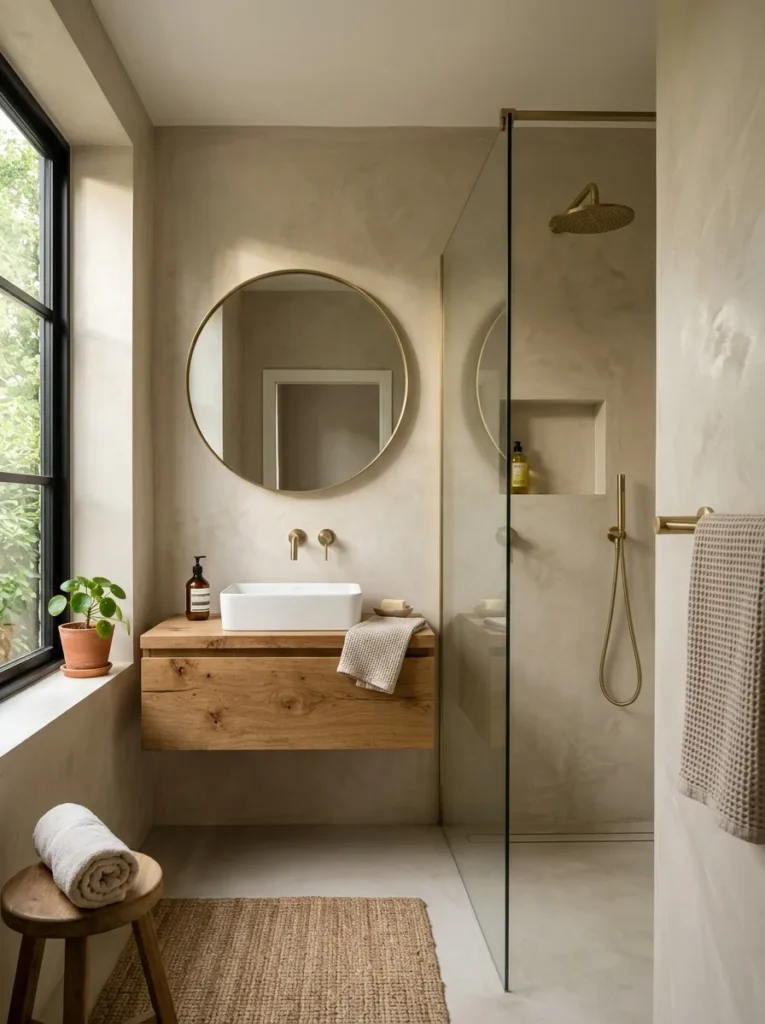
Vibe: The polished plaster bathroom feels like someone captured the quality of stone in a material that was applied by hand — the trowel variation and the polished sheen creating a surface warmth that stone tiles at the same price cannot produce.
Why it works: Polished microcement or Venetian marble plaster applied throughout a bathroom applies the artisanal surface material principle — a trowel-applied, polished plaster surface has the specific quality of a surface that was created by skilled human hands rather than manufactured to a specification and cut to fit. The trowel variation in color depth (some areas slightly darker where the plaster was applied more thickly, lighter where the trowel drew the surface thinner) creates the visual complexity of a naturally varied material without any intentional patterning — the variation is authentic to the making process rather than simulated. This authentic variation is the specific quality that distinguishes artisanal plaster from printed or manufactured alternatives.
Waterproofing: Microcement and Venetian plaster both require sealing with an appropriate waterproof sealer for bathroom use. Microcement sealed with a polyurethane sealer is genuinely waterproof and appropriate for shower interior use. Venetian plaster sealed with a beeswax or wax finish is water-resistant but not waterproof — appropriate for bathroom walls outside the splash zone but not for shower interiors without additional waterproofing.
Shop The Look
| Product |
|---|
| Microcement bathroom specialist |
| Venetian plaster warm cream-gray |
| Polyurethane sealer microcement |
| Brushed brass basin tap |
| Timber floating vanity warm |
9. Deep Dark Feature Wall — Dramatic Contrast
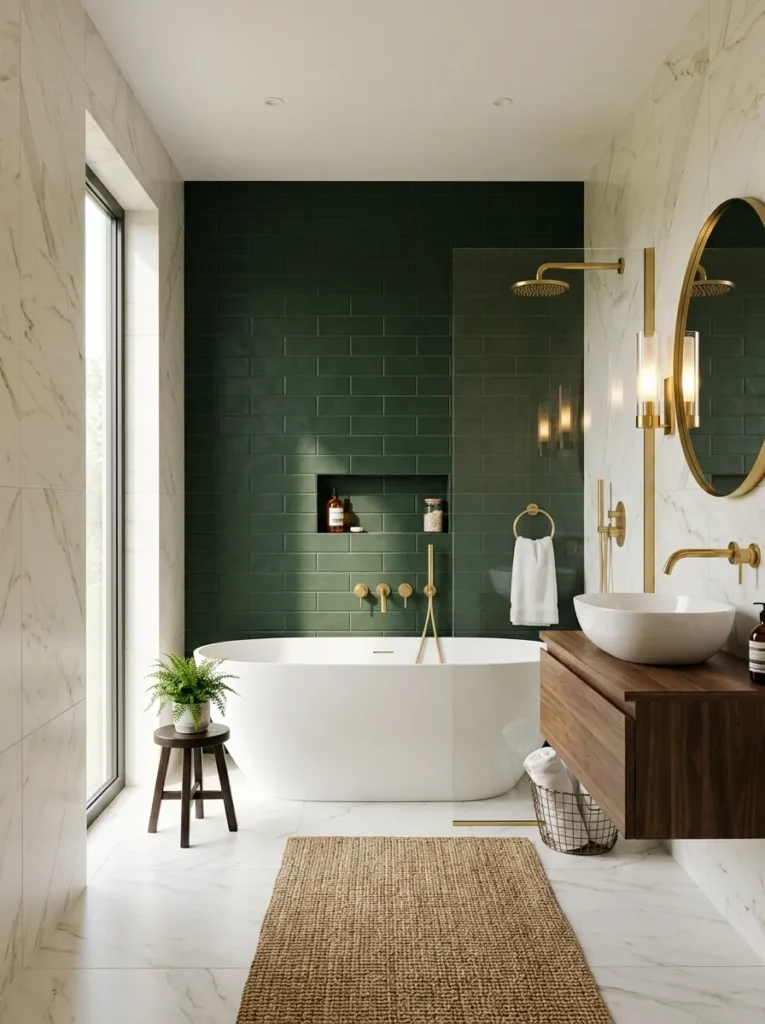
Vibe: The dark feature wall bathroom feels like the room was given a chromatic anchor that made every other element appear more precise — the deep warm dark creating the maximum contrast that makes the white bath, the warm stone, and the brass fixtures all read at their fullest quality.
Why it works: A deep dark feature wall behind the bathroom’s primary focal element applies the contrast maximization principle — when a white bath or white ceramic basin is positioned against a deep warm charcoal, forest green, or navy wall, the contrast between the white ceramic and the dark background creates the maximum chromatic separation that allows each to be read at its most precise: the white appears cleanest against the darkest possible background, the dark appears richest against the whitest possible foreground. The warm undertone specification of the dark color (warm charcoal with a slight brown warmth, forest green with a yellow-green warmth, navy with a purple-warm undertone) prevents the dark from reading as cold or clinical against the warm white bathroom surfaces.
Material choice for the dark wall: A large-format dark tile in the chosen deep tone (Nero Marquina black marble, dark green slate, dark glazed porcelain) creates the specific material richness that a painted dark wall in the same color cannot — the tile’s surface variation, depth, and reflectivity at different light angles create material interest within the dark tone that paint’s flat uniformity lacks.
Shop The Look
| Product |
|---|
| Deep charcoal large format tile |
| Deep forest green glazed tile |
| Warm white stone complementary tile |
| Brushed brass fixtures full set |
| White freestanding bath contrast |
10. Acoustic and Thermal Comfort — The Invisible Luxury
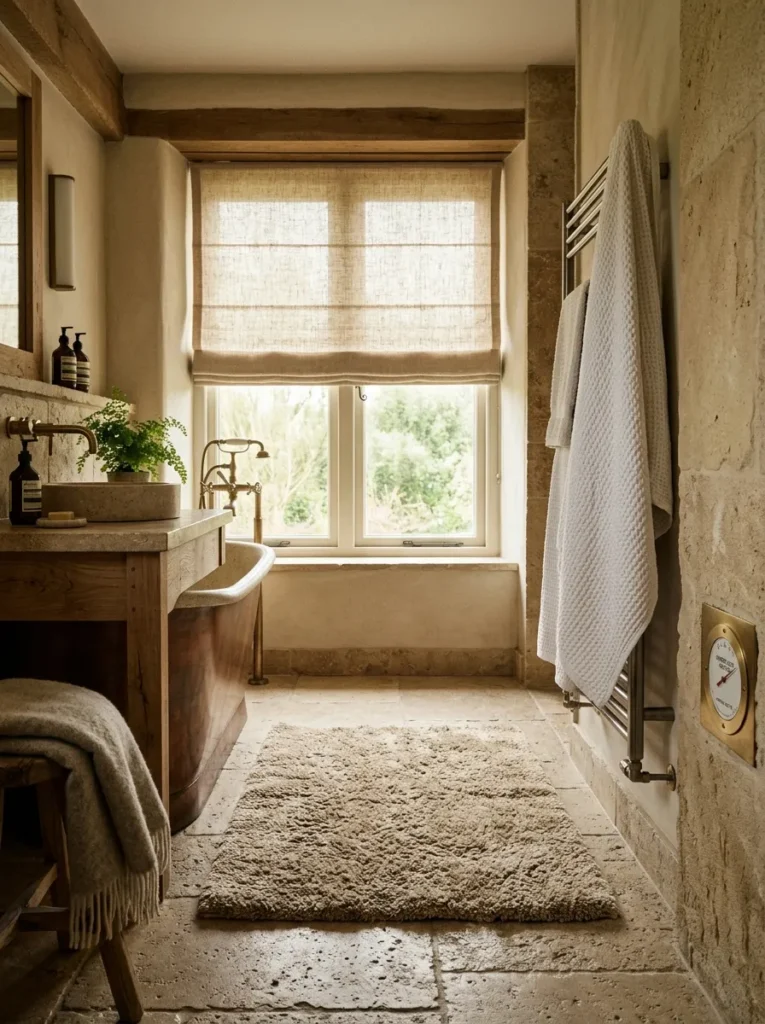
Vibe: The thermally considered bathroom feels like someone designed it for the experience of being in it rather than for the experience of looking at it — the heated floor, the deep pile mat, and the warm linen blind communicating warmth that is physical rather than merely visual.
Why it works: Acoustic and thermal comfort provisions in a bathroom apply the invisible luxury principle — the most sophisticated luxury is the kind that is experienced rather than seen. A heated stone floor (underfloor heating beneath a natural stone tile creates the specific quality of warm stone underfoot — a material quality that stone in a cold room fundamentally cannot provide), a thick natural linen bath mat (whose deep pile is soft, warm, and moisture-absorbing in a way that thin cotton bath mats cannot approach), and a natural linen Roman blind (which diffuses natural light into a soft warm quality without eliminating it) together create a bathroom whose comfort is experienced with the body before it registers with the eye.
Underfloor heating specification: Electric underfloor heating (a heating mat element installed beneath the tile adhesive) is suitable for bathrooms where a significant structural floor buildup is not appropriate. The heating mat must be compatible with the tile adhesive system, and the thermostat should be programmable (set to pre-warm the floor before morning use). Ensure the electric underfloor heating system is specified and installed by an electrician and that the installation is covered under Part P of the Building Regulations (UK) or equivalent national electrical code.
Shop The Look
| Product |
|---|
| Electric underfloor heating mat bathroom |
| UFH programmable thermostat |
| Deep pile linen bath mat oat |
| White cotton waffle towel large |
| Natural linen Roman blind bathroom |
11. Handmade Ceramic Basin — The Artisan Statement
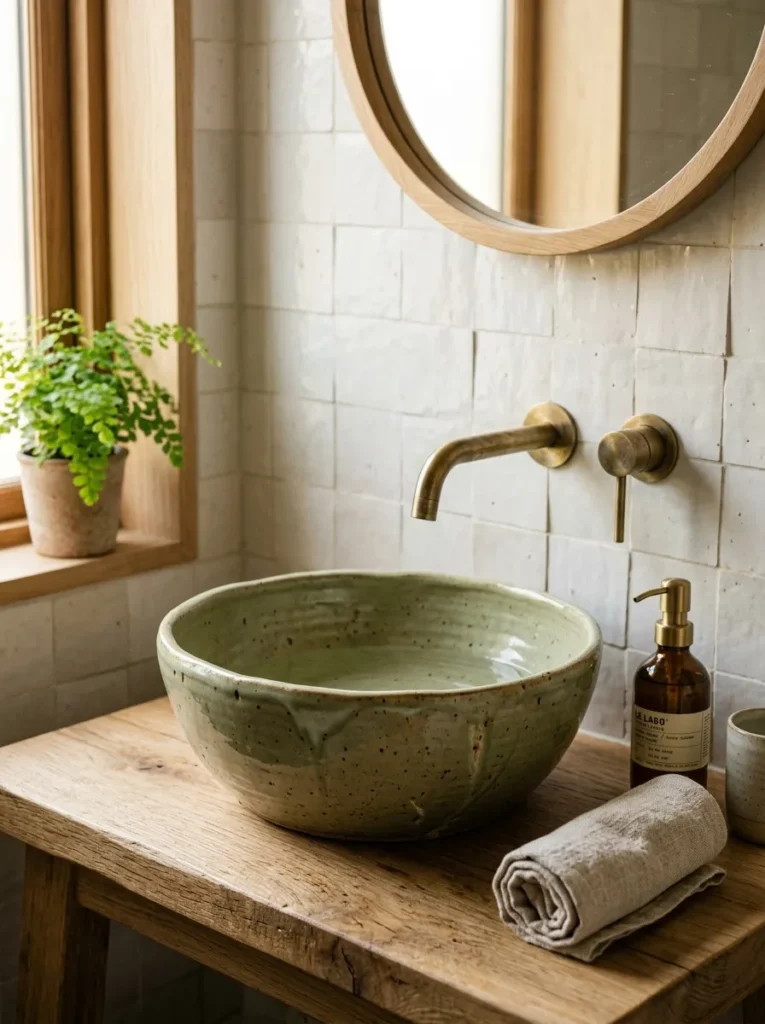
Vibe: The handmade ceramic basin feels like the bathroom contains something genuinely irreplaceable — the specific glaze variation and hand-thrown form creating an object of individual character that no manufactured equivalent can reproduce.
Why it works: A handmade ceramic vessel basin applies the artisan object principle — the bathroom’s standard fittings (mass-produced ceramic basins, injection-molded acrylic baths, factory-stamped metal fittings) are by definition identical to thousands of others and carry no individual character. A hand-thrown ceramic basin, by contrast, is a specific object made by a specific maker at a specific moment — the slight asymmetry of the thrown form, the variation in glaze color as the temperature in the kiln created different chemical reactions across the surface, the specific weight of the ceramic walls — are qualities that identify the object as individual and therefore as genuinely artisanal. This individual character is the form of luxury that money cannot guarantee — a manufactured product can be expensive and remain generic; a handmade object carries authenticity that is independent of its cost.
Source: Independent ceramic artists on Etsy, at craft markets, and through galleries specializing in functional ceramics produce vessel basins in the full range of glazes, forms, and diameters. Custom commissions (a specific glaze color to coordinate with the bathroom’s tile palette) are available from most studio ceramicists at costs comparable to or below mid-range commercial basins ($150–600 depending on the artist and the commission complexity).
Shop The Look
| Product |
|---|
| Hand-thrown ceramic vessel basin |
| Natural oak vanity surface slab |
| Wall-mounted brass mono tap |
| Custom ceramic basin commission |
| Vessel basin drain assembly |
12. Full-Height Pivot Door — The Architectural Entry
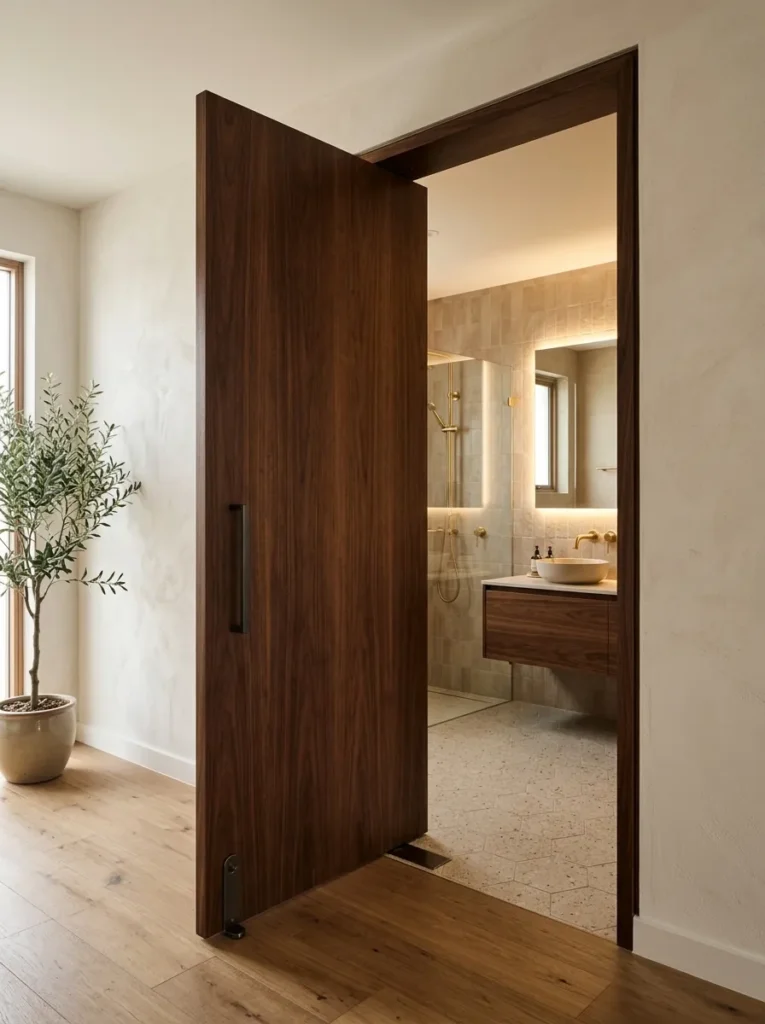
Vibe: The full-height pivot door feels like the bathroom decided its entry should be as considered as its interior — the floor-to-ceiling pivot creating an architectural moment that conventional doors, regardless of their material quality, cannot produce.
Why it works: A full-height pivot door at the bathroom entry applies the threshold architecture principle — the entry to a bathroom is the moment when the occupant’s experience shifts from the domestic interior to the personal restorative space, and a full-height pivot door marks this threshold with an architectural gesture that conventional side-hung doors cannot make. The pivot hinge (which attaches at the floor and ceiling rather than at the door’s side edge) allows the door to be any width (conventionally side-hung doors are limited in width by lever-arm forces on the hinges) and creates the specific opening and closing behavior of a rotating panel rather than a swinging leaf — a motion that reads as architectural rather than domestic. The full-height specification (door extended to ceiling height, eliminating the standard gap above the door frame) creates the visual continuity that makes the door read as an architectural element rather than a fitted opening.
Shop The Look
| Product |
|---|
| Full-height pivot door walnut |
| Floor-to-ceiling pivot hinge set |
| Dark stain timber door large |
| Brushed brass door pull integrated |
| Pivot door frame concealed |
13. Outdoor Connection — The Window to Garden or Sky
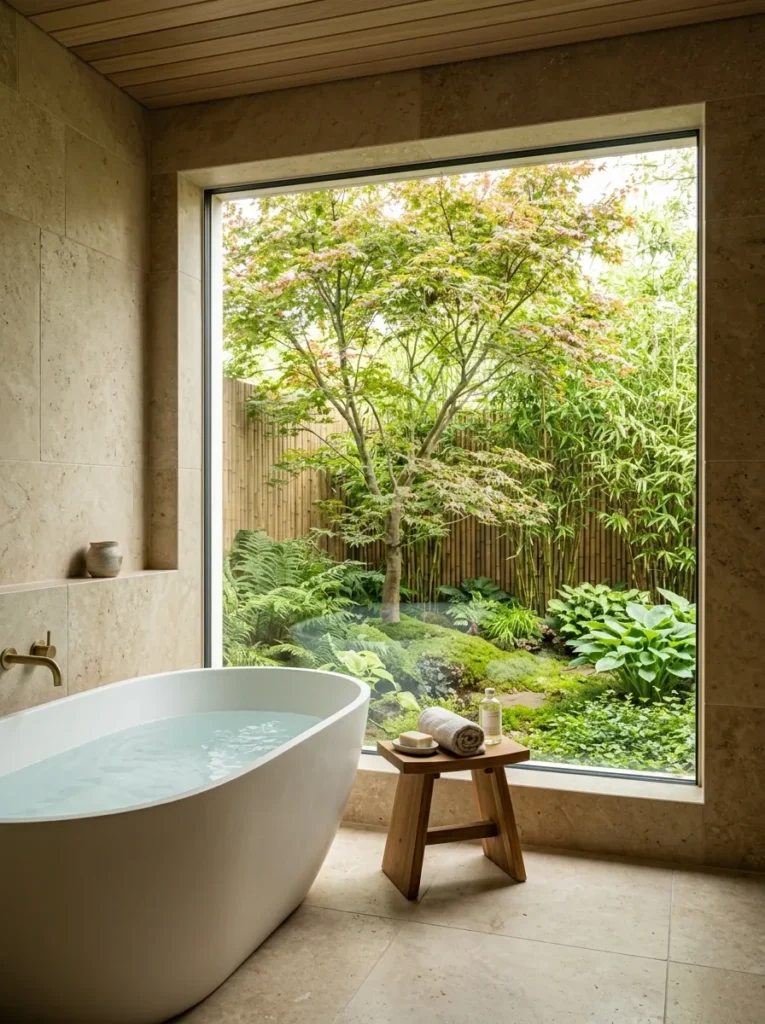
Vibe: The garden-connected bathroom feels like bathing in a private garden room — the large fixed window dissolving the boundary between the interior sanctuary and the exterior natural world.
Why it works: A large fixed window creating a direct connection between the bathroom interior and a private garden applies the biophilic luxury principle — the ability to bathe while looking at a private garden is one of the most consistently cited luxury amenity preferences in high-end residential and hospitality design research. The fixed window (specified without opening panels to maximize glass area and eliminate frame divisions) creates the maximum visual connection between interior and exterior. Privacy is managed through the garden design rather than the window treatment: a bamboo screen, a planted hedge, or an enclosed courtyard provides the privacy that allows the window to remain without curtains or frosting while maintaining the visual connection to natural planting.
The biophilic quality: The specific quality of natural garden light entering a bathroom through a large window — the light quality changing with the weather, the time of day, and the season — is the environmental richness that no artificial lighting system can replicate. Bathing in changing natural light is the bathrooming equivalent of eating food from a garden you can see from the kitchen.
Shop The Look
| Product |
|---|
| Fixed bathroom window large format |
| Privacy bamboo screen garden |
| Specimen tree garden view |
| Naturalistic bath-view planting |
| Stone bath positioned garden sightline |
14. Cohesive Hardware Language — Every Fitting in One Finish
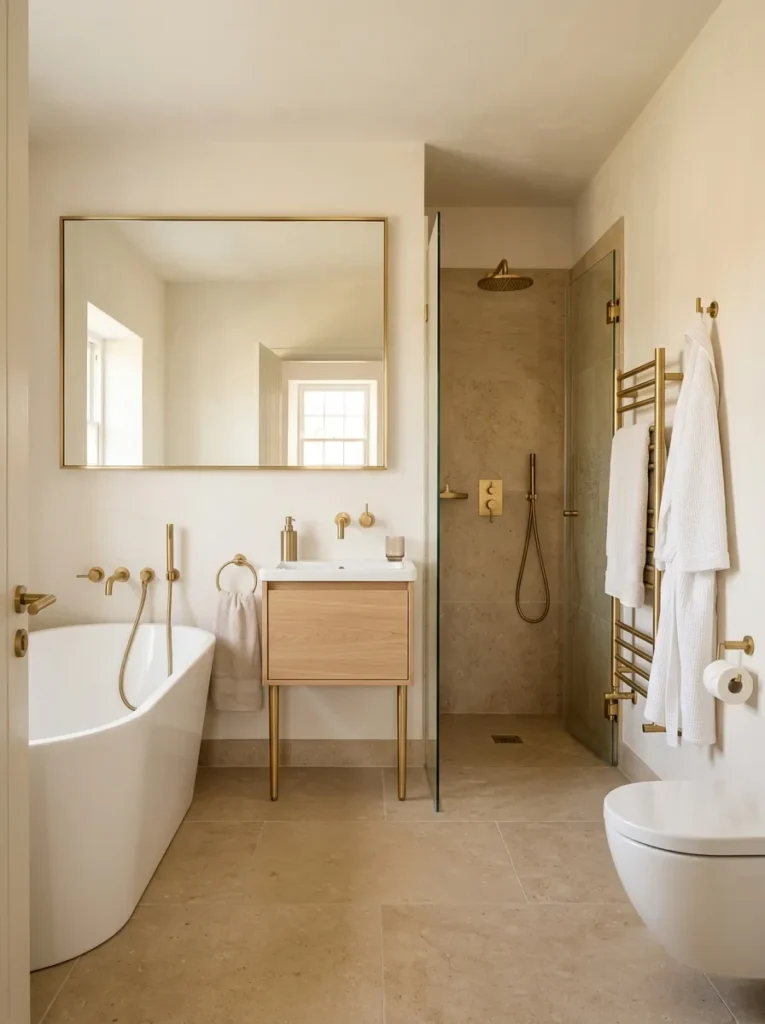
Vibe: The consistent hardware bathroom feels like the bathroom was specified by a single decision rather than assembled from separate ones — the identical brushed brass across every fitting creating the cohesion of a room designed as a unified object.
Why it works: Consistent brushed brass hardware across every bathroom fitting applies the hardware language principle — the most common bathroom quality failure is not in the primary material choices (the tile, the basin, the bath) but in the accumulated metallic hardware, where multiple finishes (chrome tap, nickel towel rail, brushed steel holder, polished toilet flush, matte black robe hook) create visual inconsistency that reads as the absence of a design decision. Specifying one metallic finish — brushed brass throughout — and applying it to every single metallic element in the bathroom (tap, shower, towel rail, toilet roll holder, robe hook, mirror frame, door handle, soap dispenser) creates the cohesion that reads as unified design intent. The brushed finish specifically (rather than polished) reduces fingerprint and water spot visibility while maintaining the warm metallic quality.
Supplier coordination: The most reliable approach to full hardware finish consistency is specifying all hardware from a single manufacturer’s coordinated range — Perrin & Rowe, Samuel Heath, Crosswater, and Vado all produce complete bathroom hardware ranges in brushed brass that cover every fixture category from the tap to the robe hook within the same finish specification.
Shop The Look
| Product |
|---|
| Brushed brass basin tap set |
| Brushed brass shower system |
| Brushed brass towel rail |
| Brushed brass accessory set full |
| Brushed brass door handle bathroom |
How to Start Your Elegant Modern Bathroom
The single most important first move before beginning any bathroom renovation or specification project is creating a single-page material board — a physical collage of actual samples, not digital images — that shows every material and finish intended for the bathroom arranged together on one A3 sheet of paper, assessed in the bathroom’s actual light conditions before any work begins. This material board should include: a tile sample at minimum 10×10cm (large enough to see pattern and variation at actual scale), a stone sample at minimum 15×15cm, the tap finish sample from the hardware supplier, the timber veneer or solid timber sample for the vanity, the paint or plaster color chip, and the grout color sample placed between two tile samples. Assessing this physical board in the actual bathroom’s light conditions (its natural light, its existing artificial light) reveals the specific material relationships that digital renderings and Pinterest images cannot — the specific warm or cool quality of the tile under the bathroom’s specific north-facing window, the way the timber’s warmth sits against the stone’s coolness in that particular light.
The most common mistake in luxury bathroom design is investing the budget in one or two premium elements (an expensive stone tile, a designer bath) while allowing the supporting elements (the grout color, the tap finish, the lighting quality) to default to generic specifications. The perceived luxury of a bathroom is a function of its lowest-quality design decision rather than its highest — a premium stone tile with cheap chrome fittings and cool overhead lighting reads as expensive tile in a mediocre bathroom; the same stone tile with consistent brushed brass hardware, warm LED mirror lighting, and a handmade ceramic basin reads as a considered luxury bathroom throughout. Distribute the design investment across all the elements rather than concentrating it in one flagship element.
Three specific investments under $200 that most immediately improve any bathroom’s apparent luxury level: replacing all chrome bathroom accessories (towel ring, toilet roll holder, robe hook) with consistent brushed brass equivalents ($60–120 for a three-piece set in brushed brass from a hardware specialist, the highest-return per-dollar investment in bathroom luxury perception); replacing the bathroom mirror with an LED backlit mirror ($80–150 for a quality LED mirror with warm halo backlighting, creating the professional vanity lighting quality that all other mirror types lack); and replacing white cotton bath mats with a natural linen or waffle cotton bath mat in warm oat or warm natural ($30–60, providing the specific warm natural material quality that reads as luxurious rather than functional). These three investments combined for under $200 address the hardware finish consistency, the lighting quality, and the textile warmth — three of the most visible and most frequently experienced bathroom quality dimensions.
Frequently Asked Questions About Elegant Modern Luxury Bathrooms
What makes a bathroom look luxurious without a large renovation budget?
The most impactful low-budget luxury improvements, in order of visual return per investment, are: consistent hardware finish (replacing mismatched chrome and nickel accessories with a consistent brushed brass or brushed nickel set — approximately $80–150 for a full accessory set), warm LED mirror lighting (replacing an existing mirror with an LED backlit version — approximately $100–200), grout color replacement (raking out existing white or gray grout and replacing with a warm putty or warm coordinating grout color — approximately $30–50 in materials for a standard bathroom), and natural textile upgrades (replacing white synthetic towels and bath mats with warm natural linen or thick cotton equivalents — approximately $80–150). These four changes combined for approximately $300–500 produce the most significant luxury perception improvement available without structural renovation.
What is the best tile format for a luxury modern bathroom?
Large-format tiles (600×1200mm or larger) consistently produce the most luxurious result in modern bathrooms because they reduce the frequency of grout lines, allowing the tile’s surface pattern and material quality to be read as a continuous surface rather than a repeated module. In a natural stone tile, a 600×1200mm format allows the stone’s vein pattern to develop across a significant area before a grout line interrupts it. In a porcelain tile, the large format allows the stone-effect print to be read as continuous material rather than as a repeated photographic print. The practical constraint on large-format tile is the flatness and precision of the substrate — large-format tiles bridge surface irregularities less effectively than small tiles and require a perfectly flat, precisely prepared substrate to prevent lippage (one tile edge sitting higher than the adjacent tile, visible as a step across the tile surface).
How do you make a small bathroom feel luxurious?
Small bathrooms feel most luxurious when the design decisions consistently maximize visual continuity and minimize surface interruption. The most effective small bathroom luxury strategies are: a single material on floor and walls without a change at the wall base (the tile running from floor to wall without a different skirting material eliminates the visual interruption that reduces apparent room height), a frameless shower enclosure (the glass panel defines the shower zone without creating the visual barrier of a framed door), a floating vanity (the wall-hung vanity reveals the floor beneath, making the room appear wider), a large mirror (filling the full wall above the vanity doubles the apparent depth of the room in that direction), and warm lighting (warm, directional light from multiple low-level sources rather than single cool overhead light makes the room feel more intimate and considered rather than small and functional).
What is the difference between expensive bathroom hardware and value bathroom hardware?
The material and manufacturing differences between premium and value bathroom hardware are primarily in finish durability and mechanism quality rather than appearance. Premium hardware (Samuel Heath, Perrin & Rowe, Watermarks, Vola) uses solid brass substrate with a physical vapor deposition (PVD) or electroplating finish that penetrates and bonds with the brass surface — these finishes maintain their appearance through decades of daily use without tarnishing, pitting, or wearing through. Value hardware typically uses a zinc alloy (zamak) substrate with a spray-applied chrome or colored lacquer finish — the lacquer finish begins to show wear at high-contact points within 3–5 years of regular use. The visual difference between premium and value hardware of the same finish specification is negligible when new; the difference after five years of bathroom use is significant.
How important is ventilation in a modern bathroom?
Ventilation is the most important invisible design decision in a luxury bathroom because insufficient ventilation produces the specific failure — mold growth, tile grout staining, wall paint peeling, lingering humidity — that most directly undermines the bathroom’s luxury aesthetic over time. A modern luxury bathroom should be specified with mechanical extraction ventilation at a minimum rate of 15 litres per second (continuous) or 30 litres per second (intermittent during and after bathing). The ventilation fan should be placed at the highest point in the room (heat and humidity rise) and should be ducted externally (not recirculating through a charcoal filter, which is the most common under-specification for bathroom extraction). The fan unit itself — visible in the ceiling or high wall — should be specified in the bathroom’s hardware finish (brushed brass or brushed nickel vent grilles are available from premium ventilation suppliers in coordinating finishes).
Ready to Specify Your Luxurious Modern Bathroom?
These 14 ideas move through every dimension of what makes a modern bathroom feel genuinely luxurious — from the geological immersion of continuous natural stone and the architectural warmth of a floating walnut vanity with integrated LED, through the professional quality of a three-source mirror lighting system and the artisan specificity of a hand-thrown ceramic basin, to the invisible luxury of a heated stone floor and the architectural precision of a full-height pivot door and consistent brushed brass hardware language. Starting with the physical material board — actual samples of every proposed material and finish, assessed together in the bathroom’s specific light conditions before any work begins — is the beginning that prevents the most costly specification mistakes and confirms the material relationships that will define the finished bathroom’s quality. Collect the samples this week. Arrange them on a sheet of paper. Hold them under the morning light and the evening lamp in the room they will inhabit. When the material board reads as a resolved, warm, and genuinely considered composition in the room’s actual light — the specification is ready, the contractor can be briefed, and the bathroom can begin to become the genuinely luxurious space that these 14 ideas describe.