15 Beautiful Christmas Wall Decorating Ideas
Christmas wall decorating is the art of bringing the season’s warmth, abundance, and visual richness to the vertical surfaces of a home — using garlands, wreaths, art, lighting, textiles, and natural materials to create wall features that communicate the specific warmth and generosity of Christmas without surrendering the room’s year-round design quality or requiring the kind of elaborate installation that only professional decorators can achieve. This article gives you 15 genuinely creative, buildable Christmas wall decorating ideas that work across every interior aesthetic — from the minimalist Japandi apartment to the maximalist Victorian living room — making the most visually dominant surfaces in any room serve the season beautifully.
Most Christmas wall decoration defaults to the predictable — a store-bought wreath on a nail, a string of fairy lights taped along a baseboard, a generic holiday print purchased in November and discarded in January. The homes in this list make more considered choices: they treat the Christmas wall as a genuine design opportunity, using seasonal materials and compositional intention to create wall features that look more beautiful with a Christmas brief than they do at any other time of year. Here are 15 ideas worth saving — and decorating.
Why Beautiful Christmas Wall Decorating Works So Well
The tradition of decorating domestic walls for winter celebrations predates Christianity by several millennia — the Roman practice of adorning homes with greenery during Saturnalia, the Norse tradition of bringing evergreen branches inside during the winter solstice as symbols of life’s persistence through the dark season, and the Celtic practice of decorating with holly and mistletoe as protective and fertility symbols all contributed to the long tradition of winter wall decoration that Christmas absorbed and amplified. What connects all of these pre-Christian traditions is the same fundamental design logic that makes contemporary Christmas wall decoration most effective: the use of natural, living, or once-living materials (greenery, berries, dried botanicals) to signal the ongoing presence of life and warmth in the darkest period of the year.
The materials that define beautiful Christmas wall decoration are those that engage multiple senses simultaneously while coordinating with the existing aesthetic quality of the rooms they inhabit. Fresh greenery — pine, fir, eucalyptus, rosemary, bay, and cedar — provides the olfactory richness that is the most powerful single trigger of the Christmas sensory memory, activating the specific nostalgic recognition of the season before any visual element is processed. Beeswax and natural wax candles provide the warm amber light quality that is simultaneously the oldest and the most contemporary form of Christmas illumination, connecting the season’s lighting tradition directly to the material culture of pre-electric winter celebration. Warm metallics — aged brass, burnished gold, antique silver — provide the reflective luminosity that amplifies the warm light quality of candles and fairy lights at the room’s vertical surfaces. Natural dried botanicals (cinnamon sticks, dried orange slices, seed pods, pine cones) provide the textural richness and the winter spice scent that complete the Christmas sensory environment.
The contemporary Christmas wall decoration aesthetic has been shaped by two competing impulses that most successfully resolved homes hold in creative tension: the desire for genuine seasonal warmth and material richness (which favors abundance, natural materials, and warm color) and the desire to maintain the year-round design quality of the room through the Christmas season (which favors restraint, design coherence, and the selection of seasonal elements that amplify rather than interrupt the room’s existing aesthetic). The homes in this list navigate this tension successfully by treating the Christmas brief as a design intensification rather than a design suspension — choosing Christmas wall elements that make the room’s existing materials and palette more beautiful in the season rather than replacing them with seasonal alternatives.
Small apartments and compact living spaces benefit specifically from beautiful Christmas wall decoration because the vertical surfaces of walls offer the season’s richest decorating opportunities at zero floor plan cost — a garland across a mantelpiece, a wreath on a wall, a gallery of seasonal prints all occupy only the wall surface, leaving the floor plan available for the furniture and circulation that compact living requires. Wall decoration is, by definition, the Christmas decorating approach that is most specifically appropriate for small spaces.
Style at a Glance
| Element | Detail |
|---|---|
| Philosophy | Christmas wall decoration is a design intensification, not a design suspension — the best seasonal wall features make the room more beautiful in December than at any other time of year |
| Key Materials | Fresh pine and fir, eucalyptus, dried orange slices, cinnamon, pine cones, beeswax candles, aged brass, burnished gold, warm fairy lights, velvet ribbon |
| Color Palette | Forest green, deep burgundy, warm gold, aged brass, warm ivory, cranberry, warm white, natural dried material tones |
15 Beautiful Christmas Wall Decorating Ideas
1. Fresh Eucalyptus and Pine Garland Across the Mantelpiece
Vibe: Warm and abundantly festive — the mantelpiece that makes the entire room smell like Christmas before anyone sees a single decoration.
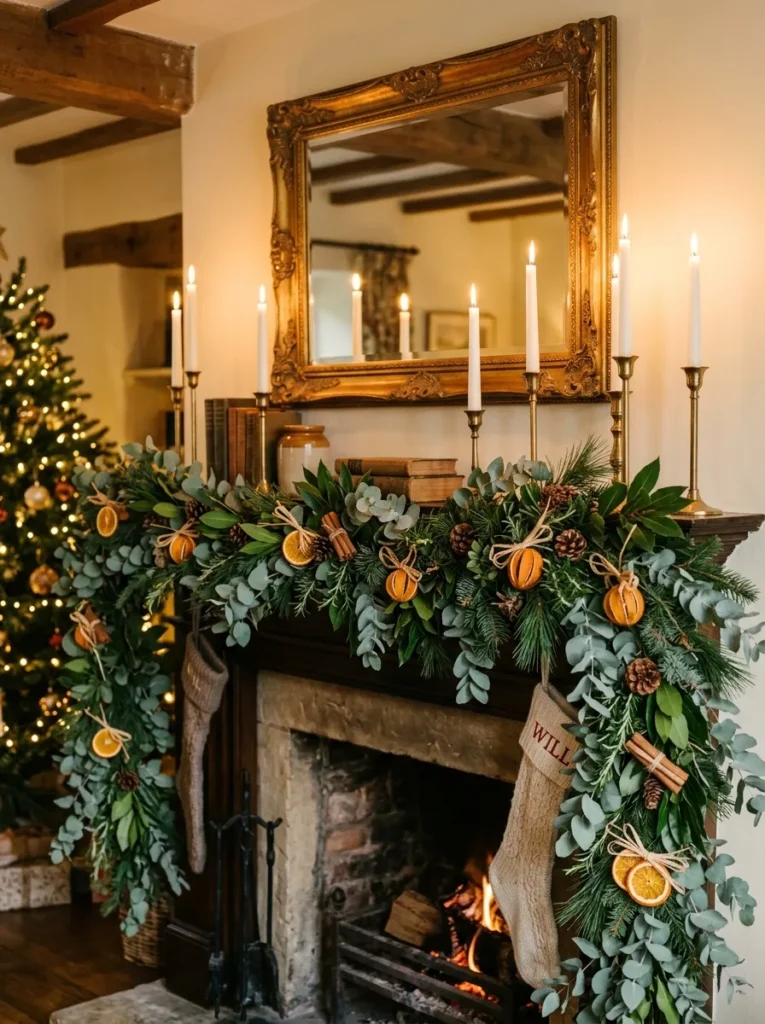
Why it works: The fresh eucalyptus and pine garland across the mantelpiece is the single Christmas wall decorating idea with the highest sensory impact per linear meter — the combination of fresh eucalyptus oil, pine resin, dried orange peel, and cinnamon creates a scent composition at the room’s primary focal surface that is simultaneously the most recognizable and the most genuinely beautiful Christmas fragrance available. The garland at the mantelpiece is the specific application that activates the olfactory dimension of Christmas decoration most powerfully because the mantelpiece’s warmth from the fireplace below accelerates the release of the essential oils in the fresh greenery, making the fragrance more present and more continuously released than the same garland at a cooler position. The large gilt mirror above the mantelpiece doubles the visual richness of the garland by reflecting it back into the room, creating the impression that the garland occupies both the mantelpiece surface and the vertical wall space above it simultaneously.
How to get it: Build the garland from individual stem sections rather than purchasing a pre-made garland — a DIY garland from fresh-cut eucalyptus, pine, and bay allows the specific density, color combination, and dried material integration that most pre-made garlands cannot provide. Cut stems to 200–300mm lengths and bind to a central wire or rope using florist’s wire, working in one direction and overlapping each stem section by half to prevent visible gaps. Spritz the finished garland with water before positioning to extend the fresh greenery’s lifespan to 2–3 weeks.
Quick Win: A bunch of fresh eucalyptus ($8–15 from a florist or farmers market) draped loosely across a mantelpiece with a few purchased pine cones and a pair of brass candlesticks immediately creates 80% of the visual and olfactory impact of the fully developed mantelpiece garland, requiring only 10 minutes of arrangement effort and no wire, binding, or construction work.
Shop the Look
| Product |
|---|
| Fresh eucalyptus bunch |
| Fresh pine branch stems |
| Dried orange slice pack |
| Slim brass candlestick set varied |
| White beeswax taper candle |
Also view: 14 Warm Fall Porch Decor Ideas to Welcome Autumn
2. Oversized Wreath on a Blank Wall as a Seasonal Artwork
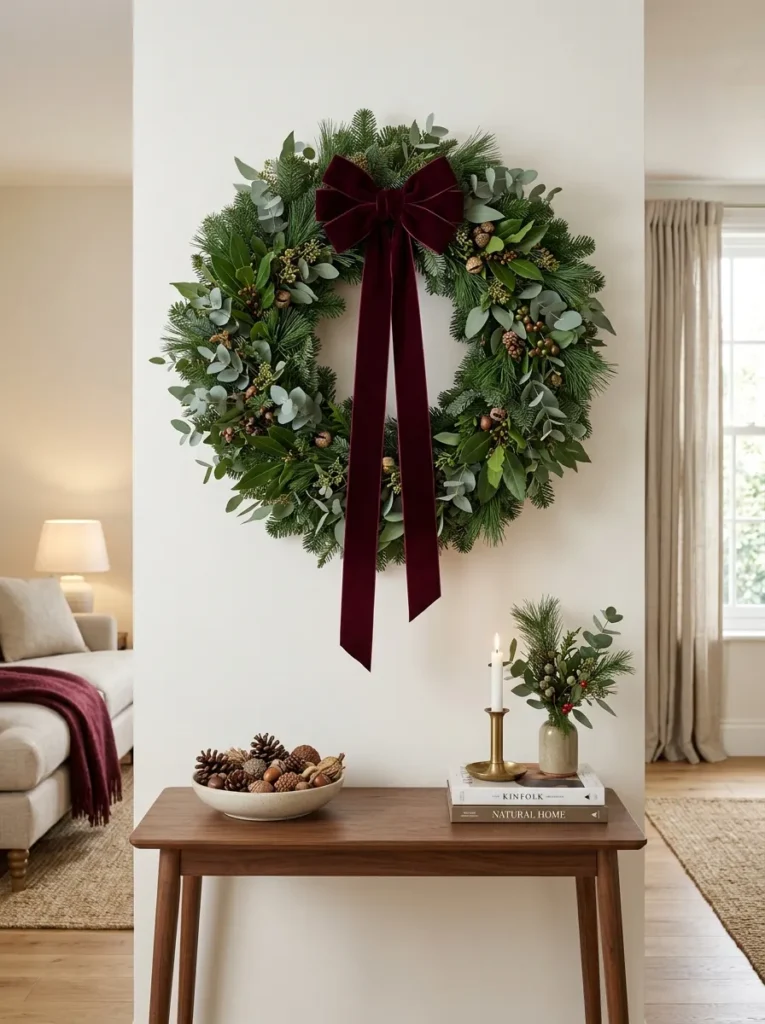
Vibe: Clean and considered — the Christmas wall feature that reads as a design decision rather than a seasonal decoration.
Why it works: The oversized wreath hung as a seasonal artwork on a blank interior wall is the Christmas wall decorating idea that most completely achieves the design intention of seasonal intensification — the wreath at 700mm diameter occupies the same visual scale as a significant piece of artwork, functioning as the room’s primary wall feature during the season and replacing rather than supplementing the wall’s year-round design content with something more beautiful for the specific period. The wreath’s circular form is the compositional quality that makes it appropriate for this artwork-scale application: the circle reads as a resolved, compositionally complete form in the same way that a framed canvas does, providing the visual closure and self-containment that makes it read as a designed object rather than a decorative element hung on a wall. The deep burgundy velvet ribbon is the material accent that provides the warmth and seasonal color that fresh greenery alone cannot deliver.
How to get it: Make or commission a wreath at minimum 600mm diameter for this wall-artwork application — below 600mm, the wreath reads as a standard door size and loses the artwork-scale quality that makes the interior wall placement so effective. Source a pre-made large wreath from a specialist Christmas wreath maker or from a wholesale florist who produces large-scale wreath bases, then add fresh greenery, dried botanicals, and the velvet ribbon to personalize. Hang with a single nail or a Command strip rated for the wreath’s weight, positioned at the wall’s visual center height (1500mm from the floor) rather than at door height.
Shop the Look
| Product |
|---|
| Large wreath base 700mm wire |
| Mixed fresh greenery bundle |
| Deep burgundy velvet ribbon wide |
| Pine cone cluster natural |
| Command strip picture hanging |
Also view: 14 IKEA KALLAX TV Unit Ideas for Small Spaces
3. Staircase Garland with Fairy Lights and Ribbon
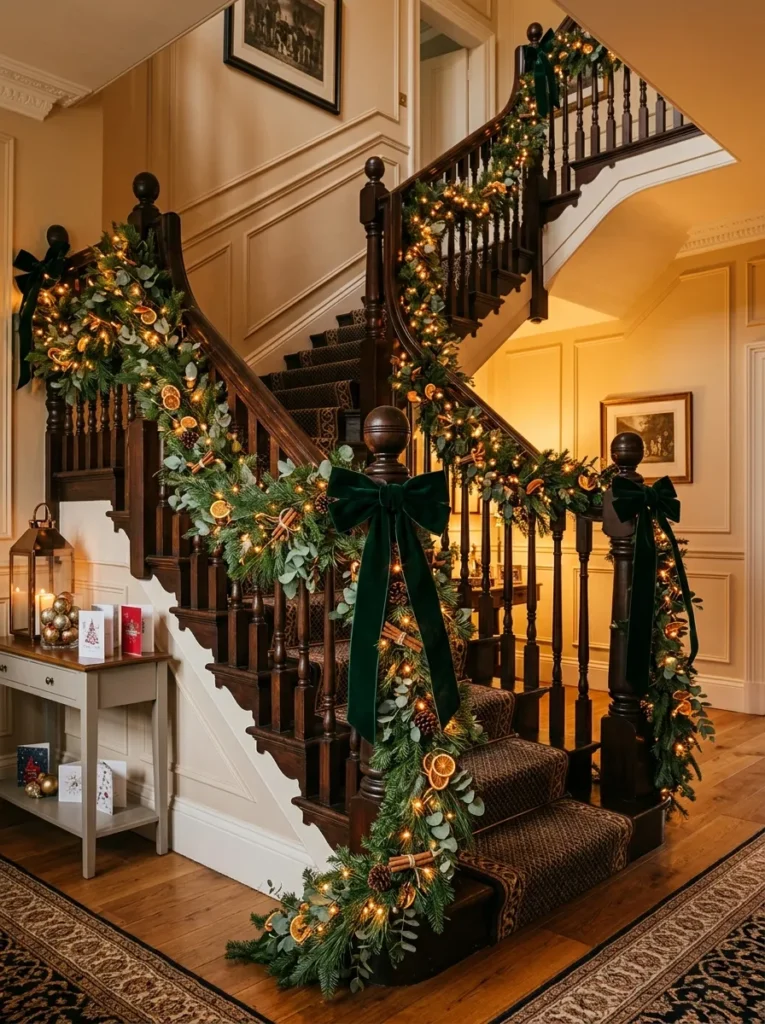
Vibe: Warm and dramatic — the staircase that makes arriving home every evening in December feel like entering the most beautiful place you know.
Why it works: The Christmas staircase garland is the decorating idea that most powerfully uses the home’s existing architecture as the organizing structure for the seasonal installation — rather than introducing a separate decorating element into the space, the garland amplifies and enriches an architectural feature that is already the home’s primary vertical circulation element. The staircase garland creates the specific quality of sensory immersion that is unique to Christmas decoration at an architectural scale: as a person climbs the garland-dressed staircase, the fresh greenery’s fragrance is encountered at progressively closer range, the fairy lights create a warm amber glow at face height, and the velvet ribbon’s texture is perceptible at arm reach — the staircase becomes a multi-sensory passage rather than a functional connection between floors. The warm copper fairy lights woven through the garland are the element that most dramatically transforms the staircase from a daytime decorating feature to an evening atmospheric installation.
How to get it: Calculate the garland length required at 1.5 times the staircase banister’s actual length — the additional 50% accounts for the draping and wrapping around the banister that reduces the effective coverage of a straight-length garland. Secure the garland to the banister using green florist’s wire at 300mm intervals — the wire should be invisible within the garland’s greenery but sufficiently secure to prevent the garland from slipping under its own weight. Weave the copper fairy lights through the garland before securing it to the banister, routing the wire back to a power point at the base of the staircase.
Shop the Look
| Product |
|---|
| Pine garland long length |
| Copper wire fairy lights long |
| Forest green velvet ribbon wide |
| Dried orange cinnamon bundle |
| Florist’s green wire reel |
4. Christmas Gallery Wall with Seasonal Prints and Art
Vibe: Warm and curated — the Christmas wall that reads like the personal collection of someone with genuine aesthetic intelligence and a long relationship with the season.
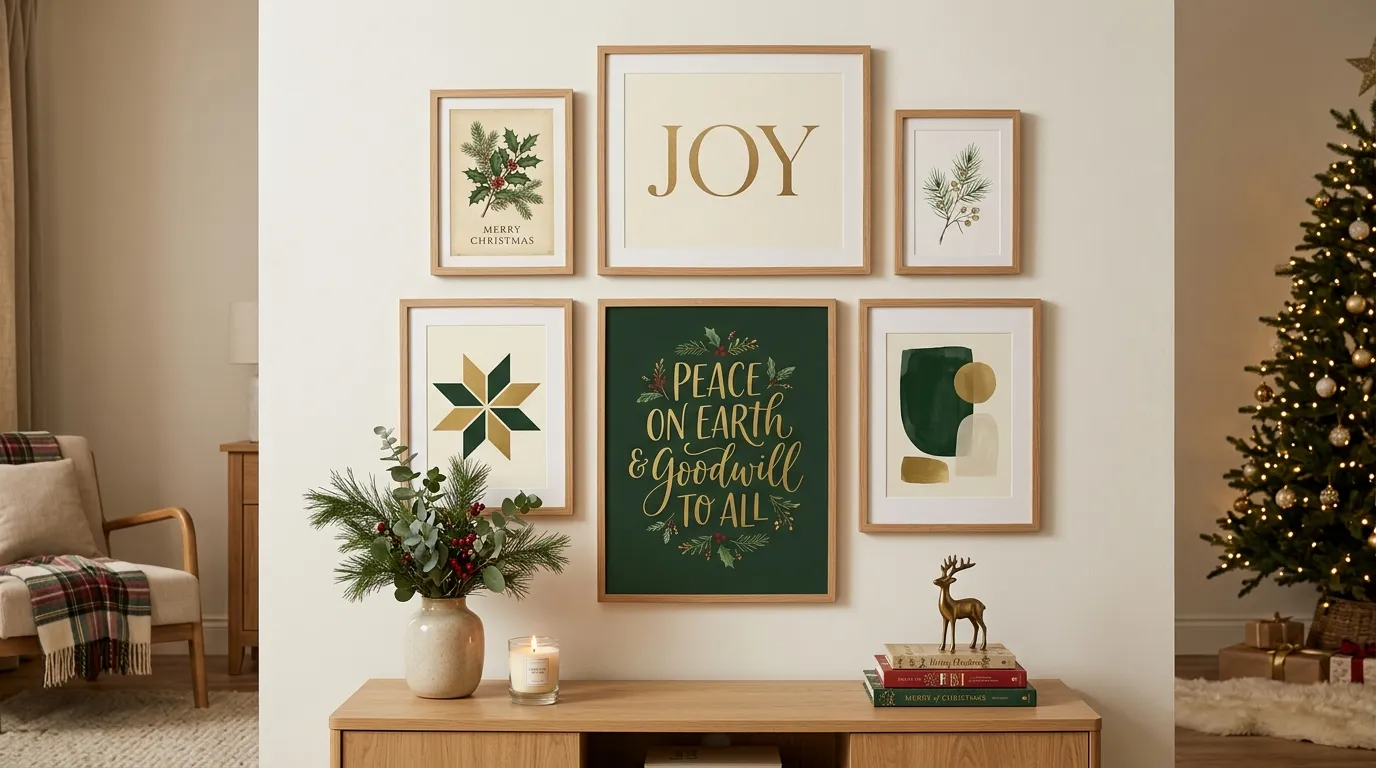
Why it works: The Christmas gallery wall with seasonal prints and artwork is the decorating idea that most gracefully integrates the Christmas season into the room’s existing design culture — treating the season’s visual content as art rather than decoration, displayed in the same gallery format and the same frames as the room’s year-round artwork. The gallery wall format is the compositional approach that most naturally accommodates the seasonal artwork’s varied scale and content diversity: a botanical Christmas print, a typographic piece, and an abstract in seasonal colors all read as a coherent gallery composition within matching frames in a way they would not if displayed as individually hung pieces. The key design principle that makes the Christmas gallery wall read as a genuine curated collection rather than a seasonal display is the consistent frame finish — matching natural timber or matte black frames across all pieces unifies the varied content into a single composed wall statement.
How to get it: Source Christmas art prints from specialist print retailers (Society6, Minted, Art.com, and Etsy’s print-on-demand sellers all carry extensive Christmas and winter art collections) in a consistent palette of forest green, deep burgundy, warm gold, and warm white — restricting the prints’ color palette to this coherent seasonal range creates the visual unity that makes the gallery read as a planned collection. Reuse the frames from the room’s year-round gallery wall — replacing the existing prints with seasonal alternatives and returning the year-round prints in January is the most cost-effective gallery wall approach.
Shop the Look
| Product |
|---|
| Christmas botanical art print |
| Seasonal typographic print |
| Natural timber gallery frame set |
| Geometric star print Christmas |
| Watercolor pine illustration |
5. Advent Calendar Wall Display with Numbered Paper Bags
Vibe: Warm and anticipatory — the advent display that makes December feel like the most considered month of the year from the first day to the last.
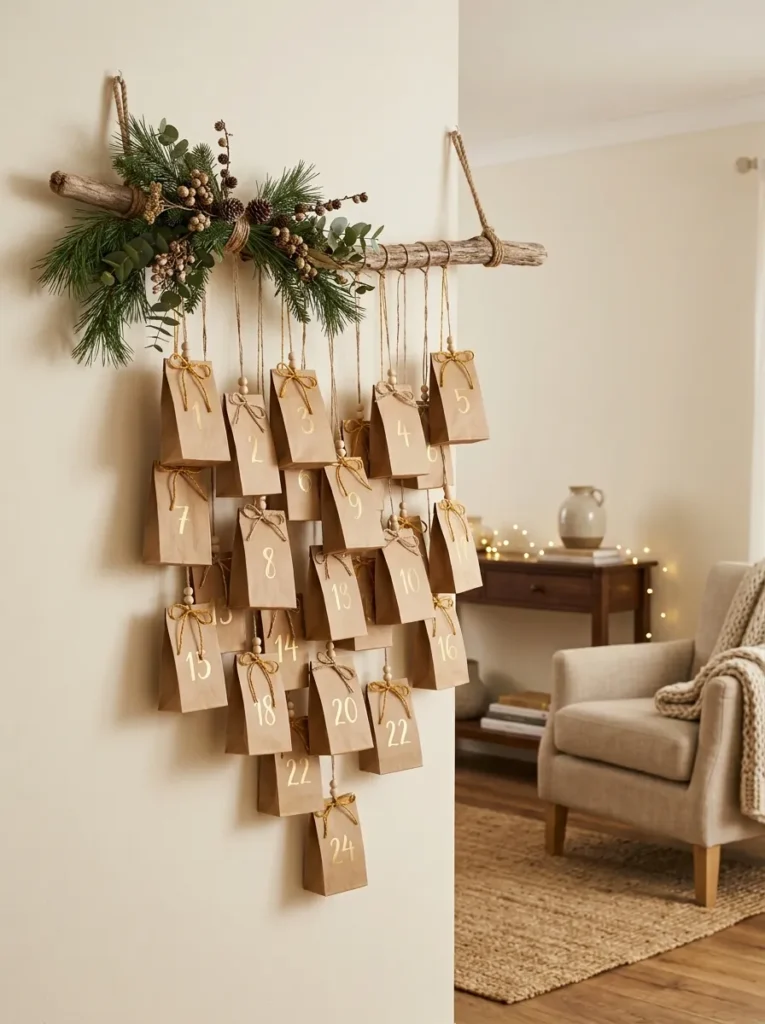
Why it works: The wall-mounted advent calendar display with numbered kraft bags is the Christmas wall decorating idea that most completely integrates a functional seasonal tradition into a designed wall feature — the advent calendar’s countdown function provides daily engagement with the wall display rather than the passive observation that purely decorative Christmas wall features receive. The driftwood or timber branch mounting transforms what could be a domestic craft project into a designed wall installation: the natural branch provides a warm, organic mounting structure that reads as a design choice rather than a hardware solution, and its slight irregularity — no branch is perfectly straight — creates the organic asymmetry that most distinguishes this display from a commercial advent calendar. The kraft paper bags in varied sizes at varied hanging lengths create the visual irregularity that reads as personally assembled rather than manufactured.
How to get it: Source a natural branch or piece of driftwood at 800–1000mm length from a beach, woodland walk, or garden — the specific character of a found natural branch is the quality that most powerfully communicates the personal investment of a DIY advent display. Mount the branch to the wall using two picture hooks positioned at the branch’s natural balance points. Number each kraft bag using a gold ink stamp kit or a gold paint pen — handwritten gold numbers read as more personally invested than printed labels.
Shop the Look
| Product |
|---|
| Kraft paper bag small set |
| Gold ink number stamp set |
| Natural gold twine roll |
| Driftwood branch natural |
| Pine branch small decoration |
6. Hanging Mistletoe Bunch with Velvet Ribbon
Vibe: Warm and traditionally festive — the single decoration that carries an entire cultural history of the season in one hanging bunch.
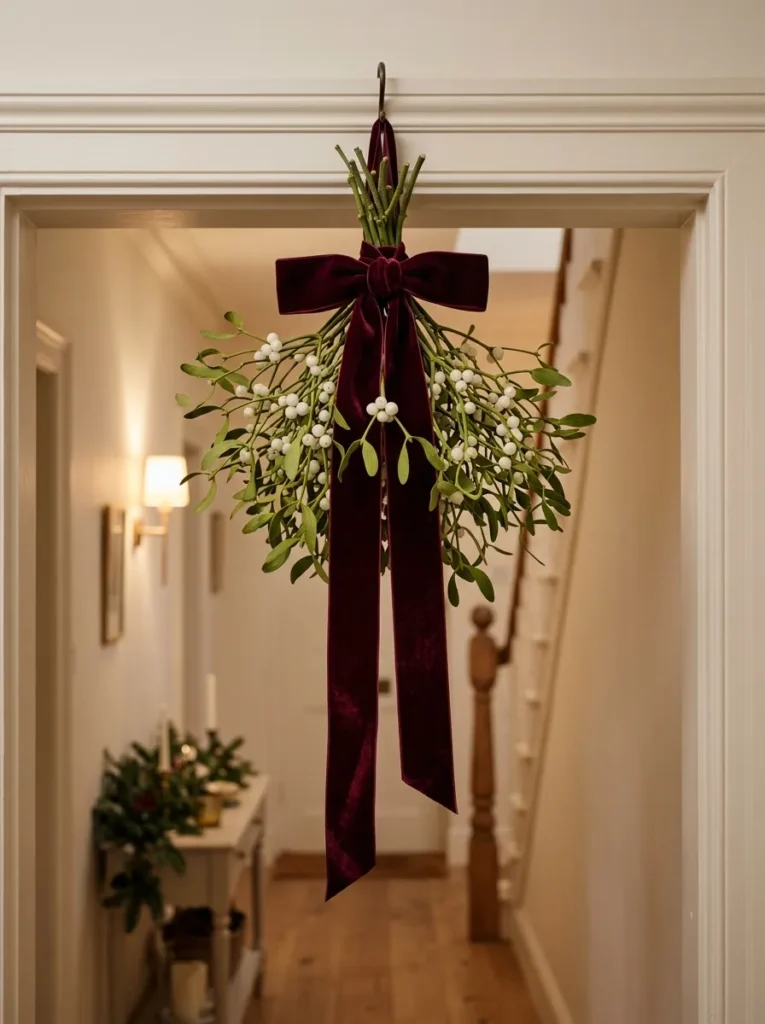
Why it works: A generous bunch of fresh mistletoe hung at a doorway or archway is the Christmas wall decorating idea with the deepest cultural resonance per square centimeter of any seasonal element — mistletoe has been a winter celebration botanical since the Druidic and Norse traditions that preceded Christianity, and its presence in a domestic interior activates a specific cultural recognition of the Christmas season’s convivial, affectionate character that no manufactured seasonal decoration can replicate. The botanical quality of fresh mistletoe — its pale sage leaves, its pearl-white berries, its organic irregular branching form — is specifically beautiful as an interior botanical object rather than merely as a seasonal reference, making it the Christmas wall decoration that most naturally reads as both a designed object and a seasonal symbol simultaneously. The deep burgundy velvet ribbon is the material accent that elevates the hanging bunch from a botanical curiosity to a composed decorating feature.
How to get it: Source fresh mistletoe from specialist florists, Christmas tree farms, or farmers markets during the Christmas season — mistletoe is harvested in late November and early December and maintains its fresh quality for 2–3 weeks when hung in a cool, well-ventilated position. Bundle multiple sprigs together to create the generous, full bunch that reads as abundant rather than sparse — a single sprig has insufficient visual weight for the doorway application; a bunch of five to eight sprigs has the presence required. Tie the bundle with the velvet ribbon before hanging, creating a large bow with trailing ends rather than a simple knot.
Shop the Look
| Product |
|---|
| Fresh mistletoe bunch |
| Deep burgundy velvet ribbon wide |
| Ceiling hook brass |
| Raffia natural alternative |
| Velvet ribbon deep green alternative |
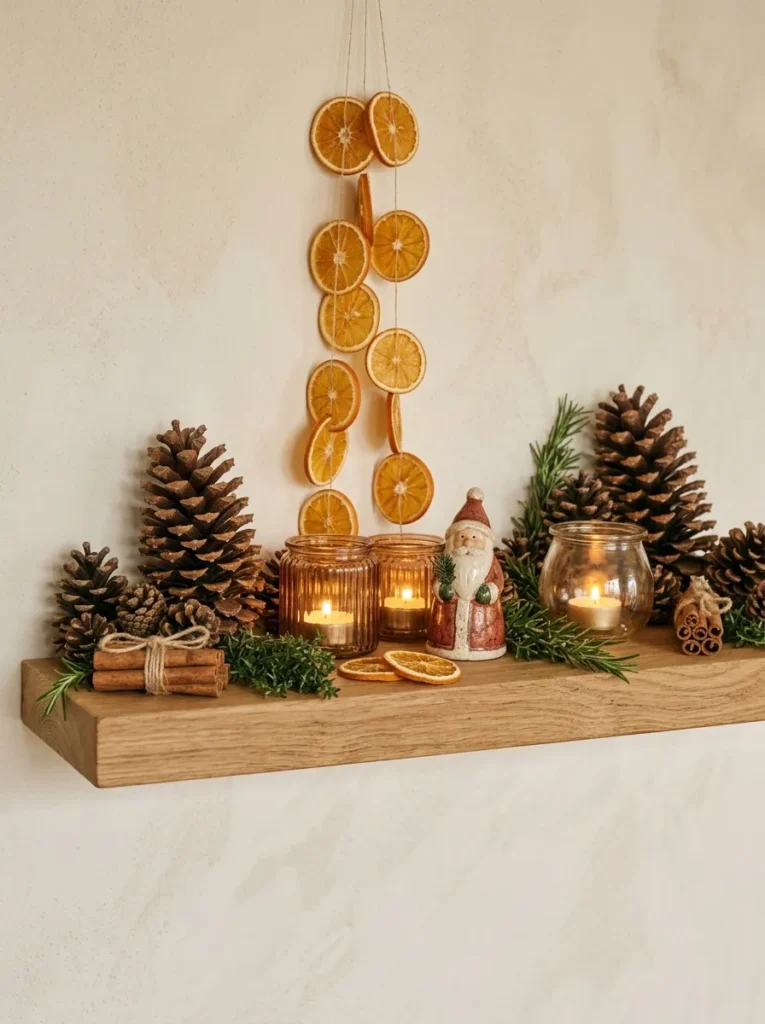
7. Pine Cone and Dried Botanical Arrangement on a Floating Shelf
🖼️ IMAGE PROMPT: A photorealistic, ultra-detailed contemporary interior photograph of a floating timber shelf Christmas display — a natural oak floating shelf styled with a curated arrangement of Christmas botanicals: a collection of varied pine cones in graduated sizes, dried orange slices arranged vertically against the wall, cinnamon stick bundles tied with natural twine, small glass lanterns with tea light candles casting warm amber light, sprigs of fresh rosemary and thyme tucked between objects, and a small ceramic Santa or seasonal figurine — the shelf reading as a designed botanical still life with seasonal content. Lighting: warm tea light glow from glass lanterns and warm ambient. Camera angle: eye-level, straight-on to the shelf. Mood: warm and botanical. Key details: pine cone variety and size, dried orange vertical arrangement, cinnamon stick bundle, glass lantern tea light, fresh herb sprig. Decor accents: ceramic seasonal figurine, varied pine cone texture, cinnamon scent element, glass lantern warmth. Color palette: pine cone natural warm brown, dried orange warm, cinnamon brown, glass lantern amber, rosemary silver-green. Style tags: photorealistic, 8K resolution, interior design photography, Pinterest vertical 2:3 ratio, no people, magazine quality.
Vibe: Warm and botanical — the Christmas shelf display that looks as beautiful at 11am as it does at 7pm by candlelight.
Why it works: The Christmas botanical shelf display on a floating shelf is the decorating idea that most effectively transforms a year-round display surface into a seasonal sensory experience — the combination of pine cones, dried orange, cinnamon, rosemary, and thyme creates a scent composition at the shelf’s immediate level that is perceived at the close range of daily passage through the room, making the shelf’s fragrance a consistent ambient Christmas presence. The glass lanterns with tea light candles are the lighting element that most powerfully transforms the shelf display from a daytime decorating feature to an evening atmospheric installation — the warm amber glow of a tea light within a glass lantern creates a specific pool of warm light at the shelf level that reads as firelight quality rather than electric light quality. This firelight quality is the specific atmospheric contribution that makes the shelf display not merely beautiful but genuinely Christmassy.
How to get it: Collect pine cones from natural sources (pine and cedar forests, fallen cones in parks and gardens) in the weeks before Christmas for the most varied size and texture range — collected cones have the specific aged, resinous quality that purchased cones often lack. Dry citrus slices in a low oven (90°C for 3–4 hours) or a food dehydrator to achieve the deep amber-orange transparency that makes dried orange slices such a visually beautiful shelf element. Arrange the shelf’s objects in odd-number groupings — three pine cones, five dried orange slices, one cinnamon bundle — using the rule of odd numbers to create the compositional dynamism that even-number groupings cannot.
Shop the Look
| Product |
|---|
| Pine cone collection natural |
| Dried orange slice pack |
| Cinnamon stick bundle |
| Small glass lantern tea light |
| Natural twine roll |
8. Festive Fabric Bunting Across a Chimney Breast or Wall
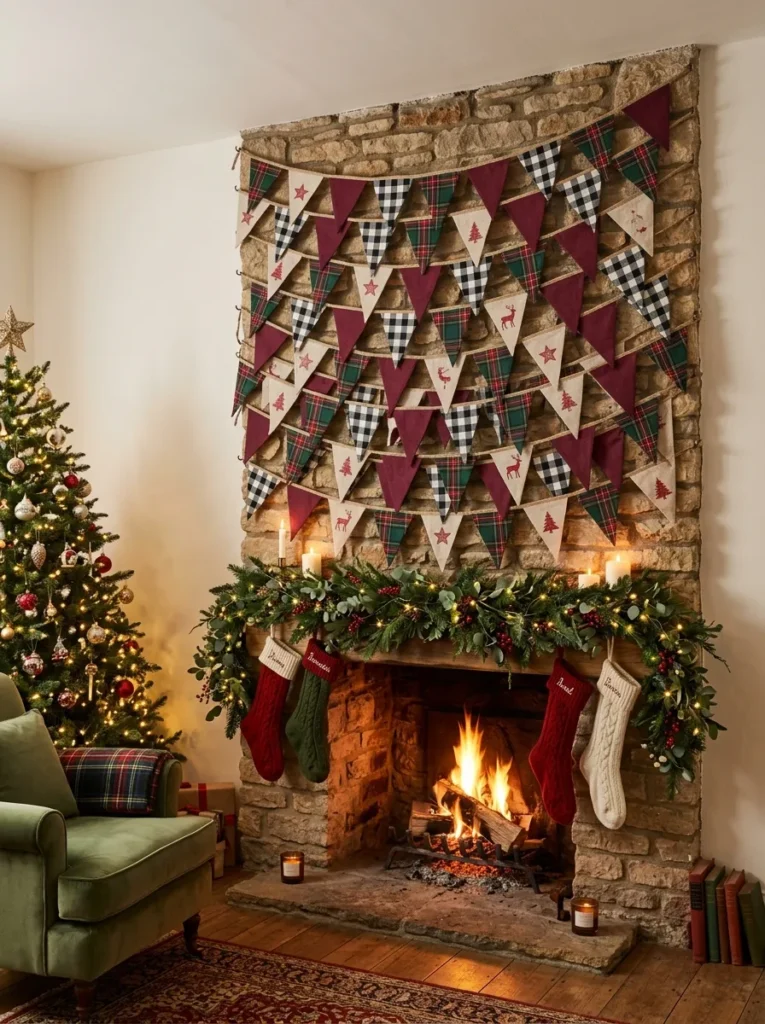
Vibe: Warm and handmade — the Christmas wall feature that reads as genuinely personal rather than generically festive.
Why it works: Fabric Christmas bunting is the wall decorating idea that most authentically references the domestic craft tradition of Christmas decoration — the hand-sewn or cut-and-pinked fabric pennant carries the specific visual quality of something made rather than purchased, communicating the personal investment and seasonal care that the Christmas tradition of handmade decoration represents. The coordinated fabric palette — plaid, check, solid, and simple stamped pattern all in the same forest green, burgundy, and cream palette — is the design discipline that transforms individual craft pennants into a coherent designed wall feature: within a consistent color palette, pattern variety reads as considered variety; outside a consistent palette, the same variety reads as random accumulation. The bunting at the chimney breast is the specific wall position that most naturally integrates the fabric festivity with the room’s primary architectural feature.
How to get it: Cut fabric pennants from a coordinating range of Christmas fabrics — fat quarter packs from a fabric retailer in a consistent color palette provide sufficient variety while guaranteeing color coordination. The pennant size should be consistent across all fabrics at approximately 200mm wide at the base and 300mm tall — consistency of pennant size with variation of fabric pattern is the design formula that reads as most considered. String on natural jute twine rather than ribbon, as the natural twine provides the artisanal quality that coordinates with the handmade fabric pennants.
Shop the Look
| Product |
|---|
| Christmas fabric fat quarter set |
| Natural jute twine roll |
| Pinking shears fabric |
| Sewing machine needle and thread |
| Christmas stamp set for plain fabric |
9. Wired Star or Geometric Shape Wall Light Installation
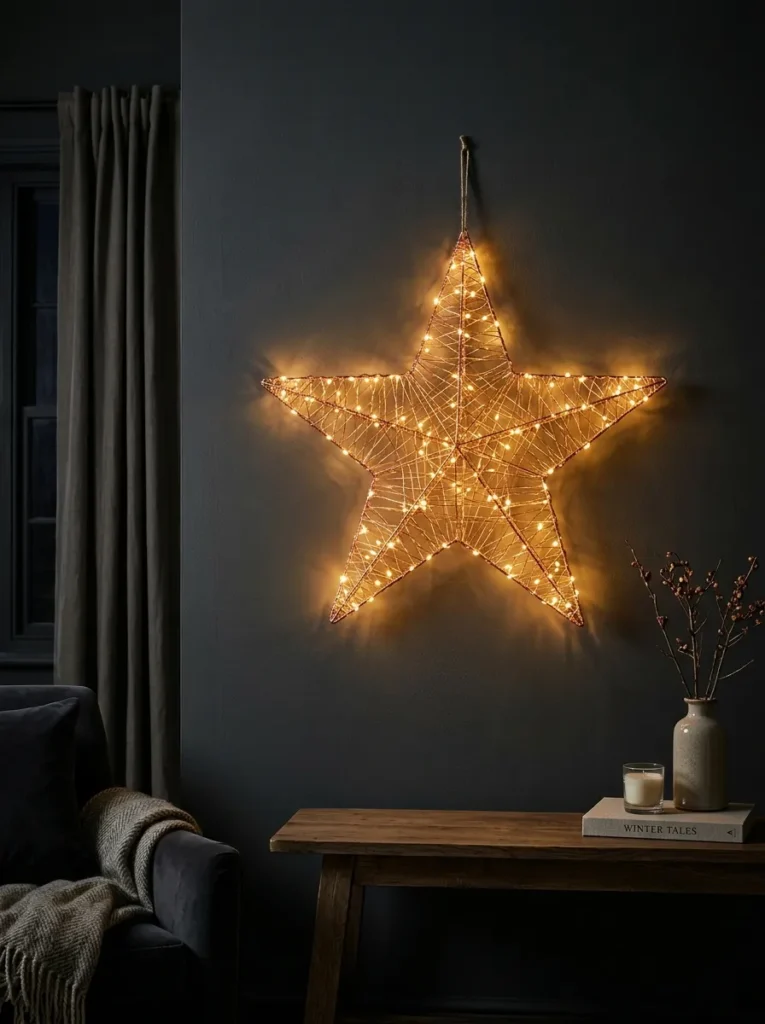
Vibe: Warm and magical — the wall feature that makes the room feel like the inside of the most beautiful evening sky.
Why it works: The large wired star wall light is the Christmas wall decorating idea that most powerfully uses light as the primary decorating medium rather than as a supporting element for physical decoration — the star of wound copper wire and fairy lights is primarily a light object rather than a form object, and its most beautiful quality (the warm star-shaped halo cast on the surrounding wall surface) only exists in the evening when the room’s ambient light is low enough to reveal the glow. This time-dependent beauty — invisible in the daytime, magical in the evening — gives the star installation a quality of daily revelation that static decorating elements cannot achieve. The copper wire’s warm metallic tone coordinates with the fairy lights’ warm amber glow to create a material and light composition that reads as both ancient (the star as a winter celebration symbol of the deepest cultural vintage) and contemporary (the copper wire as the material of contemporary DIY design culture).
How to get it: Form the star shape from 2mm copper armature wire (available from art and craft suppliers) by bending five equal-length sections into a star point form and joining at the center and the five outer tips with additional wire wraps. The star diameter should be minimum 500mm for a wall installation that reads at room scale — smaller stars read as ornaments rather than wall features. Weave 30–50 warm fairy lights (copper wire LED, battery operated) through the star structure after forming, distributing the light points evenly through all five star points and the central pentagon.
Shop the Look
| Product |
|---|
| Copper armature wire 2mm |
| Copper wire fairy lights battery |
| Wire bending plier set |
| Wall hook picture hanging |
| Warm white LED spare bulbs |
10. Christmas Stocking Display on a Decorative Rail
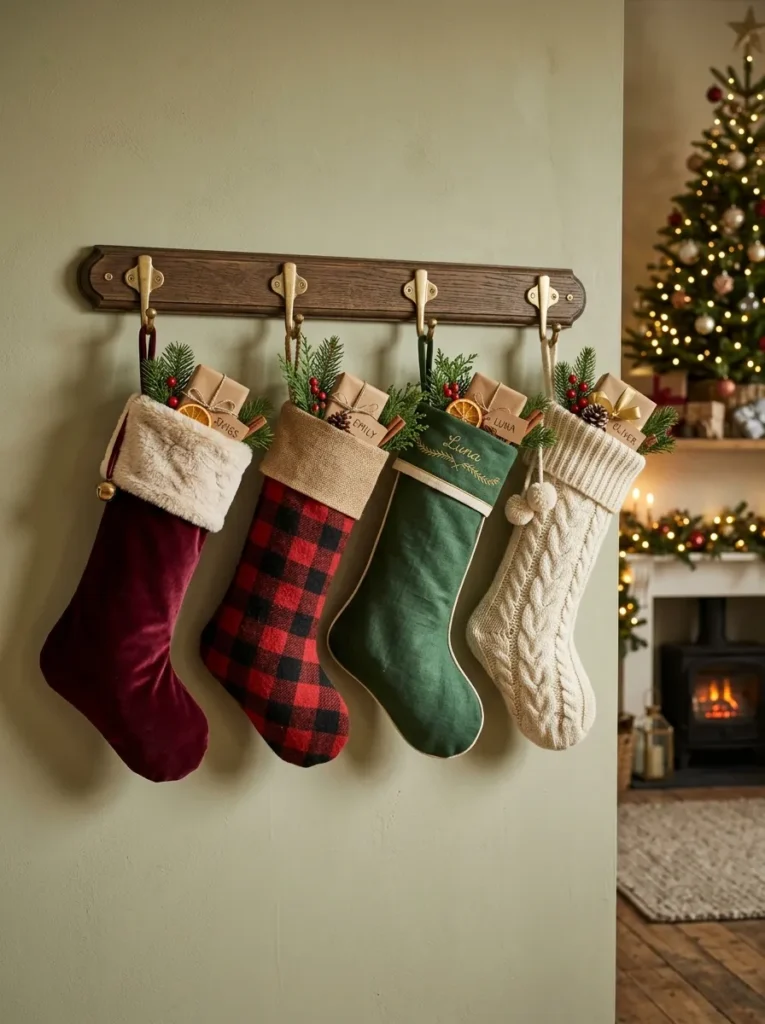
Vibe: Warm and generously festive — the wall installation that makes Christmas morning feel imminent and abundant from the first day of December.
Why it works: The Christmas stocking display on a decorative rail is the seasonal wall decorating idea that most effectively combines functional seasonal tradition with designed wall feature — the stockings serve their genuine seasonal function (anticipatory gift holders in the weeks before Christmas) while simultaneously creating a textile and color wall installation of genuine decorative quality. The decorative rail is the specific design element that elevates the stocking display from stockings hung from whatever is available to a designed wall installation: a brass or painted timber rail mounted at the correct height provides the structural authority that transforms the hanging stockings from improvised seasonal arrangements into a composed textile wall feature. The varied but coordinated stocking fabrics — velvet, linen, check, and knit all within the same burgundy-green-cream palette — create the textile variety that makes the display read as curated rather than matched.
How to get it: Mount the rail at 1.6 meters height — high enough to hang stockings at full length without the toe touching the floor, low enough to be accessible for children to reach the stocking’s top. Use a 25mm × 25mm brass or painted timber dowel section at 100mm longer than the number of stockings times their combined width, secured to the wall with two sturdy wall brackets. Source or make stockings at minimum 500mm in length for generous visual proportion — short stockings lose the dramatic hanging quality that makes the stocking display work as a wall feature.
Shop the Look
| Product |
|---|
| Christmas stocking velvet burgundy |
| Christmas stocking green linen |
| Decorative rail brass or timber |
| Brass stocking hook set |
| Cream knit Christmas stocking |
11. Festive Mirror Styling with Greenery and Ribbon
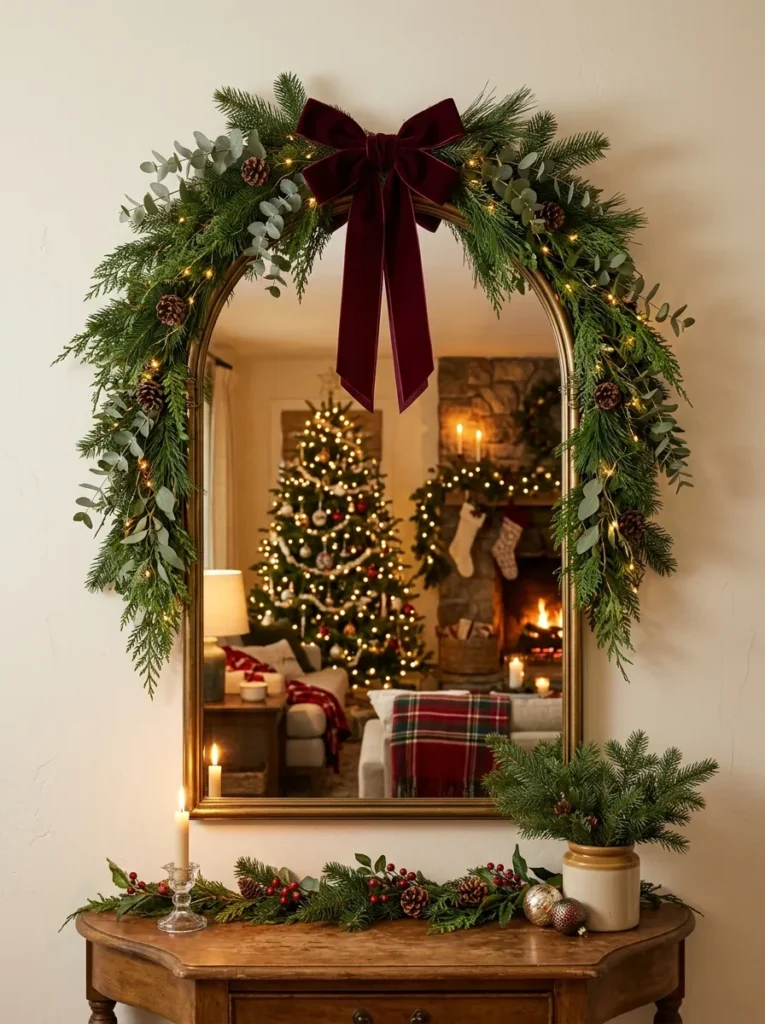
Vibe: Warm and festively elegant — the Christmas wall feature that makes a mirror that is always beautiful even more so.
Why it works: Dressing an existing mirror with Christmas greenery and ribbon is the seasonal wall decorating idea that most intelligently amplifies a year-round decorating asset rather than supplementing it — the mirror that already contributes to the room’s spatial quality and light reflection becomes the organizing frame for a seasonal composition that is visually complete from every position in the room. The greenery tucked behind the mirror frame (rather than attached to it) is the specific installation approach that most clearly communicates design quality: the natural stems emerging from behind the frame read as though the greenery is growing around the mirror rather than being attached to it, creating the impression of a botanical frame rather than a decorated one. The mirror’s reflective surface doubles every element of the Christmas room visible behind the viewer, making the dressed mirror simultaneously a seasonal decoration and a spatial amplifier of all other Christmas decoration in the room.
How to get it: Tuck individual greenery stems behind the mirror frame at its top and sides without glue or wire — the frame’s friction against the stems, combined with the slight gap between the frame and the wall, provides sufficient support for stems up to 400mm in length. Weave battery-operated copper wire fairy lights through the tucked greenery before adding the velvet bow at the top, routing the battery pack to a position behind the mirror where it is hidden. Replace the greenery every 10–14 days as the fresh material dries — dried stems lose the visual freshness that makes the greenery crown effective.
Shop the Look
| Product |
|---|
| Round arch wall mirror existing |
| Fresh pine branch stems |
| Deep burgundy velvet bow |
| Battery copper fairy lights short |
| Fresh eucalyptus stems |
12. Hand-Lettered Christmas Quote on Chalkboard or Art Paper

Vibe: Warm and personal — the Christmas wall piece that communicates something specific and genuine about the people who live in the room.
Why it works: The hand-lettered Christmas quote displayed as a framed wall artwork is the seasonal decorating idea that most directly introduces textual content into the Christmas wall — making the wall itself speak with the specific voice and values of the household rather than communicating only through visual and botanical means. The brush lettering style is the typographic choice that most authentically communicates the warmth and personality that Christmas lettering should convey — the organic variation of handwritten brush strokes reads as genuinely human rather than typeset and printed, which is the quality that makes a lettered wall piece feel personal rather than generic. The choice of quote is the content decision that most determines whether this wall feature reads as genuinely meaningful or as a generic seasonal placeholder.
How to get it: Commission a custom hand-lettered print from an Etsy calligraphy artist who works in the brush lettering tradition, specifying the quote, the palette (forest green background with gold lettering or cream with warm charcoal), and the size (minimum 500mm × 700mm for an artwork-scale wall piece). Source the quote from a genuinely meaningful text rather than a commercially popular seasonal phrase — a line from a poem read at a family Christmas, a phrase associated with a specific family tradition, or a genuinely beautiful line from a Christmas carol read carefully for its literary quality. Custom lettering from an Etsy artist in a digital-print format costs $25–60 and can be printed locally at any standard print format.
Shop the Look
| Product |
|---|
| Custom lettered Christmas print |
| Slim natural timber picture frame |
| Art paper print local print service |
| Seasonal quote selection |
| Frame hanging hardware set |
13. Windowsill Christmas Village or Nativity Scene
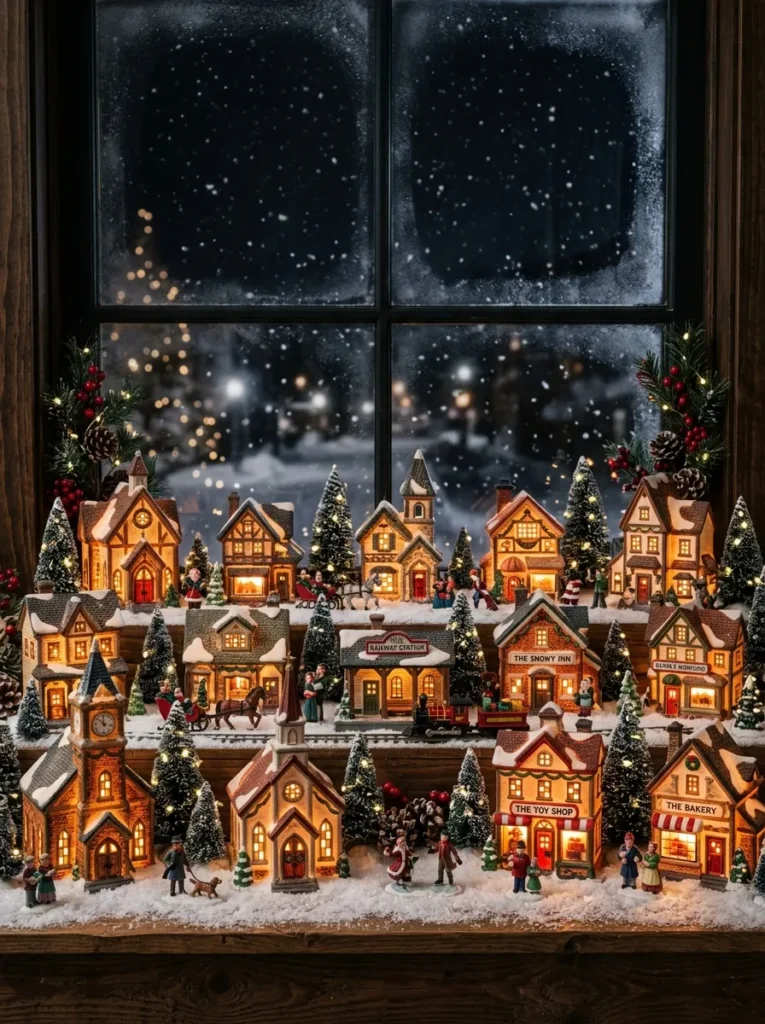
Vibe: Warm and magical — the windowsill that makes the most beautiful view of the evening not the garden beyond the glass but the scene in front of it.
Why it works: The windowsill Christmas village display is the seasonal decorating idea that most powerfully uses the window’s relationship with darkness as a design asset — the dark window beyond the village buildings is the backdrop that most dramatically amplifies the warm inner glow of the lit buildings, creating the contrast between warm interior light and dark exterior night that is the specific visual quality of Christmas at its most evocative. A Christmas village displayed in front of a lit room reads as a ceramic collection; the same village displayed in front of a dark winter window reads as a magical scene in a world of its own. The windowsill is the specific architectural position that provides this dark backdrop naturally every evening from sunset to sunrise throughout December, making it the only position in the room where this specific visual quality is achievable.
How to get it: Arrange the village buildings in a composition that uses scale variation to create depth — largest buildings at the back of the sill, medium buildings in the middle, smallest trees and figures at the front — to create the impression of a village receding into a winter landscape rather than a flat row of ceramic buildings. Use LED tea light inserts within each building rather than standard tea lights — LED inserts provide the warm amber glow without the fire risk of open flame in an enclosed ceramic building at a curtained window.
Shop the Look
| Product |
|---|
| Ceramic Christmas village building set |
| LED tea light insert warm amber |
| Artificial snow scatter |
| Small ceramic village trees |
| Ceramic nativity set |
14. Vintage Botanical Print Gallery with Christmas Foliage
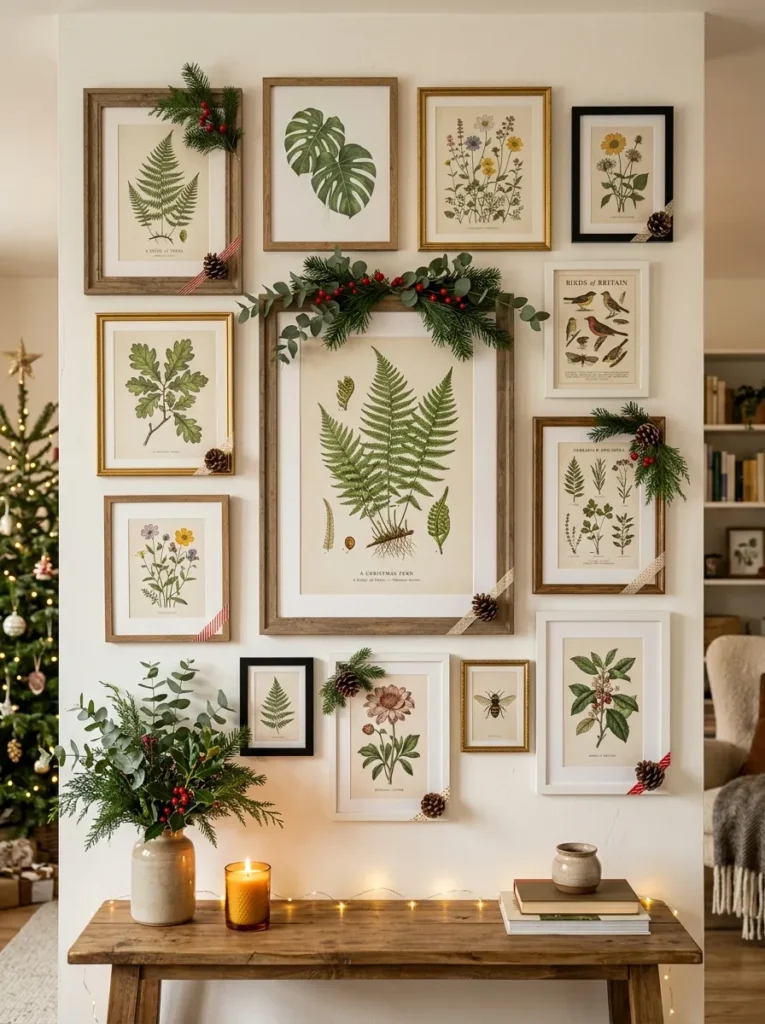
Vibe: Warm and seasonally layered — the gallery wall that doesn’t ask you to remove your year-round art to celebrate Christmas.
Why it works: Adding seasonal foliage to an existing gallery wall is the Christmas wall decorating idea that most intelligently treats the seasonal decoration as an addition to rather than a replacement of the room’s year-round design quality — it preserves the gallery wall’s designed composition while introducing the botanical freshness and fragrance of Christmas greenery as a seasonal layer. This additive approach communicates a specific kind of design confidence: the willingness to let the existing design remain visible through the seasonal layer rather than concealing it entirely. The fresh greenery tucked into frame corners and laid across frame tops is the installation approach that most directly mimics the way seasonal decoration accrues naturally in a long-inhabited home — gradually, personally, and in specific relationship to the objects already present rather than as a wholesale seasonal replacement.
How to get it: Select three to five frames in the gallery as the Christmas greenery recipients — the largest frames and those with botanical print content are the most natural hosts for real botanical additions. Tuck small fresh eucalyptus or pine sprigs behind the frames at the top corners — the gap between the frame back and the wall provides the holding slot that allows fresh stems to rest in place without any attachment. Replace the fresh greenery sprigs every 10–14 days to maintain the fresh visual quality that makes the botanical addition read as living material rather than dried ornament.
Shop the Look
| Product |
|---|
| Fresh eucalyptus short stems |
| Fresh pine small stems |
| Small pine cone collection |
| Existing gallery frame collection |
| Gallery wax adhesive removable |
15. Maximalist Christmas Wall with Layered Garlands and Lights
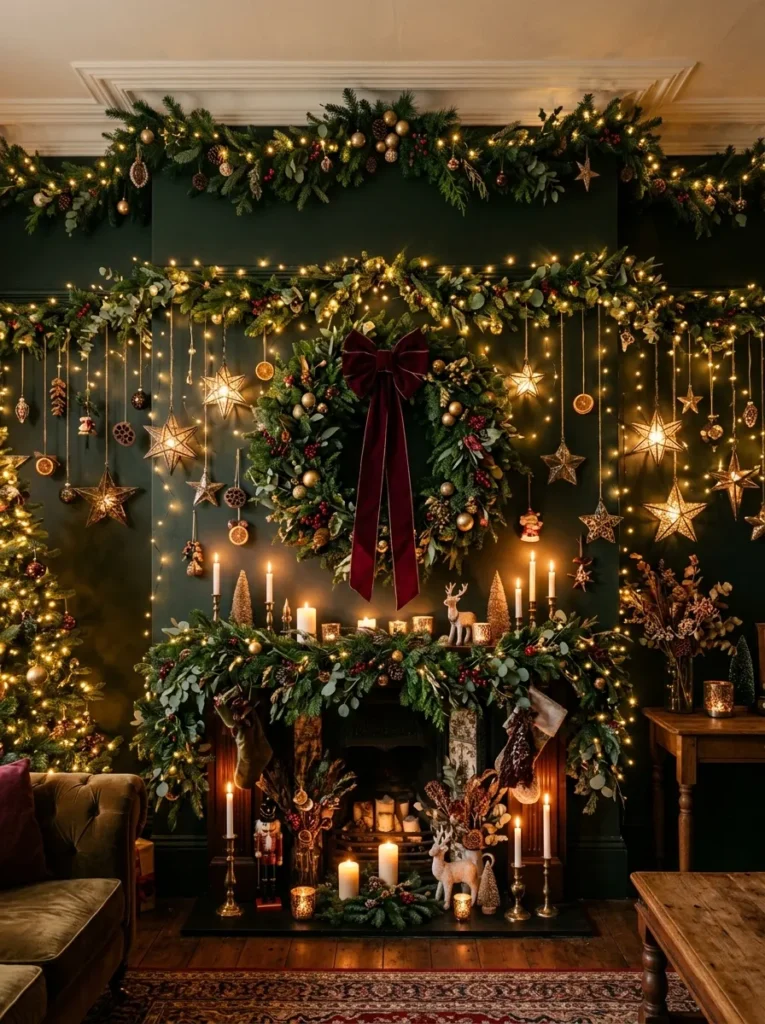
Vibe: Maximally warm and festive — the Christmas wall that stops being a wall and becomes the room’s most complete seasonal experience.
Why it works: The maximalist layered Christmas wall installation is the decorating idea that most completely embraces the principle of Christmas abundance — the idea that Christmas, among all seasonal celebrations, is specifically the season that licenses and celebrates decorative excess as an expression of joy, generosity, and the warm resistance to winter darkness. The three-height garland system is the structural design principle that gives the maximalist wall its architectural coherence: by running garlands at the horizontal levels defined by the room’s existing architectural elements (mantelpiece, picture rail, ceiling cornice), the installation works within the room’s architecture rather than against it, creating the impression of a Christmas environment that belongs to the room rather than being applied to it. The overlapping fairy light strings are the element that most dramatically transforms the wall at evening — a maximalist Christmas wall in daylight is a beautiful decorating achievement; the same wall at night with multiple strings of warm fairy lights casting a warm ambient wash is a genuinely immersive seasonal environment.
How to get it: Plan the maximalist wall installation from the bottom upward — the mantelpiece garland establishes the base level, the picture-rail garland establishes the mid level, and the ceiling cornice garland establishes the top level. Run the fairy light strings between these structural garland levels rather than on the garlands themselves, creating a wash of warm ambient light across the wall surface that is distinct from the fairy lights woven through the garlands. The central oversized wreath (minimum 700mm diameter) is positioned at the visual center of the wall between the mantelpiece and picture-rail garlands, where it provides the compositional anchor that prevents the abundant decorating from reading as chaotic.
Shop the Look
| Product |
|---|
| Fresh pine garland long set |
| Warm fairy light string set |
| Oversized wreath base large |
| Hanging botanical star ornament |
| Deep burgundy velvet ribbon wide |
How to Start Your Christmas Wall Decorating Transformation
Your single first move is to identify the one wall in your home that would most benefit from a Christmas decorating feature — not the wall with the most space, but the wall that is most seen, most visited, and most shared in the daily life of the household. In most homes, this is either the chimney breast and mantelpiece wall (which is the primary focal point of the main living room and the most frequently decorated surface in the Western Christmas tradition), the entry hall wall (which is the surface that every household member and every guest sees on every arrival and departure), or the staircase wall and baluster (which creates the most dramatically vertical Christmas installation available in any multi-story home). The correct starting wall is the one whose daily observation provides the most Christmas atmosphere to the most people on the most occasions — not the wall of the room that guests see only at Christmas dinner.
The most common Christmas wall decorating mistake is installing seasonal decoration that requires the removal of the room’s year-round design content rather than adding seasonal elements that work alongside it. This replacement approach — taking down the gallery wall to put up a seasonal display, removing the mirror to install a wreath — creates a room that looks emptied of its design quality rather than enriched by the season’s, and it makes the post-Christmas restoration of the room’s design content feel like a significant undertaking rather than a quick removal of seasonal additions. The additive approach — adding greenery to an existing gallery wall, dressing an existing mirror with botanical material, placing a Christmas village on an existing windowsill — preserves the room’s design quality through the season while achieving the Christmas wall decorating effect.
Three specific investments under $50 that create immediate Christmas wall decorating impact: (1) A bunch of fresh eucalyptus ($8–15 from a florist or farmers market) draped across any horizontal surface — mantelpiece, shelf, console — immediately introduces the dominant sensory quality of Christmas wall decoration (fragrance) at a cost and complexity level that makes it the most accessible and most impactful Christmas wall decorating investment available. (2) A length of deep burgundy velvet ribbon ($10–20 for a 3-meter length) tied as a large bow on any existing door wreath, mirror, or wall decoration immediately introduces the material warmth and seasonal color that elevates any basic Christmas decoration to a considered design statement — the velvet ribbon is the single material upgrade with the highest visual return in all of Christmas decoration. (3) A set of copper wire battery fairy lights ($12–25 from any homewares or electrical retailer) draped or woven through any existing wall decoration immediately transforms it from a daytime decorating feature to an evening atmospheric installation — the warm amber glow of quality LED fairy lights is the most powerful single tool available for creating the Christmas atmosphere that distinguishes a beautifully decorated home from a merely decorated one.
Realistically, a complete Christmas wall decorating scheme — a dressed mantelpiece garland, a large entry hall wreath, a garland-dressed staircase, and a Christmas gallery wall — requires $150–400 in fresh greenery, dried botanicals, candles, ribbons, lights, and prints, and 3–6 hours of installation time across the first weekend of December. A focused single-wall Christmas transformation — a beautifully dressed mantelpiece with fresh eucalyptus, brass candlesticks, and dried botanicals — requires $40–80 in materials and one hour of arrangement time, producing a wall feature that is genuinely beautiful for 3–4 weeks and that provides the daily olfactory richness of fresh greenery throughout the period. Most households begin with the mantelpiece and the entry door wreath — the two Christmas wall positions with the deepest cultural tradition and the highest daily visibility — and add further wall decoration in subsequent years as the confidence and pleasure of Christmas decorating grows.
Frequently Asked Questions About Christmas Wall Decorating
What is the most impactful single Christmas wall decoration?
A fresh garland across a mantelpiece is the most impactful single Christmas wall decoration available in most homes — it occupies the room’s primary focal wall, creates the strongest olfactory impact of any single seasonal element, provides the most visually complete seasonal transformation at a single wall location, and has the deepest cultural resonance of any Christmas wall decoration tradition. When a mantelpiece is not available (in apartments without fireplaces), a large-format wreath at a minimum of 600mm diameter hung on the main living room wall achieves the greatest single-object impact per decorating investment. In both cases, the addition of warm candlelight (brass candlesticks with beeswax tapers on the mantelpiece, or fairy lights woven through the wreath) multiplies the impact significantly beyond the decoration’s daytime visual quality.
How do I make Christmas wall decorations look elegant rather than kitsch?
The three qualities that most reliably prevent Christmas wall decoration from reading as kitsch are natural materials (fresh and dried botanicals rather than plastic or synthetic greenery), warm color palette restraint (deep forest green, burgundy, warm gold, and cream rather than bright primary red and green or mixed commercial Christmas colors), and material quality (velvet ribbon rather than polyester, beeswax candles rather than paraffin, aged brass rather than gold plastic). The single most important quality distinction is the greenery — fresh or quality dried botanical greenery provides the material authenticity that creates elegant Christmas decoration, while synthetic greenery with a plastic sheen immediately produces the kitsch quality that the best Christmas wall decoration specifically avoids.
How do I decorate a rental apartment’s walls for Christmas without damaging them?
The most effective damage-free Christmas wall decorating approaches use Command hooks, removable adhesive strips, and tension-rod systems rather than nails, screws, or tape directly on painted surfaces. Large Command strips (the picture-hanging variety rated for 3–7kg) are sufficient for most wreath and garland installations at reasonable scales. A tension rod positioned in a window frame or doorway can support a full garland display without any wall contact. The botanical additions to an existing gallery wall — fresh stems tucked behind frames, pine cones attached with gallery wax — require no wall contact or adhesive at all, making them the most universally accessible Christmas wall decorating approach for rental environments.
What are the best Christmas wall colors to complement existing interior design?
The Christmas palette that complements the widest range of existing interior design colors is the one built from deep forest green, warm ivory, aged brass, and natural dried material tones — these are all warm colors that coordinate naturally with the warm neutrals (greige, warm white, natural timber) that define most contemporary residential interiors. Adding deep burgundy as a textile accent (ribbon, velvet cushions, stocking fabric) introduces the red-family color of the Christmas tradition in its most sophisticated, least kitschy form. The most challenging interior to complement with Christmas wall decoration is a cool, grey-toned modern interior — in this context, using warm white and natural dried botanical materials rather than deep forest green and gold provides a Christmas palette that reads as continuous with the cool interior’s quality rather than as an imported seasonal contrast.
When should I put up Christmas wall decorations and when should I take them down?
Fresh greenery Christmas wall decorations have a natural lifespan of 2–3 weeks, which makes the first weekend of December (approximately 25 days before Christmas) the ideal installation date — the fresh greenery maintains its visual quality and fragrance through to Christmas Day and the days immediately following. Dried botanical, fabric, and print-based Christmas wall decorations have no natural expiration but are conventionally removed in early January — the traditional Twelfth Night (January 6th, the Feast of the Epiphany) is the conventional end date for Christmas decoration in the Western Christian tradition, though many households remove their decorations in the first week of January for practical reasons. The key timing principle is that Christmas wall decorations achieve their maximum atmospheric impact when the season of December is present to context them — a Christmas wall installation in November reads as premature and one retained into February reads as neglected.
Ready to Decorate Your Walls for Christmas?
These 15 ideas span the full range of what Christmas wall decorating can be — from a fresh eucalyptus and pine garland across the mantelpiece that makes the entire room smell like the season’s most beautiful memory, and a giant wreath on a blank wall that reads as seasonal artwork rather than a door accessory, to a hand-lettered Christmas quote that makes the wall speak with the household’s own voice, a maximalist layered garland and fairy light installation that transforms an entire wall into a complete Christmas environment, and a botanical gallery addition that enriches the room’s year-round design quality with seasonal material rather than replacing it — so whether you are decorating a compact rental apartment for the first time or planning the most elaborate Christmas home installation you have ever attempted, there is a genuinely achievable, genuinely beautiful Christmas wall decorating approach here for your specific rooms, your specific walls, and your specific relationship with the season. The decoration begins not with the shopping but with the observation — with standing in each room and identifying the one wall whose daily visibility and existing architectural quality make it the most worthwhile investment of Christmas decorating attention — and continues with the first bunch of fresh eucalyptus that fills the room with the fragrance that announces, more powerfully than any visual element, that Christmas has genuinely and beautifully arrived. Today’s specific action: find the most prominent wall in your most-used room, identify which of the 15 ideas in this list would most naturally complement its existing design quality, and purchase the single most impactful material for that installation — whether that is a bunch of fresh eucalyptus, a length of deep burgundy velvet ribbon, or a set of warm copper fairy lights. Place that material against the wall you have chosen and observe what it does to the room. That observation is the beginning of your Christmas wall decorating practice, and everything else in this list follows from the warmth and the fragrance and the beauty that single material brings into the room with it.