15 Trendy Kitchen Decor Ideas for a Fresh Look
Trendy kitchen decor is the thoughtful application of current design ideas — in materials, color, hardware, textiles, and accessory choices — to create a kitchen that feels contemporary, warm, and personally considered without requiring a full renovation or a significant budget outlay. Here are 15 ideas for refreshing your kitchen’s look in ways that are genuinely current, genuinely practical, and genuinely worth the investment.
The kitchen is the room that most people spend the most time improving and the least time actually enjoying. The gap between the kitchen someone has and the kitchen they want is almost never about structure — it is about the hundred small decisions that determine whether a room feels considered or accidental. The right hardware, the right light fixture, the right textile at the window — any one of these can shift a kitchen from functional to felt. Here are 15 ideas worth saving — and installing.
Why Trendy Kitchen Decor Works So Well
What makes kitchen decor trends different from decor trends in other rooms? Kitchen decor trends operate on a longer cycle than living room or bedroom trends because the kitchen contains more fixed elements — cabinetry, countertops, appliances, and flooring that represent significant capital investment and cannot be easily changed. This means kitchen decor trends tend to be more material-quality driven and less form-driven than other room trends: the trend is not typically “replace your cabinets” but rather “update your cabinet hardware,” not “install new countertops” but “add a wood-tone element to warm the counter zone.” The most durable kitchen decor trends are the ones that address material quality and warmth — adding natural materials, warm lighting, and considered textiles to a kitchen that already has good bones.
Core materials and colors defining current kitchen aesthetics. The contemporary kitchen decor palette has shifted away from the cool, stark minimalism of the 2010s toward warmer, more material-rich aesthetics: warm white (rather than stark white) for cabinets and walls, natural wood tones in countertops, open shelving, and cutting board collections, matte black and brushed brass hardware replacing chrome and stainless, zellige and handmade-look tile for backsplashes introducing imperfect-surface warmth, and warm terracotta, sage green, and warm cream as accent colors in textiles, ceramics, and small appliances. The connecting thread across all current kitchen decor trends is material warmth — the shift away from cold, hard, reflective surfaces toward organic, textured, and naturally toned materials.
Why the current kitchen decor moment is particularly accessible. The convergence of high-quality reproductions of previously expensive materials (peel-and-stick zellige-look tile, quality hardware at accessible price points, realistic faux stone contact paper) with a design philosophy that values considered small details over comprehensive renovation has made the current kitchen decor moment one of the most achievable in recent memory. The most impactful kitchen decor changes of this era — hardware swaps, open shelf styling, lighting upgrades, textile refreshes — are within the reach of any kitchen regardless of its original specification.
Can kitchen decor updates genuinely transform the space? Consistently yes — and kitchen decor updates have a higher perceived value multiplier than almost any other home investment because the kitchen’s function (daily food preparation) gives every aesthetic improvement daily visibility and daily emotional impact. A kitchen that looks beautiful at 7am while making coffee feels different to the person who inhabits it — and that daily difference is the return on the investment.
Style at a Glance
| Element | Detail |
|---|---|
| Philosophy | Material warmth over sterile minimalism — consider every daily-use surface |
| Key Materials | Natural wood, zellige tile, matte black steel, brass, linen, ceramic |
| Key Colors | Warm white, sage green, warm terracotta, warm cream, matte black, brass |
15 Trendy Kitchen Decor Ideas for a Fresh Look
1. Swap Cabinet Hardware to Brushed Brass or Matte Black
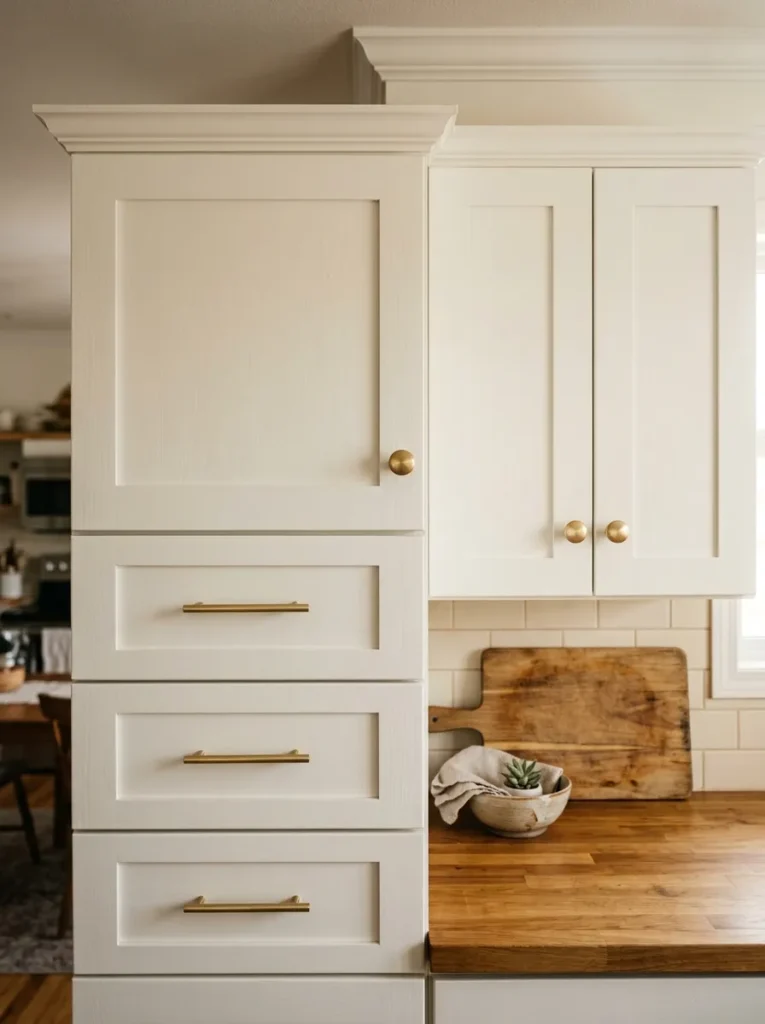
Vibe: New brass hardware on white cabinets feels immediately elevated — the single change that makes a builder-grade kitchen look deliberately designed.
Why it works: Cabinet hardware is the kitchen’s jewelry — the detail that draws the eye most directly to the cabinetry and most immediately communicates the kitchen’s design intention. The design principle is material accent as visual upgrade: replacing generic chrome or nickel hardware with brushed brass or matte black converts the cabinet’s surface from anonymous to considered, referencing the warm material palette that defines current kitchen aesthetics most precisely. Brushed brass specifically reads as warm, artisanal, and enduringly sophisticated — it has been at the center of kitchen hardware trends for long enough that it reads as established rather than fleeting, and the brushed (rather than polished) finish prevents the mirror-bright quality that ages poorly. The hardware swap requires only a screwdriver and takes 30–60 minutes for a full kitchen.
How to get it: Measure the existing hardware’s hole spacing (center-to-center distance between the two screw holes on bar pulls) before purchasing — most existing hardware uses 3-inch or 3.75-inch spacing. Choose bar pulls for drawers and round knobs for upper cabinet doors — this combination reads as more considered than uniform hardware across all door types. Brushed brass bar pulls at 4–5 inches for drawers and 1.25-inch round knobs for upper cabinets is the current most versatile combination.
Quick Win: A complete kitchen hardware swap — 12 knobs and 8 drawer pulls — costs $60–$150 in brushed brass and takes one afternoon. It is consistently the highest-return kitchen decor investment available at any budget level.
Shop The Look
| Product |
|---|
| Brushed brass bar pull 4 inch set of 10 |
| Brushed brass round knob 1.25 inch set of 12 |
| Screwdriver set for hardware installation |
| Hardware jig for consistent placement |
| Cabinet hole cover plate for old holes |
Also view: 14 Stylish House Interior Design Ideas
2. Install Open Shelving for Display and Storage
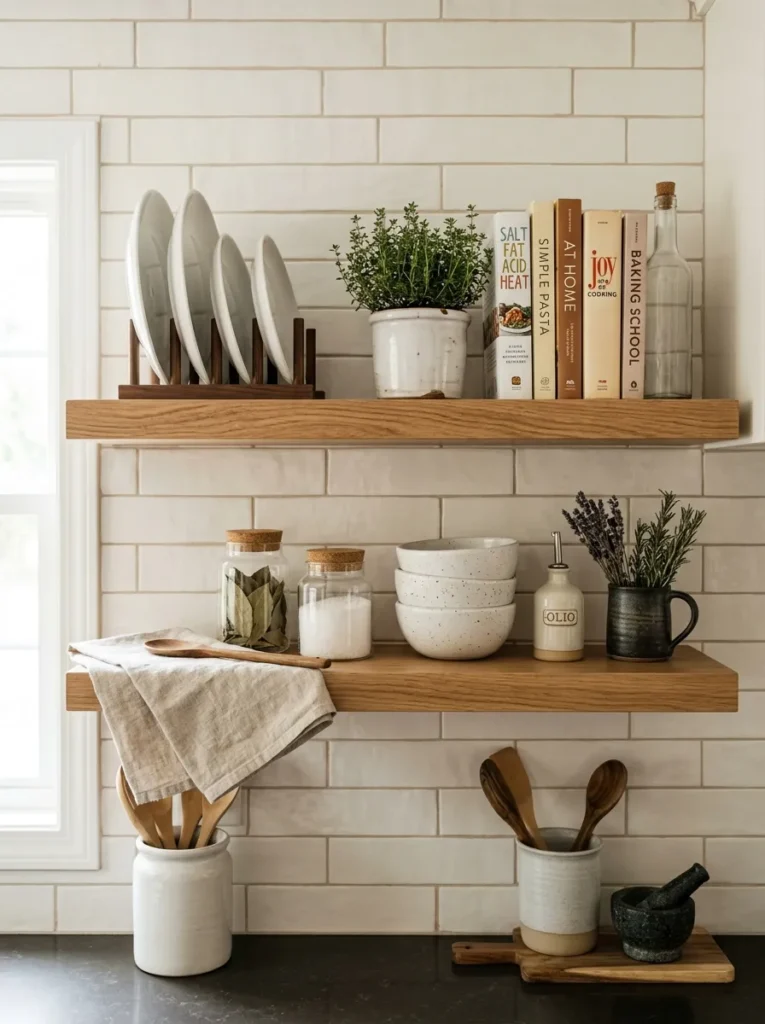
Vibe: Open kitchen shelving feels warmly generous — the visual extension of the kitchen that makes cooking feel like it happens in a room worth being in.
Why it works: Open shelving in the kitchen is the decor decision that most dramatically changes the room’s visual character — it converts a wall of closed cabinet doors into a composed display of everyday objects that communicate the kitchen’s personality. The design principle is functional display as room character: white ceramic plates, clear glass vessels, cookbooks, and plants displayed on open shelves are simultaneously useful kitchen objects and the visual content that makes the kitchen feel inhabited and personal. White oak shelving specifically is the current most popular open shelf material because its warm grain bridges the white cabinetry and painted walls below while introducing the natural wood element that contemporary kitchen aesthetics consistently favor.
How to get it: Replace one run of upper cabinets (typically the wall above the main counter run) with two floating oak shelves mounted at 10-inch spacing. Install heavy-duty floating shelf brackets rated for the combined weight of dishes and objects — the shelf’s aesthetic depends on the brackets being invisible, which requires correct stud mounting. Style shelves using the principle of layered depth: plates and larger objects at the back, smaller objects in front, one plant per shelf, and never more than 70% full.
Shop The Look
| Product |
|---|
| White oak floating shelf 36 inch kitchen |
| Heavy duty invisible shelf bracket set |
| White ceramic plate set for display |
| Clear glass vessel set kitchen display |
| Small herb plant for shelf display |
Also view: 15 Stylish Green Living Room Designs for Every Home
3. Add a Statement Pendant Light Above the Island or Sink
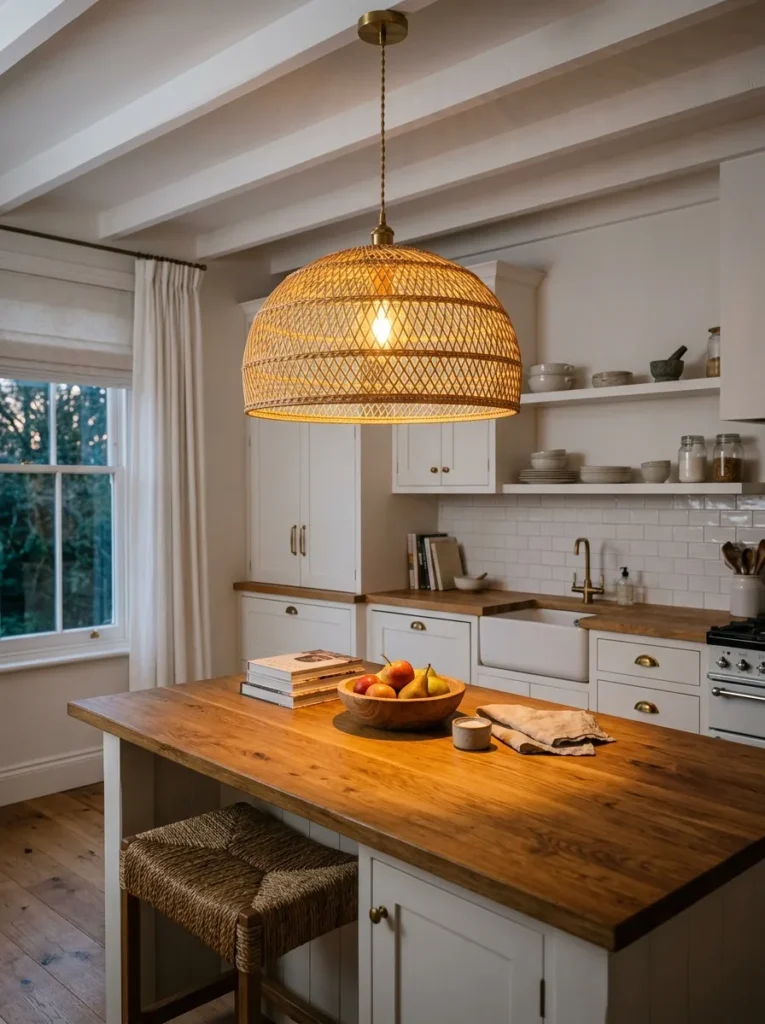
Vibe: A statement pendant above the kitchen island feels warmly specific — the fixture that makes the kitchen’s working heart feel like a place worth gathering around.
Why it works: A pendant light above the kitchen island or sink is the lighting decision with the highest atmospheric impact in the kitchen — it introduces directional, warm, intimate light to the kitchen’s primary work zone, which fundamentally changes the room’s character after dark. The design principle is focal light as room anchor: a pendant light centered above the kitchen island or sink creates a visual and functional anchor for that zone, marking it as the kitchen’s center of activity in a way that recessed overhead lighting distributed evenly across the ceiling cannot. Rattan and natural fiber pendants are the current most popular kitchen pendant style because their woven texture introduces organic warmth that metal and glass fixtures cannot, and their honey-amber tone works with virtually any kitchen palette.
How to get it: Install the pendant so its bottom edge hangs 76–85 cm above the counter surface — this is the standard range that provides adequate light on the work surface while keeping the fixture above the eye line of people working at the counter. For islands, choose a pendant diameter proportional to the island width — a 50 cm pendant for a 90 cm wide island, a 60–70 cm pendant (or two smaller pendants) for an island wider than 120 cm. Use a 2700K warm LED bulb for the intimate atmosphere that the pendant creates; a cooler bulb temperature defeats the warming effect of the fixture’s material.
Shop The Look
| Product |
|---|
| Large rattan pendant light 50cm kitchen |
| Warm LED bulb 2700K pendant compatible |
| Pendant light canopy ceiling mount |
| Pendant cord cover fabric sleeve |
| Ceiling medallion decorative for pendant |
4. Introduce a Zellige or Handmade-Look Tile Backsplash
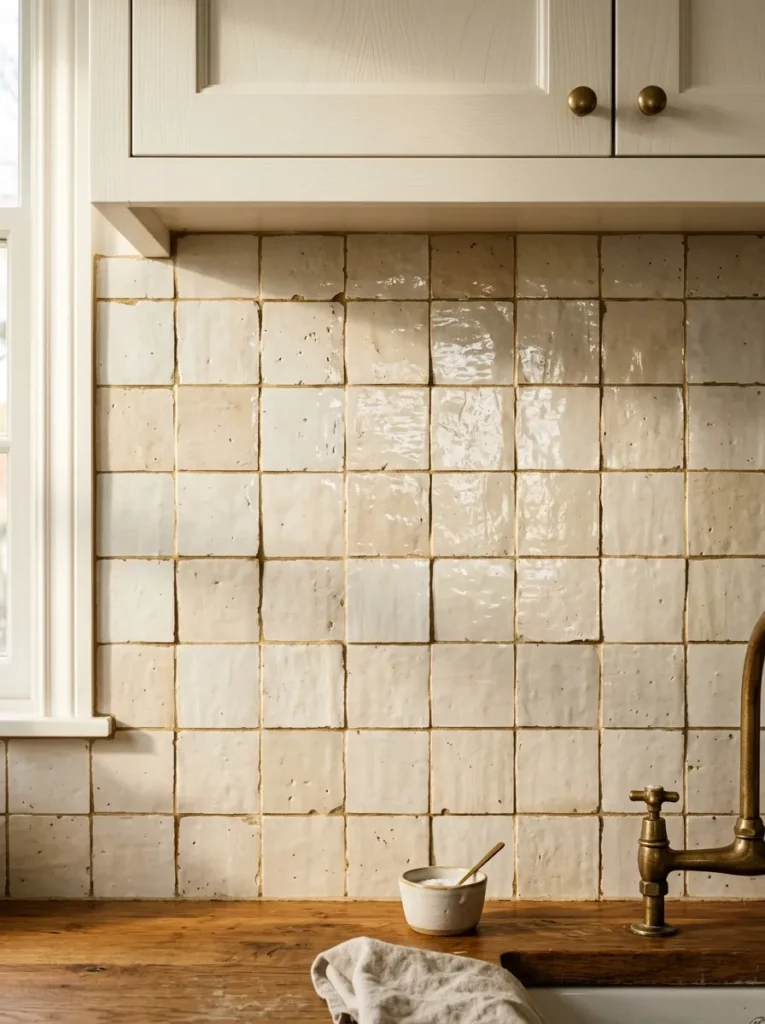
Vibe: A zellige-look backsplash feels artisanally warm — the kitchen surface that catches light differently at every hour and rewards closer looking.
Why it works: Zellige tile — the hand-pressed, imperfect-surface Moroccan ceramic tile tradition — is the backsplash material that most dramatically changed kitchen aesthetics in the past five years because it introduced organic surface imperfection as a deliberate design value in a room previously dominated by machine-perfect tile. The design principle is material imperfection as visual warmth: the tonal variation, slight surface undulation, and reflective shimmer of zellige tile creates a backsplash that reads differently in different light conditions — catching warm morning light one way and evening lamp light another — which gives the kitchen a dynamic visual quality that perfectly uniform tile cannot produce. The warm white or cream version is the most versatile kitchen application — it works with white, grey, and wood-tone cabinet palettes equally.
How to get it: Genuine zellige is available from specialty tile importers at significant cost ($25–$60 per square foot). High-quality zellige-look porcelain alternatives from brands like Cle Tile, Fireclay, or specialist suppliers produce convincing surface variation at $8–$20 per square foot. Peel-and-stick zellige-look tiles are available for renter-friendly applications at $3–$6 per square foot. The grout color is as important as the tile — a warm-toned grey or cream grout (not white) allows the tile’s tonal variation to read clearly rather than being interrupted by bright grout lines.
Shop The Look
| Product |
|---|
| Zellige look ceramic tile warm white 10x10cm |
| Warm grey unsanded grout for zellige tile |
| Tile adhesive mastic for backsplash |
| Notched trowel for tile application |
| Grout sealer for backsplash protection |
5. Style the Counter with a Curated Everyday Objects Vignette
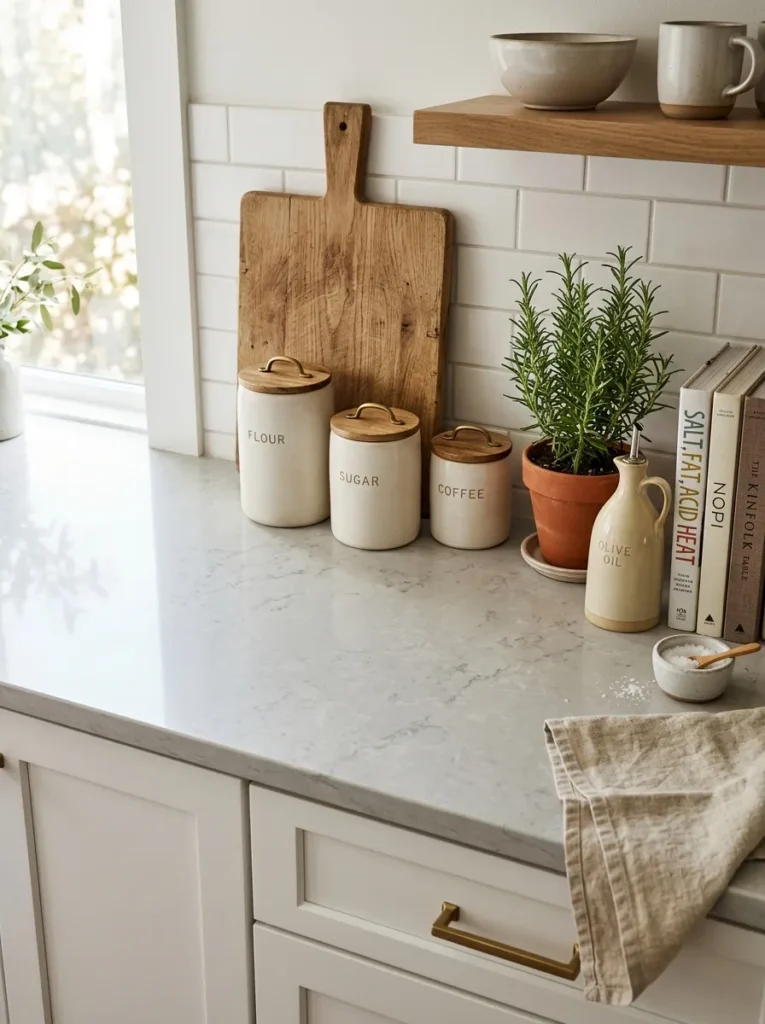
Vibe: A curated kitchen counter feels domestic and considered — the surface that communicates daily life as a pleasurable practice.
Why it works: Kitchen counter styling is the decor decision most directly experienced during daily domestic activity — the quality of the counter’s visual composition affects the quality of every cooking session, every morning coffee, every meal preparation. The design principle is functional object curation as visual composition: every item on the counter should be both genuinely useful and genuinely attractive — branded packaging and plastic containers belong in drawers, while wooden cutting boards, ceramic canisters, terracotta herb pots, and ceramic oil pourers belong on the counter as both functional tools and visual elements. The two-thirds rule — leaving 65–70% of the counter surface clear — prevents the visual crowding that makes counters read as cluttered rather than curated.
How to get it: Remove everything from the counter surface. Return only items used at least several times per week and visually consistent with the kitchen’s palette. For most kitchens, five to six counter items is the maximum for a styled rather than cluttered appearance: one cutting board (leaned against the backsplash), a matched canister set (two or three), one small plant in terracotta, one oil or vinegar vessel, and one small object of personal appeal. Everything else — the toaster, the blender, the coffee machine — should be evaluated for counter visibility on an individual basis and stored in cabinets if used less than daily.
Shop The Look
| Product |
|---|
| Ceramic canister set warm white three piece |
| Wooden cutting board large for leaning |
| Terracotta pot small for kitchen herb |
| Ceramic olive oil pourer bottle |
| Small ceramic salt cellar for counter |
6. Introduce Warm-Toned Kitchen Textiles — Linen Towels and Curtains
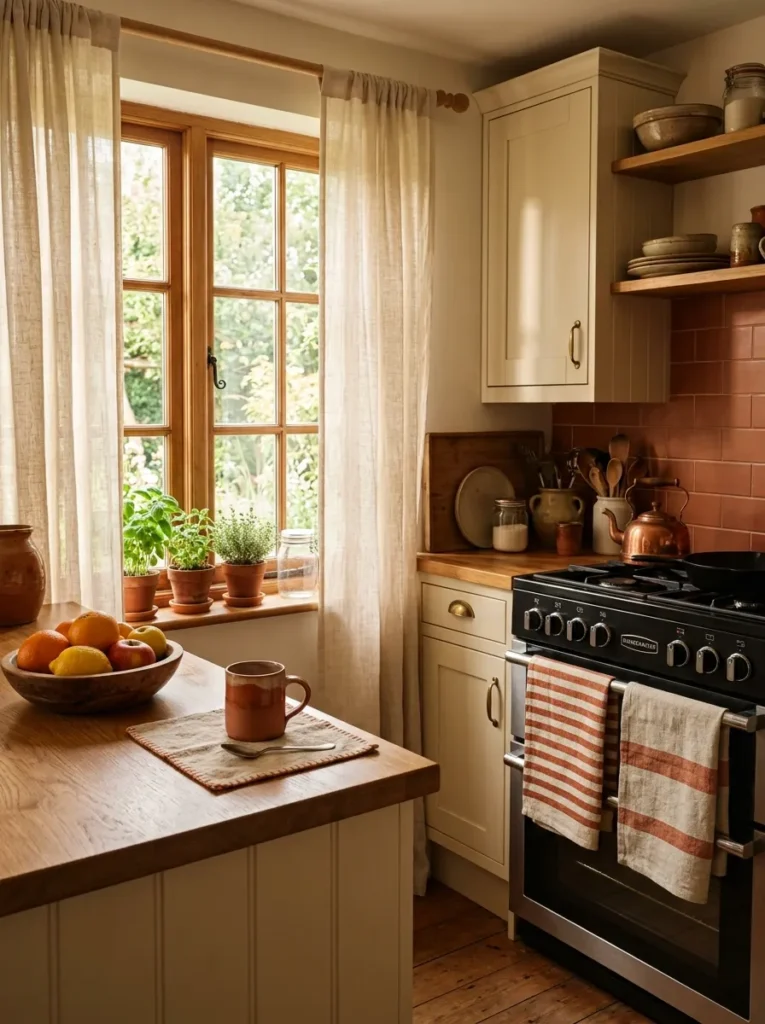
Vibe: Warm linen kitchen textiles feel domestically considered — the soft elements that make a kitchen feel genuinely lived in rather than merely equipped.
Why it works: Kitchen textiles are the fastest and least expensive category of kitchen decor update with an immediate impact on the room’s warmth and personality. The design principle is textile warmth as room character: linen specifically — with its natural slub texture, warm cream tone, and slight irregularity — introduces organic material warmth to a room otherwise dominated by hard surfaces (tile, stone, painted cabinet, glass). Striped linen kitchen towels in a warm palette (cream and terracotta, cream and sage, cream and warm charcoal) are the current kitchen textile that reads as most authentically considered — they reference the traditional kitchen textile traditions of Southern European and Scandinavian cooking cultures while connecting to contemporary warm-palette interiors.
How to get it: Replace any synthetic fabric or printed commercial kitchen towels with plain or simply striped linen kitchen towels in a warm palette consistent with the kitchen’s overall color direction. Hang from the oven handle (two to three towels in a coordinating set) as both function and display. Add a pair of natural linen curtains at the kitchen window — even a simple flat panel in natural linen significantly improves the kitchen’s light quality by filtering rather than blocking natural light. Maintain the textile palette consistently — mixing printed patterns with plain linen reads as accidental rather than considered.
Shop The Look
| Product |
|---|
| Linen kitchen towel set striped terracotta cream |
| Natural linen curtain panel kitchen window |
| Linen placemat set natural for counter |
| Linen napkin set for kitchen table |
| Linen apron natural for kitchen use |
7. Add a Wooden Butcher Block Island or Countertop Section
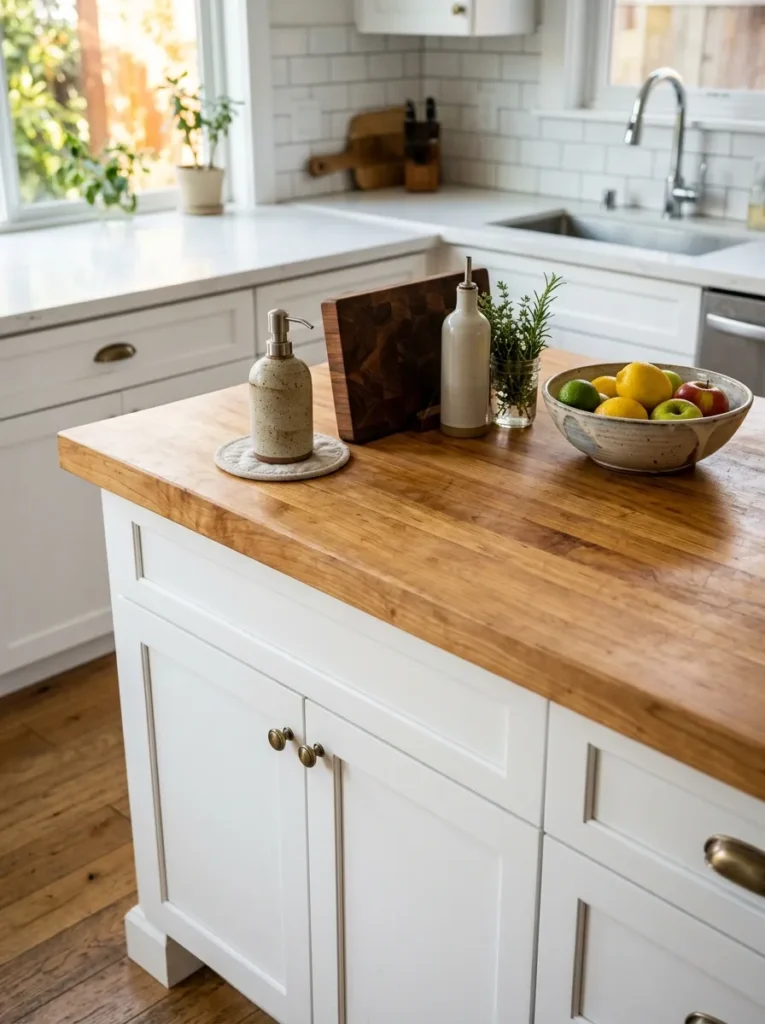
Vibe: A butcher block countertop section feels warmly organic — the kitchen surface that makes every other surface in the room read as warmer by association.
Why it works: A butcher block wood countertop or island surface is the kitchen material upgrade with the most immediate warming impact on the overall kitchen atmosphere — natural wood grain against painted cabinets and tile backsplash provides the organic material contrast that makes a kitchen feel genuinely warm rather than merely clean. The design principle is material contrast as warmth generation: a kitchen with all-stone, all-laminate, or all-tile horizontal surfaces reads as materially uniform; introducing a wood element (even a single butcher block section on an island) breaks the material uniformity and creates the natural material warmth that registers most immediately as domestic and inviting. Butcher block also improves practically — it is the most forgiving cutting surface in a kitchen, can be sanded and re-oiled when damaged, and develops a beautiful patina with use.
How to get it: Purchase a butcher block panel in hard maple, birch, or walnut (walnut is the most visually dramatic, maple and birch the most traditional and food-safe). IKEA’s NUMERAR or KARLBY countertops are widely available and provide the full butcher block experience at accessible price points. Seal with food-grade mineral oil or Howard Butcher Block Conditioner (beeswax and mineral oil) — three coats before use, then monthly maintenance. Clean with plain water and mild soap; never soak or leave standing water on wood countertops.
Shop The Look
| Product |
|---|
| Butcher block countertop maple 74 inch |
| Food grade mineral oil for wood sealing |
| Butcher block conditioner beeswax oil |
| L-bracket support set for counter mounting |
| Wood oil applicator cloth set |
8. Update the Kitchen Sink Area with a Ceramic or Farmhouse Sink
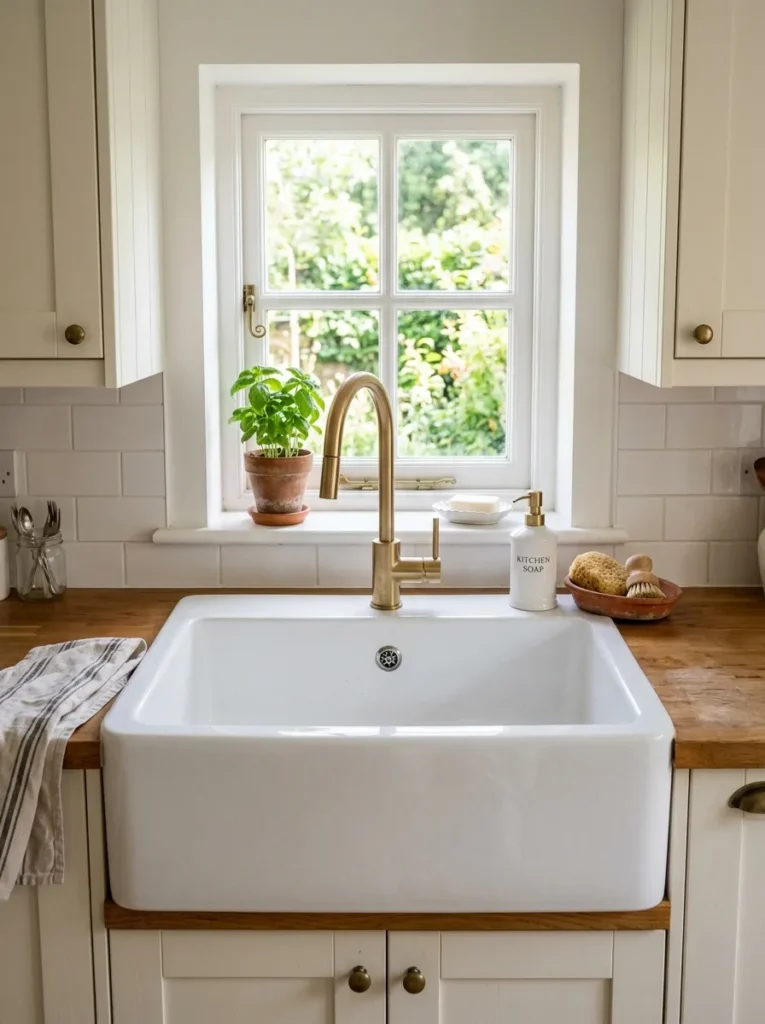
Vibe: A farmhouse apron-front sink feels classically warm — the kitchen fixture that makes washing dishes feel like part of the home’s character rather than a chore.
Why it works: The apron-front farmhouse sink is the kitchen fixture upgrade with the highest architectural impact — it is visible as a decorative element from across the room in a way that undermount and drop-in sinks are not, making it as much a design statement as a functional fixture. The design principle is fixture as architectural feature: an apron-front sink’s exposed front panel faces into the kitchen rather than being hidden by the cabinet below, which means it reads as a composed element in the kitchen’s visual composition rather than simply a utility item. The white fireclay farmhouse sink has been consistently at the center of kitchen design for decades because its warmth, depth, and material quality connect to the authentic kitchen traditions that contemporary kitchen aesthetics draw from.
How to get it: A fireclay farmhouse sink requires professional installation as it is significantly heavier than standard undermount sinks and requires cabinet modification. Ruvati, Kraus, and American Standard offer quality fireclay apron-front sinks in the $400–$900 range. The faucet choice is as important as the sink — a brushed brass or matte black gooseneck faucet with a high arc completes the farmhouse aesthetic and provides the functional clearance a deep farmhouse basin requires. Install the faucet on a separate deck plate behind the sink rather than through the sink itself where possible.
Shop The Look
| Product |
|---|
| White fireclay farmhouse apron sink 33 inch |
| Brushed brass gooseneck kitchen faucet |
| Fireclay sink mounting hardware set |
| Ceramic soap dispenser farmhouse style |
| Natural loofah sponge for sink display |
9. Create a Coffee and Tea Station as a Dedicated Vignette
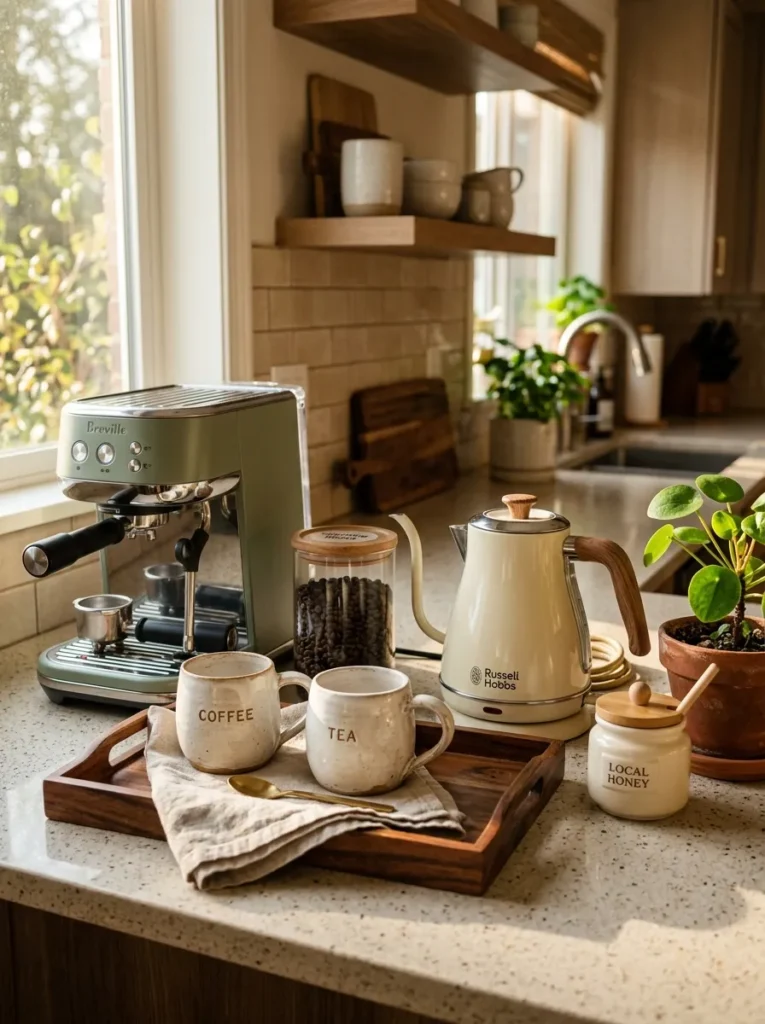
Vibe: A dedicated coffee station feels morning-specific and warm — the counter zone that makes the first five minutes of every day feel intentionally designed.
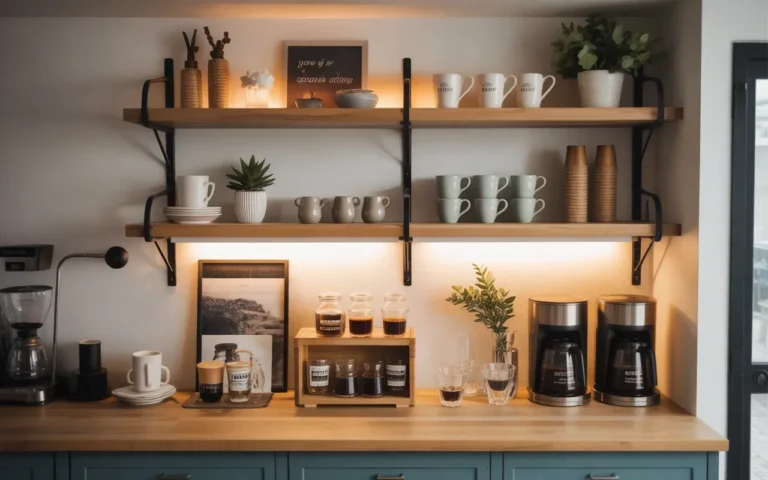
Why it works: A dedicated coffee and tea station is the kitchen decor concept that most directly improves the quality of a daily ritual — by organizing the morning beverage routine into a defined, visually composed zone, it converts a dispersed functional process (reaching into different cabinets for mugs, grinder, coffee) into a composed domestic moment. The design principle is ritual zone definition as quality-of-life design: when a daily ritual (making coffee, preparing tea) has a dedicated, visually warm zone, the ritual’s quality improves simply by virtue of its composed setting. A wooden tray as the containing element creates the visual boundary that defines the station as a zone rather than a collection of appliances — everything on the tray belongs to the coffee ritual, everything off the tray belongs to the rest of the kitchen.
How to get it: Identify a counter zone 60–80 cm wide for the station. Position the coffee machine at the back-center. Place a wooden tray (30×40 cm minimum) in front of and beside the machine — this becomes the organization surface for everything related to the coffee ritual. Display ceramic mugs on the tray or on a small wooden mug rack beside it. Add a glass or ceramic bean canister, a honey jar, and one small plant. Keep all non-coffee items off the tray. The station reads as designed when the tray defines the zone’s boundary clearly.
Shop The Look
| Product |
|---|
| Wooden tray rectangle natural for station |
| Ceramic mug set warm white set of 4 |
| Glass coffee bean canister airtight |
| Cream electric kettle small kitchen |
| Ceramic honey jar with wooden dipper |
10. Paint an Accent Wall or Lower Cabinet Color
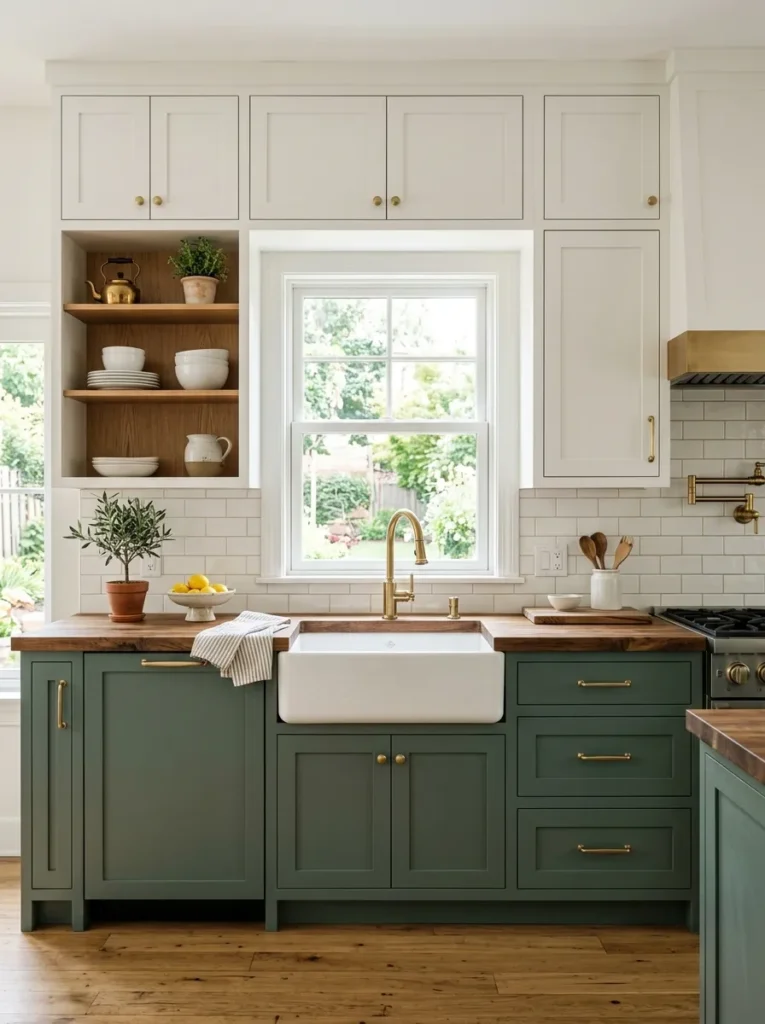
Vibe: Two-tone kitchen cabinets feel deliberately designed — the color decision that immediately makes a kitchen look like it had a designer rather than a builder.
Why it works: Painting lower cabinets in a bold, muted color while keeping uppers white is the single most impactful kitchen transformation available through paint — it introduces depth, sophistication, and a clear design decision to a kitchen that might otherwise read as undifferentiated. The design principle is color blocking as visual zoning: the upper-white, lower-color combination creates a visual distinction between the kitchen’s overhead zone (which benefits from lightness to reflect ceiling light) and its working zone at counter level (where a bolder color grounds the space and creates the visual weight that makes the kitchen feel anchored rather than floating). Dusty sage green is the most versatile lower cabinet color in current kitchen design — it bridges natural material tones (wood, stone, ceramic) and reads as sophisticated rather than trendy.
How to get it: Paint lower cabinets only — this is half the work of repainting the full kitchen and produces a more sophisticated result through the two-tone contrast. Use a cabinet-specific paint (not wall paint — cabinet paints are formulated for durability and washability): Benjamin Moore’s Advance or Sherwin-Williams Emerald Urethane Trim Enamel are widely recommended formulations that adhere to cabinet surfaces and withstand daily kitchen use without chipping. Remove cabinet doors, clean and lightly sand all surfaces, apply one coat of adhesion primer, then two to three coats of cabinet paint in the chosen color.
Shop The Look
| Product |
|---|
| Dusty sage cabinet paint Benjamin Moore Advance |
| Cabinet adhesion primer for painting |
| Cabinet paint brush set fine finish |
| Small foam roller for flat cabinet surfaces |
| Painter’s tape for clean edges |
11. Introduce a Woven or Ceramic Fruit Bowl as Centerpiece
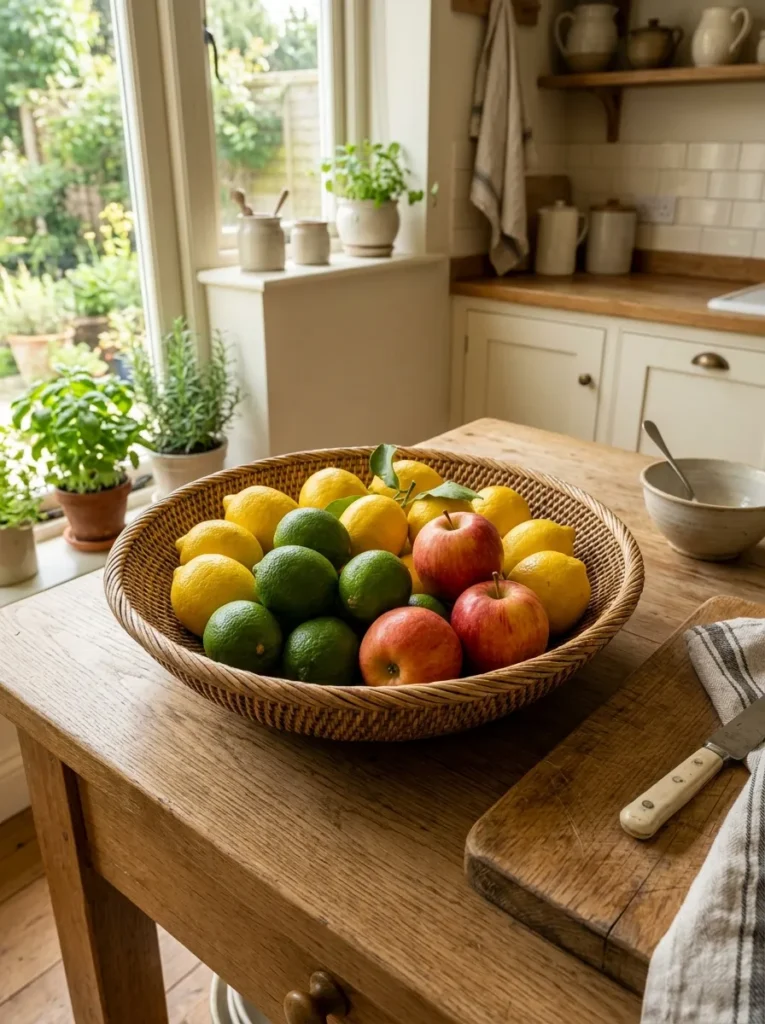
Vibe: A generous fruit bowl on the kitchen island feels abundantly domestic — the kitchen centerpiece that serves nutrition, color, and warmth simultaneously.
Why it works: A bowl of seasonal fruit is the kitchen decor element with the most immediate atmospheric impact per dollar — it introduces fresh color (the bright yellow of lemons, the deep red of apples), organic form, and the sense of generous domestic abundance that makes a kitchen feel inhabited rather than merely furnished. The design principle is living color as seasonal kitchen decor: unlike painted or manufactured color elements that are fixed, a fruit bowl’s color changes with the season’s available fruit — lemons and limes in spring, peaches and cherries in summer, figs and pomegranates in autumn, citrus and pears in winter. A large rattan woven bowl is the most versatile vessel for this purpose — its natural tone bridges every season’s fruit palette and every kitchen’s color direction.
How to get it: Choose a bowl large enough to hold a genuinely abundant quantity of fruit (35 cm minimum diameter) — a bowl that is underfilled with three pieces of fruit reads as staged rather than lived-in. Natural rattan, handmade ceramics, and turned wood are the bowl materials that read as most warmly considered. Position on the kitchen island, counter, or table where it is most visible from the kitchen’s primary entry point. Replenish with whatever is freshest and most colorful at the market rather than specific varieties — the freshness and abundance are the design elements, not the specific fruit selection.
Shop The Look
| Product |
|---|
| Large rattan woven fruit bowl 35cm natural |
| Ceramic fruit bowl handmade large |
| Turned wood fruit bowl natural |
| Ceramic pedestal fruit bowl white |
| Small ceramic side bowl companion |
12. Layer Kitchen Lighting with Under-Cabinet LED Strips
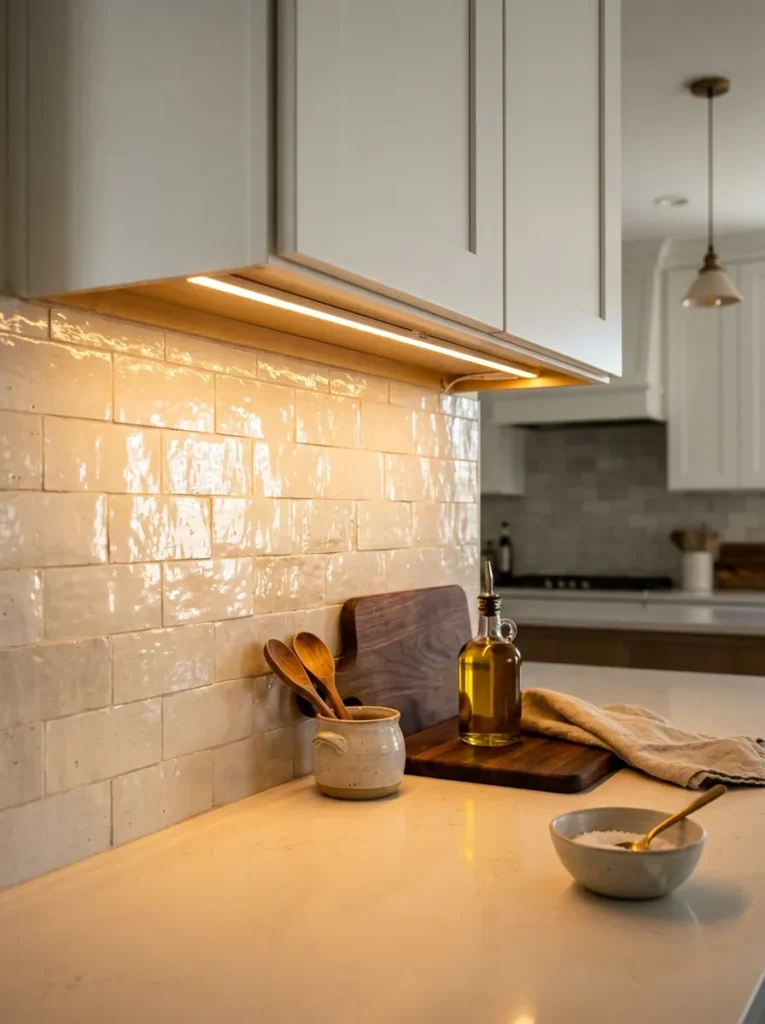
Vibe: Under-cabinet lighting feels warmly layered — the light source that changes the kitchen’s entire evening atmosphere in a single strip.
Why it works: Under-cabinet LED strip lighting is the kitchen lighting upgrade with the highest atmospheric return per installation cost — it creates a dedicated warm light layer at the counter level that functions both as practical task lighting (illuminating the counter surface directly for food preparation) and as atmospheric lighting (creating the warm, layered light environment that makes kitchens feel intimate in the evening). The design principle is counter-level warm light as kitchen atmosphere: most kitchens rely on overhead recessed or surface-mounted lighting that provides flat, even illumination across the full room — adding a warm light source at the counter’s immediate level creates the directional intimacy that a single overhead source cannot. The 2700K temperature is essential — cooler temperatures eliminate the atmospheric warmth that makes under-cabinet lighting valuable beyond its task function.
How to get it: Install a 2700K warm white LED strip light (dimmable, in a waterproof rating appropriate for the kitchen environment) under the upper cabinet base using the adhesive backing provided or supplemented with clear mounting clips. Connect to a plug and install a switch at the counter level for independent control. A dimmer switch compatible with the LED strip allows full range from bright task lighting to intimate accent lighting. Total installation cost: $20–$60 for the strip and switch for a standard kitchen run.
Shop The Look
| Product |
|---|
| LED strip light 2700K warm white dimmable |
| Under cabinet LED strip mounting clips |
| Dimmer switch compatible LED inline |
| LED strip connector set corner joining |
| Power supply for LED strip kitchen |
13. Style the Kitchen Window with Herbs and Botanicals
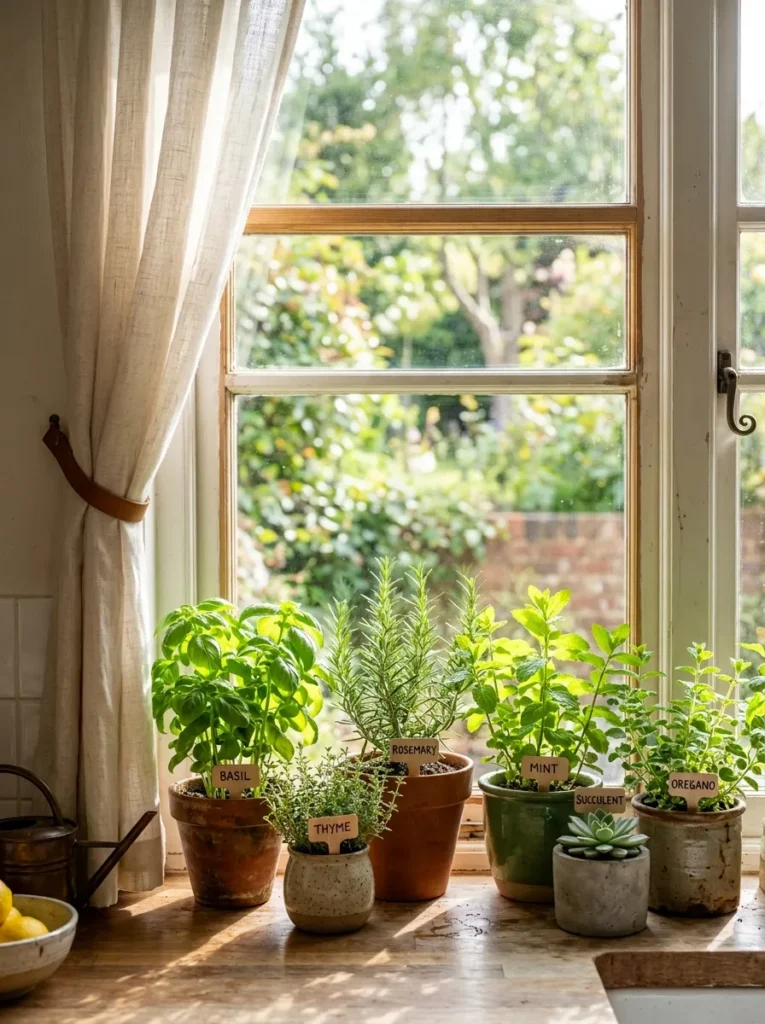
Vibe: A kitchen window herb collection feels freshly alive — the plant installation that makes the kitchen smell like a garden and look like it belongs to someone who genuinely cooks.
Why it works: A kitchen windowsill herb garden is the decor element that most completely connects the kitchen to its primary purpose — growing the actual ingredients used in daily cooking at the room’s most naturally lit point. The design principle is functional living decoration as room character: herbs are simultaneously decorative objects (their varied forms, textures, and green tones create a dynamic plant composition) and genuine kitchen ingredients — which makes them uniquely appropriate kitchen decor that earns its counter space through function rather than simply occupying it for visual effect. The bright window backlight creates the luminous leaf translucency that makes herb collections particularly beautiful at the specific time of day the kitchen is most actively used — morning.
How to get it: Select herbs based on actual cooking use — rosemary, thyme, and sage for savory cooking, basil for summer cooking, mint for drinks and desserts. Plant in small terracotta pots (9 cm diameter) for the warmest visual effect — white or ceramic pots are a more contemporary alternative. Add one non-herb plant (a small succulent or a trailing pothos cutting) for variety. Water individually based on each plant’s needs — a common mistake is watering all herbs equally, which kills the drought-tolerant varieties (rosemary, thyme) while under-watering the moisture-needing ones (basil, mint). Replace any plant that becomes leggy or root-bound with a fresh grocery store herb transplant.
Shop The Look
| Product |
|---|
| Fresh herb starter plant set kitchen |
| Small terracotta pot set 9cm kitchen herbs |
| Herb potting mix indoor kitchen |
| Small ceramic label set for herb pots |
| Linen kitchen window curtain panel |
14. Add Warmth with a Kitchen Runner Rug
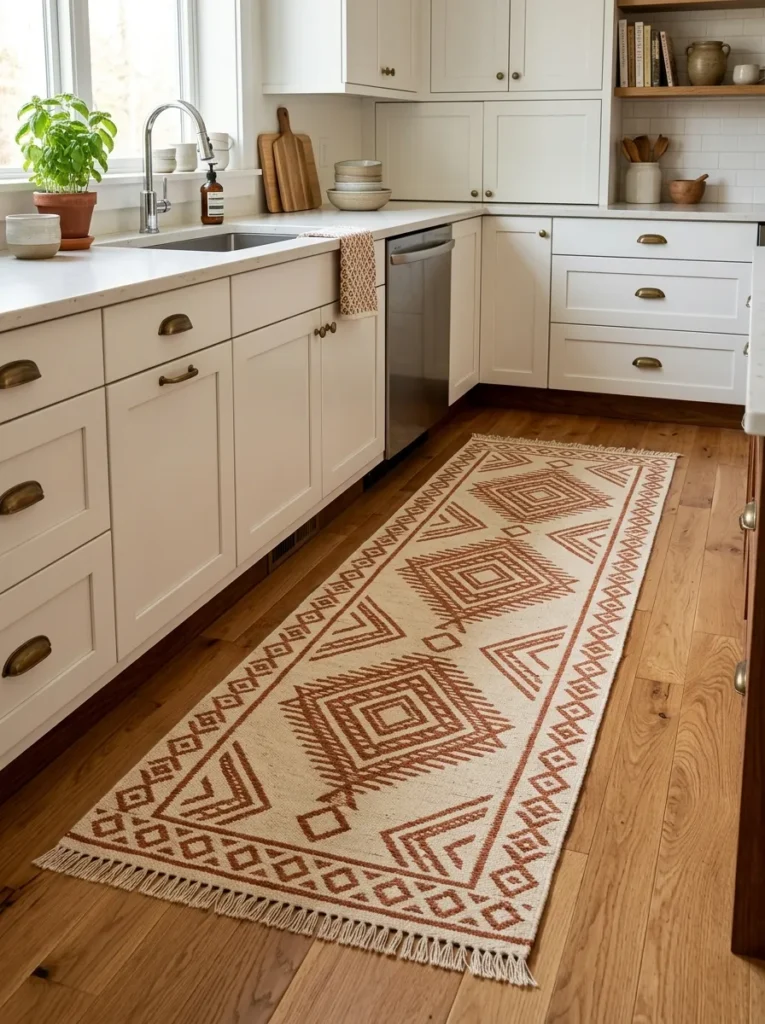
Vibe: A kitchen runner rug feels warmly grounding — the textile intervention that makes standing in the kitchen feel less like standing on a floor and more like standing somewhere considered.
Why it works: A kitchen runner rug is the kitchen textile with the most practical and aesthetic dual-function — it reduces the physical fatigue of standing on hard kitchen floors during extended cooking sessions (a genuine ergonomic benefit documented in studies of kitchen worker fatigue), while simultaneously introducing the color, pattern, and warmth that hard kitchen floor surfaces fundamentally lack. The design principle is comfort material as design element: a runner rug doesn’t simply decorate the kitchen floor, it improves the physical experience of using the kitchen in a way that is felt every day. A geometric pattern in warm cream and terracotta is the current most versatile kitchen runner option — it reads as design-forward while complementing warm-palette kitchens and natural material kitchens equally.
How to get it: Choose a runner rug 60 cm wide for a standard kitchen counter run (wider runners impede cabinet door opening) and long enough to extend the full length of the primary work counter, typically 150–200 cm. Material must be washable — cotton flatweave, polypropylene, or a cotton-and-polypropylene blend are the most practical kitchen rug materials. A non-slip backing is essential on hard kitchen floors. Machine washable is strongly preferred — kitchen rugs require frequent washing. Replace annually or when the pattern or texture begins to look worn rather than allowing a deteriorating rug to remain as a decor liability.
Shop The Look
| Product |
|---|
| Kitchen runner rug cream terracotta geometric |
| Non-slip rug pad runner size |
| Cotton flatweave kitchen runner washable |
| Rug tape for runner edge securing |
| Machine washable kitchen mat runner |
15. Small-Space Kitchen Refresh — Maximum Impact in a Galley or Studio Kitchen
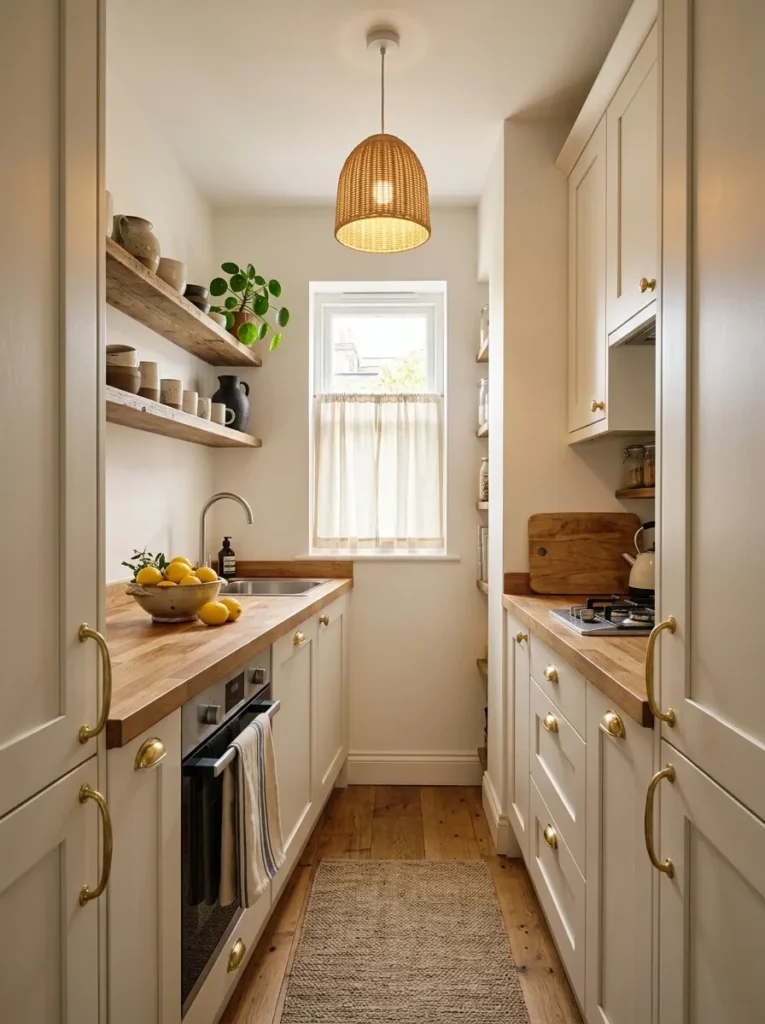
Vibe: A maximally refreshed compact kitchen feels surprisingly complete — the space that proves that a kitchen’s character is determined by its decisions, not its dimensions.
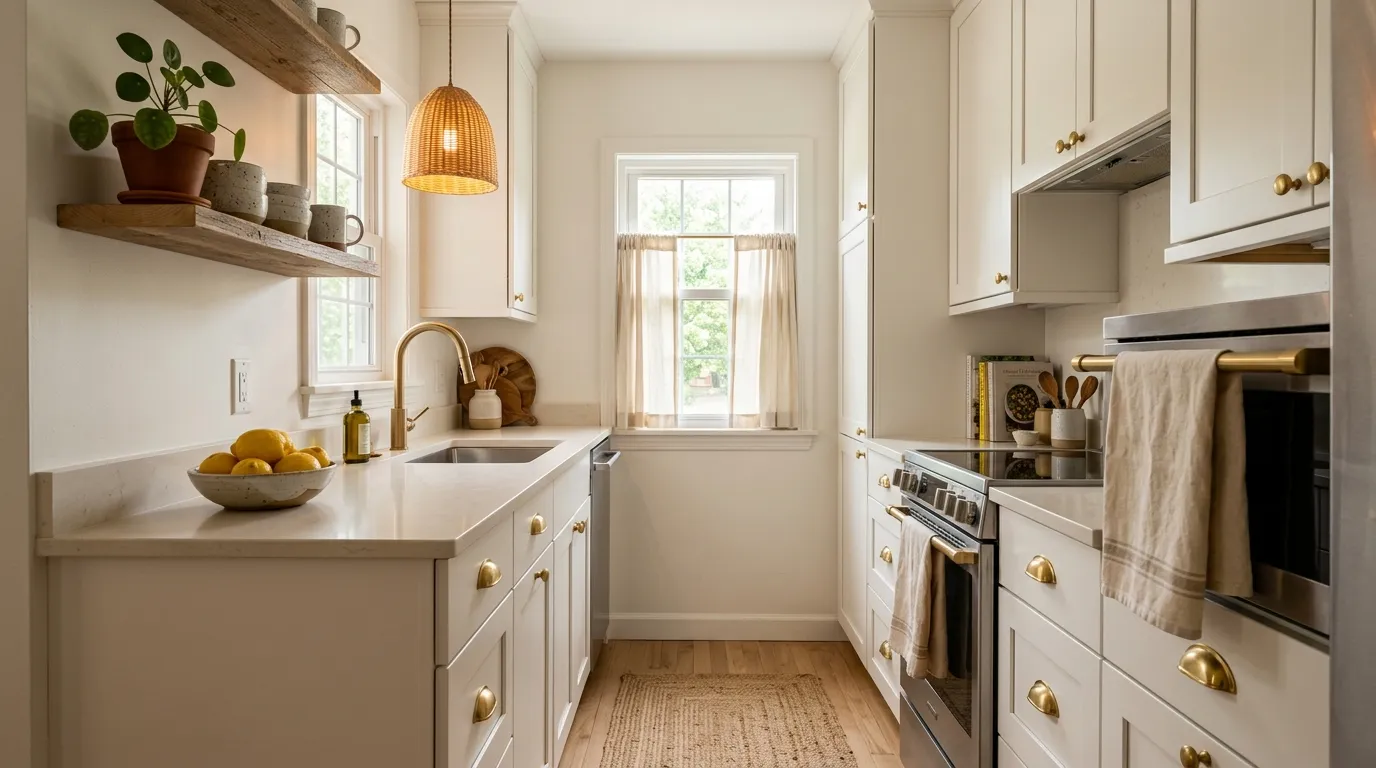
Why it works: The compact galley or studio kitchen presents the concentrated version of the kitchen decor challenge — in a space where every element is seen simultaneously from any position, every decision has compounded visibility and impact. The design principle is elemental concentration for maximum effect: the five most impactful kitchen decor decisions (hardware, lighting, open shelf, textile, botanical) applied simultaneously in a compact kitchen produce a result where each element amplifies the others — the brass hardware reads warmer under the rattan pendant’s warm light, the open shelf reads more considered beside the linen textile, and the lemon bowl reads more abundant against the neutral backdrop created by the other four elements. The compounding effect of five well-chosen small decisions in a compact space consistently outperforms the visual impact of individual larger investments.
How to get it: In a galley kitchen under 3 meters long, implement five changes in this order of visual impact: hardware swap first (brass or matte black, 30 minutes), install one rattan pendant above the sink (60 minutes, plug-in option available), add one open shelf above the counter run (90 minutes), refresh textiles (linen towels on the oven handle, 5 minutes), and place a bowl of seasonal citrus on the counter. Total implementation time: one weekend afternoon. Total material cost: $80–$200 depending on pendant and shelf quality. Total visual impact: the equivalent of a kitchen that has been thoughtfully considered.
Shop The Look
| Product |
|---|
| Brushed brass hardware set compact kitchen |
| Small rattan pendant light plug in |
| Narrow floating shelf white oak compact kitchen |
| Linen kitchen towel set for oven handle |
| Seasonal fruit bowl for counter centerpiece |
How to Start Your Kitchen Decor Refresh
The single first move is the hardware swap — specifically, purchasing a set of brushed brass or matte black bar pulls and knobs sized for your existing cabinet hole spacing and installing them in one afternoon. This single intervention is the kitchen decor change with the highest return on time invested because it changes every cabinet door and drawer front simultaneously, which means it changes the entire kitchen’s visual register in a single session. A kitchen with brass hardware reads as a kitchen that was considered. The same kitchen with original chrome or brushed nickel reads as a kitchen that came with the house and was never thought about. The hardware is the kitchen’s most visible detail — updating it updates everything.
The most common mistake in kitchen decor refreshes is attempting to address every element simultaneously without a clear design direction — purchasing a new pendant, new textiles, new open shelf, and new accessories all at once without establishing a consistent palette first. The result is a kitchen with more stuff but not more coherence. The fix is to establish the kitchen’s color direction (warm cream and brass, or sage and brass, or warm white and matte black) before purchasing any individual element, and to evaluate every subsequent purchase against that palette rather than against how it looks in isolation. A kitchen with a clear color palette and five considered elements reads as designed; a kitchen with ten mismatched elements reads as accumulated.
Three kitchen decor investments under $75 each that produce the most immediate impact: a complete hardware swap in brushed brass ($60–$120 for a full kitchen, achievable in one afternoon), a set of three to four linen kitchen towels in a coordinated warm palette ($25–$45 that immediately refresh the textile register), and a large natural rattan fruit bowl filled with seasonal citrus ($20–$40 that introduces fresh color, organic form, and living abundance). Together these three investments — totaling $105–$205 — address the three most immediately visible kitchen decor categories (hardware quality, textile warmth, and living botanical element) and produce a kitchen that reads as genuinely considered for a total investment that represents a fraction of any renovation cost.
Realistic expectations: a complete kitchen decor refresh — hardware, lighting pendant, open shelving, textile update, counter styling, and accent wall — is achievable over two to three weekends and $300–$600 in total materials and purchases. The visual transformation at this investment level is typically described by first-time visitors as equivalent to a renovation — which it is not, but the quality of the design decisions at this investment level can genuinely equal the visual impact of much more expensive work when the decisions are the right ones. The most stylish kitchens are consistently not the most renovated ones but the ones where every visible decision was made with intention.
Frequently Asked Questions About Kitchen Decor Ideas
What kitchen decor changes make the biggest difference without renovating?
The three changes with the highest visual impact without renovation are cabinet hardware replacement (transforms every cabinet door and drawer simultaneously), pendant lighting installation above the island or sink (changes the kitchen’s evening atmosphere completely), and open shelf installation replacing upper cabinets (converts a closed, uniform upper cabinet wall into a composed display). All three are reversible, all three require only basic tools or professional assistance for electrical work, and all three are achievable on realistic weekend timelines. The hardware swap is specifically the most impactful single change per hour invested.
What kitchen color trends are most enduring in the current moment?
The kitchen color trends with the greatest staying power in the current design moment are: warm white (not stark white — warm white with a yellow or cream undertone) for upper cabinets and walls, sage green or forest green for lower cabinets or accent walls, warm wood tones for open shelving and island countertops, and warm terracotta as an accent color in textiles and accessories. The connecting principle is warmth — every enduring kitchen color trend of this period tilts toward warmth and organic material reference rather than the cool, stark minimalism that characterized the previous decade’s aesthetic. These warm directions have the longevity that trend colors based purely on novelty do not.
How do I make a small kitchen feel larger through decor?
The most effective small kitchen decor approaches for increasing perceived space are: open shelving instead of upper cabinets (visually opens the upper kitchen zone), warm white or light warm cream paint on walls and upper cabinets (reflects light without the flatness of stark white), a mirror or large reflective backsplash tile (creates visual depth behind the counter), and a single large pendant rather than multiple small fixtures (one strong light point reads as more spacious than several competing ones). Paradoxically, a bold lower cabinet color (sage green, navy) in a small kitchen often reads as more confident and less cramped than a timid all-white palette, because the color gives the space a decisive character rather than an anxious uniformity.
What kitchen textiles are most practical and stylish?
The most practical and stylish kitchen textile combination is 100% linen or a linen-cotton blend — for kitchen towels (highly absorbent, fast-drying, improves with washing), curtains or window panels (light-filtering without blocking light, easy to wash), and placemats or counter mats. Linen’s natural material warmth, its characteristic weave texture, and its durability under repeated washing make it simultaneously the most practical and most aesthetically considered kitchen textile material. In terms of color, a warm neutral palette (natural linen, cream, warm stripe) reads as consistently more sophisticated than patterned or brightly colored kitchen textiles and coordinates more easily with seasonal or accessory changes.
How do I choose the right pendant light for my kitchen?
The four variables that determine pendant light selection for a kitchen are: height above the work surface (76–85 cm from counter to pendant bottom is standard), diameter proportional to the island or counter width (pendant diameter should be approximately half the island width for single pendants over islands), material appropriate to the kitchen’s palette (rattan for warm organic kitchens, metal for more contemporary spaces, glass for industrial or transitional kitchens), and light temperature (2700K warm white for atmospheric warmth — never daylight or cool white in a kitchen pendant). A pendant that is too small for its position is the most common kitchen lighting mistake — when in doubt about size, choose the larger option.
Ready to Refresh Your Kitchen?
These 15 kitchen decor ideas span every scale of intervention and every aspect of the kitchen’s visual composition — from the foundational hardware swap and warm paint choices to the statement pendant, the zellige backsplash, the open shelving installation, and the curated counter vignette — so whether you have an afternoon and a screwdriver or a full renovation weekend, there is a specific, achievable, and genuinely impactful starting point here for exactly the kitchen you have. The most important thing to understand about kitchen decor is that the kitchen’s quality is determined not by what was installed when the house was built but by the accumulated decisions made by the people who live in it — and every one of those decisions is still available to you. Today, pull out every piece of hardware in your kitchen, look at what it says about the room, and ask whether something better is possible for $2 per pull and one afternoon of your time. That single question is where every beautiful kitchen began. Pin the ideas that made you look at your own kitchen differently, and let those be the ones you change first.