15 Beautiful French Country Home Decor Ideas
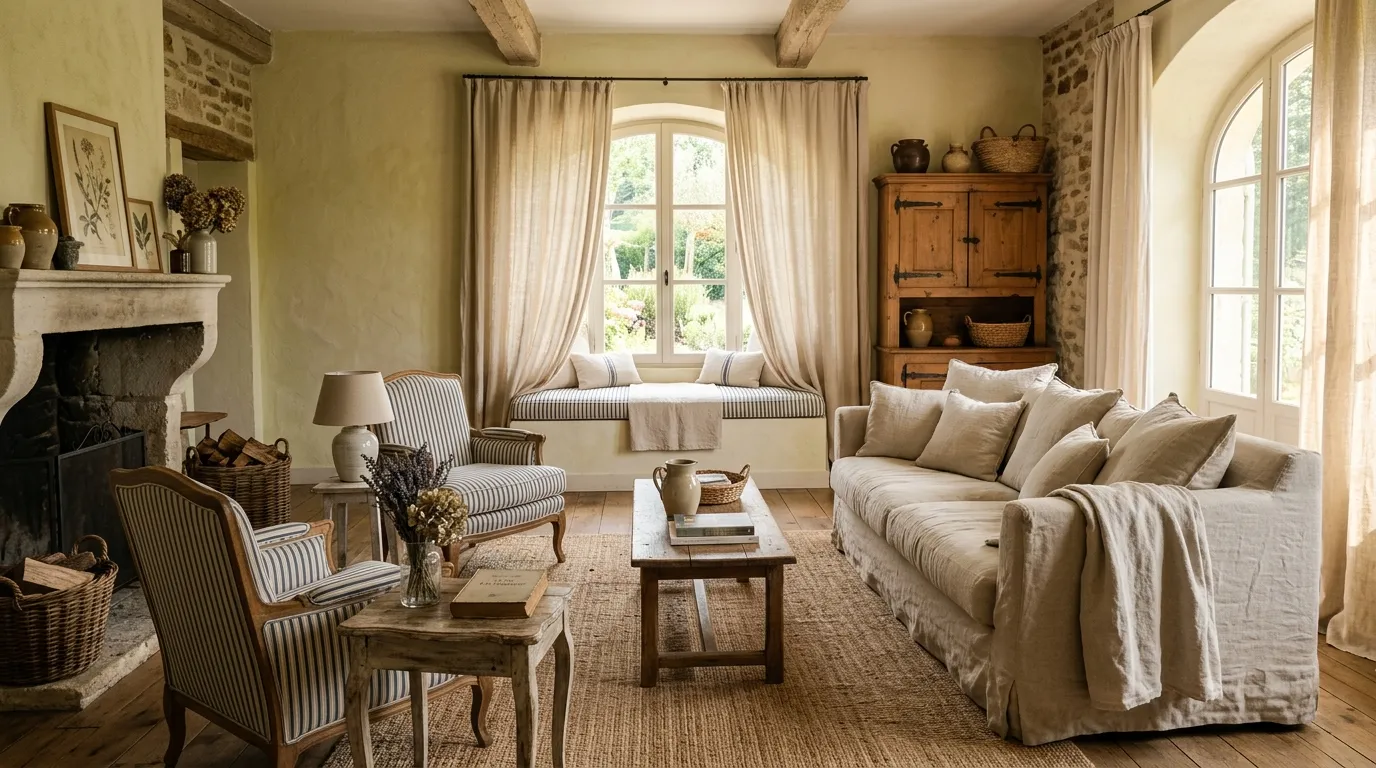
French country home decor refers to the design aesthetic that draws from the rural farmhouses, manor houses, and village homes of Provence, Normandy, Burgundy, and the Dordogne — a style defined by the specific warmth of aged stone and whitewashed plaster, the faded elegance of toile and ticking stripe, the patina of worn timber and wrought iron, the abundance of fresh and dried botanicals, and the quality of rooms that feel genuinely inhabited and loved rather than designed and preserved. This article gives you 15 beautiful French country decor ideas that work across every room in the home, every budget level, and every starting point — from a rented apartment where nothing can be permanently changed to a house whose bones are already sympathetic to the style.
Picture a kitchen where bundles of dried lavender hang from the rafters above a worn stone floor, where the dresser holds a collection of blue-and-white faience pottery accumulated across years of market visits, where the linen curtains at the window billow slightly in the afternoon breeze and the whole room smells of something cooking slowly and something dried and botanical. Or a bedroom where the iron bed is piled with faded linen, where the armoire in the corner has seen several generations of clothing, and where the only art on the wall is a single large botanical print in a simple wooden frame. That quality — of warmth, of accumulation, of materials that have aged into their character rather than being manufactured to look as though they have — is what French country decor achieves at its best. Here are 15 ideas worth saving — and living in.
Why French Country Home Decor Works So Well
French country decor succeeds as a design approach because it operates from a philosophy of authentic material aging rather than stylistic imitation — the genuine French country interior is not a curated assembly of French-themed objects but the natural result of materials (stone, plaster, linen, oak, iron) developing their character over decades of actual use in a specific climate and domestic context. The design principle that makes this style reproducible outside France is material authenticity: choosing genuine aged materials over reproduction alternatives, prioritizing objects with actual history over those designed to appear historical, and allowing the specific imperfections of genuine materials — the slight unevenness of hand-thrown ceramics, the surface variation of genuine limewash, the irregular weave of authentic linen — to be the aesthetic rather than a flaw to be corrected.
The material palette of genuine French country interiors is narrow and consistent across regions: stone, plaster, and limewash for surfaces; oak, walnut, and painted timber for furniture and cabinetry; wrought iron and aged brass for hardware and fixtures; linen, cotton, and toile for textiles; terracotta and faience for ceramics and flooring; and the specific botanical presence of lavender, rosemary, olive, and dried herb bundles that connects the interior to the agricultural landscape immediately outside. These materials share the quality of honest aging — they are visibly what they are and their use and age make them more rather than less beautiful.
The French country style has maintained its cultural relevance across decades of design trend cycling because it is not a trend — it is a vernacular architectural and domestic tradition whose specific aesthetic qualities (warmth, material richness, relaxed formality, botanical generosity) address universal human desires for comfort and beauty that never date. The farmhouse in Provence that inspired the style’s contemporary domestic interpretation has not changed; only the number of people wanting to replicate it has grown.
Even the most urban, contemporary apartment can achieve genuinely French country moments through textile choice, ceramics, botanical elements, and the specific quality of warm candlelight on an aged wooden surface — the style is more accessible than its association with ancient Provençal farmhouses suggests, because its essential qualities are material and atmospheric rather than architectural.
Style at a Glance
| Element | Trait 1 | Trait 2 |
|---|---|---|
| Philosophy | Authentic material aging as aesthetic — genuine patina, honest wear, and accumulated history preferred over reproduction imitation | Relaxed elegance — formal French design traditions simplified and worn-in by rural domestic life |
| Materials | Stone, plaster, limewash, linen, toile, oak, walnut, wrought iron, aged brass, terracotta, faience | Dried lavender, rosemary bundles, olive branches, beeswax candles, hand-thrown ceramics, wicker |
| Color Palette | Warm white, aged plaster, Provence lavender, sunflower yellow, sage green, faded blue, terracotta |
1. Limewash Plaster Walls in Warm White
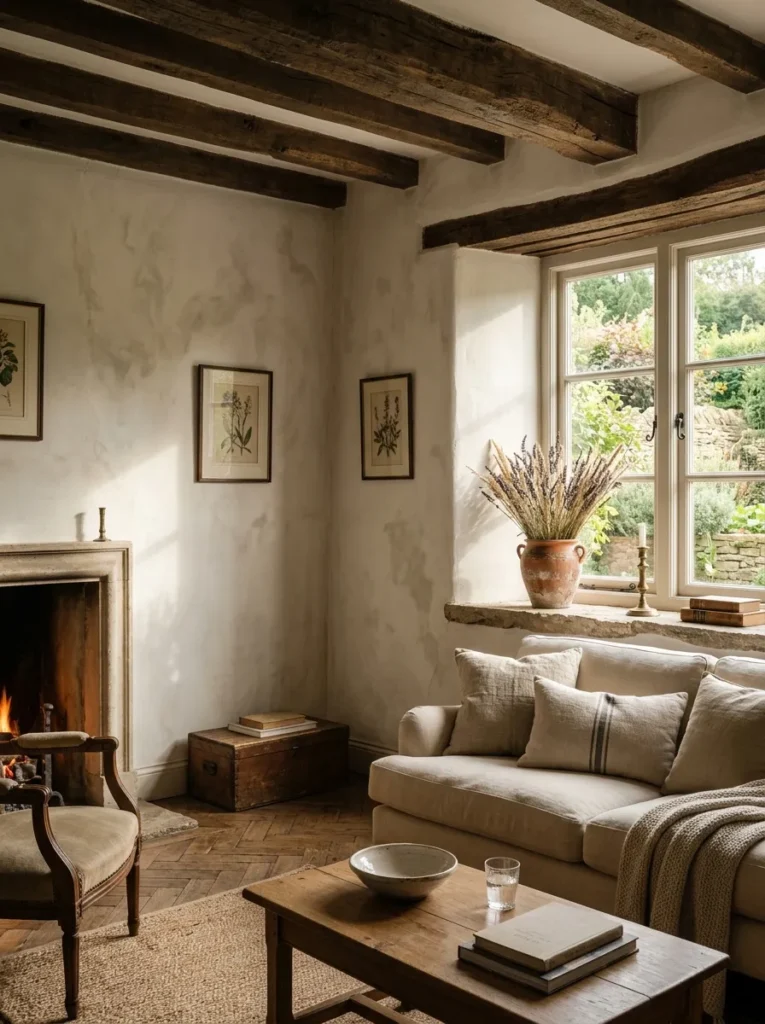
Vibe: Warm and aged — the wall treatment that makes a room feel like it has absorbed decades of afternoon light and domestic life.
Why it works: Limewash walls are the foundational French country surface treatment because lime-based plaster and whitewash is the historic wall finishing material of French rural architecture — every farmhouse in Provence and Normandy was originally finished in some form of lime plaster or wash, and the quality of light that lime surfaces create (slightly luminous, warm, and varying in tone across the wall’s surface as the viewing angle changes) is the specific atmospheric quality most associated with French country interiors. The limewash’s slight tonal variation — darker in recesses, lighter on projections, showing the brush mark direction in raking light — gives the wall a visual depth that flat paint cannot achieve and makes every change in natural light throughout the day create a different surface quality.
How to get it: Apply genuine limewash (Kalk paint, traditional lime wash, or specialist brands such as Bauwerk or Portola Paints’ Lime Paint) in warm white to all walls using a wide natural bristle brush in overlapping cross-directional strokes — the direction and pressure variation is what creates the characteristic tonal variation. Two to three coats applied with wet-on-damp timing (applying the second coat while the first is still slightly damp at the edges) produces the most authentic cloudy depth. Add a small quantity of warm yellow ochre pigment to the limewash to shift the white from cool to warm — the slightly yellow-warm white is the specific tone that reads as French country rather than contemporary minimal.
Quick Win: Limewash paint applied to a single accent wall in a room produces 80% of the atmospheric impact of a full-room limewash treatment at 25% of the material and labor cost — begin with the fireplace wall or the wall opposite the main window for maximum impact.
| Product |
|---|
| Limewash paint warm white natural |
| Yellow ochre pigment for warming |
| Wide natural bristle brush for application |
| Lime paint sealer breathable |
| Venetian plaster trowel for texture |
Also view: 16 Relaxing Beach Decor Ideas with Coastal Charm
2. Exposed Timber Ceiling Beams
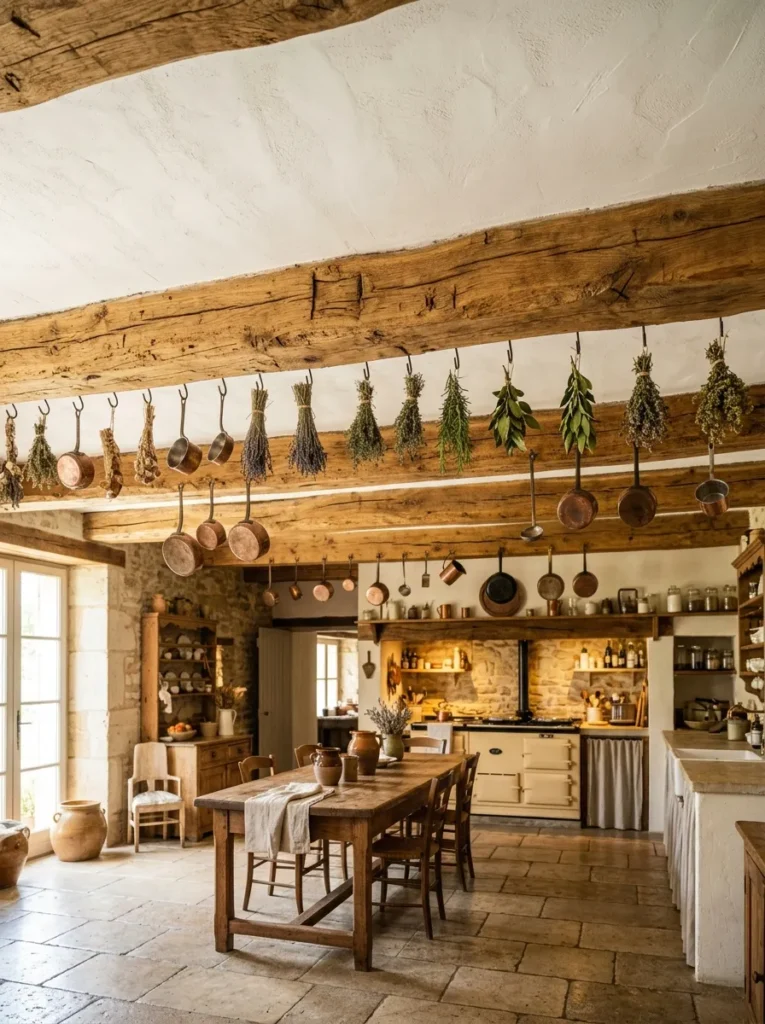
Vibe: Warm and rustic — the ceiling detail that makes every room it occupies feel like it has architectural history worth honoring.
Why it works: Exposed timber ceiling beams are the single architectural element most strongly associated with French country interiors because they are the structural reality of historic French rural construction — the heavy timber frame of a Normandy farmhouse or a Dordogne manor house is literally the building’s skeleton made visible, and this structural honesty (the building showing how it was built) is precisely the quality that French country decor celebrates. The beams’ specific warmth — the honey and dark-brown tones of aged oak, the surface variation of hand-hewn timber, the way warm light catches the irregular surface — creates a ceiling that contributes more to the room’s warmth and character than any painted or plastered ceiling alternative.
How to get it: In a house with genuine exposed beams, strip any paint or varnish using chemical stripper or heat gun and sand to reveal the natural timber, then seal with a penetrating natural oil (tung oil or Danish oil) rather than a surface varnish — the oil finish preserves and enriches the natural color without the plastic-film quality of polyurethane. In a house without genuine beams, install decorative beam sleeves (hollow box beams in aged oak or reclaimed timber finish) available from specialist suppliers — the hollow construction makes them lightweight enough for standard ceiling attachment. Hang iron hook strips from the beams for displaying dried herbs, copper pans, and seasonal botanical bundles.
| Product |
|---|
| Reclaimed oak beam decorative sleeve |
| Tung oil natural for beam sealing |
| Wrought iron hook strip for beams |
| Chemical paint stripper for genuine beams |
| Beam aging stain for color matching |
Also view: 14 Stylish House Interior Design Ideas
3. French Toile de Jouy Textiles
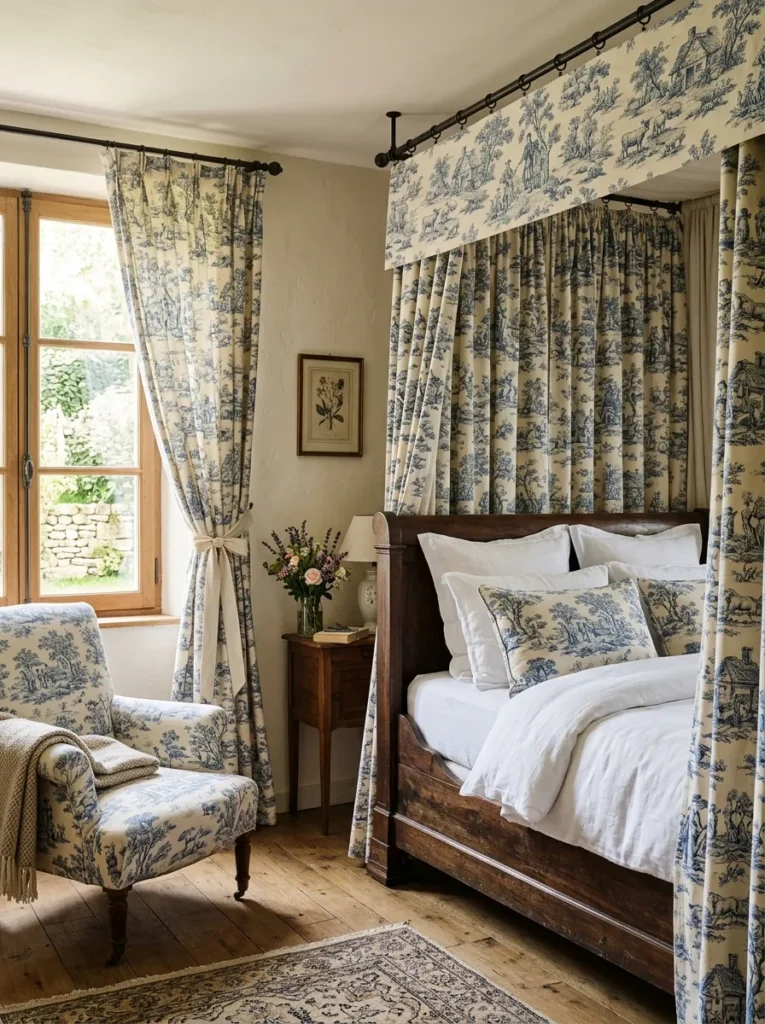
Vibe: Classic and pastoral — the textile that makes a room feel like a scene from an 18th-century French engraving brought into domestic life.
Why it works: Toile de Jouy — the copperplate-printed cotton fabric produced at the Oberkampf manufactory in Jouy-en-Josas from 1760 onward, depicting pastoral scenes, exotic landscapes, and mythological subjects in a single color on cream ground — is the textile most specifically and authentically associated with French country decorating tradition. Its visual richness (the fine-line engraved quality of the print, the narrative complexity of the pastoral scenes) combined with its restrained two-color palette (typically blue, red, black, or green on cream) makes it the pattern that reads as both formally French and domestically relaxed simultaneously. The key to using toile successfully is confidence — it works best when used generously across multiple textile elements in the same room (bed hangings, pillow covers, upholstery, and window treatments in the same toile) rather than as a single token gesture.
How to get it: Source genuine Jouy-print toile from specialist fabric suppliers rather than printed imitations — authentic toile uses fine engraving-quality line work that cheap digital printed alternatives cannot replicate. Classic blue-on-cream toile is the most versatile colorway, relating to the blue-and-white faience ceramics and the cream plaster walls that characterize French country interiors. Use toile for upholstery, bed hangings, and window treatments where its large pattern scale can be appreciated fully rather than in small accent pieces where the pastoral scenes are truncated.
| Product |
|---|
| Toile de Jouy fabric blue cream classic |
| Toile pillow cover set coordinating |
| Linen ribbon cream for tie-backs |
| Toile upholstery fabric for armchair |
| Toile bed canopy or curtain panel |
4. Stone or Terracotta Tile Floors
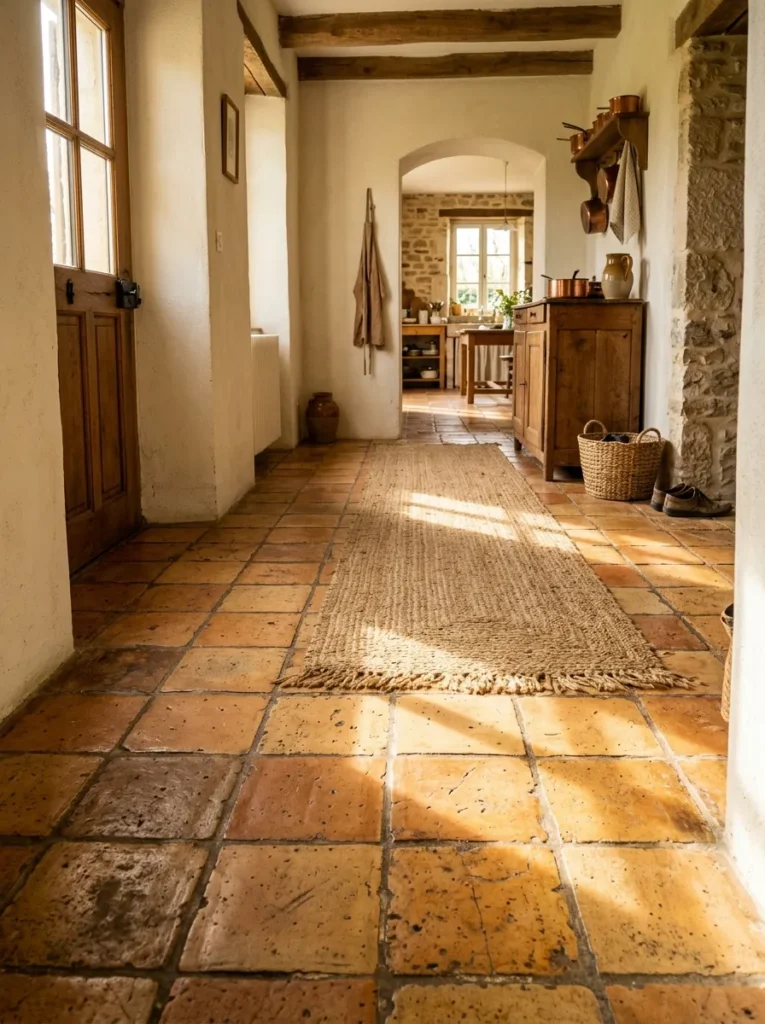
Vibe: Warm and timeless — the floor that improves with every year of use and looks most beautiful exactly as it is.
Why it works: Handmade terracotta tile flooring is the most authentic French country floor material because it is the historic flooring of French rural architecture — the fired clay tiles of Provence, made from local clay and dried in the Mediterranean sun, are the origin of the warm honey-orange floor color most strongly associated with French country interiors. Genuine handmade terracotta has a surface variation (differences in color, subtle surface texture, and slight size variation between tiles) that machine-made alternatives cannot replicate, and this variation is precisely what makes the floor visually warm rather than flat. The tiles’ natural aging process — darker in heavily trafficked areas, lighter at the edges — records the domestic life of the space in its surface, creating the accumulated warmth that no new floor installation can immediately possess.
How to get it: Source genuine handmade terracotta from French tile specialists (Carrelages du Midi, Terres d’Argence, and similar Provençal suppliers) or from reclaimed tile dealers who source directly from French farmhouse renovations. Seal with a penetrating stone sealer before installation and annually thereafter — unsealed terracotta absorbs oil and staining liquids permanently. Apply a beeswax polish after sealing to deepen the color and add the specific warm sheen associated with well-maintained terracotta floors.
| Product |
|---|
| Handmade terracotta floor tile set |
| Penetrating stone sealer for terracotta |
| Beeswax floor polish for shine |
| Jute runner natural for hallway |
| Terracotta grout matching warm tone |
5. Armoire as Bedroom Statement Piece
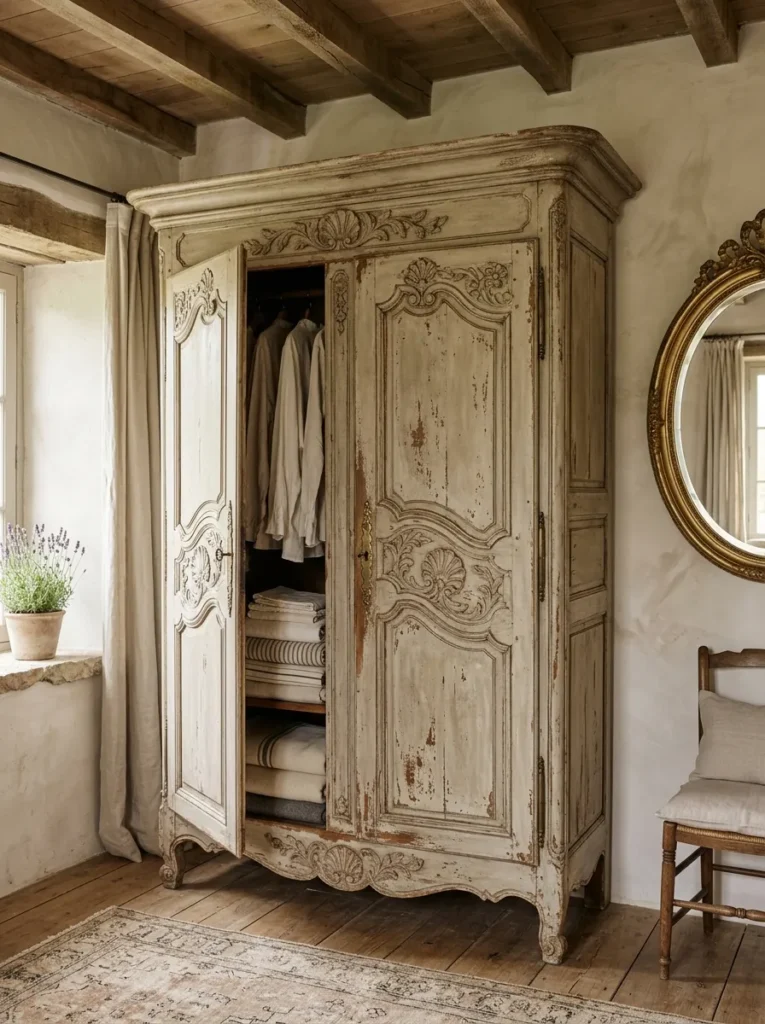
Vibe: Elegant and aged — the bedroom armoire that occupies the room as a piece of furniture with genuine history and presence.
Why it works: The French armoire is the piece of bedroom furniture most specifically and authentically associated with French domestic tradition — in historic French homes without built-in wardrobes, the armoire was the primary clothing storage piece, and its substantial scale (typically 180–220cm tall and 120–160cm wide), carved panel doors, and architectural presence made it the bedroom’s dominant furniture statement. A genuine or authentically reproduced French country armoire brings to the bedroom the quality of furniture that was made to last centuries — its weight, its carved detail, and its aged paint treatment communicate a permanence and quality that contemporary flat-pack alternatives cannot approach. The slightly distressed paint finish (cream or pale gray revealing oak beneath at corners and edges from decades of handling) is the specific aging quality that distinguishes an authentic piece from a new reproduction.
How to get it: Source from French antique dealers, estate sales, or specialist French furniture importers for genuine antique pieces. For reproduction armoires, seek those with genuine hand-carved panel details, solid timber construction, and factory-applied distressing that uses actual abrasion rather than photographic printing to create the aged appearance. Distress a new or undistressed armoire by sanding at natural wear points (door edges, hardware surrounds, feet, and drawer fronts) using 80-grit sandpaper until the underlying timber is revealed, then apply a tinted wax over the whole piece to unify the aged appearance.
| Product |
|---|
| French country armoire antique or reproduction |
| Aged cream chalk paint for existing armoire |
| Antiquing wax for distressing |
| Aged brass armoire hardware set |
| 80 grit sandpaper for distressing |
6. French Country Kitchen Dresser with Faience Display
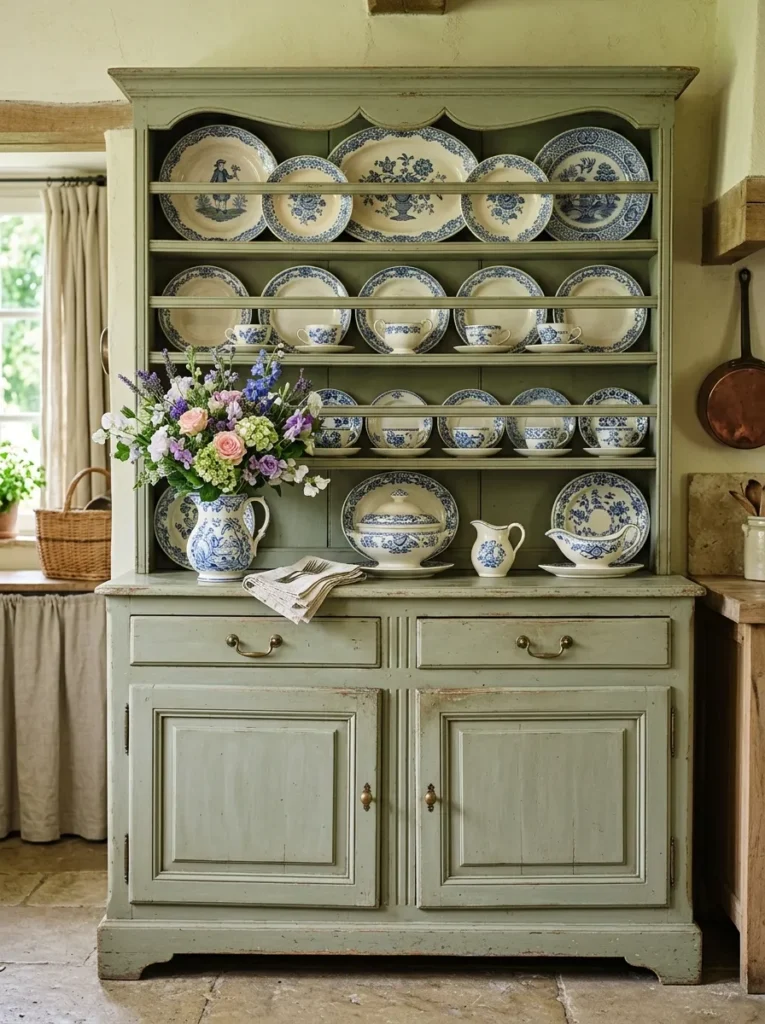
Vibe: Warm and collected — the kitchen dresser that makes a ceramic collection look like the room’s most considered design feature.
Why it works: The French kitchen dresser (vaisselier) displaying faience pottery is the most iconic single furniture and object composition in French country decorating — the combination of the painted dresser’s architectural presence and the blue-and-white faience collection’s accumulated visual richness creates the specific warmth of a French farmhouse kitchen that has gathered beautiful things over generations of domestic life. French faience (tin-glazed earthenware from traditional production centers including Quimper, Moustiers, Nevers, and Gien) is both genuinely beautiful as a collection and functionally appropriate for daily kitchen use — the pieces are designed to be used rather than preserved, which gives the display its lived-in quality rather than the museum stillness of decorative-only ceramics.
How to get it: Source a kitchen dresser from an antique dealer or paint an existing large bookcase in sage green chalk paint to serve the vaisselier function. Build a genuine faience collection gradually from antique markets, specialist French ceramic dealers, and market visits — Quimper pieces (from Brittany, decorated with figures in Breton costume) and Moustiers pieces (from Provence, decorated with hunting scenes and mythological subjects) are both widely available. Display plates on plate rails with cups, jugs, and serving pieces in front — the layered depth of a well-arranged faience display is the quality that makes it more visually interesting than flat shelf arrangements.
| Product |
|---|
| French country kitchen dresser painted |
| Sage green chalk paint for dresser |
| Faience plate collection blue-white |
| Quimper pottery pieces traditional |
| Plate rail set for dresser shelves |
7. Wrought Iron and Aged Brass Fixtures
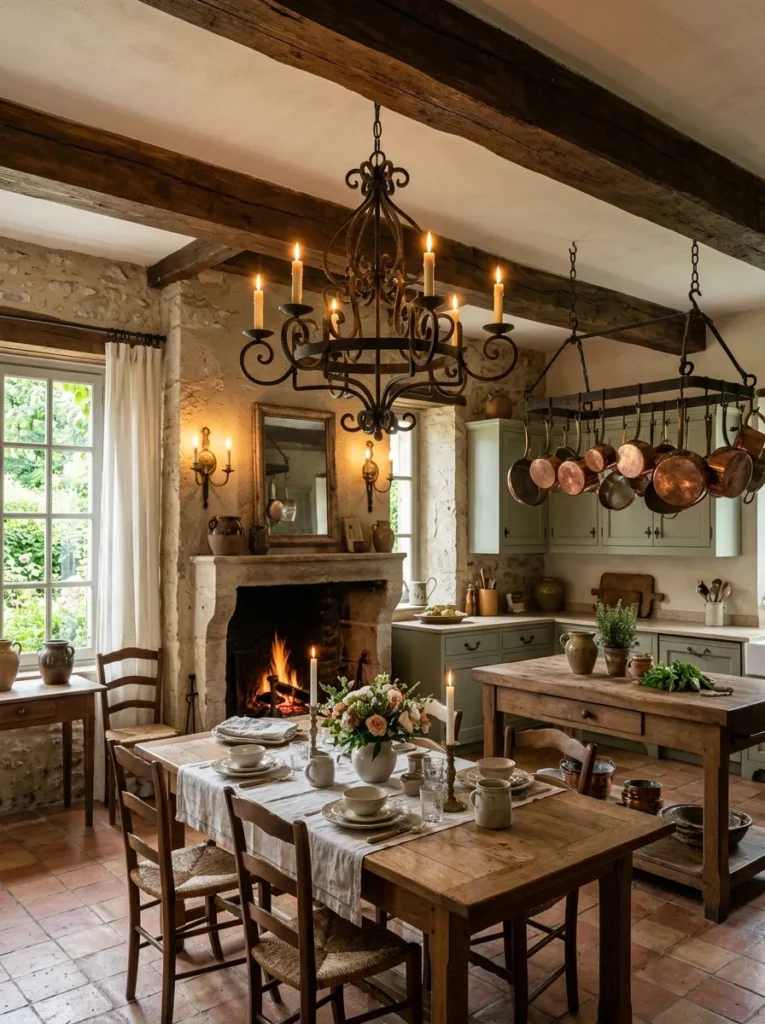
Vibe: Warm and artisanal — the metal fixtures that make a room feel like it was outfitted by a blacksmith rather than a hardware supplier.
Why it works: Wrought iron and aged brass are the authentic metal materials of French country hardware tradition — the hand-forged iron of the village blacksmith (the maréchal-ferrant) and the cast and hand-finished brass of the period hardware makers produced the specific dark-iron and warm-gold material combination that characterizes every historic French farmhouse and manor house interior. Wrought iron has a surface quality (the slightly rough, varied surface of hand-worked metal) that machine-made alternatives cannot replicate, and this surface quality is what makes wrought iron fixtures read as authentic rather than decorative. The pairing of wrought iron (ceiling fixtures, curtain rods, hardware) with aged brass (wall sconces, tap fittings, smaller hardware) creates the warm, craftsman-quality material combination that is the French country interior’s defining hardware character.
How to get it: Source genuine wrought iron fixtures from specialist iron workers and artisan hardware suppliers — several French and Spanish ironwork studios produce traditional wrought iron chandeliers, curtain rods, and fixtures appropriate for French country interiors. For aged brass fixtures, specify unlacquered brass (living finish) that will develop its natural patina rather than maintaining the uniform brightness of lacquered alternatives. Replace standard chrome and brushed nickel fixtures with wrought iron and aged brass equivalents in all rooms where French country style is being developed.
| Product |
|---|
| Wrought iron chandelier candle style |
| Aged brass wall sconce pair |
| Wrought iron curtain rod set |
| Wrought iron cabinet hardware set |
| Iron pot rack ceiling mount |
8. Linen and Ticking Stripe Upholstery
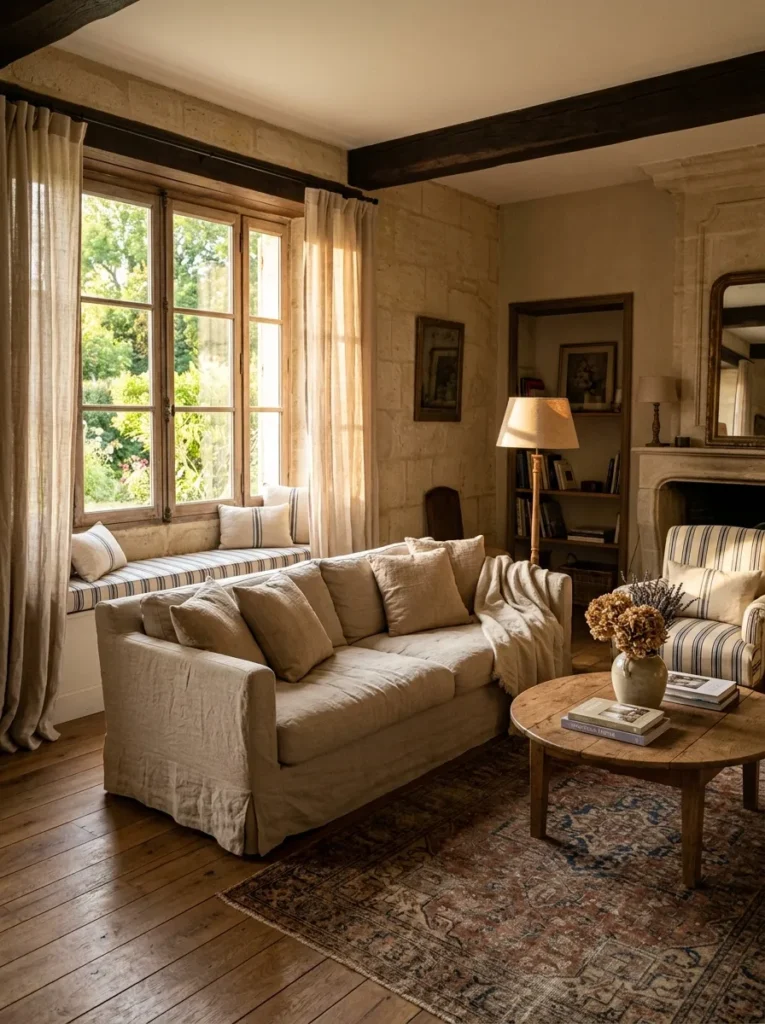
Vibe: Relaxed and textile-rich — the upholstery combination that makes a living room feel like it has been comfortable for a very long time.
Why it works: Natural linen and French ticking stripe are the two upholstery materials most authentically associated with French country domestic life — linen (the historic textile of Normandy and Brittany, woven from locally grown flax) provides the warm, slightly irregular surface texture and the natural cream-to-oatmeal color that reads as genuinely French rather than decorator-French, while ticking stripe (originally the fabric used for mattress covers and bolster ticking in French farmhouses, its diagonal stripe serving a structural reinforcement purpose) provides the graphic linear pattern that complements the linen’s textural quality without competing in complexity. Both materials are functionally appropriate for upholstery — linen’s durability and ticking’s woven density both handle daily use reliably — which connects the aesthetic choice to the functional tradition these materials originate from.
How to get it: Source genuine natural linen for sofa slipcovers from specialist linen fabric suppliers — undyed or stone-washed linen in natural cream or warm flax tones is the most authentic option. Specify ticking stripe in navy on cream (the classic French ticking colorway) from fabric specialist suppliers who stock traditional narrow-stripe ticking rather than wide-stripe reproductions. Commission slipcovers from a local upholsterer who can work with the linen’s natural behavior — linen stretches and softens with use in a way that makes slightly loose, slightly rumpled slipcovers more authentic than tightly fitted alternatives.
| Product |
|---|
| Natural undyed linen fabric for slipcover |
| French ticking stripe navy cream |
| Linen throw pillow cover set |
| Natural linen throw blanket |
| Linen curtain panel set natural |
9. Dried Botanical Bundles and Lavender Displays
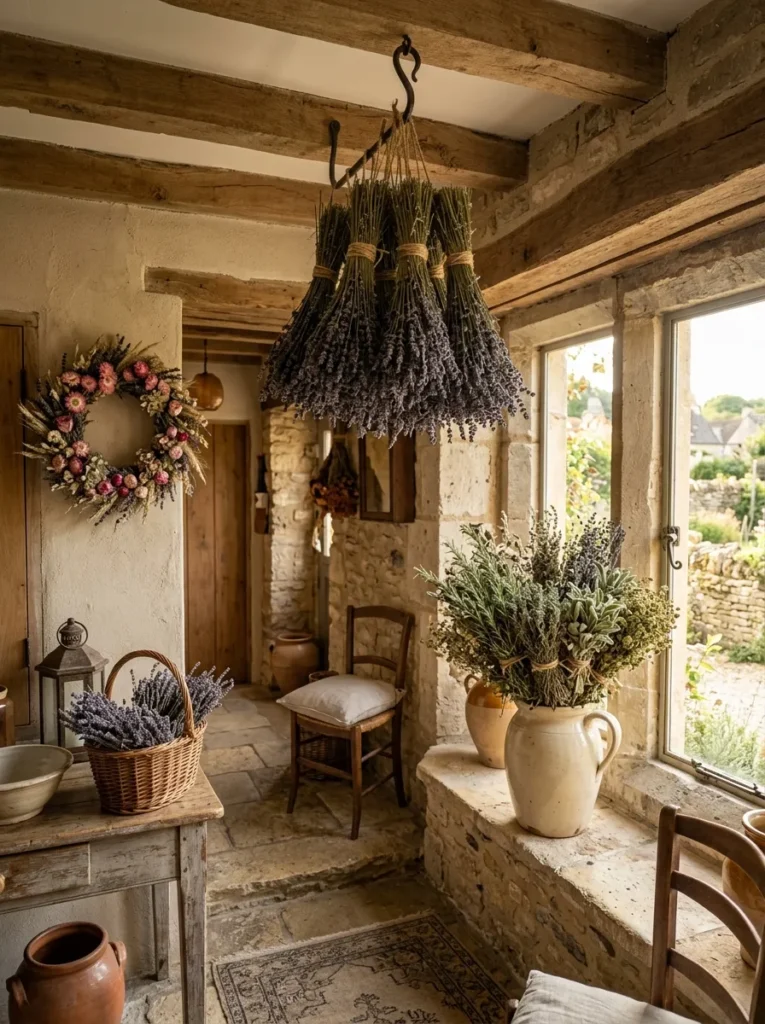
Vibe: Fragrant and abundant — the botanical displays that connect a room to the French countryside regardless of the view outside the window.
Why it works: Dried botanical bundles are the French country interior element that most directly connects the home to the agricultural and horticultural landscape of the French countryside — bunches of dried lavender hanging from kitchen beams, rosemary and thyme bundled beside the hearth, wreaths of dried flowers on the wall, and baskets of herbs on the table are all practices rooted in the genuine domestic traditions of Provençal and Normandy farm households where herbs were grown, harvested, bundled, and hung to dry as both food preservation and air-scenting practice. The specific quality these displays add to a room is the quality of biological material in its most honest form — dried to preserve rather than artificially maintained, fragrant with the essential oils that persist in dried lavender for months or years, and visually warm with the faded colors that drying produces from summer purple to gentle mauve-gray.
How to get it: Source dried lavender bundles from Provençal lavender producers, specialist botanical suppliers, or dry your own from garden-grown or purchased fresh lavender cut at the peak of flowering. Tie bundles tightly with jute twine at the stem and hang upside down in a warm, dry place for 2–4 weeks until fully dry. Hang from wrought iron hooks on beams, display in ceramic jugs without water, or scatter loose dried lavender in small wicker baskets around the home. Refresh dried botanicals annually as their fragrance diminishes over time.
| Product |
|---|
| Dried lavender bundle set Provençal |
| Jute twine natural for bundle tying |
| Wrought iron S-hook set for hanging |
| Ceramic jug cream for botanical display |
| Small woven basket for loose botanicals |
10. Antique French Mirror Above Fireplace
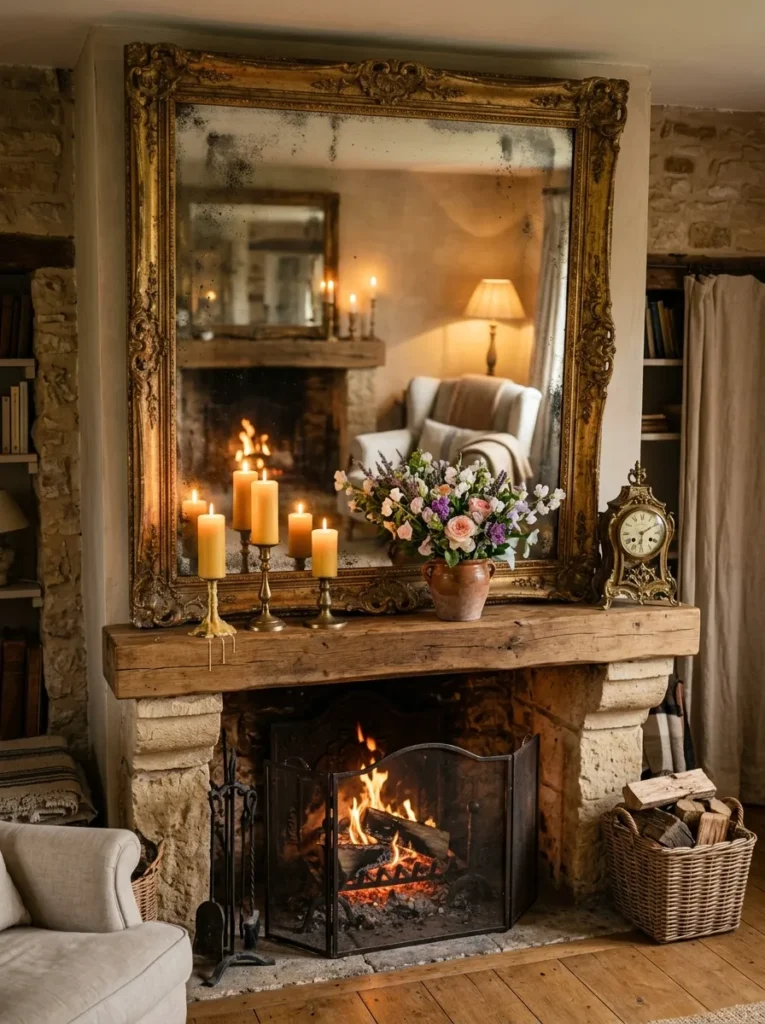
Vibe: Warm and antique — the fireplace and mirror composition that makes an entire room feel like it has been assembled over a lifetime of considered living.
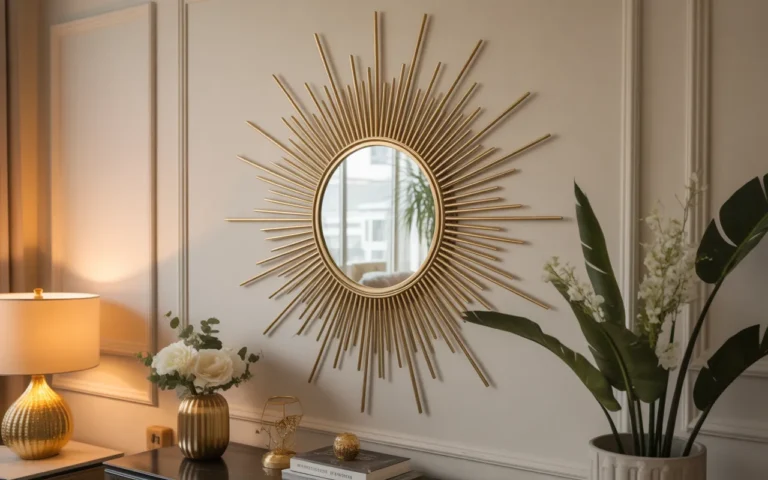
Why it works: An antique French mirror above a fireplace applies the design principle of reflected light as atmospheric amplifier — the mirror above the fireplace doubles the visual depth of the room by reflecting the space behind the viewer and the candlelight on the mantel, creating the specific warmth of a room where light appears to come from multiple directions and where the space seems larger and more richly furnished than it physically is. The ornate gilt frame of a genuine French antique mirror (typically from the Louis XV, Louis XVI, or Directoire periods) provides the elaborate carved detail that the fireplace’s stone simplicity cannot, creating the visual conversation between simple and ornate that characterizes French country elegance. Partial silvering foxing (the gray-brown discoloration that develops in old mirrors as the silver backing oxidizes) is an authenticity marker that distinguishes genuine antique mirrors from reproductions.
How to get it: Source from French antique dealers, auction houses, or specialist mirror dealers — genuine antique French mirrors are available at a wide range of price points depending on size, period, frame condition, and mirror foxing. For a reproduction, commission a new mirror with a hand-carved and gilt frame and request that the glass be treated with an artificial foxing process (available from specialist glass suppliers). Style the mantel with a strict maximum of five objects — three beeswax candles of varied height, one small floral arrangement, and one significant antique object (clock, inkwell, small sculpture).
| Product |
|---|
| Antique French gilt mirror large |
| Beeswax pillar candle set varied heights |
| Small terracotta pot for mantel flowers |
| Vintage French mantel clock |
| Mirror plate hanging hardware antique |
11. French Country Kitchen with Open Shelving and Copper
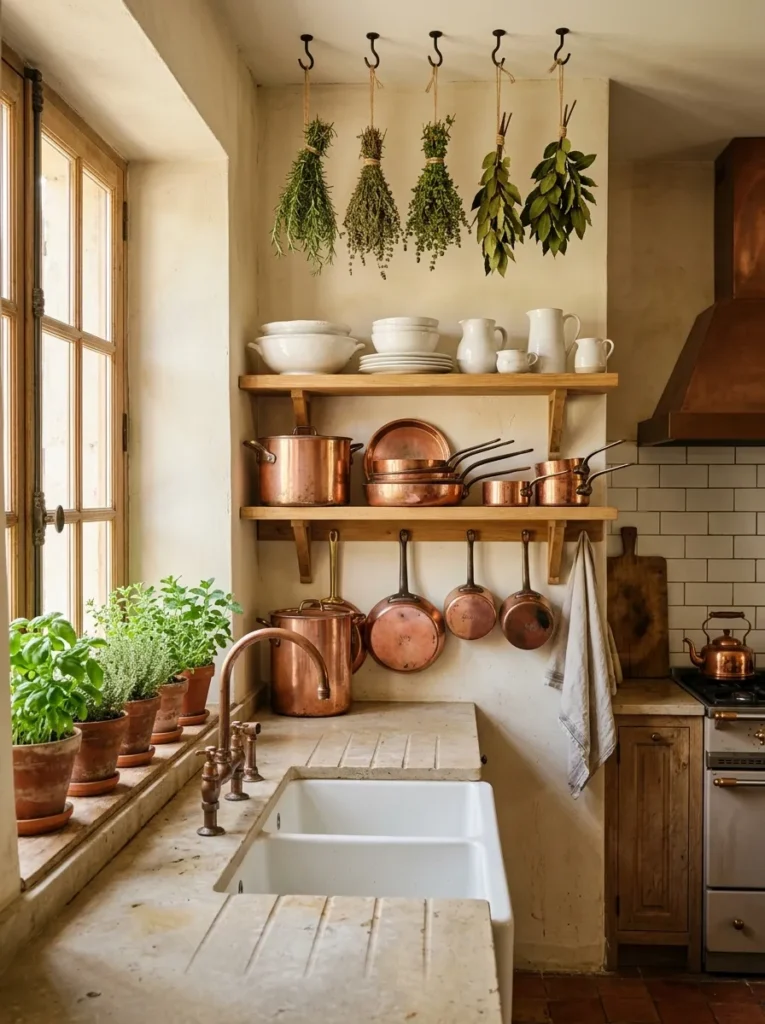
Vibe: Warm and culinary — the kitchen that makes cooking feel like participating in a domestic tradition with genuine depth and history.
Why it works: Copper in the French country kitchen applies the authentic material principle — copper cookware was the historic cooking material of French professional and domestic kitchens from the 17th through the 19th centuries, and the specific warmth of copper’s color and surface quality against white ceramic, oak timber, and dried herbs creates the most quintessentially French kitchen material combination available. A collection of copper pans displayed on open shelving is simultaneously a functional storage solution and a visual composition whose warm orange-pink tones provide the room’s primary decorative warmth. The aging differential between copper pans of different ages (newer copper bright and pink-orange, older copper darker with patina variation) creates the collected quality that makes a copper display read as accumulated over time rather than purchased as a set.
How to get it: Build the copper collection gradually from specialist French kitchen suppliers (Mauviel is the most authentic French copper cookware manufacturer), antique markets, and estate sales where older copper with developed patina is available. Mount natural oak floating shelves using concealed heavy-duty brackets rated for the cumulative weight of a full copper collection — copper is significantly heavier than standard shelf load estimates. Keep copper maintained with a regular beeswax conditioning treatment rather than polishing to a bright shine — a gentle, slightly matte copper surface reads as more authentically French than polished bright copper.
| Product |
|---|
| Copper pan collection Mauviel or antique |
| Natural oak floating shelf set deep |
| Heavy-duty shelf bracket for copper weight |
| Copper conditioning beeswax |
| White ceramic serving pieces collection |
12. Provençal Pattern Fabric Accents
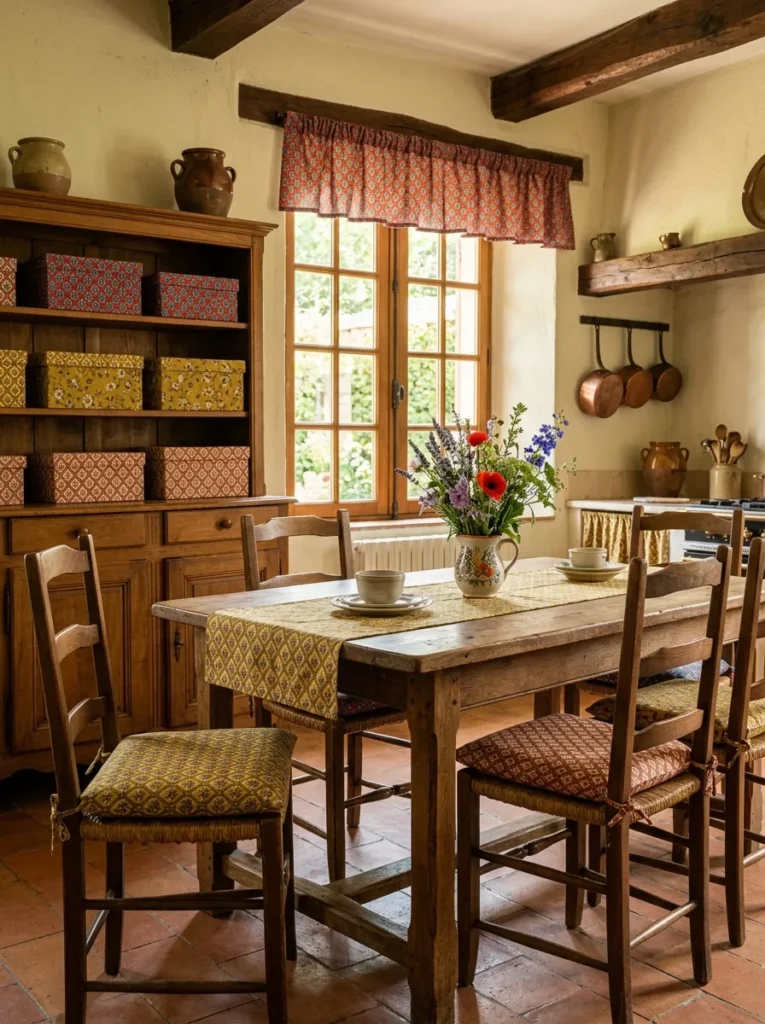
Vibe: Colorful and authentic — the Provençal pattern that brings the warmth and color of a southern French market to any kitchen table.
Why it works: Provençal printed fabric (the small-scale geometric and floral prints produced in Provence from the 17th century onward, originally inspired by Indian chintz imports and developed into a distinctly regional textile tradition) is the French country fabric that introduces color into the otherwise muted French country palette — its warm yellow-golds, rich reds, deep blues, and terracottas are the specific color expressions of the Provençal landscape (sunflowers, lavender, red poppies, olive groves) rendered in textile. The small scale of the traditional Provençal print pattern (typically 2–5cm repeats in complex geometric-and-floral combinations) means it functions as a textural pattern from a distance and a detailed composition up close, providing the visual richness appropriate for French country interiors without the large-pattern dominance of toile.
How to get it: Source authentic Provençal print fabric from specialist suppliers — Souleiado and Valdrôme are the two most authentically Provençal textile brands, both producing prints in the traditional small-scale geometric-floral patterns in the characteristic warm colorways. Use Provençal fabric in accent quantities rather than as the room’s dominant textile — seat cushions, a table runner, a gathered valance, and fabric-covered boxes are the appropriate scale for Provençal print in a room that also contains linen, ticking stripe, and other French country textiles.
| Product |
|---|
| Souleiado Provençal print fabric |
| Seat cushion cover set Provençal pattern |
| Table runner Provençal print |
| Gathered window valance Provençal |
| Fabric-covered storage box set |
13. Stone Fireplace as Room Anchor
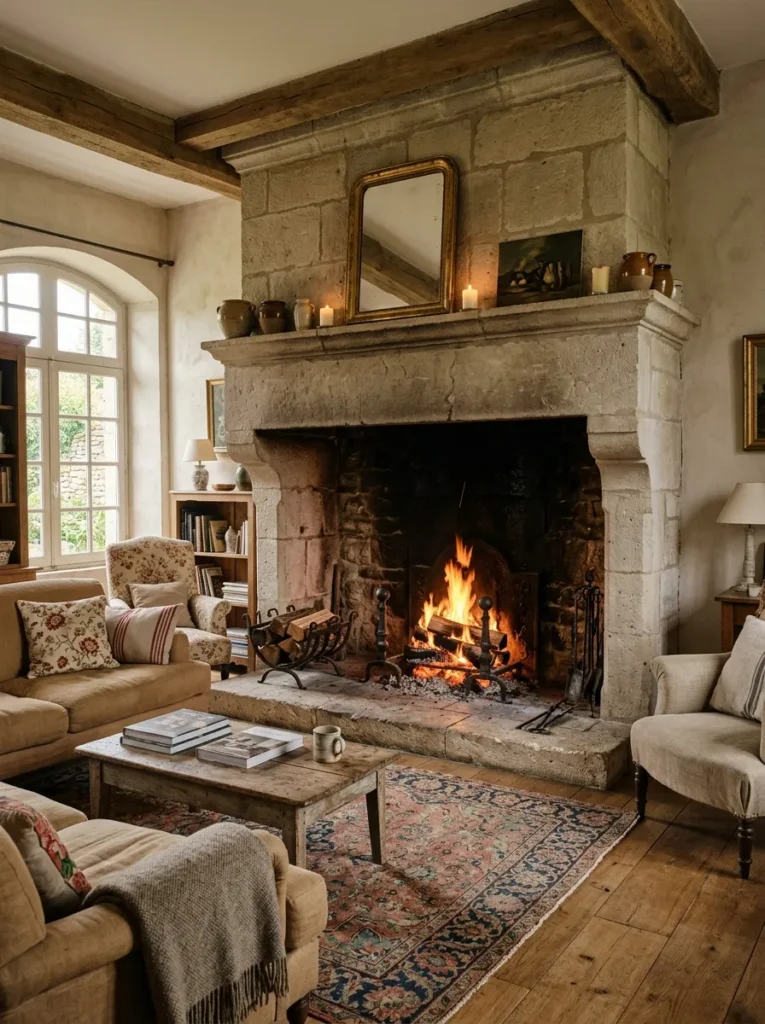
Vibe: Warm and anchored — the fireplace that organizes the entire room around itself and makes every winter evening feel like the best possible place to be.
Why it works: A stone fireplace is the most powerful architectural anchor available in a French country interior — historically the literal center of domestic life in a French farmhouse (the hearth where food was cooked, the family gathered, and warmth was generated), the stone fireplace carries a functional and cultural significance that no decorative element can replicate. The specific material quality of French country fireplaces — the honey-gray of aged limestone or the warm cream of Burgundian stone, the depth of the firebox designed for large log fires, the simplicity of the surround that makes the stone itself the decoration — is the quality that connects the interior to the specific domestic architecture of French rural building. An original stone fireplace in a house that has one should never be blocked, painted, or converted — its presence is the room’s most valuable French country asset.
How to get it: Where an original stone fireplace exists, strip any painted or varnished surfaces with appropriate stone-safe chemical strippers and brush the stone clean — the natural color of the limestone or granite should not be coated or sealed unless absolutely necessary for stability. Where no fireplace exists, commission a stone fireplace insert from a reclaimed architectural stone supplier — genuine reclaimed French limestone fireplace surrounds are available from architectural salvage dealers and can be installed around a new firebox. The mantel shelf should be in solid aged timber (an old plank from reclaimed wood) rather than stone or marble, which reads as more formal than the French country farmhouse tradition requires.
| Product |
|---|
| Reclaimed stone fireplace surround |
| Aged oak mantel plank reclaimed |
| Wrought iron andiron set |
| Log holder iron beside hearth |
| Worn Persian or Aubusson carpet |
14. French Country Table Setting with Faience and Linen
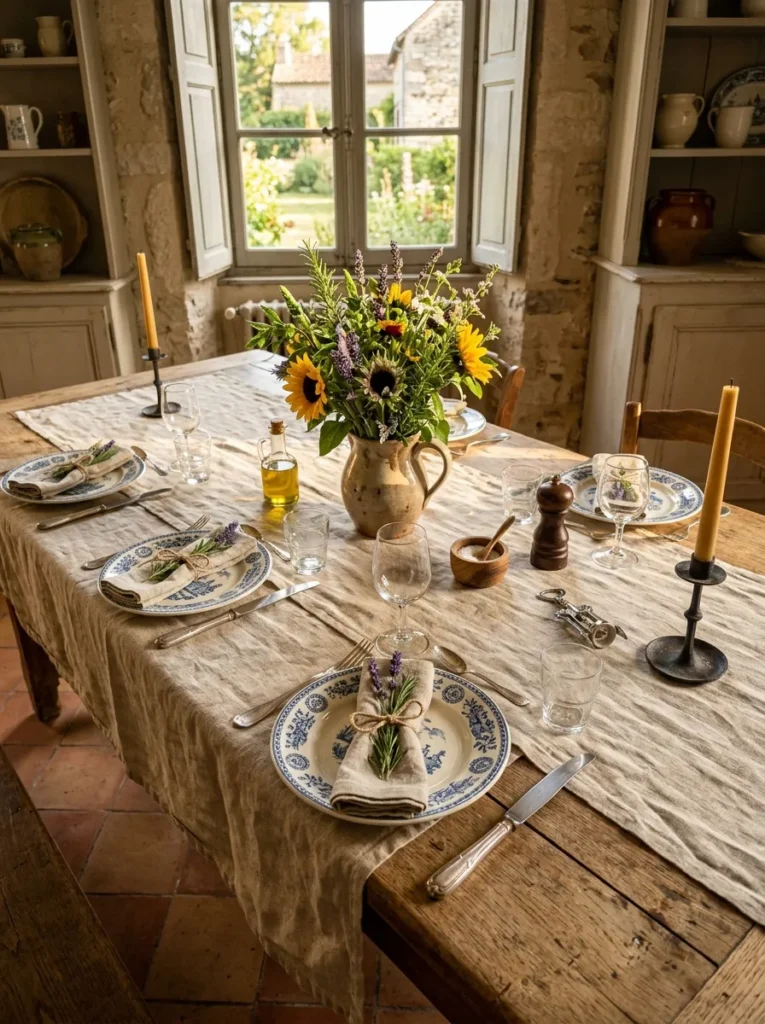
Vibe: Relaxed and beautiful — the table setting that makes any meal feel like the occasion deserves to be lingered over.
Why it works: A French country table setting demonstrates the design principle of relaxed elegance — the combination of genuinely good quality elements (faience plates, linen napkins, beeswax candles, fresh garden flowers) arranged without the stiff formality of a formal dining setting (the slightly draped tablecloth, the loosely tied napkins with a garden cutting rather than a folded geometric) produces the specific table quality most associated with French domestic hospitality. The French meal tradition — long, relaxed, centered on conversation as much as food — demands a table setting that communicates ease and abundance rather than performance and precision, and the materials of the French country table (worn oak, natural linen, handmade faience, garden flowers) collectively produce this ease quality.
How to get it: The farmhouse table should be in solid aged oak rather than a veneer or painted surface — the natural grain and warmth of genuine oak develops with use in the way that substitute materials cannot. Source faience plates from antique markets or specialist French ceramic dealers rather than contemporary reproductions — genuine hand-painted faience has the slight variation in each piece that identifies it as handmade. Tie each linen napkin with a sprig of fresh garden herb (lavender, rosemary, or thyme) rather than a napkin ring — the botanical detail is the specifically French table gesture that most immediately communicates the style.
| Product |
|---|
| Natural linen tablecloth undyed |
| Blue-white faience dinner plate set |
| Bistro wine glass set clear |
| Natural linen napkin set undyed |
| Beeswax taper candle set with iron holders |
15. Potager Garden Elements Brought Indoors
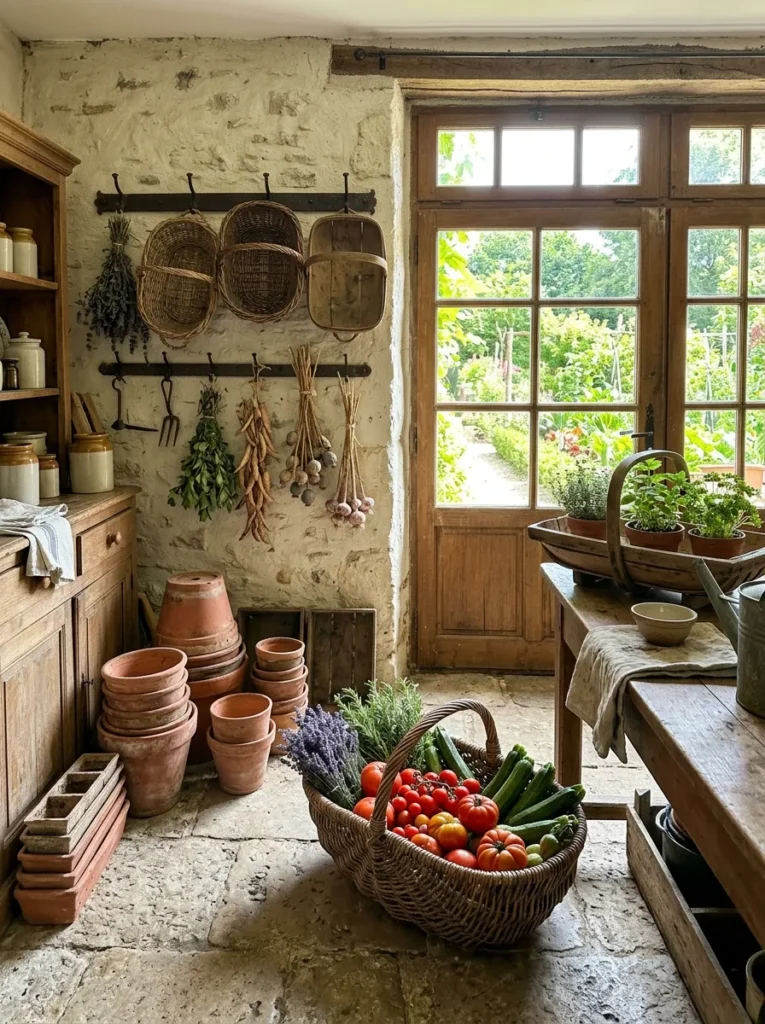
Vibe: Abundant and working — the interior moment that makes the boundary between house and garden feel genuinely permeable.
Why it works: Bringing potager garden elements — the terracotta forcing pots, the wicker trugs, the freshly harvested vegetables and herbs, the dried seed heads and bean bundles — into the kitchen or utility room applies the French country principle of honest domestic function as decoration. In the traditional French farmhouse, the separation between the productive garden (the potager) and the working kitchen was minimal and intentionally so — the vegetables went from garden to kitchen directly, the dried herbs hung from the same hooks as the copper pans, and the terracotta pots of a lifetime of gardening lived beside the dresser when not in the ground. This working quality — the room that is evidently connected to a real garden and real cooking — is precisely what distinguishes authentic French country from its stylistic imitation.
How to get it: Use the utility room, kitchen back corridor, or kitchen itself as a transitional garden-to-kitchen space by keeping baskets and trugs for harvest in immediate reach of the back door, storing stacks of terracotta pots rather than hiding them, and hanging dried herbs and seed heads from the same hooks as kitchen implements. Display the current season’s garden harvest loosely in a large wicker trug on the counter rather than immediately storing everything in the refrigerator — the visual abundance of a fresh harvest display is the most genuinely seasonal and most genuinely French country decorating moment available in any home with a productive garden.
| Product |
|---|
| Wicker trug garden basket large |
| Terracotta forcing pot set varied sizes |
| Garden trug collection natural wood |
| Iron wall hook set for trug hanging |
| Terracotta herb pot set small |
How to Start Your French Country Decor Transformation
Start with the textiles. Before repainting walls, sourcing antique furniture, or planning any structural modification, change the room’s textiles — replace synthetic or mixed-fiber curtains with natural linen panels, replace decorator cushion covers with undyed linen alternatives, and introduce a ticking stripe element (a chair cushion, a throw pillow, or a simple bolster). These changes cost $50–$200 depending on scale and immediately shift the room’s material character from synthetic warmth to natural warmth — the specific quality that distinguishes genuinely French country from its imitation. The natural linen’s drape, the way it takes light, and the slight irregularity of its woven surface create the atmospheric quality that no synthetic alternative replicates regardless of how similar it looks in photographs.
The most common mistake people make when attempting French country decor is purchasing new objects designed to look old rather than sourcing genuinely aged alternatives — a new faience plate designed to look hand-painted and aged is immediately distinguishable from a genuine antique faience piece to any observer who examines it closely, while a genuine antique Quimper plate sourced from a French market for the same price as a reproduction is more beautiful, more interesting, and more authentically French. The French country interior’s essential quality is genuine material aging — the patina of actually aged objects is irreplaceable by design intent, and the investment of sourcing genuinely aged alternatives (even when they require patience, market visits, and imperfect condition) always produces better results than the convenience of new reproduction alternatives.
Three items under $50 that make an immediate impact: A bundle of dried lavender from a Provençal supplier or specialist botanical seller ($8–$15) displayed in an old ceramic jug that immediately introduces the botanical fragrance and visual quality most associated with the French countryside; a length of natural undyed linen fabric ($12–$20 per meter) that can be cut and hemmed into a simple tablecloth or curtain in an afternoon; and a genuine piece of blue-and-white faience from an antique market or charity shop ($5–$30 for a plate or small jug) that introduces the authentic ceramic quality of French country collecting at an accessible entry point.
Realistic expectations: A textile upgrade — new linen curtains, ticking stripe cushions, and a linen tablecloth — takes one weekend of sourcing and hemming and costs $150–$400 depending on room size. A mid-level French country room transformation — limewash walls, replaced hardware, open shelving with ceramic display, botanical elements, and antique mirror — typically costs $500–$1,500 and takes 2–3 weekends. A full French country interior renovation — stone floor, exposed beams, armoire, stone fireplace, dresser with faience collection, and coordinated textiles throughout — ranges from $5,000–$25,000 depending on the extent of structural work and the quality of antique furnishings sourced. The investment that produces the highest return per pound spent is always the authentic aged object over its reproduction alternative — one genuine antique piece transforms a room more powerfully than ten reproduction equivalents at the same total cost.
Frequently Asked Questions About French Country Home Decor
What is the difference between French country, Provence style, and French farmhouse decor?
These three terms are frequently used interchangeably but have distinct regional and stylistic emphases. French country is the broadest term, encompassing the rural domestic aesthetic of all French regions — Normandy, Burgundy, the Loire, the Dordogne, and Provence among others. Provence style specifically references the southern French aesthetic — warmer colors (sunflower yellow, terracotta, lavender purple), the specific botanical presence of lavender, olive, and Mediterranean herbs, toile de Jouy in warm colorways, and the terracotta floor tiles of the Midi. French farmhouse style emphasizes the working agricultural aesthetic rather than the gentler elegance of the manor house tradition — rougher stone, less decorative carving, more functional kitchen display, and the organic abundance of a productive kitchen garden. In practice, most French country interiors blend elements from all three — the distinction is primarily useful for directing specific purchases and sourcing decisions.
How do I achieve French country style in a modern apartment with no original features?
The French country style’s essential qualities are material and atmospheric rather than architectural, which makes it achievable in contemporary spaces that lack original features. Begin with textiles — natural linen curtains, ticking stripe cushions, and a linen throw immediately shift any room’s material character. Add limewash paint to at least one wall — the cloudy, slightly textured surface transforms a flat plaster wall without requiring any structural modification. Introduce faience ceramics, copper pots, and dried botanicals as decorative elements. Replace synthetic lighting with wrought iron or aged brass alternatives. Source one genuinely antique piece — an antique French mirror, a single faience plate, an aged ceramic jug — as an authentic anchor around which reproduction elements read as more convincingly related. The absence of stone floors and exposed beams can be compensated for through the strength of the material and textile choices applied to the surfaces that do exist.
Which French country colors work best in rooms with limited natural light?
In rooms with limited natural light, the French country color choices that perform best are the warm, slightly yellow-tinted whites (limewash in warm ochre-white, aged plaster in warm cream) rather than pure white or blue-tinted white — the warm undertone in these whites reflects the available light with warmth rather than the cool clarity of pure white. Deep terracotta and warm sage green also perform well in low-light spaces because their warm undertones absorb less light than cool colors while providing color richness that makes the space feel considered. Avoid the cooler blue-gray tones of Normandy-inspired palettes in rooms with north-facing or limited light exposure — these colors become cold and flat without the strong natural light they need to read as sophisticated rather than dull.
Where is the best place to source genuine French country antiques?
The most authentic and often most affordable source for genuine French country antiques is directly from France — the marchés aux puces (flea markets) of major French cities, particularly the Marché aux Puces de Saint-Ouen in Paris and the regional brocantes (smaller antique markets) held throughout the French countryside on weekends, provide access to genuine faience, copper, linen, wrought iron, and furniture at prices significantly lower than equivalent pieces sold in anglophone antique markets. For sourcing from home, specialist French antique importers in major cities typically bring containers of French country antiques to annual antique fairs and maintain online shops. For individual pieces, reputable online platforms including Chairish, 1stDibs (for higher-end pieces), and Vinterior regularly list genuine French country antiques from European dealers.
Can French country decor work alongside contemporary or Scandinavian interior design?
French country decor combines most naturally with contemporary and Scandinavian design when both approaches share a commitment to natural material authenticity — natural linen, oak timber, handmade ceramics, and botanical elements are common to both French country and contemporary Scandinavian design traditions, and rooms that combine the two typically resolve their differences through this shared material vocabulary. The primary tension between French country and purely contemporary design is the French country’s warmth and accumulated quality versus contemporary design’s preference for visual restraint and new-material freshness. This tension is resolved by using French country’s material language (linen, oak, ceramics, botanicals) within a contemporary spatial arrangement (clean lines, ample negative space, minimal accessory density) — the result is a room that feels warmer and more personal than pure contemporary design and more contemporary and spatially clear than full French country maximalism.
Ready to Create Your Dream French Country Home?
These 15 ideas cover the complete spectrum of what French country home decor can achieve — from the foundational warmth of limewash walls and exposed timber beams, to the specific pleasure of a table set with faience and linen, to the working abundance of a potager garden brought through the kitchen door. Every French country interior transformation begins with the smallest possible authentic gesture — a bundle of dried lavender in an old jug on the kitchen windowsill, a genuine antique plate from a charity shop, a length of natural linen cut into a tablecloth for Sunday lunch. These small authentic moments accumulate over time into the specific quality that no single large decorating intervention can produce — the quality of a home that looks and feels as though it has been quietly becoming itself for a very long time. Save the ideas that match your home’s architecture, your domestic life, and the specific quality of French country warmth that calls to you most clearly — and begin from that first dried lavender bundle, placed in an old ceramic jug, on the windowsill where the afternoon light can find it.