17 Classy Bedroom Designs That Look Expensive
Classy bedroom designs that look expensive refer to the specific combination of design principles, material choices, proportion decisions, and atmospheric qualities that make a bedroom read as significantly more luxurious and considered than its actual investment suggests — producing spaces that feel genuinely restful, visually rich, and carefully composed through the application of design intelligence rather than through spending alone. This article gives you 17 bedroom design ideas that achieve the look of an expensive, well-designed bedroom across every style direction, every room size, and every budget level.
Picture a bedroom where the first thing you notice is not any individual object but a quality — a warmth, a visual coherence, a specific atmosphere of considered rest that makes the room feel like it was designed for the exact purpose of recovery and recharge. The bed is correctly proportioned to the room. The light is warm and arrives from the right height. The surfaces carry the specific material quality that rewards close looking. The colors relate to each other in a tonal family that produces harmony rather than competition. Nothing is there that should not be there. That quality — the evidence of thought rather than the display of spending — is what makes a bedroom look expensive. Here are 17 ideas worth saving — and implementing.
Why Classy Bedroom Designs Look Expensive
Bedroom designs that look expensive succeed not because of the cost of their components but because of the application of design principles that produce visual quality independent of budget — correct furniture scale relative to room volume, warm and layered light from multiple sources at appropriate heights, material authenticity that provides visual depth and tactile richness, considered color relationships that create harmony rather than competition, and the specific editorial restraint that removes everything from the room that does not earn its presence. These principles, applied consistently, produce bedrooms that read as significantly more sophisticated than their actual investment justifies.
The materials that most reliably create the expensive bedroom quality are those with inherent depth and authenticity — natural linen whose woven texture is visible at close range, honed marble or natural stone whose surface variation rewards sustained looking, aged timber whose grain and patina tell a material story, hand-thrown ceramics whose making marks communicate craft, and quality wool or mohair upholstery whose directional pile changes tone with viewing angle. These materials share the quality of looking better up close than at a distance — which is the opposite of cheap materials that appear acceptable from across the room but reveal their inadequacy on close inspection.
The bedroom is the most personal room in the home — the space that most reflects the specific aesthetic sensibility and comfort priorities of the person who inhabits it, and the room in which the quality of the design environment most directly affects the quality of sleep, rest, and the daily rituals of beginning and ending each day. A well-designed bedroom does not merely look expensive — it functions as a genuinely superior environment for rest, and this functional quality is inseparable from the aesthetic quality.
Style at a Glance
| Element | Trait 1 | Trait 2 |
|---|---|---|
| Philosophy | Design intelligence over spending power — correct proportion, warm light, and material authenticity producing luxury quality at any budget | The bedroom as rest environment — every design decision evaluated for its contribution to sleep quality and sensory calm |
| Materials | Natural linen, honed marble, aged timber, mohair velvet, cashmere, hand-thrown ceramic, lacquered panel | Quality cotton percale, wool rug, silk blend curtain, unlacquered brass, aged leather, boucle |
| Color Palette | Warm white, aged plaster, deep charcoal, warm cream, sage green, dusty blush, warm navy |
1. Floor-to-Ceiling Curtains on Ceiling-Height Rods
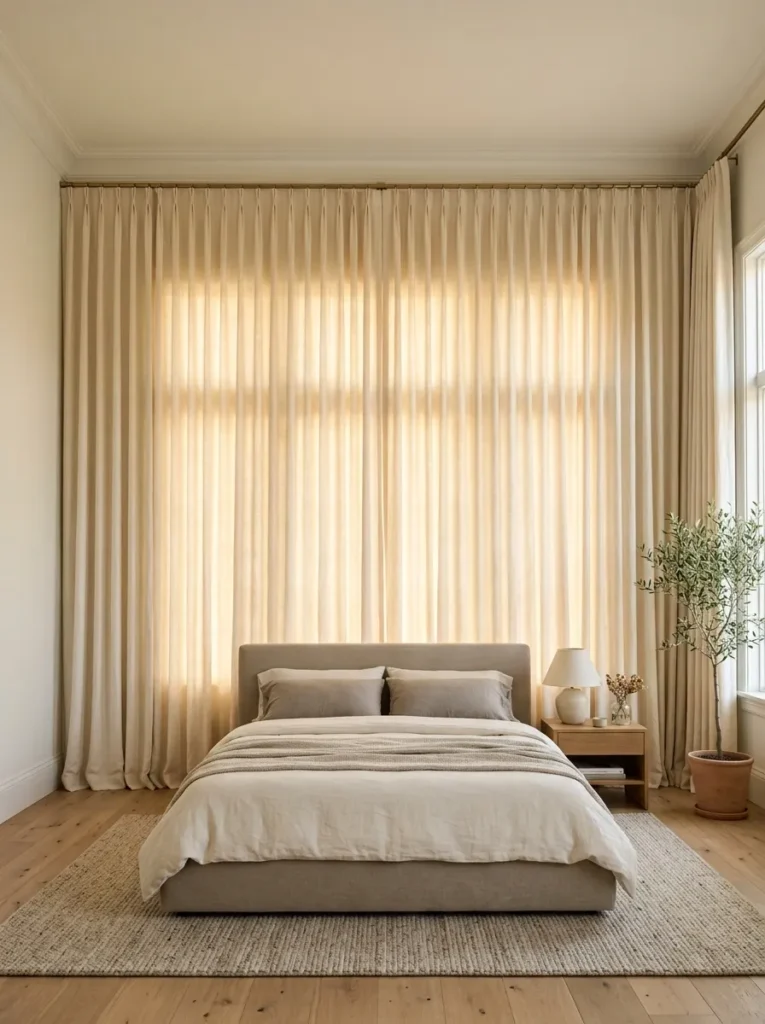
Vibe: Luminous and expansive — the curtain treatment that makes any bedroom ceiling appear higher and any window appear larger than its actual dimensions.
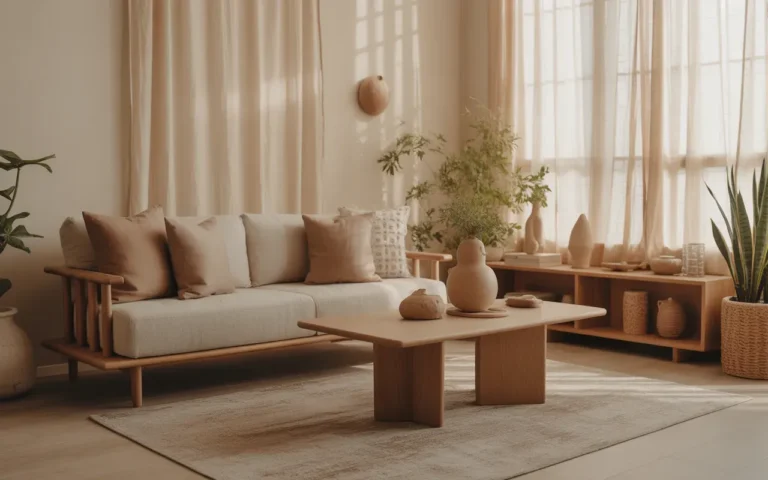
Why it works: Floor-to-ceiling curtains hung from ceiling-height rods apply three simultaneous design principles that collectively produce the most powerful single visual improvement available for any bedroom: height illusion (rods mounted within 5cm of the ceiling draw the eye vertically and make the ceiling read as higher than its actual measurement), window enlargement (curtains extending beyond the window frame on both sides create the visual impression of a much larger window when open), and light diffusion (a quality fabric converts direct sunlight into warm, diffuse golden light that flatters every surface and material in the room). The slight puddle at the floor — 3–5cm of fabric resting on the floor rather than breaking precisely at the baseboard — is the specific styling detail that most clearly communicates quality and luxury in bedroom curtain installation.
How to get it: Mount curtain rods at ceiling height — within 5cm of the ceiling coving or cornice — rather than at window frame height. Extend rods 40–50cm beyond the window frame on each side so the curtains stack completely clear of the glass when open. Choose a fabric weight that falls cleanly rather than billowing — medium-weight linen, silk-linen blend, or weighted linen voile all fall in the clean vertical drape that reads as expensive. Specify panels that are 2.5–3 times the rod width in fullness for proper gathered drape at the heading.
Quick Win: Moving existing curtain rods from window-frame height to ceiling height — without changing the curtains themselves — immediately makes the ceiling appear higher and the windows appear larger for the cost of two new rod brackets and an afternoon of rehinging.
| Product |
|---|
| Ceiling-height curtain rod brass extendable |
| Cream silk-linen curtain panel pair |
| Curtain pleat heading tape quality |
| Curtain rod bracket ceiling mount |
| Curtain weight tape for clean fall |
Also view: 13 Elegant Living Room Designs for Every Home
2. Upholstered Bed Frame in Quality Fabric
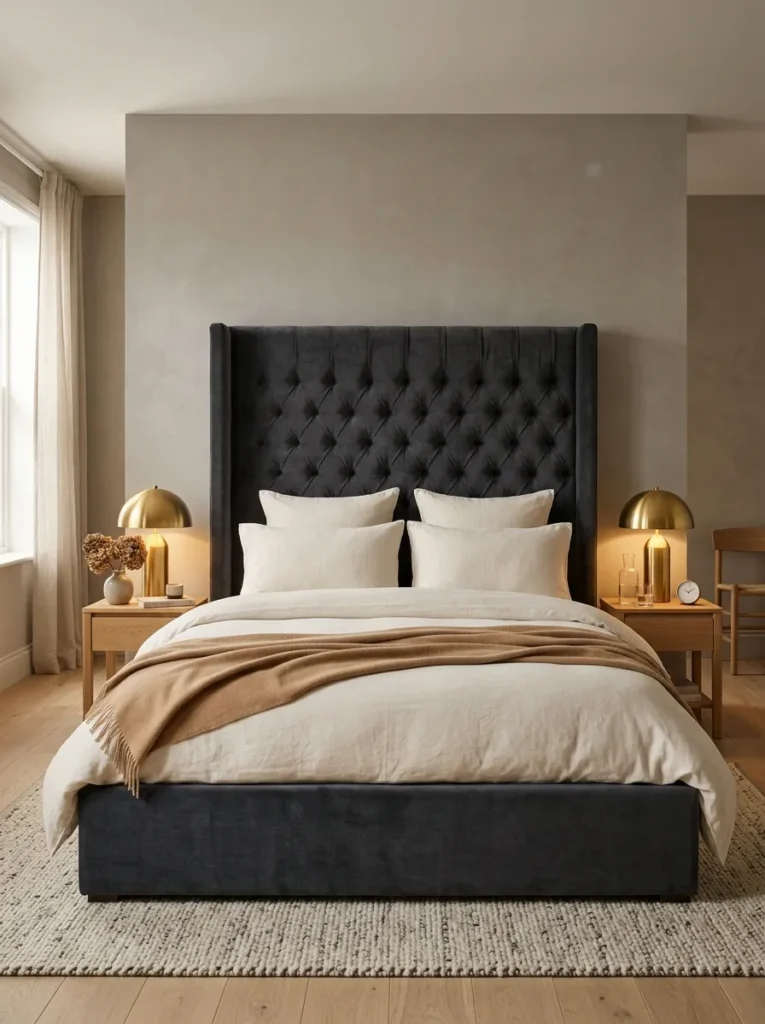
Vibe: Rich and restful — the bed that makes the room look expensive before anything else in it is noticed.
Why it works: An upholstered bed frame in quality fabric is the single bedroom investment with the highest visual return per pound spent — the bed occupies the greatest visual territory in the bedroom and is the first element every entering observer registers, which means its quality of material and construction determines the room’s first impression more decisively than any other element. A tall upholstered headboard in mohair velvet, bouclé, or quality linen elevates the perceived quality of the entire room because upholstery is the material language of premium residential furniture — it communicates that the bed was considered as furniture rather than purchased as a necessity. The headboard height is particularly important: a headboard that extends to 120–150cm above the mattress creates a proportion that relates correctly to the wall height above it, while a low headboard leaves an awkward visual gap between the top of the bed and the ceiling that makes the room feel less considered.
How to get it: Source an upholstered bed frame from a quality furniture maker who uses genuine foam grades (minimum 1.8lb density for the headboard padding) and solid timber or strong metal internal framing — the quality of the internal construction determines whether the upholstery maintains its shape over years of use. For a budget-conscious approach, commission a local upholsterer to upholster an existing bed frame’s headboard in a quality fabric — this produces the same visual result as a purchased upholstered bed at a fraction of the total cost. Specify a fabric that relates to the room’s existing or planned textile palette — the bed frame fabric should participate in the room’s color story rather than introducing a new unrelated tone.
| Product |
|---|
| Upholstered bed frame mohair velvet |
| Button-tuft headboard commission fabric |
| Mohair velvet fabric yard for upholstery |
| Quality foam 1.8lb for headboard padding |
| French knot button set for tufting |
Also view: 18 Excellent Storage Beds for Small Spaces for Tiny Rooms
3. Layered Bedding in Natural Fibers
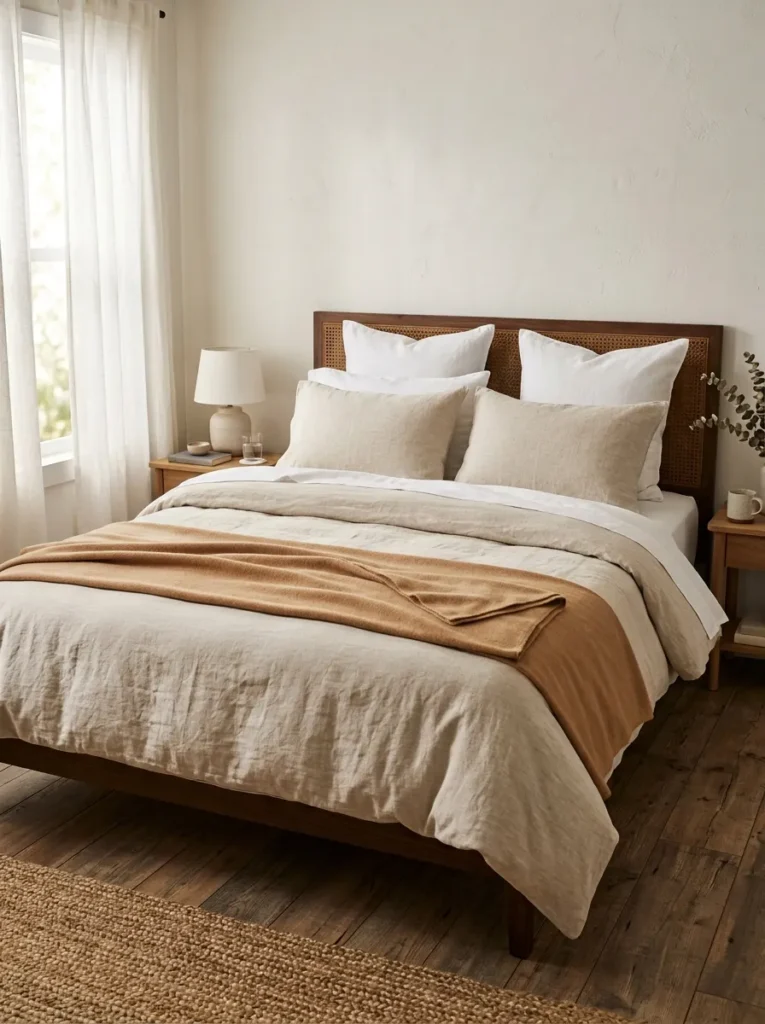
Vibe: Serene and textural — the bed that looks like someone who understands comfort made it with genuine care for the materials.
Why it works: Layered bedding in natural fibers applies the textile quality principle that distinguishes genuinely expensive-looking beds from well-made beds — the combination of different natural fiber textures (the crisp smoothness of percale cotton, the slight roughness of linen, the soft warmth of cashmere) within a tonal color family (white through oatmeal through warm camel) creates a textile composition with the visual richness and sensory depth that single-material, single-color bedding cannot achieve. The specific layering sequence (fitted sheet, duvet, folded blanket, pillow stacking front to back) is what produces the hotel-quality bed appearance — each layer visible and contributing its specific textile quality to the overall composition. Natural fibers are the essential material specification — synthetic alternatives in the same colors and arrangement will always read as less expensive because their surface quality lacks the tonal depth and material character of genuine natural fibers.
How to get it: Invest in one genuinely high-quality piece at a time — the cashmere blanket is the single piece that most elevates a bed’s apparent quality because cashmere’s specific softness and drape communicates luxury in a way that wool and acrylic alternatives cannot approach. The percale cotton fitted sheet should be minimum 400 thread count long-staple Egyptian or Pima cotton — the foundation quality matters because it is the layer most in contact with the body and the one whose quality is most directly experienced. The linen duvet cover’s slight surface roughness is a quality signal rather than a texture to be avoided — smooth linen alternatives lack the natural character that makes linen the premium bedding fabric.
| Product |
|---|
| Long-staple cotton percale fitted sheet |
| Linen duvet cover oatmeal warm tone |
| European pillow set linen white |
| Cashmere blanket warm camel fold |
| Linen pillowcase set coordinating |
4. Statement Bedside Lighting at Correct Height
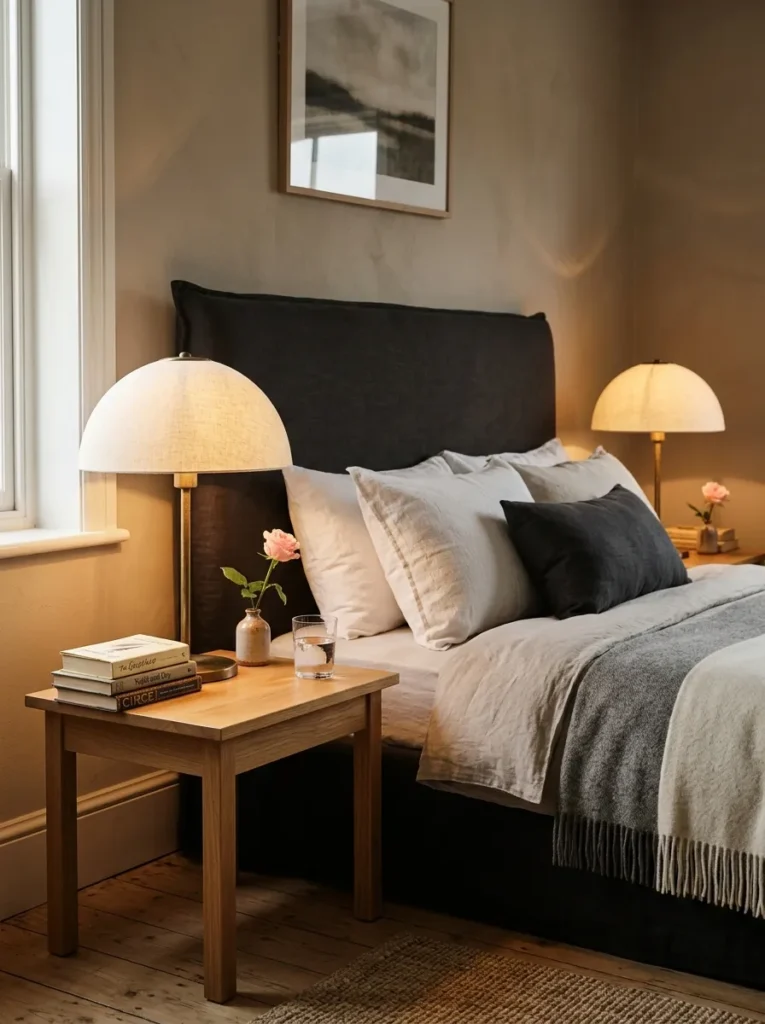
Vibe: Warm and intimate — the bedside lighting that makes evening in the bedroom feel genuinely restorative rather than simply dimmer.
Why it works: Bedside lighting at the correct height is the most frequently under-specified element in bedroom design and the one whose correction produces the most immediate improvement to both the room’s atmosphere and its functional quality. The correct bedside lamp height positions the center of the lamp shade at approximately 130cm from the floor — this aligns the light source with a comfortable reading angle from a seated or reclined position in the bed, eliminating the upward glare of lamps positioned too low (where the bulb is visible to a reclined viewer) and the downward glare of lamps positioned too high (where the light falls on the pillow rather than the reading material). The warm amber quality of the light (2700K or warmer) is as important as the height — cool-white bedside lighting actively interferes with melatonin production and sleep onset in a way that warm-toned lighting does not.
How to get it: Measure 130cm from the floor and position this at the center of the lamp shade — this may mean the table height plus lamp base plus shade height equals approximately 130cm at the shade center. If the existing bedside tables are too low, add 5–10cm table risers before purchasing new tables. Specify all bedside bulbs at 2700K warm white and install a bedside dimmer switch so the light level can be reduced from reading brightness to ambient warmth without changing fixtures or bulbs.
| Product |
|---|
| Dome-shade bedside lamp aged brass pair |
| Cream linen lamp shade replacement |
| Warm white bulb 2700K E27 set |
| Bedside dimmer switch compatible |
| Natural oak bedside table correct height |
5. Genuine Artwork Above the Bed
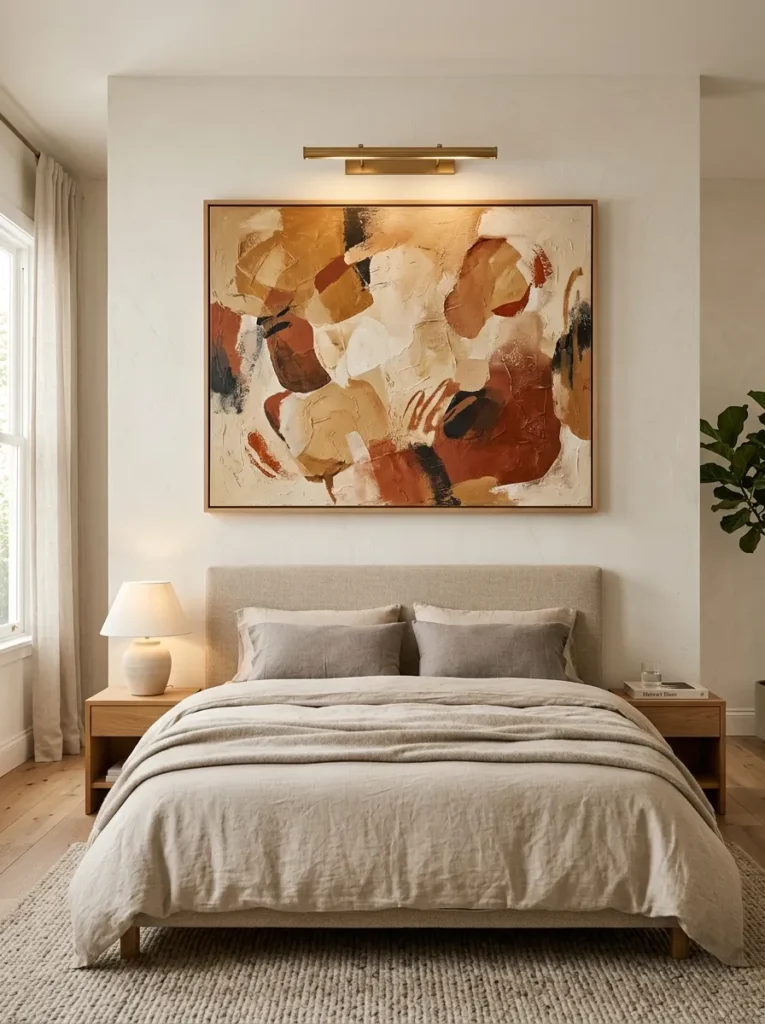
Vibe: Considered and artistic — the wall above the bed that tells every visitor something specific about who lives in this room.
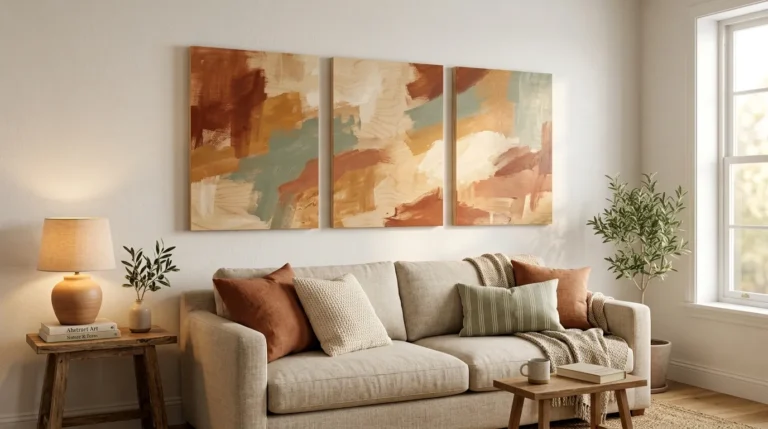
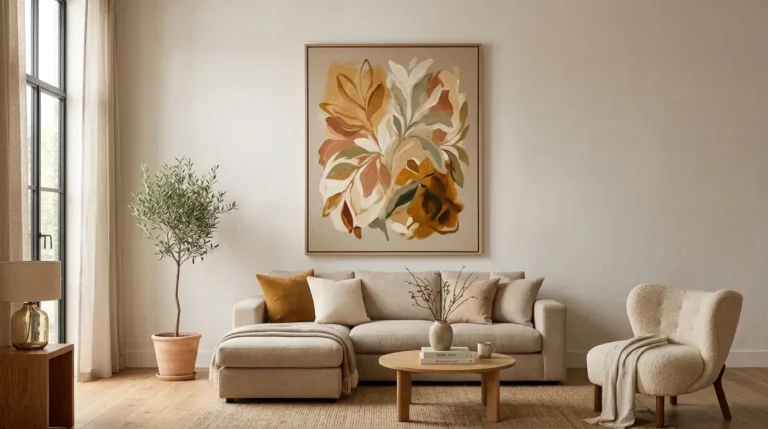
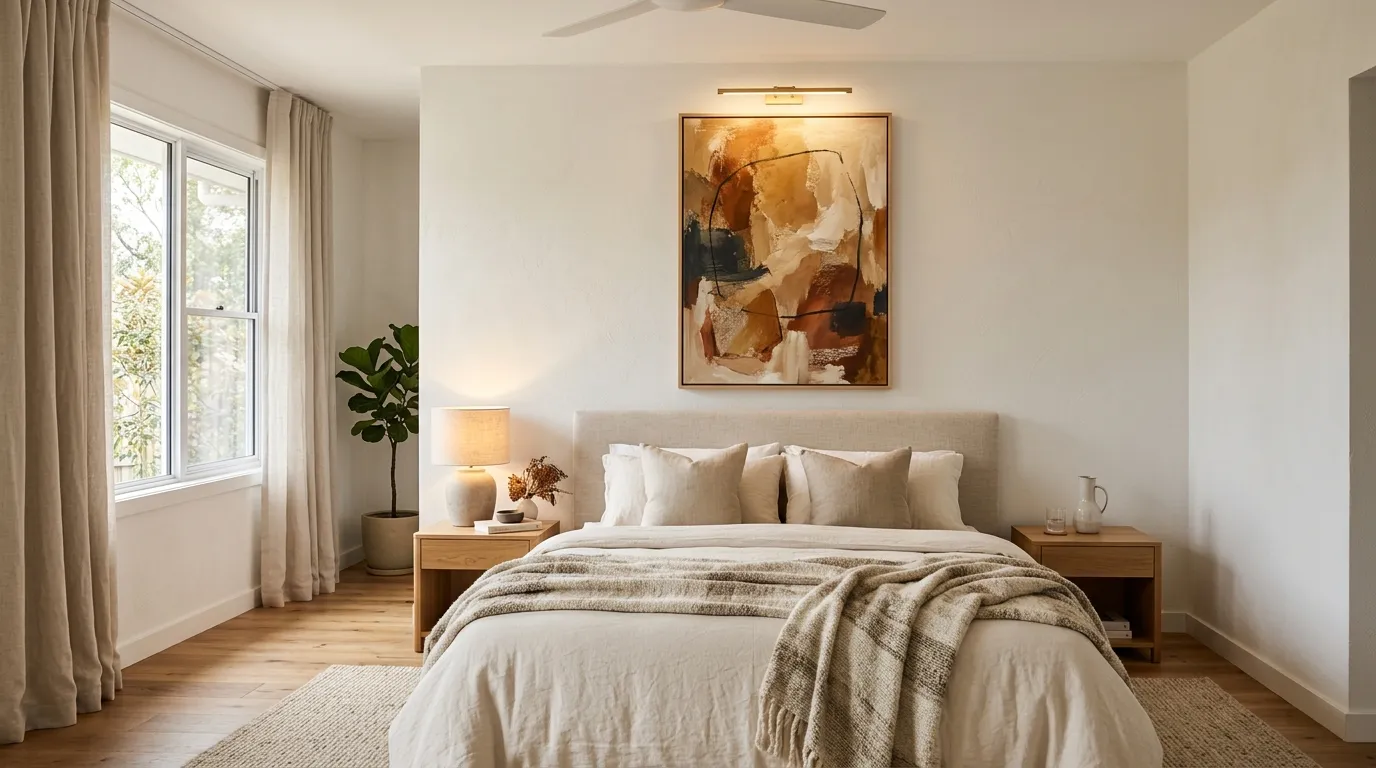
Why it works: Genuine artwork above the bed applies the design principle of singular visual statement as room quality anchor — a single large artwork in the correct position above the headboard creates the bedroom’s primary focal point and communicates the design intelligence that makes the room feel considered rather than assembled. The artwork’s quality (whether an original painting, a high-quality limited print, or a significant photograph) determines whether the room reads as genuinely curated or generically decorated — a bedroom with a significant piece of art above the bed reads as the room of someone with specific aesthetic values, while the same room with a mass-market decorative print reads as a furnished rental. The warm earth tones of an abstract painting relate naturally to the warm neutral palette of quality bedroom materials and create the specific visual warmth that makes a bedroom feel enveloping.
How to get it: Source artwork from independent artists through gallery exhibitions, art fairs, online platforms (Artfinder, Saatchi Art, Rise Art), or directly from the artist’s studio — an original painting at a price point equivalent to a quality decorative mirror or statement lamp provides significantly more design value and personal resonance. Hang at the correct height — the artwork’s center at 155–160cm from the floor, which is the standard gallery hanging height and the position at which artwork reads most correctly when viewed from standing position. Install a dedicated picture light above the frame — the directed illumination of a picture light makes the artwork visible at night and creates the most flattering, art-specific light quality on the work’s surface.
| Product |
|---|
| Original abstract painting warm earth tones |
| Natural oak float frame set |
| Picture light above artwork brass |
| Mirror plate hanging hardware |
| Artwork insurance valuation document |
6. Fitted Wardrobe Wall with Integrated Handles
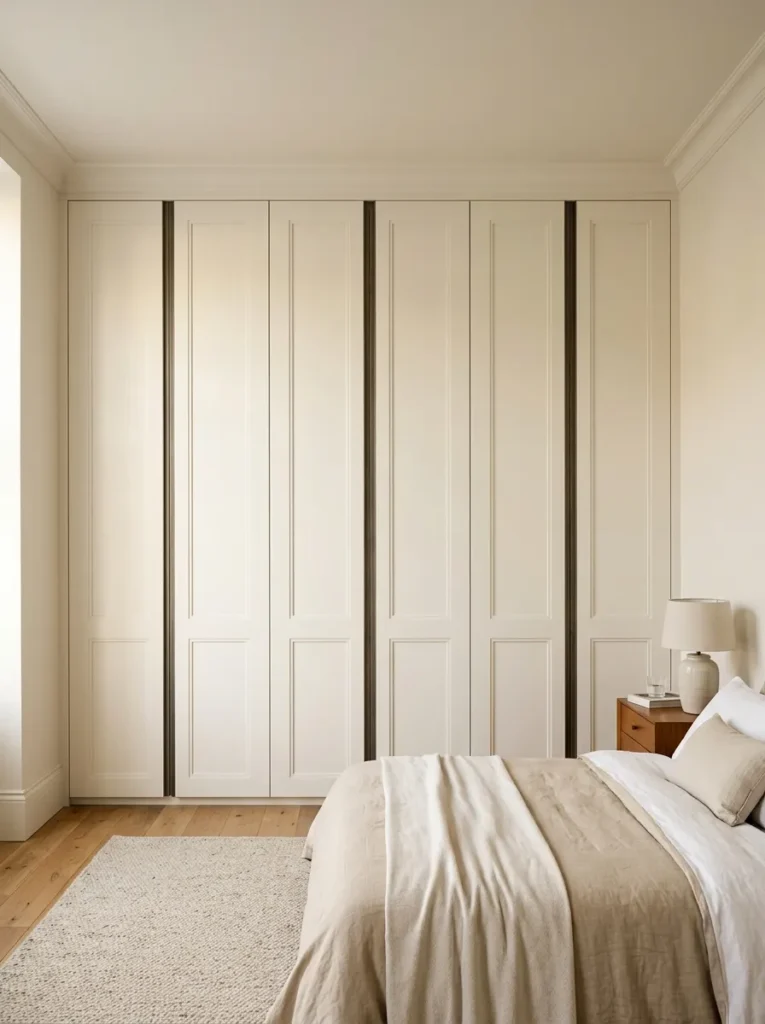
Vibe: Architectural and seamless — the wardrobe wall that makes the bedroom look like it was custom-designed rather than furnished.
Why it works: A fitted wardrobe wall painted in the same color as the bedroom walls applies the design principle of visual integration through color continuity — when the wardrobe doors, the wall returns between doors, the cornice above, and the skirting below all share the same warm off-white color, the wardrobe ceases to read as a piece of furniture and begins to read as part of the room’s architecture. This architectural reading is what most clearly communicates expensive, custom design — the fitted wardrobe that disappears into the wall reads as bespoke joinery created specifically for the room, while the freestanding or color-contrasting wardrobe reads as furniture placed in a room. Integrated push-to-open or recessed grip handles reinforce the architectural reading by eliminating the hardware that most clearly signals furniture rather than cabinetry.
How to get it: Fit floor-to-ceiling sliding or hinged door panels across the full wall width using a standard sliding wardrobe door system sized to the wall — IKEA PAX, Neville Johnson, or Hammonds all produce systems achievable at varied budget levels. Paint all wardrobe door faces and any wall sections between doors in the exact same color as the bedroom walls using the same paint finish. Install a simple cornice or shadow-gap detail at the ceiling junction to resolve the wardrobe-to-ceiling transition as cleanly as possible. Specify push-to-open hinges or recessed grip handles to eliminate protruding hardware.
| Product |
|---|
| Floor-to-ceiling sliding wardrobe system |
| Push-to-open hinge mechanism set |
| Paint same as bedroom walls for doors |
| Cornice detail strip for ceiling junction |
| Interior wardrobe organization system |
7. Velvet or Bouclé Accent Chair in Bedroom Corner
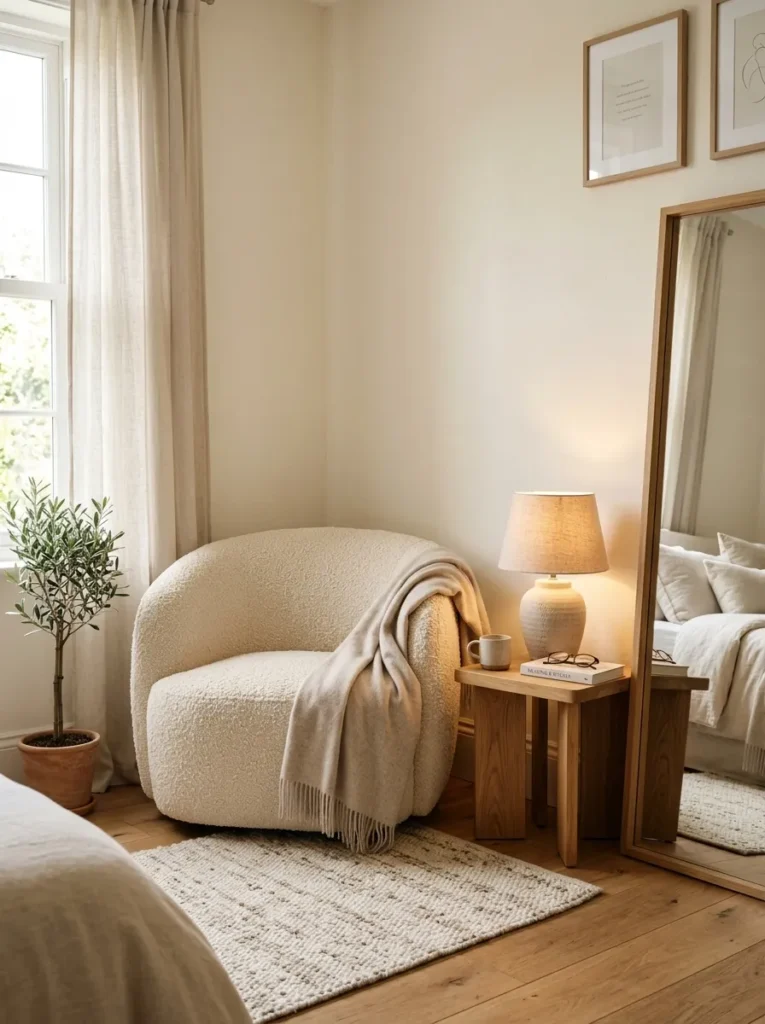
Vibe: Considered and inviting — the bedroom corner that makes the room feel as though it contains more than one place to be.
Why it works: A velvet or bouclé accent chair in a bedroom corner applies the spatial design principle of zone multiplication — a bedroom with only a bed as its primary occupying element reads as a single-function sleeping room, while a bedroom with a designated seating and dressing area reads as a complete personal suite with multiple functions and multiple qualities of inhabitation. The accent chair is the element that most efficiently creates this zone — a single chair, a small side table, a lamp, and a throw establish a reading and dressing area that changes the bedroom’s spatial character from dormitory to personal retreat. The bouclé fabric specifically is the upholstery choice that most effectively communicates luxury in a bedroom corner context — its textural richness and warm cream tones relate naturally to quality linen bedding while its substantial visual presence makes the chair read as a significant furniture investment rather than an afterthought accessory.
How to get it: Position the accent chair in the corner with the most natural light — either the corner adjacent to the bedroom’s main window for daytime reading or opposite a mirror for dressing. The chair should face toward the room rather than the corner — a chair positioned to see the room creates the settled, observational quality of a good reading chair; a chair facing the corner creates an awkward spatial relationship. The side table should be at arm height beside the chair (approximately 55–65cm for most chairs) and hold only the lamp and two or three small objects — no more.
| Product |
|---|
| Cream bouclé accent chair bedroom |
| Natural oak side table small round |
| Ceramic table lamp warm shade |
| Cashmere throw oatmeal fold |
| Small woven wool rug for corner |
8. Honed Marble or Stone Bedside Surfaces
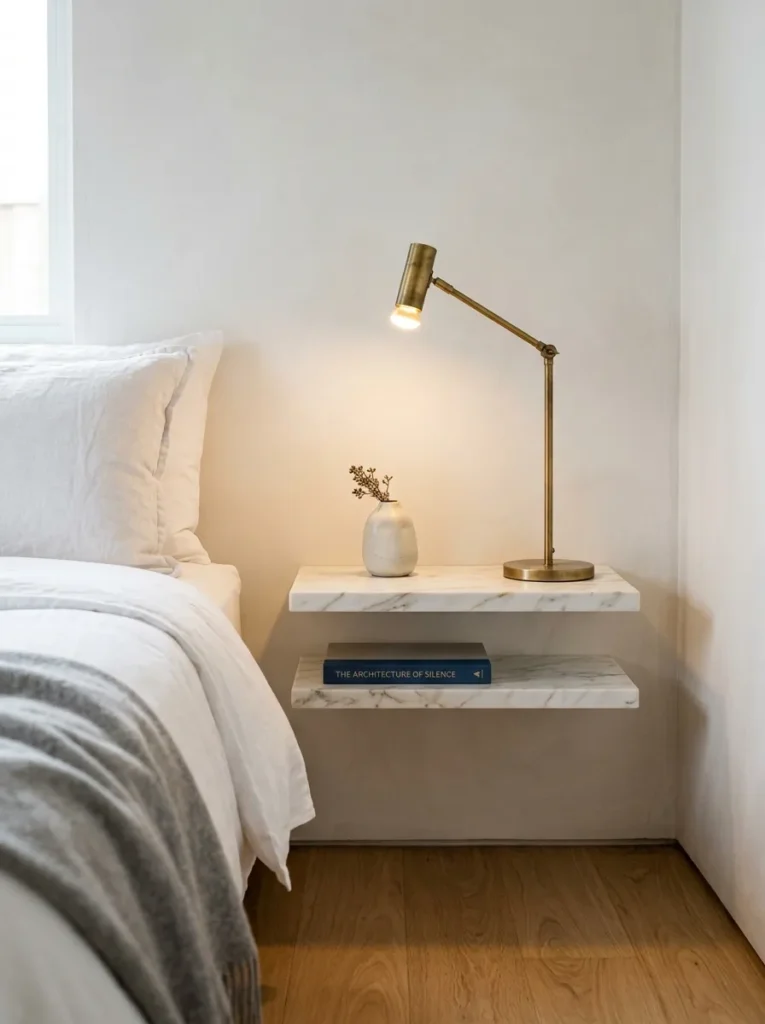
Vibe: Minimal and refined — the bedside surface that replaces a bedside table with something that looks like it belongs in an architecture magazine.
Why it works: Honed marble floating shelves as bedside surfaces apply the material luxury principle at the smallest possible scale — a piece of honed Calacatta marble approximately 45x30cm and 3cm thick provides the visual quality of one of the most premium natural materials available at a cost equivalent to a modest bedside table. The wall-mounted configuration is the spatial decision that amplifies the material’s effect — floating shelves clear the floor beneath, making the room appear larger, while the marble’s slight weight and the precision of its wall mounting communicate the quality of custom, built-in bedside provision rather than furniture placed in position. Honed finish specifically — matte rather than polished — is the correct specification for bedroom bedside marble because it provides a soft, warm light response appropriate to a sleep environment while being more forgiving of daily use marking than polished stone.
How to get it: Source marble offcut pieces from a stone merchant — remnant pieces from worktop installations are available at minimal cost, and the bedside shelf dimensions (45x30cm) make excellent use of the irregular offcut shapes that stone merchants are often happy to clear. Have the marble cut with a polished edge on the visible front and side faces and a honed top surface — the contrast between polished edge and honed top provides a refined material detail. Mount using two concealed steel floating shelf brackets fixed to wall studs.
| Product |
|---|
| Honed marble slab remnant for shelves |
| Concealed floating shelf bracket steel |
| Marble edge router for polished edge |
| Marble sealer penetrating for protection |
| Aged brass bedside lamp slim |
9. Upholstered Walls or Fabric Headboard Panel
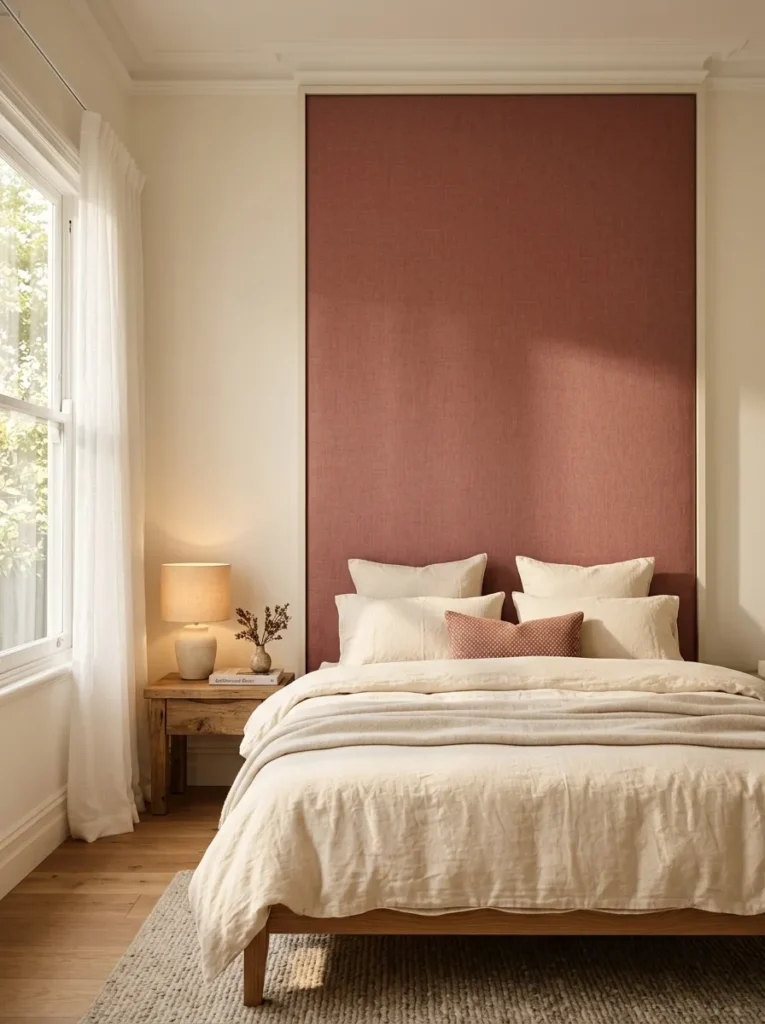
Vibe: Warm and architectural — the fabric panel that creates the bedroom’s defining design feature from a single considered wall treatment.
Why it works: An upholstered wall panel above and around the bed applies the design principle of material enclosure as luxury experience — fabric-covered walls in the bedroom zone provide genuine acoustic benefit (sound absorption that makes the bedroom noticeably quieter than hard-wall alternatives), thermal insulation (the padding beneath the fabric adds measurable insulation value to the wall), and the specific visual warmth of a fabric surface that no paint color can replicate. The panel framed within thin painted timber battens is the construction detail that most clearly distinguishes an intentional upholstered headboard feature from a piece of fabric attached to a wall — the battens create the architectural containment that makes the fabric panel read as a designed wall element.
How to get it: Install a grid of 25x25mm timber battens on the wall surface, creating the rectangular panel boundaries. Staple a layer of 25mm polyester batting to the wall within the batten grid. Pull the chosen fabric taut over the batting and staple within the batten channel, working from the center of each edge outward to maintain even tension. Apply thin painted trim molding over the batten face to cover the staple edge and create the clean panel border. The fabric chosen should be a mid-weight textile appropriate for wall application — linen, velvet, and cotton canvas all work well and provide different visual characters.
| Product |
|---|
| Dusty rose linen fabric for panel |
| Polyester batting 25mm for wall |
| Timber batten 25x25mm for framing |
| Trim molding for batten cover |
| Staple gun heavy-duty for fabric |
10. Dark Feature Wall Behind the Bed
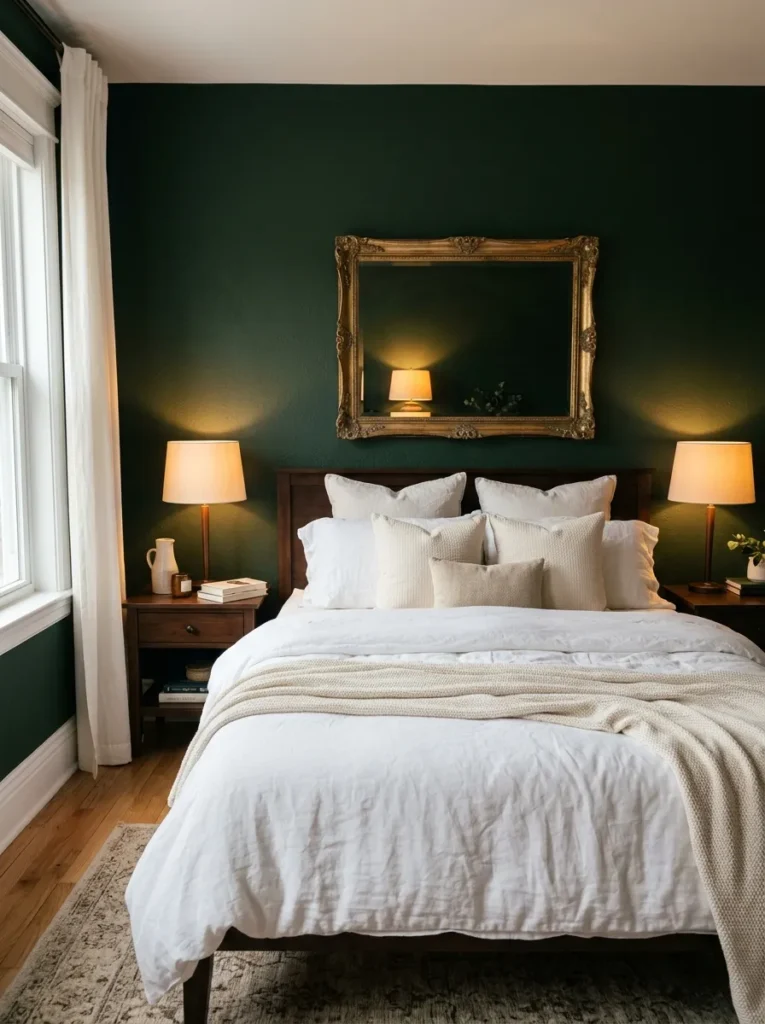
Vibe: Rich and cocooning — the feature wall that makes the bed feel like a destination rather than a piece of furniture.
Why it works: A dark feature wall behind the bed applies the chromatic enclosure principle — painting the wall that forms the bed’s backdrop in a deep, saturated matte color creates a visual frame around the bed that both defines the sleep zone as the room’s primary territory and makes the white or cream bedding appear luminous by contrast. Deep forest green is the specific color that creates the most sophisticated bedroom feature wall because it references the warmth of botanical environments (dark green is associated with sheltered, enclosed natural spaces that humans instinctively find restful) while providing the visual depth and richness appropriate to a primary bedroom feature. The gilt mirror centered above the headboard on the dark wall is the styling element that most completely realizes the feature wall’s design potential — the gold of the frame and the mirror’s reflective quality create light and warmth on the darkest surface in the room.
How to get it: Paint only the wall behind the bed rather than all four walls — the single feature wall creates the enveloping effect behind the bed while the lighter walls on the other three sides maintain the room’s sense of spaciousness. Use chalk-finish paint in deep forest green (Farrow and Ball Calke Green No. 80, Annie Sloan Chalk Paint in Antibes Green, or Dulux Heritage Duck Egg) in a matte formulation — semi-gloss or satin finishes in deep colors create light-catching surfaces that undermine the enveloping quality the dark feature wall is meant to provide.
| Product |
|---|
| Deep forest green chalk paint matte |
| Aged gilt mirror for above headboard |
| Matte finish sealant for dark paint |
| Picture light for gilt mirror |
| Warm white baseboard paint for contrast |
11. Considered Bedside Table Styling
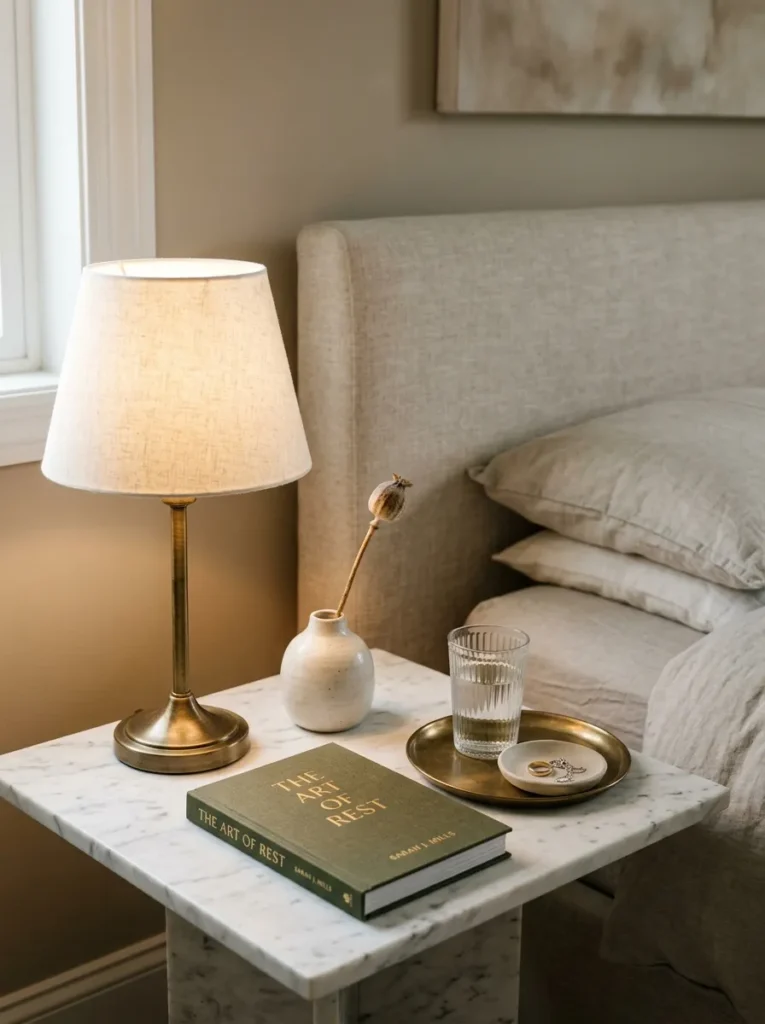
Vibe: Curated and calm — the bedside table that makes the act of going to bed feel like a considered transition rather than a collapse.
Why it works: Considered bedside table styling applies the editorial principle of curation — the specific composition of objects on a bedside table (lamp, one small vessel, one book, one tray containing small daily objects) communicates the specific design intelligence that makes expensive bedrooms feel different from ordinary ones. The bedside table is the most closely observed horizontal surface in any bedroom because it is inspected at close range during the most intimate daily moments, and the quality of its styling — whether each object has been consciously chosen or whether the surface has simply accumulated — is immediately apparent to any observer. The negative space between objects is as important as the objects themselves — a bedside surface with generous visible surface between each element reads as curated and confident; a crowded surface reads as unconsidered regardless of the individual quality of each object.
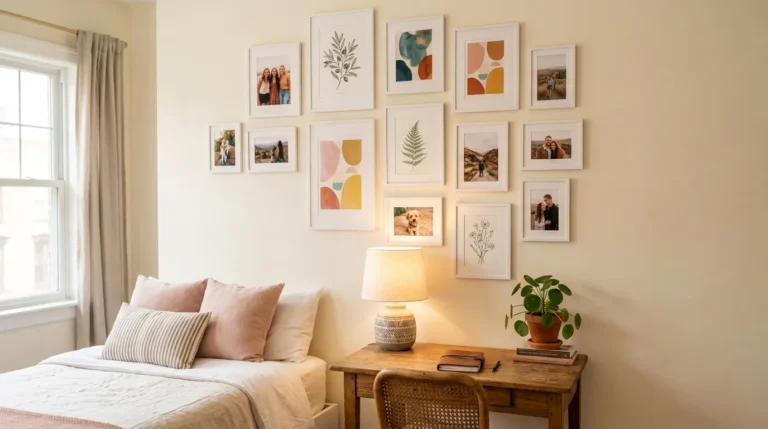
How to get it: Begin by removing everything from the bedside table. Return only: the lamp (the only non-negotiable bedside element), one small vessel (a bud vase, a small ceramic cup), one book or periodical, and one small tray containing the daily objects that must live on the bedside surface (water glass, ring dish, reading glasses). Everything else should live in the bedside drawer, the wardrobe, or another location. The tray is the organizational element that most immediately improves the bedside styling quality — it contains the small daily objects within a defined boundary that reads as intentional rather than scattered.
| Product |
|---|
| Hand-thrown ceramic bud vase small |
| Aged brass desk tray for daily objects |
| Small ceramic ring dish |
| Single dried botanical stem for vase |
| Slim hardback book cover design quality |
12. Hotel-Quality Pillow Arrangement
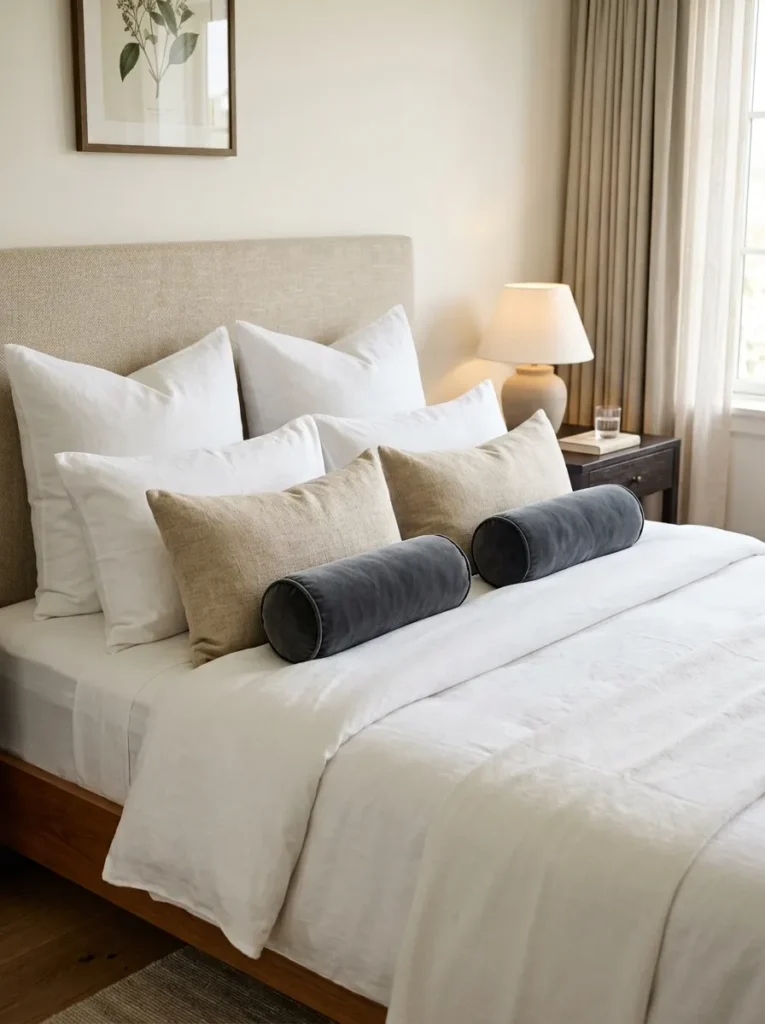
Vibe: Abundant and quality — the pillow arrangement that makes a bed look like it was made by someone who has stayed in very good hotels and paid attention.
Why it works: A correctly layered hotel-quality pillow arrangement applies the design principle of textile depth as visual luxury — the three-layer pillow arrangement (large European squares at the back, standard sleeping pillows in the middle, decorative cushions or bolsters at the front) creates a visible depth of textile quality and generosity that single-layer arrangements cannot achieve. This three-layer system is the specific arrangement used in all quality hotel bedmaking because it separates the functional sleeping pillows from the decorative display pillows — the front decorative layer is removed at bedtime, the middle layer used for sleeping, and the back European squares remain as structural backing throughout. The distinction between display and sleeping layers is the detail that most clearly communicates understanding of quality bedmaking rather than simply adding more pillows to a bed.
How to get it: Three European pillow inserts (65x65cm) in white linen cases at the back — the European size requires specific square pillowcases, which are available from quality linen retailers. Two standard sleeping pillows in white linen cases in the middle row. Two standard sleeping pillows in a slightly warmer tonal linen in the row in front of those. Two decorative bolsters or small square cushions in a contrasting fabric (velvet, bouclé, or a patterned textile) at the front. Each row should stand or rest slightly forward from the row behind it, creating the visible layered depth that defines the arrangement.
| Product |
|---|
| European pillow insert 65x65cm set of 3 |
| European linen pillowcase white set |
| Oatmeal linen pillowcase standard set |
| Charcoal velvet bolster cushion pair |
| Feather pillow insert set for fullness |
13. Full-Length Mirror as Statement Piece
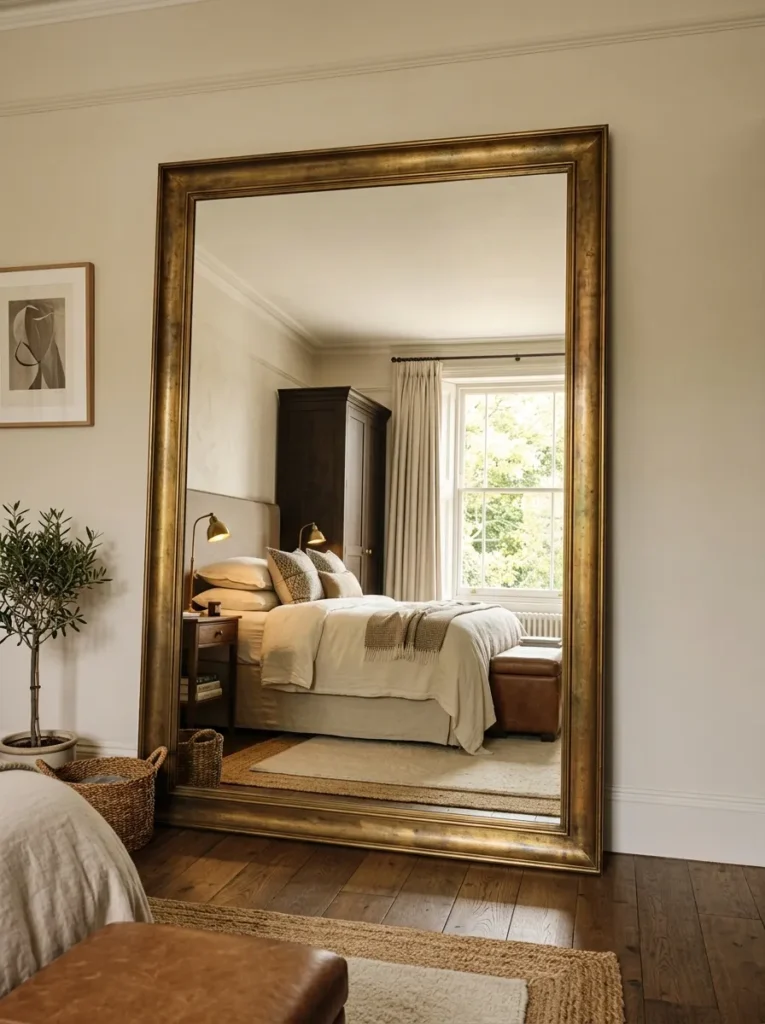
Vibe: Generous and spatial — the mirror that makes a bedroom feel 30% larger and infinitely more considered simultaneously.
Why it works: A large full-length mirror with a substantial frame leaning against the bedroom wall applies the spatial design principle of reflective volume multiplication — a full-length mirror reflecting the room behind the viewer doubles the apparent volume of the bedroom by creating the visual impression of a second identical room beyond the mirror surface. The leaning format (as opposed to wall-hung) is the specific installation that reads as most confident and most contemporary — a leaning mirror is large enough and heavy enough to not require wall anchoring for stability, which communicates that the mirror is a piece of furniture in its own right rather than a utility wall fitting. The frame width is the quality signal — a slimline or frameless mirror reads as a utility mirror, while a substantial 6–10cm wide frame in aged brass or warm gold reads as a furniture piece that has been chosen for its design quality.
How to get it: Choose a mirror large enough to see from head to toe with a 10–15cm margin above and below — typically 180–200cm tall for most adults. Lean against the wall at a slight backward angle for stability and for the most flattering reflection angle. The leaning mirror’s position beside the wardrobe or in the room’s dressing area creates the practical full-length view needed for outfit assessment while the mirror’s visual contribution to the room extends beyond this functional position through the room reflection it creates at all times.
| Product |
|---|
| Full-length mirror aged brass frame large |
| Mirror anti-tip wall strap safety |
| Floor pad beneath mirror for protection |
| Mirror polish for maintenance |
| Small wooden wedge for lean angle |
14. Organic Linen or Wool Rug Under the Bed
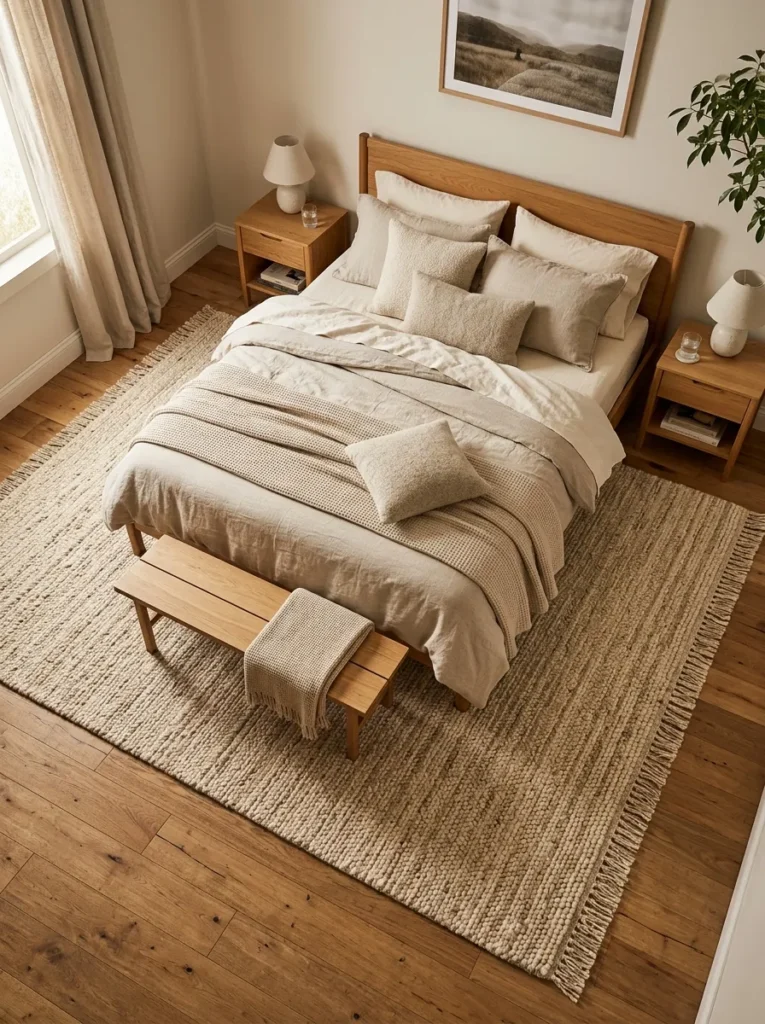
Vibe: Warm and textural — the rug that makes stepping out of bed the specific pleasure of bare feet on warm natural fiber.
Why it works: A large natural fiber rug correctly sized beneath the bed applies two simultaneous design principles: the rug’s size relative to the bed determines the room’s perceived floor quality — a rug that extends at least 60cm beyond the bed on both sides and at the foot is large enough to frame the bed as an object within the rug rather than a piece of furniture sitting on top of a mat. This size relationship (rug as room element rather than furniture mat) is what produces the quality bedroom appearance. The natural fiber quality — hand-knotted wool’s pile depth and surface variation — provides the sensory luxury of texture underfoot that synthetic alternatives cannot replicate, and this sensory quality is experienced daily in the most intimate bedroom moment: the first step onto the floor each morning.
How to get it: Size the rug generously — for a standard king bed (180cm wide), the appropriate rug width is minimum 260cm (180cm bed width plus 40cm each side). For a queen bed (160cm wide), minimum 240cm rug width. Position the rug so the bedside tables sit on the rug surface — the visual continuity of rug, bed, and bedside tables as a single composition is the spatial quality that most clearly reads as considered design. Source hand-knotted or hand-tufted natural wool rather than machine-made alternatives — the slightly irregular pile of genuine hand-knotted wool is visible and desirable.
| Product |
|---|
| Hand-knotted wool rug oatmeal cream large |
| Non-slip underlay for rug stability |
| Rug pad for protection under rug |
| Wool rug stain protector spray |
| Rug corner weight set |
15. Integrated Reading Nook or Window Seat
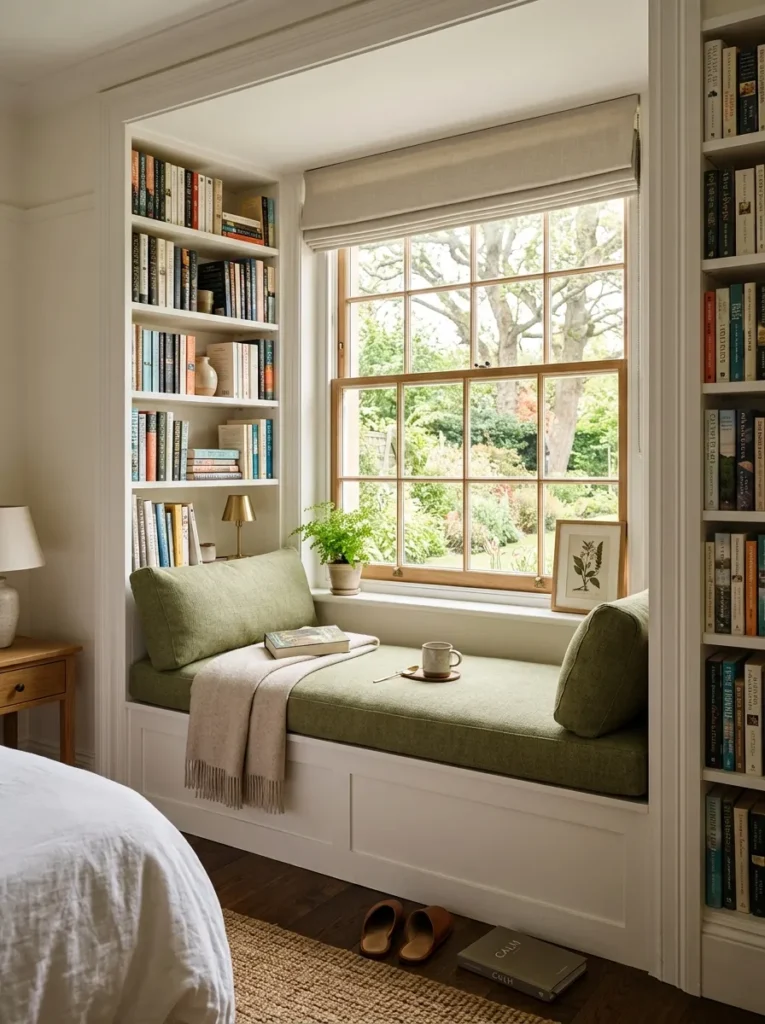
Vibe: Inviting and considered — the reading nook that makes the bedroom feel like it contains a secret room within the room.
Why it works: A built-in window seat reading nook in the bedroom applies the spatial design principle of dedicated zone creation as perceived room enlargement — a bedroom that contains only a bed reads as a single-function sleeping room, while a bedroom with a built-in reading nook reads as a complete personal environment with multiple functions and multiple spatial qualities. The reading nook specifically creates the most sought-after quality in residential interior design — a small, sheltered, naturally lit sitting space that provides privacy within the larger room and the specific psychological comfort of a contained, view-oriented personal territory. Built-in shelving flanking the window on both sides provides the context that makes the reading nook feel like a library alcove rather than simply a padded seat.
How to get it: Build the window seat platform from 18mm plywood with a painted MDF face frame, sizing the depth to a minimum of 60cm for comfortable sitting (80cm for the most comfortable reclined reading position). Include lift-top storage within the seat platform for seasonal bedding. Commission a thick foam cushion (minimum 10cm depth in 1.8lb density foam) covered in performance linen or cotton for durability. Build flanking shelving units that run from floor level to window head height, creating the alcove framing that defines the reading nook as a complete enclosed zone.
| Product |
|---|
| Window seat platform plywood |
| Thick foam cushion 10cm for seat |
| Sage green performance linen for cover |
| Deep bolster cushion pair for ends |
| Built-in shelf lighting LED strip |
16. Textured Wallpaper on Headboard Wall
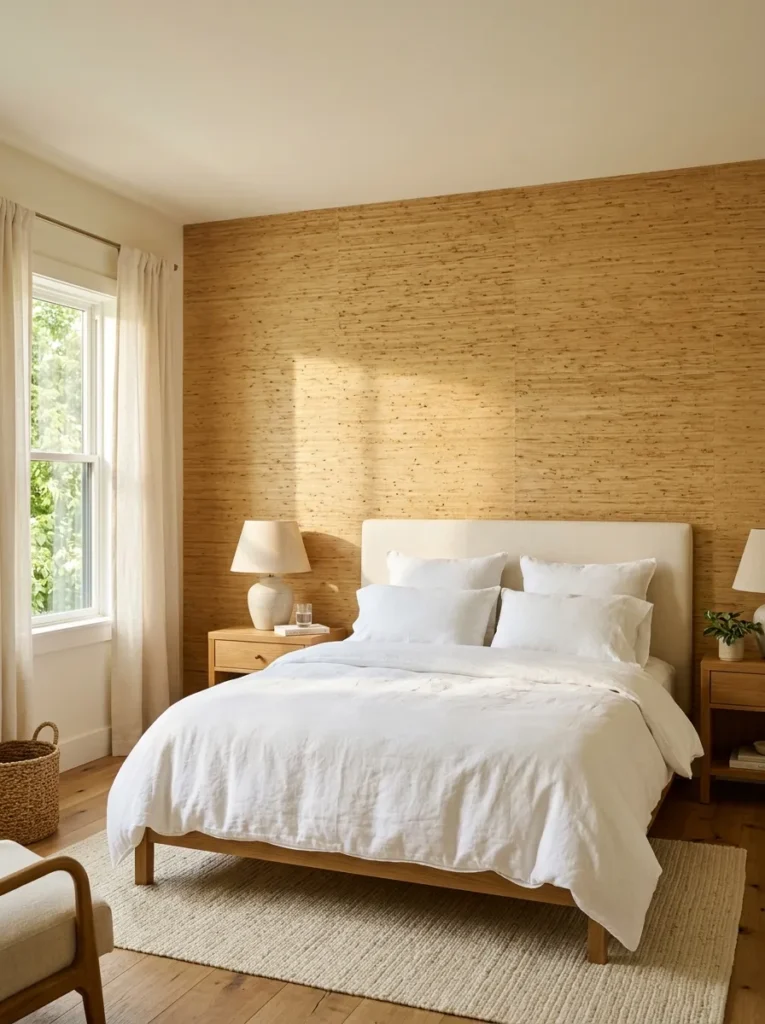
Vibe: Warm and textural — the wallpaper wall that provides the bedroom’s entire material warmth from a single design decision.
Why it works: Natural grasscloth wallpaper on the headboard wall applies the material depth principle at wall scale — grasscloth’s natural woven texture (genuine woven sea grass, sisal, or jute mounted on paper backing) provides a wall surface with genuine three-dimensional material character that rewards close inspection and that responds dynamically to raking natural light throughout the day. The grasscloth wall is the single-wall wallpaper application most consistently recommended by interior designers for bedroom headboard walls because it provides the visual warmth of a dark feature wall without the visual weight — honey-gold grasscloth reads as light and natural rather than dark and heavy, making it appropriate for bedrooms where a genuinely dark feature wall would feel oppressive. The natural material origin of grasscloth (woven plant fiber) connects it to the natural material palette of quality linen bedding and wood furniture in a way that printed wallpaper alternatives cannot.
How to get it: Apply grasscloth wallpaper to the single headboard wall only — the material’s cost and the installation attention required by grasscloth’s natural fiber behavior (seam visibility is inherent to grasscloth and should be embraced rather than disguised) makes single-wall application the appropriate scope for most bedrooms. Grasscloth requires professional installation for best seam management — the natural fiber’s slight width variation between rolls means seams require careful matching and expert trimming. Specify honey-gold or warm tan grasscloth rather than the cooler gray-green alternatives — the warm tones relate most naturally to the warm material palette of an expensive-looking bedroom.
| Product |
|---|
| Natural grasscloth wallpaper honey-gold |
| Grasscloth wallpaper paste specialist |
| Professional installation for grasscloth |
| Grasscloth seam sealer for edges |
| Warm natural fiber rug coordinating |
17. Scent and Sensory Details
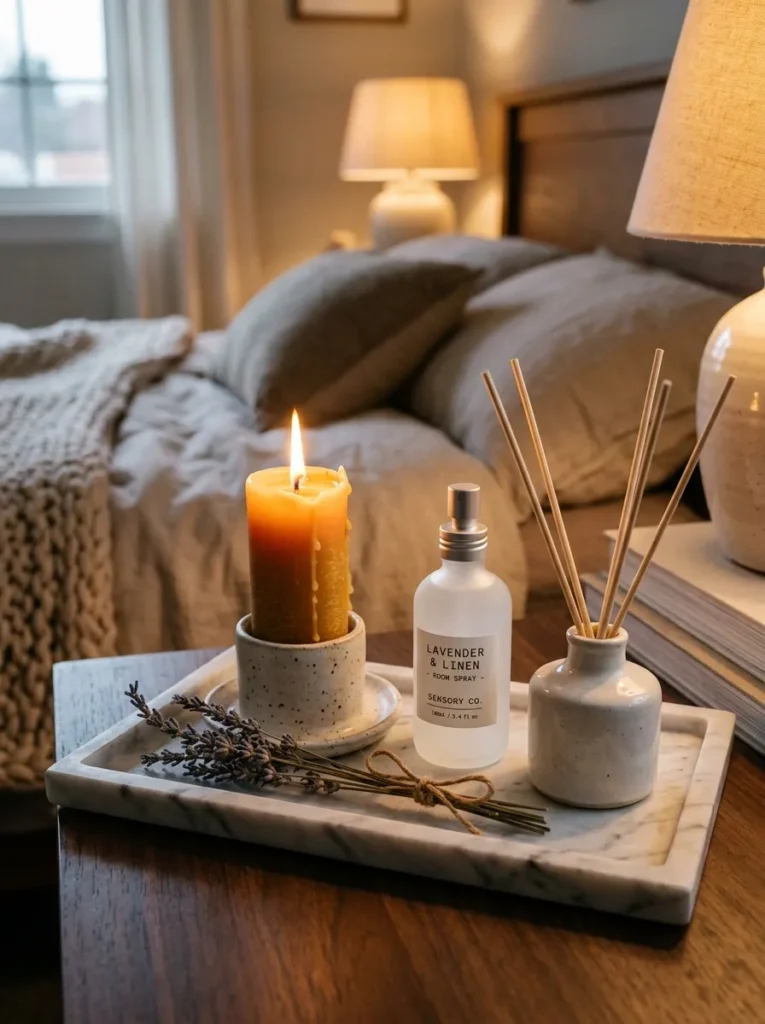
Vibe: Sensory and serene — the bedroom detail that engages the sense of smell in the same way the room’s other design decisions engage sight and touch.
Why it works: Considered bedroom scent and sensory details apply the holistic design principle that genuinely luxurious environments address all senses simultaneously — the most expensive hotel rooms are distinguished not only by their visual quality but by the specific quality of their scent, the temperature of the air, the feel of the textiles, and the quietness of the acoustic environment. Beeswax candles are the specific scent choice for bedrooms because their natural honey fragrance is warm and gentle rather than sharp or complex, their flame is genuinely calming to observe, and their material honesty (genuine beeswax rather than paraffin or synthetic alternatives) aligns with the material authenticity principle that defines expensive-looking bedroom design throughout. The marble tray organizing all scent objects into a composed vignette is the styling element that turns a collection of separate objects into a deliberate bedside composition.
How to get it: Source a large beeswax pillar candle from a specialist beeswax chandler — genuine beeswax has a natural honey scent that intensifies when burned, while paraffin candles with added fragrance never achieve the same quality. Organize all bedroom scent objects on a single marble or aged brass tray so they read as a designed vignette rather than accumulated objects. Specify linen room spray with a light, natural fragrance (lavender, sandalwood, or bergamot) rather than synthetic floral alternatives — the spray should enhance the room’s restfulness rather than introduce a competing olfactory note.
| Product |
|---|
| Beeswax pillar candle large |
| Ceramic candle holder for pillar |
| Marble tray for bedside vignette |
| Linen room spray natural fragrance |
| Ceramic reed diffuser vessel with sticks |
How to Start Your Classy Bedroom Transformation
Start with the curtains. Before purchasing any new furniture, repainting any walls, or investing in any significant bedroom upgrade, move your existing curtain rods to ceiling height and rehang the existing curtains on the repositioned rods. This single afternoon modification — costing only the price of two new rod brackets — immediately makes the room’s ceiling appear higher, the windows appear larger, and the room’s proportions appear more generous than they actually are. The improvement is immediate and dramatic, and it costs less than $20. From this improved starting point, every subsequent decision — whether to repaint, what rug size to source, where to invest in new textiles — is made from within a room that already looks more considered than it did that morning.
The most common mistake people make when trying to make a bedroom look expensive is purchasing many moderately priced objects hoping that quantity will create the quality that individual pieces lack. This approach always fails — a bedroom filled with twelve moderately priced accessories reads as cluttered and unsophisticated regardless of how individually appropriate each piece might be. The principle that produces expensive-looking bedrooms is concentration and restraint: invest the available budget in the three or four elements that most determine the room’s quality (the bedding fabric, the rug, the lighting, the primary artwork) and leave everything else reduced to its minimum — one lamp, one small bedside object, one bedside book, one throw. The room that contains only the best of what it needs reads as expensive; the room that contains everything it might possibly want reads as anxious.
Three items under $50 that make an immediate impact: A set of warm white 2700K LED bulbs ($8–$15) replacing any cool-white bulbs in bedside lamps — warm light quality is the fastest and cheapest improvement available for any bedroom and the one whose effect is felt most immediately in the daily experience of the room; a single linen pillowcase in a warm oatmeal or cream tone ($12–$20) replacing one synthetic pillowcase on the most visible pillow — the immediate contrast in texture and material quality between the linen and its synthetic neighbors will make the linen replacement clearly apparent and motivate further textile investment; and a small hand-thrown ceramic bud vase ($15–$30 from a pottery market or independent ceramic maker) placed on the bedside table with a single dried botanical stem — the specific quality of a handmade ceramic object changes the bedside table’s material character from generic to considered in a way that no equivalent-cost manufactured alternative achieves.
Realistic expectations: A bedroom lighting upgrade — replacing bulbs, adding a bedside dimmer, and moving curtain rods to ceiling height — takes one afternoon and costs $30–$80. A mid-level bedroom transformation — quality rug, linen bedding, upholstered headboard, and considered lighting — typically costs $800–$2,500 depending on material quality and room size. A full expensive-looking bedroom renovation — fitted wardrobe wall, grasscloth feature wall, marble bedside surfaces, quality upholstered bed, and complete textile upgrade — ranges from $4,000–$15,000 for a standard bedroom depending on specification. The investment sequence that produces the fastest improvement per pound spent is: curtains to ceiling height first, warm lighting second, quality bedding textile third, and correct rug size fourth — these four modifications produce the most dramatic quality improvement available to any bedroom regardless of its starting point.
Frequently Asked Questions About Classy Bedroom Designs
What makes a bedroom look expensive without spending a lot of money?
The design changes that most consistently make a bedroom look expensive without significant spending are: curtains moved to ceiling height (makes the room feel taller and the windows larger for under $20 in bracket cost); warm white 2700K bulbs replacing cool-white bulbs (changes the room’s atmosphere from clinical to warm for under $15); a large enough rug correctly positioned under the bed rather than a too-small rug beside it (the correct size rug makes the furniture arrangement read as designed rather than placed); and the removal of all non-essential objects from visible surfaces (reducing bedside tables to lamp, one object, and one book makes the room read as edited and confident regardless of the quality of the remaining objects). Each of these changes costs little but demonstrates the design principle that separates expensive-looking bedrooms from ordinary ones: that quality is produced by correctness of proportion and restraint of content rather than by the cost of individual components.
How important is the bed frame to the overall quality of a bedroom’s appearance?
The bed frame is the most important single piece of furniture in the bedroom because it occupies the greatest visual territory in the room and is the element that every entering observer registers first. An upholstered bed frame in quality fabric (linen, velvet, bouclé, or mohair) immediately elevates the perceived quality of the entire room because upholstery communicates that the bed was considered as designed furniture rather than purchased as a sleeping necessity. The headboard height is particularly important — a headboard that extends 120–150cm above the mattress creates the correct proportion relationship between the bed and the wall behind it, while a low headboard leaves an awkward visual gap that makes the room feel unresolved. If budget allows only one bedroom furniture investment, the quality upholstered bed frame provides the highest design return.
What color palette makes a bedroom look most expensive?
The color palettes most consistently associated with expensive-looking bedrooms are those built from a narrow tonal family of warm neutrals — warm white, oatmeal, cream, warm gray, and camel — with one accent color in a rich, saturated tone (deep charcoal, forest green, dusty rose, or deep navy). This specific palette combination (warm neutral dominant, single rich accent) works because warm neutrals provide the visual calm appropriate to a sleep environment while the single rich accent provides the focal-point visual interest that makes the room read as designed rather than generic. The key restriction is saturation — pale, slightly greyed versions of all colors (dusty rose rather than bright pink, sage green rather than kelly green, warm cream rather than stark white) are the tonal expressions that consistently read as expensive, while bright, fully saturated versions of the same hues read as less sophisticated.
How do I make a small bedroom look expensive and larger?
The five design decisions that most reliably make a small bedroom look expensive and appear larger are: floor-to-ceiling curtains on ceiling-height rods (the vertical line makes the ceiling appear higher); a single large mirror (either a leaning full-length piece or a large wall-mounted mirror that reflects the room and doubles its apparent volume); furniture with legs rather than floor-level furniture (visible floor between furniture legs makes the room read as more spacious); a single color for walls, trim, and built-in wardrobe (color continuity eliminates the visual fragmentation that makes small rooms feel smaller); and the elimination of all non-essential objects from surfaces (visual clutter in a small room is disproportionately damaging to its perceived quality compared to clutter in a large room). The counterintuitive principle that applies specifically to small bedrooms is that larger individual pieces (one large artwork, one substantial mirror, one large rug) read better than multiple smaller equivalents — scale confidence makes a small room feel designed, while multiple small pieces make it feel inadequate.
What is the most important lighting consideration for a classy bedroom?
The single most important bedroom lighting decision is color temperature — specifying all bedroom light sources at 2700K warm white rather than the 4000K or 5000K cool white that dominates standard residential lighting. The 2700K color temperature (the warmth of traditional incandescent bulbs and candlelight) produces the warm, amber-tinted bedroom atmosphere associated with rest, luxury, and sensory comfort, while 4000K+ cool white produces the bright, blue-tinted light associated with offices and clinical environments that actively interferes with the melatonin production needed for quality sleep. After color temperature, the second most important decision is source height — bedside lamps should position the light source at approximately 130cm from floor level for reading comfort, and no single overhead ceiling light should be the primary bedroom light source. The most expensive-feeling bedroom lighting is always layered — bedside lamps as primary ambient, a floor lamp or picture light for secondary ambient, and a dimmable overhead fitting reduced to minimum for functional overhead light only when needed.
Ready to Create Your Dream Classy Bedroom?
These 17 ideas cover the complete range of what a classy, expensive-looking bedroom can achieve — from the immediate atmospheric transformation of ceiling-height curtains and warm lighting, to the material richness of honed marble bedside shelves and a quality upholstered headboard, to the sensory completeness of beeswax candlelight and natural fiber textiles at every surface. Every bedroom transformation begins with the same first action — moving the curtain rods to ceiling height and changing the light bulbs to 2700K warm white. These two modifications, achievable in a single afternoon for under $100, will show you more clearly than any design planning or inspiration image collection what your specific bedroom is capable of becoming. The warm light on the ceiling-height curtains at the end of that afternoon is the beginning of every subsequent design decision — and it costs almost nothing compared to what it reveals about the room’s potential. Save the ideas that match your bedroom’s architecture, your material preferences, and the specific quality of rest you want your bedroom to provide — and begin from those first two changes this weekend.