15 Stylish Kids Closet Storage Ideas for Small Spaces
Stylish kids closet storage ideas for small spaces solve the specific organizational challenge of children’s wardrobes — which must simultaneously contain clothing across rapidly changing size ranges, accommodate the toy overflow that migrates from bedrooms into any available storage cavity, manage shoes, accessories, bags, sports equipment, and art supplies in a single confined footprint, and do all of this in a way that the child can actually maintain independently. This article gives you exactly 15 ideas spanning closet conversion systems, IKEA modular builds, hanging organizers, shoe storage, and the specific dual-function solutions that convert under-used closet space into comprehensive room organization so every closet size, every budget, and every child’s organizational needs find a workable and beautiful approach.
A well-organized children’s closet does something a chaotic one cannot — it makes the morning routine achievable without adult assistance, creates the organizational habits that children carry into adult life, and frees the bedroom floor from the accumulated physical evidence of a storage system that has failed. Here are 15 ideas worth implementing this weekend.
Why Stylish Kids Closet Storage Ideas Work for Small Spaces
The organizational challenge of a children’s closet is categorically different from an adult’s for three reasons that most closet organization advice does not adequately address. First, children’s clothing exists in a state of perpetual size flux — a child typically moves through two to three clothing sizes per year in the early years, meaning that at any given moment the closet contains current-size items, items held for the next size up, and items to be passed on or stored — three simultaneous inventory categories within the same physical space. Second, children’s ownership of objects is dramatically more varied per square metre of storage space than adults’ — a standard children’s closet must accommodate not just clothing but the entirety of the toy, craft, sports, and personal accessory collection that overflows from a small bedroom. Third, the organizational system must be usable by the child at the child’s height and with the child’s motor skills — a storage system that requires adult assistance for daily retrieval and return is a system that the child will abandon in favour of the floor.
The design principles that most consistently produce successful children’s closet organization are: accessibility (the items used most frequently must be at the child’s eye level and arm reach, typically 60–120cm from the floor depending on age), visibility (open storage or clear-fronted storage dramatically reduces the “I can’t find it” problem that closed opaque drawers create for children), categorical simplicity (the organizational categories must be few enough and clear enough for a child to maintain without adult reminders — too many categories create confusion and abandonment), and growth adaptability (the storage system must accommodate the rapid changes in the child’s wardrobe and possessions without requiring complete reconstruction at each transition).
The small closet specifically offers two organizational advantages that larger closets do not: the contained footprint forces categorical prioritization (there is insufficient space for every item, which drives the regular decluttering that large-closet children’s wardrobes avoid), and the small space is completely visible from any position within it, eliminating the “forgotten corner” phenomenon that larger closet spaces create. The most effective small children’s closet is one that has been designed around the specific contents it must hold — measured and planned before any shelving is purchased, with each storage zone assigned to a specific category of items that the household has confirmed will actually be stored there.
Style at a Glance
| Element | Organizational Function | Stylish Edge |
|---|---|---|
| Philosophy | Accessible, visible, categorically simple | Design that the child can maintain independently |
| Materials | IKEA PAX, timber, MDF, wire basket, fabric bin | Color-coded, labeled, age-appropriate system |
| Key Zones | Hanging, folded clothing, shoes, toys, accessories |
15 Stylish Kids Closet Storage Ideas for Small Spaces
1. Double Hanging Rod System — Maximizing Vertical Space
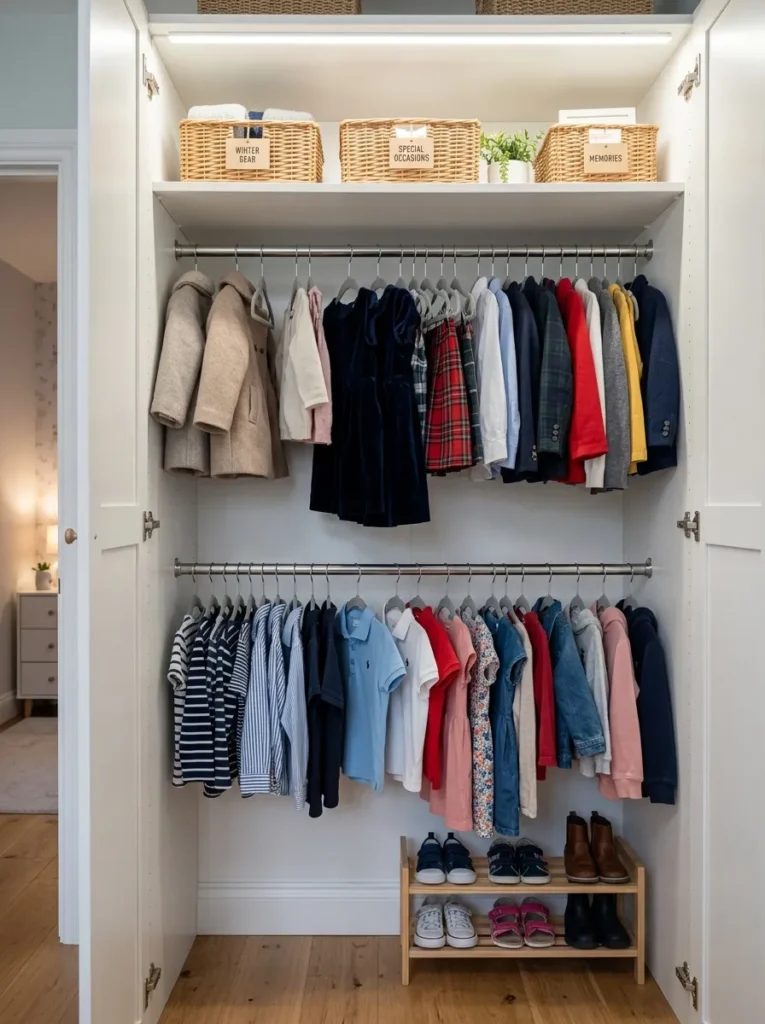
Vibe: The double rod closet feels like the morning routine has been solved architecturally — the lower rod within the child’s reach communicating that this system was designed for them, not for the adult who organizes it.
Why it works: A double hanging rod system in a children’s closet applies the accessibility layering principle — children’s clothing divides naturally into two categories with different access requirements: daily clothes (school uniform, casual clothes, regularly worn items that the child should be able to retrieve and return independently) and occasional clothes (special occasion wear, seasonal storage, items that require adult selection or assistance). Installing two rods at different heights assigns each category to the access level appropriate to who is using it: the lower rod at 80cm is within comfortable reach for a child of approximately 4–10 years, while the upper rod at 140cm requires adult reach or a small step stool, creating a natural physical distinction between self-service and adult-managed clothing.
Installation: The double rod conversion requires only one additional rod installation — the existing rod becomes the upper rod (adjust its height to 140cm if it is at the standard adult closet height of 170cm), and a second rod is added at 80cm below. Use standard closet rod brackets fixed into the closet side walls or into a vertical shelf divider.
Budget: Double rod installation: $15–35 in additional hardware.
Quick Win: Replacing wire closet hangers with matching slim velvet hangers ($12–20 for a set of 30) reduces the visual clutter of a children’s closet more dramatically than almost any other single intervention — the consistent hanger creates visual order that even a partially filled closet maintains.
Shop The Look
| Product |
|---|
| Closet rod set additional lower |
| Slim velvet hanger set 30 gray |
| Closet rod bracket set pair |
| Small shoe rack below rod |
| Closet LED strip light |
Also view: 14 DIY Fall Craft Ideas for Cozy Home Decor
2. IKEA PAX Wardrobe — Custom Interior for Children
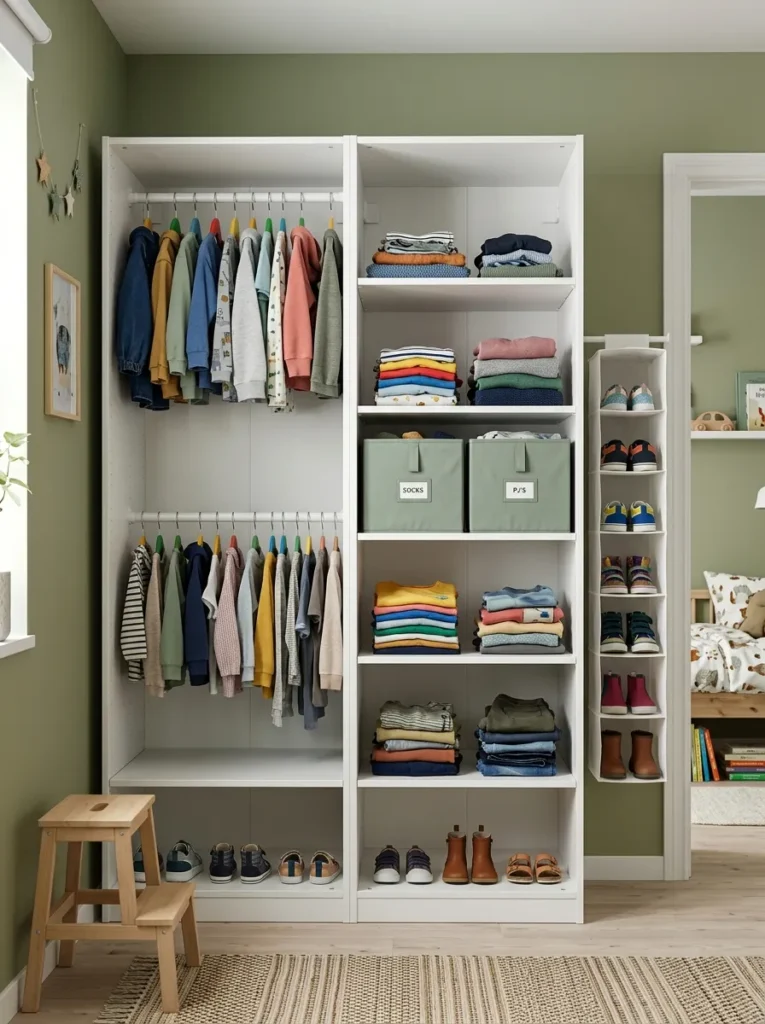
Vibe: The doorless PAX wardrobe feels like a children’s boutique that has been installed in a bedroom wall — the open configuration making every item visible and accessible, the SKUBB boxes adding the only closed storage where it is genuinely needed.
Why it works: An IKEA PAX wardrobe with a child-specific interior configuration applies the visibility-first principle — removing the PAX doors (or leaving them off) converts the wardrobe from a closed storage unit into an open one, making every item within it fully visible from the bedroom. For children who struggle to maintain organizational systems, this visibility is the single most impactful change available: when everything can be seen, nothing is forgotten in a closed drawer, and the return-to-storage decision is made with full awareness of where the item belongs. The SKUBB fabric boxes (available from IKEA in coordinating color families) provide the only closed storage where it is genuinely beneficial — folded seasonal items or less frequently accessed clothing.
Configuration guidance: For children aged 4–8: lower hanging rod at 65–75cm, upper rod at 110–120cm, shelf spacing of 25–30cm for folded items. For children aged 8–12: lower rod at 80cm, upper rod at 130cm, shelf spacing of 30–35cm. Adjust the KOMPLEMENT interior components as the child grows.
Shop The Look
| Product |
|---|
| IKEA PAX wardrobe frame 100cm |
| KOMPLEMENT shelving set PAX |
| SKUBB box sage fabric 2-pack |
| IKEA KOMPLEMENT rod set |
| SKUBB shoe organizer door mount |
3. Over-Door Shoe and Accessory Organizer
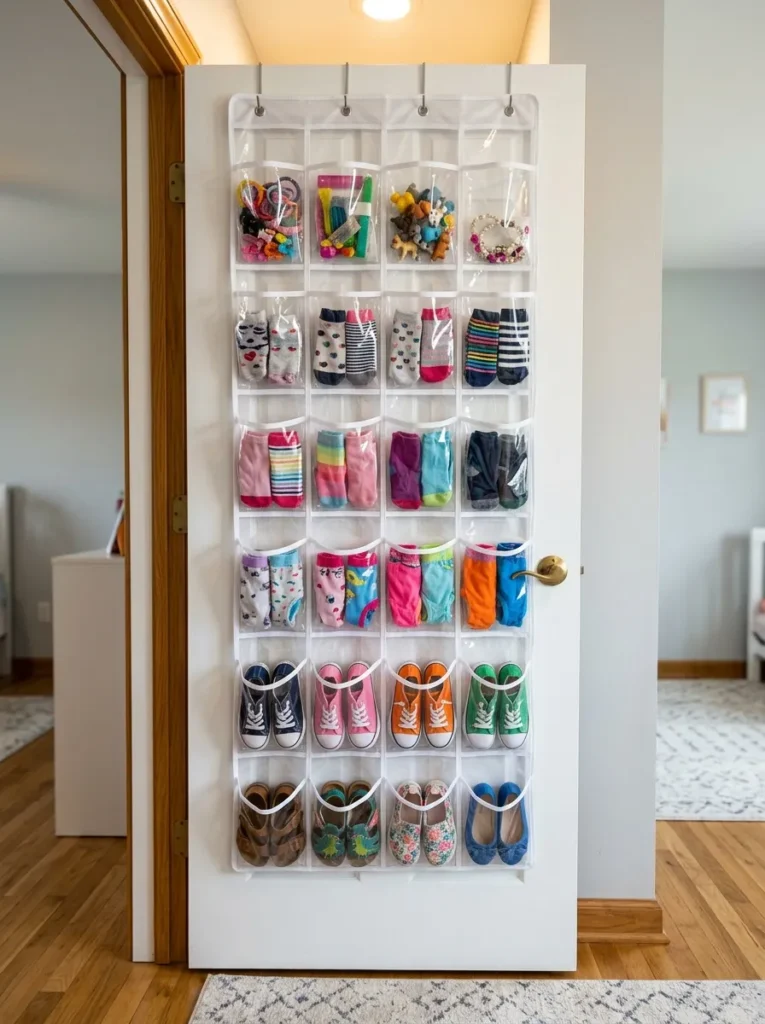
Vibe: The over-door organizer feels like finding an entire extra storage zone on a surface that was previously contributing nothing — the door’s interior face converted to a comprehensive accessory and shoe library.
Why it works: An over-door pocket organizer on a closet door applies the dormant surface activation principle — the interior face of a closet door is typically the only completely unused surface in a small closet system. A 24-pocket clear organizer hung over the door converts approximately 0.5 square metres of unused vertical surface into approximately 24 individual storage slots, which in a children’s closet accommodates the small-item categories (socks, underwear, hair accessories, belts, small toys) that typically consume dedicated drawer space. The clear pocket format is specifically appropriate for children because it makes all contents immediately visible without any drawer-opening or rummaging — the child can see exactly where their socks are, exactly which shoes are available, and exactly where each accessory category lives.
Cost: Over-door organizers are among the most cost-effective storage additions available — $8–18 for a full-door clear pocket organizer from most homeware retailers. Installation requires no fixings — the organizer’s hook hangs over the door’s top edge.
Shop The Look
| Product |
|---|
| Clear pocket over-door organizer 24 |
| Over-door hook set reinforced |
| Children’s shoe organizer door |
| Sock and underwear pocket organizer |
| Hair accessory small pocket set |
Also view: 13 Vintage Florida Design Ideas That Feel Timeless
4. Labeled Bin and Basket System for Toy Overflow
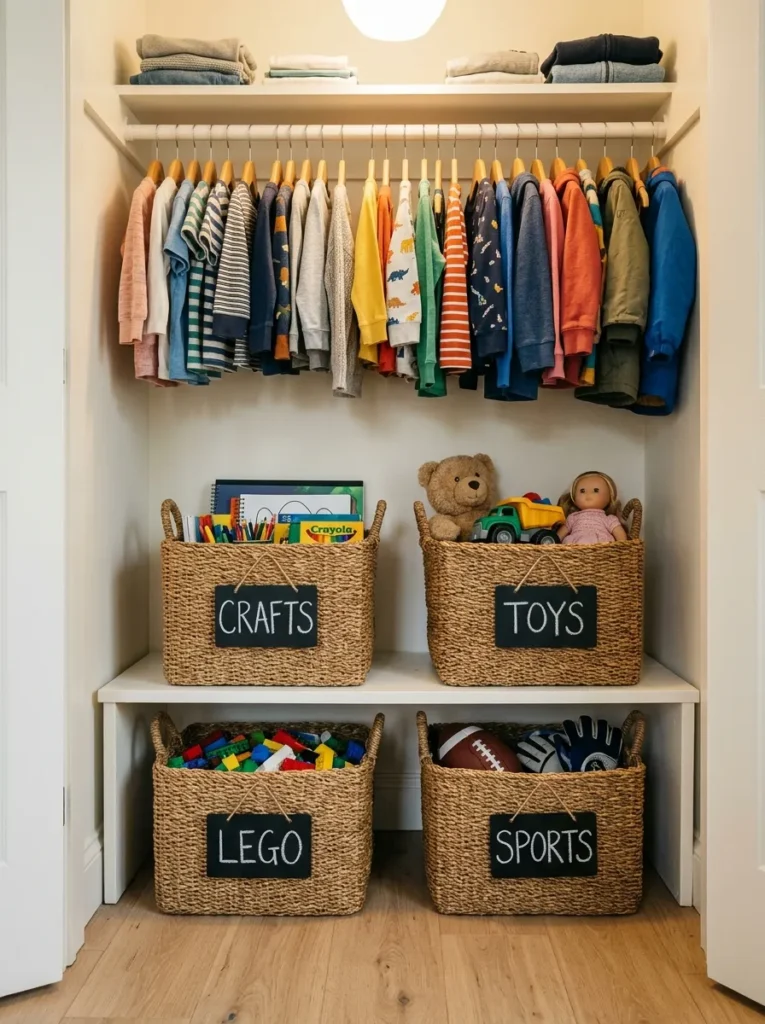
Vibe: The labeled bin system feels like the toy chaos accepted a reasonable compromise — the generous, approachable bins low enough for a child to use independently and specific enough for a child to know where each thing belongs.
Why it works: A labeled bin and basket system in a children’s closet applies the category clarity principle — children’s toy and activity material storage works most reliably when organized into a small number of large, clearly labeled categories (four to six categories maximum) rather than a large number of small, specifically organized categories. A child who has a LEGO bin and a CRAFTS bin can make the retrieval and return decision correctly in under three seconds; a child who has “small LEGO pieces,” “large LEGO bricks,” “LEGO minifigures,” and “LEGO instruction booklets” as separate categories will inevitably merge them and abandon the system. The chalk label format (a small chalkboard tag that can be re-labeled as the child’s possessions evolve) allows the category system to update without the expense of reprinting or purchasing new labels.
Building the two-level system: Install a single shelf at 35cm height across the closet’s full width (or across the floor portion not occupied by shoes). This shelf doubles the available bin positions within the lower closet zone — four bins on the floor level and four bins on the shelf provide eight total storage positions in the same footprint that four floor bins alone would occupy.
Shop The Look
| Product |
|---|
| Seagrass basket bin set 4 |
| Chalk label tag set tied |
| Low shelf board 35cm height |
| Simple L-bracket low shelf |
| Chalk marker white fine tip |
5. Clear Stackable Shoe Storage — Visibility and Economy
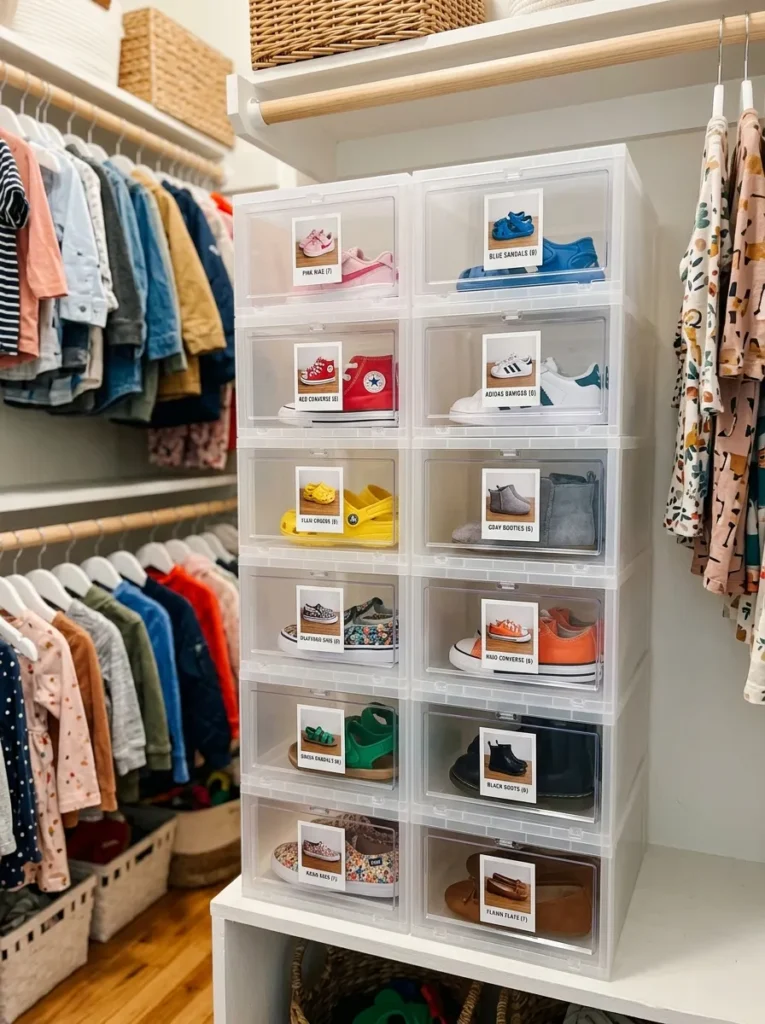
Vibe: The clear shoe box stacks feel like a children’s shoe shop curated down to the essentials — the graphic display of twelve pairs in identical clear boxes converting a practical storage need into a composed visual element.
Why it works: Clear stackable shoe boxes for children’s shoe storage apply the visual inventory principle — a child who cannot see which shoes are in which box will either forget pairs exist or empty every box to find a specific pair. Clear-front stacking boxes eliminate this problem entirely: the shoe pair is visible from the front, the stack is stable, and the boxes are repositionable in any sequence without losing the visual inventory. Photo labels (a small photograph of the shoe attached to the box front with a label holder) add a further retrieval aid specifically useful for younger children who cannot yet read text labels — the photo of the shoe rather than a text description allows independent self-service retrieval.
Photo label technique: Photograph each pair of shoes against a plain white background. Print at 3×4cm on a home printer or photo printing service. Laminate if possible. Attach to the box using a small adhesive label holder (available from stationery retailers in clear plastic self-adhesive format).
Shop The Look
| Product |
|---|
| Clear stacking shoe box set 12 |
| Adhesive label holder clear set |
| Small photo label print paper |
| Laminator pouch small set |
| Label holder self-adhesive clear |
6. Pegboard Closet Back Wall for Accessories and Tools
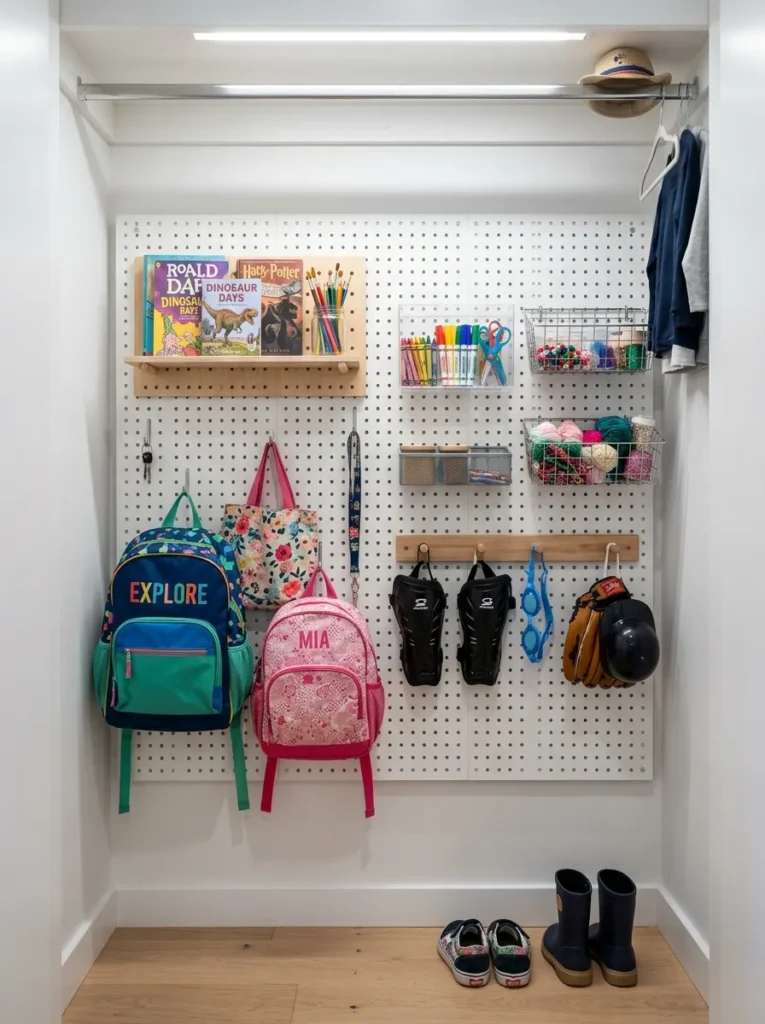
Vibe: The pegboard closet back wall feels like the accessories finally have an address — every bag, sports item, and craft supply with its own specific hook or shelf, the pegboard converting the back wall from unused space to the closet’s most functional surface.
Why it works: A pegboard back wall in a children’s closet applies the adaptable infrastructure principle — pegboard (perforated hardboard or MDF with regularly spaced holes) provides a wall surface that accepts any combination of hooks, shelves, containers, and rails in a completely reconfigurable system that can be updated without tools as the child’s possessions and interests change. The back wall of a children’s closet is typically the most overlooked storage surface — it is visually accessible when the closet is open but is rarely utilized beyond the occasional hook. A full-height pegboard panel on the back wall can accommodate six to ten different categories of accessories within a 90×140cm surface, addressing the bags, sports equipment, craft supplies, and personal accessories that would otherwise occupy shelving or floor space.
Installation: Mount the pegboard panel 2cm away from the back wall using spacer blocks (the gap is required for pegboard hooks to engage correctly). Fix the spacer blocks to the back wall using construction adhesive or screws, then fix the pegboard to the spacer blocks with finishing nails.
Shop The Look
| Product |
|---|
| White pegboard panel closet size |
| Pegboard hook set assorted |
| Pegboard shelf small wooden |
| Pegboard rail sports accessories |
| Pegboard container bin mounted |
7. Tiered Hanging Organizer for Folded Clothes
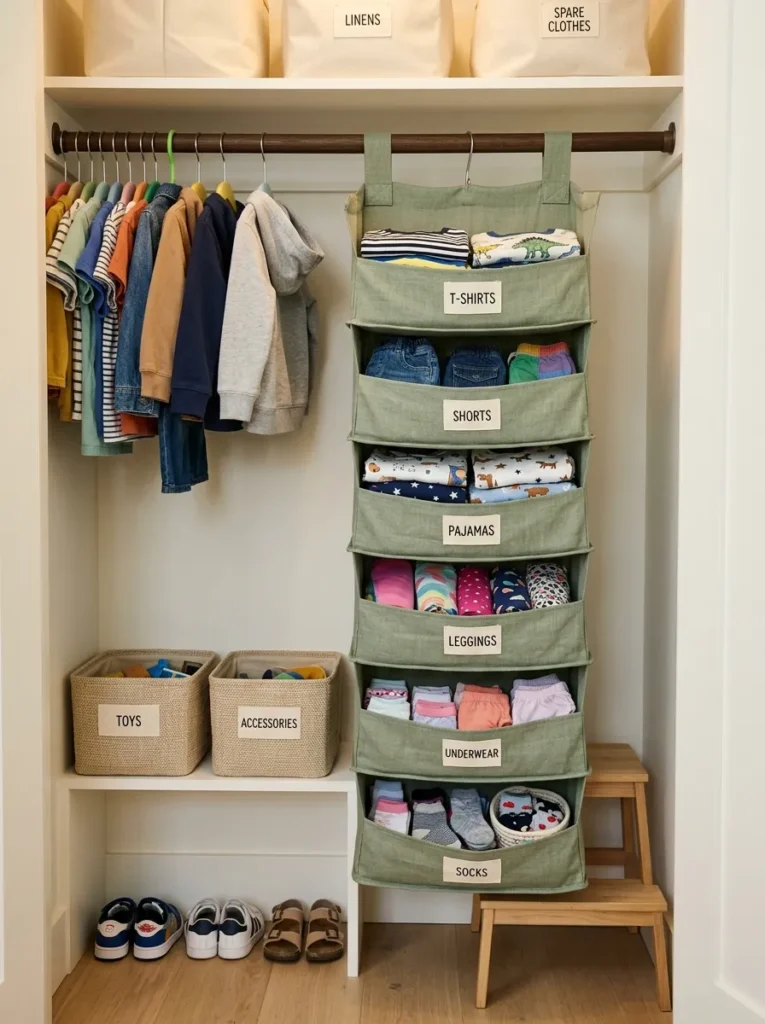
Vibe: The hanging tier organizer feels like a dresser drawer system that has been suspended in mid-air — the six-tier vertical stack providing the folded clothing storage that a chest of drawers provides while occupying only the hanging rod’s footprint.
Why it works: A hanging fabric tier organizer suspended from the closet rod applies the dresser-free bedroom principle — in small children’s bedrooms, a significant portion of the floor space is typically occupied by a chest of drawers that serves primarily as folded clothing storage. A hanging tier organizer in the closet provides equivalent folded clothing capacity within the closet footprint, eliminating the need for the dresser entirely and freeing the bedroom floor for play space. The hanging rod space occupied by the organizer (approximately 30cm of rod width) is significantly less than the floor space occupied by the dresser it replaces (typically 80–100cm floor width), making the net space gain substantial.
For maximum efficiency: Assign one tier per clothing category (not per clothing type within a category): all daywear tops together on one tier, all daywear bottoms on the next, sleepwear on the third, and so on. The child should be able to retrieve a complete outfit by accessing two adjacent tiers.
Shop The Look
| Product |
|---|
| Six-tier hanging fabric organizer |
| Natural canvas hanging organizer |
| Tier label set closet organizer |
| Rod reinforcement for added weight |
| Children’s clothing fold set |
8. Color-Coded Clothing System for Independent Dressing
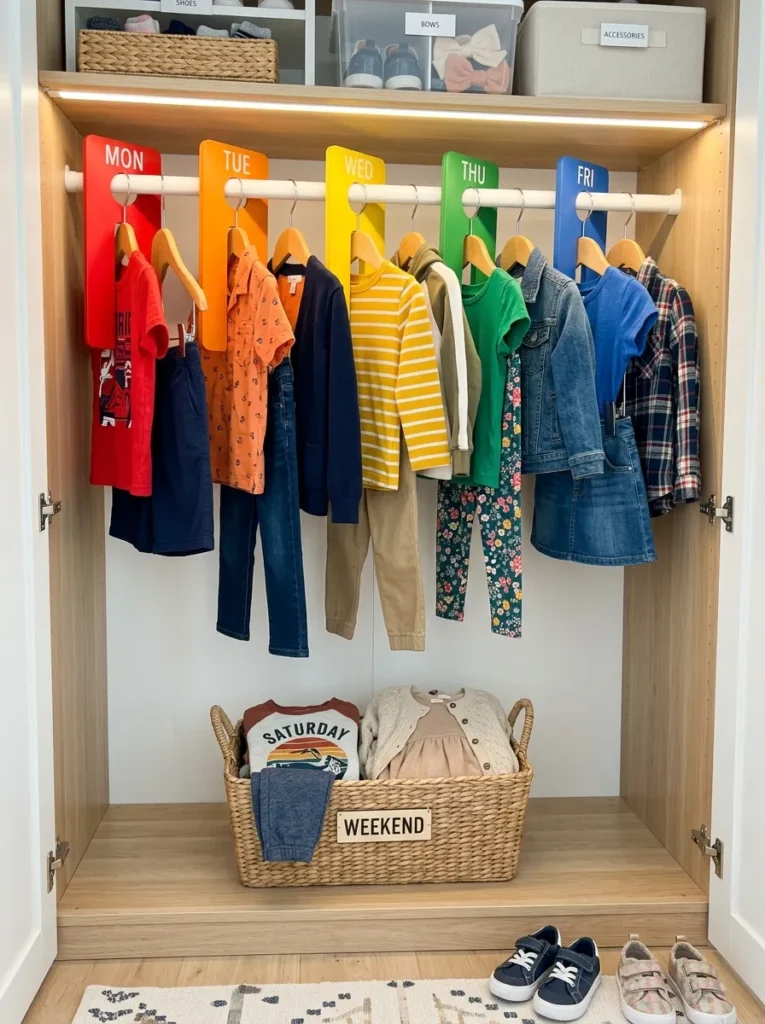
Vibe: The color-coded weekly system feels like the morning routine has been moved from Sunday evening’s argument to Sunday evening’s simple preparation — the five-section layout reducing every weekday morning decision to a single closet opening.
Why it works: A color-coded weekly clothing system applies the decision elimination principle — the morning clothing selection for a school-age child is one of the most time-consuming and conflict-prone daily household routines in families with young children. A pre-organized weekly system (five school-day sections, each containing one complete pre-selected outfit) eliminates the morning decision entirely. The child’s role shifts from “selecting and locating” (high cognitive load, high conflict potential) to “removing the day’s section” (zero cognitive load, immediate independence). Research in habit formation documents that eliminating decision-making at high-friction daily moments significantly reduces both the time and emotional energy the routine requires.
Implementation: On Sunday evening, the parent and child together select and pre-hang five complete outfits (top, bottom, and if needed a layer or cardigan, all on adjacent hangers in the same section). The Saturday and Sunday casual clothes are not pre-selected — they remain in a basket or the hanging weekend section for relaxed self-selection. Closet dividers ($8–15 for a set of seven from organizational retailers) clip onto the hanging rod to separate each day’s section.
Shop The Look
| Product |
|---|
| Closet divider day-of-week set 7 |
| Rainbow closet section label set |
| Weekend basket below rod |
| Velvet slim hanger matching |
| Sunday evening prep checklist |
9. Repurposed Bookshelf in a Small Closet — Folded Storage
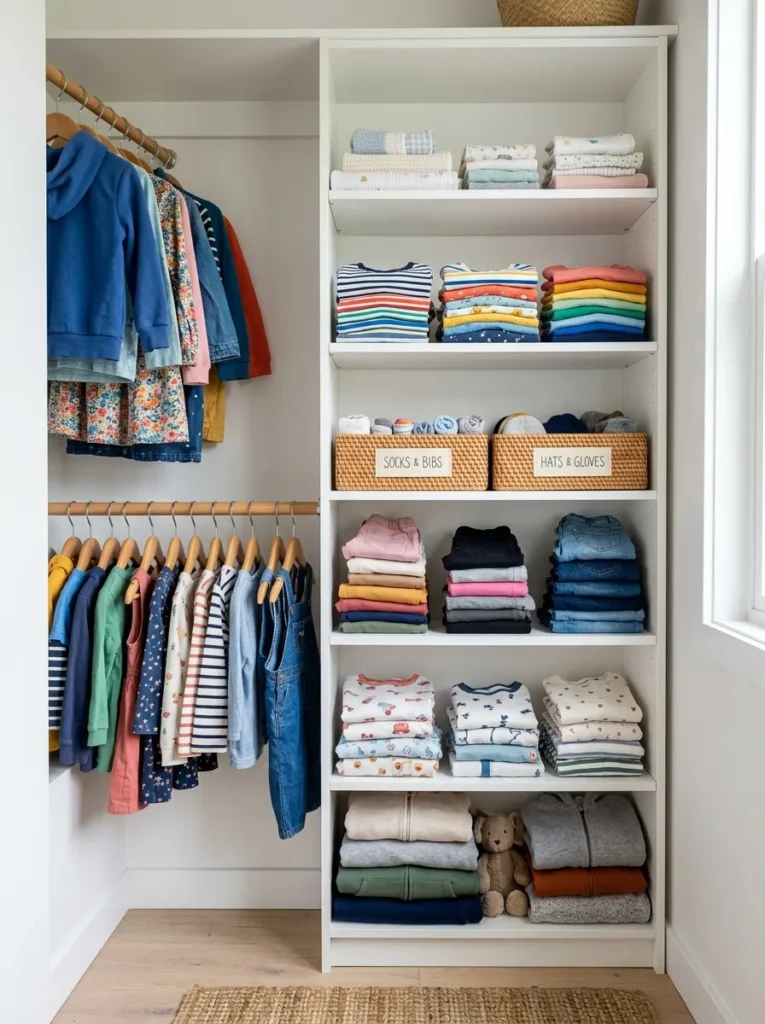
Vibe: The closet bookshelf feels like discovering that the shallow space beside the hanging clothes section was the dresser all along — the standard bookshelf’s proportion perfectly matched to the specific spatial logic of a children’s closet.
Why it works: A repurposed bookshelf in a children’s closet applies the furniture-as-closet-insert principle — standard bookcases (particularly the IKEA BILLY at 28cm depth, or equivalent narrow bookcases) have a depth that is precisely appropriate for folded children’s clothing storage (folded children’s clothing in standard horizontal stack occupies 20–25cm of shelf depth). This means a standard narrow bookshelf serves as a complete folded clothing storage unit within the closet’s limited depth without wasting the space behind each folded item stack. A 25–30cm deep closet side section (the section beside the hanging rod) that would typically be used for a single row of shelves with significant depth waste can be replaced by a narrow bookshelf that provides six full-width shelves within the same space.
For the most efficient installation: The bookshelf should be the same height as the closet interior and should fit the side section width precisely — measure the closet depth and purchase or cut a bookshelf to match. Fix the bookshelf to the closet wall with anti-tip anchor as standard safety practice.
Shop The Look
| Product |
|---|
| Narrow bookshelf 25cm depth |
| Small woven divider box set |
| Shelf label set folded clothing |
| Anti-tip anchor bookshelf safety |
| Clothing fold organizer tool |
10. Tension Rod Shoe Rack — No-Drill Lower Closet
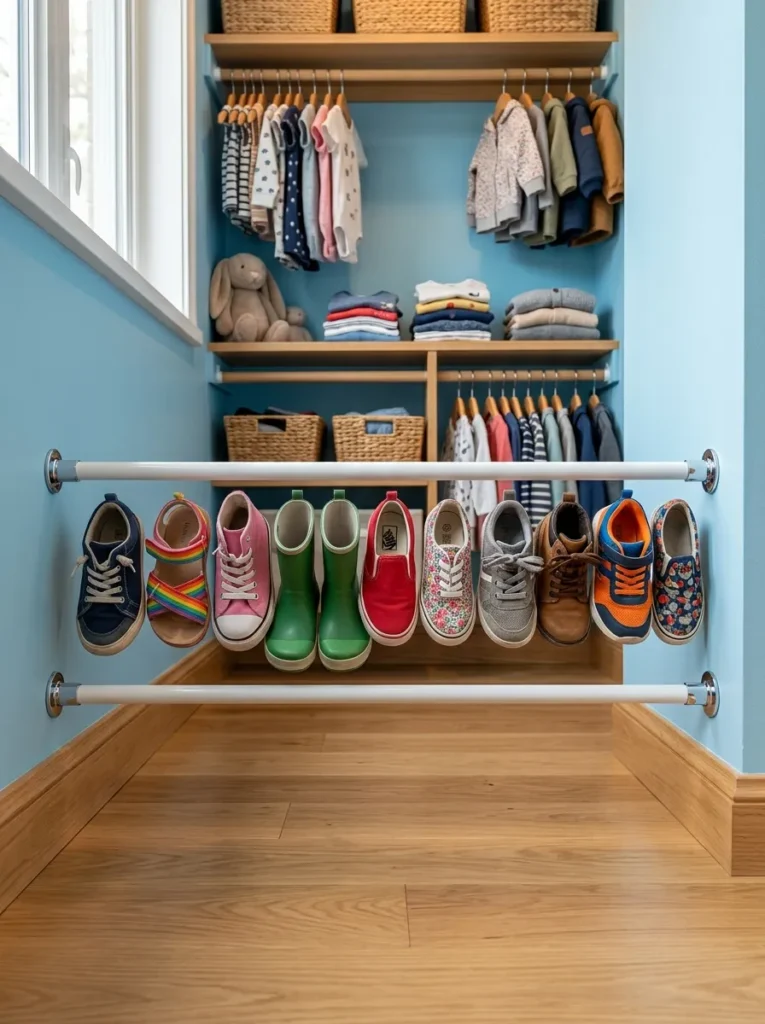
Vibe: The tension rod shoe rack feels like an engineering discovery hiding in the bottom of a closet — the two-rod system converting what is normally the messiest closet zone into the most elegantly resolved.
Why it works: Two tension rods used as a shoe rack apply the heel-hang storage principle — shoes hung by their heels over a horizontal rod with a second rod supporting the toe angle stack in approximately half the floor space of the same shoes laid flat or stored in a traditional shoe rack. The no-drill tension rod installation (tension rods expand to grip between the two side walls of the closet) is specifically appropriate for rental properties, for closets with finished walls that must not be drilled, and for a quick, low-cost implementation that can be adjusted or removed without wall repair. The cleared closet floor beneath the hung shoes (typically 15–18cm of clearance) accommodates flat items — a shallow storage tray for out-of-season shoes, a mat, or simply a clean floor surface.
Installation: The two tension rods should be installed approximately 12cm apart vertically (upper rod at approximately 20cm from the floor, lower rod at 8cm). The closet width determines the rod length required — tension rods are available in lengths from 25cm to 120cm in most homeware retailers. For very wide closets, install two pairs of tension rods at separate positions.
Shop The Look
| Product |
|---|
| Tension rod set pair white |
| Tension rod 45–75cm adjustable |
| Children’s shoe set organized |
| Floor tray below shoe rack |
| Non-slip tension rod end set |
11. Kids Closet Reading Nook Conversion
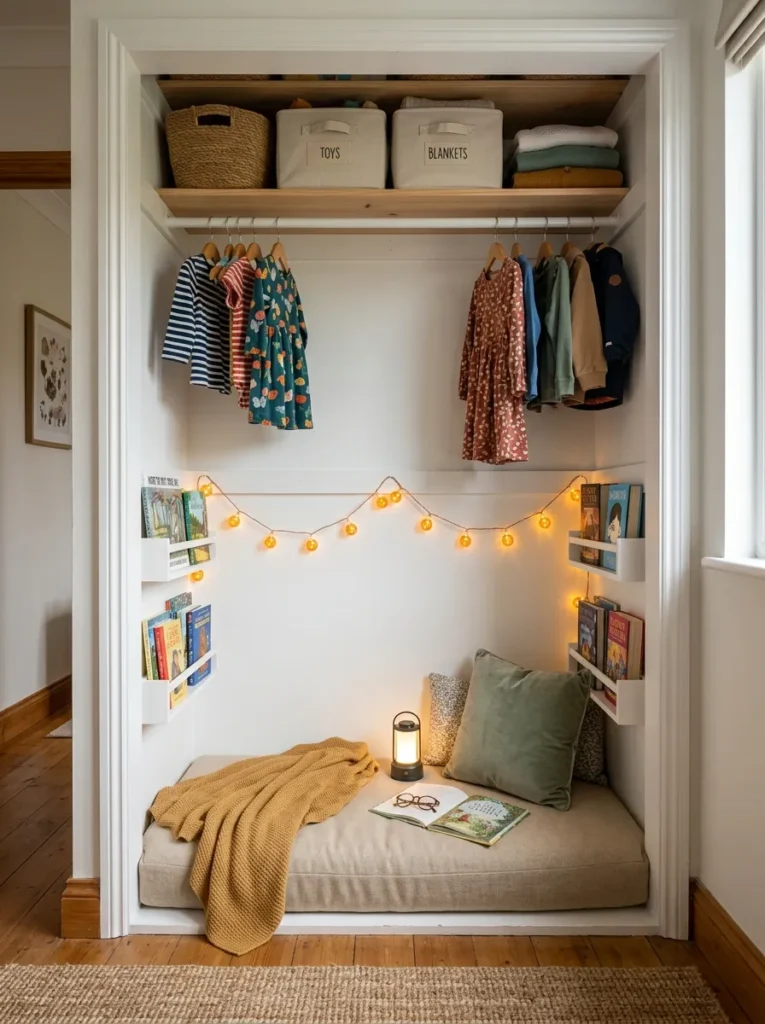
Vibe: The closet reading nook feels like the best use of a small enclosed space that a child has ever discovered — the converted lower section providing the private, enclosed den environment that children instinctively seek.
Why it works: A partial closet reading nook conversion applies the dual-function principle — the lower section of a children’s closet (below 90cm) is typically the least efficiently used zone in a standard closet configuration: the rod hanging requires approximately 120cm of clearance, making the lower 40–50cm of a standard closet accessible only for shoe storage or floor bins. Converting this lower zone into a reading nook provides the enclosed, private space that child development research consistently identifies as a key component of children’s cognitive and emotional wellbeing — the ability to be in a small, contained space within the larger home is a need that the closet nook specifically addresses. The upper half of the closet retains its full clothing storage function, so the clothing storage capacity is not compromised by the nook.
Implementation: Remove the closet floor-level rod (if any) and install a fitted cushion (an MDF base board with foam and fabric covering, or a purchased seat pad cut to the closet width). Install two small shelves on the closet side walls at 60–70cm height for book access. String warm amber fairy lights (battery operated for safety with no trailing cord) along the top of the nook zone.
Shop The Look
| Product |
|---|
| Closet floor cushion pad fitted |
| Battery fairy lights warm amber |
| Small side wall shelf pair |
| Battery reading light small |
| Children’s book selection small shelf |
12. Art Supply Station in a Half-Closet
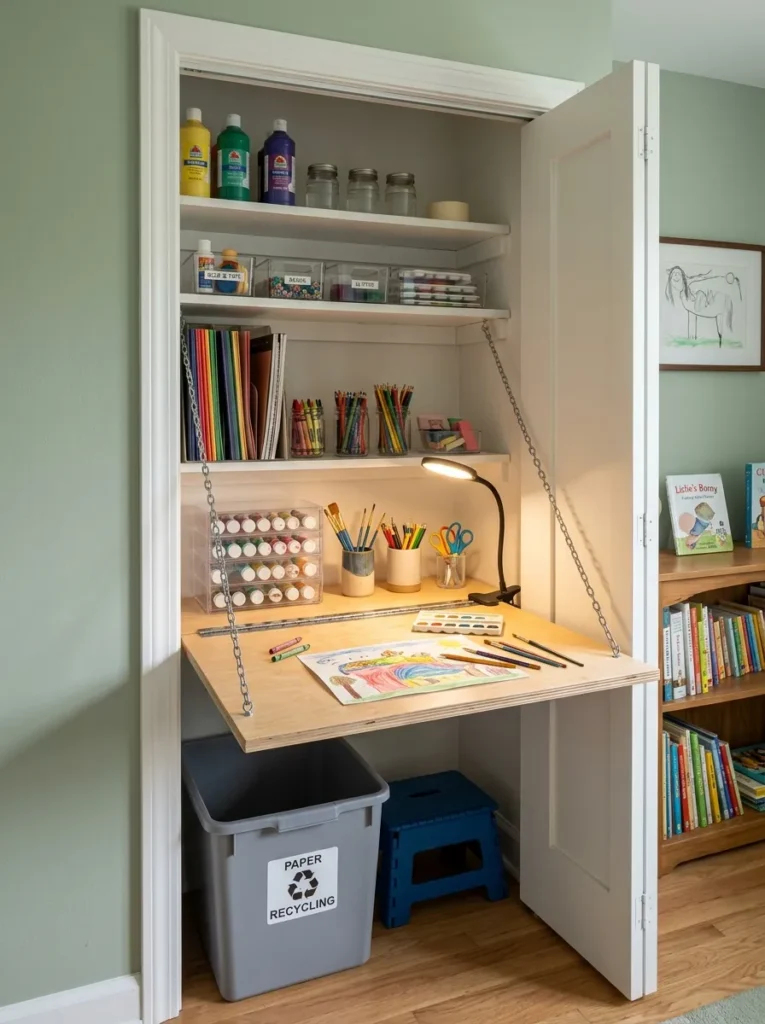
Vibe: The art station closet feels like it solved the art supply problem and the bedroom mess problem simultaneously — the fold-down surface and the organized supply shelves creating a complete creative workspace that disappears behind a closed door.
Why it works: An art supply station in a closet section applies the contained creative space principle — art supplies are among the most organizationally challenging children’s possessions because they are numerous in individual item count, varied in size from small (single colored pencils) to large (A2 paper pads), require accessibility for regular use, and create significant visual clutter when stored on open bedroom shelving. A dedicated closet section with a fold-down work surface and organized supply shelves addresses all four dimensions simultaneously: the fold-down surface provides a dedicated work area that prevents art from spreading to the bedroom floor, the organized shelves make all supplies visible and accessible, and the closing closet door removes the visual clutter from the bedroom entirely when art time is over.
Fold-down surface construction: The surface is a 16mm plywood board cut to the closet width at approximately 40cm depth, hinged at the wall side using a 50cm piano hinge, and supported in the open position by two 30cm chain supports (the same hardware used for lid stays in blanket chests). The surface height of 70cm is appropriate for a child standing or using a tall stool.
Shop The Look
| Product |
|---|
| Piano hinge 50cm fold-down |
| Chain support lid stay pair |
| Clear acrylic art supply organizer |
| Vertical paper file holder A4 |
| Pull-out bin recycling paper |
13. Seasonal Rotation System — Current and Storage Zones
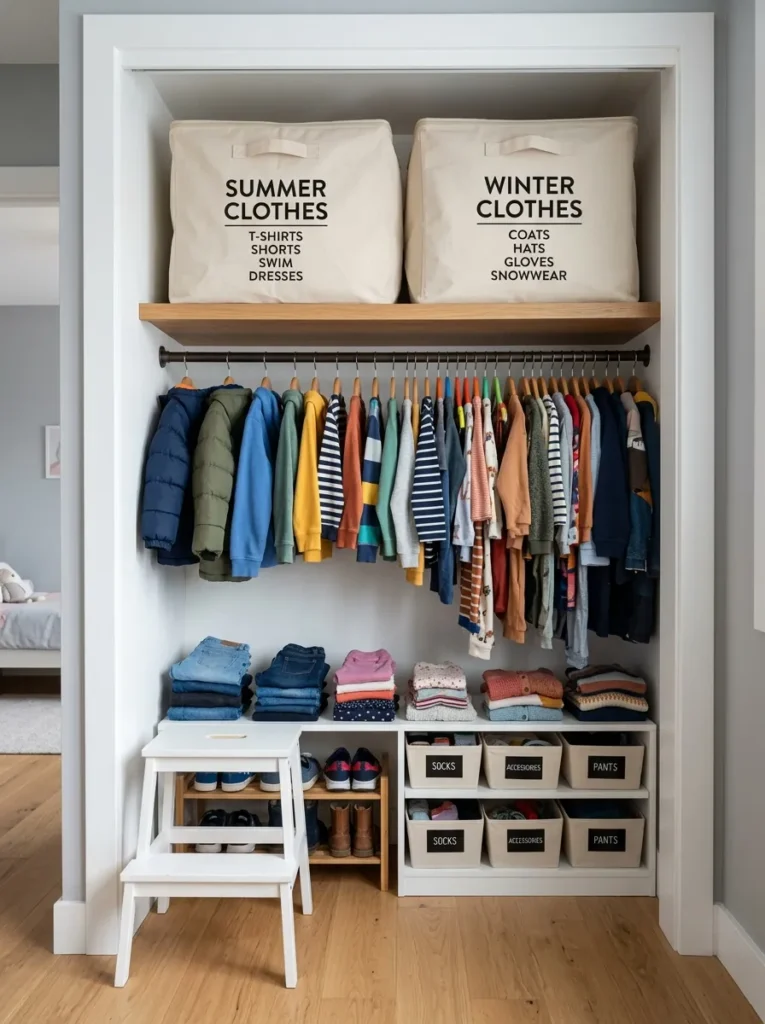
Vibe: The seasonal rotation system feels like the most honest organizational response to a closet that must hold more than it can comfortably display — the two-zone approach acknowledging that not all clothes need to be accessible at once and acting on that acknowledgment.
Why it works: A seasonal rotation system for a children’s closet applies the inventory management principle — a children’s wardrobe at any given time contains three categories of clothing: current-season active items, current-size future-season items (stored for when the season changes), and next-size items (stored for when the child grows). Trying to store all three categories in the closet’s primary zone creates a crowded, visually complex system that is difficult for the child to navigate and maintain. The seasonal rotation system assigns only the current-season active items to the closet’s primary accessible zone (the area below 160cm) and moves all other categories to a dedicated high-level storage zone (above 160cm) that the adult accesses at seasonal transitions. This dramatically simplifies the primary zone’s organizational challenge while keeping all clothing within the same physical closet.
Implementation: Twice per year (at the spring-summer and autumn-winter transitions), the adult retrieves the stored bags from the upper zone, sorts into the appropriate primary zone sections, and moves the out-of-season items to labeled storage bags at the upper zone. This bi-annual effort replaces the ongoing organizational maintenance challenge of managing three clothing categories simultaneously.
Shop The Look
| Product |
|---|
| Large labeled storage bag set |
| SUMMER label set textile |
| WINTER label set textile |
| Step stool folding compact |
| Vacuum storage bag large |
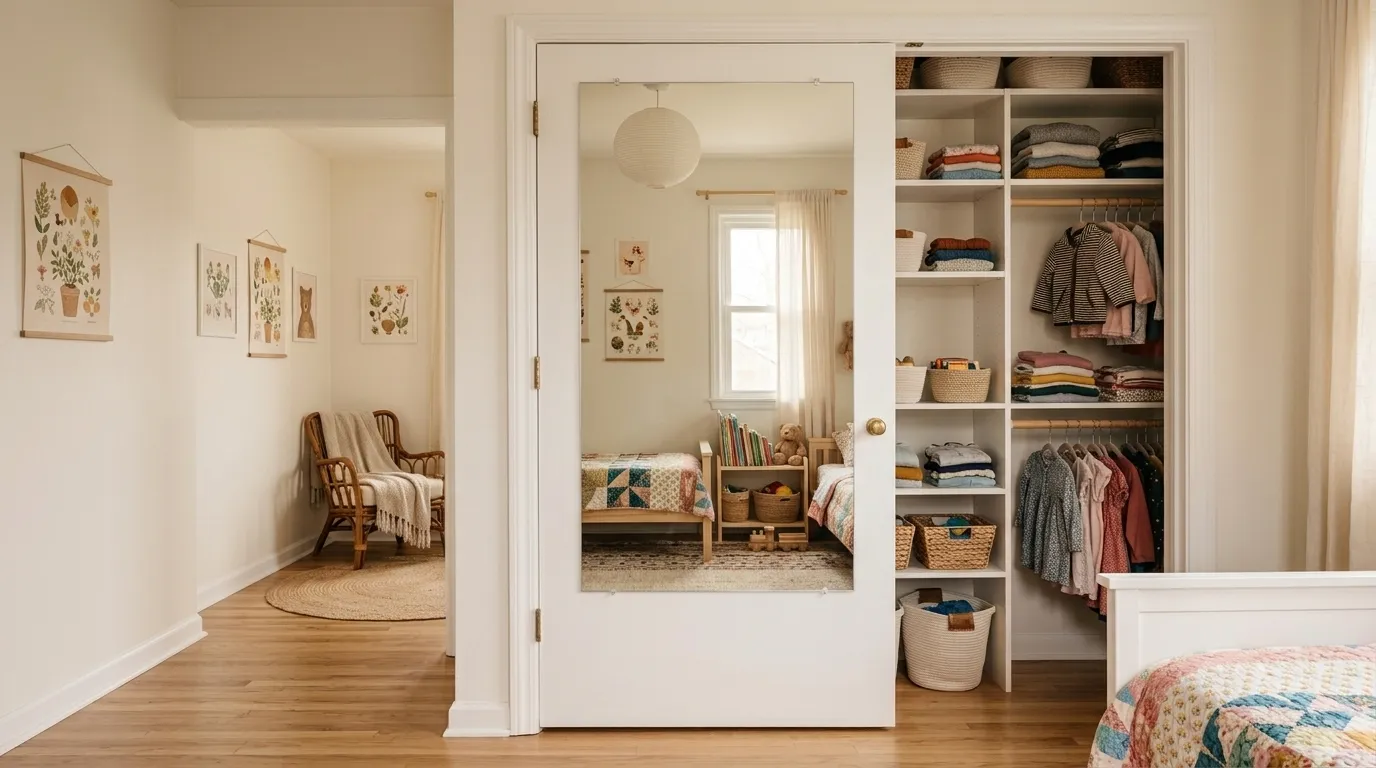
14. Mirror Panel on Closet Door — Space and Function
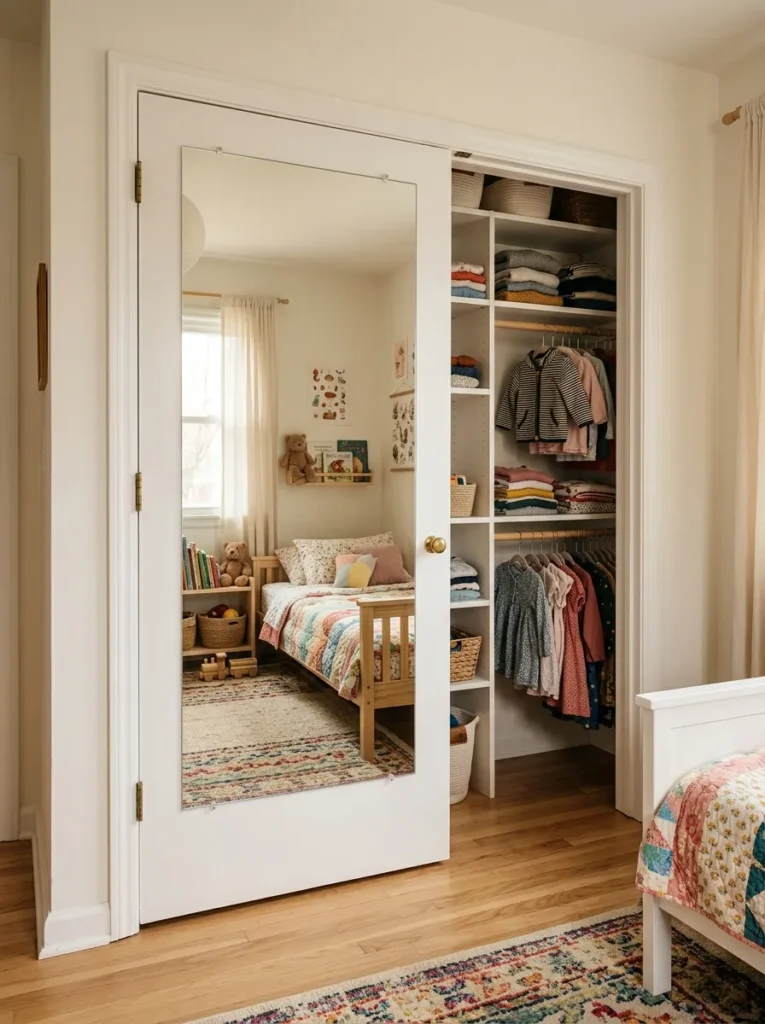
Vibe: The mirror-door closet feels like a small room that decided to look larger rather than complaining about being small — the mirror solving the dressing mirror problem and the bedroom’s spatial compression problem simultaneously.
Why it works: A full-length mirror on a closet door exterior applies the dual-function space expansion principle — a separate freestanding dressing mirror in a small children’s bedroom typically occupies 30–50cm of floor width that the small room cannot comfortably afford. Fitting the mirror to the closet door eliminates the floor footprint entirely while providing the full-length mirror function, and the mirror’s reflective surface simultaneously makes the bedroom appear wider by reflecting the room’s natural light and depth across its own surface. For children developing independent dressing skills, a full-length mirror at the closet door creates the self-assessment capacity (can I see my full outfit?) that a small face mirror cannot provide.
Specification: A full-length mirror on a closet door is best specified as a mirror-effect acrylic sheet (lighter than glass, safely shatter-resistant if the door is bumped open hard) rather than a glass mirror. Mirror-effect acrylic in 3mm thickness is available from specialist plastics suppliers cut to door dimensions.
Shop The Look
| Product |
|---|
| Mirror effect acrylic panel door |
| Mirror adhesive mounting set |
| Door mirror frame self-adhesive |
| Mirror panel mounting clip set |
| Safety film mirror backing |
15. Complete Small Closet Makeover — Every Zone Addressed
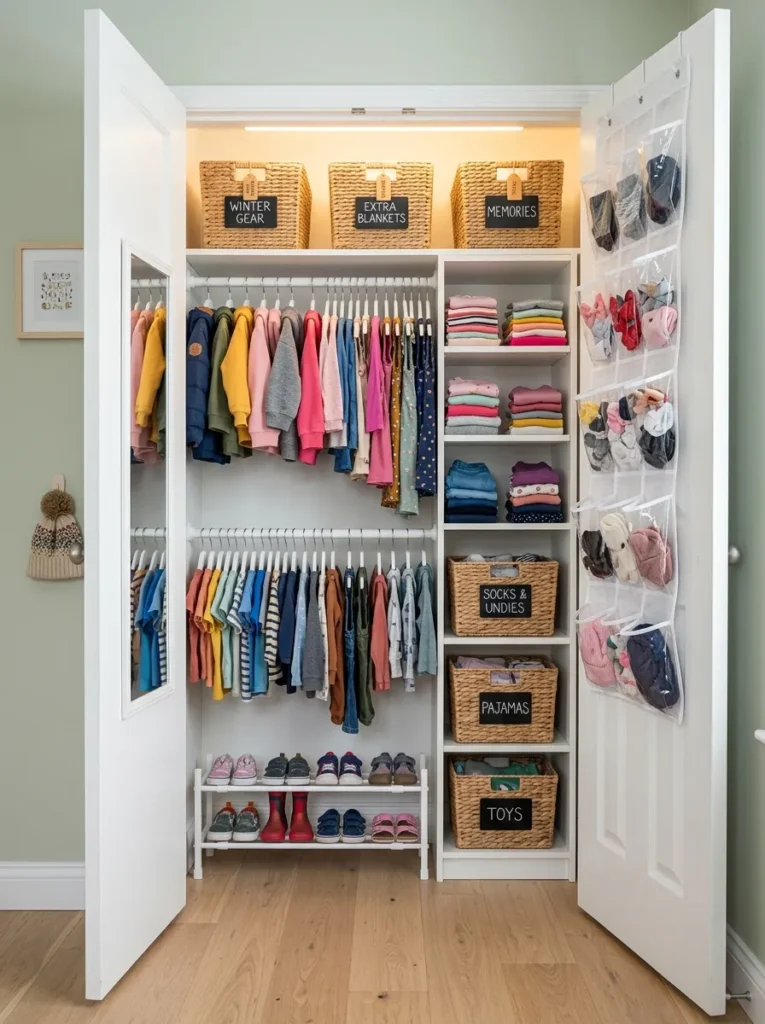
Vibe: The complete closet makeover feels like every decision was made in service of the child who uses it every day — the comprehensive system addressing every organizational challenge in the same 75cm of closet width that previously contained only chaos.
Why it works: A comprehensive small closet makeover that addresses every zone simultaneously applies the system integration principle — the most common closet organization failure is addressing one zone (installing a shoe rack, adding a shelf) while leaving other zones disorganized, producing a closet that is improved but not transformed. A comprehensive makeover that assigns every cubic centimetre of closet space to a specific organizational purpose produces a qualitatively different result: the child experiences the closet as a complete, navigable system rather than an improved but still imperfect space. The comprehensive makeover also captures the cross-zone efficiency gains that single-zone interventions miss — the double hanging rod creates floor space for the tension rod shoe system, which creates shelving space previously consumed by floor shoes, which frees the narrow shelf unit for folded clothing rather than shoe overflow.
The complete inventory for this 75cm closet makeover: Double hanging rod ($15–30); narrow five-shelf unit ($35–80); tension rod pair for shoe rack ($8–15); over-door clear pocket organizer ($10–18); exterior door mirror or acrylic panel ($25–50); LED closet strip light ($8–15); chalk-labeled woven bins ($6–12 each × 4); total investment: $120–240 depending on material choices, producing a complete organizational system within a standard children’s small closet.
Shop The Look
| Product |
|---|
| Double rod kit closet |
| Narrow five-shelf unit white |
| Tension rod pair shoe rack |
| Over-door clear organizer |
| Closet LED strip light warm |
How to Start Your Kids Closet Organization Project
The single best first move before purchasing any closet organization product is conducting a complete inventory audit of the child’s current clothing and possessions — removing everything from the closet, sorting into categories on the floor, and counting items in each category before making any purchasing decisions. This audit (which takes 45–90 minutes for most children’s closets) consistently reveals two things that most closet organization projects do not account for: the significant quantity of items that should be removed from the closet entirely (clothes that no longer fit, shoes that have been outgrown, toys that are no longer played with, accessories that have lost their pairs or batteries) and the actual quantity of items in each category (which determines the shelf height, bin quantity, and rod length required). An organization system purchased for an imagined inventory frequently does not fit the actual inventory when it arrives.
The most common mistake in children’s closet organization is purchasing more storage than the closet can hold — the instinct to solve a storage problem by adding more containers, more shelves, and more organizational products frequently produces a closet that is more crowded, not less. The correct response to an overflowing children’s closet is typically to remove items before adding any storage products. The decluttering step (removing all out-grown clothing, all broken or incomplete toys, all duplicate items, and all items that have not been touched in six months) consistently reveals that the existing closet is adequate for the remaining items, and that the organizational challenge is arrangement rather than capacity.
Three specific products under $30 that immediately improve any children’s small closet: a set of matching slim velvet hangers ($12–20 for 30 hangers, which reduces the visual clutter of the hanging section more than any other single intervention and recovers approximately 30% more rod space than wire hangers); an over-door clear pocket organizer ($10–18, which converts the unused interior face of the closet door into organized storage for small items without any wall holes); and a pack of chalk label tags ($5–8 for 20 tags, which provides the labeling system that converts an organized arrangement into a self-maintaining one that the child can use independently). These three products combined for under $40 address the hanging section, the door, and the labeling system — the three organizational elements that most directly affect whether the child can maintain the closet independently on a daily basis.
Frequently Asked Questions About Kids Closet Storage for Small Spaces
At what height should closet rods and shelves be positioned for children?
The correct height for a child-accessible hanging rod is dependent on the child’s age and height, but the practical guideline is: the rod should be at the height where the child can comfortably reach a hanging item without stretching — typically 70–80cm for ages 3–6, 80–95cm for ages 6–10, and 95–110cm for ages 10–14. A second adult-height rod above the child’s accessible rod (at 130–150cm) provides adult-managed hanging for special occasion clothes, seasonal items, and anything that does not require daily child access. Shelf heights for folded clothing should ensure that the child can see into the top of each shelf without tipping contents forward — for a child of 4–8 years, shelves should not exceed 120cm in height for the primary accessed shelves.
How do you maintain a children’s closet organization system once it is set up?
The most reliable maintenance practice for a children’s closet organization system is a monthly reset — a thirty-minute session at the end of each month where everything is returned to its designated location, any items that have accumulated in the wrong place are re-homed, and a quick assessment is made of what is no longer being used (and should be donated or stored). A quarterly seasonal rotation (removing out-of-season clothing to the high-level storage zone, introducing the current season’s items to the primary zone) prevents the gradual accumulation of non-current clothing in the primary accessible zone. The most important single maintenance practice is removing grown-out clothing immediately when discovered rather than leaving it in the closet to gradually crowd out the current items.
What is the most important factor in a children’s closet organization system?
The single most important factor in a children’s closet organization system is child accessibility — specifically, whether the child can retrieve and return their own possessions without adult assistance. An organization system that requires adult assistance for daily use is a system that will be abandoned by the child in favor of the floor, regardless of how well-designed it is from an organizational perspective. Every zone of the system that the child is expected to use daily should be within the child’s comfortable reach (below 120cm for most school-age children), organized into categories that the child can identify and use independently, and designed so that the return-to-storage action (putting things away) requires the same single motion as the retrieval action (getting things out).
How do you organize a closet that must serve a child from toddler through teenager?
A children’s closet designed for long-term use across multiple developmental stages should prioritize adjustability over fixed configuration. The IKEA PAX system with KOMPLEMENT accessories is the most adjustable commercial option — every shelf height, rod position, and accessory position can be changed without tools, allowing the same furniture to serve as a toddler’s accessible toy and clothing storage at 4 years and a teenager’s wardrobe and study accessory system at 14. DIY built-in systems should specify adjustable shelf pin hole strips (drilled at 32mm intervals along the full height of each vertical side panel) rather than fixed shelf supports — this allows shelf heights to be adjusted annually as the child’s clothing sizes, possessions, and organizational needs change.
How do you organize a children’s closet in a shared bedroom?
A shared bedroom children’s closet requires categorical separation between each child’s possessions as the primary organizational principle. The most practical approach is spatial division: assign the left half of the closet to one child and the right half to the other, with each half containing a complete organizational system (hanging section, shelf section, shoe storage) for that child independently. Color-coding (one child’s items on blue hangers, the other’s on pink or green) provides a secondary identification system that prevents mixing. In a very small shared closet where a 50/50 split creates inadequate space for each child, a floor-to-ceiling divider (a simple timber panel fixed between the closet floor and ceiling) creates two narrower but completely separate closet spaces, each with its own door if the closet opening permits.
Ready to Transform Your Child’s Closet?
These 15 ideas move through every dimension of what makes a children’s small closet genuinely organized and genuinely maintainable — from the foundational intervention of a double hanging rod that separates daily from occasional clothing, through the creative dual-function solutions of reading nooks, art stations, and floating book-and-cat shelf hybrids, to the comprehensive single-closet makeover that addresses every zone simultaneously for under $240. Starting with the inventory audit — everything out, everything sorted, everything counted — is the beginning that makes every subsequent purchasing decision precise rather than hopeful. It takes an hour and produces the specific knowledge that no closet organization guide can provide: what this child actually owns, in what quantities, in what categories, and therefore what storage products will genuinely solve the specific organizational challenge rather than the general one. Remove the grown-out items this weekend. Measure the closet this weekend. Order the matching velvet hangers and the chalk labels this weekend. When the closet is organized and the child opens it on a Monday morning and independently finds their outfit and puts on their shoes and is ready before you have finished your coffee — that is the organizational system that worked.