16 Contemporary Dining Room Decor Ideas Worth Saving
A contemporary dining room is a dining space designed with the defining characteristics of the current design moment — clean architectural lines, a warm but restrained material palette, intentional lighting at multiple levels, and a composition that balances visual interest with the breathing room that makes a room feel genuinely livable rather than merely styled. This article gives you 16 contemporary dining room decor ideas across lighting, furniture selection, wall treatment, textile layering, material pairing, and spatial organization so every element of your dining room contributes actively to a room that is both beautiful to look at and genuinely pleasurable to eat in.
A dining room that works is not merely a room with a table and chairs in it. It is a room where the light quality flatters the people gathered at the table, where the materials feel warm and considered at close range, where the proportions of every element relate intelligently to every other, and where the overall atmosphere communicates that this space was designed for the specific pleasure of gathering, eating, and talking together. The contemporary dining room achieves all of this without the ornamental complexity of traditional interiors or the austere coldness of strict modernism — it is warm minimalism in service of one of the most fundamental human social activities. Here are 16 ideas worth saving — and designing.
Why Contemporary Dining Room Design Works So Well
Contemporary dining room design draws from the convergence of three design movements that reached their synthesis in the current decade: the warm minimalism aesthetic that prioritizes natural materials and restrained color over decorative accumulation; the biophilic design impulse that integrates organic forms, botanical elements, and natural material textures into the built interior; and the hospitality design influence that has moved restaurant-quality lighting strategy, material specification, and spatial composition into residential dining rooms. The result is a dining room aesthetic that is simultaneously more beautiful and more livable than any of its predecessors — warmer than mid-century modernism, simpler than traditional style, and more material-rich than the grey-and-white minimalism of the previous decade.
The material palette of the contemporary dining room is specific and important. White oak and walnut are the dominant timber species — white oak for its warm, open grain and honey tone, walnut for its deep chocolate warmth and fine straight grain. Linen and boucle are the dominant textile materials — linen for its natural slub texture and warm cream-to-oat tonal range, boucle for its looped pile warmth and dimensional surface quality. Unlacquered brass and matte black are the two dominant hardware and fixture metals — brass for its warm gold patina that deepens rather than diminishes over time, matte black for its graphic weight and contemporary visual precision. Natural stone — marble, travertine, and quartzite — provides the cool mineral richness that balances the room’s warm wood and textile elements. These materials share the quality of improving with age and use rather than deteriorating from it.
The cultural appetite for contemporary dining room design has never been stronger. The growth of home entertaining — accelerated by the post-pandemic preference for hosting at home rather than in restaurants — has made the dining room a genuine design priority for a generation of homeowners who previously considered it a secondary or occasional space. The dining room has become a room that must function as beautifully for a Tuesday family dinner as for a Saturday dinner party, which demands a design intelligence that purely formal dining room design cannot provide. Contemporary dining room design meets this dual requirement through material quality that looks equally good under natural daylight and candlelight, furniture that functions both for everyday use and for entertaining scale, and an atmosphere that is warm without being formal and simple without being bare.
Small dining rooms respond particularly well to contemporary design principles because the palette restraint and material specificity of contemporary style eliminate the visual complexity that makes small rooms feel cramped. A small dining room with warm white walls, a white oak table, linen chairs, and a single warm pendant light has more visual intelligence and more spatial generosity than the same room crowded with patterned wallpaper, upholstered dining chairs in multiple colors, and a chandelier with too many arms for the room’s scale.
Style at a Glance
| Element | Detail |
|---|---|
| Philosophy | Warm materiality in simple form — every element chosen for quality over decoration |
| Key Materials | White oak, walnut, linen, boucle, unlacquered brass, matte black, natural stone |
| Key Colors | Warm white, dusty sage, warm charcoal, terracotta blush, deep forest green, warm greige |
16 Contemporary Dining Room Decor Ideas Worth Saving
1. Statement Pendant Light as the Room’s Primary Design Element
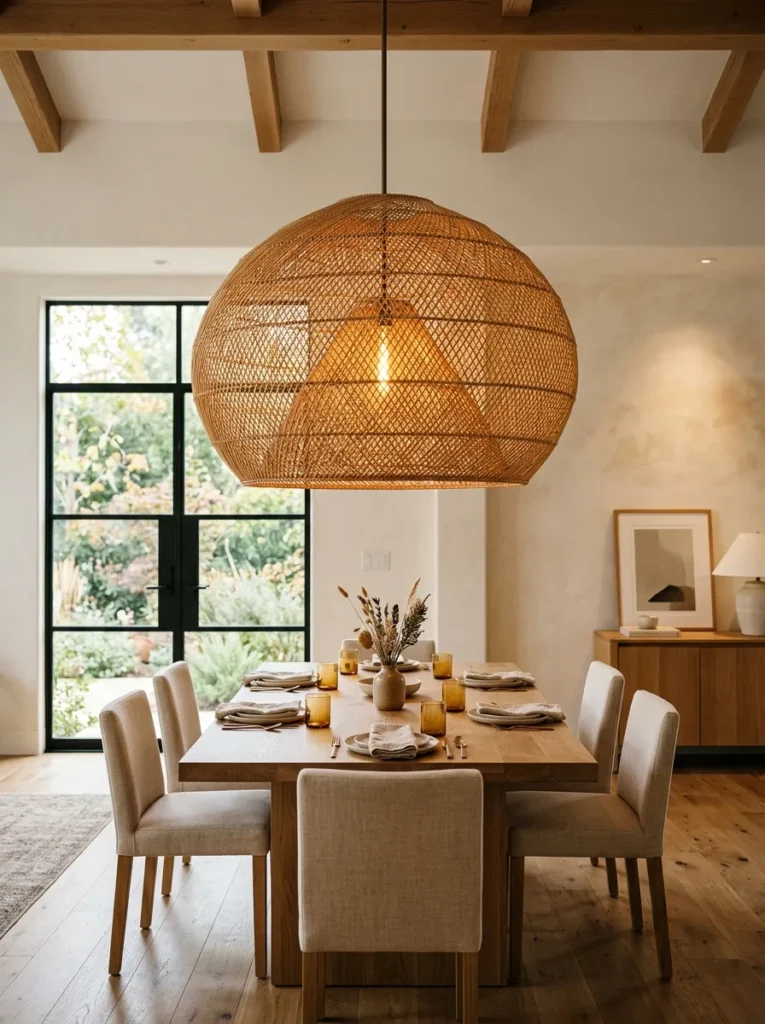
Vibe: The pendant is commanding — an oversized dining room pendant light that is sized correctly for its architectural role (rather than the conventionally undersized pendant that most dining rooms receive) transforms the room’s entire compositional hierarchy, making the light fixture the design statement it was always meant to be.
Why it works: The pendant light above a dining table is the room’s compositional center of gravity — the eye goes there first, and the quality of that first impression sets the tone for how everything else in the room is read. Most dining room pendants are undersized — 12 to 16 inches in diameter above a 36×72-inch table — which reads as insufficient and makes the light fixture look like an afterthought. The correct scale is 24 to 30 inches in diameter for a standard dining table, or approximately two-thirds of the table’s width. An oversized pendant in a quality material (woven rattan for warmth and organic texture, sculptural plaster for architectural weight, brushed brass for metallic warmth) creates the room’s primary design statement with a single object, allowing every other element in the room to be simpler and more restrained.
How to get it: The pendant should hang so its bottom is 30–36 inches above the table surface for a standard 8-foot ceiling. For higher ceilings, lower the pendant to maintain the 30–36-inch clearance rather than allowing it to float higher — pendants hung too high lose their visual connection to the table and read as ceiling fixtures rather than table lights. Use a warm white LED bulb at 2700K or lower for the most flattering dining room light quality. Dimmer switch control is essential — the pendant’s atmosphere-creating quality depends on the ability to lower the light level during meals.
Quick Win: Replacing an existing undersized pendant with a correctly-scaled version is the single highest-impact dining room change available — more impactful than any furniture, wall treatment, or accessory upgrade — and can be accomplished in an afternoon with basic electrical tools.
Shop The Look
- Oversized rattan pendant light 26 inch dining
- Sculptural plaster pendant light large
- Pendant light canopy adjustable cord
- Warm white LED bulb 2700K E26
- Dimmer switch single pole compatible
Also view: 14 Stylish IKEA Round Mirror Ideas for Every Room
2. White Oak Dining Table with Clean Waterfall Edge
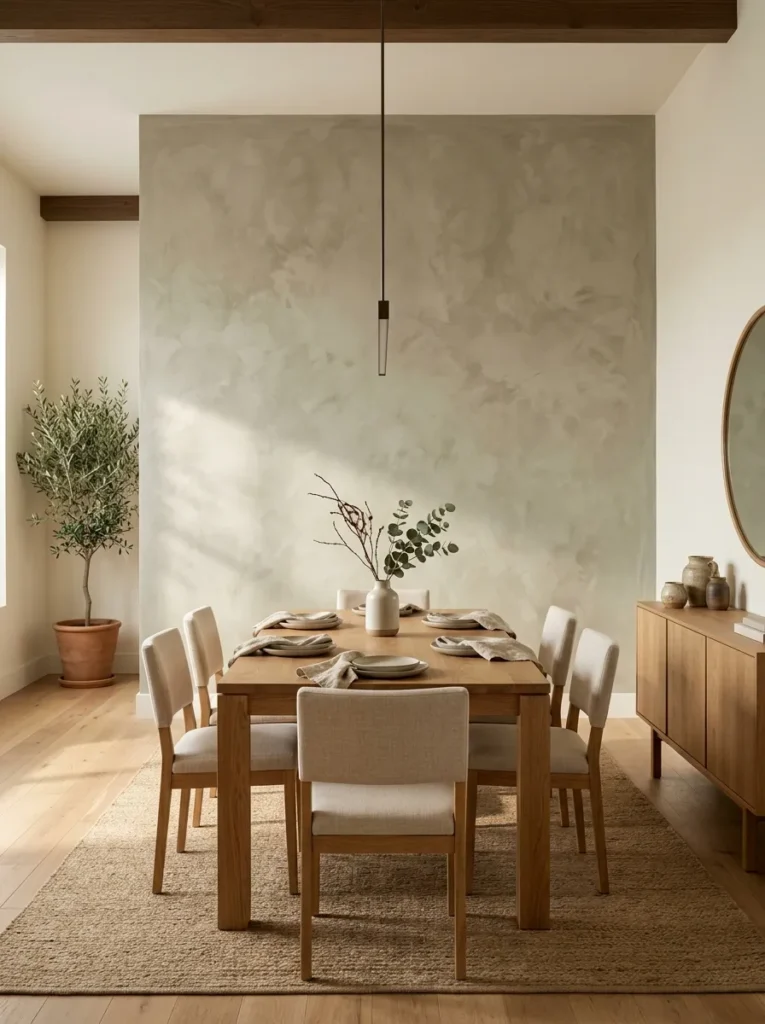
Vibe: The table is clean — a white oak dining table with a waterfall edge is the contemporary dining room’s most refined furniture gesture, where the grain-matched fold at the table’s end reads as both a technical accomplishment and a material celebration.
Why it works: The waterfall edge detail — where the tabletop wood grain runs continuously over the edge of the table end, matching precisely at the fold — is the contemporary furniture detail that most clearly communicates craftsmanship and material knowledge. It requires selecting and bookmatching the timber specifically for this continuous grain flow, cutting precisely at the fold, and joining with invisible mechanical fasteners — none of which is visible in the finished piece, but all of which is perceptible in the result’s quality. White oak specifically is the correct species for this application because its open grain structure and warm honey tone read beautifully in the strong directional light that a dining room window typically provides, and its hardness (Janka rating 1290) makes it durable enough for daily dining table use.
How to get it: White oak dining tables with waterfall edges are available from high-quality furniture makers and retailers at $1,500–$5,000 for a standard 36×72-inch size. The furniture investment is significant but justified by white oak’s 50-plus-year functional lifespan when properly finished (hard wax oil recommended over polyurethane for the most beautiful aging). Chair selection should be in a single upholstery material — natural linen in warm oat or cream — to allow the table to be the room’s material focus rather than competing with varied chair materials.
Shop The Look
- White oak dining table waterfall edge
- Linen upholstered dining chair natural oat
- Hard wax oil finish white oak furniture
- White oak table leg tapered natural
- Dining chair linen set of four
Also view: 16 Creative Living Room Artwork Ideas for Stylish Interiors
3. Limewash Accent Wall Behind the Dining Table
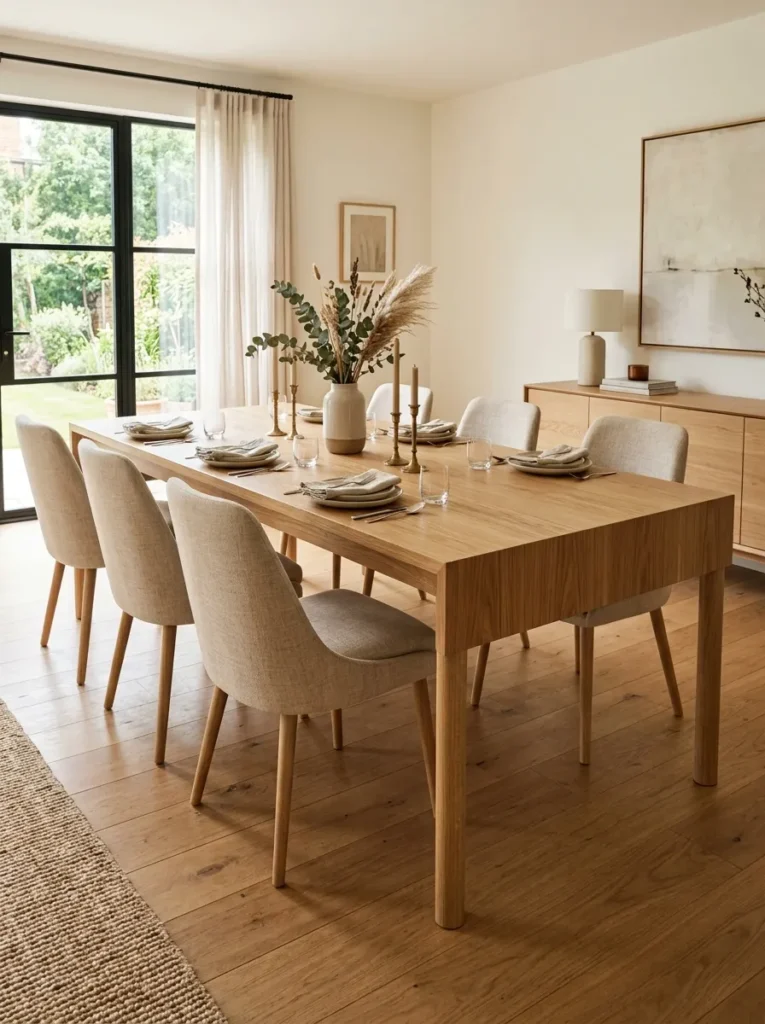
Vibe: The wall is warm — a limewash accent wall behind the dining table creates a backdrop of organic color depth that reads differently under morning light than evening light, and differently at every point of its textured surface, giving the dining room a visual dynamism that flat-painted walls permanently lack.
Why it works: The wall behind the dining table is the room’s primary visual backdrop — it is what diners see when they look across the table at each other, and what photographers capture in every dining room image. A limewash finish on this wall creates a tonal complexity (lighter in some areas, deeper in others, the variation created by the layered application technique) that makes the dining room feel more designed and more atmospheric than a uniformly painted surface. Dusty sage and warm greige are the two limewash tones that work most universally behind dining tables because they warm the skin tones of people seated in front of them — the green-grey of dusty sage and the warm brown-grey of greige both reflect light in the warm spectrum that the flatters faces and food.
How to get it: Portola Paints Classico Limewash and Romabio Classico Limewash are the two most widely available professional-quality limewash products. Application requires a wide natural bristle brush and a cross-hatching second pass on the partially dried first coat. A standard 12×9-foot dining room accent wall takes 3–4 hours of application time including drying between coats. Total material cost: $60–$120 in paint for one feature wall.
Shop The Look
- Limewash paint Portola dusty sage or greige
- Natural bristle brush wide limewash
- Limewash application sponge technique
- Warm white interior paint adjacent walls
- Limewash color sample set comparison
4. Upholstered Bench on One Side of the Dining Table
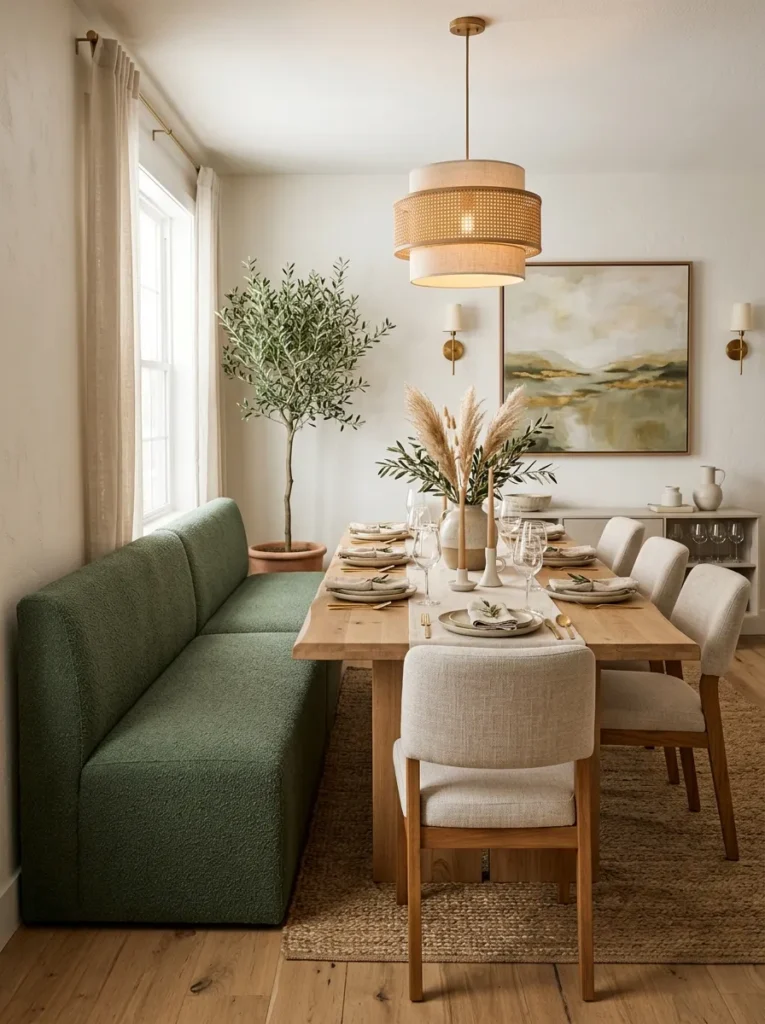
Vibe: The arrangement is relaxed — replacing one row of individual dining chairs with a long upholstered bench creates the most casual and most sociable dining room seating configuration, where guests on the bench sit shoulder-to-shoulder in a configuration that encourages conversation and communal ease rather than formal separation.
Why it works: The bench-on-one-side dining arrangement is one of the most functional contemporary dining room decisions available because it solves the seating capacity problem that individual chairs create — a bench provides approximately 50% more seating capacity per linear foot than individual chairs (three chairs at 18 inches per chair versus four or five people on a 60-inch bench) without adding any additional furniture footprint. The bench also allows children to sit together without the space management challenge of individual chairs, and its seating positions (people can slide along the bench to accommodate late arrivals) are more flexible than fixed-position chairs. The upholstered bench format — deep, wide, and generously cushioned — creates a seating experience that guests find more comfortable than most dining chairs for extended meals.
How to get it: The bench should run the full length of the table’s seating side (typically 60–72 inches for a standard 6-person table) at the correct seat height of 17–19 inches from the floor. Upholstery in performance fabrics (indoor-outdoor boucle, performance linen, or velvet with a soil-resistant treatment) is recommended for dining room use where food spills are inevitable. The bench back may be omitted for a more modern look when the bench is positioned against a wall, or included as a low backrest (16–18 inches high from seat surface) when the bench floats in open space.
Shop The Look
- Upholstered dining bench sage boucle 60 inch
- Boucle performance fabric dining bench
- Dining bench backless modern 66 inch
- Dining chair individual linen set two
- Bench leg set tapered wood natural
5. Travertine or Marble Dining Table for Mineral Elegance
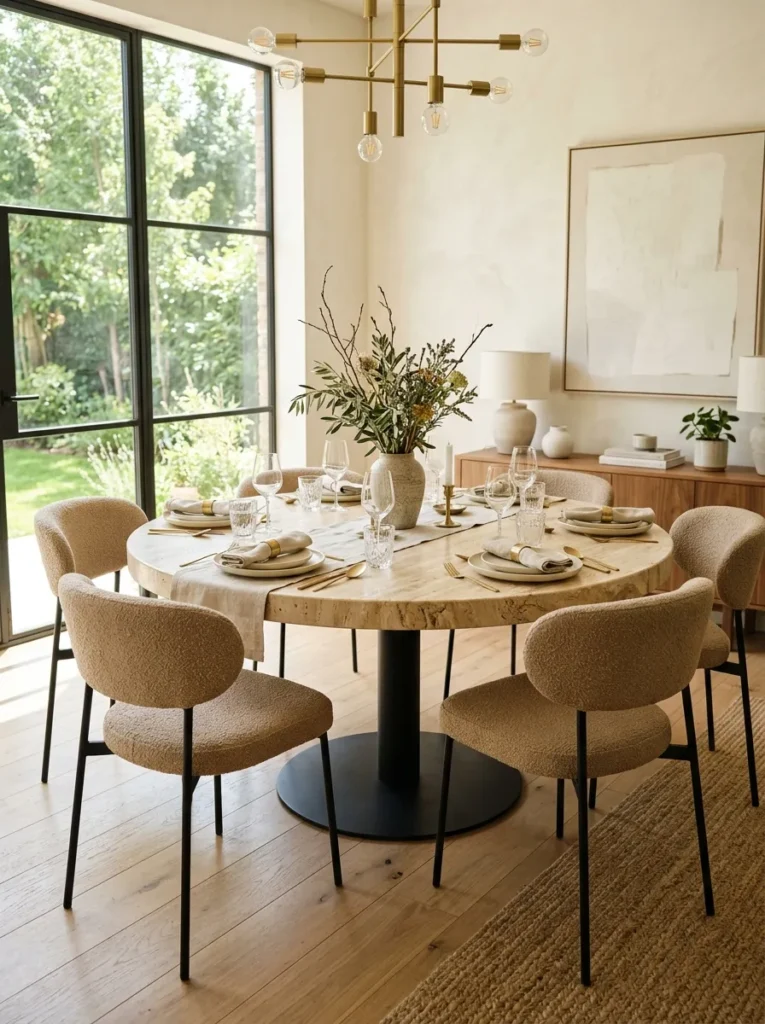
Vibe: The table is luxurious — a travertine or marble dining table is the mineral material statement that elevates a dining room beyond any wood or lacquered alternative, where the natural stone’s veining and surface depth create a table that is genuinely different at every viewing angle and in every light condition.
Why it works: Natural stone dining tables are the contemporary dining room’s highest-impact single investment because stone is the material that most directly communicates permanence, geological depth, and material luxury at the scale of a dining table top. Travertine specifically has become the dominant stone choice in contemporary dining room design because its warm cream-to-tan tone (warmer than most white marbles) and its natural pitting (small voids in the stone surface that are characteristic of travertine’s sedimentary formation) create a surface that reads as more organic and more forgiving than the cool precision of Carrara marble. The matte black steel or warm brass base creates the material juxtaposition — hard geometric metal against soft organic stone — that gives the contemporary stone table its design tension and resolution.
How to get it: Natural travertine dining tables (filled or unfilled — filled travertine has the pits grouted with a matching compound, unfilled leaves them open as a more raw aesthetic) are available from stone furniture specialists at $1,500–$4,000 for a standard dining size. Engineered stone alternatives in travertine patterns are available at $600–$1,200 and provide better stain and scratch resistance at the cost of the natural stone’s organic quality. Seal natural travertine annually with a penetrating stone sealer for food-safe protection.
Shop The Look
- Travertine dining table marble base
- Natural stone sealer penetrating food safe
- Matte black steel dining table base
- Warm brass dining table pedestal base
- Linen dining chair set stone table
6. Rattan or Cane Dining Chairs for Organic Warmth
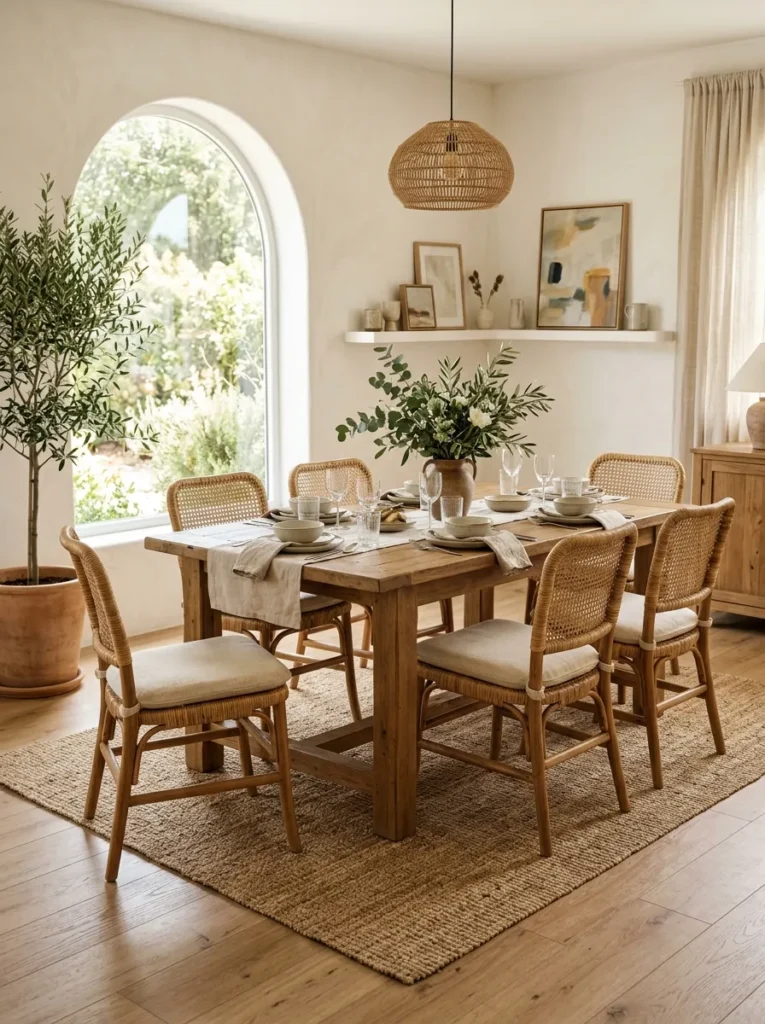
Vibe: The dining room is organic — rattan or cane-back dining chairs bring a woven natural material texture to the dining room’s primary furniture piece, creating an atmosphere of warm, botanical lightness that upholstered or solid wood chairs cannot approach.
Why it works: Rattan and cane dining chairs are specifically effective in contemporary dining rooms because their woven backs are visually transparent — light passes through the woven pattern rather than being blocked by a solid chair back, which keeps the dining room feeling open and light-filled even when all chairs are occupied. This visual lightness is particularly valuable in smaller dining rooms where solid upholstered chairs can make the room feel heavy and crowded. The natural rattan material’s warm honey-tan color works harmoniously with white oak and walnut tables, with linen textiles, and with warm white or sage walls — it contributes warmth through its color family without introducing a competing decorative pattern. A seat cushion in natural linen adds the textile softness that bare rattan cannot provide and significantly improves dining comfort for extended meals.
How to get it: Source rattan dining chairs from specialist natural furniture retailers, Serena & Lily, Pottery Barn, and World Market at $80–$250 per chair. The most durable rattan dining chairs have solid wood frames (teak, ash, or oak) with rattan or woven seagrass backs rather than all-rattan construction — the solid wood frame provides structural longevity that fully woven frames may not sustain through years of dining use. Add tie-on or non-slip linen seat cushions ($20–$40 each) for comfort and washability.
Shop The Look
- Rattan dining chair natural set of four
- Cane back dining chair wood frame
- Natural linen seat cushion tie on
- Rattan armchair dining head of table
- Cane back chair seat pad natural
7. Deep Forest Green Dining Room for Dramatic Atmosphere
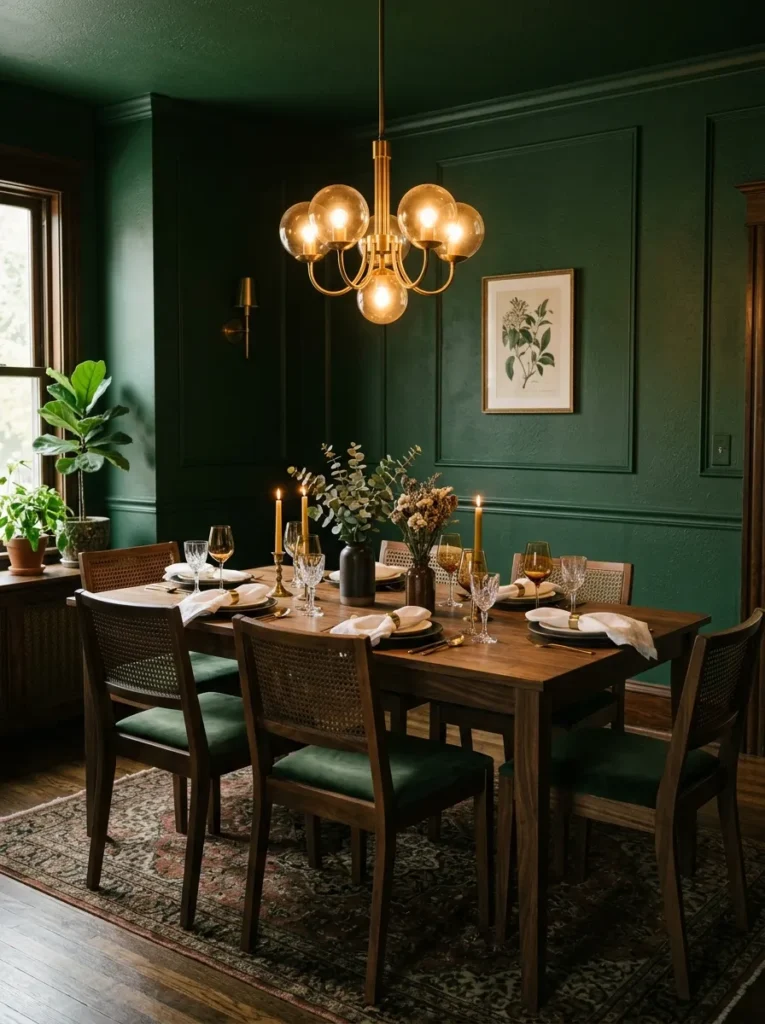
Vibe: The room is jewel-box — a dining room with all four walls in deep forest green creates the most atmospheric and most photogenic contemporary dining room available, where the dark botanical surround makes every element inside it — the warm table, the white linen, the brass light — appear to glow with unusual warmth and intensity.
Why it works: The all-dark-dining-room technique works specifically well in dining rooms because dining rooms are typically used most for evening meals, when natural light is absent and the room is lit entirely by artificial sources — under these conditions, dark walls enhance rather than diminish the room’s warmth because they absorb overhead light and reflect only the warm tones of candlelight and warm-spectrum pendant light. The forest green specifically (Farrow & Ball Calke Green No. 80, Sherwin-Williams Cascades SW 6477, or Benjamin Moore Forest Green 2047-10) works better than navy or charcoal in dining rooms because its botanical undertone creates warmth rather than coolness, and it relates naturally to the organic materials — wood, linen, rattan — that contemporary dining rooms favor.
How to get it: Apply deep forest green in a flat or matte finish to all four walls — any sheen level amplifies reflections that create visual busyness in a dark room. Extend the green to the ceiling for the full jewel-box effect, or maintain a warm white ceiling for a less committed version. Pair exclusively with warm materials: walnut or dark oak furniture, unlacquered brass fixtures, white or cream linen, and warm amber LED bulbs at 2200–2700K. The combination of dark botanical walls and exclusively warm accessories is what makes this technique produce beauty rather than gloom.
Shop The Look
- Deep forest green interior paint matte
- Warm walnut dining table dark finish
- Unlacquered brass pendant light dining
- White linen napkin set dining
- Warm amber LED bulb 2200K candelabra
8. Gallery Wall of Black and White Art Above the Dining Sideboard
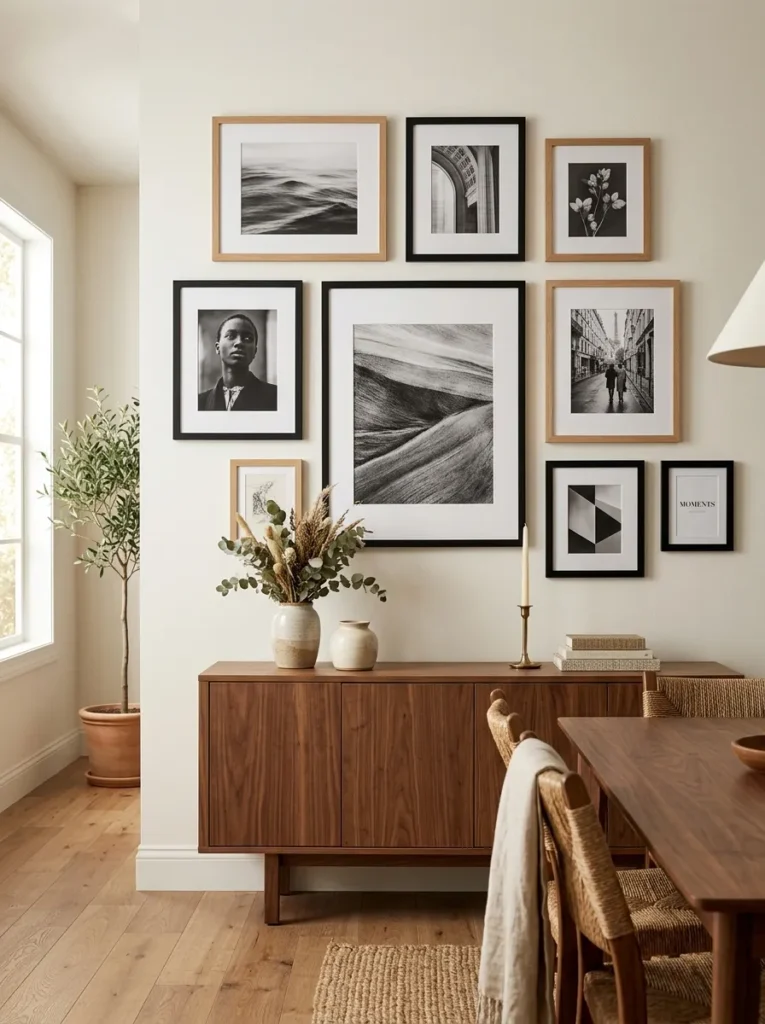
Vibe: The wall is curated — a gallery wall of black and white art in varied frames above a walnut sideboard creates a secondary visual focal point in the dining room that transforms the storage wall into an art installation, giving the room a dual-focal-point composition that makes it genuinely interesting from multiple positions.
Why it works: The dining room sideboard wall is the second most important design surface in the room after the light fixture, and a gallery wall treatment is the most impactful way to address it because it provides the visual complexity at medium-close viewing distance that a single large artwork or a blank wall cannot. The black and white palette for the gallery’s art content is the right choice in contemporary dining rooms because it reads as sophisticated and timeless rather than trend-specific, coordinates with any dining room color palette, and ensures that the gallery reads as a cohesive collection rather than a varied assemblage of different-colored prints. The sideboard beneath the gallery (a storage piece for dining room linens, tableware, and serving pieces) provides the compositional base that grounds the gallery and prevents it from floating on the wall.
How to get it: Plan the gallery wall arrangement on the floor before hanging — lay all frames out in a 2-foot clearance space and adjust the composition until the arrangement is balanced asymmetrically (no symmetry, but a visual center of gravity in the largest or most impactful piece). The arrangement’s bottom edge should sit 6–8 inches above the sideboard surface. Maintain consistent 2–3-inch gaps between all frames. Mix matte black and natural wood frames in a ratio of approximately 60:40 for visual variety without losing cohesion.
Shop The Look
- Matte black picture frame set varied sizes
- Natural wood gallery frame 8×10 5×7
- Black white art print set dining room
- Walnut sideboard buffet modern
- Abstract art print black white set
9. Oval Dining Table for Social and Spatial Efficiency
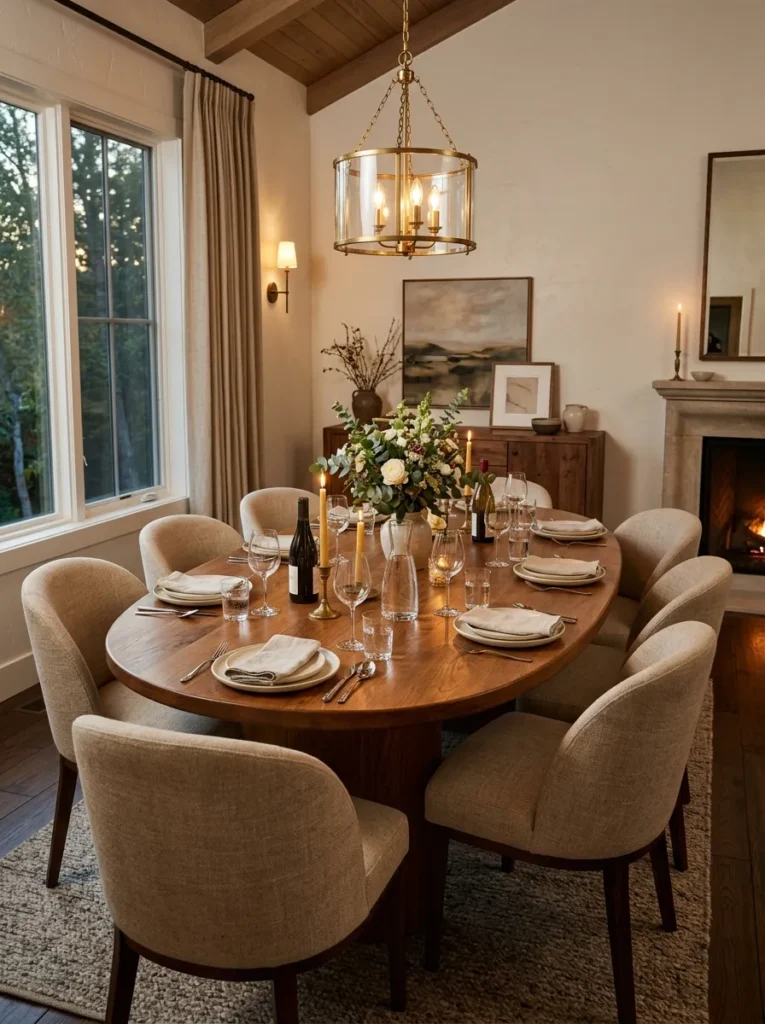
Vibe: The arrangement is social — an oval dining table eliminates the head-of-table hierarchy of rectangular dining, creates a more intimate proximity between diners on opposite sides, and uses the room’s floor area more efficiently by eliminating the wasted corner space of a rectangular table of equivalent seat count.
Why it works: The oval dining table is the most socially intelligent table form for gatherings of 4–8 people because it simultaneously eliminates the hierarchy problem of the rectangular table (there is no “head” of an oval table, only positions of equivalent status around a continuous curve), reduces the perceived distance between diners on opposite sides (the shorter oval diameter is typically 12–18 inches narrower than the long dimension, bringing diners closer together at the midpoints), and allows chairs to be added at the ends without the awkward corner seating that rectangular tables produce. The oval’s curved perimeter also allows more chairs per linear foot of table edge than a rectangle — a 72-inch oval seats 6 people more comfortably than a 60×36-inch rectangle because the curved ends provide more perimeter for end seating.
How to get it: Oval dining tables are available in white oak, walnut, and marble from contemporary furniture retailers at $800–$3,000. The pedestal base is particularly effective for oval tables (a single central support column rather than four corner legs) because it eliminates the leg-and-person-proximity issue of corner legs at the oval’s ends, allowing chairs to be positioned freely around the full oval perimeter without any leg-position conflict.
Shop The Look
- Oval dining table white oak walnut
- Oval dining table pedestal base
- Upholstered dining chair set six
- Oval table extension leaf system
- Dining chair linen cream oval table
10. Warm Walnut Sideboard with Sculptural Object Styling
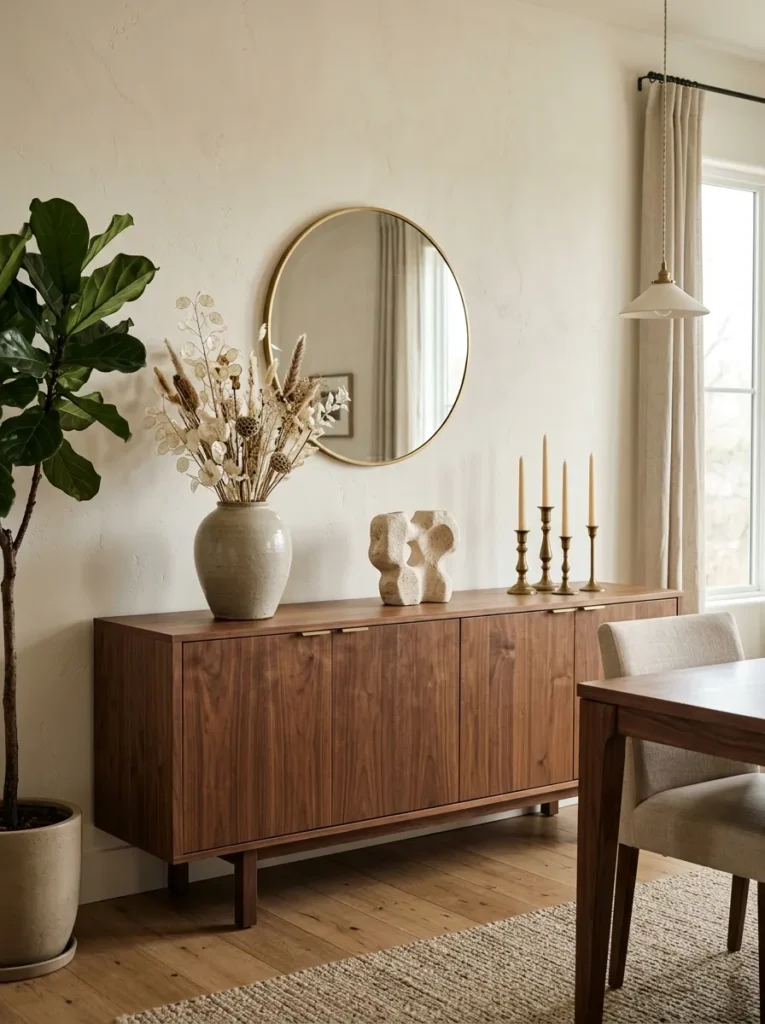
Vibe: The sideboard is restrained — a long walnut sideboard styled with three carefully chosen objects demonstrates the principle that furniture of genuine material quality needs almost no decoration to create a composed and beautiful surface, and that restraint communicates design confidence more clearly than abundance.
Why it works: The walnut sideboard is the contemporary dining room’s most versatile and most practical secondary furniture piece — it provides storage for dining room linens, tableware, serving pieces, and wine while offering a long horizontal display surface that allows a composed accessory arrangement at the room’s secondary focal wall. The three-object styling rule (no more than three distinct objects on the sideboard’s top surface, ideally at three different heights) creates the visual restraint that makes the sideboard’s wood grain surface visible as the primary material rather than as a background for decorative clutter. Each of the three objects should represent a different material category — one ceramic or stone, one natural botanical, one metallic — to create the material layering that gives the composition depth.
How to get it: A walnut sideboard in the 60–72-inch length range ($600–$2,000 from contemporary furniture retailers) provides the longest possible horizontal display surface for a dining room wall while maintaining the low profile (typically 32–36 inches tall) that allows art or a gallery wall to be mounted above. Style the top with the three-object rule: position the tallest object (a vase with dried stems) at one end, the most visually substantial object (a large ceramic or stone sculpture) at the center-offset position, and the smallest but most warm element (a brass candle cluster or small plant) at the opposite end.
Shop The Look
- Walnut sideboard buffet 66 inch modern
- Large ceramic vase dried stems styling
- Sculptural stone object display table
- Unlacquered brass candlestick set small
- Dried pampas stem arrangement minimal
11. Concrete or Plaster Ceiling Pendant with Warm Bulb
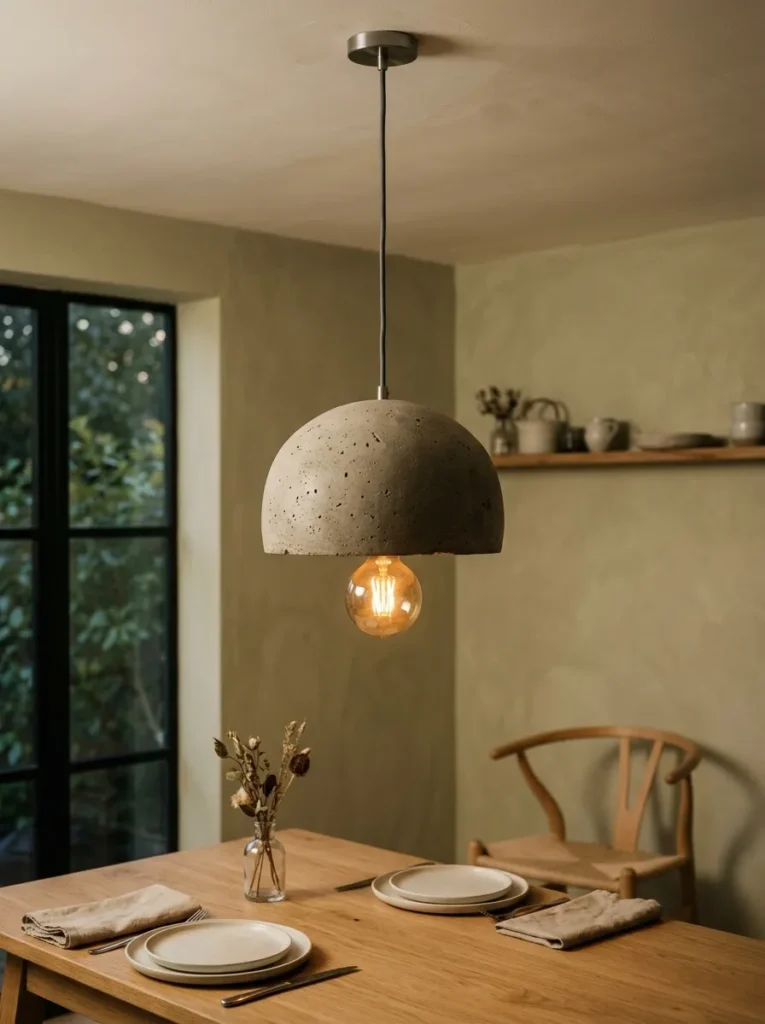
Vibe: The pendant is architectural — a concrete or plaster pendant light with a visible warm filament bulb creates a dining room light fixture of minimal architectural authority, where the beauty comes entirely from the material’s own quality and the form’s geometric clarity.
Why it works: Concrete and plaster pendants represent the contemporary dining room’s most restrained lighting approach — a single material in a simple form with a visible warm-spectrum bulb. This restraint is specifically effective when the dining room’s other elements are warm and material-rich (walnut table, linen chairs, sage walls) because the cool-material pendant provides the visual counterpoint that prevents the room from reading as uniformly warm and heavy. The visible filament bulb is an intentional design choice rather than a practical necessity — it references the Edison bulb aesthetic while providing the warm amber light (at 2200K color temperature) that flatters faces and food at a dining table better than any other light source.
How to get it: Concrete and plaster pendants are available from specialty lighting retailers and independent studio makers at $80–$400 for dining-appropriate sizes. The pendant’s mounting canopy and cord cover should be in a compatible material (brushed brass, matte black, or white) — the canopy is visible from the dining table seating position and contributes to the overall fixture’s visual quality. Ensure the bulb is an E26-base warm filament LED at 2200K and 400–600 lumens for the correct combination of atmospheric warmth and functional light level.
Shop The Look
- Concrete pendant light dining dome form
- Plaster pendant light sculptural minimal
- Warm filament LED bulb 2200K E26
- Pendant cord cover brushed brass
- Pendant light canopy ceiling mount
12. Layered Rug Approach for a Defined Dining Zone
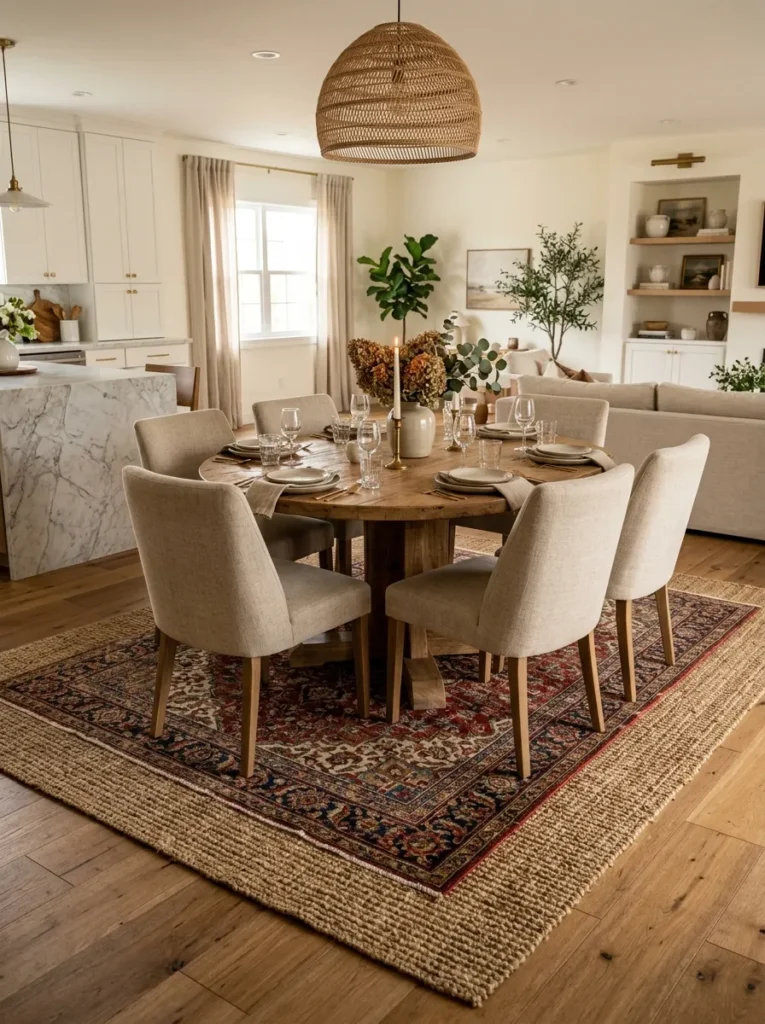
Vibe: The floor is layered — the two-rug approach under a dining table creates the warmest and most compositionally resolved dining zone floor treatment, where the large neutral base rug anchors the space and the smaller patterned overlay adds the warmth and visual interest that a single rug of either type alone cannot achieve.
Why it works: The dining room rug is a critical spatial element that most contemporary dining rooms get wrong in one of two ways: either a rug too small to anchor the furniture grouping properly (chairs pull off the rug when seated, which reads as incomplete), or a single large patterned rug that competes visually with the dining furniture for attention. The layered rug approach resolves both problems: the large jute or sisal base rug (which must extend at least 24 inches beyond each chair leg when pulled out for seating) anchors the furniture grouping correctly and reads as a neutral grounding element, while the smaller vintage-style or textural overlay rug adds visual warmth and material interest without the visual dominance that a large patterned rug creates as the sole rug. The jute base layer’s natural fiber texture and the vintage wool overlay’s aged patina together create a floor composition with genuine visual complexity.
How to get it: Size the base jute or sisal rug at 9×12 feet minimum for a standard 6-person dining table (chair legs must remain on the rug even when chairs are pulled out for seating). Lay the overlay rug (5×8 feet, in a vintage-style or low-pile wool in warm tones) centered on the jute base, ensuring 18–24 inches of jute base visible on all sides. A rug pad between the jute and the floor prevents sliding; no additional pad is needed between the two rugs as the jute’s texture holds the overlay in position.
Shop The Look
- Natural jute area rug 9×12 dining room
- Vintage style wool rug 5×8 warm overlay
- Rug pad non slip felt dining room
- Rug gripper mesh between layers
- Neutral sisal dining rug large flat weave
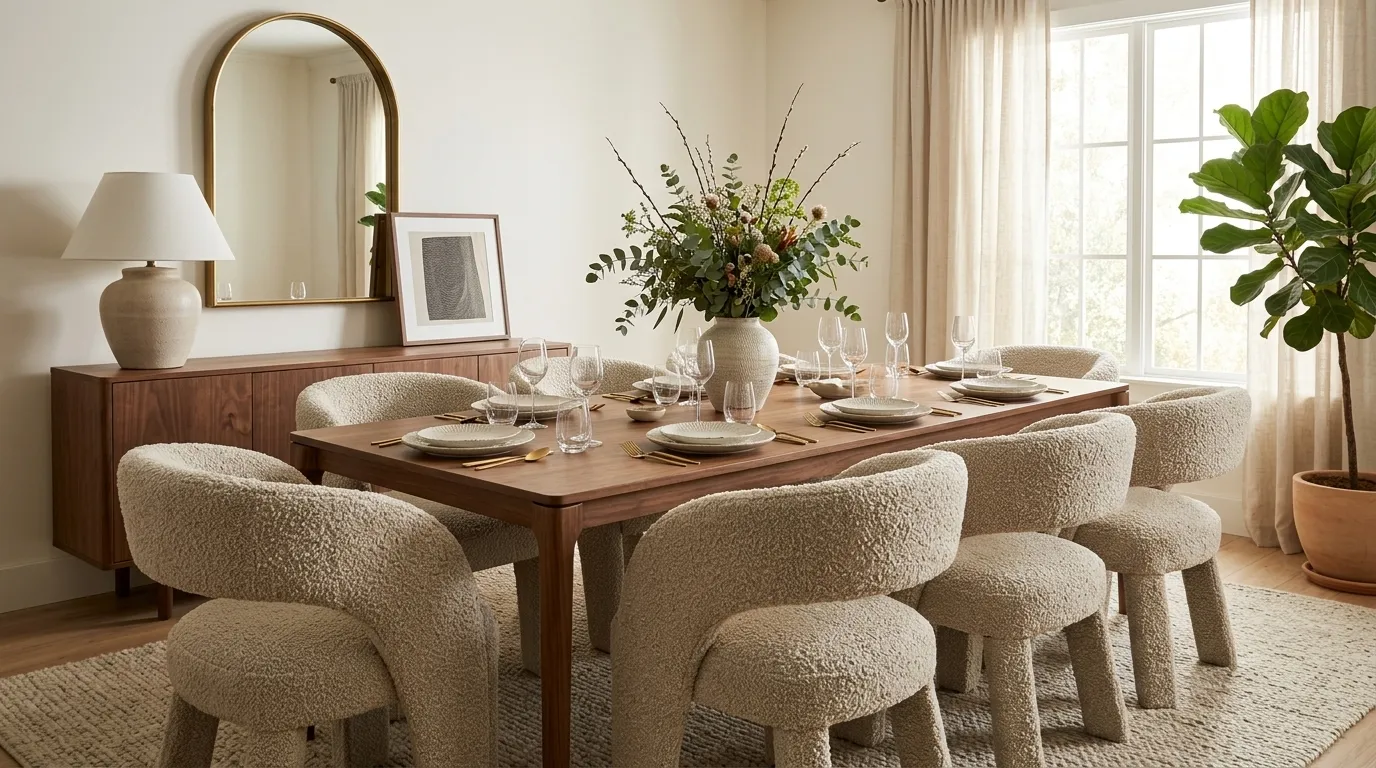
13. Boucle Dining Chairs for Textural Warmth
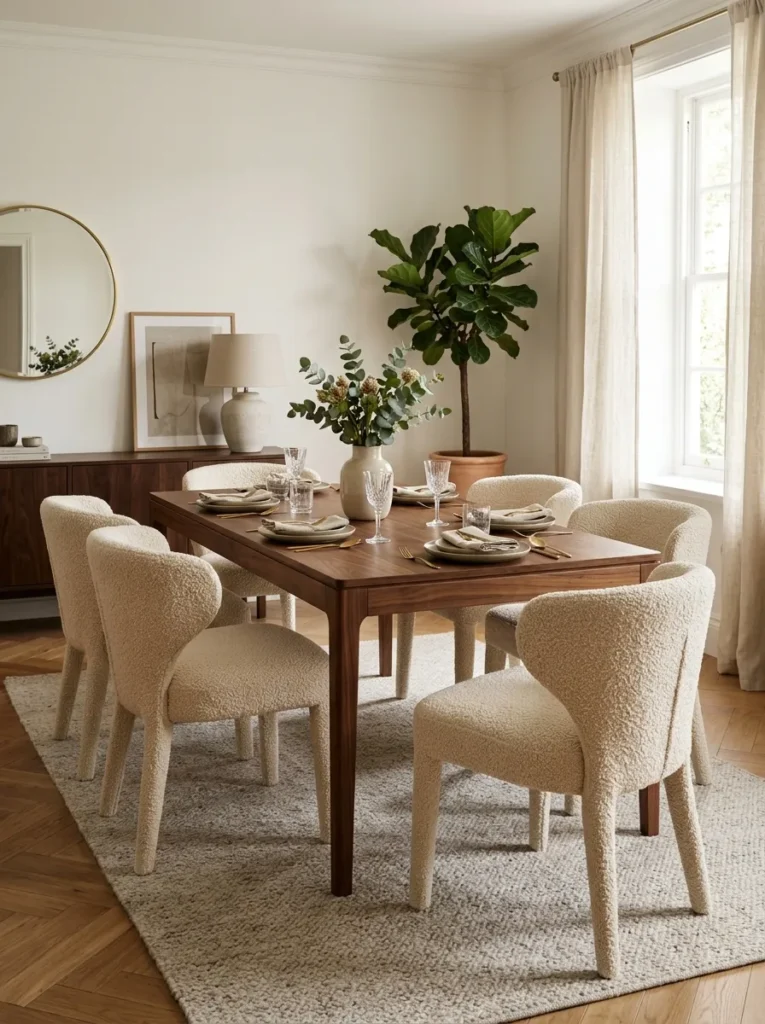
Vibe: The chairs are luxurious — boucle-upholstered dining chairs bring the most tactilely rich textile surface available in contemporary upholstery to the room’s most touched and most socially significant furniture, where the fabric’s looped pile creates warmth that is both visually and physically perceptible.
Why it works: Boucle is the contemporary interior’s most design-resonant upholstery fabric because its looped pile structure creates a three-dimensional surface that reads as expensive and warm in a way that woven or flat-surfaced upholstery cannot. The looped pile catches light at varied angles across the chair’s surface — some loops in direct light appear cream or warm white, others in shadow appear warm greige or oat — creating a tonal depth within a single-color fabric that makes the chair appear more visually complex than it is. For dining room use, performance boucle (a synthetic or blended version of the traditional wool fabric) provides the visual quality of boucle with significantly better stain and cleaning resistance — an important consideration for upholstered dining seating.
How to get it: Performance boucle dining chairs are available from Crate & Barrel, Restoration Hardware, and specialist upholstery furniture retailers at $200–$500 per chair. The chair back should be slightly curved or have a gentle backward rake for ergonomic comfort during extended dining — straight-backed chairs create discomfort after 30–45 minutes. Leg material in warm brass or warm natural wood maintains the contemporary material palette that boucle upholstery requires.
Shop The Look
- Boucle dining chair cream performance fabric
- Boucle upholstered dining chair warm greige
- Performance boucle fabric dining chair
- Boucle armchair dining head of table
- Boucle seat cushion dining chair add on
14. Dramatic Floor-to-Ceiling Curtains Framing the Dining Window
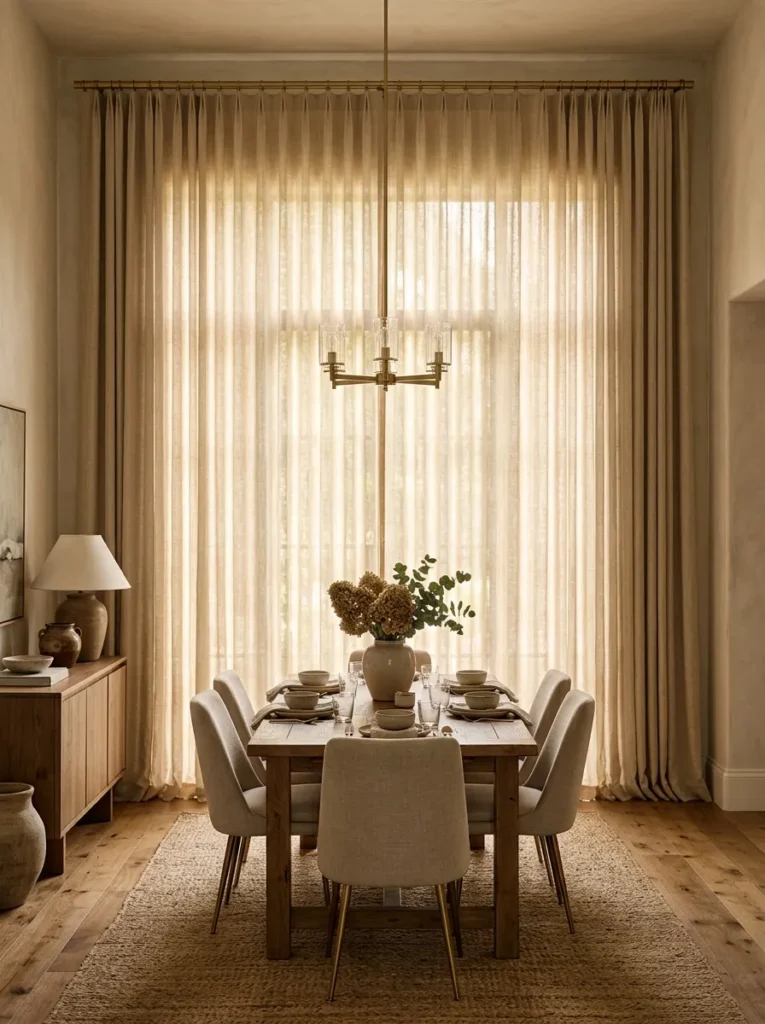
Vibe: The window is architectural — floor-to-ceiling curtains hung at ceiling height and wide of the window frame create the illusion of a significantly larger window and a significantly taller room, where the curtain treatment is as much architectural intervention as decoration.
Why it works: The single most impactful window treatment decision in any dining room is the height and width of the curtain installation relative to the actual window opening. Curtains hung at window-frame height look like curtains; curtains hung at ceiling height look like architectural elements. Curtains hung 6 inches wider than the window frame on each side look like they barely cover the window; curtains hung 12–18 inches wider on each side (so the full curtain panel folds to one side of the window when open, with no curtain covering the glass itself) make the window appear 60–80% wider than it actually is. Both adjustments together — full ceiling height and full window-width extension — create the spatial illusion of a much larger and more architecturally generous window than physically exists.
How to get it: Install the curtain rod at the ceiling or within 2 inches of the ceiling molding rather than at the traditional position 4–6 inches above the window frame. The rod should extend 12–18 inches past the window frame on each side. Natural linen curtain panels in warm cream or oat tones are the most universally appropriate fabric for contemporary dining rooms — they diffuse natural light beautifully rather than blocking it, and their natural slub texture reads as warm and considered at close range.
Shop The Look
- Linen curtain panel floor to ceiling cream
- Ceiling height curtain rod brass extended
- Curtain rod finials brushed brass pair
- Curtain ring clip set brass
- Sheer linen panel light filtering dining
15. Arched Doorway or Architectural Detail as a Focal Feature
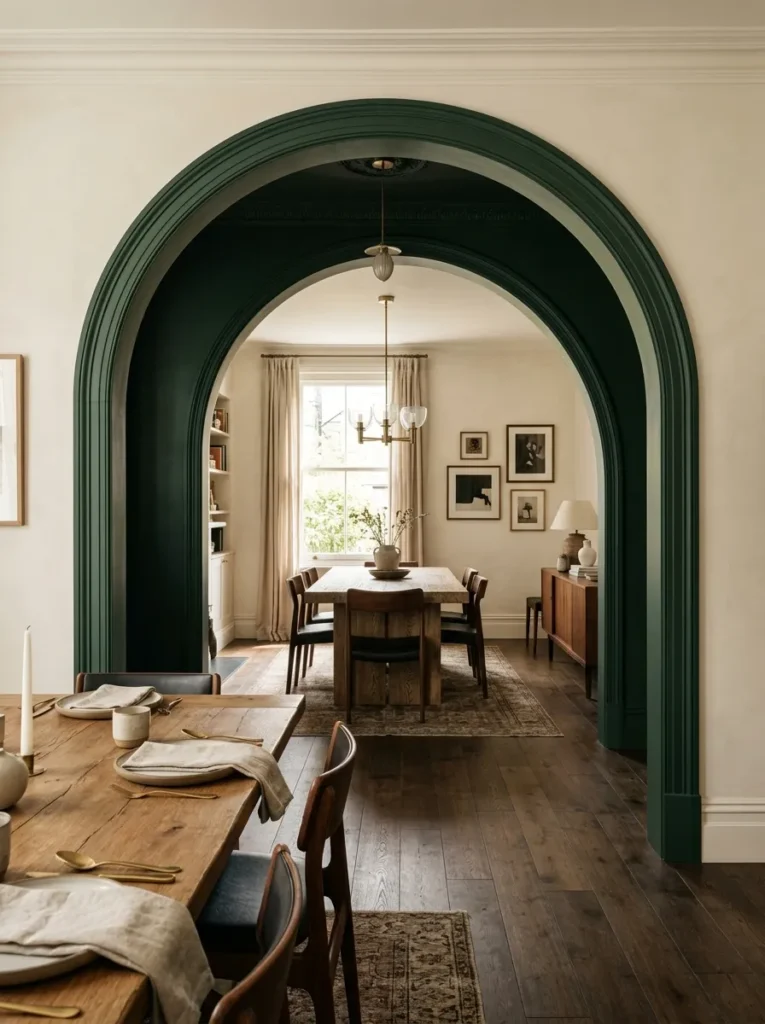
Vibe: The arch is dramatic — a painted or molded arched doorway into the dining room transforms a standard rectangular doorway into an architectural announcement of the dining space, creating a transition from adjacent spaces that communicates arrival and occasion.
Why it works: The arched doorway is the single architectural modification that most dramatically improves the perceived quality of a dining room without altering its function — the arch frames the dining space as a defined, separate world rather than as a continuation of the adjacent room, which gives every entry into the dining room a quality of occasion and arrival. Painting the arch interior in a deep contrasting tone (matching the dining room accent wall color, if one exists, or introducing the dining room’s primary color palette at the threshold) creates a visual portal effect — the arch is dark and defined, and through it the warm dining room glows with invitation. This technique requires only a jigsaw to cut the arch shape from existing square drywall and trim, or flexible MDF molding to create an arch overlay on an existing square opening.
How to get it: For an existing square doorway, create the arch form using flexible MDF trim molding ($15–$25 per 8-foot piece) bent to the desired arch radius and attached to the doorway’s face trim with construction adhesive. The arch height (distance from the floor to the arch’s highest interior point) should be at least 84 inches for passage clearance with the arch curve peaking above the existing door opening. Paint the arch’s interior surface in the selected contrasting tone, blending the paint approximately 6 inches into the adjacent room on each side to create the deep-set appearance of genuine architectural depth.
Shop The Look
- Flexible MDF molding arch form trim
- Deep forest green interior paint arch
- Construction adhesive molding trim
- Arch doorway template kit measurement
- Warm charcoal paint arch accent
16. Candlelit Dining Table with Layered Table Setting
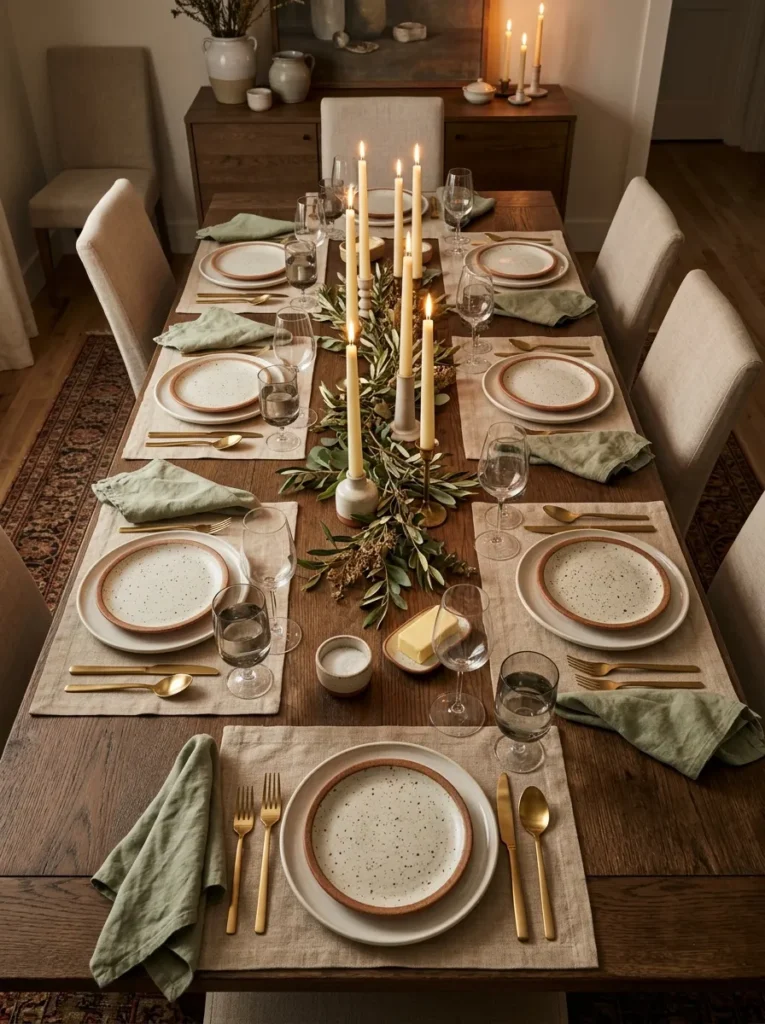
Vibe: The table is hospitality-generous — a deliberately layered table setting that combines natural linen, mixed ceramic, warm metal cutlery, and cloth napkins communicates genuine care for the people about to gather, where the time and thought invested in the table’s composition is itself a form of welcome.
Why it works: A layered contemporary table setting works through the principle of material contrast within tonal cohesion — every element is in the warm neutral family (cream, oat, warm white, natural linen, warm brass) while being in a distinct material category (woven linen mat, smooth ceramic plate, textured stoneware second plate, polished metal cutlery, clear glass). The contrast between smooth and textured, woven and smooth, translucent and opaque creates visual richness at close range — the distance at which a dining table is experienced — without any single element competing for visual dominance. The loose cloth napkin (dropped rather than elaborately folded) is the detail that most directly communicates the contemporary hospitality ethic of genuine warmth over formal performance.
How to get it: The three material decisions that make the biggest difference in a contemporary table setting: first, natural linen placemats rather than paper or synthetic, which set the warm material tone for the full setting; second, a combination of two plate types (smooth white ceramic for the dinner plate, textured stoneware or terracotta for the salad plate) that creates the layered ceramic quality rather than uniform matching; and third, cloth napkins in a warm sage, cream, or oat tone that coordinates with but does not match the placemat. The full setting requires no matching or coordinated patterns — the contemporary approach is tonal harmony across varied materials rather than matching sets.
Shop The Look
- Natural linen placemat set four dining
- White ceramic dinner plate set minimal
- Speckled stoneware salad plate set
- Polished silver flatware set modern
- Cloth napkin set sage or warm cream
How to Start Your Contemporary Dining Room Transformation
The single most important first decision in a contemporary dining room transformation is the pendant light above the dining table — before repainting, before purchasing new chairs, before considering any other element. The pendant light is the dining room’s compositional center of gravity and its most visible architectural element, and an undersized or aesthetically mismatched pendant undermines the quality of every other element in the room regardless of how well those other elements are chosen. Measure the table width and multiply by 0.67 to get the minimum pendant diameter — a 36-inch-wide table needs a pendant of at least 24 inches diameter. Purchase the correctly-scaled pendant first, install it, and evaluate all subsequent decisions (wall color, chair material, table finish, sideboard styling) against the pendant’s established material and aesthetic register.
The most common contemporary dining room mistake is choosing furniture and materials that are individually appropriate for the style but belong to different tonal subfamilies — warm white oak chairs with cool grey linen chairs, warm brass fixtures with cool chrome pulls, warm travertine table with cool blue-grey walls. Contemporary dining room design requires tonal commitment: choose either the warm direction (white oak, walnut, unlacquered brass, linen, warm white walls, sage and forest green accents) or the cool direction (light ash, marble, matte black, grey linen, cool white walls, navy and charcoal accents) and commit fully. Mixed tonal direction produces the visual unsettledness that reads as an unresolved room even when individual elements are of high quality.
Three contemporary dining room upgrades under $100 that create immediate, significant visual improvement: installing a dimmer switch on the dining room light circuit ($15–$30, a 30-minute DIY project) that transforms the room’s atmosphere by allowing light level adjustment for different occasions; replacing existing pendant bulbs with warm white LED filament bulbs at 2700K or lower ($10–$25 for a four-pack) that immediately improve the quality of the room’s light and its flattery of faces and food at the table; and adding three unlacquered brass candlesticks in varied heights with cream taper candles ($20–$60 from thrift stores and craft markets) that create the warm light quality at the table level that no overhead pendant alone can achieve.
A complete contemporary dining room transformation — new pendant, new table or chairs or both, limewash feature wall, sideboard styling, and layered rug — is a 3–6 month project of intentional accumulation rather than a single shopping event. Total investment ranges from $800–$2,500 for a complete room transformation using one investment furniture piece (table or chairs, not both) supplemented by mid-range lighting, paint treatments, and accessories, to $4,000–$10,000 for a full specification including quality stone or hardwood furniture and designer lighting. The most sustainable approach — replacing one element per season, starting with lighting and ending with furniture — produces the most considered result and allows each addition to be evaluated in the context of what already exists before the next purchase.
Frequently Asked Questions About Contemporary Dining Room Decor
What is the most important single element in a contemporary dining room?
Lighting is the most important single element in any dining room, and the pendant light above the dining table is specifically the most important single fixture in the space. This is not primarily because of the light’s visual appearance as an object (though that matters) but because of the quality of the light it produces and how that light quality affects everything in the room — the appearance of the food on the table, the warmth and flattery of the faces gathered around it, and the room’s overall atmospheric quality during the evening meals for which the dining room is most used. A correctly scaled pendant at the correct height above the table, with a warm-spectrum LED bulb on a dimmer switch, does more for the dining room experience than any furniture, wall treatment, or accessory decision. The secondary lighting element of near-equal importance is candlelight — taper candles on the table provide the most flattering and most atmospheric supplemental light source available for dining.
What size dining table do I need and how does it relate to the room’s size?
The dining table should leave a minimum of 36 inches of clearance between the table edge and any adjacent wall or furniture piece — this clearance allows a chair to be pulled out for seating (requiring approximately 18 inches) with an additional 18 inches for comfortable passage behind a seated person. For a 12×14-foot dining room, a 36×72-inch rectangular table or a 48-inch round table are the largest options that maintain the 36-inch clearance on all sides. For 10×12-foot rooms, a 36×60-inch table or a 42-inch round table are appropriate. The most common dining room furniture sizing mistake is choosing a table that is too small for the room’s scale — an undersized table in a generously proportioned dining room reads as insufficient and makes the room feel empty rather than airy. A correctly sized table that fills the room to within the clearance requirements reads as generous and intentional.
How do I choose between a round and rectangular dining table for a contemporary room?
The choice between round and rectangular is primarily determined by the room’s shape and the intended use pattern rather than by aesthetic preference alone. Rectangular tables are the better choice for rooms that are longer than wide (a 10×14-foot room benefits from a rectangular table’s alignment with the room’s long axis), for households that frequently need to seat more than eight people (rectangular tables extend more easily), and for dining rooms that also serve as secondary work or homework spaces (the rectangular table’s consistent width provides a reliable work surface). Round and oval tables are the better choice for rooms that are approximately square (a 12×12-foot room reads as more resolved with a round table centered in it), for households where the intimate, democratic nature of round seating is a priority, and for smaller dining rooms where a round table’s absence of corners allows more efficient use of the available space by not projecting into corners.
What wall color works best in a contemporary dining room?
The most widely effective wall color choices for contemporary dining rooms fall into three categories. Warm whites (Benjamin Moore White Dove OC-17, Sherwin-Williams Alabaster SW 7012) are the most universally compatible choice — they work with every furniture material and color direction, reflect maximum natural light, and allow the furniture, lighting, and accessories to establish the room’s character. Dusty sage and sage-green tones (Farrow & Ball Mizzle No. 266, Benjamin Moore Aganthus Green 2029-40) create the most botanical warmth in a dining room and work specifically well with white oak furniture and natural linen textiles. Deep, dark tones (forest green, warm charcoal, navy) create the most atmospheric and most photogenic dining rooms and are particularly effective when the room is used primarily for evening entertaining — the dark wall treatment makes candlelight and warm pendant light appear more intense and more flattering by contrast with the dark surround.
How do I make a small dining room feel larger without structural changes?
Four specific design strategies make small dining rooms feel significantly larger without physical expansion. First, hang curtains at ceiling height and wide of the window frame (as described in Idea 14) — this creates the illusion of taller ceilings and larger windows. Second, use a round or oval table rather than a rectangular table — the absence of corners allows chairs to be positioned more efficiently and the room’s corners to remain visually open. Third, choose chairs with visually light profiles (rattan backs as in Idea 6, or wire chairs, or simple wooden-legged chairs without heavy upholstery to the floor) that allow the dining room floor to remain visible, which makes the room appear larger. Fourth, install a large mirror on the dining room’s primary wall or use a mirror-finish sideboard — a mirror in a dining room doubles the perceived depth of the space and reflects the dining room’s light and color back into itself, creating the impression of a more generous room. These four strategies together can make a 10×10-foot dining room feel as generous and comfortable as a 12×14-foot room.
Ready to Transform Your Contemporary Dining Room?
These 16 ideas cover the full spectrum of what a contemporary dining room can be — from the commanding architectural presence of an oversized woven rattan pendant and the material luxury of a travertine dining table, to the botanical warmth of a deep forest green jewel-box room and the social intelligence of an oval table that eliminates hierarchy and maximizes conversation, from the tactile richness of boucle dining chairs and the spatial magic of floor-to-ceiling linen curtains, to the careful hospitality of a layered table setting that communicates genuine care for the people gathered around it. You do not need to implement all 16 simultaneously — the most resolved contemporary dining rooms are built one considered element at a time, beginning with the lighting that sets the room’s atmospheric quality and adding each subsequent element in response to what is already there. Start this week with the pendant light — measure your table, calculate the correct diameter, find the right piece, and install it. Every other decision will be easier and more coherent once the room’s visual and atmospheric anchor is in place. A contemporary dining room that is genuinely well designed does not merely look beautiful — it changes how meals feel, how conversations unfold, and how welcome guests feel at your table. Pin the ideas that made you want to rearrange your dining room immediately — those are the ones your room is already asking for.