15 French Country Decorating Ideas Worth Saving
French country decorating is an interior design style that draws from the domestic architecture and material culture of rural southern and central France — Provence, Burgundy, the Dordogne — creating rooms that feel simultaneously elegant and lived-in, aged and cared-for, sophisticated and genuinely habitable. This article gives you 15 genuinely creative, buildable French country decorating ideas that capture the warmth, material richness, and effortless grace of the style without requiring either a French farmhouse or a decorator’s budget.
French country is the style that most completely solves the tension between beauty and livability — it is not precious, not minimal, and not aspirationally perfect. Its rooms look beautiful because they have been lived in and cared for over a long time, not because they have been arranged for a photograph. The homes in this list understand this: they are warm, layered, and full of the material evidence of a considered domestic life. Here are 15 ideas worth saving — and living in.
Why French Country Decorating Works So Well
French country design draws from the specific material culture of the French provincial countryside — a culture shaped by centuries of agricultural prosperity, skilled regional craftsmanship, and the particular French domestic tradition of treating the home as the primary site of civilized life. The style emerged from the contrast between the formal, court-influenced interiors of Parisian apartments and the more relaxed, materially honest interiors of the French countryside, where local limestone, hand-thrown pottery, hand-woven linen, and locally harvested timber produced rooms of unselfconscious beauty. The 18th-century farmhouses of Provence, the bastides of the Luberon, and the manor houses of Burgundy all contributed to the repertoire of materials, forms, and spatial arrangements that define the style — the exposed stone wall, the terracotta tile floor, the carved limestone fireplace, the armoire of regional walnut, the table set for a long lunch that would become a longer dinner.
The materials that define authentic French country design are those of honest regional craftsmanship: natural linen and ticking stripe for soft furnishings, aged timber (walnut, cherry, oak) for furniture, hand-thrown faience pottery for display and use, terracotta and limestone for flooring, wrought iron for hardware and light fixtures, lavender and dried botanicals for fragrance, and natural beeswax for surface finishing. The color palette is resolutely warm and earthy but never muddy: warm white (not cool white), aged stone, Provençal blue, lavender, olive green, terracotta, and the warm ochre of Luberon limestone. These are the colors of the Provençal landscape — the colors of sun-aged stone, wildflower meadows, and the particular Mediterranean quality of southern French light.
The style has endured as a permanent fixture in international residential design because it solves two problems that most design styles cannot simultaneously solve. The first is the problem of elegance without formality — French country rooms have genuine beauty and genuine culture without the intimidating perfection that makes a room feel uninhabitable. The second is the problem of age without shabbiness — the style specifically values the patina of age, the worn edge of a table, the slightly irregular glazing of a pottery piece, as design assets rather than quality failures. These two solutions together produce a style that feels as aspirational as it is achievable, and that improves over time rather than requiring maintenance to preserve its original condition.
Small homes and apartments adapt French country principles readily — the style’s essential character is determined by material choices and compositional discipline rather than by room scale. A Paris apartment with terracotta tiles, linen curtains, a carved oak armoire, and lavender in a faience jug reads as genuinely French country regardless of its modest footprint. The same materials and compositional choices translate to any room size.
Style at a Glance
| Element | Detail |
|---|---|
| Philosophy | Elegant without being formal, aged without being shabby — rooms that improve with time and feel genuinely inhabited |
| Key Materials | Natural linen, aged walnut and oak, hand-thrown faience pottery, terracotta, limestone, wrought iron, dried lavender |
| Color Palette | Warm white, aged stone, Provençal blue, lavender, olive green, terracotta, warm ochre |
15 French Country Decorating Ideas
1. Exposed Stone or Faux Stone Fireplace as the Room’s Anchor
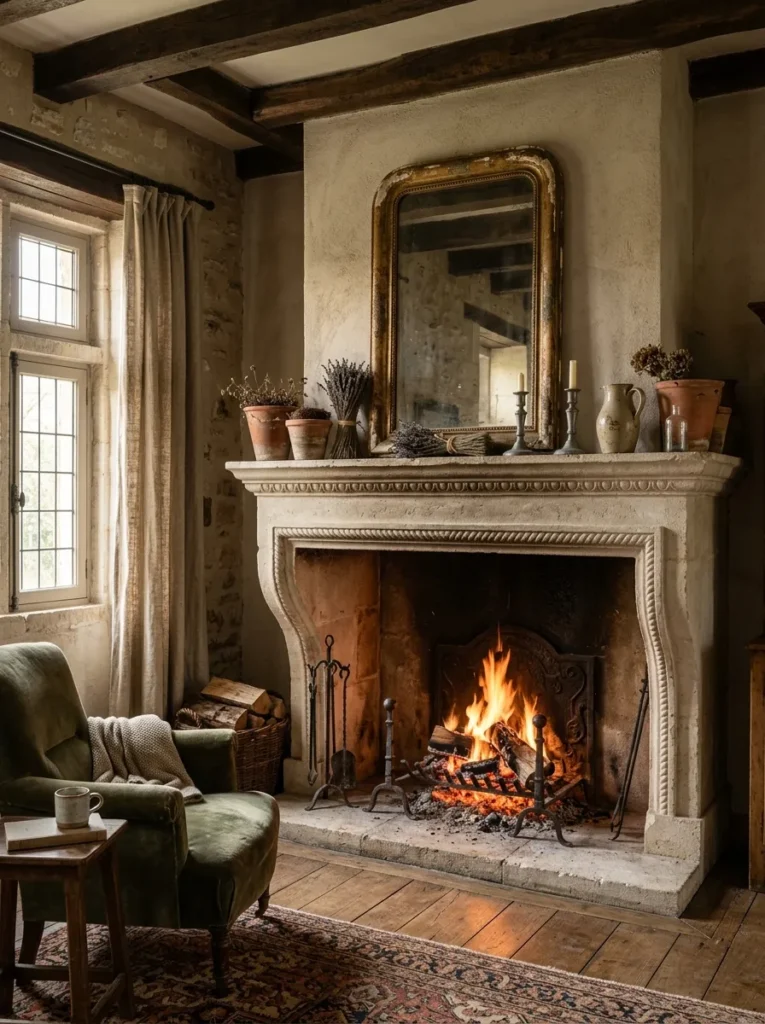
Vibe: Warm and deeply inhabited — the fireplace that makes the entire room feel like it has been loved for generations.
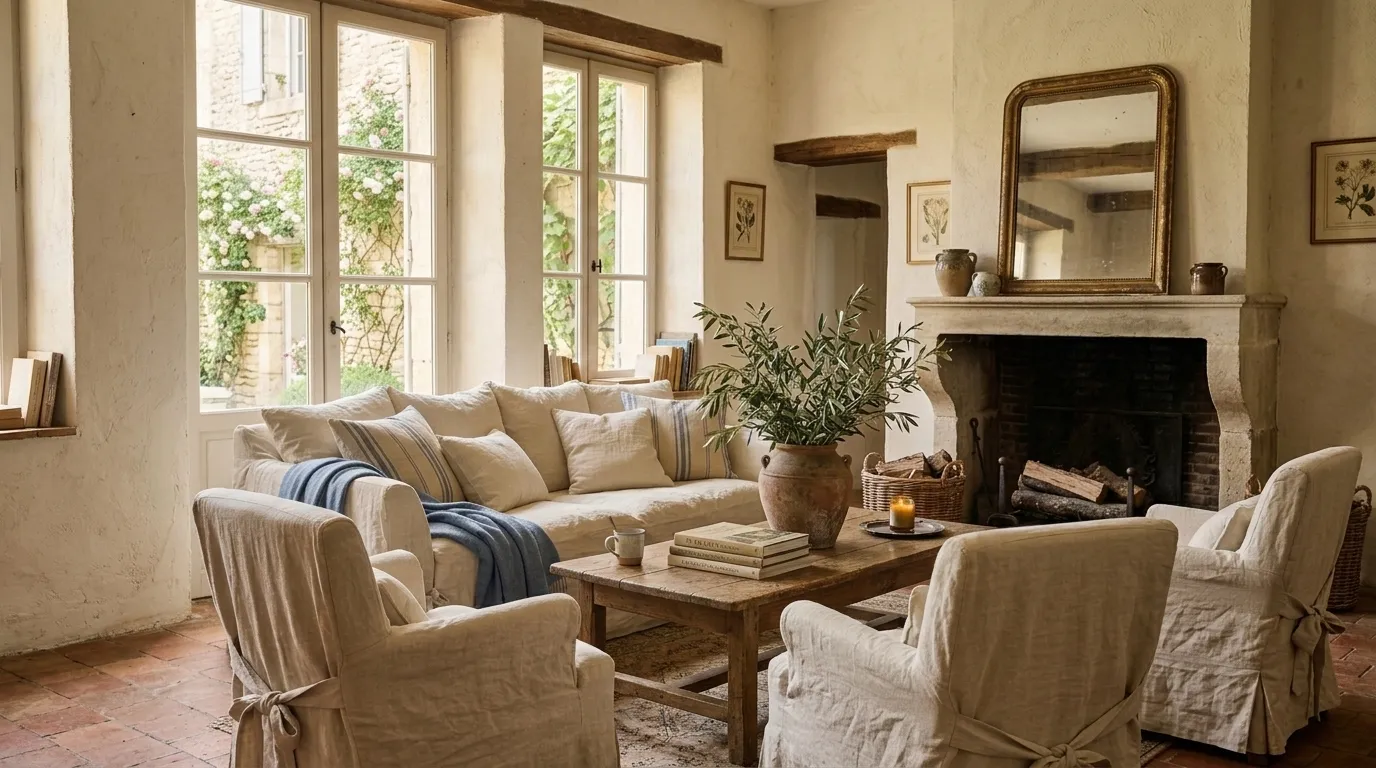
Why it works: The limestone fireplace is the single most defining element of French country domestic architecture — every farmhouse, bastide, and manor in the French countryside is organized around its fireplace, and every room with a genuine limestone or stone fireplace carries the entire weight of French provincial culture in that single architectural element. The fireplace’s proportional relationship to the room — tall enough to command the wall, wide enough to suggest generosity, the mantel deep enough to hold a domestic collection of objects — establishes the spatial hierarchy from which the entire room is organized. Even a faux stone surround applied to a standard fireplace opening, using cast stone panels or a hand-applied lime plaster finish troweled to a rough texture, achieves most of the visual quality of genuine limestone at a fraction of the cost, because the material character of the surface — warm, slightly irregular, visibly hand-made — is more important than its geological authenticity.
How to get it: The mantel styling is as important as the fireplace surround itself — a beautiful limestone surround styled with generic modern objects reads as incongruous, while the same surround styled with aged terracotta, pewter candlesticks, dried lavender, and a large gilt mirror reads as authentically French country. The rule for fireplace mantel styling in the French country tradition: one large dominant object (the mirror or a large framed artwork), two flanking objects of similar scale but different heights (candlesticks, lanterns, or large pottery), and a continuous botanical or natural material element (a garland of dried botanicals, a grouping of dried lavender bundles, or a branch of seasonal foliage) that bridges the gap between the architectural mantel and the decorative objects above it.
Quick Win: A large vintage gilt mirror hung above an existing standard fireplace mantel immediately introduces the most essential visual element of the French country fireplace wall — the mirror above the mantel — even before any changes are made to the mantel surround itself, and the transformation is disproportionately large relative to the single object addition.
Shop the Look
| Product |
|---|
| Cast stone fireplace surround |
| Antique gilt mirror large |
| Dried lavender bundle tied |
| Aged terracotta pot set |
| Pewter candlestick pair |
Also view: 16 Charming Beach Cottages with Coastal Style
2. Natural Linen Slipcovers on All Upholstered Furniture
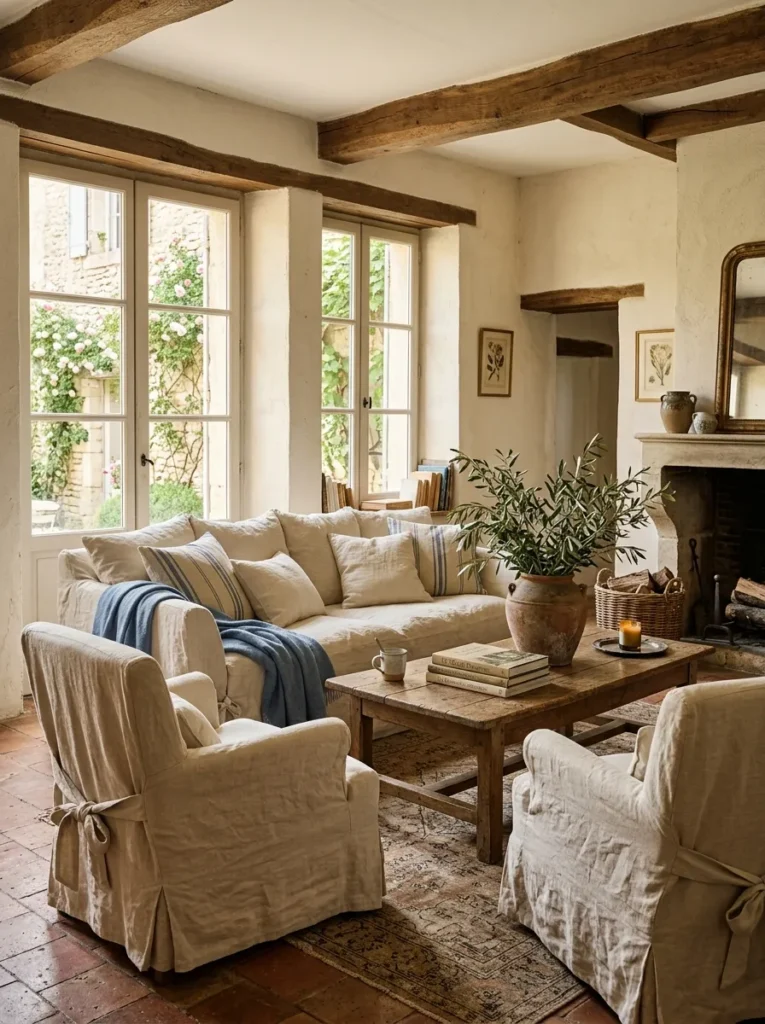
Vibe: Relaxed and inviting — the sofa arrangement that makes guests remove their shoes and stay for hours without being asked.
Why it works: Natural linen slipcovers on all upholstered furniture are the French country upholstery decision that most fundamentally communicates the style’s core value — the deliberate preference for comfort over formality, for lived-in quality over showroom perfection. Linen’s characteristic slight wrinkling under use is not a flaw in the French country context but a feature: the creased, slightly relaxed slipcover communicates that the sofa has been sat in and reclined upon, that comfort has been the priority over the perfect, unwrinkled sofa surface. This quality — the visual evidence of inhabitation — is specifically what French country design seeks and what most other contemporary styles avoid. The self-tie bow at the slipcover corners is the functional and aesthetic detail that makes the slipcover read as deliberately chosen rather than improvised — it signals that this is a considered approach to upholstery rather than a cover-up for worn or damaged fabric beneath.
How to get it: Source pre-made linen slipcovers from specialist slipcover retailers (Sure Fit, Comfort Works, and Bemz all produce well-regarded linen slipcover systems) or commission from a local upholstery workshop using 240–280 gram weight natural linen. The correct fit for a French country slipcover is intentionally relaxed — 50–80mm of excess at the tuck points creates the characteristic relaxed drape. The ivory or warm white color is the specific linen tone that reads as French country — neutral natural linen rather than white or cream. Pre-wash the linen twice before installation to achieve the softness and slight relaxation that new-stiff linen cannot provide.
Shop the Look
| Product |
|---|
| Natural linen slipcover sofa |
| Natural linen armchair slipcover |
| Provençal stripe linen cushion |
| Large terracotta olive pot |
| Worn timber coffee table |
Also view: 15 Smart Florida Packing Ideas for Beach Vacations
3. Provençal Blue and White Ticking Stripe Textiles
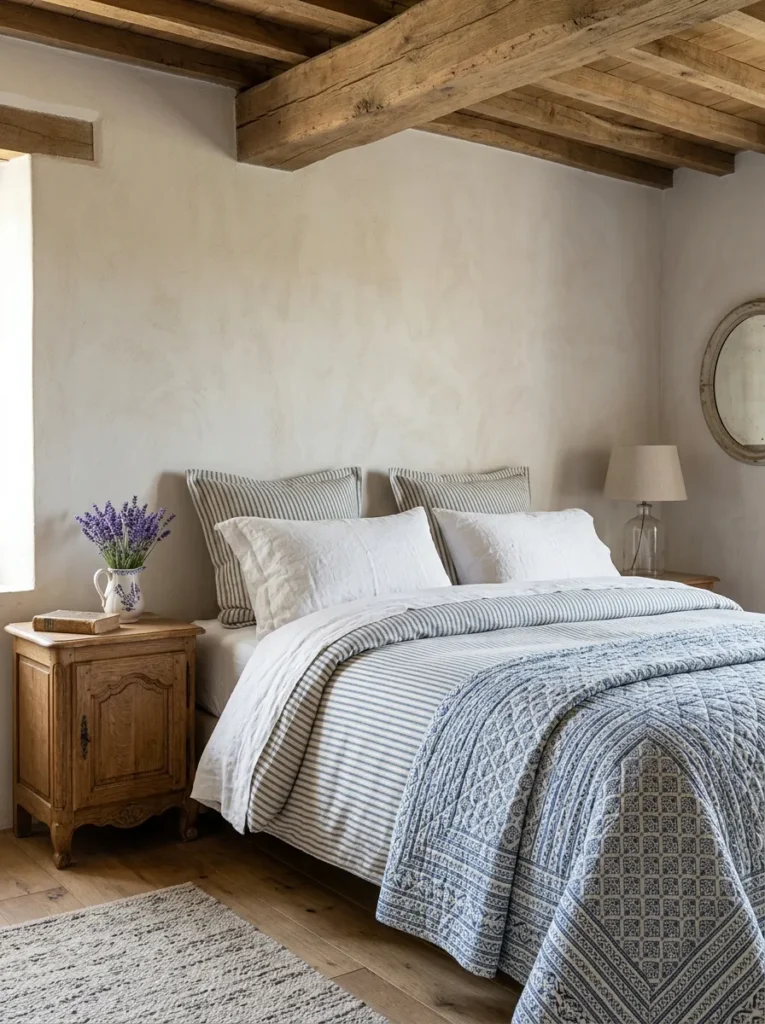
Vibe: Fresh and regional — the bedroom that smells like lavender and sunlight even when the windows are closed.
Why it works: The Provençal ticking stripe is the most historically authenticated textile in the French country palette — the narrow blue-and-white stripe of traditional mattress ticking has been produced in the textile mills of Provence and Normandy since the 17th century, and its presence in a room is the single most immediate visual signal of French country authenticity. The ticking stripe works in French country interiors specifically because its pattern is both humble and historically significant: it is the fabric of the farmhouse mattress, the peasant bolster, the working household — a material whose beauty comes from its honest utility rather than from decorative ambition. The combination of ticking stripe with the quilted boutis (a traditional Provençal quilted cover in printed cotton) creates the layered textile composition that is the signature of the French country bed — it is deliberately neither minimalist nor maximalist, but the specific middle register of a working household where textiles are both beautiful and used.
How to get it: Source authentic Provençal ticking stripe fabric from French textile specialists (Les Olivades, Souleiado, or their international stockists) for the most authentic narrow-stripe proportion. The correct Provençal blue is a specific dusty, slightly greyed blue rather than a bright or saturated blue — it references the color of aged indigo dye rather than modern synthetic dye, which is what gives it the distinctive muted, authentic quality. Layer the ticking stripe bedding with at minimum two other textile patterns (the boutis and the plain linen pillowcase) — the French country bedroom achieves its textile richness through layering, not through any single exceptional piece.
Shop the Look
| Product |
|---|
| Provençal ticking stripe duvet cover |
| Quilted boutis Provençal bedcover |
| White linen pillowcase set |
| Small faience pitcher Provençal |
| Dried lavender bunch |
4. Armoire as the Room’s Primary Storage Statement
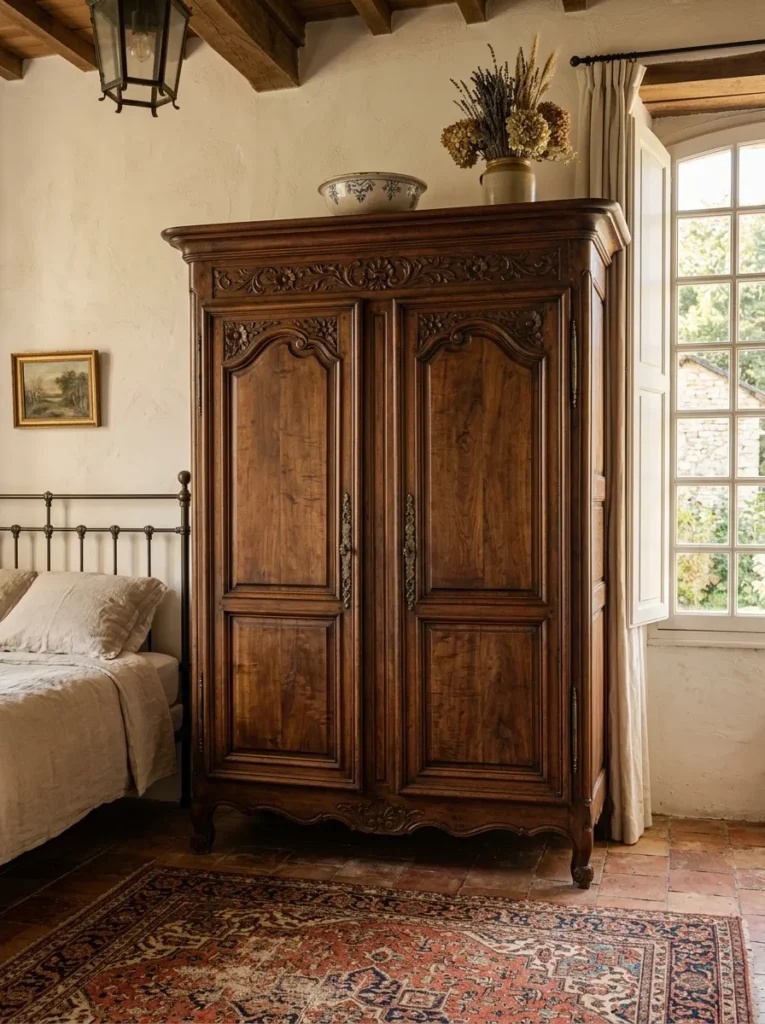
Vibe: Warm and ancestral — the piece of furniture that makes the room feel like it has a history worth knowing.
Why it works: The French country armoire is the furniture piece with the deepest cultural roots in French provincial domestic life — before built-in closets, the armoire was the household’s primary storage for linen, clothing, and valuables, and its quality and scale communicated the family’s prosperity and social standing. A genuinely old or antique armoire carries this cultural weight in every room it occupies, but even a reproduction in the correct style and proportion — carved arched panels, regional timber species (walnut in Provence, oak in Normandy and Burgundy), drop-pull hardware in aged bronze — achieves the essential design function of the armoire, which is to provide a single, dominant, beautiful storage statement that makes the room’s furniture arrangement feel historically grounded. The armoire’s height — typically 1.8–2.2 meters — creates the vertical emphasis in a French country bedroom that the bed itself cannot provide alone.
How to get it: Source French country armoires from antique dealers, estate sales, and specialist French furniture importers for genuine period pieces, or from furniture makers who produce reproduction regional styles in the correct timber species and proportions. The carved frieze at the top of a French country armoire is the most important detail for regional authenticity — the motifs (wheat sheaves, floral swags, vine leaves, or simple geometric profiles) identify the piece’s regional origin and its place in the French craft tradition. An armoire that extends to within 200mm of the ceiling reads as genuinely imposing and architecturally appropriate; one that leaves more than 300mm of dead space above reads as furniture placed in a room rather than furniture scaled to it.
Shop the Look
| Product |
|---|
| French country armoire walnut |
| Aged bronze drop pull hardware |
| Faience bowl display |
| Dried floral arrangement large |
| Worn Persian rug bedroom |
5. Terracotta Tile Floors with Natural Imperfection
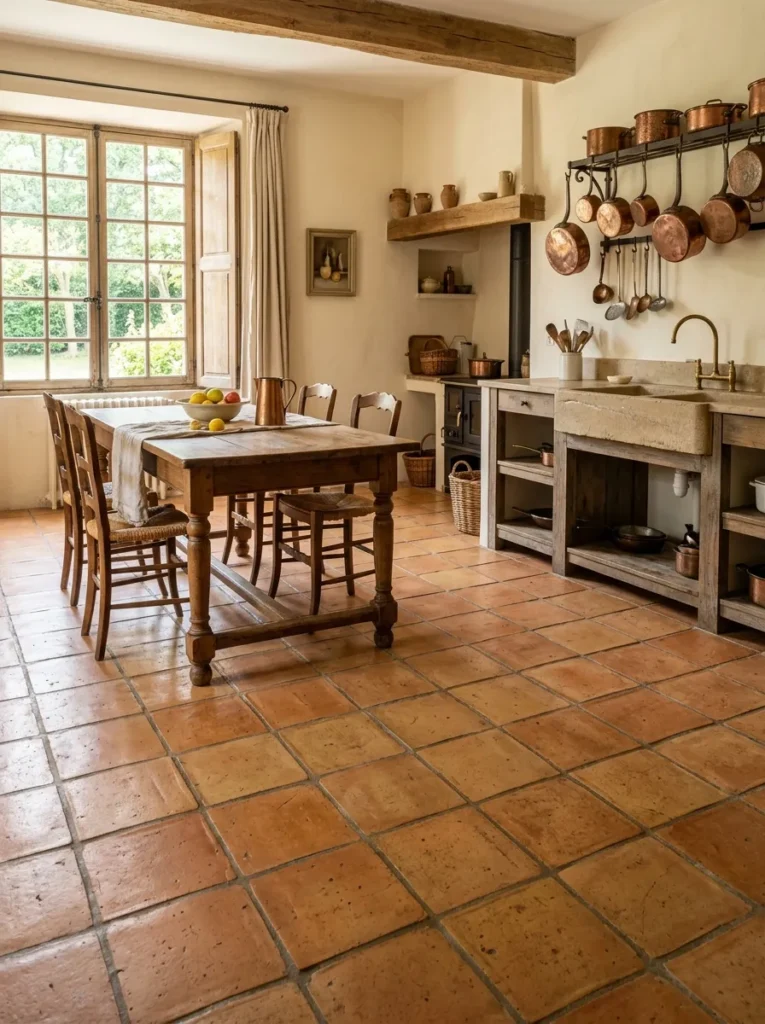
Vibe: Warm and deeply French — the floor that makes the kitchen feel like every meal cooked on it has already been worth eating.
Why it works: Handmade terracotta tile flooring is the most atmospherically powerful material in the French country interior — more so than any painted wall color, textile choice, or furniture selection — because it is simultaneously beautiful, practical, warm underfoot when heated, historically authentic, and visually richer than any manufactured floor covering. The handmade terracotta tile’s characteristic surface variation — the slight color difference between individual tiles from the same firing, the gentle dimensional irregularity that prevents perfect grid alignment, the naturally occurring surface texture of the clay — is what makes it read as genuine rather than manufactured, and this genuineness is what most resists reproduction in cheaper alternatives. A beeswax seal rather than a polyurethane coating is the finishing specification that preserves the terracotta’s natural matte surface while protecting it from staining — the sealed-with-beeswax terracotta reads as aged and authentic; polyurethane-coated terracotta reads as factory-finished regardless of the tile’s genuine quality.
How to get it: Source genuine handmade terracotta tiles from specialist importers of French or Spanish terracotta (Saltillo and Toulouse terracotta are both widely available internationally). Before installation, seal the unglazed tiles with a penetrating terracotta sealer to prevent oil and liquid absorption, then finish with natural beeswax applied and buffed to a soft matte sheen. The grout joint should be approximately 8–12mm in grey-beige grout — the wider grout joint of traditional terracotta laying is more historically authentic than the narrow joints of contemporary tile installation.
Shop the Look
| Product |
|---|
| Handmade terracotta floor tile |
| Terracotta penetrating sealer |
| Natural beeswax floor finish |
| Grey-beige tile grout |
| Terracotta tile laying adhesive |
6. French Country Kitchen with Open Shelving and Faience Display
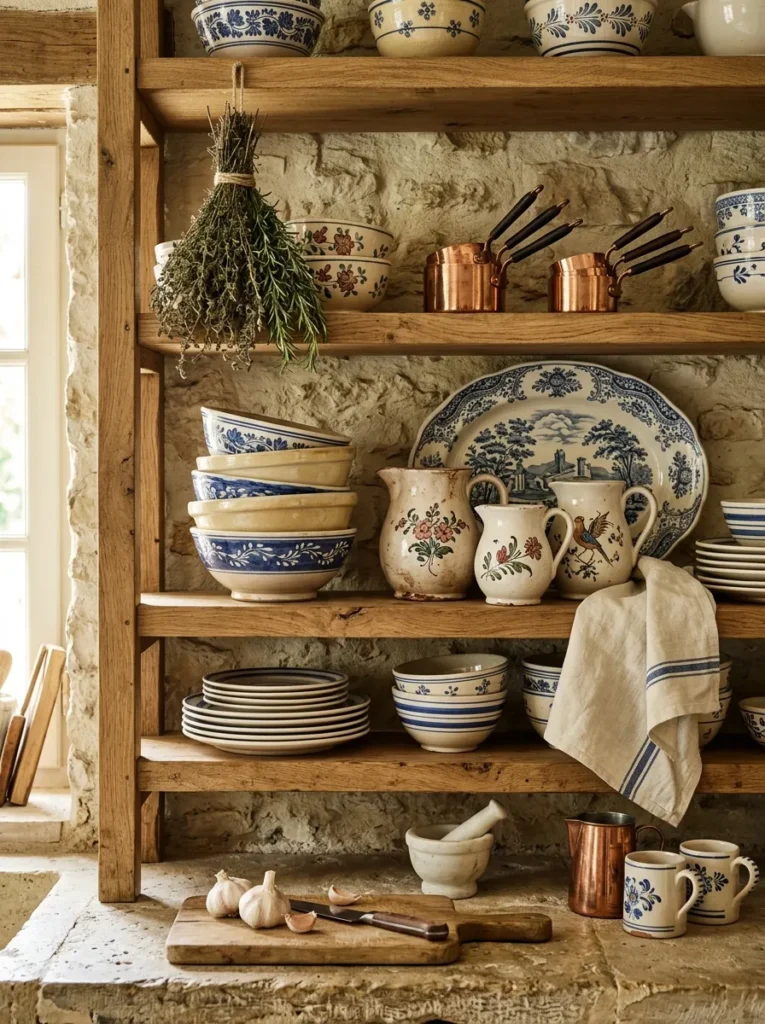
Vibe: Abundant and domestic — the kitchen shelves that look like they have been collecting the right things in the right place for thirty years.
Why it works: Open shelving in a French country kitchen serves a fundamentally different purpose than open shelving in a contemporary minimalist kitchen — rather than displaying a curated selection of identical objects for visual calm, French country open shelving displays the abundance of a working domestic kitchen in which beautiful functional objects have accumulated through use, need, and affection over time. The faience collection is the centerpiece of this display — hand-thrown and hand-painted Provençal faience pottery in the characteristic blue-and-ivory palette is simultaneously the most practically useful and most visually beautiful category of domestic French country object, because it is designed to be used daily while being beautiful enough to display when not in use. The styling principle for French country kitchen shelves: nothing that is not used, nothing that is purely decorative, nothing that did not belong in a French provincial kitchen — but within those constraints, everything beautiful and abundant.
How to get it: Source genuine faience pottery from Moustiers-Sainte-Marie, Quimper, or Nevers faience makers (all available through specialist importers and online French ceramics retailers) for authentic Provençal or regional designs. The display arrangement on open shelving should be the natural result of use and storage rather than a styled composition — bowls stacked in the order they are used, pitchers grouped by size, platters displayed vertically for space efficiency. This functional logic produces a more authentically French country display than any styled composition.
Shop the Look
| Product |
|---|
| Provençal faience bowl set blue |
| Faience large platter display |
| Copper measuring cup set |
| Dried rosemary thyme bundle |
| Linen dish cloth French natural |
7. Washed Linen Curtains with Iron Ring Hardware
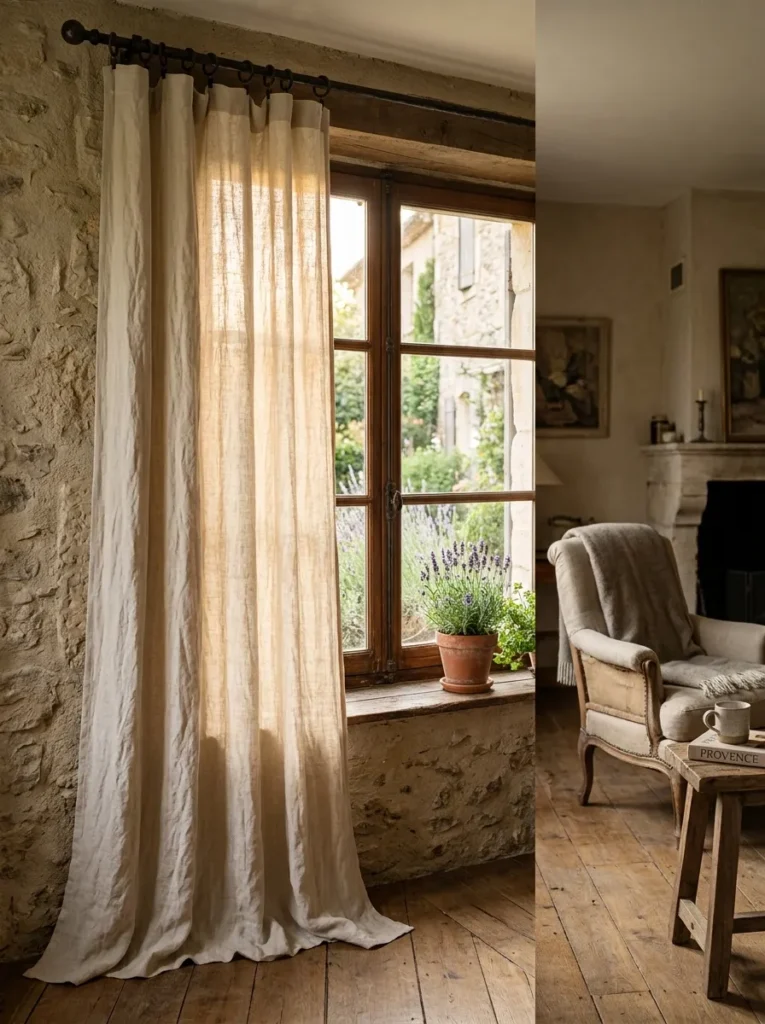
Vibe: Warm and soft — the curtain that turns morning light into the most beautiful thing in the room.
Why it works: Washed linen curtains on iron ring hardware are the French country window treatment that most perfectly balances the style’s two primary aesthetic values — the material honesty of natural fiber and the practical elegance of honest hardware. The washed linen (pre-washed multiple times before installation to achieve maximum softness and relaxation) is the correct treatment because it produces the relaxed, slightly crumpled drape that new, stiff linen cannot achieve — the softened, lived-in quality of washed linen is the visual evidence of a textile that has been used, laundered, and appreciated over time, which is the specific quality that distinguishes French country from new-country pastiche. The forged iron rod and simple iron ring clips are the hardware choice that reads as genuinely regional and craft-made — the slight irregularity of hand-forged iron is visible at close range and communicates the same artisanal quality as the hand-thrown faience pottery and hand-made terracotta tiles throughout the French country interior.
How to get it: Pre-wash linen curtain fabric three to four times in warm water with a gentle detergent before hemming and installation — each wash cycle further relaxes and softens the linen, producing the characteristic soft drape that is impossible to achieve with new-stiff fabric. The curtain width should be 2.5 times the window width at minimum — the generosity of the gathered fullness is the detail that makes washed linen curtains read as deliberately chosen rather than economically constrained. Source forged iron curtain rods from blacksmith workshops or specialist ironwork suppliers rather than hardware stores — the slight irregularity of hand-forged iron is the quality that distinguishes authentic hardware from machine-made approximations.
Shop the Look
| Product |
|---|
| Washed linen curtain panel ivory |
| Forged iron curtain rod |
| Iron ring curtain clip set |
| Lavender pot small windowsill |
| Iron rod bracket pair |
8. Weathered Timber Dining Table with Mismatched Chairs
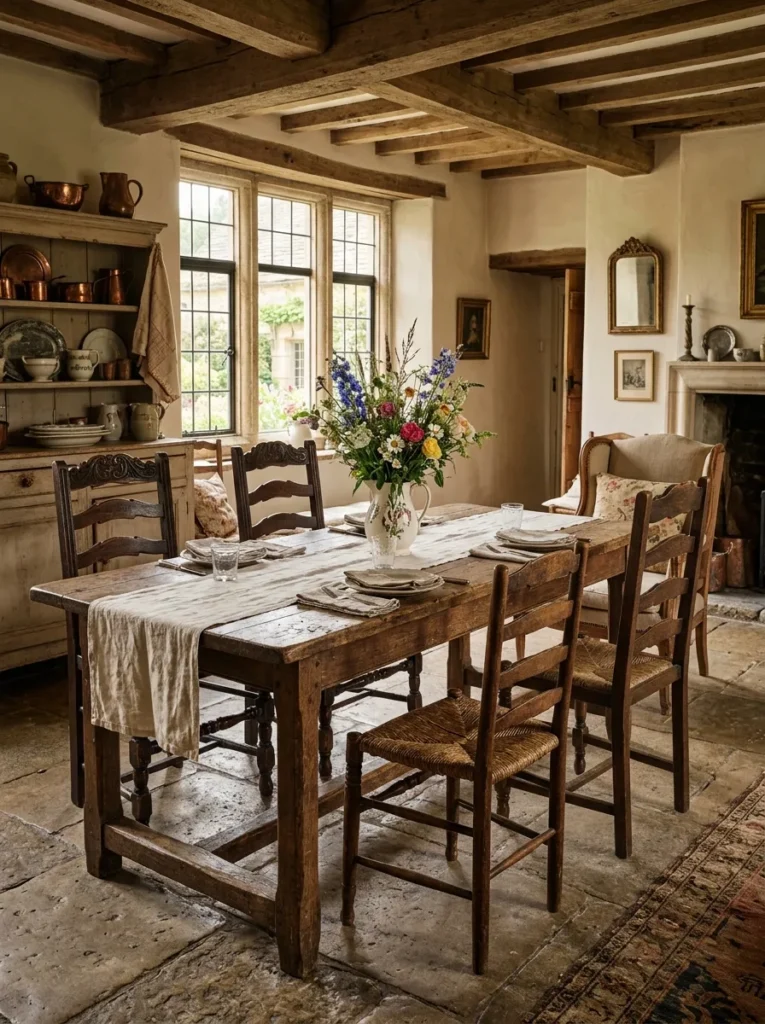
Vibe: Warm and generously hospitable — the dining table that makes every meal feel like it might last until midnight and probably should.
Why it works: The weathered farmhouse dining table with mismatched chairs is the French country dining composition that most faithfully represents the style’s philosophical relationship with furniture — the idea that a beautiful household accumulates its furniture over time from different sources, occasions, and purchases, and that this accumulated variety creates a richer, more personal domestic environment than any matched furniture suite. The weathered table specifically — with its visible grain, worn patches, and accumulated surface marks — is not a piece of furniture that has aged poorly but one that has aged authentically, and in the French country tradition, authentic aging is a form of beauty rather than a form of deterioration. The mismatched chairs share this quality: each contributes its own material history to the dining composition, and together they create the visual richness and personal character that a matched dining suite, however expensive, cannot replicate.
How to get it: Source the dining table from antique dealers, estate sales, brocantes (French flea markets), or specialist antique dealers who import French provincial furniture — a genuine weathered French farmhouse table is distinguishable by the quality of its timber (solid oak or pine rather than veneer), the visible evidence of multiple coats of wax or oil over decades, and the specific wear patterns that authentic use creates (worn patches at the seating positions, knife marks near the cutting end, ring marks from decades of glasses). The mismatched chairs should share one unifying quality — all in natural timber, all approximately the same seat height, all from the same general regional tradition — while differing in style, period, and detail.
Shop the Look
| Product |
|---|
| Weathered oak farmhouse table |
| Ladder back rush seat chair |
| Carved oak dining chair pair |
| Long linen table runner |
| Large faience pitcher display |
9. Dried Lavender and Botanical Arrangements Throughout
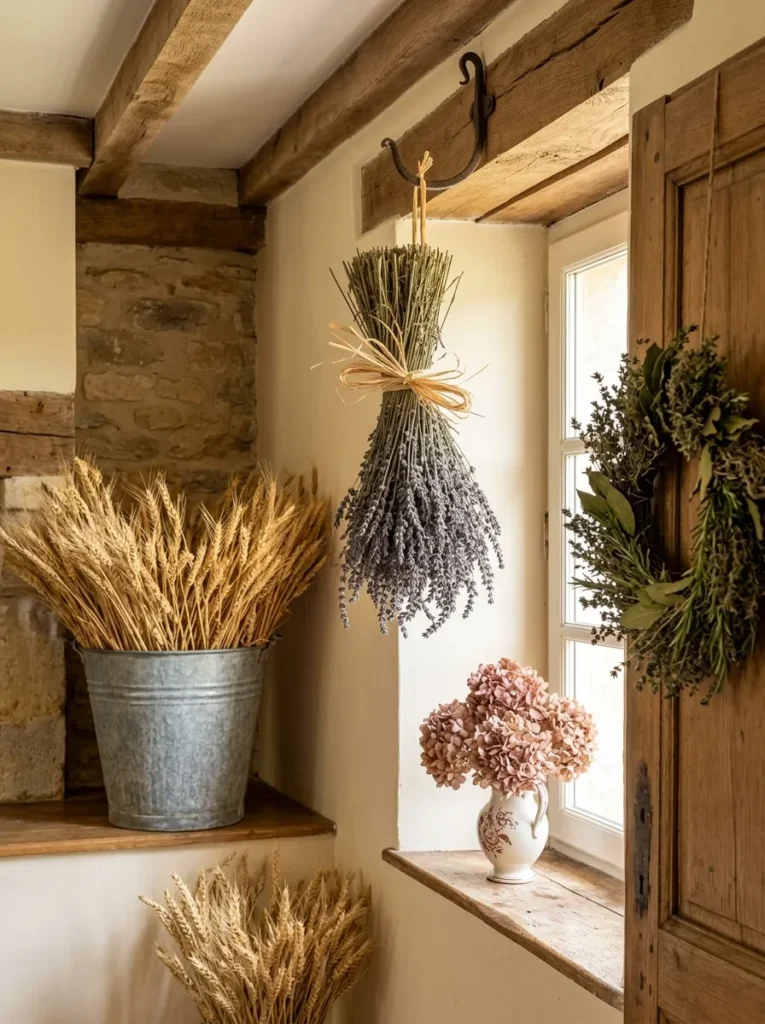
Vibe: Fragrant and natural — the room that smells of the Provençal countryside even when you are nowhere near it.
Why it works: Dried lavender and botanical arrangements are the French country decorating element that most completely engages the olfactory dimension of interior design — the specific scent of dried Provençal lavender (Lavandula angustifolia, the genuine Haute-Provence variety rather than the hybrid lavandin) is one of the most powerful domestic scent experiences available in any interior, and its presence in a room immediately signals a specific place, culture, and time of year that no other botanical can replicate. In the French country tradition, dried botanicals are not merely decorative — they are the natural overflow of a household that grows, harvests, and processes its own agricultural produce, and their presence in bundles hanging from beams, in galvanized buckets, in faience vases, and in wreaths on doors communicates the productive domestic life that is the lifestyle aspiration at the heart of French country design.
How to get it: Source genuine Provençal dried lavender from specialist importers or Provençal lavender farms that sell dried bundles directly — the quality difference between genuine Haute-Provence lavender and commodity dried lavender is significant in both fragrance intensity and visual quality. Hang bundles with the flower heads downward from iron hooks on beams or from the back of doors using raffia or natural twine — the hanging position allows the essential oil to concentrate at the flower heads rather than evaporating from the stem ends. Replace bundles annually in late summer when new Provençal lavender harvests become available.
Shop the Look
| Product |
|---|
| Dried Provençal lavender bundle |
| Natural raffia tie roll |
| Iron beam hook |
| Galvanized bucket display |
| Dried hydrangea bunch |
10. Hand-Painted French Country Kitchen Cabinets
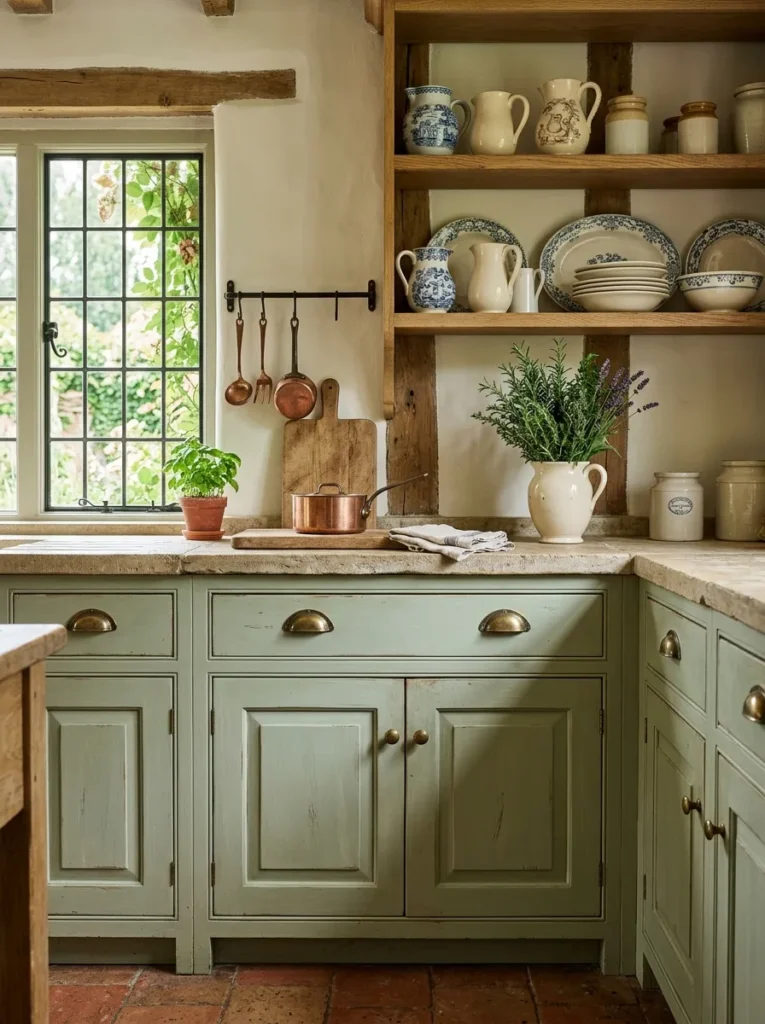
Vibe: Warm and craft-made — the kitchen that looks like it was painted with love rather than installed with a factory spray gun.
Why it works: Hand-painted kitchen cabinets in the French country style are the kitchen renovation decision that most authentically communicates the style’s core relationship with craft — the slight variation in paint tone that results from brush application, the visible brush marks in raking light, the gentle imperfection of a hand-painted surface are the visual qualities that distinguish a French country kitchen from a contemporary factory-finished one, and they are qualities that are specifically more beautiful and more authentic than the machine-perfect finish of modern spray painting. The French country color palette for kitchen cabinets — soft sage, aged blue-grey, warm cream, faded Provençal blue — is resolutely non-white: these kitchens are not neutral backgrounds for modern life but primary characters in the domestic narrative, with their own warmth, their own color history, and their own material personality.
How to get it: Apply a chalk-based or mineral paint (Farrow & Ball, Annie Sloan Chalk Paint, or Porter’s Paints Limewash) in a soft sage or aged blue-grey to existing cabinet doors using a natural bristle brush rather than a roller — the brush application produces the slight surface variation that reads as hand-painted. Apply two thin coats with a light sand between coats to achieve a durable finish while retaining the visible brush texture at the surface. Replace all existing hardware with aged brass or iron pull-style hardware — the hardware upgrade is as important as the paint color in creating the French country cabinet aesthetic.
Shop the Look
| Product |
|---|
| Chalk paint soft sage kitchen |
| Natural bristle paint brush |
| Aged brass kitchen pull hardware |
| Stone countertop slab |
| Faience vase kitchen display |
11. Exposed Timber Beams on Ceilings and Walls
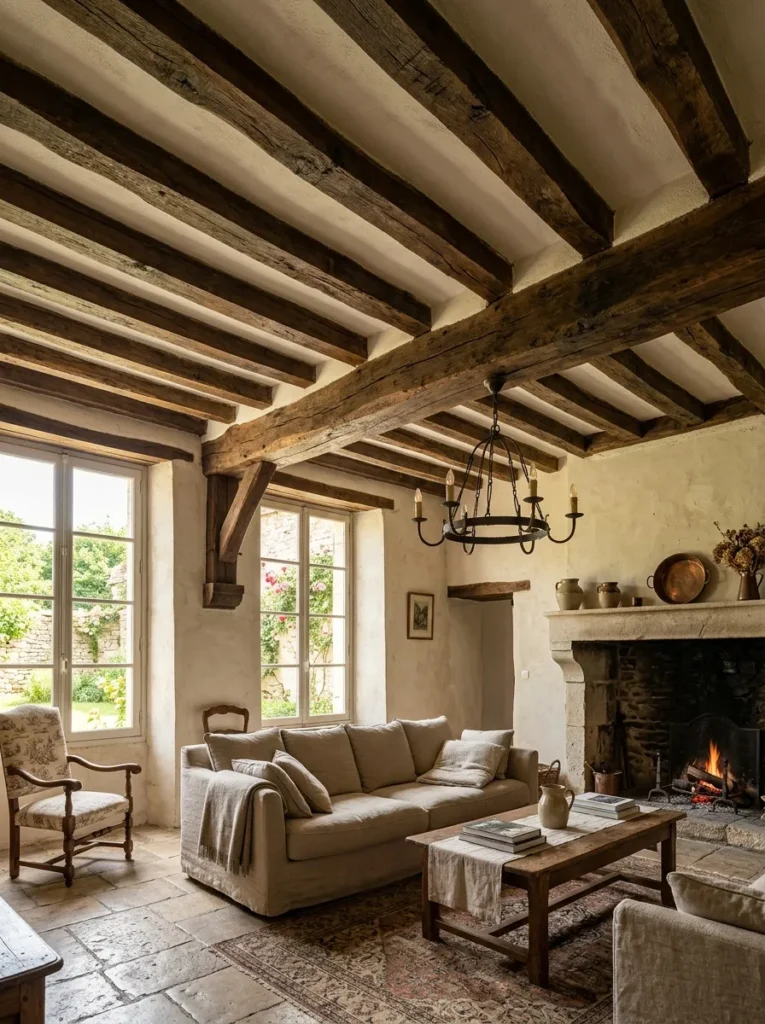
Vibe: Warm and deeply rooted — the ceiling that makes the room feel as though the building has been standing for three hundred years.
Why it works: Exposed timber ceiling beams are the most architecturally irreplaceable element of the French country aesthetic — they are the structural feature that most directly communicates the building’s age, material honesty, and regional identity, and their presence in a room establishes the entire design register of everything below them. The contrast between dark aged oak beams and white lime plaster ceiling is the visual rhythm that appears in virtually every authentic French country interior from the smallest farmhouse kitchen to the grandest bastide salon, because it is the visual signature of vernacular French construction — the load-bearing oak structure of the building expressing itself through the plaster skin of the interior. Applied beam systems — steel-reinforced polyurethane foam or timber hollow sections applied to an existing plasterboard ceiling — are widely available and visually convincing at normal room observation distances when finished in the correct aged timber color.
How to get it: Install genuine solid timber beams (oak, pine, or elm in the correct regional tradition) if the building structure permits — structural engineer consultation is required for genuine beam installation. For applied decorative beams, source solid timber hollow-box systems (PermaTimber, Volterra Architectural Products, or regional timber suppliers all produce these) in the correct cross-section proportions — minimum 150mm × 100mm visible face for a standard room height of 2.7 meters. Finish with a dark brown beeswax or oil (Sikkens Cetol in Teak or Dark Oak) to achieve the aged, absorbed-finish quality that distinguishes genuine old timber from new timber with a surface stain applied.
Shop the Look
| Product |
|---|
| Decorative timber hollow beam set |
| Dark oak timber oil finish |
| Beam adhesive and fixings |
| Iron chandelier French country |
| Lime plaster wall finish |
12. French Country Bathroom with Clawfoot Tub and Stone Basin
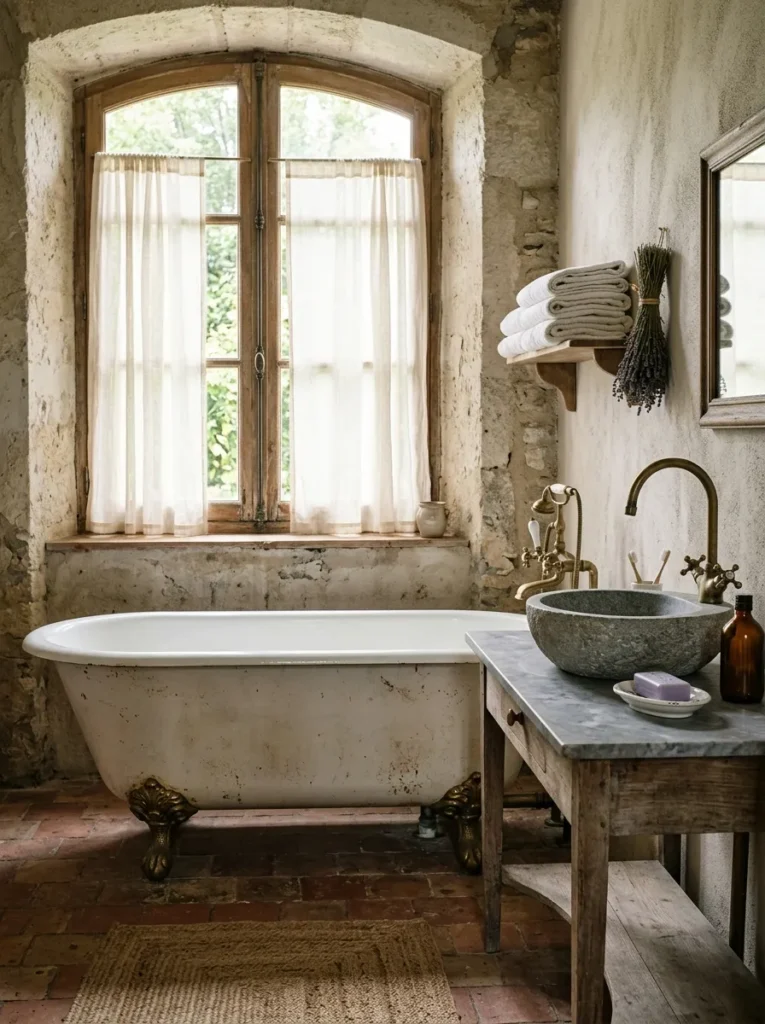
Vibe: Luxurious and historic — the bathroom that makes bathing feel like a ritual worth building the rest of the day around.
Why it works: The French country bathroom centered on a freestanding clawfoot tub is the bathing environment that most powerfully makes the everyday routine of bathing feel like a genuine sensory and cultural experience — the combination of the aged enamel tub, terracotta floor, stone basin, sheer linen, and aged brass fittings creates an interior that is simultaneously luxurious and modest, historic and functional. The clawfoot tub is the central architectural element that organizes the entire bathroom around the act of bathing as the room’s primary purpose rather than its secondary function — it takes up floor space in a way that wall-mounted baths and shower cubicles cannot, and that spatial commitment to the bath as the room’s main event is a statement about domestic priorities that is quintessentially French. The aged enamel and original hardware communicate material authenticity that new reproduction baths can approximate but not fully achieve.
How to get it: Source genuine antique clawfoot tubs from architectural salvage yards — the aged enamel, the specific profile of the feet, and the patina of the original fittings are qualities that reproduction tubs consistently fail to replicate at full quality. If a new reproduction is the only feasible option, select one with traditional proportions (slipper or double-ended form rather than contemporary apron front) and replace the supplied chrome fittings immediately with aged brass or unlacquered brass alternatives, as the fittings are the most visible quality signal.
Shop the Look
| Product |
|---|
| Clawfoot bathtub freestanding white |
| Aged brass bath fittings |
| Stone basin washstand |
| White linen towel set |
| Faience soap dish |
13. Provençal Table Setting with Gathered Wildflowers
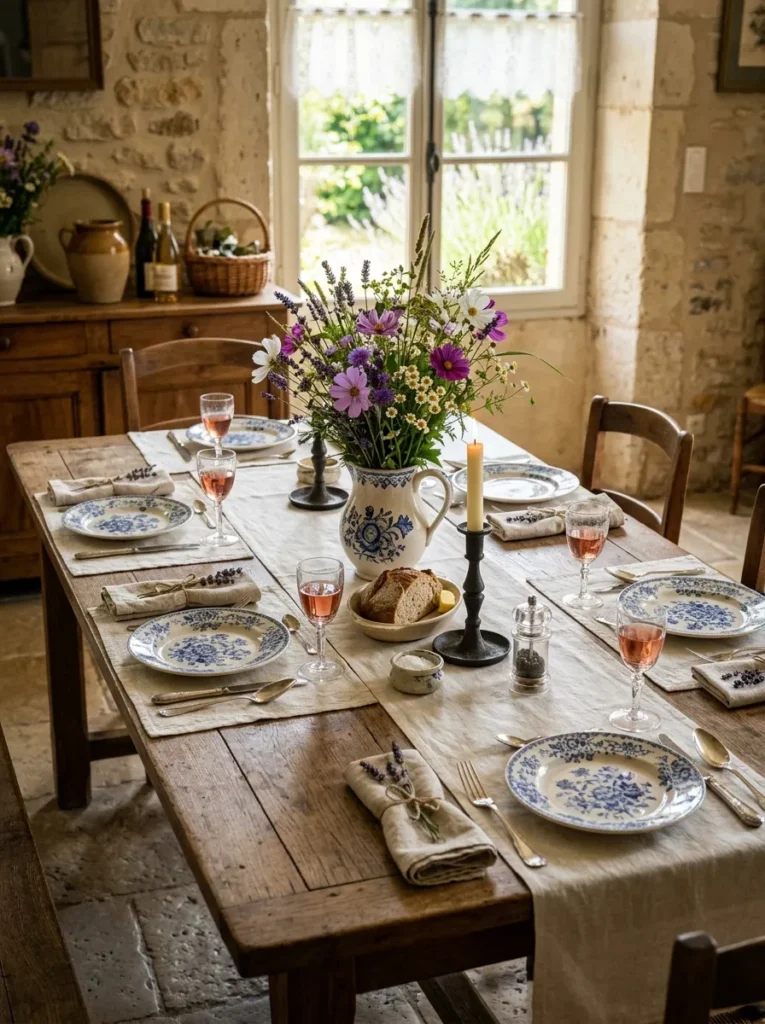
Vibe: Celebratory and domestic — the table that makes an ordinary Tuesday lunch feel like the best occasion of the week.
Why it works: The Provençal table setting with gathered wildflowers is the French country decorating idea that most completely encapsulates the style’s approach to domestic beauty — beauty that arises from the quality of daily life rather than from extraordinary effort or expenditure. The gathered wildflowers (lavender, chamomile, cosmos, wild grasses collected from the garden or roadside) are the table decoration that most faithfully represents the French country aesthetic because they communicate abundance without waste, effort without formality, and a relationship with the natural world that is both intimate and casual. The mismatched French wine glasses are the tableware choice that read as most authentically French country — the deliberate collection of glasses from different sets, different periods, and different sources communicates the accumulated domestic history of a household that uses things until they are gone and replaces them individually rather than in matched sets.
How to get it: The table setting components should be sourced gradually rather than purchased as a set — the authentic French country table is the result of years of practical accumulation rather than a single considered purchase. Start with a quantity of linen placemats or a long linen table runner, add faience plates in Provençal patterns from antique markets and specialty retailers, collect mismatched French bistro wine glasses over time, and use a large faience pitcher already in the kitchen as the wildflower vessel. The wildflowers for the centerpiece should be gathered from the garden or sourced from a farmers market — commercial supermarket flowers in cellophane do not achieve the casual abundance that makes this table setting read as genuinely French country.
Shop the Look
| Product |
|---|
| Linen table runner long natural |
| Provençal faience dinner plate |
| French bistro wine glass set |
| Large faience pitcher |
| Wildflower seed mix garden |
14. Ironwork Details Throughout — Hardware, Lighting, and Accessories
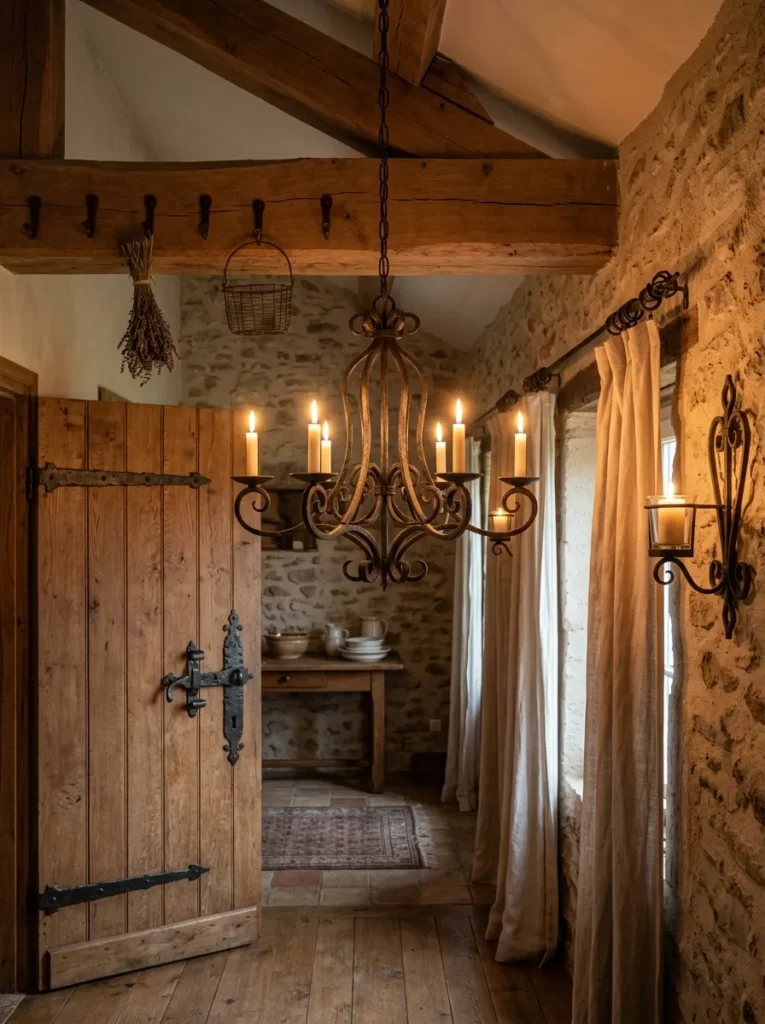
Vibe: Warm and materially coherent — the room where every metal surface tells the same story.
Why it works: Consistent ironwork throughout a French country room — forged iron chandelier, iron door hardware, iron curtain rods, iron sconces, iron hooks on beams — creates the material coherence that is the visual signature of a room that has been considered as a unified environment rather than assembled from independent decorating decisions. Wrought iron is the metal of the French country tradition for the same reason that terracotta is its clay: it is the material produced by regional craft workshops (ferronniers d’art) throughout rural France for centuries, and its characteristic surface — slightly irregular, with visible hammer marks, taking a dark patina rather than a bright polish — communicates the honest craft quality that defines the entire style. The consistent use of iron across multiple functional elements in the same room creates a visual rhythm that the eye reads as designed intention, because every element speaks the same material language.
How to get it: Source hand-forged ironwork from specialty ironwork suppliers and blacksmith workshops rather than from hardware stores — the quality and appearance of hand-forged iron is demonstrably different from machine-made iron products, and the difference is visible in the finished room. Apply a consistent approach to iron hardware across all functional categories simultaneously — door hinges and latches, curtain rods, light fixtures, and decorative hooks — replacing existing chrome, nickel, or brass hardware with the iron equivalent in each category. The visual rhythm that the consistent ironwork creates is worth the systematic replacement effort.
Shop the Look
| Product |
|---|
| Forged iron chandelier candle |
| Iron door latch hardware |
| Forged iron curtain rod |
| Iron wall candle sconce |
| Iron beam hook set |
15. A Curated Brocante Collection of Found and Inherited Objects
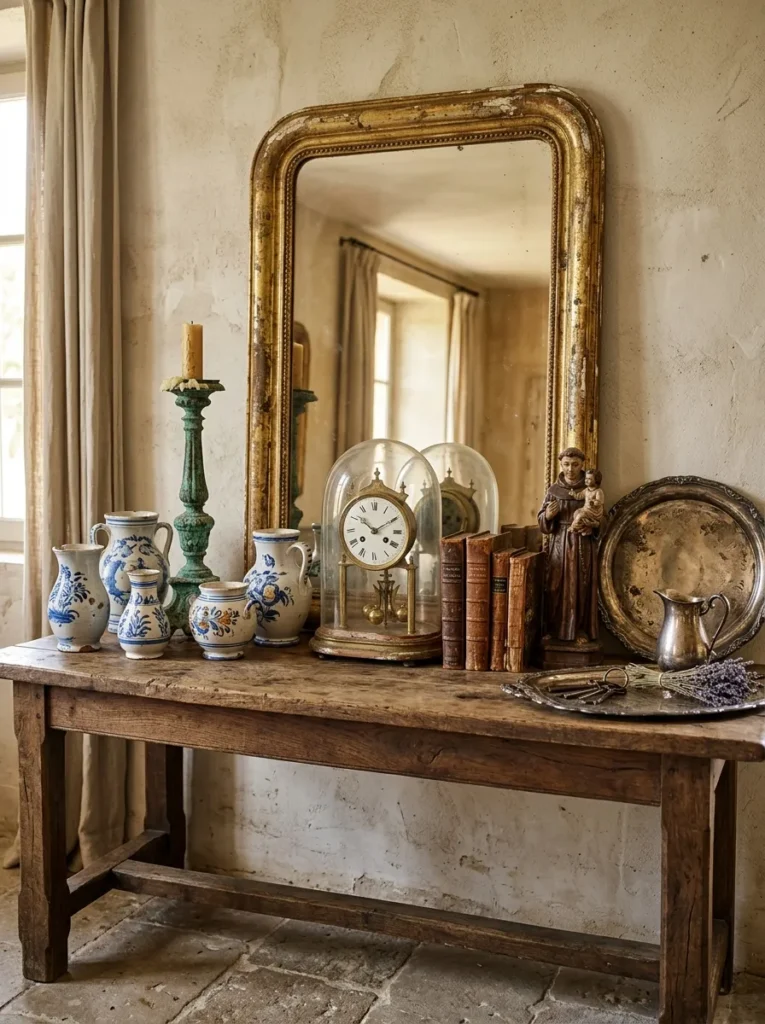
Vibe: Warm and accumulated — the console table that looks like the most interesting five minutes of browsing at a Provençal brocante.
Why it works: The brocante collection — the personal archive of found, inherited, and market-sourced objects assembled on a console or dresser — is the French country decorating idea that most completely expresses the style’s fundamental relationship with objects and their histories. In France, the brocante (flea market selling antiques, vintage, and secondhand goods) is a serious cultural institution — it is where educated French consumers shop for domestic objects, where the concept of chiner (searching and hunting for beautiful and interesting objects) is practiced as a domestic art form, and where the French preference for objects with personal history over objects of commercial newness is most fully expressed. A well-assembled brocante collection on a French country console reads as simultaneously eclectic and coherent, because while the objects vary wildly in type, period, and origin, they all belong to the same warm, aged, materially honest tonal world.
How to get it: The brocante collection is assembled over time rather than purchased in a single session — this is its essential character. Begin with two or three genuinely beautiful found objects (an aged faience piece, an antique clock, a bronze verdigris candlestick) and add to the collection slowly from markets, estate sales, and antique dealers. The unifying principle is the warm tonal palette: every object must belong to the same warm, aged, non-bright color family regardless of its material or period. Objects that are too bright, too new, or too contemporary in their design language break the collection’s coherence regardless of their individual quality. The collection should never be finished — it should always be in the process of becoming, because the process of searching and finding is as important as the objects themselves.
Shop the Look
| Product |
|---|
| Antique French clock glass dome |
| Bronze verdigris candlestick |
| Antique faience vase collection |
| Worn leather book display |
| Tarnished silver tray vintage |
How to Start Your French Country Transformation
Your single first move is to replace the existing overhead light bulbs in your most-used room with warm amber bulbs at 2200K and remove any fluorescent or cool-white light sources from the same space. French country interiors are inseparable from the quality of warm, amber light — the candlelight and firelight that historically illuminated these rooms has been replaced by warm incandescent and LED sources, but the color temperature must remain the same. Cool white or fluorescent light kills the French country atmosphere more completely than any wrong furniture choice or mismatched textile, because the entire visual warmth of terracotta, aged timber, and worn linen disappears under cool light and re-emerges under warm light. This single lighting change costs $15–30 in bulbs and produces an immediate, dramatic shift in the room’s atmospheric quality before any other change is made.
The most common French country decorating mistake is purchasing new objects designed to look old rather than finding genuine old objects that have aged naturally. A new faience bowl with a deliberately distressed glaze reads as pastiche; an actual secondhand faience bowl from a brocante reads as authentic. A new armoire distressed to look antique reads as theatrical; a genuine antique armoire with natural wear reads as history. The difference between these two approaches is not always visible at a distance, but it is consistently felt in a room — the room assembled from genuine aged objects has a material quality and atmospheric presence that reproduction aged objects cannot replicate at any price. The practical consequence of this principle: spend the French country decorating budget at antique markets, estate sales, and specialist antique dealers rather than at retail stores, even if the antique pieces cost more than their retail equivalents.
Three specific investments under $100 that create immediate French country atmosphere: (1) A large bundle of dried Provençal lavender ($15–25 from specialist French botanical suppliers) hung from an iron hook on a timber beam or placed in a large faience pitcher immediately introduces the most distinctive sensory element of the French country interior — the scent alone transforms the room’s atmospheric quality before anything is seen. (2) A set of six linen placemats or a long linen table runner ($25–55 from quality linen retailers) immediately establishes the correct textile register for a French country dining table and creates the foundation for the authentic table setting that is central to the French country domestic ritual. (3) A pair of aged brass or iron drawer pulls ($20–40 for a set of six) used to replace existing chrome or modern hardware on kitchen cabinets, dressers, or bathroom vanities immediately shifts the room’s hardware palette from the modern register to the historically appropriate one that the French country aesthetic requires.
Realistically, a complete French country room transformation — armoire, clawfoot tub, terracotta floor, limestone fireplace, hand-painted cabinets, washed linen curtains, and a brocante object collection — costs $8,000–25,000 at mid-range quality sourcing, depending heavily on the quality and source of the major pieces. A focused three-element French country transformation — a weathered farmhouse table with mismatched chairs, washed linen curtains on iron hardware, and a curated brocante object collection on a console — costs $1,500–4,000 and produces a room that reads as genuinely French country in its essential character. Most people begin with the textiles (linen curtains and slipcovers) and the scent (dried lavender), use the transformed room through one season to understand how the style feels to inhabit, and invest in the more significant pieces (the armoire, the farmhouse table, the faience collection) as they find the right sources and the right individual pieces over time.
Frequently Asked Questions About French Country Decorating
What is the difference between French country and Shabby Chic decorating?
French country and Shabby Chic share surface similarities — both value aged patina, soft colors, and natural materials — but they differ fundamentally in their philosophical approach to age and material quality. French country values genuine aging: objects that have aged naturally through decades of authentic use, wear that has occurred through regular inhabitation, patina that is the direct result of material oxidation and use. Shabby Chic values the appearance of aging: new objects deliberately distressed to simulate wear, bright white or pastel paint with artificially applied chipping, reproduction pieces designed to look antique. French country is understated and earthy in its color palette (warm stone, terracotta, Provençal blue, olive green); Shabby Chic is more pastel and feminine (pale pink, powder blue, cream). French country draws from specific regional French craft traditions (faience, forged iron, terracotta, regional textiles); Shabby Chic borrows from a more general romantic-vintage aesthetic without regional specificity.
What colors are most authentic to French country decorating?
The most historically and regionally authentic French country colors are: warm white (the color of aged lime plaster — not brilliant white, not cool white, but the specifically warm, slightly cream white of genuine lime plaster walls), Provençal blue (a dusty, slightly greyed blue that references aged indigo dye rather than modern synthetic blue), terracotta (the warm orange-brown of the regional clay floor tiles — not a bright orange, but the specific warm earth tone of Haute-Provence terracotta), olive green (the specific deep, slightly grey-toned green of the Provençal olive landscape), lavender grey-purple (the dried flower color that is simultaneously grey and purple, never the bright purple of fresh lavender), and warm ochre (the golden yellow of Luberon limestone in full sunlight). These colors are characteristically warm, slightly muted, and of medium saturation — bright, cool, or very pale versions of any of these colors move the palette away from French country toward a more generic country or coastal aesthetic.
How do I achieve authentic French country style in a modern apartment?
The French country aesthetic is achievable in any apartment through material choices rather than architectural features — the specific materials (natural linen, aged timber, faience pottery, wrought iron, dried lavender, terracotta) communicate the style more effectively than the building’s architectural period or condition. The highest-impact French country transformations for a modern apartment are: washed linen curtains on iron hardware hung from the ceiling (creating the textile quality and window treatment that is the most visible French country signal in a modern room), a large brocante-found or antique armoire or dresser as the primary storage piece (replacing built-in or flatpack storage with a piece that has genuine material character), and a collection of faience pottery and dried botanicals in the kitchen (converting the kitchen display from the contemporary retail aesthetic to the specific French country domestic aesthetic). These three changes, together with warm-amber lighting throughout, produce a room that reads as genuinely French country despite its modern building context.
What is a brocante and how do I shop at one for French country decor?
A brocante is a French flea market specializing in antiques, vintage goods, and secondhand objects — literally a market for “brocante” (secondhand goods). Every French town and village holds periodic brocantes, and the major regional brocantes (the Marché aux Puces de Saint-Ouen in Paris, the Emmaus regional markets, and the Brocante de Lyon) attract dealers and collectors from across France and Europe. For international buyers, the closest equivalent is an antique market, estate sale, or specialist French antique importer — any of which will carry the categories of object (faience pottery, forged ironwork, provincial furniture, regional textiles) that define the brocante aesthetic. The shopping approach for French country brocante finds: look for objects in good structural condition but with visible natural patina, avoid objects that have been over-restored or artificially aged, prioritize objects from specific regional craft traditions (Provençal faience, Norman lace, Burgundian timber furniture), and buy slowly over time rather than quickly in a single session — the brocante collection improves with the patient accumulation of the right individual finds rather than the rapid assembly of many approximate ones.
How do I incorporate French country style without making the room feel like a theme park?
The French country style becomes thematic pastiche when it is applied uniformly and completely — when every object in the room is a French country reference and the room reads as a set designed for a specific theme rather than a genuine domestic environment. The antidote to pastiche is restraint and authenticity: use fewer French country references rather than more, choose genuine aged objects over reproduction distressed ones, maintain the room’s functional purpose rather than decorating around it, and allow the non-French country elements (contemporary art, a modern sofa, current books and technology) to coexist with the French country elements rather than eliminating them. The most sophisticated French country interiors are those in which the French country elements (the limestone fireplace, the armoire, the faience collection) coexist with contemporary furniture and modern life in a way that reads as a cultivated, cosmopolitan choice rather than a complete stylistic commitment — the same aesthetic approach that educated French homeowners themselves apply to their own domestic environments.
Ready to Create Your French Country Home?
These 15 ideas span the full range of what French country decorating can be — from a carved limestone fireplace that organizes an entire living room around the primacy of warmth and gathering, and natural linen slipcovers that make comfort the room’s primary design value, to a brocante collection assembled from genuine finds that gives the room a material history it could not have been purchased, and a Provençal table setting with gathered wildflowers that makes every meal feel like the most important event of the week — so whether you are transforming a single room or building a French country home environment from the ground up, there is a genuinely achievable, genuinely authentic approach here for your space, your budget, and the quality of domestic life you are working toward. The transformation begins not with shopping but with lighting — with the warm amber bulb that reveals what the room can be when its materials are seen in the right light — and continues with the patient accumulation of the right objects from the right sources over the right amount of time. Today’s specific action: find one genuine aged object in your home or at your nearest antique market — a piece of faience pottery, a worn linen cloth, a tarnished brass candlestick — place it where you will see it every day, and observe how it changes the quality of everything around it. That single object is the beginning of the brocante collection, and the beginning of the French country home. Save the ideas that matched your room’s specific architecture and your domestic life’s specific rhythms — those are the ones that will make your home feel, over time, like the French country interior that was always there waiting to be inhabited.