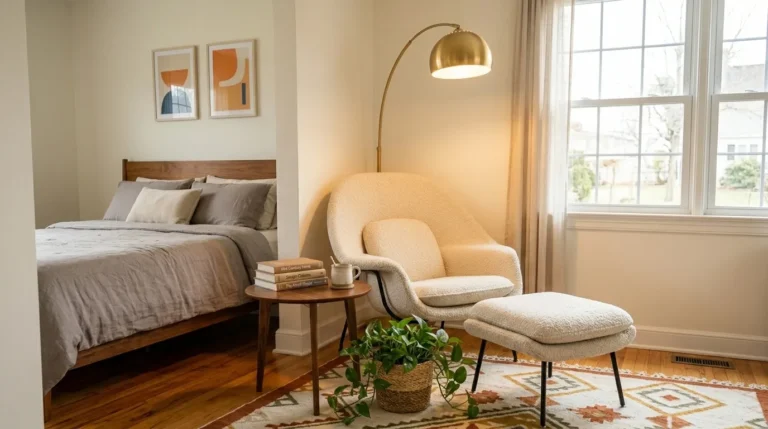
15 Dream Room Decor Ideas That Look Expensive
Dream room decor that looks expensive is the art of creating a space that reads as considered, luxurious, and professionally designed through the quality of specific design decisions — material choices, proportion, lighting, and compositional discipline — rather than through the quantity of money spent. This article gives you 15 genuinely creative, achievable dream room decor ideas that deliver the visual quality of a high-end interior at a fraction of the cost, by identifying exactly which decisions make a room look expensive and which substitutions preserve that quality at a dramatically lower price point.
Most attempts at a luxury-looking room fail not because of budget limitations but because the budget was spent in the wrong places — expensive furniture paired with poor lighting, quality textiles undermined by cluttered surfaces, a beautiful sofa in a room whose walls were last painted a decade ago. The rooms in this list spend the design budget with precision, knowing that five deliberate choices consistently produce more expensive-looking results than twenty undirected purchases. Here are 15 ideas worth saving — and implementing.
Why Expensive-Looking Room Decor Works So Well
The psychology of perceived luxury in interior design has been studied extensively by environmental psychologists and consumer behavior researchers, and the research consistently identifies that the perception of expense in a room is driven not by the actual cost of individual objects but by three specific design qualities that expensive interiors reliably exhibit and inexpensive interiors reliably lack. The first is material coherence — the sense that every material in the room belongs to the same tonal and textural family, creating a unified material palette rather than a collection of unrelated finishes. The second is spatial discipline — the restraint to leave surfaces and floor space unoccupied, which reads as a confident design statement in the same way that silence in music reads as compositional choice rather than absence. The third is lighting quality — the presence of warm, multi-directional, controllable artificial light that makes the room look beautiful at any time of day regardless of natural light conditions.
The materials that most reliably produce an expensive look at accessible price points are those whose visual quality is determined by texture and natural variation rather than by manufacturing cost. Linen is the most affordable premium-looking textile available — a linen curtain costs a fraction of silk but reads from across a room with equal sophistication, because its natural fiber variation and characteristic slight texture are the visual qualities that communicate material quality, not its thread count or fiber cost. Matte paint finishes in deep, complex colors — particularly those with significant colour depth (the ability to shift between warm and cool in different lighting conditions) — read as expensive because they communicate a design decision rather than a default choice. Natural stone and stone-effect surfaces have become increasingly accessible through high-quality porcelain tile and resin composites that are visually indistinguishable from genuine stone at normal room observation distances. Solid brass and brushed gold hardware at any quality level provides the warm metallic accent that elevates adjacent materials by association.
The trend reflects the maturation of a decade of design literacy in the general population, driven by HGTV, Instagram, and Pinterest creating a generation of homeowners who have developed sophisticated visual taste without necessarily having the budget to match. This demographic — design-aware, budget-conscious, and motivated — has created a massive market for what the industry calls “accessible luxury”: the design approach that uses strategic spending, material intelligence, and compositional knowledge to produce results that look significantly more expensive than they cost. IKEA’s sustained success in the high-design low-cost position, the emergence of brands including H&M Home, Zara Home, and West Elm’s budget lines, and the explosion of the DIY design community on social media all reflect the same cultural force: the democratization of design knowledge has made expensive-looking rooms achievable at any budget for anyone willing to learn and apply the relevant principles.
Small rooms benefit specifically from the expensive-looking design approach because the principles that make a room look expensive — material coherence, spatial discipline, lighting quality — are all more achievable in a small room than in a large one, since they require fewer materials, less furniture, and fewer light sources to execute completely. A small bedroom with three perfectly chosen textiles, one exceptional piece of furniture, and a well-designed lighting scheme will consistently look more expensive than a large bedroom furnished without those specific design disciplines applied.
Style at a Glance
| Element | Detail |
|---|---|
| Philosophy | Five deliberate choices produce more expensive-looking results than twenty undirected purchases — spend the budget on the decisions that most determine the room’s perceived quality |
| Key Materials | Linen, matte paint in complex colors, natural stone or quality stone-effect, solid brass or brushed gold, velvet, natural timber, ceramic |
| Three Principles | Material coherence, spatial discipline, lighting quality |
15 Dream Room Decor Ideas That Look Expensive
1. Full-Height Curtains in Natural Linen from Ceiling to Floor
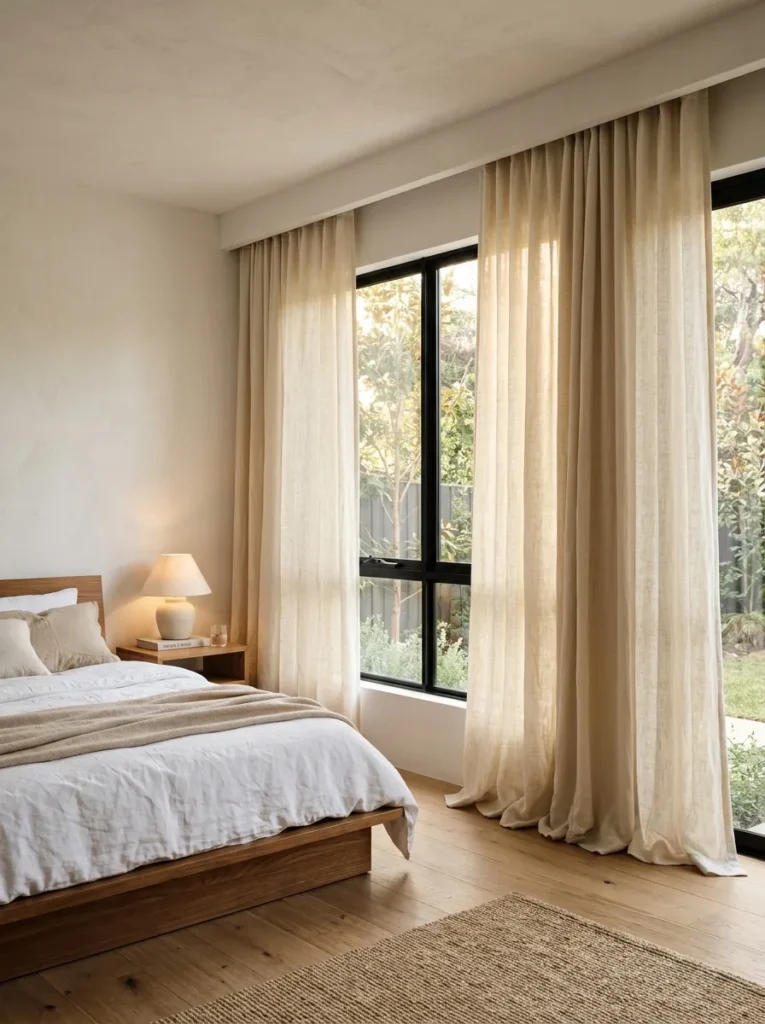
Vibe: Warm and considered — the bedroom that looks like a boutique hotel before the bed is even seen.
Why it works: Full-height ceiling-to-floor curtains in natural linen are the single highest-impact, most frequently underestimated decorating decision available in any room. Standard curtains — hung from a rod positioned 200mm above the window frame, falling to 10mm above the floor — communicate budget constraint regardless of the fabric quality, because the proportions announce the window’s actual size rather than the room’s architectural aspirations. Ceiling-mounted curtains that fall to the floor — ideally pooling by 30–50mm — communicate the opposite: they suggest that the ceiling is the relevant architectural boundary rather than the window opening, making every window appear taller and the ceiling appear higher than it actually is. Natural linen is the correct fabric for this application at every budget level because its visual quality — the characteristic irregular weave, the slight texture variation, the way it filters and warms light — is determined by the fiber’s natural properties rather than by the manufacturing cost, making inexpensive linen look substantially similar to expensive linen from across the room.
How to get it: Mount a ceiling track or a curtain rod within 50mm of the ceiling (or ideally at the ceiling itself) and hang the curtains at this height regardless of where the window is positioned on the wall below. The curtains should be 2.5–3 times the window width to create the full, gathered look when closed and generous stack-back panels when open. A plaster return (a small section of plaster wall that bridges the gap between the ceiling and the curtain track) conceals the hardware completely and makes the curtains appear to emerge from the ceiling itself — this finish detail, achievable by any plasterer in 30 minutes, is the specific upgrade that transforms a ceiling-hung curtain from a clever trick into genuine architecture.
Quick Win: Hanging existing curtains from a rod positioned at ceiling height — even if the rod is visible — immediately transforms the room’s perceived ceiling height and window scale at zero additional cost. The proportional change alone produces a noticeable increase in the room’s perceived luxury level before any other change is made.
Shop the Look
| Product |
|---|
| Natural linen curtain panel ivory |
| Ceiling mount curtain track |
| Curtain ring clip set |
| Platform bed frame low profile |
| White linen bedding set |
Also view: 17 Organic Modern Dining Decor Ideas for Every Home
2. Statement Lighting That Does the Work of Three Fixtures
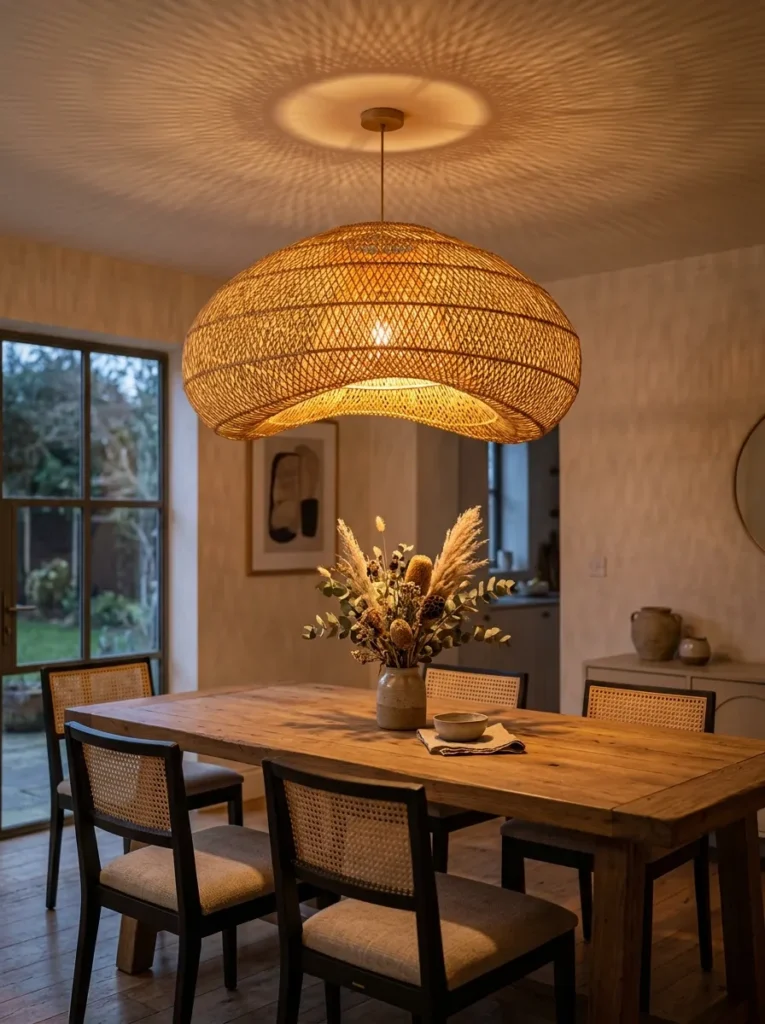
Vibe: Warm and considered — the dining room that needs only one light fitting to feel like a restaurant worth returning to.
Why it works: Statement lighting is the room design investment with the highest return on perceived luxury because a genuinely exceptional pendant or chandelier performs three simultaneous functions that no other single object in the room can replicate: it provides the room’s primary ambient light, it creates a focal point that organizes the spatial composition around it, and it introduces a material quality (woven natural fiber, blown glass, sculpted metal) that contributes to the room’s tactile richness. Rooms without a statement light fitting rely on multiple smaller light sources that collectively produce adequate illumination but no single point of visual interest — this proliferation of small, undistinguished light sources is one of the most consistent visual signals of an undesigned room. A large sculptural rattan pendant costs $80–250 from most homewares retailers and provides a design investment-to-visual-return ratio that is unmatched by any furniture purchase at the same price point.
How to get it: The hanging height of a pendant above a dining table is the installation detail that most determines whether the pendant reads as designed or accidental — 700mm from the table surface to the pendant’s base is the standard specified by interior designers for a pendant that creates an intimate light pool over the table without interrupting sightlines across the table. A pendant that hangs too high loses its visual relationship with the table and reads as a ceiling light rather than a table light; a pendant that hangs too low interrupts sightlines and creates a physical obstacle. Install on a dimmer switch — the dimmer is the single most valuable lighting investment available, converting any fixture from a functional light into an atmospheric one.
Shop the Look
| Product |
|---|
| Large rattan pendant light |
| Pendant cord adjustable length |
| LED dimmer switch |
| Warm white LED globe 2200K |
| Timber dining table natural |
Also view: 22 Easy Kids Closet Organization Ideas for Busy Families
3. Deep, Complex Wall Color in Eggshell or Satin Finish
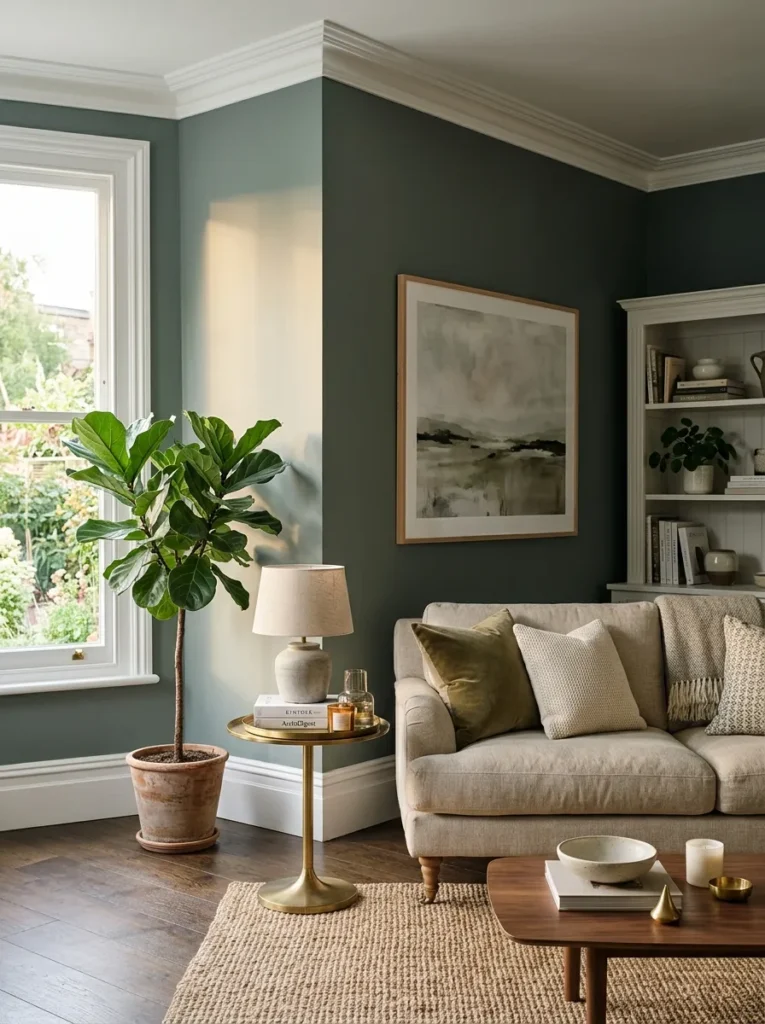
Vibe: Warm and sophisticated — the room that looks like someone made a design decision rather than avoided making one.
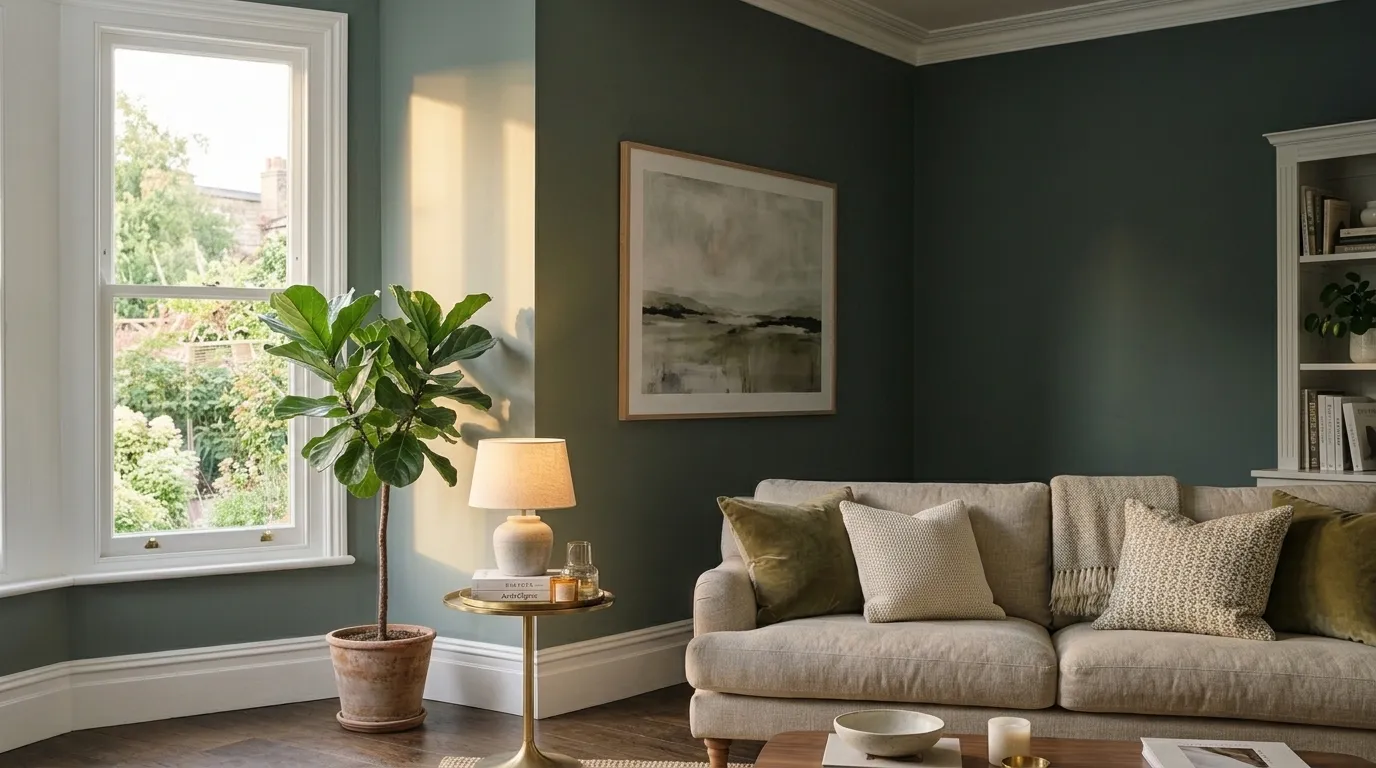
Why it works: A deep, complex wall color in a quality eggshell or satin finish is the decorating decision with the highest confidence-to-cost ratio available in residential interiors — a $60 tin of quality paint applied to all four walls transforms a room’s perceived design quality more completely than any single furniture purchase at ten times the price. The specific qualities that make a wall color read as expensive are complexity (the color should shift between warm and cool depending on the light direction, rather than reading as a flat single tone throughout the day) and depth (the color should be saturated enough to create visual richness in shadow while remaining responsive to light in sunny conditions). Dusty sage, warm charcoal, deep terracotta, and complex greige all exhibit these qualities at any paint quality level. The eggshell or satin finish is the application specification that most communicates quality — flat paint absorbs light uniformly and reads as utilitarian; eggshell creates the slight sheen that reads as deliberate and considered.
How to get it: Farrow & Ball, Dulux Colour of the Year ranges, and Benjamin Moore’s Affinity collection all produce complex, depth-rich colors at varied price points. The formula that reliably creates an expensive-looking wall color: choose a color with a named grey or brown undertone even if the primary color read is green, blue, or pink — the undertone creates the complexity that shifts the color across different light conditions. Paint all four walls including the ceiling in the same color (slightly lightened with white for the ceiling) for a room that reads as completely enveloped in the color rather than decorated with it.
Shop the Look
| Product |
|---|
| Dusty sage interior paint eggshell |
| Quality roller and tray set |
| White trim paint gloss |
| Natural linen sofa throw |
| Brass side table |
4. A Single Large-Format Piece of Art Rather Than Many Small Ones
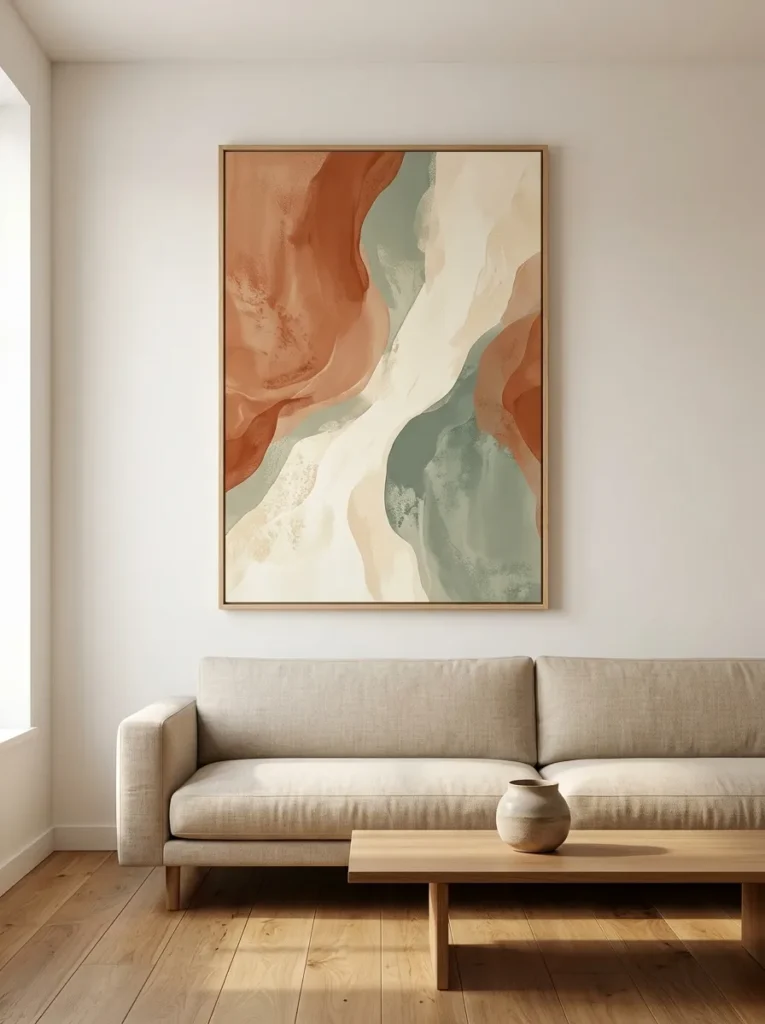
Vibe: Clean and considered — the living room that has the confidence to let one beautiful thing be the entire wall conversation.
Why it works: The single large-format artwork above a sofa is the decorating decision that most reliably communicates design confidence — and design confidence is the quality that is most consistently mistaken for design budget. A small collection of mismatched prints, framed photographs, and decorative items arranged on a wall above a sofa reads as accumulated; a single large, well-chosen artwork on the same wall with generous empty space on all sides reads as curated. This is the museum principle applied to residential design: museums hang one or two significant works per wall with generous breathing space between them, and that spatial generosity makes each work appear more significant, more valuable, and more chosen than the same works crowded together on the same wall. A large-format art print — 100cm × 140cm from a quality print service — costs $60–120 printed and $80–200 framed, and reads as a design investment that could be ten times that price.
How to get it: The artwork should be minimum 60% of the sofa’s width to read as designed rather than undersized — a standard 2.2-meter sofa needs an artwork of minimum 130cm width to anchor it visually. Hang the artwork center at 1500–1550mm from the floor — this is the eye-height that art galleries use and the height at which artwork reads as installed for a standing adult. The frame should be simple and neutral — a slim natural oak, matte black, or thin brass frame focuses attention on the artwork rather than the framing, which is the correct hierarchy for a single large artwork that needs to read as the room’s primary visual statement.
Shop the Look
| Product |
|---|
| Large format art print abstract |
| Slim natural oak picture frame |
| Picture hanging kit level |
| Natural linen sofa |
| Single ceramic decorative object |
5. Layered Bedding System with Matched Linen in Three Tones
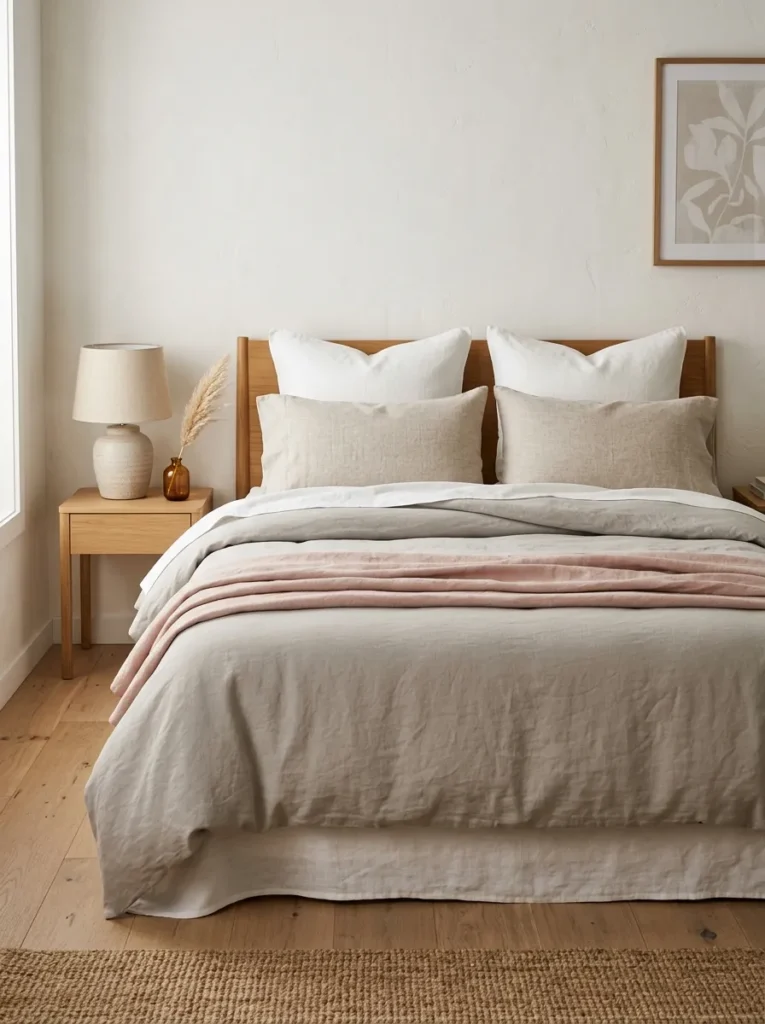
Vibe: Serene and considered — the bed that makes the room look expensive before anything else is noticed.
Why it works: The layered linen bedding system with a tonal graduation is the single most impactful investment available in a bedroom for the perceived quality return it delivers. A bed with a complete, tonally matched linen layer system — European pillows creating depth at the headboard, standard pillows in front, a duvet in a mid-tone, and a contrast throw at the foot — reads as a hotel-quality composition because it demonstrates the same design discipline that luxury hotels apply to their bed presentation: tonal coherence (all colors from the same warm family), material consistency (all linen from a single supplier for uniform weave), and compositional structure (the three-layer depth creates visual richness without visual chaos). The entire system can be executed for $150–350 from a quality linen supplier and will read as three times that price level in the room.
How to get it: Source all bedding from a single supplier to guarantee color temperature consistency across the layers — two slightly different whites from different suppliers create a color dissonance visible in the bed that undermines the tonal coherence of the system. The European pillowcases at the headboard should be 65cm × 65cm to create the visual depth and mass behind the standard pillows that makes the bed read as generously furnished. The blanket at the foot should be folded in thirds — a double fold to approximately 400mm width — and positioned across the full width of the bed rather than draped informally over one side.
Shop the Look
| Product |
|---|
| Linen European pillowcase pair |
| Linen duvet cover soft greige |
| Linen fitted sheet warm white |
| Linen throw blanket dusty blush |
| Ceramic bedside lamp |
6. Integrated Dimmer Switches on Every Light Circuit
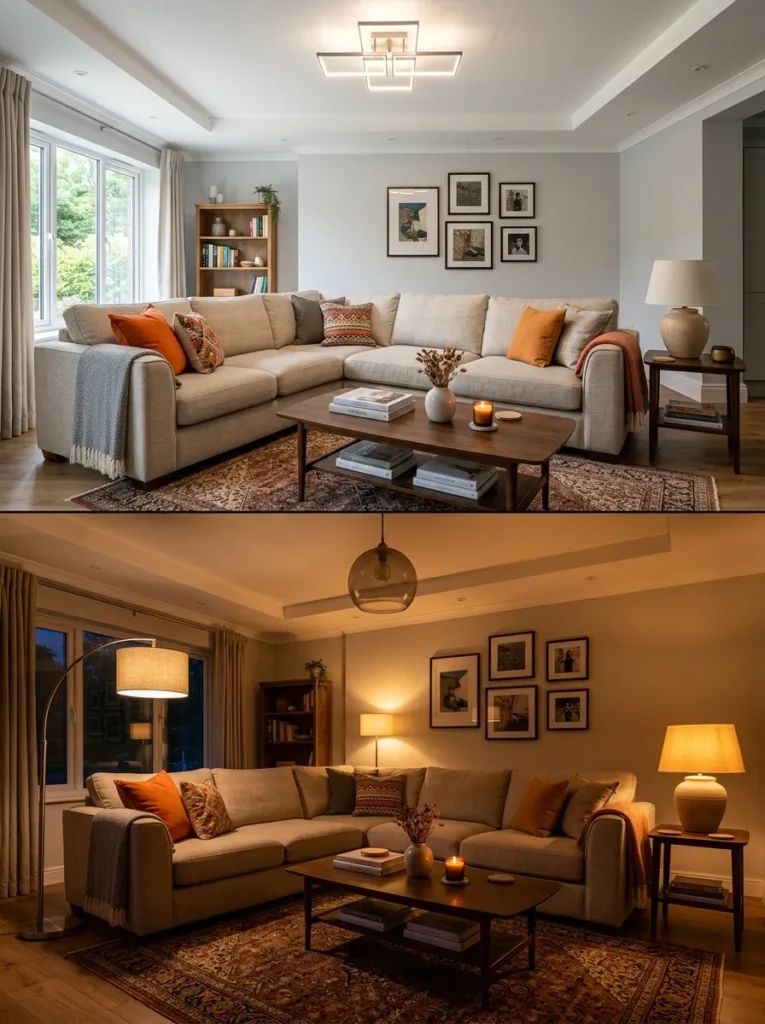
Vibe: Warm and atmospheric — the room that reveals its real quality only after 6pm, when the dimmer does what the decorator intended.
Why it works: Dimmer switches on all light circuits are the renovation investment with the highest daily-use quality-of-life return available in any room — they cost $25–45 per switch installed and immediately transform every evening in the home by allowing the room’s lighting to transition from functional bright-light levels during daytime activities to warm, intimate ambient levels during evenings. The inability to dim the lights is one of the most consistent visual signals of an undesigned room: overhead lighting at full brightness on a standard switch flattens a room’s texture, eliminates its shadows, and removes the atmospheric variation that makes a room feel designed rather than illuminated. Most residential rooms in rental and standard homeownership contexts use only one or two light circuits with standard on-off switches — replacing these with trailing-edge LED dimmers converts a utilitarian light system into a controllable atmosphere tool.
How to get it: Install trailing-edge LED dimmers (not leading-edge or standard dimmers, which cause LED flickering) on every circuit that feeds a warm-light source: pendant lights, bedside lamps on dedicated circuits, and wall sconces. The living room, bedroom, and dining room are the three rooms where dimmer switches provide the highest daily-use return. A licensed electrician installs a standard dimmer switch in 20–30 minutes — the total installation cost for three to four rooms is typically $200–350, which is the most cost-effective room quality upgrade available at that price point.
Quick Win: A smart bulb such as a Philips Hue or LIFX warm white LED ($15–25 per bulb) in any existing lamp provides immediate dimming capability through a phone app without any electrical installation — this is the rental-appropriate equivalent of a wired dimmer switch, providing the same atmospheric transition capability from a single bulb purchase.
Shop the Look
| Product |
|---|
| Trailing edge LED dimmer switch |
| Smart warm white bulb 2200K |
| Table lamp linen shade warm |
| Floor lamp warm ambient |
| Wall sconce plug-in |
7. A Statement Rug Sized Correctly for the Room
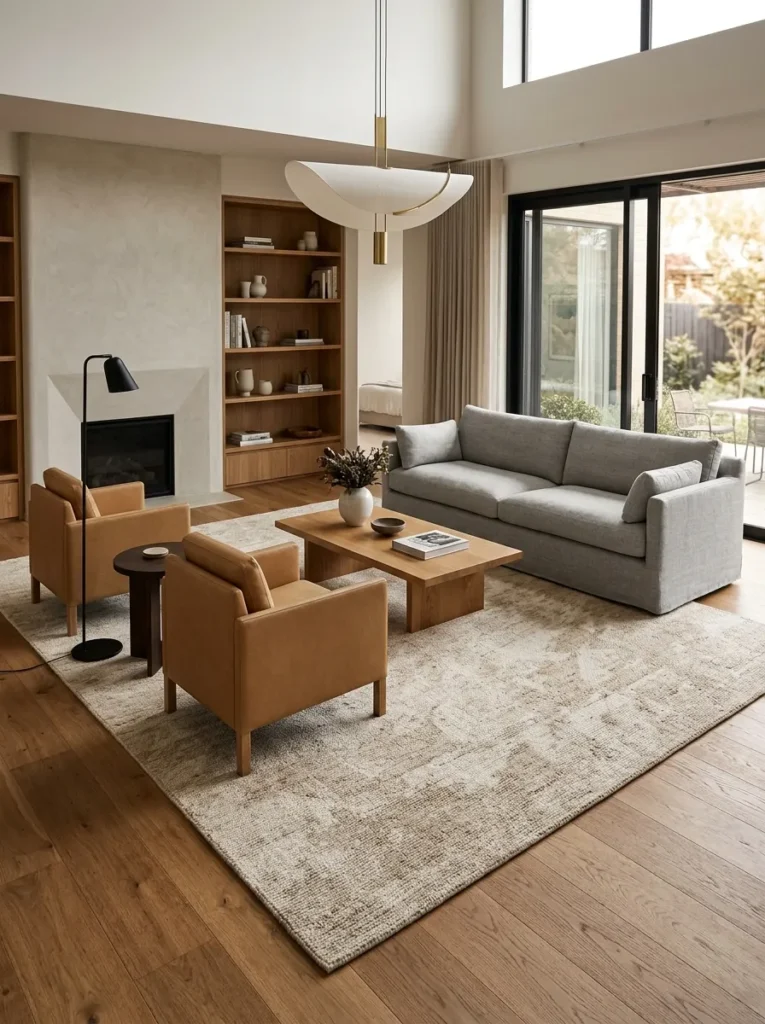
Vibe: Warm and grounded — the living room that finally looks like a room rather than a furniture showroom.
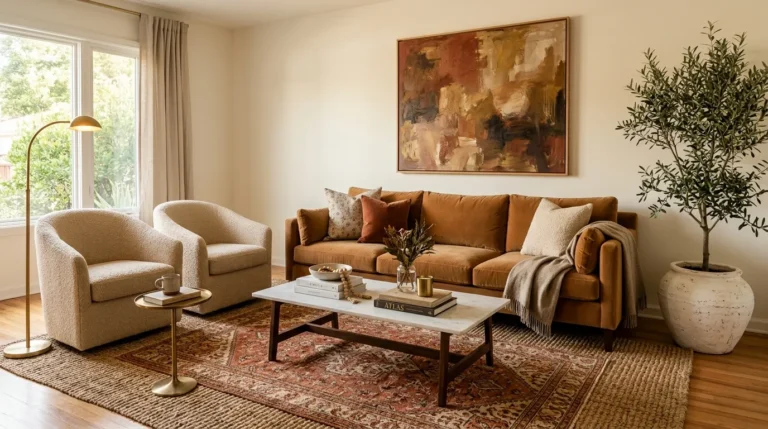
Why it works: An undersized rug is one of the most consistent visual signals of an undesigned room, and correcting rug scale is the single change that most immediately transforms a living room’s perceived quality. The correct rug size for a living room — large enough for all four legs of every seating piece to rest on the rug — creates a defined room-within-a-room that organizes the furniture group as a designed spatial composition rather than individual pieces arranged near each other. An undersized rug (only front legs on the rug, or a rug that doesn’t extend under the coffee table) creates visual fragmentation and reads as a decorative afterthought rather than a design anchor. A large correctly-sized wool rug at $400–800 from a quality retailer looks significantly more expensive than a small incorrectly-sized rug at the same price, because the large rug does the design work that makes the room read as resolved.
How to get it: The minimum rug size for a standard three-seater sofa with two armchairs is 240cm × 300cm — smaller than this and not all furniture legs can sit on the rug simultaneously. Measure the full extent of the seating group (including the coffee table) and add 300–450mm on each side — this total measurement gives the minimum rug dimension that reads as correctly sized from a standing position at the room’s entry. Choose a rug in a natural fiber (wool, jute, sisal) or a quality synthetic with a low-pile or flat-weave texture — deep pile rugs quickly show wear patterns from regular foot traffic that undermine their perceived quality after 12–18 months of use.
Shop the Look
| Product |
|---|
| Large wool rug natural abstract |
| Rug underlay non slip |
| Sofa natural linen |
| Armchair matching pair |
| Round coffee table |
8. Decluttered Surfaces with Three Carefully Chosen Objects
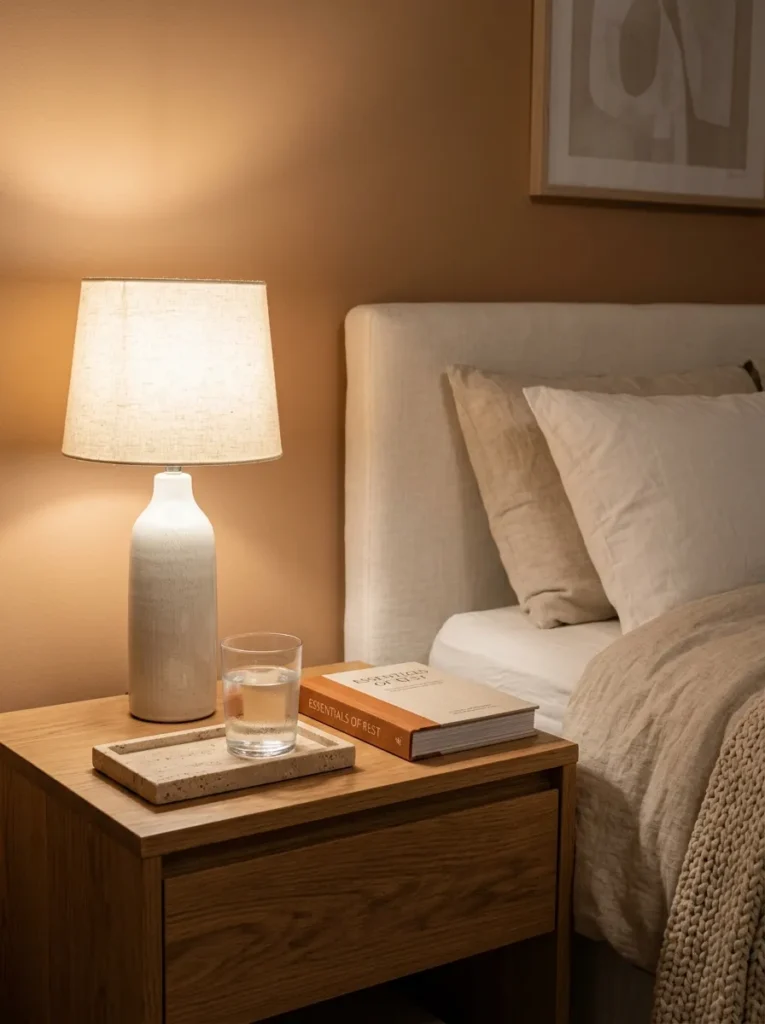
Vibe: Calm and considered — the bedside table that looks like a thoughtful design decision rather than wherever things were put down.
Why it works: Surface discipline — the deliberate decision to limit every surface in a room to three or fewer objects — is the decorating practice that most consistently and most costlessly transforms the perceived quality of a room. A surface with six or eight objects reads as cluttered regardless of the individual quality of each object; the same surface with three well-chosen objects in a considered arrangement reads as curated and expensive regardless of the individual objects’ cost. This is not minimalism — it is compositional editing, the same discipline that display stylists apply when preparing a room for a magazine photograph. The travertine tray in this composition is the grouping device that makes the three objects read as a composed vignette: placing two of the three objects on a small tray treats them as a sub-group within the surface arrangement, which is the detail that elevates the surface from three individual objects to a composed display.
How to get it: Apply the three-object maximum to every surface in the room simultaneously — coffee tables, nightstands, shelves, console tables, dining sideboards. Objects in excess of three per surface should either be stored (if purely functional) or distributed to other surfaces (if decorative). The rule of three is the compositional principle behind the discipline: one tall element, one medium element, and one low element on any surface creates the visual hierarchy and three-dimensional depth that makes a surface arrangement read as styled rather than random. The tray is the consolidation tool that converts two objects into one grouped element, allowing a surface that appears to have three objects to actually hold four or five while still reading as disciplined.
Shop the Look
| Product |
|---|
| Travertine tray small |
| Slim ceramic table lamp |
| Quality hardcover book set |
| Minimal glass water carafe |
| Bedside table slim profile |
9. Velvet or Boucle Accent Chair as the Room’s Luxury Focal Point
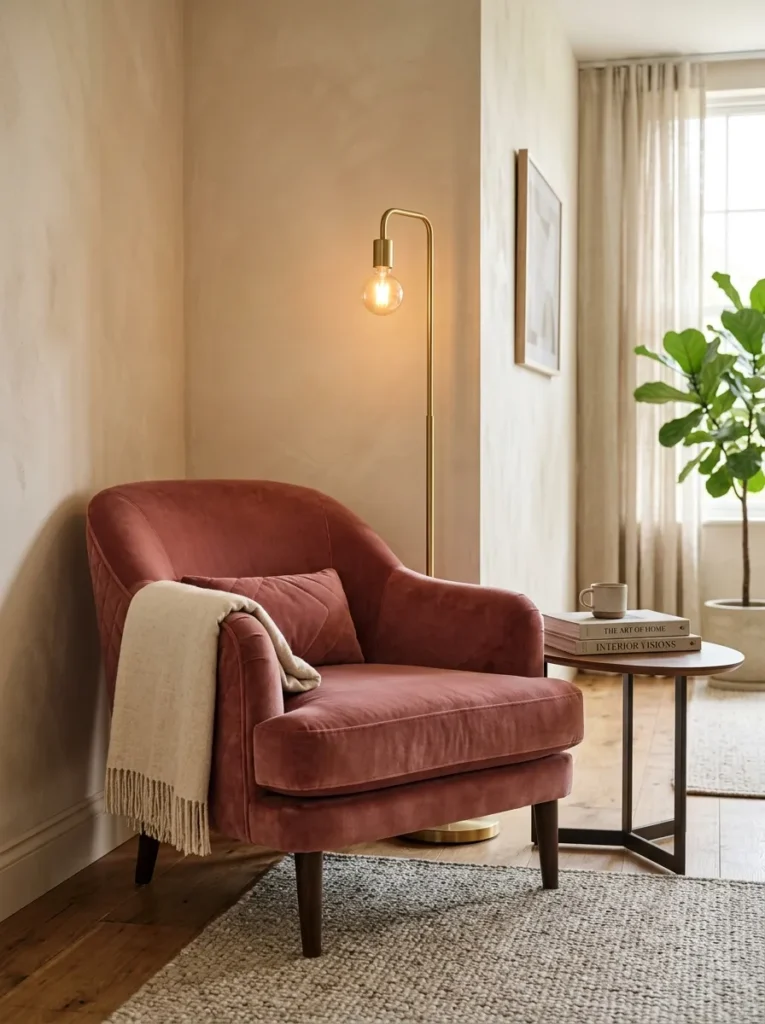
Vibe: Warm and considered — the room’s single most expensive-looking element, which costs the same as a mid-range dining table.
Why it works: A velvet or boucle accent chair is the furniture investment that delivers the highest perceived luxury return per dollar in any living room — the specific visual qualities of deep pile velvet (the way it changes color as the pile direction changes, the richness of its saturated color at depth) and of boucle (the looped, tactile surface that reads as a luxury upholstery material at any price point) communicate material quality more powerfully than any other fabric available at a residential furniture price point. A velvet accent chair at $350–700 from a quality furniture retailer reads as a $1,200–2,000 purchase in a room context — the material quality of velvet elevates the chair’s perceived value beyond its actual cost because the eye reads velvet’s deep, complex surface as intrinsically expensive. Positioning the chair in a composed corner with a floor lamp and side table completes the expensive-reading corner composition.
How to get it: The correct velvet color for a living room accent chair is one that provides a focal contrast with the room’s dominant neutral tone — dusty rose in a grey-toned room, deep teal in a warm neutral room, warm rust in a cool-toned room. The contrast color draws the eye to the chair as the room’s deliberate focal point, which is the compositional function of the accent chair in the room design. Performance velvet (Crypton or similar treated velvet) is the practical choice for a chair that will see regular use — it maintains the visual quality of standard velvet while resisting the crushing and marking that standard velvet develops under regular occupancy.
Shop the Look
| Product |
|---|
| Velvet accent chair dusty rose |
| Slim brass floor lamp |
| Small oval side table |
| Warm linen throw blanket |
| Design coffee table books set |
10. Matching Furniture Hardware Upgraded to Brushed Brass
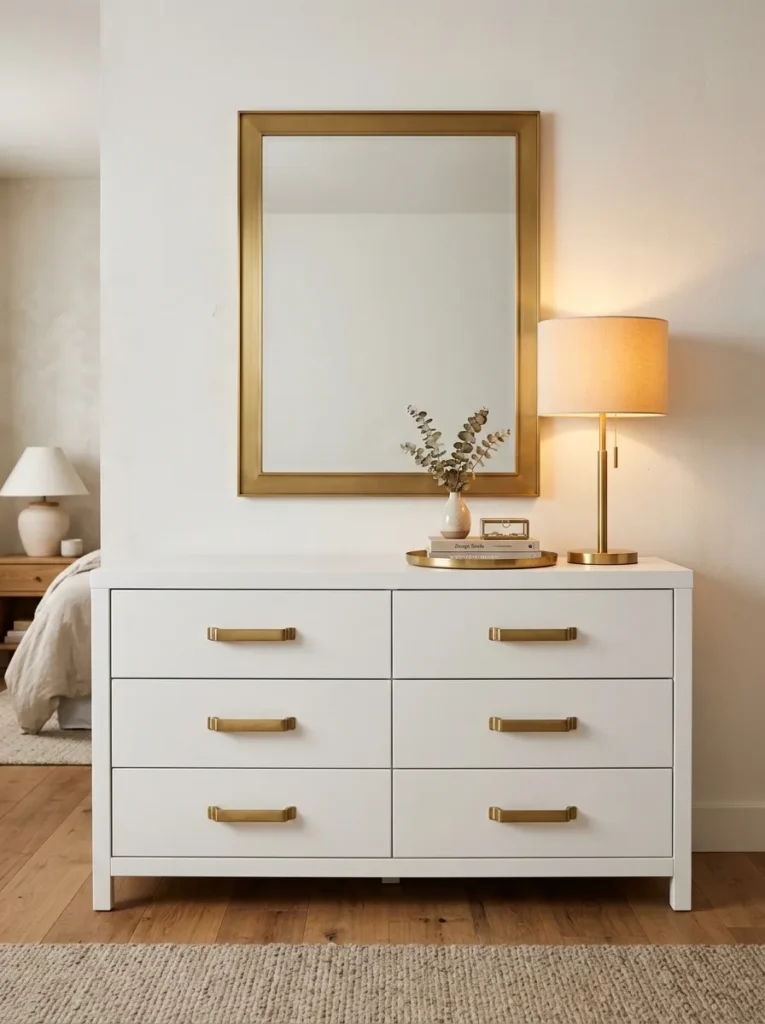
Vibe: Warm and upgraded — the dresser that looks like it cost twice its actual price because someone spent $40 on the right handles.
Why it works: Replacing existing furniture hardware with matching brushed brass is the single highest-return home improvement investment available per dollar — a set of six brushed brass drawer pulls at $4–8 per handle costs $24–48 for a six-drawer dresser and transforms a standard flatpack or secondhand piece into a designed furniture item whose hardware reads as deliberately chosen. The visual transformation is disproportionately large relative to the cost because furniture hardware is a detail that the eye unconsciously uses to assess the quality of a piece — standard chrome or basic metal hardware signals a manufacturer’s budget decision; matching brushed brass hardware signals an owner’s design decision, which reads as considered personalization and investment. The coordination across multiple pieces in the room — dresser hardware, lamp base, mirror frame, and tray all in brushed brass — creates the material coherence that makes the room feel comprehensively designed rather than decorated piece by piece.
How to get it: Measure the existing hardware’s hole spacing (the distance between the two screw holes in a bar pull, or the single central hole of a knob) before purchasing replacements — this dimension determines which replacement hardware will fit without requiring new holes in the furniture. Standard hole spacings are 76mm, 96mm, 128mm, and 160mm. Brushed brass (also labeled satin brass or antique brass) is more forgiving of fingerprints and daily handling marks than polished brass, making it the more practical specification for frequently used furniture hardware. Apply the hardware upgrade consistently across all storage furniture in a room simultaneously — inconsistent hardware creates the effect of incomplete renovation.
Shop the Look
| Product |
|---|
| Brushed brass drawer pull set |
| Screwdriver hardware installation |
| Brass table lamp bedroom |
| Brass-frame mirror small |
| Brass tray small decorative |
11. Indoor Tree or Statement Plant at Room Scale
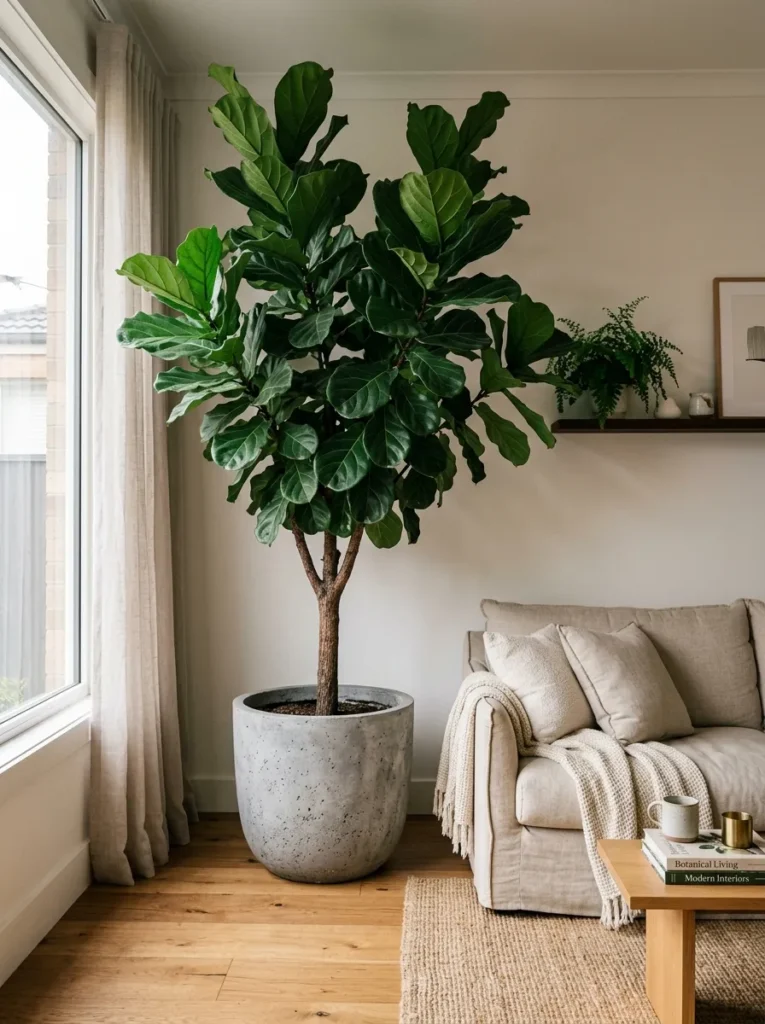
Vibe: Warm and botanical — the living room corner that needed one object, and the right object turned out to be alive.
Why it works: A large indoor tree — a fiddle-leaf fig, olive, ficus, or rubber tree at 1.5–2 meters height — is the room decor investment that most powerfully creates the spatial richness of a professionally designed interior at a plant nursery price point. Large indoor trees perform three simultaneous room design functions: they fill vertical space in corners and beside windows that furniture cannot occupy without blocking function, they introduce the organic material quality of living plants at a scale that changes the room’s spatial composition rather than merely decorating it, and they provide a natural focal point that organizes the room’s visual composition around an organic form. The pot is the design detail that determines whether the tree reads as purchased from a nursery or installed by an interior designer — a large concrete, stone, or ceramic pot of appropriate scale (the pot diameter should be minimum 20% of the tree’s height) communicates material quality that elevates the tree from a houseplant to a designed room element.
How to get it: The tree should be positioned in the room’s primary natural light zone — within 3 meters of a north or east-facing window for most tropical species. The pot should be heavy enough to be stable under the tree’s full height and weight — a top-heavy tree in a lightweight nursery pot reads as temporary; the same tree in a large stone or concrete pot reads as installed. Leave at least 300mm of clear floor space around the pot base — a tree pressed into a corner with no breathing space loses the sculptural quality that makes it read as a room feature.
Shop the Look
| Product |
|---|
| Fiddle leaf fig tree established |
| Large concrete or stone planter |
| Pot saucer waterproof large |
| Quality potting mix indoor |
| Plant stake support large |
12. Monochromatic Color Palette Throughout the Room
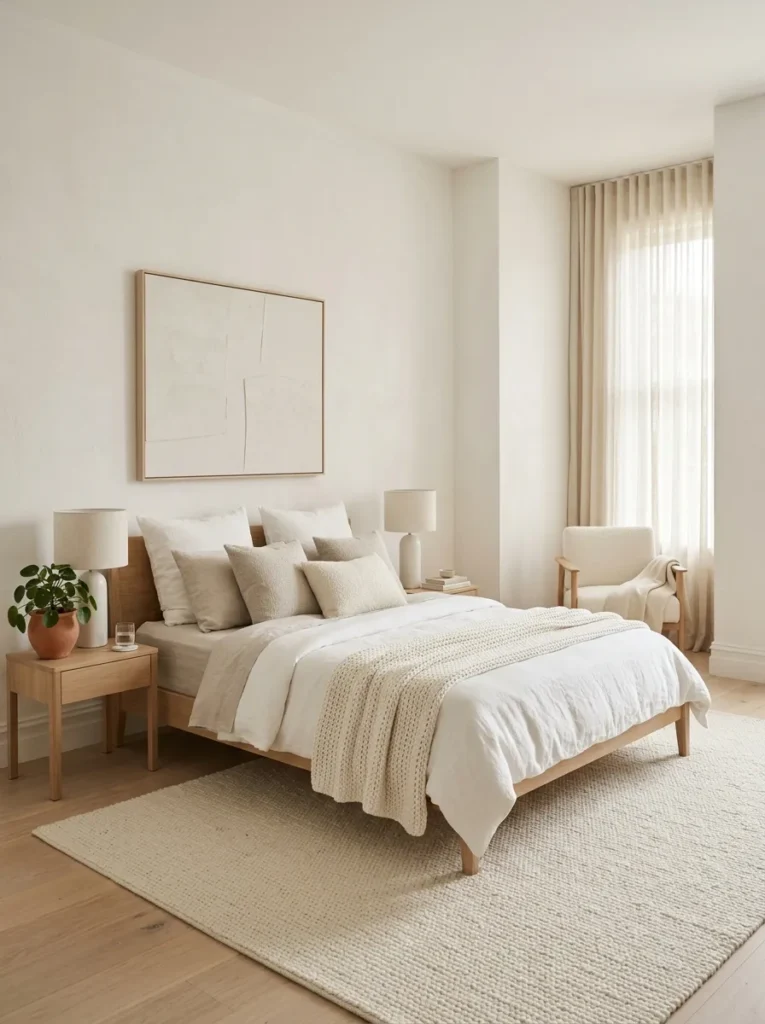
Vibe: Serene and sophisticated — the bedroom that looks like it was designed by someone who understood that restraint is its own form of luxury.
Why it works: A monochromatic color palette — where every surface in the room belongs to the same tonal family, with variety provided by texture rather than color — is the design decision that most reliably produces the expensive, considered aesthetic of high-end hotel rooms and editorial interior photography. Monochromatic rooms look expensive because the eye reads the tonal coherence as deliberate design intention rather than accumulated accumulation — every object in the room appears to have been chosen in relation to every other object, which is the visual signature of professional curation. The practical achievement of a monochromatic palette requires only one design rule: every new object purchased for the room must pass the tonal test — does it belong to the same warm or cool tonal family as the existing room elements? Objects that pass the test stay; objects that fail the test belong in a different room.
How to get it: Define the room’s primary tonal family before making any purchases — warm (cream, ivory, oatmeal, camel, natural timber) or cool (grey, blue-grey, stone, cool white). Every subsequent purchase is filtered through this tonal lens. A single warm accent in a monochromatic room (a terracotta pot, a dusty rose throw, a warm brass lamp) adds character without breaking the monochromatic logic — one accent color, in the correct warm family, enriches the palette. More than one accent color in a monochromatic room begins to dissolve its coherence.
Shop the Look
| Product |
|---|
| Warm white interior paint |
| Natural wool cream rug |
| Ivory linen curtain panel |
| Pale oak bed frame |
| Single terracotta pot large |
13. Architectural Molding or Paneling Detail on One Wall
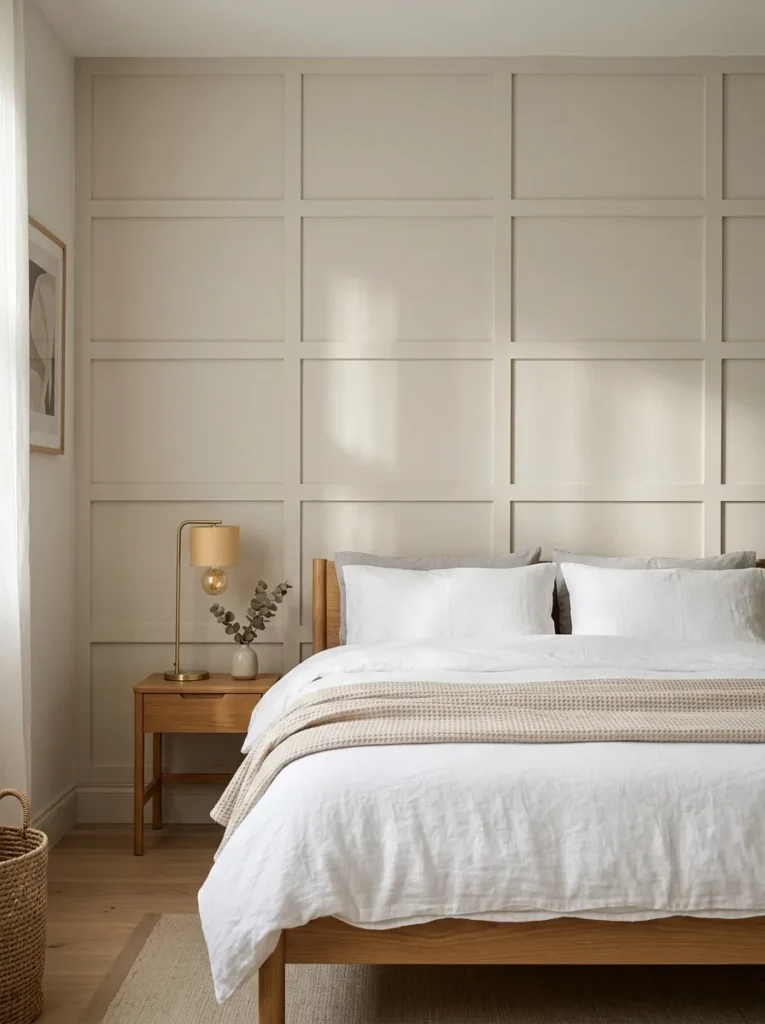
Vibe: Warm and architectural — the bedroom wall that looks like a $15,000 architectural renovation that actually cost $150 in materials and one weekend.
Why it works: Applied wall paneling — strips of painted MDF or timber applied to a wall surface to create the shadow relief of architectural panel molding — is the DIY improvement with the highest architectural quality-to-cost ratio available in residential design. Genuine architectural panel molding (the kind found in period homes, luxury hotels, and high-end residences) costs $80–200 per square meter to install professionally; applied strip paneling produces a visually similar shadow-relief effect at $15–30 per square meter in materials and a single weekend’s DIY work. The critical design specification is painting both the wall surface and the applied strips in the same color — this creates the shadow-relief quality that reads as genuine architectural detail, while a two-color treatment (strips in a different color from the wall) reads as applied decoration rather than architectural molding.
How to get it: Apply 30mm × 10mm MDF strips (available from timber merchants and hardware stores) to the wall surface using construction adhesive and panel pins, creating rectangular panels of 600mm × 400mm proportion (or any proportion that divides the wall width and height into even panels). Fill all nail holes and joints with decorator’s filler, sand smooth, and paint the entire wall — strips and background — in the same color in eggshell finish. The raking light from a window creates the shadow relief that makes the paneling read as genuine architectural molding from across the room.
Shop the Look
| Product |
|---|
| MDF strip 30mm x 10mm lengths |
| Construction adhesive tube |
| Panel pin set |
| Decorator’s filler white |
| Eggshell paint for molding wall |
14. Matching Sets of Decorative Objects in Odd Numbers
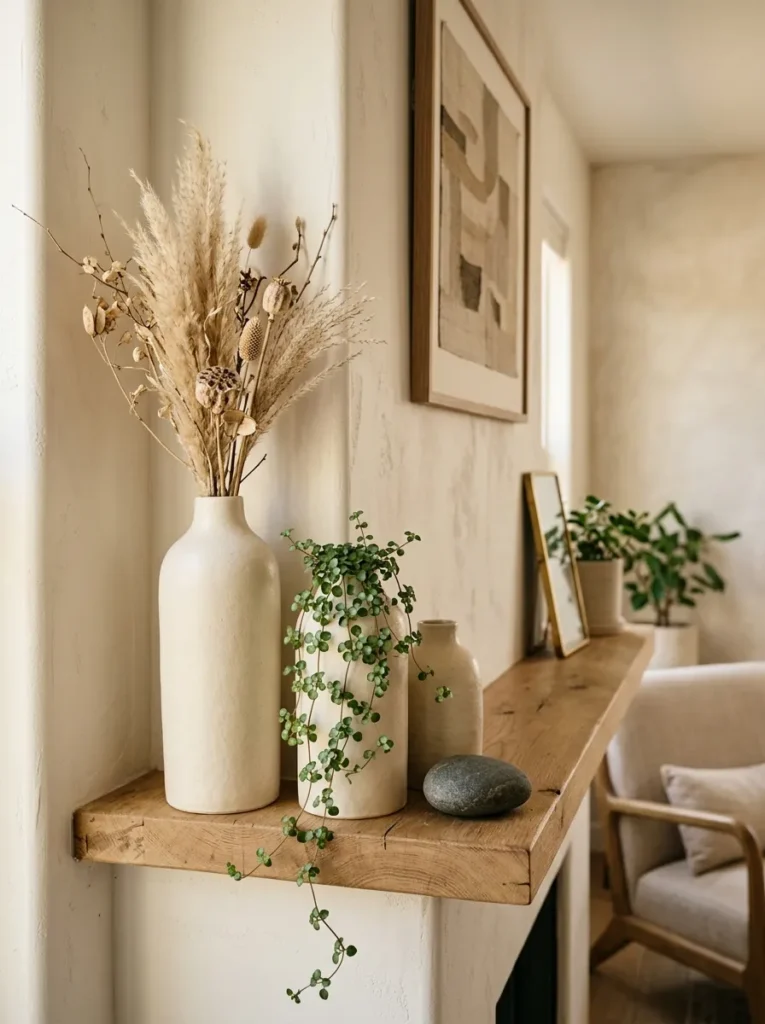
Vibe: Warm and composed — the surface grouping that looks like it was placed by a stylist rather than arranged by an occupant.
Why it works: Matching sets of decorative objects in odd numbers — always three, five, or seven — is the styling principle that most consistently produces the composed, editorial quality that makes surfaces in professionally designed and photographed rooms look curated while surfaces in most homes look accumulated. The odd number principle is grounded in compositional psychology: even numbers create stable, symmetrical arrangements that read as finished; odd numbers create dynamic, asymmetric arrangements that read as artistically composed. The matching color or material principle within the group (all ceramic, all natural fiber, all in warm neutrals) creates the visual cohesion that makes the objects read as a set rather than a random arrangement. The graduated height principle (three objects at tall, medium, and low heights) creates the three-dimensional depth that gives the grouping visual richness from any angle.
How to get it: Source matching ceramic vases, vessels, or decorative objects in a consistent tonal family from a single retailer — the easiest way to create a styled odd-number grouping is to purchase three objects from the same retailer’s collection at the same time, ensuring they share a visual design language even if they differ in size. The objects should differ in height by approximately 30–50% between each graduation — if the tallest is 30cm, the medium should be approximately 20cm and the shortest approximately 12–15cm, creating a clear visual staircase rather than three similar heights.
Shop the Look
| Product |
|---|
| Ceramic vase set three graduated |
| Dried botanical bundle natural |
| Trailing indoor plant small |
| River stone smooth decorative |
| Sideboard or mantelpiece surface |
15. A Genuine Scent Strategy for the Room
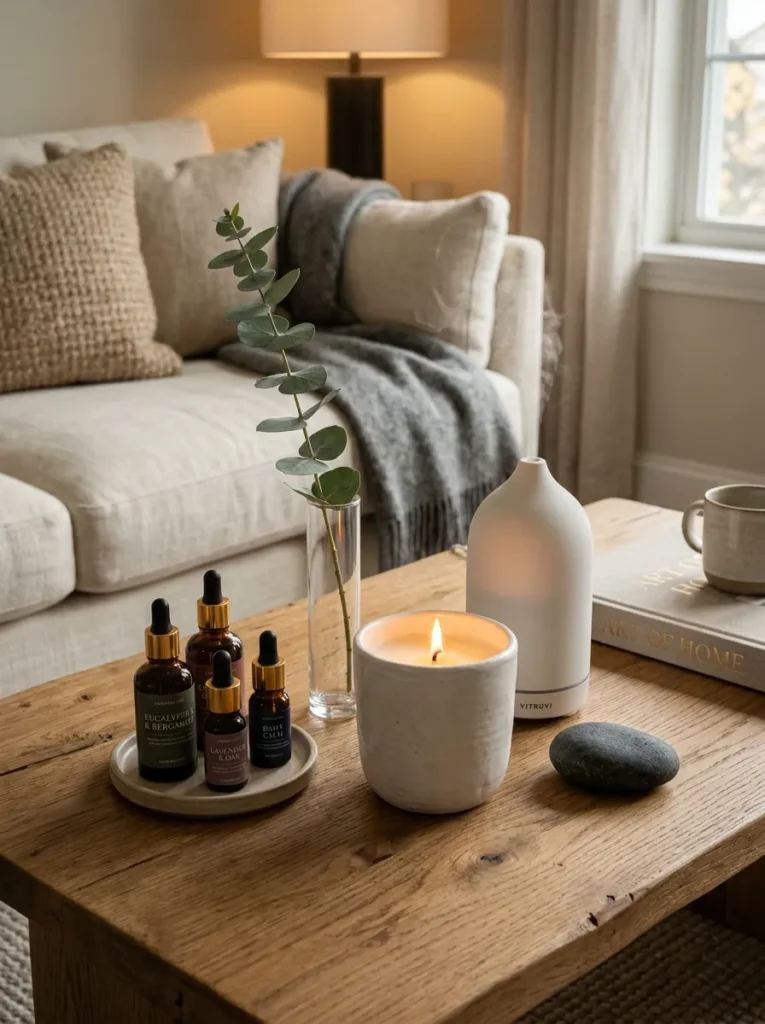
Vibe: Warm and sensory — the room that smells as good as it looks, which is the detail that makes visitors feel the quality before they can articulate it.
Why it works: A deliberate scent strategy is the dream room decor element that operates entirely outside the visual register — it is the design decision that affects the perceived quality of a room through the olfactory system rather than the visual one, yet research in environmental psychology consistently demonstrates that scent has a more immediate and more powerful effect on the perceived quality of a space than any visual element. High-end hotels, luxury retail environments, and premium residential buildings all use scent as a primary hospitality quality signal: their characteristic scents (often custom-developed at significant cost) are as much a part of their brand identity as their visual design. In a residential context, the scent strategy requires only three elements: a quality candle in a beautiful vessel (lit for the hour before guests arrive and during the evening), an essential oil diffuser with a consistent signature scent, and fresh botanical elements (eucalyptus, herbs, fresh flowers) that provide natural aromatic variation. The ceramic candle vessel and the matte white diffuser are the design objects; the scent is the experience they deliver.
How to get it: Develop a consistent room scent from two or three essential oils that layer well together — a base note (sandalwood or cedarwood), a mid note (lavender or bergamot), and a top note (eucalyptus or lemon). Apply this blend in the cold-air diffuser for ambient background scent, and choose a candle whose fragrance complements rather than duplicates the diffuser blend for the occasional foreground scent element. The key to a scent strategy that reads as expensive is consistency — using the same scent blend every time the room is occupied creates the associative memory that makes the room’s scent as recognizable as its visual identity.
Quick Win: Placing three or four fresh eucalyptus stems in a vase of water in any room provides a clean, botanical, spa-quality scent for 7–14 days at a cost of $3–6 for a bunch of stems — the lowest-cost, most immediately effective scent strategy available at any room quality level.
Shop the Look
| Product |
|---|
| White ceramic candle vessel quality |
| Cold air diffuser white ceramic |
| Sandalwood essential oil |
| Bergamot essential oil |
| Fresh eucalyptus stems bunch |
How to Start Your Dream Room Transformation
Your single first move is to audit your room’s existing lighting before spending a single dollar on furniture, art, or textiles. Stand in your room at 7pm with only the existing light sources operating and assess honestly: does the room look warm, layered, and atmospheric, or does it look flat, bright, and utilitarian? If the answer is flat and utilitarian, no amount of beautiful furniture or expensive textiles will overcome the lighting deficit — the furniture will look exactly as ordinary under poor lighting as it did before the purchase. Fix the lighting first: replace cool or bright overhead bulbs with warm 2700K equivalents, add a table lamp and a floor lamp if no secondary light sources exist, and install dimmer switches on the primary circuit. This single audit and intervention, costing $50–200, will show you the room’s true design potential and reveal which subsequent investments will make the most difference.
The most common dream room mistake is purchasing individual pieces of furniture or decor that are individually beautiful but collectively incoherent — a velvet sofa in one color family, curtains in another, a rug in a third, artwork in a fourth, all of genuine individual quality but collectively producing a room that reads as assembled rather than designed. The design principle that prevents this mistake is the palette-first approach: define the room’s tonal family (warm or cool, dominant neutral color, accent colors if any) before purchasing any individual piece, and filter every subsequent purchase through the palette question — does this belong to the same tonal family as the existing room elements? A room built from individually cheaper pieces that all belong to the same palette will consistently read as more expensive and more designed than a room built from individually more expensive pieces that belong to different palette families.
Three specific investments under $100 that create immediate dream room impact: (1) A pair of linen curtain panels in warm ivory ($45–90 for a pair from IKEA or similar) hung from the ceiling creates the full-height curtain effect that is the single most visible signal of a designed versus an undesigned room, even before any other change is made. (2) A set of two European square linen pillowcases ($35–65 for a pair) placed behind the existing sleeping pillows on any bed immediately creates the hotel-pillow depth that communicates luxury bedding regardless of the underlying bedding quality. (3) A small travertine or marble tray ($20–45) on the bedside table or coffee table consolidates the existing objects on that surface into a composed vignette, converting the surface from accumulated to styled without removing or replacing any of the existing objects.
Realistically, a complete dream room transformation — full-height linen curtains, statement pendant on a dimmer, deep wall color, large-format artwork, layered linen bedding, correctly sized rug, velvet accent chair, upgraded hardware, statement plant, monochromatic palette, wall paneling, styled odd-number groupings, and a scent strategy — costs $1,500–4,000 in materials and furniture for a standard bedroom or living room, depending on the existing furnishing quality and the price points chosen within each category. A focused five-element transformation hitting the highest-impact items (curtains, lighting with dimmer, wall color, rug, and bedding) costs $400–900 and produces a room that reads as significantly more expensive and more designed than its actual investment would suggest. Most homeowners begin with the wall color and the curtains — the two highest-impact, lowest-cost interventions available — use the transformed room for a month, and then invest in the furniture and textile upgrades that the improved setting now makes obviously worthwhile.
Frequently Asked Questions About Dream Room Decor
What makes a room look expensive without spending a lot of money?
The three qualities that most reliably make a room look expensive regardless of actual spending are material coherence (all objects in the room belong to the same tonal and textural family), spatial discipline (surfaces are edited to three or fewer objects, with generous breathing space between furniture pieces), and lighting quality (warm, multi-directional, dimmable light that creates atmosphere rather than merely illuminating the room). These three qualities can be achieved at any budget level because they are design decisions rather than purchasing decisions — a room with coherent materials, edited surfaces, and warm lighting reads as expensive even if every piece of furniture is from a budget retailer, while a room with incoherent materials, cluttered surfaces, and poor lighting reads as undesigned even if every piece of furniture is expensive.
What colors make a room look most luxurious?
Deep, complex colors with significant tonal depth — colors that shift between warm and cool depending on the light direction — consistently read as more luxurious than flat, one-dimensional colors. Dusty sage, warm charcoal, deep terracotta, complex greige, and navy with warm undertones all exhibit this quality. The color family (warm versus cool) matters less than the complexity within the chosen family — a warm greige with perceptible pink and grey undertones reads as significantly more sophisticated than a single-note beige of the same value. The finish application is equally important: eggshell or satin finish creates the slight, non-glossy sheen that reads as deliberate and considered; flat paint reads as utilitarian and undesigned regardless of the color’s quality.
How much should I spend on a rug to make it look expensive?
A quality wool or natural fiber rug of the correct size — large enough for all furniture legs to rest on the rug — reads as expensive at $400–800 from a quality retailer. The size is more important than the price: a $2,000 rug that is too small for the furniture group reads as an expensive rug in the wrong place, while a $500 rug of the correct size reads as a well-chosen design anchor for the room. The minimum investment for a rug that reads as genuinely quality is approximately $300–400 for a standard living room size — below this price point, most natural fiber rugs lack the density and fiber quality that makes a rug read as a considered material choice rather than a floor covering.
What is the single highest-impact change I can make to an existing room?
The single change that produces the most dramatic improvement in a room’s perceived quality is replacing the existing window treatment with full-height ceiling-to-floor linen curtains hung from a ceiling-mounted track. This change simultaneously improves the room’s apparent ceiling height, its window scale, its textile warmth, its light quality (linen filters and warms natural light), and its overall design coherence by introducing a large-format natural material that coordinates with almost every other room element. The cost is $80–200 for a pair of quality linen curtains and $30–60 for a ceiling track and installation hardware — making the full intervention achievable for $110–260, which is less than most furniture accessories and significantly more impactful than any of them.
How do I make a small room look expensive?
Small rooms look most expensive when the design principles of luxury interiors are applied at reduced scale: full-height curtains (making the ceiling appear higher), a single large artwork (providing the room’s visual anchor without visual fragmentation), a monochromatic palette (creating spatial continuity that makes the room read as larger), one exceptional piece of furniture in a quality material (delivering the material richness that the room cannot achieve through furniture quantity), and carefully edited surfaces with a maximum of three objects each (providing breathing space that makes the room feel more generous than its actual dimensions). The most important principle for a small room specifically is the quality-over-quantity rule: one beautiful linen curtain panel, one quality bedside lamp, and one exceptional small rug will make a small room look significantly more expensive than the same budget distributed across multiple lower-quality versions of the same items.
Ready to Create Your Dream Room?
These 15 ideas span the full range of what makes a room look genuinely expensive — from ceiling-height linen curtains and statement lighting on a dimmer that transforms the room’s evening quality, to deep complex wall color, correctly sized rugs, and the surface discipline that makes three objects read as curation — so whether you are starting with a blank room or transforming an existing space that has never quite achieved the quality you imagined for it, there is a genuinely achievable, genuinely high-impact approach here for your specific room, your specific budget, and the specific quality level you are working toward. The transformation begins not with a purchase but with an audit — the honest assessment of which three qualities your room currently lacks most acutely, because those three gaps are where your available budget will produce the highest return. Today’s specific action: stand in the room you most want to transform at 7pm with all existing lights on and ask three questions — is the lighting warm and atmospheric? Is the dominant color deep and complex? Are the surfaces edited to a maximum of three objects? The first question that receives a no answer is where your transformation begins, and everything else follows from solving that first problem completely before moving to the next. Save the ideas that addressed your room’s specific quality gaps in the right sequence — those are the ones that will produce the visible, substantial transformation that makes the room feel, finally, like the dream room it was always meant to be.