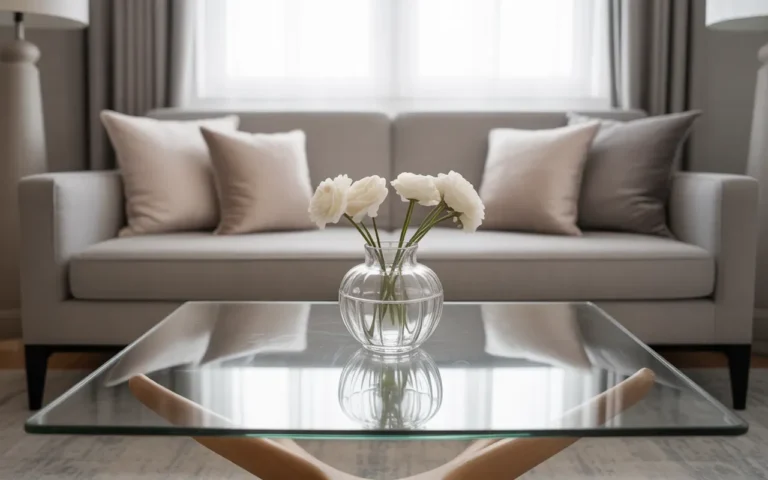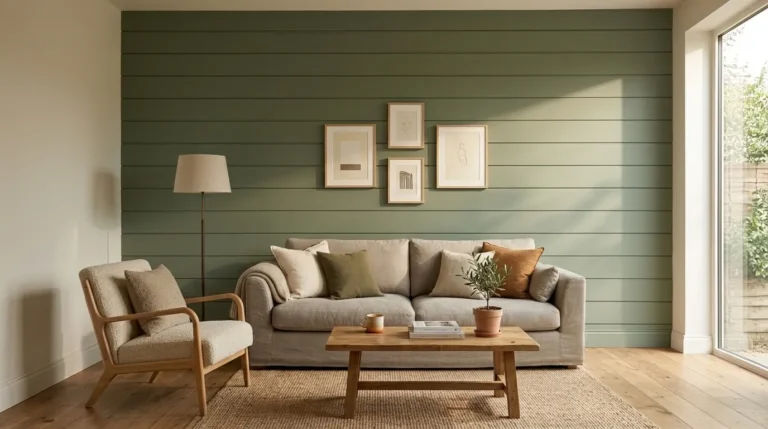

13 Cozy Bedroom Decor Ideas That Feel Dreamy
Cozy bedroom decor ideas that feel dreamy create the specific atmosphere where rest comes easily — where the room’s warmth, softness, layered lighting, and considered material palette communicate to the nervous system before sleep that the space is safe, comfortable, and genuinely separate from the demands of the waking day. This article gives you exactly 13 ideas spanning bedding, lighting, textiles, furniture arrangement, botanical elements, scent, and wall treatments so every bedroom size, every budget, and every aesthetic finds a dreamy cozy direction that is achievable and genuinely transformative.
A dreamy cozy bedroom is not the most decorated bedroom. It is the most considered one — where every material decision reduces rather than increases visual stimulation, where every light source warms rather than bleaches, and where the accumulated effect of all the choices together creates an environment that the body recognizes as a place specifically designed for rest. Here are 13 ideas worth implementing.
Why Cozy Bedroom Decor Ideas That Feel Dreamy Work So Well
The bedroom’s functional purpose — restorative sleep — is one that the environment either supports or undermines, and the design decisions made in a bedroom are among the most consequential of any room in the house because their effects are experienced every single night. Environmental sleep research consistently documents that the visual, thermal, olfactory, and acoustic qualities of the bedroom environment significantly affect both sleep onset time (how quickly a person falls asleep) and sleep quality (the depth and continuity of sleep cycles). The specific environmental qualities that most consistently support sleep are: low ambient light levels with warm color temperature in the hours before sleep (warm-toned light at approximately 2200–2700K reduces melatonin suppression compared to cool-white light at the same intensity), thermal comfort in the range of 16–19°C (the human body’s core temperature drops during sleep onset, and an environment that facilitates this drop supports faster sleep onset), low olfactory stimulation or specific botanical scents (lavender, in particular, is documented in clinical trials as reducing pre-sleep anxiety and improving subjective sleep quality), and a room with low visual complexity at the sleep-direction sightline (the view from the bed toward the room’s primary visual field).
The dream quality in a bedroom — the specific atmosphere that feels soft, enveloping, slightly removed from ordinary domestic space — comes from the accumulation of decisions that each move the room away from stimulation and toward restoration. Warm materials (linen, velvet, wool, sheepskin) that register to both visual and tactile processing as soft and warm; warm-toned lighting from multiple low-level sources rather than a single overhead source; a color palette that sits in the warm neutral, dusty blush, sage, or deep earthy register rather than the stimulating bright or cool ranges; and the botanical, natural material, and organic form elements (a plant, a wooden lamp base, a woven throw) that reference the natural world and its specific signal value — these are the design decisions that together produce the dreamy cozy atmosphere.
The 13 ideas in this list are arranged to be applied in any combination — each produces an independent improvement in the bedroom’s atmospheric quality while combining with others to produce the cumulative transformation from a functional sleep room to a dreamy restorative environment.
Style at a Glance
| Element | Atmospheric Function | Dreamy Design Edge |
|---|---|---|
| Philosophy | Every decision reduces stimulation, increases warmth | The room should feel different from every other room |
| Materials | Linen, velvet, wool, sheepskin, natural fiber | Warm white, dusty blush, sage, deep earth tones |
| Key Senses | Visual, tactile, olfactory, thermal |
13 Cozy Bedroom Decor Ideas That Feel Dreamy
1. Linen Bedding in Warm White — The Foundation

Vibe: The linen bed feels like every luxury hotel distilled to its essential quality — the natural crease of the fabric communicating that rest has been thought about here, not just provided.
Why it works: Washed linen bedding is the material foundation of a dreamy cozy bedroom because it combines visual warmth (the slightly creased, slightly irregular surface reads as genuinely used and genuinely inviting rather than sterile) with physical warmth (linen regulates temperature better than cotton, keeping warm in cool bedrooms and cool in warm ones) and with aging behavior that improves rather than degrades the material (linen becomes softer, more luminous, and more textured with every wash rather than pilling or losing its quality as synthetic alternatives do). The warm white specification (not bright cool white, not gray, not pure ecru — warm white with a slight yellow or pink undertone) coordinates with every warm-toned paint color and material in the bedroom while reading as clean, calm, and genuinely restful.
The waffle blanket fold: The specific placement of the waffle or textured cotton blanket across the lower third of the bed (folded in half lengthwise, placed across the foot end of the bed with equal amounts hanging over each side) is the detail that creates the composed quality distinguishing a beautifully made bed from a merely neat one. It adds a layer of visible texture against the smooth linen and communicates that the bed has been dressed with intention.
Shop The Look
| Product |
|---|
| Washed linen duvet cover warm white |
| Washed linen pillowcase pair natural |
| Waffle cotton blanket oat |
| Oat linen upholstered headboard |
| Ceramic bedside lamp warm shade |
Also view: 15 Stylish Kids Closet Storage Ideas for Small Spaces
2. Layered Warm Lighting — Three Sources, No Overhead
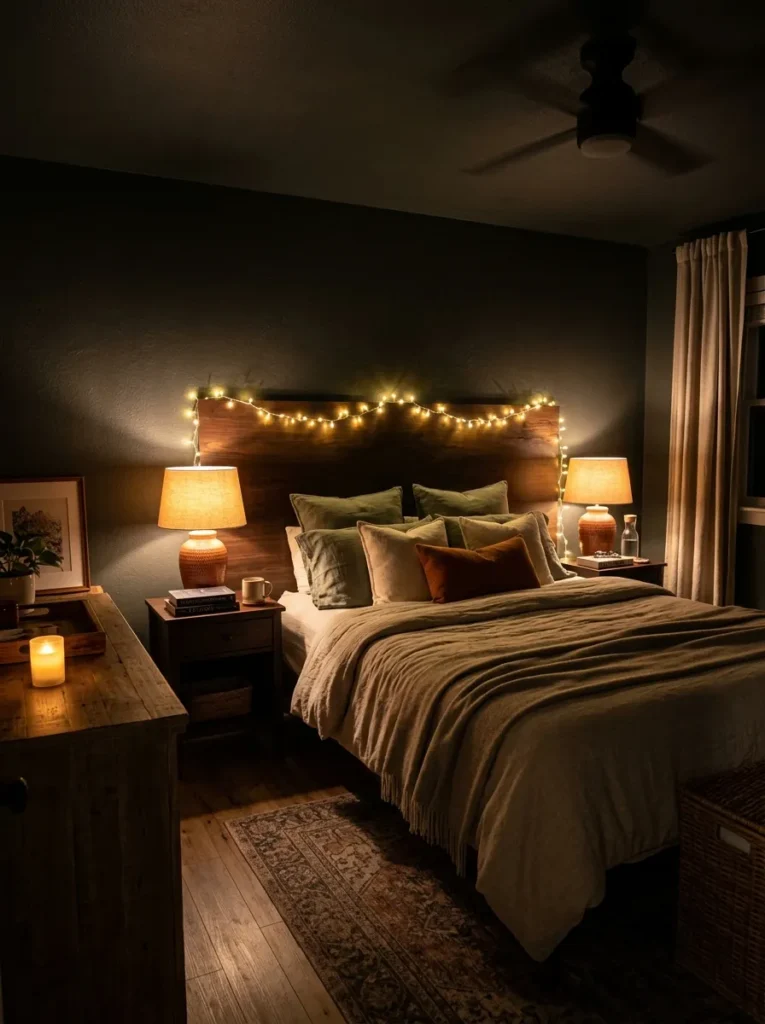
Vibe: The three-source bedroom lighting feels like the room learned to be warm without the overhead light’s help — the pooled light from each source creating zones of warmth rather than a uniformly lit room.
Why it works: A bedroom lit by three low-level warm sources with no overhead light applies the circadian alignment principle — the human body’s circadian rhythm is most disrupted by overhead light sources at cool color temperatures, which the nervous system interprets as midday sunlight regardless of the actual time of day. Switching from overhead lighting to three low-level warm sources in the hours before sleep transitions the room from a daytime-reading environment to a pre-sleep environment, supporting the melatonin rise that initiates sleep onset. The three specific sources — bedside lamps (functional reading light at the correct height for the bed), a small accent light on the dresser (providing ambient fill without functional brightness), and a fairy light string (the lowest-intensity warm light source, appropriate for the final pre-sleep hour) — create a dimmable sequence: all three on for getting ready for bed, two on for reading, one (fairy light) on for the final settling before sleep.
Bulb specification: All three sources should be warm white (2200–2700K) LED bulbs. The bedside lamps benefit from dimmer-compatible bulbs — a dimmer switch on each bedside lamp allows the light level to be reduced as sleep approaches.
Shop The Look
| Product |
|---|
| Ceramic bedside lamp pair |
| Linen drum shade warm 25cm |
| Warm white LED dimmable bulb |
| Fairy light string warm copper wire |
| Battery LED candle flicker warm |
Also view: 13 Vintage Florida Design Ideas That Feel Timeless
3. Velvet Cushion and Throw Layer — Tactile Richness
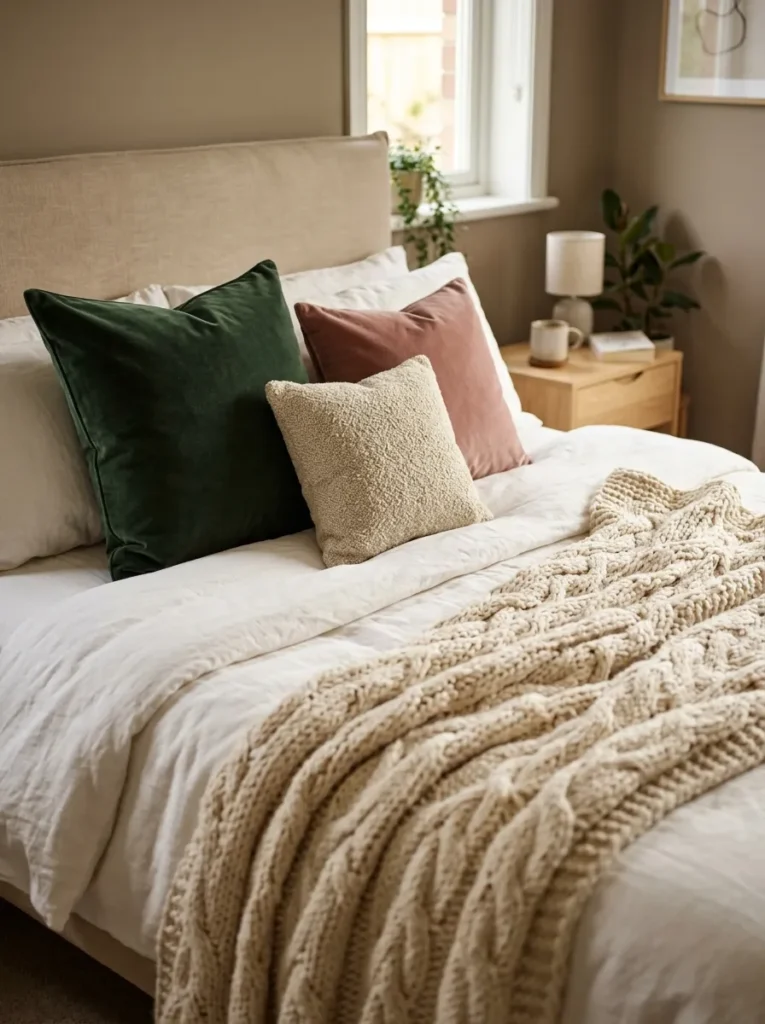
Vibe: The velvet cushion layer feels like the bed decided it needed to be warmer in every possible way — the deep green and dusty rose velvet adding the specific color depth that plain linen bedding cannot provide alone.
Why it works: Velvet cushions on a linen bed apply the tactile richness through material contrast principle — the combination of linen (matte, slightly textured, natural) with velvet (pile, slightly reflective, rich in color depth because the pile absorbs and reflects light differently at different angles) creates a tactile and visual contrast at the bed’s most photographed and most noticed zone (the pillow and upper third of the bed) that reads as considered and abundant. The deep forest green and dusty rose velvet cushions specifically are the color decisions that most reliably produce the dreamy bedroom effect regardless of the room’s overall color palette — both colors are warm-toned, both are associated with the natural world (forest, flower), and both provide the visual depth that a monochromatic neutral bed alone lacks.
The three-cushion rule: One large, one medium, one small. The size variation (50cm, 40cm, 30cm) creates the visual hierarchy that makes a cushion arrangement read as composed rather than accumulative. All three in the same size reads as a set; all three in different sizes reads as a collection.
Shop The Look
| Product |
|---|
| Forest green velvet cushion cover 50cm |
| Dusty rose velvet cushion cover 40cm |
| Oat boucle cushion cover 30cm |
| Chunky knit throw cream |
| Cushion inner pad set three |
4. Botanical Element — The Right Plant in the Right Place
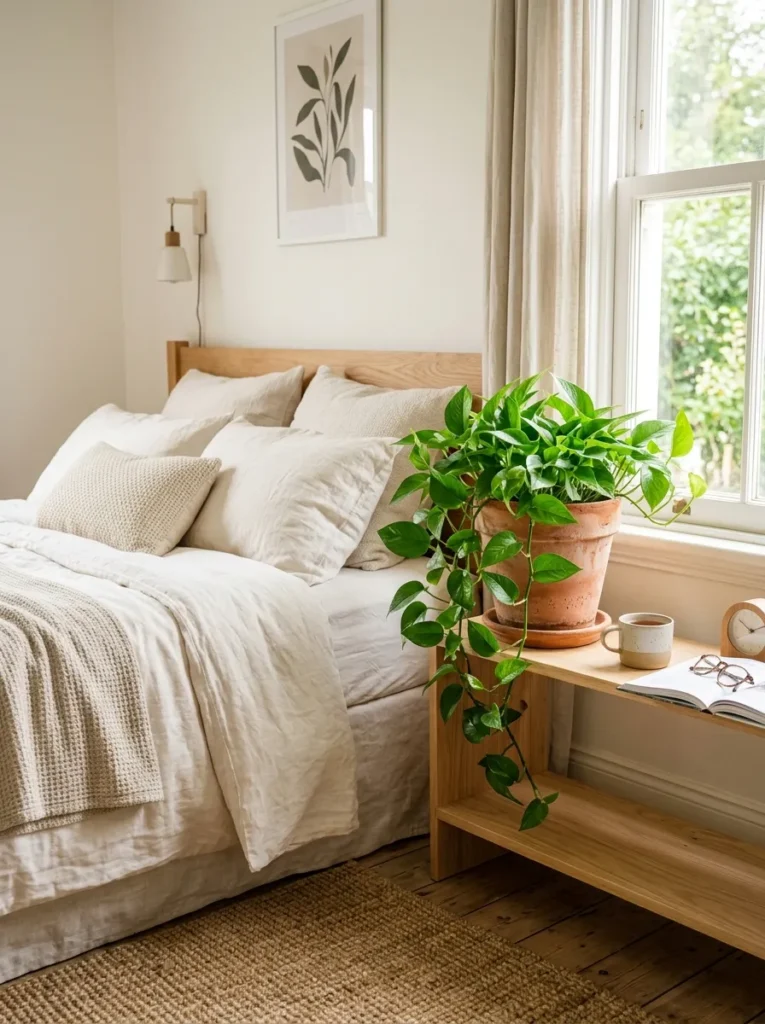
Vibe: The bedroom plant feels like the room has been given permission to breathe — the single green living element doing more atmospheric work than any purchased decoration could.
Why it works: One well-chosen plant in the right position applies the biophilic minimum principle — environmental psychology research documents that a single living plant (as opposed to artificial plants or no plants) in a bedroom reduces reported anxiety levels and improves subjective sleep quality in consistent studies, likely through the combination of visual contact with a living organism, minor improvements in air quality and humidity, and the specific psychological effect of a space that includes something growing. The “right plant” for a bedroom is species-specific: trailing pothos, snake plant, and peace lily are documented as tolerating the low light levels of most bedrooms while providing these benefits; fiddle-leaf figs suit brighter bedrooms close to windows.
The position: Beside the bed at a height where the plant’s growth pattern is experienced at close range during the pre-sleep period (not high on a shelf where it is seen from across the room, not low on the floor where it is only visible when standing) maximizes the plant’s contribution to the pre-sleep environment. A simple natural wood plant stand at 60–75cm height beside one bedside table positions the plant at the eye level of a person lying in bed looking sideways — the most consistently experienced viewing position in the bedroom.
Shop The Look
| Product |
|---|
| Trailing pothos indoor plant |
| Warm terracotta pot 18cm |
| Natural wood plant stand 65cm |
| Indoor plant potting mix |
| Drainage saucer terracotta |
5. Sheer Canopy or Bed Drapes — The Enclosure Effect

Vibe: The sheer canopy feels like the bed became a room within the room — the soft gauze framing the sleep space in a way that creates psychological enclosure without any actual barrier.
Why it works: A bed canopy or sheer drape applies the psychological enclosure principle — sleep research documents that enclosed or semi-enclosed sleep environments (historically: curtained bed alcoves, canopy beds, sleeping niches) reduce pre-sleep anxiety by creating a sense of physical and psychological boundary between the sleep zone and the wider environment. A ceiling-hung sheer canopy creates this enclosure effect through visual rather than physical separation — the sheer material marks the sleep space’s boundary while allowing light and air to pass freely. The simplest installation (one ceiling hook directly above the bed center, one circular curtain ring threaded with the sheer fabric and hung from the hook, the fabric allowed to drape naturally outward and downward on each side) requires no woodworking, no structural modification, and no specialized skills.
Safety note: The ceiling hook must be fixed into a joist (not plasterboard anchor) because fabric weight plus the dynamic load of occasional wind or movement may exceed a plasterboard anchor’s rating. Use a stud finder to locate the joist closest to the bed center and fix a 60–80mm ceiling hook into it.
Shop The Look
| Product |
|---|
| Natural linen gauze sheer canopy |
| Cotton voile sheer panel white |
| Ceiling hook joist-fixed large |
| Curtain ring round ceiling hang |
| Ceiling hook plate decorative |
6. Warm Rug Under the Bed — Floor Warmth
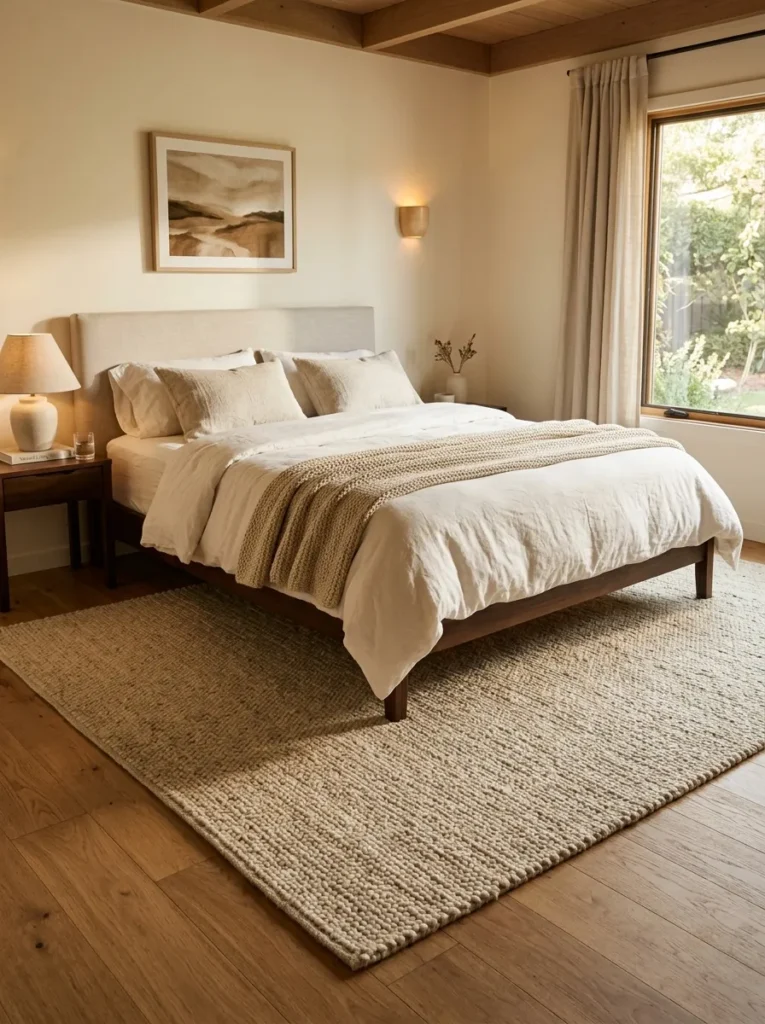
Vibe: The bedroom rug feels like the floor learned to be part of the comfort — the warm fiber surface creating a landing zone for bare feet at the most critical moment of the day (the first step out of bed in the morning, the last step in at night).
Why it works: A large warm rug under and beside the bed applies the thermal comfort anchoring principle — the bedroom floor is typically the coldest surface in the sleep environment (cold air settles at floor level, and hard floor materials — wood, tile — have low thermal mass and feel cold to bare feet regardless of room temperature). A large rug (positioned so it extends at least 60cm on each accessible side of the bed) converts the floor contact experience from cold to warm for the two most thermally significant moments of the day: stepping out of bed in the morning (when the body temperature is lowest) and stepping into bed at night (when cold feet delay sleep onset by directing blood flow away from the extremities needed for core temperature regulation).
The placement rule: The rug should extend from approximately 60cm under the bed on the head-end side to 80cm beyond the foot of the bed. This placement ensures that the rug is the first surface contacted when exiting the bed from any accessible side while keeping the majority of the rug visible (and therefore contributing to the room’s visual warmth) rather than hidden under the bed.
Shop The Look
| Product |
|---|
| Wool area rug warm oat 200x300cm |
| Non-slip rug pad large |
| Natural jute rug alternative |
| Rug tape corner adhesive |
| Wool rug care cleaning kit |
7. Gallery of Botanical Prints — Calm Wall Content
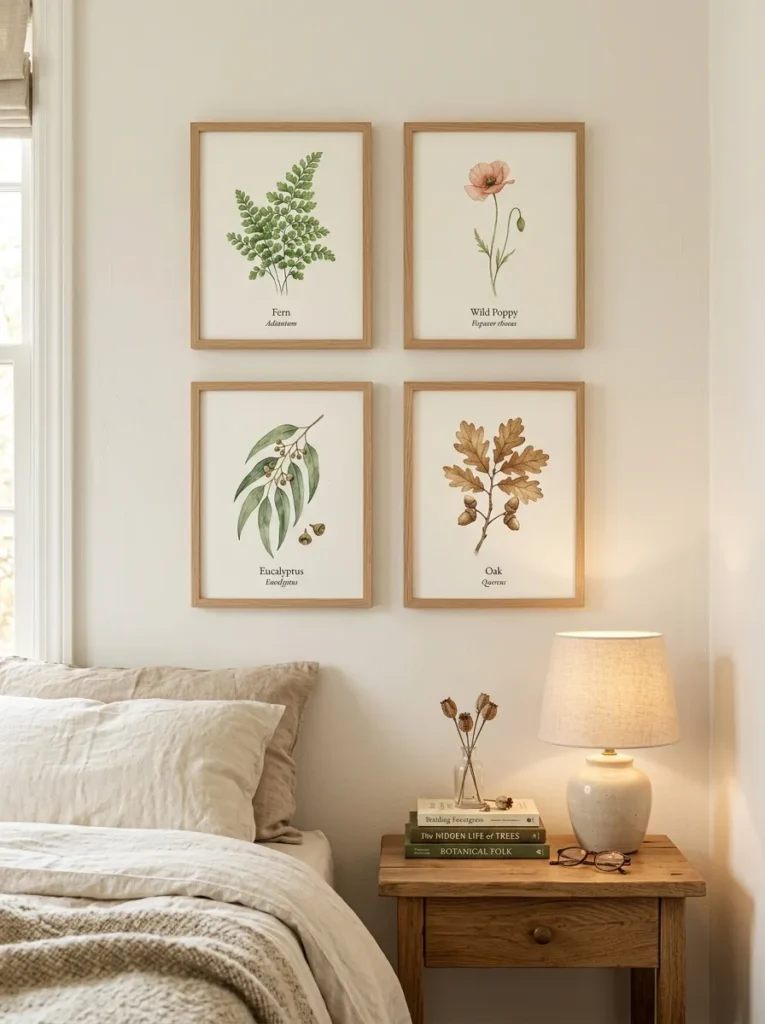
Vibe: The botanical print gallery feels like the wall has been given a subject it genuinely cares about — the botanical illustrations providing the visual content that makes a bedroom wall interesting without being stimulating.
Why it works: A small botanical print gallery on a bedroom wall applies the calm visual content principle — the bedroom wall closest to the pillow-end of the bed (the wall that is most frequently in the occupant’s sightline during the pre-sleep period when lying awake) benefits from visual content that is engaging enough to provide interest but insufficiently complex to sustain the kind of analytical attention that delays sleep. Botanical illustration prints specifically provide this quality: each print has sufficient detail to reward close examination (the specific leaf structure, the rendering of a petal’s translucency in watercolor) while communicating a subject (a fern, a flower, a leaf) that does not require or trigger the kind of narrative processing (who are these people, what is happening in this scene) that figurative art with human subjects provokes. The two-by-two grid arrangement is the compositional minimum for a gallery wall to read as composed rather than random.
Shop The Look
| Product |
|---|
| Botanical watercolor print set 4 |
| Natural wood frame 20x25cm set |
| Damage-free picture strip hook |
| Botanical illustration download print |
| Level tool small hanging |
8. Scent Layer — Lavender and Botanical Night Routine
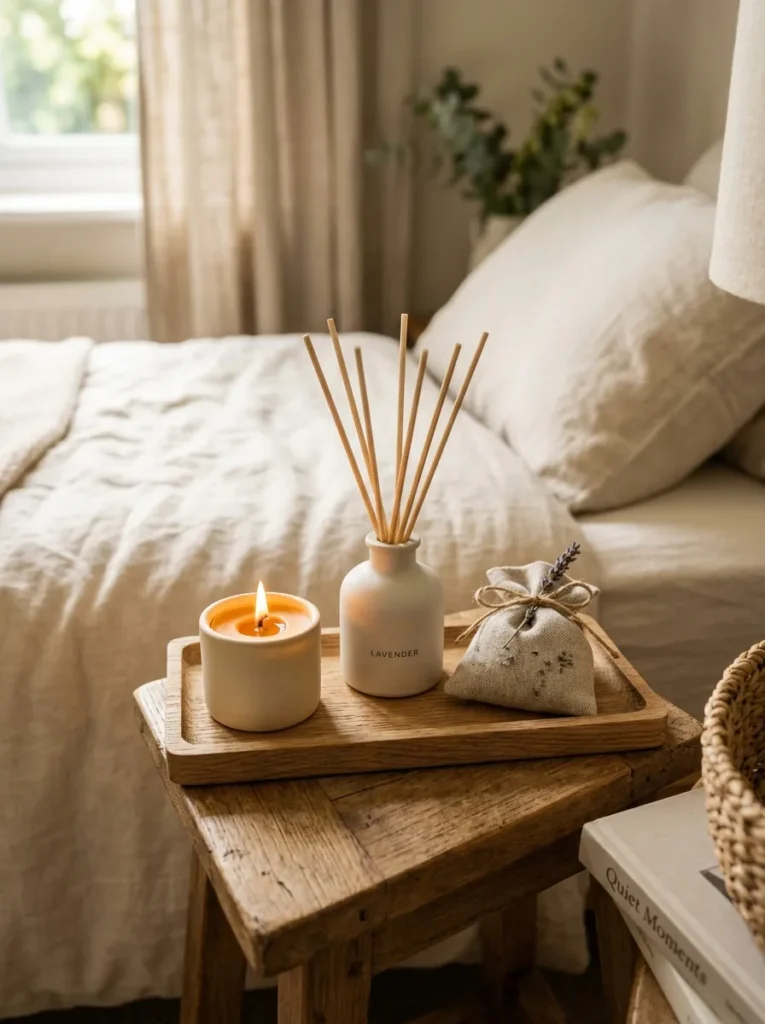
Vibe: The bedside scent arrangement feels like the most considered pre-sleep ritual distilled to three objects on a small tray — the specific combination of botanical scent sources creating an olfactory environment that the nervous system associates with rest.
Why it works: A layered bedroom scent system applies the olfactory pre-sleep signaling principle — lavender (Lavandula angustifolia) is the most extensively studied botanical scent in sleep research, with randomized controlled trials documenting statistically significant reductions in pre-sleep anxiety, reductions in time to sleep onset, and improvements in subjective sleep quality when lavender essential oil is present in the bedroom environment. The three-source approach (candle for intermittent use, reed diffuser for continuous low-level background scent, dried lavender sachet for contact scent on the pillow) creates a layered olfactory environment that covers the three primary exposure pathways. The beeswax candle specifically (rather than paraffin or synthetic fragrance) provides the cleanest burning flame scent — beeswax produces a mild natural honey fragrance rather than the synthetic fragrance compounds that can cause respiratory irritation in sensitive individuals.
Practical application: Light the beeswax candle for 20–30 minutes before sleep, allowing the warmth of the candle to release the beeswax’s natural scent. The reed diffuser operates continuously for long-term background lavender presence. The dried lavender sachet is placed inside the pillowcase for direct contact scent during sleep.
Shop The Look
| Product |
|---|
| Natural beeswax candle small |
| Ceramic candle holder simple |
| Lavender essential oil pure |
| Ceramic reed diffuser small |
| Dried lavender sachet linen |
9. Warm Paint Color — Transforming the Room’s Atmosphere
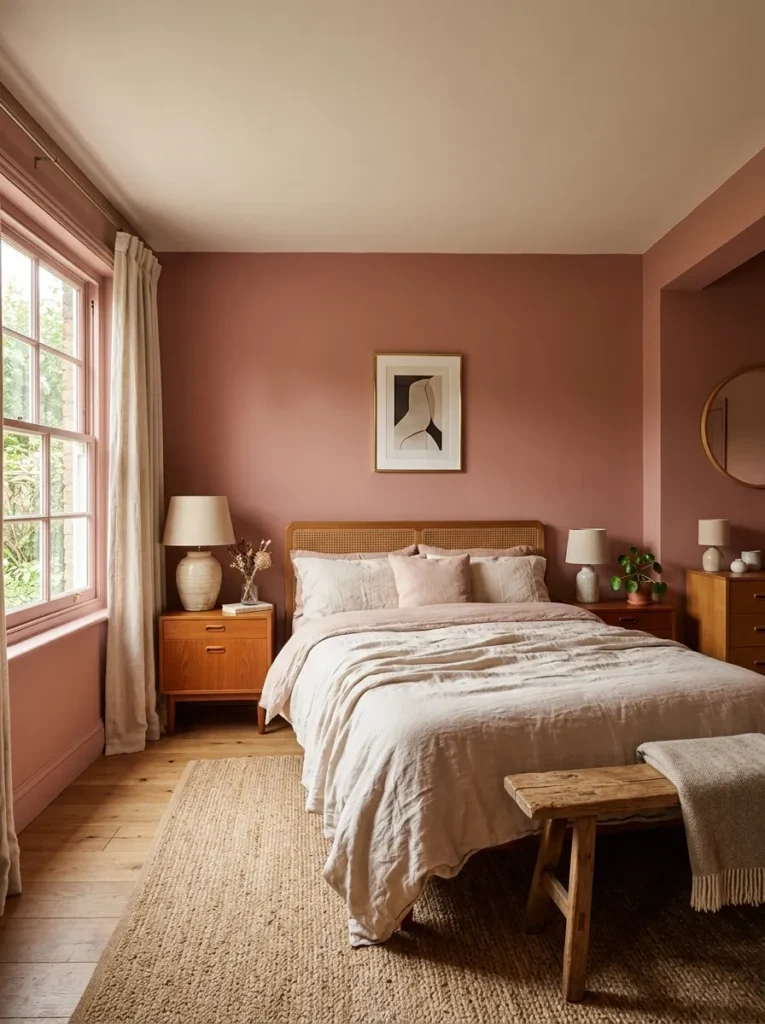
Vibe: The warm painted bedroom feels like the walls themselves are part of the warmth — the enveloping color eliminating the cool, receding quality of white walls and replacing it with the specific psychological warmth of color that surrounds rather than frames.
Why it works: A warm matte wall color applied to all four walls of a bedroom (rather than a single feature wall) applies the chromatic immersion principle — when all four walls share the same warm-toned matte color, the room’s visual field is uniformly warm, and the ceiling’s lighter version of the same color extends the warmth upward without creating a sharp visual boundary between wall and ceiling. This immersive quality (warm color in all directions from any position in the room) creates the psychological enclosure and warmth that the bedroom’s sleep function benefits from. Matte paint is the mandatory finish specification — eggshell and satin finishes introduce a slight sheen that reflects light back toward the viewer, reducing the color’s depth and creating an institutional rather than domestic quality; matte absorbs light, deepening the color and warming the room.
Color recommendation: Dusty rose (Farrow & Ball Setting Plaster No. 231, Little Greene Pale Blush, or Benjamin Moore Pale Blush OC-107) and warm sage (Farrow & Ball Mizzle No. 266, Sherwin-Williams Retreat SW 6207, or Little Greene Lichen No. 76) are the two warm bedroom paint colors with the most consistent transformative effect across varied bedroom furniture and lighting conditions.
Shop The Look
| Product |
|---|
| Dusty rose matte bedroom paint |
| Warm sage matte bedroom paint |
| Warm white ceiling paint lighter |
| Paint roller set bedroom walls |
| Painter’s tape ceiling line |
10. Reading Nook Corner — A Dedicated Rest-Adjacent Space
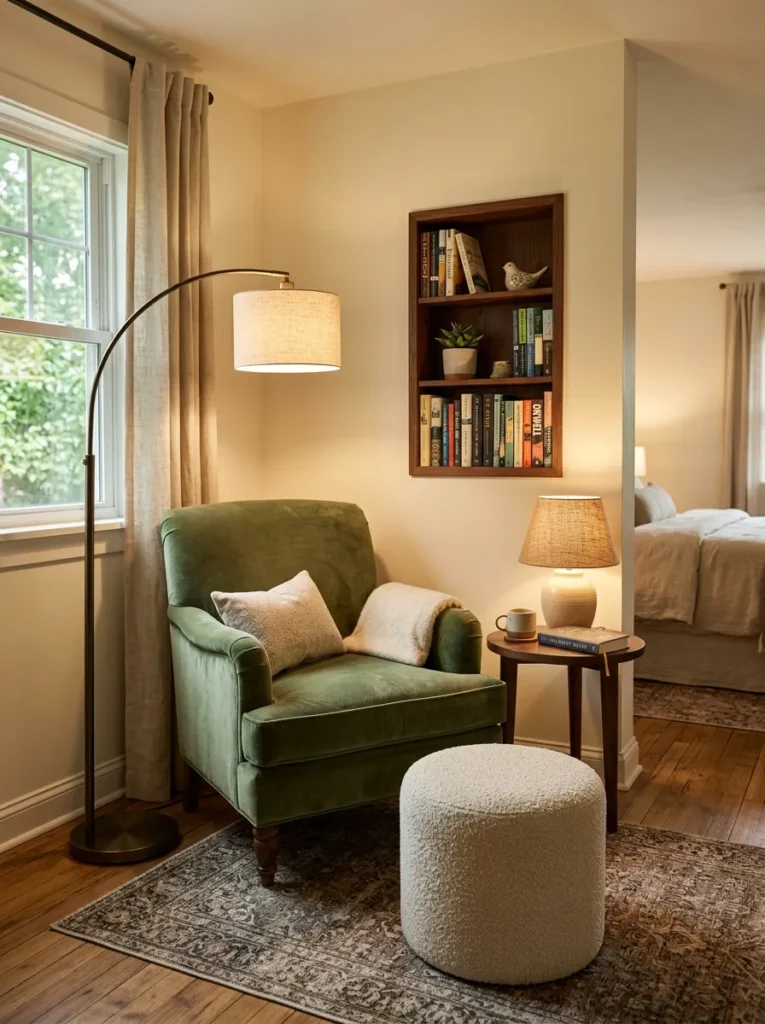
Vibe: The reading nook corner feels like the bedroom has a second function that the bed doesn’t need to perform alone — the dedicated non-sleep seating creating the possibility of rest in the bedroom that doesn’t require being in bed.
Why it works: A bedroom reading corner applies the sleep hygiene design principle — sleep research recommends “stimulus control” as one of the most effective behavioral interventions for insomnia: restricting the bed to sleep and intimacy only (not reading, not working, not watching television in bed) strengthens the association between being in bed and falling asleep. A bedroom reading nook provides the alternative rest location that makes this behavioral principle practically achievable — instead of reading in bed (which compromises the bed’s sleep-associated stimulus control), the pre-sleep reading ritual can be performed in the dedicated armchair before the move to the bed for sleep. The specific comfort elements of the reading corner (the good reading lamp, the footstool, the books within reach) make it a genuinely appealing alternative rather than a compromise.
Shop The Look
| Product |
|---|
| Velvet armchair sage or oat linen |
| Small side table arm height |
| Arc floor lamp warm bulb |
| Boucle footstool warm |
| Small bookshelf bedroom |
11. Textured Wall Treatment — Limewash or Plaster Effect
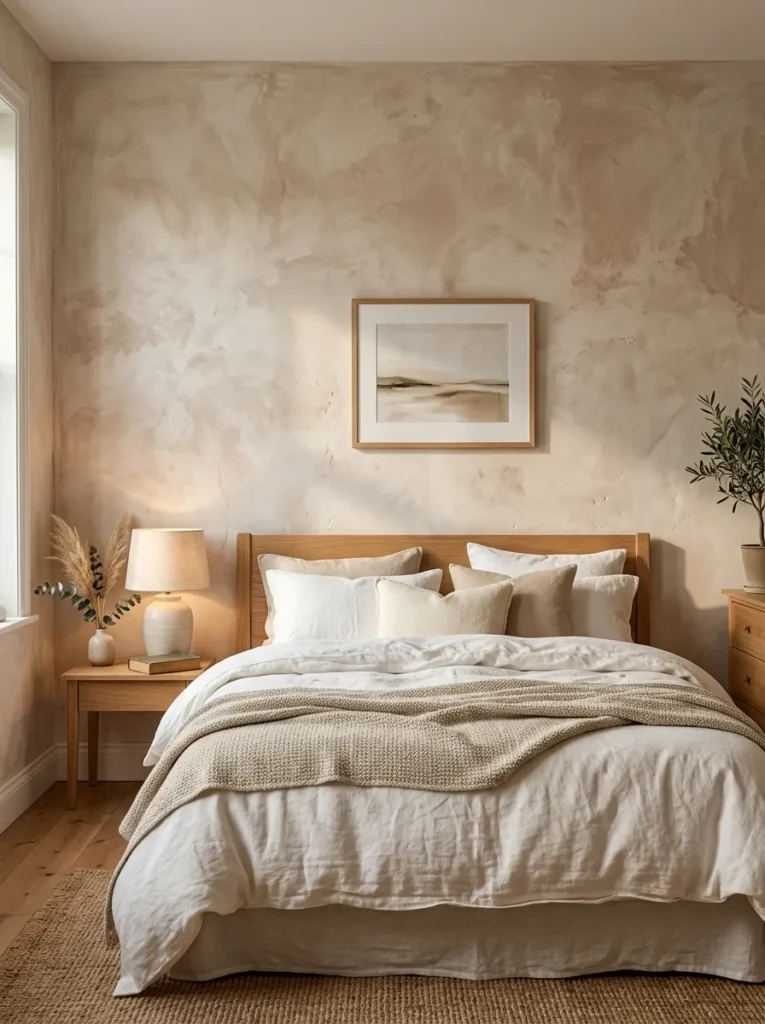
Vibe: The limewash wall feels like a surface that has absorbed sunlight and is slowly releasing it — the varied depth of the wash creating warmth that moves across the wall with the light rather than being fixed at a single value.
Why it works: A limewash paint finish on the bedroom’s headboard wall applies the material depth principle — flat paint produces a uniform, single-value surface that reads as a background; limewash paint (applied in translucent, overlapping strokes that create varied color depth across the surface) produces a surface that reads as having genuine material quality, somewhere between painted plaster and stone. This material depth is perceptible and visually satisfying in a bedroom context because it provides the low-level visual complexity that the eye finds restful — enough variation to be interesting without the strong contrast or sharp patterns that stimulate analytical attention.
Application technique: Limewash paint (available from Farrow & Ball, Kalk-Design, and specialist paint retailers, or achievable with a DIY mixture of slaked lime and pigment) is applied with a wide brush in overlapping strokes that intentionally vary the coverage — areas of thicker application appear darker, thinner areas lighter. The variation is the intention, not a quality failure. Apply two coats in opposite stroke directions, allowing the first coat to dry completely (24–48 hours) before the second.
Shop The Look
| Product |
|---|
| Limewash paint warm white terracotta |
| Wide brush limewash application |
| Limewash application cloth |
| Venetian plaster alternative effect |
| Wall primer limewash base |
12. Curtains to the Ceiling — Dramatic Softness
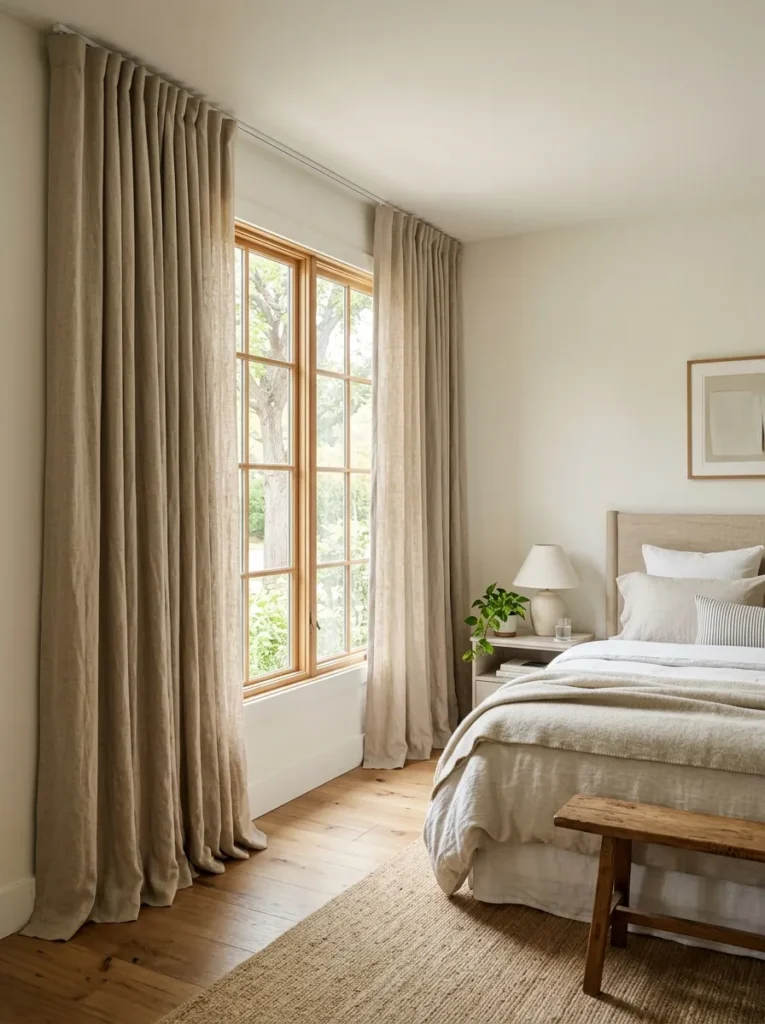
Vibe: The ceiling-height curtains feel like the room borrowed several feet of ceiling height and installed them in the window — the full-height drop creating the room’s most dramatic spatial quality from a single installation decision.
Why it works: Ceiling-height curtains in a bedroom apply the vertical dimension amplification principle — curtains hung from a ceiling-mounted rod (rather than from a rod positioned above the window frame) appear to begin at the ceiling and end at the floor, making the room’s apparent ceiling height equal to the curtain’s total drop. In a standard bedroom with 240cm ceilings, ceiling-mounted curtains create the apparent height of a 280–300cm ceiling. The soft linen material (semi-transparent, slightly irregular in texture, warm in color) adds the specific material quality that the bedroom’s dreamy cozy atmosphere requires: weight without heaviness, softness without transparency, warmth without opacity.
The puddle: A 3–5cm puddle (where the curtain extends slightly beyond the floor level and rests against the floor) is the finishing detail that distinguishes a designed curtain installation from a practical one — it communicates that the curtain was measured and installed with precision and intention rather than trimmed to clear the floor.
Shop The Look
| Product |
|---|
| Natural linen curtain panel floor length |
| Ceiling mount curtain rod bracket |
| Curtain rod extended length |
| Linen ring clip set curtain |
| Floor puddle hem guide |
13. Curated Bedside Table — The Pre-Sleep Environment
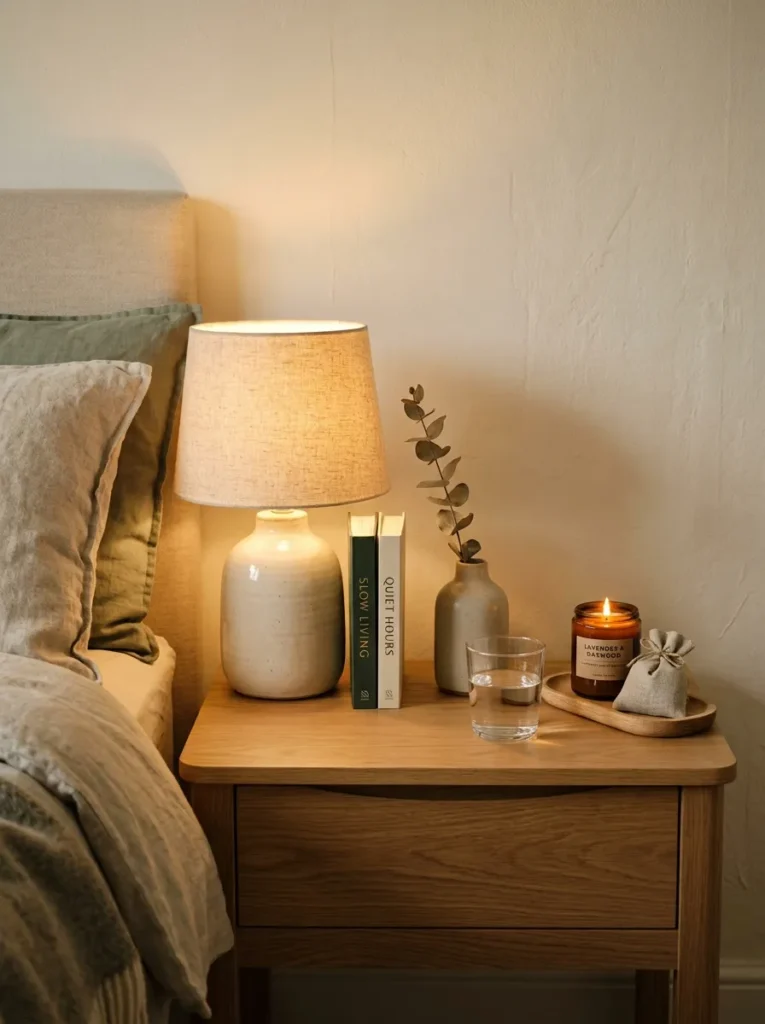
Vibe: The curated bedside table feels like the pre-sleep environment has been thought about specifically — the five objects representing exactly the five things needed for the pre-sleep ritual, nothing more, nothing available to distract.
Why it works: A curated bedside table with a maximum object rule applies the decision reduction principle — a bedside table covered in accumulated objects (phone charger, multiple books, hand cream, headphones, tissues, phone, glass, lamp, alarm clock, accumulated receipts, lip balm, headband) creates a zone of minor visual complexity and accumulated decision-making that is the last thing the pre-sleep mind should engage with. A bedside table limited to five deliberate objects (the lamp, two books, a botanical accent, and a water glass) reduces the visual complexity of the most-viewed pre-sleep surface to a composition rather than an accumulation. The five-object rule is the discipline that most consistently produces the curated quality — the first impulse to add a sixth object should be met with the question of which of the five existing objects it should replace.
The five object formula: One light source (lamp), one reading material (one or two books), one botanical or natural accent (a small vase, a dried stem), one hydration source (glass of water), and one scent element (candle or lavender sachet). Everything else lives in the bedside table drawer.
Shop The Look
| Product |
|---|
| Natural wood bedside table small |
| Ceramic bud vase simple |
| Dried botanical stem single |
| Glass water carafe and glass |
| Slim book set bedside |
How to Start Your Dreamy Cozy Bedroom Transformation
The single best first move before spending anything on a bedroom transformation is spending one evening in the existing bedroom with the overhead light switched off and three warm lamps switched on — and observing what the room feels like under this condition alone. This test costs nothing and requires only two or three LED bulbs at 2700K in the room’s existing lamps (if they are currently cool white). The experience of the same room at the same hour under warm versus cool overhead light is consistently described by people who conduct this test as more dramatically different than expected — the room feels smaller, warmer, softer, and more genuinely restful under warm lamp light than under overhead illumination, even before any other change has been made. This test provides the most compelling possible argument for the first spending decision in any bedroom transformation: replacing the bulbs before replacing anything else.
The most common mistake in attempting a dreamy cozy bedroom transformation is starting with the decorative layer (new cushions, a new print, a new plant) rather than the foundational layers (lighting, bedding, paint). The decorative layer produces the most immediately photographable changes but the least atmospheric change — a new velvet cushion on a bed in a cool-white-lit room does not make the room feel dreamy. The same cushion in a warm-lamp-lit room with linen bedding and a warm paint color produces the cumulative atmosphere that makes each individual element appear more intentional and more beautiful than it would in isolation. The transformation order that produces the most noticeable improvement at each stage is: lighting first (bulb change), bedding second (linen duvet cover), paint third (warm wall color), and textiles last (cushions, throw, rug).
Three specific items under $60 that immediately improve any bedroom’s dreamy cozy atmosphere: a set of warm white 2700K LED bulbs for all existing bedroom lamps ($8–15 for a pack of four, the single highest-impact low-cost bedroom change available); one forest green velvet cushion cover in the 50cm format ($15–25 from homeware retailers, adding the color depth that linen bedding alone lacks); and a dried lavender sachet for the pillowcase ($4–8 from botanical or homeware retailers, providing the olfactory signal that consistently improves pre-sleep quality in the clinical studies that test it). These three items combined for under $50 address lighting, tactile richness, and pre-sleep scent simultaneously — three of the four most impactful sensory dimensions of the bedroom environment.
Frequently Asked Questions About Cozy Bedroom Decor
What makes a bedroom feel cozy and dreamy rather than just decorated?
The distinction between a decorated bedroom and a genuinely cozy, dreamy bedroom comes from whether the design decisions serve the room’s sleep function or merely its visual appearance. A decorated bedroom has beautiful objects arranged carefully; a cozy dreamy bedroom has warm lighting that supports pre-sleep relaxation, soft materials that register as comfortable to the tactile and visual senses, a warm color palette that encloses rather than expands, botanical elements that reference the natural world, and a scent layer that signals rest. The dreamy quality specifically — the sense that the room exists slightly outside of ordinary daily life — comes from the accumulation of decisions that consistently reduce stimulation: the absence of overhead light, the absence of electronic screens, the absence of visual clutter, and the presence of warm, soft, natural materials that communicate a different relationship to time than the waking rooms of the house.
What is the best color for a cozy dreamy bedroom?
The colors most consistently associated with a cozy dreamy bedroom atmosphere are warm-toned, mid-value, and low-saturation — they have warmth (a yellow or pink undertone rather than a blue or green undertone), medium depth (neither very pale nor very dark), and reduced saturation (tending toward dusty, faded, or earthy rather than vivid or bright). Within these parameters, the most successful specific colors are: dusty rose (the pink range from very pale blush through warm terracotta, all with sufficient warmth and desaturation to read as restful rather than energetic), warm sage (the green range from pale silvery sage through warm olive, all with the yellow-warmth that prevents cool green from reading as clinical), and warm earthy neutrals (warm oat, warm mushroom, warm clay — all essentially warm white or warm beige with enough color presence to read as deliberate rather than default). Avoid: cool gray (reads as modern and energetic, not dreamy), bright white (lacks warmth, stimulating rather than restful), and saturated primaries (too energetic for a sleep environment).
How do you create a cozy bedroom in a small space?
Small bedrooms benefit from the cozy bedroom design principles more than large bedrooms because the size constraint naturally produces several of the qualities that the dreamy cozy atmosphere requires: the physical enclosure of a small room creates the psychological enclosure that canopies and curtains work to produce in larger rooms; the limited space naturally restricts the number of objects, producing the edited quality that a large bedroom requires discipline to achieve; and the smaller surface areas mean that a single warm paint color, one large rug, or one set of ceiling-height curtains creates a proportionally larger atmospheric change than in a larger room. The specific adaptations for small bedrooms: use a single bedside lamp rather than two (one lamp in a small bedroom at one side of the bed creates asymmetric warmth that is more interesting than two identical lamps at the same scale), use a wall-mounted reading lamp rather than a freestanding floor lamp in the reading corner (conserves floor space), and prioritize the rug and the bedding over the curtains (in a small room the floor and the bed are the primary spatial elements that most affect the atmosphere).
What are the most important textiles for a cozy bedroom?
The textile hierarchy in a cozy bedroom, ranked by atmospheric impact from highest to lowest: the duvet cover and pillowcases (the largest textile surface in the bedroom, directly experienced for approximately eight hours per night — linen in warm white is the highest-impact single textile decision), the curtains or window treatments (the largest vertical textile surface, determining the room’s light quality throughout the day and providing visual privacy at night), the bedroom rug (the largest floor-contact textile, determining the physical warmth of the floor and the visual warmth of the room’s lower third), the throw blanket or quilt (the tactile accent that sits at the visible fold of the bed, adding color and texture depth to the bedding), and finally the decorative cushions (the highest-visibility but lowest-impact textile, because while they are the most immediately noticed change, they contribute the least to the underlying atmospheric qualities of warmth, softness, and restfulness that the other textiles establish). Invest in this order.
How do you make a bedroom smell cozy and dreamy?
A cozy dreamy bedroom scent is achieved through a layered approach using natural botanical sources rather than synthetic fragrance sprays. The three-layer approach: a continuous background source (a lavender essential oil reed diffuser positioned near the bed provides ongoing low-level lavender scent that the nose habituates to but that continues to affect pre-sleep anxiety levels), a contact source (a dried lavender sachet inside the pillowcase provides scent at the point of closest contact during sleep), and an intermittent warming source (a natural beeswax candle burned for 20–30 minutes before sleep releases natural honey and botanical scent from the warmed wax while producing the specific warm light quality that supports pre-sleep relaxation). Synthetic fragrance sprays and heavily perfumed candles are less appropriate for the bedroom environment because their synthetic fragrance compounds can cause respiratory irritation and because their scent intensity does not modulate (the reed diffuser’s gentle continuous release is more appropriate for a sleep environment than a heavy spray application).
Ready to Create Your Dreamy Cozy Bedroom?
These 13 ideas move through every dimension of what makes a bedroom genuinely dreamy and genuinely cozy — from the foundational warmth of linen bedding and layered lamp lighting, through the sensory richness of velvet cushions, botanical scent, and a warm rug underfoot, to the architectural interventions of ceiling-height curtains, limewash walls, and a reading nook that gives the bedroom a second function. Starting with the bulb change — switching every bedroom lamp from cool-white to warm 2700K this evening before any other change is made — is the beginning that reveals what the room can become without any other investment. Light two lamps. Switch off the overhead. Sit on the bed in the warm glow for fifteen minutes and notice what the room feels like compared to its overhead-lit version. That specific difference — between the room that was built for function and the room that could support rest — is the project. Every idea in this list serves that project. Pin the three or four that most resonated, order the bulbs and the linen sachet and the velvet cushion this week, and let the bedroom begin becoming the dreamy cozy environment that eight hours of sleep every night deserves.