15 Contemporary Succulent Planter Ideas for Stylish Homes
Modern succulent arrangements worth saving use the extraordinary formal variety of the succulent family — from the tight geometric rosette of echeveria through the architectural column of euphorbia to the cascading bead string of senecio rowleyanus — in compositions that treat these plants as living sculpture rather than as generic “low-maintenance greenery,” producing arrangements that reward examination, age beautifully, and read as considered design decisions rather than convenient container-filling. This article gives you exactly 15 ideas spanning container choice, compositional approach, indoor and outdoor applications, seasonal planting, and the specific design decisions that distinguish a modern succulent arrangement of genuine visual quality from one that is merely tidy and green.
A modern succulent arrangement worth saving is not defined by how many succulents it contains or how geometric its container is — it is defined by the quality of the compositional relationship between plant form, container material, and display context, and by the maker’s understanding of which specific succulent forms, textures, and colors create the visual conversation that makes looking at the arrangement genuinely rewarding. Here are 15 ideas worth making.
Why Modern Succulent Arrangements Work
The design case for succulents as contemporary arrangement subjects rests on a convergence of botanical, aesthetic, and practical qualities that no other plant family provides simultaneously. Botanically, succulents have evolved water-storage tissue (in leaves, stems, or roots) specifically as an adaptation to periodically arid environments — a biological investment in structural integrity that produces the specific formal qualities (the geometric precision of rosette leaf arrangement following Fibonacci-sequence phyllotaxis, the smooth cylindrical columns of cactus stems, the plump spherical globes of haworthia and lithops) that make succulents so visually compelling as design objects. Aesthetically, these same botanical qualities — geometric precision, varied surface texture from smooth to spined to powdery-bloomed, color range from silver-blue through warm terracotta to deep burgundy — provide the material vocabulary for compositions of genuine visual complexity within a compact footprint. Practically, the drought adaptation that produces these aesthetic qualities also produces the specific care requirement profile (infrequent watering, bright light, excellent drainage) that makes succulents more reliably maintainable than any equivalent-impact flowering or foliage plant.
The contemporary design interest in succulents — documented as a sustained trend in editorial coverage from approximately 2010 onward and established now as a permanent part of the indoor and garden plant design landscape — reflects a broader cultural shift toward an appreciation of architectural plant forms that reward close examination rather than merely providing background greenery. The best modern succulent arrangements share a design intelligence with the Japanese ikebana tradition’s interest in the quality of individual plant forms and spatial relationships, with the contemporary sculptor’s interest in the conversation between an object and its container or ground, and with the interior designer’s interest in botanical elements that contribute to a room’s material palette rather than simply adding a generic “plant presence.”
Style at a Glance
| Element | Botanical Core | Modern Design Edge |
|---|---|---|
| Philosophy | Plant form as sculpture, container as setting | Composition, proportion, and plant-container dialogue |
| Succulent Family | Echeveria, haworthia, sempervivum, euphorbia | Crassula, sedum, aloe, aeonium, lithops |
| Display Range | Single specimen to landscape installation |
15 Contemporary Succulent Planter Ideas for Stylish Homes
1. Single Specimen Statement — The One-Plant Rule
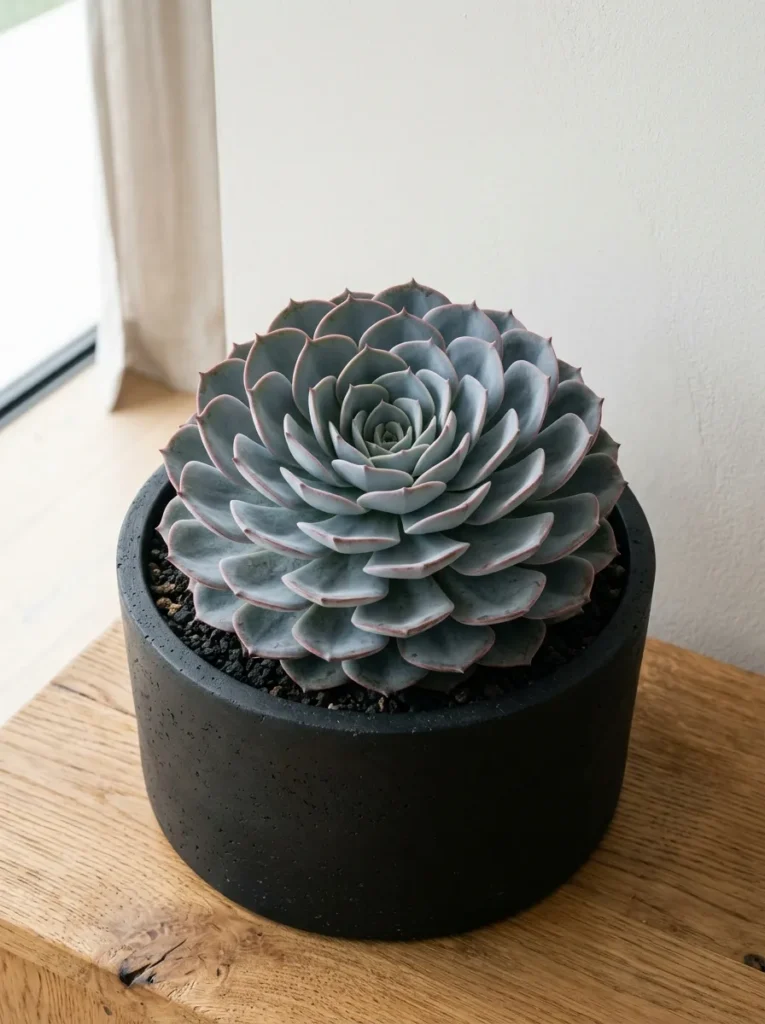
Vibe: The single specimen echeveria feels like a bowl of perfect geometry set on the table — the solitary rosette’s Fibonacci-precise leaf arrangement creating a living sculpture that needs no companions to read as complete.
Why it works: A single large specimen succulent in a perfectly proportioned container applies the sculptural restraint principle — the instinct in arrangement design is to combine multiple plants into a composition, but a succulent of genuine botanical quality and size (a mature echeveria at 30–40cm diameter, a large agave, a mature aeonium tree) is most effectively displayed as a sole specimen because its own formal complexity (the leaf spiral, the color gradation from center to tip, the precise geometry of the rosette) is the composition. Adding companion plants to a specimen of this quality creates compositional competition; the single specimen display allows the plant’s own formal qualities to be read without interruption.
Container proportion: The container diameter should be approximately 80–90% of the plant’s widest dimension — for a 35cm diameter echeveria, a 28–32cm container. The container height should be approximately 55–65% of the container width — for a 30cm diameter container, 16–20cm height. These proportions create the visual weight relationship that makes the plant appear neither perched on an undersized container nor swamped by an oversized one.
Quick Win: A single mature echeveria purchased in a generic plastic nursery pot, repotted into a simple matte concrete or matte black ceramic pot at the correct proportional dimensions, produces a display of genuine contemporary quality for under $25 in plant cost and $15–30 in pot cost.
Shop The Look
| Product |
|---|
| Large mature echeveria specimen |
| Matte black ceramic pot 30cm |
| Concrete pot low profile 35cm |
| Cactus and succulent potting mix |
| Oak display surface or plinth |
Also view: 17 Mason Jar Projects for Cozy Home Decor
2. Monochromatic Gray-Blue Composition — Tonal Plant Collection
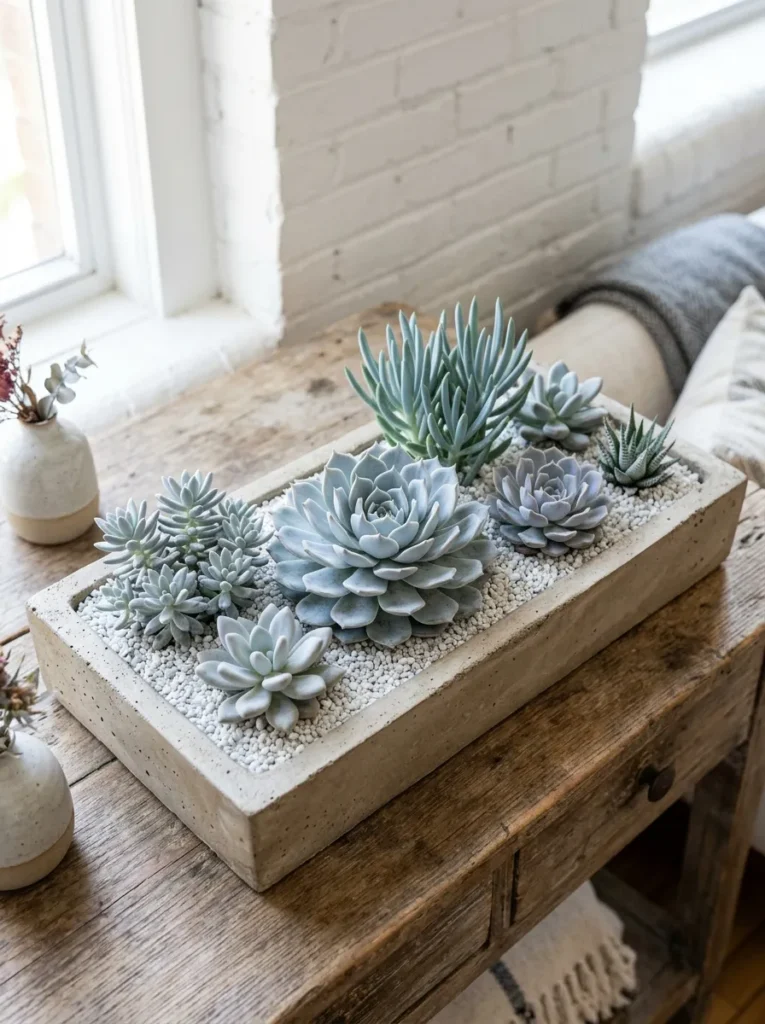
Vibe: The monochromatic blue-gray composition feels like a mineral landscape viewed from above — the tonal unity of the blue-gray succulents creating a composition whose variety is entirely in form and texture rather than color.
Why it works: A monochromatic succulent composition using plants from the same color family applies the tonal unity with formal variety principle — the most sophisticated succulent compositions are not those with the most color variety but those where a restricted color palette allows the variety of form and texture to be read without chromatic distraction. The blue-gray succulent family (blue echeveria, silver-gray sedum, chalk-dusted pachyveria, silver haworthia) provides extraordinary formal variety — rosette forms, upright forms, trailing forms, clustered forms — within a single cool-warm silver-blue tonal range. The white grit topdressing between plants extends the tonal palette to the composition’s ground plane, creating a continuous cool-toned environment from which the plants emerge.
Color specification: The blue-gray succulent family includes: Echeveria ‘Blue Bird,’ Echeveria ‘Perle von Nürnberg’ (blue-gray with purple flush), Sedeveria ‘Blue Mist,’ Pachyveria ‘Powder Puff’ (silver-white powder coat), Haworthia cooperi (silver-green translucent), and any sedum with silver-gray foliage. All should be verified for similar light and water requirements before composing together.
Shop The Look
| Product |
|---|
| Blue echeveria multiple size |
| Silver-gray sedum variety |
| Chalk echeveria powdery bloom |
| Concrete shallow tray 35x20cm |
| White horticultural grit topdress |
Also view: 15 Cozy Craft Night Themes for Every Season
3. Terracotta Gradient — Warm Earth Tones
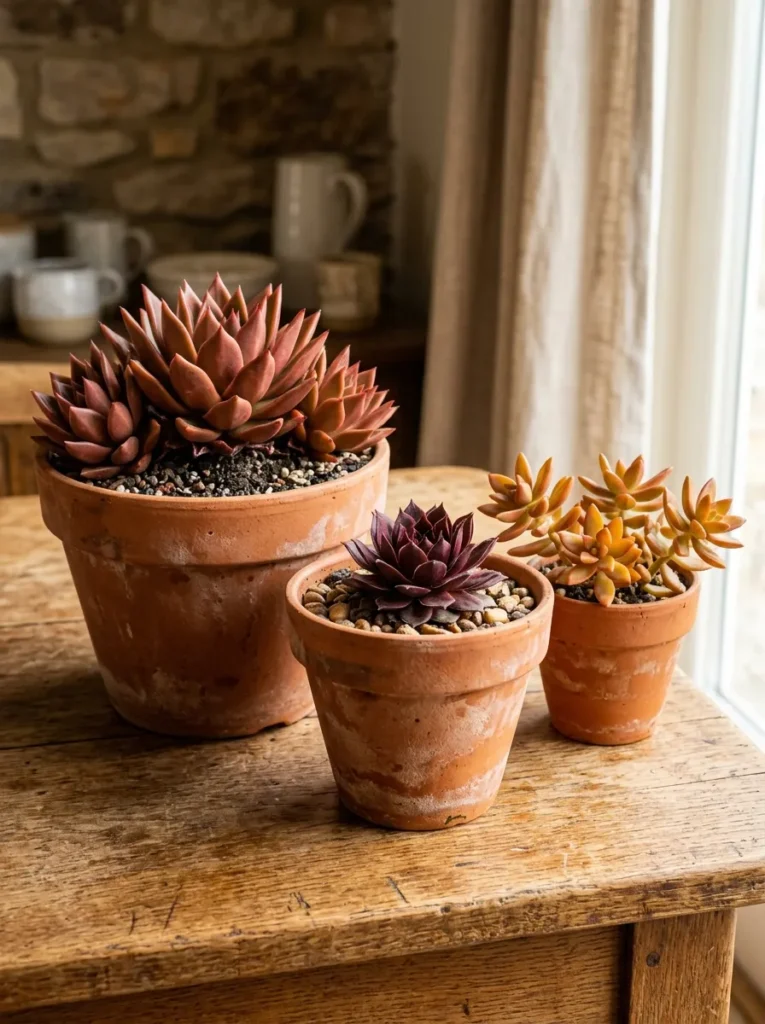
Vibe: The terracotta gradient arrangement feels like autumn compressed into three pots — the warm copper, burgundy, and orange plants in their matching unglazed terracotta containers creating a composition where the material warmth of pot and plant are genuinely continuous.
Why it works: Warm-toned succulents in unglazed terracotta pots arranged as a graduated group applies the material-plant continuity principle — the unglazed terracotta’s specific warm orange-clay color creates a material resonance with the warm red, copper, and orange succulents it contains, making plant and pot appear to belong to the same warm earth palette rather than to be independent elements in different materials. This color continuity between the container material and the plant’s foliage is the specific quality that makes the terracotta-with-warm-succulent combination read as a composed design decision rather than a convenient pairing.
Stress coloring: The warm red, copper, and burgundy colors in many succulents are stress responses — they develop more intensely under conditions of high light intensity, temperature variation, or slight drought stress. To intensify the warm coloring of echeveria agavoides ‘Romeo,’ sempervivum, and similar warm-toned succulents: position in the brightest available indirect light, reduce watering to slightly below the plant’s comfort threshold, and allow occasional mild temperature variation (night temperatures 5–10°C cooler than day temperatures significantly intensify the coloration of many succulents).
Shop The Look
| Product |
|---|
| Echeveria agavoides Romeo copper-red |
| Dark burgundy sempervivum |
| Sedum nussbaumerianum warm orange |
| Unglazed terracotta pot set graduated |
| Warm wood display tray |
4. Architectural Cactus Grouping — Vertical Drama
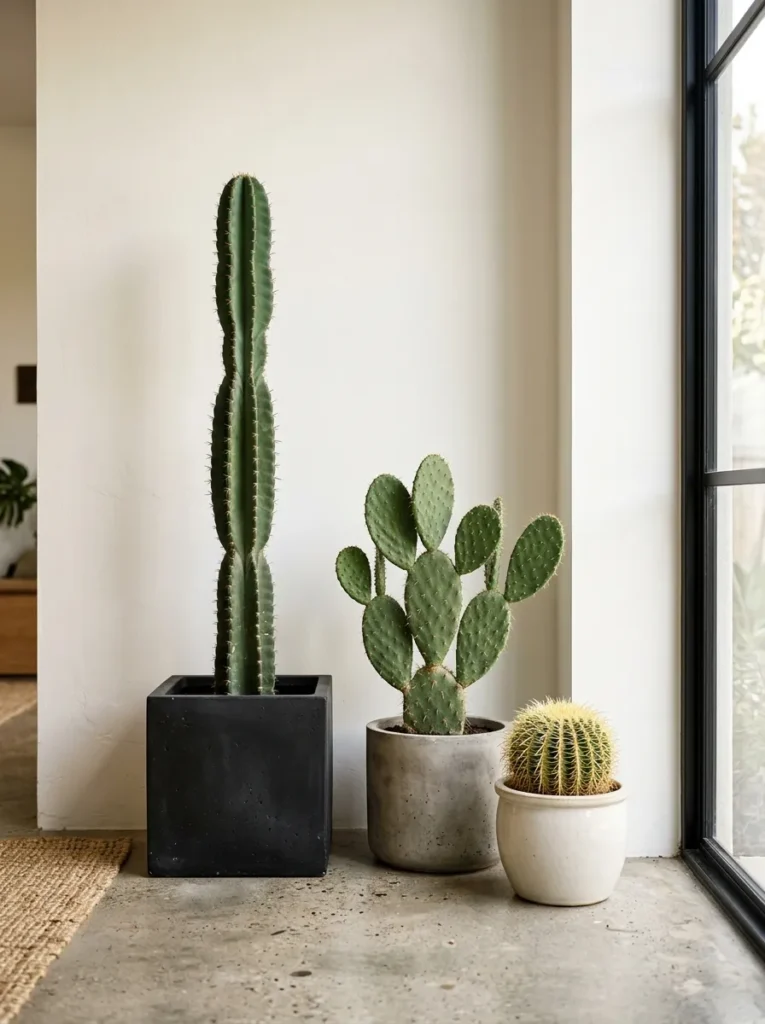
Vibe: The cactus grouping feels like a miniature desert skyline installed in a living room — the varied heights and silhouettes of the three cacti creating a composed vertical composition that functions as the room’s botanical sculpture.
Why it works: A grouping of three cacti at varied heights in coordinated but different containers applies the vertical silhouette composition principle — the most visually compelling plant groupings are composed with height variation as their primary structural principle. Three cacti at 80cm, 40cm, and 20cm create a descending visual sequence that the eye reads as a skyline — the eye travels from the tallest to the shortest and back, registering the composition as a complete visual unit. The three different container types (square matte black, round concrete, simple white ceramic) prevent the grouping from reading as a matched set while the container’s tonal coordination (dark matte, medium gray, pale white) creates a light-to-dark gradient that mirrors the height gradient.
Safety: Cacti with significant spination should be positioned where foot traffic will not bring people into inadvertent contact with the spines. The large columnar cactus (Cereus or Euphorbia) at floor level in a room with pets or children should be positioned in a corner or against a wall where contact is unlikely. Euphorbia trigona specifically produces a white latex sap that is severely irritating to skin and eyes — handle wearing gloves and keep out of reach of children and pets.
Shop The Look
| Product |
|---|
| Cereus peruvianus columnar tall |
| Opuntia medium fan cactus |
| Echinocactus grusonii golden barrel |
| Matte black square pot large |
| Round concrete pot medium |
5. String of Pearls Cascade — The Trailing Statement
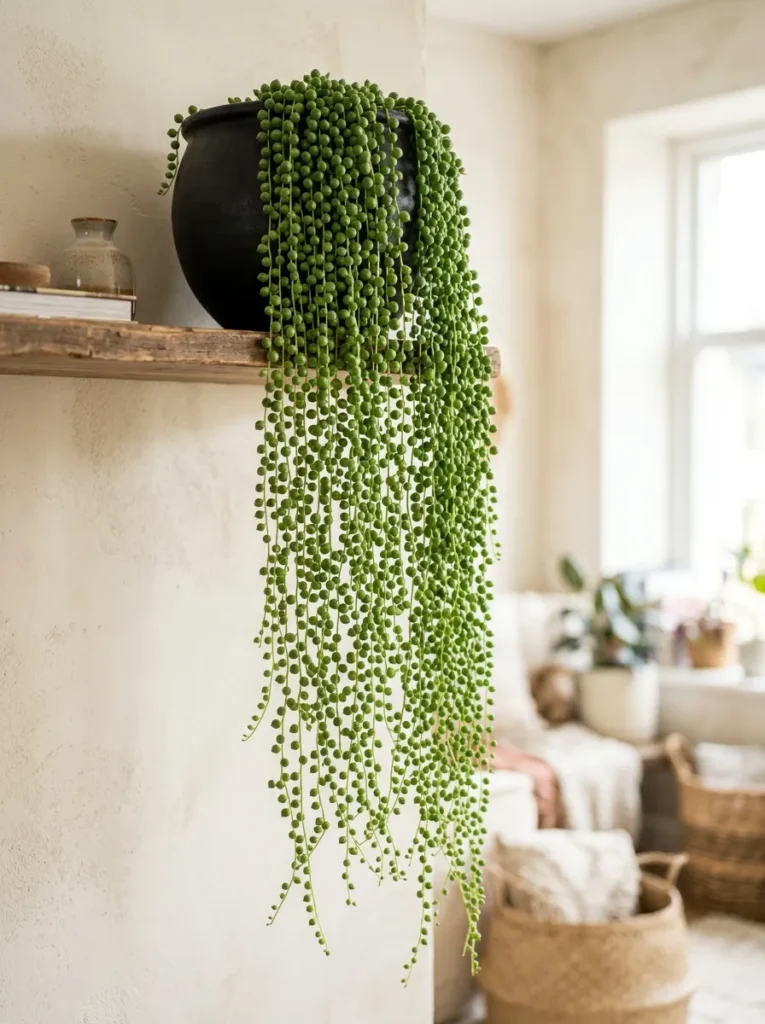
Vibe: The string of pearls cascade feels like someone strung a curtain of living beads from the ceiling — the spherical leaf forms and the long trailing strings creating a visual texture found nowhere else in the plant world.
Why it works: A large, well-grown string of pearls (Senecio rowleyanus) displayed at height to maximize the cascade applies the botanical uniqueness principle — the string of pearls is botanically distinctive from every other commonly available houseplant: no other plant produces the combination of perfect sphere-shaped modified leaves on thin trailing stems that creates the distinctive bead-string visual. This formal uniqueness means that the string of pearls creates a visual contribution that no other plant can substitute, making it specifically worth incorporating in an arrangement precisely because its appearance is unlike any other available botanical material.
Growth requirement: A string of pearls at 60–80cm cascade length represents a well-established mature plant — allow 18–24 months of growth from a standard 12cm pot to achieve a 60cm cascade in good conditions. The plant requires: bright indirect light (insufficient light produces thin, widely-spaced beads rather than tight, plump, closely-spaced ones), careful watering (thoroughly wet the soil then allow to dry completely before watering again — overwatering rots the shallow root system rapidly), and a container with excellent drainage.
Shop The Look
| Product |
|---|
| String of pearls Senecio rowleyanus |
| White ceramic hanging pot |
| Matte black round pot 15cm |
| High shelf bracket ceiling height |
| Well-draining succulent mix |
6. Driftwood and Succulent Landscape — Organic Composition
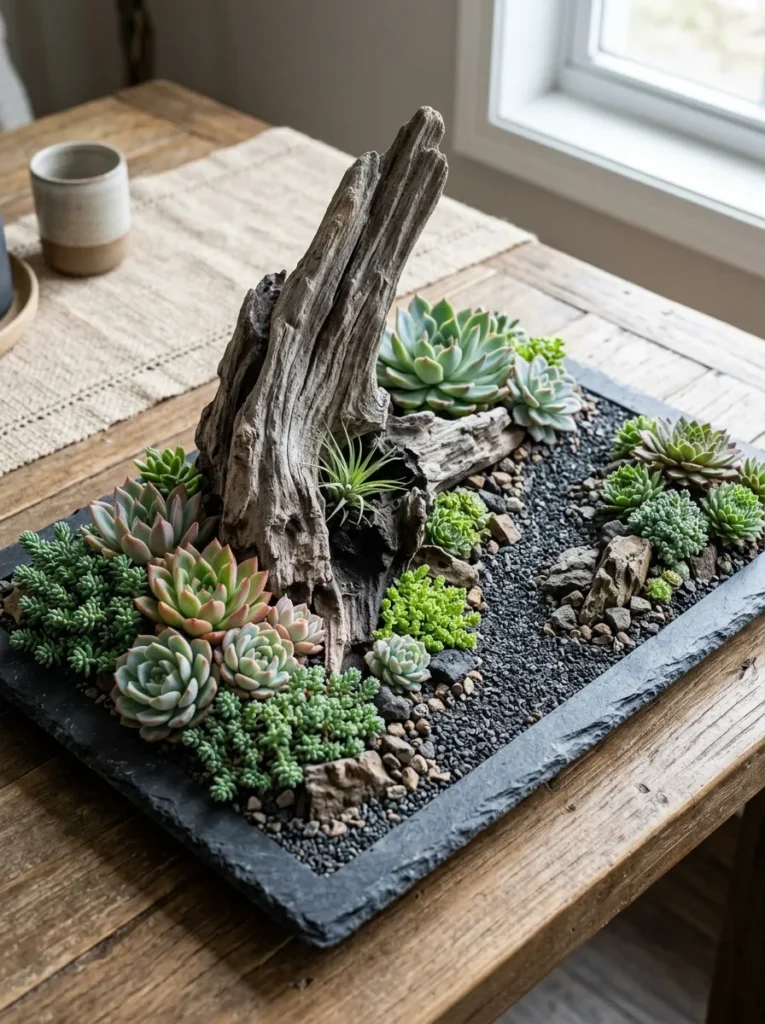
Vibe: The driftwood landscape feels like a coastal cliff section in miniature — the organic driftwood, the rosette plants, and the dark grit creating a complete small-scale landscape with geological credibility.
Why it works: A driftwood and succulent landscape composition applies the miniature landscape design principle — the most compelling succulent arrangements are those that reference a recognizable natural environment in miniature rather than simply grouping plants in a container. A piece of driftwood with succulents planted around its base references the specific landscape of rocky coastal slopes and arid cliff faces where both driftwood and many succulent species naturally coexist — the visual credibility of the pairing comes from this ecological authenticity. The off-center placement of the driftwood (following the rule of thirds rather than centering) creates compositional tension that a centered placement resolves prematurely.
Tillandsia integration: An air plant (Tillandsia) tucked at the driftwood base requires no soil and can be placed in the composition without planting — it sits naturally in the crevice between the driftwood and the grit topdressing. Mist the Tillandsia weekly with a water spray (removing it from the composition for the soaking-in-water method and returning it to the crevice when drained) and allow it to absorb the same bright indirect light as the surrounding succulents.
Shop The Look
| Product |
|---|
| Natural driftwood piece display |
| Concrete shallow tray rectangular |
| Small echeveria rosette set |
| Mat-forming sedum ground cover |
| Tillandsia air plant small |
7. Black Pot Collection — Matte Container as Design System
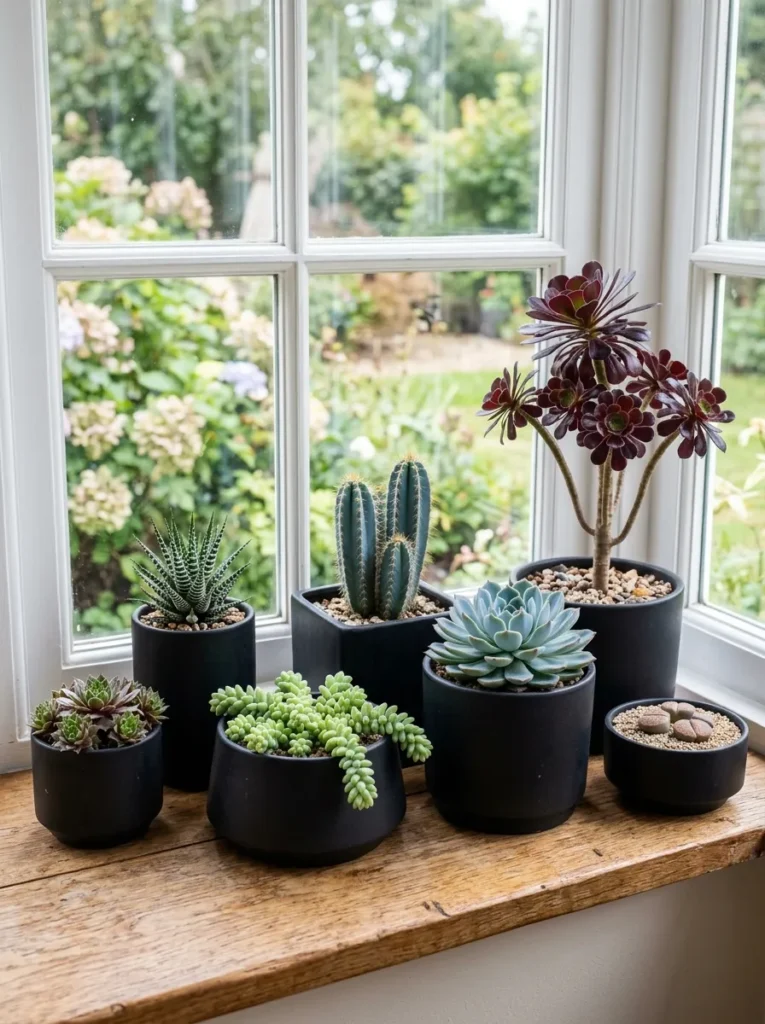
Vibe: The matte black pot collection feels like a botanical design system — the consistent container finish converting a diverse plant collection into a unified composition whose variety is entirely botanical rather than material.
Why it works: A succulent collection unified by a single container finish applies the container-as-system principle — when a collection of succulents in varied species is displayed in containers of varied sizes and forms but in a single consistent finish (matte black), the collection reads as a designed system rather than an accumulated assortment. The container finish provides the visual coherence that allows the plants’ own diversity (the varied leaf forms, the varied plant heights, the varied growth habits) to be read as intentional variety rather than random accumulation. Matte black specifically is the container finish that most effectively foregrounds plant color — every green, blue-gray, burgundy, and copper plant tone appears more vivid and more specifically its own color against matte black than against any other container color.
Collection building strategy: Build the matte black collection over time, adding one plant-in-black-pot at each stage rather than purchasing all simultaneously. The collection benefits from being built gradually because mature specimens (acquired over time) read as more considered than multiple small cuttings acquired simultaneously for immediate arrangement purposes.
Shop The Look
| Product |
|---|
| Matte black ceramic pot set varied |
| Matte black round pot 8cm |
| Matte black square pot 15cm |
| Large echeveria blue gray |
| Haworthia attenuata dark green |
8. Wall-Mounted Succulent Frame — Vertical Garden
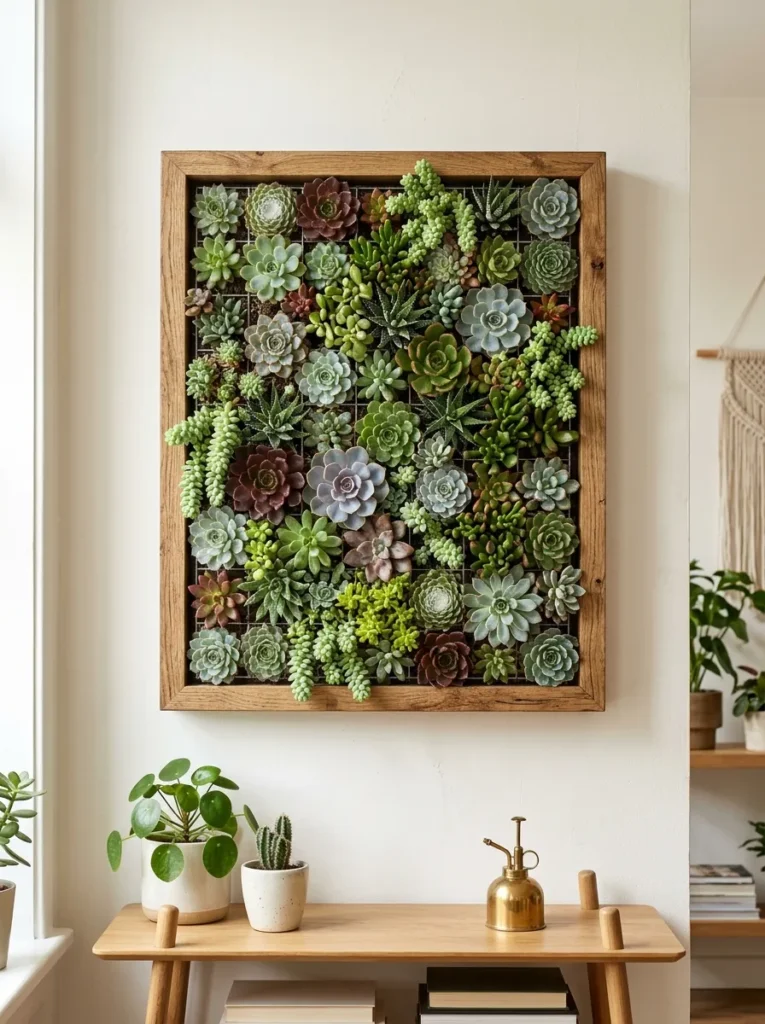
Vibe: The succulent frame feels like the wall grew a garden section and framed it — the dense botanical mosaic creating a three-dimensional artwork that no painting or print can replicate.
Why it works: A wall-mounted succulent picture frame applies the vertical botanical artwork principle — a shadow box frame planted with a dense mosaic of small succulents is simultaneously a piece of wall art (framed, hung, experienced as a two-dimensional composition from normal viewing distance) and a three-dimensional botanical installation (the individual succulents’ forms and textures visible and interesting at close range). The dual reading (art at distance, garden at close range) is the specific quality that makes a well-planted succulent frame more engaging than either a framed print or a conventional container planting.
Construction: Build or purchase a shadow box frame (30–60cm square, 8–12cm deep) with a chicken wire or hardware cloth backing stretched across the open front. Line the interior with a coir fiber mat (the kind used in hanging basket liners). Mix a succulent-specific planting medium and pack behind the coir fiber. Cut small pockets in the coir and insert succulent plugs or rooted cuttings through the pockets into the planting medium. Allow the plants to establish in a horizontal position for 4–6 weeks before hanging vertically.
Shop The Look
| Product |
|---|
| Shadow box succulent frame kit |
| Coir fiber liner frame |
| Small succulent plug assorted |
| Succulent vertical wall mix |
| Hardware cloth frame backing |
9. Desert Terrarium — Enclosed Landscape
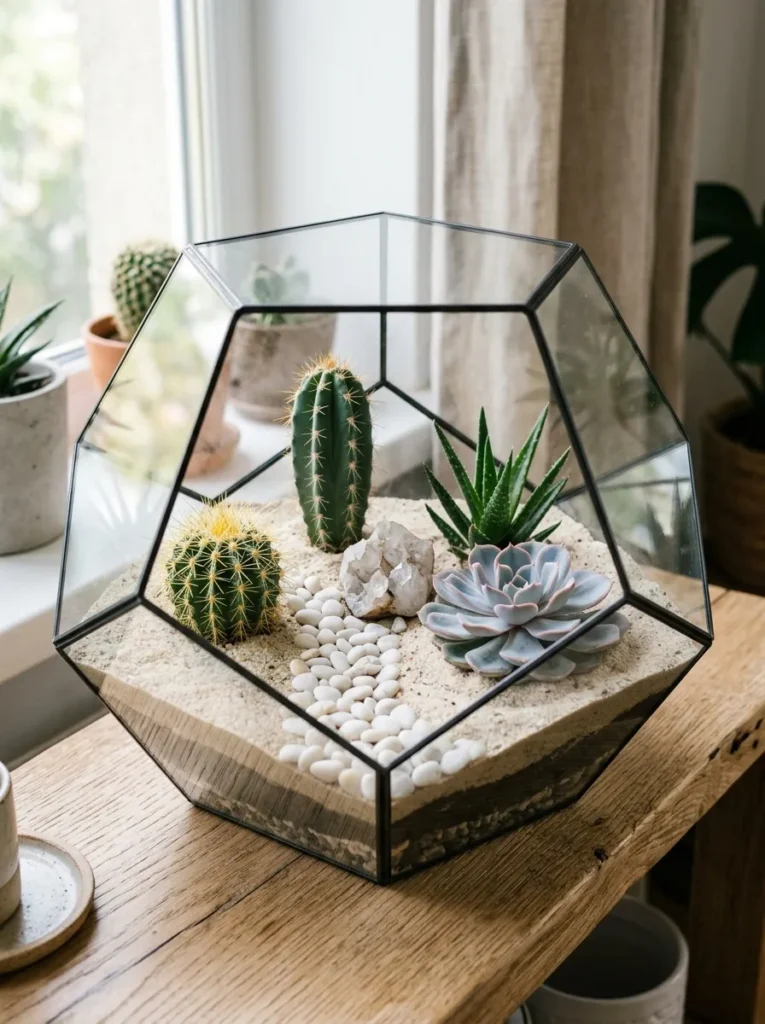
Vibe: The geometric desert terrarium feels like a desert landscape that accepted the frame of a crystal — the angular glass vessel creating a precise contemporary container for the organic desert composition inside.
Why it works: A desert-planted open geometric glass terrarium applies the contained landscape precision principle — the geometric glass vessel (with its angular facets and precise glass joins) creates the maximum possible contrast with the organic natural materials inside (the pale sand, the irregular pebbles, the varied plant forms), and this contrast — between the precision of the manufactured vessel and the organic irregularity of the natural composition — is the specific quality that makes geometric terrariums more visually compelling than round vessels with the same contents. The open top is specifically important for succulents and cacti — closed terrariums create high humidity environments that cause rot in desert plants, while open-top vessels allow air circulation that replicates the low-humidity desert conditions that succulents require.
Layering sequence: Create the terrarium landscape in layers — first a thin layer of horticultural grit at the base for drainage (2–3cm), then the pale sand planting medium layer (5–7cm), then position the plants in their intended positions, add the pebble accents around plant bases, and finally place the mineral or quartz accent. The layering should be visible through the glass sides as a landscape cross-section.
Shop The Look
| Product |
|---|
| Geometric glass terrarium open top |
| Pale sand horticultural desert |
| Small smooth white pebble set |
| Small columnar cactus mini |
| Quartz crystal accent natural |
10. Seasonal Color — Autumn Tones Composition
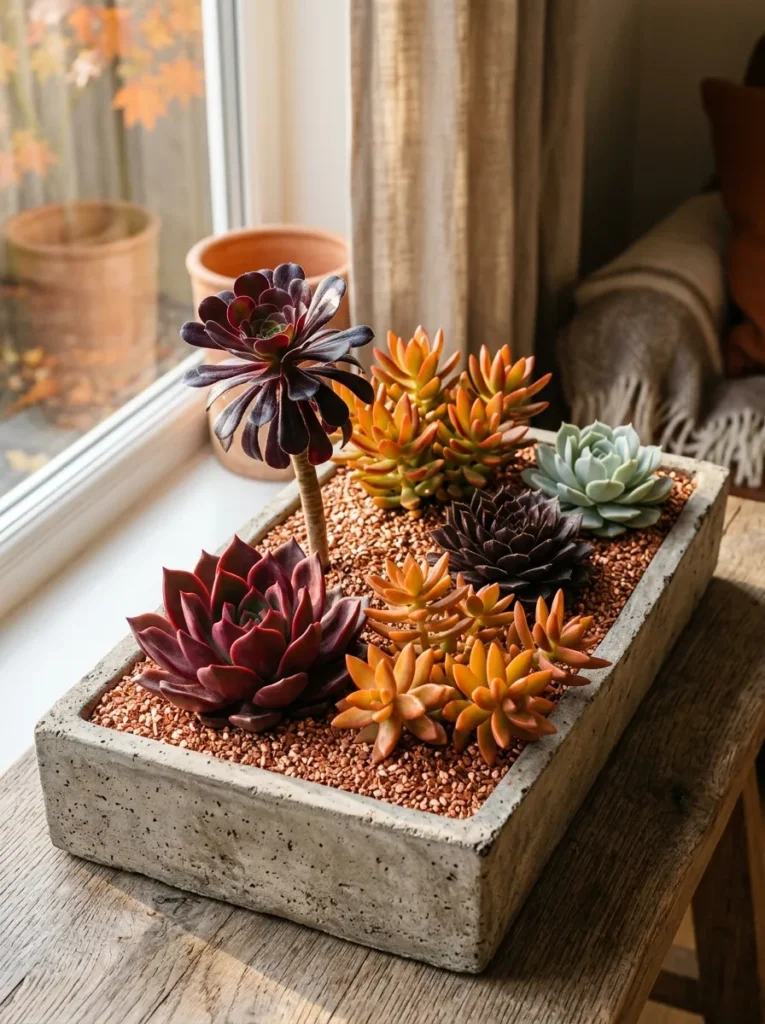
Vibe: The autumn succulent composition feels like the season’s color palette distilled into six plants — the warm burgundy, copper, and purple creating a seasonal composition that requires no flowers and no deciduous leaves.
Why it works: A succulent composition planned around a seasonal color palette applies the palette-led plant selection principle — rather than selecting succulents for botanical variety and then hoping the colors coordinate, the palette-led approach specifies the desired color family first (autumn burgundy-copper-purple) and selects plant species whose stressed coloring produces those tones. This approach consistently produces more visually resolved compositions than botanically-led selection because the color coherence of the resulting arrangement is the intended outcome rather than the accidental byproduct.
Seasonal staging: The warm burgundy, copper, and purple colors in many succulents intensify in autumn and winter under the same environmental triggers that produce autumn leaf color in deciduous trees — lower temperatures, shorter days, reduced soil moisture. An autumn succulent composition assembled in September and placed in a bright outdoor or windowsill position will develop increasingly vivid coloration through October and November as the seasonal conditions naturally stress the plants toward their warmest color expressions.
Shop The Look
| Product |
|---|
| Deep burgundy echeveria autumn |
| Copper orange sedum warm |
| Purple aeonium dark leaf |
| Chocolate sempervivum dark |
| Copper grit topdressing warm |
11. Minimal Japandi Arrangement — Restraint as Composition
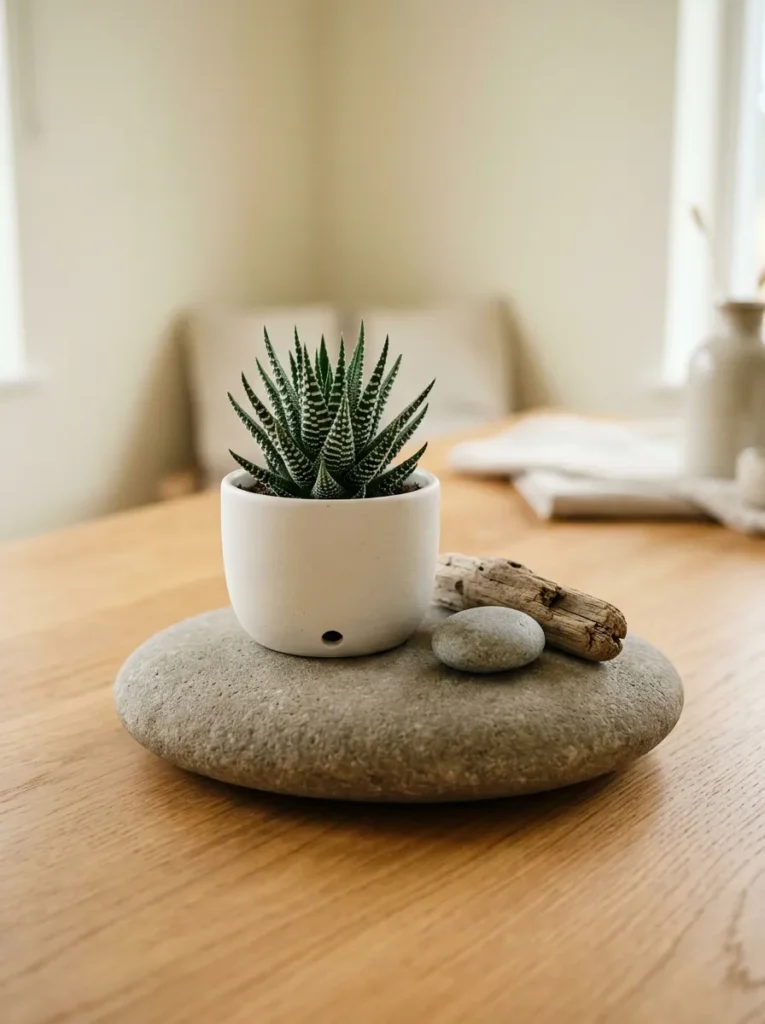
Vibe: The Japandi succulent arrangement feels like a small poem about restraint — the single plant, the single pebble, and the single driftwood piece creating a composition that reads as complete precisely because nothing has been added beyond what is necessary.
Why it works: A Japandi minimal succulent arrangement with a maximum of three elements applies the ma principle — the Japanese design concept of ma (negative space, the meaningful absence of elements) proposes that the space around and between objects is as compositionally active as the objects themselves, and that adding more elements to a composition is not the same as adding more meaning. A three-element arrangement (plant in pot, one pebble, one small driftwood piece, all within the boundary of a single flat display stone) that leaves the surrounding surface largely clear creates a composition whose specific quality is its restraint — the viewer’s eye is drawn to what is present because so much of the field is clear.
Haworthia selection: The haworthia family (including Haworthia, Gasteria, and Haworthiopsis) is the plant genus most compatible with the Japandi minimal aesthetic because its compact forms, regular patterning (the white spots or translucent window-tips), and low light tolerance make it the perfect small-scale specimen for a restrained indoor arrangement. Haworthia attenuata (dark green with regular white-spotted markings), Haworthia cooperi (translucent window-tips), and Gasteria batesiana (dark green, white-speckled) are all appropriate species.
Shop The Look
| Product |
|---|
| Haworthia attenuata small perfect |
| Matte white ceramic pot 10cm |
| Large flat smooth display stone |
| River pebble smooth gray |
| Small aged driftwood piece |
12. Succulent Wedding Favor or Gift Arrangement — Personal Scale
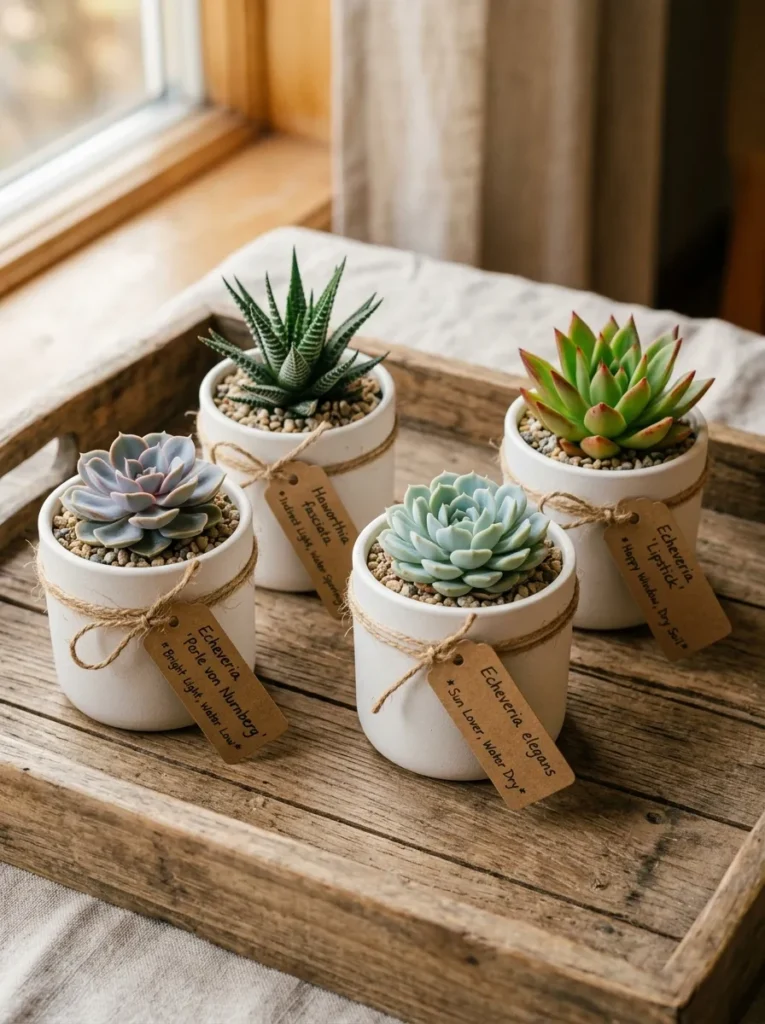
Vibe: The succulent gift arrangement feels like the most living possible gift — the small echeveria in its matte white ceramic pot communicating genuine care and botanical appreciation that no purchased equivalent can replicate.
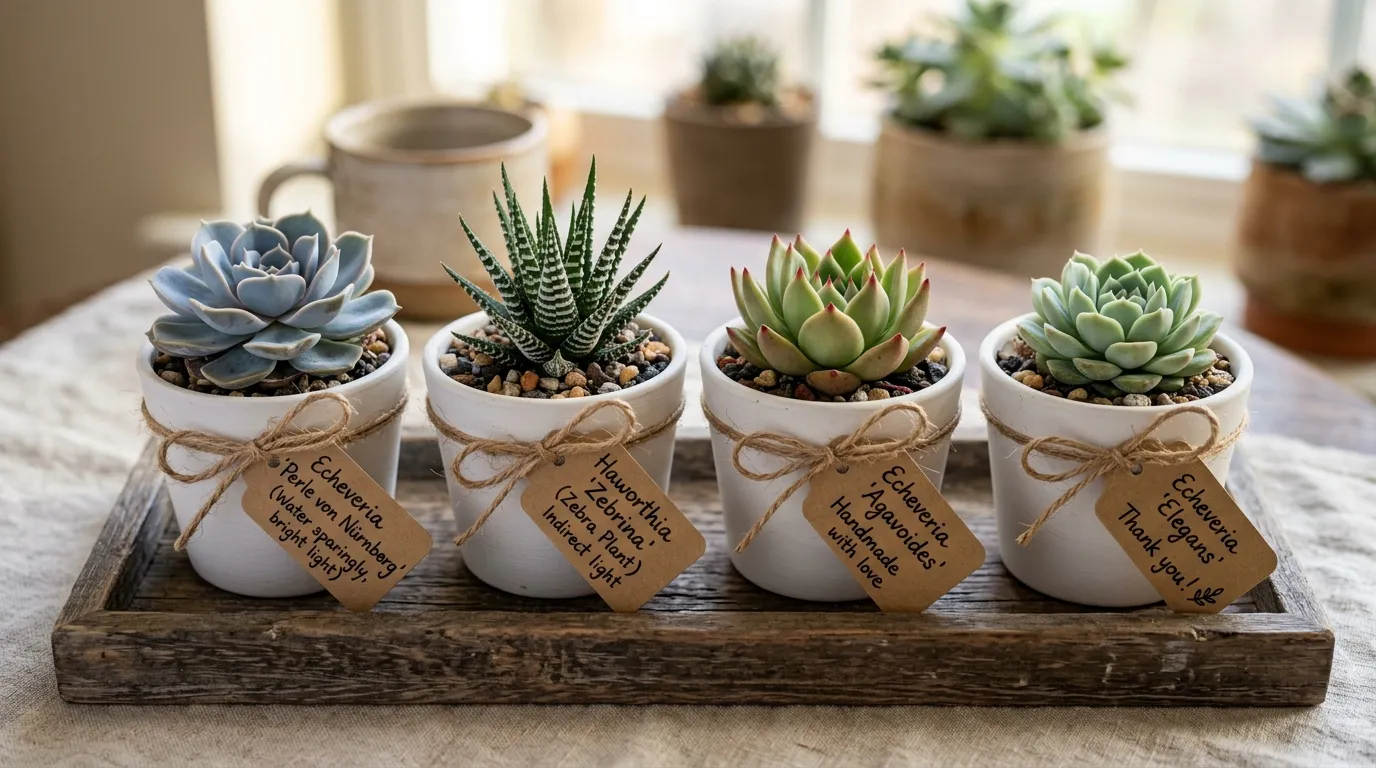
Why it works: A small succulent in a matte white ceramic pot with a handwritten tag applies the living gift principle — a gift that is alive (and that will continue to grow, change, and require a small amount of care from the recipient) creates a more lasting emotional resonance than any equivalent-value purchased object because it communicates ongoing care and creates an ongoing relationship between giver and recipient through the plant’s continued life. The specific styling details (matte white ceramic rather than plastic nursery pot, jute twine rather than plastic tie, handwritten kraft tag rather than printed label) communicate the considered investment that converts a $5 plant into a gift of genuine thoughtfulness.
Gift species selection: The best succulent gift species are those most tolerant of the variable conditions that the recipient may provide: echeveria (tolerates occasional underwatering), haworthia (tolerates lower light than most succulents — ideal for recipients without bright windows), sempervivum (outdoor hardy — appropriate for garden-having recipients), and aloe vera (genuinely useful medicinally — the gel from cut leaves soothes minor burns).
Shop The Look
| Product |
|---|
| Small echeveria gift size 6cm |
| Small haworthia gift size 6cm |
| Matte white ceramic pot 6–8cm |
| Natural jute twine gift |
| Kraft paper tag handwritten |
13. Elevated Planter Stand — Height and Drama
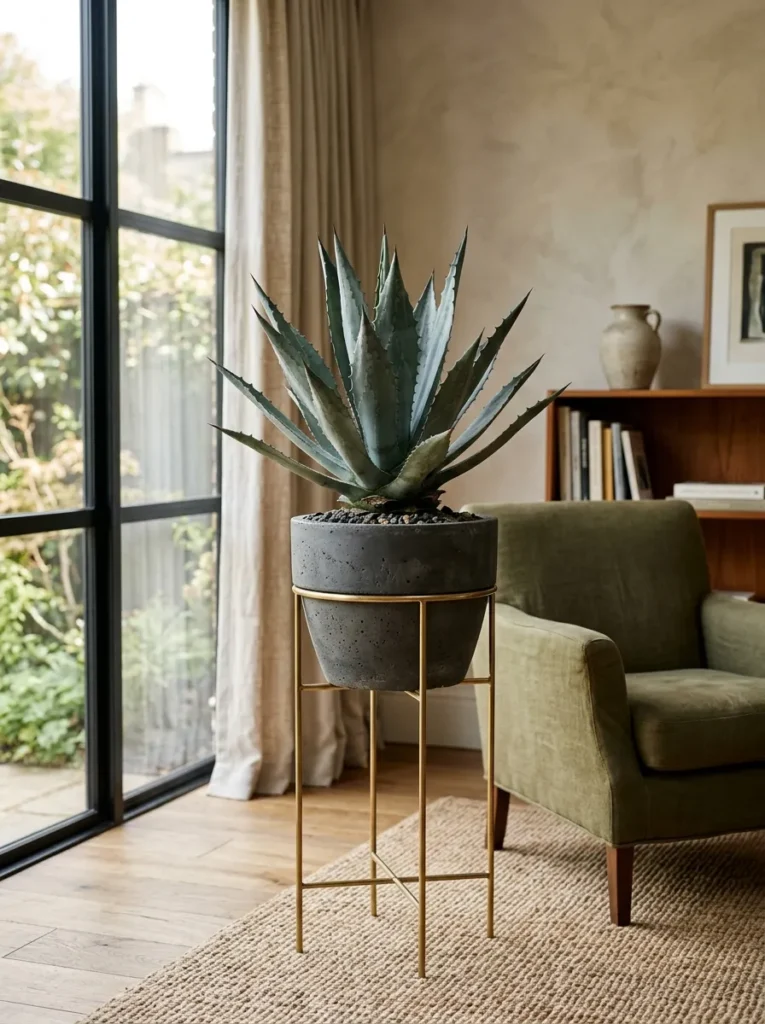
Vibe: The elevated succulent installation feels like a sculptural object that also happens to be alive — the tall plant stand elevating the dramatic succulent to a height where it creates the same spatial drama as a floor lamp or a significant sculpture.
Why it works: A large architectural succulent elevated on a tall slim plant stand applies the visual drama through height principle — a large succulent (agave, aeonium tree, large aloe) at its natural pot-on-floor height (30cm pot plus 60cm plant = 90cm) reads as a significant floor plant but does not create the room-scale vertical drama that the same plant elevated on a 70–80cm plant stand achieves. At 130–140cm combined height, the plant occupies the room’s vertical space at the same scale as major furniture pieces, creating the specific spatial drama of a floor lamp or a significant sculpture.
Stand specification: The slim metal or timber stand (with legs no wider than 10–15mm for a maximum visual lightness effect) creates minimal visual interruption between the floor and the elevated pot — the pot appears to float at height rather than to be supported by a substantial structure. Natural brass or warm copper stands specifically coordinate with the warm gold-green tones of agave and aloe foliage.
Shop The Look
| Product |
|---|
| Large agave architectural specimen |
| Large aeonium tree mature |
| Matte black pot 30cm deep |
| Slim brass plant stand tall |
| Thin timber plant stand tall |
14. Propagation Display — The Process as Decoration
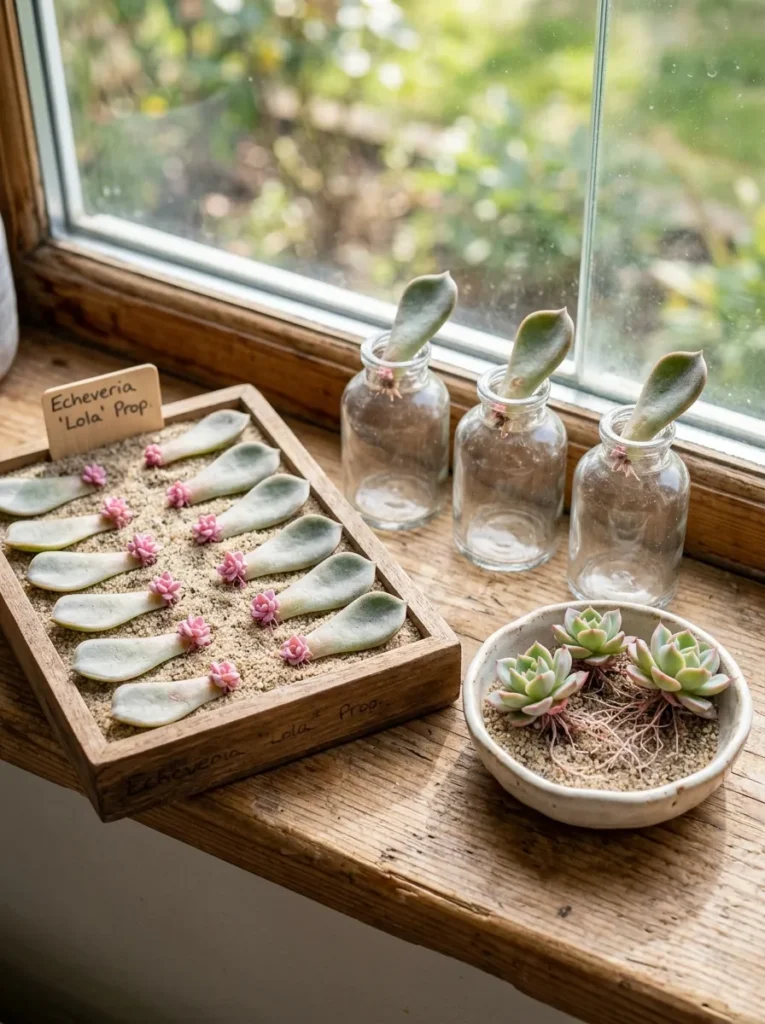
Vibe: The propagation display feels like a botanical laboratory in miniature — the grid of leaves and the emerging rosettes converting the growing process into a visual composition as beautiful as the finished plants.
Why it works: Displaying the succulent propagation process as an arrangement applies the process-as-display principle — the propagation of echeveria from individual leaves (each leaf producing a tiny rosette at its base over approximately 6–8 weeks) is a botanical process of genuine visual interest that is typically hidden in a drawer or forgotten on a windowsill rather than displayed as the living composition it actually is. The grid arrangement of propagating leaves in a sand tray (12 leaves in a 3×4 grid, each leaf at the same angle, the emerging rosettes visible at the leaf bases) creates a botanical installation of genuine aesthetic quality while serving the functional propagation purpose — the arrangement displays the process as honestly as it serves it.
The propagation process: Remove healthy, firm echeveria or sedum leaves with a gentle twisting motion (the leaf must detach cleanly at the base — no remaining attachment to the stem). Allow the leaves to callous (dry and heal the cut end) for 24–48 hours in open air before placing them on the propagation sand. Lay the leaves on top of dry, well-draining sand (do not bury them) in a bright indirect light position and mist lightly weekly. Tiny rosettes emerge from the leaf base within 4–8 weeks.
Shop The Look
| Product |
|---|
| Fine propagation sand dry |
| Clear glass bud vase small set |
| Small ceramic propagation dish |
| Echeveria leaves for propagation |
| Misting bottle fine spray |
15. Outdoor Succulent Rock Garden — The Landscape Scale
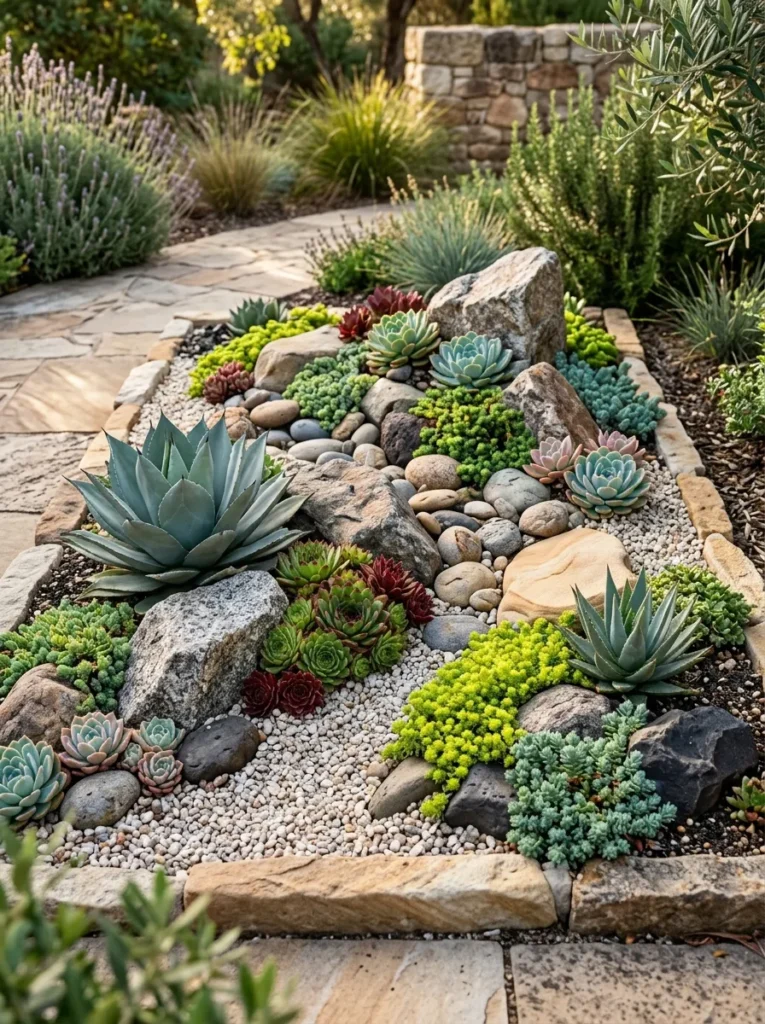
Vibe: The outdoor succulent rock garden feels like a mountain scree slope that was designed — the natural stone structure and the varied succulent planting creating a landscape that appears both genuinely natural and genuinely considered.
Why it works: A designed outdoor succulent rock garden applying landscape design principles applies the ecology-informed composition principle — the most convincing and most enduring succulent rock gardens are those that reference the specific landscape ecology of natural rocky hillsides and arid slopes where succulents and stone coexist: the stones clustered at varied sizes and angles as they would in a genuine geological formation (not laid in a flat grid), the plants clustered in the crevices and sheltered positions where they would naturally colonize, and the varied ground cover (gravel, small stone) in the spaces between as the natural scree material of rocky slopes. This ecological reference does not require botanical accuracy but does require that the arrangement’s logic appears natural rather than arbitrary.
Hardy succulent species for outdoor UK/northern European gardens: Sempervivum (fully hardy, self-propagating, wide variety of color and form), Sedum spurium and Sedum acre (spreading ground cover, fully hardy), Sedum rupestre (upright, fully hardy), and Phedimus hybridus (formerly Sedum hybridum, clustering rosettes, fully hardy). Echeveria and most cacti require protection from frost in UK or northern European winters.
Shop The Look
| Product |
|---|
| Sempervivum collection outdoor hardy |
| Sedum ground cover outdoor set |
| Varied natural stone garden set |
| Pale gravel crushed granite garden |
| Aloe or agave specimen outdoor |
How to Start Your Modern Succulent Arrangement Practice
The single best first move for beginning a modern succulent arrangement practice is visiting a specialist succulent or cactus nursery (rather than a general garden centre) and spending thirty minutes looking at the full range of available species before purchasing anything. This looking exercise — which costs nothing and requires no plant knowledge — typically reveals two things that online browsing cannot: the specific formal and color qualities of individual specimens that make them worth composing (the specific blue-gray of a particular echeveria, the perfect symmetry of an individual haworthia, the striking architecture of a specific small aloe) and the scale relationships between different species that determine whether they will compose well together (a 15cm haworthia and a 5cm echeveria are not compositionally compatible in the same arrangement; a 8cm haworthia and a 6cm echeveria are). This in-person scale assessment is the foundational skill of succulent arrangement composition and cannot be substituted by online purchasing.
The most common mistake in creating modern succulent arrangements is purchasing too many plants of similar size and similar form — filling a container with eight or ten echeveria of the same size in slightly different colors produces an arrangement that reads as a collection of similar things rather than a composition. The design principles that most consistently distinguish a modern arrangement from a filled container are: height variation (use plants of at least three distinctly different heights in any composition larger than a single specimen), form variety (include at least two different growth habits — rosette, columnar, trailing, clustering, or upright — in any multi-plant composition), and restraint in plant quantity (fewer plants with more negative space between them read as more considered than maximum planting density).
Three specific items under $50 that provide the foundation of a modern succulent arrangement practice: one bag of cactus and succulent-specific potting mix ($8–12, the correctly draining growing medium that all succulent health depends on and that cannot be substituted with general-purpose compost), one bag of fine horticultural grit or coarse sand for topdressing ($5–10, the surface finish that gives any succulent arrangement an immediate professional quality), and one matte black or concrete-effect pot in the 15–20cm diameter range ($12–25, the container finish that most effectively foregrounds plant color and creates the contemporary arrangement quality that plastic or glazed nursery pots cannot produce). These three items combined for under $50 are the kit from which any arrangement in this list can be started — the plant is the final, specific, and enjoyable purchase that follows.
Frequently Asked Questions About Modern Succulent Arrangements
How do you water succulents in an arrangement without overwatering?
The correct watering approach for succulents in arrangements is the soak-and-dry method: water thoroughly until water drains freely from the container’s drainage holes, then allow the potting mix to dry completely before watering again. In practice, this means checking the potting mix with a finger or a wooden skewer (inserted to the bottom of the pot — if it comes out with any moist soil adhering, the medium is not yet dry) before watering rather than watering on a schedule. In most indoor environments in active growing seasons (spring and summer), this produces a watering frequency of every 10–14 days for most succulents. In winter (when succulents’ metabolic activity reduces significantly in response to lower light levels), watering frequency should reduce to every 3–5 weeks. The single most important physical requirement for achieving this watering approach is genuine drainage — a container without a drainage hole will retain excess water regardless of how carefully it is applied.
Which succulents are safe for households with cats and dogs?
The safety status of succulents varies significantly by genus. Succulents that are confirmed non-toxic to cats and dogs (according to the ASPCA toxic plant database): Haworthia (all species), Sempervivum (hens and chicks), Sedum (most species), Echeveria (most species), Gasteria (most species), and Hoya (most species). Succulents to keep out of reach of pets: Aloe vera (toxic — causes gastrointestinal upset if ingested), Euphorbia (all species — toxic sap causes severe irritation), Crassula ovata (jade plant — toxic to cats and dogs), and Kalanchoe (toxic — particularly toxic to cats). Always verify any plant’s safety status on the ASPCA database before placing it in a home with pets.
How do you prevent succulent arrangements from becoming leggy?
Leggy growth in succulents (the stretched, elongated stems and widely-spaced leaves that develop when plants reach toward insufficient light) is caused by a single environmental factor: insufficient light intensity. The prevention is consistent bright indirect light at a minimum of 6 hours per day. In rooms where windows do not provide 6 hours of bright indirect light, a full-spectrum LED grow light positioned 20–30cm above the plants for 12–14 hours per day prevents leggy growth reliably. If a plant has already become leggy: the top section of the stem can be cut off with a clean blade, the cut end allowed to callous for 24–48 hours, and then replanted in fresh succulent mix — the beheaded stem will typically produce new side shoots within 4–8 weeks, and the cut top becomes a new individual plant.
What container material is best for modern succulent arrangements?
Container material choices for modern succulent arrangements should satisfy both aesthetic and functional requirements. The functional requirements are excellent drainage (the container must have drainage holes, or the container must be used as a cachepot with a draining inner pot) and appropriate porous quality (unglazed terracotta, concrete, and porous ceramic all allow some moisture evaporation through the container walls, providing an additional buffer against overwatering that glazed ceramic and plastic do not). Aesthetically, the container finishes that most consistently produce modern arrangement quality are: matte concrete (warm gray, contemporary quality, available in varied forms), matte black ceramic (foregrounds plant color most effectively), unglazed terracotta (coordinates specifically with warm-toned succulents, historically honest material), and simple matte white ceramic (clean, contemporary, coordinates with the full range of plant colors). Avoid: ornate or decorative containers that compete with the plant’s own formal quality, bright colored containers that introduce a color reference unrelated to the plant palette, and containers without drainage holes.
How long do succulent arrangements last?
A well-designed and appropriately cared for succulent arrangement lasts indefinitely — succulents are perennial plants that, in the correct conditions, grow and develop over years. However, an arrangement’s specific composition will evolve over time as the plants grow at different rates, some species eventually outgrowing their position in the arrangement. The most common compositional changes that occur over time in a succulent arrangement: the fastest-growing species (often sedum and crassula) eventually dominates smaller species if not managed; some succulents (particularly monocarpic species such as some sempervivum varieties and certain agave) die after flowering; some species produce offsets (pups) that crowd the original composition. Managing these changes — repotting individual plants that have outgrown the arrangement, removing spent monocarpic plants, dividing overcrowded clusters — is part of the ongoing relationship with a living arrangement and produces a gradual evolution of the composition over time rather than a static display.
Ready to Create Your Modern Succulent Arrangements?
These 15 ideas move through every scale and context of what modern succulent arrangement can be — from the confident sculptural restraint of a single large specimen echeveria in a perfectly proportioned matte pot, through the tonal sophistication of a monochromatic blue-gray composition and the warm seasonal richness of an autumn palette arrangement, to the process-display interest of a propagation still life and the landscape ambition of an outdoor succulent rock garden. Starting at the specialist nursery — thirty minutes of looking before purchasing, assessing individual specimens for the specific form, color, and scale qualities that make them worth composing — is the beginning that produces arrangements of genuine botanical quality rather than convenient container-filling. Handle the individual plants. Look at the specific blue of this echeveria against the specific gray of a concrete pot. Assess whether the tall haworthia and the small echeveria have the scale relationship that allows them to compose together. Make the purchasing decisions from specific botanical observation rather than from general category selection. Bring the chosen plants and the chosen container home together, repot into the correctly draining succulent mix, topdress with fine grit, and place in the brightest indirect light the room provides. The arrangement will begin to be beautiful the moment it is complete and will become more interesting with each week of growth.