13 Handmade Gift Ideas for Friends and Family
Handmade gifts are personally crafted objects — made by hand using materials, tools, and techniques chosen by the maker — that carry the irreplaceable quality of time, intention, and individual attention that no purchased gift can replicate. Here are 13 ideas for creating handmade gifts that friends and family will genuinely use, display, and remember.
There is a specific quality to a handmade gift that the recipient almost always recognizes immediately — before they know what it is or how it was made. It is the quality of being thought about. Not browsed for, not added to a cart, not delivered in two days. Thought about. The best handmade gifts are ones where the recipient understands, in the first moment of holding them, that someone spent time on their behalf. Here are 13 ideas worth making — and giving.
Why Handmade Gifts Work So Well
What makes a handmade gift genuinely meaningful rather than merely homemade? Handmade gifts sit at the intersection of craft skill, personal knowledge of the recipient, and the investment of time — which is, in the gift economy, the scarcest and most meaningful currency available. Research in consumer psychology consistently demonstrates that recipients value handmade gifts more highly than equivalently priced purchased gifts when the handmade quality is apparent and the making effort is understood. The distinction between a genuinely meaningful handmade gift and a generic homemade object lies in the specificity of the choice: a handmade gift that reflects something known and true about the recipient carries exponentially more emotional weight than one that simply demonstrates that the giver can make things.
Core materials and approaches. The handmade gift material vocabulary is intentionally broad — it spans beeswax and soy wax for candles, natural fiber yarns and fabrics for textile gifts, food-safe clays and ceramic glazes for functional objects, premium quality food ingredients for edible gifts, natural botanical and essential oil ingredients for personal care gifts, and archival papers and inks for paper-based gifts. The quality of materials is the single most consequential decision in handmade gift-making: a handmade candle in premium coconut-soy wax with a fine fragrance oil reads as a luxury gift; the same candle in low-quality paraffin with a synthetic fragrance reads as a craft project. Material investment is where handmade gifts either justify or undermine the time invested in making them.
Why handmade gifts are increasingly valued now. The gift economy has shifted significantly toward experiential and meaningful exchange — away from the expectation of purchased novelty and toward the expectation of genuine personal investment. This shift is particularly pronounced among adults who have accumulated most of the material objects they need and find themselves most moved by evidence of another person’s thought, time, and craft. Simultaneously, the growing maker movement and the accessibility of craft skills through online tutorials have raised the quality ceiling of what handmade gifts can achieve — a home cook with access to quality ingredients can make chocolate truffles that rival artisan confectionery; a maker with access to quality wax and fragrance can produce candles that rival premium home fragrance brands.
Can handmade gifts look and feel as high-quality as purchased ones? With the right materials, the right techniques, and careful finishing and presentation, consistently yes. The finishing and packaging of a handmade gift is as important as the making — a beautifully crafted item wrapped in tissue paper, tied with linen twine, and accompanied by a handwritten note reads as a considered, premium gift. The same item placed in a sandwich bag reads as a hasty afterthought regardless of the quality of the making.
Style at a Glance
| Element | Detail |
|---|---|
| Philosophy | Time and intention are the materials no purchased gift contains |
| Key Materials | Beeswax, soy wax, natural fiber, quality food ingredients, botanical |
| Key Approach | Make something specific to the recipient, finish and package with care |
13 Handmade Gift Ideas for Friends and Family
1. Hand-Poured Soy Candle with Custom Fragrance Blend
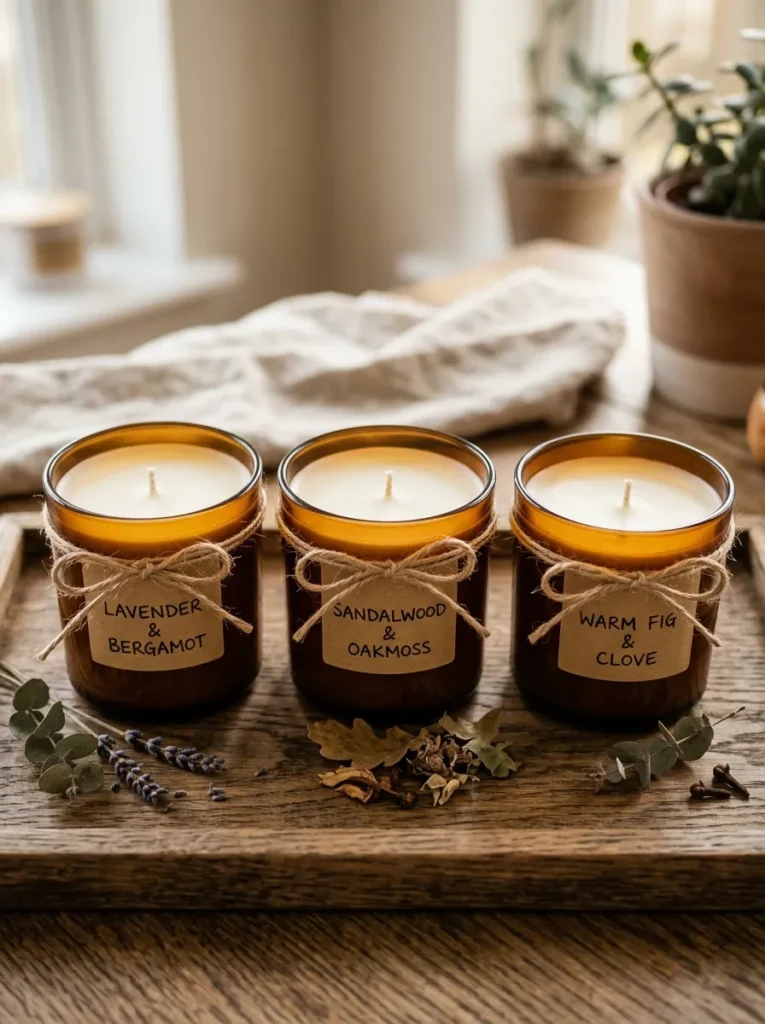
Vibe: A hand-poured soy candle feels warmly luxurious — the handmade gift that the recipient lights immediately rather than saving for a special occasion.
Why it works: A hand-poured candle in a quality vessel with a thoughtfully chosen fragrance is the handmade gift with the highest perceived value relative to its material cost — premium soy candles retail for $25–$45, while the material cost for a handmade equivalent is $4–$8 per candle. The design principle is material quality as perceived value: the choice between coconut-soy wax (which produces a creamy, premium-looking surface) and paraffin (which produces a harder, less appealing surface) is the single decision that most determines whether the finished candle reads as a luxury gift or a craft project. The fragrance selection is the personalization layer — choosing a scent that specifically suits the recipient (their home aesthetic, their favorite season, a scent they’ve mentioned loving) converts a beautiful candle into a specifically thoughtful one.
How to get it: Melt coconut-soy wax blend to 80°C in a double boiler. Add fragrance oil at 10% by weight (approximately 24ml per 240ml vessel) at 75°C and stir for 2 minutes to fully incorporate. Allow to cool to 65°C before pouring into pre-warmed amber glass vessels with centered, wick-bar-supported cotton wicks. Allow to cool undisturbed for 24 hours. Trim wicks to 6mm. Make a small kraft paper label with the fragrance name and your name handwritten in pencil or fine pen. Tie with a length of linen twine.
Quick Win: Fragrance oil blending creates signature combinations that purchased candles don’t offer — a 60/40 blend of cedarwood and vanilla fragrance oils creates a warm, distinctive home fragrance that most recipients have never encountered and can’t easily replicate.
Shop The Look
| Product |
|---|
| Coconut soy wax blend flakes 500g bag |
| Fragrance oil set premium warm scents |
| Amber glass vessel 8oz for candles |
| Pre-tabbed cotton wick set with centering bar |
| Kraft paper label sheets for handwriting |
Also view: 17 Mason Jar Projects for Cozy Home Decor
2. Homemade Flavored Salt Set
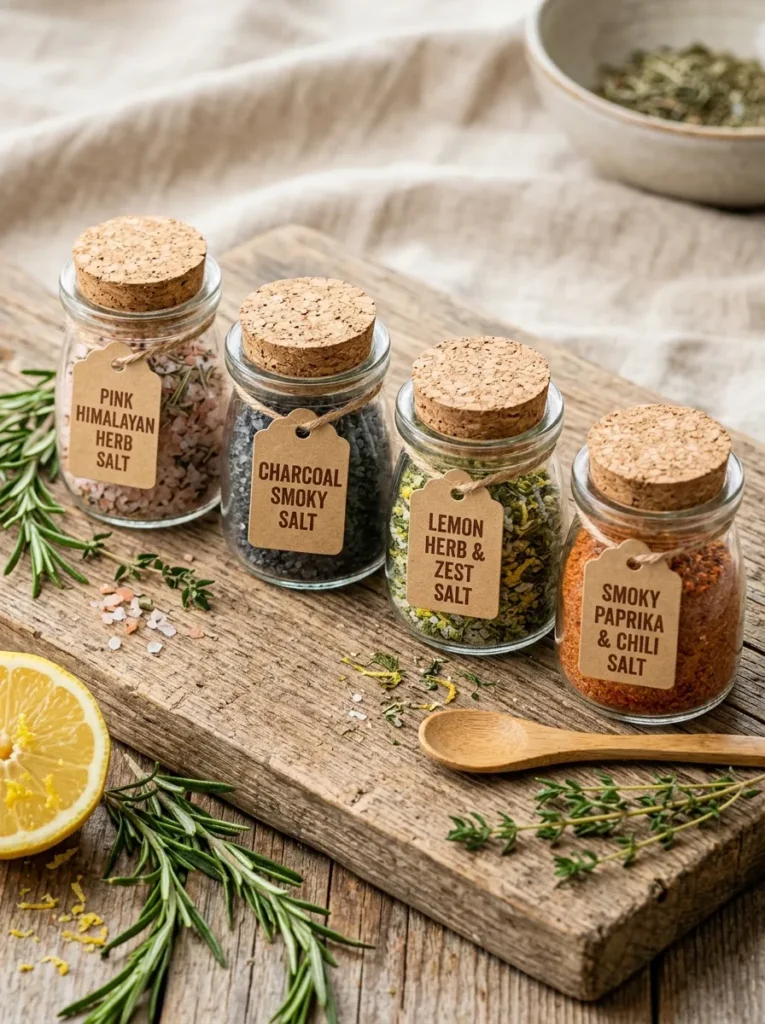
Vibe: A flavored salt set feels artisanal and genuinely useful — the handmade gift that improves every meal the recipient cooks for months.
Why it works: A set of flavored salts is the handmade food gift with the highest practical longevity — well-made flavored salts last 6–12 months, meaning the recipient uses and thinks about the gift regularly across an extended period rather than consuming it in a single occasion. The design principle is daily utility as extended gift experience: a gift that integrates into the recipient’s daily cooking routine delivers its thoughtfulness in accumulated small moments rather than one occasion. A set of four salts — one herb, one citrus, one smoky, one floral — covers the full range of cooking applications and demonstrates the maker’s consideration of the recipient’s culinary life.
How to get it: Combine coarse sea salt or flake salt (Maldon or similar) with dried aromatics in a 4:1 salt-to-aromatic ratio by volume. For herb salt: dried rosemary, thyme, and lemon zest. For smoky paprika salt: sweet smoked paprika and dried garlic. For citrus salt: dried lemon and orange zest with fennel seed. For lavender salt: dried culinary lavender buds and dried lemon thyme. Spread each blend on a baking sheet and dry in a 100°C oven for 20 minutes to drive off any moisture. Cool completely before jarring in small cork-lid glass jars (120ml capacity). Label each with a handwritten kraft tag.
Shop The Look
| Product |
|---|
| Flake sea salt Maldon style large bag |
| Small cork lid glass jar set 120ml |
| Dried herb set for flavored salt making |
| Smoked paprika quality for salt blend |
| Kraft paper tag set for labeling |
Also view: 15 Cozy Craft Night Themes for Every Season
3. Hand-Stitched Linen Pouch Set
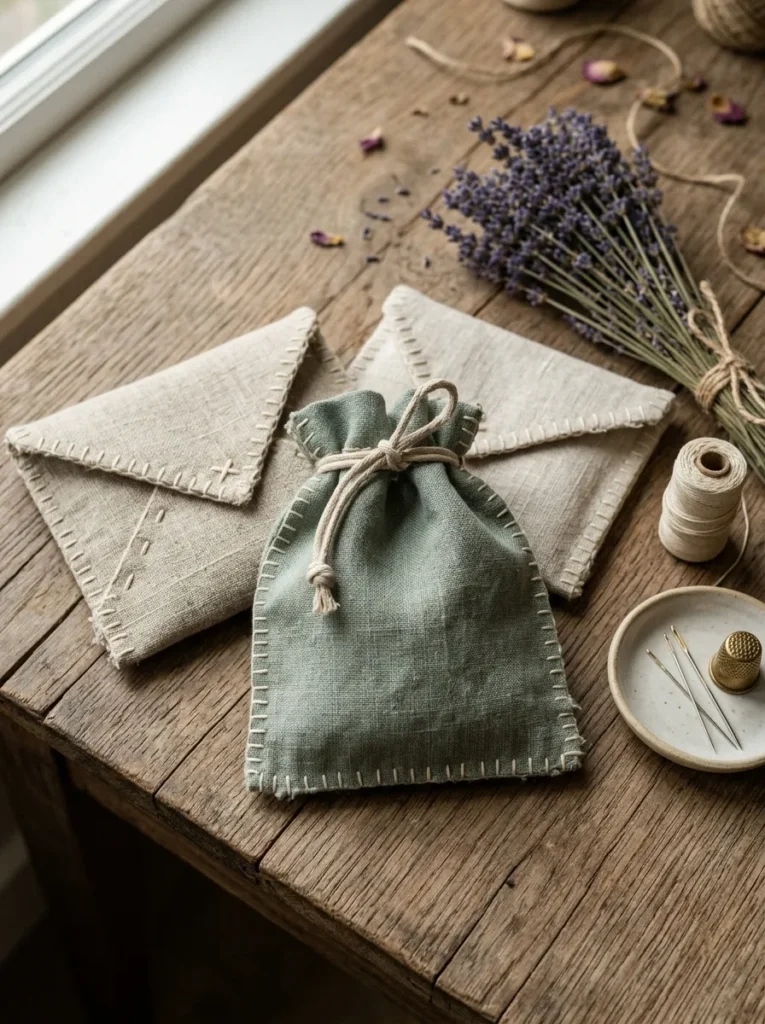
Vibe: A hand-stitched linen pouch feels quietly personal — the gift that shows the stitch marks of the time spent making it.
Why it works: A hand-stitched linen pouch is the handmade textile gift that most directly communicates the time and care of its making — the visible hand stitching, the slight irregularity of the stitch rhythm, and the warmth of natural linen fabric are all evidence of human involvement that no machine-made alternative can replicate. The design principle is visible craft as emotional communication: the recipient of a hand-stitched pouch understands immediately that the maker sat with a needle and thread and thought about them throughout the making. Linen is the optimal fabric for this application because its natural weave, warm tone, and subtle texture read as premium and artisanal regardless of the maker’s skill level.
How to get it: Cut two pieces of natural linen fabric to 15×18 cm (for a small jewelry or toiletry pouch) or 20×25 cm (for a larger pouch). Place right sides together and stitch three sides using a running stitch in cream or warm-toned linen thread, spacing stitches approximately 5mm apart — the visible hand stitch is a design feature, not a flaw to be hidden. Turn right-side out, fold the top edge 2 cm and stitch a channel, then thread a 30 cm length of linen cord through for a drawstring. Alternatively, make an envelope-style pouch with a button and loop closure. Fill with lavender or a small sachet of dried botanicals for an immediately fragrant gift.
Shop The Look
| Product |
|---|
| Natural linen fabric by yard medium weight |
| Linen thread cream for hand stitching |
| Hand sewing needle set assorted |
| Linen cord 3mm for drawstring |
| Dried lavender to fill pouch |
4. Homemade Vanilla Extract in Decorative Bottles
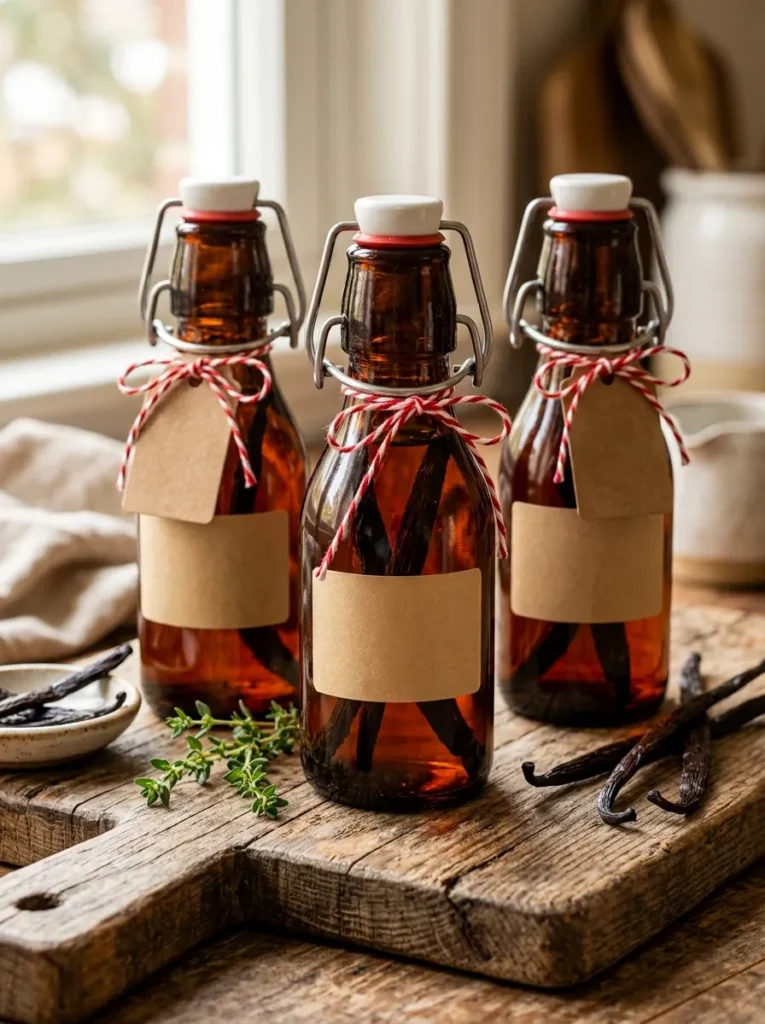
Vibe: A bottle of homemade vanilla extract feels luxuriously patient — the gift that took three months to make and will improve everything the recipient bakes.
Why it works: Homemade vanilla extract is the handmade food gift with the most impressive quality-to-simplicity ratio — it requires only two ingredients (vanilla beans and vodka) and three months of passive infusion time, yet the finished product is indistinguishable from or superior to premium artisan vanilla extract retailing at $20–$40 per bottle. The design principle is time as ingredient: the three-month infusion period is itself a gift — the maker thought about the recipient for three months before giving them anything, which is a form of care that has no commercial equivalent. The dark, complex flavor of properly made vanilla extract enhances baked goods in ways that artificial vanilla cannot, making this a gift that every baking-inclined recipient will notice and appreciate.
How to get it: Split three to four Grade A vanilla beans per 120ml bottle lengthwise with a sharp knife, exposing the seeds. Place in a dark glass bottle and fill with a quality vodka (70 proof minimum). Seal and store in a cool, dark location for a minimum of 8 weeks, ideally 12 weeks, shaking gently once per week. The extract darkens progressively from clear to pale amber to rich dark amber as the vanillin compounds infuse into the alcohol. Label with the date of making and the estimated ready date, and note the bean origin if known (Madagascar, Tahitian, and Mexican vanilla beans each produce distinct flavor profiles).
Shop The Look
| Product |
|---|
| Grade A vanilla bean pods 10 pack |
| Dark glass swing top bottle 120ml set of 4 |
| Baker’s twine for gift labeling |
| Kraft paper tag set handwriting |
| Quality vodka 70 proof for infusion base |
5. Hand-Bound Notebook with Linen Cover
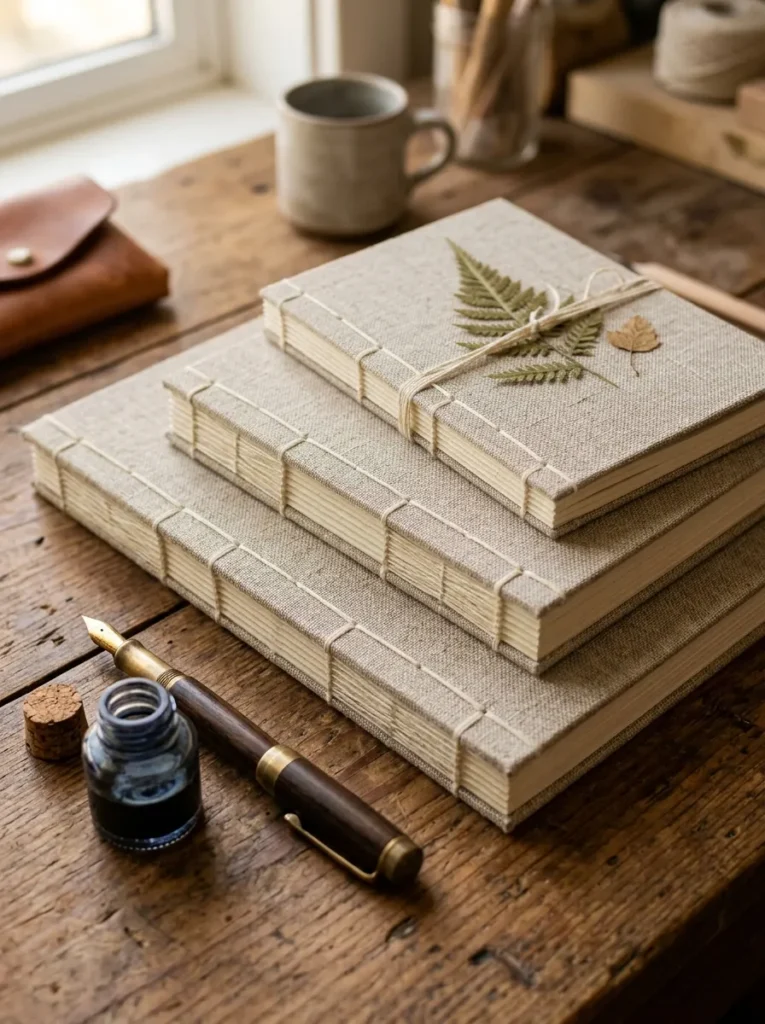
Vibe: A hand-bound linen notebook feels genuinely crafted — the journal that makes writing in it feel like it deserves the quality of the book.
Why it works: A hand-bound notebook with a visible binding technique — Japanese stab binding, Coptic binding, or long stitch — is the paper craft gift that most directly demonstrates bookbinding skill while producing an object of genuine daily utility. The design principle is functional beauty: a notebook that is both beautiful to look at and pleasant to write in delivers its gift value across every page the recipient fills — which, for an active journal keeper or planner, can mean months of daily contact with something made by hand for them. The linen cover is the material choice that elevates a handmade notebook from craft project to designed object — its natural weave and neutral warm tone reads as premium stationery rather than homemade paper product.
How to get it: For Japanese stab binding (the most accessible bookbinding technique): Cut 20–30 sheets of 90gsm cream or ivory paper to A5 size. Fold in half (or leave flat for a side-bound format). Stack pages evenly and clip with binder clips. Cut a linen cover piece 2mm larger than the page block on all sides. Use a bookbinding awl to pierce holes through the full text block and cover at 5mm from the spine edge, spaced 2 cm apart. Thread a blunt needle with waxed linen thread and stitch the stab binding pattern through all holes. The stitching pattern is visible on the exterior spine — choose a cross-stitch or diamond pattern for the most visually distinctive result.
Shop The Look
| Product |
|---|
| Natural linen fabric for book cover |
| Cream ivory paper 90gsm A5 for pages |
| Bookbinding awl for hole piercing |
| Waxed linen thread bookbinding |
| Binder clip set for page block assembly |
6. Infused Olive Oil Set
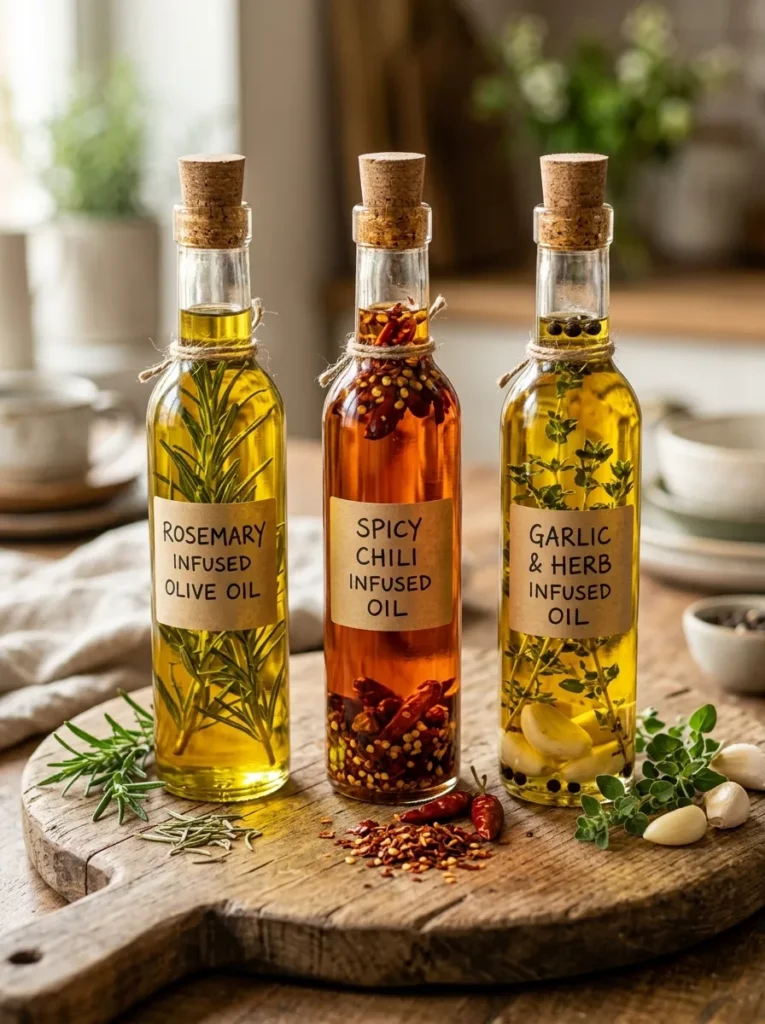
Vibe: An infused olive oil set feels culinarily thoughtful — the gift that improves bread, pasta, and cooking for months after it’s received.
Why it works: An infused olive oil set is the handmade culinary gift that most effectively communicates knowledge of the recipient’s cooking habits — choosing between herb-infused, chili-infused, and garlic-infused oils reflects awareness of how the recipient actually cooks and what they cook most. The design principle is personalized utility: a gift that integrates daily into the recipient’s cooking practice delivers its value across every meal rather than as a single occasion, which extends the gift’s emotional resonance over months. A set of three small bottles covers different culinary applications — the herb oil for finishing vegetables and bread, the chili oil for pasta and pizza, the garlic oil for everything — creating a complete kitchen companion.
How to get it: Use dry infusion methods only for food-safety — fresh herb and fresh garlic infusions require refrigeration and consumption within one week to prevent botulism risk; dried herb and dried garlic infusions are shelf-stable at room temperature for three to four months. For dried herb olive oil: combine 500ml quality extra virgin olive oil with 2 tablespoons dried rosemary, 1 tablespoon dried thyme, and 1 teaspoon black pepper in a clean bottle. Seal and infuse at room temperature for two weeks before gifting. For chili oil: combine with 1 tablespoon dried chili flakes and 1 teaspoon smoked paprika. Label clearly with the infusion date and a best-by date 3 months from making.
Shop The Look
| Product |
|---|
| Quality extra virgin olive oil 500ml |
| Slim glass bottle cork stopper 200ml set of 3 |
| Dried rosemary thyme quality herb set |
| Dried chili flakes culinary grade |
| Kraft label and baker’s twine gift set |
7. Natural Beeswax Hand Salve
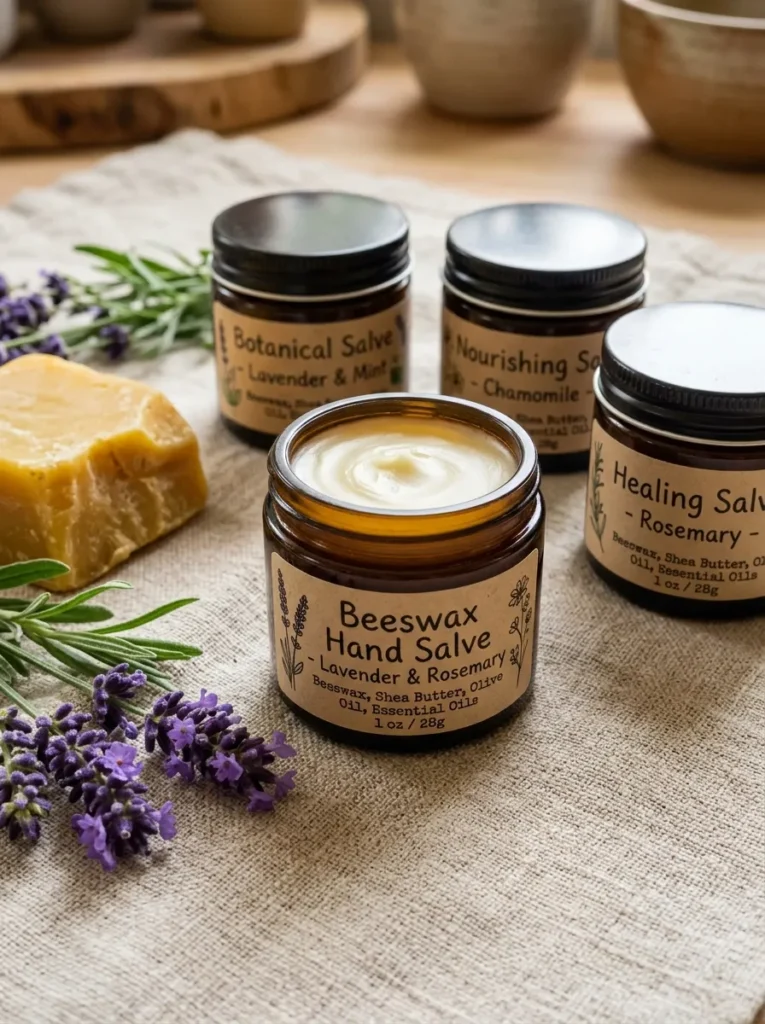
Vibe: A tin of homemade beeswax hand salve feels genuinely caring — the personal care gift that someone used their hands to make for someone else’s hands.
Why it works: A beeswax hand salve is the handmade personal care gift with the most immediate practical value — genuinely effective hand salve, particularly in dry winter months, is something most people use daily and rarely invest in purchasing for themselves. The design principle is comfort as care: a gift that physically comforts the recipient (softening dry, cracked hands) delivers its care in a direct, physical way that few other gift categories can match. Natural beeswax and quality carrier oils (shea butter, sweet almond oil, jojoba) produce a hand salve that is genuinely more effective than most commercial alternatives, because the beeswax creates a protective occlusive layer while the carrier oils absorb and nourish — the combination outperforms petroleum-based commercial balms.
How to get it: Melt 30g pure beeswax pellets and 20g refined shea butter together in a double boiler. Remove from heat and add 50ml sweet almond oil and 10ml jojoba oil. Allow to cool to 45°C and add 20 drops lavender essential oil and 10 drops frankincense essential oil. Pour into small amber tins (30ml capacity) before the mixture begins to set. Allow to cool completely at room temperature — do not refrigerate. Label with a handwritten kraft label listing the key ingredients and the making date. Makes four to five 30ml tins.
Shop The Look
| Product |
|---|
| Pure beeswax pellets cosmetic grade |
| Refined shea butter unscented |
| Sweet almond oil carrier cosmetic grade |
| Small amber tin set 30ml |
| Lavender essential oil pure therapeutic |
8. Painted Watercolor Card Set
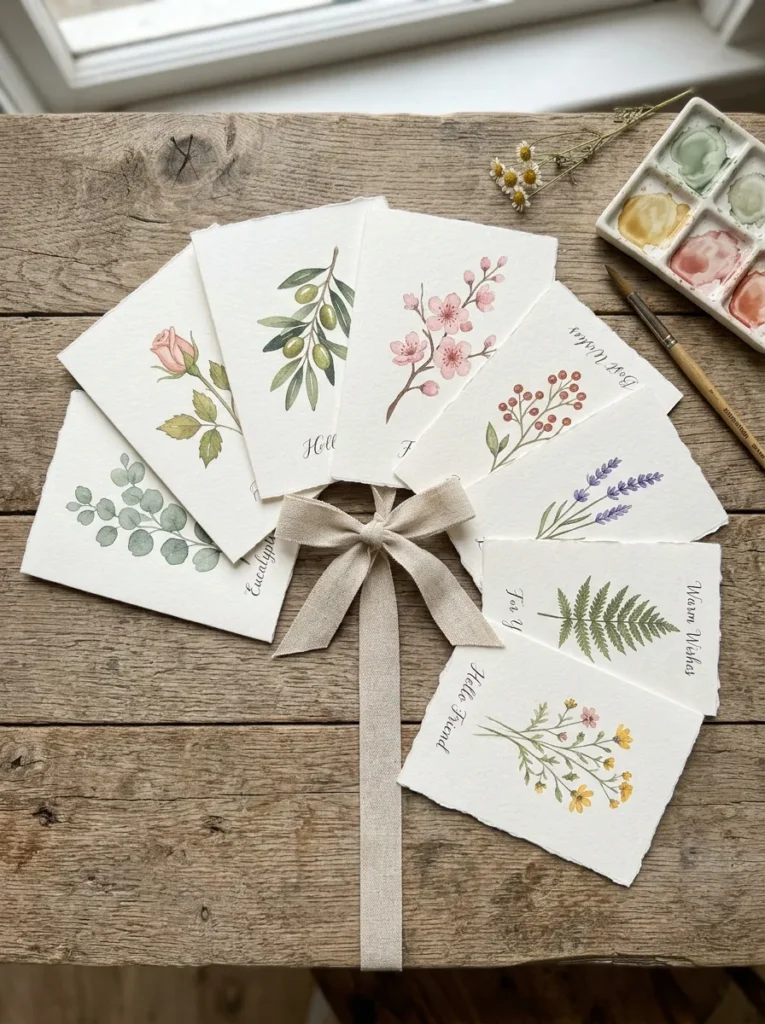
Vibe: A hand-painted watercolor card set feels specifically personal — correspondence that begins the relationship with the recipient before any words are written inside.
Why it works: A set of hand-painted watercolor cards is the paper gift that most directly communicates artistic investment — each card represents a complete small artwork as well as a vehicle for future correspondence, which gives the gift a dual value as both art object and functional stationery. The design principle is repeated gesture as gift: a set of eight cards means the maker painted eight individual pieces specifically for this gift, which the recipient understands as eight separate moments of thought and attention. Botanical subjects — a single sprig of rosemary, a simple flower, a leaf — are the most accessible watercolor subjects for makers at all skill levels, and their natural subjects connect the cards to a visual tradition of botanical illustration that reads as genuinely artistic regardless of technical complexity.
How to get it: Cut 300gsm cold-press watercolor paper into A6 card blanks (10.5×14.8 cm). Wet each card with clean water using a flat wash brush, then drop in pigment — starting with the lightest tones and adding darker shadows wet-on-wet. Allow the watercolor to bloom and spread naturally rather than controlling every edge — the organic bleeding of watercolor is the technique’s most beautiful characteristic and requires the least control to achieve well. Paint one simple botanical per card, varying the subject across the set. Allow each card to dry fully before stacking. Bundle with a linen ribbon and include a pack of matching envelopes.
Quick Win: A set of eight watercolor botanical cards in varied designs, bundled together, costs approximately $3–$5 in materials (paper, paint) and takes 2–3 hours total — making it one of the most time-efficient handmade gifts for the emotional impact it delivers.
Shop The Look
| Product |
|---|
| Watercolor paper 300gsm cold press block |
| Watercolor paint set botanical warm tones |
| Flat wash brush set for watercolor |
| A6 blank envelope set white or cream |
| Linen ribbon for card bundle tying |
9. Handmade Chocolate Bark with Toppings
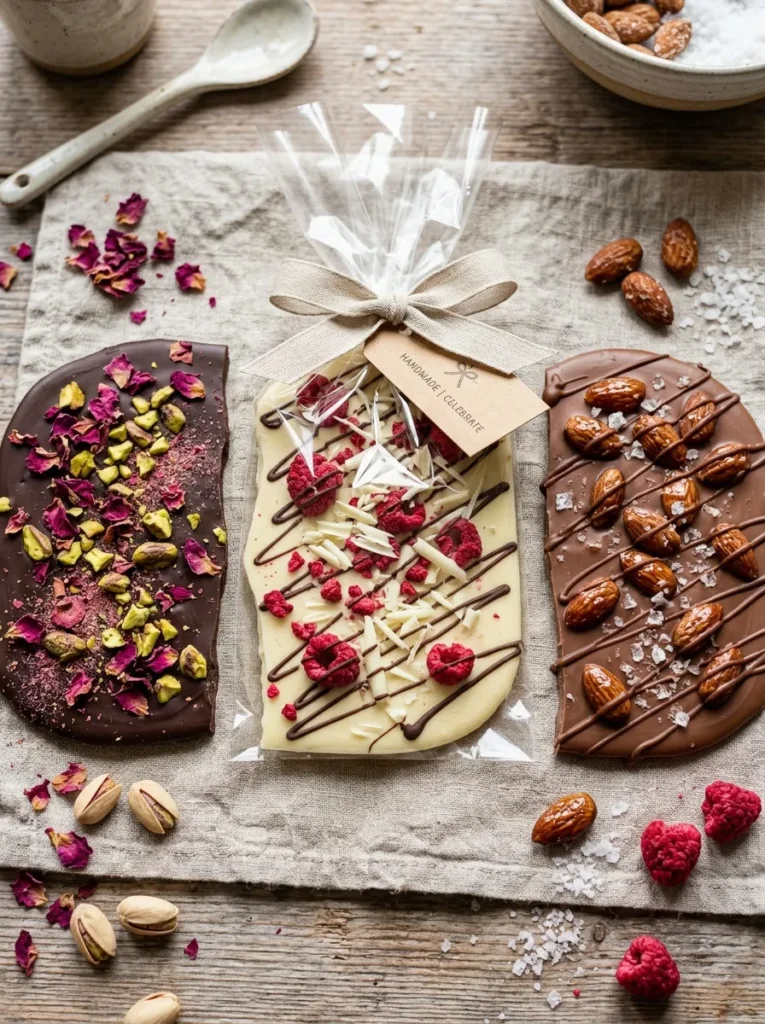
Vibe: Handmade chocolate bark feels indulgent and specific — the confectionery gift that shows the giver paid attention to what the recipient loves.
Why it works: Chocolate bark is the handmade confectionery gift with the most accessible technique relative to its impressive result — it requires no candy thermometer, no special molds, and no professional technique, yet the finished product reads as artisan confectionery when well-topped and packaged. The design principle is topping personalization as emotional specificity: choosing toppings that reflect something known about the recipient (they love pistachios, they always reach for the salty-sweet combination, they mentioned loving rose-flavored things) converts a beautiful confection into a specifically personal gift. High-quality chocolate is the material investment that most determines the finished result — Callebaut, Valrhona, or similar couverture chocolate produces a finish and flavor that no supermarket baking chocolate can approximate.
How to get it: Melt quality couverture chocolate using a double boiler, stirring until smooth. Pour onto parchment-lined baking trays and spread to approximately 5mm thickness using an offset spatula. Immediately scatter toppings across the wet chocolate surface and press gently to adhere. For a crisp snap, allow to set at room temperature (18–20°C) for 2 hours rather than refrigerating — refrigeration causes condensation that mars the surface. Break into irregular pieces by hand for the most natural presentation. Wrap in clear cellophane bags sealed with a heat sealer or a linen ribbon tie.
Shop The Look
| Product |
|---|
| Quality couverture dark chocolate 500g |
| Freeze dried raspberry for topping |
| Dried rose petal culinary grade |
| Flake sea salt Maldon for chocolate |
| Clear cellophane gift bag set with ties |
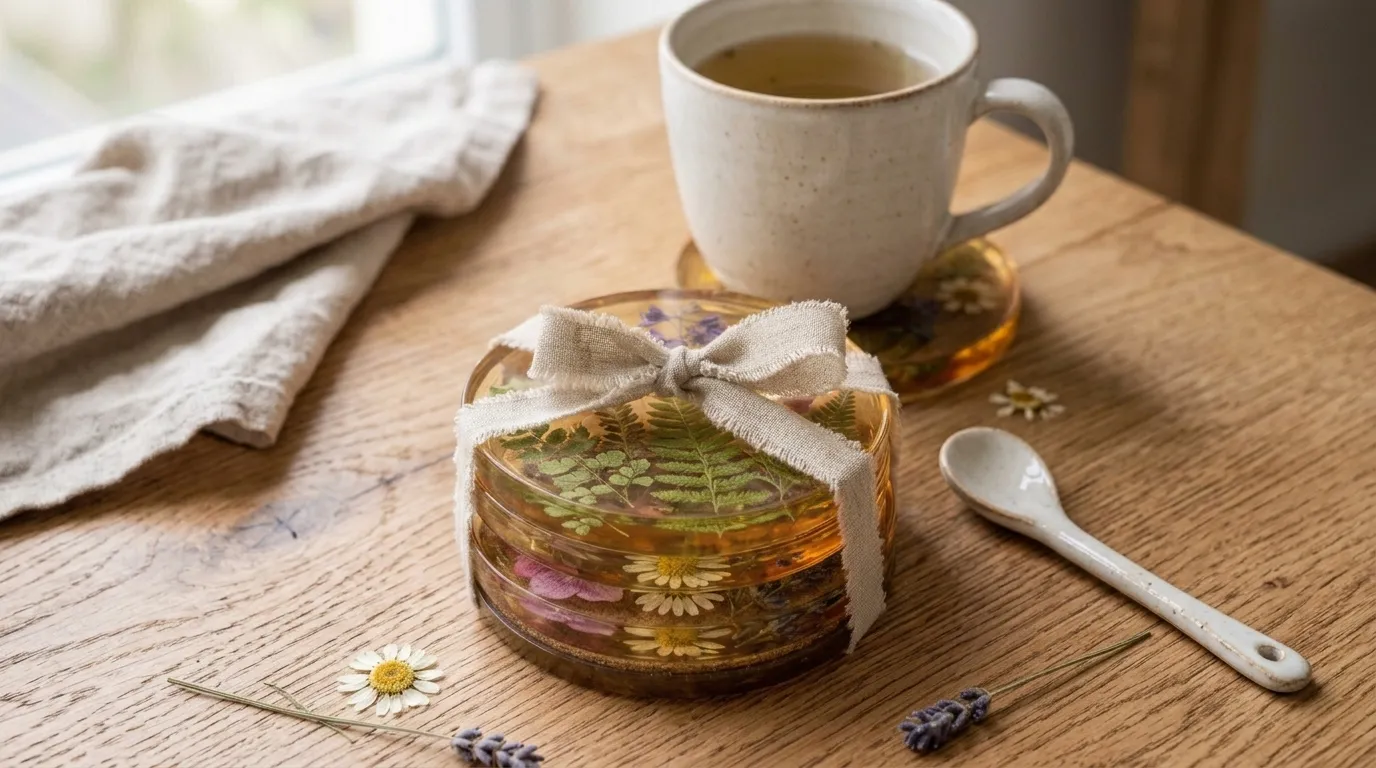
10. Custom Pressed Botanical Resin Coaster Set
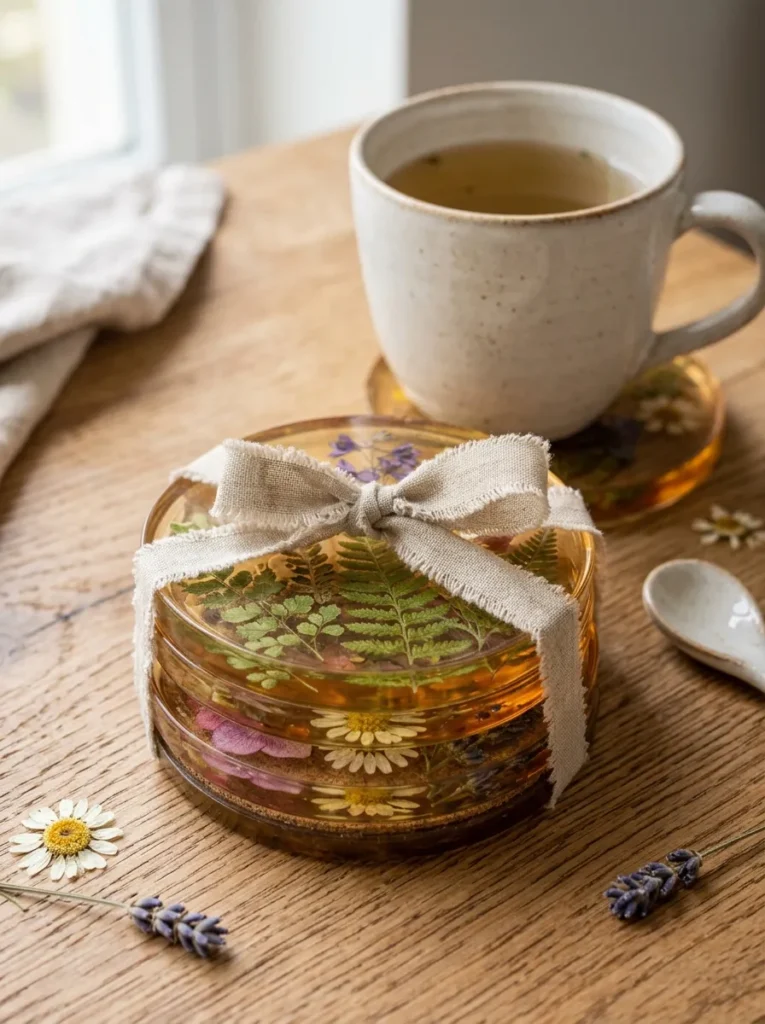
Vibe: A botanical resin coaster set feels delicately permanent — natural specimens preserved at their most beautiful and made into something used every day.
Why it works: Resin coasters with pressed botanicals are the handmade home object gift that most successfully bridges craft and interior design — they are functional objects (coasters serve a daily protective purpose), beautiful objects (the botanical specimens are preserved in their full color and detail), and personal objects (the choice of botanical can reflect something meaningful about the recipient or the maker-recipient relationship). The design principle is preservation as gift: encasing a pressed botanical in clear resin transforms a transient natural object into a permanent one, which is a form of care that connects to the gifting impulse of preserving and honoring what is beautiful and fleeting.
How to get it: Press ferns, pansies, and small wildflowers between heavy books for 48 hours. Mix two-part casting resin per manufacturer instructions. Pour a thin base layer (5mm) into round silicone coaster molds (10cm diameter). Allow to partially cure (30–45 minutes) until the surface is gel-like but not fully set. Arrange pressed botanicals face-down on the gel surface. Pour a second layer of resin to fill the mold completely. Allow to cure fully per manufacturer instructions (typically 24–48 hours). Remove from molds and apply self-adhesive cork sheet circles to the base of each coaster.
Shop The Look
| Product |
|---|
| Casting resin two-part clear kit |
| Round silicone coaster mold 10cm set of 4 |
| Pressed flower set assorted botanical |
| Self-adhesive cork sheet for coaster base |
| Linen ribbon for coaster set bundling |
11. Hand-Knit or Crochet Dishcloth Set
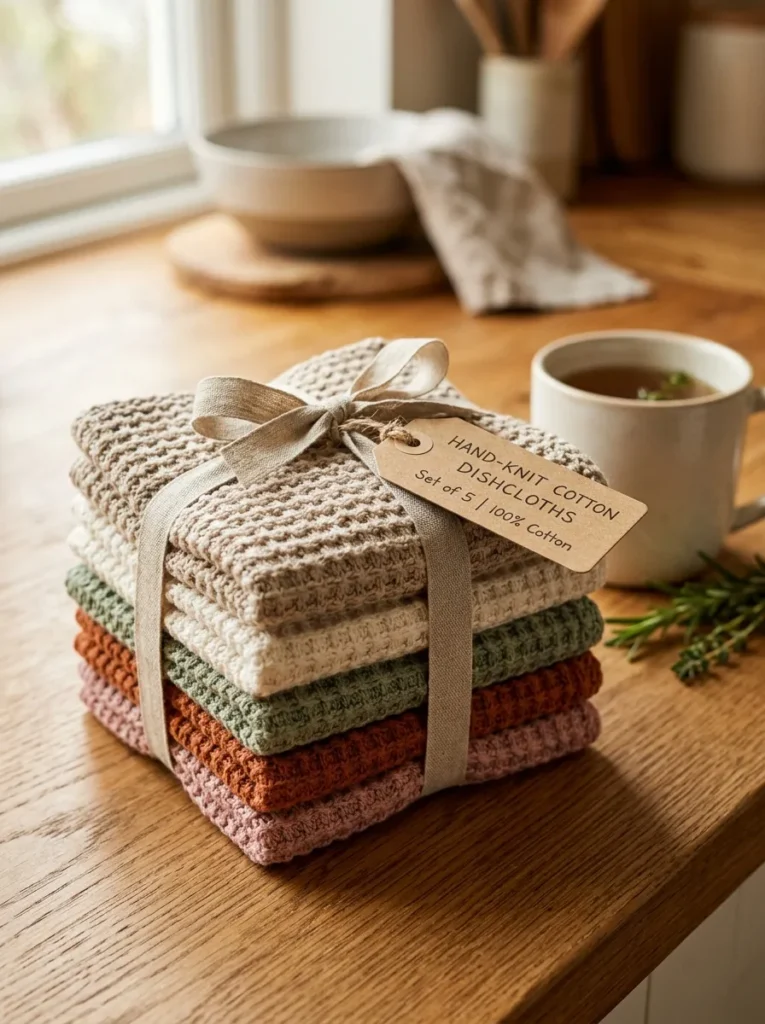
Vibe: A hand-knit dishcloth set feels warmly domestic — the handmade gift that turns a daily kitchen task into a small daily pleasure.
Why it works: A set of hand-knit cotton dishcloths is the handmade textile gift that delivers the most consistent daily use value — a well-made cotton dishcloth is used multiple times per day by most households, making it an object with extraordinary daily contact frequency. The design principle is quality material in a daily use object: most commercially available dishcloths are made from synthetic or low-quality cotton that performs poorly and wears quickly; a hand-knit 100% cotton dishcloth in a proper stitch pattern (waffle stitch is both attractive and highly absorbent due to its textured surface area) performs significantly better and feels considerably more pleasant in use. The coordinated color palette across five cloths creates a kitchen textile collection with the visual coherence of purchased tableware.
How to get it: Choose 100% cotton yarn in a worsted weight — Paintbox Cotton Aran or Lion Brand 24/7 Cotton are consistently recommended for dishcloths due to their durability, absorbency, and wide color range. Cast on 30 stitches on US 7 (4.5mm) needles. Work in seed stitch (knit 1, purl 1, alternating on every row) for approximately 36 rows until the cloth is square. Cast off loosely. For crochet: chain 30 and work in half-double crochet for approximately 30 rows. Both techniques produce a finished cloth in 1.5–2 hours per cloth. Stack, fold uniformly, tie with linen ribbon, and attach a small kraft tag.
Shop The Look
| Product |
|---|
| 100% cotton yarn worsted weight set of 5 colors |
| US 7 knitting needles 4.5mm bamboo |
| Linen ribbon for cloth stack tying |
| Kraft paper tag set for gift label |
| Tapestry needle for weaving in ends |
12. Homemade Granola in a Decorated Jar
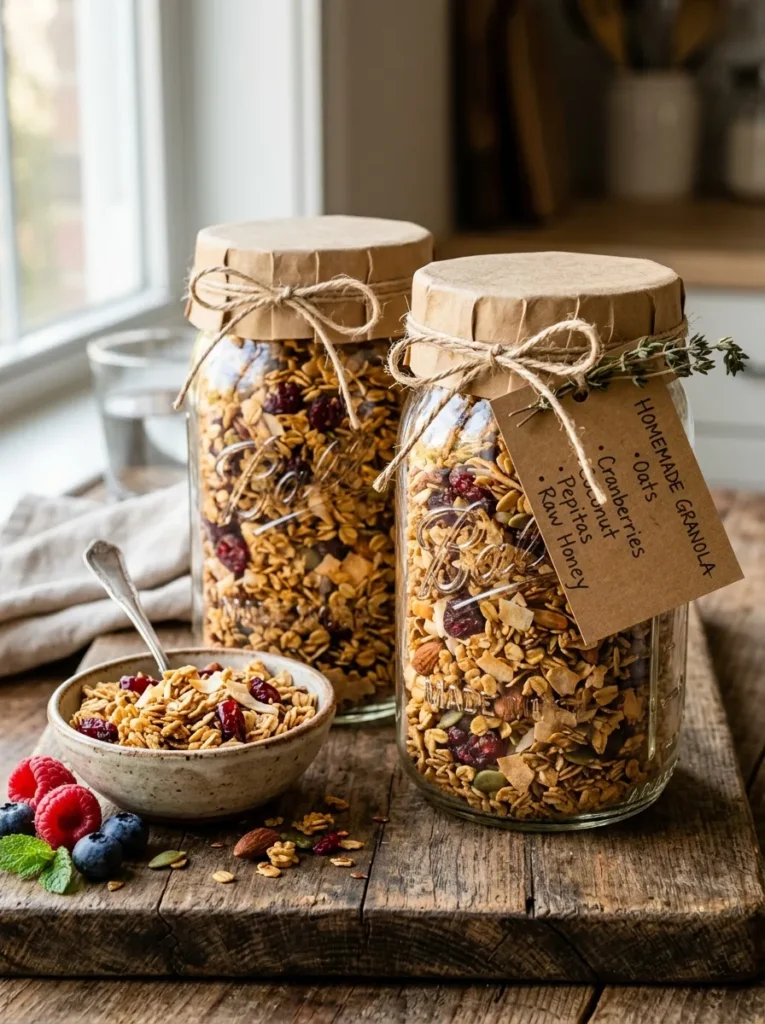
Vibe: A jar of homemade granola feels genuinely nourishing — the breakfast gift that makes the recipient’s morning better for weeks.
Why it works: Homemade granola is the handmade food gift with the most universally appreciated reception — it is a breakfast staple that most people eat regularly, rarely make themselves, and consistently consider a treat when it is high quality. The design principle is everyday luxury: good granola — deeply toasted, properly sweetened, with interesting additions — is significantly better than anything available at a reasonable supermarket price point, which means the homemade version delivers a quality upgrade to a daily routine. The recipe card attached to the jar adds a layer of generosity — the recipient can reproduce the granola themselves when the jar is empty, which extends the gift from a consumable to a skill transfer.
How to get it: Combine 400g rolled oats, 100g mixed seeds (pepitas, sunflower, sesame), 60g coconut flakes, and 60g chopped nuts (almonds, pecans, or macadamia). Mix 80ml quality olive oil, 80ml pure maple syrup, 1 teaspoon vanilla extract, 1 teaspoon cinnamon, and 1/2 teaspoon sea salt. Combine with the dry mixture and spread on a parchment-lined baking tray. Bake at 170°C for 25–30 minutes, stirring once at 15 minutes, until deeply golden. Allow to cool completely without stirring — cooling undisturbed creates the large clusters that distinguish quality granola. Add 100g dried fruit (cranberries, raisins, or chopped apricot) after cooling. Jar in a wide-mouth quart mason jar.
Quick Win: A double batch of granola (using 800g oats) fills three quart jars — the material cost per jar is $4–$7, and one baking session produces three complete gifts ready for giving.
Shop The Look
| Product |
|---|
| Rolled oats large flake quality bag |
| Pure maple syrup for granola binding |
| Mixed seed set pepitas sunflower sesame |
| Quart mason jar wide mouth set of 4 |
| Kraft paper circle lid cover for jar |
13. Small-Space Handmade Gift: Personalized Photo Memory Book
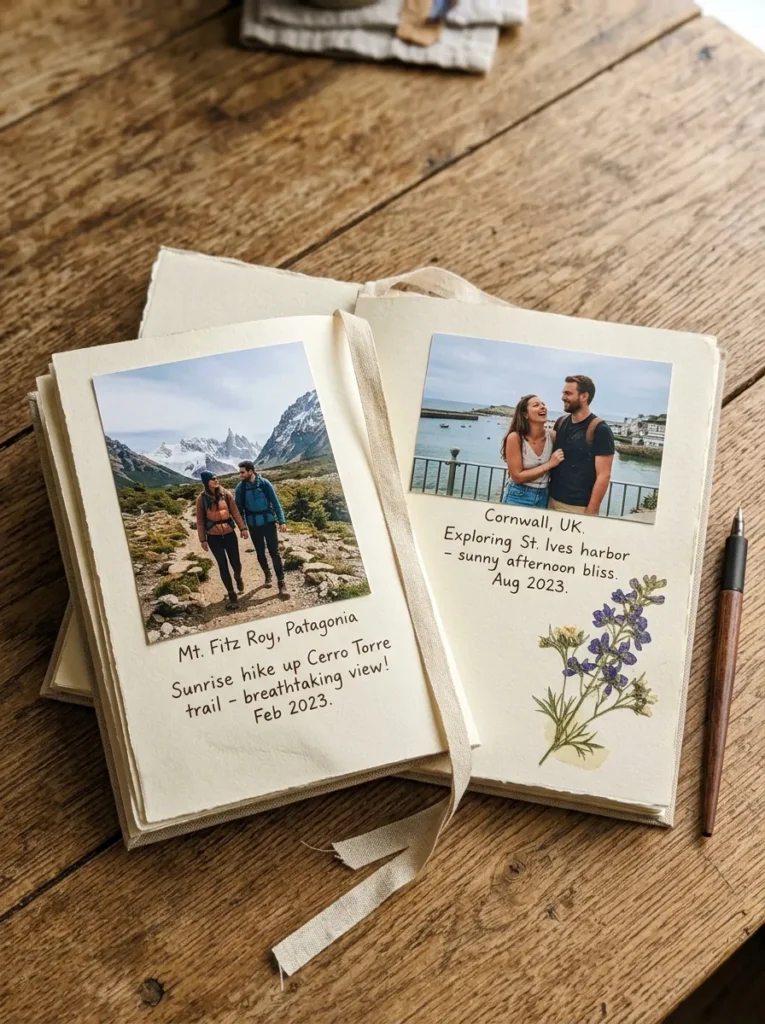
Vibe: A personalized photo memory book feels irreplaceable — the handmade gift that no amount of money could purchase because it contains something only the maker could assemble.
Why it works: A handmade photo memory book is the handmade gift category with the highest emotional impact because it contains irreplaceable personal content — specific photographs of shared experiences, handwritten captions that reflect private knowledge and inside understanding, and the physical craft of a bound book that gives the memories a permanent, holdable form. The design principle is personal narrative made physical: the book contains a story that only the giver knows how to tell in this specific way, which is the most powerful version of the handmade gift principle — that the gift is something only the maker could have made. A linen-covered hand-bound book with printed photographs and handwritten captions reads as a considered archival object rather than a scrapbook or photo album.
How to get it: Print photographs at 10×15 cm or smaller at a print kiosk or home printer on matte photo paper. Arrange in chronological or thematic order. Mount each photograph on a cream cardstock page (A5 size, 200gsm) using photo-safe adhesive, leaving space below for a handwritten caption. Write captions in fine-tip black or sepia ink pen. Bind the completed pages using Japanese stab binding with a natural linen fabric cover (see idea 5 for binding technique). The finished book has a handmade quality that a printed photo book service cannot replicate — the handwriting, the hand binding, and the personal selection of every photograph communicate the maker’s investment in a way that digital photo books do not.
Shop The Look
| Product |
|---|
| Cream cardstock 200gsm A5 for photo pages |
| Photo-safe adhesive for mounting |
| Fine tip black ink pen for captions |
| Natural linen fabric for book cover |
| Waxed linen thread for stab binding |
How to Start Your Handmade Gift Practice
The single first move is to choose one gift from this list — specifically, the one that most closely matches a skill you already have or a material you already work with — and make a test version for yourself before making it for a recipient. This test-batch approach is the discipline that separates handmade gifts that read as finished and considered from ones that read as well-intentioned but unpolished. A test candle teaches you the pour temperature that produces the smoothest surface; a test batch of granola teaches you the toasting time that produces the deepest color without burning; a test watercolor card teaches you the botanical subjects that come most naturally from your hand. The test version costs the same materials as the gift version and produces a finished object you understand well enough to make with confidence.
The most common mistake in handmade gift-making is under-investing in packaging and presentation — spending significant time making a beautiful object and then presenting it in a plastic bag or without any wrapping. The packaging communicates the value of the gift before the recipient has opened it: a handmade candle in a kraft paper bag tied with linen twine, with a small handwritten tag, reads as a considered, premium gift. The same candle in a grocery store bag reads as an afterthought. The fix is to budget for packaging materials (kraft paper bags, linen ribbon, kraft tags, tissue paper) as part of the gift’s material cost, and to spend as much care on the presentation as on the making.
Three handmade gifts under $15 in materials that deliver the most emotional impact: a set of three chalk-painted watercolor cards with personal photographs printed inside ($3–$5 in materials, invaluable in personal meaning), a batch of homemade granola in a decorated mason jar ($5–$8 in materials, weeks of morning use value), and a small beeswax hand salve tin with a handwritten ingredient label ($4–$7 in materials, daily use value through winter). All three can be made in a single afternoon, all three require no specialized equipment, and all three deliver their gift value across an extended period rather than a single moment.
Realistic expectations: the most meaningful handmade gifts are rarely the most technically complex — a jar of properly made granola, a small painting on a card, or a tin of beeswax salve communicates care as effectively as a hand-bound book or a complex resin coaster set, and is achievable in a fraction of the time. Match the complexity of the gift to the time available, and invest any remaining time in quality materials and careful packaging rather than in technique complexity. A simple gift made with excellent materials and presented with care will almost always outperform a complex gift made with mediocre materials and presented hastily.
Frequently Asked Questions About Handmade Gifts
What handmade gifts are most appreciated by adults who have everything?
Adults who have accumulated most of the material objects they need consistently value handmade gifts that prioritize time investment over object novelty — specifically, gifts that contain irreplaceable personal content (the photo memory book, personalized watercolor cards), gifts that reflect specific knowledge of the recipient’s daily life (the infused oil that suits their cooking style, the candle fragrance that matches their home aesthetic), and gifts that improve a daily routine rather than adding to accumulated possessions (the hand salve used every morning, the granola eaten every breakfast, the dishcloths used multiple times daily). The handmade gift’s advantage over purchased gifts is greatest precisely with recipients who have everything purchasable, because it offers what purchasing cannot provide.
How do I make handmade gifts look as professional as purchased ones?
The four presentation decisions that most determine a handmade gift’s perceived professionalism are label quality (handwritten in consistent, clear script on quality kraft or linen paper rather than printed computer labels which read as commercially generic), packaging material (tissue paper, kraft paper bags, cellophane wrap, and linen ribbon rather than plastic bags or clingfilm), finishing quality (trimmed wicks, even paint coats, uniform stitch spacing, properly set chocolate — any finishing detail that suggests the maker reviewed and completed the object before giving it), and the handwritten note (which converts any handmade gift from an object into a communication, and is the single most impactful addition to any handmade gift regardless of what the gift itself is).
Are handmade food gifts safe to give?
Handmade food gifts are safe when made with appropriate food-safety awareness for each specific type. The primary food safety consideration for handmade gifts is the difference between shelf-stable and perishable preparations: dried herb and spice flavored salts, granola, chocolate bark, and properly made infused oils with dried herbs are all shelf-stable for weeks to months at room temperature. Fresh herb or fresh garlic infused oils, fresh cream-based preparations, and any cooked items containing dairy or eggs require refrigeration and should be consumed within three to five days. Label all food gifts with the making date and a best-by date, and include refrigeration instructions if applicable.
How do I choose which handmade gift to make for a specific person?
The most reliable selection method is the daily-life question: what does this person do every single day that a handmade gift could improve? A person who lights candles every evening needs a candle made with a fragrance specifically suited to their aesthetic. A person who cooks every day benefits from flavored salts or infused oils. A person who writes in a journal benefits from a hand-bound notebook. A person who bakes appreciates vanilla extract or a handwritten recipe with a bag of its key ingredients. This daily-life orientation — asking what the gift will integrate into rather than what the recipient might like once — consistently produces handmade gifts that are used and appreciated across extended periods rather than admired once and placed on a shelf.
How far in advance should I start making handmade gifts?
The timeline varies significantly by gift type and the preparation required. Vanilla extract requires a minimum eight weeks and ideally twelve weeks of infusion time — it must be started three months before gifting. Infused olive oils need two weeks of passive infusion. Resin coasters require 48–72 hours of curing time between pour sessions. Soy candles need 24 hours to cure before use. Granola, chocolate bark, and flavored salts can be made within 24–48 hours of gifting. Hand-bound books, watercolor cards, and textile gifts (dishcloths, linen pouches) should be scheduled with enough time to complete the craft project plus the finishing and packaging — typically two to four hours of active time depending on the project and the maker’s experience. The general guidance is to identify any gift requiring passive time (infusion, curing) first and start those immediately, then plan the active-time projects for the week before giving.
Ready to Make Something That Only You Could Give?
These 13 handmade gift ideas span every skill level, every material category, and every recipient type — from the candle maker and the home baker to the textile crafter, the paper artist, and the resin worker — so whether you have an afternoon or three months, a full craft studio or a kitchen counter, there is a specific, achievable, and genuinely meaningful starting point here for exactly who you are and who you are making for. The most important thing to understand about handmade gifts is that their value does not come from the complexity of the technique or the cost of the materials — it comes from the decision to make rather than to purchase, and from the specific knowledge of the recipient that guided every choice from material to fragrance to topping to botanical. Today, choose the one gift on this list that made you think immediately of a specific person, gather the materials, and begin — the moment you start making something for someone, the gift has already begun. Pin the ideas that made you reach for your craft supplies, and let those be the ones you make first.