15 Modern Farmhouse Ideas That Look Expensive
Modern farmhouse design is the interior aesthetic that most successfully resolves the tension between the warmth and material richness of traditional agricultural vernacular architecture and the spatial discipline, material restraint, and compositional intelligence of contemporary design — creating rooms that feel simultaneously rooted and resolved, comfortable and considered, historical and genuinely present. This article gives you 15 genuinely creative, achievable modern farmhouse ideas that deliver the visual quality of a high-end Joanna Gaines–caliber renovation at a fraction of the cost, by identifying exactly which decisions make a modern farmhouse interior look expensive and which substitutions preserve that quality at dramatically lower price points.
Most modern farmhouse attempts fail not because the aesthetic is unachievable but because the budget was concentrated in the wrong places — shiplap applied to a room with poor lighting, quality timber beams in a space with cluttered surfaces, a beautiful farmhouse kitchen undermined by cheap hardware and inadequate material coherence. The rooms in this list spend the design budget with precision, knowing that five genuinely considered decisions produce more convincingly expensive results than fifteen undirected purchases. Here are 15 ideas worth saving — and implementing.
Why Modern Farmhouse Design Looks Expensive
The modern farmhouse aesthetic occupies a specific cultural position in contemporary residential design that explains both its enduring popularity and its capacity to read as genuinely luxurious when executed well. It draws from the material culture of American agricultural vernacular architecture — the working farmhouse, the grain barn, the rural general store — and applies the discipline of contemporary design editing to that material richness, retaining the warmth and honest material quality of the vernacular tradition while eliminating the clutter and spatial inefficiency that characterized the original domestic environments. The result is a design language that reads as simultaneously rooted (in the specific material traditions of timber, iron, stone, and linen) and considered (in the spatial discipline and compositional intelligence of contemporary design).
The materials that define a convincingly expensive modern farmhouse interior are those that share the vernacular tradition’s commitment to material honesty — materials that look like what they are, that age beautifully, and that improve in visual quality with the passage of time and use. Reclaimed or rough-sawn timber in natural tones provides the primary material warmth and historical reference. Matte black iron and steel hardware provides the graphic, functional aesthetic of agricultural ironwork without the decorative elaboration of more formal metal traditions. Natural stone — limestone, slate, river stone, concrete — provides the geological permanence that grounds the warm timber palette in material weight and coolness. White painted plaster or shiplap provides the light-reflective wall surface that allows the warm material accents to read at their richest.
The specific quality that separates expensive-looking modern farmhouse interiors from cheap ones is material coherence — the consistent application of a tightly defined material palette (warm natural timber, matte black iron, white or near-white wall surfaces, natural fiber textiles, and natural stone) across every element of the room simultaneously, rather than the selective application of farmhouse references in a room otherwise furnished in an unrelated aesthetic. A room that has shiplap walls and a mid-century modern sofa and chrome light fittings and a glass coffee table reads as a room with a shiplap wall; a room in which every material decision — walls, floors, hardware, lighting, textiles, accessories — belongs to the same warm, honest, natural-material palette reads as genuinely farmhouse.
Style at a Glance
| Element | Detail |
|---|---|
| Philosophy | Five material coherence decisions produce more genuinely expensive-looking results than fifteen undirected farmhouse references — the palette disciplines every decision that follows |
| Key Materials | Reclaimed or rough-sawn timber, matte black iron, white painted shiplap, natural stone, linen and cotton canvas, rattan, beeswax, concrete |
| Color Palette | Warm white, natural timber warm, matte black, warm stone grey, natural linen, aged iron, terracotta accent |
15 Modern Farmhouse Ideas That Look Expensive
1. Shiplap Feature Wall Done Right — Paint, Scale, and Lighting
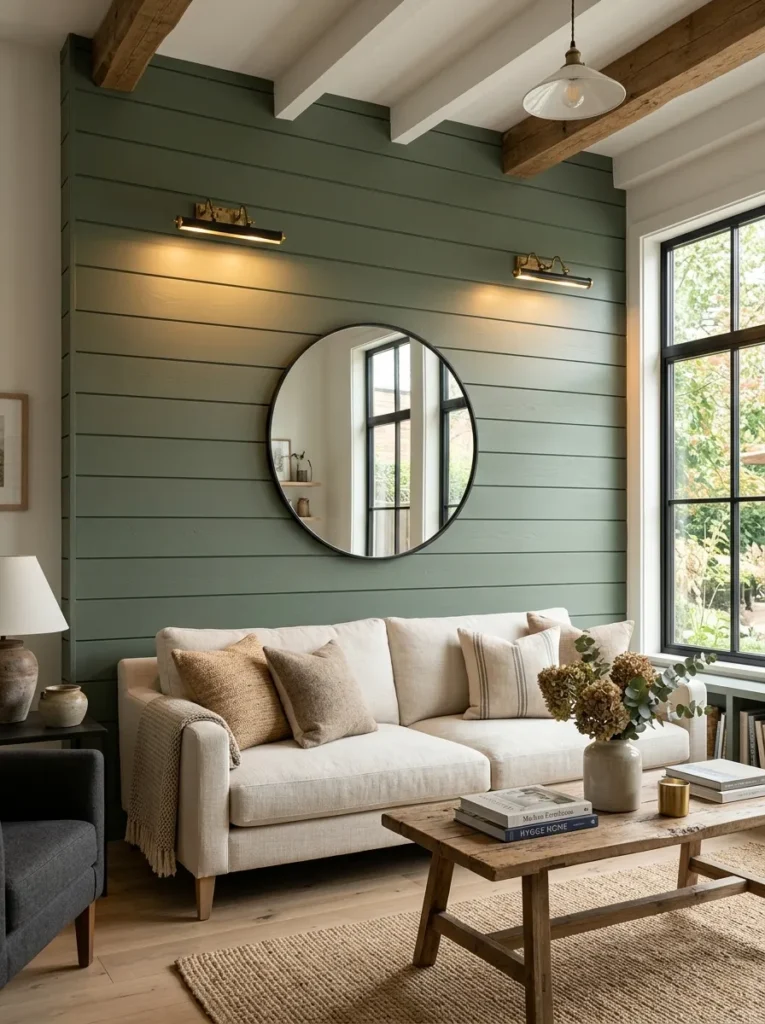
Vibe: Warm and architecturally resolved — the shiplap wall that reads as a genuine design decision rather than a Pinterest reference applied without conviction.
Why it works: Shiplap is the modern farmhouse wall treatment whose quality difference between well-executed and poorly executed is most visible and most immediately perceived by anyone who has seen both — the shadow reveal between boards is the specific detail that distinguishes architectural shiplap from decorative shiplap, creating the dimensional quality that makes the wall read as a designed surface with genuine depth rather than a flat panel with grooves pressed into it. The 3mm shadow reveal requires precise installation (boards set on spacers during installation rather than simply butted) but produces the specific horizontal rhythm of light and shadow across the wall surface that is the defining visual quality of high-end shiplap installation. Painting the shiplap in a warm sage rather than the standard bright white is the color decision that most distinguishes an expensive-looking shiplap wall from a generic one — bright white shiplap reads as ubiquitous; a warm, complex sage reads as a considered design decision that happens to be expressed in shiplap.
How to get it: Install 140mm × 19mm pine shiplap boards with a 3mm spacer between each board during installation to maintain precise reveal consistency. Apply a timber primer to all boards before painting — unpainted pine contains natural resins that bleed through paint without a primer layer. Paint in a warm sage with eggshell finish for the combination of color complexity and durability that a living room feature wall requires. Install warm LED picture lights along the top of the wall at 300mm from the ceiling — the raking light from the picture lights catches the shadow reveals and amplifies the wall’s dimensional quality significantly beyond what ambient room lighting achieves.
Quick Win: Installing warm LED picture lights along the top of an existing shiplap wall immediately transforms the wall’s visual quality without any structural change — the raking light from the picture lights creates the shadow depth in the reveals that makes even a standard shiplap installation read as architecturally considered.
Shop the Look
| Product |
|---|
| Pine shiplap board 140mm |
| Warm sage interior paint eggshell |
| Round black iron mirror large |
| LED picture light warm plug-in |
| Natural linen sofa |
Also view: 13 Elegant Living Room Designs for Every Home
2. Exposed Timber Ceiling Beams with the Correct Proportions
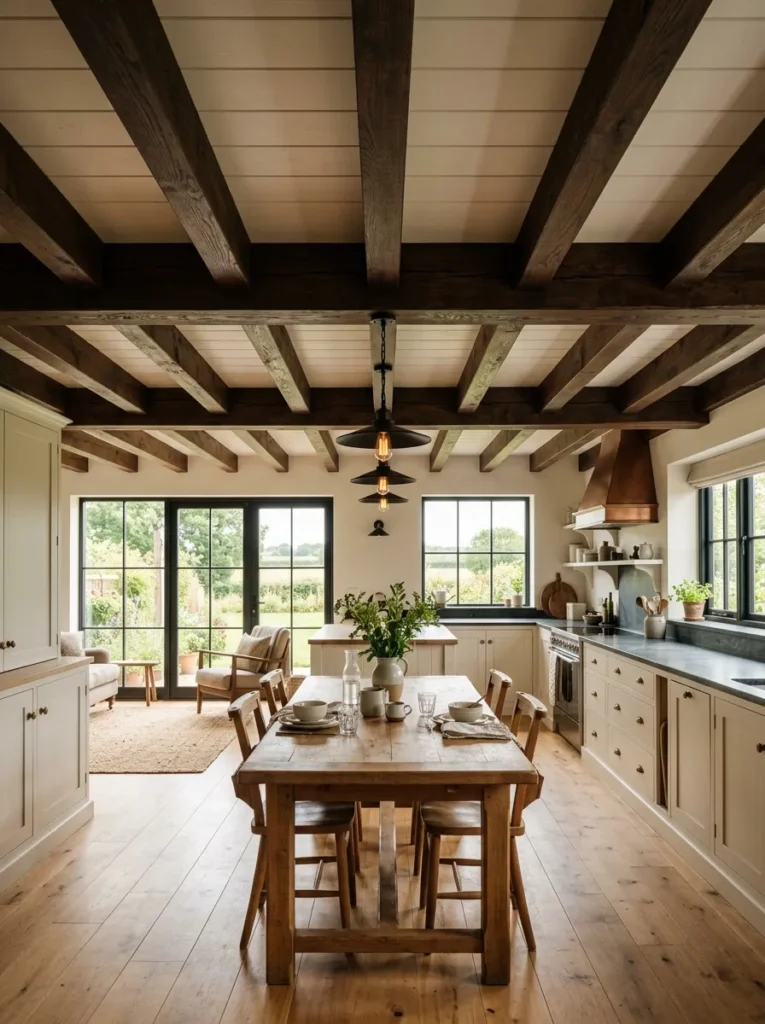
Vibe: Warm and structurally authentic — the ceiling that makes the room feel as though the building has been standing for three generations rather than three years.
Why it works: Ceiling beam proportions are the single most immediately distinguishing detail between an expensive-looking modern farmhouse beam installation and a cheap one — undersized decorative beams (typically 100mm × 75mm or smaller) read immediately as applied decoration rather than genuine structural timber, which is the specific quality failure that makes cheap beam installations read as theatrical rather than authentic. Genuine structural timber proportions (minimum 200mm × 150mm for a residential span at normal ceiling heights) create the specific visual weight and ceiling presence that reads as authentic historic construction — the kind of timber sizing that was required before engineered lumber eliminated the need for large-section solid timber in residential framing. The correct dark warm brown stain further amplifies the structural authenticity — raw or lightly oiled beams can read as new construction; a dark warm stain reads as aged timber that has absorbed decades of hearth smoke and linseed oil.
How to get it: Apply box beam casing systems (hollow timber boxes in the correct proportional dimensions) over existing ceiling joists for the most structurally convincing false beam installation — box beams constructed from three pieces of 25mm dressed hardwood (bottom face and two side faces) create a beam with the same visual profile as a solid timber section at significantly reduced material cost and weight. Stain the box beam casing in Jacobean or Dark Walnut gel stain before installation to achieve the aged, dark warm brown tone that reads as most authentically farmhouse. Space beams at 600–800mm centers — wider spacing than this reads as undersupplied; narrower reads as over-elaborate.
Shop the Look
| Product |
|---|
| Box beam casing hardwood |
| Dark walnut gel stain |
| Beam adhesive and fixing |
| Warm pendant light for beam |
| White ceiling paint between beams |
3. Farmhouse Kitchen with Unlacquered Brass Hardware
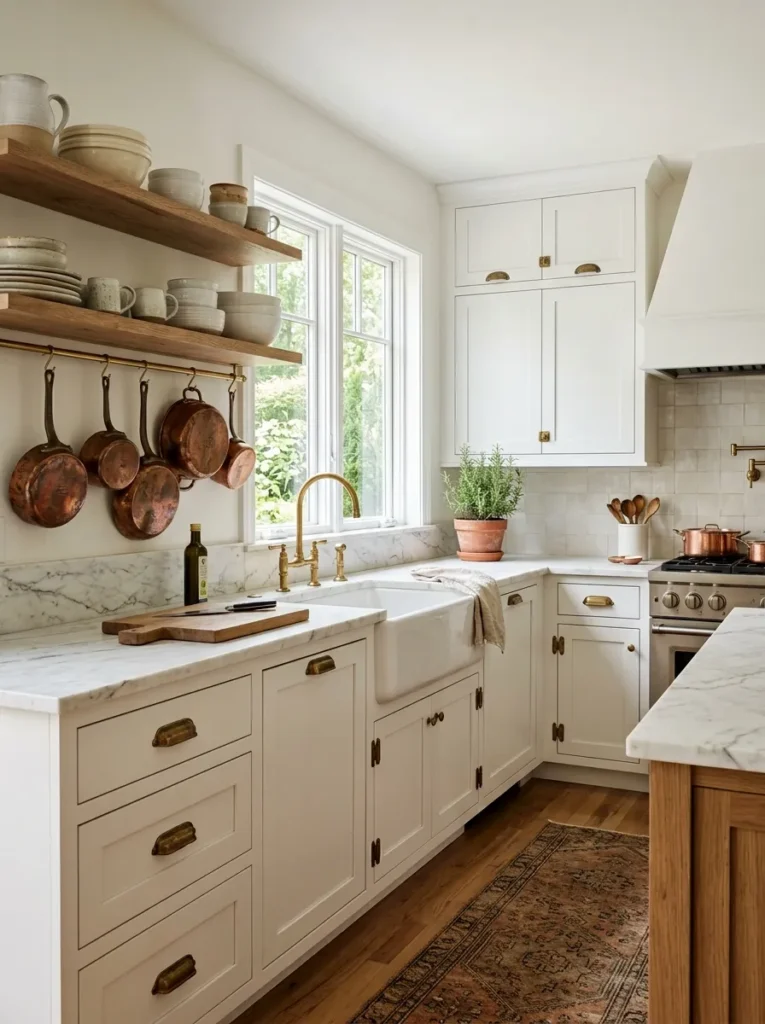
Vibe: Warm and material — the kitchen that reads as the most considered room in a home that was designed by someone who understood the difference between aged brass and gold plastic.
Why it works: Unlacquered brass hardware is the modern farmhouse kitchen specification that most powerfully communicates material intelligence and design confidence — it is the choice that requires accepting that the hardware will change over time, developing the natural patina of oxidized brass that converts the bright, uniform gold of new unlacquered brass into the warm, varied, deeply characterful surface of genuinely aged metal. This acceptance of temporal change is itself a design philosophy, communicating the farmhouse aesthetic’s fundamental commitment to the beauty of natural aging over the maintenance of pristine newness. Unlacquered brass develops its patina according to the specific handling and humidity conditions of each individual kitchen, which means that a kitchen with unlacquered brass hardware develops a uniquely personal material history that lacquered or plated hardware cannot replicate.
How to get it: Source unlacquered solid brass hardware (not brass-plated zinc, which does not patina authentically) from specialist hardware suppliers — Rocky Mountain Hardware, Sun Valley Bronze, and Rejuvenation all produce solid unlacquered brass collections in farmhouse-appropriate profiles. Clean with only mild soap and water — harsh cleaners remove the developing patina and reset the aging process. Accept the patina variation between frequently handled pieces and less-used ones as a feature of authentic material aging rather than an inconsistency requiring correction.
Shop the Look
| Product |
|---|
| Unlacquered brass bin pull |
| Unlacquered brass cup pull |
| Unlacquered brass exposed hinge |
| White shaker cabinet door |
| Honed marble countertop |
4. Farmhouse Sink as the Kitchen’s Primary Design Statement
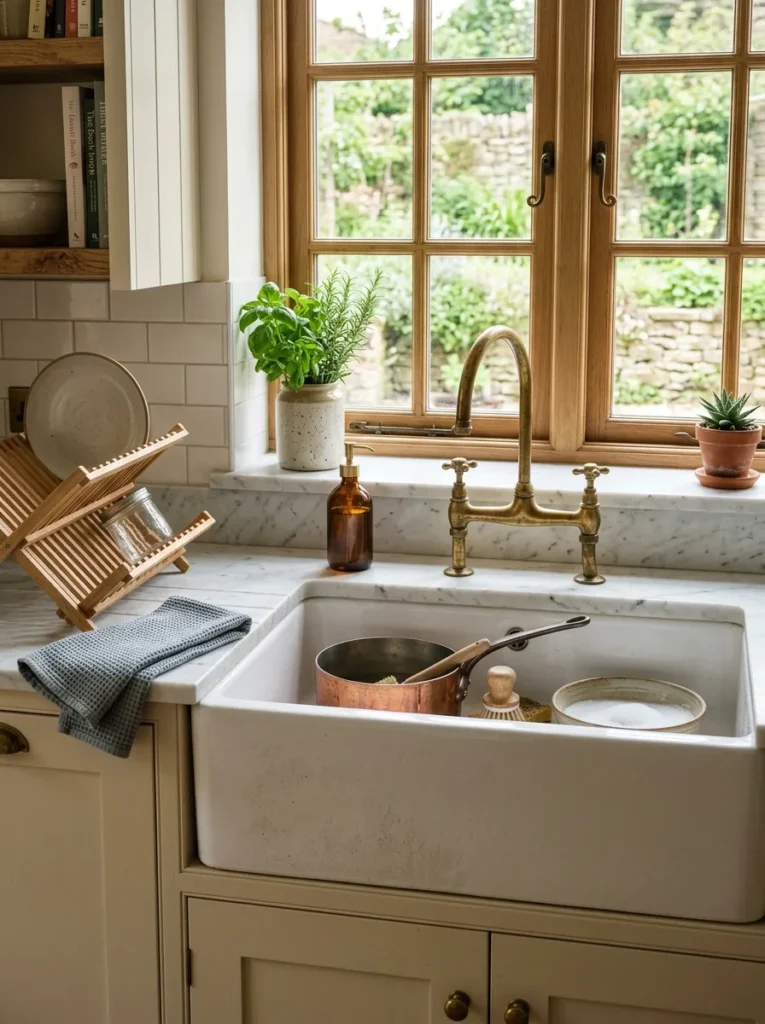
Vibe: Warm and functional — the kitchen sink that reads as the most genuinely purposeful object in the room, which is exactly what a farmhouse sink should be.
Why it works: The farmhouse sink is the kitchen element that most powerfully communicates the modern farmhouse aesthetic’s core value — the functional object elevated to genuine beauty through its proportions, its material, and its unapologetic scale. A genuine farmhouse sink (fireclay apron-front, single large bowl, 850mm width minimum) reads as expensive primarily because of its scale — the generosity of the single large basin, the substantial thickness of the exposed apron face, and the visual weight of a properly proportioned farmhouse sink all communicate material investment and spatial generosity that smaller, more modest sink formats cannot replicate. The fireclay material is the specific specification that reads as genuinely farmhouse — fireclay has the same material character as traditional English ceramic ware, with a slightly irregular glaze surface and the specific creamy warmth of high-fired ceramic that machine-made stainless steel cannot replicate.
How to get it: The minimum farmhouse sink width for a kitchen that reads as genuinely farmhouse in its proportions is 750mm — below this width, the sink reads as a decorative apron-front rather than the working farmhouse sink that the aesthetic references. Source from fireclay specialists (Rohl, Kohler Whitehaven, or Shaw’s Original) rather than acrylic copies — the material weight, glaze quality, and surface character of genuine fireclay is perceivably different from acrylic imitation at close range. Pair with a bridge mixer tap in unlacquered brass — the bridge mixer’s exposed cross-connection between the hot and cold supplies references the specific tap configuration of authentic farmhouse plumbing in a way that modern single-body mixers do not.
Shop the Look
| Product |
|---|
| Fireclay farmhouse sink 850mm |
| Bridge mixer tap brass unlacquered |
| Honed stone counter integration |
| Wooden dish rack natural |
| Linen dish towel natural |
5. Reclaimed Timber Floating Shelves in the Kitchen
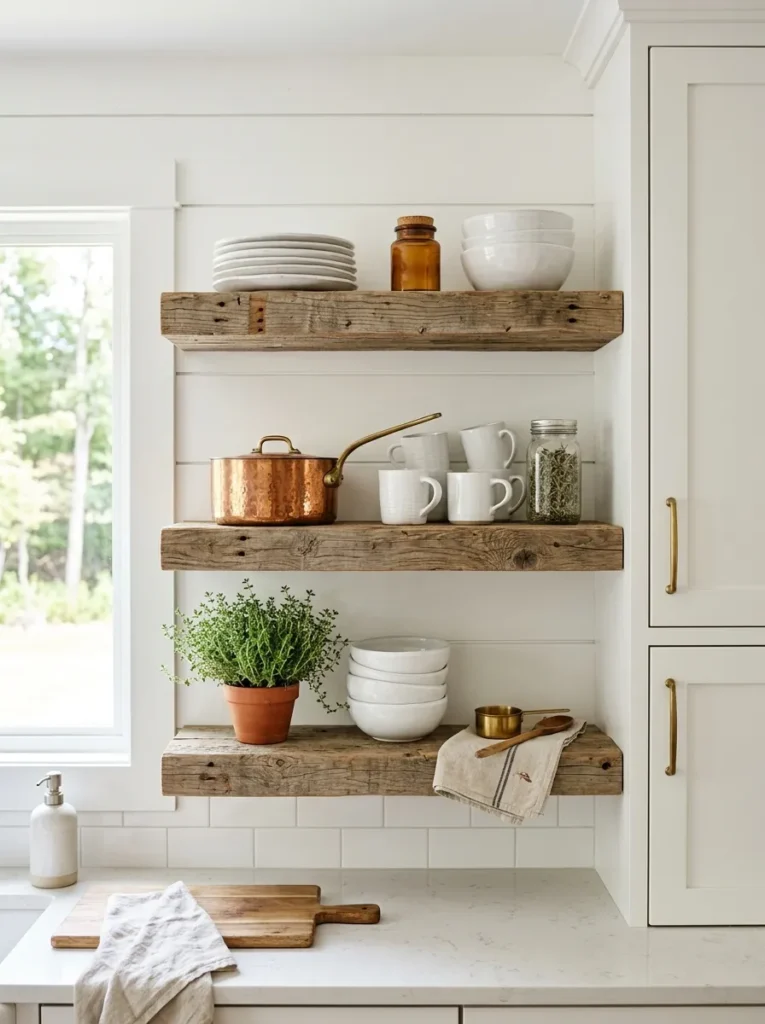
Vibe: Warm and collected — the kitchen shelves that look like they have been accumulating the right things in the right place for twenty years.
Why it works: Reclaimed timber floating shelves in a farmhouse kitchen are the design element that most naturally and most immediately introduces the genuine material history that defines authentic farmhouse interiors — a piece of timber that has been used in an agricultural building, a mill floor, or a barn roof carries the specific material character of decades of use (the saw marks, the nail holes, the weathered color variation that results from years of light exposure) that no new timber, however it is finished, can replicate. This material history is perceivable at close range and at distance: from across a kitchen, the reclaimed timber reads as warm and varied in a way that new dressed timber does not; up close, the specific surface character of genuinely aged material rewards examination in the same way that a quality piece of aged leather or a handmade ceramic does.
How to get it: Source reclaimed timber from architectural salvage specialists, demolition contractors, and specialist timber merchants who stock genuine reclaimed material — the quality difference between genuinely reclaimed timber and artificially distressed new timber is visible in the specific character of the aging: genuine reclaimed timber has surface variation that follows the wood’s natural grain and use history; artificial distressing has a mechanical, repetitive quality that reads as manufactured. Install floating shelves using heavy-duty concealed shelf brackets rated for the combined weight of the shelf and its contents — a reclaimed timber shelf of 200mm depth and 1000mm length can weigh 15–25kg before contents are added.
Shop the Look
| Product |
|---|
| Reclaimed timber shelf board |
| Heavy duty concealed shelf bracket |
| White ceramic bowl stack |
| Vintage glass jar set |
| Copper pot small display |
6. Black Iron Light Fixtures Throughout — Consistency Matters
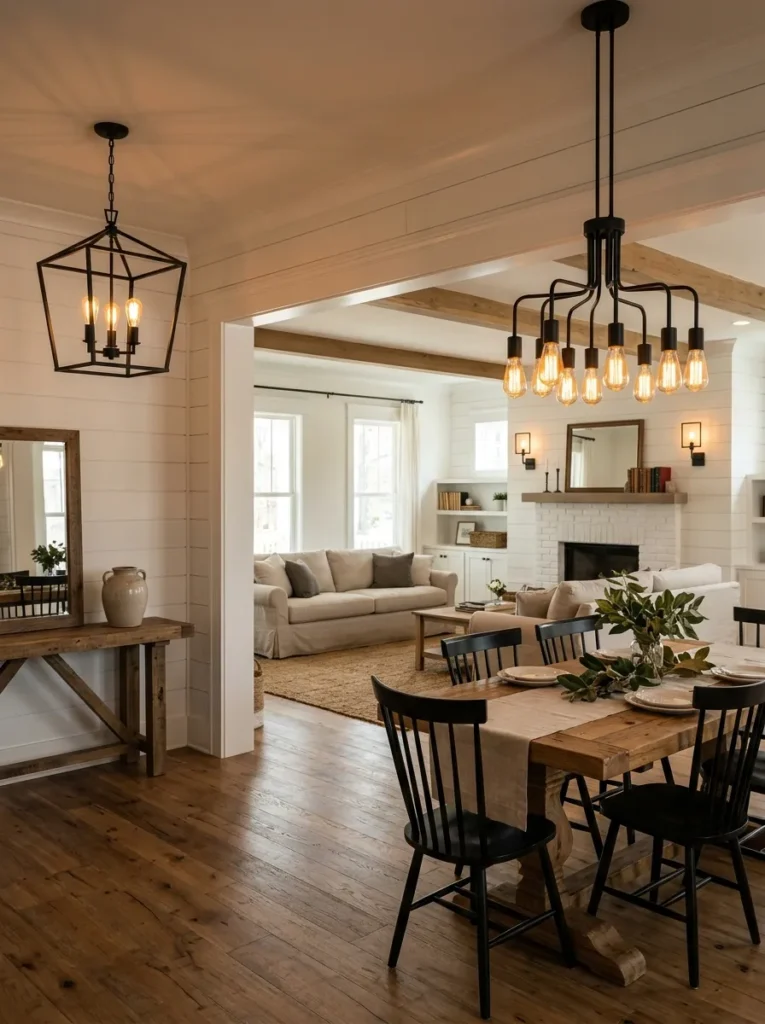
Vibe: Warm and coherent — the home where every light fitting tells the same material story, which is what makes the whole greater than the sum of its parts.
Why it works: The single most visible signal of an expensive-looking modern farmhouse interior versus a cheap one is the consistency of the light fixture finish across every room — a home in which every visible light fitting is in the same matte black iron finish reads as designed; a home in which the kitchen pendant is chrome, the entry lantern is bronze, the living room floor lamp is gold, and the bedroom sconce is nickel reads as furnished from different stores at different times without any unifying design principle. Matte black iron is the specific light fixture finish that most authentically references the farmhouse tradition — the agricultural ironwork of hinges, hooks, and hardware in original farmhouses was invariably in unfinished iron, and the matte black of contemporary iron-finish fixtures is the closest modern equivalent to that material character.
How to get it: Replace every light fixture in the primary rooms simultaneously rather than one at a time — the full visual impact of a consistent matte black iron fixture scheme is only perceptible when all fixtures are changed together. The matte black iron finish is widely available across all fixture categories (pendant, sconce, floor lamp, table lamp, ceiling fan) from specialist farmhouse lighting retailers including Schoolhouse, Hudson Valley Lighting, and Shades of Light. Specify Edison-style LED filament bulbs (2200K, visible filament coil) in all matte black iron fixtures — the warm amber glow of a filament LED within a matte black iron pendant is the specific light quality that most completely expresses the modern farmhouse aesthetic.
Shop the Look
| Product |
|---|
| Matte black iron pendant dining |
| Matte black iron entry lantern |
| Matte black iron wall sconce pair |
| Edison LED filament bulb 2200K |
| Matte black iron floor lamp |
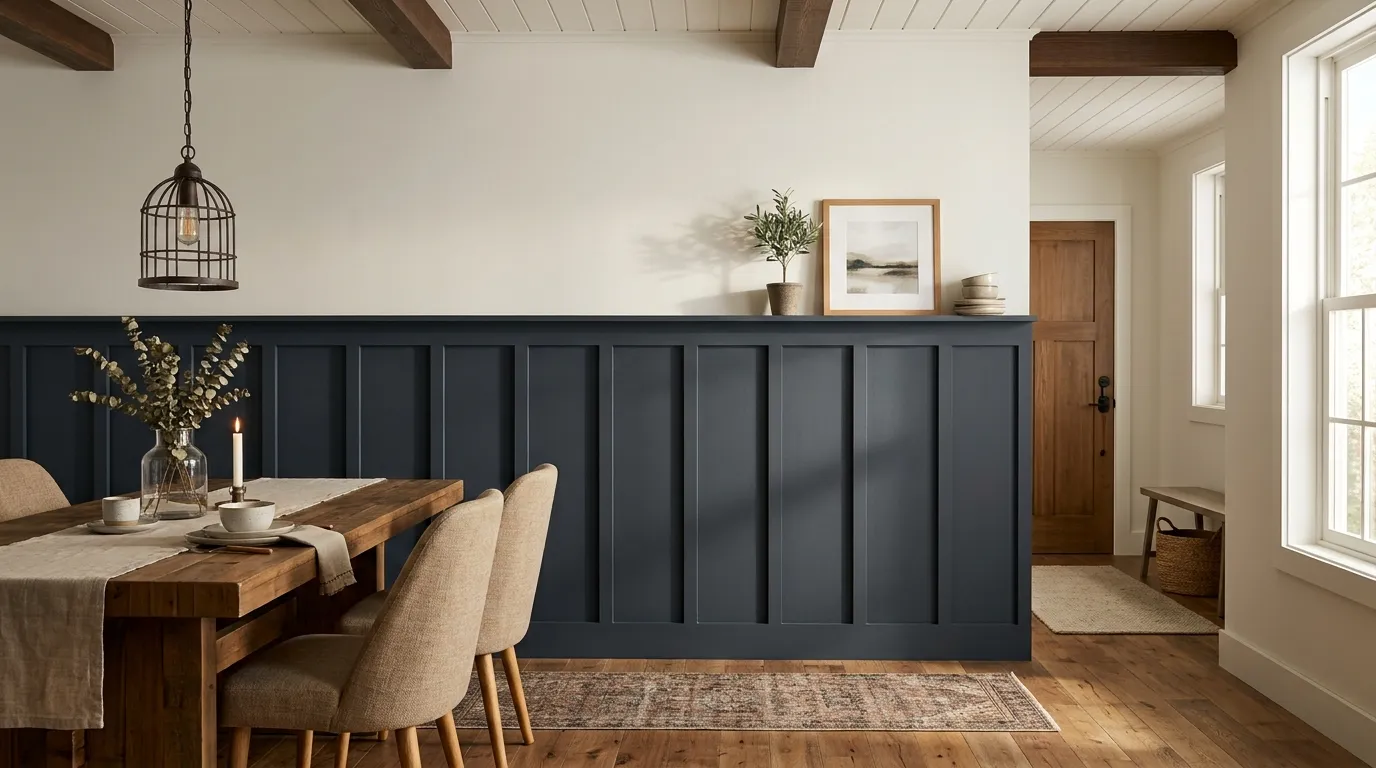
7. Wainscoting or Board-and-Batten Wall Treatment
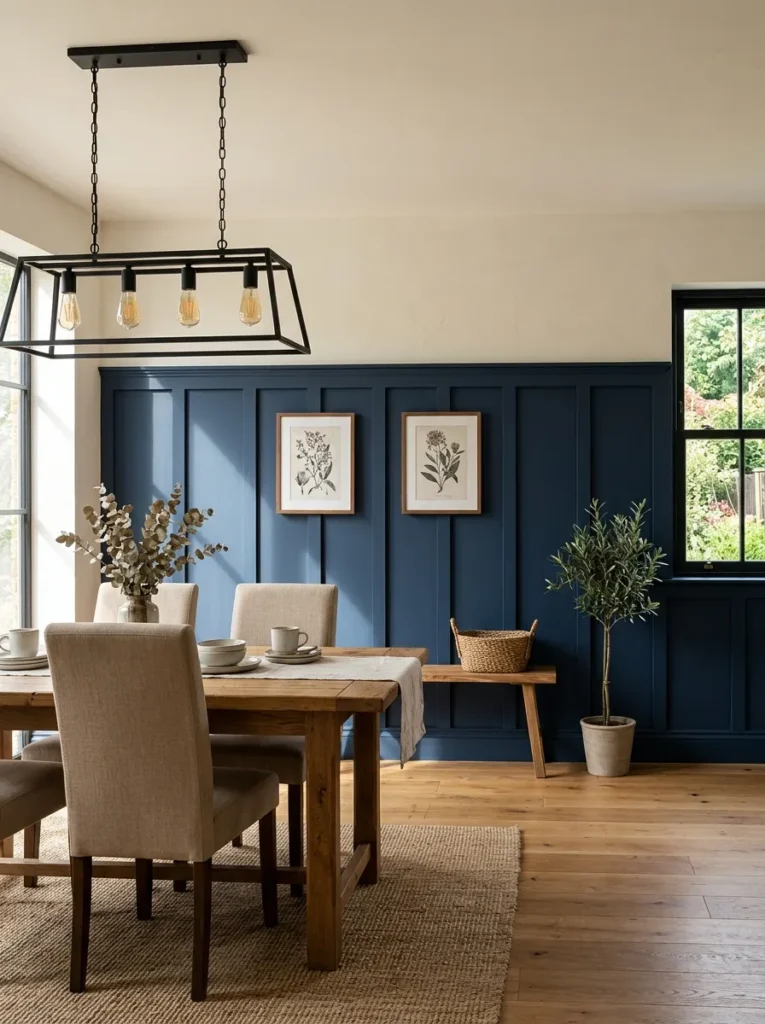
Vibe: Warm and architectural — the dining room wall treatment that makes the room look like it was designed rather than painted.
Why it works: Board-and-batten wall treatment is the modern farmhouse architectural detail that delivers the highest perceived renovation quality per dollar of material and labor — it converts a plain flat wall into a designed architectural surface with dimensional shadow depth, a visible cap rail that creates a horizontal datum line at seated eye height, and the two-tone color scheme that reads as period-appropriate to the farmhouse tradition. The deep navy or dark charcoal below the cap rail is the color decision that elevates this beyond the standard white-on-white board-and-batten that appears in every basic farmhouse renovation — a deep, saturated color below the rail creates the specific visual weight and spatial enclosure quality that makes a dining room feel intimate and considered rather than simply decorated.
How to get it: Apply 40mm × 10mm MDF battens vertically at 600mm centers over a flat, painted wall surface using construction adhesive and panel pins. Install a horizontal cap rail of 90mm × 19mm MDF at exactly 1200mm height (standard chair back height, which creates the visual relationship between the treatment and the dining furniture) above the floor. Fill all nail holes and junctions with decorator’s filler, sand smooth, and paint the full batten and lower wall treatment in a deep navy or charcoal in eggshell finish. Paint the upper wall in a warm white that contains a slight cream undertone rather than a cool bright white — the warm white above coordinates with the treatment’s warm color below, while a cool bright white would create a temperature contrast that disrupts the palette’s coherence.
Shop the Look
| Product |
|---|
| MDF batten 40mm x 10mm |
| Cap rail MDF 90mm |
| Deep navy interior paint eggshell |
| Warm white upper wall paint |
| Panel pin and adhesive set |
8. Natural Stone or Concrete Floors That Read as Genuine
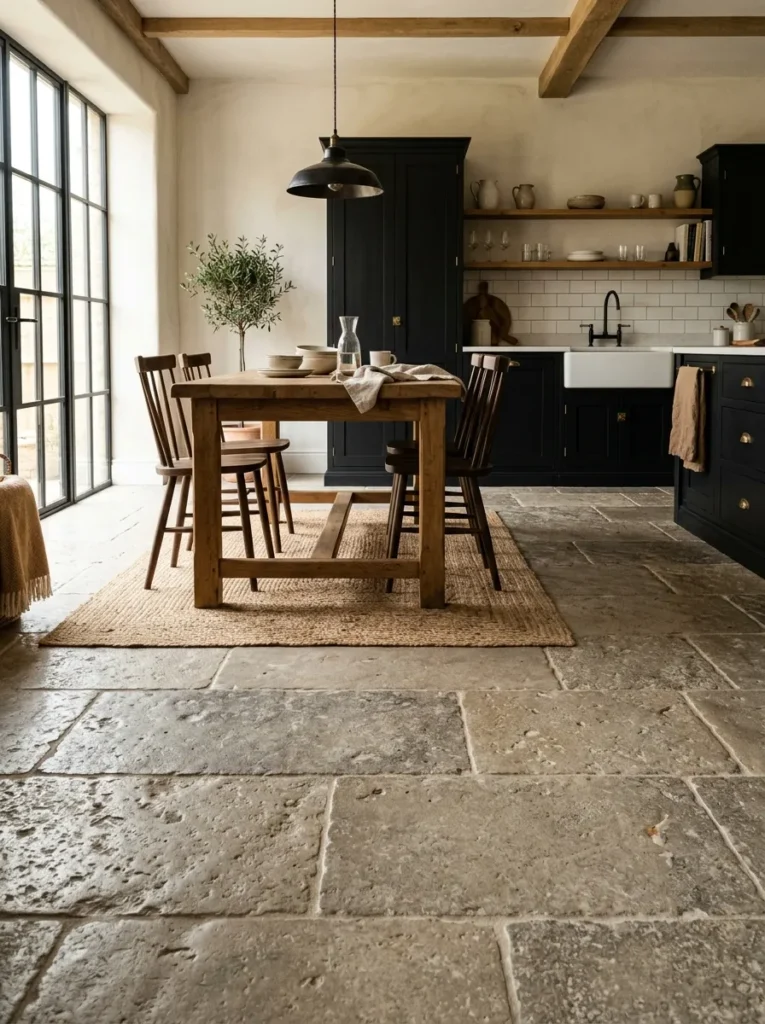
Vibe: Warm and material — the floor that reads as the room’s most honest surface, which is exactly the role that the floor plays in a genuinely farmhouse interior.
Why it works: Natural stone or quality concrete floors are the modern farmhouse flooring specification that most completely satisfies the material honesty principle — they look like what they are, they age beautifully, and they connect the interior to the geological and agricultural material tradition that is the farmhouse aesthetic’s authentic foundation. Limestone and slate were the standard floor materials of original farmhouses precisely because they were available from local quarries, required no manufactured processing beyond cutting and laying, and provided the thermal mass and durability that agricultural domestic environments required. The contemporary application of these same materials in a modern farmhouse context creates a continuity with that material tradition that no manufactured flooring alternative achieves.
How to get it: Honed (rather than polished) limestone or slate is the correct surface finish for a modern farmhouse application — polished stone reads as commercial; honed stone reads as domestic and genuine. Large format tiles (600mm × 600mm or larger) with narrow grout joints (5–8mm) provide the most architecturally generous reading. For a polished concrete alternative, specify an in-situ poured and polished concrete floor with a warm grey aggregate mix rather than a standard grey — the aggregate color is visible through the polished surface and determines the floor’s warm or cool tonal reading.
Shop the Look
| Product |
|---|
| Honed limestone floor tile large |
| Slate floor tile natural |
| Concrete floor aggregate warm grey |
| Natural stone sealer penetrating |
| Warm grey grout |
9. A Genuine Vintage or Antique Piece as the Room’s Anchor
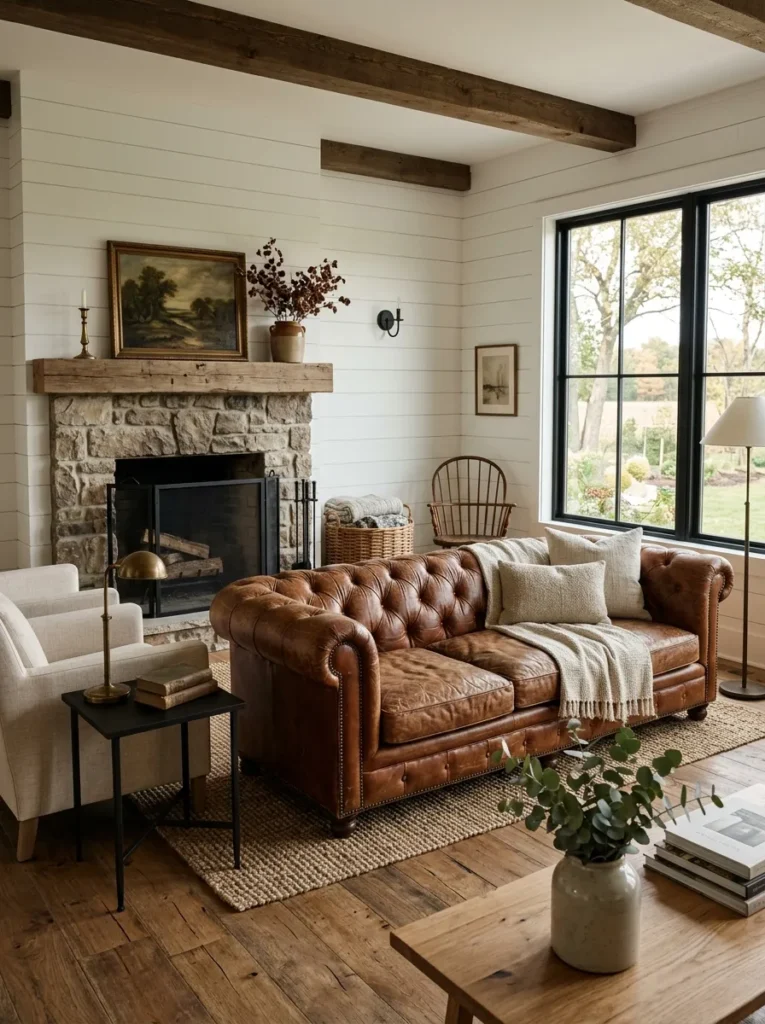
Vibe: Warm and authentically material — the room where the antique piece answers every question about whether the farmhouse aesthetic is genuine or aspirational.
Why it works: A single genuine antique or vintage piece is the modern farmhouse design element that most powerfully prevents the aesthetic from reading as a designed pastiche — new farmhouse-inspired furniture, however skillfully made, reads as contemporary furniture designed to look old; a genuine antique reads as furniture that is old, and the material difference between these two readings is immediately perceptible at close range. The aged patina of a pine armoire that has been used for 150 years, the specific wear patterns of a Windsor chair that has been sat in daily for decades, the deep colour development of cognac leather on a Chesterfield that has absorbed years of body oils and polish — all of these are the specific material qualities that cannot be manufactured, only accumulated through time, and their presence in a room provides the authentic material foundation from which all surrounding farmhouse design elements receive their validation.
How to get it: Source genuine antiques from estate sales, antique dealers, auction houses, and brocante markets rather than from reproduction furniture retailers — the material difference between a genuine antique and a quality reproduction is visible at close range in the specific character of the aging. The most accessible antique categories for a modern farmhouse interior (in terms of availability and price) are primitive furniture in painted pine (kitchen dressers, blanket boxes, step-back cupboards), Windsor and ladder-back chairs in oak and elm, and farmhouse tables in reclaimed pine or oak. Do not refinish genuine antiques — the patina of original surface treatment is precisely the quality that makes them authentic.
Shop the Look
| Product |
|---|
| Antique pine farmhouse piece |
| Windsor chair genuine antique |
| Estate sale antique consultant |
| Beeswax antique furniture polish |
| Antique dealer sourcing service |
10. Layered Natural Textiles — Linen, Cotton Canvas, and Wool
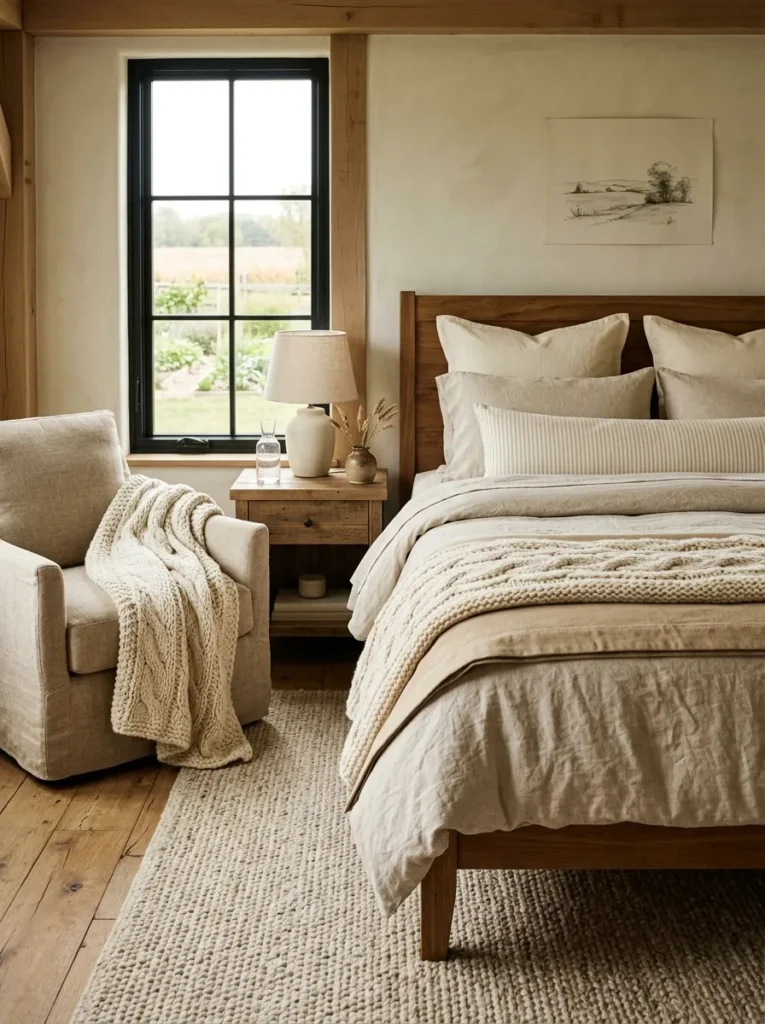
Vibe: Warm and textural — the bedroom that makes the distinction between sleeping and resting feel meaningless, which is the highest aspiration of any bedroom design.
Why it works: The layering of natural textiles — linen, cotton canvas, and wool — in a coordinated warm neutral palette is the modern farmhouse bedroom’s most direct expression of the aesthetic’s core value: the warmth, comfort, and material honesty of natural fiber against the human body. The specific combination of these three natural textile categories creates a visual and tactile richness that synthetic alternatives cannot replicate because each natural fiber has its own specific surface character: linen’s slight texture and characteristic irregular weave, cotton canvas’s smooth density and structured drape, and wool’s dimensional depth and warmth provide three distinct tactile qualities within a single coordinated palette. The tonal coordination — all textiles in the warm neutral range from oatmeal through ivory through natural cream — is the design discipline that makes the layered textile approach read as considered rather than accumulated.
How to get it: Source all textiles from the same tonal warm neutral family — the critical discipline is the warmth of the white tones, which must all be warm-toned (containing yellow or cream rather than blue or grey undertones) to maintain the palette’s coherence. Mixing warm and cool whites in a natural textile layering is the most common modern farmhouse bedroom styling failure, creating temperature discords between adjacent textiles that read as unintentional color variation rather than deliberate tonal range. The chunky wool throw — the heaviest-weight and most visually dimensional textile in the layering — should be draped rather than folded, positioned over the arm of the chair or across one corner of the bed in a gesture of casual use that communicates inhabitation rather than styling.
Shop the Look
| Product |
|---|
| Natural linen duvet oatmeal |
| Cotton canvas coverlet warm |
| Chunky wool throw natural cream |
| Linen European pillowcase ivory |
| Cotton ticking stripe bolster |
11. A Genuine Statement Range or Aga in the Farmhouse Kitchen
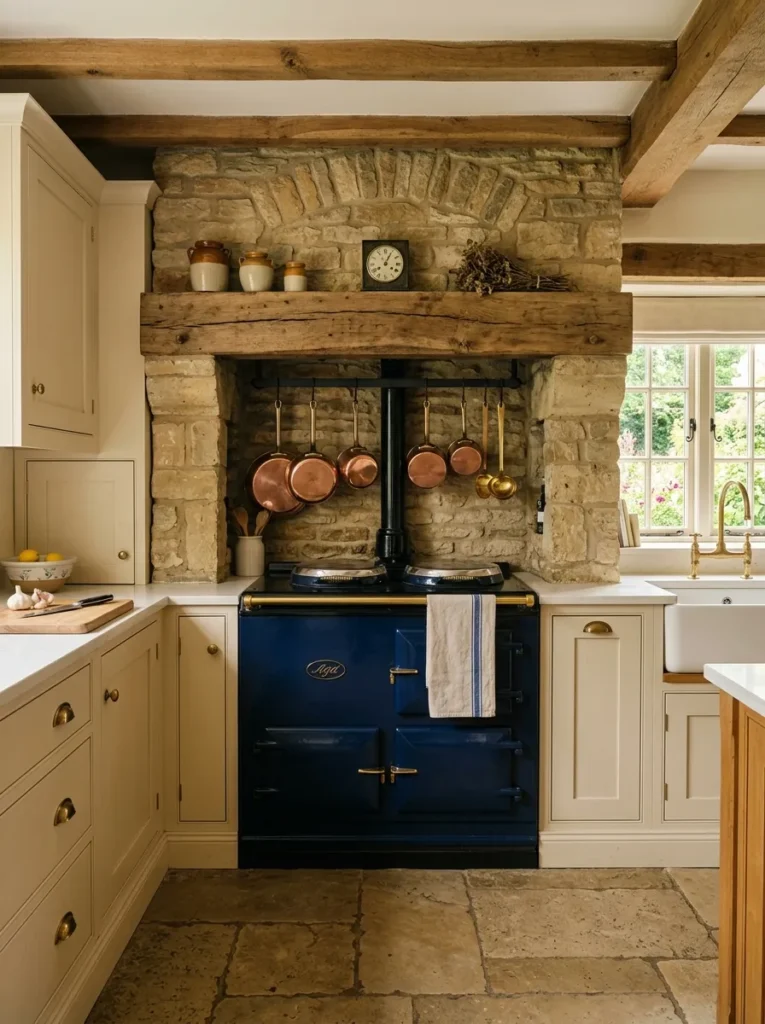
Vibe: Warm and central — the kitchen whose range is the reason for the kitchen’s existence rather than one of its appliances.
Why it works: A genuine cast iron range cooker — an Aga, a Rangemaster, or a quality freestanding range in a farmhouse-appropriate finish — is the kitchen element that most completely communicates the modern farmhouse aesthetic’s fundamental relationship with the hearth as the home’s organizing center. The Aga specifically has been the definitive farmhouse kitchen appliance for nearly a century, and its presence in a kitchen immediately establishes the farmhouse identity with a material specificity that no surface treatment or hardware choice achieves. The range’s role as the kitchen’s spatial and compositional anchor — the element around which the rest of the kitchen is organized — references the same organizing principle as the fireplace in the farmhouse living room: the warmth-producing element as the room’s center of domestic life.
How to get it: Position the range in an alcove, a chimney breast niche, or a purpose-designed range surround that emphasizes its role as the kitchen’s primary architectural element rather than a large appliance placed against a wall. Install a reclaimed timber mantel or a stone mantel shelf above the range as the visual frame that establishes the range’s hearth-like status. Hang copper pots from a rail above the range — the copper pot collection is the specific accessory grouping most historically associated with the Aga kitchen and the one that most authentically completes the farmhouse range installation.
Shop the Look
| Product |
|---|
| Cast iron range cooker cream |
| Reclaimed timber mantel shelf |
| Copper pot collection hanging |
| Pot rail above range |
| Stone floor below range |
12. Exposed Brick or Brick-Effect Wall Feature
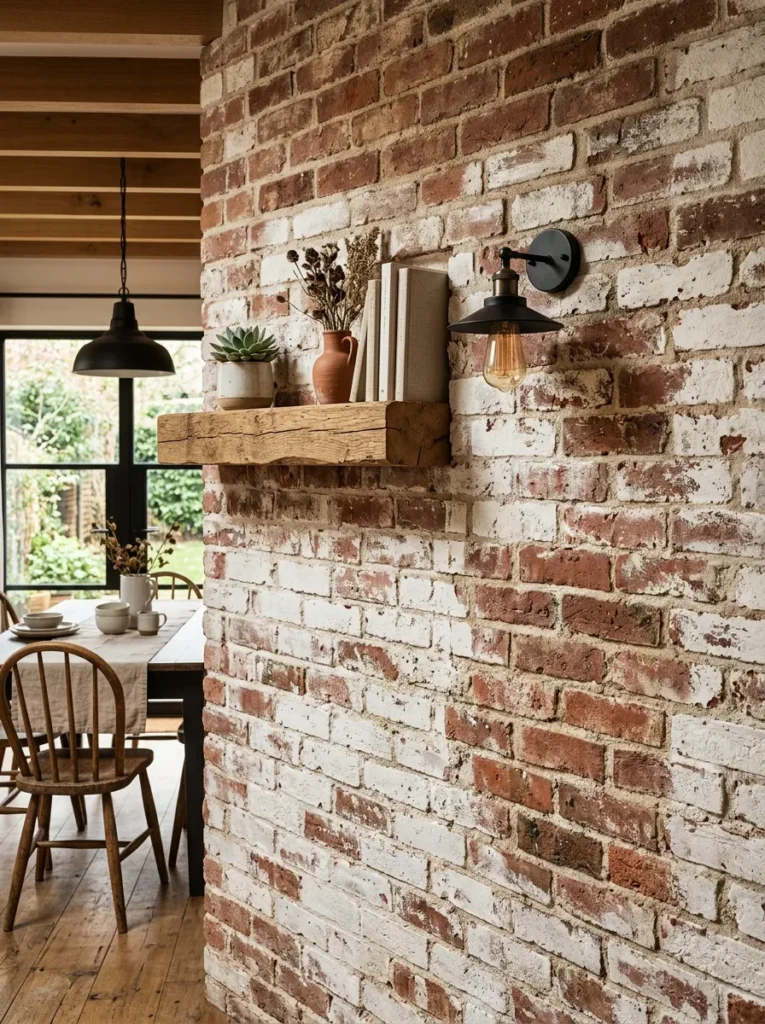
Vibe: Warm and material — the wall that makes all other walls in the room feel like they are merely surfaces and this one is architecture.
Why it works: Exposed brick — particularly antique or reclaimed brick with visible aging, varied color, and character mortar joints — is the modern farmhouse wall material that most powerfully communicates genuine construction history and genuine material authenticity. Brick’s specific visual quality — the color variation between individual bricks from the same kiln firing, the texture variation of the fired clay surface, the specific quality of aged lime mortar — creates a wall surface of genuine visual richness that no manufactured material can replicate, because the variation itself is the quality. The limewash technique — applying a diluted white limewash to approximately 60% of the brick surface, allowing some original brick color to show through — is the specific treatment that most beautifully balances the original brick’s warm red-brown character with the lightness required for a modern farmhouse interior.
How to get it: For an existing brick wall, apply limewash (genuine calcium hydroxide limewash rather than paint that mimics limewash) with a wide natural bristle brush, working in sections of approximately one square meter at a time and varying the coverage pressure to create the uneven, organic application that characterizes genuine limewash. For a feature wall in a room without existing brick, install genuine antique or reclaimed brick slips (thin brick sections at 20–25mm thickness) rather than manufactured brick-look ceramic tiles — the material difference between genuine reclaimed brick slips and ceramic imitation is immediately perceptible in the surface texture and color variation.
Shop the Look
| Product |
|---|
| Genuine calcium hydroxide limewash |
| Reclaimed brick slip set |
| Wide natural bristle brush |
| Timber shelf for brick wall |
| Matte black iron wall hook |
13. Farmhouse Table Styling with Linen and Seasonal Botanicals
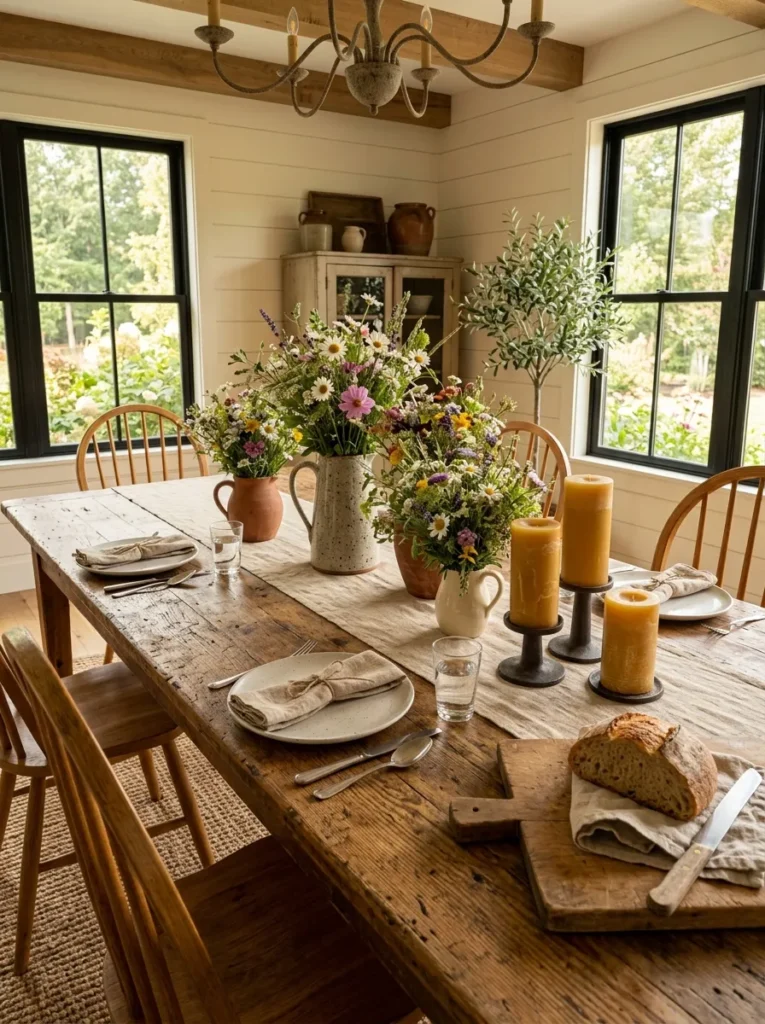
Vibe: Warm and daily-beautiful — the farmhouse table that makes every ordinary meal feel like it is worth sitting down for.
Why it works: The farmhouse table styled with natural materials and seasonal botanicals is the daily-use table decor approach that most naturally expresses the modern farmhouse philosophy of beauty through honest, natural, daily-use materials rather than through special occasion display or purchased decorative arrangement. The linen runner, the ceramic pitchers with wildflowers, and the beeswax candles in iron holders are all materials that belong to the farmhouse’s daily life — they are not set-pieces brought out for guests but the consistent, daily expression of a domestic aesthetic that treats every meal as worth the care of beautiful table materials. This daily-use philosophy is the specific quality that makes a farmhouse dining room read as genuinely lived in rather than staged for photography.
How to get it: Replace the farmhouse table’s typical centerpiece with a rotating seasonal botanical arrangement in ceramic pitchers — wildflowers in spring, garden herbs in summer, dried wheat and seed heads in autumn, evergreen branches in winter. The seasonal botanical is free or near-free (cut from the garden or gathered from the immediate landscape) and is the single table decor element that most naturally and most costlessly communicates the farmhouse aesthetic’s relationship with the natural seasonal cycle. The beeswax pillar candles should be lit at every dinner rather than reserved for special occasions — the daily practice of lighting candles at the farmhouse table is the ritual that most consistently produces the atmospheric quality that expensive restaurant design aspires to create.
Shop the Look
| Product |
|---|
| Natural linen table runner |
| Ceramic pitcher set varied heights |
| Beeswax pillar candle set |
| Simple iron candle holder |
| White ceramic tableware set |
14. Warm Neutral Paint Colors in Complex Undertones
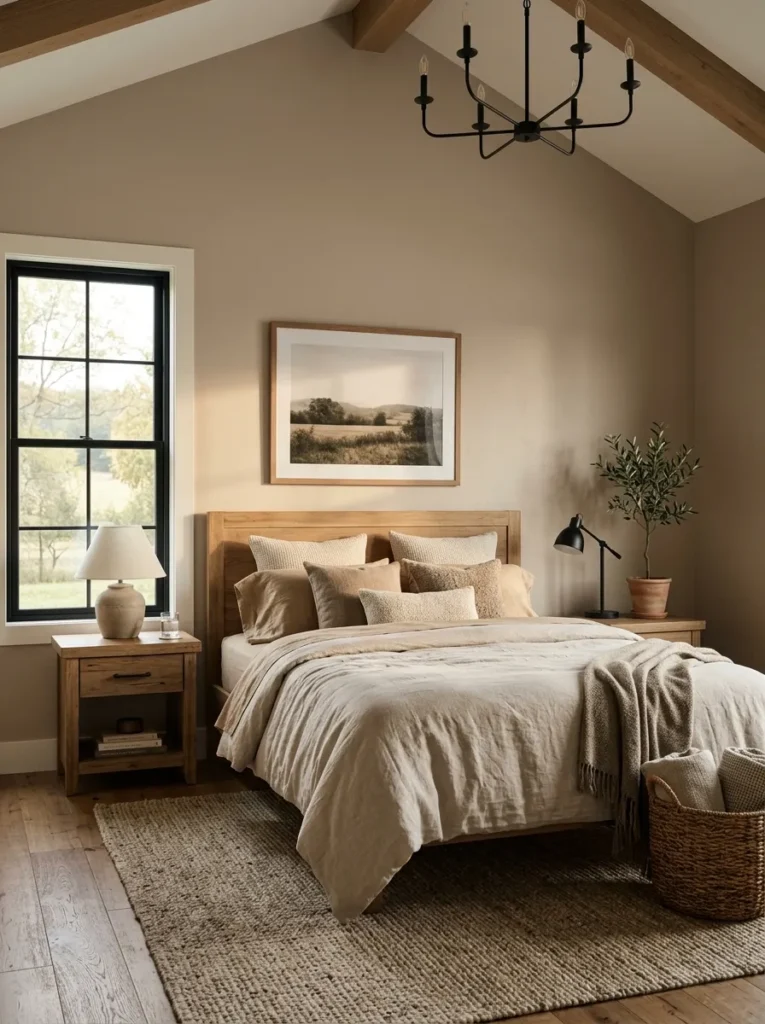
Vibe: Warm and settled — the room whose wall color feels as though it was always there and always exactly right.
Why it works: Warm neutral paint colors with genuine undertone complexity are the modern farmhouse wall treatment that most naturally and most effortlessly creates the material warmth that is the aesthetic’s defining atmospheric quality. Standard cool grey or bright white — the default paint choices of contemporary residential construction — create the flat, slightly clinical wall quality that makes a room feel unfinished regardless of the furniture investment; a warm greige or dusty linen white with sufficient yellow-pink undertones creates the specific warmth that reads as natural material illumination — the quality of a wall that has absorbed years of firelight and natural light and reflected it back into the room with a warmth of its own. This wall warmth is the atmospheric quality that the most expensive modern farmhouse renovations achieve and that most medium-budget renovations fail to prioritize because it appears, incorrectly, to be a minor decision.
How to get it: Farrow & Ball’s String No. 8, Elephant’s Breath No. 229, and Clunch No. 2009 are all in the correct warm neutral register for a modern farmhouse bedroom. Benjamin Moore’s White Dove OC-17 and Bone White OC-12 provide accessible alternatives in the warm-toned white register. The test for a farmhouse-appropriate warm neutral: the color should read as slightly warmer than white rather than slightly cooler — a pink-yellow undertone rather than a blue-grey undertone. Apply in an eggshell finish for the slight sheen that allows the color’s complexity to be revealed by directional light.
Shop the Look
| Product |
|---|
| Warm greige farmhouse paint |
| Eggshell paint finish |
| Natural linen bedding coordinating |
| Matte black iron bedroom fittings |
| Warm timber bedroom furniture |
15. Thoughtful Accessory Editing — Fewer, Better Objects
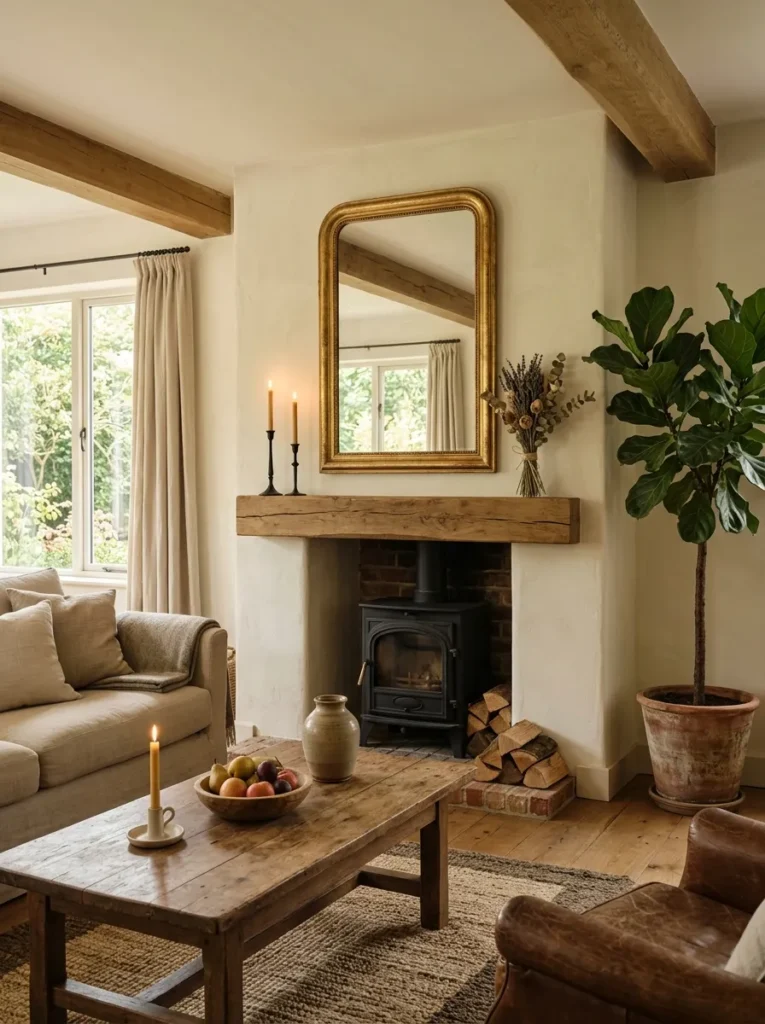
Vibe: Warm and resolved — the modern farmhouse interior that proves that the most expensive-looking rooms are the ones in which the most editing has occurred rather than the most purchasing.
Why it works: Thoughtful accessory editing — the deliberate reduction of every surface to only objects that are genuinely beautiful, genuinely natural, and genuinely coherent with the farmhouse palette — is the modern farmhouse design practice that most consistently separates expensive-looking farmhouse interiors from cluttered ones. The modern farmhouse aesthetic is particularly vulnerable to accessory accumulation because its material richness is seductive: the handmade ceramic, the wooden bowl, the woven basket, the dried botanical, the iron candlestick — each is individually beautiful, but the accumulation of twenty of these objects on three surfaces creates the visual clutter that prevents any individual object from being perceived as genuinely beautiful. The editing discipline — reducing every surface to three or fewer objects, choosing the three that are most genuinely natural-material and most compositionally interesting — is the practice that most immediately and most costlessly improves any farmhouse room’s perceived quality.
How to get it: Apply the farmhouse object test to every accessory currently in the room: the object should be made from a natural material (timber, ceramic, iron, stone, linen, beeswax), it should be functional as well as decorative (a bowl that holds fruit, a candle that is lit, a basket that stores), and it should be able to exist naturally in an original farmhouse kitchen or living room. Objects that fail any of these three tests are removed and replaced with nothing — empty surface is always preferable to an object that undermines the room’s material coherence. The wood bowl of fruit, the beeswax candle, and the ceramic jug are the three objects that most consistently satisfy all three criteria and that most reliably read as genuinely farmhouse rather than farmhouse-inspired.
Shop the Look
| Product |
|---|
| Wooden bowl natural |
| Beeswax candle pillar |
| Single quality ceramic jug |
| Dried botanical bundle tied |
| Large terracotta pot plant |
How to Start Your Modern Farmhouse Transformation
Your single first move is to establish the material palette before spending a single dollar on farmhouse-specific purchases — identifying the specific combination of warm natural timber, matte black iron, warm white painted surface, natural linen, and natural stone or concrete that your specific home’s existing bones most naturally support. Every home has a specific material starting point — existing timber floors, existing stone walls, existing brick, existing ceiling height and beam structure — and the modern farmhouse transformation that works with these existing materials rather than against them will always read as more authentic and more expensive than the transformation that introduces farmhouse references into an inherently unsympathetic architectural context. A Victorian terrace townhouse with original timber floorboards and period ceiling heights is an ideal farmhouse transformation candidate; a 1970s brick veneer house with low ceilings and carpet throughout requires more selective farmhouse application to avoid reading as costume.
The most common modern farmhouse renovation mistake is applying farmhouse surface treatments (shiplap, beams, board-and-batten) to rooms that have not first been resolved in their spatial discipline and lighting quality — farmhouse wall treatments applied to a room with poor lighting, cluttered surfaces, and mismatched furniture reads as decoration rather than design. The correct sequence for a modern farmhouse renovation is: lighting first (replacing all light fittings with consistent matte black iron in warm Edison bulbs and installing dimmers on all circuits), surface editing second (removing accessory clutter, replacing average furniture with fewer better pieces), wall and ceiling treatment third (shiplap, board-and-batten, or beam installation), and material accessory collection fourth (the gradual accumulation of natural-material farmhouse objects to replace the synthetic and manufactured items removed in the editing phase).
Three specific investments under $100 that create immediate modern farmhouse quality: (1) Replacing every visible light fitting’s bulb with Edison-style LED filament bulbs at 2200K ($25–40 for a full house) immediately shifts the room’s atmospheric quality from flat and bright to warm and amber — this single material change makes every existing farmhouse element (timber floors, exposed beams, linen textiles) appear significantly more beautiful and more genuinely farmhouse in quality. (2) A set of unlacquered brass cabinet pulls to replace existing chrome or plastic kitchen hardware ($4–8 per pull, $40–80 for a full kitchen) immediately shifts the kitchen’s perceived quality from builder-grade to designed without any structural change. (3) Three beeswax pillar candles in simple iron holders ($20–40 from a specialty candle retailer) placed at the coffee table and mantelpiece and lit every evening immediately creates the warm amber light quality that is the modern farmhouse’s most atmospheric and most recognizable quality — the candlelight practice is the farmhouse atmospheric ritual whose daily repetition produces a genuinely different quality of domestic evening from the overhead-only alternative.
Realistically, a complete single-room modern farmhouse transformation — shiplap wall, exposed beam installation, matte black iron light fixtures, reclaimed timber shelving, farmhouse sink, unlacquered brass hardware, natural stone floor, layered natural textiles, and a genuine antique anchor piece — costs $8,000–25,000 depending on the room’s size and the quality level specified at each category. A focused five-element transformation — warm wall paint, consistent matte black iron fixtures, reclaimed timber floating shelves, natural linen textiles, and a surface-edited accessory arrangement — costs $500–1,500 and produces a room that reads as convincingly modern farmhouse in its essential character without any structural renovation work. Most homeowners begin with the two highest-impact, lowest-cost changes (light bulbs to Edison filament and hardware to unlacquered brass) and observe the room’s transformation before committing to the more significant material investments.
Frequently Asked Questions About Modern Farmhouse Design
What is the difference between modern farmhouse and the original farmhouse aesthetic?
Original farmhouse design was not a designed aesthetic but a practical vernacular response to specific material availability and functional requirements — the working farms of 18th and 19th-century America used what was available locally (timber from the farm’s own land, stone from the farm’s own ground, iron from the local smithy, linen from the farm’s own flax) in the most functionally effective combinations available. Modern farmhouse design is the contemporary aesthetic that selects and curates the most visually beautiful elements of that vernacular tradition — the shiplap, the beams, the farmhouse sink, the iron hardware, the natural stone — and applies them within the spatial discipline and material restraint of contemporary design, eliminating the functional elements of the original that are not visually productive (the cramped low-ceiling rooms, the limited natural light, the maximum-utility surface treatments) while retaining and amplifying those that are genuinely beautiful.
How do I prevent my modern farmhouse interior from looking overdone or clichéd?
The modern farmhouse aesthetic becomes clichéd when it is applied as a collection of visual references rather than as a material philosophy — when shiplap, beams, subway tile, farmhouse sinks, and Edison bulbs are all applied simultaneously without a governing design principle that connects them. The prevention of cliché is the prevention of quantity — the modern farmhouse interior that reads as genuinely considered and genuinely expensive uses fewer farmhouse references executed at higher quality rather than the full vocabulary of farmhouse visual references executed at average quality. One perfectly proportioned beam installation in a room with consistent matte black iron fittings and genuinely reclaimed timber shelving reads as designed; the same room with added shiplap, added subway tile, added barn doors, and added mason jar light fixtures reads as a farmhouse theme park.
What flooring works best in a modern farmhouse interior?
The flooring materials that most naturally and most authentically complement the modern farmhouse aesthetic are solid or engineered hardwood in warm brown tones (white oak or hickory in a natural or slightly warm stain), genuine natural stone (limestone, slate, or bluestone in a honed finish), and polished or exposed aggregate concrete. All three share the material honesty and the temporal improvement quality that the farmhouse aesthetic requires — they age beautifully, they feel genuine rather than manufactured, and they provide the material warmth at the floor level that the overall palette requires. Luxury vinyl plank (LVP) in farmhouse-appropriate tones is the accessible flooring alternative that most convincingly approximates the appearance of hardwood — the best quality LVP products are visually indistinguishable from genuine hardwood at normal room observation distances and provide the practical advantages of waterproofing and dimensional stability.
How do I modernize a farmhouse aesthetic for a contemporary apartment?
The modern farmhouse aesthetic adapts to a contemporary apartment by concentrating the farmhouse material references in the elements that are most changeable and most immediately perceptible — the textiles, the lighting, the hardware, and the accessory objects — while accepting that the architectural elements (floors, ceilings, built-in joinery) may be inappropriate for farmhouse modification in a rental or modern-construction context. Warm linen textiles throughout, consistent matte black iron light fittings, unlacquered brass hardware on existing cabinetry, a genuine handmade rug, a farmhouse table with natural candles, and a curated arrangement of natural-material accessories create a convincing farmhouse atmosphere in a contemporary apartment without requiring any structural modification to the apartment’s existing architecture.
What is the most expensive-looking single investment in a modern farmhouse renovation?
A genuine farmhouse apron-front fireclay sink is the single element whose installation most dramatically and most immediately shifts the visual register of a modern farmhouse kitchen from standard to genuinely expensive — it is the element that guests notice first and comment on most frequently, and its presence in a kitchen establishes the farmhouse aesthetic’s material credentials more powerfully than any wall treatment, floor material, or cabinetry specification. This is because the farmhouse sink’s specific visual qualities — its generous proportions, its thick apron front, its creamy fireclay surface — are immediately perceptible from across the room and communicate both material investment and aesthetic intention at the room’s primary work surface. Second to the farmhouse sink, consistent genuine antique or vintage pieces — particularly a large-scale antique piece such as a pine armoire, a genuine farmhouse dresser, or a collection of Windsor chairs — provide the material authenticity that most powerfully elevates a farmhouse interior from aspirational to genuinely realized.
Ready to Create Your Modern Farmhouse Interior?
These 15 ideas span the full range of what a modern farmhouse design approach can achieve — from a shiplap feature wall executed at genuine architectural quality with the shadow reveal and the complex sage paint that separate it from every basic shiplap installation, and ceiling beams in the correct structural proportions that read as genuinely aged construction rather than applied decoration, to a farmhouse sink that makes the kitchen’s functional center its most beautiful object, reclaimed timber shelves that introduce genuine material history into a contemporary space, and a surface-edited accessory arrangement that proves the most expensive-looking rooms are the ones where the most editing has occurred — so whether you are beginning a complete farmhouse renovation of a period farmhouse or introducing the modern farmhouse aesthetic selectively into a contemporary home, there is a genuinely achievable, genuinely material approach here for your specific architectural context, your specific budget, and your specific appetite for the warmth, honesty, and material richness that the modern farmhouse aesthetic, at its best, provides. The transformation begins with the palette — with the commitment to warm natural timber, matte black iron, warm white painted surfaces, and natural fiber textiles as the organizing material principle from which every subsequent decision follows — and continues with the patient accumulation of genuinely excellent individual decisions that compound in quality over time into an interior that looks more farmhouse, more beautiful, and more genuinely expensive with every passing year of inhabitation. Today’s specific action: replace every light bulb in your most-used room with an Edison-style LED filament bulb at 2200K, sit in the room in the evening with no overhead lights and observe what the room becomes in that warm amber glow — that observation tells you more about what your modern farmhouse interior can become than any mood board, any magazine, and any number of saved Pinterest images. Save the ideas that matched your home’s specific bones and your budget’s specific priorities — those are the modern farmhouse ideas that will actually be implemented, that will look genuinely considered from the first day they are in place, and that will make every person who enters the room feel that the best possible version of home is exactly what they have just walked into.