17 Elegant Room Decorating Ideas for Every Home
Elegant room decorating is the practice of making interior spaces feel genuinely gracious — combining material quality, compositional restraint, warm light, and deliberate object curation into rooms that communicate care, refinement, and genuine inhabitation rather than accumulated decoration or trend-following novelty. This article gives you 17 elegant room decorating ideas across living rooms, bedrooms, dining rooms, entryways, and transitional spaces so every room in your home can be elevated toward a quality of genuine elegance that is achievable at any budget through intelligent design decisions rather than expensive purchases.
Elegance in a room is not a function of spending — it is a function of decision quality. A room furnished entirely from affordable sources but decorated with restraint, material coordination, warm lighting, and genuine personal aesthetic commitment reads as more genuinely elegant than a room of expensive furniture arranged without compositional intelligence, over-accessorized, and lit by cool-white overhead fixtures. The most consistent characteristic of genuinely elegant rooms across all design traditions and all budget levels is the evidence of genuine thought — the sense that someone has considered what belongs in this room and what does not, and has had the confidence to act on that consideration. Here are 17 ideas worth saving — and implementing throughout every room.
Why Elegant Room Decorating Transforms Daily Living
Elegant room decorating draws from the convergence of the French interior design tradition (restraint, quality, and the confidence to leave space around beautiful objects), the Scandinavian hygge tradition (warmth, natural materials, and the creation of genuinely comfortable environments), the contemporary quiet luxury movement (material quality over accumulation, confidence in simplicity), and the growing understanding from environmental psychology research that the quality of domestic environments has measurable effects on mood, cognitive function, and emotional wellbeing. Rooms that are materially rich, compositionally clear, warmly lit, and personally meaningful consistently produce better wellbeing outcomes than rooms that are cluttered, poorly lit, or aesthetically arbitrary — which gives elegant room decorating a functional case as well as an aesthetic one.
The specific design decisions that produce elegant rooms are not, in most cases, expensive decisions — they are editing decisions, material coordination decisions, scale decisions, and lighting decisions that cost little or nothing but require genuine aesthetic attention and the confidence to prioritize quality over quantity at every scale of the room’s design.
What Every Elegant Room Shares
| Quality | Detail |
|---|---|
| Restraint | Fewer objects of genuine quality rather than many objects of moderate quality |
| Material Cohesion | A consistent material palette that relates all objects to each other and to the room |
| Warm Light | 2700K or warmer light from multiple sources at varied heights |
| Negative Space | Visible surface between objects — the space around things is as designed as the things themselves |
| Personal Authenticity | Objects chosen for genuine meaning or beauty rather than trend-following |
17 Elegant Room Decorating Ideas for Every Home
1. Edit Every Surface to a Maximum of Three Objects
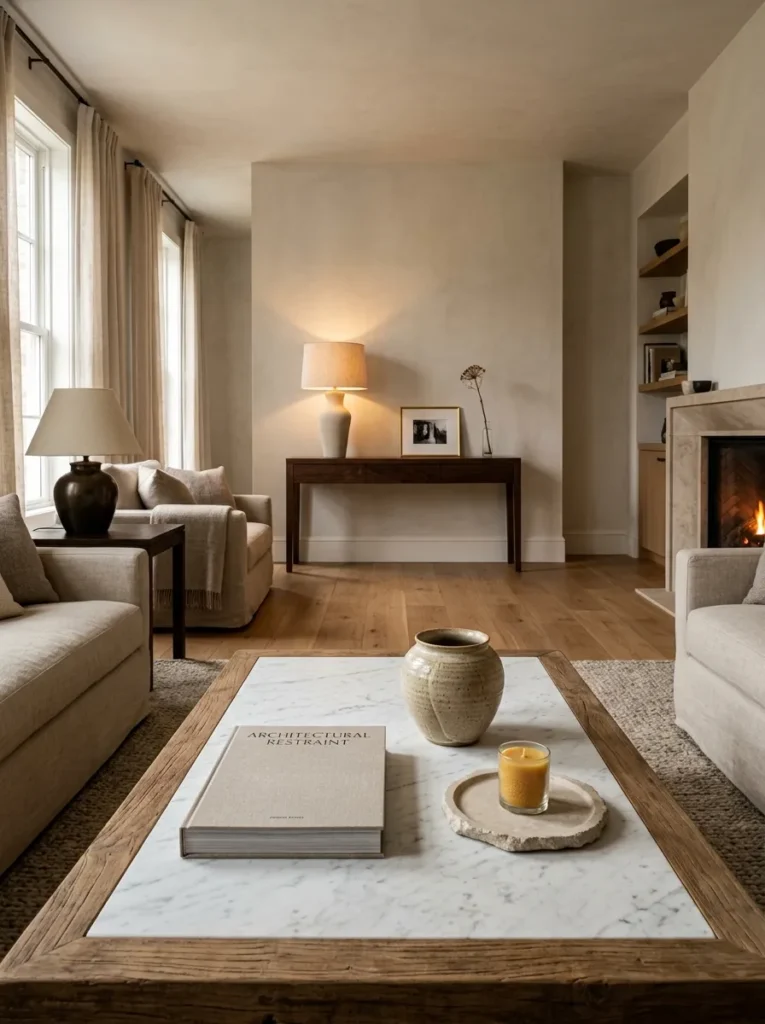
Vibe: The room is restrained — the three-object maximum per surface is the single most transformative elegant room decorating discipline available, creating the negative space that makes every remaining object appear more valuable and more deliberately chosen.
Why it works: Surface editing is the design principle with the highest ratio of visual impact to cost because it requires removing objects rather than purchasing them — the financial investment is zero and the return is immediate. The three-object maximum is specifically effective because it corresponds to the human visual system’s comfortable processing capacity for a single surface vignette — three objects create a composition (with foreground, middle, and background elements, or with height variation across three positions), while four or more objects on a standard surface begin to read as collection rather than composition. The visible surface material between objects is as important as the objects themselves — a beautiful coffee table with three objects on it shows the coffee table; the same table covered with seven objects hides the table entirely.
How to get it: Apply the three-object maximum to every horizontal surface in the room simultaneously — coffee table, console table, side tables, bookshelves, mantels, and windowsills. Remove everything currently on each surface, then return only the three objects that best represent the surface’s function and the room’s aesthetic direction. Apply the one-object minimum (no surface should be completely empty) and the three-object maximum (no surface should have more than three distinct objects) as a consistent discipline across the room.
Quick Win: Removing every surface in a single room to zero objects and spending 30 minutes deciding what returns — and keeping that number at or below three per surface — creates more immediate visual elegance than any purchase at any price.
Shop The Look
- Coffee table book large format quality
- Ceramic vessel living room display
- Stone candle plate minimal
- Narrow bud vase single stem
- Quality table lamp side table
Also view: 15 Bedroom Wall Decor Ideas for Every Style
2. Replace All Light Bulbs with Warm 2700K Equivalents
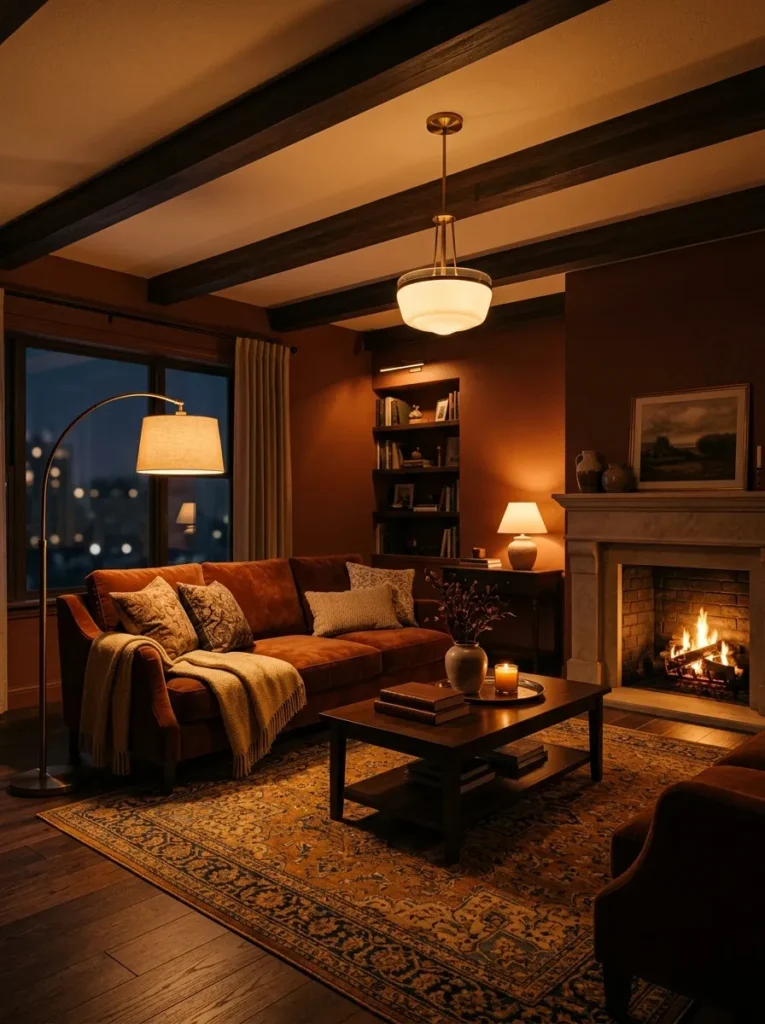
Vibe: The room is amber — replacing every light bulb in every room with warm 2700K equivalents transforms the home’s entire atmospheric register from adequately illuminated to genuinely elegant, because warm light makes every material in every room appear richer, warmer, and more beautiful than it does under cool or neutral white illumination.
Why it works: Warm light is the single most efficient elegant room decorating upgrade available because it simultaneously improves the appearance of every material, every textile, every wood surface, and every object in the room without changing any of them. The specific quality improvement is significant — the same natural linen sofa appears flat and slightly grey under 4000K cool light and appears warm, textured, and genuinely luxurious under 2700K warm light. The same wood floor appears washed out under cool light and appears rich and warm under amber light. The same room reads as adequately furnished under overhead cool white and as genuinely elegant under warm, layered, dimmed 2700K. This is a bulb replacement — not a renovation.
How to get it: Replace every bulb in every room with the warmest available equivalent — 2700K warm white for minimum, 2200K extra-warm white for maximum warmth. The total investment for all bulbs in a standard three-bedroom home: $30–$80. Pair with dimmer switches on as many circuits as possible ($15–$25 per switch) to allow the warm bulbs to be used at the lower, more atmospheric levels where their warm quality is most apparent.
Shop The Look
- Warm white LED bulb 2700K set
- Extra warm LED bulb 2200K set
- Edison filament LED 2200K amber
- Dimmer switch LED compatible
- Smart bulb warm white 2700K app
3. Install Floor-to-Ceiling Curtains in Every Room
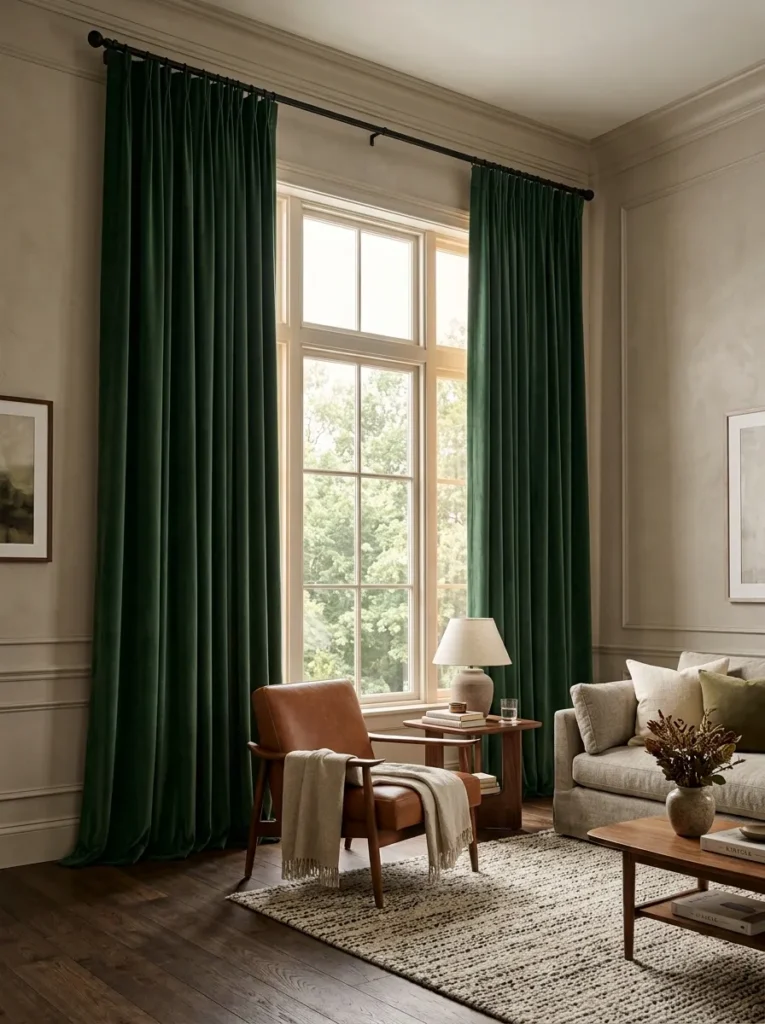
Vibe: The room is elevated — floor-to-ceiling curtains hung from ceiling-height rods create the most dramatic vertical line available in any room, making windows appear taller, ceilings appear higher, and the entire room appear more generously proportioned than its actual dimensions.
Why it works: The curtain rod position is the most frequently cited elegant room decorating upgrade in professional interior design because it requires only moving an existing curtain rod upward (from window-frame height to ceiling height) and purchasing longer curtain panels — a change that costs $20–$80 in rod hardware and $40–$150 in panel length upgrades and produces one of the most dramatic room improvements available at any price. The ceiling-height rod creates a continuous vertical line from the room’s floor to its ceiling at the window position, which the eye reads as architecture rather than decoration — the curtain becomes a designed wall element rather than a window treatment.
How to get it: Purchase a curtain rod sized to extend 12 inches beyond the window frame on each side (this makes the window appear 60–80% wider than its actual measurement when the curtains are open). Mount the rod within 2 inches of the ceiling molding or ceiling plane. Purchase curtain panels long enough to touch the floor with a 2–3-inch pool — measure from the rod to the floor and add 3 inches for the pool. Quality linen or linen-look curtain panels in warm neutral colors are the most universally elegant choice.
Shop The Look
- Ceiling curtain rod extended bracket
- Floor length linen curtain panel cream
- Velvet curtain panel deep color long
- Curtain ring clip set ceiling mount
- Long curtain panel floor pool linen
4. Choose One Large Artwork Over Multiple Small Ones
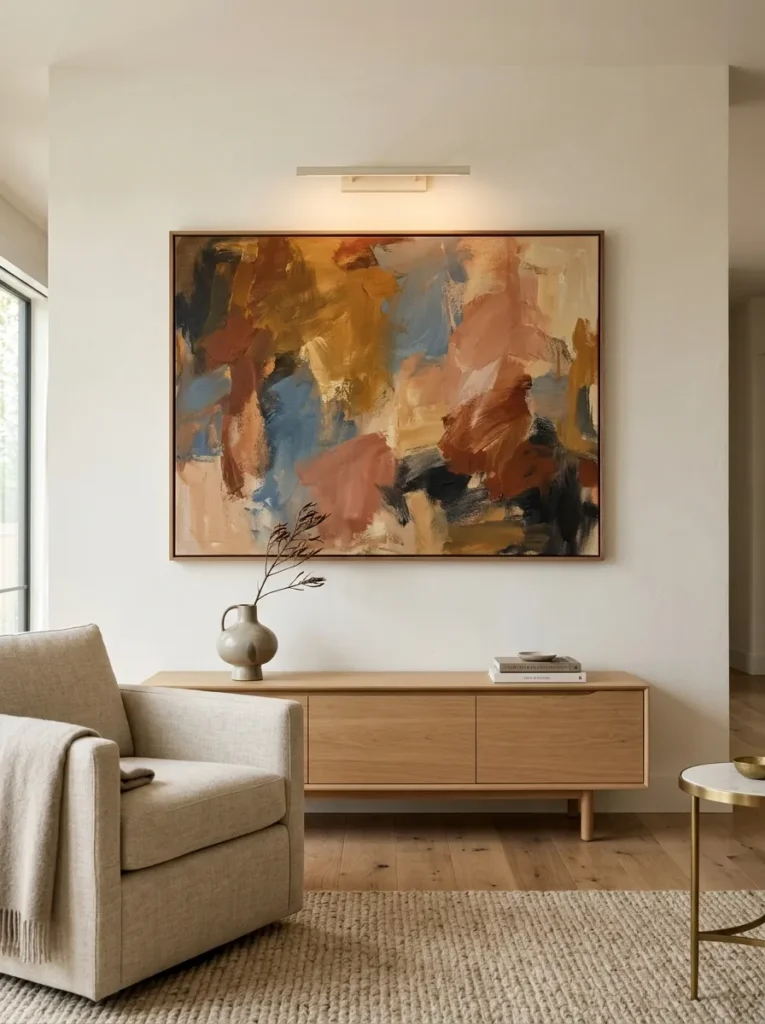
Vibe: The wall is confident — a single large artwork as the room’s primary wall statement communicates the most fundamental principle of elegant room decorating: that one thing done with full commitment creates more impact than many things done with partial commitment.
Why it works: The choice of a single large artwork over a gallery wall of multiple smaller pieces is the design decision that most clearly distinguishes a confidently designed room from an assembled one. A gallery wall of many small prints requires multiple coordinating decisions (frame styles, spacing, arrangement) and produces a visual complexity that distributes attention across many objects; a single large artwork requires one decisive choice and produces a clear, commanding focal point that gives the room visual organization and authority. The large artwork’s scale also means that the empty wall space around it reads as a design decision rather than an empty surface — the breathing room around a large piece communicates that the space itself is valued, not just filled.
How to get it: The correct scale for a primary room artwork is 50–70% of the wall’s width — on an 8-foot-wide wall, a 48–56-inch wide artwork is correctly proportioned. Position the artwork’s visual center at 57–60 inches from the floor regardless of ceiling height — this is the standard gallery hanging height at the human visual center. Source original works from local galleries, emerging artist platforms (Saatchi Art, Artfinder), or limited edition prints from quality art print publishers for genuinely personal and genuinely impactful primary room art.
Shop The Look
- Large canvas artwork living room
- Original art print large format
- Simple wide mat frame large artwork
- Art hanging system cable wall
- Matte black frame large format
5. Add a Quality Area Rug in Every Room
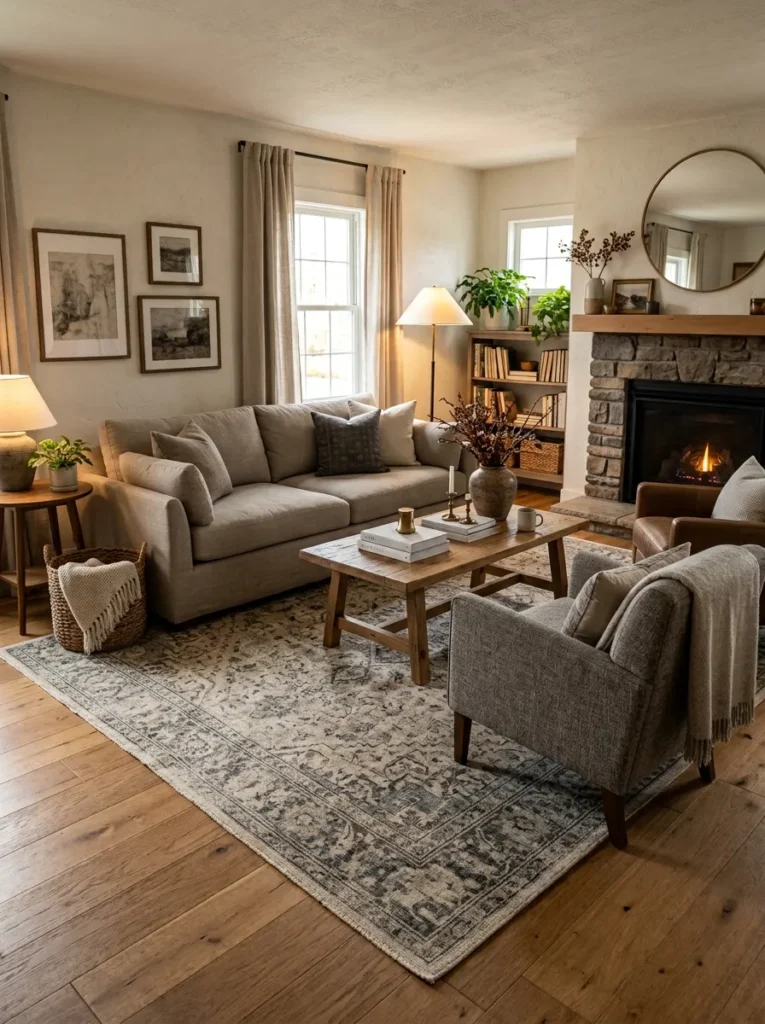
Vibe: The room is anchored — a correctly sized area rug under all primary seating transforms floating furniture into a composed conversation zone, giving the room the spatial definition and material warmth that bare floors cannot provide regardless of their quality.
Why it works: An area rug sized too small for its furniture grouping is one of the most common and most visually disruptive room decorating mistakes — the undersized rug reads as a decoration placed in front of the furniture rather than as the spatial anchor that defines the seating zone. The correct rug size for a living room seating grouping places at least the front legs of all seating on the rug, which creates the visual connection between the furniture and the rug that makes both elements read as intentionally related. A wool or natural fiber rug also provides the material warmth that hard floor surfaces lack — the sound-absorbing, tactilely warm, visually textured surface of a quality rug transforms the room’s acoustic and visual quality simultaneously.
How to get it: For a standard living room seating grouping with a sofa and two chairs, a minimum 8×10-foot rug is typically required; a 9×12-foot rug is often more appropriate and more generous. For a bedroom, the rug should extend at least 24 inches beyond the bed’s footprint on all accessible sides. Quality wool area rugs in warm neutral colors are available from specialty rug retailers at $200–$600 for accessible quality levels; vintage and antique rugs with warm, faded patina (the most elegantly aged option) are available from estate sales and vintage markets at $100–$500 for quality examples in good condition.
Shop The Look
- Wool area rug warm ivory 9×12
- Natural fiber rug living room large
- Vintage style faded rug warm tones
- Area rug 8×10 living room anchor
- Wool rug warm grey bedroom
6. Use Natural Materials Consistently Throughout
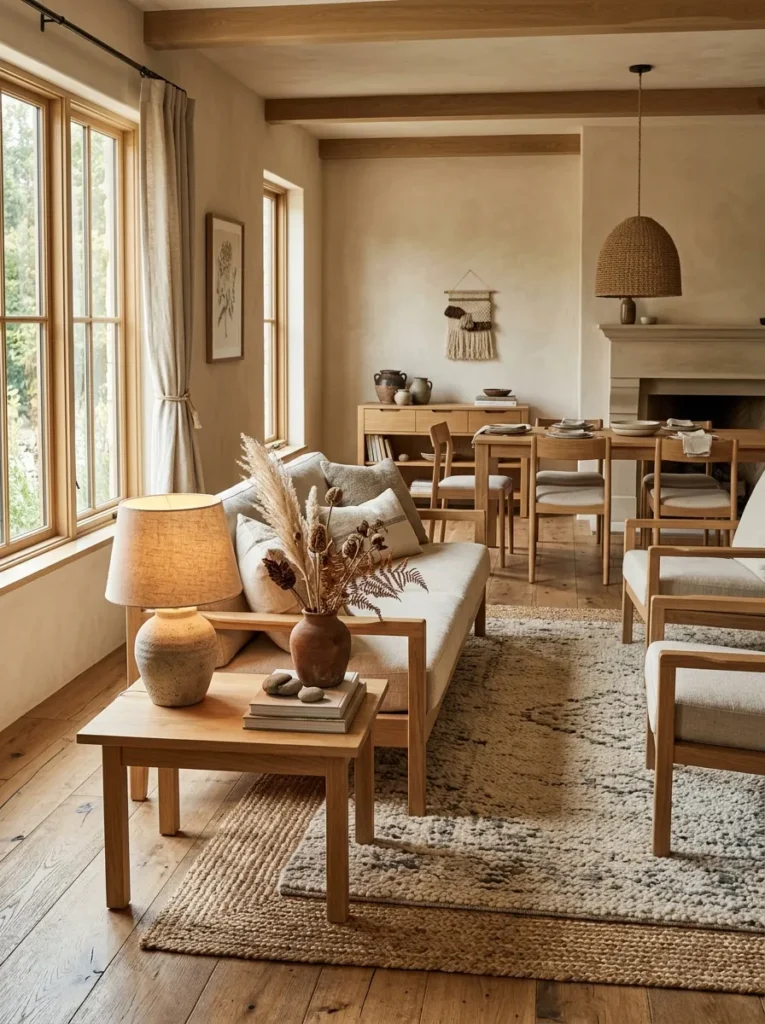
Vibe: The room is authentic — consistent natural material use throughout a room creates the specific quality of material honesty — every surface and object in the room is what it appears to be — that is the most enduring foundation of genuine elegance.
Why it works: Natural materials improve with age and use in ways that synthetic alternatives do not — solid wood develops richer patina, natural linen softens and drapes more beautifully, wool rug pile compresses gracefully, and ceramic glazes develop the character of daily use. A room furnished entirely with genuine natural materials has a quality that improves over time rather than deteriorating with it, which is the specific characteristic of truly elegant rooms. The material consistency principle — choosing objects within the same natural material families (warm wood, natural textile, stone, ceramic) rather than mixing natural and synthetic indiscriminately — creates the cohesive material palette that makes a room read as designed rather than assembled.
How to get it: Apply the natural material audit to every room: identify all visible synthetic or simulated materials (wood-look laminate, leather-look vinyl, synthetic rug fiber, plastic decorative objects) and create a replacement plan that substitutes genuine natural equivalents as each item requires replacement. The replacement does not need to happen simultaneously — adding one genuine natural material item per month produces a noticeably more authentic room within six months without a large single expenditure.
Shop The Look
- Solid wood furniture natural material
- Natural linen upholstery fabric
- Wool area rug genuine fiber
- Ceramic lamp base natural material
- Clay vessel dried botanical display
7. Create a Composed Vignette at Every Room’s Entry Point
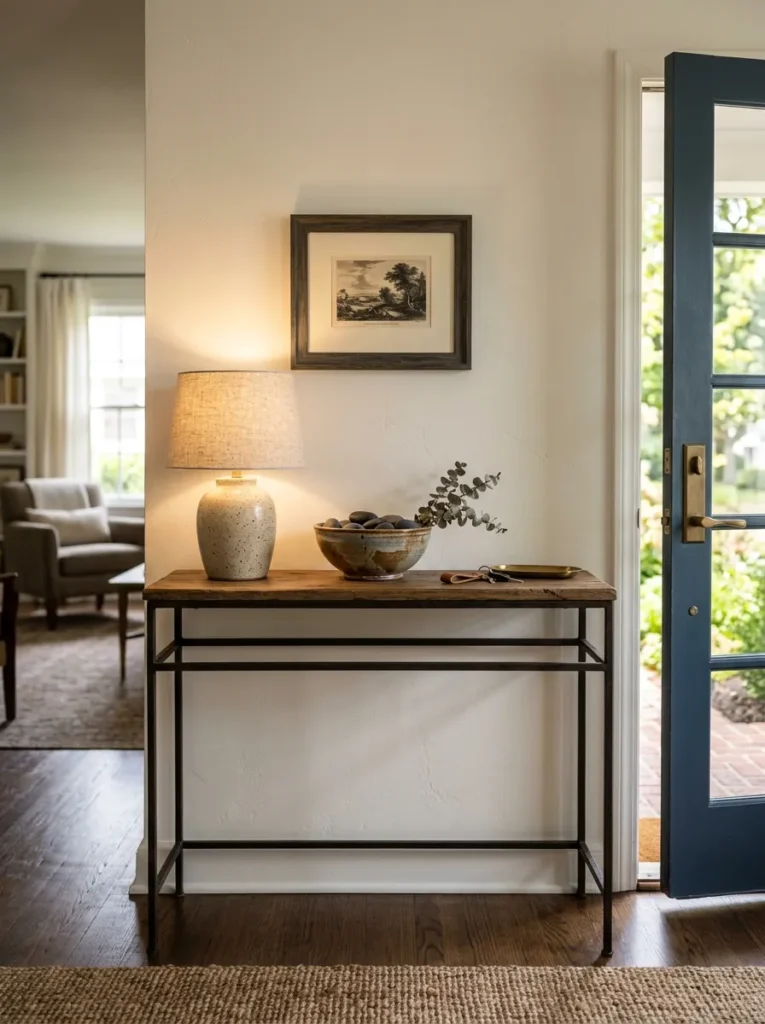
Vibe: The entry is welcoming — a composed vignette at the room’s entry point creates the first impression that establishes the room’s design register — the three deliberate objects and the warm lamp light communicate that the space beyond has been genuinely considered.
Why it works: The entry vignette is the room decorating element with the highest first-impression impact because it is the first surface seen upon entering a room and establishes the design expectations for everything that follows. A composed entry vignette (lamp, art or mirror, one organic object) communicates design intention from the first step into the room; an empty entryway or one with accumulated mail, keys, and random objects communicates the absence of design intention regardless of how beautiful the room’s interior is. The console table is the ideal entry vignette anchor because its narrow profile (12–14 inches deep) occupies minimal floor space while providing the surface for a designed arrangement at the eye-level zone.
How to get it: Position a narrow console table (available from furniture retailers at $80–$400 depending on material) against the first wall seen upon entering the room. Style with a lamp (the single most important vignette element — it provides warm light at the entry and vertical height in the composition), one piece of art or a mirror above the console (proportioned to the console’s width — the art or mirror should be 50–70% of the console’s width), and one organic or natural object on the console surface. Keep the rest of the console surface clear.
Shop The Look
- Narrow console table warm wood
- Entry console table slim dark metal
- Table lamp warm entry console
- Small art frame entry console
- Terracotta pot entry organic object
8. Layer Textiles in the Same Tonal Family
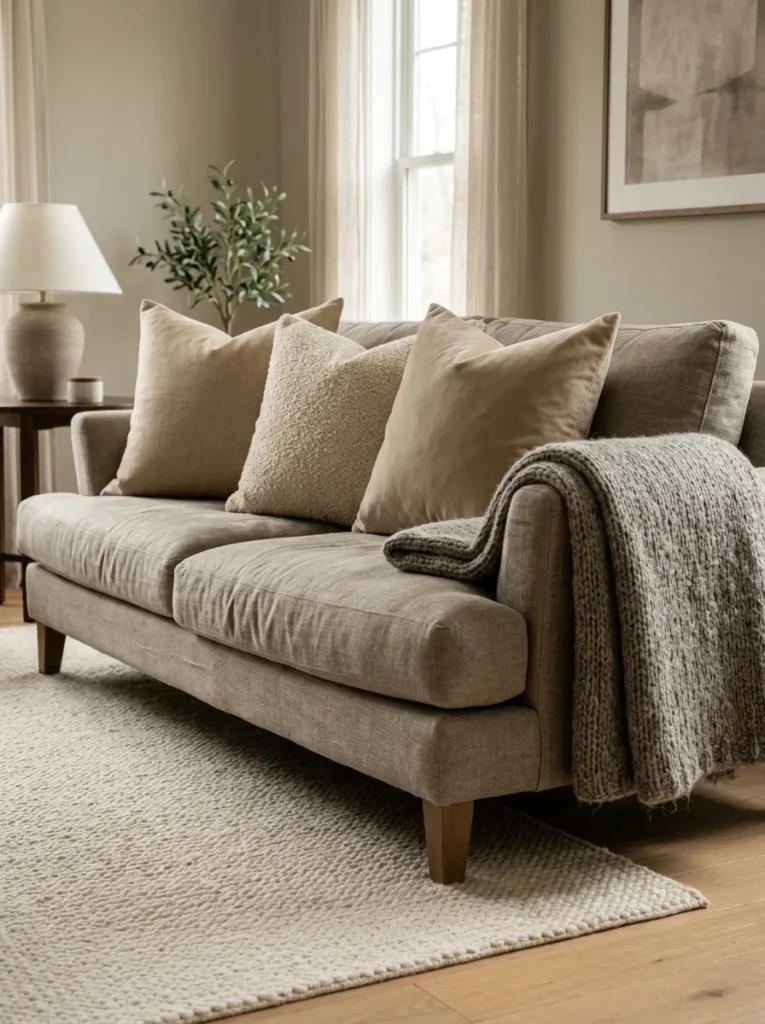
Vibe: The sofa is layered — tonal textile layering across three or four material types within the same warm neutral family creates the visual richness that tonal variety (multiple colors in the same materials) cannot approach, where the interest comes from material texture rather than color contrast.
Why it works: Tonal textile layering — using multiple textiles in the same color family but varied material textures — is the most sophisticated approach to sofa and soft furnishing styling because it achieves visual complexity through material variety (the different ways that linen, boucle, velvet, and wool each catch and reflect light) rather than through color variety (multiple different colors in the same material). This approach is more elegant than color-varied pillow styling because it communicates material awareness — the understanding that the same warm oat tone looks different in smooth linen, in looped boucle, and in cut velvet is a genuinely sophisticated material distinction that reads as designed intention rather than assembled decoration.
How to get it: Select all sofa textiles (pillows, throw, sofa upholstery itself) within a single warm neutral tonal family — warm cream to warm oat to warm greige to warm sand. Vary the materials: one or two smooth linen pillows, one boucle pillow (looped texture), one velvet accent pillow (cut pile), and a chunky wool or cashmere throw. Limit the tonal range to within one tonal family — introducing a strongly contrasting color (even a muted one) breaks the cohesion that makes the tonal layering approach work.
Shop The Look
- Boucle throw pillow warm cream
- Velvet pillow warm neutral sand
- Chunky knit wool throw warm grey
- Linen sofa pillow warm oat set
- Wool rug warm ivory sofa layer
9. Install Dimmer Switches on All Lighting Circuits
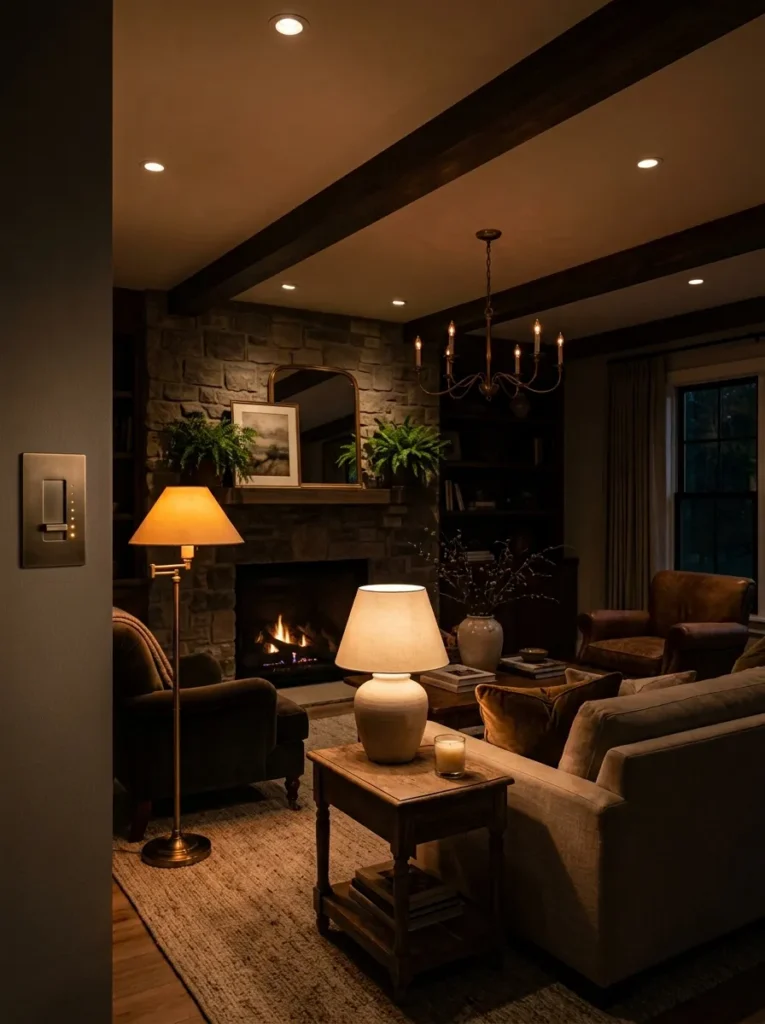
Vibe: The room is atmospheric — dimmer switches on every room circuit are the architectural upgrade that transforms fixed-level functional lighting into an infinitely adjustable atmospheric tool, where the difference between full bright and 30% dimmed is the difference between an illuminated room and a genuinely elegant one.
Why it works: The relationship between light level and room elegance is not linear — a room is not more elegant at higher light levels. The light level that produces the most genuinely elegant room atmosphere is 20–40% of maximum, where the warm bulbs create visible warm pools with genuine shadow zones between them rather than uniform room illumination. At this level, the room acquires the atmospheric depth — the quality of having light and shadow working together — that full-bright illumination eliminates entirely. A room at 30% warm dimmed looks like an interior design photograph; the same room at 100% cool-white ceiling light looks like a hardware store. The dimmer switch is the single most elegant architectural upgrade available.
How to get it: Install LED-compatible dimmer switches on every lighting circuit in the home — ceiling fixtures, lamp outlet switches, and any hardwired sconces or pendants. Lutron Caseta smart dimmers ($40–$60 each) provide the most reliable LED compatibility and the additional benefit of smartphone scene programming. Standard rotary or slide dimmers ($15–$25) provide manual control without smart features. The total investment for dimmer switches on all circuits in a three-bedroom home: $100–$300.
Shop The Look
- LED dimmer switch living room
- Lutron Caseta smart dimmer
- Dimmer switch multi-pack rooms
- Smart dimmer LED compatible
- Slide dimmer switch bedroom living
10. Add a Statement Mirror to Create Light and Space
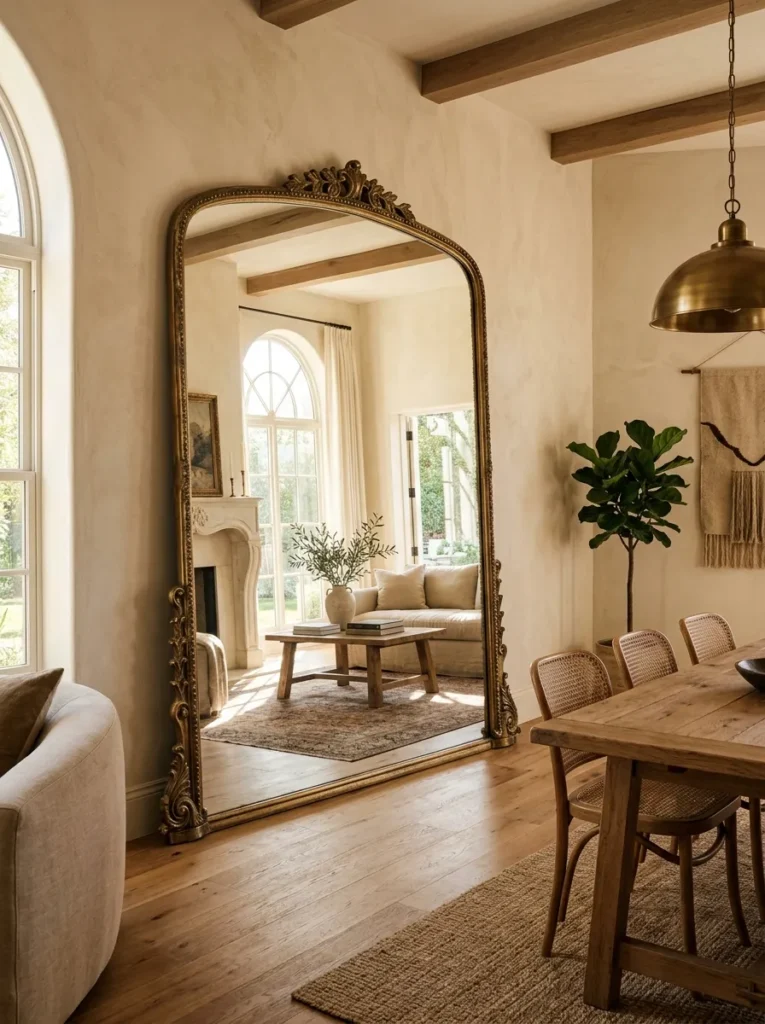
Vibe: The mirror is expansive — a large statement mirror positioned to reflect a natural light source and a beautiful room composition simultaneously doubles the perceived room depth, amplifies natural light, and creates a focal point of genuine material elegance at its wall position.
Why it works: A large mirror is the room decorating element that performs the most design functions simultaneously: it reflects and amplifies natural light (making the room brighter without adding fixtures), it doubles the perceived depth of the room at its wall position (making the room appear to continue beyond the wall), it provides a reflection of the room’s most beautiful composed zone (making the room’s design quality appear in two positions at once), and it contributes its own material quality through the frame (aged gilt, warm brass, or dark wood) to the room’s decorative vocabulary. No single decorating purchase provides equivalent multi-function return at equivalent cost.
How to get it: Position a large mirror (30×60-inch minimum for most rooms) on the wall that most directly faces the room’s primary natural light source or its most beautiful composed zone. Avoid positioning directly opposite a window (which reflects the window back at the viewer without the beneficial room reflection); instead, position on the adjacent or perpendicular wall where the mirror captures both the light and the room. Leaning a large mirror against the wall (secured with anti-tip hardware) creates a more casual, contemporary elegance than wall-mounting and allows repositioning as the room evolves.
Shop The Look
- Large statement mirror warm gold frame
- Aged brass floor mirror leaning
- Warm gilt wall mirror living room
- Large floor mirror dark wood frame
- Antique style mirror room statement
11. Use Tall Plants as Architectural Room Elements
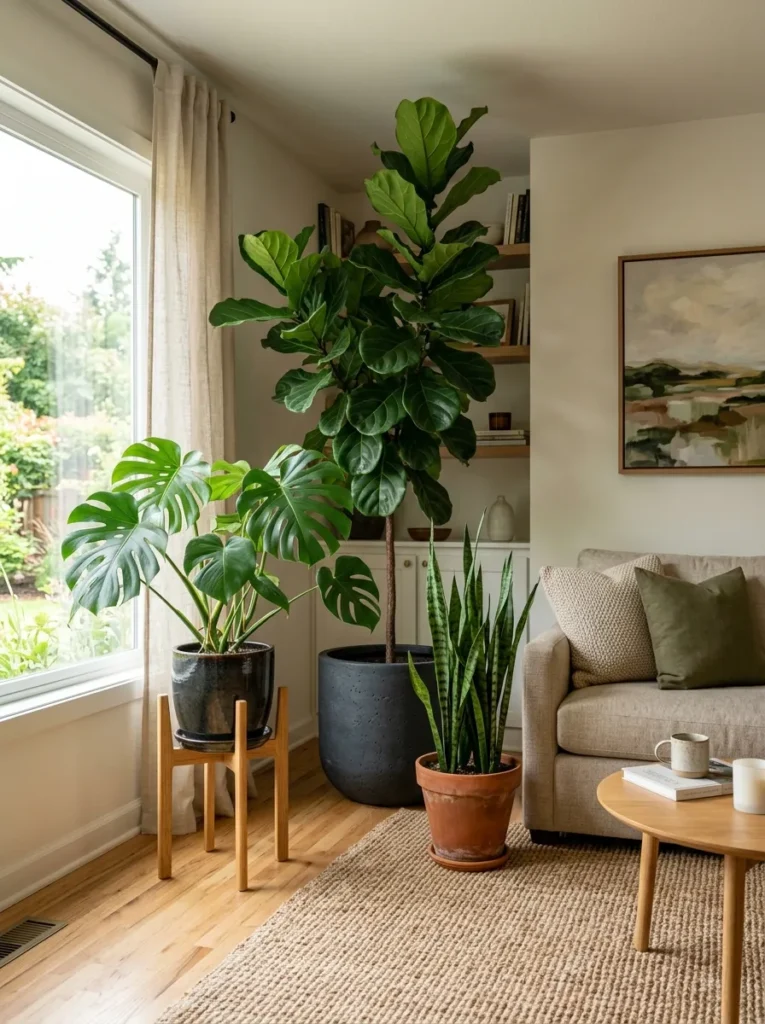
Vibe: The room is alive — tall architectural plants used as deliberate room elements create the organic warmth, biological presence, and vertical dimension that no manufactured decorating element can replicate, transforming rooms from decorated spaces to genuinely inhabited ones.
Why it works: Large indoor plants provide the decorating return that is most disproportionate to their cost — a 5-foot fiddle-leaf fig ($40–$80 at a garden center) provides the architectural room presence of a significant piece of furniture at a fraction of the cost, and its organic form creates a warmth and naturalness that no manufactured object achieves. Environmental psychology research consistently shows that the presence of living plants reduces stress markers and improves subjective wellbeing ratings of the spaces they inhabit — which gives large plant placement a functional case as well as an aesthetic one. The three-plant strategy (one large architectural plant, one mid-scale plant on a stand, one smaller plant at sofa or side table level) creates the layered botanical presence that reads as genuinely designed rather than as token plant placement.
How to get it: Source the largest available specimens of the desired plant species — a larger, more mature plant creates immediate room impact while a smaller specimen requires years of growth to achieve the same architectural presence. Position the primary plant in the room’s corner that receives the most natural light (typically the corner closest to the primary window) in a pot that is proportional to the plant’s scale (undersized pots make large plants read as precarious; generously scaled pots make them read as architecturally intended).
Shop The Look
- Fiddle leaf fig tree large live
- Concrete floor pot large plant
- Monstera deliciosa live large
- Quality plant stand natural wood
- Snake plant tall pot terracotta
12. Choose Furniture That Fits the Room’s Scale
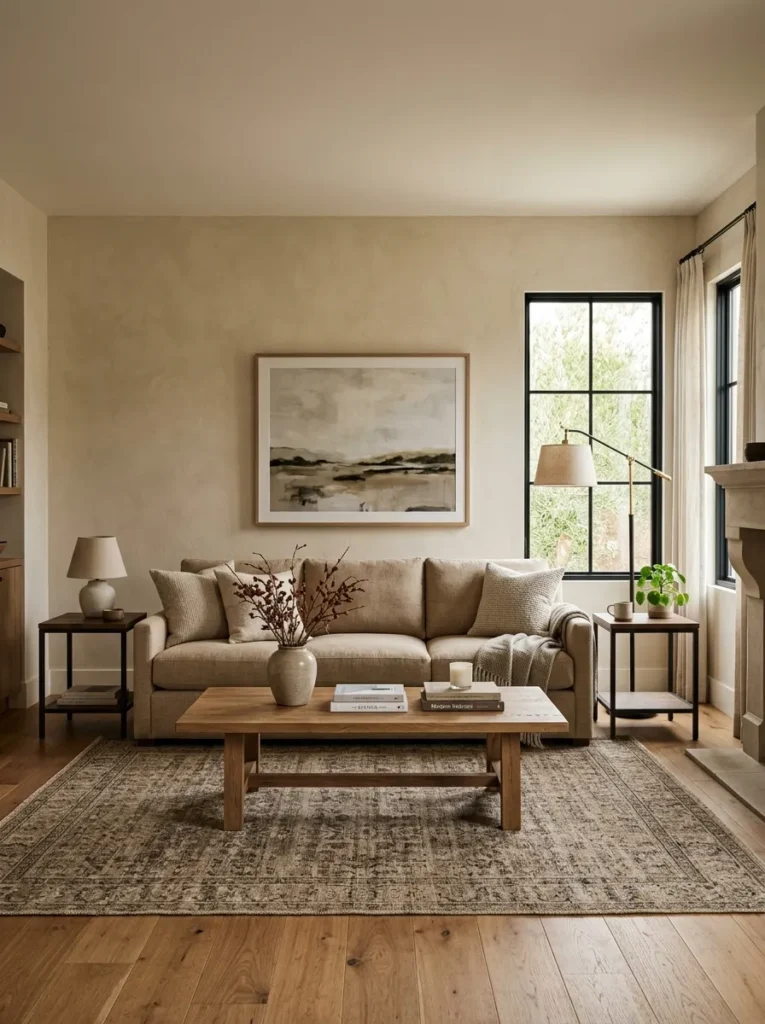
Vibe: The room is resolved — furniture at the correct scale for the room and for each other creates the quality of a professionally designed interior, where every piece relates proportionally to its neighbors and to the room’s dimensions rather than competing or shrinking.
Why it works: Furniture scale mismatch is the most pervasive room decorating problem in residential interiors — specifically, furniture that is too small for the room’s scale, creating floating, disconnected pieces that make the room feel empty and unresolved even when many pieces are present. The correct scale relationships (sofa spanning 2/3 of the primary wall, coffee table at 1/2 to 2/3 of the sofa’s length, side tables at sofa arm height) are the proportional ratios that interior designers use as baseline specifications because they create the visual relationships that read as naturally resolved — the furniture appears to belong together and to belong in the room.
How to get it: Before purchasing any furniture, measure the room and create a scaled floor plan (graph paper or a free room planning app). Test furniture dimensions on the floor plan before purchasing — a sofa that appears normal-sized in a showroom may be too small for the room’s scale or too large for the furniture arrangement. The most common scale mistake is a rug that is too small (purchase one size larger than initially planned) and a sofa that is too small (measure the primary wall and choose a sofa at least 60% of that wall’s length).
Shop The Look
- Room planning app furniture scale
- Graph paper floor plan room
- Furniture scale guide proportions
- Room furniture arrangement planner
- Scale template furniture living room
13. Create a Reading or Conversation Corner
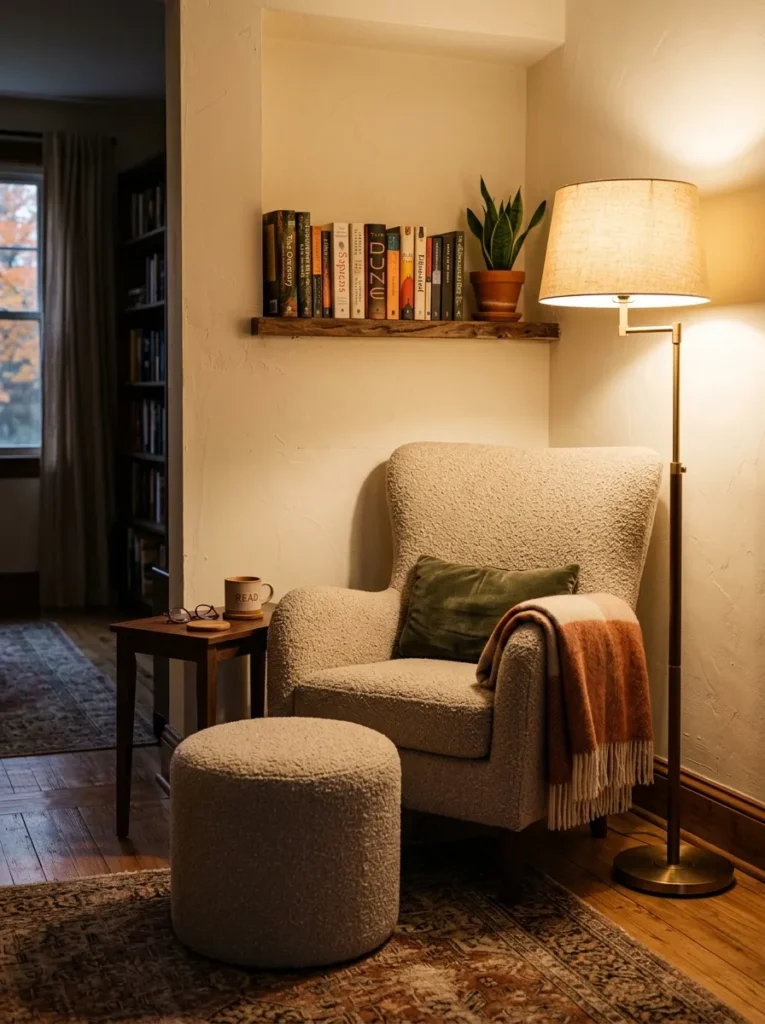
Vibe: The corner is intimate — a composed reading or conversation corner with a quality armchair, directional floor lamp, and side table creates the most genuinely comfortable and most personally meaningful zone in any room — a space designed for a specific and valued human activity rather than for general circulation.
Why it works: A reading or conversation corner creates the specific quality that distinguishes a genuinely inhabited room from a merely furnished one — the evidence that the room has been designed for specific human activities rather than arranged for general domestic utility. The armchair at 45 degrees to the corner (the most welcoming orientation, which faces both toward the room’s social center and toward the corner’s privacy), the floor lamp at the correct reading height (shade bottom at shoulder height of the seated occupant), and the side table within arm’s reach (for a drink, a book, and nothing else) create a complete functional composition that makes the corner feel like a room within the room — an intimate destination rather than a seating option.
How to get it: Position the armchair at 45 degrees to the room’s corner, approximately 2 feet from each wall. Place a small side table ($50–$150) at arm height (the table surface at the same height as the chair’s arm) within 12 inches of the chair’s right or left side. Position a floor lamp immediately beside the chair (within 6 inches of the chair’s side) with the shade bottom at approximately 20 inches above the seat surface. Add a footstool or small ottoman ($40–$150) in front of the chair at leg-rest height.
Shop The Look
- Quality armchair linen reading corner
- Boucle reading chair warm cream
- Small side table reading corner
- Floor lamp reading position warm
- Footstool ottoman reading corner
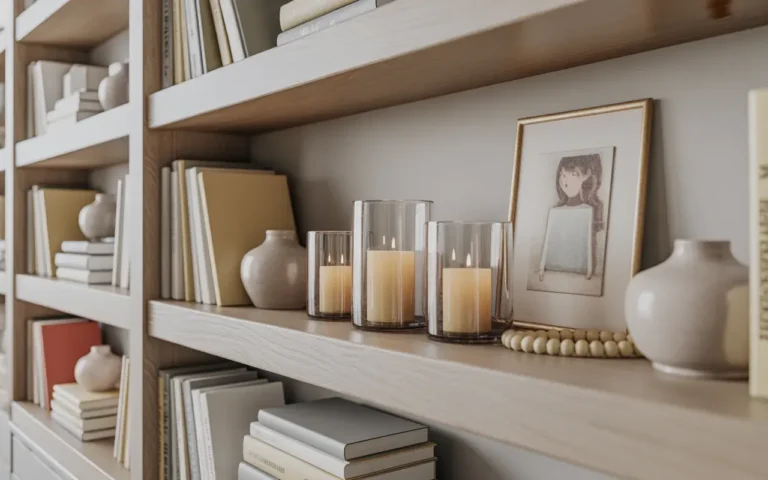
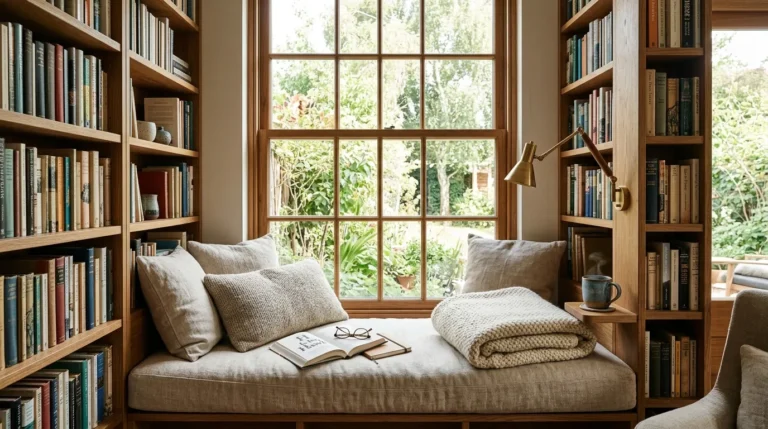
14. Use Books as Design Elements in Every Room
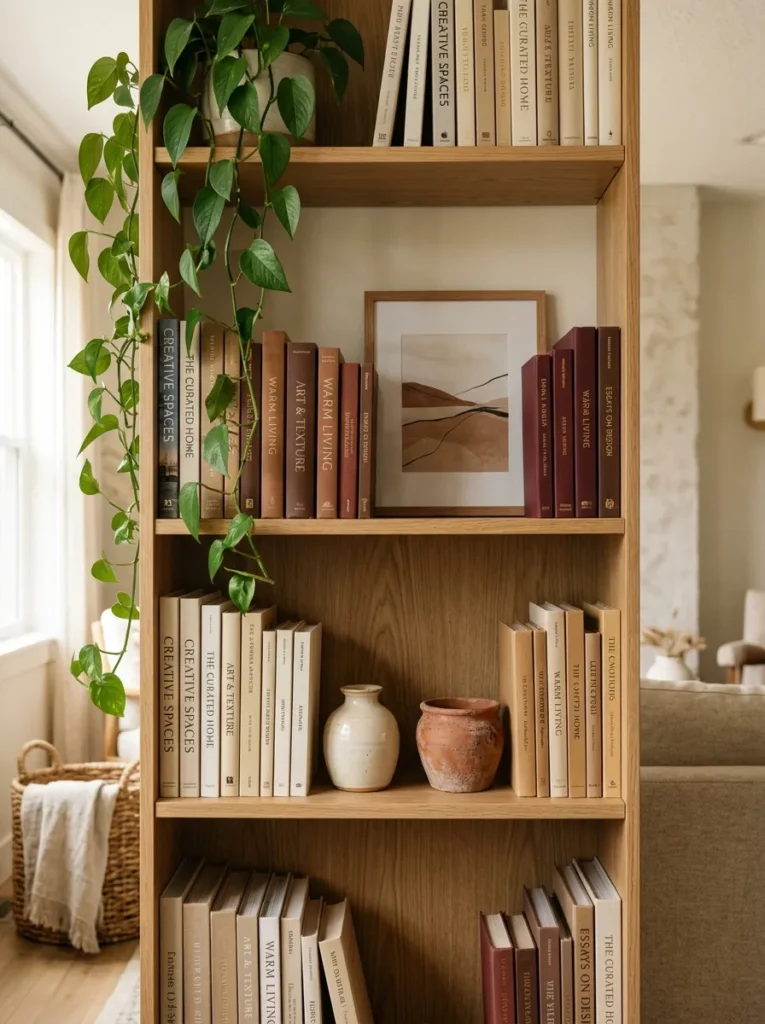
Vibe: The bookshelf is composed — books organized by spine color in a warm tonal progression create a warm material composition at the bookshelf’s scale that reads as a designed room element rather than a storage solution, communicating the intellectual and aesthetic life of the room’s inhabitants.
Why it works: Books organized by spine color are the room decorating approach that most elegantly combines the functional with the aesthetic — the books are genuinely accessible and genuinely used, but their arrangement (by the tonal progression of their spine colors rather than by author or subject) creates a warm material composition that warms the bookshelf as a visual element. The removal of book jackets (which are designed for retail display rather than home decoration) reveals the underlying hardcover bindings in warm, varied tones that contribute to the tonal composition far more effectively than the commercial imagery of retail jackets. The interspersed ceramic objects, plants, and leaning prints create the rhythm that prevents the shelf from reading as a purely utilitarian storage wall.
How to get it: Remove all book jackets from hardcover books and organize the resulting bare hardcovers by spine color in a warm tonal progression from cream to tan to warm brown to warm burgundy. Place one ceramic or sculptural object per shelf at an irregular position (not centered) — the object position should create visual rhythm across multiple shelves rather than centering on each shelf individually. Add one trailing plant at a shelf position where it can cascade downward, and one leaning print (small framed artwork leaning against the back of a shelf) at the shelf level that most needs visual interest.
Shop The Look
- Quality hardcover books warm spine
- Ceramic shelf object display
- Trailing plant shelf small
- Small frame art leaning shelf
- Book organization color system
15. Incorporate Personal Objects and Inherited Pieces
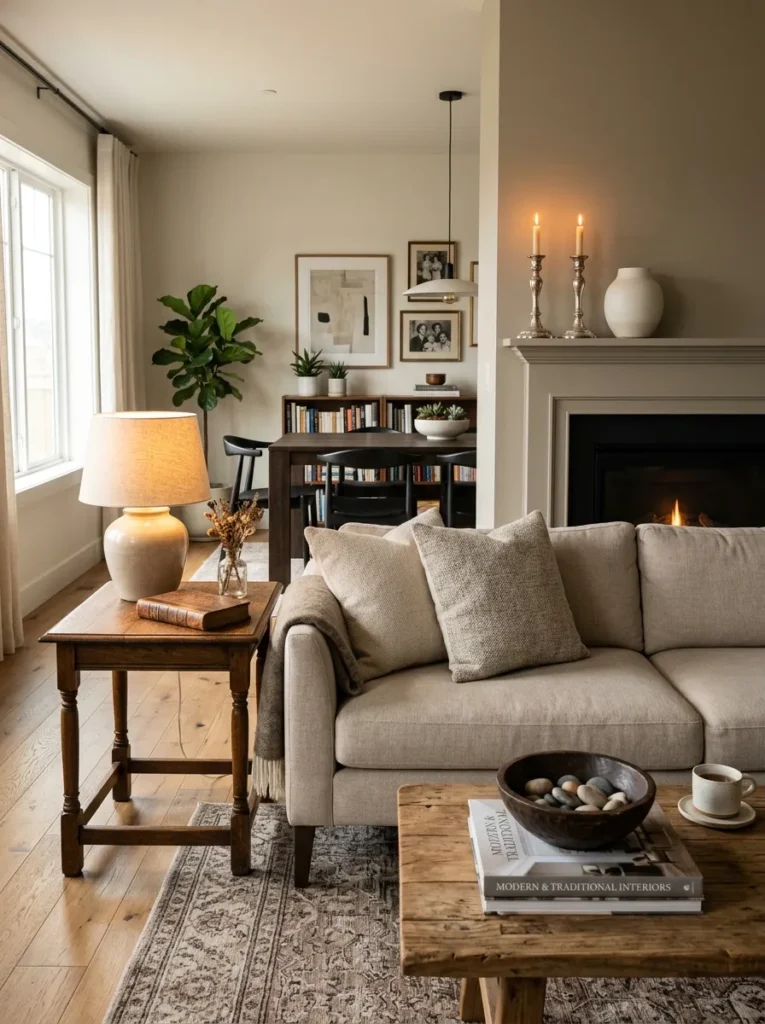
Vibe: The room is personal — the integration of inherited pieces, travel acquisitions, and genuinely meaningful objects within a contemporary design creates the most authentic form of room elegance — a room that could belong to only one specific household with one specific history and one specific set of aesthetic experiences.
Why it works: Personal objects and inherited pieces provide the room with what no retail purchase can supply — genuine history, genuine connection, and genuine uniqueness. An inherited silver candlestick pair has been owned, used, and cared for across multiple generations; a travel-acquired wooden bowl was selected in a specific place at a specific moment of genuine discovery; a grandmother’s ceramic was chosen by someone with genuine taste for a purpose of genuine daily use. These material histories are visible and perceptible in the objects themselves — the patina of a used silver piece, the wear pattern of a daily-used bowl — and they communicate the specific quality of genuine inhabitation that makes a room feel genuinely elegant rather than expertly staged.
How to get it: Identify the three to five personally meaningful objects currently in storage or in inconspicuous positions in the home — inherited pieces, travel acquisitions, gifts of genuine meaning — and find the correct place for each in the home’s designed rooms. The position should allow the object to be seen and experienced daily rather than stored for occasional display. The styling principle for personal objects in contemporary rooms is to give them sufficient negative space around them — a single inherited candlestick pair on a cleared mantel reads as more personally significant than the same pair buried among eight other mantel objects.
Shop The Look
- Antique side table inherited style
- Silver candlestick pair vintage
- Wooden bowl travel organic display
- Personal object display quality
- Inherited piece styling guide
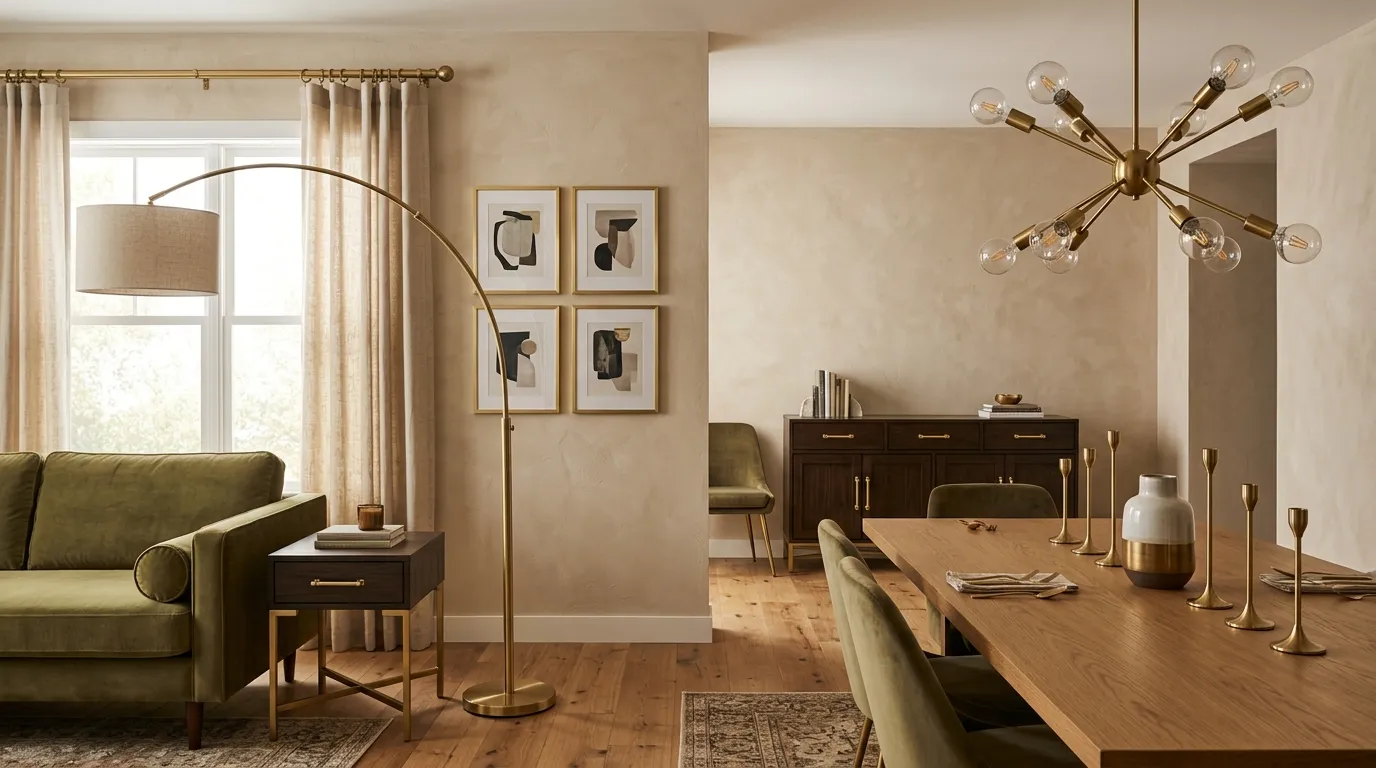
16. Maintain Consistent Metallic Finish Throughout
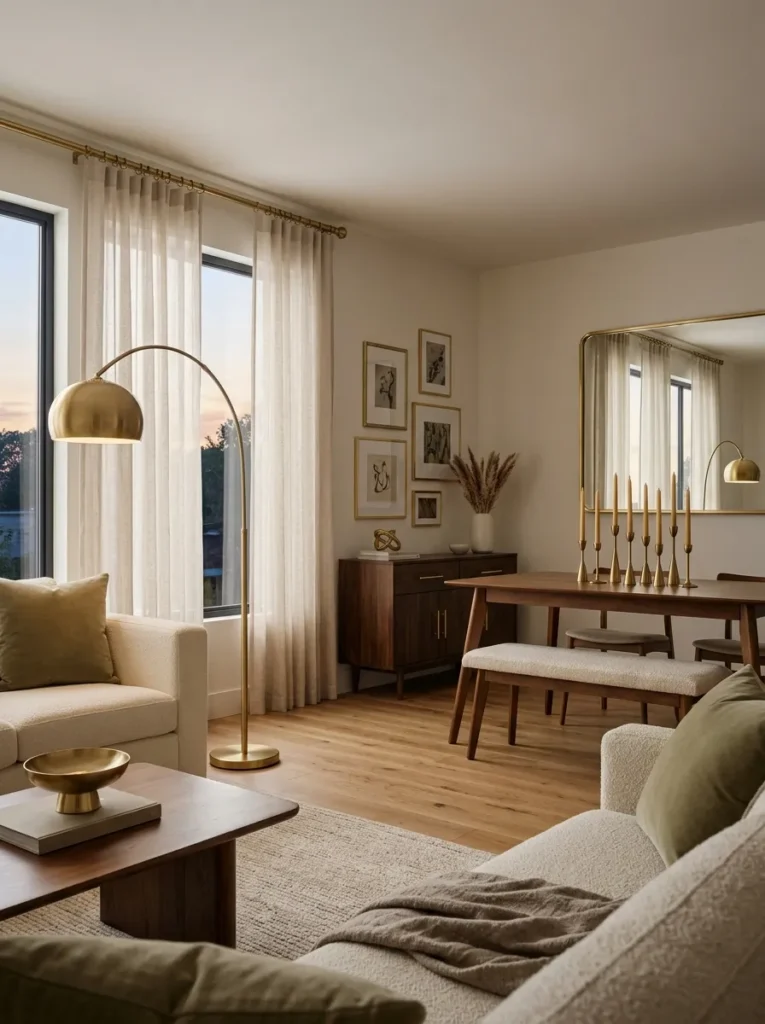
Vibe: The room is cohesive — consistent metallic finish throughout all decorative hardware elements creates the quality of a professionally designed interior, where the shared metallic language makes every element feel deliberately related to every other.
Why it works: Metallic finish consistency is the detail-level design decision that most clearly separates a designed room from an assembled one — in a room where the floor lamp is brushed nickel, the curtain rod is chrome, the picture frames have aged gold trim, and the cabinet hardware is oil-rubbed bronze, each element is individually reasonable but collectively incoherent. The eye processes the varied metals as random rather than intentional, creating the impression of objects purchased separately without reference to each other. When all metallic elements are in the same finish family, the room reads as having been designed from a single material brief — every metallic detail relates to every other through their shared finish, creating the visual unity that communicates professional design intelligence.
How to get it: Choose a single metallic finish direction for each room — brushed brass (the warmest, most currently resonant choice), matte black (the most graphic and most contemporary), or aged silver (the coolest, most traditionally elegant). Create a replacement plan for all metallic elements that do not match the chosen finish — curtain rod, lamp, picture frames, candle holders, vase hardware, cabinet pulls and knobs. Replace in order of most visible first, most expensive last, over 3–6 months. Total investment for metallic cohesion in a standard room: $80–$300 in replacement hardware and accent pieces.
Shop The Look
- Brushed brass curtain rod set
- Matte black picture frame set
- Aged silver candle holder pair
- Brass floor lamp consistent finish
- Consistent metallic hardware set
17. Style the Room for Its Primary Activity
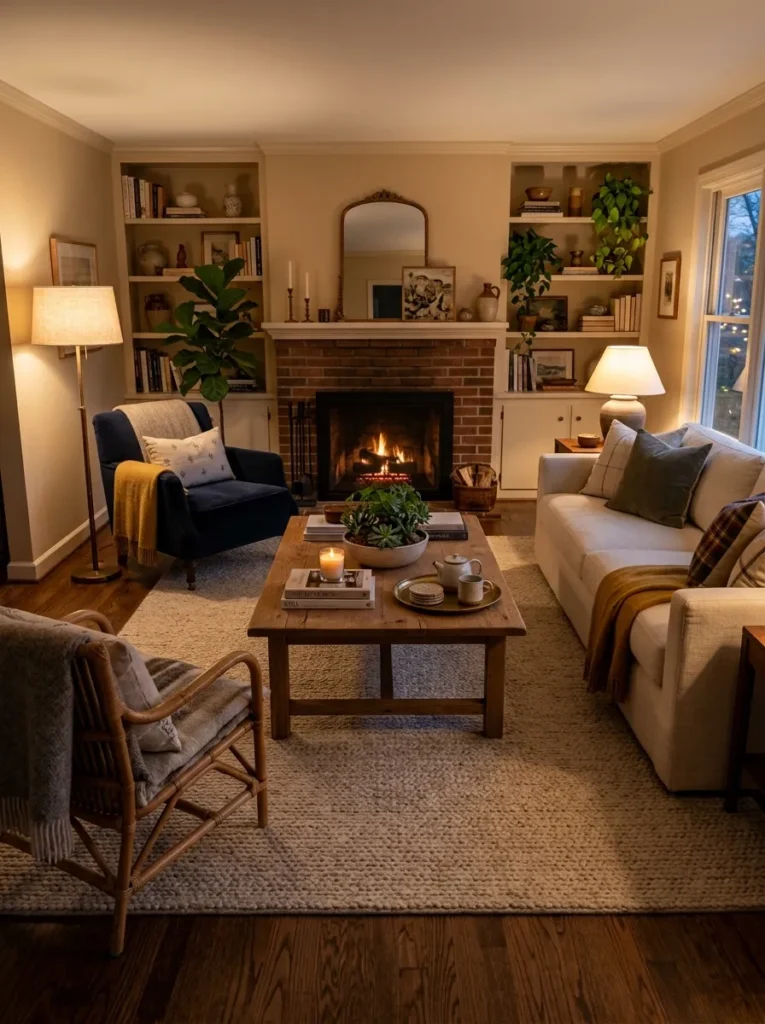
Vibe: The room is purposeful — styling a room for its primary intended activity (conversation, reading, dining, sleeping) creates the most authentically elegant version of that room, where every furniture position, every light source, and every object selection serves the room’s specific human purpose rather than generic domestic decoration.
Why it works: The most fundamentally elegant rooms are those designed for a specific and valued human activity — the dining room designed for genuinely pleasurable meals (with lighting that flatters both the food and the diners, a table at the correct scale for the household’s entertaining frequency, and chairs comfortable for two-hour dinners), the bedroom designed for genuine rest (with warm, dimmable light, quality bedding, and minimal visual distraction), and the living room designed for genuine conversation (with seating arranged toward each other rather than toward a screen, and lighting at the conversational level). A room styled for its actual primary use communicates a respect for that activity that generic decorating cannot replicate.
How to get it: Identify each room’s primary intended activity (the specific human experience the room is designed to support) and assess every furniture position, every light source, and every decorating object against the question: does this serve or enhance the room’s primary activity? In a conversation-oriented living room: orient all seating toward the conversation zone (not the television), position the coffee table at 14–18 inches from the sofa front (conversation distance, not television-watching distance), light with multiple warm dimmed sources at conversation level, and choose decorating objects that invite curiosity and discussion (interesting art, quality books, beautiful natural objects). Remove everything that does not serve the room’s primary activity.
Shop The Look
- Conversation seating arrangement guide
- Coffee table correct distance sofa
- Living room activity oriented design
- Dining room elegant occasion ready
- Room purpose design guide
How to Implement Elegant Room Decorating Throughout Your Home
The correct implementation sequence for elegant room decorating is: lighting first, editing second, textiles third, and decorating objects fourth. Lighting first because it affects every other element’s perceived quality — the most beautiful room looks mediocre under poor light, and a modest room looks genuinely elegant under warm, dimmed, layered light. Editing second because no decorating addition improves a cluttered room — the negative space that editing creates is the canvas on which all subsequent additions make their full impact. Textiles third because they are the room’s primary warmth and comfort providers at both the tactile and visual level. And decorating objects last — after the room is correctly lit, edited, and textile-layered, the objects placed within it will each have maximum impact and maximum clarity.
The most pervasive elegant room decorating mistake is conflating elegance with formality — many people approach “elegant” decorating as synonymous with stiff, untouchable, and unpersonally formal. The most genuinely elegant rooms are the opposite — they are warm, materially rich, personally meaningful, and completely livable. The Parisian apartment that is the reference point for elegant residential design is characterized by comfort, personal objects, and visible evidence of genuine inhabitation (books read and replaced, plants cared for and growing, surfaces that show daily use) alongside material quality and compositional intelligence. Elegant rooms feel better to live in, not better to look at from a safe distance.
Three across-the-home elegant decorating upgrades that cost under $80 total: replacing all home light bulbs with warm 2700K equivalents ($30–$50) which immediately improves the perceived quality of every room; removing every object from every surface in every room to zero and returning only the objects that genuinely belong there ($0 — through subtraction), which reveals the surface quality of every piece of furniture and creates the negative space that makes every remaining object more impactful; and adding one quality linen or natural fiber textile (a throw blanket, a set of curtains in one key room, or a quality cushion cover set) in the home’s primary color palette ($20–$60) which introduces the natural textile warmth that most homes need more of. These three changes cost under $100 total and produce more immediate and more lasting elegant room improvement than any furniture purchase at any price.
A completely elegantly decorated home — correctly lit with warm dimmed layered light, edited to maximum three objects per surface, furnished with correctly scaled furniture in natural materials, dressed with consistently metallically finished hardware, styled with genuine personal objects alongside quality purchased pieces, and inhabited by large architectural plants that grow and change — is not a static achievement but a continuous practice. Elegant rooms are maintained by the ongoing discipline of returning objects to their storage positions after use, continuing to subtract when accumulation creeps back, upgrading one material at a time as objects require replacement, and attending to the lighting quality as bulbs age and circuits are expanded. Elegance is a standard maintained over time rather than a destination reached once.
Frequently Asked Questions About Elegant Room Decorating
What is the single most important elegant room decorating change?
Replacing all light bulbs with warm 2700K equivalents and installing dimmer switches on the home’s primary room circuits is the single most impactful elegant room decorating change available at any budget level. Warm, dimmed light simultaneously improves the apparent quality of every material in the room (wood appears richer, linen appears warmer, stone appears more dimensional), creates the atmospheric depth that elegant rooms require (the pools of warm light with genuine shadow zones between them), and supports the physiological transition to relaxation and rest that the home’s evening function demands. A $50 investment in warm bulbs and one dimmer switch produces more visible room improvement than a $500 decorating purchase under existing cool-white full-bright lighting.
How do I make a small room look elegant rather than cramped?
Four specific decisions most effectively create elegant small rooms: floor-to-ceiling curtains (which make the room appear taller by drawing the eye vertically to the ceiling line), one large artwork rather than multiple small ones (which prevents the visual fragmentation that small rooms cannot afford), a correctly scaled rug in a warm, light neutral tone (which defines the room’s spatial zone without visually dividing it), and a maximum of three objects per surface (which prevents the visual clutter that makes small rooms feel overwhelmingly busy). Additionally, a large mirror positioned to reflect natural light creates the spatial expansion that most directly addresses the small room’s primary challenge. The common small room decorating mistake of choosing smaller-scale furniture “to save space” typically produces a room that feels more cramped, not less — correctly scaled furniture (the largest pieces that still allow comfortable circulation) makes small rooms feel more resolved and more elegant.
How much should I spend to make a room look elegant?
Elegant rooms are not correlated with decorating budgets — they are correlated with decision quality. The specific decisions that most consistently produce elegance (editing surfaces to a maximum of three objects, installing warm lighting on dimmers, hanging curtains from ceiling height, choosing one large artwork over many small ones, maintaining consistent metallic finish, and incorporating personally meaningful objects) cost little to nothing beyond the investment of attention and the confidence to subtract rather than add. The budget-most-impactful purchases for room elegance are warm light bulbs ($30–$80 for all rooms), dimmer switches ($60–$150 for all key circuits), quality natural linen curtains at ceiling height ($80–$200 per room), and one correctly sized area rug ($150–$400 for a quality option). Beyond these, elegant rooms benefit most from quality in the materials most touched and most seen daily — bedding, sofa upholstery, primary rug — rather than from comprehensive furniture replacement.
What colors make the most elegant rooms?
The most consistently elegant room color palette is warm neutral dominant with one or two deeper accent tones — specifically, walls and major furniture in the warm cream, warm white, and warm greige family, with deeper accents (forest green, warm charcoal, dusty rose, warm navy) in textiles and accent objects. This warm neutral dominant palette creates three qualities simultaneously: maximum luminosity (pale surfaces reflect maximum light), maximum perceived space (warm neutrals eliminate the contrast boundaries that divide rooms into smaller-reading zones), and maximum material emphasis (when color does not carry the room’s visual interest, material texture and quality must — which rewards investment in genuine natural materials over synthetic alternatives). Rooms decorated in this warm neutral dominant palette with warm 2700K lighting and natural materials are, with very few exceptions, the most consistently and most enduringly elegant rooms in the residential design canon.
How do I maintain an elegantly decorated room over time?
Elegant rooms are maintained through three ongoing practices: the daily return (every object used in the room is returned to its designated position before the room is left — this prevents accumulation from undoing the editing discipline that creates the elegant composition); the monthly audit (once per month, each room’s surfaces are assessed against the three-object maximum and any accumulated objects are returned to storage — this catches the gradual creep of surface accumulation that elegant editing prevents when practiced consistently); and the seasonal upgrade (one quality addition per room per season — a new linen cushion, a fresh botanical arrangement, a newly discovered plant, or a reposition of existing art — keeps the room’s composition fresh and evolving without the cost and disruption of comprehensive redecorating). Elegant rooms require ongoing attentive maintenance rather than a one-time decorating effort — they are practices more than achievements.
Ready to Decorate Every Room Elegantly?
These 17 ideas cover the full spectrum of what genuinely elegant room decorating achieves — from the immediate atmospheric transformation of warm lighting on dimmers and the architectural impact of floor-to-ceiling curtains, to the compositional confidence of a single large artwork and the material cohesion of consistent metallic finish throughout, from the spatial warmth of correctly sized area rugs and the organic vitality of architectural indoor plants, to the personal depth of inherited objects integrated with contemporary design and the purposeful intelligence of rooms styled for their specific primary activities, from the warmth of tonal textile layering and the material authenticity of consistent natural material use, to the organizational elegance of surface editing and the composed welcome of vignettes at every room’s entry point. You do not need all 17 to create genuinely elegant rooms throughout your home — you need the warm light in every fixture, the editing discipline on every surface, and the confidence to choose quality and restraint over accumulation and novelty. Start tonight with the bulbs: replace every light in one room with the warmest available equivalent and dim the circuit to 30%. Sit in the room that results. What you see is the elegant room that has been waiting inside every room you already have. Pin the ideas that named what each of your rooms is reaching toward — those are the ones worth implementing first.