13 Elegant Living Room Designs for Every Home
Elegant living room design refers to the approach that prioritizes considered proportion, material quality, visual restraint, and the specific atmospheric quality of rooms that have been thought about carefully — producing spaces that feel genuinely generous, warm, and sophisticated without relying on expensive objects alone to communicate their quality. This article gives you 13 elegant living room design ideas that work across every architectural style, every budget level, and every personal aesthetic direction — from quietly minimal to richly layered maximalist — each one united by the principle that elegance is a design quality produced through intention and proportion rather than through spending alone.
Picture a living room where everything feels exactly right — where the sofa sits in the correct relationship to the room’s volume, where the light arrives from the right places at the right warmth, where the rug anchors the furniture as a cohesive composition rather than as individual pieces placed independently, and where the whole environment produces an immediate and specific feeling of ease, welcome, and considered order that makes every person who enters it want to sit down and stay. That is what elegant living room design achieves at its best — not the display of wealth but the evidence of thought. Here are 13 ideas worth saving — and living in.
Why Elegant Living Room Design Works So Well
Elegant living room design succeeds as an approach because it operates from design principles that are independent of cost — correct furniture scale relative to room volume, warm and layered light quality, material honesty that rewards close looking, textural depth through textile layering, and the specific restraint of editing that removes every object that does not earn its place. These principles, applied consistently, produce rooms that feel significantly more expensive and more designed than their actual investment suggests — and rooms that violate these principles feel unsatisfying regardless of how much was spent on individual components.
The materials that define genuinely elegant living rooms are those with inherent depth and authenticity — hand-knotted wool rugs whose pile changes quality with viewing angle, natural linen upholstery whose woven irregularity is visible at close range, unlacquered brass whose patina develops uniquely with use, honed marble whose veining is different at every point, aged timber whose grain and surface history tell a specific material story, and hand-thrown ceramic whose making marks communicate genuine craft. These materials share the quality of authenticity — they are visibly what they are, and their age and use improve rather than diminish them.
The living room is the home’s primary social space — the room that communicates the household’s aesthetic identity most completely to anyone who visits, and the room in which the family itself spends the greatest proportion of its time at rest. The design investment applied to the living room therefore has a higher daily return than equivalent investment in any other room in the home, because the living room’s design quality is experienced more frequently, by more people, across more hours than any other domestic space.
Even the most budget-constrained living room can achieve genuine elegance in specific moments — one correctly proportioned hand-knotted rug beneath correctly scaled furniture, one quality lighting investment positioned to flatter rather than illuminate the space, one genuinely beautiful textile over an ordinary sofa — each one producing an elegance dividend that accumulates across the room’s composition.
Style at a Glance
| Element | Trait 1 | Trait 2 |
|---|---|---|
| Philosophy | Proportion and light as foundational elegance — the room that feels right before it is furnished | Material depth over material quantity — one excellent piece over many mediocre alternatives |
| Materials | Hand-knotted wool rug, natural linen, unlacquered brass, honed marble, aged timber, mohair velvet | Silk drapery, hand-thrown ceramic, lacquered wall panels, aged leather, hand-blocked wallpaper |
| Color Palette | Warm stone white, deep charcoal, warm cream, aged brass, forest green, dusty plum | Terracotta, warm caramel, deep navy, sage green, oxblood, natural undyed linen |
1. Classic Symmetrical Living Room with Paired Sofas
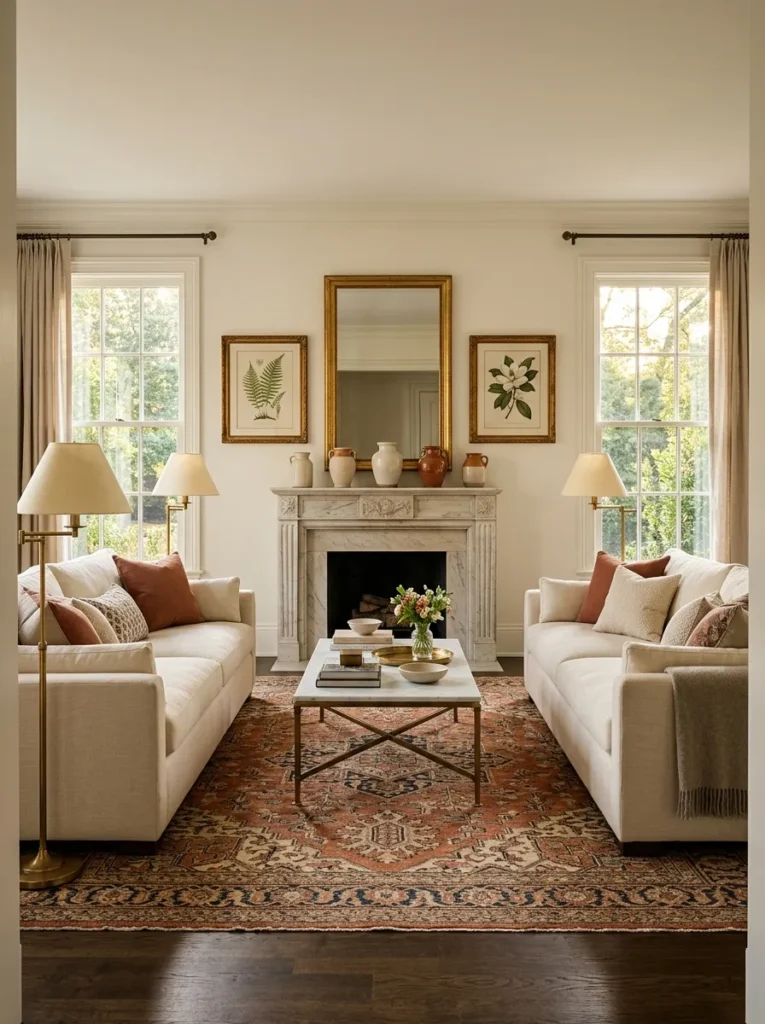
Vibe: Formal and warm — the living room that makes any occasion feel considered without ever feeling stiff.
Why it works: A classically symmetrical living room with paired sofas facing each other applies the oldest and most formally elegant spatial principle in residential design — bilateral symmetry, which the eye reads as order, completeness, and deliberate intention rather than the accumulated furniture arrangement that most living rooms produce over time. The paired sofa configuration is also the most socially generous seating arrangement available: it creates a natural conversation zone between the two sofas that accommodates four to six people in face-to-face positions, producing exactly the social dynamic that a living room is designed to facilitate. The centered fireplace as the room’s primary focal point organizes the symmetrical arrangement and provides the visual anchor from which all other element positions derive.
How to get it: Begin by establishing the rug’s position — the rug must be large enough for the front legs of both sofas to sit on it, which means sizing to the width of the sofa arrangement plus at least 45cm on each side. Position the sofas equidistant from the rug’s center line and equidistant from the coffee table. Install paired floor lamps at each end of the sofa arrangement — the lamps provide task lighting for readers at each sofa end while reinforcing the symmetrical composition. Style the fireplace mantel with an odd number of objects arranged symmetrically around the mantel’s central point.
Quick Win: Replacing mismatched throw pillows on an existing sofa arrangement with two identical pairs — one pair for each sofa in matching fabric — immediately creates a symmetrical visual rhythm across the seating arrangement without replacing any furniture.
| Product |
|---|
| Deep linen sofa cream upholstered pair |
| Hand-knotted wool rug terracotta cream |
| Marble-top coffee table rectangular |
| Aged brass floor lamp pair |
| Marble fireplace surround white |
Also view: 15 Stylish Green Living Room Designs for Every Home
2. Moody Dark Living Room with Velvet and Brass
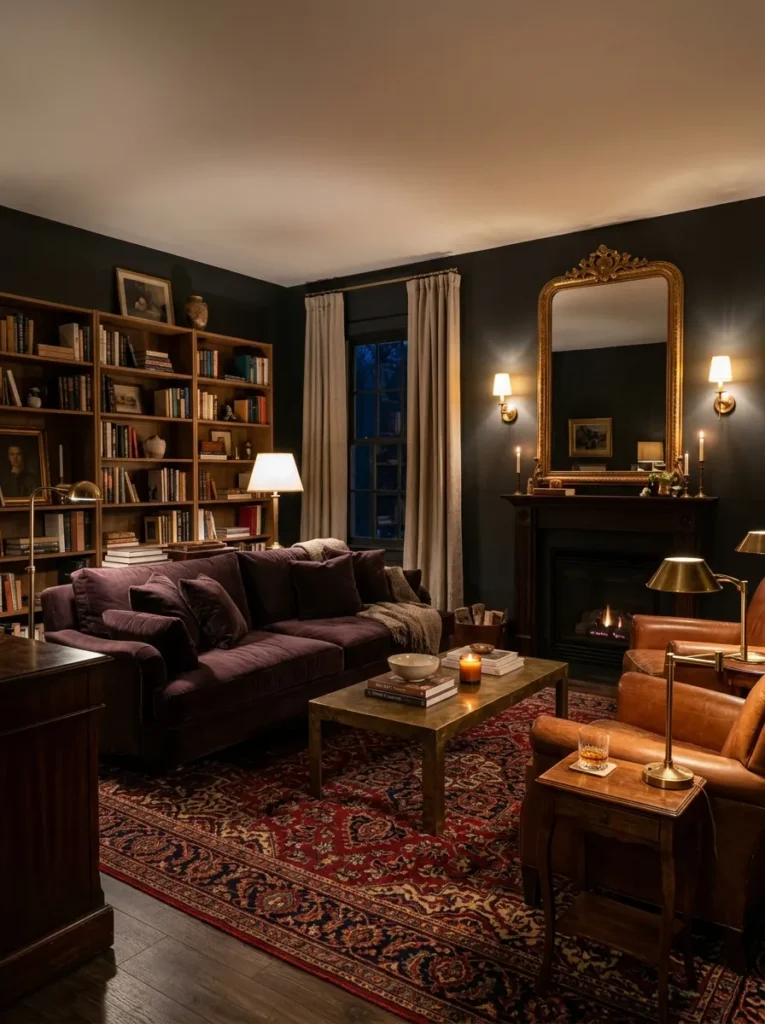
Vibe: Dramatic and enveloping — the living room that makes every evening feel like the beginning of a story worth telling.
Why it works: A dark living room with velvet and brass applies the chromatic enclosure principle to the home’s most social room — deep charcoal walls create a defined, intimate spatial quality that makes the room feel deliberately cozy rather than accidentally compressed, and the warm brass fixtures against the dark walls create the warm-against-dark light contrast that is the most flattering and most atmospheric artificial lighting condition available in any domestic room. Velvet is the upholstery fabric that most effectively communicates luxury in a dark room because its directional pile changes color with viewing angle, creating a surface that appears to have internal light and depth that flat-weave fabrics cannot produce in low light conditions. The unlacquered brass coffee table’s developing patina is specifically beautiful against the dark velvet and charcoal wall context — the warm, irregular brass surface provides the room’s primary metallic warmth against the dark palette.
How to get it: Paint walls in deep charcoal using an oil-based satin formulation — the oil-based satin produces a more luminous surface quality in low light than water-based equivalents. Specify feather-wrap cushion inserts for all sofa and chair cushions — the slight irregularity of feather-filled cushion surfaces is both more comfortable and more visually sophisticated in a luxury context. Install brass wall sconces on dimmer switches so the sconce light can be adjusted between functional brightness and atmospheric glow without changing the fixture or bulb.
| Product |
|---|
| Deep charcoal interior oil-based satin paint |
| Deep plum velvet sofa large |
| Unlacquered brass coffee table |
| Cognac leather armchair pair |
| Brass wall sconce pair dimmable |
3. Japandi Living Room with Natural Materials
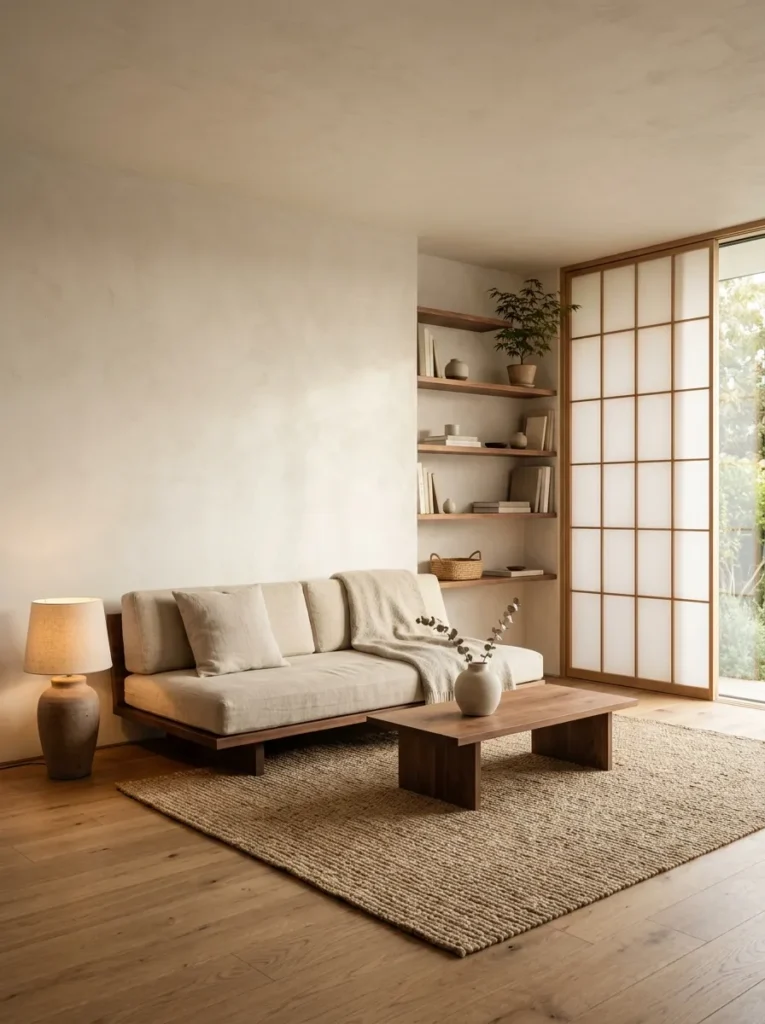
Vibe: Serene and minimal — the living room that makes stillness feel like the most intelligent response to being in it.
Why it works: A Japandi living room applies the combined design principles of Japanese wabi-sabi (finding beauty in imperfection and natural aging) and Scandinavian functional minimalism to produce a room where every material choice is both aesthetically considered and functionally purposeful. The low-profile furniture scale is the dimensional decision that most powerfully defines the Japandi aesthetic — low-slung walnut platform sofas and coffee tables that sit 30–40cm off the floor create a room that feels closer to the ground plane, which is the physical position associated with rest and contemplation in both Japanese and Scandinavian domestic traditions. The limewash wall treatment is specifically appropriate for Japandi interiors because its slightly imperfect, organically varied surface embodies the wabi-sabi appreciation of natural process and material character rather than mechanical perfection.
How to get it: Apply limewash in warm white (Kalk paint or traditional lime wash formulation) to all walls using a wide natural bristle brush in cross-directional strokes — the tonal variation produced by this technique creates a surface that reads as organically alive rather than flat. Source low-profile furniture from Scandinavian or Japanese-influenced furniture makers — seat heights of 35–40cm (versus the standard 42–46cm) are the dimensional threshold that most clearly signals the Japandi aesthetic. Edit all displayed objects to a maximum of three per surface — Japandi styling requires negative space between objects as a primary compositional element.
| Product |
|---|
| Limewash paint warm white Japanese style |
| Low walnut platform sofa natural linen |
| Natural fiber rug jute or sisal large |
| Low walnut coffee table Japandi style |
| Unglazed ceramic floor lamp |
4. French-Inspired Living Room with Parquet and Plaster
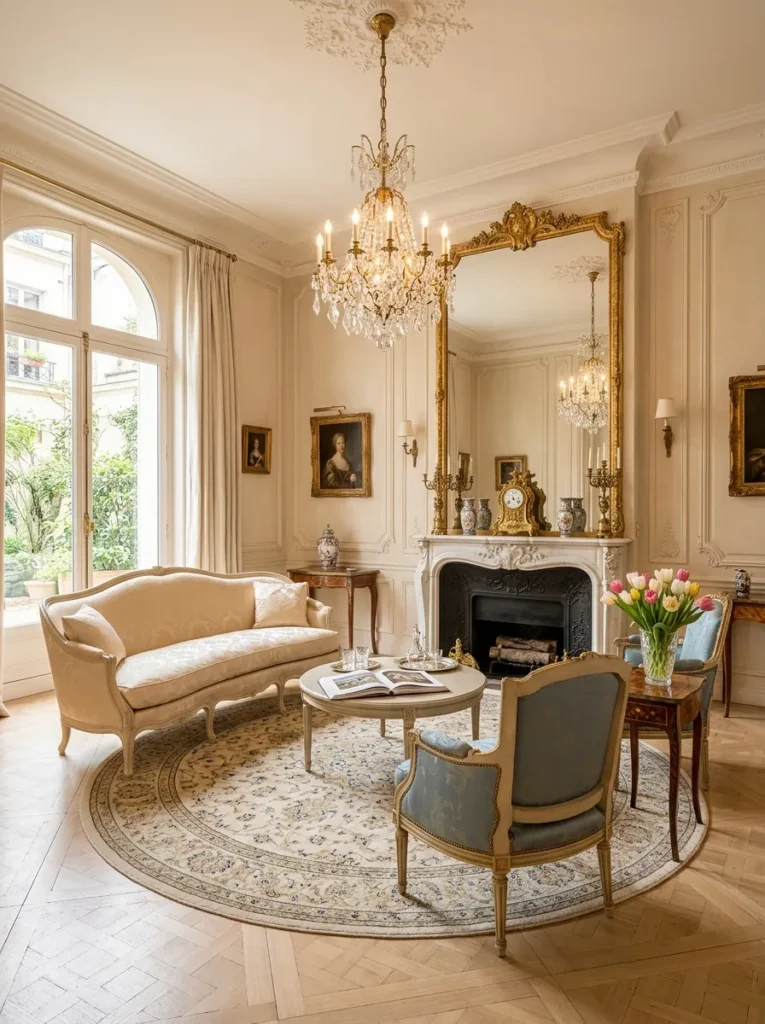
Vibe: Refined and luminous — the living room where the afternoon light does the majority of the decorating.
Why it works: A French-inspired living room with parquet flooring and plaster molding applies the design principle of architectural surface as primary decoration — in a room with genuine parquet flooring, classical plaster molding, and an antique marble fireplace, the architecture itself provides enough visual richness that furniture and accessories need only to complement rather than compete with or compensate for the room’s structure. The pale silk upholstery, faded blue bergère chairs, and crystal chandelier are each elegant in their own right, but their specific elegance in this context derives from their relationship to the architecture rather than from their individual quality. This is the French approach to interior decoration — the room is dressed rather than furnished, and the dressing defers to the architecture as the primary aesthetic statement.
How to get it: Install Versailles-pattern parquet in pale blonde oak or a bleached oak finish — this pattern (large squares formed by smaller diagonal blocks) is the most formally elegant parquet format and is now available as an engineered wood product at far more accessible cost than traditional solid timber. Apply plaster molding at the ceiling perimeter and around any existing doorways — modern foam or plaster-compound molding profiles applied with construction adhesive replicate classical molding profiles at accessible cost. Source a statement antique or reproduction marble fireplace surround as the room’s primary investment piece.
| Product |
|---|
| Versailles parquet flooring pale oak |
| Classical plaster ceiling molding set |
| Crystal chandelier traditional |
| Bergère armchair pair upholstered |
| Crystal clear vase for fresh flowers |
5. Contemporary Minimal Living Room in Warm Neutrals
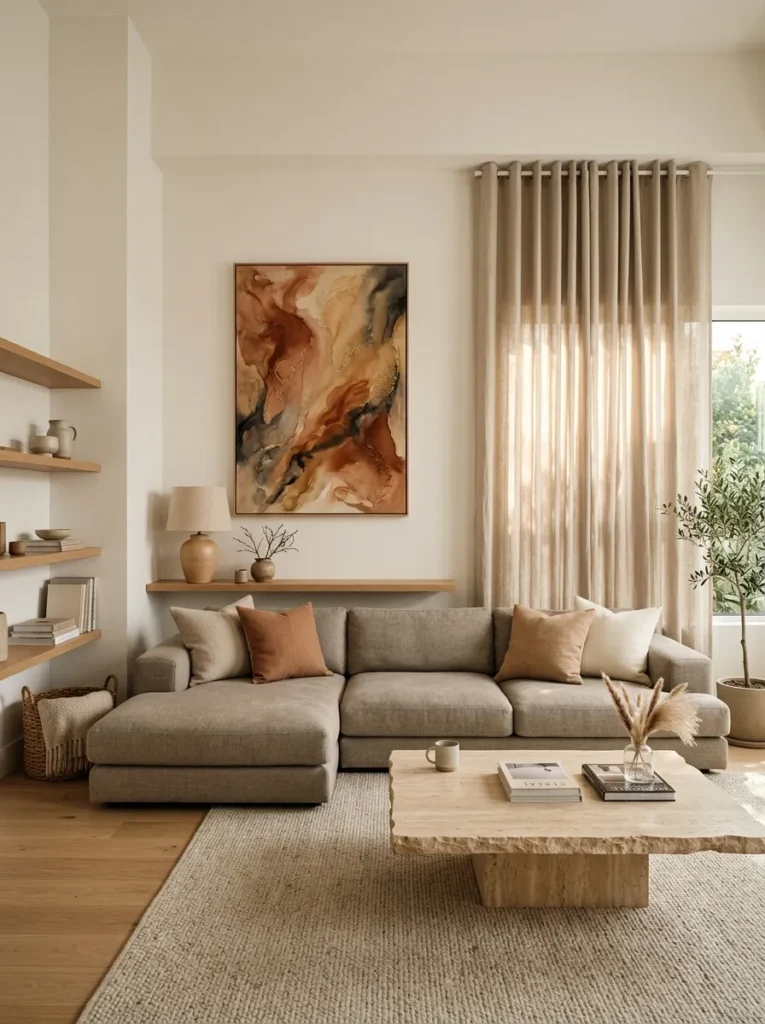
Vibe: Calm and considered — the living room that makes clarity feel like the most sophisticated design position available.
Why it works: A contemporary minimal living room in warm neutrals applies the design principle of tonal variation as visual interest within a restrained palette — rather than using color contrast between design elements, the room achieves visual richness through the tonal variation between different warm neutral materials (greige linen, warm travertine, oatmeal wool, natural oak, warm ceramic) whose differences are subtle enough to read as harmonious from a distance and interesting enough to reward closer inspection. The large abstract painting is the single design element that introduces the room’s most complex visual content, and its position above the sofa in the room’s primary wall position makes it the undisputed focal point — every other design decision defers to and supports the painting’s visual presence. Floor-to-ceiling linen curtains are the element that most dramatically improves the room’s apparent ceiling height and spatial generosity — they draw the eye upward and make the room feel 20–30% larger than it is.
How to get it: Invest the room’s primary budget in the rug, the painting, and the curtains — these three elements determine 70% of the room’s visual quality and are the most difficult elements to upgrade incrementally after the room is furnished. The sofa, shelving, and lamps can be sourced at more accessible price points without compromising the room’s overall elegance because their supporting visual role means their individual quality matters less than their collective tonal relationship.
| Product |
|---|
| Large low linen sofa warm greige |
| Travertine coffee table natural stone |
| Oatmeal wool area rug large |
| Ceramic table lamp warm tone pair |
| Floor-to-ceiling linen curtain panel set |
6. Library Living Room with Floor-to-Ceiling Books
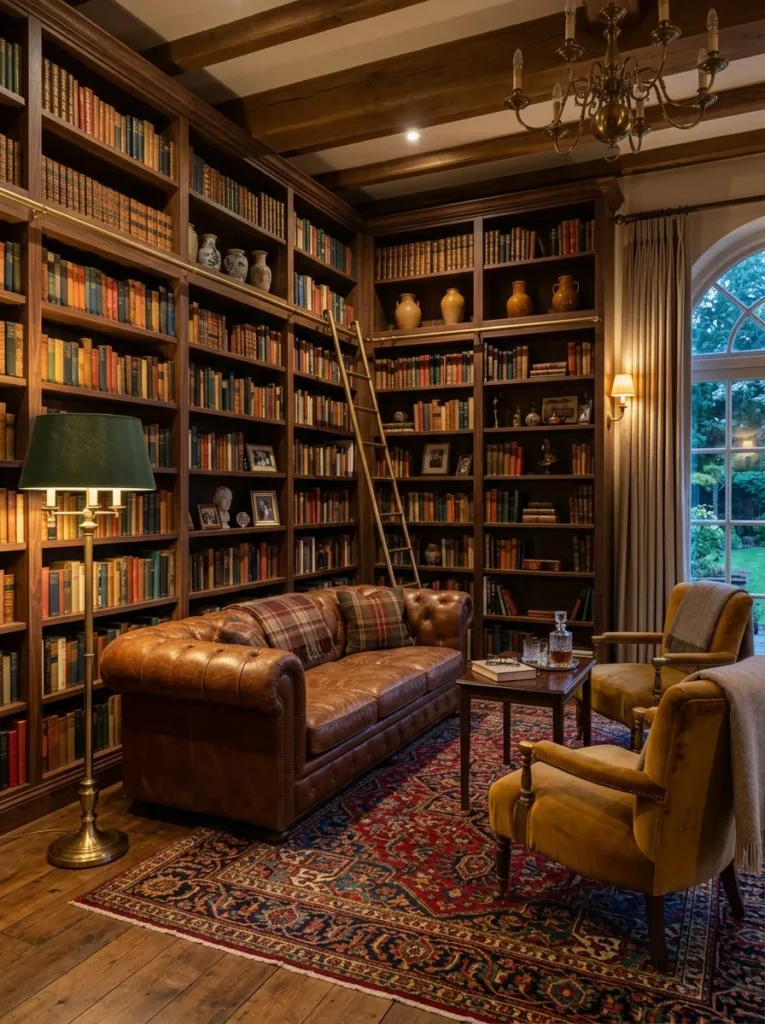
Vibe: Scholarly and enveloping — the living room that makes reading feel like the most important thing happening in the world.
Why it works: A library living room with floor-to-ceiling bookshelves applies the design principle of enveloping material richness through book accumulation — books are the most materially diverse wall covering available, providing a continuously varied composition of color, texture, and dimensional interest that no wallpaper or paint can replicate because books change as they are added, removed, and rearranged over a lifetime of reading. The specific social quality of a library living room is also distinct from other elegant living room configurations — the presence of books signals intellectual generosity, the suggestion that ideas and stories are as welcome in the room as their human carriers, which gives the space a warmth and depth that architecturally plain rooms cannot manufacture through decoration alone.
How to get it: Build floor-to-ceiling bookshelves in dark walnut or dark-stained MDF using full-height panel units with adjustable shelf pins — the adjustable shelves allow the shelf height to be varied between different sections of the bookshelf run for the visual complexity that fixed-height shelves cannot produce. Install the rolling brass library ladder before completing the top shelf — the ladder rail requires a clear mounting path that is easiest to establish before the final shelf is installed. Style the shelves with books grouped loosely by color family interspersed with ceramic vessels and objects — pure alphabetical or categorical organization produces a more uniform appearance that reduces the visual richness of the book surface.
| Product |
|---|
| Floor-to-ceiling bookshelf dark walnut |
| Library rolling ladder brass rail |
| Cognac leather Chesterfield sofa |
| Persian rug jewel tones large |
| Brass floor lamp with green shade |
7. Art-Centric Living Room as Gallery Space
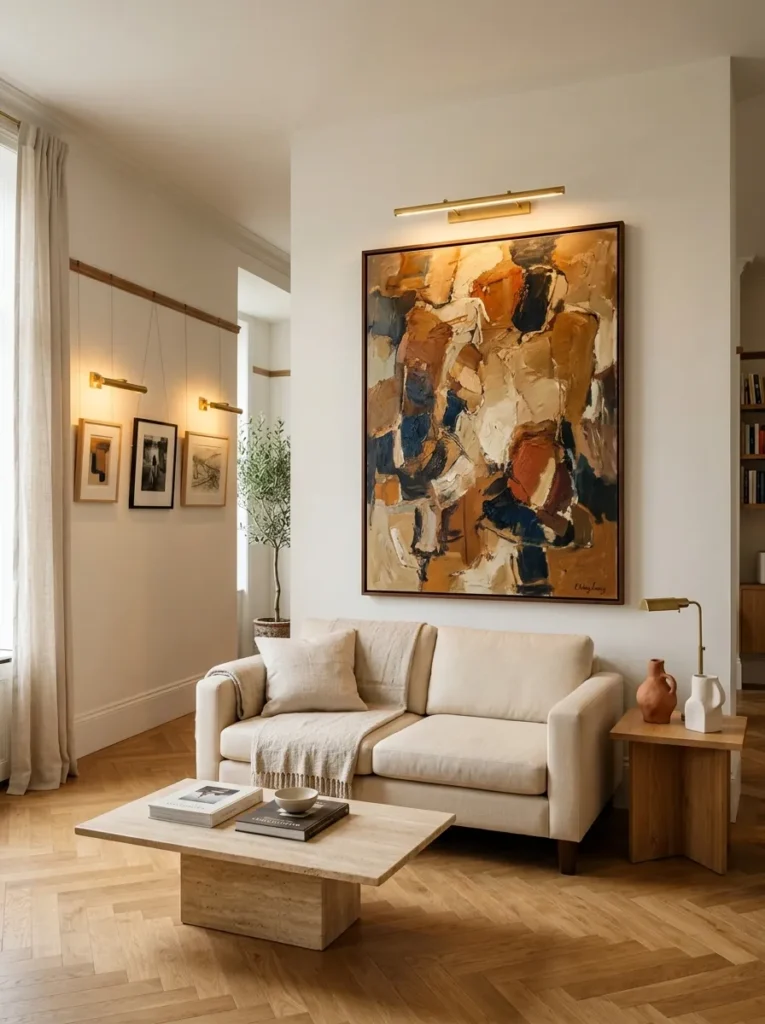
Vibe: Quiet and focused — the living room whose furniture arrangement acknowledges that the painting is the most important presence in the room.
Why it works: An art-centric living room applies the gallery design principle of neutral support — when a genuinely significant artwork is the room’s primary design investment and design identity, every other element (wall color, sofa fabric, coffee table material, floor finish) should recede to support rather than compete with the artwork’s visual presence. The warm white wall is specifically not pure gallery white — pure white in a residential context reads as cold and clinical; warm white with a slight yellow or cream undertone reads as domestic and inviting while providing the same neutral backdrop quality. The sofa positioned to face the primary painting is the spatial decision that most directly communicates that the artwork is the room’s focal point — the furniture arrangement treats the painting as a destination within the room rather than as a wall decoration peripheral to the seating zone.
How to get it: Install a dedicated picture light above the primary artwork — a properly designed picture light (either corded or hardwired) illuminates the artwork from its own light source rather than relying on ambient room lighting, which improves color accuracy and reduces glare. Size the artwork to the wall — a work that is 50–75% of the wall width reads as properly scaled; anything smaller reads as decorative rather than dominant. Hang the artwork center at standard 150–160cm eye height regardless of the wall’s total height.
| Product |
|---|
| Large abstract oil painting original |
| Picture light brass above artwork |
| Warm cream performance fabric sofa |
| Natural stone coffee table minimal |
| Picture rail system for additional works |
8. Coastal Elegant Living Room in Bleached Tones
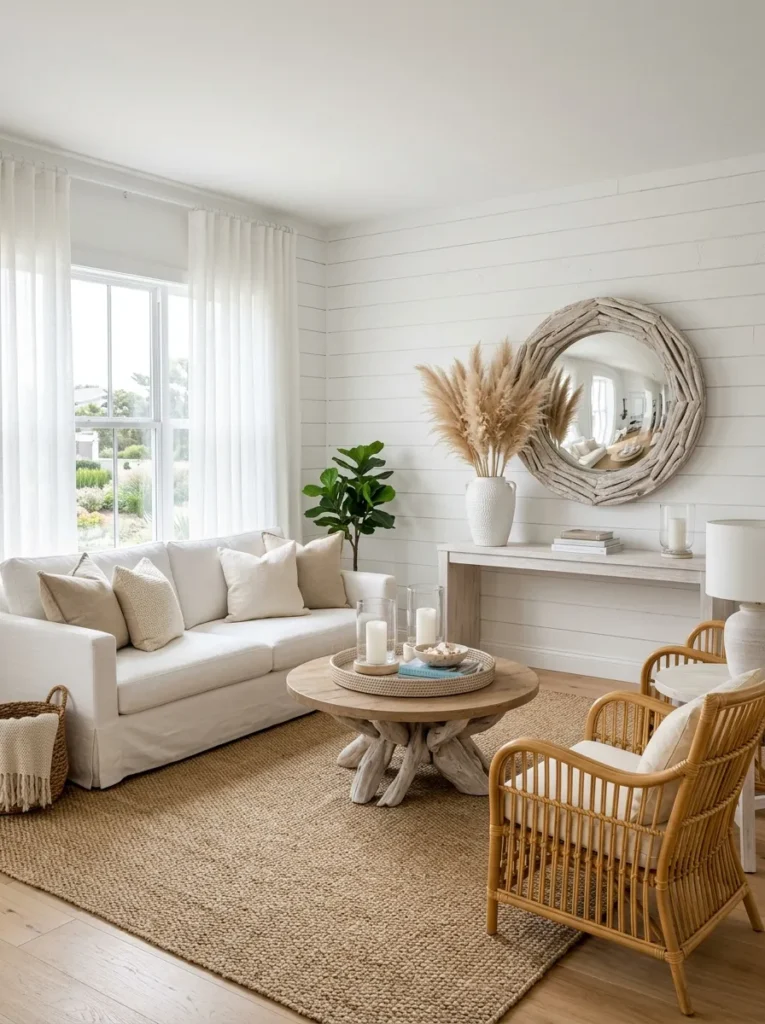
Vibe: Bright and serene — the living room that makes you feel like you arrived somewhere genuinely restful the moment you sit down.
Why it works: An elegantly coastal living room in bleached tones applies the design principle of tonal restraint within a natural material family — by using white, natural linen, bleached oak, seagrass, rattan, and driftwood-gray as the room’s complete material palette, the room achieves a visual cohesion through material family membership that makes the space feel simultaneously simple and richly textured. Each material in this palette belongs to the same organic, sun-bleached, sea-adjacent material family, which means there are no visual conflicts between elements — everything relates to everything else through a shared material language. The convex mirror in a driftwood frame is the specific accent that gives this coastal elegant room its distinctive quality — convex mirrors reflect a wide-angle view of the room and surrounding light, creating a warm, spherical focal point that adds visual interest without competing with the palette’s tonal restraint.
How to get it: Install shiplap or board-and-batten wall paneling in crisp white on the primary wall — the paneling’s horizontal lines provide the visual warmth and texture that plain drywall walls cannot achieve. Source a genuine seagrass area rug rather than a printed alternative — the actual fiber texture of real seagrass is what produces the characteristic scratchy warmth underfoot and the light-diffusing surface quality that synthetic alternatives cannot replicate. Slipcover an existing sofa in white linen as an accessible alternative to purchasing a new slipcovered piece.
| Product |
|---|
| White shiplap wall paneling set |
| Natural seagrass area rug large |
| White linen sofa slipcover |
| Bleached oak coffee table |
| Driftwood frame convex mirror |
9. Maximalist Living Room with Layered Pattern
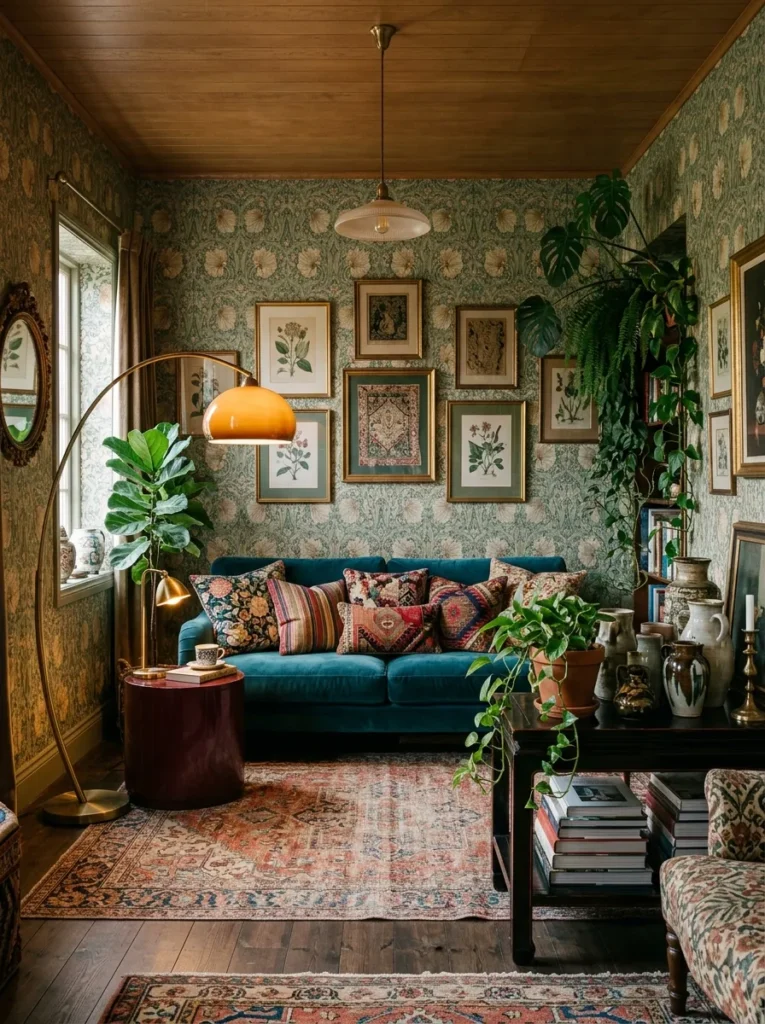
Vibe: Lush and warm — the living room that rewards sustained looking because there is always more to find.
Why it works: A maximalist living room with layered pattern applies the design principle of pattern family coherence as complexity management — the secret of maximalist rooms that work versus those that overwhelm is not the quantity of pattern but the tonal family relationship between all patterns present. When every pattern in the room — the wallpaper’s botanical motif, the cushions’ geometric stripe, the rug’s medallion — shares a common warm color register (deep sage, cream, warm red, teal, burgundy), the eye reads the multiple patterns as variations on a theme rather than competing visual demands. Tonal family coherence makes any quantity of pattern readable and pleasurable rather than chaotic.
How to get it: Choose the wallpaper first — it is the room’s dominant pattern and the tonal reference from which all other pattern choices should be derived. Select additional patterns (cushion fabrics, rug) by testing them against the wallpaper in physical swatches rather than screen images — color relationships between patterns are difficult to assess accurately on screen and must be verified in person. Mix pattern scales deliberately — a large-scale botanical wallpaper requires at least one small-scale pattern (geometric stripe cushion) to create the scale variety that makes pattern mixing successful.
| Product |
|---|
| Floral botanical wallpaper sage cream |
| Deep teal velvet sofa large |
| Vintage Turkish rug warm tones |
| Burgundy lacquered side table |
| Mixed pattern cushion cover set |
10. Mid-Century Modern Living Room with Warm Tones
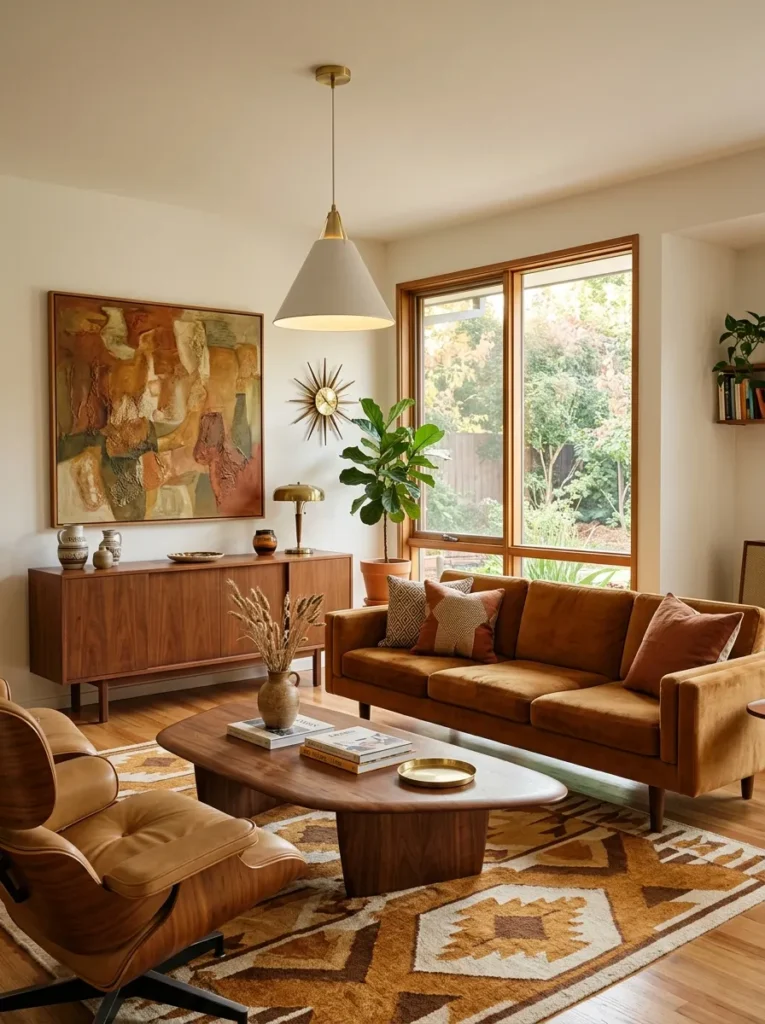
Vibe: Warm and retro-sophisticated — the living room that makes the 1960s feel like the most forward-thinking decade in design history.
Why it works: A warm mid-century modern living room applies the design principle of period-specific material vocabulary — walnut, mohair, tan leather, and brass are the specific material family of American mid-century modern furniture design, and their use together creates the precise design atmosphere associated with this period rather than a generic “vintage” quality that mixed-era furniture cannot produce. The low furniture profile of genuine mid-century design (sofa seat heights of 38–40cm, coffee table heights of 35–40cm) is the dimensional decision that most clearly defines the mid-century aesthetic — the furniture sits in a specific relationship to the floor that high-seated contemporary furniture cannot replicate. The sunburst brass clock and cone pendant are the decorative accent types most strongly associated with mid-century design without crossing into literal reproduction.
How to get it: Invest in genuine walnut or walnut-veneered furniture rather than walnut-stained alternatives — the grain and natural color of walnut is distinctive and recognizable in a way that walnut stain on other species cannot replicate. Source mid-century inspired furniture from specialist makers who work in the correct material proportions rather than simply applying mid-century decorative details to contemporary furniture profiles.
| Product |
|---|
| Low walnut-leg sofa caramel mohair |
| Tan leather lounge chair walnut shell pair |
| Organic walnut coffee table |
| Walnut credenza mid-century |
| Sunburst brass wall clock |
11. Warm Terracotta Living Room with Earthy Tones
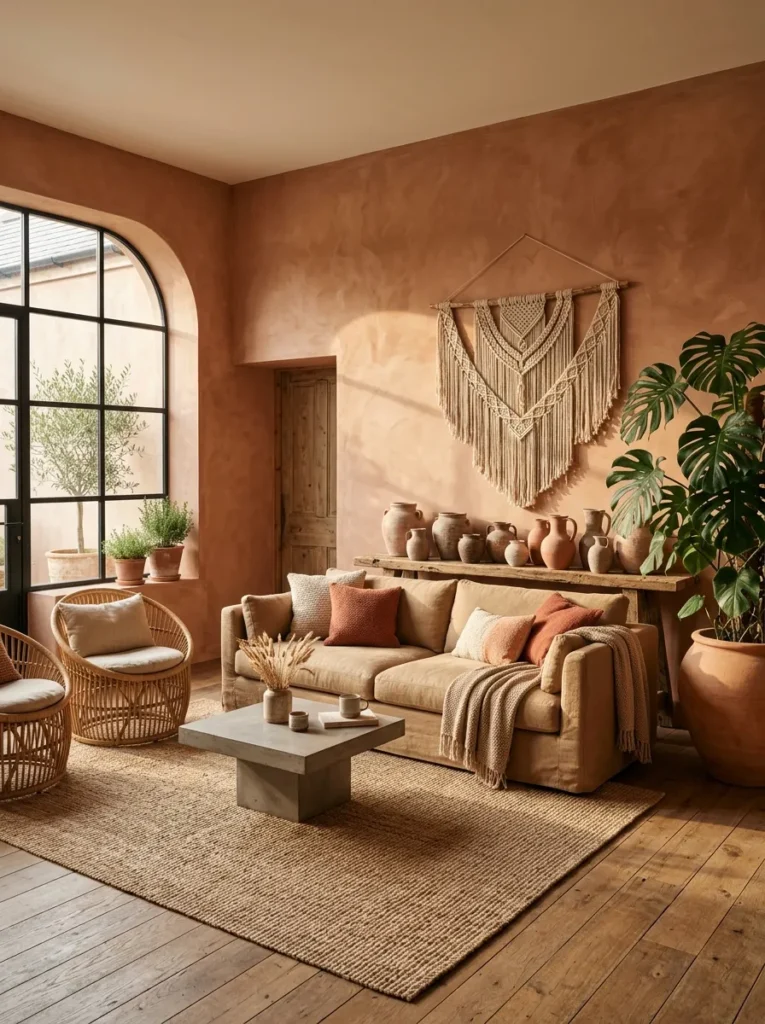
Vibe: Warm and organic — the living room that makes you feel like you have stepped into the specific warmth of a Mediterranean summer afternoon.
Why it works: A warm terracotta living room applies the design principle of material origin coherence — terracotta (fired clay), concrete (mineral aggregate), unglazed ceramic (fired earth), jute (plant fiber), rattan (plant stem), and linen (plant fiber) are all materials that originate from the earth in their most direct forms, and their combination creates a room that reads as materially unified through shared elemental origin rather than through designed coordination. This material family coherence — all organic, all earthy, all referencing the same geological and botanical origin — produces a room that feels fundamentally natural in a way that rooms combining synthetic and natural materials cannot achieve. The limewash wall treatment is the specific surface decision that most completely anchors the terracotta room in genuine material tradition — terracotta was the historic building material of the same climate zones where limewash was the historic wall finish.
How to get it: Apply terracotta limewash to walls using pigmented natural lime in the warm terracotta range — the limewash’s inherent tonal variation amplifies the terracotta color’s warmth in afternoon light and creates the surface depth that flat acrylic paint cannot produce. Maintain strict material discipline — no chrome, no glass, no synthetic materials in any accent position. Every object in the room should be traceable to an organic material origin.
| Product |
|---|
| Terracotta limewash paint natural pigment |
| Natural jute area rug large |
| Sand tone linen sofa natural |
| Round rattan accent chair pair |
| Raw concrete coffee table |
12. English Country Living Room with Antiques and Pattern
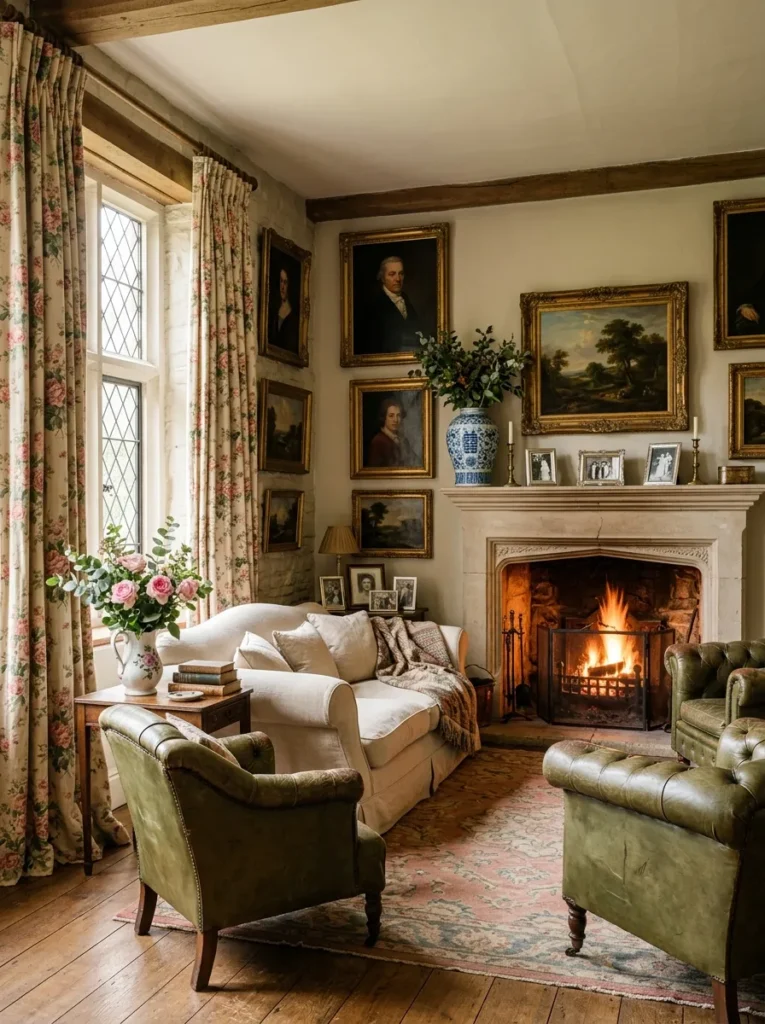
Vibe: Warm and timeless — the living room that communicates belonging and continuity more powerfully than any designed room can.
Why it works: An English country living room applies the design principle of accumulated authenticity as primary atmosphere — the worn leather Chesterfields, the faded Aubusson carpet, the stacked books and silver-framed photographs, and the fresh garden roses in a porcelain jug are all objects and elements that communicate genuine inhabitation over time rather than the coordinated purchasing of a furnished room. The English country aesthetic is the most difficult design direction to achieve through deliberate purchase because its defining quality is precisely the lack of deliberate coordination — and yet it is achievable through specific material choices (genuinely aged leather, genuinely faded chintz, genuinely old books) and styling principles (stacking rather than displaying, using rather than preserving, mixing genuine antiques with comfortable modern pieces).
How to get it: The English country living room is built backwards from the typical design process — begin with inherited, found, or genuinely antique pieces and build the room around them rather than purchasing a complete set of new furniture. The wool or silk carpet, the curtain fabric, and the fireplace are the room’s structural design decisions; everything else should be acquired over time from antique markets, estate sales, and the objects of accumulated domestic life. Fresh flowers are the most important styling element in an English country living room — they signal that the room is lived in and tended rather than preserved for occasional display.
| Product |
|---|
| Chintz floral curtain fabric faded tones |
| Aged green leather Chesterfield armchair |
| Stone fireplace surround carved |
| Aubusson or Aubusson-style carpet faded |
| Oil portrait or landscape painting antique |
13. Modern Organic Living Room with Curved Forms
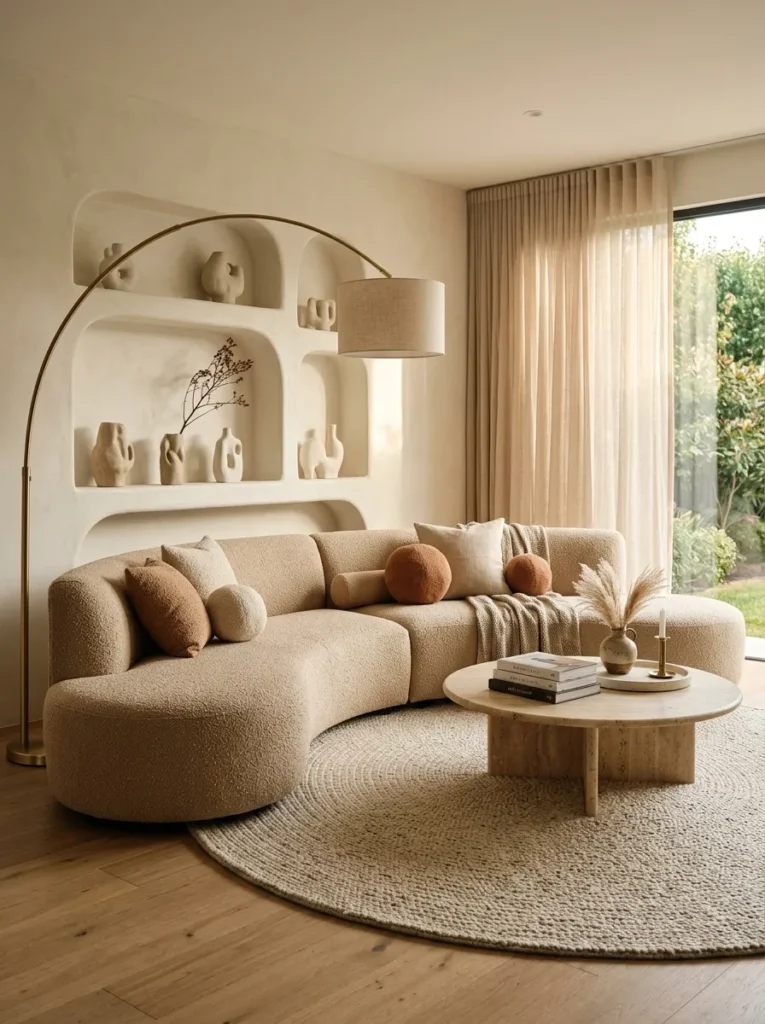
Vibe: Warm and sculptural — the living room where the furniture itself is the most interesting object in the room.
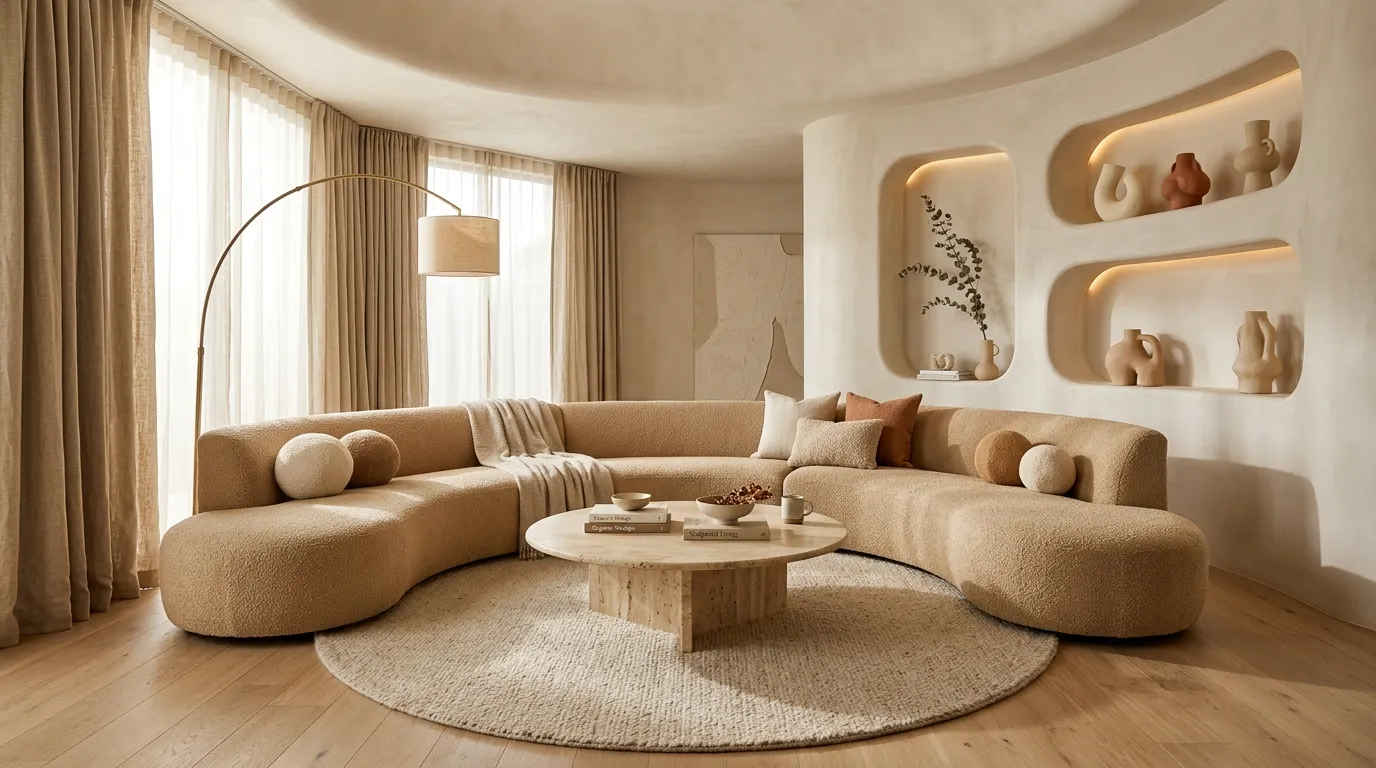
Why it works: A modern organic living room with curved forms applies the design principle of formal harmony through shape repetition — when the sofa’s continuous curve, the coffee table’s circular form, the rug’s round silhouette, and the plaster shelf niches’ arched profiles all share the curved, organic shape vocabulary, the room reads as a designed formal system rather than an accumulation of individual furniture choices. Curved furniture in boucle fabric is the current design moment’s most widely recognized luxury signifier precisely because it departs from the rectilinear furniture default in a way that requires confident design commitment — angular furniture is the safe choice, curved furniture is the considered one. The arc floor lamp positioned over the curved sofa is the lighting decision that completes the composition by adding a literal curved element to the lighting infrastructure.
How to get it: The curved sectional sofa is the room’s primary investment — source from a quality manufacturer who builds curved forms with proper internal framing (curved sofas require more complex internal framing than linear sofas and the quality of this framing determines whether the curve holds its form over years of use). Specify boucle or performance boucle for the sofa fabric — the textural richness of boucle complements the curved form in a way that smooth fabrics do not. Round coffee tables and rugs are more readily accessible at all price points and should be sourced to complement the sofa’s diameter and the room’s overall scale.
| Product |
|---|
| Curved sectional sofa boucle sand large |
| Round travertine coffee table |
| Round natural wool area rug |
| Arc floor lamp brushed gold |
| Curved plaster shelf niche DIY kit |
How to Start Your Elegant Living Room Transformation
Start with the rug. Before changing any furniture, lighting, or paint, invest in a rug that is correctly sized for the room — large enough for the front legs of all sofas and chairs to sit on it, centered on the seating arrangement’s primary axis, and in a quality, material, and color that represents the room’s intended design direction. The rug is the living room’s foundational design element from which every other spatial decision derives its scale reference and material palette — a correctly positioned, correctly sized quality rug organizes the furniture arrangement, defines the room’s primary seating zone, and introduces the color and material language from which all subsequent purchases should take their cue. A living room with the right rug and unremarkable furniture looks designed. A living room with remarkable furniture and no rug, or the wrong rug, looks unresolved regardless of the individual quality of each piece.
The most common mistake people make when pursuing an elegant living room is purchasing furniture that is too small for the room — specifically sofas and coffee tables that look appropriate in the showroom’s context but read as inadequate in the home’s actual room volume. Furniture scale is the most difficult design judgment to make accurately in a showroom or online context, and undersized furniture is the single most consistent cause of living rooms that feel unsatisfying despite high individual piece quality. The minimum sofa length for a standard living room (4–5m in its shorter dimension) is 220cm; anything shorter creates a seating arrangement that cannot comfortably accommodate three adults. The coffee table should be approximately two-thirds the length of the sofa and positioned 45–50cm from the sofa edge — close enough to reach from a seated position, far enough to allow comfortable leg extension.
Three items under $50 that make an immediate impact: A set of 2700K warm white LED bulbs ($8–$15) replacing any cool-white bulbs in the room’s existing fixtures — warm light quality is the single most impactful environmental change available for any living room at any budget level; a set of two matching throw pillow covers in the room’s intended palette ($18–$35) that immediately introduces material coordination where none existed; and a single quality dried botanical arrangement in a ceramic vessel ($20–$40 for stems and vessel combined) that introduces the natural material quality and composed object arrangement most associated with styled, elegant living rooms.
Realistic expectations: A single-room lighting upgrade — replacing all bulbs with warm white, adding one floor lamp, and installing a dimmer switch — takes one afternoon and costs $50–$150. A mid-level living room transformation — quality rug, correctly sized sofa, floor-to-ceiling curtains, and edited accessories — typically costs $1,200–$3,500 depending on material quality and room size. A full elegant living room renovation — new flooring, architectural molding or paneling, quality upholstery, hand-knotted rug, and custom drapery — ranges from $8,000–$30,000 for a standard living room depending on specification. The principle that applies across every budget level is concentration — spending 80% of the available resource on the three elements that most determine a living room’s quality (rug, main sofa, lighting) and using the remaining 20% for everything else consistently produces better results than distributing the budget equally across every element category.
Frequently Asked Questions About Elegant Living Room Design
What makes a living room feel elegant rather than simply expensive?
The defining quality of elegant living room design is the evidence of considered proportion and intentional restraint — rooms where furniture scale relates correctly to room volume, where light arrives from the right positions at the right warmth, where every object present has been curated to earn its place, and where the overall effect communicates design intelligence rather than purchasing power. Elegance is independent of cost — a room with correctly proportioned furniture in warm light with one genuinely beautiful material reads as more elegant than a room full of expensive objects in the wrong proportions under the wrong light. The specific indicators of elegance that are achievable at any budget are: furniture scale appropriate to room volume, warm light (2700K from multiple sources at varied heights), natural fiber textiles in quality materials, and edited accessory placement with generous negative space between objects.
How do I choose between the 13 elegant living room styles for my home?
The most reliable method for selecting an appropriate elegant living room style is to identify the architectural character of the existing room — a room with classical plaster molding, an existing fireplace, and high ceilings will naturally support a French-inspired or English country design direction; a room with exposed concrete, industrial windows, and low ceilings will naturally support a Japandi or contemporary minimal direction; a room in a traditional suburban home with standard 2.4m ceiling height and no distinctive architectural features has the flexibility to accommodate any of the 13 directions with appropriate material choices. The key insight is that elegant design works with the architecture rather than against it — attempting to impose a French classical aesthetic on a 1970s suburban living room requires extensive architectural modification, while working with the room’s inherent character typically produces more satisfying results.
What is the most important investment in an elegant living room?
The rug is consistently the highest-leverage investment available in a living room — a hand-knotted or high-quality machine-knotted wool rug of the correct size grounds the furniture arrangement, introduces the room’s primary color and material palette, provides the room’s most tactile surface quality, and appreciates or maintains its value over time in a way that most other furniture investments do not. After the rug, the primary upholstered piece (the sofa) is the second-highest leverage investment because it occupies the greatest visual territory in the room and is experienced most frequently and most directly. The third-highest leverage investment is lighting — not individual fixtures but the complete lighting system including bulb color temperature, number of light sources, and the presence of dimmable control.
How do I make a small living room feel elegant?
The five design decisions that most reliably create elegance in a small living room are: one large rug rather than a small rug (counter-intuitively, a large rug makes a small room feel larger by creating one continuous floor zone rather than fragmenting the floor into furniture areas and rug area); floor-to-ceiling curtains hung on ceiling-height rods even if the window is small (the vertical line draws the eye upward and makes the ceiling feel higher); a single large artwork or mirror rather than multiple small pieces (one large element reads as confident; multiple small elements read as compensatory); furniture with legs rather than floor-level furniture (visible floor between furniture legs makes the room read as larger); and warm, layered lighting from multiple low-level sources rather than a single ceiling fixture.
How long should an elegant living room redesign take to complete?
The most successful elegant living room redesigns unfold over 6–18 months rather than being completed in a single purchasing event — this timeline allows the room’s design direction to develop organically as the key pieces are acquired, as the relationships between elements become visible, and as the budget is concentrated on the most impactful pieces rather than being distributed rapidly across all categories simultaneously. Purchasing the rug and primary sofa first, living with them for 4–8 weeks before selecting lighting and accent furniture, and adding accessories and art last is the design sequence that produces the most considered results because each layer of purchasing is informed by the actual visual experience of the previous layer rather than by the theoretical imagining of a complete design system. The elegant living rooms that look most genuinely considered are almost always those that developed over time rather than those installed in a single shopping weekend.
Ready to Create Your Dream Elegant Living Room?
These 13 designs cover the complete range of what elegant living room design can achieve — from the formal warmth of paired sofas flanking a marble fireplace and the scholarly depth of a floor-to-ceiling library room, to the serene minimalism of a Japandi material palette and the lush, accumulated character of an English country room. Every elegant living room transformation begins with the decision to treat proportion and light as primary design considerations rather than decorative afterthoughts — and sourcing the correctly sized rug as the first purchase is the concrete, achievable first step that immediately demonstrates what the room can become. Right now, measure your living room, calculate the appropriate rug dimensions (the seating arrangement width plus 45cm on each long side, the seating arrangement depth plus 30cm at the coffee table end), and begin looking for a rug in that size and in the material and palette of your chosen design direction. That rug, when it arrives and is laid under the furniture, will show you more clearly than any design exercise what the room needs next — and from there, every subsequent decision becomes a refinement rather than a speculation. Save the design directions that match your room’s architecture, your material instincts, and the life you want to live in your most important social space — and begin from that first rug.