16 Decorative Vase Ideas for Every Home Style
A decorative vase is a vessel — ceramic, glass, metal, woven, or carved — chosen and displayed not merely for its function of holding flowers but for its material quality, form, color, and contribution to the room’s composition as a standalone object of beauty. This article gives you 16 decorative vase ideas across material types, styling approaches, arrangement strategies, room applications, and design styles so every room in your home has a vessel that genuinely belongs in it rather than merely occupying surface space.
There is a particular design intelligence in a well-chosen vase. A single piece of hand-thrown stoneware on a kitchen shelf communicates the same design vocabulary as the room’s best furniture — material honesty, form over decoration, warmth over novelty. A tall glass cylinder on a console table extends vertical interest into an otherwise horizontal arrangement. A cluster of three mismatched ceramic vessels on a mantel creates the collected quality that single, matching sets never achieve. The vase is one of the smallest objects in a room and one of the most revealing of the care taken with it. Here are 16 ideas worth saving — and stealing.
Why Decorative Vases Transform a Room’s Character
Decorative vases sit at the intersection of sculpture, craft tradition, and functional design — a position that gives them unusual versatility as home accessories. The history of the decorative vessel runs from ancient Greek amphorae and Tang Dynasty celadon to Scandinavian mid-century ceramic studios and contemporary Japanese mingei folk pottery, and every tradition contributes to the enormous range of vase forms, glazes, materials, and proportions available today. What all these traditions share is the recognition that a vessel made with genuine craft skill carries the maker’s intention in its form — the slight asymmetry of a thrown rim, the depth of a reduction-fired glaze, the balance of a form that sits correctly at the bottom and opens correctly at the top are qualities that communicate skill and care without requiring any explanation.
The material palette of decorative vases is as wide as the craft traditions that produce them. Unglazed stoneware in warm clay tones provides the most organic, tactile presence. Glazed earthenware in matte terracotta or sage reads as botanical and grounded. Mouth-blown glass in clear, amber, or smoke tones transmits and reflects light in ways that ceramic cannot. Hand-hammered copper and brass develop living patinas that improve with age. Woven seagrass and rattan vessels bring textile warmth to a surface typically occupied by hard materials. Carved marble and travertine provide architectural weight and cool mineral beauty. The material choice is the single most important vase decision because it determines the object’s relationship with light, the room’s warmth, and the design tradition it references.
The cultural moment for decorative vases is rich and varied. The quiet luxury movement has elevated simple, high-quality ceramic vessels to genuine status objects — a single hand-thrown stoneware vase in a muted glaze is as design-credible as any piece of furniture or lighting in the contemporary interior. The biophilic design movement has renewed interest in botanical vessels — pieces specifically designed to display dried botanicals, branches, and sculptural stems rather than traditional cut flowers. The sustainability shift has driven renewed interest in handmade, locally produced ceramics over mass-manufactured alternatives. All of these movements point in the same direction: toward vessels made with genuine craft attention and chosen with genuine design intention.
Small spaces benefit from vase styling precisely because vases are inherently compact — a well-chosen vase on a windowsill, a bathroom shelf, or a kitchen counter makes a design statement in a 4-inch footprint that a piece of furniture requiring 4 square feet cannot match. The scale efficiency of a quality vase is one of its primary design virtues.
Style at a Glance
| Element | Detail |
|---|---|
| Philosophy | The vessel as object of beauty — form, material, and placement chosen with the same intention as furniture |
| Key Materials | Stoneware, earthenware, mouth-blown glass, hammered brass, woven seagrass, carved marble, hand-thrown porcelain |
| Key Colors | Warm clay, sage glaze, smoke glass, unlacquered brass, natural seagrass, white marble, matte charcoal |
1. Hand-Thrown Stoneware Cluster in Graduated Heights
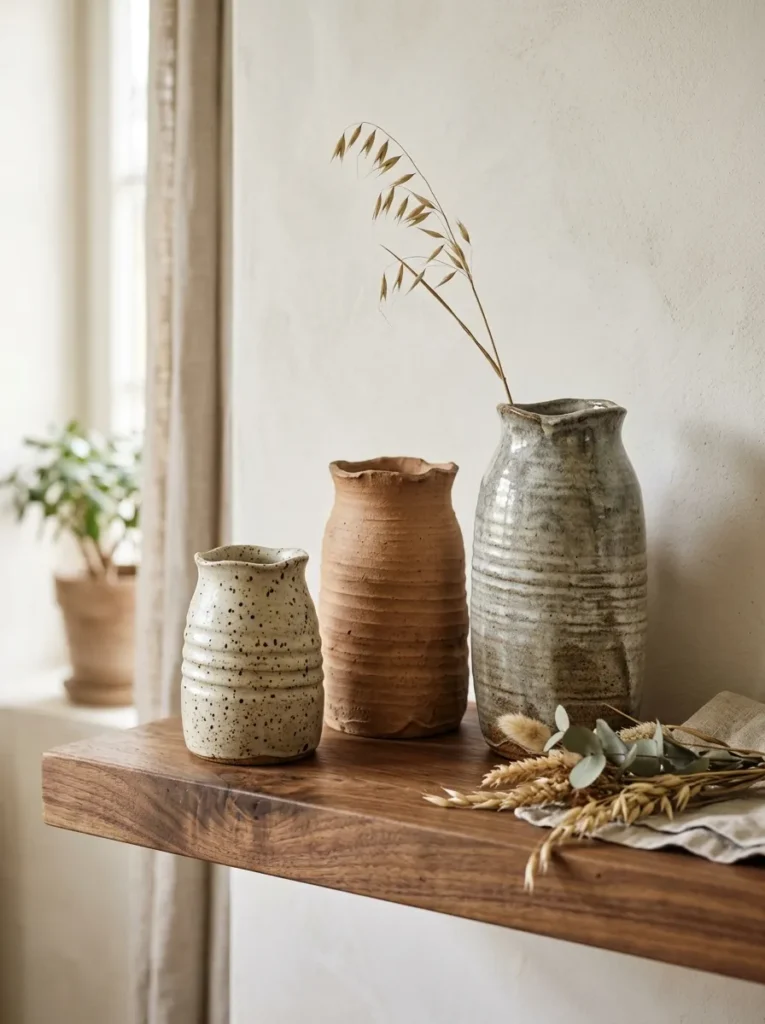
Vibe: The cluster is artisan — three hand-thrown stoneware vases in graduated heights on a walnut shelf have the quality of a curated collection that communicates genuine material knowledge, where the slight variation between each piece confirms that hands, not machines, made them.
Why it works: The graduated height cluster exploits the design principle of asymmetric balance — three vessels at different heights create vertical rhythm that a single vase or a matched pair cannot. The tallest vessel draws the eye upward and anchors the composition, the medium vessel provides visual mass, and the shortest vessel grounds the arrangement at shelf level. The key requirement is that all three pieces share a material family (all stoneware, all warm-toned glazes) while varying in both height and glaze color — this variation within consistency creates the collected quality that makes a cluster read as curated rather than purchased as a set. Visible throwing rings confirm authentic hand-throwing and are never a flaw — they are the mark of genuine craft.
How to get it: Source hand-thrown stoneware from local pottery studios, weekend craft markets, or Etsy ceramicists — look specifically for pieces with unglazed foot rings (the raw clay base left unfinished, which confirms throwing rather than slip-casting) and organic rim variation. Height ratios of approximately 3:2:1 (tall to medium to short) create the most visually satisfying proportion. Position the tallest at the back or side, never in the center.
Quick Win: Two existing vessels from different sources, placed at different heights by using a small block or book under one to create a height differential, immediately read as a cluster rather than as two separate objects — height variation is the single most important styling variable in vase groupings.
Shop The Look
- Hand thrown stoneware vase set varied heights
- Ash glaze ceramic vase tall artisan
- Matte terracotta clay vase medium
- Speckled cream ceramic bud vase small
- Floating walnut shelf wall mount
Also view: 14 Budget Backyard Ideas for Small Outdoor Spaces
2. Tall Clear Glass Cylinder Vase with Architectural Stems
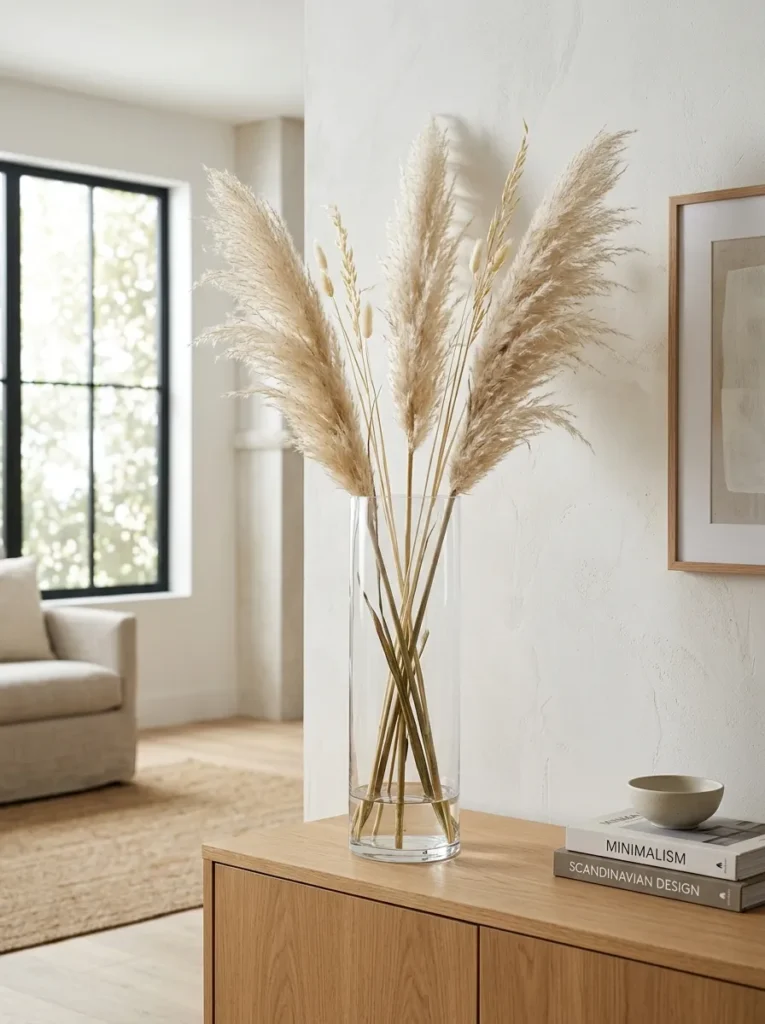
Vibe: The arrangement is architectural — a tall glass cylinder with a few long architectural stems reads as a design decision rather than a flower arrangement, where the form of the vessel and the form of the stems are in conversation rather than the vessel merely serving as a container.
Why it works: Clear glass cylinders have a unique design property — they display the stems inside as part of the composition rather than concealing them. This means the visual experience includes both the above-rim element (the stem tops and any plumes or seed heads) and the below-rim element (the stems themselves, the water or absence of water, and the gathered stem bases). This two-zone composition is more visually interesting than opaque vessels where the stem bases are hidden. Tall cylinders (18 inches or taller) have a specific architectural quality that shorter vases lack — they introduce vertical interest at a scale that competes credibly with furniture and lighting as a room element. Three to five long stems in a tall cylinder read as deliberate; a dozen shorter stems in the same vessel read as a conventional flower arrangement.
How to get it: Source tall clear glass cylinders from home decor stores or glass suppliers — look for a clean, geometric form with no embellishment. Add gravel or decorative stones in the base (approximately 2 inches deep) to provide stem stability and add visual interest to the lower portion of the glass. Choose stems specifically for architectural form — pampas grass, dried cortaderia, Japanese knotweed, curly willow, or sculptural bare branches all work. Trim stems to varying heights (tallest at 1.5–2 times the vase height for proper proportion).
Shop The Look
- Tall clear glass cylinder vase 18 inch
- Dried pampas grass stem tall natural
- Decorative gravel clear glass vase filler
- Curly willow branch tall stem bundle
- Console table slim profile modern
Also view: 12 Home Depot Christmas Decorations for Small Spaces
3. Matte Black Ceramic Vase as a Graphic Accent
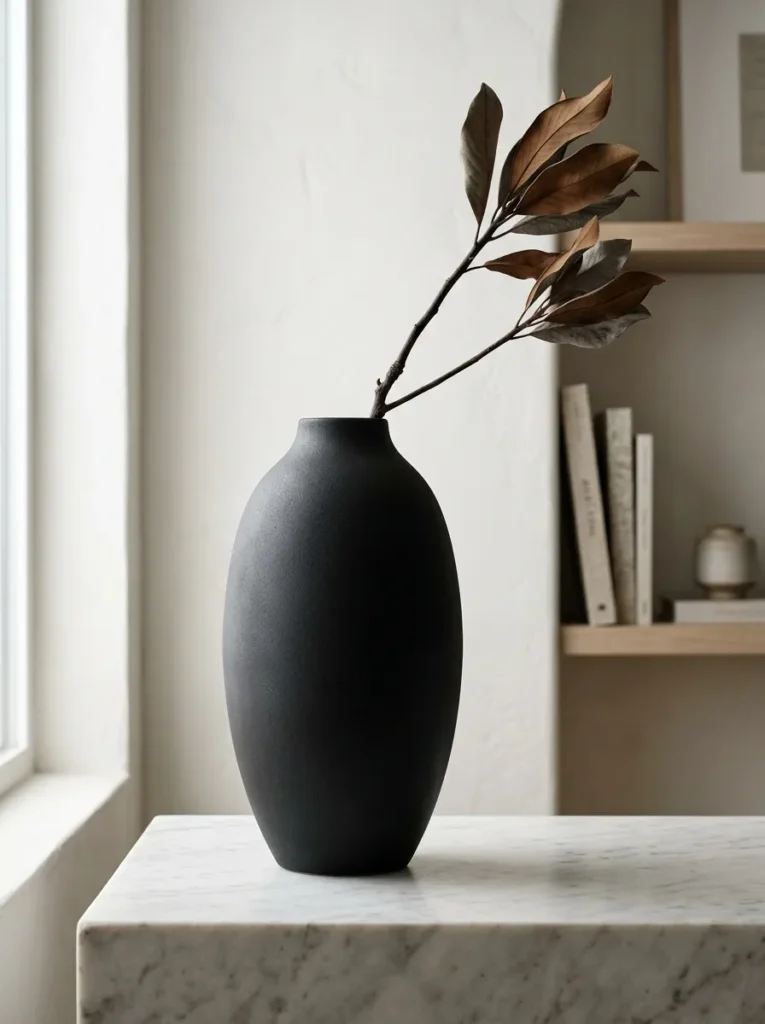
Vibe: The vase is graphic — a single large matte black ceramic on a light surface is the vase equivalent of a statement sculpture, where the color contrast and the matte surface quality make the object demand attention without any supporting elements.
Why it works: Matte black ceramic is the design material that most effectively creates graphic contrast in a light-toned room — the absolute darkest tone against the lightest possible backgrounds maximizes visual separation between the object and its context, making the vase read as a deliberate design insertion rather than a decorative accessory. The matte surface is critical — a gloss black ceramic reflects the surrounding room and partially disappears into light and reflection, while a matte black surface absorbs light and reads as a solid, confident form. A single large matte black vase is more impactful than multiple smaller black pieces because it concentrates the graphic effect at one point rather than distributing it.
How to get it: Look for matte black ceramic with a sculptural, non-generic form — an elongated oval, a narrow-necked bottle form, or a squared cylinder all read as design-considered. Avoid round ball forms, which read as decorative rather than architectural. Position on the highest-contrast surface available — white marble, light stone, or a cream-painted shelf — and use a single large stem rather than a full arrangement to keep the vase itself as the visual subject.
Shop The Look
- Matte black ceramic vase large sculptural
- Dried magnolia branch large decorative
- White marble tray display surface
- Matte black finish ceramic tall bottle form
- Single stem dried eucalyptus tall
Also view: 12 Home Depot Christmas Decorations for Small Spaces
4. Amber Glass Vase for Warm Light Transmission
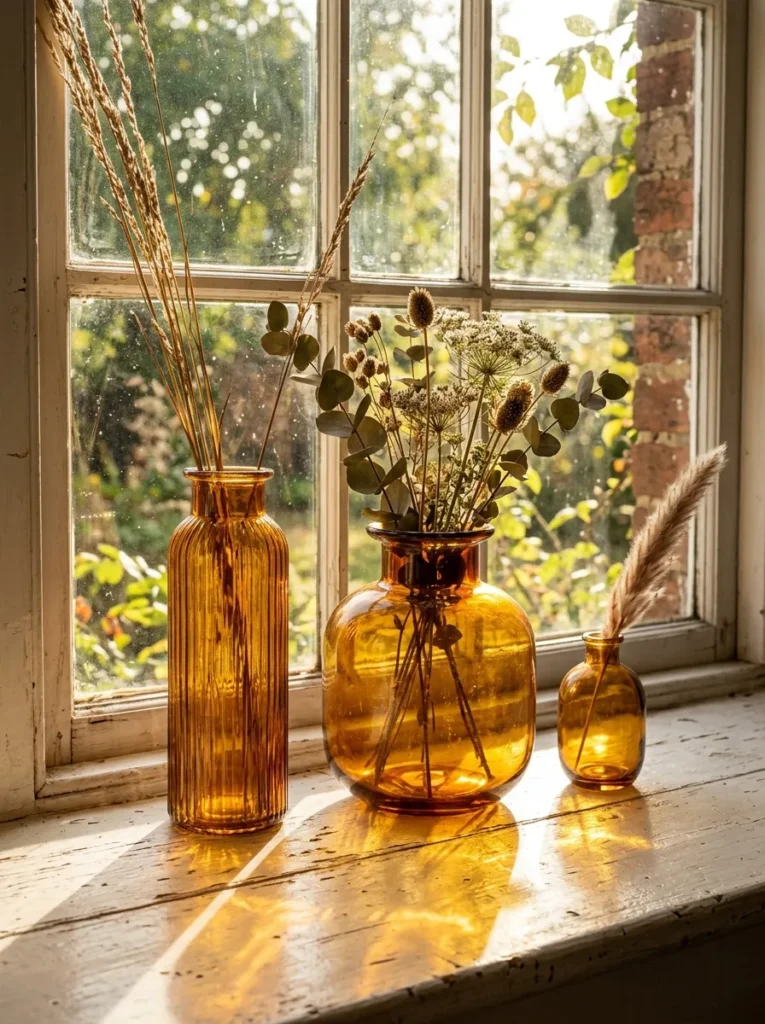
Vibe: The window is luminous — amber glass vases in afternoon light transmit warm honey-gold illumination onto surrounding surfaces, functioning as both decorative objects and passive light filters that change the room’s warmth quality throughout the day.
Why it works: Amber glass has a unique optical property that no other vase material possesses — it transmits warm wavelengths of light (orange, yellow, red) while filtering cooler wavelengths, producing the specific honey-gold light quality associated with late afternoon sun and candlelight. In a window placement, amber glass vases function as stained glass at domestic scale, casting colored light pools on windowsills and adjacent surfaces that shift in size and intensity throughout the day as the sun moves. This dynamic quality — the vase looking different at 10am than at 4pm — gives the object a vitality that static, light-absorbing materials cannot provide. Varied glass forms in the same amber tone (ribbed, smooth, thick-walled, thin-blown) create texture variation within a unified color palette.
How to get it: Source amber glass vases from vintage and antique shops (vintage amber glass is typically higher quality and more varied in form than contemporary versions), specialty glass retailers, and home decor stores. Look specifically for pieces with varied wall thicknesses — thick amber glass produces a deeper, richer color cast while thin-blown glass produces a lighter, more delicate transmission. Position in a south or west-facing window for maximum afternoon light interaction.
Shop The Look
- Amber glass vase ribbed cylinder vintage
- Amber glass wide mouth rounded vase
- Small amber glass bud vase set
- Amber glass collection varied forms
- Window shelf display ledge adhesive mount
Also view: 13 Wall Mirror Decor Ideas That Brighten Spaces
5. Woven Seagrass or Rattan Vase for Organic Warmth
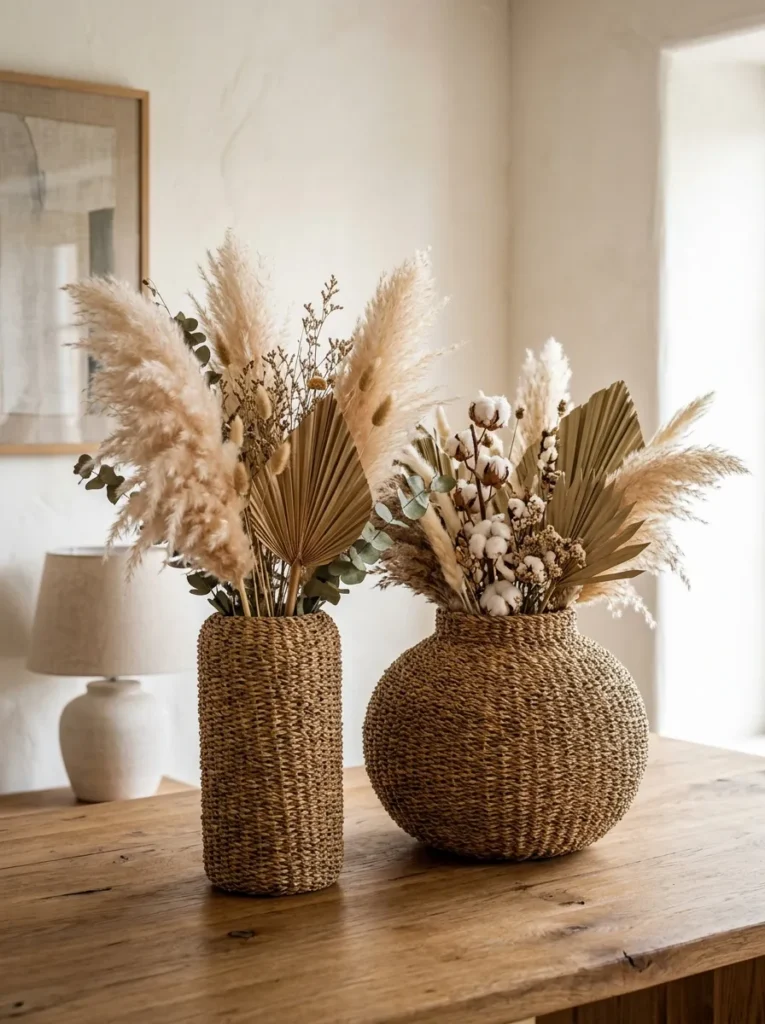
Vibe: The arrangement is organic — woven seagrass vessels with dried botanicals create a surface composition built entirely from natural fibers and dried plant material, where every element has the same warm, handmade quality and the room gains a particular botanical softness.
Why it works: Woven seagrass and rattan vessels bring a textile quality to the vessel category — their woven surface reads as fabric rather than clay or glass, introducing warmth through a different material register than ceramic or metal. This textile quality is specifically effective in rooms that already have warm linen or wool textiles, because the woven vase surface reads as part of the same natural fiber language. Dried botanicals rather than fresh flowers are the correct fill for woven vessels — the matte, textural quality of dried stems and leaves complements the matte, textural quality of the woven surface, while fresh flowers introduce a color saturation that contrasts awkwardly with the vessel’s natural tone. Note: woven vessels are not watertight and must be used with dried stems only or with a glass liner insert for fresh flowers.
How to get it: Source woven seagrass or rattan vases from home decor stores, import retailers, or craft markets — look for tight, even weave with no loose or broken fibers, and bases that sit flat without rocking. For fresh flowers, insert a tall drinking glass into the vessel interior before adding water — the glass contains the water while the woven vessel provides the exterior display surface. For dried stems, no liner is needed.
Shop The Look
- Woven seagrass vase tall cylinder natural
- Rattan woven vessel rounded wide form
- Dried pampas grass stem cream-blush
- Dried tropical palm leaf stem decor
- Natural wood display shelf floating
6. Vintage Blue and White Porcelain for Classic Character
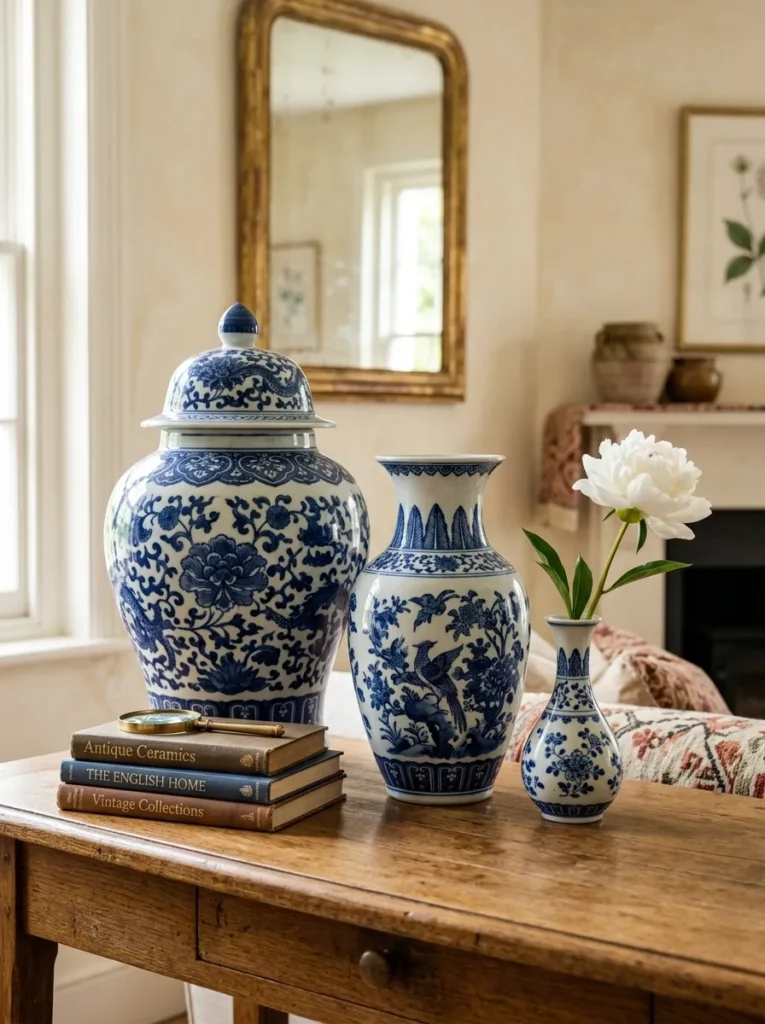
Vibe: The grouping is refined — blue and white porcelain vases have four centuries of design authority behind them, and a well-chosen grouping on a mantel or console reads as both historically grounded and perpetually current.
Why it works: Blue and white porcelain is the single most cross-culturally validated decorative vessel tradition — it appears in Chinese export ware, Dutch Delftware, English transferware, Japanese Imari porcelain, and contemporary studio ceramics, all sharing the same fundamental appeal of cobalt blue pattern on white ground. This universality is not accidental: the color combination (cool cobalt blue against bright white) creates one of the highest-contrast decorative pairings available in ceramic form, and the contrast reads as visual clarity and precision. A collected grouping — pieces from varied sources, in varied forms, with varied pattern densities — reads as genuinely assembled over time rather than purchased as a set, which gives the arrangement the quality of a collection rather than a decoration.
How to get it: Source vintage blue and white porcelain from antique markets, thrift stores, and online vintage retailers — pieces with visible crazing (fine crack networks in the glaze) and pattern variation are preferred over pristine or uniform examples for a genuinely collected appearance. Mix Chinese export forms (ginger jars, moon vases) with European forms (urn shapes, pitchers) for the most interesting grouping. A group of three in varied heights following the 3:2:1 height ratio works consistently.
Shop The Look
- Blue white porcelain ginger jar large
- Vintage blue white ceramic urn vase
- Small blue white porcelain bud vase
- Antique blue white chinoiserie vessel
- Console table classic style display
7. Hammered Brass or Copper Vase for Warm Metallic Presence
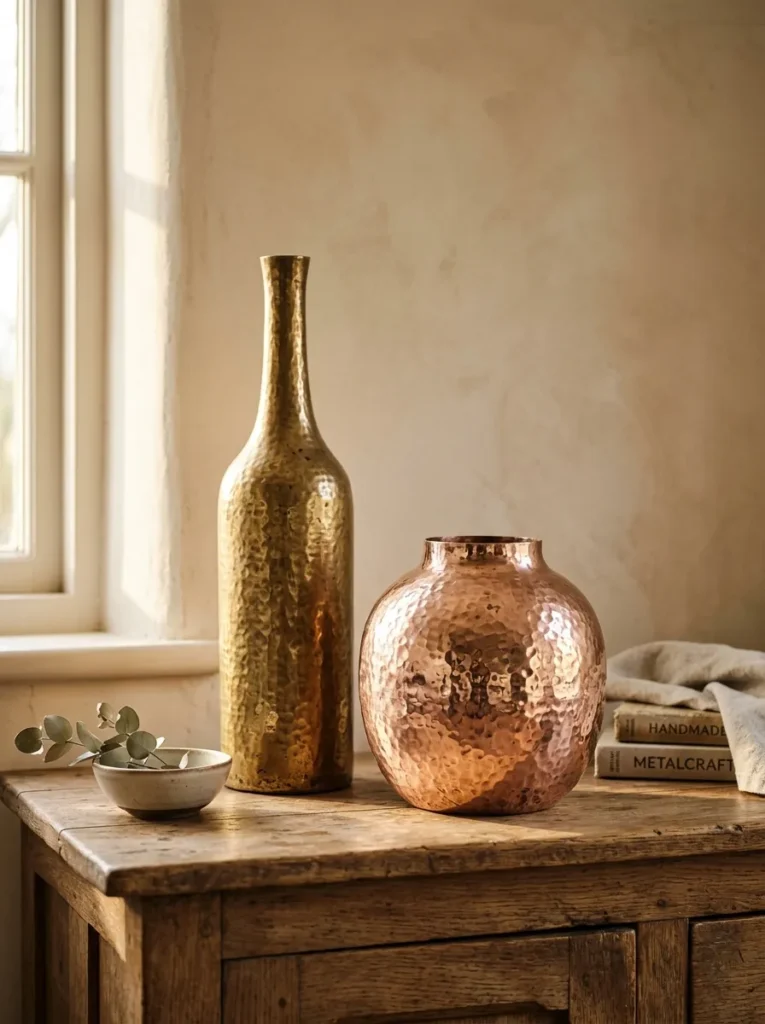
Vibe: The vases are warm — hammered brass or copper vases catch light across every facet of their hand-worked surface, creating a dynamic metallic presence that smooth, cast metal or ceramic cannot replicate, and their warm tone against warm walls generates a room quality of genuine material richness.
Why it works: Hammered metal vases have a specific optical property created by their surface texture — each small facet of the hammered surface faces a slightly different direction than its neighbors, which means the vase reflects light differently across its surface depending on the viewer’s position and the light source’s angle. This creates a visual animation that smooth surfaces lack — a hammered brass vase appears to glow and shift as light conditions change throughout the day. Unlacquered brass and copper develop natural patinas in ambient air over months and years — areas of darker, deeper tone appearing alongside the original bright metal — that make the piece more beautiful over time rather than requiring maintenance to restore an original appearance.
How to get it: Look for unlacquered (not lacquered or coated) hammered brass or copper specifically — lacquered versions maintain their bright initial appearance but cannot develop the patina that gives these materials their long-term value. Indian, Moroccan, and Turkish craft traditions produce the highest-quality hammered metal vessels at the most accessible price points, available from specialty import retailers and online. Use only with dried stems in hammered metal vessels — water in unlacquered metal creates oxidation that is difficult to clean from the interior.
Shop The Look
- Hammered brass vase tall bottle neck
- Hammered copper vase wide form artisan
- Unlacquered brass vessel Indian craft
- Moroccan hammered metal vase set
- Dried stem botanical arrangement minimal
8. Sculptural Organic Form Ceramic as a Solo Statement
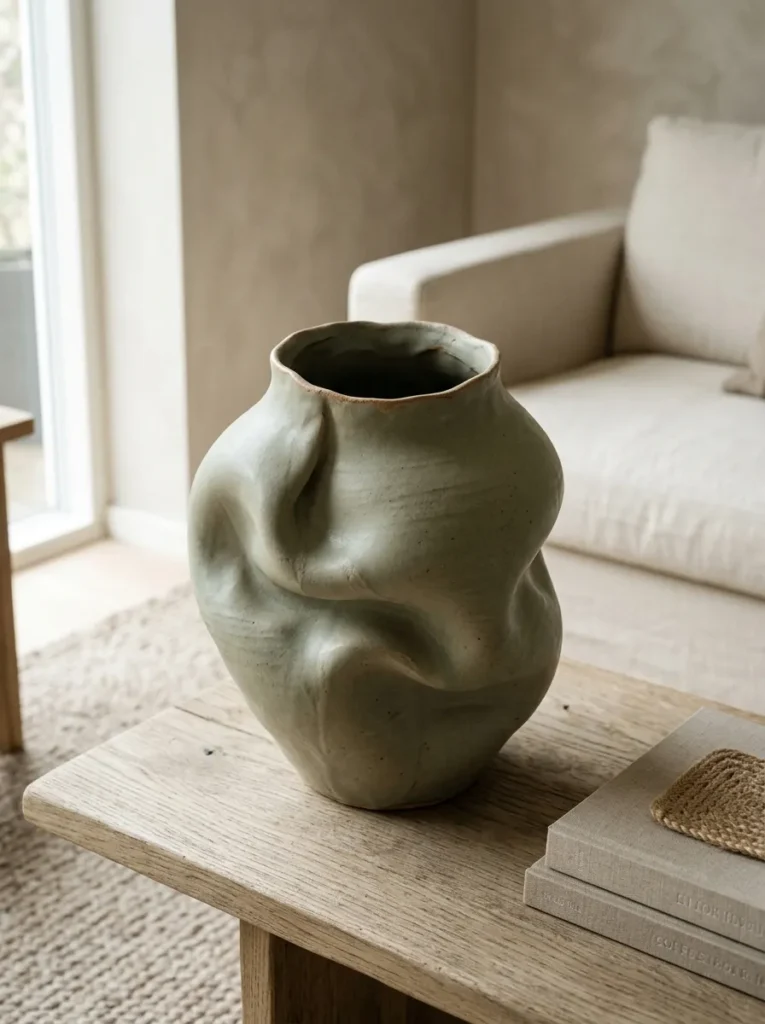
Vibe: The vase is sculptural — a single large organic ceramic form displayed without stems or botanicals asserts itself as a three-dimensional art object rather than a container, and this assertion changes the room’s compositional center of gravity.
Why it works: A ceramic vessel displayed empty — particularly one with genuine sculptural form — makes the most direct possible case for the vessel as an art object rather than a functional accessory. The design principle is subtraction: by removing the expectation of content (flowers, stems, or branches) the form of the vessel itself becomes the subject, and the viewer’s attention falls on the clay body, the glaze depth, the organic contour of the form, and the shadow it casts on surrounding surfaces. This approach is only effective when the vessel has genuine sculptural merit — an organic, hand-built or thrown form with visible craft evidence. A generic or mass-produced form displayed empty reads as insufficient rather than considered.
How to get it: Specifically seek ceramic artists who make vessel forms with sculptural intent — their work typically appears at art fairs, gallery shows, and on artist-run Etsy shops. The form should be interesting from multiple viewing angles (not just the front), should have visible evidence of making (throwing lines, pinch marks, or coil seams that are part of the design rather than accidents), and should have a glaze or clay body that rewards close inspection. Price point is typically $60–$300 for studio-quality sculptural ceramics — a meaningful but not extravagant investment for an object that functions as the room’s primary sculptural statement.
Shop The Look
- Sculptural ceramic vase organic form large
- Studio pottery vessel asymmetric form
- Hand built ceramic large artisan
- Matte sage glaze ceramic sculptural
- Ceramic pedestal display stand small
9. Bud Vase Collection for Bathroom or Kitchen Windowsill
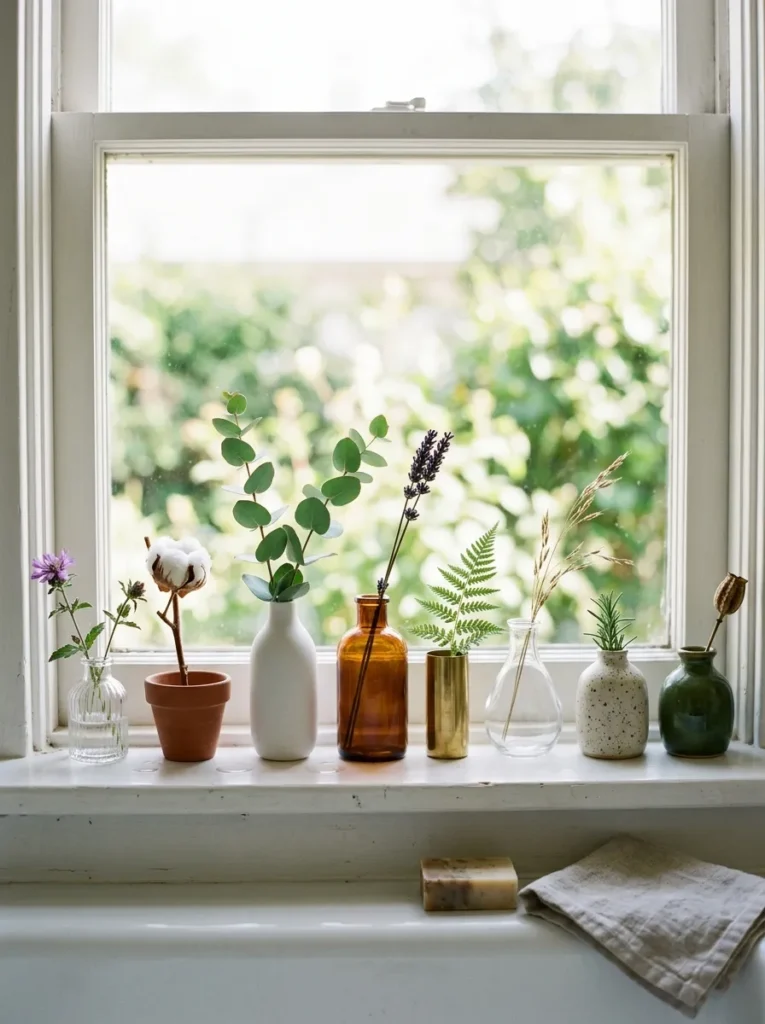
Vibe: The windowsill is personal — a collection of small bud vases in varied materials each holding a single stem creates the most intimate botanical display available, where the individual character of each tiny vessel and its single stem communicates care at the smallest possible scale.
Why it works: Bud vase collections work on the windowsill because the window’s natural light (particularly when backlit) reveals the material differences between vessels — clear glass transmits light, amber glass warms it, porcelain blocks it and glows at the rim, terracotta absorbs it and appears darker. These material differences, which might be less legible in ambient interior light, become apparent in window light, creating a naturally varied display that teaches the viewer to look carefully. Single stems in each vessel — one wildflower, one dried lavender spike, one eucalyptus sprig — create botanical individuality rather than the uniformity of a single flower type repeated across all vessels. The collection grows naturally over time as a new vessel is added when a beautiful small piece is found.
How to get it: Build the collection incrementally rather than purchasing all pieces simultaneously — the genuine collected quality that makes a bud vase collection look artisan rather than retail comes from pieces acquired at different times from different sources. A thrift store clear glass vessel, a craft market terracotta bud vase, a vintage amber glass pharmacy bottle, and a small brass vessel from an import shop are more interesting together than six identical pieces from one retailer. Budget $3–$20 per piece over several months for a collection of 6–10 that reads as genuinely personal.
Shop The Look
- Clear glass bud vase small set varied forms
- Small terracotta bud vase minimal
- White porcelain bud vase narrow neck
- Amber glass pharmacy bottle small vintage
- Small brass bud vase minimal modern
10. Oversized Floor Vase as Architectural Room Element
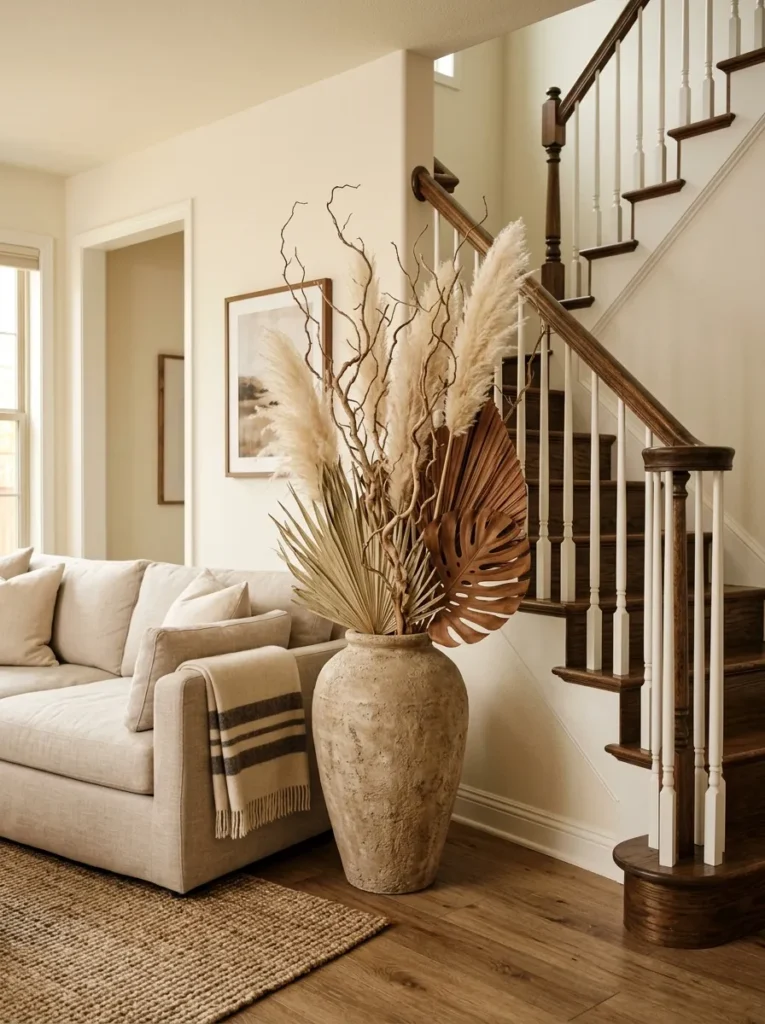
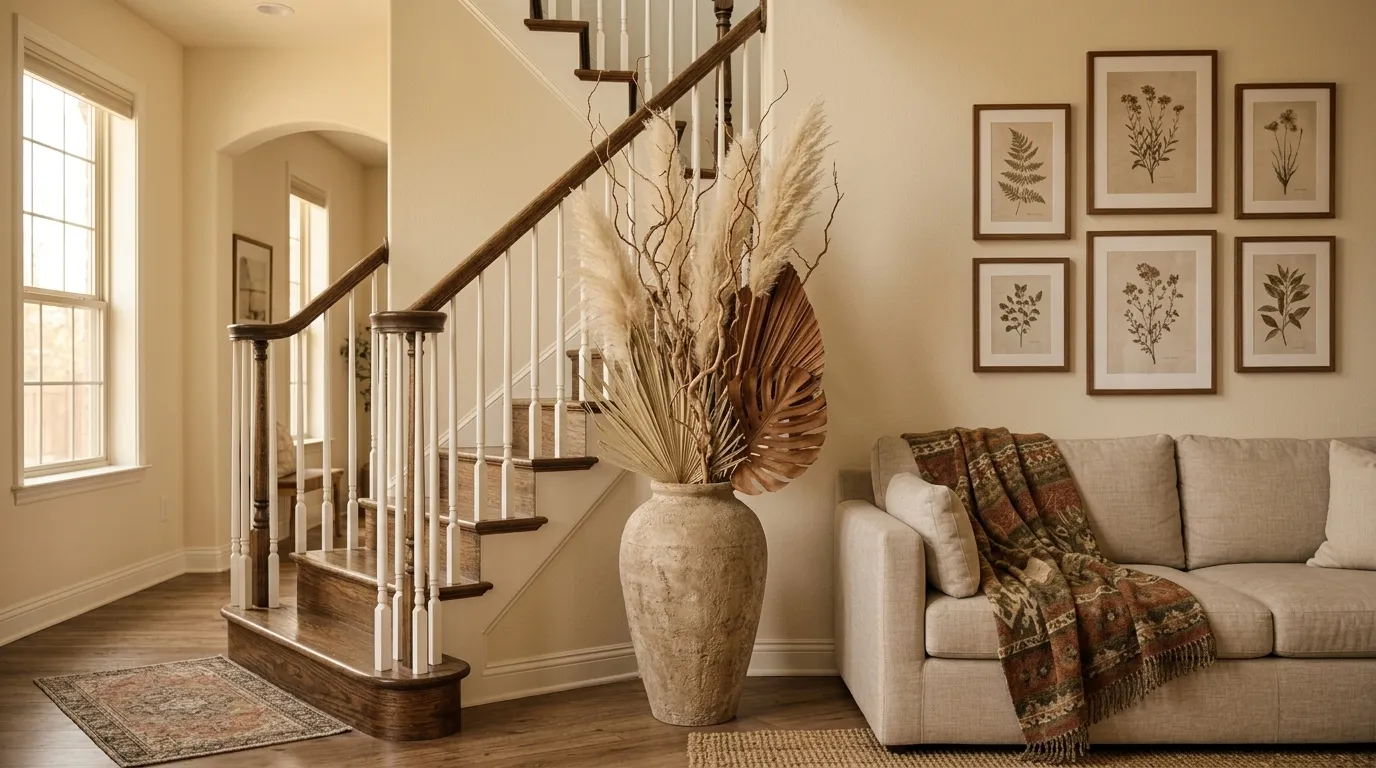
Vibe: The vase is architectural — a large floor vase with a tall botanical arrangement fills a room’s vertical dimension at the scale of furniture and built architecture, making it the room’s dominant botanical statement rather than one element among many.
Why it works: Floor vases occupy the room’s base zone (floor level) while their botanical content extends into the mid-zone and upper zone, creating a vertical element that links the floor to the ceiling in a way that no shelf or table vase can achieve. The most effective floor vase placements are beside a sofa’s end (where the vase punctuates the sofa’s horizontal run), in a room corner (where the botanical arrangement occupies otherwise unused vertical space), or at the foot of a staircase (where the arrangement echoes the staircase’s vertical movement). The vase itself should be visually heavy enough to anchor the arrangement above it — thin-walled vessels look unstable under large botanical arrangements, while thick-walled ceramic or stone floor vases provide appropriate visual weight.
How to get it: Source large floor ceramic vases from home decor stores, import retailers, or ceramic studios ($40–$200 depending on size and material quality). Weight the base with sand or gravel before adding stems to prevent tipping. For the botanical arrangement, begin with the longest stems to establish height (the arrangement should be 1.5–2 times the vase height for correct proportion), then fill in with medium-height textural elements, and add low trailing elements last.
Shop The Look
- Large ceramic floor vase 28 inch tall
- Dried pampas grass bundle tall natural
- Long dried botanical branch architectural
- Floor vase sand weight filler bag
- Dried tropical leaf stem arrangement
11. Smoke Glass Vase for a Modern Moody Interior
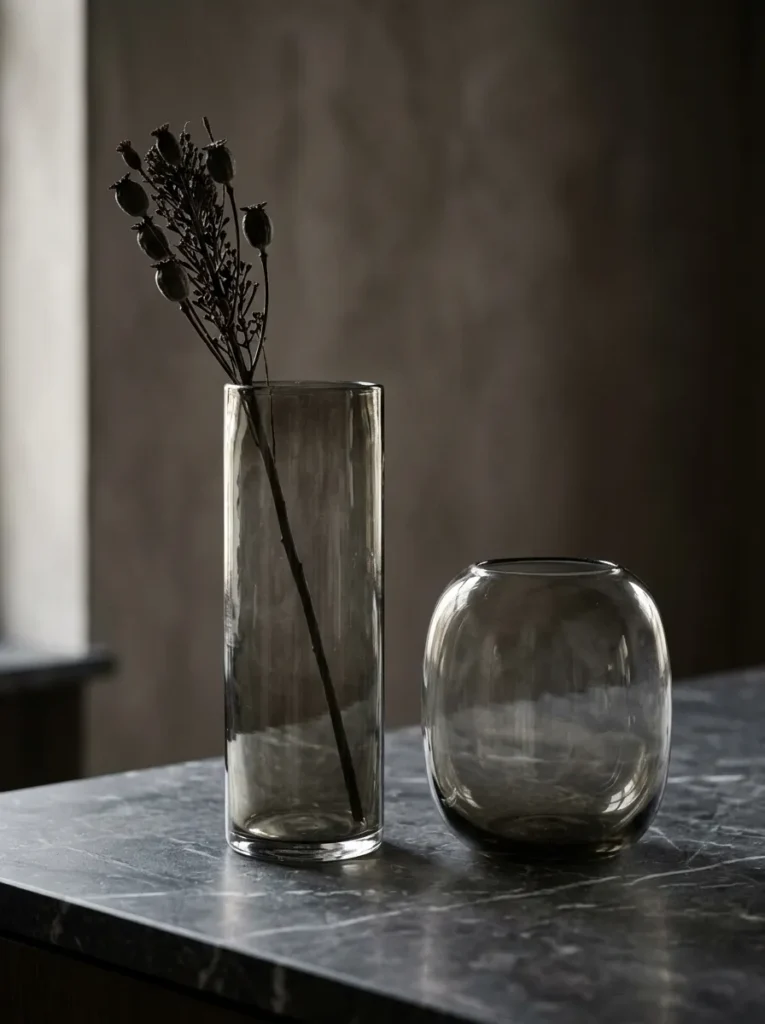
Vibe: The vases are moody — smoke glass occupies the design space between transparency and opacity, transmitting diffused rather than clear light, which creates a mysterious, shadowed quality that neither clear glass nor solid ceramic achieves.
Why it works: Smoke glass has a specific optical quality — it transmits diffused light rather than clear light, which means it reveals the presence of stems inside (as dark silhouettes) without revealing their detail. This semi-visibility is more visually interesting than both full transparency (everything visible) and full opacity (nothing visible) because it creates ambiguity and depth. Smoke glass in a dark or moody interior context (dark marble surfaces, charcoal walls, deep navy or forest green backgrounds) reads as a sophisticated material choice that acknowledges and amplifies the room’s deliberate darkness. It pairs most effectively with single dark or structural stems — a dried teasel, a blackened branch, a sculptural dried seedpod — rather than with fresh or bright botanicals that read as tonally inconsistent.
How to get it: Smoke glass vases have become increasingly available in the contemporary home decor market — look for pieces with consistent smoke tone throughout the glass body rather than pieces that are smoked on the exterior surface only (which can chip or scratch). Dark marble or slate surfaces enhance the moody quality of smoke glass; light surfaces reduce it. Position to receive directional sidelight rather than overhead light for the most atmospheric effect.
Shop The Look
- Smoke glass vase tall cylinder dark grey
- Smoked grey glass rounded vase modern
- Dark marble display tray surface
- Dried teasel stem dark architectural
- Blackened branch dried botanical dark
12. Maximalist Tropical Color Vase for Eclectic Interiors
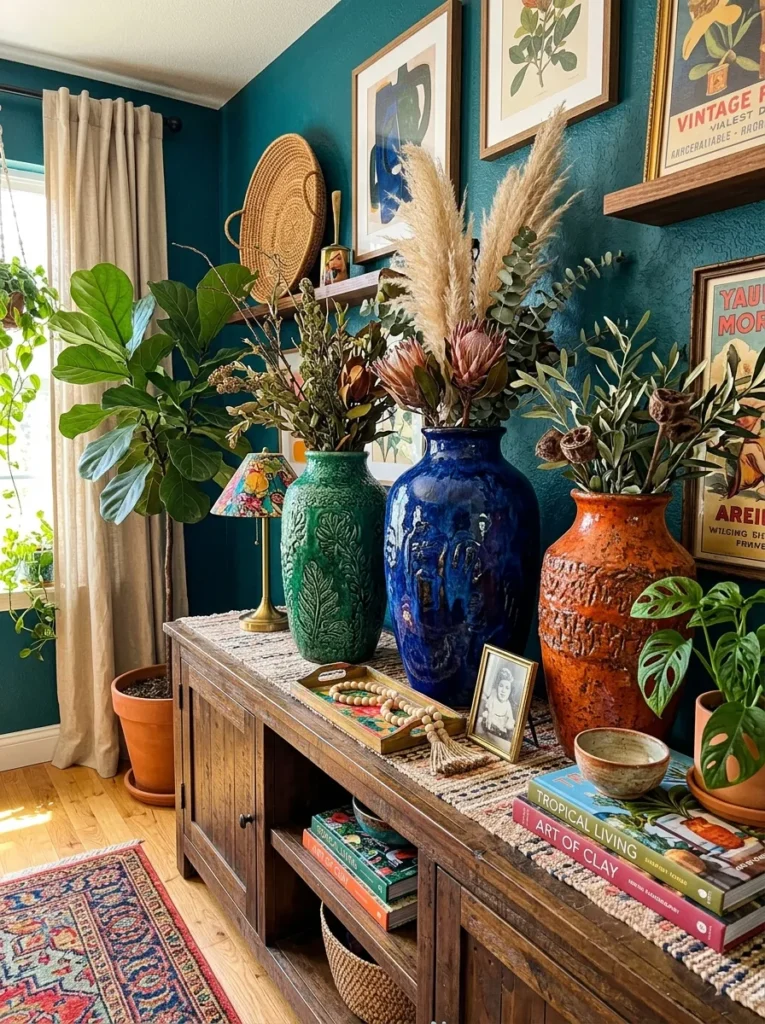
Vibe: The grouping is vibrant — deep cobalt, emerald, and terracotta ceramics grouped together create a color statement of genuine boldness that rejects the quiet neutral palette in favor of the saturated, joyful color world of tropical botanical abundance.
Why it works: Bold color ceramic groupings work when the colors chosen are all equally saturated — mixing a deep, rich cobalt with a clear emerald and a bright terracotta creates harmony between strong colors because all three share the same intensity level. The conflict that makes bold color pairings fail is typically a saturation mismatch — one highly saturated color beside one muted color reads as jarring, while two or three colors at similar saturation levels read as coordinated confidence. Eclectic interiors benefit specifically from bold vase groupings because the vases’ concentrated color provides the visual anchoring that rooms with varied furniture styles and patterns need to cohere.
How to get it: Build the bold grouping around one hero piece — the largest and most saturated color vase — then add two supporting pieces in colors that share either the same undertone family (cobalt and emerald are both cool-toned) or the same saturation level (terracotta and cobalt at similar richness). Mix surface textures (one glossy, one matte, one textured) within the bold color group to prevent the grouping from reading as matching sets of paint colors.
Shop The Look
- Deep cobalt blue ceramic vase large
- Emerald green glazed ceramic vase
- Terracotta orange ceramic vase large
- Bold color ceramic collection eclectic
- Sideboard eclectic display surface
13. Marble or Travertine Vase for Mineral Elegance
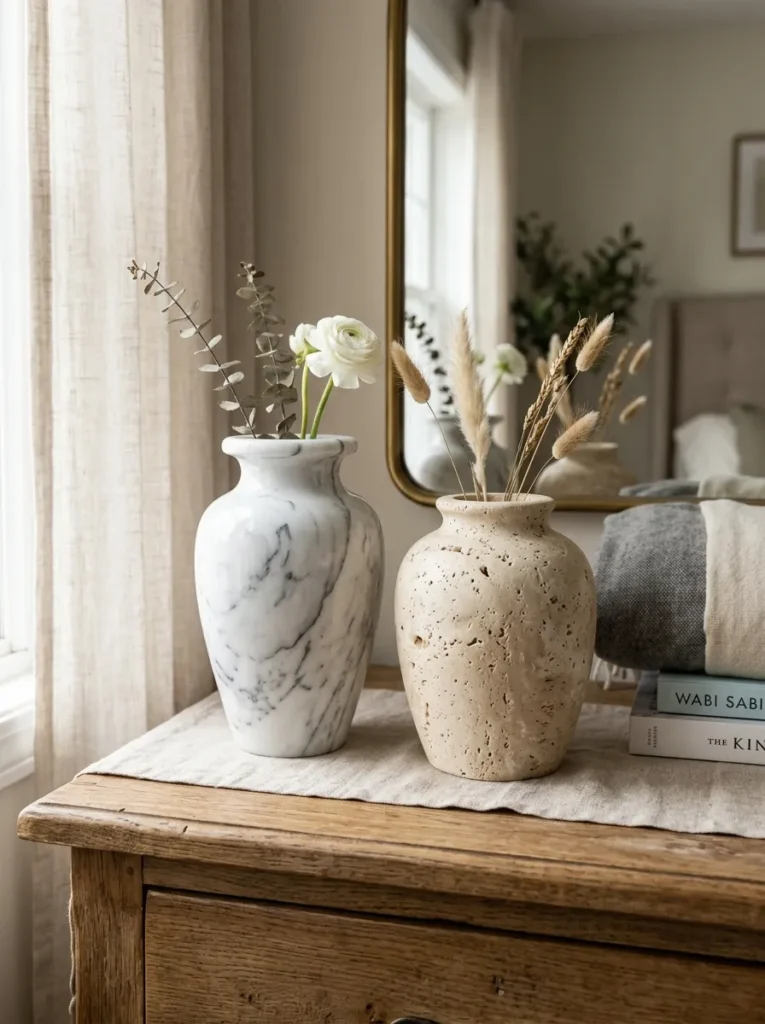
Vibe: The vases are elegant — marble and travertine vessels carry the mineral beauty of stone in a form that brings the weight and permanence of architectural material to the domestic surface, creating a quality that no ceramic or glass can approximate.
Why it works: Stone vases have a specific material quality — their weight and cool surface temperature are physically perceptible in a way that ceramic and glass are not, and this physical perception contributes to the impression of quality and permanence. Marble’s veining creates natural pattern that is unique to each piece, so no two marble vases are identical even if they are the same form — this inherent uniqueness is a quality that manufactured ceramics cannot replicate. Travertine’s natural pitting (the small voids in the stone that characterize this material) creates surface texture that catches and holds shadows in a way that smooth marble does not, giving travertine vessels a rougher, more organic quality than the refined smoothness of marble.
How to get it: Stone vases are available from specialty home decor retailers and online stone suppliers — look for pieces that show natural veining or pitting clearly rather than pieces where the stone’s distinctive character has been polished away. Stone vases are typically not watertight due to natural porosity — use with dried stems only or insert a glass liner for fresh flowers. Handle with care as stone chips at edges under impact.
Shop The Look
- White marble vase Carrara grey vein
- Travertine stone vase natural pitting
- Marble bud vase small bathroom
- Travertine cylinder vase modern
- Stone vase glass liner insert small
14. Dried Flower Arrangement in a Terracotta Pot
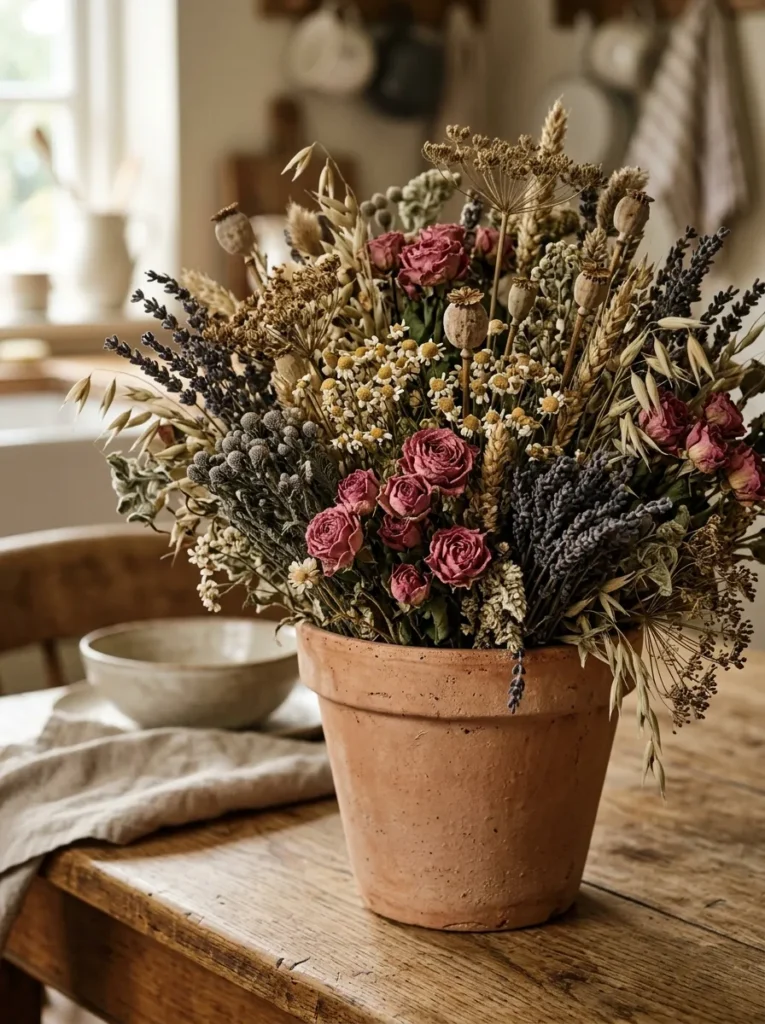
Vibe: The arrangement is botanical — an abundant dried flower arrangement in a simple terracotta pot creates the most naturalistic, garden-connected display possible for a kitchen or dining surface, where the honest clay vessel and the dried botanical abundance reference the garden’s own materials.
Why it works: Terracotta pots are the correct vessel for abundant dried flower arrangements because their unglazed clay surface and warm orange-brown tone reference the earth itself — the material the flowers grew in and the material the pot is made from are essentially the same. This material connection gives the arrangement a coherence that glazed or synthetic vessels do not provide. Dried flowers specifically work in terracotta because the matte, textured clay surface and the matte, textured dried botanicals exist in the same tactile register — both absorb light rather than reflecting it, creating a unified surface quality. Fresh flowers in terracotta pots require a watertight liner, but dried arrangements need no modification.
How to get it: Fill the terracotta pot with dry floral foam cut to fit (or crumpled paper as a free alternative) to provide stem support. Begin with the longest stems to establish the arrangement height and overall shape. Insert stems at varied angles — some leaning outward toward the viewer, some leaning to the sides — to create the generously overflowing quality that makes dried arrangements in terracotta read as garden-abundance rather than formal arrangement. Mix at least five different botanical types for visual complexity.
Shop The Look
- Unglazed terracotta pot medium display
- Dried rose bundle dusty rose
- Dried lavender bunch purple natural
- Dried chamomile stem bundle cream
- Dried seed head assortment natural
15. Monochrome White Ceramic Grouping for Minimalist Rooms
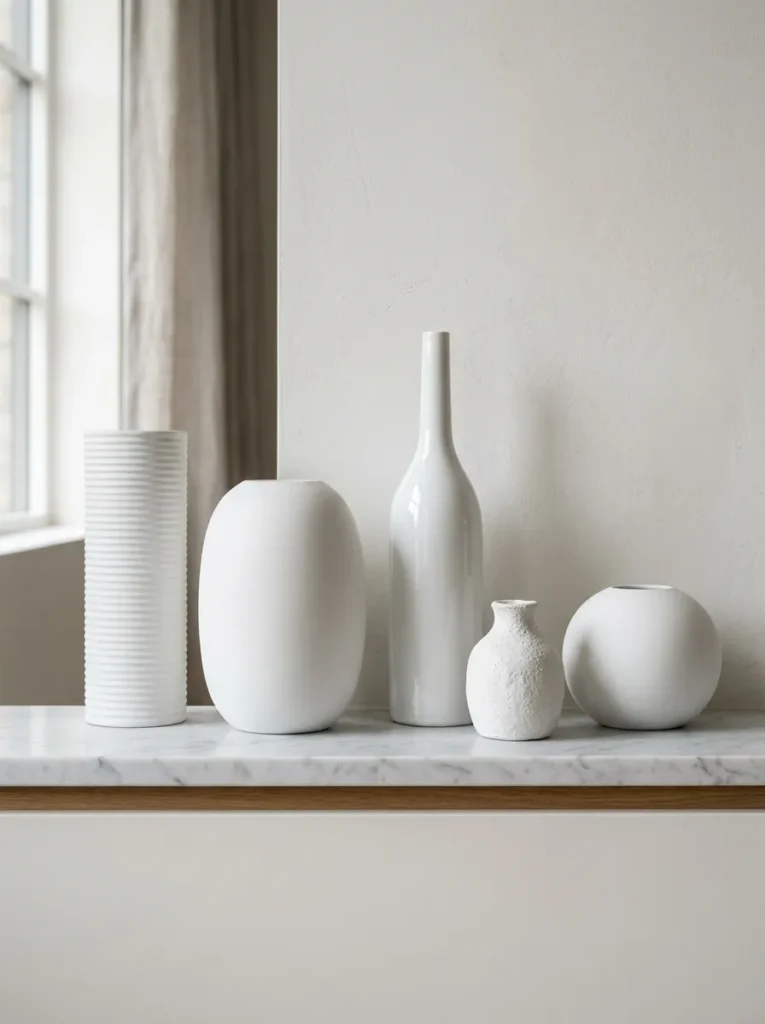
Vibe: The grouping is meditative — five white ceramic forms in a tonal study together create a composition that rewards patient looking, where the differences between forms and surface textures become more apparent the longer they are observed.
Why it works: A monochrome white ceramic grouping exploits the visual principle that removing color from a composition forces the viewer to perceive form and texture — qualities that color contrast typically overshadows. When all pieces are white, the eye distinguishes them through shadow (which reveals three-dimensional form) and surface texture (ribbed surfaces catch shadow differently from smooth surfaces, matte surfaces differently from glossy). This enforced attention to formal and tactile qualities rather than color is a meditative design strategy that works specifically in minimalist rooms where the intention is to slow visual processing rather than accelerate it. The grouping must include genuine texture variation — a grouping of five identical smooth white pieces reads as repetition rather than a study.
How to get it: Build the white grouping from multiple sources rather than from a single collection — the subtle differences in white tone (warm white, cool white, pure white) between pieces from different makers and traditions add visual richness to an apparently uniform palette. Mix ceramic traditions (a rough handmade piece from a studio potter, a refined porcelain bud vase, a mass-market ribbed form with an interesting profile) for genuine variety within the white constraint.
Shop The Look
- White ribbed ceramic vase tall cylinder
- Matte white oval ceramic vase modern
- White porcelain bottle neck vase narrow
- Rough textured white handmade bud vase
- White rounded ceramic vessel minimal
16. Seasonal Vase Styling for Year-Round Relevance
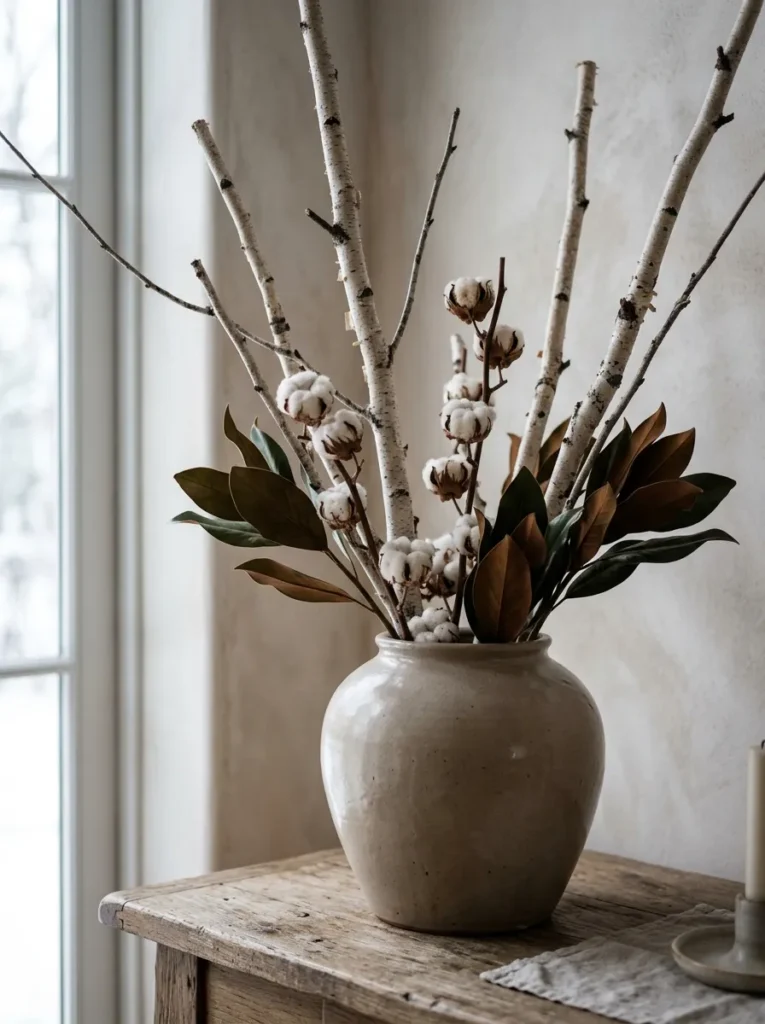
Vibe: The arrangement is seasonal — a single quality vase dressed with botanicals that change four times a year creates a permanent design element in the room that is never stale, where the vessel provides the year-round material presence and the seasonally changed content provides the living connection to the world outside.
Why it works: Seasonal vase styling is the highest-value decorating strategy available for a quality vessel — rather than purchasing four seasonal decorative objects, one quality vase with four seasonal botanical groupings provides four distinct room moments from a single investment. The vessel itself becomes a room anchor as permanent as a piece of furniture, while the botanical content changes to reflect the season’s specific botanical character: spring branches and fresh tulips, summer wildflowers and garden roses, autumn dried grasses and berry branches, winter bare branches and cotton stems. The seasonal change is low-cost (botanicals from garden, farm stand, and craft store) and low-effort (a complete restyle takes 10–20 minutes) while the visual impact of a seasonally appropriate botanical arrangement is among the most effective room refreshers available.
How to get it: Identify the room’s permanent quality vase — the one piece that is beautiful enough in form and material to live on the same surface year-round without boring you. For spring: forced forsythia or cherry branches, fresh tulips, or moss and wildflower stems. For summer: garden roses, tall zinnias, sunflowers, or fresh eucalyptus. For autumn: dried grasses, bittersweet berries, dried corn, or fall branches. For winter: bare birch or willow branches, dried cotton stems, evergreen clippings, or dried seed heads. Each seasonal grouping should use the simplest, most direct expression of that season’s botanical character rather than artificially elaborate arrangements.
Shop The Look
- Tall neutral ceramic vase large seasonal
- Silver birch branch bundle dried white
- Dried cotton stem branch white boll
- Preserved magnolia leaf branch brown
- Greige ceramic vase sculptural form
How to Start Your Decorative Vase Collection
The single most important first principle in building a decorative vase collection is to prioritize one quality piece over multiple mediocre ones. A single hand-thrown stoneware vessel with genuine craft evidence — throwing rings, organic rim, depth of glaze — on a well-chosen surface does more design work than six identical mass-produced vases arranged in a group, because the quality piece rewards close inspection in a way that mass-produced objects do not. Budget that would buy six generic vessels is better spent on one genuinely made piece and one quality botanical arrangement for it — the design result is superior and the long-term satisfaction is incomparable.
The most common beginner mistake in decorative vase styling is matching — purchasing vases in matching sets, filling all vases with the same botanical, or arranging vases in symmetrical pairs that read as retail display rather than personal collection. The fix is deliberate mismatching: source pieces from different places and different times, use different botanicals in different vessels, and arrange in odd-numbered groups at varied heights. A matched pair of vases reads as purchased together; two vases from different sources in the same color family reads as curated.
Three vase styling upgrades under $50 that make an immediate, significant visual difference: one single quality dried botanical stem or branch ($8–$20 from a specialty florist or craft market) placed in an existing vessel that has been sitting empty, which costs nothing for the vessel and transforms it from a prop to an arranged object; a small bag of decorative gravel or smooth river stones ($4–$8) placed in the base of a clear glass vase before adding stems, which adds a visible base layer that makes the arrangement read as designed; and a small amber glass pharmacy bottle ($3–$8 at a thrift store or antique shop) added to an existing bud vase collection as a light-transmitting element that warms the windowsill grouping significantly.
A complete decorative vase styling program — one anchor piece for the main living surface, a bud vase collection for a window or bathroom, and one floor vase for architectural presence — is achievable over two to three months of intentional acquisition rather than a single shopping trip, and the incremental, collected quality that results is visually superior to any single-session purchase. Total investment for a complete home vase program ranges from $60–$150 for a thrift-sourced and craft-market approach to $250–$600 for studio ceramics, quality glass, and specialty material pieces — in both cases, less than the equivalent investment in any piece of furniture while producing comparable design impact.
Frequently Asked Questions About Decorative Vases
What size vase works best for different surfaces and rooms?
The proportional rule for vase sizing is that the vessel’s height should be approximately one-third to one-half the height of the surface it sits on — a 32-inch tall sideboard calls for a vase in the 10–16 inch range, while a 16-inch tall coffee table is best served by vases in the 6–8 inch range. For botanical arrangements, the stems should be 1.5 to 2 times the height of the vase — shorter stems read as stuffed into the vessel rather than arranged, while longer stems create the visual proportion associated with intentional design. Floor vases (24–36 inches) belong beside sofas, in corners, and at staircase bases where their height fills the vertical zone between floor-level furniture and ceiling. Bud vases (3–8 inches) belong on windowsills, bathroom shelves, bedside tables, and kitchen counters where their small scale suits the intimate surface context.
How do I style a vase without flowers for year-round use?
Dried botanicals are the most versatile year-round vase content — they require no water, last for months to years, and include a wider range of interesting sculptural forms than fresh flowers. Dried pampas grass, cotton stems, dried seed heads, preserved leaves, dried lavender, and bare branches all work across seasons with different botanical personalities. Sculptural non-botanical content — smooth river stones, pinecones, driftwood pieces, or decorative spheres — works in wide-mouth vases for textural interest without botanical content. The most sophisticated approach is to display a quality vessel entirely empty when its form is interesting enough to carry the visual weight alone — a sculptural or highly textured ceramic, an interesting glass form, or a hammered metal piece can all sustain interest without any content when the object itself is genuinely beautiful.
What is the best way to arrange multiple vases together?
The three rules for effective vase groupings are: odd numbers (three or five read as collected, even numbers read as arranged in pairs), varied heights (a minimum height differential of 30% between the tallest and shortest piece), and shared material family (all ceramic, all glass, all warm-toned metals — mixing material categories in a small group creates visual confusion rather than variety). Within these constraints, vary glaze color, form, and surface texture as much as possible — a grouping of three stoneware vases works best when each has a different glaze, a different form, and a different surface texture, because the variation confirms that the pieces were curated rather than purchased as a set. Position the tallest at the back or side of the group, medium at center or front-side, and shortest at the front to create visual depth.
How do I choose the right vase color for my room?
The vase color decision is most effective when it either extends the room’s existing color palette (a dusty sage vase in a room with sage cushions and botanical prints creates color continuity) or introduces the room’s most intentionally absent color as a small accent (a single deep cobalt blue vase in an otherwise warm-neutral room introduces cool contrast at small scale without committing to a full accent color direction). Warm neutrals — terracotta, clay, cream, warm grey — are the most universally compatible vase colors because they coordinate with both warm and cool room palettes without conflict. Avoid matching the vase color exactly to an existing room element — a vase that exactly matches the cushion color reads as coordinated to the point of being designed rather than collected, which undermines the personal quality that decorative vases should communicate.
What is the most important quality to look for when buying a decorative vase?
The most important quality in a decorative vase purchase is form — the three-dimensional shape of the vessel as it occupies space and creates shadow. Glaze, color, and surface decoration can all be interesting, but a vase with an unconvincing form (one that reads as generic or mass-produced in its basic silhouette) is not rescued by an interesting glaze or attractive color. A well-designed form — one that has the correct relationship between its base width and height, between its body volume and neck proportion, and between its overall scale and the weight it reads as having — looks correct from every angle and in every light condition. When evaluating a vase, view it from the side, front, top, and at a low angle — a form with genuine design quality rewards every viewing angle, while a form with a design weakness (a base too small for the body, a neck disproportionate to the shoulder, an overall silhouette without visual logic) reveals its problem from at least one of these views.
Ready to Style Your Home with Decorative Vases?
These 16 ideas span the full range of what a decorative vase can be in a home — from the quiet authority of a hand-thrown stoneware cluster on a walnut shelf and the architectural presence of a tall floor vase in a room corner, to the botanical abundance of a dried flower arrangement in unglazed terracotta and the luminous warmth of amber glass in afternoon light, from the graphic confidence of a single matte black ceramic on white marble to the meditative tonal study of five white ceramics in one careful grouping. You do not need all 16 — the most considered vase collections are built incrementally, one quality piece at a time, from sources as varied as a local potter’s studio, a thrift store shelf, a farm stand, and an antique market. Start this week by looking at every existing vessel on every surface in your home and asking one honest question about each: is this genuinely beautiful, or is it merely occupying space? The ones that fail that question are the ones to remove, and the space they leave is the invitation to begin. Pin the ideas that named something your home already needs — those are the ones worth pursuing first.