14 IKEA HOVET Mirror Tips to Brighten Any Room
The IKEA HOVET mirror is a full-length aluminum-framed mirror measuring 30¾ × 77⅛ inches — a tall, slim, architecturally proportioned mirror in a simple brushed aluminum frame that has become one of the most widely used and most widely styled mirrors in contemporary residential interiors because its slim profile, its neutral metallic frame, and its full-length format make it simultaneously functional, spatially generous, and visually compatible with almost every interior design direction. This article gives you 14 HOVET mirror tips across placement strategy, leaning versus mounting approaches, room brightening techniques, styling compositions, hacking and customization, grouping configurations, and small-space applications so your HOVET mirror contributes maximum light, space, and design quality to the room it occupies.
The HOVET mirror’s specific design quality — a slim aluminum frame at less than 1-inch profile, a clear glass surface with no tint or distortion, and dimensions that provide a true full-length reflection — makes it the functional baseline from which every subsequent styling and placement decision should begin. The mirror’s value is in what it does: reflects light, doubles perceived space, provides a true full-length view, and frames the room beyond it as a visual composition. Understanding these four functions and optimizing the placement and context decisions around them is what transforms a wall-leaned IKEA mirror into a room-defining design element. Here are 14 tips worth saving — and implementing.
Why the IKEA HOVET Mirror Works in Contemporary Rooms
The HOVET mirror’s contemporary resonance draws from the convergence of the minimalist design movement’s preference for clean-line, unornamented objects that perform their function with visual restraint, and the practical reality that a full-length mirror in a slim neutral frame is among the most spatially intelligent investments available in residential interior design. The mirror’s aluminum frame — consistently silver-toned, brushed rather than polished, narrower in profile than most full-length mirror frames — reads as a neutral architectural element rather than a decorative furniture piece, which is specifically what makes it visually compatible with such a wide range of interior styles from Japandi and Scandinavian minimalism to contemporary transitional and even maximalist settings where the mirror’s visual restraint provides necessary breathing space.
The HOVET’s specific dimensions (30¾ inches wide by 77⅛ inches tall) create a proportional relationship that the eye reads as genuinely architectural — the 2.5:1 height-to-width ratio references the proportions of a standard interior door, which is why a HOVET mirror leaned against or mounted on a wall reads as a designed architectural element rather than as a piece of furniture. This architectural proportion is the primary reason the HOVET performs better at room scale than most alternative full-length mirrors at similar price points — mirrors with squarer proportions read as furniture while mirrors with this elongated proportion read as architectural features.
The spatial intelligence of a properly placed full-length mirror — specifically the HOVET’s clear, true-color glass that accurately reflects the room’s colors and light rather than introducing the warm or cool color shift that some mirror glass produces — is well-documented in interior design practice. A mirror placed to reflect a natural light source (a window, a skylight) effectively doubles the room’s perceived natural light level. A mirror placed at the end of a short room extends the perceived depth of the space dramatically. A mirror placed to reflect the room’s most beautiful view (a garden beyond a window, a well-composed bookshelf, a quality piece of art) doubles the visual richness of the room without any additional purchase.
Performance at a Glance
| Element | Detail |
|---|---|
| Mirror Dimensions | 30¾ × 77⅛ inches (78 × 196 cm) |
| Frame Material | Brushed aluminum, slim profile under 1 inch |
| Glass Quality | Clear, true-color glass — no color shift |
| Primary Functions | Light reflection, spatial expansion, full-length view, room composition doubling |
14 IKEA HOVET Mirror Tips to Brighten Any Room
1. Position Perpendicular to the Primary Window for Maximum Light Reflection
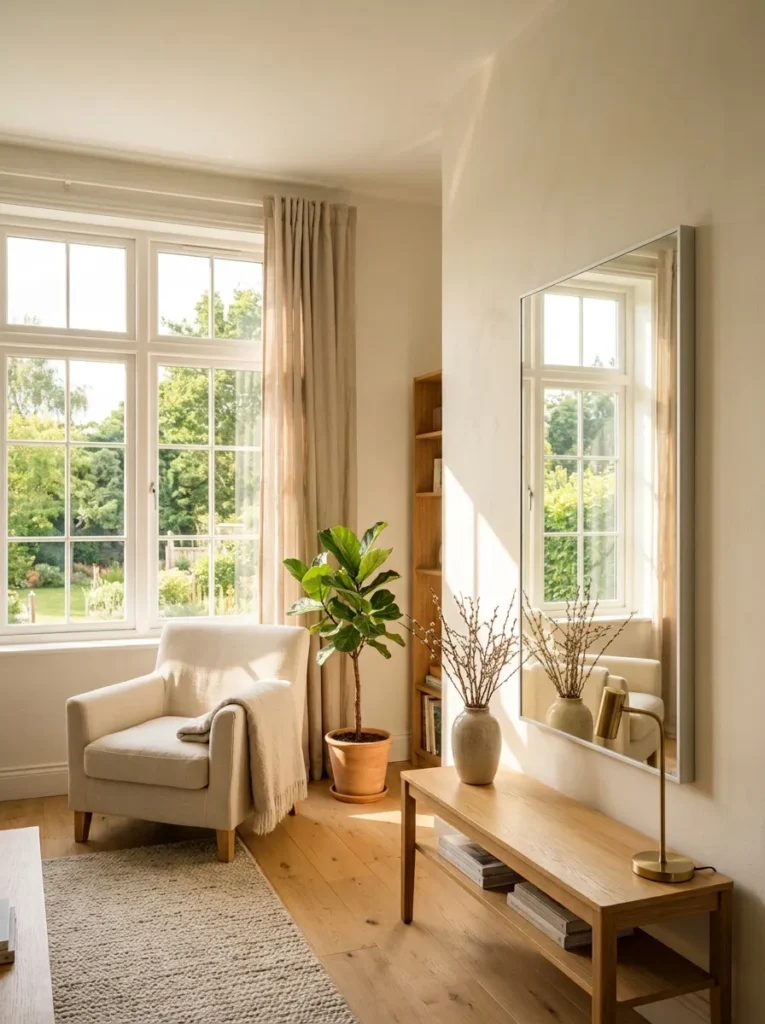
Vibe: The room is bright — a HOVET mirror positioned perpendicular to the window catches and reflects natural light across the full depth of the room, creating a light reflection that makes the room feel genuinely more luminous without any additional light fixtures.
Why it works: The perpendicular placement of a mirror relative to a window is the most effective light-reflection positioning available because it catches the window’s light at an angle that reflects it across the room rather than simply bouncing it back toward the window. A mirror placed directly opposite a window reflects light back toward the window, which creates a bright spot on the mirror but does not illuminate the rest of the room. A mirror placed on the wall adjacent to (perpendicular to) the window catches the light as it passes through the room and reflects it at roughly 90 degrees, sending it across the room’s width and into the room’s darker zones. The HOVET’s full height (77 inches) maximizes the reflected light quantity — a taller mirror captures more of the window’s light field than a shorter mirror at the same wall position.
How to get it: Measure the distance from the window wall to the adjacent wall where the mirror will be placed. The optimal perpendicular position for light reflection is within 3–6 feet of the window — close enough to the window to capture a wide angle of the incoming light, but not so close to the window frame that the mirror’s reflection mostly captures the window frame rather than the room beyond. Lean the mirror against the adjacent wall or mount using the HOVET’s provided hanging hardware, positioned so the mirror’s face is at a slight forward angle (if leaning) or perfectly plumb (if wall-mounted) for accurate room reflection.
Quick Win: Moving an existing HOVET mirror from a wall directly opposite the window to the perpendicular wall adjacent to the window takes five minutes and can increase the perceived light level in a north-facing or dark room by 30–50% with no additional fixtures or purchases.
Shop The Look
- IKEA HOVET mirror aluminum full length
- Mirror wall anchor kit safety
- Window light reflective positioning guide
- Sheer linen curtain light-maximize window
- Anti-tip furniture strap wall safety
Also view: 14 Stylish Living Room Ideas That Look Expensive
2. Lean at a Slight Forward Angle for a More Flattering Reflection
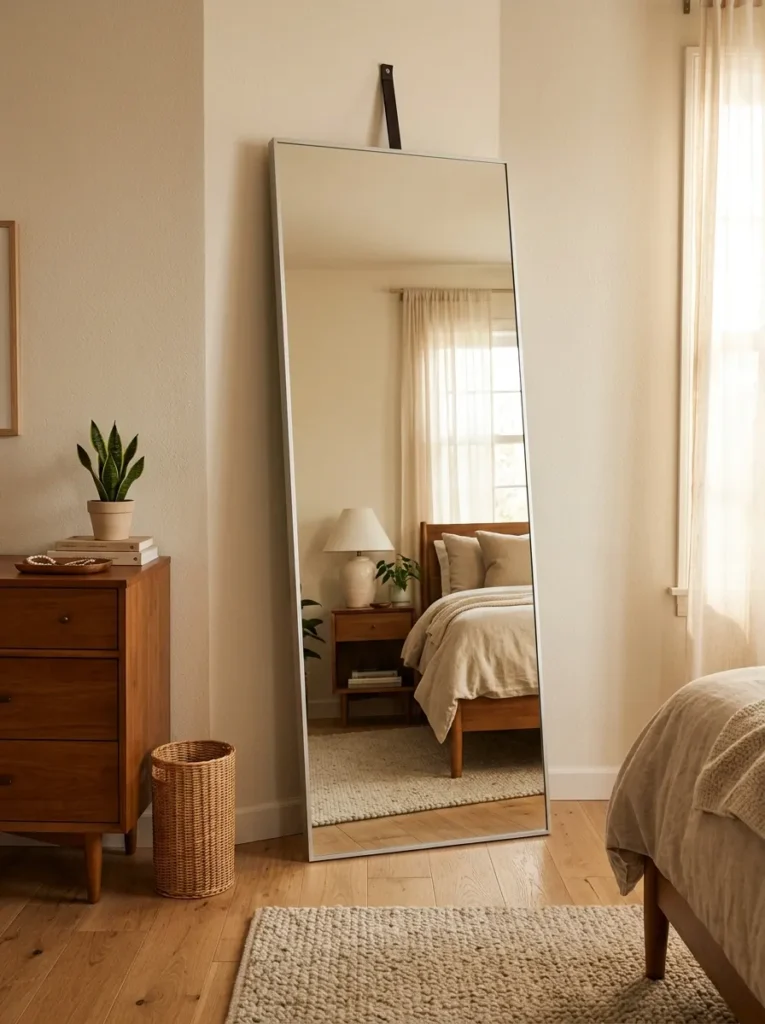
Vibe: The reflection is flattering — a HOVET mirror leaned at a slight forward angle creates the elongating reflection that makes the viewer appear taller and slimmer than a perfectly vertical or backward-leaning mirror, because the slight forward angle shows more floor below and ceiling above relative to the body in the reflection.
Why it works: Mirror angle significantly affects the reflection’s apparent proportions — this is a well-understood optical phenomenon in photography, filmmaking, and retail design, where mirror angles are deliberately calibrated to affect the viewer’s perception of their own appearance. A mirror tilted slightly forward (the bottom of the mirror farther from the wall than the top) creates an elongating effect because the viewer sees more of the floor below their feet and more of the ceiling above their head in the reflection, which makes the body appear taller and the proportions longer. A mirror tilted backward (the common result of leaning a mirror without a forward-lean guide) creates the opposite effect — it shows more of the ceiling and less of the floor, which makes the viewer appear shorter and broader. The correct forward-lean angle for a flattering full-length reflection is 3–5 degrees from vertical — enough to produce the elongating effect without distorting the reflection into an obvious fish-eye quality.
How to get it: Lean the HOVET against the wall and place a thin wedge (a folded piece of cardboard, a door stop, or a purchased mirror lean wedge) under the mirror’s base to create the 3–5-degree forward tilt. Secure the mirror at the top with an anti-tip wall strap (included with the HOVET or available separately for $5–$10) anchored into a wall stud — the forward lean increases the tipping risk that the wall anchor must compensate for. Test the reflection at your normal viewing distance (approximately 6–8 feet) and adjust the base wedge until the elongating effect is visible and the floor below your feet reads naturally in the reflection.
Shop The Look
- Mirror lean wedge forward angle set
- Anti tip furniture strap wall anchor
- Door stop rubber wedge small
- Stud finder wall anchor installation
- HOVET mirror lean styling guide
Also view: 15 French Country Decorating Ideas Worth Saving
3. Group Two HOVET Mirrors Side by Side for a Full-Width Wall Effect
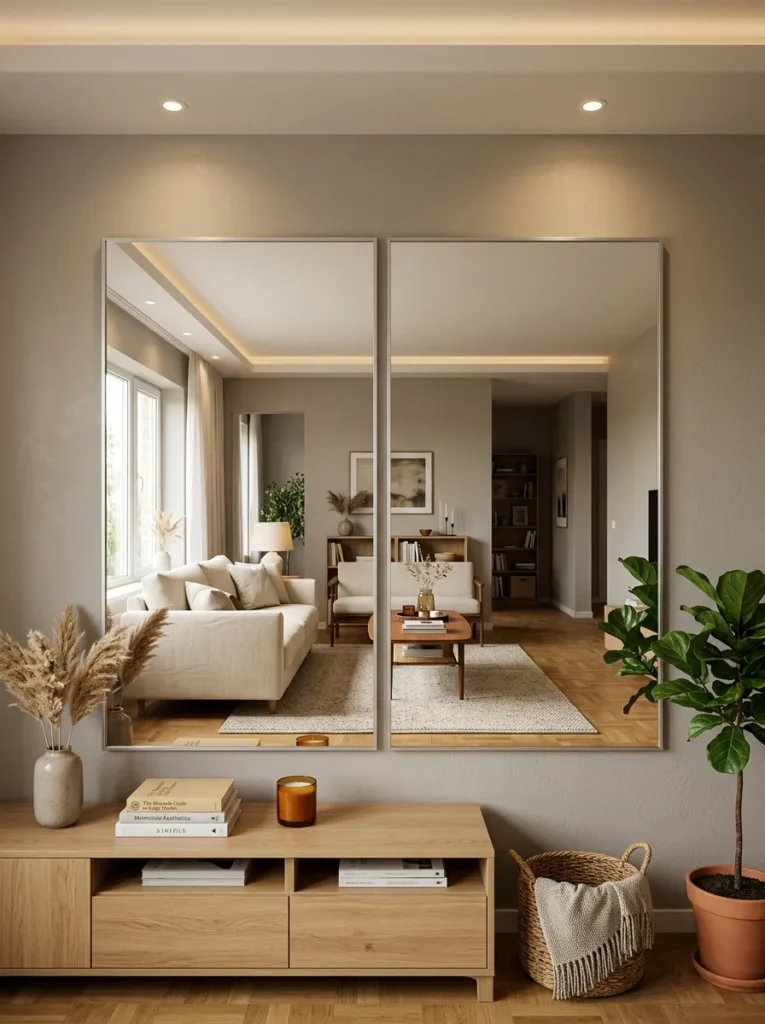
Vibe: The wall is expansive — two HOVET mirrors placed side by side create a nearly full-width mirror installation that reflects the full room and functions visually as a mirror wall without the cost or installation complexity of a custom mirror wall installation.
Why it works: Two HOVET mirrors placed side by side create a combined reflective surface of approximately 62 inches width and 77 inches height — a mirror installation larger than any comparable off-the-shelf mirror product available at or near the HOVET’s $149 price point. At this scale, the mirror wall effect creates a room-defining spatial expansion — the full room in front of the mirrors is reflected in its entirety, making the room appear to continue beyond the wall rather than terminating at it. The slim aluminum frames of the two adjacent HOVETs become the only visual interruption in the combined reflective surface, and the 1-inch aluminum gap between the two frame edges is visually similar to the natural seaming in larger mirror installations at significantly higher cost. This two-mirror configuration is specifically effective in narrow bedrooms, long hallways, and dining rooms where the spatial expansion of a wide mirror installation most directly addresses the room’s proportional challenge.
How to get it: Mount both HOVET mirrors using the IKEA-provided hanging hardware, ensuring both mirrors are hung at exactly the same height and exactly plumb — a laser level ($15–$30) is the most reliable tool for ensuring the two mirrors align precisely without visible height discrepancy. Position the two mirrors with their inner frames touching or with a minimal gap (no more than 2 inches) to maintain the unified mirror-wall reading. The total wall space required for a two-HOVET side-by-side installation is 62–64 inches — ensure the chosen wall has sufficient uninterrupted width.
Shop The Look
- IKEA HOVET mirror two pack same wall
- Laser level mirror alignment tool
- Picture hanging strip heavy load
- Mirror wall mount two piece kit
- Level spirit magnetic hanging
4. Mount Horizontally as a Wide Architectural Feature
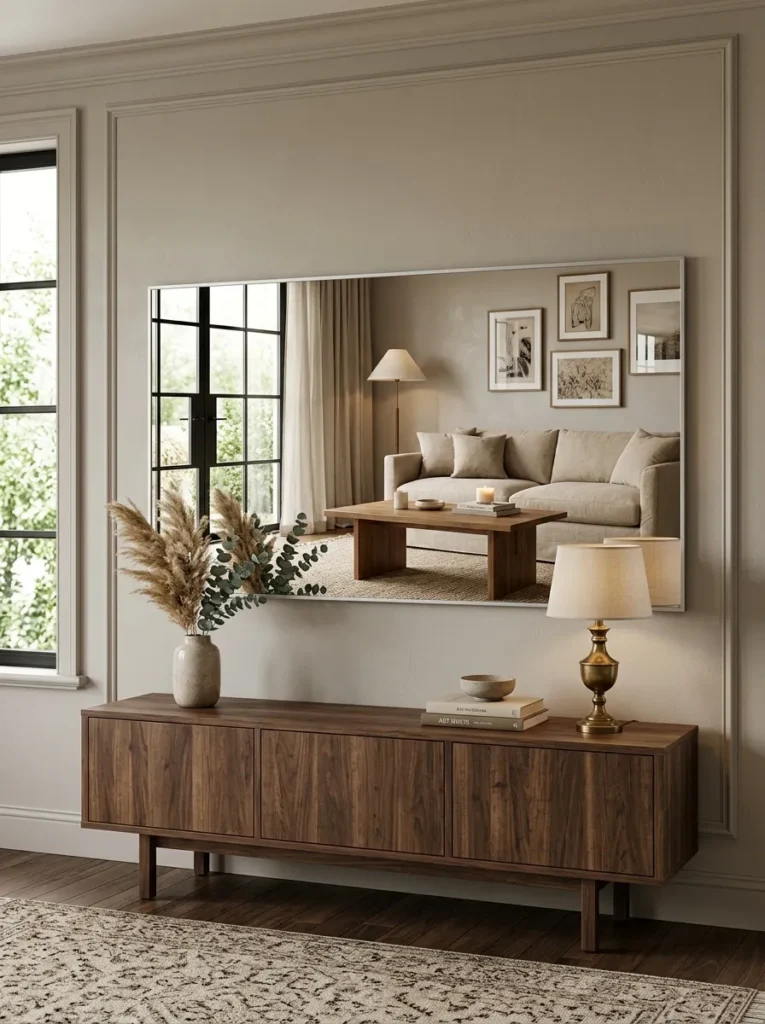
Vibe: The mirror is architectural — a horizontally mounted HOVET creates a wide, low proportioned mirror that reads as a designed architectural element rather than a standard full-length mirror, providing horizontal spatial expansion and a wide room-reflection view above furniture.
Why it works: Rotating the HOVET to horizontal orientation transforms its proportional relationship to the room and its furniture completely — a 77-inch-wide, 30-inch-tall mirror above a console table creates a horizontal composition that references the proportions of a landscape painting or an architectural transom window rather than the vertical proportion of a standard dressing mirror. This horizontal proportion is specifically effective above sideboards, console tables, and fireplace mantels where a very tall vertical mirror would feel disproportionately large relative to the furniture below it, while a very wide horizontal mirror creates the correct proportional relationship. The horizontal HOVET reflects the full width of the room in front of it rather than the full height, providing a panoramic room view rather than a vertical strip.
How to get it: The HOVET’s backing plate and hanger can be repositioned for horizontal mounting — the two hanging holes on the back panel can be redrilled in the correct positions for horizontal hanging, or D-ring hardware can be added at the appropriate horizontal-mounting positions. The mirror should hang with the long dimension horizontal and the hardware anchored into at least two wall studs — at 77 inches, the horizontal HOVET spans three stud positions in standard 16-inch stud spacing, providing excellent mounting security. Position the bottom edge of the mirror approximately 6 inches above the console or sideboard surface below for the most resolved compositional relationship.
Shop The Look
- D-ring mirror hardware horizontal mount
- Console table below mirror natural wood
- Wall stud finder anchor horizontal
- Picture rail horizontal mount kit
- Level horizontal mirror installation
5. Create a Dressing Room Effect in a Small Bedroom
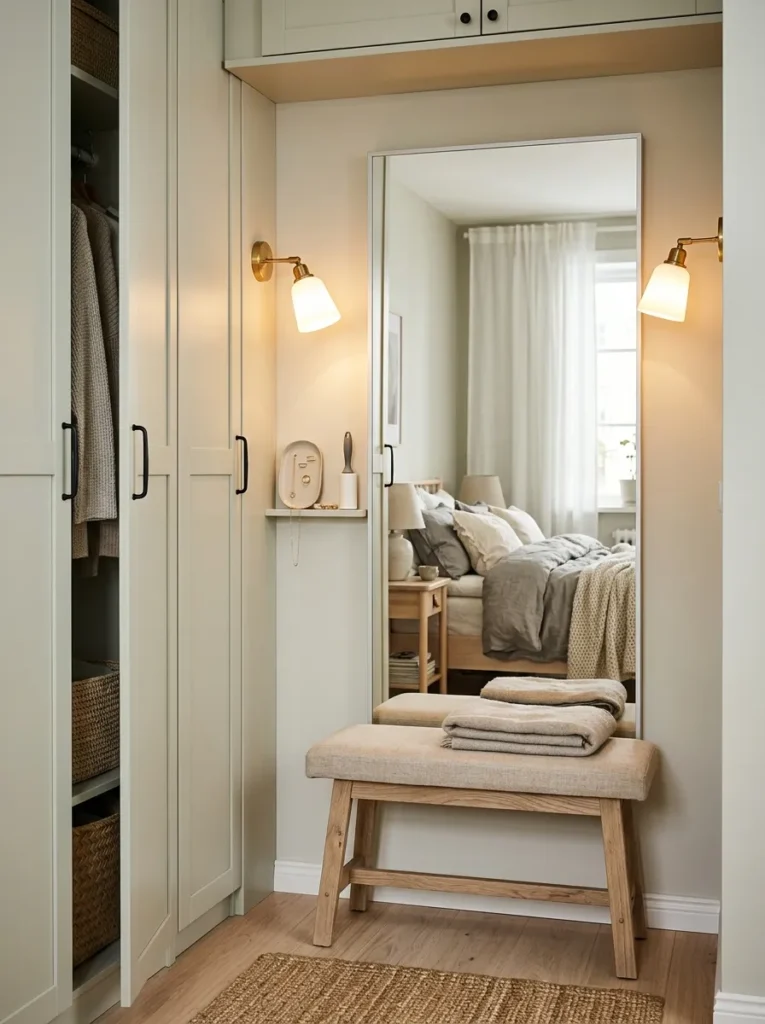
Vibe: The corner is functional — a HOVET mirror positioned adjacent to the wardrobe with bilateral lighting and a small bench creates a dedicated dressing zone that functions as a dressing room within a small bedroom, using the mirror as the spatial and functional anchor of the zone.
Why it works: A dedicated dressing zone within a small bedroom — created by positioning the HOVET mirror adjacent to the wardrobe with complementary lighting and seating — creates the specific quality of a functional area with defined purpose rather than a floating mirror in an undifferentiated room. The bilateral lighting (a wall sconce on each side of the mirror at face level) creates the correct lighting condition for dressing assessment — light coming from both sides of the face simultaneously, which is the most accurate and most flattering dressing light available. The small bench or stool positioned in front of the mirror provides the practical surface for shoe-putting-on and accessory selection that transforms a mirror into a complete dressing station. The corner or alcove position defines the dressing zone spatially without requiring any physical partition.
How to get it: Position the HOVET on the wall adjacent to the wardrobe or closet — within arm’s reach of the wardrobe door handles for the most efficient dressing workflow. Install two wall sconces (hardwired or plug-in) at 60-inch height, one on each side of the mirror, positioned at the mirror’s outer edges. A small upholstered bench ($40–$120) or a simple wooden stool ($20–$60) positioned 3–4 feet in front of the mirror completes the dressing station. The zone definition is achieved by the functional organization of these three elements (mirror, lighting, seating) rather than by any physical partition.
Shop The Look
- Wall sconce pair bilateral dressing light
- Small upholstered bench dressing room
- HOVET mirror adjacent wardrobe
- Warm LED bulb 2700K wall sconce
- Small wooden stool dressing room
6. Style with Hanging Plants and Natural Elements for Warmth
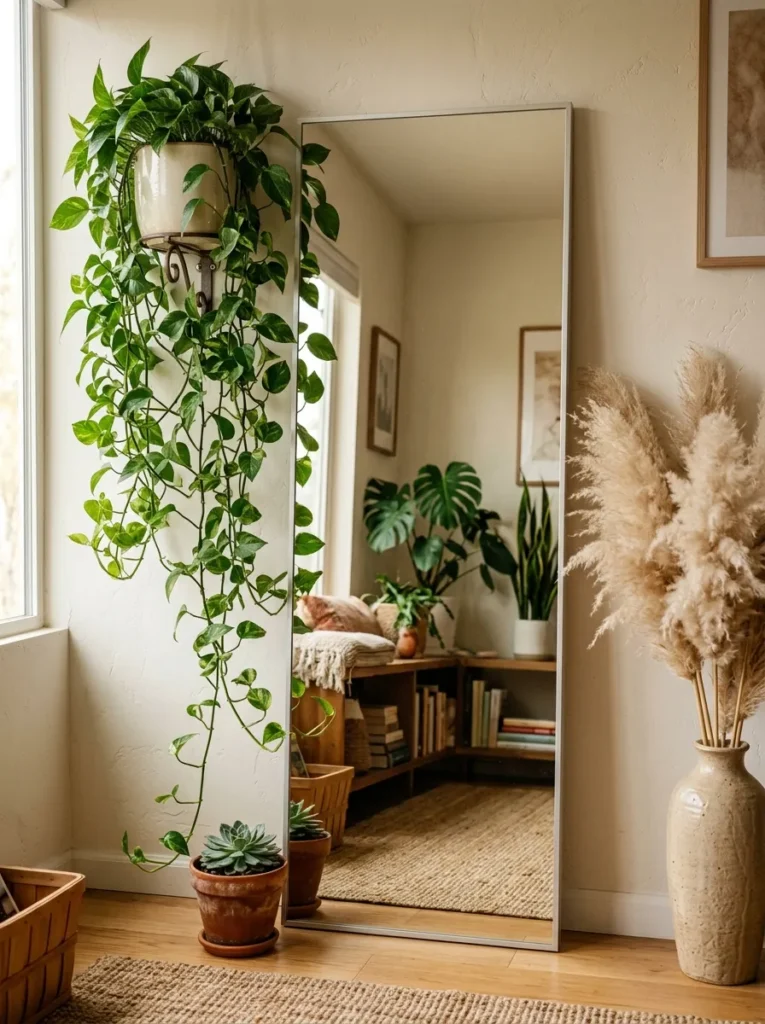
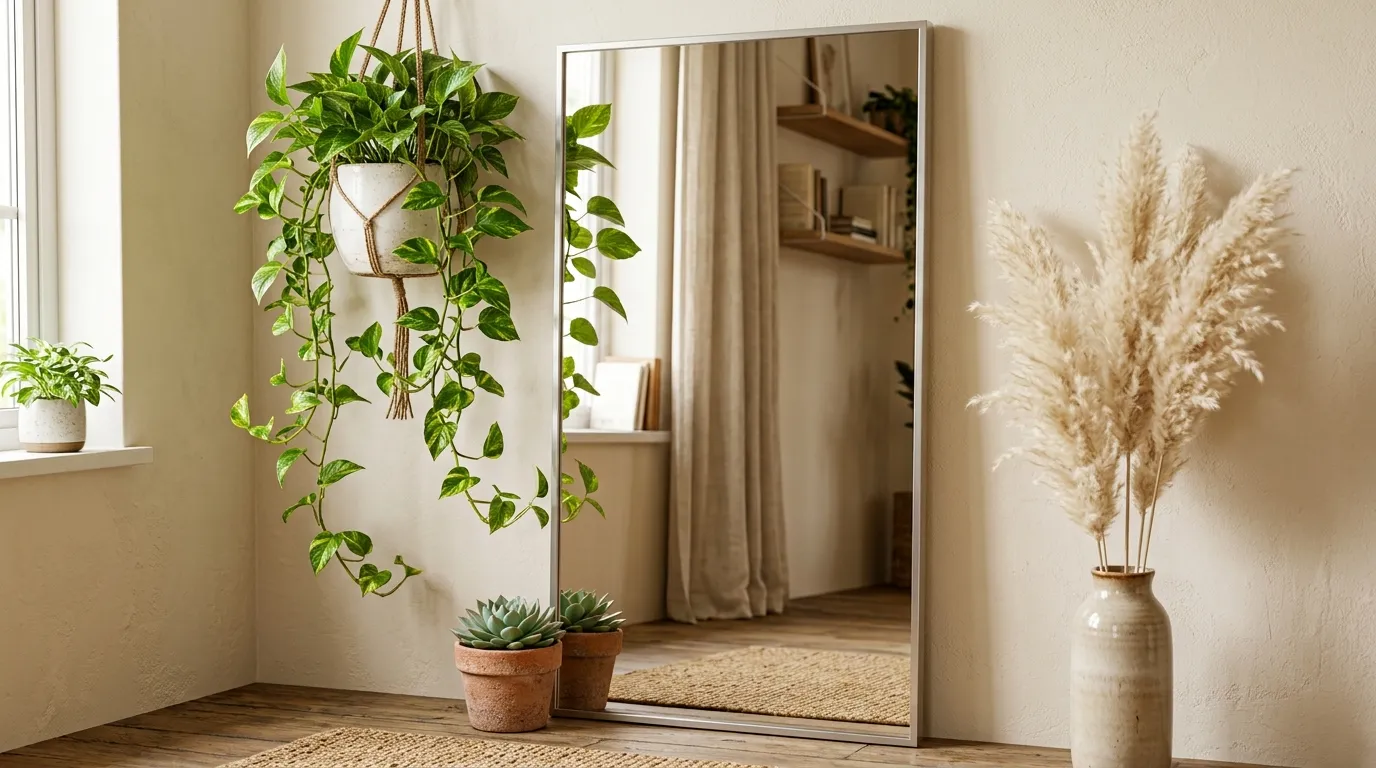
Vibe: The mirror is botanical — a HOVET mirror styled with hanging trailing plants, floor-level succulents, and dried pampas creates a botanical vignette that frames the mirror with organic warmth, where the aluminum frame’s cool silver reads as a designed counterpoint to the natural plant material rather than as a clinical metallic surface.
Why it works: Styling a full-length mirror with botanical elements creates two simultaneous effects that improve the mirror’s impact in the room. First, the botanical elements visually anchor the mirror to the room’s material context — a hanging plant beside the mirror and a floor plant at its base create a vertical botanical composition that integrates the mirror with the room rather than allowing it to read as a disconnected reflective surface on a bare wall. Second, the botanical elements appear in the mirror’s reflection, which doubles their visual presence and creates a richer, more materially complex reflection than an empty room would provide — a trailing plant beside the mirror becomes a doubled trailing plant in the reflection, creating the impression of a more abundantly planted room. The HOVET’s slim aluminum frame has a visual neutrality that accepts botanical companionship more gracefully than ornate or colored frames.
How to get it: Mount a wall-mounted planter or hanging pot at the mirror’s upper-left or upper-right position (approximately 72–80 inches from the floor, above the mirror’s top edge) with a trailing plant (pothos, string of pearls, or heartleaf philodendron work beautifully) whose stems trail downward along the mirror’s side. Place a floor-level plant (succulent in terracotta pot, small fiddle-leaf fig, or trailing plant in a ceramic vessel) at the mirror’s base. Add a dried botanical arrangement (pampas grass, dried eucalyptus, or dried botanicals in a tall vase) on the opposite side of the mirror for the bilateral framing effect.
Shop The Look
- Hanging planter wall mount ceramic
- Trailing pothos plant live indoor
- Terracotta pot small succulent
- Dried pampas grass stem tall vessel
- Wall hook plant hanger mirror side
7. Use in a Hallway to Visually Extend the Space
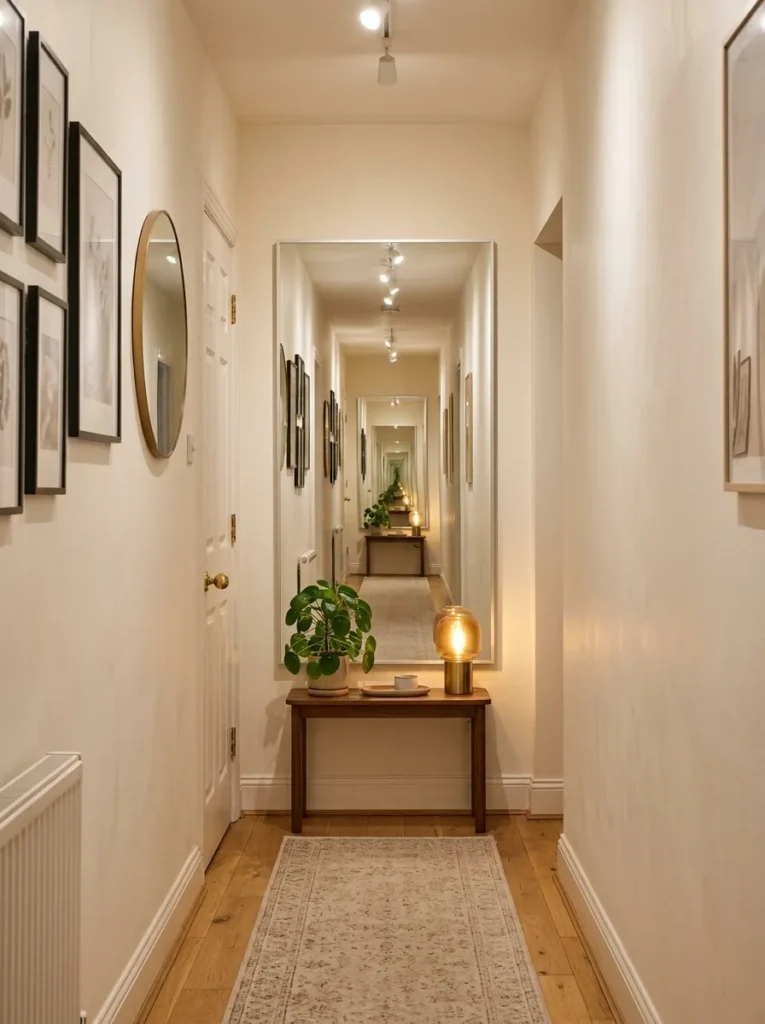
Vibe: The hallway is expansive — a HOVET mirror at the end of a narrow hallway reflects the hallway’s full length back toward the viewer, creating the optical illusion that the hallway continues beyond the physical wall and transforming the most architecturally challenging space in many homes into a corridor with apparent depth and generous proportions.
Why it works: Narrow hallways are among the most spatially challenging residential environments because their proportional constraint — significantly greater length than width — creates a corridor-like experience of spatial limitation that most people find psychologically uncomfortable. A full-length mirror at the hallway’s terminus is the single most effective spatial intervention available because it addresses the primary perceptual problem (the sense of the hallway ending abruptly) with the most direct possible solution (a reflection that makes the hallway appear to continue). The HOVET’s full height (77 inches) is specifically important in a hallway application because a shorter mirror would be seen above and below by people of normal height, which breaks the spatial illusion; a full-height mirror maintains the illusion to the full height of the visual field. The console table and lamp in front of the mirror create the designed entry moment that gives the hallway’s terminus a sense of arrival rather than termination.
How to get it: Mount the HOVET on the hallway’s end wall at the standard height (bottom of mirror at 6–12 inches from the floor for a leaned version, or centered at 57–60-inch height from the floor to the mirror’s visual center for a wall-mounted version). Position a narrow console table ($50–$200) in front of the mirror, leaving at least 24 inches between the console’s back and the mirror’s face for visual clearance of the reflection. Style the console with one plant, one small lamp, and one additional decorative object — the console styling will appear doubled in the mirror’s reflection, creating visual richness from a modest material investment.
Shop The Look
- Narrow console table hallway slim
- HOVET mirror hallway end wall
- Small table lamp warm shade console
- Single plant console styling
- Wall mount anchor hallway end
8. Install Beside the Front Door for a Functional Entry Moment
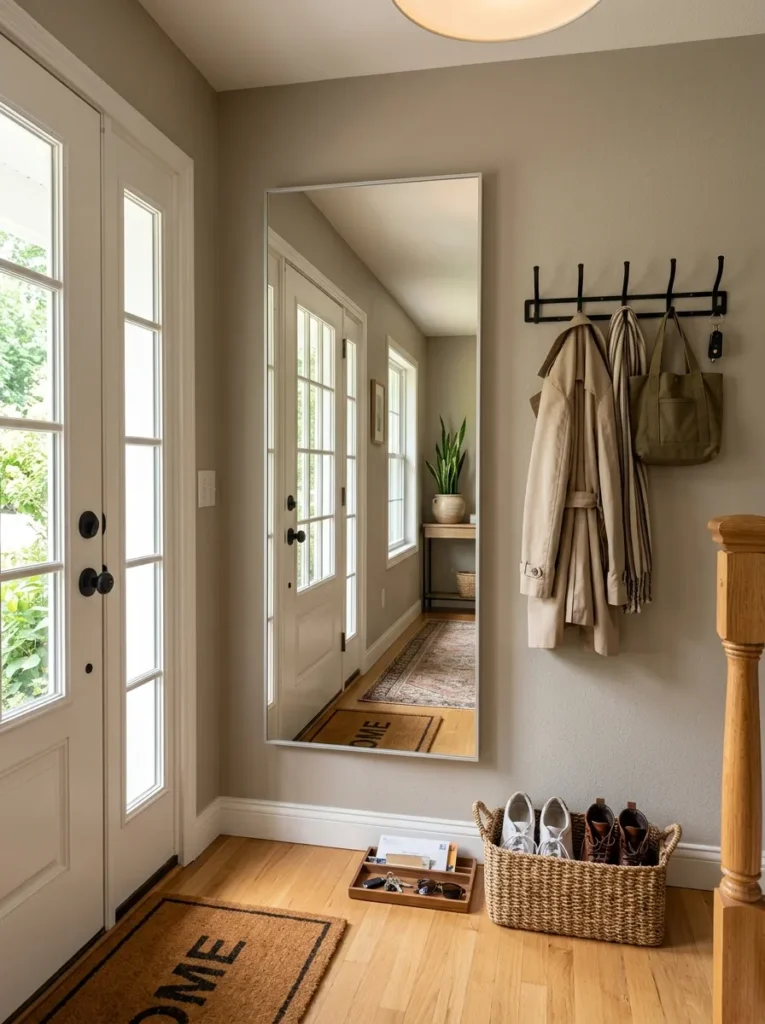
Vibe: The entry is functional — a HOVET mirror positioned directly beside the front door creates the entry station that every home benefits from: a full-length appearance check point at the moment of departure, combined with the hook and tray organization that makes the entry genuinely functional rather than merely decorative.
Why it works: The mirror beside the front door serves the most practically important function of any mirror in the home — the final appearance check before leaving that catches everything from a crooked collar to a mismatched shoe that a bedroom mirror (used earlier in the dressing process) may not catch in the final assembled look. The HOVET’s full length (77 inches) provides the complete head-to-toe view that apartment entry mirrors (typically 18–24 inches tall) cannot. The organization elements (wall hooks for coats and bags, entry tray for daily-carry items) create the entry station that the mirror anchors visually — the combination of mirror, hooks, and tray at the entry creates a zone that is simultaneously functional, organized, and visually considered. The mirror’s reflection at the entry also amplifies the entry’s natural light (from the front door or adjacent window) into the interior of the home.
How to get it: Position the HOVET on the wall immediately adjacent to the front door — within arm’s reach of the door handle for the most efficient entry workflow. Install wall hooks ($15–$40 for a quality matte black or brass hook set) on the wall above or immediately beside the mirror at coat-hanging height (65–70 inches from the floor). Place a small entry tray ($15–$30 from home decor retailers) or a woven basket ($10–$25) on the floor at the mirror’s base for shoe, umbrella, or bag storage. Secure the mirror with anti-tip wall straps if leaning, or use the HOVET’s included hanging hardware for a wall-mounted installation.
Shop The Look
- Wall hook set matte black entry
- Entry tray small console floor
- Anti tip strap mirror safety door entry
- Woven basket entry floor storage
- HOVET beside door functional styling
9. Customize the Frame with Paint or Tape for a New Aesthetic
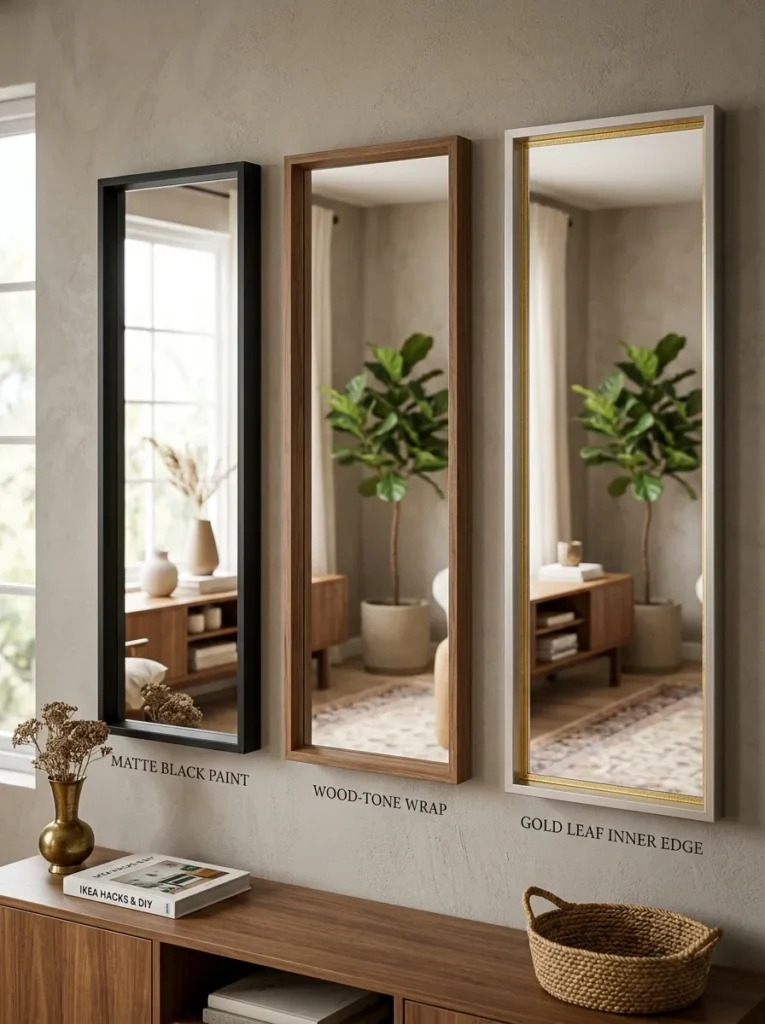
Vibe: The mirror is customized — painting, wrapping, or accenting the HOVET’s standard aluminum frame transforms the mirror from a widely recognized IKEA product into something that reads as specifically chosen and specifically designed for the room it occupies.
Why it works: The HOVET’s standard brushed aluminum frame is neutral enough to work in most design contexts without customization — but in rooms with a specific material palette (warm wood, aged brass, matte black) where the aluminum silver reads as a slightly discordant cool metallic, a simple frame customization creates the material harmony that the standard frame cannot provide. Matte black spray paint (the most dramatic transformation — turns the mirror into a design statement rather than a functional object) requires only tape masking, two coats of spray paint, and a clear topcoat for durability. Wood-tone adhesive contact paper (the warmest transformation — creates the appearance of a wood-framed mirror at a fraction of the cost of an actual wood-framed alternative) requires only careful measuring and application with a squeegee.
How to get it: For matte black frame painting: tape the mirror glass edge with painter’s tape, apply two coats of matte black spray paint formulated for metal surfaces ($6–$10 per can), and finish with a clear matte topcoat for scratch resistance. For wood-tone contact paper: measure the frame’s width and length carefully, cut contact paper ($8–$20 per roll) to exact dimensions, and apply with a squeegee, working out air bubbles toward the edges. For gold tape accent: apply narrow gold adhesive tape ($5–$10 per roll) along the inner frame edge where the frame meets the glass — the thin gold line reads as a detail design decision that references gallery-framed mirrors at significantly higher cost.
Shop The Look
- Matte black spray paint metal surfaces
- Wood grain contact paper adhesive
- Gold adhesive tape narrow detail
- Painter’s tape mirror edge mask
- Clear matte topcoat metal finish
10. Pair with a Warm Floor Lamp for a Styled Vignette
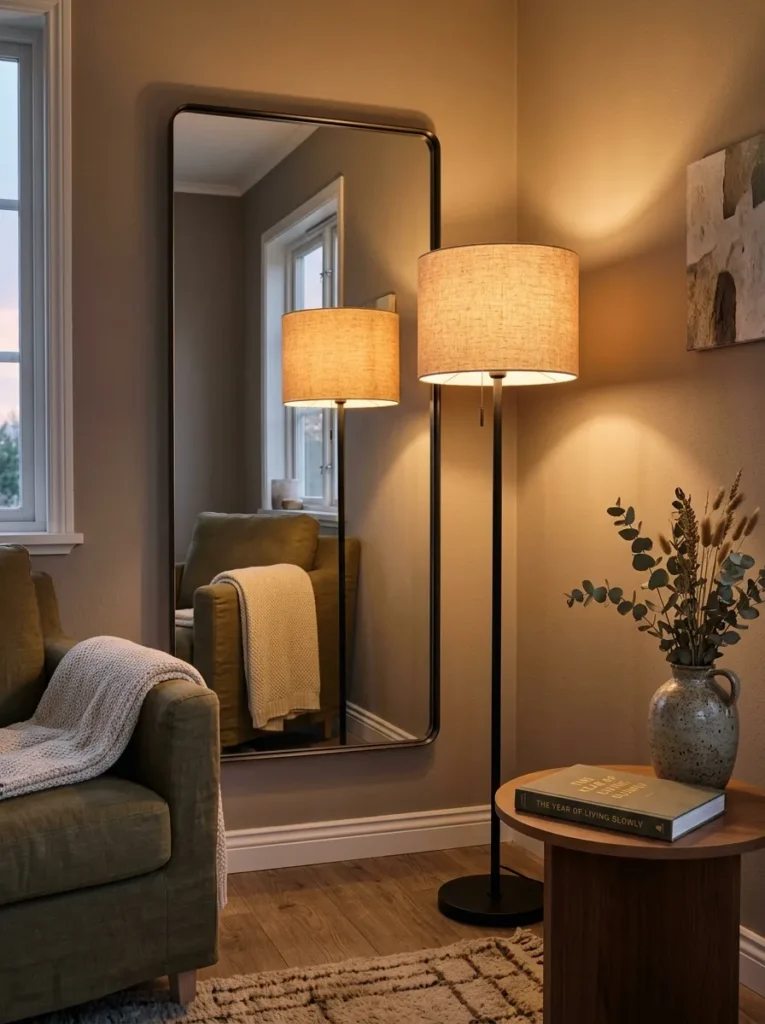
Vibe: The vignette is warm — a floor lamp positioned directly beside the HOVET mirror creates a doubled warm light source in the room through the mirror’s reflection — the lamp appears twice (directly and in the reflection), creating double the warm ambient light contribution of the lamp alone.
Why it works: Positioning a warm floor lamp beside the HOVET mirror exploits the mirror’s light-reflection function at the most intimate scale — rather than reflecting distant window light from across the room, the mirror reflects the warm lamp light from immediately beside it, creating a concentrated zone of warm ambient glow that appears richer and warmer than the same lamp without the mirror. The doubled lamp in the reflection creates the visual impression of a bilaterally lit corner (the lamp from the left and its reflection from the right) that is both more atmospheric and more flattering to the room and its occupants than a single unmirrored lamp source. The small side table completing the vignette (book, ceramic object, lamp) creates a composed vignette at mirror level that is itself reflected and doubled in the mirror’s surface.
How to get it: Position the floor lamp immediately beside the HOVET mirror — within 6–12 inches of the mirror’s edge rather than at a conversational distance. The lamp’s shade should be at a height where its reflected image in the mirror creates bilateral symmetry with the lamp itself — typically with the shade center at approximately 55–60 inches from the floor for standard floor lamp proportions. Use a warm 2700K or 2200K LED bulb in the lamp for the warmest possible reflected light quality — the mirror’s reflection amplifies the color temperature of the reflected light, so cool white lamps appear even cooler in the reflection while warm amber lamps appear even warmer.
Shop The Look
- Floor lamp warm shade natural linen
- Warm LED bulb 2700K floor lamp
- Small round side table beside lamp
- Ceramic object small display table
- Floor lamp position beside mirror
11. Use Behind a Desk or Work Area to Visually Expand a Small Office
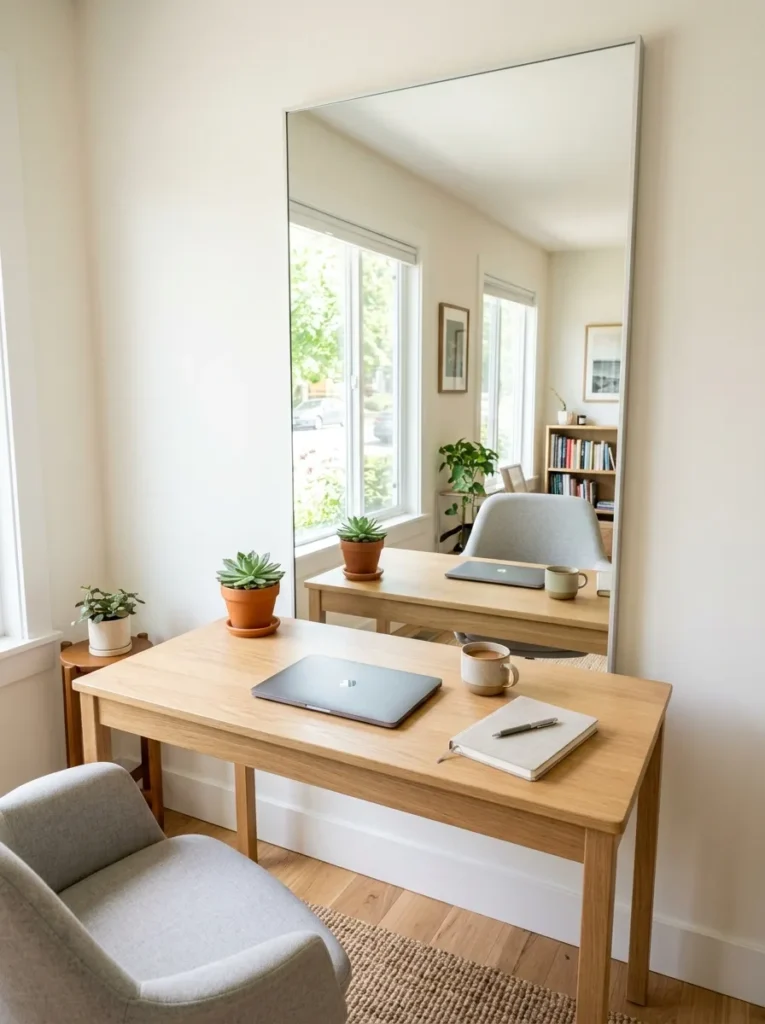
Vibe: The office is expansive — a HOVET mirror behind or beside a compact desk reflects the window and the room beyond the workspace, making a small home office feel significantly more generous and more light-filled than its physical dimensions suggest.
Why it works: A full-length mirror in a small home office serves a specific function that differs from its use in a bedroom or living room — in a workspace, the mirror’s primary function is spatial expansion and light amplification for the person seated at the desk, who spends hours in a fixed position looking at a limited visual field. A mirror that reflects a window or natural light source into the desk zone effectively adds a second perceived window to the workspace — the reflected light from the opposite direction creates the bilateral natural light quality that photographers and designers consistently identify as the most productive and most psychologically comfortable workspace lighting. The reflection also extends the perceived depth of the workspace dramatically — a small office that appears to terminate at the wall behind the desk appears to extend beyond the wall when the HOVET mirror is positioned there.
How to get it: Position the HOVET on the wall directly behind the desk chair’s position (if the room layout allows) or on the wall at the desk’s end, positioned to reflect both the primary natural light source and the room beyond the desk toward the viewer. Ensure the mirror is anchored securely — a mirror positioned behind a desk receives close-proximity daily use and needs secure wall mounting rather than a leaning position that could be disturbed by chair movement. The desk surface will appear in the mirror’s lower portion — keep the desk surface relatively organized, as the doubled reflection emphasizes any desk surface clutter.
Shop The Look
- HOVET mirror home office small
- Compact desk position mirror behind
- Wall mount mirror anchor office
- Desk surface organization minimal
- Natural light workspace reflection
12. Install in a Dark Bathroom for Light and Space
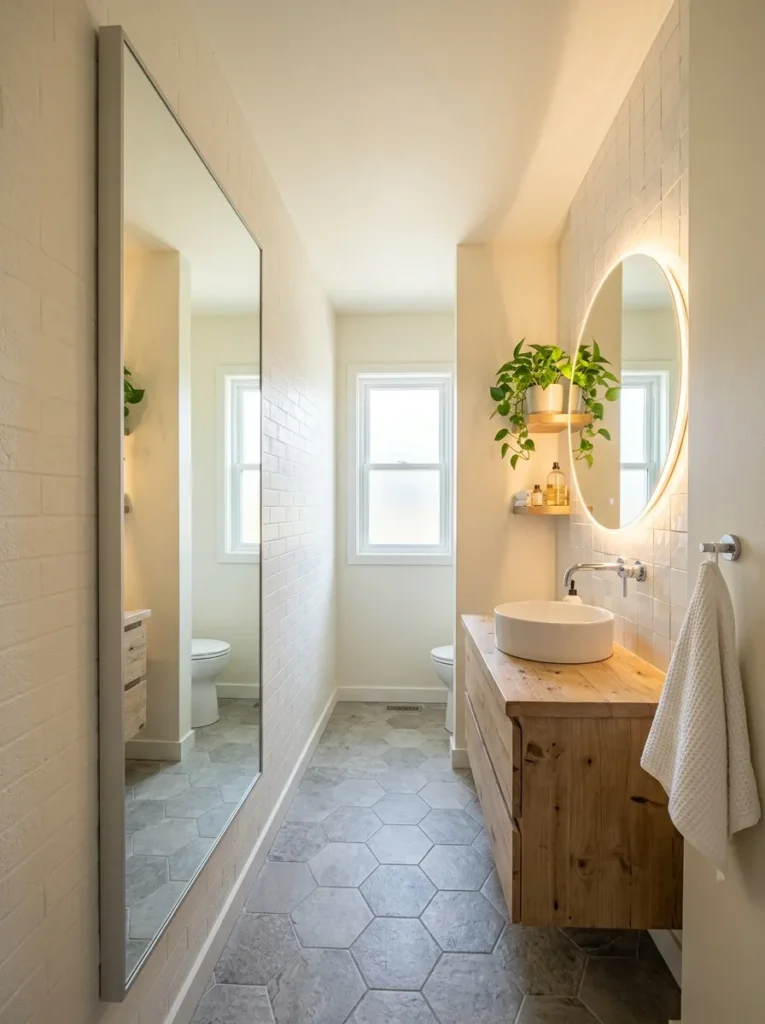
Vibe: The bathroom is spacious — a HOVET mirror on the bathroom’s longest or opposite wall (rather than the standard vanity wall position) reflects the full room and its light sources, making a small or dark bathroom feel dramatically more generous and more luminous.
Why it works: Standard bathroom mirror placement — directly above the vanity, sized to match the vanity width — provides functional vanity use but does little for the bathroom’s spatial quality. Placing the HOVET on a different wall (the opposite wall, the longest side wall, or the wall beside the shower) exploits the mirror’s spatial expansion function rather than only its grooming function — the full-height mirror on an unexpected wall reflects the room’s primary light sources (the window and the vanity lighting) across the bathroom, significantly amplifying the perceived light level, and its full height makes the bathroom appear dramatically taller. In small bathrooms where ceiling height is already limited to 8 feet, a 77-inch mirror (extending nearly to the ceiling) creates the impression of a higher ceiling by anchoring the visual field at nearly the ceiling line.
How to get it: Install the HOVET on the bathroom wall that will create the most impactful light reflection — typically the wall opposite or perpendicular to the primary window or the vanity lighting. Bathroom installation requires moisture-resistant mounting hardware — use stainless steel or zinc-coated anchors rather than standard steel, which can rust in bathroom humidity. Seal the mirror’s back panel edges with a bead of clear silicone caulk to prevent moisture penetration behind the mirror backing. The aluminum frame is naturally moisture-resistant and requires no additional sealing.
Shop The Look
- Stainless steel mirror anchor bathroom
- HOVET bathroom installation moisture
- Clear silicone caulk mirror edge seal
- Bathroom wall mount mirror side wall
- Moisture resistant hanging hardware
13. Create a Gallery Wall Composition with the HOVET as Anchor
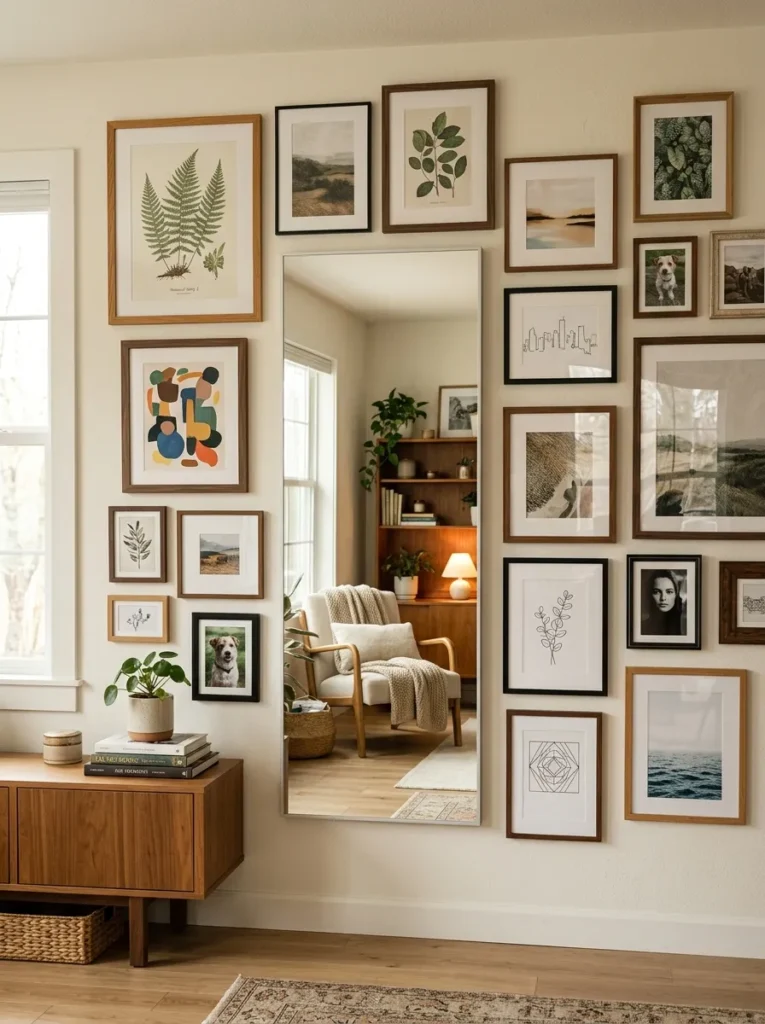
Vibe: The gallery is dynamic — using the HOVET mirror as the anchor piece in a gallery wall composition creates a wall installation with unusual visual depth, where the mirror’s changing reflection (responding to room light and movement) creates a living element among the fixed images of the surrounding artwork.
Why it works: Incorporating a large mirror into a gallery wall composition creates the most visually interesting gallery wall available because the mirror introduces a fundamentally different type of visual information — reflection, which changes with time, light, and viewpoint — among the fixed information of framed artwork. The gallery visitor’s eye alternates between the artwork’s fixed images and the mirror’s reflection, which shows the room behind the viewer from a different perspective and reveals different compositional relationships depending on where the viewer stands. The HOVET’s slim aluminum frame has a visual weight similar to a simple matte black or natural wood picture frame at the same width, making it visually compatible with most gallery wall framing approaches without dominating the composition.
How to get it: Plan the gallery wall composition on the floor before hanging — lay the HOVET (or a same-size cardboard cutout representing the HOVET) as the anchor piece and arrange the framed artwork around it, maintaining consistent 2–3-inch gaps between all elements. Position the HOVET so its center aligns with the gallery’s visual center of gravity (typically at eye level, 57–60 inches from the floor). Ensure the art pieces flanking the mirror do not extend past the mirror’s reflective surface zone where they would appear in the reflection — the reflection should be clear and room-focused rather than showing the edges of adjacent framed pieces.
Shop The Look
- Gallery wall planning kit template
- Art print set botanical gallery
- Natural wood gallery frame set
- Gallery wall art print varied sizes
- Level mirror gallery wall align
14. Secure and Style a Leaning HOVET with a Decorative Base Detail
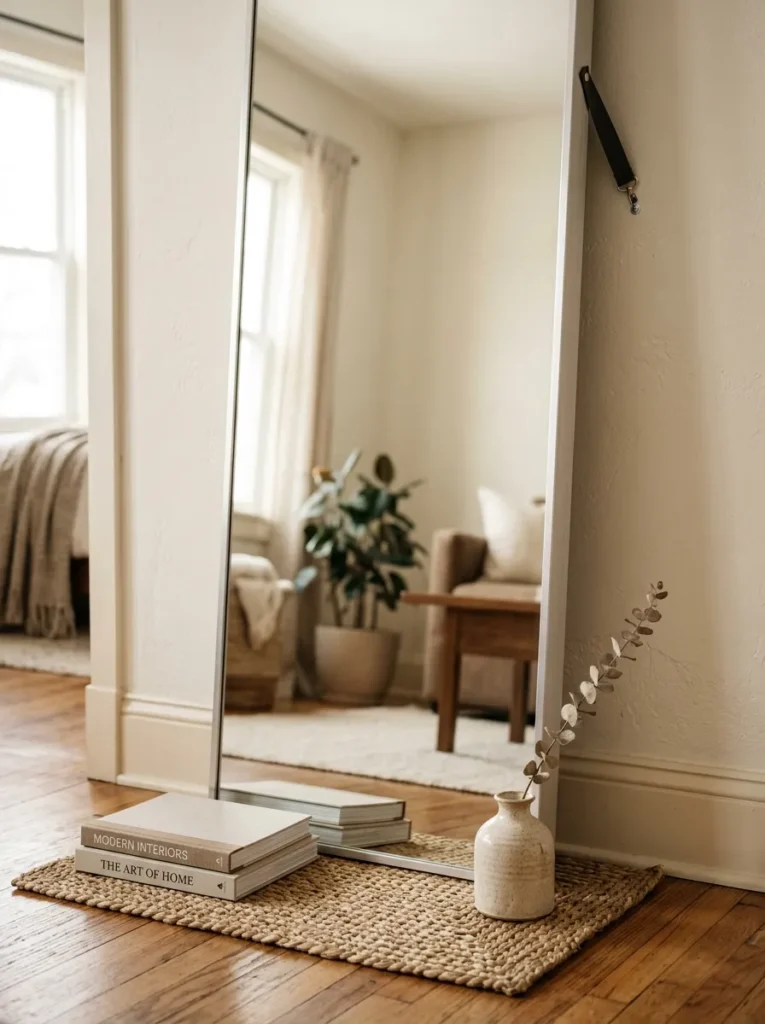
Vibe: The base is intentional — a deliberately styled mirror base composition with a tray, a small ceramic, and an art book stack transforms the functional necessity of a leaning mirror into a designed vignette where every element at the mirror’s base contributes to the room’s compositional quality.
Why it works: A leaning mirror without base styling reads as a mirror that has been placed temporarily and not yet hung — the absence of deliberate base composition communicates incompleteness. A leaning mirror with intentional base styling (a tray that defines the mirror’s floor zone, a small sculptural object or ceramic that provides the low vignette element, and one additional object like a book or small plant that provides the middle vignette height) reads as a design decision — a composed installation that has been placed with intention rather than left as a convenience. The tray is specifically the most important base element because it defines the mirror’s footprint on the floor as a designed zone rather than a random placement, converting the floor area around the mirror’s base into part of the composition rather than simply the space beneath a leaning object.
How to get it: Place a natural wood tray ($20–$40 from home decor retailers) or a woven seagrass mat ($15–$30) at the base of the leaning HOVET, sizing the tray or mat to extend approximately 12 inches on each side of the mirror’s frame. Position two objects within the tray: a ceramic vase with a single dried stem at the mirror’s right side (at floor level, so its reflection in the mirror appears slightly elevated) and a small art book stack at the mirror’s left side (two books maximum — a larger flat book with a smaller book on top). Secure the mirror at its upper third with an anti-tip wall strap ($5–$10) anchored into a wall stud — the strap is visible in the installation but reads as an honest safety element rather than an unsightly addition.
Shop The Look
- Natural wood tray mirror base styling
- Seagrass mat rectangular floor mirror
- Small ceramic vase single stem
- Art book stack display floor mirror
- Anti-tip strap wall anchor safety
How to Get the Most from Your HOVET Mirror
The single most important principle governing all HOVET mirror placement decisions is the concept of intentional reflection — before placing the mirror in any position, standing at the mirror’s proposed location and looking at what the mirror will reflect from the room’s primary viewing positions. A mirror that reflects a beautiful composition (a window, a bookshelf, a quality piece of art, a well-styled console table) increases the room’s visual richness at every moment it is seen. A mirror that reflects a cluttered closet door, an empty wall, or an unattractive room element duplicates the problem rather than solving it. The intentional reflection principle — choosing what the mirror reflects as deliberately as choosing what the mirror itself looks like — is the design intelligence that separates a professionally placed mirror from a functionally placed one.
The most common HOVET placement mistake is positioning the mirror where it is most convenient rather than where it is most effective — typically in the room’s corner because it is out of the way, or behind a door because it provides privacy during use. Both corner placement and behind-door placement minimize the mirror’s spatial expansion function: a corner mirror reflects only a narrow slice of the room (the corner itself), and a behind-door mirror is visible only when the door is closed and contributes nothing to the room’s spatial quality during the majority of the time when the door is open. The most effective HOVET positions are on the room’s primary walls (the walls that define the room’s spatial character) where the mirror can reflect the room’s full depth or its primary light source.
Three HOVET improvements under $30 that create immediate visual impact: adding a natural wood tray ($20–$35) at the mirror’s base that transforms an unresolved leaning mirror into a designed vignette; applying narrow gold adhesive tape ($5–$10) along the frame’s inner edge that upgrades the standard aluminum aesthetic to something more designer-referencing; and repositioning the mirror from its current wall to the wall perpendicular to the room’s primary window ($0 — a 10-minute reposition that can dramatically improve the room’s light quality) to maximize its light reflection function.
A complete HOVET mirror installation — wall-mounted in the optimal position for light reflection, styled with botanical companion elements, secured with appropriate anti-tip hardware, and designed with deliberate base or side vignette composition — is achievable in one afternoon at a total additional cost of $20–$80 beyond the mirror’s own purchase price. The HOVET mirror at $149 delivers spatial and light quality improvements to any room it occupies that would cost $400–$1,200 from alternative full-length mirrors of comparable reflective quality and proportional elegance — making it one of the most consistently high-value interior design purchases available at any residential budget level.
Frequently Asked Questions About the IKEA HOVET Mirror
Should I mount the HOVET on the wall or lean it?
Both mounting options are genuinely appropriate for the HOVET, and the choice depends on the specific room context and the owner’s priorities rather than a single correct answer. Wall mounting provides the most secure installation, the most precise placement control, and the most architectural appearance — a wall-mounted mirror reads as a permanent room element with the same visual weight as a built-in feature. Leaning provides more flexibility (the mirror can be repositioned without wall repair), a more casual aesthetic that is appropriate in some bedroom and living room contexts, and the ability to create the styled base vignette that a mounted mirror cannot accommodate. The HOVET’s weight (approximately 26 pounds) and height (77 inches) make it most safely secured against the wall regardless of whether it is mounted — a leaning HOVET should always be secured with an anti-tip wall strap anchored into a stud, especially in homes with children or pets.
How do I hang the HOVET mirror safely on the wall?
The HOVET includes two hanging brackets and the necessary screws for standard wall installation. The critical safety requirement is anchoring both hanging brackets into wall studs rather than into drywall alone — the mirror’s 26-pound weight at its 77-inch height creates a significant leverage force on the anchoring points that drywall anchors cannot reliably sustain over time. Locate the wall studs with a stud finder ($10–$25), position the hanging brackets to align with stud locations (adjusting the mirror’s horizontal position if necessary to achieve stud alignment), and drive the provided screws through the brackets into the studs. If stud alignment is not possible at the desired horizontal position, use toggle bolt anchors rated for at least 50 pounds (double the mirror’s actual weight for the appropriate safety margin) rather than standard drywall anchors.
Can the HOVET mirror be installed in a bathroom?
Yes, the HOVET can be installed in a bathroom with appropriate moisture-resistant mounting hardware. The aluminum frame is inherently moisture-resistant and will not rust, corrode, or warp in bathroom humidity. The mirror’s hanging hardware (the brackets and screws provided with the mirror) should be replaced with stainless steel or zinc-coated equivalents for bathroom installation, as the provided hardware is not specifically moisture-rated. Seal the mirror’s back panel perimeter with a thin bead of clear silicone to prevent moisture from entering behind the backing, which can cause the mirror’s reflective coating to develop dark spots over time. The HOVET is not recommended for installation directly in a shower or wet zone — proximity to direct water spray will compromise both the mirror and its mounting hardware regardless of the materials used.
How far should the HOVET mirror be from the floor when leaning?
A leaning HOVET mirror’s base should rest on the floor with the mirror frame’s bottom edge at floor level (or on a thin tray or mat of no more than 1–2 inches elevation). The mirror is designed for floor-leaning use and its proportions (with the bottom of the reflective surface at approximately 6 inches from the floor) are calibrated to provide a full-length reflection for a standing viewer at the standard 3–6 foot viewing distance when the mirror base is at floor level. Elevating the mirror base on a furniture piece (a dresser, a console table) raises the reflective field and eliminates the floor-level portion of the full-length reflection, which reduces the mirror’s function as a complete head-to-toe view mirror. If the installation context requires the mirror to be elevated, specify the elevation when purchasing to ensure the reflective field remains appropriate for full-length viewing at the intended distance.
What are the best rooms for a HOVET mirror in a small apartment?
In a small apartment, the HOVET mirror provides the greatest spatial benefit in the rooms and positions where its light reflection and spatial expansion functions most directly address the apartment’s most significant spatial limitations. In order of typically highest impact: a narrow hallway (the full-length mirror at the hallway terminus creates the most dramatic spatial expansion available in apartment design at any price point); a small bedroom (where the full-length mirror doubles the perceived room depth and provides the dressing function that small bedrooms particularly benefit from); a dark living room or sitting area (where the perpendicular-to-window positioning maximizes reflected natural light in the room most used for daytime living); and a small bathroom (where the unexpected wall position creates both height and depth expansion in the apartment’s smallest room). Small apartments specifically benefit from the HOVET’s full-height proportion — shorter mirrors in small spaces create a visual interruption at mid-wall height that makes ceilings feel lower, while the HOVET’s 77-inch height anchors the visual field at near-ceiling level and creates the impression of greater ceiling height.
Ready to Transform Your Room with the HOVET Mirror?
These 14 tips cover the full range of what the IKEA HOVET mirror can achieve — from the light-maximizing intelligence of perpendicular window positioning and the spatial magic of a hallway terminus installation, to the domestic warmth of a botanical vignette styling and the functional completeness of a bilateral-lit dressing station, from the dramatic impact of a two-mirror side-by-side wall installation and the unexpected architectural quality of a horizontal orientation, to the creative customization of a painted or wrapped frame and the composed elegance of a deliberately styled leaning base. You do not need all 14 to transform your room with the HOVET mirror — you need the one correct placement decision (where will this mirror reflect the most light, double the most space, or capture the most beautiful reflection?) and the one or two styling decisions that integrate the mirror into the room’s existing material composition. Start with the repositioning: move the mirror to the wall perpendicular to your primary window, secure it, and spend a day experiencing what the changed light reflection does to the room. The most impactful mirror tip is almost always the placement tip, and the placement tip almost always costs nothing. Pin the ideas that made you look at your room’s walls differently — those are the ones worth implementing first.